Infrared signals can be used for short range communication in a closed area using ________ propagation.
a.
Ground
b.
Sky
c.
Line of sight
Correct Answer
d.
Space
Step-by-Step AI Explanation
Verified Method
Infrared signals have high frequencies and cannot penetrate walls. They propagate via line-of-sight propagation, meaning the transmitter and receiver must have an unobstructed straight line between them or reflect off surfaces within a closed area.
Q1mcq
Beam-penetration and shadow-mask are the two basic techniques for producing color displays with a CRT. Which of the following is not true ? I. The beam-penetration is used with random scan monitors. II. Shadow-mask is used in rasterscan systems. III. Beam-penetration method is better than shadow-mask method. IV. Shadow-mask method is better than beam-penetration method.
a.
I and II
b.
II and III
c.
III only
Correct Answer
d.
IV only
Step-by-Step AI Explanation
Verified Method
Statement I is true (beam-penetration is used with random-scan displays). Statement II is true (shadow-mask is primarily used in raster-scan systems). Statement IV is true because shadow-mask can display millions of colors and has realistic image reproduction, whereas beam-penetration can only display a few colors (typically four: red, green, orange, yellow). Therefore, Statement III is false, making 'III only' the correct option.
Q2mcq
A bridge has access to ________ address in the same network.
a.
Physical
Correct Answer
b.
Network
c.
Datalink
d.
Application
Step-by-Step AI Explanation
Verified Method
A bridge is a Data Link layer (Layer 2) device that uses physical (MAC) addresses to filter and forward frames between network segments.
Q2mcq
Line caps are used for adjusting the shape of the line ends to give them a better appearance. Various kinds of line caps used are
a.
Butt cap and sharp cap
b.
Butt cap and round cap
c.
Butt cap, sharp cap and round cap
d.
Butt cap, round cap and projecting square cap
Correct Answer
Step-by-Step AI Explanation
Verified Method
In computer graphics, standard line-capping options for thick lines include butt caps, round caps, and projecting square caps (extended square caps).
Q3mcq
The minimum frame length for 10 Mbps Ethernet is ________ bytes and maximum is ________ bytes.
a.
64 & 128
b.
128 & 1518
c.
1518 & 3036
d.
64 & 1518
Correct Answer
Step-by-Step AI Explanation
Verified Method
According to IEEE 802.3 Ethernet standards, the minimum frame length is 64 bytes (to ensure collision detection in CSMA/CD) and the maximum standard frame length is 1518 bytes.
Q3mcq
Given below are certain output primitives and their associated attributes. Match each primitive with its corresponding attributes : List – I: A. Line, B. Fill Area, C. Text, D. Marker; List – II: i. Type, Size, Color, ii. Color, Size, Font, iii. Style, Color, Pattern, iv. Type, Width, Color
a.
A - i, B - ii, C - iii, D - iv
b.
A - ii, B - i, C - iii, D - iv
c.
A - iv, B - iii, C - ii, D - i
Correct Answer
d.
A - iii, B - i, C - iv, D - ii
Step-by-Step AI Explanation
Verified Method
Matching the primitives with their attributes:
- A. Line: Type, Width, Color (iv)
- B. Fill Area: Style, Color, Pattern (iii)
- C. Text: Color, Size, Font (ii)
- D. Marker: Type, Size, Color (i)
Thus, the correct matching is A - iv, B - iii, C - ii, D - i.
Q4mcq
The bit rate of a signal is 3000 bps. If each signal unit carries 6 bits, the baud rate of the signal is ________.
a.
500 baud/sec
Correct Answer
b.
1000 baud/sec
c.
3000 baud/sec
d.
18000 baud/sec
Step-by-Step AI Explanation
Verified Method
The relationship between baud rate and bit rate is given by:
$$\text{Baud rate} = \frac{\text{Bit rate}}{\text{Bits per signal unit}} = \frac{3000}{6} = 500\text{ baud/sec}.$$
Q4mcq
Consider a window bounded by the lines : $x = 0; y = 0; x = 5$ and $y = 3$. The line segment joining $(-1, 0)$ and $(4, 5)$, if against this window will connect the points
a.
$(0, 1)$ and $(2, 3)$
Correct Answer
b.
$(0, 1)$ and $(3, 3)$
c.
$(0, 1)$ and $(4, 3)$
d.
$(0, 1)$ and $(3, 2)$
Step-by-Step AI Explanation
Verified Method
The line passes through $(-1, 0)$ and $(4, 5)$.
Slope $m = \frac{5 - 0}{4 - (-1)} = \frac{5}{5} = 1$.
The equation of the line is $y - 0 = 1 \cdot (x - (-1)) \implies y = x + 1$.
The clipping window is defined by $0 \le x \le 5$ and $0 \le y \le 3$.
1. Left boundary ($x = 0$): $y = 0 + 1 = 1$. The point $(0, 1)$ lies on the boundary ($0 \le 1 \le 3$), so it is an intersection point.
2. Top boundary ($y = 3$): $3 = x + 1 \implies x = 2$. The point $(2, 3)$ lies on the boundary ($0 \le 2 \le 5$), so it is the other intersection point.
Thus, the clipped line segment connects $(0, 1)$ and $(2, 3)$.
Q5mcq
Match the following :
**List – I**
A. Physical layer
B. Datalink layer
C. Network layer
D. Transport layer
E. Application
**List – II**
i. Allow resources to network access
ii. Move packets from one destination to other
iii. Process to process message delivery
iv. Transmission of bit stream
v. Formation of frames
a.
A-iv, B-v, C-ii, D-iii, E-i
Correct Answer
b.
A-v, B-iv, C-i, D-ii, E-iii
c.
A-i, B-iii, C-ii, D-v, E-iv
d.
A-i, B-ii, C-iv, D-iii, E-v
Step-by-Step AI Explanation
Verified Method
Matching the OSI/TCP-IP layers to their key responsibilities:
- **Physical layer (A)** deals with the **transmission of raw bit stream** over a physical medium $\rightarrow$ **iv**.
- **Data link layer (B)** handles **formation of frames**, error control, and flow control $\rightarrow$ **v**.
- **Network layer (C)** is responsible for packet delivery, i.e., to **move packets from one destination to another** $\rightarrow$ **ii**.
- **Transport layer (D)** provides **process-to-process message delivery** $\rightarrow$ **iii**.
- **Application layer (E)** provides interface/protocols to **allow resources to network access** $\rightarrow$ **i**.
Thus, the correct mapping is A-iv, B-v, C-ii, D-iii, E-i.
Q5mcq
Which of the following color models are defined with three primary colors ?
a.
RGB and HSV color models
b.
CMY and HSV color models
c.
HSV and HLS color models
d.
RGB and CMY color models
Correct Answer
Step-by-Step AI Explanation
Verified Method
The RGB model is based on three additive primary colors: Red, Green, and Blue. The CMY model is based on three subtractive primary colors: Cyan, Magenta, and Yellow. HSV and HLS, on the other hand, are defined in terms of Hue, Saturation, and Value/Lightness, which are perceptual color attributes rather than three primary colors. Therefore, the RGB and CMY color models are defined with three primary colors.
🎉 10 Free Sample Solutions Completed
Unlock All 118 Questions & Solutions
Sign up free in seconds to unlock step-by-step AI answers for the remaining 108 questions.
A grammar G is LL(1) if and only if the following conditions hold for two distinct productions $A \rightarrow \alpha \mid \beta$
I. $\text{First } (\alpha) \cap \text{First } (\beta) \neq (\text{a})$ where a is some terminal symbol of the grammar.
II. $\text{First } (\alpha) \cap \text{First } (\beta) \neq \lambda$
III. $\text{First } (\alpha) \cap \text{Follow } (A) = \phi$ if $\lambda \in \text{First } (\beta)$
a.
I and II
b.
I and III
c.
II and III
d.
I, II and III
Correct Answer & Step-by-Step Solution Locked
Sign in free to reveal the correct answer and AI explanation for this question.
In a digital transmission, the receiver clock is $0.1$ percent faster than the sender clock. How many extra bits per second does the receiver receive if the data rate is $1\text{ Mbps}$ ?
a.
$10\text{ bps}$
b.
$100\text{ bps}$
c.
$1000\text{ bps}$
d.
$10000\text{ bps}$
Correct Answer & Step-by-Step Solution Locked
Sign in free to reveal the correct answer and AI explanation for this question.
Consider a fuzzy set old as defined below: $\text{Old} = \{(20, 0.1), (30, 0.2), (40, 0.4), (50, 0.6), (60, 0.8), (70, 1), (80, 1)\}$. Then the alpha-cut for $\text{alpha} = 0.4$ for the set old will be
The regular grammar for the language $L = \{n_a(w) \text{ and } n_b(w) \text{ are both even}, w \in \{a, b\}^*\}$ is given by :
(Assume p, q, r and s states)
a.
$p \to aq \mid br \mid \lambda$, $q \to bs \mid ap$
$r \to as \mid bp$, $s \to ar \mid bq$, p and s are initial and final states.
b.
$p \to aq \mid br$, $q \to bs \mid ap$
$r \to as \mid bp$, $s \to ar \mid bq$, p and s are initial and final states.
c.
$p \to aq \mid br \mid \lambda$, $q \to bs \mid ap$
$r \to as \mid bp$, $s \to ar \mid bq$
p is both initial and final states.
d.
$p \to aq \mid br$, $q \to bs \mid ap$
$r \to as \mid bp$, $s \to ar \mid bq$
p is both initial and final states.
Correct Answer & Step-by-Step Solution Locked
Sign in free to reveal the correct answer and AI explanation for this question.
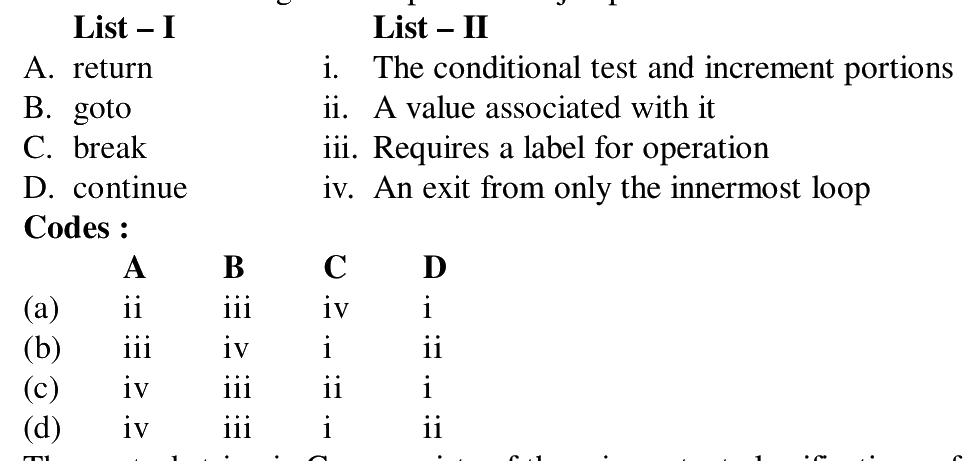
Match the following with respect to the jump statements :
\begin{tabular}{ll}
\textbf{List -- I} & \textbf{List -- II} \\
A. return & i. The conditional test and increment portions \\
B. goto & ii. A value associated with it \\
C. break & iii. Requires a label for operation \\
D. continue & iv. An exit from only the innermost loop
\end{tabular}
a.
A - ii, B - iii, C - iv, D - i
b.
A - iii, B - iv, C - i, D - ii
c.
A - iv, B - iii, C - ii, D - i
d.
A - iv, B - iii, C - i, D - ii
Correct Answer & Step-by-Step Solution Locked
Sign in free to reveal the correct answer and AI explanation for this question.
______ of a system is the structure or structures of the system which comprise software elements, the externally visible properties of these elements and the relationship amongst them.
a.
Software construction
b.
Software evolution
c.
Software architecture
d.
Software reuse
Correct Answer & Step-by-Step Solution Locked
Sign in free to reveal the correct answer and AI explanation for this question.
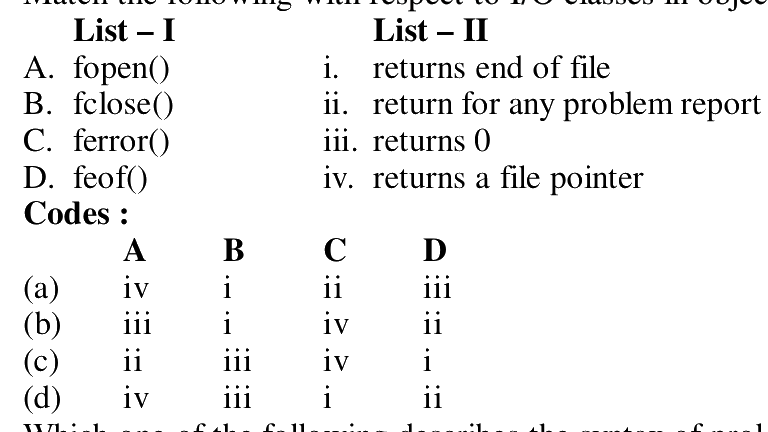
Match the following with respect to I/O classes in object oriented programming :
\begin{tabular}{ll}
\textbf{List -- I} & \textbf{List -- II} \\
A. fopen() & i. returns end of file \\
B. fclose() & ii. return for any problem report \\
C. ferror() & iii. returns 0 \\
D. feof() & iv. returns a file pointer
\end{tabular}
a.
A - iv, B - i, C - ii, D - iii
b.
A - iii, B - i, C - iv, D - ii
c.
A - ii, B - iii, C - iv, D - i
d.
A - iv, B - iii, C - i, D - ii
Correct Answer & Step-by-Step Solution Locked
Sign in free to reveal the correct answer and AI explanation for this question.
Which one of the following describes the syntax of prolog program ?
I. Rules and facts are terminated by full stop (.)
II. Rules and facts are terminated by (;)
III. Variables names must start with upper case alphabets.
IV. Variables names must start with lower case alphabets.
a.
I, II
b.
III, IV
c.
I, III
d.
II, IV
Correct Answer & Step-by-Step Solution Locked
Sign in free to reveal the correct answer and AI explanation for this question.
A Boolean function $\text{F}$ is called self-dual if and only if
$$\text{F}(x_1, x_2, \dots x_n) = \overline{\text{F}}(\overline{x_1}, \overline{x_2}, \dots \overline{x_n})$$
How many Boolean functions of degree $n$ are self-dual ?
a.
$2^n$
b.
$(2)^{2^n}$
c.
$(2)^{n^2}$
d.
$(2)^{2^{n-1}}$
Correct Answer & Step-by-Step Solution Locked
Sign in free to reveal the correct answer and AI explanation for this question.
Which of the following statement(s) is (are) not correct ?
(i) The 2's complement of 0 is 0.
(ii) In 2's complement, the left most bit cannot be used to express a quantity.
(iii) For an n-bit word (2's complement) which includes the sign bit, there are $2^{n+1}$ negative integers and one 0 for a total of $2^n$ unique states.
(iv) In 2's complement the significant information is contained in the 1's of positive numbers and 0's of the negative numbers.
a.
i and iv
b.
i and ii
c.
iii
d.
iv
Correct Answer & Step-by-Step Solution Locked
Sign in free to reveal the correct answer and AI explanation for this question.
The notation $\exists !x \text{P}(x)$ denotes the proposition "there exists a unique $x$ such that $\text{P}(x)$ is true".
Give the truth values of the following statements :
I $\exists !x \text{P}(x) \rightarrow \exists x \text{P}(x)$
II $\exists !x \neg \text{P}(x) \rightarrow \neg \forall x \text{P}(x)$
a.
Both I & II are true
b.
Both I & II are false
c.
I – false, II – true
d.
I – true, II – false
Correct Answer & Step-by-Step Solution Locked
Sign in free to reveal the correct answer and AI explanation for this question.
Give a compound proposition involving propositions $\text{p}$, $\text{q}$ and $\text{r}$ that is true when exactly two of $\text{p}$, $\text{q}$ and $\text{r}$ are true and is false otherwise.
Consider the following relational schemas for a library database :
Book (Title, Author, Catalog_no, Publisher, Year, Price)
Collection (Title, Author, Catalog_no) with the following functional dependencies :
I. $\text{Title, Author} \rightarrow \text{Catalog\_no}$
II. $\text{Catalog\_no} \rightarrow \text{Title, Author, Publisher, Year}$
III. $\text{Publisher, Title, Year} \rightarrow \text{Price}$
Assume (Author, Title) is the key for both schemas. Which one of the following is true ?
a.
Both Book and Collection are in BCNF.
b.
Both Book and Collection are in 3NF.
c.
Book is in 2NF and Collection in 3NF.
d.
Both Book and Collection are in 2NF.
Correct Answer & Step-by-Step Solution Locked
Sign in free to reveal the correct answer and AI explanation for this question.
Consider a complete bipartite graph $\text{k}_{\text{m,n}}$. For which values of $\text{m}$ and $\text{n}$ does this, complete graph have a Hamiltonian circuit
a.
$\text{m} = 3, \text{n} = 2$
b.
$\text{m} = 2, \text{n} = 3$
c.
$\text{m} = \text{n} \ge 2$
d.
$\text{m} = \text{n} \ge 3$
Correct Answer & Step-by-Step Solution Locked
Sign in free to reveal the correct answer and AI explanation for this question.
Match the following :
List – I
A. Timeout ordering protocol
B. Deadlock prevention
C. Deadlock detection
D. Deadlock recovery
List – II
i. Wait for graph
ii. Roll back
iii. Wait-die scheme
iv. Thomas Write Rule
a.
A-iv, B-iii, C-i, D-ii
b.
A-iii, B-ii, C-iv, D-i
c.
A-ii, B-i, C-iv, D-iii
d.
A-iii, B-i, C-iv, D-iii
Correct Answer & Step-by-Step Solution Locked
Sign in free to reveal the correct answer and AI explanation for this question.
How many cards must be chosen from a deck to guarantee that atleast
(i) two aces of two kinds are chosen.
(ii) two aces are chosen.
(iii) two cards of the same kind are chosen.
(iv) two cards of two different kinds are chosen.
a.
$50, 50, 14, 5$
b.
$51, 51, 15, 7$
c.
$52, 52, 14, 5$
d.
$51, 51, 14, 5$
Correct Answer & Step-by-Step Solution Locked
Sign in free to reveal the correct answer and AI explanation for this question.
Consider the schema
$\text{R} = \{\text{S, T, U, V}\}$
and the dependencies
$\text{S} \rightarrow \text{T}$, $\text{T} \rightarrow \text{U}$, $\text{U} \rightarrow \text{V}$ and $\text{V} \rightarrow \text{S}$
If $\text{R} = (\text{R}_1 \text{ and } \text{R}_2)$ be a decomposition such that $\text{R}_1 \cap \text{R}_2 = \phi$ then the decomposition is
a.
not in 2NF
b.
in 2NF but not in 3NF
c.
in 3NF but not in 2NF
d.
in both 2NF and 3NF
Correct Answer & Step-by-Step Solution Locked
Sign in free to reveal the correct answer and AI explanation for this question.
Match the following with respect to the mobile computing technologies :
**List – I**
A. GPRS
B. GSM
C. UMTS
D. EDGE
**List – II**
i. An integrated digital radio standard
ii. 3G wireless/ Mobile technology
iii. Nine different schemes for modulation and error correction
iv. An emerging wireless service that offers a mobile data
**Codes :**
$\begin{matrix} & \text{A} & \text{B} & \text{C} & \text{D} \\ \text{(a)} & \text{iii} & \text{iv} & \text{ii} & \text{i} \\ \text{(b)} & \text{iv} & \text{i} & \text{ii} & \text{iii} \\ \text{(c)} & \text{ii} & \text{iii} & \text{iv} & \text{i} \\ \text{(d)} & \text{ii} & \text{i} & \text{iv} & \text{iii} \end{matrix}$
a.
A-iii, B-iv, C-ii, D-i
b.
A-iv, B-i, C-ii, D-iii
c.
A-ii, B-iii, C-iv, D-i
d.
A-ii, B-i, C-iv, D-iii
Correct Answer & Step-by-Step Solution Locked
Sign in free to reveal the correct answer and AI explanation for this question.
Object Request Broker (ORB) is
**I** A software program that runs on the client as well as on the application server.
**II** A software program that runs on the client side only.
**III** A software program that runs on the application server, where most of the components reside.
a.
I, II and III
b.
I and II
c.
II and III
d.
I only
Correct Answer & Step-by-Step Solution Locked
Sign in free to reveal the correct answer and AI explanation for this question.
Which one of the following concurrency protocol ensures both conflict serializability and freedom from deadlock :
I. 2-phase locking
II. Time phase ordering
a.
Both I & II
b.
II only
c.
I only
d.
Neither I nor II
Correct Answer & Step-by-Step Solution Locked
Sign in free to reveal the correct answer and AI explanation for this question.
A software agent is defined as
**I** A software developed for accomplishing a given task.
**II** A computer program which is capable of acting on behalf of the user in order to accomplish a given computational task.
**III** An open source software for accomplishing a given task.
a.
I
b.
II
c.
III
d.
All of the above
Correct Answer & Step-by-Step Solution Locked
Sign in free to reveal the correct answer and AI explanation for this question.
Match the following :
List – I
A. Expert systems
B. Planning
C. Prolog
D. Natural language processing
List – II
i. Pragmatics
ii. Resolution
iii. Means-end analysis
iv. Explanation facility Codes :
a.
A - iii, B - iv, C - i, D - ii
b.
A - iii, B - iv, C - ii, D - i
c.
A - i, B - ii, C - iii, D - iv
d.
A - iv, B - iii, C - ii, D - i
Correct Answer & Step-by-Step Solution Locked
Sign in free to reveal the correct answer and AI explanation for this question.
Match the following :
**List – I**
A. Classification
B. Clustering
C. Feature Extraction
D. Feature Selection
**List – II**
i. Principal component analysis
ii. Branch and Bound
iii. K-nearest neighbour
iv. K-means Codes :
a.
A - iii, B - iv, C - ii, D - i
b.
A - iv, B - iii, C - i, D - ii
c.
A - iii, B - iv, C - i, D - ii
d.
A - iv, B - iii, C - ii, D - i
Correct Answer & Step-by-Step Solution Locked
Sign in free to reveal the correct answer and AI explanation for this question.
In a paged memory management algorithm, the hit ratio is $70\%$. If it takes $30\text{ nanoseconds}$ to search Translation Look-aside Buffer (TLB) and $100\text{ nanoseconds (ns)}$ to access memory, the effective memory access time is
a.
$91\text{ ns}$
b.
$69\text{ ns}$
c.
$200\text{ ns}$
d.
$160\text{ ns}$
Correct Answer & Step-by-Step Solution Locked
Sign in free to reveal the correct answer and AI explanation for this question.
Consider $f(N) = g(N) + h(N)$
Where function $g$ is a measure of the cost of getting from the start node to the current node $N$ and $h$ is an estimate of additional cost of getting from the current node $N$ to the goal node. Then $f(N) = h(N)$ is used in which one of the following algorithms ?
a.
A* algorithm
b.
AO* algorithm
c.
Greedy best first search algorithm
d.
Iterative A* algorithm
Correct Answer & Step-by-Step Solution Locked
Sign in free to reveal the correct answer and AI explanation for this question.
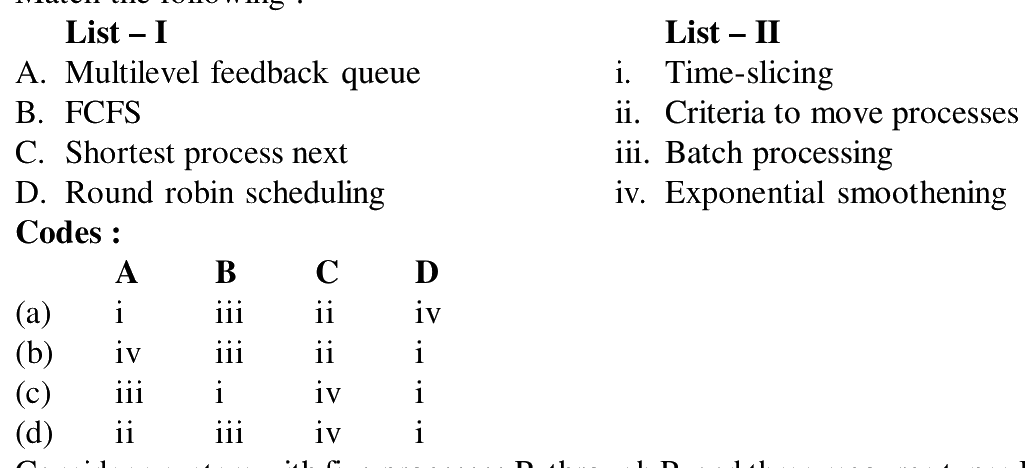
Match the following :
\begin{tabular}{ll}
\textbf{List -- I} & \textbf{List -- II} \\
A. Multilevel feedback queue & i. Time-slicing \\
B. FCFS & ii. Criteria to move processes between queues \\
C. Shortest process next & iii. Batch processing \\
D. Round robin scheduling & iv. Exponential smoothening
\end{tabular}
a.
A - i, B - iii, C - ii, D - iv
b.
A - iv, B - iii, C - ii, D - i
c.
A - iii, B - i, C - iv, D - i
d.
A - ii, B - iii, C - iv, D - i
Correct Answer & Step-by-Step Solution Locked
Sign in free to reveal the correct answer and AI explanation for this question.
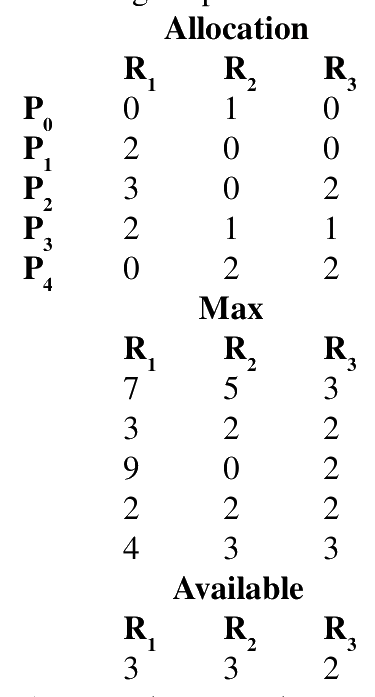
Consider a system with five processes $\text{P}_0$ through $\text{P}_4$ and three resource types $\text{R}_1$, $\text{R}_2$ and $\text{R}_3$. Resource type $\text{R}_1$ has 10 instances, $\text{R}_2$ has 5 instances and $\text{R}_3$ has 7 instances. Suppose that at time $\text{T}_0$, the following snapshot of the system has been taken :
\begin{tabular}{cccc}
& \multicolumn{3}{c}{\textbf{Allocation}} \\
& $\text{R}_1$ & $\text{R}_2$ & $\text{R}_3$ \\
$\text{P}_0$ & 0 & 1 & 0 \\
$\text{P}_1$ & 2 & 0 & 0 \\
$\text{P}_2$ & 3 & 0 & 2 \\
$\text{P}_3$ & 2 & 1 & 1 \\
$\text{P}_4$ & 0 & 2 & 2 \\
& \multicolumn{3}{c}{\textbf{Max}} \\
& $\text{R}_1$ & $\text{R}_2$ & $\text{R}_3$ \\
& 7 & 5 & 3 \\
& 3 & 2 & 2 \\
& 9 & 0 & 2 \\
& 2 & 2 & 2 \\
& 4 & 3 & 3 \\
& \multicolumn{3}{c}{\textbf{Available}} \\
& $\text{R}_1$ & $\text{R}_2$ & $\text{R}_3$ \\
& 3 & 3 & 2
\end{tabular}
Assume that now the process $\text{P}_1$ requests one additional instance of type $\text{R}_1$ and two instances of resource type $\text{R}_3$. The state resulting after this allocation will be
a.
Ready state
b.
Safe state
c.
Blocked state
d.
Unsafe state
Correct Answer & Step-by-Step Solution Locked
Sign in free to reveal the correct answer and AI explanation for this question.
Match the following :
**List – I**
A. Contiguous allocation
B. Linked allocation
C. Indexed allocation
D. Multi-level indexed
**List – II**
i. This scheme supports very large file sizes.
ii. This allocation technique supports only sequential files.
iii. Number of disks required to access file is minimal.
iv. This technique suffers from maximum wastage of space in storing pointers
a.
A - iii, B - iv, C - ii, D - i
b.
A - iii, B - ii, C - iv, D - i
c.
A - i, B - ii, C - iv, D - iii
d.
A - i, B - iv, C - ii, D - iii
Correct Answer & Step-by-Step Solution Locked
Sign in free to reveal the correct answer and AI explanation for this question.
Consider a uniprocessor system where new processes arrive at an average of five processes per minute and each process needs an average of 6 seconds of service time. What will be the CPU utilization ?
a.
80%
b.
50%
c.
60%
d.
30%
Correct Answer & Step-by-Step Solution Locked
Sign in free to reveal the correct answer and AI explanation for this question.
Consider a program that consists of 8 pages (from 0 to 7) and we have 4 page frames in the physical memory for the pages. The page reference string is :
$1\ 2\ 3\ 2\ 5\ 6\ 3\ 4\ 6\ 3\ 7\ 3\ 1\ 5\ 3\ 6\ 3\ 4\ 2\ 4\ 3\ 4\ 5\ 1$
The number of page faults in LRU and optimal page replacement algorithms are respectively (without including initial page faults to fill available page frames with pages) :
a.
9 and 6
b.
10 and 7
c.
9 and 7
d.
10 and 6
Correct Answer & Step-by-Step Solution Locked
Sign in free to reveal the correct answer and AI explanation for this question.
A text is made up of the characters $\alpha$, $\beta$, $\gamma$, $\delta$ and $\sigma$ with the probability $0.12$, $0.40$, $0.15$, $0.08$ and $0.25$ respectively. The optimal coding technique will have the average length of
a.
$1.7$
b.
$2.15$
c.
$3.4$
d.
$3.8$
Correct Answer & Step-by-Step Solution Locked
Sign in free to reveal the correct answer and AI explanation for this question.
An algorithm is made up of 2 modulus $\text{M}_1$ and $\text{M}_2$. If time complexity of modulus $\text{M}_1$ and $\text{M}_2$ are $h(n)$ and $g(n)$ respectively, the time complexity of the algorithm is
a.
$\min(h(n), g(n))$
b.
$\max(h(n), g(n))$
c.
$h(n) + g(n)$
d.
$h(n) * g(n)$
Correct Answer & Step-by-Step Solution Locked
Sign in free to reveal the correct answer and AI explanation for this question.
Match the following with reference to Unix shell scripts :
\begin{tabular}{ll}
\textbf{List -- I} & \textbf{List -- II} \\
A. \$? & i. File name of the current script \\
B. \$\# & ii. List of arguments \\
C. \$0 & iii. The number of arguments \\
D. \$* & iv. Exit status of last command
\end{tabular}
a.
A-iii, B-ii, C-i, D-iv
b.
A-ii, B-iii, C-i, D-iv
c.
A-iv, B-iii, C-i, D-ii
d.
A-i, B-iii, C-i, D-iv
Correct Answer & Step-by-Step Solution Locked
Sign in free to reveal the correct answer and AI explanation for this question.
Match the following :
**List – I**
A. Automatic storage class
B. Register storage class
C. Static storage class
D. External storage class
**List – II**
i. Scope of the variable is global.
ii. Value of the variable persists between different function calls.
iii. Value stored in memory and local to the block in which the variable is defined.
iv. Value stored in CPU registers. Codes :
$$\begin{matrix} & \text{A} & \text{B} & \text{C} & \text{D} \\ \text{(a)} & \text{iii} & \text{iv} & \text{i} & \text{ii} \\ \text{(b)} & \text{iii} & \text{iv} & \text{ii} & \text{i} \\ \text{(c)} & \text{iv} & \text{iii} & \text{ii} & \text{i} \\ \text{(d)} & \text{iv} & \text{iii} & \text{i} & \text{ii} \end{matrix}$$
a.
A - iii, B - iv, C - i, D - ii
b.
A - iii, B - iv, C - ii, D - i
c.
A - iv, B - iii, C - ii, D - i
d.
A - iv, B - iii, C - i, D - ii
Correct Answer & Step-by-Step Solution Locked
Sign in free to reveal the correct answer and AI explanation for this question.
A byte addressable computer has a memory capacity of $2^m$ Kbytes and can perform $2^n$ operations. An instruction involving 3 operands and one operator needs a maximum of
a.
$3m$ bits
b.
$m + n$ bits
c.
$3m + n$ bits
d.
$3m + n + 30$ bits
Correct Answer & Step-by-Step Solution Locked
Sign in free to reveal the correct answer and AI explanation for this question.
Let $\text{R} = \{\text{A, B, C, D, E, F}\}$ be a relation schema with the following dependencies
$$\text{C} \rightarrow \text{F}, \text{E} \rightarrow \text{A}, \text{EC} \rightarrow \text{D}, \text{A} \rightarrow \text{B}$$
Which of the following is a key for $\text{R}$ ?
a.
CD
b.
EC
c.
AE
d.
AC
Correct Answer & Step-by-Step Solution Locked
Sign in free to reveal the correct answer and AI explanation for this question.
Match the following :
\begin{tabular}{ll}
\textbf{List -- I} & \textbf{List -- II} \\
A. DDL & i. LOCK TABLE \\
B. DML & ii. COMMIT \\
C. TCL & iii. Natural Difference \\
D. BINARY Operation & iv. REVOKE
\end{tabular}
a.
A - ii, B - i, C - iii, D - iv
b.
A - i, B - ii, C - iv, D - iii
c.
A - iii, B - ii, C - i, D - iv
d.
A - iv, B - i, C - ii, D - iii
Correct Answer & Step-by-Step Solution Locked
Sign in free to reveal the correct answer and AI explanation for this question.
The “part-whole”, or “a-part-of”, relationship in which objects representing the components of something associated with an object representing the entire assembly is called as
a.
Association
b.
Aggregation
c.
Encapsulation
d.
Generalisation
Correct Answer & Step-by-Step Solution Locked
Sign in free to reveal the correct answer and AI explanation for this question.
Match the following interfaces of Java. Servlet package :
**List – I**
A. Servlet Config
B. Servlet Context
C. Servlet Request
D. Servlet Response
**List – II**
i. Enables Servlets to log events
ii. Read data from a client
iii. Write data to a client
iv. To get initialization parameters
**Codes :**
$\begin{matrix} & \text{A} & \text{B} & \text{C} & \text{D} \end{matrix}$
a.
iii iv ii i
b.
iii ii iv i
c.
ii iii iv i
d.
iv i ii iii
Correct Answer & Step-by-Step Solution Locked
Sign in free to reveal the correct answer and AI explanation for this question.
Linking to another place in the same or another webpage require two A (Anchor) tags, the first with the _______ attribute and the second with the _______ attribute.
a.
NAME & LINK
b.
LINK & HREF
c.
HREF & NAME
d.
TARGET & VALUE
Correct Answer & Step-by-Step Solution Locked
Sign in free to reveal the correct answer and AI explanation for this question.
Given an image of size $1024 \times 1024$ pixels in which intensity of each pixel is an 8-bit quality. It requires _______ of storage space if the image is not compressed.
a.
one Terabyte
b.
one Megabyte
c.
8 Megabytes
d.
8 Terabytes
Correct Answer & Step-by-Step Solution Locked
Sign in free to reveal the correct answer and AI explanation for this question.
Match the following cryptographic algorithms with their design issues :
**List – I**
A. DES
B. AES
C. RSA
D. SHA-1
**List – II**
i. Message Digest
ii. Public Key
iii. 56-bit key
iv. 128-bit key
**Codes :**
$\begin{matrix} & \text{A} & \text{B} & \text{C} & \text{D} \end{matrix}$
a.
ii i iv iii
b.
iii i iv ii
c.
iii iv ii i
d.
iv i ii iii
Correct Answer & Step-by-Step Solution Locked
Sign in free to reveal the correct answer and AI explanation for this question.
Consider a code with five valid code words of length ten :
$0000000000$, $0000011111$, $1111100000$, $1110000011$, $1111111111$
Hamming distance of the code is
a.
5
b.
10
c.
8
d.
9
Correct Answer & Step-by-Step Solution Locked
Sign in free to reveal the correct answer and AI explanation for this question.
Given the following equalities :
$\text{E}_1 : n^{\text{K}+\in} + n^{\text{K}} \lg n = \theta(n^{\text{K}+\in})$ for all fixed $\text{K}$ and $\in$, $\text{K} \ge 0$ and $\in > 0$.
$\text{E}_2 : n^3 2^n + 6n^2 3^n = \text{O}(n^3 2^n)$
Which of the following is true ?
a.
$\text{E}_1$ is correct and $\text{E}_2$ is correct.
b.
$\text{E}_1$ is correct and $\text{E}_2$ is not correct.
c.
$\text{E}_1$ is not correct and $\text{E}_2$ is correct.
d.
$\text{E}_1$ is not correct and $\text{E}_2$ is not correct.
Correct Answer & Step-by-Step Solution Locked
Sign in free to reveal the correct answer and AI explanation for this question.
Consider the fractional knapsack instance $n = 4$, $(p_1, p_2, p_3, p_4) = (10, 10, 12, 18)$, $(w_1, w_2, w_3, w_4) = (2, 4, 6, 9)$ and $\text{M} = 15$. The maximum profit is given by
(Assume $\text{p}$ and $\text{w}$ denotes profit and weight of objects respectively)
a.
40
b.
38
c.
32
d.
30
Correct Answer & Step-by-Step Solution Locked
Sign in free to reveal the correct answer and AI explanation for this question.
If $\text{h}$ is chosen from a universal collection of hash functions and is used to hash $\text{n}$ keys into a table of size $\text{m}$, where $\text{n} \le \text{m}$, the expected number of collisions involving a particular key $\text{K}$ is
a.
less than 1
b.
less than $l\text{g}\ \text{n}$
c.
greater than 1
d.
greater than $l\text{g}\ \text{n}$
Correct Answer & Step-by-Step Solution Locked
Sign in free to reveal the correct answer and AI explanation for this question.
Given the following statements :
$\text{S}_1$ : The subgraph-isomorphism problem takes two graphs $\text{G}_1$ and $\text{G}_2$ and asks whether $\text{G}_1$ is a sub-graph of $\text{G}_2$.
$\text{S}_2$ : The set-partition problem takes as input a set $\text{S}$ of numbers and asks whether the numbers can be partitioned into two sets $\text{A}$ and $\bar{\text{A}} = \text{S} - \text{A}$ such that $\sum_{x \in \text{A}} x = \sum_{x \in \bar{\text{A}}} x$
Which of the following is true ?
a.
$\text{S}_1$ is NP problem and $\text{S}_2$ is P problem.
b.
$\text{S}_1$ is NP problem and $\text{S}_2$ is NP problem.
c.
$\text{S}_1$ is P problem and $\text{S}_2$ is P problem.
d.
$\text{S}_1$ is P problem and $\text{S}_2$ is NP problem.
Correct Answer & Step-by-Step Solution Locked
Sign in free to reveal the correct answer and AI explanation for this question.
Suppose that the splits at every level of quicksort are in the proportion $(1 - \alpha)$ to $\alpha$ , where $0 < \alpha \le 1/2$ is a constant. The minimum depth of a leaf in the recursion tree is approximately given by
a.
$-\frac{l\text{g} n}{l\text{g}(1 - \alpha)}$
b.
$-\frac{l\text{g}(1 - \alpha)}{l\text{g} n}$
c.
$-\frac{l\text{g} n}{l\text{g} \alpha}$
d.
$-\frac{l\text{g} \alpha}{l\text{g} n}$
Correct Answer & Step-by-Step Solution Locked
Sign in free to reveal the correct answer and AI explanation for this question.
Ten signals, each requiring $3000\text{ Hz}$, are multiplexed on to a single channel using FDM. How much minimum bandwidth is required for the multiplexed channel ? Assume that the guard bands are $300\text{ Hz}$ wide.
a.
30,000
b.
32,700
c.
33,000
d.
None of the above
Correct Answer & Step-by-Step Solution Locked
Sign in free to reveal the correct answer and AI explanation for this question.
A terminal multiplexer has six $1200\text{ bps}$ terminals and ‘n’ $300\text{ bps}$ terminals connected to it. If the outgoing line is $9600\text{ bps}$, what is the value of n ?
a.
4
b.
8
c.
16
d.
28
Correct Answer & Step-by-Step Solution Locked
Sign in free to reveal the correct answer and AI explanation for this question.
Given the following two grammars :
$\text{G}_1 : \text{S} \rightarrow \text{AB} \mid \text{aaB}$
$\text{A} \rightarrow \text{a} \mid \text{Aa}$
$\text{B} \rightarrow \text{b}$
$\text{G}_2 : \text{S} \rightarrow \text{a S b S} \mid \text{b S a S} \mid \lambda$
Which statement is correct ?
a.
$\text{G}_1$ is unambiguous and $ ext{G}_2$ is unambiguous
b.
$\text{G}_1$ is unambiguous and $ ext{G}_2$ is ambiguous
c.
$\text{G}_1$ is ambiguous and $ ext{G}_2$ is unambiguous
d.
$\text{G}_1$ is ambiguous and $ ext{G}_2$ is ambiguous
Correct Answer & Step-by-Step Solution Locked
Sign in free to reveal the correct answer and AI explanation for this question.
Match the following :
**List – I**
A. Chomsky Normal form
B. Greibach Normal form
C. S-grammar
D. LL grammar
**List – II**
i. $\text{S} \rightarrow \text{b S S} \mid \text{a S} \mid \text{c}$
ii. $\text{S} \rightarrow \text{a S b} \mid \text{ab}$
iii. $\text{S} \rightarrow \text{AS} \mid \text{a}$, $\text{A} \rightarrow \text{SA} \mid \text{b}$
iv. $\text{S} \rightarrow \text{a B S B}$, $\text{B} \rightarrow \text{b}$
a.
A - iv, B - iii, C - i, D - ii
b.
A - iv, B - iii, C - ii, D - i
c.
A - iii, B - iv, C - i, D - ii
d.
A - iii, B - iv, C - ii, D - i
Correct Answer & Step-by-Step Solution Locked
Sign in free to reveal the correct answer and AI explanation for this question.
Given the following two languages :
$$L_1 = \{a^n b^n \mid n \ge 1\} \cup \{a\}$$
$$L_2 = \{w\text{ C }w^R \mid w \in \{a, b\}^*\}$$
Which statement is correct ?
a.
Both $L_1$ and $L_2$ are not deterministic.
b.
$L_1$ is not deterministic and $L_2$ is deterministic.
c.
$L_1$ is deterministic and $L_2$ is not deterministic.
d.
Both $L_1$ and $L_2$ are deterministic.
Correct Answer & Step-by-Step Solution Locked
Sign in free to reveal the correct answer and AI explanation for this question.