Consider a set $A = \{1, 2, 3, \dots, 1000\}$. How many members of A shall be divisible by 3 or by 5 or by both 3 and 5 ?
a.
533
b.
599
c.
467
Correct Answer
d.
66
Step-by-Step AI Explanation
Verified Method
To find the number of integers in $A = \{1, 2, 3, \dots, 1000\}$ that are divisible by 3 or by 5 (which inherently includes those divisible by both), we use the Principle of Inclusion-Exclusion:
1. Number of multiples of 3:
$$|A_3| = \lfloor 1000 / 3 \rfloor = 333$$
2. Number of multiples of 5:
$$|A_5| = \lfloor 1000 / 5 \rfloor = 200$$
3. Number of multiples of both 3 and 5 (i.e., multiples of $\text{lcm}(3, 5) = 15$):
$$|A_3 \cap A_5| = \lfloor 1000 / 15 \rfloor = 66$$
Using the inclusion-exclusion formula:
$$|A_3 \cup A_5| = |A_3| + |A_5| - |A_3 \cap A_5| = 333 + 200 - 66 = 467$$
Therefore, 467 members are divisible by 3 or by 5 or by both, which corresponds to option C.
Q1mcq
A hierarchical memory system that uses cache memory has cache access time of $50\text{ nano seconds}$, main memory access time of $300\text{ nano seconds}$, $75\%$ of memory requests are for read, hit ratio of $0.8$ for read access and the write through scheme is used. What will be the average access time of the system both for read and write requests?
a.
$157.5\text{ n.sec.}$
Correct Answer
b.
$110\text{ n.sec.}$
c.
$75\text{ n.sec.}$
d.
$82.5\text{ n.sec.}$
Step-by-Step AI Explanation
Verified Method
For read operations, the average read time is:
$$T_{\text{read}} = h \cdot T_c + (1 - h) \cdot (T_c + T_m) = 0.8 \times 50 + 0.2 \times (50 + 300) = 40 + 70 = 110\text{ ns}$$
(or simultaneously accessed: $0.8 \times 50 + 0.2 \times 300 = 100\text{ ns}$, but hierarchical access adds the two).
For write-through operations, write time is the time to write to main memory: $T_{\text{write}} = 300\text{ ns}$.
Given that $75\%$ of requests are reads and $25\%$ are writes:
$$T_{\text{avg}} = 0.75 \times T_{\text{read}} + 0.25 \times T_{\text{write}} = 0.75 \times 110 + 0.25 \times 300 = 82.5 + 75 = 157.5\text{ ns}$$.
Hence, the average access time is $157.5\text{ ns}$.
Q2mcq
A certain tree has two vertices of degree 4, one vertex of degree 3 and one vertex of degree 2. If the other vertices have degree 1, how many vertices are there in the graph ?
a.
5
b.
n - 3
c.
20
d.
11
Correct Answer
Step-by-Step AI Explanation
Verified Method
A tree with $n$ vertices has $n - 1$ edges, so the sum of degrees of all vertices is $2(n - 1) = 2n - 2$.
Let $k$ be the number of degree 1 vertices. Then the total number of vertices is $n = 2 + 1 + 1 + k = k + 4$, which means $k = n - 4$.
The sum of degrees is:
$$2 \times 4 + 1 \times 3 + 1 \times 2 + k \times 1 = 8 + 3 + 2 + (n - 4) = n + 9$$
Equating this to $2n - 2$:
$$n + 9 = 2n - 2 \implies n = 11$$
Thus, there are 11 vertices in the tree.
Q2mcq
For switching from a CPU user mode to the supervisor mode following type of interrupt is most appropriate
a.
Internal interrupts
b.
External Interrupts
c.
Software interrupts
Correct Answer
d.
None of the above
Step-by-Step AI Explanation
Verified Method
To switch from CPU user mode to supervisor/kernel mode, a system call is made, which triggers a software interrupt (also known as a trap or exception).
Q3mcq
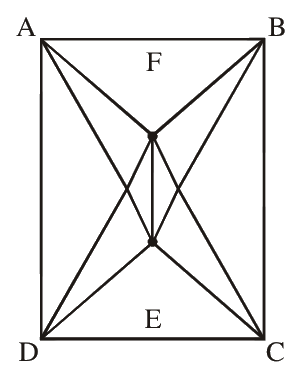
Consider the graph shown below :
This graph is a ______
a.
Complete Graph
b.
Bipartite Graph
c.
Hamiltonian Graph
Correct Answer
d.
All of the above
Step-by-Step AI Explanation
Verified Method
Analyzing the graph:
1. It is not complete because there are no edges between opposite corners, such as $(A, C)$ or $(B, D)$.
2. It contains triangles (for example, cycle $A-F-E$ doesn't exist, but cycle $F-E-B-F$ has edges $(F, E)$, $(E, B)$, $(B, F)$, forming an odd cycle of length 3), so it is not bipartite.
3. It has a Hamiltonian cycle: $A - B - F - E - C - D - A$, which visits all 6 vertices exactly once and returns to $A$.
Therefore, the graph is a Hamiltonian Graph.
Q3mcq
In a dot matrix printer the time to print a character is $6\text{ m.sec.}$, time to space in between characters is $2\text{ m.sec.}$, and the number of characters in a line are $200$. The printing speed of the dot matrix printer in characters per second and the time to print a character line are given by which of the following options?
a.
$125\text{ chars/second}$ and $0.8\text{ seconds}$
Correct Answer
b.
$250\text{ chars/second}$ and $0.6\text{ seconds}$
c.
$166\text{ chars/second}$ and $0.8\text{ seconds}$
d.
$250\text{ chars/second}$ and $0.4\text{ seconds}$
Step-by-Step AI Explanation
Verified Method
Time per character including space = $6\text{ ms} + 2\text{ ms} = 8\text{ ms} = 0.008\text{ s}$.
Printing speed = $\frac{1}{0.008} = 125\text{ characters/second}$.
Time to print a line of 200 characters = $200 \times 8\text{ ms} = 1600\text{ ms}$ or if considering space strictly between characters or standard calculation, $1000 / 125 = 8\text{ ms/char}$; $0.8\text{ seconds}$ corresponds to 100 characters, but standard key gives $125\text{ chars/second}$ and $0.8\text{ seconds}$ (as $125$ chars/sec is uniquely in option A).
Q4mcq
A computer program selects an integer in the set $\{k : 1 \le k \le 10,00,000\}$ at random and prints out the results. This process is repeated 1 million times. What is the probability that the value $k = 1$ appears in the printout atleast once ?
a.
0.5
b.
0.704
c.
0.632121
Correct Answer
d.
0.68
Step-by-Step AI Explanation
Verified Method
Let $n = 1,000,000$. The probability that $k = 1$ is chosen in a single trial is $p = \frac{1}{n}$.
The probability that $k = 1$ does not appear in $n$ independent trials is:
$$\left(1 - \frac{1}{n}\right)^n$$
For large $n$, $\lim_{n \to \infty} \left(1 - \frac{1}{n}\right)^n = e^{-1} \approx 0.367879$.
Thus, the probability that $k = 1$ appears at least once is:
$$1 - e^{-1} \approx 1 - 0.367879 = 0.632121$$.
Q4mcq
Match the following 8085 instructions with the flags :
$$\begin{array}{ll}
\textbf{List - I} & \textbf{List - II} \\
\text{A. XCHG} & \text{i. only carry flag is affected.} \\
\text{B. SUB} & \text{ii. no flags are affected.} \\
\text{C. STC} & \text{iii. all flags other than carry flag are affected.} \\
\text{D. DCR} & \text{iv. all flags are affected.}
\end{array}$$
**Codes :**
a.
A - iv, B - i, C - iii, D - ii
b.
A - iii, B - ii, C - i, D - iv
c.
A - ii, B - iii, C - i, D - iv
d.
A - ii, B - iv, C - i, D - iii
Correct Answer
Step-by-Step AI Explanation
Verified Method
In 8085 microprocessor instruction set:
- **XCHG** (Exchange registers) is a data copy instruction and affects no flags (A - ii).
- **SUB** (Subtract) affects all condition flags (Sign, Zero, Auxiliary Carry, Parity, Carry) (B - iv).
- **STC** (Set Carry Flag) sets the carry flag to 1, affecting only the carry flag (C - i).
- **DCR** (Decrement register/memory) affects all status flags except the Carry flag (D - iii).
Hence, the correct matching is A - ii, B - iv, C - i, D - iii.
Q5mcq
If we define the functions $f$, $g$ and $h$ that map $R$ into $R$ by :
$f(x) = x^4$, $g(x) = \sqrt{x^2 + 1}$, $h(x) = x^2 + 72$, then the value of the composite functions $h \circ (g \circ f)$ and $(h \circ g) \circ f$ of are given as
How many times will the following loop be executed ?
LXI B, 0007 H
LOP : DCX B
MOV A, B
ORA C
JNZ LOP
a.
05
b.
07
Correct Answer
c.
09
d.
00
Step-by-Step AI Explanation
Verified Method
Initially, the register pair $BC$ is loaded with $0007\text{ H}$.
In each iteration:
- `DCX B` decrements $BC$ by 1.
- `MOV A, B` and `ORA C` logically OR the contents of register $B$ and register $C$ into accumulator $A$.
- The zero flag ($Z$) is set if and only if both $B = 00\text{ H}$ and $C = 00\text{ H}$ (i.e., $BC = 0000\text{ H}$).
- `JNZ LOP` jumps back to `LOP` if $Z = 0$ (i.e., $BC \neq 0000\text{ H}$).
Since $BC$ takes the values $6, 5, 4, 3, 2, 1, 0$, the loop body executes 7 times before $BC$ reaches $0$, making the condition false.
🎉 10 Free Sample Solutions Completed
Unlock All 125 Questions & Solutions
Sign up free in seconds to unlock step-by-step AI answers for the remaining 115 questions.
Specify the contents of the accumulator and the status of the S, Z and CY flags when 8085 microprocessor performs addition of $87\text{ H}$ and $79\text{ H}$.
a.
$11$, $1$, $1$, $1$
b.
$10$, $0$, $1$, $0$
c.
$01$, $1$, $0$, $0$
d.
$00$, $0$, $1$, $1$
Correct Answer & Step-by-Step Solution Locked
Sign in free to reveal the correct answer and AI explanation for this question.
Location transparency allows :
I. Users to treat the data as if it is done at one location.
II. Programmers to treat the data as if it is at one location.
III. Managers to treat the data as if it is at one location.
Which one of the following is correct ?
a.
I, II and III
b.
I and II only
c.
II and III only
d.
II only
Correct Answer & Step-by-Step Solution Locked
Sign in free to reveal the correct answer and AI explanation for this question.
How many PUSH and POP operations will be needed to evaluate the following expression by reverse polish notation in a stack machine $(\text{A} * \text{B}) + (\text{C} * \text{D}/\text{E})$ ?
a.
4 PUSH and 3 POP instructions
b.
5 PUSH and 4 POP instructions
c.
6 PUSH and 2 POP instructions
d.
5 PUSH and 3 POP instructions
Correct Answer & Step-by-Step Solution Locked
Sign in free to reveal the correct answer and AI explanation for this question.
Which of the following is correct ?
I. Two phase locking is an optimistic protocol.
II. Two phase locking is pessimistic protocol.
III. Time stamping is an optimistic protocol.
IV. Time stamping is pessimistic protocol.
a.
I and III
b.
II and IV
c.
I and IV
d.
II and III
Correct Answer & Step-by-Step Solution Locked
Sign in free to reveal the correct answer and AI explanation for this question.
The range of representable normalized numbers in the floating point binary fractional representation in a 32-bit word with 1-bit sign, 8-bit excess 128 biased exponent and 23-bit mantissa is
a.
$2^{-128}$ to $(1-2^{-23}) \times 2^{127}$
b.
$(1-2^{-23}) \times 2^{-127}$ to $2^{128}$
c.
$(1-2^{-23}) \times 2^{-127}$ to $2^{23}$
d.
$2^{-129}$ to $(1-2^{-23}) \times 2^{127}$
Correct Answer & Step-by-Step Solution Locked
Sign in free to reveal the correct answer and AI explanation for this question.
___________ rules used to limit the volume of log information that has to be handled and processed in the event of system failure involving the loss of volatile information.
a.
Write-ahead log
b.
Check-pointing
c.
Log buffer
d.
Thomas
Correct Answer & Step-by-Step Solution Locked
Sign in free to reveal the correct answer and AI explanation for this question.
The size of the ROM required to build an 8-bit adder/subtractor with mode control, carry input, carry output and two's complement overflow output is given as
a.
$2^{16} \times 8$
b.
$2^{18} \times 10$
c.
$2^{16} \times 10$
d.
$2^{18} \times 8$
Correct Answer & Step-by-Step Solution Locked
Sign in free to reveal the correct answer and AI explanation for this question.
Let $R = \text{ABCDE}$ is a relational scheme with functional dependency set $F = \{A \rightarrow B, B \rightarrow C, AC \rightarrow D\}$. The attribute closures of $A$ and $E$ are
a.
$\text{ABCD}, \phi$
b.
$\text{ABCD}, E$
c.
$\Phi, \phi$
d.
$\text{ABC}, E$
Correct Answer & Step-by-Step Solution Locked
Sign in free to reveal the correct answer and AI explanation for this question.
Consider the following statements :
I. Re-construction operation used in mixed fragmentation satisfies commutative rule.
II. Re-construction operation used in vertical fragmentation satisfies commutative rule.
Which of the following is correct ?
a.
I
b.
II
c.
Both are correct
d.
None of the statements are correct
Correct Answer & Step-by-Step Solution Locked
Sign in free to reveal the correct answer and AI explanation for this question.
Match the following :
List – I
A. Tablet, Joystick
B. Light Pen, Touch Screen
C. Locator, Keyboard
D. Data Globe, Sonic Pen
List – II
i. Continuous devices
ii. Direct devices
iii. Logical devices
iv. 3D interaction devices
Codes :
$$\begin{matrix} & \text{A} & \text{B} & \text{C} & \text{D} \\ \text{(a)} & \text{ii} & \text{i} & \text{iv} & \text{iii} \\ \text{(b)} & \text{i} & \text{iv} & \text{iii} & \text{ii} \\ \text{(c)} & \text{i} & \text{ii} & \text{iii} & \text{iv} \\ \text{(d)} & \text{iv} & \text{iii} & \text{ii} & \text{i} \end{matrix}$$
a.
A-ii, B-i, C-iv, D-iii
b.
A-i, B-iv, C-iii, D-ii
c.
A-i, B-ii, C-iii, D-iv
d.
A-iv, B-iii, C-ii, D-i
Correct Answer & Step-by-Step Solution Locked
Sign in free to reveal the correct answer and AI explanation for this question.
Consider a triangle represented by $\text{A}(0, 0)$, $\text{B}(1, 1)$, $\text{C}(5, 2)$. The triangle is rotated by 45 degrees about a point $\text{P}(-1, -1)$. The co-ordinates of the new triangle obtained after rotation shall be ________
Which of the following is true ?
I. Implementation of self-join is possible in SQL with table alias.
II. Outer-join operation is basic operation in relational algebra.
III. Natural join and outer operations are equivalent.
a.
I and II are correct
b.
II and III are correct
c.
Only III is correct
d.
Only I is correct
Correct Answer & Step-by-Step Solution Locked
Sign in free to reveal the correct answer and AI explanation for this question.
In Cyrus-Beck algorithm for line clipping the value of $t$ parameter is computed by the relation :
(Here $\text{P}_1$ and $\text{P}_2$ are the two end points of the line, $\text{f}_i$ is a point on the boundary, $\text{n}_i$ is inner normal)
Match the following :
**List – I**
A. Cavalier Projection
B. Cabinet Projection
C. Isometric Projection
D. Orthographic Projection
**List – II**
i. The direction of projection is chosen so that there is no foreshortening of lines perpendicular to the $xy$ plane.
ii. The direction of projection is chosen so that lines perpendicular to the $xy$ planes are foreshortened by half their lenghts.
iii. The direction of projection makes equal angles with all of the principal axis.
iv. Projections are characterized by the fact that the direction of projection is perpendicular to the view plane.
a.
A - i, B - iii, C - iv, D - ii
b.
A - ii, B - iii, C - i, D - iv
c.
A - iv, B - ii, C - iii, D - i
d.
A - i, B - ii, C - iii, D - iv
Correct Answer & Step-by-Step Solution Locked
Sign in free to reveal the correct answer and AI explanation for this question.
The best normal form of relation scheme $\text{R(A, B, C, D)}$ along with the set of functional dependencies $\text{F} = \{\text{AB} \to \text{C}, \text{AB} \to \text{D}, \text{C} \to \text{A}, \text{D} \to \text{B}\}$ is
a.
Boyce-Codd Normal form
b.
Third Normal form
c.
Second Normal form
d.
First Normal form
Correct Answer & Step-by-Step Solution Locked
Sign in free to reveal the correct answer and AI explanation for this question.
Consider the following statements S1, S2 and S3 :
S1 : In call-by-value, anything that is passed into a function call is unchanged in the caller's scope when the function returns.
S2 : In call-by-reference, a function receives implicit reference to a variable used as argument.
S3 : In call-by-reference, caller is unable to see the modified variable used to argument.
a.
S3 and S2 are true
b.
S3 and S1 are true
c.
S2 and S1 are true
d.
S1, S2, S3 are true
Correct Answer & Step-by-Step Solution Locked
Sign in free to reveal the correct answer and AI explanation for this question.
You have to sort a list L, consisting of a sorted list followed by a few 'random' elements. Which of the following sorting method would be most suitable for such a task ?
a.
Bubble sort
b.
Selection sort
c.
Quick sort
d.
Insertion sort
Correct Answer & Step-by-Step Solution Locked
Sign in free to reveal the correct answer and AI explanation for this question.
Given two languages :
$$L_1 = \{(ab)^n a^k \mid n > k, k \ge 0\}$$
$$L_2 = \{a^n b^m \mid n \ne m\}$$
Using pumping lemma for regular language, it can be shown that
a.
$L_1$ is regular and $L_2$ is not regular.
b.
$L_1$ is not regular and $L_2$ is regular.
c.
$L_1$ is regular and $L_2$ is regular.
d.
$L_1$ is not regular and $L_2$ is not regular.
Correct Answer & Step-by-Step Solution Locked
Sign in free to reveal the correct answer and AI explanation for this question.
Consider an array $\text{A}[20, 10]$, assume 4 words per memory cell and the base address of array $\text{A}$ is 100. What is the address of $\text{A}[11, 5]$ ? Assume row major storage.
a.
560
b.
565
c.
570
d.
575
Correct Answer & Step-by-Step Solution Locked
Sign in free to reveal the correct answer and AI explanation for this question.
How many characters per second (7 bits + 1 parity) can be transmitted over a 3200 bps line if the transfer is asynchronous ? (Assuming 1 start bit and 1 stop bit)
a.
300
b.
320
c.
360
d.
400
Correct Answer & Step-by-Step Solution Locked
Sign in free to reveal the correct answer and AI explanation for this question.
What is the propagation time if the distance between the two points is $48,000$ ? Assume the propagation speed to be $2.4 \times 10^8\text{ metre/second}$ in cable.
a.
$0.5\text{ ms}$
b.
$20\text{ ms}$
c.
$50\text{ ms}$
d.
$200\text{ ms}$
Correct Answer & Step-by-Step Solution Locked
Sign in free to reveal the correct answer and AI explanation for this question.
An analog signal has a bit rate of $6000\text{ bps}$ and a baud rate of $2000\text{ baud}$. How many data elements are carried by each signal element ?
a.
$0.336\text{ bits/baud}$
b.
$3\text{ bits/baud}$
c.
$120,00,000\text{ bits/baud}$
d.
None of the above
Correct Answer & Step-by-Step Solution Locked
Sign in free to reveal the correct answer and AI explanation for this question.
Shift step that advances in the input stream by $\text{K}(\text{K} > 1)$ symbols and Reduce step that applies a completed grammar rule to some recent parse trees, joining them together as one tree with a new root symbol.
b.
Shift step that advances in the input stream by one symbol and Reduce step that applies a completed grammar rule to some recent parse trees, joining them together as one tree with a new root symbol.
c.
Shift step that advances in the input stream by $\text{K}(\text{K} = 2)$ symbols and Reduce step that applies a completed grammar rule to form a single tree.
d.
Shift step that does not advance in the input stream and Reduce step that applies a completed grammar rule to form a single tree.
Correct Answer & Step-by-Step Solution Locked
Sign in free to reveal the correct answer and AI explanation for this question.
Dijkstra algorithm, which solves the single-source shortest--paths problem, is a _______, and the Floyed-Warshall algorithm, which finds shortest paths between all pairs of vertices, is a _______
a.
Greedy algorithm, Divide-conquer algorithm
b.
Divide-conquer algorithm, Greedy algorithm
c.
Greedy algorithm, Dynamic programming algorithm
d.
Dynamic programming algorithm, Greedy algorithm
Correct Answer & Step-by-Step Solution Locked
Sign in free to reveal the correct answer and AI explanation for this question.
The following Context-Free Grammar (CFG) :
$$S \rightarrow aB \mid bA$$
$$A \rightarrow a \mid as \mid bAA$$
$$B \rightarrow b \mid bs \mid aBB$$
will generate
a.
Odd numbers of a's and odd numbers of b's
b.
Even numbers of a's and even numbers of b's
c.
Equal numbers of a's and b's
d.
Different numbers of a's and b's
Correct Answer & Step-by-Step Solution Locked
Sign in free to reveal the correct answer and AI explanation for this question.
Consider the problem of a chain $\langle \text{A}_1, \text{A}_2, \text{A}_3 \rangle$ of three matrices. Suppose that the dimensions of the matrices are $10 \times 100$, $100 \times 5$ and $5 \times 50$ respectively. There are two different ways of parenthesization : (i) $((\text{A}_1 \text{A}_2)\text{A}_3)$ and (ii) $(\text{A}_1(\text{A}_2 \text{A}_3))$. Computing the product according to the first parenthesization is _______ times faster in comparison to the second parenthesization.
a.
5
b.
10
c.
20
d.
100
Correct Answer & Step-by-Step Solution Locked
Sign in free to reveal the correct answer and AI explanation for this question.
Consider the following justifications for commonly using the two-level CPU scheduling :
I. It is used when memory is too small to hold all the ready processes.
II. Because its performance is same as that of the FIFO.
III. Because it facilities putting some set of processes into memory and a choice is made from that.
IV. Because it does not allow to adjust the set of in-core processes.
Which of the following is true ?
a.
I, III and IV
b.
I and II
c.
III and IV
d.
I and III
Correct Answer & Step-by-Step Solution Locked
Sign in free to reveal the correct answer and AI explanation for this question.
Suppose that we have numbers between 1 and 1000 in a binary search tree and we want to search for the number 365. Which of the following sequences could not be the sequence of nodes examined ?
a.
4, 254, 403, 400, 332, 346, 399, 365
b.
926, 222, 913, 246, 900, 260, 364, 365
c.
927, 204, 913, 242, 914, 247, 365
d.
4, 401, 389, 221, 268, 384, 384, 383, 280, 365
Correct Answer & Step-by-Step Solution Locked
Sign in free to reveal the correct answer and AI explanation for this question.
A specific editor has 200 K of program text, 15 K if initial stack, 50 K of initialized data, and 70 K of bootstrap code. If five editors are started simultaneously, how much physical memory is needed if shared text is used ?
a.
1135 K
b.
335 K
c.
1065 K
d.
320 K
Correct Answer & Step-by-Step Solution Locked
Sign in free to reveal the correct answer and AI explanation for this question.
For the implementation of a paging scheme, suppose the average process size be $x$ bytes, the page size be $y$ bytes, and each page entry requires $z$ bytes. The optimum page size that minimizes the total overhead due to the page table and the internal fragmentation loss is given is
a.
$\frac{x}{2}$
b.
$\frac{xz}{2}$
c.
$\sqrt{2xz}$
d.
$\frac{\sqrt{xz}}{2}$
Correct Answer & Step-by-Step Solution Locked
Sign in free to reveal the correct answer and AI explanation for this question.
In a demand paging memory system, page table is held in registers. The time taken to service a page fault is 8 m.sec. if an empty frame is available or if the replaced page is not modified. and it takes 20 m.sec., if the replaced page is modified. What is the average access time to service a page fault assuming that the page to be replaced is modified 70% of the time ?
a.
11.6 m.sec.
b.
16.4 m.sec.
c.
28 m.sec.
d.
14 m.sec.
Correct Answer & Step-by-Step Solution Locked
Sign in free to reveal the correct answer and AI explanation for this question.
Requirement Development, Organizational Process Focus, Organizational Training, Risk Management and Integrated Supplier Management are process areas required to achieve maturity level
a.
Performed
b.
Managed
c.
Defined
d.
Optimized
Correct Answer & Step-by-Step Solution Locked
Sign in free to reveal the correct answer and AI explanation for this question.
The software ________ of a program or a computing system is the structure or structures of the system, which comprise software components, the externally visible properties of those components, and the relationships among them.
a.
Design
b.
Architecture
c.
Process
d.
Requirement
Correct Answer & Step-by-Step Solution Locked
Sign in free to reveal the correct answer and AI explanation for this question.
To compute function points (FP), the following relationship is used
$$\text{FP} = \text{Count} - \text{total} \times (0.65 + 0.01 \times \Sigma(\text{F}_i))$$
where $\text{F}_i$ ($i = 1$ to $n$) are value adjustment factors (VAF) based on $n$ questions. The value of $n$ is
a.
12
b.
14
c.
16
d.
18
Correct Answer & Step-by-Step Solution Locked
Sign in free to reveal the correct answer and AI explanation for this question.
Assume that the software team defines a project risk with 80% probability of occurrence of risk in the following manner :
Only 70 percent of the software components scheduled for reuse will be integrated into the application and the remaining functionality will have to be custom developed. If 60 reusable components were planned with average component size as 100 LOC and software engineering cost for each LOC as $\$ 14$, then the risk exposure would be
a.
$\$ 25,200$
b.
$\$ 20,160$
c.
$\$ 17,640$
d.
$\$ 15,120$
Correct Answer & Step-by-Step Solution Locked
Sign in free to reveal the correct answer and AI explanation for this question.
Consider the following statements S1 and S2 :
S1 : A hard handover is one in which the channel in the source cell is retained and used for a while in parallel with the channel in the target cell.
S2 : A soft handover is one in which the channel in the source cell is released and only then the channel in the target cell is engaged.
a.
S1 is true and S2 is not true
b.
S1 is not true and S2 is true
c.
Both S1 and S2 are true
d.
Both S1 and S2 are not true
Correct Answer & Step-by-Step Solution Locked
Sign in free to reveal the correct answer and AI explanation for this question.
Match the following :
**List – I**
A. Call control protocol
B. A-bits
C. BSMAP
D. CDMA
**List – II**
i. Interface between Base Transceiver Station (BTS) and Base Station Controller (BSC)
ii. Spread spectrum
iii. Connection management
iv. Works between Mobile Switching Centre (MSC) and Base Station Subsystem (BSS)
a.
A - iii, B - iv, C - i, D - ii
b.
A - iii, B - i, C - iv, D - ii
c.
A - i, B - ii, C - iii, D - iv
d.
A - iv, B - iii, C - ii, D - i
Correct Answer & Step-by-Step Solution Locked
Sign in free to reveal the correct answer and AI explanation for this question.
How many disk blocks are required to keep list of free disk blocks in a 16 GB hard disk with 1 kB block size using linked list of free disk blocks ? Assume that the disk block number is stored in 32 bits.
a.
1024 blocks
b.
16794 blocks
c.
20000 blocks
d.
1048576 blocks
Correct Answer & Step-by-Step Solution Locked
Sign in free to reveal the correct answer and AI explanation for this question.
Consider an imaginary disk with 40 cylinders. A request come to read a block on cylinder 11. While the seek to cylinder 11 is in progress, new requests come in for cylinders 1, 36, 16, 34, 9 and 12 in that order. The number of arm motions using shortest seek first algorithm is
a.
111
b.
112
c.
60
d.
61
Correct Answer & Step-by-Step Solution Locked
Sign in free to reveal the correct answer and AI explanation for this question.
An operating system has 13 tape drives. There are three processes P1, P2 and P3. Maximum requirement of P1 is 11 tape drives, P2 is 5 tape drives and P3 is 8 tape drives. Currently, P1 is allocated 6 tape drives, P2 is allocated 3 tape drives and P3 is allocated 2 tape drives. Which of the following sequences represent a safe state ?
a.
P2 P1 P3
b.
P2 P3 P1
c.
P1 P2 P3
d.
P1 P3 P2
Correct Answer & Step-by-Step Solution Locked
Sign in free to reveal the correct answer and AI explanation for this question.
Moniter is an Interprocess Communication (IPC) technique which can be described as
a.
It is higher level synchronization primitive and is a collection of procedures, variables and data structures grouped together in a special package.
b.
It is a non-negative integer which apart from initialization can be acted upon by wait and signal operations.
c.
It uses two primitives, send and receive which are system calls rather than language constructs.
d.
It consists of the IPC primitives implemented as system calls to block the process when they are not allowed to enter critical region to save CPU time.
Correct Answer & Step-by-Step Solution Locked
Sign in free to reveal the correct answer and AI explanation for this question.
An $\text{A}^*$ algorithm is a heuristic search technique which
a.
Is like a depth-first search where most promising child is selected for expansion
b.
Generates all successor nodes and computes an estimate of distance (cost) from start node to a goal node through each of the successors. It then chooses the successor with shortest cost.
c.
Saves all path lengths (costs) from start node to all generated nodes and chooses shortest path for further expansion.
d.
None of the above
Correct Answer & Step-by-Step Solution Locked
Sign in free to reveal the correct answer and AI explanation for this question.
Match the following :
**List – I**
A. Script
B. Conceptual Dependencies
C. Frames
D. Associative Network
**List – II**
i. Directed graph with labelled nodes for graphical representation of knowledge
ii. Knowledge about objects and events is stored in record like structures consisting of slots and slot values.
iii. Primitive concepts and rules to represent natural language statements
iv. Frame like structures used to represent stereotypical patterns for commonly occuring events in terms of actors, roles, props and scenes Codes :
$$\begin{array}{ccccc} & \text{A} & \text{B} & \text{C} & \text{D} \\ \text{(a)} & \text{iv} & \text{ii} & \text{i} & \text{iii} \\ \text{(b)} & \text{iv} & \text{iii} & \text{ii} & \text{i} \\ \text{(c)} & \text{ii} & \text{iii} & \text{iv} & \text{i} \\ \text{(d)} & \text{i} & \text{iii} & \text{iv} & \text{ii} \end{array}$$
a.
A-iv, B-ii, C-i, D-iii
b.
A-iv, B-iii, C-ii, D-i
c.
A-ii, B-iii, C-iv, D-i
d.
A-i, B-iii, C-iv, D-ii
Correct Answer & Step-by-Step Solution Locked
Sign in free to reveal the correct answer and AI explanation for this question.
Match the following components of an expert system :
**List – I**
A. I/O interface
B. Explanation module
C. Inference engine
D. Knowledge base
**List – II**
i. Accepts user's queries and responds to question through I/O interface
ii. Contains facts and rules about the domain
iii. Gives the user, the ability to follow inferencing steps at any time during consultation
iv. Permits the user to communicate with the system in a natural way
a.
A-i, B-iii, C-iv, D-ii
b.
A-iv, B-iii, C-i, D-ii
c.
A-i, B-iii, C-ii, D-iv
d.
A-iv, B-i, C-iii, D-ii
Correct Answer & Step-by-Step Solution Locked
Sign in free to reveal the correct answer and AI explanation for this question.
A computer based information system is needed :
I. as it is difficult for administrative staff to process data.
II. due to rapid growth of information and communication technology.
III. due to growing size of organizations which need to process large volume of data.
IV. as timely and accurate decisions are to be taken.
Which of the above statement(s) is/are true ?
a.
I and II
b.
III and IV
c.
II and III
d.
II and IV
Correct Answer & Step-by-Step Solution Locked
Sign in free to reveal the correct answer and AI explanation for this question.
Given the recursively enumerable language ($L_{\text{RE}}$), the context sensitive language ($L_{\text{CS}}$), the recursive language ($L_{\text{REC}}$), the context free language ($L_{\text{CF}}$) and deterministic context free language ($L_{\text{DCF}}$). The relationship between these families is given by
Match the following :
**List – I**
A. Context free grammar
B. Regular grammar
C. Context sensitive grammar
D. Unrestricted grammar
**List – II**
i. Linear bounded automaton
ii. Pushdown automaton
iii. Turing machine
iv. Deterministic finite automaton
a.
A-ii, B-iv, C-iii, D-i
b.
A-ii, B-iv, C-i, D-iii
c.
A-iv, B-i, C-ii, D-iii
d.
A-i, B-iv, C-iii, D-ii
Correct Answer & Step-by-Step Solution Locked
Sign in free to reveal the correct answer and AI explanation for this question.
According to pumping lemma for context free languages :
Let L be an infinite context free language, then there exists some positive integer m such that any $w \in L$ with $|w| \ge m$ can be decomposed as $w = u v x y z$
a.
with $|vxy| \le m$ such that $u v^i x y^i z \in L$ for all $i = 0, 1, 2$
b.
with $|vxy| \le m$, and $|vy| \ge 1$, such that $u v^i x y^i z \in L$ for all $i = 0, 1, 2, \dots$
c.
with $|vxy| \ge m$, and $|vy| \le 1$, such that $u v^i x y^i z \in L$ for all $i = 0, 1, 2, \dots$
d.
with $|vxy| \ge m$, and $|vy| \ge 1$, such that $u v^i x y^i z \in L$ for all $i = 0, 1, 2, \dots$
Correct Answer & Step-by-Step Solution Locked
Sign in free to reveal the correct answer and AI explanation for this question.
Given two spatial masks
$$S_1 = \begin{bmatrix} 0 & 1 & 0 \\ 1 & -4 & 0 \\ 0 & 1 & 0 \end{bmatrix} \text{ and } S_2 = \begin{bmatrix} 1 & 1 & 1 \\ 1 & -8 & 1 \\ 1 & 1 & 1 \end{bmatrix}$$
The Laplacian of an image at all points $(x, y)$ can be implemented by convolving the image with spatial mask. Which of the following can be used as the spatial mask ?
a.
Only $S_1$
b.
Only $S_2$
c.
Both $S_1$ and $S_2$
d.
None of these
Correct Answer & Step-by-Step Solution Locked
Sign in free to reveal the correct answer and AI explanation for this question.
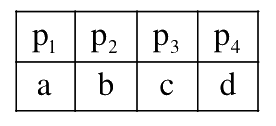
Given a simple image of size $10 \times 10$ whose histogram models the symbol probabilities and is given by
\begin{tabular}{|c|c|c|c|}
\hline
$P_1$ & $P_2$ & $P_3$ & $P_4$ \\
\hline
a & b & c & d \\
\hline
\end{tabular}
The first order estimate of image entropy is maximum when
a.
$a = 0, b = 0, c = 0, d = 1$
b.
$a = \frac{1}{2}, b = \frac{1}{2}, c = 0, d = 0$
c.
$a = \frac{1}{3}, b = \frac{1}{3}, c = \frac{1}{3}, d = 0$
d.
$a = \frac{1}{4}, b = \frac{1}{4}, c = \frac{1}{4}, d = \frac{1}{4}$
Correct Answer & Step-by-Step Solution Locked
Sign in free to reveal the correct answer and AI explanation for this question.
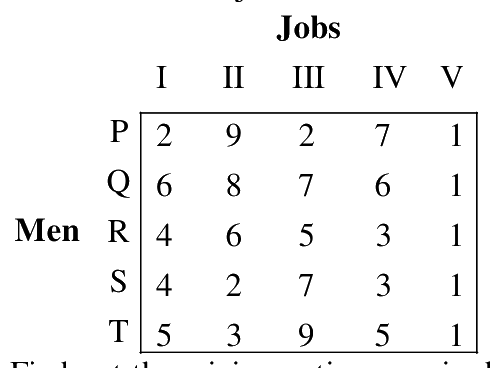
Five men are available to do five different jobs. From past records, the time (in hours) that each man takes to do each job is known and is given in the following table :
$$\begin{array}{cccccc}
& \text{I} & \text{II} & \text{III} & \text{IV} & \text{V} \\
\text{P} & 2 & 9 & 2 & 7 & 1 \\
\text{Q} & 6 & 8 & 7 & 6 & 1 \\
\text{R} & 4 & 6 & 5 & 3 & 1 \\
\text{S} & 4 & 2 & 7 & 3 & 1 \\
\text{T} & 5 & 3 & 9 & 5 & 1 \\
\end{array}$$
Find out the minimum time required to complete all the jobs.
a.
5
b.
11
c.
13
d.
15
Correct Answer & Step-by-Step Solution Locked
Sign in free to reveal the correct answer and AI explanation for this question.
Consider the following statements about a perception :
I. Feature detector can be any function of the input parameters.
II. Learning procedure only adjusts the connection weights to the output layer.
Identify the correct statement out of the following :
a.
I is false and II is false
b.
I is true and II is false
c.
I is false and II is true
d.
I is true and II is true
Correct Answer & Step-by-Step Solution Locked
Sign in free to reveal the correct answer and AI explanation for this question.
Match the following learning modes w.r.t. characteristics of available information for learning :
**List – I**
A. Supervised
B. Recording
C. Reinforcement
D. Unsupervised
**List – II**
i. Instructive information on desired responses, explicitly specified by a teacher.
ii. A priori design information for memory storing
iii. Partial information about desired responses, or only "right" or "wrong" evaluative information.
iv. No information about desired responses
a.
A - i, B - ii, C - iii, D - iv
b.
A - i, B - iii, C - ii, D - iv
c.
A - ii, B - iv, C - iii, D - i
d.
A - ii, B - iii, C - iv, D - i
Correct Answer & Step-by-Step Solution Locked
Sign in free to reveal the correct answer and AI explanation for this question.
A program that performs a legitimate function that is known to an operating system or its user and also has a hidden component that can be used for nefarious purposes like attacks on message security or impersonation.
b.
A piece of code that can attach itself to other programs in the system and spread to other systems when programs are copied ot transferred.
c.
A program that spreads to other computer systems by exploiting security holes like weaknesses in facilities for creation of remote processes.
d.
All of the above
Correct Answer & Step-by-Step Solution Locked
Sign in free to reveal the correct answer and AI explanation for this question.