When data and acknowledgement are sent in the same frame, this is called as
a.
Piggy packing
b.
Piggy backing
c.
Back packing
d.
Good packing
Step-by-Step AI Explanation
Verified Method
The technique of temporarily delaying outgoing acknowledgements so that they can be hooked onto the next outgoing data frame is known as **piggybacking**.
Q2mcq
Encryption and decryption is the responsibility of ______ layer
a.
Physical
b.
Network
c.
Application
d.
Datalink
Step-by-Step AI Explanation
Verified Method
In the standard OSI model, encryption and decryption are traditionally functions of the Presentation layer. However, among the given choices (Physical, Network, Application, Datalink), encryption and decryption are implemented at the **Application** layer (e.g., PGP, S/MIME, HTTPS/SSL/TLS at higher levels). Therefore, (C) is the most appropriate answer.
Q3mcq
An analog signal carries 4 bits in each signal unit. If 1000 signal units are sent per second, then baud rate and bit rate of the signal are ______ and ______
a.
4000 bauds\sec and 1000 bps
b.
2000 bauds\sec and 1000 bps
c.
1000 bauds \ sec and 500 bps
d.
1000 bauds \ sec and 4000 bps
Step-by-Step AI Explanation
Verified Method
Baud rate is the number of signal units (symbols) transmitted per second, so Baud rate $= 1000\text{ bauds/sec}$.
Bit rate is the number of bits transmitted per second:
$$\text{Bit rate} = \text{Baud rate} \times \text{bits per signal unit} = 1000 \times 4 = 4000\text{ bps}$$
Thus, the baud rate and bit rate are $1000\text{ bauds/sec}$ and $4000\text{ bps}$.
Q4mcq
The VLF and LF bands use ______ propagation for communication
a.
Ground
b.
Sky
c.
Line of sight
d.
Space
Step-by-Step AI Explanation
Verified Method
Very Low Frequency (VLF, $3\text{ kHz} - 30\text{ kHz}$) and Low Frequency (LF, $30\text{ kHz} - 300\text{ kHz}$) radio waves follow the curvature of the Earth and propagate via **ground wave** (surface wave) propagation.
Q5mcq
Using the RSA public key crypto system, if $p = 13$, $q = 31$ and $d = 7$, then the vlaue of $e$ is
a.
101
b.
103
c.
105
d.
107
Step-by-Step AI Explanation
Verified Method
In the RSA cryptosystem:
- $p = 13$, $q = 31$
- $\phi(n) = (p - 1)(q - 1) = 12 \times 30 = 360$
- We are given $d = 7$, and we need to find $e$ such that:
$$e \cdot d \equiv 1 \pmod{\phi(n)} \implies 7e \equiv 1 \pmod{360}$$
Testing the options:
- For $e = 101$: $7 \times 101 = 707 \equiv 347 \pmod{360}$
- For $e = 103$: $7 \times 103 = 721 = 2 \times 360 + 1 \equiv 1 \pmod{360}$
Thus, $e = 103$.
Q6mcq
FAN IN of a component A is defined as
a.
Number of components that can call or pass control to component A
b.
Number of components that are called by component A
c.
Number of components related to component A
d.
Number of components dependent on component A
Step-by-Step AI Explanation
Verified Method
**Fan-in** of a module/component $A$ is the number of incoming control flows or the number of modules that call/invoke component $A$. **Fan-out** is the number of components directly called by component $A$.
Q7mcq
The relationship of data elements in a module is called
a.
Coupling
b.
Modularity
c.
Cohesion
d.
Granularity
Step-by-Step AI Explanation
Verified Method
**Cohesion** is a measure of the degree to which the elements inside a module are functionally related and belong together. **Coupling** measures the degree of interdependence between different modules.
Q8mcq
Software Configuration Management is the discipline systematically controlling
a.
the changes due to the evolution of work products as the project proceeds
b.
the changes due to defects (bugs) being found and then fixed
c.
the changes due to requirement changes
d.
all of the above
Step-by-Step AI Explanation
Verified Method
Software Configuration Management (SCM) controls changes throughout the software lifecycle, including evolutionary changes to work products, bug fixes, and modifications resulting from changing requirements. Therefore, all of the given options are correct.
Q9mcq
Which one of the following is not a step of requirement engineering?
a.
Requirement elicitation
b.
Requirement analysis
c.
Requirement design
Correct Answer
d.
Requirement documentation
Step-by-Step AI Explanation
Verified Method
The typical steps of Requirement Engineering are:
1. Requirements Elicitation
2. Requirements Analysis and Negotiation
3. Requirements Specification / Documentation
4. Requirements Validation
"Requirement design" is not a recognized step of requirement engineering; design is a distinct subsequent phase in the software development life cycle (SDLC). Therefore, option C is correct.
Q10mcq
Testing of software with actual data and in actual environment is called
a.
Alpha testing
b.
Beta testing
Correct Answer
c.
Regression testing
d.
None of the above
Step-by-Step AI Explanation
Verified Method
Beta testing is conducted by real users in a real-world, operational environment using actual data before the general release of the product. In contrast, Alpha testing is performed in-house by developers or an internal QA team in a simulated or lab environment.
🎉 10 Free Sample Solutions Completed
Unlock All 105 Questions & Solutions
Sign up free in seconds to unlock step-by-step AI answers for the remaining 95 questions.
An ER Model includes
(1) An ER diagram portraying entity types
(2) Attributes for each entity type
(3) Relationships among entity types
(4) Semantic integrity constraints that reflects the business rules about data not captured in the ER diagram
a.
I, II, III and IV
b.
I and IV
c.
I, II and IV
d.
I and III
Correct Answer & Step-by-Step Solution Locked
Sign in free to reveal the correct answer and AI explanation for this question.
Based on the cardinality ratio and participation ______ associated with a relationship type, choose either the Foreign Key Design, the Cross Referencing Design or Mutual Referencing Design
a.
Entity
b.
Constraints
c.
Rules
d.
Keys
Correct Answer & Step-by-Step Solution Locked
Sign in free to reveal the correct answer and AI explanation for this question.
Match the following with respect to programming languages:
List-I
(A) Structured Language
(B) Non-structured Language
(C) Object oreinted Programming
(D) Interpreted Programming Language
List-II
(i) JAVA
(ii) BASIC
(iii) PASCAL
(iv) FORTRAN
a.
A - iii, B - iv, C - i, D - ii
b.
A - iv, B - iii, C - ii, D - i
c.
A - ii, B - iv, C - i, D - iii
d.
A - ii, B - iii, C - iv, D - i
Correct Answer & Step-by-Step Solution Locked
Sign in free to reveal the correct answer and AI explanation for this question.
______ allows to create classes which are derived from other classes, so that they automatically include some of its "parent's" members, plus its own members.
a.
Overloading
b.
Inheritance
c.
Plymorphism
d.
Encapsulation
Correct Answer & Step-by-Step Solution Locked
Sign in free to reveal the correct answer and AI explanation for this question.
Match the following control strategic of prolog:
List-I
(A) Forward movement
(B) Unification
(C) Deep back-tracking
(D) Shallow back-tracking
List-II
(i) Variable can be done with a constant, another variable or a function.
(ii) The entire conjunctive goal is executed.
(iii) Previous sub goal to find alternative solutions
(iv) Chooses sub goal with possible unifier. Codes:
$$\begin{matrix} & \text{A} & \text{B} & \text{C} & \text{D} \\ (a) & \text{iv} & \text{i} & \text{ii} & \text{iii} \\ (b) & \text{ii} & \text{iv} & \text{i} & \text{iii} \\ (c) & \text{iii} & \text{i} & \text{iv} & \text{ii} \\ (d) & \text{ii} & \text{iii} & \text{iv} & \text{i} \end{matrix}$$
a.
A - iv, B - i, C - ii, D - iii
b.
A - ii, B - iv, C - i, D - iii
c.
A - iii, B - i, C - iv, D - ii
d.
A - ii, B - iii, C - iv, D - i
Correct Answer & Step-by-Step Solution Locked
Sign in free to reveal the correct answer and AI explanation for this question.
Given the following statements:
$S_1$: The grammar $S \to aSb \mid bSa \mid SS \mid a$ and $S \to aSb \mid bSa \mid a$ are not equivalent
$S_2$: The grammar $S \to SS \mid SSS \mid aSb \mid bSa \mid \lambda$ and $S \to SS \mid aSb \mid bSa \mid \lambda$ are equivalent.
Which of the following is true?
a.
$S_1$ is correct and $S_2$ is not correct.
b.
Both $S_1$ and $S_2$ are correct
c.
$S_1$ is not correct and $S_2$ is correct
d.
Both $S_1$ and $S_2$ are not correct.
Correct Answer & Step-by-Step Solution Locked
Sign in free to reveal the correct answer and AI explanation for this question.
If the queue is implemented with a linked list, keeping track of a front pointer and rear pointer, which of these pointers will change during an insertion into a non-empty queue?
a.
Neither of the pointers change
b.
Only front pointer changes
c.
Only rear pointer changes
d.
Both of the pointers changes
Correct Answer & Step-by-Step Solution Locked
Sign in free to reveal the correct answer and AI explanation for this question.
If $h^*$ represents an estimate of the cost of getting from the current node N to the goal node and $h$ represents actual cost of getting from the current node to the goal node, then $A^*$ algorithm gives an optimal solution if
a.
$h^*$ is equal to $h$
b.
$h^*$ overestimates $h$
c.
$h^*$ underestimates $h$
d.
none of these
Correct Answer & Step-by-Step Solution Locked
Sign in free to reveal the correct answer and AI explanation for this question.
Given the following statements:
S1: SLR uses follow information to guide reductions. In case of LR and LALR parsers, the look-aheads are associated with the items and they make use of the left context available to the parser.
S2: LR grammar is a large, subclass of context free grammar as compared to that SLR and LALR grammars.
Which of the following is true?
a.
$S_1$ is not correct and $S_2$ is not correct
b.
$S_1$ is not correct and $S_2$ is correct
c.
$S_1$ is correct and $S_2$ is not correct
d.
$S_1$ is correct and $S_2$ is correct.
Correct Answer & Step-by-Step Solution Locked
Sign in free to reveal the correct answer and AI explanation for this question.
The mean-end analysis process centers around the detection of differences between the current state and goal state. Once such a difference is isolated, an operator that can reduce the difference must be found. But perhaps that operator can not be applied to the current state. So, a sub-problem of getting to a state in which it can be applied is set up. The kind of backward chaining in which operators are selected and then sub goals are set up to establish the precondition of operators is called
a.
backward planning
b.
goal stack planning
c.
operator subgoaling
d.
operator overloading
Correct Answer & Step-by-Step Solution Locked
Sign in free to reveal the correct answer and AI explanation for this question.
In alpha-beta pruning, ______ is used to cut off the search at maximizing level only and ______ is used to cut off the search at maximizing level only.
a.
alpha, beta
b.
beta, alpha
c.
alpha, alpha
d.
beta, beta
Correct Answer & Step-by-Step Solution Locked
Sign in free to reveal the correct answer and AI explanation for this question.
Given the following statements:
$\text{S}_1$ : If $L$ is a regular language then the language $\{uv \mid u \in L, v \in L^R\}$ is also regular
$\text{S}_2$ : $L = \{ww^R\}$ is regular language.
Which of the following is true?
a.
$\text{S}_1$ is not correct and $\text{S}_2$ is not correct.
b.
$\text{S}_1$ is not correct and $\text{S}_2$ is correct.
c.
$\text{S}_1$ is correct and $\text{S}_2$ is not correct
d.
$\text{S}_1$ is correct and $\text{S}_2$ is correct.
Correct Answer & Step-by-Step Solution Locked
Sign in free to reveal the correct answer and AI explanation for this question.
If A and B are two fuzzy sets with membership functions
$$\mu_A(x) = \{0.2, 0.5, 0.6, 0.1, 0.9\}$$
$$\mu_B(x) = \{0.1, 0.5, 0.2, 0.7, 0.8\}$$
Then the value of $\mu_{A \cap B}$ will be
Correct Answer & Step-by-Step Solution Locked
Sign in free to reveal the correct answer and AI explanation for this question.
The process of assigning load addresses to the various parts of the program and adjusting the code and data in the program to reflect the assigned addresses is called ________
a.
Symbol resolution
b.
Parsing
c.
Assembly
d.
Relocation
Correct Answer & Step-by-Step Solution Locked
Sign in free to reveal the correct answer and AI explanation for this question.
Let $\text{P}(m, n)$ be the statement "$m$ divides $n$" where the universe of discourse for both the variables is the set of positive integers. Determine the truth values of each of the following propositions:
(I) $\forall m\ \forall n\ \text{P}(m, n)$
(II) $\exists m\ \forall n\ \text{P}(m, n)$
a.
Both I and II are true
b.
Both I and II are false
c.
I-false and II-true
d.
I-true and II-false
Correct Answer & Step-by-Step Solution Locked
Sign in free to reveal the correct answer and AI explanation for this question.
Let $f$ and $g$ be the functions from the set of integers to the set integers defined by
$$f(x) = 2x + 3 \text{ and } g(x) = 3x + 2$$
Then the composition of $f$ and $g$ and $g$ and $f$ is given as
a.
$6x + 7$, $6x + 11$
b.
$6x + 11$, $6x + 7$
c.
$5x + 5$, $5x + 5$
d.
None of the above
Correct Answer & Step-by-Step Solution Locked
Sign in free to reveal the correct answer and AI explanation for this question.
Which of the following statements are true?
(I) A circuit that adds two bits, producing a sum bit and a carry bit is called half adder.
(II) A circuit that adds two bits, producing a sum bit and a carry bit is called full adder
(III) A circuit that adds two bits and a carry bit producing a sum bit and a carry bit is called full adder.
(IV) A device that accepts the value of a Boolean variable as input and products its complement is called an inverter.
a.
I and II
b.
II and III
c.
I, II, III
d.
I, III and IV
Correct Answer & Step-by-Step Solution Locked
Sign in free to reveal the correct answer and AI explanation for this question.
Pumping lemma for context-free language states:
Let L be an infinite context free language. Then there exists some positive integer $m$ such that any $w \in L$ with $|w| \ge m$ can be decomposed as $w = uvxyz$ with $|vxy|$ _______ and $|vy|$ _______ such that $uv^i x y^i z \in L$ for all $i = 0, 1, 2, \dots$.
a.
$\le m, \le 1$
b.
$\le m, \ge 1$
c.
$\ge m, \le 1$
d.
$\ge m, \ge 1$
Correct Answer & Step-by-Step Solution Locked
Sign in free to reveal the correct answer and AI explanation for this question.
Given the following statements:
$S_1$ : Every context-sensitive language L is recursive
$S_2$: There exists a recursive language that is not context sensitive.
a.
$S_1$ is not correct and $S_2$ is not correct
b.
$S_1$ is not correct and $S_2$ is correct
c.
$S_1$ is correct and $S_2$ is not correct
d.
$S_1$ is correct and $S_2$ is correct.
Correct Answer & Step-by-Step Solution Locked
Sign in free to reveal the correct answer and AI explanation for this question.
The document standards for EDI were first developed by large business house during the 1970s and are now under the control of the following standard organization
a.
ISO
b.
ANSI
c.
ITU-T
d.
IEEE
Correct Answer & Step-by-Step Solution Locked
Sign in free to reveal the correct answer and AI explanation for this question.
Which layer of OSI reference model is responsible for decomposition of messages and generation of sequence numbers to ensure correct re-composition from end to end of the network?
a.
Physical
b.
Data link
c.
Transport
d.
Application
Correct Answer & Step-by-Step Solution Locked
Sign in free to reveal the correct answer and AI explanation for this question.
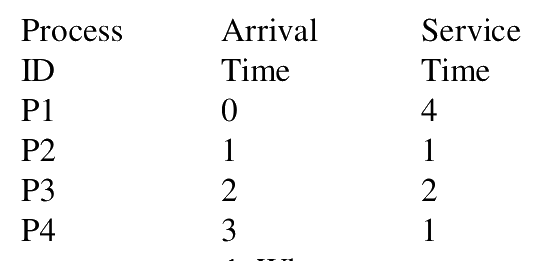
Consider a preemptive priority based scheduling algorithm based on dynamically changing priority. Larger priority number implies higher priority. When the process is waiting for CPU in the ready queue (but not yet started execution), its priority changes at a rate $a = 2$. When it starts running, its priority changes at a rate $b = 1$. All the processes are assigned priority vlaue 0 when they enter ready queue. Assume that the following processes want to execute:
Correct Answer & Step-by-Step Solution Locked
Sign in free to reveal the correct answer and AI explanation for this question.
Process ID | Arrival Time | Service Time
---|---|---
P1 | 0 | 4
P2 | 1 | 1
P3 | 2 | 2
P4 | 3 | 1
The time quantum $q = 1$. When two processes want to join ready queue simultaneously, the process which has not executed recently is given priority. The finish time of processes P1, P2, P3 and P4 will respectively be
a.
4, 5, 7 and 8
b.
8, 2, 7 and 5
c.
2, 5, 7 and 8
d.
8, 2, 5 and 7
Correct Answer & Step-by-Step Solution Locked
Sign in free to reveal the correct answer and AI explanation for this question.
A client-server system uses a satellite network, with the satellite at a height of 40, 000 kms. What is the best-case delay in response to a request? (Note that the speed of light in air is 3, 00, 000 km/second).
a.
133.33 m sec
b.
266.67 m sec
c.
400.00 m sec
d.
533.33 m sec
Correct Answer & Step-by-Step Solution Locked
Sign in free to reveal the correct answer and AI explanation for this question.
The virtual address generated by a CPU is 32 bits. The translation Lookaside Buffer (TLB) can hold total 64 page table entries and a 4-way set assocaitive (i.e. with 4–cache lines in the set). The page size is 4 KB. The minimum size of TLB tag is
a.
12 bits
b.
15 bits
c.
16 bits
d.
20 bits
Correct Answer & Step-by-Step Solution Locked
Sign in free to reveal the correct answer and AI explanation for this question.
Consider a disk queue with request for input/output to block on cylinders 98, 183, 37, 122, 14, 124, 65, 67 in that order. Assume that disk head is initially positioned at cylinder 53 and moving towards cylinder number 0. The total number of head movements using Shortest Seek Time First (SSTF) and SCAN algorithms are respectively.
a.
236 and 252 cylinders
b.
640 and 236 cylinders
c.
235 and 640 cylinders
d.
235 and 252 cylinders
Correct Answer & Step-by-Step Solution Locked
Sign in free to reveal the correct answer and AI explanation for this question.
Match the following
**List-I**
(A) indexed addressing
(B) Direct addressing
(C) Register addressing
(D) Base-indexed addressing
**List-II**
(i) is not used when an operand is moved from memory into a register or from a register to memory.
(ii) memory address is computed by adding up two registers plus an (optional) offset.
(iii) Addressing memory by giving a register plus a context offset.
(iv) can only be used to access global variables whose address is known at compile time. Codes:
\begin{tabular}{ccccc} & A & B & C & D \\ (a) & ii & i & iv & iii \\ (b) & ii & iv & i & iii \\ (c) & iii & iv & i & ii \\ (d) & iii & i & iv & ii \end{tabular}
a.
A-ii, B-i, C-iv, D-iii
b.
A-ii, B-iv, C-i, D-iii
c.
A-iii, B-iv, C-i, D-ii
d.
A-iii, B-i, C-iv, D-ii
Correct Answer & Step-by-Step Solution Locked
Sign in free to reveal the correct answer and AI explanation for this question.
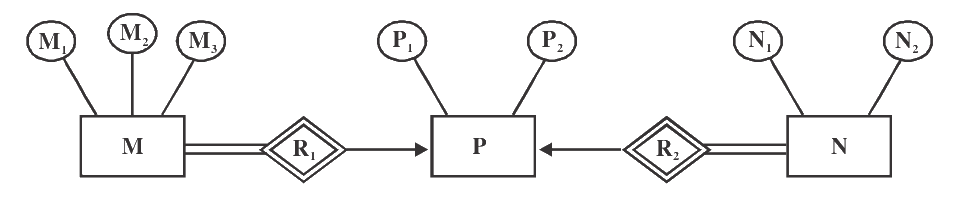
Consider the following ER diagram.
The minimum number of tables required to represent $\text{M}$, $\text{N}$, $\text{P}$, $\text{R}_1$, $\text{R}_2$ is
a.
2
b.
3
c.
4
d.
5
Correct Answer & Step-by-Step Solution Locked
Sign in free to reveal the correct answer and AI explanation for this question.
Consider the following schemas:
Branch = (Branch-name, Assests, Branch-city)
Customer = (Customer-name, Bank name, Customer-city)
Borrow = (Branch-name, loan number, customer account-number)
Deposit = (Branch-name, Account-number, Customer-name, Balance) Using relational Algebra, the Query that finds customers who have balance more than $10,000$ is ______
Consider the table:
Student(stuid, name, course, marks).
Which one of the following two queries is correct to find the highest marks student in course 5?
$\text{Q}_1$. Select S.stuid From student S Where not exists (select * from student e where e course = ‘5’ and e marks $\ge$ s marks)
$\text{Q}_2$. Select s.stu.id From student S Where s.marks > any (select distinct marks from student S where s.course=5)
a.
$\text{Q}_1$
b.
$\text{Q}_2$
c.
Both $\text{Q}_1$ and $\text{Q}_2$
d.
Neither $\text{Q}_1$ nor $\text{Q}_2$
Correct Answer & Step-by-Step Solution Locked
Sign in free to reveal the correct answer and AI explanation for this question.
Armstrong (1974) proposed systematic approach to derive functional dependencies. Match the following w.r.t. functional dependencies:
**List-I**
(A) Decomposition rule
(B) Union rule
(C) Composition rule
(D) Pseudo transitivity rule
**List-II**
(i) If $X \rightarrow Y$ and $Z \rightarrow W$ then $\{X, Z\} \rightarrow \{Y, W\}$
(ii) If $X \rightarrow Y$ and $\{Y, W\} \rightarrow Z$ then $\{X, W\} \rightarrow Z$
(iii) If $X \rightarrow Y$ and $X \rightarrow Z$ then $X \rightarrow \{Y, Z\}$
(iv) If $X \rightarrow \{Y, Z\}$ then $X \rightarrow Y$ and $X \rightarrow Z$
a.
(A)-(iiii), (B)-(ii), (C)-(iv), (D)-(i)
b.
(A)-(i), (B)-(iii), (C)-(iv), (D)-(ii)
c.
(A)-(ii), (B)-(i), (C)-(iii), (D)-(iv)
d.
(A)-(iv), (B)-(iii), (C)-(i), (D)-(ii)
Correct Answer & Step-by-Step Solution Locked
Sign in free to reveal the correct answer and AI explanation for this question.
Match the following:
**List-I**
(A) Secondary index
(B) Non-procedural Query language
(C) Closure of set of attributes
(D) Natural JOIN
**List-II**
(i) Functional dependency
(ii) B-tree
(iii) Relational Algebraic Operation
(iv) Domain Calculus
a.
(A)-(i), (B)-(ii), (C)-(iv), (D)-(iii)
b.
(A)-(ii), (B)-(i), (C)-(iv), (D)-(iii)
c.
(A)-(i), (B)-(iii), (C)-(iv), (D)-(ii)
d.
(A)-(ii), (B)-(iv), (C)-(i), (D)-(iii)
Correct Answer & Step-by-Step Solution Locked
Sign in free to reveal the correct answer and AI explanation for this question.
Which of the following is not true with respect to a trackball and/or spaceball?
(I) A trackball is a two dimensional positioning device while as a spaceball provides six degrees of freedom
(II) Unlike the trackball a spaceball does not actually move
(III) A trackball is a three dimensional positioning device while as a spaceball provides six degrees of freedom
a.
I and II
b.
II and III
c.
II only
d.
III only
Correct Answer & Step-by-Step Solution Locked
Sign in free to reveal the correct answer and AI explanation for this question.
Which of the following statement(s) is (are) true?
(I) Two successive translations are additive
(II) Two successive rotations are additive
(III) Two successive scaling operations are multiplicative
a.
I and II
b.
I and III,
c.
II and III
d.
All the above.
Correct Answer & Step-by-Step Solution Locked
Sign in free to reveal the correct answer and AI explanation for this question.
Given below are three basic rules
(I) Squash and Stretch (II) Slow-in and Slow-out (III) To stage the action properly
These rules are applied in case of
a.
Rendering
b.
Morphing
c.
Animation
d.
All the above
Correct Answer & Step-by-Step Solution Locked
Sign in free to reveal the correct answer and AI explanation for this question.
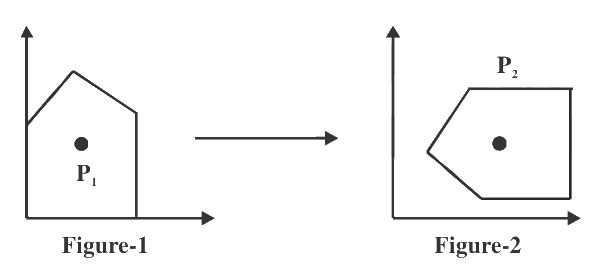
What steps shall be required to rotate an object about the point $\text{P}_1$ (as shown in figure 1) and its placement such that what was at $\text{P}_1$ is now reduced and is at $\text{P}_2$ (as shown in figure 2)?
(I) Translate P1 to origin
(II) Scale as required
(III) Rotate
(IV) Translate to the final position $\text{P}_2$.
a.
I, II and III
b.
II, III and IV
c.
I, III and IV
d.
All of the above.
Correct Answer & Step-by-Step Solution Locked
Sign in free to reveal the correct answer and AI explanation for this question.