According to Coulomb's law, electrostatic force F between two point charges separated by the distance r varies as
a.
$F \propto \frac{1}{r}$
b.
$F \propto r$
c.
$F \propto \frac{1}{r^2}$
Correct Answer
d.
$F \propto r^2$
Step-by-Step AI Explanation
Verified Method
Coulomb's law states that the electrostatic force between two point charges is inversely proportional to the square of the distance between them, mathematically expressed as $F \propto \frac{1}{r^2}$.
Q2mcq1 mark
The maximum electric field that a dielectric medium can withstand without breakdown of dielectric property is
a.
dielectric constant
b.
dielectric strength
Correct Answer
c.
dielectric polarization
d.
electrical susceptibility
Step-by-Step AI Explanation
Verified Method
Dielectric strength is defined as the maximum electric field that a dielectric material can withstand without undergoing electrical breakdown (i.e., becoming conductive).
Q3mcq1 mark
The electric current per unit area of cross-section of a conductor is called
a.
Conductivity
b.
Resistivity
c.
Current density
Correct Answer
d.
Mobility
Step-by-Step AI Explanation
Verified Method
Current density is defined as the electric current $I$ passing per unit area $A$ of cross-section of a conductor, denoted as $J = \frac{I}{A}$.
Q4mcq1 mark
A Galvanometer which is converted to ammeter has
a.
low resistance in series
b.
low resistance in parallel
Correct Answer
c.
high resistance in series
d.
high resistance in parallel
Step-by-Step AI Explanation
Verified Method
To convert a galvanometer into an ammeter, a very low resistance called a shunt must be connected in parallel with the galvanometer to allow most of the current to bypass the meter.
Q5mcq1 mark
The substances which have the tendency to move from stronger to weaker part of external magnetic field are
a.
Diamagnetic
Correct Answer
b.
Ferromagnetic
c.
Paramagnetic
d.
Ferro and Paramagnetic
Step-by-Step AI Explanation
Verified Method
Diamagnetic substances are characterized by their tendency to move from a region of stronger magnetic field to a region of weaker magnetic field when placed in a non-uniform external magnetic field.
Q6mcq
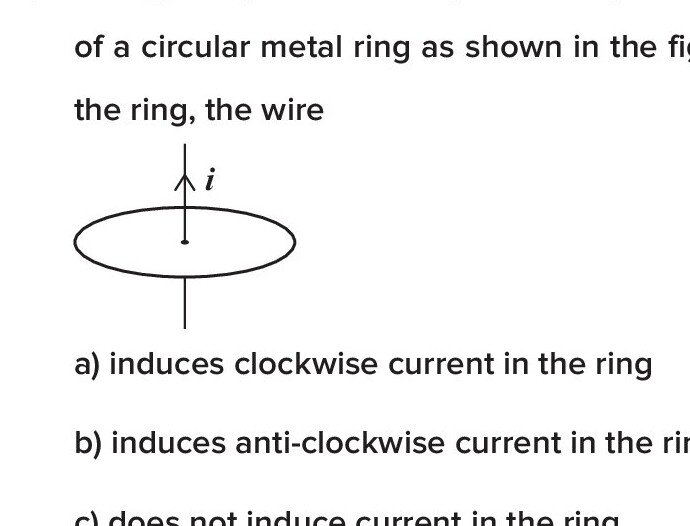
A long straight wire having increasing current at steady rate is placed along the axis of a circular conducting ring with plane of the ring perpendicular to the plane of paper. When viewed from above towards the ring, the wire
a.
induces clockwise current in the ring
b.
induces anti-clockwise current in the ring
c.
does not induce current in the ring
Correct Answer
d.
induces current in the ring, which changes its direction with respect to time.
Step-by-Step AI Explanation
Verified Method
The magnetic field lines produced by a long straight wire carrying current are in concentric circles around the wire. For a ring placed with the wire on its axis, the magnetic flux through the ring is parallel to the plane of the ring (or symmetric such that it doesn't cross the area effectively to change flux), meaning the magnetic flux $\Phi_B = \int \vec{B} \cdot d\vec{A} = 0$ at all times. Since the flux is zero and remains zero as current increases, no induced EMF or current is generated in the ring. Thus, (c) is correct.
Q6mcq1 mark
A long straight wire having increasing current at steady rate is placed along the axis of a circular metal ring as shown in the figure. When viewed from above towards the ring, the wire
a.
induces clockwise current in the ring
b.
induces anti-clockwise current in the ring
c.
does not induce current in the ring
Correct Answer
d.
induces current in the ring which changes its direction with respect to time
Step-by-Step AI Explanation
Verified Method
The magnetic field lines produced by the current in the straight wire are concentric circles lying in planes perpendicular to the wire. Since the wire passes through the center of the ring, the magnetic field lines are always parallel to the plane of the ring. Therefore, the magnetic flux through the ring is zero at all times. Since the flux does not change, no current is induced in the ring.
Q7mcq1 mark
A transformer works on the principle of
a.
Mutual induction
Correct Answer
b.
Self induction
c.
Force on coil in magnetic field
d.
Torque on coil in magnetic field
Step-by-Step AI Explanation
Verified Method
A transformer operates on the principle of mutual induction, where a change in current in the primary coil induces an electromotive force (EMF) in the secondary coil due to the changing magnetic flux linked between them.
Q8mcq1 mark
The existence of electromagnetic waves by a set of equations was given by
a.
Michel Faraday
b.
Andre Ampere
c.
Albert Einstein
d.
JC Maxwell
Correct Answer
Step-by-Step AI Explanation
Verified Method
J.C. Maxwell formulated a set of equations, known as Maxwell's equations, which unified electricity and magnetism and predicted the existence of electromagnetic waves. Faraday and Ampere contributed to the fundamental laws, but the synthesis into the wave equations was by Maxwell. Einstein developed the theory of relativity.
Q9mcq1 mark
The relation between focal length f and radius of curvature R of a spherical mirror is
a.
R = f
b.
R = f/2
c.
f = R/2
Correct Answer
d.
f = 1/R
Step-by-Step AI Explanation
Verified Method
For spherical mirrors, the focal length $f$ is half of the radius of curvature $R$. This is represented by the relationship $f = R/2$.
🎉 10 Free Sample Solutions Completed
Unlock All 48 Questions & Solutions
Sign up free in seconds to unlock step-by-step AI answers for the remaining 38 questions.
Statement I : Wave fronts obtained from a point source of light in an isotropic medium are always spherical at finite distance.
Statement II : Speed of light in an isotropic medium is constant.
a.
Only Statement I is correct
b.
Only Statement II is correct
c.
Both Statement I and Statement II are wrong
d.
Both Statement I and Statement II are correct
Correct Answer & Step-by-Step Solution Locked
Sign in free to reveal the correct answer and AI explanation for this question.
Match the following columns:
Column - I Column - II
a) Isotopes i) Nucleii having same number of neutrons
b) Isobars ii) Nucleii having same number of protons
c) Isotones iii) Nucleii having same number of nucleons
a.
a – ii, b – iii, c – i
b.
a – iii, b – ii, c – i
c.
a – ii, b – i, c – iii
d.
a – iii, b – i, c – ii
Correct Answer & Step-by-Step Solution Locked
Sign in free to reveal the correct answer and AI explanation for this question.
Match the following columns:
Column - I
a) Isotopes
b) Isobars
c) Isotones
Column - II
i) Nucleii having same number of neutrons
ii) Nucleii having same number of protons
iii) Nucleii having same number of nucleons
a.
a – ii, b – iii, c – i
b.
a – iii, b – ii, c – i
c.
a – ii, b – i, c – iii
d.
a – iii, b – i, c – ii
Correct Answer & Step-by-Step Solution Locked
Sign in free to reveal the correct answer and AI explanation for this question.
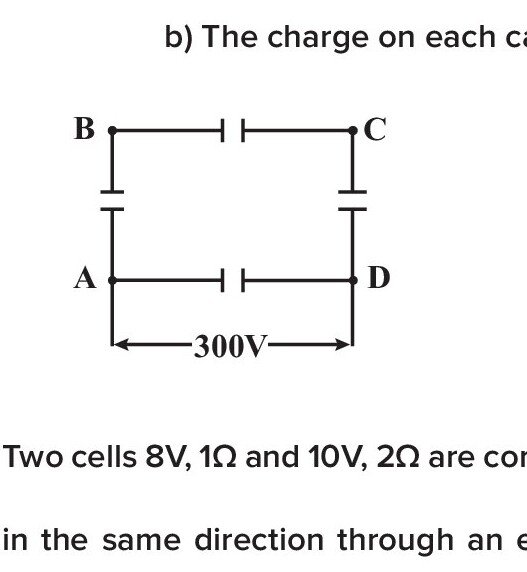
A network of four $9\mu\text{F}$ capacitors is connected to a 300V supply as shown in figure. Determine a) Equivalent capacitance of the network and b) The charge on each capacitor.
Correct Answer & Step-by-Step Solution Locked
Sign in free to reveal the correct answer and AI explanation for this question.
Four $9\mu\text{F}$ capacitors are connected at each side of a square. A 300V supply is connected across adjacent corners of the square. Determine a) Equivalent capacitance across adjacent corners of square and b) the charge on each capacitor.
Correct Answer & Step-by-Step Solution Locked
Sign in free to reveal the correct answer and AI explanation for this question.
Two cells $8\text{V}, 1\Omega$ and $10\text{V}, 2\Omega$ are connected in parallel such that they send currents in the same direction through an external resistance $20\Omega$. Find the current and potential difference across $20\Omega$.
Correct Answer & Step-by-Step Solution Locked
Sign in free to reveal the correct answer and AI explanation for this question.
A sharp object of height $3.0\text{ cm}$ is placed at $21\text{ cm}$ in front of a convex lens of focal length $14\text{ cm}$. Find the position and magnification of the image. What happens to the height of the image if the object is moved further away from the lens?
Correct Answer & Step-by-Step Solution Locked
Sign in free to reveal the correct answer and AI explanation for this question.
The work function of a metal is $2.20\text{ eV}$ when radiation of frequency $6.50 \times 10^{14}\text{ Hz}$ incident on the metal surface photo emission of electrons occurs. Calculate a) energy of incident photon and b) stopping potential of photoelectrons. (Given $h = 6.63 \times 10^{-34}\text{ Js}$ and $e = 1.6 \times 10^{-19}\text{C}$)
Correct Answer & Step-by-Step Solution Locked
Sign in free to reveal the correct answer and AI explanation for this question.