The least common multiple (LCM) of two prime numbers is their product. Since 2 and 3 are prime numbers, their LCM is $2 \times 3 = 6$. Therefore, option (D) is correct.
Q2mcq1 mark
If the lines represented by the equations $a_1x + b_1y + c_1 = 0$ and $a_2x + b_2y + c_2 = 0$ are coincident, then the correct relation is
For two linear equations $a_1x + b_1y + c_1 = 0$ and $a_2x + b_2y + c_2 = 0$, the lines are coincident if they represent the same line, which occurs when their coefficients are proportional: $\frac{a_1}{a_2} = \frac{b_1}{b_2} = \frac{c_1}{c_2}$. Thus, (A) is the correct relation.
Q3mcq1 mark
The quadratic equation in the following is
a.
$x^3 - 6x$
b.
$p(x) = x^2 + 7x$
c.
$3x = 9$
d.
$x^2 + 3x + 4 = 0$
Correct Answer
Step-by-Step AI Explanation
Verified Method
A quadratic equation must be of the form $ax^2 + bx + c = 0$ where $a \neq 0$. Option (D) fits this standard form. Option (A) is a cubic expression, (B) is a quadratic polynomial but not an equation, and (C) is a linear equation.
Q4mcq1 mark
In the following, the shapes which are always similar, are
a.
any two equilateral triangles
Correct Answer
b.
square and rectangle
c.
square and rhombus
d.
any two trapeziums
Step-by-Step AI Explanation
Verified Method
Two polygons are similar if their corresponding angles are equal and their corresponding sides are proportional. Any two equilateral triangles have all angles equal to $60^\circ$ and sides in a fixed ratio, making them always similar. Other shapes listed do not share constant similarity.
Q5mcq1 mark
The volume of a sphere of radius ‘r’ units is
a.
$\frac{2}{3}\pi r^3$ cubic units
b.
$\frac{4}{3}\pi r^3$ cubic units
Correct Answer
c.
$\frac{1}{3}\pi r^3$ cubic units
d.
$\frac{3}{2}\pi r^3$ cubic units
Step-by-Step AI Explanation
Verified Method
The standard formula for the volume $V$ of a sphere with radius $r$ is derived via calculus as $V = \frac{4}{3}\pi r^3$. Option (B) correctly represents this formula.
Q6mcq1 mark
The distance of a point P (x, y) from the origin is
a.
$\sqrt{x^2 - y^2}$
b.
$\sqrt{x + y}$
c.
$\sqrt{x^2 + y^2}$
Correct Answer
d.
$\sqrt{x - y}$
Step-by-Step AI Explanation
Verified Method
The distance formula between two points $(x_1, y_1)$ and $(x_2, y_2)$ is $\sqrt{(x_2-x_1)^2 + (y_2-y_1)^2}$. For a point $(x, y)$ and the origin $(0, 0)$, this becomes $\sqrt{(x-0)^2 + (y-0)^2} = \sqrt{x^2+y^2}$.
Q7mcq1 mark
The common difference of the arithmetic progression -1, -3, -5 ... is
a.
-1
b.
2
c.
-2
Correct Answer
d.
3
Step-by-Step AI Explanation
Verified Method
The common difference $d$ of an AP is found by subtracting a term from its successor: $d = a_2 - a_1$. For the sequence $-1, -3, -5, \dots$, $d = -3 - (-1) = -3 + 1 = -2$.
Q8mcq1 mark
In the given figure ‘O’ is the centre of the circle and the length of the arc APB is $4\pi$ cm. If OB = 9 cm, then the measure of angle $\theta$ is
a.
60°
b.
80°
Correct Answer
c.
85°
d.
70°
Step-by-Step AI Explanation
Verified Method
The length of an arc $l$ is given by $l = \frac{\theta}{360^\circ} \times 2 \pi r$. Given $l = 4\pi$ and $r = 9$, we have $4\pi = \frac{\theta}{360^\circ} \times 2 \times \pi \times 9$. This simplifies to $4\pi = \frac{\theta \times 18\pi}{360^\circ}$, so $4 = \frac{\theta}{20}$, which gives $\theta = 80^\circ$.
Q9short answer1 mark
Write the degree of a linear polynomial.
Step-by-Step AI Explanation
Verified Method
The degree of a linear polynomial is 1.
Q10short answer1 mark
Write the formula to find the total surface area of a cube of edge ‘a’ units.
Step-by-Step AI Explanation
Verified Method
The total surface area of a cube with edge length 'a' is $6a^2$ square units.
🎉 10 Free Sample Solutions Completed
Unlock All 47 Questions & Solutions
Sign up free in seconds to unlock step-by-step AI answers for the remaining 37 questions.
Prove that $6 + \sqrt{2}$ is an irrational number.
OR
The HCF and LCM of two positive integers are respectively 4 and 60. If one of the integers is 20, then find the other integer.
Correct Answer & Step-by-Step Solution Locked
Sign in free to reveal the correct answer and AI explanation for this question.
Find the roots of the quadratic equation $x^2 + 8x + 12 = 0$.
OR
Find the discriminant of the quadratic equation $x^2 + 4x + 5 = 0$ and hence write the nature of the roots.
Correct Answer & Step-by-Step Solution Locked
Sign in free to reveal the correct answer and AI explanation for this question.
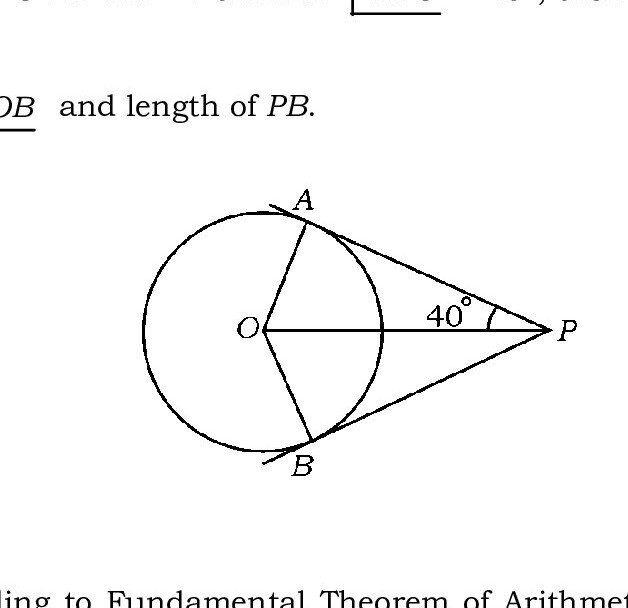
In the given figure, PA and PB are tangents to the circle with centre ‘O’. If PA = 4 cm and $\angle APO = 40^{\circ}$, then find the measure of $\angle AOB$ and length of PB.
Correct Answer & Step-by-Step Solution Locked
Sign in free to reveal the correct answer and AI explanation for this question.
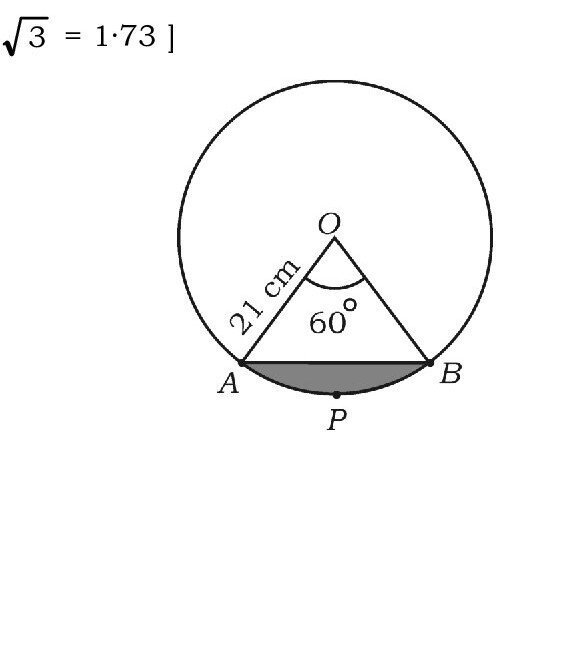
In the given figure ‘O’ is the centre of the circle of radius 21 cm. If $\angle AOB = 60^\circ$, then find the area of the segment APB. [ Take $\sqrt{3} = 1.73$ ]
Correct Answer & Step-by-Step Solution Locked
Sign in free to reveal the correct answer and AI explanation for this question.
The difference between the altitude and base of a right angled triangle is 5 cm. If the area of the triangle is 150 cm$^2$, then find the base and altitude of the triangle.
Correct Answer & Step-by-Step Solution Locked
Sign in free to reveal the correct answer and AI explanation for this question.
Prove that “If a line is drawn parallel to one side of a triangle to intersect the other two sides in distinct points, the other two sides are divided in the same ratio”.
Correct Answer & Step-by-Step Solution Locked
Sign in free to reveal the correct answer and AI explanation for this question.
A solid consisting of a right circular cone of height 120 cm and radius 60 cm standing on a hemisphere of radius 60 cm is placed upright in a right circular cylinder full of water such that it touches the bottom as shown in the figure. If the radius of the cylinder is 60 cm and height is 180 cm, then find the volume of water left in the cylinder in terms of $\pi$.
Correct Answer & Step-by-Step Solution Locked
Sign in free to reveal the correct answer and AI explanation for this question.
A solid is made of a cylinder with a hemispherical depression having the same radius (‘r’ cm) as that of cylinder at the top end as shown in the figure. The volume of the hemispherical depression is 18000 $\pi$ cm$^3$. If the height of the cylinder is 145 cm, then find the total surface area of the solid.
Correct Answer & Step-by-Step Solution Locked
Sign in free to reveal the correct answer and AI explanation for this question.
An arithmetic progression consists of 16 terms. The sum of all its terms is 768. If the last term of the progression is 93, then find the arithmetic progression. Also show that the sum of all the terms of this progression is equal to 3 times the sum of first 16 odd natural numbers using formula.
Correct Answer & Step-by-Step Solution Locked
Sign in free to reveal the correct answer and AI explanation for this question.
A pole and a tower are standing vertically on a level ground. The height of the pole is 6 m and the angle of elevation to the top of the pole from the bottom of the tower is 30°. The angle of elevation to the top of the tower from the top of the pole is 60° as shown in the figure. Find the height of the tower (CD). Also find the distance (AC) between the top of the pole and the top of the tower.
Correct Answer & Step-by-Step Solution Locked
Sign in free to reveal the correct answer and AI explanation for this question.
A box contains 20 cards numbered from 1 to 20. One card is drawn randomly from the box. Find the probability of getting a card bearing a perfect square number.
Correct Answer & Step-by-Step Solution Locked
Sign in free to reveal the correct answer and AI explanation for this question.