The nth term of an Arithmetic Progression is $a_n = 4n + 5$. Then its 5th term is
a.
20
b.
14
c.
25
Correct Answer
d.
24
Step-by-Step AI Explanation
Verified Method
The nth term is given by $a_n = 4n + 5$. To find the 5th term, substitute $n = 5$: $a_5 = 4(5) + 5 = 20 + 5 = 25$. Thus, option (c) is correct.
Q2mcq1 mark
When the quadratic equation $5x^2 = 2 ( 2x + 3 )$ is expressed in the standard form, the constant term obtained is
a.
5
b.
6
c.
4
d.
– 6
Correct Answer
Step-by-Step AI Explanation
Verified Method
Given the equation $5x^2 = 2(2x + 3)$, expand the right side: $5x^2 = 4x + 6$. Moving all terms to the left gives the standard form: $5x^2 - 4x - 6 = 0$. The constant term is $-6$. Thus, option (d) is correct.
Q3mcq1 mark
$x - 2y = 0$ and $3x + 4y - 20 = 0$ are
a.
Intersecting lines
Correct Answer
b.
Coincident lines
c.
Parallel lines
d.
Perpendicular lines
Step-by-Step AI Explanation
Verified Method
For equations $a_1x + b_1y + c_1 = 0$ and $a_2x + b_2y + c_2 = 0$, we compare the ratios: $\frac{a_1}{a_2} = \frac{1}{3}$ and $\frac{b_1}{b_2} = \frac{-2}{4} = -\frac{1}{2}$. Since $\frac{1}{3} \neq -\frac{1}{2}$, the lines are intersecting. Thus, option (a) is correct.
Q4mcq1 mark
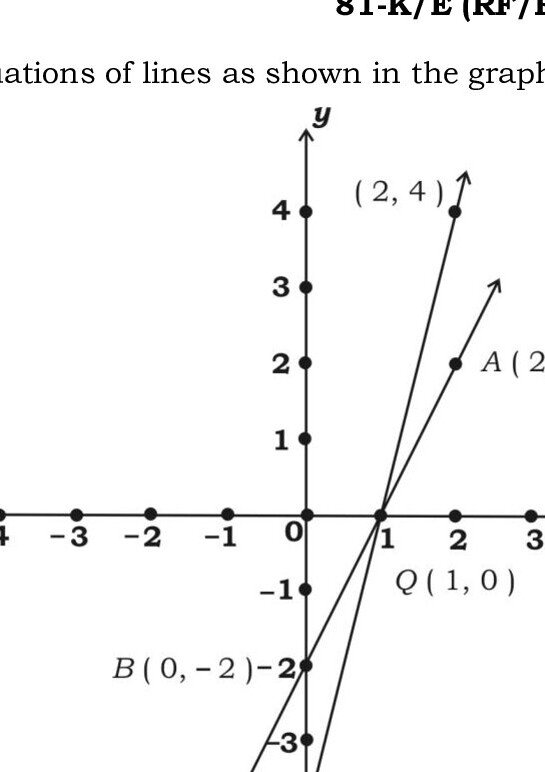
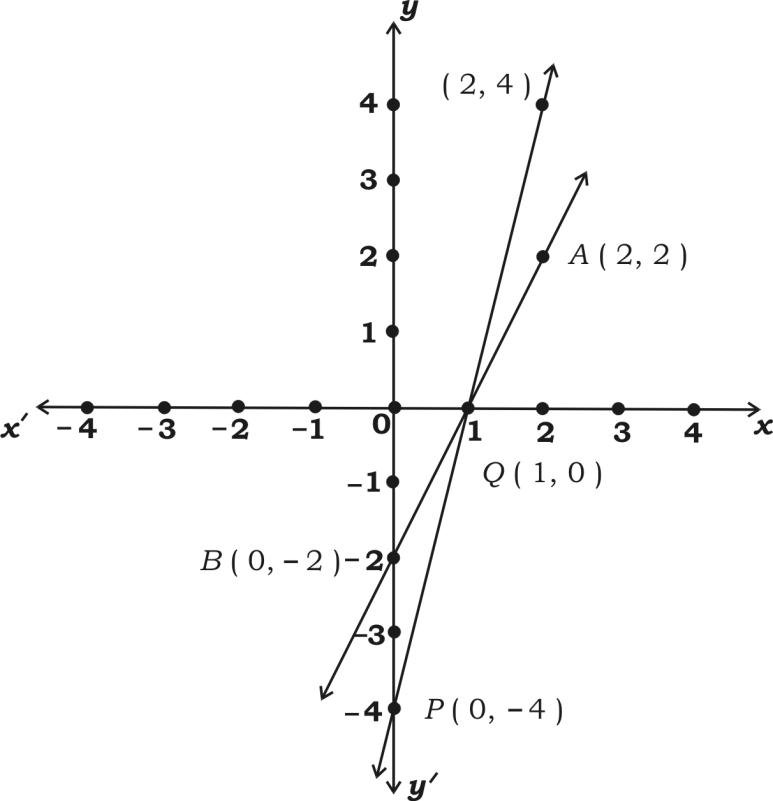
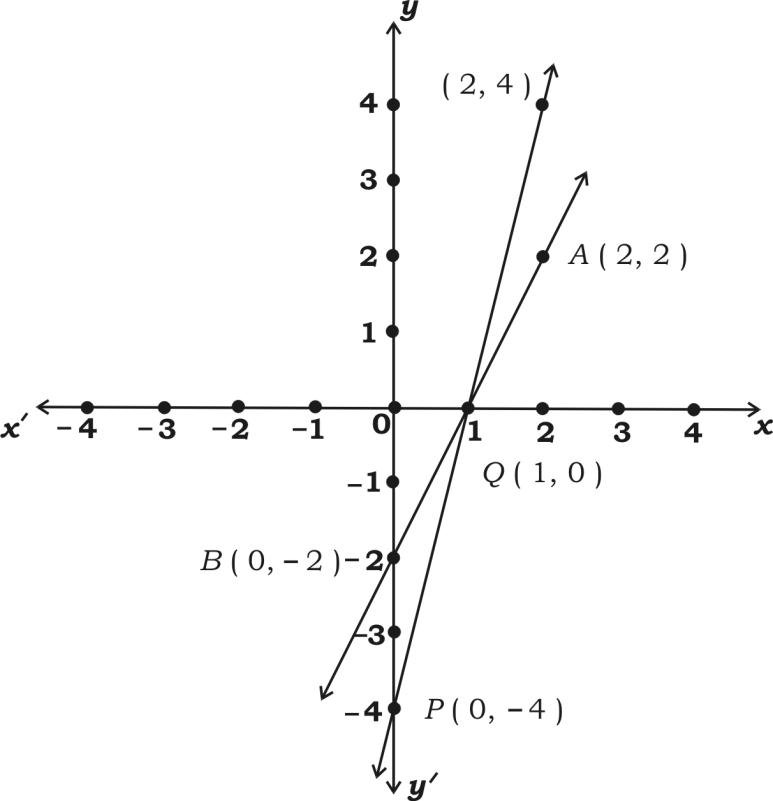
The pair of equations of lines as shown in the graph are
a.
x + y = 1 and 2x – y = 1
b.
2x + y = 2 and x + y = 2
c.
2x – y = 2 and 4x – y = 4
Correct Answer
d.
y – x = 0 and x – y = 1
Step-by-Step AI Explanation
Verified Method
From the graph, Line 1 passes through $(1, 0)$ and $(0, -2)$. Using the intercept form $\frac{x}{a} + \frac{y}{b} = 1$, we get $\frac{x}{1} + \frac{y}{-2} = 1$, which simplifies to $2x - y = 2$. Line 2 passes through $(1, 0)$ and $(2, 4)$. Its slope is $\frac{4-0}{2-1} = 4$. Using $y - y_1 = m(x - x_1)$, $y - 0 = 4(x - 1) \implies y = 4x - 4 \implies 4x - y = 4$. Thus, option (c) is correct.
Q5mcq1 mark
If the pair of linear equations in two variables $a_1x + b_1y + c_1 = 0$ and $a_2x + b_2y + c_2 = 0$ are parallel lines then the correct relation of their coefficients is
A pair of linear equations represents parallel lines if and only if the ratios of the coefficients of $x$ and $y$ are equal, but the ratio of the constants is different, i.e., $\frac{a_1}{a_2} = \frac{b_1}{b_2} \neq \frac{c_1}{c_2}$. Thus, option (a) is correct.
Q6mcq1 mark
If the pair of lines $2x + 3y + 7 = 0$ and $ax + by + 14 = 0$ are coincident lines then the values of ‘a’ and ‘b’ are respectively equal to
a.
2 and 3
b.
3 and 2
c.
4 and 6
Correct Answer
d.
1 and 2
Step-by-Step AI Explanation
Verified Method
For coincident lines, the condition is $\frac{a_1}{a_2} = \frac{b_1}{b_2} = \frac{c_1}{c_2}$. Here, $\frac{2}{a} = \frac{3}{b} = \frac{7}{14} = \frac{1}{2}$. Thus, $\frac{2}{a} = \frac{1}{2} \implies a = 4$ and $\frac{3}{b} = \frac{1}{2} \implies b = 6$. Option (c) is correct.
Q7mcq1 mark
Which of the following is an Arithmetic Progression ?
a.
1, – 1, – 2, ..........
b.
1, 5, 9, ..............
Correct Answer
c.
2, – 2, 2, – 2, ............
d.
1, 2, 4, 8, ..........
Step-by-Step AI Explanation
Verified Method
An Arithmetic Progression requires a constant common difference ($d = a_{n} - a_{n-1}$). For option (b): $5-1=4$, $9-5=4$. Since the difference is constant, it is an AP. The others do not have a constant difference.
Q8mcq1 mark
The 11th term of the Arithmetic Progression – 3, – 1, 1, 3, ....... is
a.
23
b.
– 23
c.
– 17
d.
17
Correct Answer
Step-by-Step AI Explanation
Verified Method
The general term of an AP is given by $a_n = a + (n-1)d$. Here, the first term $a = -3$ and the common difference $d = -1 - (-3) = 2$. For the 11th term ($n=11$): $a_{11} = -3 + (11-1)(2) = -3 + 10(2) = -3 + 20 = 17$. Option D is correct.
Q9mcq
The sum of the first 10 terms of an Arithmetic Progression is 155 and the sum of the first 9 terms of the same progression is 126 then the 10th term of the progression is
a.
27
b.
126
c.
29
Correct Answer
d.
25
Step-by-Step AI Explanation
Verified Method
The $n^{th}$ term of an AP can be found using the formula $a_n = S_n - S_{n-1}$. Given $S_{10} = 155$ and $S_9 = 126$, the 10th term is $a_{10} = 155 - 126 = 29$. Option C is correct.
Q10mcq
If one root of the equation $x^2 + ax + 6 = 0$ is 2, then the value of ‘a’ is
a.
7
b.
7/2
c.
– 7
d.
-7/2
No explanation saved for this question yet.
🎉 10 Free Sample Solutions Completed
Unlock All 41 Questions & Solutions
Sign up free in seconds to unlock step-by-step AI answers for the remaining 31 questions.
The angle of elevation of the top of a tower from a point on the ground, which is 30 metres away from the foot of the tower, is 30°. Then the height of the tower is
a.
10 m
b.
30 m
c.
3√10 m
d.
30√3 m
Correct Answer & Step-by-Step Solution Locked
Sign in free to reveal the correct answer and AI explanation for this question.
$\Delta ABC \sim \Delta PQR$. Area of $\Delta ABC = 64 \text{ cm}^2$ and the area of $\Delta PQR = 100 \text{ cm}^2$. If $AB = 8 \text{ cm}$ then the length of $PQ$ is
a.
12 cm
b.
15 cm
c.
10 cm
d.
8 cm
Correct Answer & Step-by-Step Solution Locked
Sign in free to reveal the correct answer and AI explanation for this question.
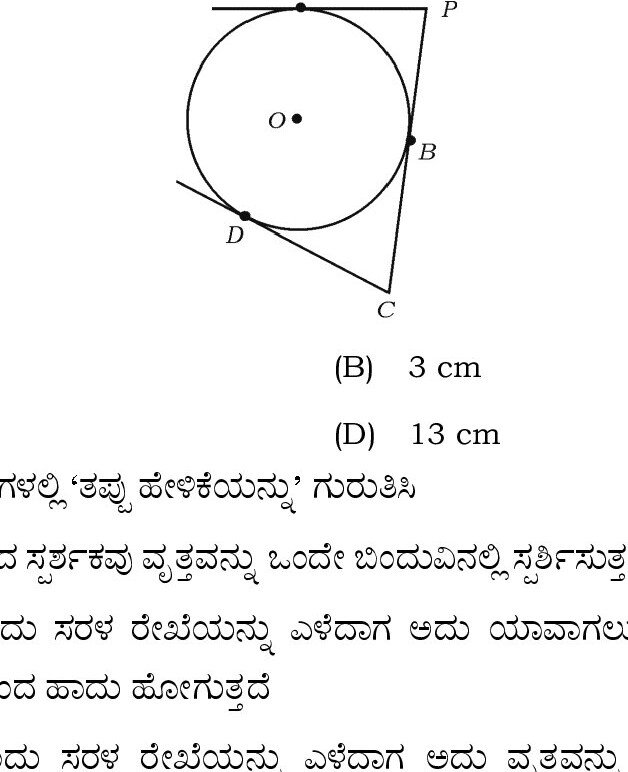
In the given figure PA, PBC and CD are the tangents to a circle with centre O. If PC = 8 \text{ cm} and AP = 5 \text{ cm}, the length of the tangent CD is
a.
5 \text{ cm}
b.
3 \text{ cm}
c.
8 \text{ cm}
d.
13 \text{ cm}
Correct Answer & Step-by-Step Solution Locked
Sign in free to reveal the correct answer and AI explanation for this question.