Assuming the nitrogen molecule is moving with $r. m. s$ . velocity at $400\,K$ , the de-Broglie wave length of
nitrogen molecule is close to : (Given : nitrogen molecule weight : $4 .64 \times 10^{-26} kg$ , Boltzman constant :
$1 .38 \times 10^{-23} J\,K^{-1}$ , Planck constant : $6 .63 \times 10^{-34} J\,s$ )
$\circ \circ$
a.
$0. 24 A$
$\circ$
Correct Answer
b.
$0. 20 A$
$\circ$
c.
$0. 34 A$
d.
$0. 44 A$
No explanation saved for this question yet.
Q2mcq
A double convex lens has power $P$ and same radii of curvature $r$ of both the surfaces. The radius of curvature
of a surface of a plano-convex lens made of the same material with power $1. 5\,P$ is :
a.
$2R$
b.
$\frac{R}{2}$
c.
$\frac{3R}{2}$
d.
$\frac{R}{3}$
Correct Answer
No explanation saved for this question yet.
Q3mcq
A circuit to verify Ohm's law uses ammeter and voltmeter in series or parallel connected corrected correctly to
the resistor. In the circuit :
a.
ammeter is always used in parallel and voltmeter
is series
b.
Both ammeter and voltmeter must be connected
in parallel
c.
ammeter is always connected in series and
voltmeter in parallel
Correct Answer
d.
Both ammeter and voltmeter must be connected
in series
No explanation saved for this question yet.
Q4mcq
A charged particle going around in a circle can be considered to be a current loop. A particle of a mass $m$
carrying charge $q$ is moving in a plane with speed $v$ under the influence of magnetic field $\vec{B}$ . The magnetic
moment of this moving particle is :
a.
$\frac{mv^{2}\vec{B}}{2B^{2}}$
b.
$- \frac{mv^{2}\vec{B}}{2$\pi$B^{2}}$
c.
$-\frac{mv^{2}\vec{B}}{B^{2}}$
d.
$- \frac{mv^{2}\vec{B}}{2B^{2}}$
Correct Answer
No explanation saved for this question yet.
Q5mcq
When a particle of mass $m$ is attached to a vertical spring of spring constant $k$ and released, its motion, is
described by $y(t) = y_{0}sin^{2}$ $\omega$ $t$ , where ' $y$ ' is measured from the lower end of upstretched spring. Then $\omega$is :
a.
$\frac{1}{2}\sqrt{\,} \frac{g}{y_{0}}$
b.
$\sqrt{\,} \frac{g}{y_{0}}$
c.
$\sqrt{\,} \frac{g}{2y_{0}}$
Correct Answer
d.
$\sqrt{\,} \frac{2g}{y_{0}}$
No explanation saved for this question yet.
Q6mcq
Two planets have masses $M$ and $16\,M$ and their radii are a and $2a$ , respectively. The separation between the
centres of the planets is $10a$ . A body of mass $m$ is fired from the surface of the larger planet towards the smaller
planet along the line joining their centres. For the body to be able to reach at the surface of smaller planet, the
minimum firing speed needed is :
In a dilute gas at pressure $P$ and temperature ' $t$ ', the time between successive collision of a molecule varies with
$T$ as :
a.
$T$
b.
$\frac{1}{\sqrt{T}}$
Correct Answer
c.
$\frac{1}{T}$
d.
$\sqrt{T}$
No explanation saved for this question yet.
Q8nat
A Young's double-slit experiment is performed using monochromatic light of wavelength $\lambda$. The intensity of
light at a point on the screen, where the path difference is $\lambda$, is $K$ units. The intensity of light at a point where
the path difference is $\frac{$\lambda$}{6}$ is given by $\frac{nK}{12}$ , where $n$ is an integer. The value of $n$ is
✓ Accepted Answer:9
No explanation saved for this question yet.
Q9nat
The centre of mass of a solid hemisphere of radius $8\, cm$ is $x\, cm$ from the centre of the flat surface. Then
value of $x$ is
✓ Accepted Answer:3
No explanation saved for this question yet.
Q10nat
In a series $LR$ circuit, power of $400\,W$ is dissipated from a source of $250\,V, \,50\, Hz$ . The power factor of the
circuit is $0. 8$ . In order to bring the power factor to unity, a capacitor of value $C$ is added in series to the $L$ and
$R$ . Taking the value of $C$ as $( \frac{n}{3$\pi$})$ $\mu$ $F$ , then value of $n$ is
✓ Accepted Answer:400
No explanation saved for this question yet.
🎉 10 Free Sample Solutions Completed
Unlock All 75 Questions & Solutions
Sign up free in seconds to unlock step-by-step AI answers for the remaining 65 questions.
A student measuring the diameter of a pencil of circular cross-section with the help of a vernier scale records
the following four readings $5. 50\, mm$ , $5. 55\, mm$ , $5. 34\, mm$ , $5. 65\, mm$ . The average of these four reading is
$5. 5375\, mm$ and the standard deviation of the data is $0. 07395\, mm$ . The average diameter of the pencil should
therefore be recorded as :
a.
$(5 .5375 \pm 0 .0739) mm$
b.
$(5 .5375 \pm 0 .0740) mm$
c.
$(5 .538 \pm 0 .074) mm$
d.
$(5 .54 \pm 0 .07) mm$
Correct Answer & Step-by-Step Solution Locked
Sign in free to reveal the correct answer and AI explanation for this question.
Particle $A$ of mass $m_{1}$ moving with velocity $(\sqrt{3}ˆi +ˆj)ms^{-1}$ collides with another particle $B$ of mass $m_{2}$
which is at rest initially. Let $\vec{v}_{1}$ and $\vec{v}_{2}$ be the velocities of particles $A$ and $B$ after collision respectively. If
$m_{1} = 2m_{2}$ and after collision $\vec{v}_{1}- (ˆi + ˆj\sqrt{3} )ms^{-1}$ , the angle between $\vec{v}_{1}$ and $\vec{v}_{2}$ is :
a.
$15^{^{\circ}}$
b.
$60^{^{\circ}}$
c.
$-45^{^{\circ}}$
d.
$105^{^{\circ}}$
Correct Answer & Step-by-Step Solution Locked
Sign in free to reveal the correct answer and AI explanation for this question.
$-^{Given the masses of various atomic particlesm}P^{= 1, 0072 u,m}n^{= 1, 0087 u,m}e^{= 0 .000548}^{u,m}v^{= 0,}$
$--_{m_{d}} = 2 .0141 u$ , where $p =$ proton, $n \equiv$ neutron, $e \equiv$ electron, $v \equiv$ antineutrino and $d \equiv$ deuteron. Which of the
following process is allowed by momentum and energy conservation :
a.
$n + n \rightarrow \rightarrow$ deuterium atom (electron bound to the
nucleus)
b.
$-p \rightarrow n + e\rightarrow^{+} + v$
c.
$n + p \rightarrow d +\rightarrow$ $\gamma$
d.
$e^{+} + e^{-} \rightarrow \rightarrow$ $\gamma$
Correct Answer & Step-by-Step Solution Locked
Sign in free to reveal the correct answer and AI explanation for this question.
A square loop of side $2a$ and carrying current $I$ is kept in $xz$ plane with its centre at origin. A long wire
carrying the same current $I$ is placed parallel to $z$ -axis and passing through point $(0, \,b, \,0), \,(b >> a)$ . The
magnitude of torque on the loop about $z$ -axis will be :
A fluid is flowing through a horizontal pipe of varying cross-section, with $v ms^{-1}$ at a point where the pressure
is $P$ Pascal. At another point where pressure $\frac{P}{2}$ Pascal its speed is $V\, ms^{-1}$ . If the density of the fluid is
$\rho$ $kg -m^{-3}$ and the flow is streamline, then $V$ is equal to
a.
$\sqrt{\frac{P}{$\rho$}} +$ υ
b.
$\sqrt{\frac{2P}{$\rho$}} +$ υ $^{2}$
c.
$\sqrt{\frac{P}{2$\rho$}} +$ υ $^{2}$
d.
$\sqrt{\frac{P}{$\rho$}} +$ υ $^{2}$
Correct Answer & Step-by-Step Solution Locked
Sign in free to reveal the correct answer and AI explanation for this question.
The linear mass density of a thin rod $AB$ of length $L$ varies from $A$ to $B$ as $\lambda$ $(x) =$ $\lambda$ $_{0}(1 + \frac{x}{L})$ , where $x$ is the
distance from $A$ . If $M$ is the mass of the rod then its moment of inertia about an axis passing through $A$ and
perpendicular to the rod :
a.
$\frac{5}{12}ML^{2}$
b.
$\frac{7}{18}ML^{2}$
c.
$\frac{2}{5} ML^{2}$
d.
$\frac{3}{7} ML^{2}$
Correct Answer & Step-by-Step Solution Locked
Sign in free to reveal the correct answer and AI explanation for this question.
A particle moving in the $xy$ -plane experiences a velocity dependent force $\vec{F}= k($ υ $_{y}ˆi +$ υ $_{x}ˆj)$ , where υ $_{x}$ and υ $_{y}$
$\rightarrow \rightarrow$
are the $x$ and $y$ components of its velocity υ. If $\vec{a}$ is the acceleration of the particle, then which of the following
statements is true for the particle ?
$\rightarrow \rightarrow$
a.
quantity υ $\times \vec{a}$ is constant in time
b.
$\vec{F}$ arises due to a magnetic field
$\rightarrow \rightarrow$
c.
kinetic energy of particle is constant in time
d.
quantity υ $. \vec{a}$ is constant in time
Correct Answer & Step-by-Step Solution Locked
Sign in free to reveal the correct answer and AI explanation for this question.
When a car is at rest, its driver sees rain drops falling on it vertically. When driving the car with speed $v$ , he sees
that rain drops coming at an angle $60^{\circ }$ from the horizontal. On further increasing the speed of the car to
$(1 +$ $\beta$ $)v$ , this angle changes to $45^{\circ }$ . The value of $\beta$is close to :
a.
$0. 50$
b.
$0. 41$
c.
$0. 37$
d.
$0. 73$
Correct Answer & Step-by-Step Solution Locked
Sign in free to reveal the correct answer and AI explanation for this question.
Consider the force $F$ on a charge ' $q$ ' due to a uniformly charged spherical shell of radius $R$ carrying charge $Q$
distributed uniformly over it. Which one of the following statements is true for $F$ , if ' $q$ ' is placed at distance $r$
from the centre of the shell?
a.
$F = \frac{1}{4$\pi$\in _{0}} \frac{Qq}{R^{2}}$ for $r < R$
b.
$\frac{1}{4$\pi$\in _{0}} \frac{qQ}{R^{2}} > F > 0$ for $r < R$
c.
$F = \frac{1}{4$\pi$\in _{0}} \frac{Qq}{r^{2}}$ for $r > R$
d.
$F = \frac{1}{4$\pi$\in _{0}} \frac{Qq}{r^{2}}$ for all $r$
Correct Answer & Step-by-Step Solution Locked
Sign in free to reveal the correct answer and AI explanation for this question.
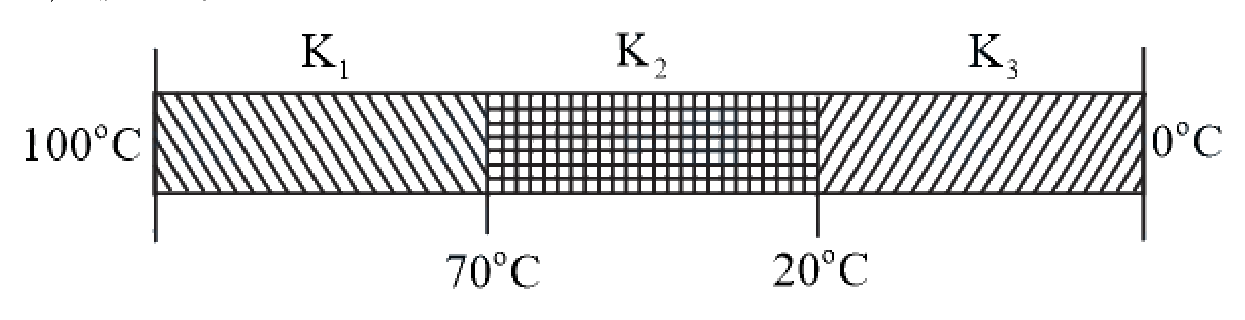
Three rods of identical cross-section and length are made of three different materials of thermal conductivity
$K_{1}, \,K_{2}$ and $K_{3}$ , respectively. They are joined together at their ends to make a long rod (see figure). One end
of the long rod is maintained at $100^{\circ}C$ and the other at $0^{\circ}C$ (see figure). If the joints of the rod are at $70^{\circ}C$ and
$20^{\circ}C$ in steady and there is no loss of energy from the surface of the rod, the correct relationship between
$K_{1}, K_{2}$ and $K_{3}$ is :
a.
$K_{1} :K_{3} = 2 : 3$ ,
$K_{2} :K_{3} = 2 : 5$
b.
$K_{1} <K_{2} <K_{3}$
c.
$K_{1} :K_{2} = 5 : 2$ ,
$K_{1} :K_{3} = 3 : 5$
d.
$K_{1} >K_{2} >K_{3}$
Correct Answer & Step-by-Step Solution Locked
Sign in free to reveal the correct answer and AI explanation for this question.
Two identical electric point dipoles have dipole have dipole moments $\vec{p}_{1} = pˆi$ and $\vec{p}_{2} = -pˆi$ and are held on
the $x$ -axis at distance ' $a$ ' from each other. When released, they move along the $x$ -axis with the direction of their
dipole moments remaining unchanged. If the mass of each dipole is ' $m$ ', their speed when they are infinitely far
apart is :
The correct match between item - I and item - II is :
Item - I Item - II
(a) Natural rubber (I) 1, 3-butadiene + styrene
(b) Neoprene (II) 1, 3-butadiene
(c) Buna-N (III) chloroprene
(d) Buna-S (IV) Isoprene
a.
(a)-(III), (b)-(IV), (c)-(I), (d)-(II)
b.
(a)-(III), (b)-(IV), (c)-(II), (d)-(I)
c.
(a)-(IV), (b)-(III), (c)-(II), (d)-(I)
d.
(a)-(IV), (b)-(III), (c)-(I), (d)-(II)
Correct Answer & Step-by-Step Solution Locked
Sign in free to reveal the correct answer and AI explanation for this question.
The rate of a reaction decreased by $3. 555$ times when the temperature was changed from $40\,^{\circ}C\, to \,30\,^{\circ}C$ . the
activation energy (in $kJ \, mol^{-1}$ ) of the reaction is ________ .
Numerical answer locked.
Correct Answer & Step-by-Step Solution Locked
Sign in free to reveal the correct answer and AI explanation for this question.
A solution of phenol in chloroform when treated with aqueous $NaOH$ gives compound $P$ as a major product.
The mass percentage of carbon in $P$ is ______ .
Numerical answer locked.
Correct Answer & Step-by-Step Solution Locked
Sign in free to reveal the correct answer and AI explanation for this question.
A set of solutions is prepared using $180\,g$ of water as a solvent and $10\,g$ of different non-volatile solutes $A, \,B$
and $C$ . The relative lowering of vapour pressure in the presence of these solutes are in the order [Given, molar
mass of $A = 100\,g\, mol^{-1} \,; \,B = 200\,g\, mol^{-1} \,; \,C = 10, 000\,g\, mol^{-1}$ ]
a.
$B > C > A$
b.
$C > B > A$
c.
$A > B > C$
d.
$A > C > B$
Correct Answer & Step-by-Step Solution Locked
Sign in free to reveal the correct answer and AI explanation for this question.
For Freundlich adsorption isotherm, a plot of $log \,(x/m)\,(y -axis)$ and $log \,p(x -axis)$ gives a straight line,
the intercept and slope fo rthe line is $0. 4771\, and \,2$ , respectively. The mass of gas, adsorbed per gram of
adsorbent if the initial pressure is $0. 04\, atm$ is _____ $\times 10^{-4}g$ .
Numerical answer locked.
Correct Answer & Step-by-Step Solution Locked
Sign in free to reveal the correct answer and AI explanation for this question.
The correct match between Item-I (starting material) and Item-II (reagent) for the preparation of benzaldehyde
is :
Item-I Item-II
(I) Benzene (P) $HCl$ and $SnCl_{2}, \,H_{3}O+$
(II) Benzonitrile (Q) $H_{2}, \,Pd -BaSO_{4}, S$ and quinoline
(III) Benzoyl Chloride (R) $Co, \, HCl \, and \, AlCl_{3}$
a.
(I)-(Q), (II)-(R) and (III)-(P)
b.
(I)-(P), (II)-(Q) and (III)-(R)
c.
(I)-(R), (II)-(P) and (III)-(Q)
d.
(I)-(R), (II)-(Q) and (III)-(P)
Correct Answer & Step-by-Step Solution Locked
Sign in free to reveal the correct answer and AI explanation for this question.
Match the following compounds (Column-I) with their uses (Column-II)
S. No. Column-I S.No. Column-II
(I) $Ca (OH)_{2}$ (A) casts of statues
(II) $NaCl$ (B) white wash
(III) $CaSO_{4}\cdot \frac{1}{2}H_{2}O$ (C) antacid
(IV) $CaCO_{3}$ (D) washing soda preparation
a.
(I)-(D), (II)-(A), (III)-(C), (IV)-(B)
b.
(I)-(B), (II)-(D), (III)-(A), (IV)-(C)
c.
(I)-(B), (II)-(C), (III)-(D), (IV)-(A)
d.
(I)-(D), (II)-(C), (III)-(B), (IV)-(A)
Correct Answer & Step-by-Step Solution Locked
Sign in free to reveal the correct answer and AI explanation for this question.
The value of $K_{c}\, us \,64\, at \,800\,K$ for the reaction
$N_{2}(g) + 3H_{2}(g) \rightarrow 2\, NH\rightarrow_{3}\,(g)$
The value of $K_{c}$ for the following reaction is :
$NH_{3}\,(g) \rightarrow \rightarrow \frac{1}{2}\,N_{2}\,(g) + \frac{3}{2}\,H_{2} (g)$
a.
$1/64$
b.
$8$
c.
$1/4$
d.
$1/8$
Correct Answer & Step-by-Step Solution Locked
Sign in free to reveal the correct answer and AI explanation for this question.
Match the following :
Test/Method Reagent
(i) Lucas Test (a) $C_{6}H_{5}SO_{2}Cl / aq. \, KOH$
(ii) Dumas method (b) $HNO_{3}/ AgNO_{3}$
(iii) Kjeldahl's method (c) $CuO / CO_{3}$
(iv) Hinsberg Test (d) Conc. $HCl$ and $ZnCl_{2}$
(e) $H_{2}SO_{4}$
a.
(i)-(d), (ii)-(c), (iii)-(b), (iv)-(e)
b.
(i)-(b), (ii)-(d), (iii)-(e), (iv)-(a)
c.
(i)-(d), (ii)-(c), (iii)-(e), (iv)-(a)
d.
(i)-(b), (ii)-(a), (iii)-(c), (iv)-(d)
Correct Answer & Step-by-Step Solution Locked
Sign in free to reveal the correct answer and AI explanation for this question.
For a reaction $4\,M(s) + nO_{2}(g) \rightarrow 2M\rightarrow_{2}O_{n}(s)$
The free energy change is plotted as a function of temperature. The temperature below which the oxide is
stable could be inferred from the plot as the point at which :
a.
the slope change from negative to positive
b.
the free energy change show a change from
negative to positive value
c.
the slope changes from positive to negative
d.
the slope changes from positive to zero
Correct Answer & Step-by-Step Solution Locked
Sign in free to reveal the correct answer and AI explanation for this question.
A crystal is made up of metal ions $'M_{1}'$ and $'M_{2}'$ and oxide ions. Oxide ions form a ccp lattice structure. The
cation $'M_{1}'$ occupies $50%$ of octahedral voids and the cation $'M_{2}'$ occupies $12. 5\,%$ of tetrahedral voids of
oxide lattice. The oxidation numbers of $'M_{1}'$ and $'M_{2}'$ are respectively :
a.
$+2, \, + 4$
b.
$+1, \, + 3$
c.
$+3, \, + 1$
d.
$+4, \, + 2$
Correct Answer & Step-by-Step Solution Locked
Sign in free to reveal the correct answer and AI explanation for this question.
If the solubility product of $AB_{2}$ is $3. 20 \times 10^{-11}\,M^{3}$ , then the solubility of $AB_{2}$ in pure water is _______
$\times 10^{-4}\, mol \,L^{-1}$
[Assuming that neither kind of ion reacts with water]
Numerical answer locked.
Correct Answer & Step-by-Step Solution Locked
Sign in free to reveal the correct answer and AI explanation for this question.
Reaction of an inorganic sulphite $X$ with dilute $H_{2}SO_{4}$ generated compound $Y$ . Reaction of $Y$ with $NaOH$
gives $X$ . Further, the reaction of $X$ with $Y$ and water affords compound $Z, \,Y$ and $X$ , respectively, are :
a.
$SO_{2}$ and $Na_{2}SO_{3}$
b.
$SO_{3}$ and $NaHSO_{3}$
c.
$SO_{2}$ and $NaHSO_{3}$
d.
$S$ and $Na_{2}SO_{3}$
Correct Answer & Step-by-Step Solution Locked
Sign in free to reveal the correct answer and AI explanation for this question.
If the normal at an end of latus rectum of an ellipse passes through an extremity of the minor axis, then the
eccentricity $e$ of the ellipse satisfies :
a.
$e^{4} + 2e^{2} -1 = 0$
b.
$e^{2} + e -1 = 0$
c.
$e^{4} + e^{2} -1 = 0$
d.
$e^{2} + 2e -1 = 0$
Correct Answer & Step-by-Step Solution Locked
Sign in free to reveal the correct answer and AI explanation for this question.
Consider the statement: "For an integer $n$ , if $n^{3} -1$ is even, then $n$ is odd". The contrapositive statement of
this statement is:
(1) For an integer $n$ , if $n$ is even, then $n^{3} -1$ is odd. (2) For an integer $n$ , if $n^{3} -1$ is not even, then $n$ is
not odd.
(3) For an integer $n$ , if $n$ is even, then $n^{3} -1$ is even.(4) For an integer $n$ , if $n$ is odd, then $n^{3} -1$ is even.
Correct Answer & Step-by-Step Solution Locked
Sign in free to reveal the correct answer and AI explanation for this question.
If the tangent to the curve, $y = f(x) = x\, log_{e}x, (x > 0)$ at a point $(c, \,f(c))$ is parallel to the line-segment
joining the points $(1, \,0)$ and $(e, \,e)$ ,then $c$ is equal to :
a.
$\frac{e-1}{e}$
b.
$e^{(}\frac{1}{e-1}^{)}$
c.
$e^{(}\frac{1}{1-e}^{)}$
d.
$\frac{1}{e-1}$
Correct Answer & Step-by-Step Solution Locked
Sign in free to reveal the correct answer and AI explanation for this question.
Consider the data on $x$ taking the values $0, \,2, \,4, \,8, \,. . . . . , \,2^{n}$ with frequencies $^{n}C_{0}, \,^{n}C_{1}, \,^{n}C_{2}, . . . . , \,^{n}C_{n}$
respectively. If the mean of this data is $\frac{728}{2^{n}}$ , then $n$ is equal to ....... .
Numerical answer locked.
Correct Answer & Step-by-Step Solution Locked
Sign in free to reveal the correct answer and AI explanation for this question.
Let $L$ denote the line in the $xy$ -plane with $x$ and $y$ intercepts as $3$ and $1$ respectively. Then the image of the
point $(-1, \, -4)$ in the line is :
a.
$(\frac{11}{5}, \,\frac{28}{5})$
b.
$(\frac{29}{5}, \,\frac{8}{5})$
c.
$(\frac{8}{5} , \,\frac{29}{5})$
d.
$(\frac{29}{5}, \,\frac{11}{5} )$
Correct Answer & Step-by-Step Solution Locked
Sign in free to reveal the correct answer and AI explanation for this question.
For a suitably chosen real constant $a$ , let a function, $f\, : \,R - {-a} R$ be defined by $f(x) = \frac{a-x}{a+x}$ .
Further supposed that for any real number $x \neq -a,$ and $f(x) \neq -a, \,(\vec{f}of)(x) = x$ . Then $f(-\frac{1}{2})$ is equal to :
a.
$\frac{1}{3}$
b.
$- \frac{1}{3}$
c.
$-3$
d.
$3$
Correct Answer & Step-by-Step Solution Locked
Sign in free to reveal the correct answer and AI explanation for this question.
The sum of distinct values of $\lambda$ for which the system of equations :
$(\lambda -1)\,x+ (3\lambda + 1)\,y+ 2\lambda z= 0$
$($ $\lambda$ $-1)\,x + (4$ $\lambda$ $-2)\,y + ($ $\lambda$ $+ 3)\,z = 0$
$2x + (3$ $\lambda$ $+ 1)\,y + 3\,($ $\lambda$ $-1)\,z = 0$ ,
Has non-zero solutions, is ....... .
Numerical answer locked.
Correct Answer & Step-by-Step Solution Locked
Sign in free to reveal the correct answer and AI explanation for this question.
Let $f :R\rightarrow \rightarrow R$ be a function defined by $f(x) = max \,{x,x^{2}}$ .Let $S$ denote the set of all points in $R$ ,where $f$
is not differentiable.Then :
a.
${0, 1}$
b.
${0}$
c.
$\phi$(an empty set)
d.
${1}$
Correct Answer & Step-by-Step Solution Locked
Sign in free to reveal the correct answer and AI explanation for this question.
The common difference of the $A. P. \,b_{1}, \,b_{2}, . . . . , b_{m}$ is $2$ more than common difference of
$A. P. \,a_{1}, \,a_{2}, \,. . . . . , \,a_{n}$ . If $a_{40} = -159, \,a_{100} = -399$ and $b_{100} = a_{70}$ , then $b_{1}$ is equal to :
a.
$81$
b.
$-127$
c.
$-81$
d.
$127$
Correct Answer & Step-by-Step Solution Locked
Sign in free to reveal the correct answer and AI explanation for this question.
The number of words (with or without meaning) that can be formed from all the letters of the word
$''LETTER''$ in which vowels never come together is.....
Numerical answer locked.
Correct Answer & Step-by-Step Solution Locked
Sign in free to reveal the correct answer and AI explanation for this question.
Suppose that a function $f :R \rightarrow R\rightarrow$ satisfies $f(x + y) = f(x)\,f(y)$ for all $x, \,y\,$ $\epsilon$ $\,R$ and $f(1) = 3$ . If
$\sum ^{n}_{i=1} f(i) = 363$ , then $n$ is equal to ..... .
Numerical answer locked.
Correct Answer & Step-by-Step Solution Locked
Sign in free to reveal the correct answer and AI explanation for this question.
$|||$
If $\vec{x}$ and $\vec{y}$ be two non-zero vectors such that $\vec{x}+ \vec{y} = \vec{x}$ and $2\vec{x}+$ $\lambda$ $\vec{y}$ is perpendicular to $\vec{y}$ , then the value of
$\lambda$is ...... .
Numerical answer locked.
Correct Answer & Step-by-Step Solution Locked
Sign in free to reveal the correct answer and AI explanation for this question.
If $y=( \frac{2}{$\pi$}x-1)cosecx$ is the solution of the differential equation, $\frac{dy}{dx} +p(x)y= -\frac{2}{$\pi$}cosecx, \,0 <x< \frac{$\pi$}{2}$ ,
then the function $p(x)$ is equal to :
a.
$cotx$
b.
$cosecx$
c.
$secx$
d.
$tanx$
Correct Answer & Step-by-Step Solution Locked
Sign in free to reveal the correct answer and AI explanation for this question.
The set of all real values $\lambda$for which the function $f(x) =(1 -cos^{2} x). \,($ $\lambda$ $+ sin \,x), \,x$ $\epsilon$ $(- \frac{$\pi$}{2}, \, \frac{$\pi$}{2})$ , has
exactly one maxima and exactly one minima, is :
a.
$(- \frac{1}{2}, \, \frac{1}{2})-{0}$
b.
$(-\frac{3}{2} , \,\frac{3}{2} )$
c.
$(- \frac{1}{2}, \, \frac{1}{2})$
d.
$(-\frac{3}{2} , \,\frac{3}{2} )-{0}$
Correct Answer & Step-by-Step Solution Locked
Sign in free to reveal the correct answer and AI explanation for this question.
The angle of elevation of the summit of a mountain from a point on the ground is $45^{\circ}$ . After climbing up one
km towards the summit at an inclination of $30^{\circ}$ from the ground, the angle of elevation of the summit is found
to be $60^{\circ}$ . Then the height (in km) of the summit from the ground is :
a.
$\frac{\sqrt{3}-1}{\sqrt{3}+1}$
b.
$\frac{\sqrt{3}+1}{\sqrt{3}-1}$
c.
$\frac{1}{\sqrt{3}-1}$
d.
$\frac{1}{\sqrt{3}+1}$
Correct Answer & Step-by-Step Solution Locked
Sign in free to reveal the correct answer and AI explanation for this question.
The probabilities of three events $A, B$ and $C$ are given $P(A) = 0. 6, \,P(B) = 0. 4$ and $P(C) = 0. 5$ . If
$P(A \cup B) = 0. 8, \,P(A \cap C) = 0. 3, \,P(A \cap B \cap C) = 0. 2, \,P(B \cap C) =$ $\beta$and $P(A \cup B \cup C) =$ $\alpha$, where
$0. 85 \leq$ $\alpha$ $\leq 0. 95,$ then $\beta$ lies in the interval :
a.
$[0. 35, \,0. 36]$
b.
$[0. 25, \,0. 35]$
c.
$[0. 20, \,0. 25]$
d.
$[0. 36, \,0. 40]$
Correct Answer & Step-by-Step Solution Locked
Sign in free to reveal the correct answer and AI explanation for this question.
A plane $P$ meets the coordinate axes at $A, B$ and $C$ respectively. The centroid of $\Delta ABC$ is given to be $(1, 1, 2)$
. Then the equation of the line through this centroid and perpendicular to the plane $P$ is :
a.
$\frac{x-1}{2} = \frac{y-1}{1} = \frac{z-2}{1}$
b.
$\frac{x-1}{1} = \frac{y-1}{1} = \frac{z-2}{2}$
c.
$\frac{x-1}{2} = \frac{y-1}{2} = \frac{z-2}{1}$
d.
$\frac{x-1}{1} = \frac{y-1}{2} = \frac{z-2}{2}$
Correct Answer & Step-by-Step Solution Locked
Sign in free to reveal the correct answer and AI explanation for this question.