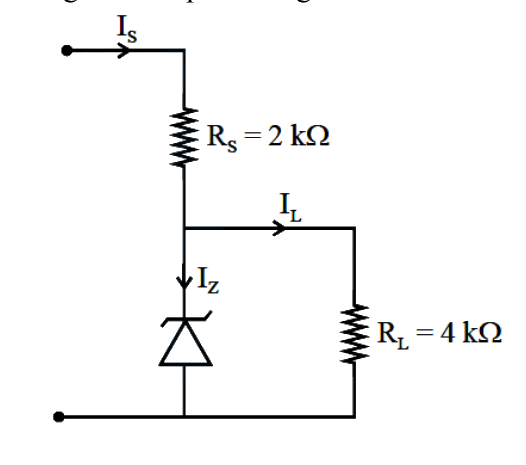
Figure shows a $DC$ voltage regulator circuit, with a Zener diode of breakdown voltage $= 6\,V$ . If the
unregulated input voltage varies between $10\,V$ to $16\,V,$ then what is the maximum Zener current?
a.
$1.5\,mA$
b.
$3.5 mA$
Correct Answer
c.
$7.5\,mA$
d.
$2.5\,mA$
No explanation saved for this question yet.
Q2mcq
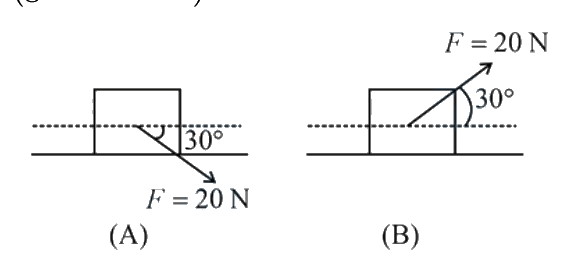
A block of mass $5\,kg$ is (i) pushed in case $(A)$ and (ii) pulled in case $(B),$ by a force $F = 20\,N,$ making an angle
of $30^{o}$ with the horizontal, as shown in the figures. The coefficient of friction between the block and floor is
$\mu = 0.2.$ The difference between the accelerations of the block, in case $(B)$ and case $(A)$ will be:
$(g = 10 m\,s^{-2})$
a.
$3.2\,m\,s^{-2}$
b.
$0\,m\,s^{-2}$
c.
$0.8\,m\,s^{-2}$
Correct Answer
d.
$0.4\,m\,s^{-2}$
No explanation saved for this question yet.
Q3mcq
A solid sphere, of radius R acquires a terminal velocity $v_{1}$ when falling (due to gravity) through a viscous fluid
having a coefficient of viscosity $\eta .$ The sphere is broken into 27 identical solid spheres. If each of these spheres
acquires a terminal velocity, $v_{2},$ when falling through the same fluid, the ratio $(\frac{v_{1}}{v_{2}})$ equals:
a.
$\frac{1}{9}$
b.
$27$
c.
$\frac{1}{27}$
d.
$9$
Correct Answer
No explanation saved for this question yet.
Q4mcq
$1\, kg$ of water, at $20\,^{\circ}C$ is heated in an electric kettle whose heating element has a mean (temperature
averaged) resistance of $20 \Omega .$ The rms voltage in the mains is $200\,V$ . Ignoring heat loss from the kettle, time
taken for water to evaporate fully is close to
[ Specific heat of water $= 4200\,J\, kg^{-1} \,^{\circ}C^{-1}$ Latent heat of water $= 2260\,kJ\,kg^{-1}$ ]
a.
$3\, min$
b.
$16\, min$
c.
$22\, min$
Correct Answer
d.
$10\, min$
No explanation saved for this question yet.
Q5mcq
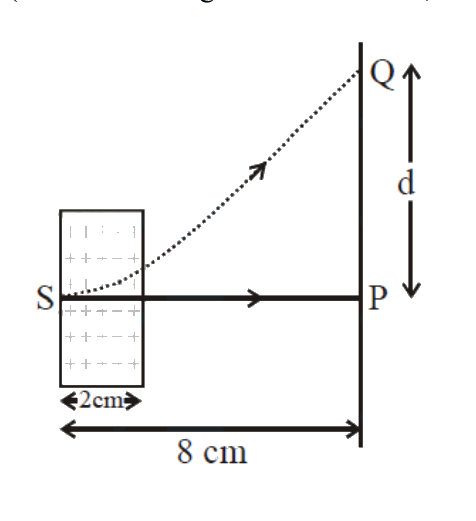
An electron, moving along the $x-$ axis with an initial energy of $100\,eV,$ enters a region of magnetic field
$\vec{B}=(1.5 \times 10^{-3}\,T)ˆk$ at S (see figure). The field extends between $x= 0$ and $x= 2\,cm.$ The electron is
detected at the point $Q$ on a screen placed $8\,cm$ away from the point $S.$ The distance d between $P$ and $Q$ (on
the screen) is:
(electron’s charge $1.6 \times 10^{-19}\,C$ , mass of electron $= 9.1 \times 10^{-31}\,kg$ )
a.
$1.22\,cm$
b.
$12.87\,cm$
Correct Answer
c.
$11.65\,cm$
d.
$2.25\,cm$
No explanation saved for this question yet.
Q6mcq
A particle is moving with speed $v=b\sqrt{x}$ along positive $x-$ axis. Calculate the speed of the particle at time
$t=τ$ (assume that the particle is at origin at $t= 0$ )
a.
$b^{2}τ$
b.
$\frac{b^{2}τ}{\sqrt{2}}$
c.
$\frac{b^{2}τ}{2}$
Correct Answer
d.
$\frac{b^{2}τ}{4}$
No explanation saved for this question yet.
Q7mcq
A diatomic gas with rigid molecules does $10\,J$ of work when expanded at constant pressure. What would be
the heat energy absorbed by the gas, in this process?
a.
$40\,J$
b.
$35\,J$
Correct Answer
c.
$25\,J$
d.
$30\,J$
No explanation saved for this question yet.
Q8mcq
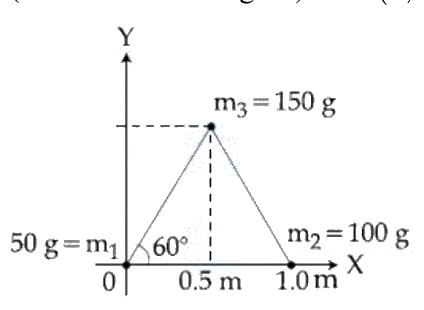
Three particles of masses $50\,g$ , $100\,g$ and $150\,g$ are placed at the vertices of an equilateral triangle of side $1\,m$
(as shown in the figure). The $(x, y)$ coordinates of the centre of mass will be:
A Carnot engine has an efficiency of $\frac{1}{6}.$ When the temperature of the sink is reduced by $62\,$ ℃, its efficiency is
doubled. The temperatures of the source and the sink are, respectively,
a.
$124\,$ ℃ $, 62\,$ ℃
b.
$37\,$ ℃ $,\,99\,$ ℃
Correct Answer
c.
$99\,$ ℃ $, \,37\,$ ℃
d.
$62\,$ ℃ $, 124\,$ ℃
No explanation saved for this question yet.
Q10mcq
A plane electromagnetic wave having a frequency $f = 23.9 GHz$ propagates along the positive $z-$ direction in
free space. The peak value of the Electric Field is $60\,V/m.$ Which among the following is the acceptable
magnetic field component in the electromagnetic wave?
A tunning fork of frequency $480\,Hz$ is used in an experiment for measuring speed of sound $(v)$ in air by
resonance tube method. Resonance is observed to occur at two successive lengths of the air column,
$l_{1} = 30 cm$ and $l_{2} = 70 cm.$ Then, $ν$ is equal to:
a.
$384\,m\,s^{-1}$
b.
$332\,m\,s^{-1}$
c.
$338\,m\,s^{-1}$
d.
$379\,m\,s^{-1}$
Correct Answer & Step-by-Step Solution Locked
Sign in free to reveal the correct answer and AI explanation for this question.
A spring whose unstrentches length is $l$ has a force constant $k.$ The spring is cut into two pieces of unstretches
lengths $l_{1}$ and $l_{2}$ where, $l_{1} =nl_{2}$ and $n$ is an integer. The ratio $k_{1}/k_{2}$ of the corresponding force constants, $k_{1}$
and $k_{2}$ will be:
a.
$\frac{1}{n^{2}}$
b.
$n^{2}$
c.
$n$
d.
$\frac{1}{n}$
Correct Answer & Step-by-Step Solution Locked
Sign in free to reveal the correct answer and AI explanation for this question.
Let a total charge $2Q$ be distributed in a sphere of radius $R,$ with the charge density given by $\rho (r) = kr,$ where
$r$ is the distance from the centre. Two charges $A$ and $B$ , of $-Q$ each, are placed on diametrically opposite
points, at equal distance, a, from the centre. If $A$ and $B$ do not experience any force, then:
a.
$a = \frac{3R}{1}$
$2$
b.
$a = \frac{R}{\sqrt{3}}$
c.
$a = 2\frac{-14}{4}R$
d.
$a = 8\frac{-1}{4} R$
Correct Answer & Step-by-Step Solution Locked
Sign in free to reveal the correct answer and AI explanation for this question.
Consider an electron in a hydrogen atom, revolving in its second excited state (having radius $4.65\,$ Å). The de-
Broglie wavelength of this electron is:
a.
$12.9\,$ Å
b.
$6.6\,$ Å
c.
$9.7\,$ Å
d.
$3.5\,$ Å
Correct Answer & Step-by-Step Solution Locked
Sign in free to reveal the correct answer and AI explanation for this question.
A small speaker delivers $2\,W$ of audio output. At what distance from the speaker will one detect $120\,\,dB$
intensity sound? [Given reference intensity of sound as $10^{-12}\,W/m^{2}$ ]
a.
$40\,cm$
b.
$20\,cm$
c.
$10\,cm$
d.
$30\,cm$
Correct Answer & Step-by-Step Solution Locked
Sign in free to reveal the correct answer and AI explanation for this question.
Two sources of sound $S_{1}$ and $S_{2}$ produce sound waves of same frequency $660\,Hz.$ A listener is moving from
source $S_{1}$ towards $S_{2}$ with a constant speed $u_{0}\,m/s$ and he hears $10\,beats/s.$ The velocity of sound is
$330\,m/s.$ Then, $u_{0}$ equals:
a.
$10.0\,m/s$
b.
$2.5\,m/s$
c.
$5.5\,m/s$
d.
$15.0\,m/s$
Correct Answer & Step-by-Step Solution Locked
Sign in free to reveal the correct answer and AI explanation for this question.
Consider the LR circuit shown in the figure. If the switch S is closed at $t = 0$ then the amount of charge that
passes through the battery between $t = 0$ and $t = \frac{L}{R}$ is:
a.
$\frac{7.3 EL}{R^{2}}$
b.
$\frac{EL}{7.3R^{2}}$
c.
$\frac{2.7 EL}{R^{2}}$
d.
$\frac{EL}{2.7R^{2}}$
Correct Answer & Step-by-Step Solution Locked
Sign in free to reveal the correct answer and AI explanation for this question.
The ratio of the weights of a body on Earth’s surface to that on the surface of a planet is $9 : 4$ The mass of the
planet is $\frac{1}{9} th$ of that of the Earth. If $R$ is the radius of the Earth, what is the radius of the planet? (Take the
planets to have the same mass density)
a.
$\frac{R}{4}$
b.
$\frac{R}{2}$
c.
$\frac{R}{3}$
d.
$\frac{R}{9}$
Correct Answer & Step-by-Step Solution Locked
Sign in free to reveal the correct answer and AI explanation for this question.
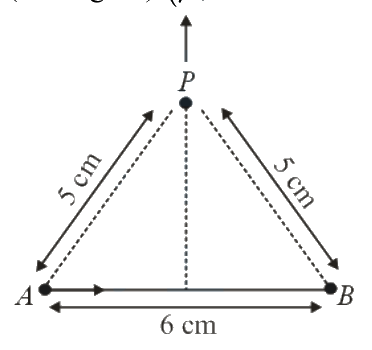
Find the magnetic field at point $P$ due to a straight line segment $AB$ of length $6\,cm$ carrying a current of $5\,A.$
(See figure) $(\mu _{0} = 4\pi \times 10^{-7}\, NA^{-2})$
a.
$1.5 \times 10^{-5}\,T$
b.
$2.0 \times 10^{-5}\,T$
c.
$3.0 \times 10^{-5}\,T$
d.
$2.5 \times 10^{-5}\,T$
Correct Answer & Step-by-Step Solution Locked
Sign in free to reveal the correct answer and AI explanation for this question.
The number density of molecules of a gas depends on their distance r from the origin as, $n(r) =n_{0}e^{-\alpha r^{4}}.$
Then the numer of molecules is proportional to:
a.
$n_{0}\alpha ^{-3}$
b.
$\sqrt{n_{0}}\alpha \frac{1}{2}$
c.
$n_{0}\alpha \frac{-3}{4}$
d.
$n_{0}\alpha \frac{1}{4}$
Correct Answer & Step-by-Step Solution Locked
Sign in free to reveal the correct answer and AI explanation for this question.
A system of three polarizers $P_{1}, P_{2}, P_{3}$ is set up such that the pass axis of $P_{3}$ is crossed with respect to that of
$P_{1}$ . The pass axis of $P_{2}$ is inclined at $60^{o}$ to the pass axis of $P_{3}.$ When a beam of unpolarized light of intensity
$I_{o}$ is incident on $P_{1},$ the intensity of light transmitted by the three polarizers is $I$ . The ratio $(I_{o}/I)$ equals
(nearly):
a.
$5.33$
b.
$16.00$
c.
$1.80$
d.
$10.67$
Correct Answer & Step-by-Step Solution Locked
Sign in free to reveal the correct answer and AI explanation for this question.
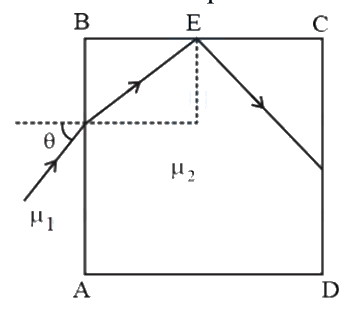
A transparent cube of side $d$ , made of a material of refractive index $\mu _{2}$ , is immersed in a liquid of refractive
index $\mu _{1}\,(\,\mu _{1} <\mu _{2})$ . A ray is incident on the face $AB$ at an angle $\theta$ (shown in the figure). Total internal
reflection takes place at the point $E$ on the face $BC.$
Then, $\theta$ must satisfy
A uniform cylindrical rod of length $L$ and radius r, is made from a material whose Young’s modulus of
Elasticity equals $Y.$ When this rod is heated by temperature T and simultaneously subjected to a net
longutudinal compressional force F, its length remains unchanged. The coefficient of volume expansion, of the
material of the rod, is (nearly) equal to:
a.
$F/(3\pi r^{2}Y T)$
b.
$9F/(\pi r^{2}Y T)$
c.
$6F/(\pi r^{2}Y T)$
d.
$3F/(\pi r^{2}Y T)$
Correct Answer & Step-by-Step Solution Locked
Sign in free to reveal the correct answer and AI explanation for this question.
Two particles are projected from the same point with the same speed u such that they have the same range R,
but different maximum heights, $h_{1}$ and $h_{2}.$ Which of the following is correct?
a.
$R^{2} = h_{1}h_{2}$
b.
$R^{2} = 4\,h_{1}h_{2}$
c.
$R^{2} = 2\,h_{1}h_{2}$
d.
$R^{2} = 16\,h_{1}h_{2}$
Correct Answer & Step-by-Step Solution Locked
Sign in free to reveal the correct answer and AI explanation for this question.
A moving coil galvanometer, having a resistance $G,$ produces full scale deflection when a current $I_{G}$ flows
through it. This galvanometer can be converted into (i) an ammeter of range 0 to $I_{o}(I_{0} > I_{g})$ by connecting a
shunt resistance $R_{A}$ to it and (ii) into a voltmeter of range 0 to $V(V = GI_{0})$ by connecting a series resistance
$R_{V}$ to it. Then,
a.
$R_{A}R_{V} = G^{2}( \frac{I_{0}-I_{g}}{I_{g}})$ and $\frac{R_{A}}{R_{V}} =(\frac{I_{g}}{(I_{0}-I_{g})} )^{2}$
b.
$R_{A}R_{V} = G^{2}$ and $\frac{R_{A}}{R_{V}} = \frac{I_{g}}{(I_{0}-I_{g})}$
c.
$R_{A}R_{V} = G^{2}( \frac{I_{g}}{I_{0}-I_{g}})$ and $\frac{R_{A}}{R_{V}} =(\frac{I_{0}-I_{g}}{I_{g}})^{2}$
d.
$R_{A}R_{V} = G^{2}$ and $\frac{R_{A}}{R_{V}} =(\frac{I_{g}}{I_{0}-I_{g}})^{2}$
Correct Answer & Step-by-Step Solution Locked
Sign in free to reveal the correct answer and AI explanation for this question.
In a $CE$ transistor amplifier, the audio signal voltage across the collector resistance of $2\,k\Omega$ is $2\,V$ , if the base
resistance is $1\,k\Omega$ and the current amplification of the transistor is $100$ then the input signal voltage is
a.
$10\, mV$
b.
$1\, mV$
c.
$0 .1 \,V$
d.
$1\,V$
Correct Answer & Step-by-Step Solution Locked
Sign in free to reveal the correct answer and AI explanation for this question.
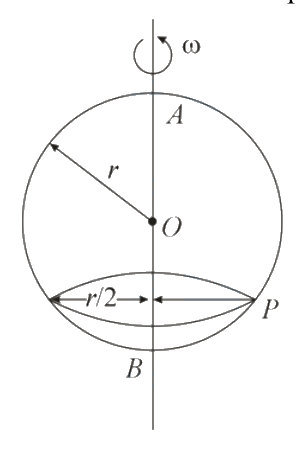
A smooth wire of length $2\pi r$ is bent into a circle and kept in a vertical plane. A bead can slide smoothly on the
wire. When the circle is rotating with angular speed about the vertical diameter $\omega$ $AB,$ as shown in figure, the
bead is at rest with respect to the circular ring at position $P$ as shown. Then the value of $\omega$ $^{2}$ is equal to:
a.
$2g/r$
b.
$\frac{\sqrt{3}g}{2r}$
c.
$2g/(r\sqrt{3})$
d.
$(g\sqrt{3})/r$
Correct Answer & Step-by-Step Solution Locked
Sign in free to reveal the correct answer and AI explanation for this question.
The electron in a hydrogen atom first jumps from the third excited state to the second excited state and
subsequently to the first excited state. The ratio of the respective wavelengths $\frac{\lambda _{1}}{\lambda _{2}}$ of the photons emitted in this
process is:
a.
$\frac{7}{5}$
b.
$\frac{20}{7}$
c.
$\frac{9}{7}$
d.
$\frac{27}{5}$
Correct Answer & Step-by-Step Solution Locked
Sign in free to reveal the correct answer and AI explanation for this question.
Half lives of two radioactive nuclei $A$ and $B$ are 10 minutes and 20 minutes, respectively. If, initially a sample
has equal number of nuclei, then after 60 minutes, the ratio of decayed numbers of nuclei A and B will be:
a.
$3 : 8$
b.
$8 : 1$
c.
$1 : 8$
d.
$9 : 8$
Correct Answer & Step-by-Step Solution Locked
Sign in free to reveal the correct answer and AI explanation for this question.
The decreasing order of electrical conductivity of the following aqueous solutions is:
$(A) 0.1\,M$ Formic acid,
$(B) 0.1\,M$ Acetic acid,
$(C) 0.1\,M$ Benzoic acid.
a.
$(A) > \,(B) > \,(C)$
b.
$(A) > \,(C) > \,(B)$
c.
$(C) > \,(B) > \,(A)$
d.
$(C) > \,(A) > \,(B)$
Correct Answer & Step-by-Step Solution Locked
Sign in free to reveal the correct answer and AI explanation for this question.
$NO_{2}$ required for a reaction is produced by the decomposition of $N_{2}O_{5}$ in $CCl_{4}$ as per the equation,
$2N_{2}O_{5}(g) \rightarrow 4NO\rightarrow_{2}(g) + O_{2}(g).$
The initial concentration of $N_{2}O_{5}$ is $3.00\,mol\,L^{-1}$ and it is $2.75\,mol\,L^{-1}$ after 30 minutes. The rate of
formation of $NO_{2}$ is:
a.
$1.667 \times 10^{-2} mol L^{-1} min^{-1}$
b.
$8.333 \times 10^{-3} mol L^{-1}min^{-1}$
c.
$4.167 \times 10^{-3} mol L^{-1}min^{-1}$
d.
$2.083 \times 10^{-3} mol L^{-1} min^{-1}$
Correct Answer & Step-by-Step Solution Locked
Sign in free to reveal the correct answer and AI explanation for this question.
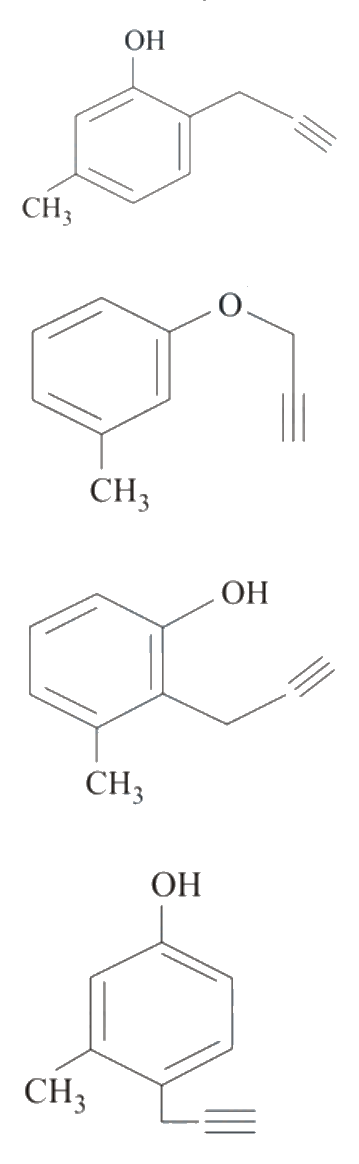
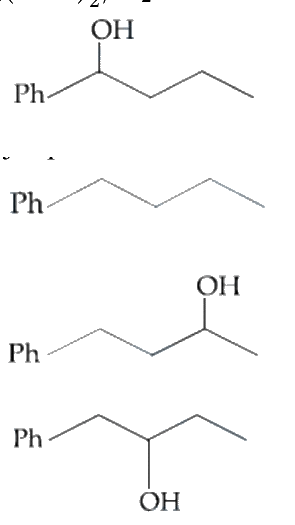
Heating of 2-chloro-1-phenylbutane with $EtOK/EtOH$ gives $X$ as the major product. Reaction $X$ with
$Hg(OAc)_{2}/H_{2}O$ followed by $NaBH_{4}$ gives $Y$ as the major product. $Y$ is:
Correct Answer & Step-by-Step Solution Locked
Sign in free to reveal the correct answer and AI explanation for this question.
An ‘Assertion’ and a ‘Reason’ is given below. Choose the correct answer from the following options:
Assertion $(A)$ : Vinyl halides do not undergo nucleophilic substitution easily.
Reason $(R)$ : Even though the intermediate carbocation is stabilized by loosely held $\pi$ $-$ electrons, the cleavage
is difficult because of the strong bonding.
a.
Both $(A)$ and $(R)$ are correct statements but $(R)$ is not the correct explanation of $(A).$
b.
Both $(A)$ and $(R)$ are wrong statements.
c.
Both $(A)$ and $(R)$ are wrong statements and $(R)$ is the correct explanation of $(A).$
d.
$(A)$ is a correct statement but $(R)$ is a wrong statement.
Correct Answer & Step-by-Step Solution Locked
Sign in free to reveal the correct answer and AI explanation for this question.
A solution is prepared by dissolving 0.6 g of urea (molar mass $= 60\,g\,mol^{-1}$ ) and $1.8\,g$ of glucose (molar
mass $= 180\,g\,mol^{-1}$ ) in 100 mL of water at $27^{o}C.$ The osmotic pressure of the solution is:
( $R = 0.08206\,Latm K^{-1}\,mol^{-1}$ )
a.
$8.2$ atm
b.
$2.46$ atm
c.
$4.92$ atm
d.
$1.64$ atm
Correct Answer & Step-by-Step Solution Locked
Sign in free to reveal the correct answer and AI explanation for this question.
Thermal decomposition of a Mn compound $(X)$ at $513\,K$ results in compound $Y, MnO_{2}$ and a gaseous
product. $MnO_{2}$ reacts with $NaCl$ and concentrated $H_{2}SO_{4}$ to give a pungent gas $Z$ . $X, \,Y$ and $Z,$ respectively,
are:
a.
$K_{3}MnO_{4}, K_{3}MnO_{4}$ and $Cl_{2}$
b.
$K_{2}MnO_{4}, KMnO_{4}$ and $Cl_{2}$
c.
$K_{2}MnO_{4}, KMnO_{4}$ and $SO_{2}$
d.
$KMnO_{4}, K_{2}MnO_{4}$ and $Cl_{2}$
Correct Answer & Step-by-Step Solution Locked
Sign in free to reveal the correct answer and AI explanation for this question.
The angle of the top of a vertical tower standing on a horizontal plane is observed to be $45^{\circ}$ from a point A on
the plane. Let $B$ be the point $30\,m$ vertically above the point A. If the angle of elevation of the top of the tower
from $B$ be $30^{\circ}$ , then the distance (in m) of the foot of the tower from the point $A$ is:
a.
$15(3 + \sqrt{3})$
b.
$15(1 + \sqrt{3})$
c.
$15(5 - \sqrt{3})$
d.
$15(3 - \sqrt{3})$
Correct Answer & Step-by-Step Solution Locked
Sign in free to reveal the correct answer and AI explanation for this question.
$1 + cos^{2}\theta sin^{2}\theta 4 cos6\theta$
A value of $\theta \in (0, \frac{\pi}{3}),$ for which $cos^{2}\theta 1 + sin^{2}\theta 4 cos6\theta = 0,$ is
$cos^{2}\theta sin^{2}\theta 1 + 4 cos6\theta$
a.
$\frac{\pi}{9}$
b.
$\frac{7\pi}{24}$
c.
$\frac{7\pi}{36}$
d.
$\frac{\pi}{18}$
Correct Answer & Step-by-Step Solution Locked
Sign in free to reveal the correct answer and AI explanation for this question.
A triangle has a vertex at $(1, \,2)$ and the mid points of the two sides through it are $(-1, \,1)$ and $(2, \,3)$ . Then
the centroid of this triangle is:
a.
$( \frac{1}{3}, 1)$
b.
$(1, \,\frac{7}{3} )$
c.
$( \frac{1}{3}, \,2)$
d.
$(\frac{1}{3}, \,\frac{5}{3})$
Correct Answer & Step-by-Step Solution Locked
Sign in free to reveal the correct answer and AI explanation for this question.
A person throws two fair dice. He wins Rs. $15$ for throwing a doublet (same numbers on the two dice), wins Rs
$12$ when the throw results in the sum of $9$ , and loses Rs. $6$ for any other outcome on the throw. Then the
expected gain/loss (in Rs.) of the person is:
a.
$\frac{1}{2}$ loss
b.
$\frac{1}{2}$ gain
c.
2 gain
d.
$\frac{1}{4}$ loss
Correct Answer & Step-by-Step Solution Locked
Sign in free to reveal the correct answer and AI explanation for this question.
If the area (in sq. units) bounded by the parabola $y^{2} = 4\lambda x$ and the line $y=\lambda x, \lambda > 0,$ is $\frac{1}{9}$ , then $\lambda$ is equal to
a.
$4\sqrt{3}$
b.
$2\sqrt{6}$
c.
$48$
d.
$24$
Correct Answer & Step-by-Step Solution Locked
Sign in free to reveal the correct answer and AI explanation for this question.
If $\alpha ,\beta$ and $\gamma$ are three consecutive terms of a non-constant G.P. Such that the equations $\alpha x^{2} + 2\beta x+\gamma = 0$
and $x^{2} +x-1 = 0$ have a common root, then $\alpha (\beta +\gamma )$ is equal to:
a.
$\beta \gamma$
b.
$\alpha \beta$
c.
$\alpha \gamma$
d.
$0$
Correct Answer & Step-by-Step Solution Locked
Sign in free to reveal the correct answer and AI explanation for this question.
A straight line $L$ at a distance of $4$ units from the origin makes positive intercepts on the coordinate axes and
the perpendicular from the origin to this line makes an angle of $60^{\circ}$ with the line $x+y= 0.$ Then an equation
of the line $L$ is:
Note: In actual JEE Main paper, two options were correct for this question. Hence, we have changed one
option.
a.
$(\sqrt{3}+ 1)x+(\sqrt{3}-1)y= 8\sqrt{2}$
b.
$x+ \sqrt{3}y= 8$
c.
$\sqrt{3}x+y= 8$
d.
$(\sqrt{3}-1)x+ \sqrt{3}y= 8\sqrt{2}$
Correct Answer & Step-by-Step Solution Locked
Sign in free to reveal the correct answer and AI explanation for this question.
Let $\alpha \in R$ and the three vectors $\vec{a}=\alpha ˆi+ ˆj+ 3ˆk, \vec{b}= 2ˆi+ ˆj- \alpha ˆk$ and $\vec{c}=\alpha ˆi-2ˆj+ 3ˆk.$ Then the set S = {
$\alpha : \vec{a}, \vec{b}$ and $\vec{c}$ are coplanar}
a.
is singleton
b.
contains exactly two positive numbers
c.
is empty
d.
contains exactly two numbers only one of which
is positive
Correct Answer & Step-by-Step Solution Locked
Sign in free to reveal the correct answer and AI explanation for this question.
For an initial screening of an admission test, a candidate is given fifty problems to solve. If the probability that
the candidate can solve any problem is $\frac{4}{5} ,$ then the probability that he is unable to solve less than two problems
is
a.
$\frac{201}{5}(\frac{1}{5})^{49}$
b.
$\frac{164}{25} ( \frac{1}{5})^{48}$
c.
$\frac{316}{25}(\frac{4}{5})^{48}$
d.
$\frac{54}{5}(\frac{4}{5})^{49}$
Correct Answer & Step-by-Step Solution Locked
Sign in free to reveal the correct answer and AI explanation for this question.
Let $f(x) = 5 -|x-2|$ and $g(x) = |x+ 1|,x\, \in \,R.$ If $f(x)$ attains maximum value at $\alpha$ and $g(x)$ attains
minimum value at $\beta ,$ then $_{x\rightarrow -\rightarrow }lim_{\alpha \beta } \frac{(x-1)(x^{2}-5x+6)}{x^{2}-6x+8}$ is equal to
a.
$\frac{3}{2}$
b.
$\frac{1}{2}$
c.
$-\frac{3}{2}$
d.
$-\frac{1}{2}$
Correct Answer & Step-by-Step Solution Locked
Sign in free to reveal the correct answer and AI explanation for this question.
The length of the perpendicular drawn from the point $(2, \,1, \,4)$ to the plane containing the lines
$\vec{r}=(ˆi+ ˆj)+\lambda (ˆi+ 2ˆj- ˆk)$ and $\vec{r}=(ˆi+ ˆj)+\mu (-ˆi+ ˆj-2ˆk)$ is
a.
$\frac{1}{3}$
b.
$3$
c.
$\sqrt{3}$
d.
$\frac{1}{\sqrt{3}}$
Correct Answer & Step-by-Step Solution Locked
Sign in free to reveal the correct answer and AI explanation for this question.
$| |$
Let $\alpha \in (0, \frac{\pi}{2})$ , be constant.If the integral $\int \frac{tanx+tan\alpha}{tanx-tan\alpha}dx=A(x)cos2\alpha +B(x)sin2\alpha +C$ , where C is a
constant of integration, then the functions $A(x)$ and $B(x)$ are respectively
a.
$x- \alpha$ and $log_{e}|sin(x- \alpha )|$
b.
$x+\alpha$ and $log_{e}|cos(x- \alpha )|\,$
c.
$x+\alpha$ and $log_{e}|sin(x+\alpha )|$
d.
$x- \alpha$ and $log_{e}|cos(x- \alpha )|$
Correct Answer & Step-by-Step Solution Locked
Sign in free to reveal the correct answer and AI explanation for this question.
A group of students comprises of $5$ boys and n girls. If the number of ways, in which a team of $3$ students can
randomly be selected from this group such that there is at least one boy and at least one girl in each team, is
$1750,$ then n is equal to
a.
$24$
b.
$27$
c.
$25$
d.
$28$
Correct Answer & Step-by-Step Solution Locked
Sign in free to reveal the correct answer and AI explanation for this question.