An $HCl$ molecule has rotational, translational and vibrational motions. If the rms velocity of $HCl$ molecules in
$-$
its gaseous phase is , m is its mass and ν $k_{B}$ is Boltzmann's constant, then its temperature will be:
a.
$-^{\,2}$
$\frac{mν}{5k_{B}}$
b.
$-^{\,2}$
$\frac{mν}{6k_{B}}$
c.
$-^{\,2}$
$\frac{mν}{3k_{B}}$
Correct Answer
d.
$-^{\,2}$
$\frac{mν}{7k_{B}}$
No explanation saved for this question yet.
Q2mcq
An $NPN$ transistor is used in common emitter configuration as an amplifier with $1\,k\Omega$ load resistance. Signal
voltage of $10\,mV$ is applied across the base-emitter. This produces a $3\,mA$ change in the collector current and
$15\,$ $\mu$ $A\,$ change in the base current of the amplifier. The input resistance and voltage gain are:
a.
$0.33\,k\Omega , \,1.5$
b.
$0.67\,k\Omega , \,300$
Correct Answer
c.
$0.67\,k\Omega , \,200$
d.
0.33 k $\Omega , \,300$
No explanation saved for this question yet.
Q3mcq
Taking the wavelength of first Balmer line in hydrogen spectrum $(n = 3\,$ to $n = 2)$ as $660\,nm$ , the
wavelength of the $2^{nd}$ Balmer line $(n\, = \,4\,$ to $\,n\, = \,2)$ will be :
a.
$889.2\,nm$
b.
$488.9\,nm$
Correct Answer
c.
$388.9\,nm$
d.
$642.7 nm$
No explanation saved for this question yet.
Q4mcq
A uniform cable of mass $M$ and length $L$ is placed on a horizontal surface such that its $( \frac{1}{n})^{th}$ part is hanging
below the edge of the surface. To lift the hanging part of the cable upto the surface, the work done should be:
a.
$\frac{MgL}{2n^{2}}$
Correct Answer
b.
$\frac{MgL}{n^{2}}$
c.
$nMgL$
d.
$\frac{2MgL}{n^{2}}$
No explanation saved for this question yet.
Q5mcq
A signal $Acos$ $\omega$ $t$ is transmitted using ν $_{0}sin$ $\omega$ $_{0}t$ as carrier wave. The correct amplitude modulated $\,(AM)$ signal
is:
The magnetic field of a plane electromagnetic wave is given by $\vec{B}= B_{0}ˆi[cos(kz -$ $\omega$ $t)] + B_{1}ˆjcos(kz +$ $\omega$ $t)$ ,
where $B_{0} = 3 \times 10^{-5}\,T$ and $B_{1} = 2 \times 10^{-6}\,T$ . The $RMS$ value of the force experienced by a stationary charge
$Q = 10^{-4}\,C$ at $z = 0$ is closest to
a.
$0.1\,N$
b.
$0.9\,N$
c.
$3 \times 10^{-2}\,N$
d.
$0.6\,N$
Correct Answer
No explanation saved for this question yet.
Q7mcq
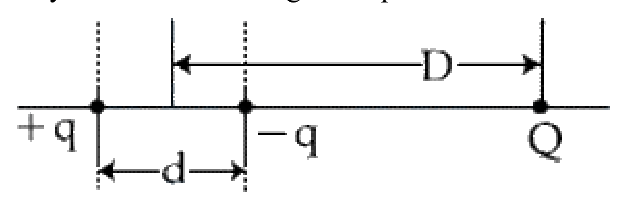
A system of three charges are placed as shown in the figure:
If $D\, >> \,d,$ the potential energy of the system is best given by:
If $'M'$ is the mass of water that rises in a capillary tube of radius $'r'$ , then mass of water which will rise in a
capillary tube of radius $'2r'$ is:
a.
$4\,M$
b.
$2\,M$
Correct Answer
c.
$\frac{M}{2}$
d.
$M$
No explanation saved for this question yet.
Q9mcq
A capacitor with capacitance $5\,$ $\mu$ $F$ is charged to $5\,$ $\mu$ $C$ . If the plates are pulled apart to reduce the capacitance
to $2\,$ $\mu$ $F$ , how much work is done?
a.
$6.25 \times 10^{-6}\,J$
b.
$2.55 \times 10^{-6}\,J$
c.
$2.16 \times 10^{-6}\,J$
d.
$3.75 \times 10^{-6}\,J$
Correct Answer
No explanation saved for this question yet.
Q10mcq
A rectangular coil (Dimension $5\,cm\, \times \,2.5\,cm$ ) with $100$ turns, carrying a current of $\,3\,A$ in the clock-wise
direction, is kept centered at the origin and in the $X -Z$ plane. A magnetic field of $1\,T$ is applied along
$X -axis$ . If the coil is tilted through $45^{\circ}$ about $Z -axis$ , then the torque on the coil is:
a.
$0.42\,N\,m$
b.
$\,0.55\,N\,m$
c.
$0.38\,N\,m$
d.
$0.27\,N\,m$
Correct Answer
No explanation saved for this question yet.
🎉 10 Free Sample Solutions Completed
Unlock All 90 Questions & Solutions
Sign up free in seconds to unlock step-by-step AI answers for the remaining 80 questions.
A moving coil galvanometer has resistance $50\,\Omega$ and it indicates full deflection at $4\,mA$ current. A voltmeter is
made using this galvanometer and a $5\,k\Omega$ resistance. The maximum voltage, that can be measured using this
voltmeter, will be close to:
a.
$40\,V$
b.
$15\,V$
c.
$20\,V$
d.
$10\,V$
Correct Answer & Step-by-Step Solution Locked
Sign in free to reveal the correct answer and AI explanation for this question.
A simple pendulum oscillating in air has period $T$ . The bob of the pendulum is completely immersed in a non-
viscous liquid. The density of the liquid is $\frac{1}{16}th$ of the material of the bob. If the bob is inside liquid all the
time, its period of oscillation in this liquid is:
a.
$2T\sqrt{\frac{1}{10}}$
b.
$2T\sqrt{\frac{1}{14}}$
c.
$4T\sqrt{\frac{1}{15}}$
d.
$4T\sqrt{\frac{1}{14}}$
Correct Answer & Step-by-Step Solution Locked
Sign in free to reveal the correct answer and AI explanation for this question.
A body of mass $2\,kg$ makes an elastic collision with a second body at rest and continues to move in the original
direction but with one fourth of its original speed. What is the mass of the second body?
a.
$1.8\,kg$
b.
$1.2\,kg$
c.
$1.0\,kg$
d.
$1.5\,kg$
Correct Answer & Step-by-Step Solution Locked
Sign in free to reveal the correct answer and AI explanation for this question.
A solid sphere of mass $M$ and radius $a$ is surrounded by a uniform concentric spherical shell of thickness $2a$ and
mass $2M.$ The gravitational field at distance $3a$ from the centre will be:
a.
$\frac{GM}{9a^{2}}$
b.
$\frac{GM}{3a^{2}}$
c.
$\frac{2GM}{3a^{2}}$
d.
$\frac{2GM}{9a^{2}}$
Correct Answer & Step-by-Step Solution Locked
Sign in free to reveal the correct answer and AI explanation for this question.
A stationary horizontal disc is free to rotate about its axis. When a torque is applied on it, its kinetic energy as a
function of , where is the angle by which it has rotated, is given as $\theta$ $\theta$ $k$ $\theta$ $^{2}$ . If its moment of inertia is $I$ then the
angular acceleration of the disc is:
a.
$\frac{2k}{I}$ $\theta$
b.
$\frac{k}{2I}$ $\theta$
c.
$\frac{k}{4I}$ $\theta$
d.
$\frac{k}{I}$ $\theta$
Correct Answer & Step-by-Step Solution Locked
Sign in free to reveal the correct answer and AI explanation for this question.
The total number of turns and cross-section area in a solenoid is fixed. However, its length $L$ is varied by
adjusting the separation between windings. The inductance of solenoid will be proportional to:
a.
$L$
b.
$\frac{1}{L^{2}}$
c.
$\frac{1}{L}$
d.
$L^{2}$
Correct Answer & Step-by-Step Solution Locked
Sign in free to reveal the correct answer and AI explanation for this question.
In the density measurement of a cube, the mass and edge length are measured as $(10.00 \pm 0.10)\,kg$ and
$(0.10 \pm 0.01)\,m,$ respectively. The error in the measurement of density is:
a.
$0.31$
b.
$0.10\,$
c.
$0.07\,$
d.
$0.01$
Correct Answer & Step-by-Step Solution Locked
Sign in free to reveal the correct answer and AI explanation for this question.
$-$
The electric field of light wave is given as $\,\vec{E}\, = 10^{-3} cos( \frac{2$\pi$x}{5\times 10^{-7}} -2$ $\pi$ $\times 6 \times 10^{14}\,t)xˆ\frac{N}{C}$ . This light falls on a
metal plate of work function $2\,eV$ . The stopping potential of the photo-electrons is:
Given, $E$ (in $eV$ ) $= \frac{12375}{$\lambda$(in\,Å)}$
a.
$0.72\,V$
b.
$2.0\,V$
c.
$2.48\,V$
d.
$0.48\,V$
Correct Answer & Step-by-Step Solution Locked
Sign in free to reveal the correct answer and AI explanation for this question.
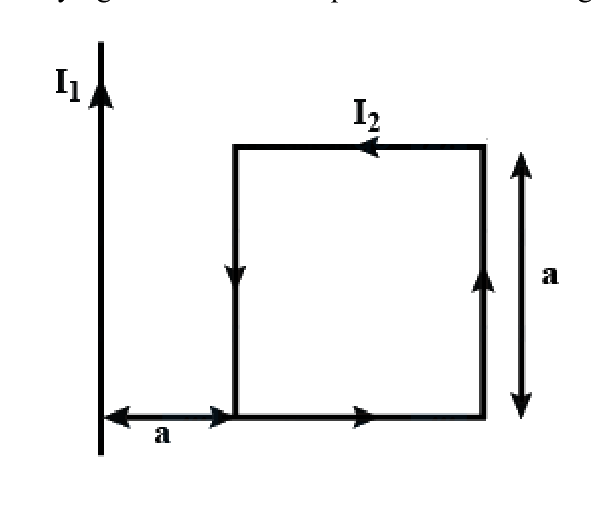
A rigid square loop of side $‘a’$ and carrying current $I_{2}$ is lying on a horizontal surface near a long current $I_{1}$
carrying wire in the same plane as shown in figure. The net force on the loop due to the wire will be:
a.
Attractive and equal to $\frac{$\mu$_{0}I_{1}I_{2}}{3$\pi$}$
b.
Repulsive and equal to $\frac{$\mu$_{0}I_{1}I_{2}}{4$\pi$}$
c.
Repulsive and equal to $\frac{$\mu$_{0}I_{1}I_{2}}{2$\pi$}$
d.
Zero
Correct Answer & Step-by-Step Solution Locked
Sign in free to reveal the correct answer and AI explanation for this question.
The pressure wave, $P = 0.01 sin[1000t -3x]N\,m^{-2}$ , corresponds to the sound produced by a vibrating blade
on a day when atmospheric temperature is $0^{\circ}C$ . On some other day when temperature is $T$ , the speed of
sound produced by the same blade and at the same frequency is found to be $336\,m\,s^{-1}$ . Approximate value of
$T$ is:
a.
$12^{\circ}\,C$
b.
$15^{\circ}\,C$
c.
$4^{\circ}\,C$
d.
$11^{\circ}\,C$
Correct Answer & Step-by-Step Solution Locked
Sign in free to reveal the correct answer and AI explanation for this question.
For given gas at $1\,atm$ pressure, $rms\,$ speed of the molecules is $200\,m/s$ at $127^{\circ}C.$ At $2\,atm$ pressure and at
$227^{\circ}\,C,$ the $rms$ speed of the molecules will be:
a.
$100\,m/s$
b.
$80\,m/s$
c.
$80\,m/s\sqrt{5}$
d.
$100\,m/s\sqrt{5}$
Correct Answer & Step-by-Step Solution Locked
Sign in free to reveal the correct answer and AI explanation for this question.
A concave mirror for face viewing has a focal length of $0.4\,m$ . The distance at which you hold the mirror from
your face in order to see your image upright with a magnification of $5$ is
a.
$1.60\,m$
b.
$0.16\,m$
c.
$0.32\,m$
d.
$0.24\,m$
Correct Answer & Step-by-Step Solution Locked
Sign in free to reveal the correct answer and AI explanation for this question.
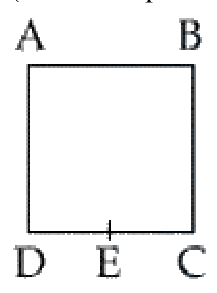
A wire of resistance $R$ is bent to form a square $ABCD$ as shown in the figure. The effective resistance
between $E$ and $C$ is:
( $E$ is mid-point of arm $CD$ )
a.
$R$
b.
$\frac{7}{64} R$
c.
$\frac{1}{16}R$
d.
$\frac{3}{4}R$
Correct Answer & Step-by-Step Solution Locked
Sign in free to reveal the correct answer and AI explanation for this question.
The following bodies are made to roll up (without slipping) the same inclined plane from a horizontal plane: (i)
a ring of radius $R,$ (ii) a solid cylinder of radius $\frac{R}{2}$ and (iii) a solid sphere of radius $\frac{R}{4}.$ If, in each case, the
speed of the center of mass at the bottom of the incline is same, the ratio of the maximum heights they climb is:
a.
$2 : 3 : 4$
b.
$20 : 15 : 14$
c.
$4 : 3 : 2$
d.
$14 : 15 : 20$
Correct Answer & Step-by-Step Solution Locked
Sign in free to reveal the correct answer and AI explanation for this question.
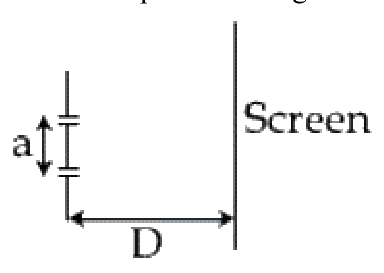
The figure shows a Young's double slit experimental setup. It is observed that when a thin transparent sheet of
thickness t and refractive index is put in front of one of the slits, the central maximum gets shifted by a$\mu$
distance equal to n fringe width. If the wavelength of light used is then $\lambda$ $t$ will be:
a.
$\frac{D$\lambda$}{a($\mu$-1)}$
b.
$\frac{n$\lambda$}{($\mu$-1)}$
c.
$\frac{2n$\lambda$}{($\mu$-1)}$
d.
$\frac{2D$\lambda$}{a($\mu$-1)}$
Correct Answer & Step-by-Step Solution Locked
Sign in free to reveal the correct answer and AI explanation for this question.
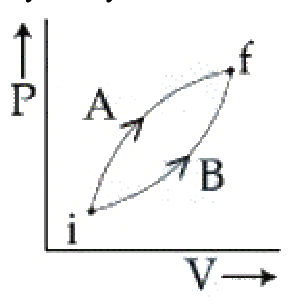
Following figure shows two processes $A$ and $B\,$ for a gas. If $\Delta Q_{A}$ and $\Delta Q_{B}$ are the amount of heat absorbed
by the system in two cases, and $\Delta U_{A}$ and $\Delta U_{B}$ are changes in internal energies, respectively, then:
A string is clamped at both the ends and it is vibrating in its $4^{th}$ harmonic. The equation of the stationary wave
is $y= 0.3 sin(0.157x)\,cos(200$ $\pi$ $t)$ . The length of the string is
(All quantities are in $SI$ units.)
a.
$20\,m$
b.
$60\,m$
c.
$40\,m$
d.
$80\,m$
Correct Answer & Step-by-Step Solution Locked
Sign in free to reveal the correct answer and AI explanation for this question.
The stream of a river is flowing with a speed of $2\,km\,h^{-1}$ . A swimmer can swim at a speed of $4\, km \,h^{-1}$ . The
direction of the swimmer with respect to the flow of the river, to cross the river straight, is
a.
$150^{\circ}$
b.
$90^{\circ}$
c.
$120^{\circ}$
d.
$60^{\circ}$
Correct Answer & Step-by-Step Solution Locked
Sign in free to reveal the correct answer and AI explanation for this question.
The osmotic pressure of a dilute solution of an ionic compound $XY$ in water is four times that of a solution
$0.01\,M\,BaCl_{2}$ in water. Assuming complete dissociation of the given ionic compounds in water, the
concentration of $XY$ ( $in\,mol\,L^{-1}$ ) in solution is
a.
$4 \times 10^{-2}$
b.
$16 \times 10^{-4}$
c.
$4 \times 10^{-4}$
d.
$6 \times 10^{-2}$
Correct Answer & Step-by-Step Solution Locked
Sign in free to reveal the correct answer and AI explanation for this question.
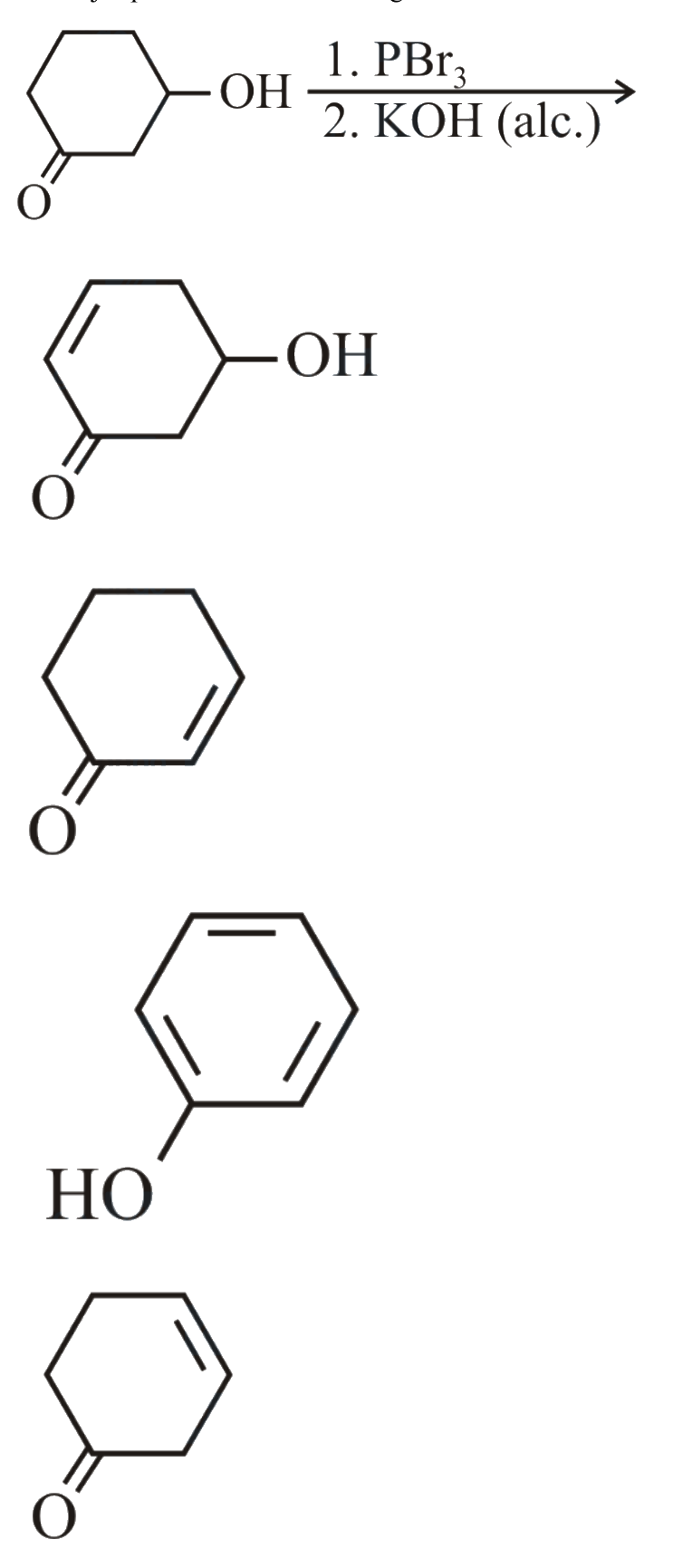
Match the catalysts (Column $I$ ) with products (Column $II$ )
Column I Column II
Catalyst Product
A. $V_{2}O_{5}$ P. Polyethylene
B. $TiCl_{4}/Al(Me)_{3}$ Q. Ethanal
C. $PdCl_{2}$ R. $H_{2}SO_{4}$
D. Iron Oxide S. $NH_{3}$
a.
$(A) -(S); \,(B) -(R); \,(C) -(Q); \,(D) -(P)$
b.
$(A) -(R); \,(B) -(S); \,(C) -(P); \,(D) -(Q)$
c.
$(A) -(Q); \,(B) -(R); \,(C) -(P); \,(D) -(S)$
d.
$(A) -(R); \,(B) -(P); \,(C) -(Q); \,(D) -(S)$
Correct Answer & Step-by-Step Solution Locked
Sign in free to reveal the correct answer and AI explanation for this question.
$- = - -$
For any given series of spectral lines of atomic hydrogen, let $\Delta v v_{max}- v_{min}$ be the difference in
maximum and minimum wave number in $cm^{-1}$ .
$- -$
The ratio $\Delta v_{Lyman}/\Delta v_{Balmar}$ is
a.
$5 : 4$
b.
$27 : 5$
c.
$4 : 1$
d.
$9 : 4$
Correct Answer & Step-by-Step Solution Locked
Sign in free to reveal the correct answer and AI explanation for this question.
For a reaction,
$N_{2}(g) + 3H_{2}(g)\longrightarrow 2NH_{3}(g)$ , identify di-hydrogen $(H_{2})$ as a limiting reagent in the following reaction
mixtures.
a.
$28\,g\,of\,N_{2}+ 6\,g\,of\,H_{2}$
b.
$35\,g\,of\,N_{2}+ 8\,g\,of\,H_{2}$
c.
$56\,g\,of\,N_{2}+ 10\,g\,of\,H_{2}$
d.
$14\,g\,of\,N_{2}+ 4\,g\,of\,H_{2}$
Correct Answer & Step-by-Step Solution Locked
Sign in free to reveal the correct answer and AI explanation for this question.
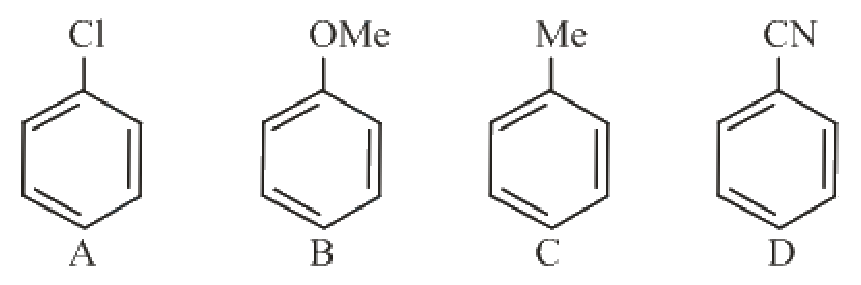
The organic compound that gives following qualitative analysis is:
Test Inference
$(a) Dil. HCl$ Insoluble
$(b) NaOH\,solution$ Soluble
$(c) Br_{2}/water$ Decolourization
Correct Answer & Step-by-Step Solution Locked
Sign in free to reveal the correct answer and AI explanation for this question.
The standard Gibbs energy for the given cell reaction in $kJ\,mol^{-1}$ at $298\,K$ is:
$Zn(s) + Cu^{2+}(aq)\longrightarrow Zn^{2+}(aq) + Cu(s)$ ,
$E^{0} = 2\,V\,at\,298\,K$
$(Faraday's\,constant\,, F = 96000\,C\,mol^{-1})$
a.
$-192$
b.
$192$
c.
$384$
d.
$-384$
Correct Answer & Step-by-Step Solution Locked
Sign in free to reveal the correct answer and AI explanation for this question.
Liquid $M$ and liquid $N$ form an ideal solution. The vapour pressures of pure liquids $M$ and $N$ are $450$ and
$700\,mmHg,$ respectively, at the same temperature. Then correct statements is:
( $x_{M} = Mole\,fraction\,of\,'M'\,in\,solution;$
$x_{N} = Mole\,fraction\,of\,'N'in\,solution;$
$y_{M} = Mole\,fraction\,of\,'M'\,in\,vapour\,phase;$
$y_{N} = Mole\,fraction\,of\,'N'\,in\,vapour\,phase;$ )
a.
$\frac{x_{M}}{x_{N}} > \frac{y_{M}}{y_{N}}$
b.
$\frac{x_{M}}{x_{N}} = \frac{y_{M}}{y_{N}}$
c.
$\frac{x_{M}}{x_{N}} < \frac{y_{M}}{y_{N}}$
d.
$(x_{M}-y_{M}) < (x_{N}-y_{N})$
Correct Answer & Step-by-Step Solution Locked
Sign in free to reveal the correct answer and AI explanation for this question.
Consider the van der Waal's constants, $a$ and $b,$ for the following gases.
Gas $Ar Ne Kr Xe$
$a/(atm\,dm^{6}\,mol^{-2}) 1.3 0.2 5.1 4.1$
$b/(10^{-2}\,dm^{3}\,mol^{-1}) 3.2 1.7 1.0 5.0$
Which gas is expected to have the highest critical temperature?
a.
$Kr$
b.
$Ar$
c.
$Xe$
d.
$Ne$
Correct Answer & Step-by-Step Solution Locked
Sign in free to reveal the correct answer and AI explanation for this question.
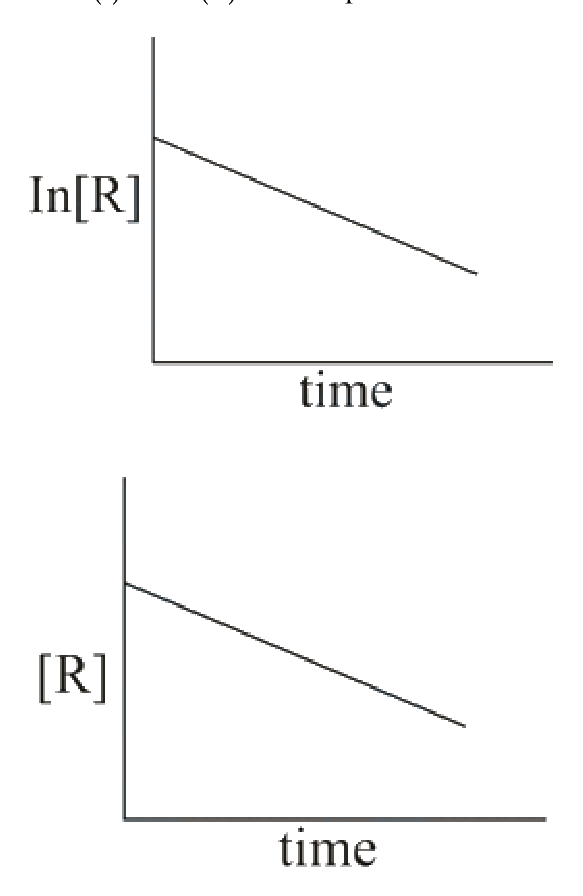
The given plots represent the variation of the concentration of a reactant $R$ with time for two different
reactions $(i)\, and \,(ii)$ . The respective orders of the reaction are
(i)
(ii)
a.
$1,1$
b.
$0,1$
c.
$1,0$
d.
$0,2$
Correct Answer & Step-by-Step Solution Locked
Sign in free to reveal the correct answer and AI explanation for this question.
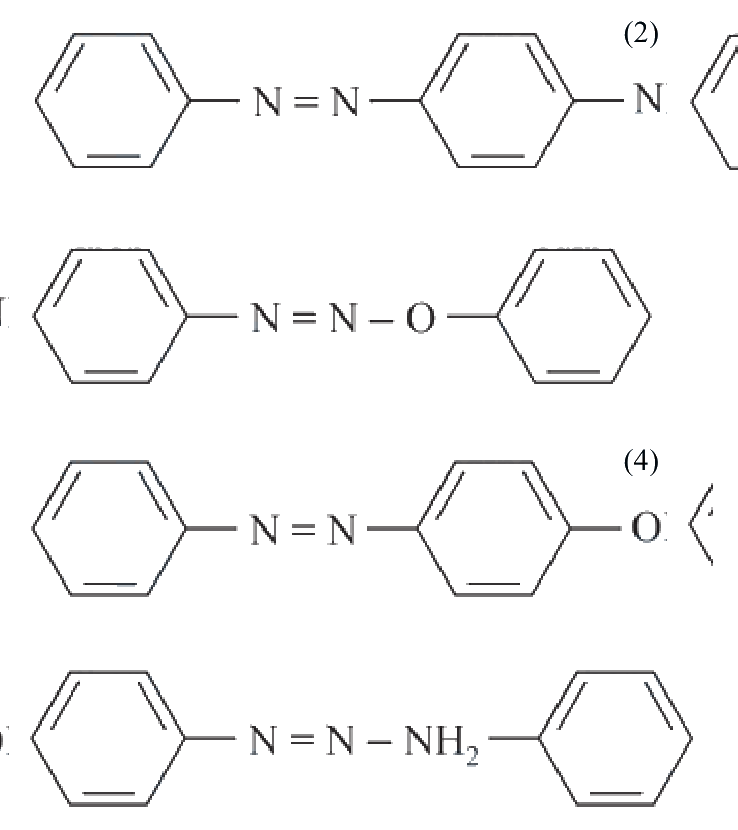
Aniline dissolved in dilute $HCl$ is reacted with sodium nitrite at $0^{\circ}C$ . This solution was added dropwise to a
solution containing an equimolar mixture of aniline and phenol in dilute $HCl$ . The structure of the major
product is
Correct Answer & Step-by-Step Solution Locked
Sign in free to reveal the correct answer and AI explanation for this question.
Let $\sum ^{10}_{k=1} f(a+k) = 16(2^{10}-1),$ where the function $f$ satisfies $f(x+y) =f(x)f(y)$ for all natural numbers
$x, \,y$ and $f(1) = 2.$ Then the natural number $'a'$ is:
a.
$3$
b.
$16$
c.
$4$
d.
$2$
Correct Answer & Step-by-Step Solution Locked
Sign in free to reveal the correct answer and AI explanation for this question.
$y+ 1 \alpha \beta$
Let $\alpha$ and $\beta$ be the roots of the equation $x^{2} +x+ 1 = 0.$ Then for $y\neq 0$ in $R, \, \alpha y+\beta 1$ is equal
$\beta 1 y+\alpha$
to
a.
$y^{3}$
b.
$y(y^{2}-1)$
c.
$y^{3}-1$
d.
$y(y^{2}-3)$
Correct Answer & Step-by-Step Solution Locked
Sign in free to reveal the correct answer and AI explanation for this question.
If the line, $\frac{x-1}{2} = \frac{y+1}{3} = \frac{z-2}{4}$ meets the plane, $x+ 2y+ 3z= 15$ at a point $P,$ then the distance of $P$ from the
origin is,
a.
$2\sqrt{5}$
b.
$\frac{9}{2}$
c.
$\frac{\sqrt{5}}{2}$
d.
$\frac{7}{2}$
Correct Answer & Step-by-Step Solution Locked
Sign in free to reveal the correct answer and AI explanation for this question.
Let $S$ be the set of all values of $x$ for which the tangent to the curve $y=f(x) =x^{3} - x^{2} -2x$ at $(x, \,y)$ is
parallel to the line segment joining the points $(1, \,f(1))$ and $(-1, \,f(-1)),$ then $S$ is equal to
a.
${-\frac{1}{3} , -1}$
b.
${-\frac{1}{3} , 1}$
c.
${\frac{1}{3}, 1}$
d.
${ \frac{1}{3}, -1}$
Correct Answer & Step-by-Step Solution Locked
Sign in free to reveal the correct answer and AI explanation for this question.
Four persons can hit a target correctly with probabilities $\frac{1}{2} , \frac{1}{3}, \frac{1}{4}$ and $\frac{1}{8}$ respectively. If all hit at the target
independently, then the probability that the target would be hit, is
a.
$\frac{25}{192}$
b.
$\frac{7}{32}$
c.
$\frac{1}{192}$
d.
$\frac{25}{32}$
Correct Answer & Step-by-Step Solution Locked
Sign in free to reveal the correct answer and AI explanation for this question.
If $f(x)$ is a non-zero polynomial of degree four, having local extreme points at $x= \,-1, \,0, \,1;$ then the set
$S = {x\in R\, :f(x) =f(0)}$ contains exactly
a.
Two irrational and two rational numbers
b.
Four rational numbers
c.
Two irrational and one rational number
d.
Four irrational numbers
Correct Answer & Step-by-Step Solution Locked
Sign in free to reveal the correct answer and AI explanation for this question.
If a tangent to the circle $x^{2} +y^{2} = 1$ intersects the coordinate axes at distinct points $P$ and $Q,$ then the locus of
the mid-point of $PQ$ is:
a.
$x^{2} +y^{2}-16x^{2}y^{2} = 0$
b.
$x^{2} +y^{2}-4x^{2}y^{2} = 0$
c.
$x^{2} +y^{2}-2xy= 0$
d.
$x^{2} +y^{2}-2x^{2}y^{2} = 0$
Correct Answer & Step-by-Step Solution Locked
Sign in free to reveal the correct answer and AI explanation for this question.
A plane passing though the points $(0, \, -1,\,0)$ and $(0, \,0,\,1)$ and making an angle $\frac{\pi}{4}$ with the plane
$y-z+ 5 = 0,$ also passes through the point
a.
$(\sqrt{2}, \, -1,\,4)$
b.
$(\sqrt{2}, \,1,\,4)$
c.
$(-, \, -1, \, -4\sqrt{2} )$
d.
$(-, \,1, \, -4\sqrt{2} )$
Correct Answer & Step-by-Step Solution Locked
Sign in free to reveal the correct answer and AI explanation for this question.
A committee of $11$ member is to be formed from $8$ males and $5$ females. If $m$ is the number of ways the
committee is formed with at least $6$ males and $n$ is the number of ways the committee is formed with at least $3$
females, then:
a.
$m=n= 68$
b.
$n= \,m\,-8$
c.
$m=n= 78$
d.
$m+n= 68$
Correct Answer & Step-by-Step Solution Locked
Sign in free to reveal the correct answer and AI explanation for this question.
$\frac{\sqrt{2}cosx-1}{cotx-1}, \,x\neq \frac{\pi}{4}$
If the function $f$ defined on $(\frac{\pi}{6}, \frac{\pi}{3})$ by $f(x) ={$ is continuous, then $k$ is equal to
$k, \,\,\,\,\,\,\,\,\,\,\,\,\,x= \frac{\pi}{4}$
a.
$\frac{1}{2}$
b.
$1$
c.
$2$
d.
$\frac{1}{\sqrt{2}}$
Correct Answer & Step-by-Step Solution Locked
Sign in free to reveal the correct answer and AI explanation for this question.
$| |$
If the tangent to the curve, $y=x^{3} +ax-b$ at the point $(1, \,-5)$ is perpendicular to the line, $-x+y+ 4 = 0,$
then which one of the following points lies on the curve?
a.
$(2, \,-2)$
b.
$(2, \,-1)$
c.
$(-2,\,1)$
d.
$(-2,\,2)$
Correct Answer & Step-by-Step Solution Locked
Sign in free to reveal the correct answer and AI explanation for this question.
Let the sum of the first $n$ terms of a non-constant $A.P. , \,a_{1}, \,a_{2}, \,a_{3}, \,. . . . , \,a_{n}$ be $50n+ \frac{n(n-7)}{2} A,$ where $A$ is
a constant. If $d$ is the common difference of this $A.P.$ , then the ordered pair $(d, \,a_{50})$ is equal to
a.
$(50, \,50 + 46A)$
b.
$(A, \,50 + 45A)$
c.
$(50,\,50 + 45A)$
d.
$(A, \,50 + 46A)$
Correct Answer & Step-by-Step Solution Locked
Sign in free to reveal the correct answer and AI explanation for this question.