A projectile can have the same range $R$ for two angles of projection. If $T_{1}$ and $T_{2}$ be the time of flights in the
two cases, then the product of the two time of flights is directly proportional to
a.
$1/R^{2}$
b.
$1/R$
c.
$R$
Correct Answer
d.
$R^{2}$
No explanation saved for this question yet.
Q2mcq
One mole of ideal monoatomic gas $(\gamma = 5/30)$ is mixed with one mole of diatomic gas $(\gamma = 7/5)$ . What is $\gamma$
for the mixture? $\gamma$ denotes the ratio of specific heat at constant pressure, to that at constant volume.
a.
$3/2$
Correct Answer
b.
$23/15$
c.
$35/23$
d.
$4/3$
No explanation saved for this question yet.
Q3mcq
Time taken by a $836\,W$ heater to heat one litre of water from $10^{\circ }C$ to $40^{\circ }C$ is
a.
$50\,s$
b.
$100\,s$
c.
$150\,s$
Correct Answer
d.
$200\,s$
No explanation saved for this question yet.
Q4mcq
When npn transistor is used as amplifier
a.
electrons move from base to collector
Correct Answer
b.
holes move from emitter to base
c.
electrons move from collector to base
d.
holes move from base to emitter.
No explanation saved for this question yet.
Q5mcq
A piece of copper and another of germanium are cooled from room temperature to $77\,K$ , the resistance of
a.
each of them increases
b.
each of them decreases
c.
copper decreases and germanium increases
d.
copper increases and germanium decreases
Correct Answer
No explanation saved for this question yet.
Q6mcq
A long wire carries a steady current. It is bent into a circle of one turn and the magnetic field at the centre of
the coil is $B$ . It is then bent into a circular loop of $n$ turns. The magnetic field at the centre of the coil will be
a.
$nB$
b.
$n^{2}\,B$
Correct Answer
c.
$2nB$
d.
$2n^{2}B$
No explanation saved for this question yet.
Q7mcq
The binding energy per nucleon of deuteron $(^{2}_{1}H)$ and helium nucleus $(^{4}_{2}He)$ is $1.1MeV$ and $7MeV$
respectively. If two deuteron nuclei react to form a single helium nucleus, then the energy released is
a.
$13.9MeV$
b.
$26.9MeV$
c.
$23.6MeV$
Correct Answer
d.
$19.2MeV$
No explanation saved for this question yet.
Q8mcq
Which of the following statements is correct for any thermodynamic system?
a.
The internal energy changes in all processes.
b.
Internal energy and entropy are state functions.
Correct Answer
c.
The change in entropy can never be zero.
d.
The work done in an adiabatic process is always
zero.
No explanation saved for this question yet.
Q9mcq
In an LCR series a.c. circuit, the voltage across each of the components, $L,C$ and $R$ is $50\,V$ . The voltage
across the LC combination will be
a.
$50\,V$
b.
$50\sqrt{2}\,V$
c.
$100\,V$
d.
$0\,V$ (zero)
Correct Answer
No explanation saved for this question yet.
Q10mcq
If the temperature of the sun were to increase from $T$ to $2T$ and its radius from $R$ to $2R$ , then the ratio of the
radiant energy received on earth to what it was previously will be
a.
4
b.
16
c.
32
d.
64
Correct Answer
No explanation saved for this question yet.
🎉 10 Free Sample Solutions Completed
Unlock All 225 Questions & Solutions
Sign up free in seconds to unlock step-by-step AI answers for the remaining 215 questions.
The resistance of the series combination of two resistances is $S$ . When they are joined in parallel through total
resistance is $P$ . If $S =nP$ , then the minimum possible value of $n$ is
a.
4
b.
3
c.
2
d.
1
Correct Answer & Step-by-Step Solution Locked
Sign in free to reveal the correct answer and AI explanation for this question.
Four charges equal to $-Q$ are placed at the four corners of a square and a charge $q$ is at its centre. If the system
is in equilibrium the value of $q$ is
a.
$-\frac{Q}{4}(1 + 2)\sqrt{2}$
b.
$- \frac{Q}{2}(1 + 2)\sqrt{2}$
c.
$-\frac{Q}{2}(1 + 2)\sqrt{2}$
d.
$\frac{Q}{2} (1 + 2)\sqrt{2}$
Correct Answer & Step-by-Step Solution Locked
Sign in free to reveal the correct answer and AI explanation for this question.
A uniform chain of length $2\,m$ is kept on a table such that a length of $60\,cm$ hangs freely from the edge of the
table. The total mass of the chain is $4\,kg$ . What is the work done in pulling the entire chain on the table?
a.
$7.2\,J$
b.
$3.6\,J$
c.
$120\,J$
d.
$1200\,J$
Correct Answer & Step-by-Step Solution Locked
Sign in free to reveal the correct answer and AI explanation for this question.
An electric current is passed through a circuit containing two wires of the same material, connected in parallel.
If the length and radii of the wires are in the ratio of $4/3$ and $2/3$ , then the ratio of the currents passing through
the wire will be
a.
3
b.
$1/3$
c.
$8/9$
d.
2
Correct Answer & Step-by-Step Solution Locked
Sign in free to reveal the correct answer and AI explanation for this question.
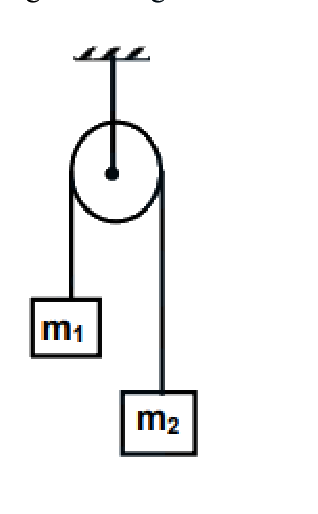
Two masses $m_{1} = 5\,kg$ and $m_{2} = 4.8\,kg$ tied to a string are hanging over a light frictionless pulley. What is the
acceleration of the masses when lift free to move $(g = 9.8\,m/s^{2})$
a.
$0.2\,m/s^{2}$
b.
$9.8\,m/s^{2}$
c.
$5\,m/s^{2}$
d.
$4.8\,m/s^{2}$
Correct Answer & Step-by-Step Solution Locked
Sign in free to reveal the correct answer and AI explanation for this question.
A body of mass $m$ , accelerates uniformly from rest to $v_{1}$ in time $t_{1}$ . The instantaneous power delivered to the
body as a function of time $t$ is
a.
$\frac{mv_{1}t}{t_{1}}$
b.
$\frac{mv^{2}t}{t^{2}}^{1}$
$1$
c.
$\frac{mv_{1}t^{2}}{t_{1}}$
d.
$\frac{mv^{2}_{1}t}{t_{1}}$
Correct Answer & Step-by-Step Solution Locked
Sign in free to reveal the correct answer and AI explanation for this question.
A ball is released from the top of a tower of height $h$ metres. It takes $T$ seconds to reach the ground. What is the
position of the ball in $T/3$ seconds?
a.
$h/9$ metres from the ground
b.
$7\,h/9$ metres from the ground
c.
$8\,h/9$ metres from the ground
d.
$17\,h/18$ metres from the ground.
Correct Answer & Step-by-Step Solution Locked
Sign in free to reveal the correct answer and AI explanation for this question.
A particle is acted upon by a force of constant magnitude which is always perpendicular to the velocity of the
particle, the motion of the particle takes place in a plane. It follows that
a.
its velocity is constant
b.
its acceleration is constant
c.
its kinetic energy is constant
d.
it moves in a straight line.
Correct Answer & Step-by-Step Solution Locked
Sign in free to reveal the correct answer and AI explanation for this question.
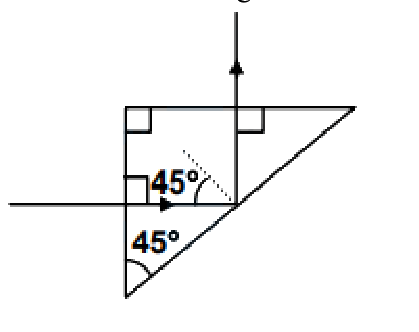
A light ray is incident perpendicular to one face of a $90^{\circ }$ prism and is totally internally reflected at the glass-air
interface. If the angle of reflection is $45^{\circ }$ , we conclude that the refractive index $n$
a.
$n < \frac{1}{2}$
b.
$n > \sqrt{2}$
c.
$n> \frac{1}{\sqrt{2}}$
d.
$n < \sqrt{2}$
Correct Answer & Step-by-Step Solution Locked
Sign in free to reveal the correct answer and AI explanation for this question.
The electrochemical equivalent of a metal is $3.3 \times 10^{-7}\,kg$ per coulomb. The mass of the metal liberated at the
cathode when a 3 A current is passed for 2 seconds will be
a.
$19.8 \times 10^{-7}\,kg$
b.
$9.9 \times 10^{-7}\,kg$
c.
$6.6 \times 10^{-7}\,kg$
d.
$1.1 \times 10^{-7}\,kg$
Correct Answer & Step-by-Step Solution Locked
Sign in free to reveal the correct answer and AI explanation for this question.
In a LCR circuit capacitance is changed from $C$ to $2C$ . For the resonant frequency to remain unchanged, the
inductance should be changed from $L$ to
a.
$4\,L$
b.
$2\,L$
c.
L/2
d.
L/4
Correct Answer & Step-by-Step Solution Locked
Sign in free to reveal the correct answer and AI explanation for this question.
The bob of a simple pendulum executes simple harmonic motion in water with a period $t$ , while the period of
oscillation of the bob is $t_{0}$ in air. Neglecting frictional force of water and given that the density of the bob is
$( \frac{4}{3})\times 1000\,kg/m^{3}$ . What relationship between $t$ and $t_{0}$ is true?
a.
$t=t_{0}$
b.
$t=t_{0}/2$
c.
$t= 2t_{0}$
d.
$t = 4t_{0}$
Correct Answer & Step-by-Step Solution Locked
Sign in free to reveal the correct answer and AI explanation for this question.
A block rests on a rough inclined plane making an angle of $30^{\circ }$ with the horizontal. The coefficient of static
friction between the block and the plane is $0.8$ . If the frictional force on the block is $10\,N$ , the mass of the
block (in $kg$ ) is (take $g = 10\,m/s^{2}$ )
a.
$2.0$
b.
$4.0$
c.
$1.6$
d.
$2.5$
Correct Answer & Step-by-Step Solution Locked
Sign in free to reveal the correct answer and AI explanation for this question.
One solid sphere A and another hollow sphere B are of same mass and same outer radii. Their moment of
inertia about their diameters are respectively $I_{A}$ and $I_{B}$ such that
a.
$I_{A} =I_{B}$
b.
$I_{A} >I_{B}$
c.
$I_{A} <I_{B}$
d.
yes, $45^{\circ } I_{A}/I_{B} =d_{A}/d_{B}$ Where $d_{A}$ and $d_{B}$ are
their densities.
Correct Answer & Step-by-Step Solution Locked
Sign in free to reveal the correct answer and AI explanation for this question.
The magnetic field due to a current carrying circular loop of radius $3\,cm$ at a point on the axis at a distance of
$4\,cm$ from the centre is $54\mu T$ . What will be its value at the centre of the Loop?
a.
$250\mu T$
b.
$150\mu T$
c.
$125\mu T$
d.
$75\mu T$
Correct Answer & Step-by-Step Solution Locked
Sign in free to reveal the correct answer and AI explanation for this question.
An $\alpha$ -particle of energy $5MeV$ is scattered through $180^{\circ }$ by a fixed uranium nucleus. The distance of the
closest approach is of the order of
a.
$1$ Å
b.
$10^{-10}\,cm$
c.
$10^{-12}\,cm$
d.
$10^{-15}\,cm$
Correct Answer & Step-by-Step Solution Locked
Sign in free to reveal the correct answer and AI explanation for this question.
A metal conductor of length $1\,m$ rotates vertically about one of its ends at angular velocity 5 radians per
second. If the horizontal component of earth's magnetic field is $0.3 \times 10^{-4}\,T$ , then the e.m.f. developed
between the two ends of the conductor is
a.
depends on the nature of the metal used
b.
depends on the intensity of the radiation
c.
depends both on the intensity of the radiation and
the metal used
d.
is the same for all metals and independent of the
intensity of the radiation.
Correct Answer & Step-by-Step Solution Locked
Sign in free to reveal the correct answer and AI explanation for this question.
In forced oscillation of a particle the amplitude is maximum for a frequency $\omega _{1}$ of the force, while the energy
is maximum for a frequency $\omega _{2}$ of the force, then
a.
$\omega _{1} =\omega _{2}$
b.
$\omega _{1} >\omega _{2}$
c.
$\omega _{1} <\omega _{2}$ when damping is small and $\omega _{1} >\omega _{2}$
when damping is large
d.
$\omega _{1} <\omega _{2}$
Correct Answer & Step-by-Step Solution Locked
Sign in free to reveal the correct answer and AI explanation for this question.
If $g$ is the acceleration due to gravity on the earth's surface, the gain in the potential energy of object of mass
$m$ raised from the surface of the earth to a height equal to the radius $R$ of the earth is
a.
$2mgR$
b.
$\frac{1}{2}mgR$
c.
$\frac{1}{4}mgR$
d.
$mgR$
Correct Answer & Step-by-Step Solution Locked
Sign in free to reveal the correct answer and AI explanation for this question.
Two thermally insulated vessels 1 and 2 are filled with air at temperatures $(T_{1},T_{2})$ , volume $(V_{1},V_{2})$ and
pressure $(P_{1},P_{2})$ respectively. If the valve joining two vessels is opened, the temperature inside the vessel at
equilibrium will be
In a uniform magnetic field of induction $B$ a wire in the form of semicircle of radius $r$ rotates about the
diameter of the circle with angular frequency $\omega$ . The axis of rotation is perpendicular to the field. If the total
resistance of the circuit is $R$ the mean power generated per period of rotation is
a.
$\frac{B\pi r^{2}\omega}{2R}$
b.
$\frac{(B\pi r^{2}\omega )}{2R}^{2}$
c.
$\frac{(B\pi r\omega )^{2}}{2R}$
d.
$\frac{(B\pi r\omega ^{2})^{2}}{8R}$
Correct Answer & Step-by-Step Solution Locked
Sign in free to reveal the correct answer and AI explanation for this question.
The displacement y of a particle in a medium can be expressed as $y= 10^{-6} sin(110t+ 20x+\pi /4)m$ , where $t$
is in seconds and $x$ in meter. The speed of the wave is
a.
$2000\,m/s$
b.
$5\,m/s$
c.
$20\,m/s$
d.
$5\pi m/s$
Correct Answer & Step-by-Step Solution Locked
Sign in free to reveal the correct answer and AI explanation for this question.
A plane convex lens of refractive index $1.5$ and radius of curvature $30\,cm$ is silvered at the curved surface.
Now this lens has been used to form the image of an object. At what distance from this lens an object be placed
in order to have a real image of the size of the object?
a.
$20\,cm$
b.
$30\,cm$
c.
$60\,cm$
d.
$80\,cm$
Correct Answer & Step-by-Step Solution Locked
Sign in free to reveal the correct answer and AI explanation for this question.
A machine gun fires a bullet of mass $40\,g$ with a velocity $1200\,ms^{-1}$ . The man holding it can exert a maximum
force of $144\,N$ on the gun. How many bullets can he fire per second at the most?
a.
one
b.
four
c.
two
d.
three
Correct Answer & Step-by-Step Solution Locked
Sign in free to reveal the correct answer and AI explanation for this question.
Suppose the gravitational force varies inversely as the nth power of distance. Then the time period planet in
circular orbit of radius $R$ around the sun will be proportional to
a.
$R^{(^{n}}\frac{+1}{2}^{)}$
b.
$R^{(^{n}}\frac{-1}{2}^{)}$
c.
$R^{n}$
d.
$R^{(^{n-2}}2^{)}$
Correct Answer & Step-by-Step Solution Locked
Sign in free to reveal the correct answer and AI explanation for this question.
If $t_{1}$ and $t_{2}$ are the times of flight of two particles having the same initial velocity $u$ and range $R$ on the
horizontal, then $t^{2}_{1} + t^{2}_{2}$ is equal to
a.
$\frac{u^{2}}{g}$
b.
$\frac{4u^{2}}{g^{2}}$
c.
$\frac{u^{2}}{2g}$
d.
1
Correct Answer & Step-by-Step Solution Locked
Sign in free to reveal the correct answer and AI explanation for this question.
A particle of mass $m$ is attached to a spring (of spring constant $k$ ) and has a natural angular frequency $\omega _{0}$ . An
external force $F(t)$ proportional to $cos\omega t(\omega \neq \omega _{0})$ is applied to the oscillator. The time displacement of the
oscillator will be proportional to
a.
$\frac{m}{\omega ^{2}_{0}-\omega ^{2}}$
b.
$\frac{1}{m(\omega ^{2}_{0}-\omega ^{2})}$
c.
$\frac{1}{m(\omega ^{2}+\omega ^{2})}$
$0$
d.
$\frac{m}{\omega ^{2}+\omega ^{2}}$
$0$
Correct Answer & Step-by-Step Solution Locked
Sign in free to reveal the correct answer and AI explanation for this question.
The thermo emf of a thermocouple varies with the temperature $\theta$ of the hot junction as $E = a\theta + b\theta ^{2}$ in volts
where the ratio $a/b$ is $700^{\circ }C$ . If the cold junction is kept at $0^{\circ }C$ , then the neutral temperature is
a.
$700^{\circ }C$
b.
$350^{\circ }C$
c.
$1400^{\circ }C$
d.
no neutral temperature is possible for this
thermocouple.
Correct Answer & Step-by-Step Solution Locked
Sign in free to reveal the correct answer and AI explanation for this question.
A charged particle $q$ is shot towards another charged particle $Q$ which is fixed, with a speed $v$ it approaches $Q$
upto a closest distance $r$ and then returns. If $q$ were given a speed $2v$ , the closest distances of approach would
be
a.
$r$
b.
$2r$
c.
$r/2$
d.
$r/4$
Correct Answer & Step-by-Step Solution Locked
Sign in free to reveal the correct answer and AI explanation for this question.
According to EInstein's photoelectric equation, the plot of the kinetic energy of the emitted photo electrons
from a metal $V_{s}$ the frequency, of the incident radiation gives straight line whose slope
a.
depends on the nature of the metal used
b.
depends on the intensity of the radiation
c.
depends both on the intensity of the radiation and
the metal used
d.
is the same for all metals and independent of the
intensity of the radiation.
Correct Answer & Step-by-Step Solution Locked
Sign in free to reveal the correct answer and AI explanation for this question.
An automobile travelling with speed of $60\,km/h$ , can brake to stop within a distance of $20\,cm$ . If the car is
going twice as fast, i.e $120\,km/h$ , the stopping distance will be
a.
$20\,m$
b.
$40\,m$
c.
$60\,m$
d.
$80\,m$
Correct Answer & Step-by-Step Solution Locked
Sign in free to reveal the correct answer and AI explanation for this question.
Two spherical conductor $B$ and $C$ having equal radii and carrying equal charges in them repel each other with
a force $F$ when kept apart at some distance. A third spherical conductor having same radius as that of $B$ but
uncharged brought in contact with $B$ , then brought in contact with $C$ and finally removed away from both. The
new force of repulsion, between $B$ and $C$ is
a.
$F/4$
b.
$3F/4$
c.
$F/8$
d.
$3\,F/8$ .
Correct Answer & Step-by-Step Solution Locked
Sign in free to reveal the correct answer and AI explanation for this question.
A particle moves in a straight line with retardation proportional to its displacement. Its loss of kinetic energy
for any displacement $x$ is proportional to
a.
$x^{3}$
b.
$e^{x}$
c.
$x$
d.
$log_{e}x$
Correct Answer & Step-by-Step Solution Locked
Sign in free to reveal the correct answer and AI explanation for this question.
Two long conductors, separated by a distance $d$ carry current $I_{1}$ and $I_{2}$ in the same direction. They exert a
force $F$ on each other. Now the current in one of them increased to two times and its direction reversed. The
distance is also increased to $3\,d$ . The new value of the force between them is
a.
$-2\,F$
b.
$F/3$
c.
$-2F/3$
d.
$-F/3$
Correct Answer & Step-by-Step Solution Locked
Sign in free to reveal the correct answer and AI explanation for this question.
Spherical balls of radius $R$ are falling in a viscous fluid of viscosity $\eta$ with a velocity $v$ . The retarding viscous
force acting on the spherical ball is
a.
directly proportional to $R$ but inversely
proportional to $v$ .
b.
directly proportional to both radius $R$ and
velocity $v$ .
c.
inversely proportional to both radius $R$ and
velocity $v$ .
d.
inversely proportional to $R$ but directly
proportional to velocity $v$ .
Correct Answer & Step-by-Step Solution Locked
Sign in free to reveal the correct answer and AI explanation for this question.
A charged oil drop is suspended in a uniform field of $3 \times 10^{4}\,V/m$ so that it neither falls nor rises. The charge
on the drop will be (take the mass of the charge $= 9.9 \times 10^{-15}\,kg$ and $g = 10\,m/s^{2}$ )
a.
$3.3 \times 10^{-18}C$
b.
$3.2 \times 10^{-18}C$
c.
$1.6 \times 10^{-18}C$
d.
$4.8 \times 10^{-18}C$
Correct Answer & Step-by-Step Solution Locked
Sign in free to reveal the correct answer and AI explanation for this question.
A particle at the end of a spring executes simple harmonic motion with a period $t_{1}$ , while the corresponding
period for another spring is $t_{2}$ . If the period of oscillation with the two springs in series is $t$ , then
a.
$T = t_{1}+ t_{2}$
b.
$\propto x^{2}$
c.
$T^{-1} = t^{-1}_{1} + t^{-1}_{2}$
d.
$T^{-2} = t^{2}_{1} + t^{2}_{2}$
Correct Answer & Step-by-Step Solution Locked
Sign in free to reveal the correct answer and AI explanation for this question.
The length of a magnet is large compared to its width and breadth. The time period of its width and breadth.
The time period of its oscillation in a vibration magnetometer is $2\,s$ . The magnet is cut along its length into
three equal parts and three parts are then placed on each other with their like poles together. The time period of
this combination will be
a.
$2\,s$
b.
$2/3\,s$
c.
$2\,s\sqrt{3}$
d.
$2/\sqrt{3}\,s$
Correct Answer & Step-by-Step Solution Locked
Sign in free to reveal the correct answer and AI explanation for this question.
A ball is thrown from a point with a speed $v_{0}$ at an angle of projection $\theta$ . From the same point and at the same
instant person starts running with a constant speed $v_{0}/2$ to catch the ball. Will the person be able to catch the
ball? If yes, what should be the angle of projection?
a.
yes, $60^{\circ }$
b.
yes, $30^{\circ }$
c.
no
d.
yes, $45^{\circ }$
Correct Answer & Step-by-Step Solution Locked
Sign in free to reveal the correct answer and AI explanation for this question.
A coil having $n$ turns and resistance $4R\Omega$ . This combination is moved in time $t$ seconds from a magnetic field
$W_{1}$ weber to $W_{2}$ weber. The induced current in the circuit is
a.
$-\frac{W_{2}-W_{1}}{5Rnt}$
b.
$- \frac{(W_{2}-W_{1})}{5Rt}$
c.
$-\frac{W_{2}-W_{1}}{\,Rnt\,}$
d.
$- \frac{n(W_{2}-W_{1})}{Rt}$
Correct Answer & Step-by-Step Solution Locked
Sign in free to reveal the correct answer and AI explanation for this question.
A satellite of mass $m$ revolves around the earth of radius $R$ at a height $x$ from its surface. If $g$ is the
acceleration due to gravity on the surface of the earth, the orbital speed of the satellite is
a.
$gx$
b.
$\frac{gR}{R-x}$
c.
$\frac{g^{2}}{R+x}$
d.
$1/2$
$(\frac{gR^{2}}{R+x})$
Correct Answer & Step-by-Step Solution Locked
Sign in free to reveal the correct answer and AI explanation for this question.
A force $\vec{F} = (5\hat{i}+ 3\hat{j}+ 2\hat{k})N$ is applied over a particle which displaces it from its origin to the point
$\vec{r}= (2\hat{i}- \hat{j})m$ . The work done on the particle in joules is
a.
$-7$
b.
$+7$
c.
$+10$
d.
$+13$
Correct Answer & Step-by-Step Solution Locked
Sign in free to reveal the correct answer and AI explanation for this question.
In a metre bridge experiment null point is obtained at $20\,cm$ from one end of the wire when resistance $X$ is
balanced against another resistance $Y$ . If $X <Y$ , then where will be the new position of the null point from
the same end, if one decides to balance a resistance of $4X$ against Y?
a.
$50\,cm$
b.
$80\,cm$
c.
$40\,cm$
d.
$70\,cm$
Correct Answer & Step-by-Step Solution Locked
Sign in free to reveal the correct answer and AI explanation for this question.
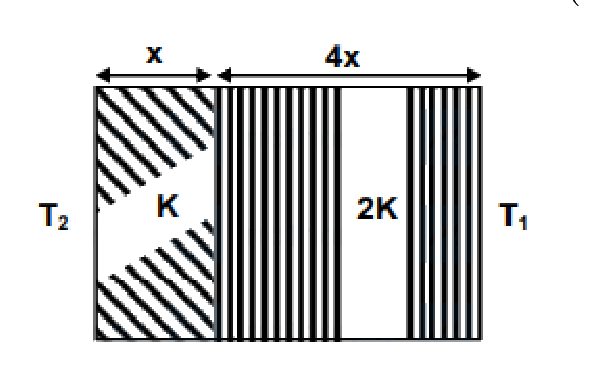
The temperature of two outer surfaces of a composite slab, consisting of two materials having coefficients of
thermal conductivity $K$ and $2K$ and thickness $x$ and $4x$ , respectively are $T_{2}$ and $T_{1}(T_{2} >T_{1})$ . The rate of heat
transfer through the slab, in a steady state is $(\frac{A(T_{2}-T_{1})K}{x} )f$ , with $f$ equal to
a.
1
b.
$1/2$
c.
$2/3$
d.
$1/3$
Correct Answer & Step-by-Step Solution Locked
Sign in free to reveal the correct answer and AI explanation for this question.
Consider the following $E^{\circ }$ values
$E^{\circ }_{Fe^{3+}/Fe^{2+}} = 0.77\,V$
$E^{\circ }_{Sn^{2+}/Sn} = -0.14\,V$
Under standard conditions the potential for the reaction $Sn(s) + 2Fe^{3+}(aq)\longrightarrow 2Fe^{2+}(aq) + Sn^{2+}(aq)$ is
a.
$1.68\,V$
b.
$0.63\,V$
c.
$0.91\,V$
d.
$1.40\,V$
Correct Answer & Step-by-Step Solution Locked
Sign in free to reveal the correct answer and AI explanation for this question.
Aluminium chloride exists as dimer, $Al_{2}Cl_{6}$ in solid state as well as in solution of non-polar solvents such as
benzene. When dissolved in water, it gives
a.
$Al^{3+} + 3Cl^{-}$
b.
$Al_{2}O_{3}+ 6HCl$
c.
$[Al(OH)_{6}]^{3-}$
d.
$[Al(H_{2}O)_{6}]^{3+} + 3Cl^{-}$
Correct Answer & Step-by-Step Solution Locked
Sign in free to reveal the correct answer and AI explanation for this question.
The ammonia evolved from the treatment of $0.30\,g$ of an organic compound for the estimation of nitrogen
was passed in $100\,mL$ of $0.1M$ sulphuric acid. The excess of acid required $20\,mL$ of $0.5M$ sodium hydroxide
solution hydroxide solutio for complete neutralization. The organic compound is
a.
acetamide
b.
thiourea
c.
urea
d.
benzamide
Correct Answer & Step-by-Step Solution Locked
Sign in free to reveal the correct answer and AI explanation for this question.
The standard e.m.f of a cell, involving one electron change is found to be $0.591\,V$ at $25^{\circ }C$ . The equilibrium
constant of the reaction is $(F = 96, 500Cmol^{-1} : R = 8.314JK^{-1}\,mol^{-1})$
a.
$1.0 \times 10^{1}$
b.
$1.0 \times 10^{30}$
c.
$1.0 \times 10^{10}$
d.
$1.0 \times 10^{5}$
Correct Answer & Step-by-Step Solution Locked
Sign in free to reveal the correct answer and AI explanation for this question.
What type of crystal defect is indicated in the diagram below? $Na^{+}Cl^{-}Na^{+}Cl^{-}Na^{+}Cl^{-}$
$Cl^{-}\square Cl^{-}\square Na^{+}\square Na^{+} Na^{+}Cl^{-}\square Cl^{-}Na^{+}Cl^{-} Cl^{-}Na^{+}Cl^{-}Na^{+}\square Na^{+}$
a.
Frenkel defect
b.
Frenkel and Schottky defects
c.
Interstitial defect
d.
Schottky defect
Correct Answer & Step-by-Step Solution Locked
Sign in free to reveal the correct answer and AI explanation for this question.
The enthalpies of combustion of carbon and carbon monoxide are $-393.5$ and $-283\,kJ\,mol^{-1}$ respectively.
The enthalpy of formation of carbon monoxide per mole is
a.
$110.5\,kJ$
b.
$-110.5\,kJ$
c.
$-676.5$ kJ
d.
$676.5\,kJ$
Correct Answer & Step-by-Step Solution Locked
Sign in free to reveal the correct answer and AI explanation for this question.
The formation of the oxide ion $O^{2-}(g)$ requires first an exothermic and then an endothermic step as shown
below $O(g) + e^{-}O^{-}(g)\Delta H^{\circ } = -142kJmol^{-1} O^{-}(g) + e^{-}O^{2-}(g)\Delta H^{\circ } = 844kJmol^{-1}$
a.
Oxygen is more electronegative
b.
$O^{-}$ ion has comparatively larger size than oxygen
atom
c.
$O^{-}$ ion will tend to resist the addition of another
electron
d.
Oxygen has high electron affinity
Correct Answer & Step-by-Step Solution Locked
Sign in free to reveal the correct answer and AI explanation for this question.
As the temperature is raised from $20^{\circ }C$ to $40^{\circ }C$ , the average kinetic energy of neon atoms changes by a factor
of which of the following?
a.
$1/2$
b.
2
c.
$\frac{313}{293}$
d.
$\sqrt{\frac{313}{293}}$
Correct Answer & Step-by-Step Solution Locked
Sign in free to reveal the correct answer and AI explanation for this question.
The wavelength of the radiation emitted, when in hydrogen atom electron falls from infinity to stationary state
1 , would be (Rydberg constant $= 1.097 \times 10^{7}\,m^{-1})$
a.
$91\,nm$
b.
$9.1 \times 10^{-8}\,nm$
c.
$406\,nm$
d.
$192\,nm$
Correct Answer & Step-by-Step Solution Locked
Sign in free to reveal the correct answer and AI explanation for this question.
For which of the following parameters the structural isomers $C_{2}H_{5}OH$ and $CH_{3}OCH_{3}$ would be expected to
have the same values? (Assume ideal behaviour)
a.
Heat of vaporization
b.
Gaseous densities at the same temperature and
pressure
c.
Boiling points
d.
Vapour pressure at the same temperature
Correct Answer & Step-by-Step Solution Locked
Sign in free to reveal the correct answer and AI explanation for this question.
To neutralize completely $20\,mL$ of $0.1M$ aqueous solution of phosphorous acid $(H_{3}PO_{3})$ , the volume of $0.1M$
aqueous $KOH$ solution required is
a.
$10\,mL$
b.
$60\,mL$
c.
$40\,mL$
d.
$20\,mL$
Correct Answer & Step-by-Step Solution Locked
Sign in free to reveal the correct answer and AI explanation for this question.
An ideal gas expands in volume from $1 \times 10^{-3}\,m^{3}$ to $1 \times 10^{-2}\,m^{3}$ at $300\,K$ against a constant pressure of
$1 \times 10^{5}Nm^{-2}$ . The work done is
a.
$-900\,J$
b.
$900\,kJ$
c.
$2780\,kJ$
d.
$-900\,kJ$
Correct Answer & Step-by-Step Solution Locked
Sign in free to reveal the correct answer and AI explanation for this question.
The limiting molar conductivities $\Lambda ^{\circ }$ for $NaCl, KBr$ and $KCl$ are 126,152 and $150\,S\,cm^{2}\,mol^{-1}$ respectively.
The $\Lambda ^{\circ }$ for $NaBr$ is
a.
$128\,S\,cm^{2}\,mol^{-1}$
b.
$302\,S\,cm^{2}\,mol^{-1}$
c.
$278\,S\,cm^{2}\,mol^{-1}$
d.
$176\,S\,cm^{2}\,mol^{-1}$
Correct Answer & Step-by-Step Solution Locked
Sign in free to reveal the correct answer and AI explanation for this question.
The soldiers of Napolean army while at Alps during freezing winter suffered a serious problem as regards to
the tin buttons of their uniforms. White metallic tin buttons got converted to grey powder. This transformation
is related to
a.
an interaction with nitrogen of the air at very
low temperatures
b.
an interaction with water vapour contained in the
humid air
c.
a change in the partial pressure of oxygen in the
air
d.
a change in the crystalline structure of tin
Correct Answer & Step-by-Step Solution Locked
Sign in free to reveal the correct answer and AI explanation for this question.
In a cell that utilises the reaction $Zn(s) + 2H^{+}(aq)\longrightarrow Zn^{2+}(aq) + H_{2}(\,g)$ addition of $H_{2}SO_{4}$ to cathode
compartment, will
a.
lower the $E$ and shift equilibrium to the left
b.
increases the $E$ and shift equilibrium to the left
c.
increase the $E$ and shift equilibrium to the right
d.
Lower the $E$ and shift equilibrium to the right
Correct Answer & Step-by-Step Solution Locked
Sign in free to reveal the correct answer and AI explanation for this question.
Consider the following nuclear reactions
$^{238}_{92} M \rightarrow \rightarrow^{x}_{y}N +^{4}_{2}He$
$^{N}_{y} N \rightarrow \rightarrow^{A}_{B}L + 2\beta ^{+}$
The number of neutrons in the element $L$ is
a.
142
b.
146
c.
140
d.
144
Correct Answer & Step-by-Step Solution Locked
Sign in free to reveal the correct answer and AI explanation for this question.
Excess of $KI$ reacts with $CuSO_{4}$ solution and then $Na_{2}\,S_{2}O_{3}$ solution is added to it. Which of the statements
is incorrect for this reaction?
a.
$Cu_{2}I_{2}$ is reduced
b.
Evolved $I_{2}$ is reduced
c.
$Na_{2}\,S_{2}O_{3}$ is oxidized
d.
$Cul_{2}$ is formed
Correct Answer & Step-by-Step Solution Locked
Sign in free to reveal the correct answer and AI explanation for this question.
In first order reaction, the concentration of the reactant decreases from $0.8M$ to $0.4M$ in 15 minutes. The time
taken for the concentration to change from $0.1M$ to $0.025M$ is
a.
30 minutes
b.
60 minutes
c.
$7.5$ minutes
d.
15 minutes
Correct Answer & Step-by-Step Solution Locked
Sign in free to reveal the correct answer and AI explanation for this question.
The equilibrium constant for the reaction $N_{2}(\,g) + O_{2}(\,g)\rightleftharpoons 2NO(g)$ at temperature $T$ is $4 \times 10^{-4}$ . The value
of $Kc$ for the reaction $NO(g)\rightleftharpoons \frac{1}{2}\,N_{2}(\,g) + \frac{1}{2} O_{2}(\,g)$ at the same temperature is
a.
$2.5 \times 10^{2}$
b.
$0.02$
c.
$4 \times 10^{-4}$
d.
50
Correct Answer & Step-by-Step Solution Locked
Sign in free to reveal the correct answer and AI explanation for this question.
The $E^{\circ }_{M^{+3}/M^{2+}}$ values for $Cr, Mn, Fe$ and Co are $-0.41, +1.57, +0.77$ and $+1.97\,V$ respectively. For which
one of these metals the change in oxidation state form $+2$ to $+3$ is easiest?
a.
$Cr$
b.
Co
c.
$Fe$
d.
Mn
Correct Answer & Step-by-Step Solution Locked
Sign in free to reveal the correct answer and AI explanation for this question.
The rate equation for the reaction $2\,A + B\longrightarrow C$ is found to be: rate $k[A][B]$ . The correct statement in
relation to this reaction is that the
a.
unit of $K$ must $bes^{-1}$
b.
values of $k$ is independent of the initial
concentration of $A$ and $B$
c.
rate of formation of $C$ is twice the rate of
disappearance of $A$
d.
$t_{1/2}$ is a constant
Correct Answer & Step-by-Step Solution Locked
Sign in free to reveal the correct answer and AI explanation for this question.
With two forces acting at a point, the maximum effect is obtained when their resultant is $4\,N$ . If they act at
right angles, then their resultant is $3\,N$ . Then the forces are
a.
$(2 + \sqrt{2})N$ and $(2 - \sqrt{2})N$
b.
$(2 + )N\sqrt{3}$ and $(2 -)N\sqrt{3}$
c.
$(2 + \frac{1}{2} \sqrt{2})N$ and $(2 - \frac{1}{2} \sqrt{2})N$
d.
$(2 + \frac{1}{2} \sqrt{3})N$ and $(2 - \frac{1}{2} \sqrt{3})N$
Correct Answer & Step-by-Step Solution Locked
Sign in free to reveal the correct answer and AI explanation for this question.
$---_{-}_{-}$
Let $-a, b$ and $-c$ be non-zero vectors such that $(a \times b) \times c = \frac{1}{3} |b||-c|-a$ . If $\theta$ is the acute angle between the
$-$
vectors $b$ and $-c$ , then $sin\theta$ equals
a.
$\frac{1}{3}$
b.
$\frac{\sqrt{2}}{3}$
c.
$\frac{2}{3}$
d.
$\frac{2\sqrt{2}}{3}$
Correct Answer & Step-by-Step Solution Locked
Sign in free to reveal the correct answer and AI explanation for this question.
A person standing on the bank of a river observes that the angle of elevation of the top of a tree on the
opposite bank of the river is $60^{\circ }$ and when he retires 40 meter away from the tree the angle of elevation
becomes $30^{\circ }$ . The breadth of the river is
a.
$20\,m$
b.
$30\,m$
c.
$40\,m$
d.
$60\,m$
Correct Answer & Step-by-Step Solution Locked
Sign in free to reveal the correct answer and AI explanation for this question.
The sides of a triangle are $sin\alpha , cos\alpha$ and $\sqrt{1 + sin\alpha cos\alpha}$ for some $0 <\alpha < \frac{\pi}{2}$ . Then the greatest angle of
the triangle is
a.
$60^{\circ }$
b.
$90^{\circ }$
c.
$120^{\circ }$
d.
$150^{\circ }$
Correct Answer & Step-by-Step Solution Locked
Sign in free to reveal the correct answer and AI explanation for this question.
The intersection of the spheres $x^{2} +y^{2} +z^{2} + 7x-2y- z= 13$ and $x^{2} +y^{2} +z^{2} -3x+ 3y+ 4z= 8$ is
the same as the intersection of one of the sphere and the plane
a.
$x- y- z= 1$
b.
$x-2y- z= 1$
c.
$x- y-2z= 1$
d.
$2x- y- z= 1$
Correct Answer & Step-by-Step Solution Locked
Sign in free to reveal the correct answer and AI explanation for this question.
The probability that A speaks truth is $\frac{4}{5}$ , while this probability for $B$ is $\frac{3}{4}$ . The probability that they contradict
each other when asked to speak on a fact is
a.
$\frac{3}{20}$
b.
$\frac{1}{5}$
c.
$\frac{7}{20}$
d.
$\frac{4}{5}$
Correct Answer & Step-by-Step Solution Locked
Sign in free to reveal the correct answer and AI explanation for this question.
A velocity $\frac{1}{4}\,m/s$ is resolved into two components along $OA$ and $OB$ making angles $30^{\circ }$ and $45^{\circ }$
respectively with the given velocity. Then the component along $OB$ is
a.
$\frac{1}{8}\,m/s$
b.
$\frac{1}{4}( -1)m/s\sqrt{3}$
c.
$\frac{1}{4}\,m/s$
d.
$\frac{1}{8}( -)m/s\sqrt{6} \sqrt{2}$
Correct Answer & Step-by-Step Solution Locked
Sign in free to reveal the correct answer and AI explanation for this question.
Let $f(x) = \frac{1-tanx}{4x-\pi},x\neq \frac{\pi}{4},x\in [0, \frac{\pi}{2}]$ . If $f(x)$ is continuous in $[0, \frac{\pi}{2}]$ , then $f(\frac{\pi}{4})$ is
a.
1
b.
$\frac{1}{2}$
c.
$-\frac{1}{2}$
d.
$-1$
Correct Answer & Step-by-Step Solution Locked
Sign in free to reveal the correct answer and AI explanation for this question.
If $u= \sqrt{a^{2}cos^{2}\theta +b^{2}sin^{2}\theta}+ \sqrt{a^{2}sin^{2}\theta +b^{2}cos^{2}\theta}$ , then the difference between the maximum and
minimum values of $u^{2}$ is given by
a.
$2(a^{2} +b^{2})$
b.
$2\sqrt{a^{2}+b^{2}}$
c.
$(a+b)^{2}$
d.
$(a- b)^{2}$
Correct Answer & Step-by-Step Solution Locked
Sign in free to reveal the correct answer and AI explanation for this question.
A function $y=f(x)$ has a second order derivative $f''(x) = 6(x-1)$ . If its graph passes through the point
$(2, 1)$ and at that point the tangent to the graph is $y= 3x-5$ , then the function is
a.
$(x-1)^{2}$
b.
$(x-1)^{3}$
c.
$(x+ 1)^{3}$
d.
$(x+ 1)^{2}$
Correct Answer & Step-by-Step Solution Locked
Sign in free to reveal the correct answer and AI explanation for this question.
In a series of $2n$ observations, half of them equal a and remaining half equal $-a$ . If the standard deviation of
the observations is 2 , then $|a|$ equals
a.
$\frac{1}{n}$
b.
$\sqrt{2}$
c.
2
d.
$\frac{\sqrt{2}}{n}$
Correct Answer & Step-by-Step Solution Locked
Sign in free to reveal the correct answer and AI explanation for this question.
A line with direction cosines proportional to $2, 1, 2$ meets each of the lines $x=y+a=z$ and
$x+a= 2y= 2z$ . The co-ordinates of each of the point of intersection are given by
a.
$(3a, 3a, 3a), (a,a,a)$
b.
$(3a, 2a, 3a), (a,a,a)$
c.
$(3a, 2a, 3a), (a,a, 2a)$
d.
$(2a, 3a, 3a), (2a,a,a)$
Correct Answer & Step-by-Step Solution Locked
Sign in free to reveal the correct answer and AI explanation for this question.
If $f(x) = \frac{e^{x}}{1+e^{x}},l_{1} =\int _{f}^{f}_{(-}^{(a}_{a}^{)}_{)} xg{x(1 - x)}dx$ and $I_{2} =\int _{f}^{f}_{(-}^{(a}_{a}^{)}_{)} g{x(1 - x)}dx$ then the value of $\frac{l_{2}}{l_{1}}$ is
a.
2
b.
$-3$
c.
$-1$
d.
1
Correct Answer & Step-by-Step Solution Locked
Sign in free to reveal the correct answer and AI explanation for this question.
Let $\vec{a}, \vec{b}$ and $\vec{c}$ be three non-zero vectors such that no two of these are collinear. If the vector $\vec{a}+ 2\vec{b}$ is
collinear with $\vec{c}$ and $\vec{b}+ 3\vec{c}$ is collinear with $\vec{a}$ ( $\lambda$ being some non-zero scalar) then $\vec{a}+ 2\vec{b}+ 6\vec{c}$ equals
a.
$\lambda \vec{a}$
b.
$\lambda \vec{b}$
c.
$\lambda \vec{c}$
d.
0
Correct Answer & Step-by-Step Solution Locked
Sign in free to reveal the correct answer and AI explanation for this question.
Let $\alpha ,\beta$ be such that $\pi <\alpha - \beta < 3\pi$ . If $sin\alpha + sin\beta = - \frac{21}{65}$ and $cos\alpha + cos\beta = -\frac{27}{65}$ , then the value of
$cos \frac{\alpha -\beta}{2}$ is
a.
$-\frac{3}{\sqrt{130}}$
b.
$\frac{3}{\sqrt{130}}$
c.
$\frac{6}{65}$
d.
$-\frac{6}{65}$
Correct Answer & Step-by-Step Solution Locked
Sign in free to reveal the correct answer and AI explanation for this question.
Let $A(2, -3)$ and $B(-2, 1)$ be vertices of a triangle $ABC$ . If the centroid of this triangle moves on the line
$2x+ 3y= 1$ , then the locus of the vertex $C$ is the line
a.
$2x+ 3y= 9$
b.
$2x-3y= 7$
c.
$3x+ 2y= 5$
d.
$3x-2y= 3$
Correct Answer & Step-by-Step Solution Locked
Sign in free to reveal the correct answer and AI explanation for this question.
$--$
If $a, b, -c$ are non-coplanar vectors and $\lambda$ is a real number, then the vectors $-a + 2b + 3-c,\lambda b + 4-c$ and
$-$
$(2\bar{\lambda}\bar{-1)}c$ are non-coplanar for
a.
all values of $\lambda$
b.
all except one value of $\lambda$
c.
all except two values of $\lambda$
d.
no value of $\lambda$
Correct Answer & Step-by-Step Solution Locked
Sign in free to reveal the correct answer and AI explanation for this question.
The sum of the first $n$ terms of the series $1^{2} + 2 \cdot 2^{2} + 3^{2} + 2 \cdot 4^{2} + 5^{2} + 2 \cdot 6^{2} + …$ is $\frac{n(n+1)^{2}}{2}$ when $n$ is
even. When $n$ is odd the sum is
a.
$\frac{3n(n+1)}{2}$
b.
$\frac{n^{2}(n+1)}{2}$
c.
$\frac{n(n+1)^{2}}{4}$
d.
$2$
$[\frac{n(n+1)}{2}]$
Correct Answer & Step-by-Step Solution Locked
Sign in free to reveal the correct answer and AI explanation for this question.
A particle moves towards east from a point $A$ to a point $B$ at the rate of $4\,km/h$ and then towards north from
$B$ to $C$ at the rate of $5\,km/h$ . If $AB= 12\,km$ and $BC = 5\,km$ , then its average speed for its journey from $A$
to $C$ and resultant average velocity direct from $A$ to $C$ are respectively
a.
$\frac{17}{4}\,km/h$ and $\frac{13}{4}\,km/h$
b.
$\frac{13}{4} \,km/h$ and $\frac{17}{4}\,km/h$
c.
$\frac{17}{9}\,km/h$ and $\frac{13}{9}\,km/h$
d.
$\frac{13}{9} \,km/h$ and $\frac{17}{9}\,km/h$
Correct Answer & Step-by-Step Solution Locked
Sign in free to reveal the correct answer and AI explanation for this question.
$||$
The coefficient of the middle term in the binomial expansion in powers of $x$ of $(1 +\alpha x)^{4}$ and of $(1 - \alpha x)^{6}$ is
the same if $\alpha$ equals
a.
$-\frac{5}{3}$
b.
$\frac{3}{5}$
c.
$\frac{-3}{10}$
d.
$\frac{10}{3}$
Correct Answer & Step-by-Step Solution Locked
Sign in free to reveal the correct answer and AI explanation for this question.
In a right angle $\triangle ABC, \angle A = 90^{\circ }$ and sides a, b, c are respectively, $5\,cm, 4\,cm$ and $3\,cm$ . If a force $\vec{F}$ has
moments 0,9 and 16 in $N$ cm. units respectively about vertices $A,B$ and $C$ , then magnitude of $\vec{F}$ is
a.
3
b.
4
c.
5
d.
9
Correct Answer & Step-by-Step Solution Locked
Sign in free to reveal the correct answer and AI explanation for this question.
Three forces $\vec{P}, \vec{Q}$ and $\vec{R}$ acting along IA, IB and IC, where I is the incentre of a $\triangle ABC$ , are in equilibrium.
Then $\vec{P} : \vec{Q}: \vec{R}$ is
a.
$cos \frac{A}{2} : cos \frac{B}{2} : cos \frac{C}{2}$
b.
$sin \frac{A}{2} : sin \frac{B}{2} : sin \frac{C}{2}$
$--$
Let $u, -v, w-$ be such that $|-u| = 1, |-v| = 2, | -w| = 3$ . If the projection $v-$ along $u-$ is equal to that of $w$ along $u$ and
$\bar{-}--_{-v, w} -$
are perpendicular to each other then $|u - v + w|$ equals
a.
2
b.
$\sqrt{7}$
c.
$\sqrt{14}$
d.
14
Correct Answer & Step-by-Step Solution Locked
Sign in free to reveal the correct answer and AI explanation for this question.
The eccentricity of an ellipse, with its centre at the origin, is $\frac{1}{2}$ . If one of the directrices is $x=$ 4 , then the
equation of the ellipse is
a.
$3x^{2} + 4y^{2} = 1$
b.
$3x^{2} + 4y^{2} = 12$
c.
$4x^{2} + 3y^{2} = 12$
d.
$4x^{2} + 3y^{2} = 1$
Correct Answer & Step-by-Step Solution Locked
Sign in free to reveal the correct answer and AI explanation for this question.
A particle is acted upon by constant forces $4I+J-3k$ and $3I+J- k$ which displace it from a point
$\hat{i}+ 2\hat{j}+ 3\hat{k}$ to the point $5\hat{i}+ 4\hat{j}+ \hat{k}$ . The work done in standard units by the forces is given by
a.
40
b.
30
c.
25
d.
15
Correct Answer & Step-by-Step Solution Locked
Sign in free to reveal the correct answer and AI explanation for this question.
Let $T_{r}$ be the rth term of an A.P. whose first term is a and common difference is $d$ . If for some positive
integers $m,n,m\neq n,T_{m} = \frac{1}{n}$ and $T_{n} = \frac{1}{m}$ , then $a- d$ equals
a.
0
b.
1
c.
$\frac{1}{mn}$
d.
$\frac{1}{m} + \frac{1}{n}$
Correct Answer & Step-by-Step Solution Locked
Sign in free to reveal the correct answer and AI explanation for this question.
Consider the following statements: Mode can be computed from histogram Median is not independent of
change of scale Variance is independent of change of origin and scale.
a.
only (a)
b.
only (b)
c.
only (a) and (b)
d.
(a), (b) and (c)
Correct Answer & Step-by-Step Solution Locked
Sign in free to reveal the correct answer and AI explanation for this question.
If $a_{1},a_{2},a_{3}, … ,a_{n}, …$ . are in G.P., then the value of the determinant
$loga_{n} loga_{n+1} loga_{n+2}$
$loga_{n+3} loga_{n+4} loga_{n+5} , is\,$
$loga_{n+6} loga_{n+7} loga_{n+8}$
a.
0
b.
$-2$
c.
2
d.
1
Correct Answer & Step-by-Step Solution Locked
Sign in free to reveal the correct answer and AI explanation for this question.
A line makes the same angle $\theta$ , with each of the $x$ and $z$ axis. If the angle $\beta$ , which it makes with $y$ -axis, is
such that $sin^{2} \beta = 3 sin^{2} \theta$ , then $cos^{2} \theta$ equals
a.
$\frac{2}{3}$
b.
$\frac{1}{5}$
c.
$\frac{3}{5}$
d.
$\frac{2}{5}$
Correct Answer & Step-by-Step Solution Locked
Sign in free to reveal the correct answer and AI explanation for this question.
If the straight lines $x= 1 +s,y= -3 - \lambda s,z= 1 +\lambda s$ and $x= \frac{t}{2},y= 1 +t,z= 2 - t$ with parameters $s$
and $t$ respectively, are co-planar then $\lambda$ equals
a.
$-2$
b.
$-1$
c.
$-\frac{1}{2}$
d.
0
Correct Answer & Step-by-Step Solution Locked
Sign in free to reveal the correct answer and AI explanation for this question.
A random variable $X$ has the probability distribution:
$\frac{X :}{p(X) :}\frac{1}{0.15}\frac{2}{0.23}\frac{3}{0.12}\frac{4}{0.10}\frac{5}{0.20}\frac{6}{0.08}\frac{7}{0.07}\frac{8}{0.05}$
For the events $E = {X$ is a prime number $}$ and $F = {X < 4}$ , the probability $P(E\cup F)$ is
a.
$0.87$
b.
$0.77$
c.
$0.35$
d.
$0.50$
Correct Answer & Step-by-Step Solution Locked
Sign in free to reveal the correct answer and AI explanation for this question.