Three friends, Mr. Rahman, Mr. George and Mr. Vedant, met after a long time. They were wearing red, green and violet colour shirts. Mr. Rahman and the person wearing violet shirt noticed that none of the three is wearing a colour that starts with same letter as his name. Which one of the following is the correct match of the persons with the colour of their shirts ?
a.
Rahman-Violet, George-Red, Vedant-Green
b.
Rahman-Green, George-Violet, Vedant-Red
c.
Rahman-Green, George-Red, Vedant-Violet
d.
Rahman-Red, George-Violet, Vedant-Green
Step-by-Step AI Explanation
Verified Method
From the problem statement:
1. None of the three is wearing a shirt colour starting with the same letter as their name:
- Mr. Rahman cannot wear Red ($R \neq \text{Red}$).
- Mr. George cannot wear Green ($G \neq \text{Green}$).
- Mr. Vedant cannot wear Violet ($V \neq \text{Violet}$).
2. The sentence mentions "Mr. Rahman and the person wearing violet shirt noticed...", which means Mr. Rahman is not wearing the violet shirt ($R \neq \text{Violet}$).
Since Mr. Rahman cannot wear Red or Violet, he must be wearing the **Green** shirt.
Now, the remaining colours are Red and Violet for George and Vedant:
- Vedant cannot wear Violet, so Mr. Vedant must wear the **Red** shirt.
- Therefore, Mr. George must wear the **Violet** shirt.
Matching:
- Rahman: Green
- George: Violet
- Vedant: Red
Thus, the correct option is (B).
Q2mcq
Kavita starts from her house and walks $200\text{ m}$ northward, then turns $45^\circ$ right and walks $70\text{ m}$. After that, she turns $90^\circ$ right and walks $70\text{ m}$. Which of the following is the closest value of the shortest distance between Kavita's current location and her house ?
a.
$296\text{ m}$
b.
$240\text{ m}$
c.
$200\text{ m}$
d.
$223\text{ m}$
Step-by-Step AI Explanation
Verified Method
Let the starting point (house) be the origin $(0, 0)$, with the east-west axis as the $x$-axis (East positive) and the north-south axis as the $y$-axis (North positive).
1. Kavita walks $200\text{ m}$ North:
$$\vec{r}_1 = (0, 200)$$
2. She turns $45^\circ$ right (heading North-East, which is along the vector $(\cos 45^\circ, \sin 45^\circ)$) and walks $70\text{ m}$:
$$\vec{r}_2 = \left(70 \sin 45^\circ, 70 \cos 45^\circ\right) = \left(70 \times \frac{1}{\sqrt{2}}, 70 \times \frac{1}{\sqrt{2}}\right) \approx (49.5, 49.5)$$
3. She then turns $90^\circ$ right (now heading South-East, along the vector $(\cos(-45^\circ), \sin(-45^\circ)) = (\cos 45^\circ, -\sin 45^\circ)$) and walks $70\text{ m}$:
$$\vec{r}_3 = \left(70 \sin 45^\circ, -70 \cos 45^\circ\right) = \left(70 \times \frac{1}{\sqrt{2}}, -70 \times \frac{1}{\sqrt{2}}\right) \approx (49.5, -49.5)$$
Notice that the two $70\text{ m}$ steps form the two legs of a right isosceles triangle. Combining the second and third displacements:
$$\Delta x = 70\sqrt{2} \approx 70 \times 1.414 = 98.99\text{ m} \approx 99\text{ m}$$
$$\Delta y = 0\text{ m}$$
So her final position relative to the house is:
$$x = 99\text{ m}, \quad y = 200\text{ m}$$
The shortest distance $d$ is:
$$d = \sqrt{x^2 + y^2} = \sqrt{99^2 + 200^2} = \sqrt{9801 + 40000} = \sqrt{49801} \approx 223.16\text{ m}$$
The closest value is $223\text{ m}$, which corresponds to option (D).
Q3mcq
In a code, the word DELTOID is written as 3152893. Then LOTION could be written as:
a.
582986
Correct Answer
b.
582981
c.
198396
d.
198392
Step-by-Step AI Explanation
Verified Method
Let us find the mapping from letters to digits from the word **DELTOID** encoded as **3152893**:
- D = 3
- E = 1
- L = 5
- T = 2
- O = 8
- I = 9
- D = 3
Notice that the letter D consistently corresponds to 3.
Now, for the word **LOTION**:
- L $\rightarrow$ 5
- O $\rightarrow$ 8
- T $\rightarrow$ 2
- I $\rightarrow$ 9
- O $\rightarrow$ 8
- N $\rightarrow$ a new digit not yet assigned to other letters (D=3, E=1, L=5, T=2, O=8, I=9)
Thus, LOTION must start with the digits **58298**. Looking at the choices:
- A) 582986 (ends with 6, which is an unused digit)
- B) 582981 (ends with 1, which corresponds to E, so it cannot be N)
- C) 198396
- D) 198392
Therefore, the correct code is **582986**, which corresponds to Option A.
Q4mcq
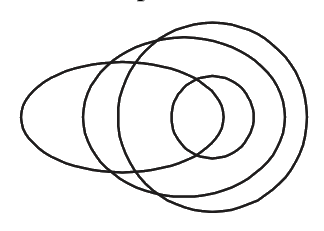
Consider the following statements:
Statement-I : All Booklets are Manuals.
Statement-II : All Manuals are Catalogues.
If statements-I and II are True, which one of the following conclusions can be conclusively drawn ?
a.
All Manuals are Booklets.
b.
All Catalogues are Booklets.
c.
All Booklets are Catalogues.
Correct Answer
d.
All Catalogues are Manuals.
Step-by-Step AI Explanation
Verified Method
We can represent the given premises using set theory or Venn diagrams:
- Statement-I: $\text{Booklets} \subseteq \text{Manuals}$
- Statement-II: $\text{Manuals} \subseteq \text{Catalogues}$
By the transitive property of subsets, if every Booklet is a Manual, and every Manual is a Catalogue, then every Booklet must also be a Catalogue:
$$\text{Booklets} \subseteq \text{Catalogues}$$
Therefore, "All Booklets are Catalogues" can be conclusively drawn.
The reverse inclusions (options A, B, and D) are not necessarily true, as the sets are not given to be equal.
Q5mcq
A car has wheels of diameter $36\text{ cm}$. If it runs at a speed of $60\text{ km/h}$, then the rotation per minute (RPM) will be closest to :
a.
884
Correct Answer
b.
898
c.
906
d.
986
Step-by-Step AI Explanation
Verified Method
To find the revolutions per minute (RPM) of the wheel:
1. Diameter of the wheel, $d = 36\text{ cm} = 0.36\text{ m}$.
Circumference of the wheel, $C = \pi d = \pi \times 0.36\text{ m} \approx 1.13097\text{ m}$.
2. Speed of the car, $v = 60\text{ km/h} = \frac{60 \times 1000}{60}\text{ m/min} = 1000\text{ m/min}$.
3. The RPM is given by:
$$\text{RPM} = \frac{v}{C} = \frac{1000}{\pi \times 0.36} = \frac{1000}{1.13097} \approx 884.19$$
Thus, the RPM is closest to 884, which corresponds to option (A).
Q6mcq
The initial monthly salaries of employees John, Riya and Sunil were in the proportion $4 : 3 : 5$. After an increase of Rs. 10000 monthly to all, the new proportion becomes $6 : 5 : 7$. What was the initial salary of Sunil ?
a.
Rs. 20000
b.
Rs. 25000
Correct Answer
c.
Rs. 30000
d.
Rs. 35000
Step-by-Step AI Explanation
Verified Method
Let the initial salaries of John, Riya, and Sunil be $4x$, $3x$, and $5x$ respectively.
After each gets an increase of Rs. $10000$, their salaries become $(4x + 10000)$, $(3x + 10000)$, and $(5x + 10000)$.
The new ratio is given as $6 : 5 : 7$. Taking the ratio for John and Riya:
$$\frac{4x + 10000}{3x + 10000} = \frac{6}{5}$$
Cross-multiplying gives:
$$5(4x + 10000) = 6(3x + 10000)$$
$$20x + 50000 = 18x + 60000$$
$$2x = 10000 \implies x = 5000$$
We can verify with Sunil's salary:
$$\frac{4(5000) + 10000}{5(5000) + 10000} = \frac{30000}{35000} = \frac{6}{7}$$, which is consistent.
Therefore, the initial salary of Sunil was:
$$5x = 5 \times 5000 = \text{Rs. } 25000$$
Hence, the correct option is (B).
Q7mcq
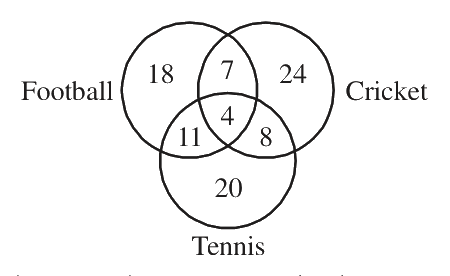
The given Venn diagram shows numbers of players playing one or more than one sport.
The percentage of players who play exactly two sports is closest to _____%.
a.
5
b.
14
c.
28
Correct Answer
d.
32
Step-by-Step AI Explanation
Verified Method
From the Venn diagram, we can read the number of players in each region:
- Exactly one sport: $18 \text{ (Football only)} + 24 \text{ (Cricket only)} + 20 \text{ (Tennis only)} = 62$
- Exactly two sports: $7 \text{ (Football & Cricket)} + 11 \text{ (Football & Tennis)} + 8 \text{ (Cricket & Tennis)} = 26$
- All three sports: $4$
Total number of players:
$$\text{Total} = 18 + 24 + 20 + 7 + 11 + 8 + 4 = 92$$
The number of players who play exactly two sports is $26$.
The percentage of players who play exactly two sports is:
$$\frac{26}{92} \times 100\% \approx 28.26\%$$
This is closest to $28\%$, so option C is correct.
Q8mcq
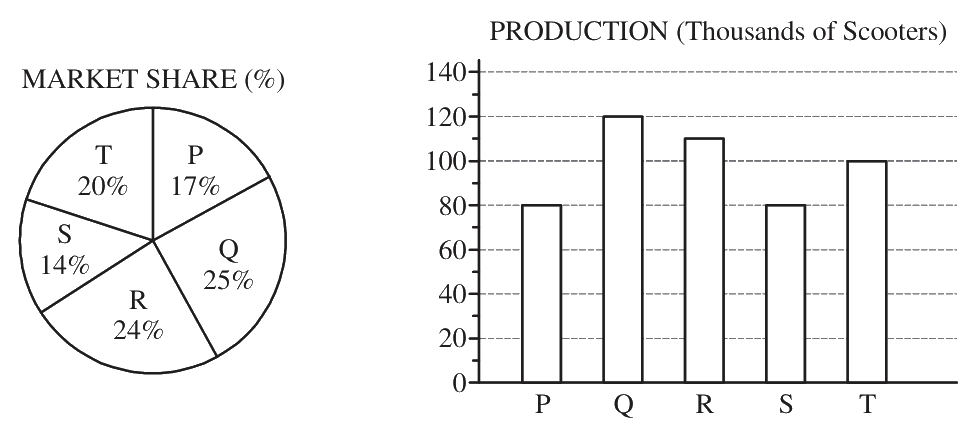
The market share (\%) and annual production of scooters from five automobile companies P, Q, R, S and T are shown in graphs.
If the profit of a company is directly proportional to the ratio of market share to production, then which of the following statements is/are correct ?
Statement X : Companies T and P have same profit.
Statement Y : Company R has the maximum profit.
Statement Z : Company S has the minimum profit.
a.
X and Y
b.
X and Z
c.
Y and Z
d.
Only Z
No explanation saved for this question yet.
Q9mcq
Numbers of Rose, Lotus, and Marigold plants in a garden are in the proportion $8 : 5 : 7$. Later, $75\%, 40\%$ and $50\%$ more plants of their respective categories were added. What will be the now proportion of plants, in the same order ?
a.
$5 : 3 : 4$
b.
$4 : 2 : 3$
Correct Answer
c.
$5 : 4 : 3$
d.
$7 : 4 : 5$
Step-by-Step AI Explanation
Verified Method
Let the initial numbers of Rose, Lotus, and Marigold plants be $8x$, $5x$, and $7x$ respectively.
- New number of Rose plants $= 8x imes (1 + 0.75) = 8x imes 1.75 = 14x$
- New number of Lotus plants $= 5x imes (1 + 0.40) = 5x imes 1.40 = 7x$
- New number of Marigold plants $= 7x imes (1 + 0.50) = 7x imes 1.50 = 10.5x$
The new ratio of plants is:
$$14x : 7x : 10.5x = 14 : 7 : 10.5$$
Dividing each term by $3.5$:
$$\frac{14}{3.5} : \frac{7}{3.5} : \frac{10.5}{3.5} = 4 : 2 : 3$$
Thus, the correct option is B.
Q10mcq
The value of a company is measured as the total value of its shares owned by different investors. Rakesh owns $2/15$ of the shares of a company. He sells $1/3$ of his shares for Rs. $75,000$. What is the total value of the company at that time ?
a.
Rs. 15,75,800
b.
Rs. 16,87,500
Correct Answer
c.
Rs. 17,75,800
d.
Rs. 18,27,500
Step-by-Step AI Explanation
Verified Method
Let $V$ be the total value of the company.
Rakesh owns $\frac{2}{15}$ of the shares, so his holding is $\frac{2}{15}V$.
He sells $\frac{1}{3}$ of his shares, which represents:
$$\frac{1}{3} \times \frac{2}{15}V = \frac{2}{45}V$$
We are given that this fraction corresponds to Rs. $75,000$:
$$\frac{2}{45}V = 75,000$$
$$V = \frac{75,000 \times 45}{2} = 37,500 \times 45 = 16,87,500$$
Therefore, the total value of the company is Rs. 16,87,500, which corresponds to option B.
🎉 10 Free Sample Solutions Completed
Unlock All 75 Questions & Solutions
Sign up free in seconds to unlock step-by-step AI answers for the remaining 65 questions.
A stock market trader has lost two-thirds of her investment on a day. Next day she recovered one-third of the previous day's loss. What fraction of her initial investment is she left with ?
a.
$\frac{1}{3}$
b.
$\frac{2}{3}$
c.
$\frac{2}{9}$
d.
$\frac{5}{9}$
Correct Answer & Step-by-Step Solution Locked
Sign in free to reveal the correct answer and AI explanation for this question.
Suresh asked Ramesh to identify the person in a photo that the latter is holding. Ramesh responds, “I have no brothers or sisters. However, that man’s father is my father’s son”. Who is the person in the photo ?
a.
Suresh
b.
Ramesh
c.
Ramesh’s son
d.
Ramesh’s cousin
Correct Answer & Step-by-Step Solution Locked
Sign in free to reveal the correct answer and AI explanation for this question.
A cylindrical container of radius 20 cm was filled with water up to 25 cm height. A solid spherical ball of radius 7 cm was then immersed in the water. What would by the approximate increase in water level in the container after the ball was fully immersed ?
a.
1.14 cm
b.
2.28 cm
c.
5.50 cm
d.
7.00 cm
Correct Answer & Step-by-Step Solution Locked
Sign in free to reveal the correct answer and AI explanation for this question.
Rahul and his father started jogging on a circular track of radius of radius $r$ ($r > 2$). Rahul completed one round and stopped. His father got tired half-way into the first round and returned to his starting point along a straight line. What is the ratio of the distances covered by Rahul and his father ?
a.
$\pi r/(\pi + 2)$
b.
$2\pi/(\pi + 2)$
c.
$1$
d.
$2$
Correct Answer & Step-by-Step Solution Locked
Sign in free to reveal the correct answer and AI explanation for this question.
Let $R_A$ and $R_B$ be the resistances of a channel determined (by taking the ratio of the voltage measured and current flowing) using configurations $A$ and $B$ respectively, as shown in the figure.
In both configurations each lead resistance is $5\ \Omega$ and each contact resistance is $10\ \Omega$. The channel has a resistivity of $20\ \Omega/\text{mm}$. Considering the voltmeter and the current source as ideal devices, the ratio $R_B / R_A$ is:
a.
1.1
b.
1.2
c.
1.3
d.
1.5
Correct Answer & Step-by-Step Solution Locked
Sign in free to reveal the correct answer and AI explanation for this question.
The Hamiltonian of the 1-dimensional quantum harmonic oscillator is given by:
$$H = \frac{p^2}{2m} + \frac{1}{2}m\omega^2 x^2$$
The expectation value of $[D, H]$ in the ground state, where $D = \frac{1}{2\hbar} (xp + px)$ is: (in units of $\hbar\omega$)
a.
$i$
b.
$\frac{1}{2}$
c.
$\frac{-3i}{2}$
d.
$0$
Correct Answer & Step-by-Step Solution Locked
Sign in free to reveal the correct answer and AI explanation for this question.
A particles of mass $m$ is subjected to a potential $V(x) = V_0\Theta(x) - kx$, where $V_0$ and $k$ are positive constants and $V_0$ is much larger than the energy of the particle. The function $\Theta(x) = 1$ for $x \ge 0$ and equals $0$ otherwise. The particle starts from rest at $t = 0$ and $x = -5$. In the limit $V_0 \to \infty$, the graph for $\dot{x}(t)$ is best represented by :
a.
Graph (a)
b.
Graph (b)
c.
Graph (c)
d.
Graph (d)
Correct Answer & Step-by-Step Solution Locked
Sign in free to reveal the correct answer and AI explanation for this question.
A spin-1/2 system is prepared in the initial state $|\phi\rangle = \frac{\sqrt{3}}{2}|\uparrow\rangle + \frac{1}{2}|\downarrow\rangle$, where $|\uparrow\rangle$ and $|\downarrow\rangle$ are eigenstates of $\hat{S}_z$ with eigenvalues $+\frac{\hbar}{2}$ and $-\frac{\hbar}{2}$ respectively. A measurement of $\hat{S}_z$ is followed by a meansurement of $\hat{S}_z$ on the system. What is the probability that the measurement of $\hat{S}_x$ yields a value $+\frac{\hbar}{2}$?
a.
$\frac{1}{2}$
b.
$\frac{2+\sqrt{3}}{4}$
c.
$\frac{2-\sqrt{3}}{4}$
d.
$\frac{3}{8}$
Correct Answer & Step-by-Step Solution Locked
Sign in free to reveal the correct answer and AI explanation for this question.
The internal energy of a system is given by $U = g(N)V^{-2/3} \exp\left[\frac{2S}{3NR}\right]$, where $V$ is the volume, $S$ is the entropy, $N$ is the number of molecules and $R$ is a constant. The function $g(N)$ is proportional to :
a.
$N^{5/3}$
b.
$N^{1/3}$
c.
$N^{2/3}$
d.
$N$
Correct Answer & Step-by-Step Solution Locked
Sign in free to reveal the correct answer and AI explanation for this question.
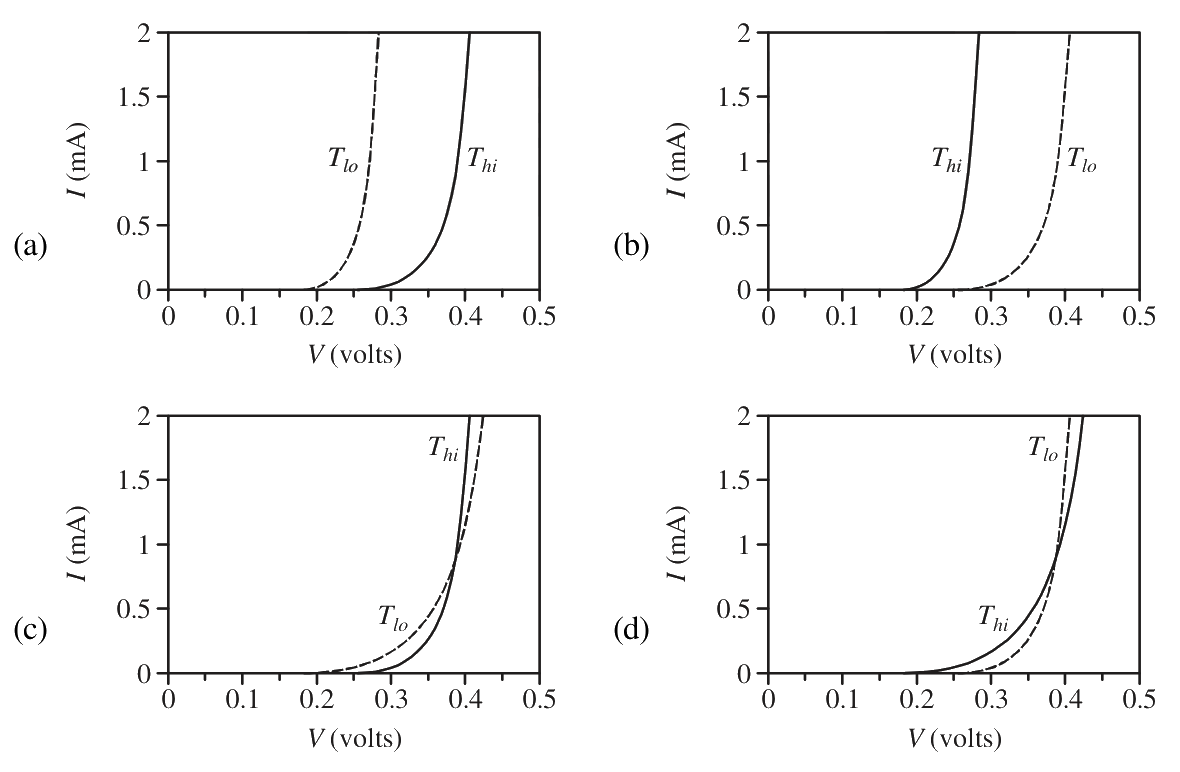
A Silicon p-n junction diode is operated under forward bias at two temperature $T_{hi} \approx 300\text{ K}$, (Shown by solid line) and $T_{lo} \approx 200\text{ K}$, (shown by dotted line). Which of the following plots best represents the I-V characteristics of the diode ?
a.
(a)
b.
(b)
c.
(c)
d.
(d)
Correct Answer & Step-by-Step Solution Locked
Sign in free to reveal the correct answer and AI explanation for this question.
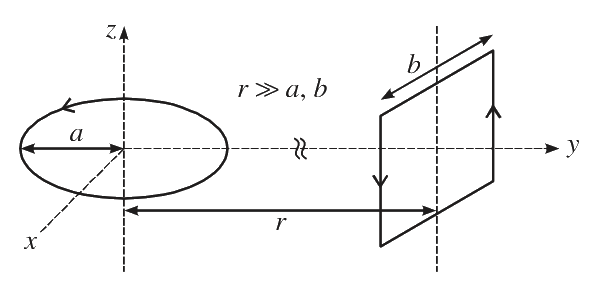
A circular loop of radius $a$ (in the $x$-$y$ plane) and a square loop of side $b$ (in the $x$-$z$ plane) are kept at a distance $r$. Both carry current $I$ as shown in the figure.
If $r \gg a, b$, the torque exerted on the square loop by the circular loop is :
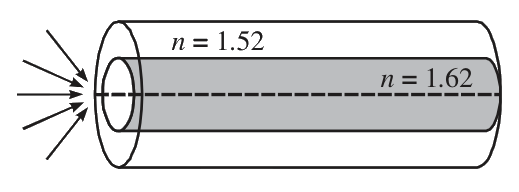
A $1\text{ km}$ long optical fiber of core and clad refractive indices $1.62$ and $1.52$, respectively, is laid in a straight line. Several identical light pulses are launched simultaneously from air on the entrance of this fiber from different angles about its axis, as shown below.
The diameter of the fiber is small compared to its length. The maximum time difference between the pulses emerging at the other end of the fiber would be closest to
a.
$355\text{ ns}$
b.
$317\text{ ns}$
c.
$5.40\text{ }\mu\text{s}$
d.
$5.75\text{ }\mu\text{s}$
Correct Answer & Step-by-Step Solution Locked
Sign in free to reveal the correct answer and AI explanation for this question.
Consider one mole of an ideal diatomic gas molecule at temperature $T$ such that $k_B T \gg h\nu$, where $\nu$ is the frequency of its vibrational mode. If $C_p$ and $C_v$ are specific heats of this gas at constant pressure and volume respectively, then the ratio $\gamma = \frac{C_p}{C_v}$, is :
a.
$2$
b.
$\frac{7}{5}$
c.
$\frac{5}{3}$
d.
$\frac{9}{7}$
Correct Answer & Step-by-Step Solution Locked
Sign in free to reveal the correct answer and AI explanation for this question.
A refrigerator can be thought to be a reversible engine operating between $T_2 = 20^\circ\text{C}$ and $T_1 = -10^\circ\text{C}$. The work needed to run this is supplied by another engine, that takes in energy at the rate of $500\text{ W}$ and runs with $50\%$ efficiency. If the refrigerator freezes $5\text{ kg}$ of water at $0^\circ\text{C}$ (latent heat $Q_L = 334\text{ kJ/kg}$ for ice) in $n$ hours, then $n$ is closest to :
a.
$0.4$
b.
$0.3$
c.
$0.1$
d.
$0.2$
Correct Answer & Step-by-Step Solution Locked
Sign in free to reveal the correct answer and AI explanation for this question.
A particle of mass $m$ is in the third energy eigenstate of an infinite potential well of width $a$. The time interval in which the phase of this wave function changes by $2\pi$ is :
a.
$\frac{4ma^2}{3\pi\hbar}$
b.
$\frac{4ma^2}{9\pi\hbar}$
c.
$\frac{8ma^2}{3\pi\hbar}$
d.
$\frac{8ma^2}{9\pi\hbar}$
Correct Answer & Step-by-Step Solution Locked
Sign in free to reveal the correct answer and AI explanation for this question.
In a particular inertial frame, electric field $\vec{E}$ and magnetic field $\vec{B}$ are :
$$\vec{E} = E_0\,\hat{x}, \;\; \vec{B} = \frac{E_0}{2c}\,\hat{x}$$
Which of the following statements is true ?
a.
There exists an inertial frame where $\vec{E} = 0, \; \vec{B} \neq 0$
b.
There exists no inertial frame where either $\vec{E} = 0$ or $\vec{B} = 0$
c.
There exists an inertial frame where $\vec{B} = 0, \; \vec{E} \neq 0$
d.
There exists an inertial frame where both $\vec{E} = 0$ and $\vec{B} = 0$
Correct Answer & Step-by-Step Solution Locked
Sign in free to reveal the correct answer and AI explanation for this question.
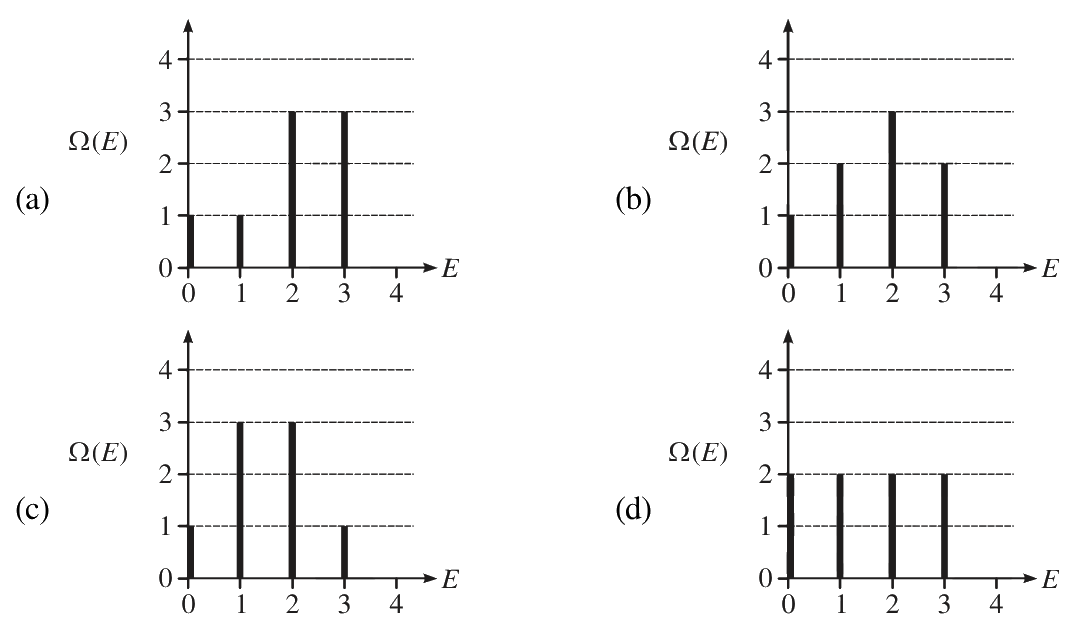
There are two boxes, one at the ground level, and the other at a fixed height $h$. There are three balls of different colours, each having mass $m$ and radius $r \ll h$. There is no restriction on the number of balls that can be simultaneously put in a given box. For a given value of the total energy $E$ (in units of $mgh$, $g$ being the acceleration due to gravity), the number of accessible microstates is $\Omega(E)$. The plot of $\Omega(E)$ vs $E$ is:
a.
Plot (a)
b.
Plot (b)
c.
Plot (c)
d.
Plot (d)
Correct Answer & Step-by-Step Solution Locked
Sign in free to reveal the correct answer and AI explanation for this question.
A plane electromagnetic wave $\vec{E}_1 \cos(k_z z + \omega t)$ is incident normally on a perfectly reflecting mirror in vacuum. If the permittivity of free space is $\varepsilon_0$, the force exerted on an area $A$ of the mirror would be
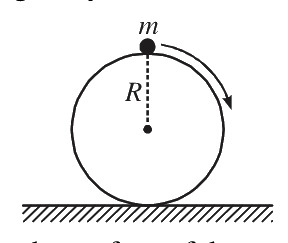
A sphere of radius $R$ is held fixed on the horizontal ground. A point particles of mass $m$ slides without friction from the top under the action of earth's gravity, as shown in the figure.
The speed of the particle when it leaves the surface of the system is :
a.
$\sqrt{\frac{2}{3} gR}$
b.
$\sqrt{\frac{3}{4} gR}$
c.
$\sqrt{2gR}$
d.
$\sqrt{gR}$
Correct Answer & Step-by-Step Solution Locked
Sign in free to reveal the correct answer and AI explanation for this question.
Consider the earth to be a free rigid body symmetric about its north-south ($z$) axis. If the principal moments of inertia satisfy $I_z = 1.003 I_x$, then its angular velocity (in the body fixed frame) would precess about the $z$-axis with a period of nearly
a.
$167\text{ days}$
b.
$333\text{ days}$
c.
$556\text{ days}$
d.
$667\text{ days}$
Correct Answer & Step-by-Step Solution Locked
Sign in free to reveal the correct answer and AI explanation for this question.
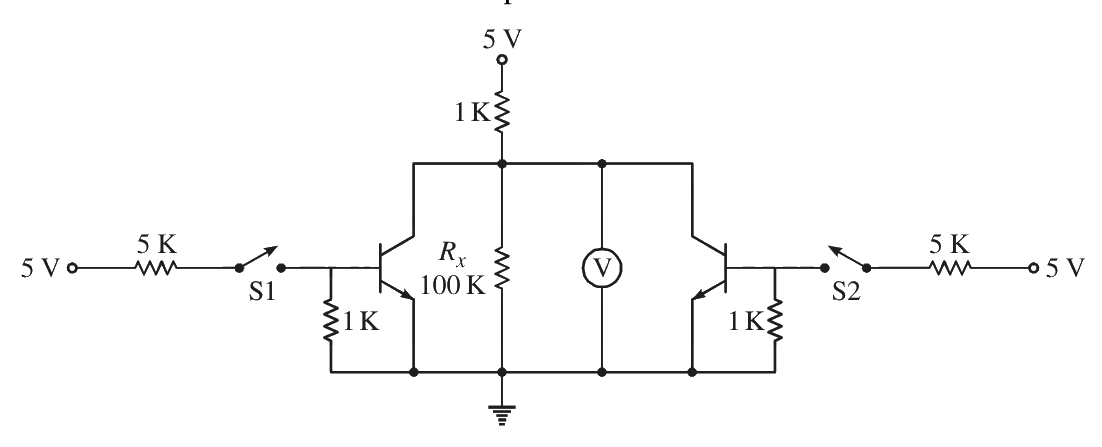
The circuit, composed of npn transistors of high $\beta$, resistors and switches, is shown in the figure. The biasing is sufficient to turn on the transistors when respective switches S1 and S2 are closed.
The voltage across the resistor $R_x = 100\text{ k}\Omega$ is
a.
$\sim 5\text{ V}$ when both S1 and S2 are closed.
b.
$\sim 5\text{ V}$ when either S1 or S2 are closed.
c.
$\sim 5\text{ V}$ when both S1 and S2 are open.
d.
$\sim 0\text{ V}$ when both S1 and S2 are open.
Correct Answer & Step-by-Step Solution Locked
Sign in free to reveal the correct answer and AI explanation for this question.
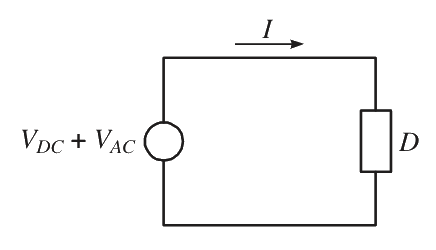
Consider the device $D$ shown in the figure below. Its current-voltage characteristic is given by $I = aV + bV^2$, where $I$ is the current, $V$ is the input voltage, and $a\ \&\ b$ are constants. The device is used to mix a voltage signal $V = V_{DC} + V_{AC}$, where $V_{AC} = V_0 \cos \omega t$. $V_{DC}$ and $V_0$ are constants. The frequency components presents in the current $I$ are:
a.
$0$ and $\omega$
b.
$0$, $\omega$ and $2\omega$
c.
$0$ and $2\omega$
d.
$\omega$ and $2\omega$
Correct Answer & Step-by-Step Solution Locked
Sign in free to reveal the correct answer and AI explanation for this question.
The Hamiltonian of a system is given by:
$$H(x, p) = -[p^2 + V^2(x)]^{1/2}$$
where $x$ and $p$ are generalized coordinate and momentum respectively and $V(x) \ge 0$. The corresponding Lagrangian is :
a.
$-V(x)\sqrt{1 - \dot{x}^2}$
b.
$-\frac{V(x)}{\sqrt{1 - \dot{x}^2}}$
c.
$V(x)\sqrt{1 - \dot{x}^2}$
d.
$\frac{V(x)}{\sqrt{1 - \dot{x}^2}}$
Correct Answer & Step-by-Step Solution Locked
Sign in free to reveal the correct answer and AI explanation for this question.
A system consists of two non-interacting identical spin-1/2 particles. The spatial wave-functions for the individual particles are given by $\phi_1(x)$ and $\phi_2(x)$. Let $x_1$ and $x_2$ denote the positions of the particles respectively. The total wave function of the system (not necessarily normalized) can be
The energy eigenstates of a one-dimensional harmonic oscillator are denoted by $|i\rangle$, where $i = 0, 1, 2, 3, \dots$.
If the momentum operator $\hat{p}$ satisfies $\frac{\langle n+1 | \hat{p} | n \rangle}{\langle 2 | \hat{p} | 1 \rangle} = \sqrt{2}$, then the value of $n$ is :
a.
$0$
b.
$1$
c.
$2$
d.
$3$
Correct Answer & Step-by-Step Solution Locked
Sign in free to reveal the correct answer and AI explanation for this question.
A highly collimated laser beam with a diameter of $1\text{ cm}$ and wavelength $500\text{ nm}$ is directed from the earth's surface towards the moon (~$384,000\text{ km}$ away from the earth). Assuming ideal diffraction limited propagation in vacuum, which of the following best estimates the diameter of the beam upon returning to the earth after reflection from an ideal reflector installed on the moon.
a.
$200\text{ m}$
b.
$20\text{ m}$
c.
$20\text{ km}$
d.
$200\text{ km}$
Correct Answer & Step-by-Step Solution Locked
Sign in free to reveal the correct answer and AI explanation for this question.
If the binding energies per nucleon of the nuclei $X(A = 240)$ and $Y(A = 120)$ are $7.6\text{ MeV}$ and $8.5\text{ MeV}$ respectively, the energy released in the symmetric fission, $X \rightarrow Y + Y$ is :
a.
$94\text{ MeV}$
b.
$9.4\text{ MeV}$
c.
$108\text{ MeV}$
d.
$216\text{ MeV}$
Correct Answer & Step-by-Step Solution Locked
Sign in free to reveal the correct answer and AI explanation for this question.
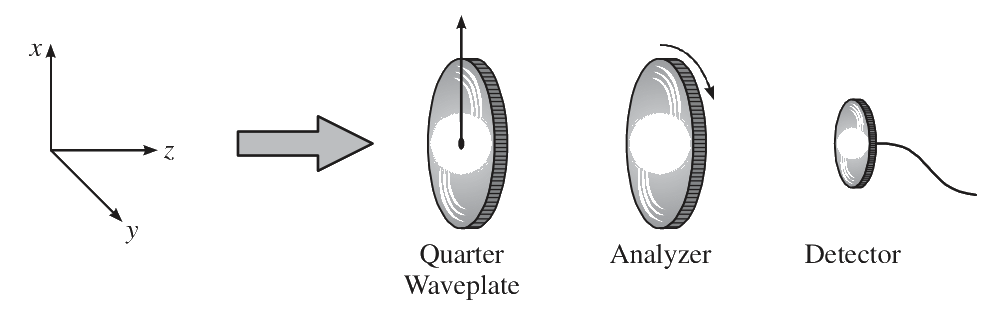
A beam of light along the $z$-axis passes through a quarter wave plate and an analyzer as shown in the figure. The fast axis of the quarter wave plate is aligned with the $x$-axis. The light intensity is measured by a detector placed after the analyzer.
Consider two scenarios where the incident light beam is (A) circularly polarized and (B) linearly polarized along the $x$-axis. If the polarization axis of the analyzer is rotated by one full cycle about the $z$-axis, the number of times the detector measures the maximum intensity in each case would be
a.
(A) 4 and (B) 0
b.
(A) 2 and (B) 0
c.
(A) 4 and (B) 4
d.
(A) 2 and (B) 2
Correct Answer & Step-by-Step Solution Locked
Sign in free to reveal the correct answer and AI explanation for this question.
Let $P_n(x)$ be a polynomial of degree $n$ with real coefficients, where $n = 0, 1, 2, 3, ...$ If $\int\limits_{2}^{4} P_n(x) P_m(x) dx = \delta_{mn}$, then
a.
$P_1(x) = \pm \sqrt{\frac{3}{2}} (3-x)$
b.
$P_1(x) = \pm \sqrt{\frac{3}{2}} (2-x)$
c.
$P_1(x) = \pm \sqrt{\frac{3}{2}} (1-x)$
d.
$P_1(x) = \pm \sqrt{3}(3+x)$
Correct Answer & Step-by-Step Solution Locked
Sign in free to reveal the correct answer and AI explanation for this question.
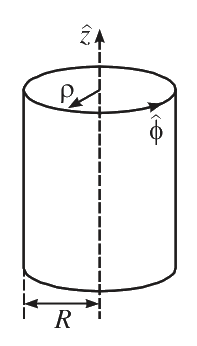
A long cylinder of radius $R$ carries a magnetization $\vec{M} = k \rho^2 \hat{\phi}$, where $k$ is a constant, $\rho$ is the radial distance from the axis and $\hat{\phi}$ is the azimuthal unit vector (see in the figure).
The magnetic field inside and outside the cylinder would be:
a.
$\vec{B}_{\text{inside}} = 0$, $\vec{B}_{\text{outside}} = \mu_0 k \rho^2 \hat{\phi}$
b.
$\vec{B}_{\text{inside}} = \mu_0 k \rho^2 \hat{\phi}$, $\vec{B}_{\text{outside}} = 0$
c.
$\vec{B}_{\text{inside}} = \vec{B}_{\text{outside}} = \mu_0 k \rho^2 \hat{\phi}$
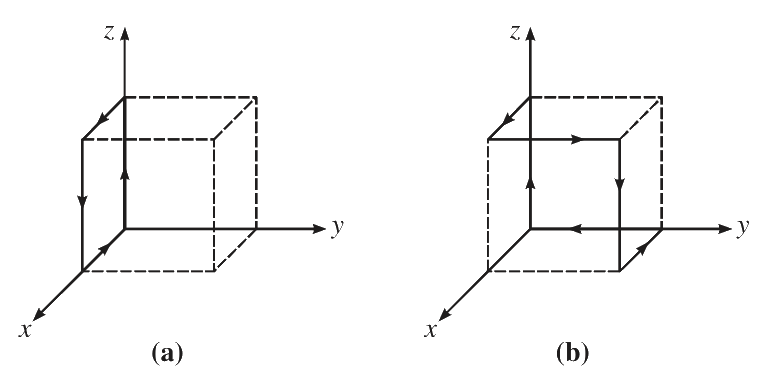
Two identical cubes are shown in figure (a) and (b). The magnitude of the magnetic field at the centre of the cube in (a), produced by the currents as shown, is $B_0$. The magnetic field at the centre of the cube in (b) will be
a.
$\sqrt{3}B_0$
b.
$2B_0$
c.
$\frac{3}{2}B_0$
d.
$\sqrt{2}B_0$
Correct Answer & Step-by-Step Solution Locked
Sign in free to reveal the correct answer and AI explanation for this question.
The minimum number of two input NOR gates required to obtain the following output for three digital inputs $A$, $B$ and $C$
$$Y = (\bar{A} + \bar{B} + \bar{C})(\bar{A} + B + \bar{C})(\bar{A} + \bar{B} + C)$$
would be
a.
4
b.
3
c.
5
d.
6
Correct Answer & Step-by-Step Solution Locked
Sign in free to reveal the correct answer and AI explanation for this question.
Consider a laser cooling experiment where atoms are slowed down by an inelastic process of absorption and subsequent emission of photons. If light of wavelength $776.5\text{ nm}$ is used to slow down potassium atoms (mass number 39) with initial speed $130\text{ ms}^{-1}$, the number of such absorption and emission cycles needed to bring the atoms to rest is closest to
a.
$10^3$
b.
$10^2$
c.
$10^5$
d.
$10^4$
Correct Answer & Step-by-Step Solution Locked
Sign in free to reveal the correct answer and AI explanation for this question.
The charge density of the electron cloud of a hydrogen atom is given by:
$$\rho(\vec{r}) = -\frac{e}{8\pi a^3}\exp\left(-\frac{r}{a}\right)$$
where '$a$' is some characteristic length. The potential energy due to the interaction between the proton (sitting at the origin) and the electron cloud is given by:
a.
$-\frac{e^2}{2\pi \varepsilon_0 a}$
b.
$-\frac{e^2}{4\pi \varepsilon_0 a}$
c.
$-\frac{e^2}{\pi \varepsilon_0 a}$
d.
$-\frac{e^2}{8\pi \varepsilon_0 a}$
Correct Answer & Step-by-Step Solution Locked
Sign in free to reveal the correct answer and AI explanation for this question.
Consider $2N$ Ising spins, $s_i$ ($s_i = \pm 1$) in a one-dimensional lattice with periodic boundary conditions. The Hamiltonian is given by:
$$H = -J \sum_{i=1}^{2N} s_i s_{i+1},$$
where $J$ denotes the strength of the nearest-neighbour interactions with $J > 0$. Let $F$ be the fully ferromagnetic state and let $A$ be the lowest energy state with zero magnetization. The energy difference between these two states is
a.
$\frac{3J}{2}$
b.
$4J$
c.
$\frac{J}{2}$
d.
$2J$
Correct Answer & Step-by-Step Solution Locked
Sign in free to reveal the correct answer and AI explanation for this question.
A thermodynamic system (at temperature $T$ and volume $V$), is described by its internal energy $U = AT^4V$ and pressure $p = \frac{1}{3}AT^4$, where $A$ is a constant of appropriate dimension. The Helmholtz free energy of the system is :
a.
$\frac{4}{3}AT^4V$
b.
$\frac{1}{3}AT^4V$
c.
$-\frac{1}{3}AT^4V$
d.
$-\frac{4}{3}AT^4V$
Correct Answer & Step-by-Step Solution Locked
Sign in free to reveal the correct answer and AI explanation for this question.
$|n\rangle$ denotes the eigenvector of the number operator for a particle of mass $m$ in a one-dimensional potential
$$V = \frac{1}{2}m\omega^2 x^2, \ [n = 0, 1, 2,...]$$
For the state vector $|\phi(x, t=0)\rangle = \frac{1}{\sqrt{3}}|1\rangle + \sqrt{\frac{2}{3}}|2\rangle$, $\langle \hat{x}(t)\rangle$ is :
A semiconductor has the dispersion relation $E = E_0 - A\cos(\alpha k_x)$, where $A$ and $\alpha$ are positive constants. The effective electron mass close to the minimum energy is :
a.
$\frac{\hbar^2}{A^2\alpha}$
b.
$\frac{1}{4}\frac{\hbar^2}{A^2\alpha}$
c.
$\frac{\hbar^2}{A\alpha^2}$
d.
$\frac{1}{2}\frac{\hbar^2}{A\alpha^2}$
Correct Answer & Step-by-Step Solution Locked
Sign in free to reveal the correct answer and AI explanation for this question.
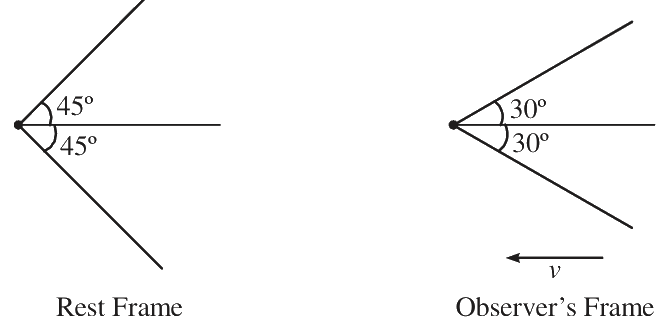
In its rest frame, a source emits light in a conical beam of width $-45^\circ$ to $45^\circ$. An observer is moving towards the source with a speed $v$. For the observer, the beam width appears to be $-30^\circ$ to $30^\circ$. The speed of the observer is closest to
a.
$0.62\ c$
b.
$0.50\ c$
c.
$0.82\ c$
d.
$0.41\ c$
Correct Answer & Step-by-Step Solution Locked
Sign in free to reveal the correct answer and AI explanation for this question.
The $\rho$-mesons are $J^P = 1^-$ particles that decay strongly into pions. The ratio of the particle decay widths
$$\frac{\Gamma(\rho^0 \to \pi^0\pi^0)}{\Gamma(\rho^+ \to \pi^+\pi^0)}$$
is closest to:
a.
1
b.
1/2
c.
0
d.
2
Correct Answer & Step-by-Step Solution Locked
Sign in free to reveal the correct answer and AI explanation for this question.
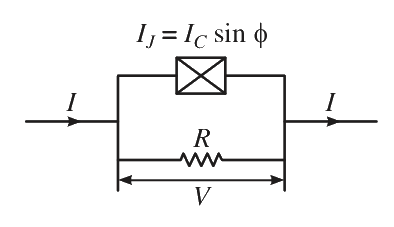
The current $I_J(t)$ through a Josephson junction (shown by the crossed box in the figure) and the voltage $V(t)$ across it, are given by:
$$\begin{aligned} I_J(t) &= I_C \sin \phi(t) \\ \frac{d\phi(t)}{dt} &= \frac{2eV(t)}{\hbar} \end{aligned}$$
where $I_C$ is the critical current of the junction and $\phi(t)$ is the phase difference across the junction. A resistor $R$ is connected in parallel to the junction and a constant current $I > I_C$ flows through the combination as shown.
The energy dissipated in $R$ in the time $\phi$ changes by $2\pi$ is:
a.
$\frac{h}{2e} I$
b.
$\frac{h}{2e} I_C$
c.
$\frac{h}{2e} (I - I_C)$
d.
$\frac{h}{2e} (I + I_C)$
Correct Answer & Step-by-Step Solution Locked
Sign in free to reveal the correct answer and AI explanation for this question.
An atom is subjected to a weak magnetic field $B = 0.1\text{ T}$. A spectral line of wavelength $184.9\text{ nm}$ corresponding to a $J = 1$ to $J = 0$ transition splits into three components. The highest and the lowest components are separated by $3.2 \times 10^{-4}\text{ nm}$. The magnetic moment of the atom in $J = 1$ state (in units of Bohr magneton) is
a.
$2.82$
b.
$0.71$
c.
$1.41$
d.
$4.23$
Correct Answer & Step-by-Step Solution Locked
Sign in free to reveal the correct answer and AI explanation for this question.
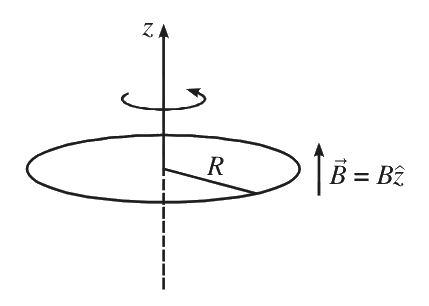
A thin circular wire loop of mass $M$, having radius $R$, carries a static change $Q$. The plane of the loop is held perpendicular to a uniform magnetic field $\vec{B}$ along the $z$-axis passing through its centre, as shown in the figure.
The loop, initially at rest, can freely rotate about the $z$-axis. When the magnetic field is switched off the loop starts rotating with an angular frequency
a.
$\frac{QB}{M}$
b.
$\frac{QB}{2M}$
c.
$\frac{\pi QB}{M}$
d.
$\frac{\pi QB}{2M}$
Correct Answer & Step-by-Step Solution Locked
Sign in free to reveal the correct answer and AI explanation for this question.
A rigid molecule can have two possible rotational states $j = 0$ or $j = 1$. Its rotational energies are given by
$$\varepsilon_j = \frac{\hbar^2}{2I} j(j+1)$$
where $I$ is its moment of inertia. For an ensemble of such molecules in thermal equilibrium at temperature $T$, the ratio of the number of molecules in the $j = 1$ state ($N_1$), to those in $j = 0$ state ($N_0$), is $\frac{N_1}{N_0} = 0.003$. The temperature $T$ (in units of $\frac{\hbar^2}{2I k_B}$, where $k_B$ is the Boltzmann constant) is closest to :
a.
0.29
b.
0.21
c.
0.15
d.
0.34
Correct Answer & Step-by-Step Solution Locked
Sign in free to reveal the correct answer and AI explanation for this question.
In a rotational-vibrational spectrum of $\text{HCl}$ ($^{1}\text{H}^{35}\text{Cl}$), the first $R$-branch line and the first $P$-branch line are observed at $\lambda^{-1} = 2906\text{ cm}^{-1}$ and $\lambda^{-1} = 2865\text{ cm}^{-1}$, respectively. The equilibrium bond length of this molecule would be closest to:
a.
$0.2\text{ \AA}$
b.
$1.3\text{ \AA}$
c.
$13\text{ \AA}$
d.
$2.1\text{ \AA}$
Correct Answer & Step-by-Step Solution Locked
Sign in free to reveal the correct answer and AI explanation for this question.
A gas of electrons (with no source of scattering) is placed in an electric field $\vec{E} = Ee^{i\omega t} (\hat{i} + \hat{k})$ and a magnetic field $\vec{B} = B\hat{k}$, where $E$ and $B$ are constants. The frequency at which the conductivity in the $z$-direction, given by the ratio of the current and the electric field, both in the $z$-direction, diverges is
a.
$0$
b.
$\frac{eB}{m}$
c.
$-\frac{eB}{m}$
d.
$\frac{eB}{2m}$
Correct Answer & Step-by-Step Solution Locked
Sign in free to reveal the correct answer and AI explanation for this question.
For a free partice of mass $m$, consider the following time dependent quantity in phase space
$$Q = \frac{qp}{m} - \frac{p^2 t}{m^2},$$
where $q$ and $p$ are the canonically conjugate position and momentum coordinates respectively. Then $dQ/dt$ is given by:
a.
$0$
b.
$\frac{p^2}{m^2}$
c.
$-\frac{p^2}{m^2}$
d.
$\frac{qp}{mt}$
Correct Answer & Step-by-Step Solution Locked
Sign in free to reveal the correct answer and AI explanation for this question.
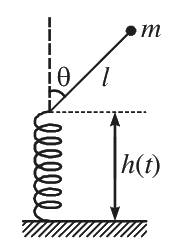
A massless rod of length $l$ is hinged at the extreme end of a vertical spring whose other end is fixed to the ground. A point mass $m$ is fixed at end of the rod, as shown in the figure.
Assume harmonic motion of the spring given by $h(t) = h_0 (2 + \cos \omega t)$, where $h_0 > l$. The equation of motion of the mass (confined to the plane of the figure) is given by:
Two discrete time random walkers start from the point $x = 0$ at time $t = 0$ taking discrete steps of unit length along the $x$-axis. The first walker is unbiased and the second walker is biased to move towards the right with probability $p$. The probability that they are at a distance of 2 units from each other at both time steps $t = 1$ and $t = 2$ is
a.
$\frac{1}{4}$
b.
$\frac{1}{2} - \frac{p}{2}$
c.
$1 - \frac{3p}{4}$
d.
$\frac{p}{2}$
Correct Answer & Step-by-Step Solution Locked
Sign in free to reveal the correct answer and AI explanation for this question.
The probability density of a free particle of mass $m$ at time $t = 0$, is given by:
$$A \exp \left( - \frac{x^2}{2\sigma^2(0)} \right)$$
At $t > 0$, its probability density is proportional to $\exp \left( - \frac{x^2}{2\sigma^2(t)} \right)$, where $\sigma^2(t)$ is :
The ground state wavefunction for the hydrogen atom is:
$$\psi_0 = \sqrt{\frac{1}{\pi a_0^3}} e^{-\frac{r}{a_0}}, \text{ (where } a_0 \text{ is the Bohr radius)}$$
Considering an additional potential $H'$ as a permutation to the hydrogen atom Hamiltonian, given by:
$$H' = \begin{cases} \frac{e^2}{4\pi \varepsilon_0} \left[ \frac{1}{r} - \frac{1}{R} \right] & \text{for } 0 < r < R \\[6pt] 0 & \text{for } r > R \end{cases}$$
where $R$ is the radius of the proton, $R \ll a_0$. The shift in the ground state energy due to $H'$ is:
When a neutron of $1\text{ keV}$ kinetic energy impinges on a $^{12}\text{C}$ target, the total scattering cross-section is $1000\text{ barns}$. The approximate value of the phase shift $\delta_0$ is :
a.
$18^\circ$
b.
$108^\circ$
c.
$90^\circ$
d.
$36^\circ$
Correct Answer & Step-by-Step Solution Locked
Sign in free to reveal the correct answer and AI explanation for this question.
From a straight-line segment of unit length, three points are chosen at random, one after another. The probability that they are in increasing other is:
a.
$\frac{1}{3}$
b.
$\frac{1}{8}$
c.
$\frac{1}{9}$
d.
$\frac{1}{6}$
Correct Answer & Step-by-Step Solution Locked
Sign in free to reveal the correct answer and AI explanation for this question.
Which one of the following curves best represents the solution of the differential equation:
$$\frac{dx}{dt} + x = 1,$$
with the initial condition $x(0) = 0$ ?
a.
[Image (a)]
b.
[Image (b)]
c.
[Image (c)]
d.
[Image (d)]
Correct Answer & Step-by-Step Solution Locked
Sign in free to reveal the correct answer and AI explanation for this question.