At time $t = 0$, a particle is in the ground state of the Hamiltonian
$$H(t) = \frac{p^2}{2m} + \frac{1}{2}m\omega^2 x^2 + \lambda x \sin \frac{\omega t}{2}$$
where $\lambda$, $\omega$ and $m$ are positive constants. To $O(\lambda^2)$, the probability that at $t = \frac{2\pi}{\omega}$, the particle would be in the first excited state of $H(t = 0)$ is
Using time-dependent perturbation theory, the transition probability from the ground state $|0\rangle$ to the first excited state $|1\rangle$ is given to order $\lambda^2$ by:
$$P_{0\to 1} = \frac{1}{\hbar^2} \left| \int_0^T \langle 1 | H'(t) | 0 \rangle e^{i\omega_{10} t} \, dt \right|^2$$
Here, $H'(t) = \lambda x \sin(\omega t/2)$, where $\langle 1 | x | 0 \rangle = \sqrt{\frac{\hbar}{2m\omega}}$ and $\omega_{10} = \omega$.
The interaction integral is:
$$I = \int_0^{2\pi/\omega} \sin\left(\frac{\omega t}{2}\right) e^{i\omega t} \, dt = \int_0^{2\pi/\omega} \frac{e^{i\omega t/2} - e^{-i\omega t/2}}{2i} e^{i\omega t} \, dt = \frac{1}{2i} \int_0^{2\pi/\omega} \left(e^{i 3\omega t/2} - e^{i \omega t/2}\right) dt$$
Evaluating the integral:
$$\int_0^{2\pi/\omega} e^{i 3\omega t/2} \, dt = \left[ \frac{e^{i 3\omega t/2}}{i 3\omega/2} \right]_0^{2\pi/\omega} = \frac{e^{i 3\pi} - 1}{i 3\omega/2} = \frac{-2}{i 3\omega/2} = \frac{4i}{3\omega}$$
$$\int_0^{2\pi/\omega} e^{i \omega t/2} \, dt = \left[ \frac{e^{i \omega t/2}}{i \omega/2} \right]_0^{2\pi/\omega} = \frac{e^{i \pi} - 1}{i \omega/2} = \frac{-2}{i \omega/2} = \frac{4i}{\omega}$$
Subtracting the two:
$$I = \frac{1}{2i} \left( \frac{4i}{3\omega} - \frac{4i}{\omega} \right) = \frac{1}{2} \left( \frac{4}{3\omega} - \frac{4}{\omega} \right) = \frac{1}{2} \left( -\frac{8}{3\omega} \right) = -\frac{4}{3\omega}$$
Thus, the transition probability is:
$$P_{0\to 1} = \frac{1}{\hbar^2} \lambda^2 |\langle 1 | x | 0 \rangle|^2 |I|^2 = \frac{\lambda^2}{\hbar^2} \left( \frac{\hbar}{2m\omega} \right) \left( -\frac{4}{3\omega} \right)^2 = \frac{\lambda^2}{\hbar^2} \frac{\hbar}{2m\omega} \frac{16}{9\omega^2} = \frac{16\lambda^2}{9m\hbar\omega^3}$$
Q1mcq
At $z = 0$, the function $\frac{1}{z - \sin z}$ of a complex variable $z$ has
a.
no singularity
b.
a simple pole
c.
a pole of order 2
d.
a pole of order 3
Correct Answer
Step-by-Step AI Explanation
Verified Method
Expanding $\sin z$ in a Taylor series around $z = 0$:
$$\sin z = z - \frac{z^3}{3!} + \frac{z^5}{5!} - \cdots$$
Thus, the denominator is:
$$z - \sin z = \frac{z^3}{6} - \frac{z^5}{120} + \cdots = z^3 \left( \frac{1}{6} - \frac{z^2}{120} + \cdots \right)$$
Therefore:
$$\frac{1}{z - \sin z} = \frac{1}{z^3} \frac{1}{\frac{1}{6} - \frac{z^2}{120} + \cdots} = \frac{6}{z^3} + O\left(\frac{1}{z}\right)$$
Since the leading term in the Laurent series is proportional to $z^{-3}$, the function has a pole of order 3 at $z = 0$.
Q1mcq
A vehicle has tyres of diameter $1\text{ m}$ connected by a shaft directly to gearwheel A which meshes with gear wheel B as shown in the diagram. A has 12 teeth and B has 8. If points $x$ on A and $y$ on B are initially in contact, they will again be in contact after the vehicle has travelled a distance (in meters)
a.
$2\pi$
Correct Answer
b.
$3\pi$
c.
$4\pi$
d.
$12\pi$
Step-by-Step AI Explanation
Verified Method
For points $x$ on gear A and $y$ on gear B to meet again, both gears must complete an integer number of full revolutions. Gear A has 12 teeth and gear B has 8 teeth. The least common multiple (LCM) of the number of teeth is $\text{LCM}(12, 8) = 24$. Therefore, gear A must turn through $24 / 12 = 2$ full revolutions. Since gear A is directly connected to the shaft of the tyres with diameter $D = 1\text{ m}$, each revolution of gear A corresponds to one revolution of the tyre, covering a distance of $\pi D = \pi\text{ m}$. Thus, in 2 revolutions, the vehicle travels a distance of $2 \times \pi = 2\pi\text{ m}$.
Q2mcq
A plant grows by $10\%$ of its height every three months. If the plant's height today is $1\text{ m}$, its height after one year is the closest to
a.
$1.10\text{ m}$
b.
$1.21\text{ m}$
c.
$1.33\text{ m}$
d.
$1.46\text{ m}$
Correct Answer
Step-by-Step AI Explanation
Verified Method
There are 4 quarters (three-month periods) in one year. The plant grows by $10\%$ every three months, so its height after one year is:
$$h = 1 \times (1 + 0.10)^4 = (1.1)^4 = 1.4641\text{ m}$$
This is closest to $1.46\text{ m}$.
Q2mcq
In the absorption spectrum of H-atom, the frequency of transition from the ground state to the first excited state is $\nu_H$. The corresponding frequency for a bound state of a positively charged muon ($\mu^+$) and an electron is $\nu_\mu$. Using $m_\mu = 10^{-28}\text{ kg}$, $m_e = 10^{-30}\text{ kg}$ and $m_p \gg m_e, m_\mu$, the value of $(\nu_\mu - \nu_H)/\nu_H$ is
a.
$0.001$
b.
$-0.001$
c.
$-0.01$
Correct Answer
d.
$0.01$
Step-by-Step AI Explanation
Verified Method
The transition frequency $\nu$ is directly proportional to the reduced mass $\mu_{\text{red}}$ of the two-body system:
$$\nu \propto \mu_{\text{red}}$$
For a hydrogen atom consisting of a proton and an electron:
Since $m_p \gg m_e$, the reduced mass is:
$$\mu_H = \frac{m_e m_p}{m_e + m_p} \approx m_e$$
For muonium (a bound state of a positive muon $\mu^+$ and an electron $e^-$):
$$\mu_\mu = \frac{m_e m_\mu}{m_e + m_\mu} = \frac{10^{-30} \times 10^{-28}}{10^{-30} + 10^{-28}} = \frac{10^{-58}}{10^{-28}(1 + 10^{-2})} = \frac{10^{-30}}{1.01} = \frac{m_e}{1.01} \approx m_e(1 - 0.01)$$
Therefore, the fractional change in frequency is:
$$\frac{\nu_\mu - \nu_H}{\nu_H} = \frac{\mu_\mu - \mu_H}{\mu_H} \approx \frac{m_e(1 - 0.01) - m_e}{m_e} = -0.01$$
Hence, the correct choice is C.
Q2mcq
If the expectation value of the momentum of a particle in one dimension is zero, then its (box-normalizable) wavefunction may be of the form:
a.
$\sin kx$
Correct Answer
b.
$e^{ikx} \sin kx$
c.
$e^{ikx} \cos kx$
d.
$\sin kx + e^{ikx} \cos kx$
Step-by-Step AI Explanation
Verified Method
For any purely real wavefunction $\psi(x)$, the momentum operator $\hat{p} = -i\hbar \frac{d}{dx}$ gives an expectation value of zero:
$$\langle p \rangle = \int \psi^*(x) \left(-i\hbar \frac{d\psi}{dx}\right) dx = -i\hbar \int \psi(x) \psi'(x) \, dx = -i\hbar \left[ \frac{1}{2}\psi^2(x) \right] = 0$$
for normalizable or box-normalized boundary conditions where the boundary term vanishes. Here, $\psi(x) = \sin kx$ is purely real, so $\langle p \rangle = 0$.
For states with traveling wave factors like $e^{ikx}$, there is a net probability current carrying non-zero momentum.
Q3mcq
At what horizontal distance from A should a vertical line be drawn so as to divide the area of the trapezium shown in the figure into two equal parts ? ($a$ and $b$ are lengths of the parallel sides.)
a.
$\frac{(a+b)}{4}$
Correct Answer
b.
$\frac{(a+b)}{3}$
c.
$\frac{(a+b)}{2}$
d.
$\frac{(2a+b)}{2}$
Step-by-Step AI Explanation
Verified Method
In a right trapezoid (or trapezium) with parallel vertical bases of lengths $h_1$ and $h_2$, or horizontal parallel sides of lengths $a$ and $b$ where the total horizontal extent is $L$, a standard question asks for dividing the area into two equal parts. For the standard CSIR NET question where the parallel sides are $a$ and $b$ along the horizontal (e.g., $a$ at the top and $b$ at the bottom, or trapezoid with base $a+b$), the horizontal distance from vertex A dividing the area into two equal parts is given by $(a+b)/4$.
Q3mcq
The Raman rotational-vibrational spectrum of nitrogen molecules is observed using an incident radiation of wavenumber $12500\text{ cm}^{-1}$. In the first shifted band, the wavenumbers of the observed lines (in $\text{cm}^{-1}$) are $10150, 10158, 10170, 10182$ and $10190$. The values of vibrational frequency and rotational constant (in $\text{cm}^{-1}$), respectively, are
a.
$2330$ and $2$
Correct Answer
b.
$2350$ and $2$
c.
$2350$ and $3$
d.
$2330$ and $3$
Step-by-Step AI Explanation
Verified Method
In the vibration-rotation Raman spectrum of a diatomic molecule, transitions belong to the O-branch ($\Delta J = -2$) and S-branch ($\Delta J = +2$), with the Q-branch ($\Delta J = 0$) at the band center:
$$\tilde{\nu} = \tilde{\nu}_0 \pm 4B(J + 3/2)$$
The line spacing between adjacent lines in the O and S branches is $\Delta \tilde{\nu} = 4B$.
The observed lines are at $10150, 10158, 10170, 10182, 10190\text{ cm}^{-1}$.
Notice the gaps between consecutive lines:
$10158 - 10150 = 8\text{ cm}^{-1}$
$10170 - 10158 = 12\text{ cm}^{-1}$
$10182 - 10170 = 12\text{ cm}^{-1}$
$10190 - 10182 = 8\text{ cm}^{-1}$
Here, the spacing between consecutive lines within the same branch is $\Delta \tilde{\nu} = 4B = 8\text{ cm}^{-1}$, which gives $B = 2\text{ cm}^{-1}$.
The center of the band (the Q-branch vibrational wavenumber $\tilde{\nu}_{\text{band}}$) lies midway between the first O-line and first S-line: $\frac{10158 + 10182}{2} = 10170\text{ cm}^{-1}$.
The vibrational Raman shift is $\Delta \tilde{\nu}_{\text{vib}} = \tilde{\nu}_{\text{incident}} - \tilde{\nu}_{\text{center}} = 12500 - 10170 = 2330\text{ cm}^{-1}$.
Thus, the vibrational frequency is $2330\text{ cm}^{-1}$ and the rotational constant is $2\text{ cm}^{-1}$.
Q3mcq
If $z = i^{i^{i^{\cdot^{\cdot^{\cdot}}}}}$ (Note that the exponent continues indefinitely), then a possible value of $\frac{1}{z} \ln z$ is
a.
$2i \ln i$
b.
$\ln i$
Correct Answer
c.
$i \ln i$
d.
$2 \ln i$
Step-by-Step AI Explanation
Verified Method
Given the infinite tower of powers:
$$z = i^{i^{i^{\cdot^{\cdot^{\cdot}}}}}$$
By the self-similarity of the infinite exponentiation, we can write:
$$z = i^z$$
Taking the natural logarithm of both sides:
$$\ln z = \ln(i^z) = z \ln i$$
Dividing both sides by $z$:
$$\frac{1}{z} \ln z = \ln i$$
Thus, a possible value is $\ln i$, which corresponds to Option B.
Q4mcq
Earth may be assumed to be an axially symmetric freely rotating rigid body. The ratio of the principal moments of inertia about the axis of symmetry and an axis perpendicular to it is $33 : 32$. If $T_0$ is the time taken by earth to make one rotation around its axis of symmetry, then the time period of precession is closest to
a.
$33\ T_0$
b.
$33T_0/2$
c.
$32T_0$
Correct Answer
d.
$16T_0$
Step-by-Step AI Explanation
Verified Method
For an axially symmetric, torque-free rotating rigid body with principal moments of inertia $I_1 = I_2 = I_\perp$ and $I_3$, the angular frequency of precession of the angular velocity vector about the symmetry axis (body frame) is given by $\Omega_p = \left| \frac{I_3 - I_\perp}{I_\perp} \right| \omega_3$. Here, the ratio of the principal moments of inertia about the axis of symmetry and an axis perpendicular to it is $\frac{I_3}{I_\perp} = \frac{33}{32}$. Therefore, $\Omega_p = \left( \frac{33}{32} - 1 \right) \omega_3 = \frac{1}{32} \omega_3$. Since the time period of rotation is $T_0 = \frac{2\pi}{\omega_3}$, the time period of precession is $T_p = \frac{2\pi}{\Omega_p} = 32 \left(\frac{2\pi}{\omega_3}\right) = 32 T_0$.
🎉 10 Free Sample Solutions Completed
Unlock All 72 Questions & Solutions
Sign up free in seconds to unlock step-by-step AI answers for the remaining 62 questions.
The squares in the following sketch are filled with digits 1 to 9, without any repetition, such that the numbers in the two horizontal rows add up to 20 each. What number appears in the square labelled A in the vertical column?
a.
It cannot be ascertained in the absence of the sum of the numbers in the column.
b.
3
c.
5
d.
7
Correct Answer & Step-by-Step Solution Locked
Sign in free to reveal the correct answer and AI explanation for this question.
The electronic configuration of $^{12}\text{C}$ is $1\text{s}^2\ 2\text{s}^2\ 2\text{p}^2$. Including LS coupling, the correct ordering of its energies is
a.
$E(^3P_2) < E(^3P_1) < E(^3P_0) < E(^1D_2)$
b.
$E(^3P_0) < E(^3P_1) < E(^3P_2) < E(^1D_2)$
c.
$E(^1D_2) < E(^3P_2) < E(^3P_1) < E(^3P_0)$
d.
$E(^3P_1) < E(^3P_0) < E(^3P_2) < E(^1D_2)$
Correct Answer & Step-by-Step Solution Locked
Sign in free to reveal the correct answer and AI explanation for this question.
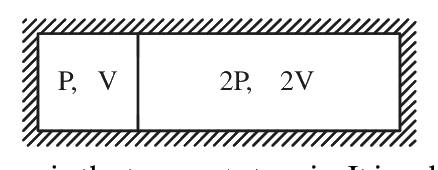
A thermally isolated container, filled with an ideal gas at temperature $T$, is divided by a partition, which is clamped initially, as shown in the figure below.
The partition does not allow the gas in the two parts to mix. It is subsequently released and allowed to move freely with negligible friction. The final pressure at equilibrium is
a.
$5P/3$
b.
$5P/4$
c.
$3P/5$
d.
$4P/5$
Correct Answer & Step-by-Step Solution Locked
Sign in free to reveal the correct answer and AI explanation for this question.
A stationary magnetic dipole $m = m\hat{k}$ is placed above an infinite surface ($z = 0$) carrying a uniform surface current density $k = k\hat{i}$. The torque on the dipole is
a.
$\frac{\mu_0}{2}mk\,\hat{i}$
b.
$-\frac{\mu_0}{2}mk\,\hat{i}$
c.
$\frac{\mu_0}{2}mk\,\hat{j}$
d.
$-\frac{\mu_0}{2}mk\,\hat{j}$
Correct Answer & Step-by-Step Solution Locked
Sign in free to reveal the correct answer and AI explanation for this question.
A particle of rest mass $m$ is moving with a velocity $v\hat{k}$, with respect to an inertial frame $S$. The energy of the particle as measured by an observer $S'$, who is moving with a uniform velocity $u\hat{i}$ with respect to $S$ (in terms of $\gamma_u = \frac{1}{\sqrt{1-\frac{u^2}{c^2}}}$ and $\gamma_v = \frac{1}{\sqrt{1-\frac{v^2}{c^2}}}$) is
a.
$\gamma_u \gamma_v m(c^2 - uv)$
b.
$\gamma_u \gamma_v mc^2$
c.
$\frac{1}{2}(\gamma_u + \gamma_v)mc^2$
d.
$\frac{1}{2}(\gamma_u + \gamma_v)m(c^2 - uv)$
Correct Answer & Step-by-Step Solution Locked
Sign in free to reveal the correct answer and AI explanation for this question.
To first order in perturbation theory, the energy of the ground state of the Hamiltonian
$$H = \frac{p^2}{2m} + \frac{1}{2}m\omega^2 x^2 + \frac{\hbar\omega}{\sqrt{512}}\exp\left[-\frac{m\omega}{\hbar}x^2\right]$$
(Treating the third term of the Hamiltonian as a perturbation) is
a.
$\frac{15}{32}\hbar\omega$
b.
$\frac{17}{32}\hbar\omega$
c.
$\frac{19}{32}\hbar\omega$
d.
$\frac{21}{32}\hbar\omega$
Correct Answer & Step-by-Step Solution Locked
Sign in free to reveal the correct answer and AI explanation for this question.
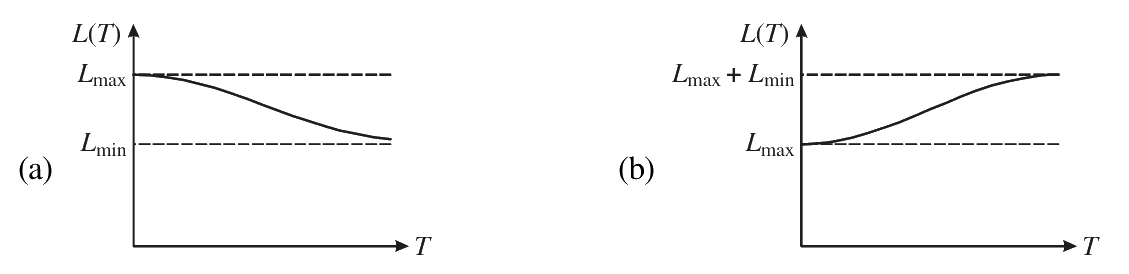
An elastic rod has a low energy state of length $L_{\max}$ and high energy state of length $L_{\min}$. The best schematic representation of the temperature ($T$) dependence of the mean equilibrium length $L(T)$ of the rod, is
Correct Answer & Step-by-Step Solution Locked
Sign in free to reveal the correct answer and AI explanation for this question.
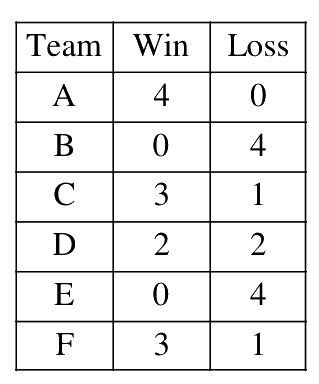
In a round-robin tournament, after each team has played exactly four matches, the number of wins/ losses of 6 participating teams are as follows:
Which of the two teams have certainly NOT played with each other?
a.
A and B
b.
C and F
c.
E and D
d.
B and E
Correct Answer & Step-by-Step Solution Locked
Sign in free to reveal the correct answer and AI explanation for this question.
An electromagnetic wave is incident from vacuum normally on a planar surface of a non-magnetic medium. If the amplitude of the electric field of the incident wave is $E_0$ and that of the transmitted wave is $2E_0/3$, then neglecting any loss, the refractive index of the medium is
a.
$1.5$
b.
$2.0$
c.
$2.4$
d.
$2.7$
Correct Answer & Step-by-Step Solution Locked
Sign in free to reveal the correct answer and AI explanation for this question.
The matrix corresponding to the differential operator $\left(1+\frac{d}{dx}\right)$ in the space of polynomials of degree at most two, in the basis spanned by $f_1 = 1$, $f_2 = x$ and $f_3 = x^2$, is
Sections A, B, C and D of a class have 24, 27, 30 and 36 students, respectively. One section has boys and girls who are seated alternately in three rows, such that the first and the last positions in each row are occupied by boys. Which section could this be?
a.
A
b.
B
c.
C
d.
D
Correct Answer & Step-by-Step Solution Locked
Sign in free to reveal the correct answer and AI explanation for this question.
Consider the Hamiltonian $H = AI + B\sigma_x + C\sigma_y$, where $A, B$ and $C$ are positive constants, $I$ is the $2 \times 2$ identity matrix and $\sigma_x, \sigma_y$ are Pauli matrices. If the normalized eigenvector corresponding to its largest energy eigenvalue is $\frac{1}{\sqrt{2}}\begin{pmatrix} 1 \\ y \end{pmatrix}$, then $y$ is
a.
$\frac{B+iC}{\sqrt{B^2+C^2}}$
b.
$\frac{A-iB}{\sqrt{A^2+B^2}}$
c.
$\frac{A-iC}{\sqrt{A^2+C^2}}$
d.
$\frac{B-iC}{\sqrt{B^2+C^2}}$
Correct Answer & Step-by-Step Solution Locked
Sign in free to reveal the correct answer and AI explanation for this question.
The energies of a two-level system are $\pm E$. Consider an ensemble of such non-interacting systems at a temperature $T$. At low temperature, the leading term in the specific heat depends on $T$ as
a.
$\frac{1}{T^2} e^{-E/k_B T}$
b.
$\frac{1}{T^2} e^{-2E/k_B T}$
c.
$T^2 e^{-E/k_B T}$
d.
$T^2 e^{-2E/k_B T}$
Correct Answer & Step-by-Step Solution Locked
Sign in free to reveal the correct answer and AI explanation for this question.
The periods of oscillation of a simple pendulum at the sea level and at the top of a mountain of height $6\text{ km}$ are $T_1$ and $T_2$, respectively. If the radius of earth is approximately $6000\text{ km}$, then $\frac{(T_2 - T_1)}{T_1}$ is closest to
a.
$-10^{-4}$
b.
$-10^{-3}$
c.
$10^{-4}$
d.
$10^{-3}$
Correct Answer & Step-by-Step Solution Locked
Sign in free to reveal the correct answer and AI explanation for this question.
Tokens numbered from 1 to 25 are mixed and one token is drawn randomly. What is the probability that the number on the token drawn is divisible either by 4 or by 6?
a.
$8/25$
b.
$10/25$
c.
$9/25$
d.
$12/25$
Correct Answer & Step-by-Step Solution Locked
Sign in free to reveal the correct answer and AI explanation for this question.
I have a brother who is 4 years elder to me, and a sister who was 5 years old when my brother was born. When my sister was born, my father was 24 years old. My mother was 27 years old when I was born. How old (in years) were my father and mother, respectively, when my brother was born?
a.
29 and 23
b.
27 and 25
c.
27 and 23
d.
29 and 25
Correct Answer & Step-by-Step Solution Locked
Sign in free to reveal the correct answer and AI explanation for this question.
The Lagrangian of a system described by three generalized coordinates $q_1, q_2$ and $q_3$ is
$$L = \frac{1}{2}m(\dot{q}_1^2 + \dot{q}_2^2) + M\dot{q}_1\dot{q}_2 + k\dot{q}_1 q_3\,, \text{ (where } m, M \text{ and } k \text{ are positive constants)}.$$
Then, as a function of time
a.
two coordinates remain constant and one evolves linearly.
b.
one coordinate remains constant, one evolves linearly and the third evolves as a quadratic function.
c.
one coordinate evolves linearly and two evolve quadratically.
d.
all three evolve linearly.
Correct Answer & Step-by-Step Solution Locked
Sign in free to reveal the correct answer and AI explanation for this question.
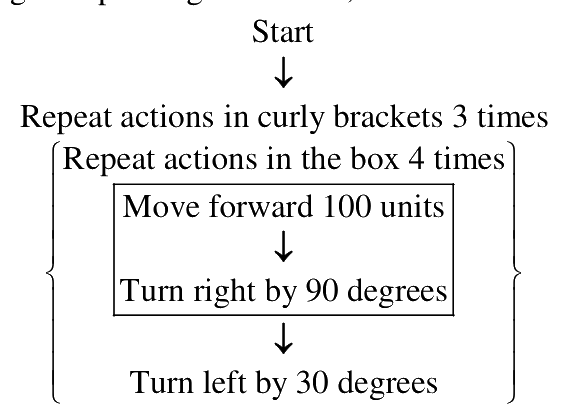
Starting from the top of a page and pointing downward, an ant moves according to the following commands.
Of the following paths Which is the correct path of the ant?
a.
A
b.
B
c.
C
d.
D
Correct Answer & Step-by-Step Solution Locked
Sign in free to reveal the correct answer and AI explanation for this question.
The Lagrangian of a system of two particles is $L = \frac{1}{2}\dot{x}_1^2 + 2\dot{x}_2^2 - \frac{1}{2}(x_1^2 + x_2^2 + x_1 x_2)$. The normal frequencies are best approximated by
a.
1.2 and 0.7
b.
1.5 and 0.5
c.
1.7 and 0.5
d.
1.0 and 0.4
Correct Answer & Step-by-Step Solution Locked
Sign in free to reveal the correct answer and AI explanation for this question.
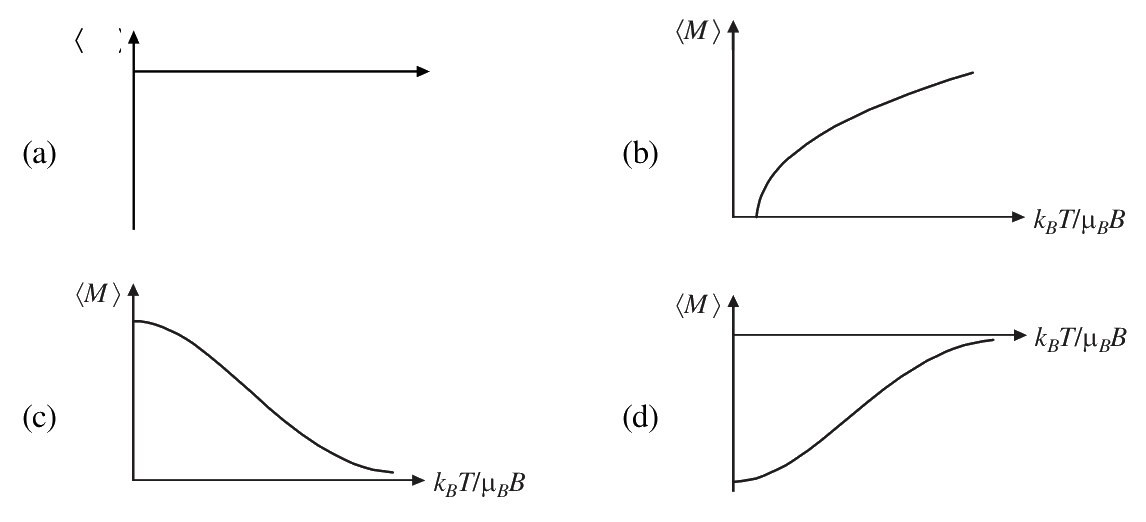
A paramagnetic salt with magnetic per ion $\mu_{\pm} = \pm \mu_B$ (where $\mu_B$ is the Bohr magneton) is in thermal equilibrium at temperature $T$ in a constant magnetic field $B$. The average magnetic moment $\langle M \rangle$, as a function of $(k_B T / \mu_B B)$, is best represented by
Correct Answer & Step-by-Step Solution Locked
Sign in free to reveal the correct answer and AI explanation for this question.
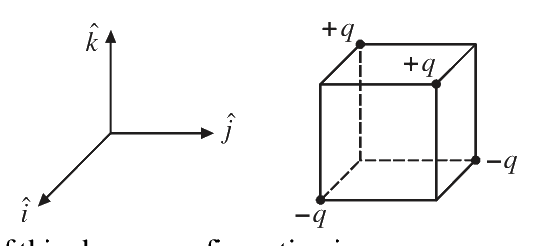
Two positive and two negative charges of magnitude $q$ are placed on the alternate vertices of a cube of side $a$ (as shown in the figure).
The electric dipole moment of this charge configuration is
a.
$-2qa\,\hat{k}$
b.
$2qa\,\hat{k}$
c.
$2qa\,(\hat{i} + \hat{j})$
d.
$2qa\,(\hat{i} - \hat{j})$
Correct Answer & Step-by-Step Solution Locked
Sign in free to reveal the correct answer and AI explanation for this question.
What is the product of the number of capital letters and the number of small letters of the English alphabet in the following text?
A4;={c8%$56((+B/;.H&r]]][u];#~K@>83<??/STvx%^(d)L:/<-N347))2;:S+}E$###[w}''',.;/89
a.
17
b.
37
c.
53
d.
63
Correct Answer & Step-by-Step Solution Locked
Sign in free to reveal the correct answer and AI explanation for this question.
The elastic scattering process $\pi^- p \to \pi^- p$ may be a treated as a hard-sphere scattering. The mass of $\pi^-$, $m_\pi \simeq \frac{1}{6} m_p$, where $m_p \simeq 938\text{ MeV}/c^2$ is the mass of the proton. The total scattering cross-section is closest to
a.
0.01 milli-barn
b.
1 milli-barn
c.
0.1 barn
d.
10 barn
Correct Answer & Step-by-Step Solution Locked
Sign in free to reveal the correct answer and AI explanation for this question.
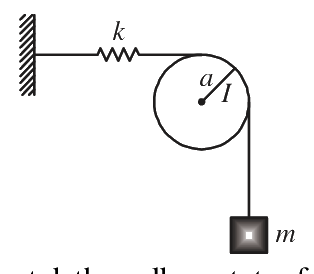
A wire, connected to a massless spring of spring constant $k$ and a block of mass $m$, goes around a disc of radius $a$ and moment of inertia $I$, as shown in the figure. Assume that the spring remains horizontal, the pulley rotates freely and there is no slippage between the wire and the pulley. The angular frequency of small oscillations of the disc is
a.
$\sqrt{\frac{2ka^2}{ma^2 + I}}$
b.
$\sqrt{\frac{ka^2}{ma^2 + I}}$
c.
$\sqrt{\frac{ka^2}{ma^2 + 2I}}$
d.
$\sqrt{\frac{ka^2}{2ma^2 + I}}$
Correct Answer & Step-by-Step Solution Locked
Sign in free to reveal the correct answer and AI explanation for this question.
A beam of square cross-section is to be cut out of a wooden log. Assuming that the log is cylindrical, what approximately is the largest fraction of the wood by volume that can be fruitfully utilised as the beam?
a.
$49\ \%$
b.
$64\ \%$
c.
$71\ \%$
d.
$81\ \%$
Correct Answer & Step-by-Step Solution Locked
Sign in free to reveal the correct answer and AI explanation for this question.
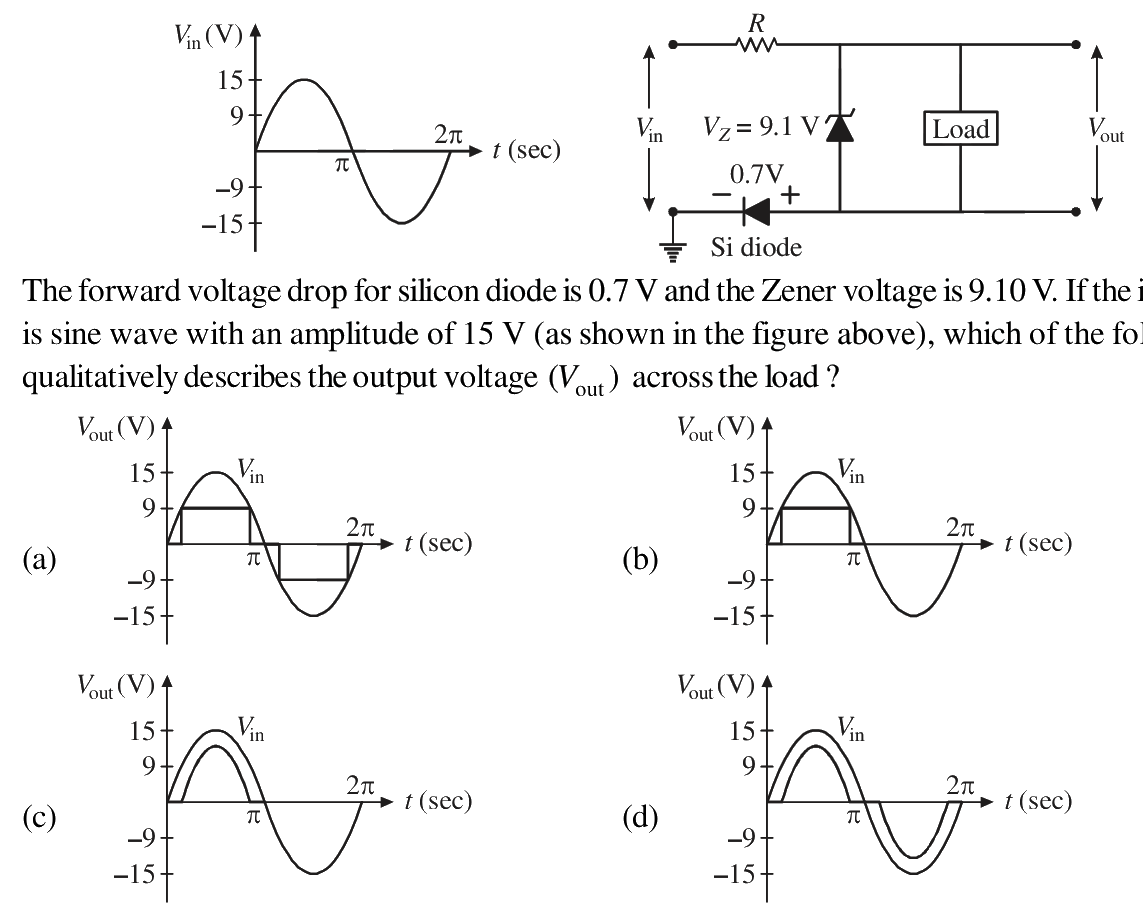
A impedance load (network) is connected in the circuit as shown below. The forward voltage drop for silicon diode is $0.7\text{ V}$ and the Zener voltage is $9.10\text{ V}$. If the input voltage ($V_{\text{in}}$) is sine wave with an amplitude of $15\text{ V}$ (as shown in the figure above), which of the following waveform qualitatively describes the output voltage ($V_{\text{out}}$) across the load ?
Correct Answer & Step-by-Step Solution Locked
Sign in free to reveal the correct answer and AI explanation for this question.
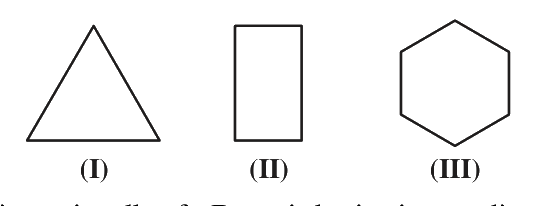
The figures (I), (II) and (III) below represent an equilateral triangle, a rectangle and a regular hexagon, respectively.
Which of these can be primitive unit cells of a Bravais lattice in two dimensions ?
a.
Only (I) and (III) but not (II)
b.
Only (I) and (II) but not (III)
c.
Only (II) and (III) but not (I)
d.
All of them
Correct Answer & Step-by-Step Solution Locked
Sign in free to reveal the correct answer and AI explanation for this question.
On a track of $200\text{ m}$ length, S runs from the starting point and R starts $20\text{ m}$ ahead of S at the same time. Both reach the end of the track at the same time. S runs at a uniform speed of $10\text{ m/s}$. If R also runs at a uniform speed, what is R's speed (in $\text{m/s}$)?
a.
9
b.
10
c.
12
d.
8
Correct Answer & Step-by-Step Solution Locked
Sign in free to reveal the correct answer and AI explanation for this question.
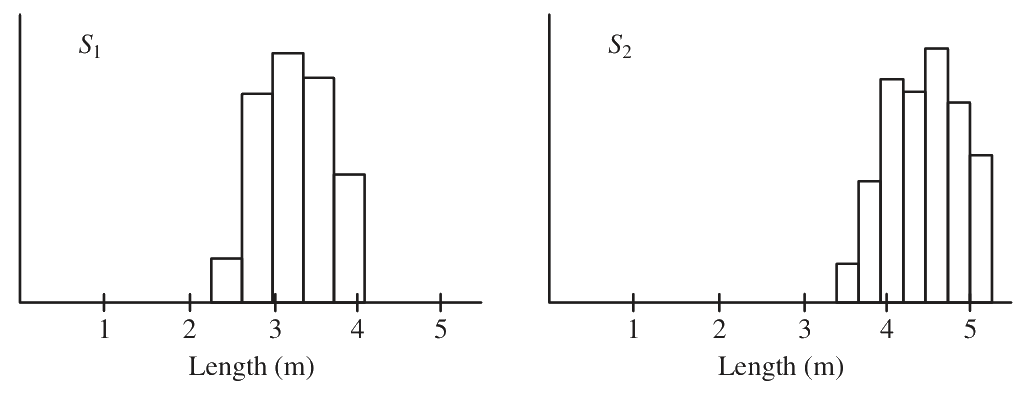
Four students ($S_1$, $S_2$, $S_3$ and $S_4$) make multiple measurement on the length of a table. The binned data are plotted as histograms in the following figures. If the length of the table, specified by the manufacturer, is 3m, the student whose measurement have the minimum have the minimum systematic error, is
a.
$S_2$
b.
$S_1$
c.
$S_4$
d.
$S_3$
Correct Answer & Step-by-Step Solution Locked
Sign in free to reveal the correct answer and AI explanation for this question.
The energy/energies $E$ of the bound state(s) of a particle of mass $m$ in one dimension in the potential
$$V(x) = \begin{cases} \infty & ; & x \le 0 \\ -V_0 & ; & 0 < x < a \\ 0 & ; & x \ge a \end{cases} \quad (\text{where } V_0 > a)\text{ is/are determined by}$$
The electric and magnetic fields in an inertial frame are $E = 3a\hat{i} - 4\hat{j}$ and $B = \frac{5a}{c}\hat{k}$, where $a$ is a constant. A massive charged particle is released from rest. The necessary and sufficient condition that there is an inertial frame, where the trajectory of the particle is a uniform-pitched helix, is
a.
$1 < a < \sqrt{2}$
b.
$-1 < a < 1$
c.
$a^2 > 1$
d.
$a^2 > 2$
Correct Answer & Step-by-Step Solution Locked
Sign in free to reveal the correct answer and AI explanation for this question.
An amplifier with a voltage gain of $40\text{ dB}$ without feedback is used in an electronic circuit. A negative feedback with a fraction $1/40$ is connected to the input of this amplifier. The net gain of the amplifier in the circuit is closest to
a.
$40\text{ dB}$
b.
$37\text{ dB}$
c.
$29\text{ dB}$
d.
$20\text{ dB}$
Correct Answer & Step-by-Step Solution Locked
Sign in free to reveal the correct answer and AI explanation for this question.
A walker takes steps, each of length $L$, randomly in the directions along east, west, north and south. After four steps its distance from the starting point is $d$. The probability that $d \le 3L$ is
a.
$63/64$
b.
$59/64$
c.
$57/64$
d.
$55/64$
Correct Answer & Step-by-Step Solution Locked
Sign in free to reveal the correct answer and AI explanation for this question.
Two small metalic objects are embedded in a weakly conducting medium of conductivity $\sigma$ and dielectric constant $\varepsilon$. A battery connected between them leads to a potential difference $V_0$. It is subsequently disconnected at time $t = 0$. The potential difference at later time $t$ is
a.
$V_0 e^{-t\sigma/4\varepsilon}$
b.
$V_0 e^{-t\sigma/2\varepsilon}$
c.
$V_0 e^{-3t\sigma/4\varepsilon}$
d.
$V_0 e^{-t\sigma/\varepsilon}$
Correct Answer & Step-by-Step Solution Locked
Sign in free to reveal the correct answer and AI explanation for this question.
The momentum space representation of the Schrödinger equation of a particle in a potential $V(\vec{r})$ is
$$\left(|p|^2 + \beta(\nabla_p^2)^2\right)\psi(p,t) = i\hbar\frac{\partial}{\partial t}\psi(p,t), \left[\text{where } (\nabla_p)_i = \frac{\partial}{\partial p_i}, \text{ and } \beta \text{ is a constant}\right].$$
The potential is (in the following $V_0$ and $a$ are constants)
a.
$V_0 e^{-r^2/a^2}$
b.
$V_0 e^{-r^4/a^4}$
c.
$V_0(r/a)^2$
d.
$V_0(r/a)^4$
Correct Answer & Step-by-Step Solution Locked
Sign in free to reveal the correct answer and AI explanation for this question.
If the average energy $\langle E\rangle_T$ of a quantum harmonic oscillator at a temperature $T$ is such that $\langle E\rangle_T = 2\langle E\rangle_{T\to 0}$, then $T$ satisfies
A receiver operating at $27^\circ\text{ C}$ has an input resistance of $100\ \Omega$. The input thermal noise voltage for this receiver with a bandwidth of $100\text{ kHz}$ is closest to
a.
$0.4\text{ nV}$
b.
$0.6\text{ pV}$
c.
$40\text{ mV}$
d.
$0.4\ \mu\text{V}$
Correct Answer & Step-by-Step Solution Locked
Sign in free to reveal the correct answer and AI explanation for this question.
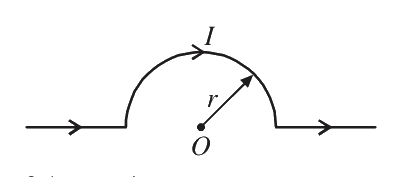
A part of an infinitely long wire, carrying a current $I$ is bent into a semi-circular arc of radius $r$ (as shown in the figure).
The magnetic field at the centre $O$ of the arc is
a.
$\frac{\mu_0 I}{4r}$
b.
$\frac{\mu_0 I}{4\pi r}$
c.
$\frac{\mu_0 I}{2r}$
d.
$\frac{\mu_0 I}{2\pi r}$
Correct Answer & Step-by-Step Solution Locked
Sign in free to reveal the correct answer and AI explanation for this question.
A bucket contains 6 red and 4 blue balls. A ball is taken out of the bucket at random and two balls of the same colour are put back. This step is repeated once more. The probability that the numbers of red and blue balls are equal at the end, is
a.
$4/11$
b.
$2/11$
c.
$1/4$
d.
$3/4$
Correct Answer & Step-by-Step Solution Locked
Sign in free to reveal the correct answer and AI explanation for this question.
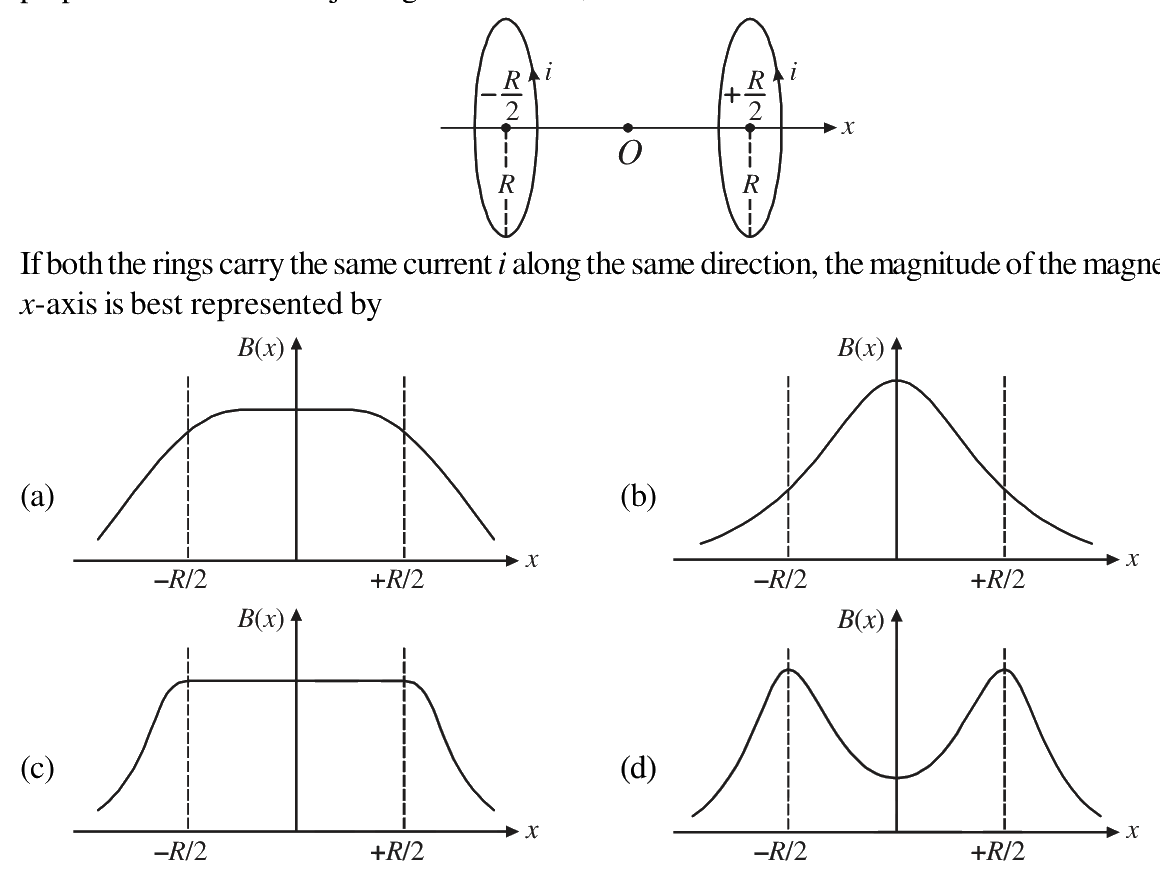
Two parallel conducting rings, both of radius $R$, are separated by a distance $R$. The planes of the rings are perpendicular to the line joining their centers, which of is taken to be the $x$-axis.
If both the rings carry the same current $i$ along the same direction, the magnitude of the magnetic field along the $x$-axis is best represented by
Correct Answer & Step-by-Step Solution Locked
Sign in free to reveal the correct answer and AI explanation for this question.
The figure below shows a circuit with two transistors, $Q_1$ and $Q_2$ having current gains $\beta_1$ and $\beta_2$ respectively.
The collector voltage $\text{V}_\text{C}$ will be closest to
a.
$0.9\text{ V}$
b.
$2.2\text{ V}$
c.
$2.9\text{ V}$
d.
$4.2\text{ V}$
Correct Answer & Step-by-Step Solution Locked
Sign in free to reveal the correct answer and AI explanation for this question.
The Lagrangian of a particle in one dimension is $L = \frac{m}{2} \dot{x}^2 - ax^2 - V_0 e^{-10x}$, where $a$ and $V_0$ are positive constants. The best qualitative representation of a trajectory in the phase space is
Correct Answer & Step-by-Step Solution Locked
Sign in free to reveal the correct answer and AI explanation for this question.
In terms of a complete set of orthogonal basis kets $|n\rangle$, $n = 0, \pm 1, \pm 2, \dots$, the Hamiltonian is
$$H = \sum_n (E |n\rangle\langle n| + \varepsilon |n+1\rangle\langle n| + \varepsilon |n\rangle\langle n+1|)$$
where $E$ and $\varepsilon$ are constants. The state $|\phi\rangle = \sum_n e^{in\phi} |n\rangle$ is an eigenstate with energy
a.
$E + \varepsilon \cos \phi$
b.
$E - \varepsilon \cos \phi$
c.
$E + 2\varepsilon \cos \phi$
d.
$E - 2\varepsilon \cos \phi$
Correct Answer & Step-by-Step Solution Locked
Sign in free to reveal the correct answer and AI explanation for this question.
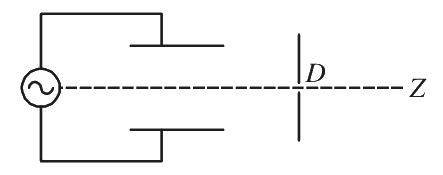
A high frequency voltage signal $V_i = V_m \sin \omega t$ is applied to a parallel plate deflector as shown in the figure.
An electron beam is passing through the deflector along the central line. The best qualitative representation of the intensity $I(t)$ of the beam after it goes through the narrow circular aperature $D$, is
Correct Answer & Step-by-Step Solution Locked
Sign in free to reveal the correct answer and AI explanation for this question.
A system of $N$ non-interacting particles in one-dimension, each of which is in a potential $V(x) = g x^6$ where $g > 0$ is a constant and $x$ denotes the displacement of the particle from its equilibrium position. In thermal equilibrium, the heat capacity at constant volume is
a.
$\frac{7}{6} N k_B$
b.
$\frac{4}{3} N k_B$
c.
$\frac{3}{2} N k_B$
d.
$\frac{2}{3} N k_B$
Correct Answer & Step-by-Step Solution Locked
Sign in free to reveal the correct answer and AI explanation for this question.
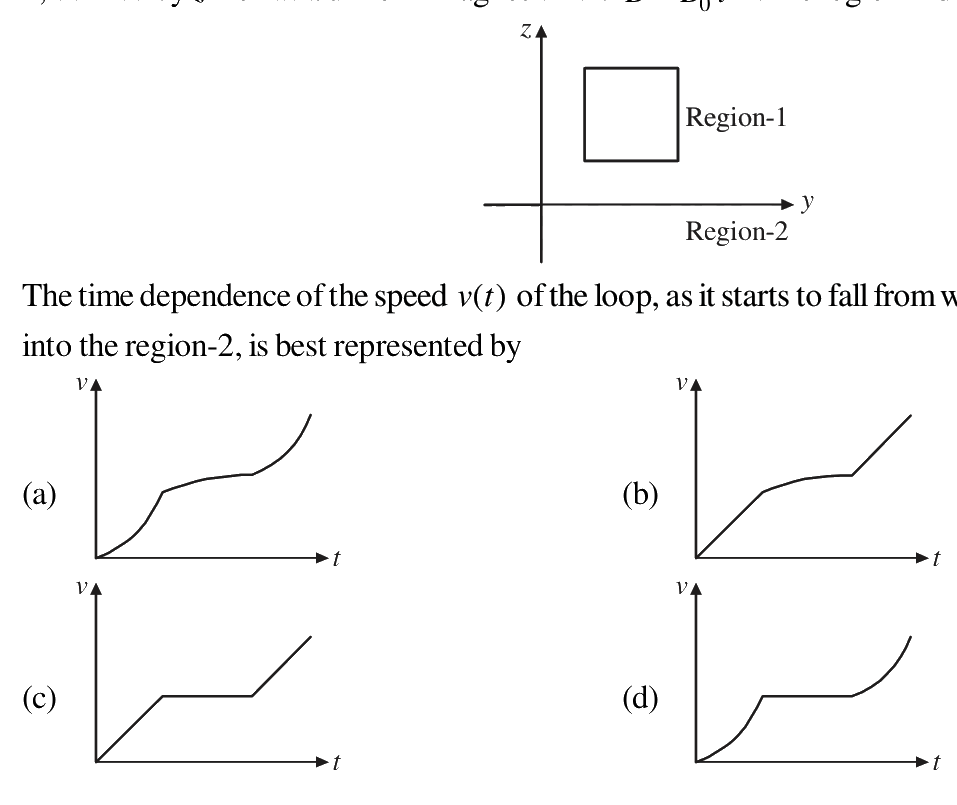
A square conducting loop in the $yz$-plane, falls downward under the gravity along the negative $z$-axis. Region-1, defined by $z > 0$ has a uniform magnetic field $B = B_0 \hat{i}$ while region-2 defined $z < 0$ has no magnetic field
The time dependence of the speed $v(t)$ of the loop, as it starts to fall from well within the region-1 and passes into the region-2, is best represented by
Correct Answer & Step-by-Step Solution Locked
Sign in free to reveal the correct answer and AI explanation for this question.