The charge density and current of an infinitely long perfectly conducting wire of radius $a$, which lies along the $z$-axis, as measured by a static observer are zero and a constant $I$, respectively. The charge density measured by an observer, who moves at a speed $v = \beta c$ parallel to the wire along the direction of the current, is
a.
$-\frac{I\beta}{\pi a^2 c \sqrt{1-\beta^2}}$
b.
$-\frac{I\beta\sqrt{1-\beta^2}}{\pi a^2 c}$
c.
$\frac{I\beta}{\pi a^2 c \sqrt{1-\beta^2}}$
d.
$\frac{I\beta\sqrt{1-\beta^2}}{\pi a^2 c}$
No explanation saved for this question yet.
Q1mcq
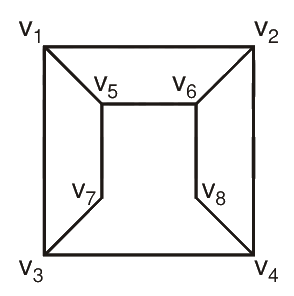
Three friends having a ball each stand at the three corners of a triangle. Each of them throws her ball independently at random to one of the others, once. The probability of no two friends throwing balls at each other is
a.
$1/4$
Correct Answer
b.
$1/8$
c.
$1/3$
d.
$1/2$
Step-by-Step AI Explanation
Verified Method
Let the three friends be $A, B, C$. Each person has 2 choices of whom to throw to, so the total number of outcomes is $2^3 = 8$. For no two friends to throw balls at each other, the throws must form a directed 3-cycle (a single loop). There are only two such cycles: $A \to B \to C \to A$ and $A \to C \to B \to A$. Thus, there are 2 favorable outcomes. The required probability is $\frac{2}{8} = \frac{1}{4}$.
Q1mcq
The Hamiltonian of a two-dimensional quantum harmonic oscillator is $H = \frac{p_x^2}{2m} + \frac{p_y^2}{2m} + \frac{1}{2}m\omega^2 x^2 + 2m\omega^2 y^2$ where $m$ and $\omega$ are positive constants. The degeneracy of the energy level $\frac{27}{2}\hbar\omega$ is
a.
14
b.
13
c.
8
d.
7
Correct Answer
Step-by-Step AI Explanation
Verified Method
The Hamiltonian represents two uncoupled harmonic oscillators with frequencies $\omega_x = \omega$ and $\omega_y = 2\omega$. The energy levels are given by $E = \hbar\omega\left(n_x + \frac{1}{2}\right) + 2\hbar\omega\left(n_y + \frac{1}{2}\right) = \hbar\omega\left(n_x + 2n_y + \frac{3}{2}\right)$, with $n_x, n_y \ge 0$. We want $n_x + 2n_y + \frac{3}{2} = \frac{27}{2}$, which simplifies to $n_x + 2n_y = 12$. Since $n_y$ can take any integer value from $0$ to $6$ (giving $n_x = 12 - 2n_y \ge 0$), there are 7 possible pairs $(n_x, n_y)$, hence the degeneracy is 7.
Q2mcq
A $50\text{ litre}$ mixture of paint is made of green, blue, and red colours in the ratio $5 : 3 : 2$. If another $10\text{ litre}$ of red colour is added to the mixture, what will be the new ratio ?
a.
$5 : 2 : 4$
b.
$4 : 3 : 2$
c.
$2 : 3 : 5$
d.
$5 : 3 : 4$
Correct Answer
Step-by-Step AI Explanation
Verified Method
The total volume is 50 litres in the ratio $5:3:2$. The sum of parts is $5+3+2 = 10$. The individual volumes are: Green = $\frac{5}{10} \times 50 = 25\text{ L}$, Blue = $\frac{3}{10} \times 50 = 15\text{ L}$, and Red = $\frac{2}{10} \times 50 = 10\text{ L}$. When 10 litres of red colour is added, the new volume of red colour becomes $10 + 10 = 20\text{ L}$. The new ratio of Green : Blue : Red is $25 : 15 : 20 = 5 : 3 : 4$.
Q2mcq
A DC motor is used to lift a mass $M$ to a height $h$ from the ground. The electric energy delivered to the motor is $VIt$, where $V$ is the applied voltage, $I$ is the current and $t$ is the time for which the motor runs. The efficiency $e$ of the motor is the ratio between the work done by the motor and the energy delivered to it. If $M = 2.00 \pm 0.02\text{ kg}$, $h = 1.00 \pm 0.01\text{ m}$, $V = 10.0 \pm 0.1\text{ V}$, $I = 2.00 \pm 0.02\text{ A}$ and $t = 300 \pm 15\text{ s}$, then the fractional error $|\delta e/e|$ in the efficiency of the motor is closest to
a.
0.05
b.
0.09
Correct Answer
c.
0.12
d.
0.15
Step-by-Step AI Explanation
Verified Method
The efficiency is $e = \frac{Mgh}{VIt}$. The fractional error in $e$ is given by $\frac{\delta e}{e} = \frac{\delta M}{M} + \frac{\delta h}{h} + \frac{\delta V}{V} + \frac{\delta I}{I} + \frac{\delta t}{t}$. Substituting the given values: $\frac{\delta M}{M} = \frac{0.02}{2.00} = 0.01$, $\frac{\delta h}{h} = \frac{0.01}{1.00} = 0.01$, $\frac{\delta V}{V} = \frac{0.1}{10.0} = 0.01$, $\frac{\delta I}{I} = \frac{0.02}{2.00} = 0.01$, and $\frac{\delta t}{t} = \frac{15}{300} = 0.05$. Summing these fractional errors gives $\left|\frac{\delta e}{e}\right| = 0.01 + 0.01 + 0.01 + 0.01 + 0.05 = 0.09$.
Q2mcq
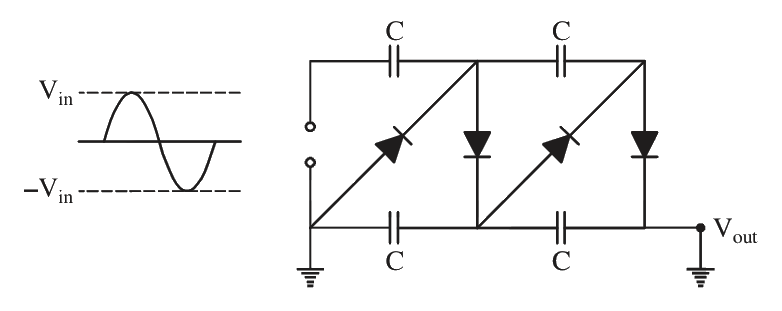
In the circuit shown below, four silicon diodes and four capacitors are connected to a sinusoidal voltages source of amplitude $V_{in} > 0.7\text{ V}$ and frequency $1\text{ kHz}$. If the knee voltage for each of the diodes is $0.7\text{ V}$ and the resistances of the capacitors are negligible, the DC output voltage $V_{out}$ after 2 seconds of starting the voltage source is closest to
a.
$4V_{in} - 0.7\text{ V}$
b.
$4V_{in} - 2.8\text{ V}$
Correct Answer
c.
$V_{in} - 0.7\text{ V}$
d.
$V_{in} - 2.8\text{ V}$
Step-by-Step AI Explanation
Verified Method
The given circuit is a 4-stage diode-capacitor voltage multiplier (specifically, a Cockcroft-Walton voltage quadrupler). Each diode has a forward knee voltage $V_D = 0.7\text{ V}$. Since there are four diodes in the conduction paths charging the four capacitors to achieve the full quadrupled output voltage, each diode introduces a voltage drop of $V_D$. Thus, the total DC output voltage is $V_{out} = 4(V_{in} - V_D) = 4V_{in} - 4(0.7\text{ V}) = 4V_{in} - 2.8\text{ V}$.
Q3mcq
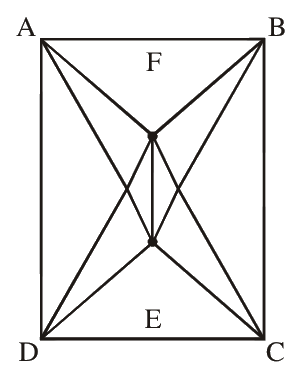
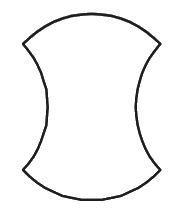
If two trapeziums of the same height, as shown below, can be joined to form a parallelogram of area $2(a + b)$, then the height of the parallelogram will be
a.
$4$
b.
$1$
c.
$1/2$
d.
$2$
Correct Answer
Step-by-Step AI Explanation
Verified Method
Let the parallel sides of the trapeziums be $a$ and $b$, and their common height be $h$. When two identical trapeziums of height $h$ and parallel sides $a$ and $b$ are joined along their non-parallel sides or bases to form a parallelogram, the base of the resulting parallelogram is $a + b$ and its height is $h$. The area of the parallelogram is $\text{Base} \times \text{Height} = (a + b)h$. We are given that the area is $2(a + b)$, hence $(a + b)h = 2(a + b)$, which gives $h = 2$.
Q3mcq
The nucleus of $^{40}\text{K}$ (of spin-parity $4^+$ in the ground state) is unstable and decays to $^{40}\text{Ar}$. The mass difference between these two nuclei is $\Delta M c^2 = 1504.4\text{ keV}$. The nucleus $^{40}\text{Ar}$ has an excited state at $1460.8\text{ keV}$ with spin-parity $2^+$. The most probable decay mode of $^{40}\text{K}$ is by
a.
a $\beta^+$ decay to the $2^+$ state of $^{40}\text{Ar}$.
b.
an electron capture to the $2^+$ state of $^{40}\text{Ar}$.
Correct Answer
c.
an electron capture to the ground state of $^{40}\text{Ar}$.
d.
a $\beta^+$ decay to the ground state of $^{40}\text{Ar}$.
Step-by-Step AI Explanation
Verified Method
The $Q$-value for $\beta^+$ decay between parent and daughter ground states is $Q_{\beta^+} = \Delta M c^2 - 2 m_e c^2 = 1504.4\text{ keV} - 1022\text{ keV} = 482.4\text{ keV}$. Since the excited $2^+$ state of $^{40}\text{Ar}$ is at $1460.8\text{ keV}$, $\beta^+$ decay to this state is energetically forbidden because $482.4\text{ keV} < 1460.8\text{ keV}$ (it requires $Q > 1460.8\text{ keV}$). However, for electron capture (EC), the threshold condition is simply $\Delta M c^2 > E_x$, and here $1504.4\text{ keV} > 1460.8\text{ keV}$, releasing $Q_{EC} = 1504.4 - 1460.8 = 43.6\text{ keV}$. Now comparing transitions: the decay from $4^+$ ground state of $^{40}\text{K}$ to the $2^+$ excited state involves $\Delta J = 2$, which is a second-forbidden unique or allowed/forbidden of much lower order than decaying to the $0^+$ ground state of $^{40}\text{Ar}$, which has $\Delta J = 4$ (a third/fourth-forbidden transition with extremely low probability). Therefore, electron capture to the $2^+$ excited state is the most probable mode of decay to $^{40}\text{Ar}$.
Q3mcq
The trajectory of a particle moving in a plane is expressed in polar coordinates $(r, \theta)$ by the equations $r = r_0 e^{\beta t}$ and $\frac{d\theta}{dt} = \omega$, where the parameters $r_0$, $\beta$ and $\omega$ are positive. Let $v_r$ and $a_r$ denote the velocity and acceleration, respectively, in the radial direction. For this trajectory
a.
$a_r < 0$ at all times irrespective of the values of the parameters.
b.
$a_r > 0$ at all times irrespective of the values of the parameters.
c.
$\frac{dv_r}{dt} > 0$ and $a_r > 0$ for all choices of parameters.
d.
$\frac{dv_r}{dt} > 0$ however, $a_r = 0$ for some choices of parameters.
Correct Answer
Step-by-Step AI Explanation
Verified Method
The radial distance is given by $r(t) = r_0 e^{\beta t}$ and the angular velocity is $\dot{\theta} = \omega$, where $r_0, \beta, \omega > 0$.
The radial velocity is:
$$v_r = \dot{r} = \frac{d}{dt}(r_0 e^{\beta t}) = \beta r_0 e^{\beta t} = \beta r$$
The rate of change of radial velocity is:
$$\frac{dv_r}{dt} = \ddot{r} = \beta^2 r_0 e^{\beta t} = \beta^2 r$$
Since $r_0 > 0$, $\beta > 0$, and $e^{\beta t} > 0$, we have $\frac{dv_r}{dt} > 0$ at all times for all parameter values.
Now, the radial component of acceleration in polar coordinates is:
$$a_r = \ddot{r} - r\dot{\theta}^2 = \beta^2 r - r\omega^2 = r(\beta^2 - \omega^2)$$
Depending on the parameters $\beta$ and $\omega$:
- If $\beta > \omega$, then $a_r > 0$.
- If $\beta < \omega$, then $a_r < 0$.
- If $\beta = \omega$, then $a_r = 0$.
Thus, $\frac{dv_r}{dt} > 0$ always, however $a_r = 0$ when $\beta = \omega$. This makes option D the correct choice.
Q4mcq
Two semicircles of same radii centred at A and C, touching each other, are placed between two parallel lines, as shown in the figure. The angle BAC is
a.
$30^\circ$
b.
$35^\circ$
c.
$45^\circ$
Correct Answer
d.
$60^\circ$
Step-by-Step AI Explanation
Verified Method
Let the two parallel lines be horizontal, separated by a distance equal to the diameter or a related dimension. For two congruent semicircles of radius $R$ placed between two parallel lines such that they touch each other externally and their diameters/bases lie appropriately against the boundaries, the vector $\vec{AC}$ connecting their centers forms an angle of $45^\circ$ with the reference line (horizontal baseline AB). Thus, the angle $\angle BAC = 45^\circ$.
🎉 10 Free Sample Solutions Completed
Unlock All 75 Questions & Solutions
Sign up free in seconds to unlock step-by-step AI answers for the remaining 65 questions.
For the transformation $x \rightarrow X = \frac{\alpha p}{x}$, $p \rightarrow P = \beta x^2$ between conjugate pairs of a coordinate and its momentum, to be canonical, the constants $\alpha$ and $\beta$ must satisfy
a.
$1 + \frac{1}{2}\alpha\beta = 0$
b.
$1 - \frac{1}{2}\alpha\beta = 0$
c.
$1 + 2\alpha\beta = 0$
d.
$1 - 2\alpha\beta = 0$
Correct Answer & Step-by-Step Solution Locked
Sign in free to reveal the correct answer and AI explanation for this question.
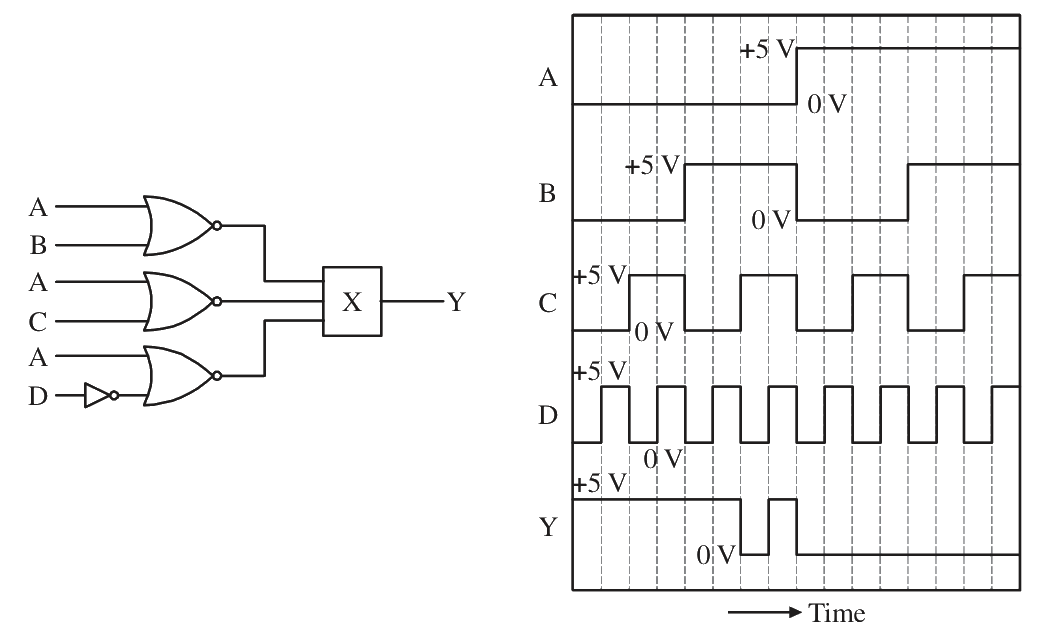
For the given logic circuit, the input waveforms A, B, C and D are shown as a function of time.
To obtain the output Y as shown in the figure, the logic gate X should be
a.
an AND gate
b.
an OR gate
c.
a NAND gate
d.
a NOR gate
Correct Answer & Step-by-Step Solution Locked
Sign in free to reveal the correct answer and AI explanation for this question.
The dispersion relation of electron in three dimensions is $\varepsilon(k) = \hbar v_F k$, where $v_F$ is the Fermi velocity. If at low temperature ($T \ll T_F$) the Fermi energy $\varepsilon_F$ depends on the number density $n$ as $\varepsilon_F(n) \sim n^\alpha$, the value of $\alpha$ is
a.
$\frac{1}{3}$
b.
$\frac{2}{3}$
c.
$1$
d.
$\frac{3}{5}$
Correct Answer & Step-by-Step Solution Locked
Sign in free to reveal the correct answer and AI explanation for this question.
The locus of the curve $\text{Im}\left(\frac{\pi(z-1)-1}{z-1}\right)=1$ in the complex $z$-plane is a circle centred at $(x_0, y_0)$ and radius $R$. The values of $(x_0, y_0)$ and $R$, respectively, are
a.
$\left(1, \frac{1}{2}\right)$ and $\frac{1}{2}$
b.
$\left(1, -\frac{1}{2}\right)$ and $\frac{1}{2}$
c.
$(1, 1)$ and $1$
d.
$(1, -1)$ and $1$
Correct Answer & Step-by-Step Solution Locked
Sign in free to reveal the correct answer and AI explanation for this question.
Given only one full $3\text{ litre}$ bottle and two empty ones of capacities $1\text{ litre}$ and $4\text{ litres}$, all angraduated, the minimum number of pourings requried to ensure $1\text{ litre}$ in each bottle is
a.
$2$
b.
$3$
c.
$4$
d.
$5$
Correct Answer & Step-by-Step Solution Locked
Sign in free to reveal the correct answer and AI explanation for this question.
The bisection method is used to find a zero $x_0$ of the polynomial $f(x) = x^3 - x^2 - 1$, while $f(2) = 3$, the values $a = 1$ and $b = 2$ are chosen as the boundaries of the interval in which the $x_0$ lies. If the bisection method is iterated three times, the resulting value of $x_0$ is
a.
$\frac{15}{8}$
b.
$\frac{13}{8}$
c.
$\frac{11}{8}$
d.
$\frac{9}{8}$
Correct Answer & Step-by-Step Solution Locked
Sign in free to reveal the correct answer and AI explanation for this question.
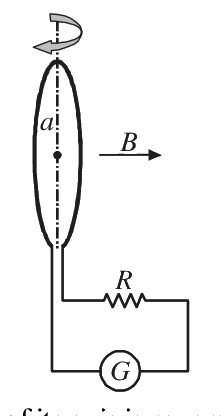
A small circular wire loop of radius $a$ and number of turns $N$, is oriented with its axis parallel to the direction of the local magnetic field $B$. A resistance $R$ and a galvanometer are connected to the coil, as shown in the figure.
When the coil is flipped (i.e., the direction of its axis is reversed) the galvanometer measures the total charge $Q$ that flows through it. If the induced e.m.f. through the coil $E_F = IR$, then $Q$ is
a.
$\frac{\pi N a^2 B}{(2R)}$
b.
$\frac{\pi N a^2 B}{R}$
c.
$\frac{\sqrt{2}\,\pi N a^2 B}{R}$
d.
$\frac{2\pi N a^2 B}{R}$
Correct Answer & Step-by-Step Solution Locked
Sign in free to reveal the correct answer and AI explanation for this question.
A jar J1 contains equal number of balls of red, blue and green colours, while another jar J2 contains balls of only red and blue colours, which are also equal in number. The probability of choosing J1 is twice as large as choosing J2. If a ball picked at random from one of the jars turns out to be red, the probability that it came from J1 is
a.
$\frac{2}{3}$
b.
$\frac{3}{5}$
c.
$\frac{2}{5}$
d.
$\frac{4}{7}$
Correct Answer & Step-by-Step Solution Locked
Sign in free to reveal the correct answer and AI explanation for this question.
At a spot S en-route, the speed of a bus was reduced by $20\%$ resulting in a delay of $45\text{ minutes}$. Instead, if the speed were reduced at $60\text{ km}$ after S, it would have been delayed by $30\text{ minutes}$. The original speed, in $\text{km/h}$, was
a.
$90$
b.
$80$
c.
$70$
d.
$60$
Correct Answer & Step-by-Step Solution Locked
Sign in free to reveal the correct answer and AI explanation for this question.
The energy (in $\text{keV}$) and spin-parity values $E(J^P)$ of the low lying excited states of a nucleus of mass number $A = 152$, are $122(2^+)$, $366(4^+)$, $707(6^+)$, and $1125(8^+)$. It may be inferred that these energy levels corresponds to a
a.
rotational spectrum of a deformed nucleus.
b.
rotational spectrum of a spherically symmetric nucleus.
c.
vibrational spectrum of a deformed nucleus.
d.
vibrational spectrum of a spherically symmetric nucleus.
Correct Answer & Step-by-Step Solution Locked
Sign in free to reveal the correct answer and AI explanation for this question.
Two energy levels, $0$ (non-degenerate) and $\varepsilon$ (doubly degenerate), are available to $N$ non-interacting distinguishable particles. If $U$ is the total energy of the system, for large values of $N$ the entropy of the system is $k_B \left[ N \ln N - \left(N - \frac{U}{\varepsilon}\right) \ln\left(N - \frac{U}{\varepsilon}\right) + X \right]$. In this expression, $X$ is
Two electrons in thermal equilibrium at temperature $T = \frac{k_B}{\beta}$ can occupy two sites. The energy of the configuration in which they occupy the different sites is $J \vec{S}_1 \cdot \vec{S}_2$ (where $J > 0$ is a constant and $\vec{S}$ denotes the spin of an electron), while it is $U$ if they are at the same site. If $U = 10J$, the probability for the system to be in the first excited state is
Persons A and B have 73 secrets each. On some day, exactly one of them discloses his secret to the other. For each secret A discloses to B in a given day, B discloses two secrets to A on the next day. For each secret B discloses to A in a given day, A discloses four secrets to B on the next day. The one who starts, starts by disclosing exactly one secret. What is the smallest possible number of days it takes for B to disclose all his secrets?
a.
5
b.
6
c.
7
d.
8
Correct Answer & Step-by-Step Solution Locked
Sign in free to reveal the correct answer and AI explanation for this question.
The dispersion relation of a gas of non-interacting bosons in two dimensions is $E(k) = c\sqrt{|k|}$, where $c$ is a positive constant. At low temperature, the leading dependence of the specific heat on temperature $T$, is
a.
$T^4$
b.
$T^3$
c.
$T^2$
d.
$T^{3/2}$
Correct Answer & Step-by-Step Solution Locked
Sign in free to reveal the correct answer and AI explanation for this question.
The matrix $R_{\hat{n}}(\theta)$ represents a rotation by an angle $\theta$ about the axis $\hat{n}$. The value of $\theta$ and $\hat{n}$ corresponding to the matrix $\begin{pmatrix} -1 & 0 & 0 \\ 0 & -1/3 & 2\sqrt{2}/3 \\ 0 & 2\sqrt{2}/3 & 1/3 \end{pmatrix}$, respectively, are
a.
$\frac{\pi}{2}$ and $\left(0, -\sqrt{\frac{2}{3}}, \frac{1}{\sqrt{3}}\right)$
b.
$\frac{\pi}{2}$ and $\left(0, \frac{1}{\sqrt{3}}, \sqrt{\frac{2}{3}}\right)$
c.
$\pi$ and $\left(0, -\sqrt{\frac{2}{3}}, \frac{1}{\sqrt{3}}\right)$
d.
$\pi$ and $\left(0, \frac{1}{\sqrt{3}}, \sqrt{\frac{2}{3}}\right)$
Correct Answer & Step-by-Step Solution Locked
Sign in free to reveal the correct answer and AI explanation for this question.
Let the separation of the frequencies of the first Stokes and the first anti-Stokes lines in the pure rotational Raman Spectrum of the $H_2$ molecule be $\Delta\nu(H_2)$, while the corresponding quantity for $D_2$ is $\Delta\nu(D_2)$. The ratio $\frac{\Delta\nu(H_2)}{\Delta\nu(D_2)}$ is
a.
0.6
b.
1.2
c.
1
d.
2
Correct Answer & Step-by-Step Solution Locked
Sign in free to reveal the correct answer and AI explanation for this question.
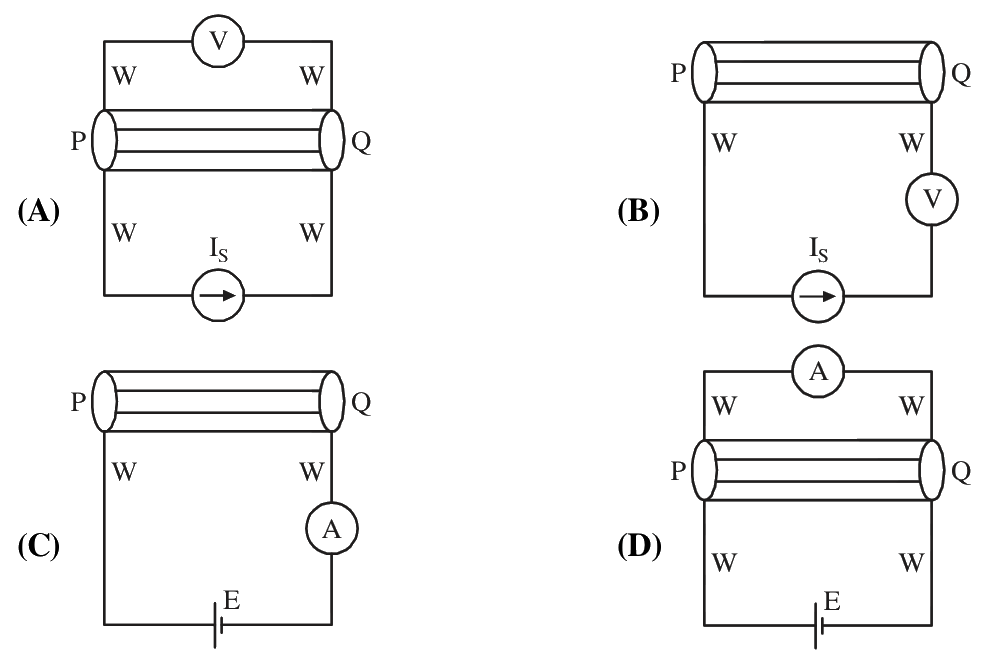
A circuit needs to be designed to measure the resistance $\text{R}$ of a cylinder $\text{PQ}$ to the best possible accuracy, using an ammeter $\text{A}$, a voltmeter $\text{V}$, a battery $\text{E}$ and a current source $\text{I}_{\text{S}}$ (all assumed to be ideal). The value of $\text{R}$ is known to be approximately $10\ \Omega$, and the resistance $\text{W}$ of each of the connecting wires is close to $10\ \Omega$. If the current from the current source and voltage from the battery are known exactly, which of the following circuits provides the most accurate measurement of $\text{R}$ ?
a.
(B)
b.
(A)
c.
(D)
d.
(C)
Correct Answer & Step-by-Step Solution Locked
Sign in free to reveal the correct answer and AI explanation for this question.
A building has windows of sizes 2, 3 and 4 feet and their respective numbers are inversely proportional to their sizes. If the total number of windows is 26, then how many windows are there of the largest size ?
a.
4
b.
6
c.
12
d.
9
Correct Answer & Step-by-Step Solution Locked
Sign in free to reveal the correct answer and AI explanation for this question.
A lattice $A$ consists of all points in three-dimensional space with coordinates $(n_x, n_y, n_z)$, where $n_x, n_y$ and $n_z$ are integers with $n_x + n_y + n_z$ being odd integers. In another lattice $B$, $n_x + n_y + n_z$ are even integers. The lattice $A$ and $B$ are
a.
Both BCC
b.
Both FCC
c.
BCC and FCC, respectively
d.
FCC and BCC, respectively
Correct Answer & Step-by-Step Solution Locked
Sign in free to reveal the correct answer and AI explanation for this question.
The energy levels available to each electron in a system of $N$ non-interacting electrons are $E_n = nE_0$, $n = 0, 1, 2,...$ A magnetic field, which does not affect the energy spectrum, but completely polarizes the electron spins, is applied to the system. The change in the ground state energy of the system is
a.
$\frac{1}{2} N^2 E_0$
b.
$N^2 E_0$
c.
$\frac{1}{8} N^2 E_0$
d.
$\frac{1}{4} N^2 E_0$
Correct Answer & Step-by-Step Solution Locked
Sign in free to reveal the correct answer and AI explanation for this question.
When a student in section A who scored 100 marks in a subject is exchanged for a student in section B who scored 0 marks, the average marks of the section A falls by 4, while that of section B increases by 5. Which of the following statements is true ?
a.
A has the same strength as B
b.
A has 5 more students than B
c.
B has 5 more students than A
d.
The relative strengths of the classes cannot be assessed from the data
Correct Answer & Step-by-Step Solution Locked
Sign in free to reveal the correct answer and AI explanation for this question.
The electron cloud (of the outermost electrons) of an ensemble of atoms of atomic number $\mathrm{Z}$ is described by a continuous charge density $\rho(r)$ that adjust itself so that the electrons at the Fermi level have zero energy. If $V(r)$ is the local electrostatic potential, then $\rho(r)$ is
A uniform circular disc on the $xy$-plane with its centre at the origin has a moment of inertia $I_0$ about the $x$-axis. If the disc is set in rotation about the origin with an angular velocity $\omega = \omega_0 (\hat{j} + \hat{k})$, the direction of its angular momentum is along
a.
$-\hat{i} + \hat{j} + \hat{k}$
b.
$-\hat{i} + \hat{j} + 2\hat{k}$
c.
$\hat{j} + 2\hat{k}$
d.
$\hat{j} + \hat{k}$
Correct Answer & Step-by-Step Solution Locked
Sign in free to reveal the correct answer and AI explanation for this question.
A long cylindrical wire of radius $R$ and conductivity $\sigma$, lying along the $z$-axis, carries a uniform axial current density $I$. The Poynting vector on the surface of the wire is (in the following $\hat{\rho}$ and $\hat{\phi}$ denote the unit vectors along the radial and azimuthal directions respectively)
a.
$\frac{I^2 R}{2\sigma}\hat{\rho}$
b.
$-\frac{I^2 R}{2\sigma}\hat{\rho}$
c.
$-\frac{I^2 \pi R}{4\sigma}\hat{\phi}$
d.
$\frac{I^2 \pi R}{4\sigma}\hat{\phi}$
Correct Answer & Step-by-Step Solution Locked
Sign in free to reveal the correct answer and AI explanation for this question.
The red line of wavelength $644\text{ nm}$ in the emission spectrum of $\text{Cd}$ corresponds to a transition from the ${}^1\text{D}_2$ level to the ${}^2\text{P}_1$ level. In the presence of a weak magnetic field, this spectral line will split into (ignore hyperfine structure)
a.
9 lines
b.
6 lines
c.
3 lines
d.
2 lines
Correct Answer & Step-by-Step Solution Locked
Sign in free to reveal the correct answer and AI explanation for this question.
If the sound of its thunder is heard $1\text{ s}$ after a lightning was observed, how far away (in $\text{m}$) was the source of thunder/linghtning from the observer (given, speed of sound $= x\text{ m s}^{-1}$, speed of light $= y\text{ m s}^{-1}$)?
a.
$\frac{x^2}{y}$
b.
$\frac{xy}{(y-x)}$
c.
$\frac{xy}{(x-y)}$
d.
$\frac{y^2}{x}$
Correct Answer & Step-by-Step Solution Locked
Sign in free to reveal the correct answer and AI explanation for this question.
Two random walkers $\text{A}$ and $\text{B}$ walk on a one-dimensional lattice. The length of each step taken by $\text{A}$ is one, while the same for $\text{B}$ is two, however, both move towards right or left with equal probability. If they start at the same point, the probability that they meet after 4 steps, is
a.
$\frac{9}{64}$
b.
$\frac{5}{32}$
c.
$\frac{11}{64}$
d.
$\frac{3}{16}$
Correct Answer & Step-by-Step Solution Locked
Sign in free to reveal the correct answer and AI explanation for this question.
A particle in one dimension is in an infinite potential well between $-\frac{L}{2} \le x \le \frac{L}{2}$. For a perturbation $\varepsilon \cos\left(\frac{\pi x}{L}\right)$, where $\varepsilon$ is a small constant, the change in the energy of the ground state, to first order in $\varepsilon$, is
a.
$\frac{5\varepsilon}{\pi}$
b.
$\frac{10\varepsilon}{3\pi}$
c.
$\frac{8\varepsilon}{3\pi}$
d.
$\frac{4\varepsilon}{\pi}$
Correct Answer & Step-by-Step Solution Locked
Sign in free to reveal the correct answer and AI explanation for this question.
The value of $\langle L_x^2 \rangle$ in the state $|\phi\rangle$ for which $L^2|\phi\rangle = 6\hbar^2 |\phi\rangle$ and $L_z|\phi\rangle = 2\hbar|\phi\rangle$, is
a.
$0$
b.
$4\hbar^2$
c.
$2\hbar^2$
d.
$\hbar^2$
Correct Answer & Step-by-Step Solution Locked
Sign in free to reveal the correct answer and AI explanation for this question.
The electric and magnetic fields at a point due to two independent source are $\vec{E}_1 = E(\alpha\hat{i} + \beta\hat{j})$, $\vec{B}_1 = B\hat{k}$ and $\vec{E}_2 = E\hat{i}$, $\vec{B}_2 = -2B\hat{k}$, where $\alpha$, $\beta$, $E$ and $B$ are constants. If the Poynting vector is along $\hat{i} + \hat{j}$, then
a.
$\alpha + \beta + 1 = 0$
b.
$\alpha + \beta - 1 = 0$
c.
$\alpha + \beta + 2 = 0$
d.
$\alpha + \beta - 2 = 0$
Correct Answer & Step-by-Step Solution Locked
Sign in free to reveal the correct answer and AI explanation for this question.
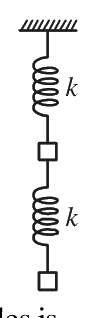
A system of two identical masses connected by identical springs, as shown in the figure, oscillates along the vertical direction.
The ratio of the frequencies of the normal modes is
a.
$\sqrt{3-\sqrt{5}} : \sqrt{3+\sqrt{5}}$
b.
$3-\sqrt{5} : 3+\sqrt{5}$
c.
$\sqrt{5-\sqrt{3}} : \sqrt{5+\sqrt{3}}$
d.
$5-\sqrt{3} : 5+\sqrt{3}$
Correct Answer & Step-by-Step Solution Locked
Sign in free to reveal the correct answer and AI explanation for this question.
Twenty litres of rainwater having a $2.0\text{ }\mu\text{mol/L}$ concentration of sulfate ions is mixed with forty litres water having $4.0\text{ }\mu\text{mol/L}$ sulfate ions. If $50\,\%$ of the total water evaporated, what would be sulfate concentration in the remaining water.
a.
$3\text{ }\mu\text{mol/L}$
b.
$3.3\text{ }\mu\text{mol/L}$
c.
$4\text{ }\mu\text{mol/L}$
d.
$6.7\text{ }\mu\text{mol/L}$
Correct Answer & Step-by-Step Solution Locked
Sign in free to reveal the correct answer and AI explanation for this question.
The radial wavefunction of hydrogen atom with the principal quantum number $n = 2$ and the orbital quantum number $l = 0$ is $R_{20} = N\left(1 - \frac{r}{2a}\right) e^{-r/2a}$, where $N$ is the normalization constant. The best schematic representation of the probability density $P(r)$ for the electron to be between $r$ and $r + dr$ is
a.
(a)
b.
(b)
c.
(c)
d.
(d)
Correct Answer & Step-by-Step Solution Locked
Sign in free to reveal the correct answer and AI explanation for this question.
The single particle energies of a system of $N$ non-interacting fermions of spin $s$ (at $T = 0$) are $E_n = n^2 E_0$, $n = 1, 2, 3,\dots$. The ratio $\frac{\varepsilon_F(3/2)}{\varepsilon_F(1/2)}$ of the Fermi energies for fermions of spin $3/2$ and spin $1/2$, is
a.
$\frac{1}{2}$
b.
$\frac{1}{4}$
c.
$2$
d.
$1$
Correct Answer & Step-by-Step Solution Locked
Sign in free to reveal the correct answer and AI explanation for this question.
Two operators $A$ and $B$ satisfy the commutation relations $[H, A] = -\hbar\omega B$ and $[H, B] = \hbar\omega A$, where $\omega$ is a constant and $H$ is the Hamiltonian of the system. The expectation value $\langle A\rangle_\psi (t) = \langle\psi|A|\psi\rangle$ in a state $|\psi\rangle$, such that at time $t=0$, $\langle A\rangle_\psi (0) = 0$ and $\langle B\rangle_\psi (0) = i$, is
a.
$\sin(\omega t)$
b.
$\sinh(\omega t)$
c.
$\cos(\omega t)$
d.
$\cosh(\omega t)$
Correct Answer & Step-by-Step Solution Locked
Sign in free to reveal the correct answer and AI explanation for this question.
In a buffet, 4 curries A, B, C and D were served. A guest was to eat any one or more than one curry, but not the combination having C and D together. The number of options available for the guest were
a.
3
b.
7
c.
11
d.
15
Correct Answer & Step-by-Step Solution Locked
Sign in free to reveal the correct answer and AI explanation for this question.
The Hamiltonian of a two particles system is $H = p_1 p_2 + q_1 q_2$, where $q_1$ and $q_2$ are generalized coordinate and $p_1$ and $p_2$ are the respective canonical momenta. The Lagrangian of this system is
a.
$\dot{q}_1 \dot{q}_2 + q_1 q_2$
b.
$-\dot{q}_1 \dot{q}_2 + q_1 q_2$
c.
$-\dot{q}_1 \dot{q}_2 - q_1 q_2$
d.
$\dot{q}_1 \dot{q}_2 - q_1 q_2$
Correct Answer & Step-by-Step Solution Locked
Sign in free to reveal the correct answer and AI explanation for this question.
A random variable $Y$ obeys a normal distribution $P(Y) = \frac{1}{\sigma\sqrt{2\pi}}\exp\left[-\frac{(Y-\mu)^2}{2\sigma^2}\right]$. The mean value of $e^Y$ is
a.
$e^{\mu + \frac{\sigma^2}{2}}$
b.
$e^{\mu - \sigma^2}$
c.
$e^{\mu + \sigma^2}$
d.
$e^{\mu - \frac{\sigma^2}{2}}$
Correct Answer & Step-by-Step Solution Locked
Sign in free to reveal the correct answer and AI explanation for this question.
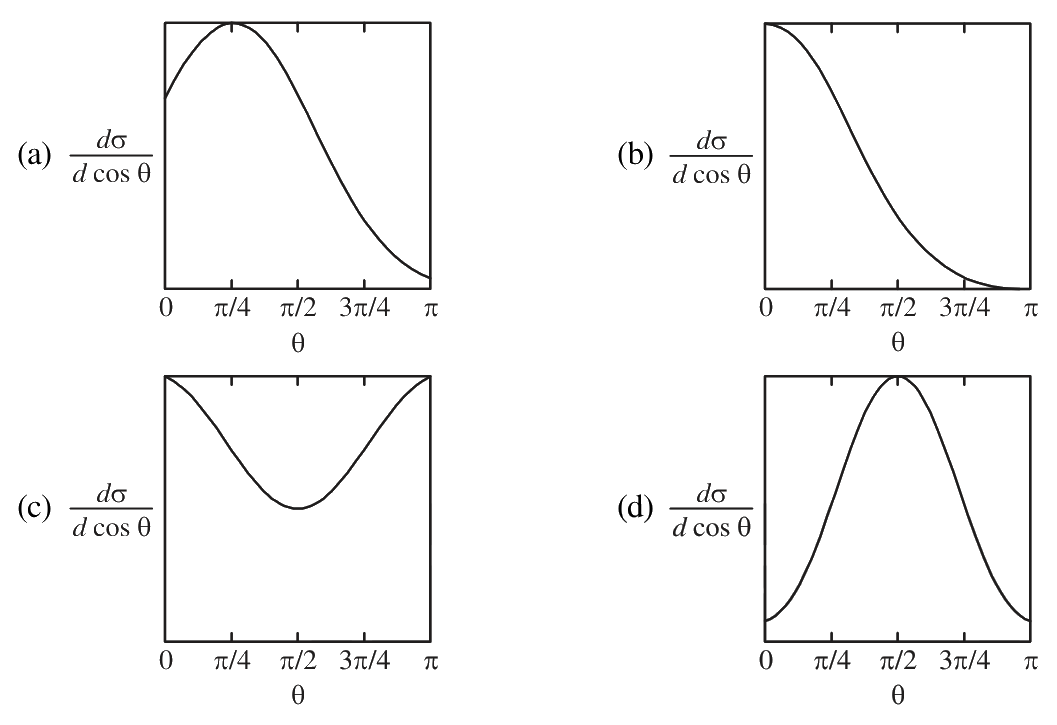
The phase shifts of the partial waves in an elastic scattering at energy $E$ are $\delta_0 = 12^\circ$, $\delta_1 = 4^\circ$ and $\delta_{l \ge 2} \simeq 0^\circ$.
The best quantitive depiction of $\theta$-dependence of the differential scattering cross-section $\frac{d\sigma}{d\cos\theta}$ is
Correct Answer & Step-by-Step Solution Locked
Sign in free to reveal the correct answer and AI explanation for this question.
The population and gross domestic products (GDP) in billion USD of three countries A, B and C in the years 2000, 2010 and 2020 are shown in the two figures below:
The decreasing order of per capita GDP of these countries in the year 2020 is
a.
A, B, C
b.
A, C, B
c.
B, C, A
d.
C, A, B
Correct Answer & Step-by-Step Solution Locked
Sign in free to reveal the correct answer and AI explanation for this question.
In a one-dimensional system of $N$ spins, the allowed values of each spin are $\sigma_i = \{1, 2, 3, \dots, q\}$, where $q \ge 2$ is an integer. The energy of the system is $-J \sum_{i=1}^{N} \delta_{\sigma_i, \sigma_{i+1}}$, where $J > 0$ is a constant. If periodic boundary conditions are imposed, the number of ground states of the system is
a.
$q$
b.
$Nq$
c.
$q^N$
d.
$1$
Correct Answer & Step-by-Step Solution Locked
Sign in free to reveal the correct answer and AI explanation for this question.
The minor axis of Earth's elliptical orbit divides the area within it into two halves. The eccentricity of the orbit is $0.0167$. The difference in time spent by Earth in the two halves is closest to
a.
$3.9\text{ days}$
b.
$4.8\text{ days}$
c.
$12.3\text{ days}$
d.
$0\text{ days}$
Correct Answer & Step-by-Step Solution Locked
Sign in free to reveal the correct answer and AI explanation for this question.
If the Bessel function of integer order $n$ is defined as $J_n(x) = \sum_{k=0}^{\infty} \frac{(-1)^k}{k!(n+k)!} \left(\frac{x}{2}\right)^{2k+n}$, then $\frac{d}{dx}\left[x^{-n} J_n(x)\right]$ is
a.
$-x^{-(n+1)} J_{n+1}(x)$
b.
$-x^{-(n+1)} J_{n-1}(x)$
c.
$-x^{-n} J_{n-1}(x)$
d.
$-x^{-n} J_{n+1}(x)$
Correct Answer & Step-by-Step Solution Locked
Sign in free to reveal the correct answer and AI explanation for this question.
The electric potential on the boundary of a spherical cavity of radius $R$, as a function of the polar angle $\theta$, is $V_0 \cos^2\frac{\theta}{2}$. The charge density inside the cavity is zero everywhere. The potential at a distance $R/2$ from the centre of the sphere is
An infinitely long solenoid of radius $r_0$ centred at origin which produces a time-dependent magnetic field $\frac{\alpha}{\pi r_0^2}\cos\omega t$, (where $\alpha$ and $\omega$ are constants) is placed along the $z$-axis. A circular loop of radius $R$, which carries unit line charge density is placed, initially at rest, on the $xy$-plane with its centre on the $z$-axis. If $R > r_0$, the magnitude of the angular momentum of the loop is
a.
$\alpha R(1 - \cos\omega t)$
b.
$\alpha R\sin\omega t$
c.
$\frac{1}{2}\alpha R(1 - \cos 2\omega t)$
d.
$\frac{1}{2}\alpha R\sin 2\omega t$
Correct Answer & Step-by-Step Solution Locked
Sign in free to reveal the correct answer and AI explanation for this question.
Two distinguishable non-interacting particles, each of mass $m$ are in a one-dimensional infinite square well in the interval $[0, a]$. If $x_1$ and $x_2$ are position operators of the two particles, the expectation value $\langle x_1 x_2 \rangle$ in the state in which one particle is in the ground state and the other one is in the first excited state, is
a.
$\frac{1}{2}a^2$
b.
$\frac{1}{2}\pi^2 a^2$
c.
$\frac{1}{4}a^2$
d.
$\frac{1}{4}\pi^2 a^2$
Correct Answer & Step-by-Step Solution Locked
Sign in free to reveal the correct answer and AI explanation for this question.
A charged particle moves uniformly on the $xy$-plane along a circle of radius $a$ centred at the origin. A detector is put at a distance $d$ on the $x$-axis to detect the electromagnetic wave radiated by the particle along the $x$-direction. If $d \gg a$, the wave received by the detector is
a.
unpolarized
b.
circularly polarized with the plane of polarization being the $yz$-plane.
c.
linearly polarized along the $y$-direction.
d.
linearly polarized along the $z$-direction.
Correct Answer & Step-by-Step Solution Locked
Sign in free to reveal the correct answer and AI explanation for this question.
In the circuit below, there is a voltage drop of $0.7\text{ V}$ across the diode $D$ in forward bias, while no current flows through it in reverse bias.
If $V_{\text{in}}$ is a sinusoidal signal of frequency $50\text{ Hz}$ with an RMS value of $1\text{ V}$, the maximum current that flows through the diode is closest to
a.
$1\text{ A}$
b.
$0.14\text{ A}$
c.
$0\text{ A}$
d.
$0.07\text{ A}$
Correct Answer & Step-by-Step Solution Locked
Sign in free to reveal the correct answer and AI explanation for this question.
The Hall coefficient $R_H$ of a sample can be determined from the measured Hall voltage $V_H = \frac{1}{d} R_H B I + R I$, where $d$ is the thickness of the sample, $B$ is the applied magnetic field, $I$ is the current passing through the sample and $R$ is an unwanted offset resistance. A lock-in detection technique is used by keeping $I$ constant with the applied magnetic field being modulated as $B = B_0 \sin \Omega t$, where $B_0$ is the amplitude of the magnetic field and $\Omega$ is frequency of the reference signal. The measured $V_H$ is
A one-dimensional rigid rod is constrained to move inside a sphere such that its two ends are always in contact with the surface. The number of constraints on the Cartesian coordinates of the endpoints of the rod is
a.
$3$
b.
$5$
c.
$2$
d.
$4$
Correct Answer & Step-by-Step Solution Locked
Sign in free to reveal the correct answer and AI explanation for this question.
A train of impulse of frequency $500\text{ Hz}$, in which the temporal width of each spike is negligible compared to its period, is used to sample a sinusoidal input signal of frequency $100\text{ Hz}$. The sampled output is
a.
discrete with the spacing between the peaks being the same as the time period of the sampling signal.
b.
a sinusoidal wave with the same time period as the sampling signal.
c.
discrete with the spacing between the peaks being the same as the time period of the input signal.
d.
a sinusoidal wave with the same time period as the input signal.
Correct Answer & Step-by-Step Solution Locked
Sign in free to reveal the correct answer and AI explanation for this question.
The angular width $\theta$ of a distant star can be measured by the Michelson radiofrequency stellar interferometer (as shown in the figure below).
The distance $h$ between the reflectors $M_1$ and $M_2$ (assumed to be much larger than the aperture of the lens), is increased till the interference fringe (at $P_0, P$ on the plane as shown) vanish for the first time. This happens for $h = 3\text{ m}$ for a star which emits radiowaves of wavelength $2.7\text{ cm}$. The measured value of $\theta$ (in degrees) is closest to
a.
$0.63$
b.
$0.32$
c.
$0.52$
d.
$0.26$
Correct Answer & Step-by-Step Solution Locked
Sign in free to reveal the correct answer and AI explanation for this question.
Electrons polarized along the $x$-direction are in a magnetic field $B_1 \hat{i} + B_2 (\hat{j} \cos \omega t + \hat{k} \sin \omega t)$, where $B_1 \gg B_2$ and $\omega$ are positive constants. The value of $\hbar\omega$ for which the polarization-flip process is a resonant one, is
a.
$2\mu_B |B_2|$
b.
$\mu_B |B_1|$
c.
$\mu_B |B_2|$
d.
$2\mu_B |B_1|$
Correct Answer & Step-by-Step Solution Locked
Sign in free to reveal the correct answer and AI explanation for this question.
A layer of ice has formed on a very deep lake. The temperature of water, as well as that of ice at the ice-water interface are $0^\circ\text{C}$, whereas the temperature of the air above is $-10^\circ\text{C}$. The thickness $L(t)$ of the ice increases with time $t$. Assuming that all physical properties of air and ice are independent of temperature, $L(t) \sim L_0 t^\alpha$ for large $t$. The value of $\alpha$ is
a.
$\frac{1}{4}$
b.
$\frac{1}{3}$
c.
$\frac{1}{2}$
d.
$1$
Correct Answer & Step-by-Step Solution Locked
Sign in free to reveal the correct answer and AI explanation for this question.
A neutral particle $X^0$ is produced in $\pi^- + p \rightarrow X^0 + n$ by $s$-wave scattering. The branching ratios of the decay of $X^0$ to $2\gamma, 3\pi$ and $2\pi$ are $0.38, 0.30$ and less than $10^{-3}$, respectively. The quantum numbers $J^{CP}$ of $X^0$ are
a.
$0^{-+}$
b.
$0^{+-}$
c.
$1^{-+}$
d.
$1^{+-}$
Correct Answer & Step-by-Step Solution Locked
Sign in free to reveal the correct answer and AI explanation for this question.