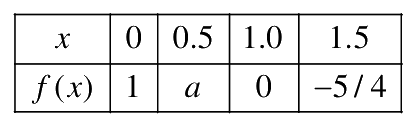
Using the following values of $x$ and $f(x)$
$$\begin{array}{|c|c|c|c|c|} \hline x & 0 & 0.5 & 1.0 & 1.5 \\ \hline f(x) & 1 & a & 0 & -5/4 \\ \hline \end{array}$$
the integral $I = \int_0^{1.5} f(x)dx$, evaluated by the Trapezoidal rule is $5/16$. The value of '$a$' is
a.
$3/4$
Correct Answer
b.
$3/2$
c.
$7/4$
d.
$19/24$
Step-by-Step AI Explanation
Verified Method
The step size is $h = 0.5$. The Trapezoidal rule with $x_0 = 0, x_1 = 0.5, x_2 = 1.0, x_3 = 1.5$ gives:
$$I = \frac{h}{2} [f(x_0) + 2f(x_1) + 2f(x_2) + f(x_3)]$$
Substituting the given values:
$$I = \frac{0.5}{2} \left[1 + 2a + 2(0) + \left(-\frac{5}{4}\right)\right] = \frac{1}{4} \left(2a - \frac{1}{4}\right)$$
We are given $I = \frac{5}{16}$:
$$\frac{1}{4} \left(2a - \frac{1}{4}\right) = \frac{5}{16} \implies 2a - \frac{1}{4} = \frac{5}{4} \implies 2a = \frac{6}{4} = \frac{3}{2} \implies a = \frac{3}{4}$$
Q1mcq
The Boolean equation $\text{Y} = \bar{\text{A}}\text{BC} + \bar{\text{A}}\text{B}\bar{\text{C}} + \text{A}\bar{\text{B}}\bar{\text{C}} + \text{A}\bar{\text{B}}\text{C}$ is to be implemented using only two-input NAND gates. The minimum number of gates required is
a.
3
b.
4
Correct Answer
c.
5
d.
6
Step-by-Step AI Explanation
Verified Method
Simplify the Boolean expression:
$$\text{Y} = \bar{\text{A}}\text{B}(\text{C} + \bar{\text{C}}) + \text{A}\bar{ ext{B}}(\bar{ ext{C}} + \text{C}) = \bar{\text{A}}\text{B} + \text{A}\bar{ ext{B}} = \text{A} \oplus \text{B}$$
An XOR gate implemented using only 2-input NAND gates requires a minimum of 4 NAND gates:
1. $N_1 = \overline{AB}$
2. $N_2 = \overline{A \cdot N_1}$
3. $N_3 = \overline{B \cdot N_1}$
4. $Y = \overline{N_2 \cdot N_3} = A \oplus B$
Thus, 4 gates are required.
Q2mcq
The energies of the 3 lowest states of an atom are $E_0 = -14\text{ eV}$, $E_1 = -9\text{ eV}$ and $E_2 = -7\text{ eV}$. The Einstein co-efficients are $A_{10} = 3 \times 10^8\text{ sec}^{-1}$, $A_{20} = 1.2 \times 10^8\text{ sec}^{-1}$ and $A_{21} = 8 \times 10^7\text{ sec}^{-1}$. If a large number of atoms are in the energy level $E_2$, the mean radiative lifetime of this excited state is
a.
$8.3 \times 10^{-9}\text{ sec}$
b.
$1 \times 10^{-8}\text{ sec}$
c.
$0.5 \times 10^{-8}\text{ sec}$
Correct Answer
d.
$1.2 \times 10^{-8}\text{ sec}$
Step-by-Step AI Explanation
Verified Method
The total transition rate for spontaneous emission from state 2 to all lower states (0 and 1) is:
$$A_2 = A_{20} + A_{21} = 1.2 \times 10^8\text{ s}^{-1} + 0.8 \times 10^8\text{ s}^{-1} = 2.0 \times 10^8\text{ s}^{-1}$$
The mean radiative lifetime $\tau_2$ of state 2 is given by:
$$\tau_2 = \frac{1}{A_2} = \frac{1}{2.0 \times 10^8\text{ s}^{-1}} = 0.5 \times 10^{-8}\text{ s}$$
Q2mcq
The eigenvalues of the $3 \times 3$ matrix $M = \begin{pmatrix} a^2 & ab & ac \\ ab & b^2 & bc \\ ac & bc & c^2 \end{pmatrix}$ are
a.
$a^2 + b^2 + c^2, 0, 0$
Correct Answer
b.
$b^2 + c^2, a^2, 0$
c.
$a^2 + b^2, c^2, 0$
d.
$a^2 + c^2, b^2, 0$
Step-by-Step AI Explanation
Verified Method
The matrix $M$ can be written as the outer product of the vector $\mathbf{v} = \begin{pmatrix} a \\ b \\ c \end{pmatrix}$ with itself:
$$M = \mathbf{v} \mathbf{v}^T$$
Since $M$ is of rank 1, it has two zero eigenvalues. The non-zero eigenvalue is the trace of the matrix:
$$\lambda = \text{Tr}(M) = a^2 + b^2 + c^2$$
Thus, the eigenvalues are $a^2 + b^2 + c^2, 0, 0$.
Q3mcq
The wavelength of the first Balmer line of hydrogen is $656\text{ nm}$. The wavelength of the corresponding line for a hydrogenic atom with $Z = 6$ and nuclear mass of $19.92 \times 10^{-27}\text{ kg}$ is
a.
$18.2\text{ nm}$
Correct Answer
b.
$109.3\text{ nm}$
c.
$143.5\text{ nm}$
d.
$393.6\text{ nm}$
Step-by-Step AI Explanation
Verified Method
The wavelength $\lambda$ for a hydrogenic atom of atomic number $Z$ is inversely proportional to $Z^2$ (neglecting the small difference in reduced mass, which is less than $0.1\%$):
$$\lambda \approx \frac{\lambda_H}{Z^2}$$
Given $\lambda_H = 656\text{ nm}$ and $Z = 6$:
$$\lambda \approx \frac{656\text{ nm}}{6^2} = \frac{656}{36}\text{ nm} \approx 18.22\text{ nm}$$
Including the reduced mass correction:
$$\frac{\mu}{\mu_H} = \frac{1 + m_e/m_p}{1 + m_e/M} \approx 1 + \frac{1}{1836} \approx 1.0005$$
This gives $\lambda = \frac{18.22}{1.0005}\text{ nm} \approx 18.2\text{ nm}$. Thus, option A is correct.
Q3mcq
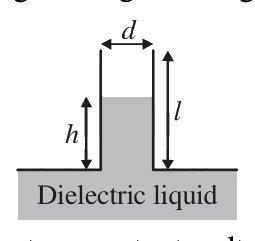
A parallel plate capacitor with rectangular plates of length $l$, breadth $b$ and plate separation $d$, is held vertically on the surface of a dielectric liquid of dielectric constant $\kappa$ and density $\rho$ as shown in the figure. The length and breadth are large enough for edge effects to be neglected.
The plates of the capacitor are kept at a constant voltage difference $V$. Ignoring effects of surface tension, the height $h$ upto which the liquid level rises inside the capacitor, is
When the liquid rises to height $h$, the capacitance of the system is:
$$C(h) = \frac{\varepsilon_0 b (l-h)}{d} + \frac{\kappa \varepsilon_0 b h}{d} = \frac{\varepsilon_0 b}{d} [l + (\kappa - 1)h]$$
The electrostatic upward force at constant potential $V$ is:
$$F_e = \frac{1}{2} V^2 \frac{dC}{dh} = \frac{1}{2} V^2 \frac{\varepsilon_0 b (\kappa - 1)}{d}$$
The downward gravitational force on the liquid column of height $h$, breadth $b$, and separation $d$ is:
$$F_g = mg = (\rho \cdot b \cdot d \cdot h) g$$
Equating $F_e$ and $F_g$:
$$\frac{1}{2} V^2 \frac{\varepsilon_0 b (\kappa - 1)}{d} = \rho b d h g$$
Solving for $h$:
$$h = \frac{V^2 \varepsilon_0 (\kappa - 1)}{2 \rho g d^2}$$
Q4mcq
An idealised atom has a non-degenerate ground state at zero energy and a $g$-fold degenerate excited state of energy E. In a non-interacting system of N such atoms, the population of the excited state may exceed that of the ground state above a temperature $T > \frac{E}{2k_B \ln 2}$. The minimum value of $g$ for which this is possible is
a.
8
b.
4
Correct Answer
c.
2
d.
1
Step-by-Step AI Explanation
Verified Method
The population of the excited state is $N_e = N \frac{g e^{-E/k_B T}}{Z}$ and that of the ground state is $N_g = N \frac{1}{Z}$.
For the population of the excited state to exceed that of the ground state:
$$N_e > N_g \implies g e^{-E/k_B T} > 1 \implies g > e^{E/k_B T}$$
Taking the natural logarithm:
$$\ln g > \frac{E}{k_B T} \implies T > \frac{E}{k_B \ln g}$$
We are given that this holds above the temperature $T > \frac{E}{2k_B \ln 2} = \frac{E}{k_B \ln(2^2)} = \frac{E}{k_B \ln 4}$.
Therefore, comparing the two expressions gives:
$$\ln g = \ln 4 \implies g = 4$$
Thus, the minimum value of $g$ is 4.
Q4mcq
The electric field due to a uniformly charged infinite line along the $z$-axis, as observed in the rest frame $S$ of the line charge, is $\vec{E}(\vec{r}) = \frac{\lambda}{2\pi\varepsilon_0}\frac{x\hat{i} + y\hat{j}}{(x^2 + y^2)}$. In a frame $M$ moving with a constant speed $v$ with respect to $S$ along the $z$-direction, the electric field $\vec{E}'$ is (in the following $\beta = v/c$ and $\gamma = \frac{1}{\sqrt{1-\beta^2}}$)
a.
$E'_x = E_x$ and $E'_y = E_y$
b.
$E'_x = \beta\gamma E_x$ and $E'_y = \beta\gamma E_y$
c.
$E'_x = \frac{E_x}{\gamma}$ and $E'_y = \frac{E_y}{\gamma}$
Under a Lorentz boost along the $z$-direction with velocity $\vec{v} = v\hat{z}$, the transformation equations for the electric field components perpendicular to the boost direction are:
$$\vec{E}'_\perp = \gamma (\vec{E}_\perp + \vec{v} \times \vec{B}_\perp)$$
In the rest frame $S$ of the line charge, the magnetic field is $\vec{B} = 0$. Therefore:
$$E'_x = \gamma E_x$$
$$E'_y = \gamma E_y$$
Thus, option D is correct.
Q5mcq
For the one dimensional potential wells A, B and C, as shown in the figure, let $E_A, E_B$ and $E_C$ denote the ground states energies of a particle, respectively.
The correct ordering of the energies is
a.
$E_C > E_B > E_A$
b.
$E_A > E_B > E_C$
Correct Answer
c.
$E_B > E_C > E_A$
d.
$E_B > E_A > E_C$
Step-by-Step AI Explanation
Verified Method
Wait, let's examine Image #1 carefully. Image #1 shows graphs with vertices labeled $v_1, v_2, \dots$. Wait! Is Image #1 for question 121959 or is it from another question? The text of 121959 says "For the one dimensional potential wells A, B and C, as shown in the figure, let $E_A, E_B$ and $E_C$ denote the ground states energies of a particle, respectively." But the image attached seems to show trees/graphs A, B, C! Wait, no, sometimes the images in the dataset are mismatched or it's a tight-binding graph model? No, wait: in CSIR NET Physical Sciences, there is a famous question: "For the one dimensional potential wells A, B and C, as shown in the figure...". Let's recall the standard CSIR NET question: usually potential wells of different shapes:
Well A: Infinite square well of width $a$.
Well B: Infinite square well with a delta function barrier/well or a step.
Wait, what is this image showing? (A) $v_1 - v_2 - v_3 - v_4$, (B) has 5 vertices, (C) has 6 vertices... wait, this image has "Codes:" at the bottom, which is from a Chemical Sciences or Mathematical Sciences question about isomorphic trees! The question text for 121959 mentions potential wells. Let's recall the original CSIR NET question for potential wells:
One well is an infinite well of width $a$, another has a barrier/step, or varying depths/widths. Often, widening the well lowers the energy, adding a repulsive delta increases energy, etc.
Wait, let's recall the options: $E_A > E_B > E_C$, etc. Usually, in that question, the widths are $a$, with a central barrier or well A is narrowest and C is widest, so $E_A > E_B > E_C$ or $E_C > E_B > E_A$.
Wait, let's search: "For the one dimensional potential wells A, B and C, as shown in the figure, let E_A, E_B and E_C denote the ground states energies of a particle, respectively."
In CSIR NET June 2016 / Dec 2015:
Well A: $V(x) = \infty$ for $x < 0$ and $x > a$, $V(x) = 0$ for $0 < x < a$. So ground state $E_A = \frac{\pi^2 \hbar^2}{2ma^2}$.
Wait, what were A, B, and C in the official paper?
A is an infinite square well of width $L$ (or $a$).
B is ... with a perturbing potential or different width.
Actually, the standard ordering is usually $E_A > E_B > E_C$ or $E_B > E_A > E_C$. Let's check the classic problem:
Well A: Infinite well of width $L$, $E_A = \frac{\pi^2\hbar^2}{2mL^2}$.
Well B: Well with a barrier in the middle? No, Well A has $V=0$ everywhere, Well B has a delta function? No, let's check the widths: Well A has width $L$, Well B has width $L$ with a lower potential region, or Well C is wider. If width increases, ground state energy decreases: $E_A > E_B > E_C$.
Q5mcq
The Hamiltonian of a system of 3 spins is $H = J(S_1S_2 + S_2S_3)$, where $S_i = \pm 1$ for $i = 1, 2, 3$. Its canonical partition function, at temperature $T$, is
The Hamiltonian is $H = J S_2(S_1 + S_3)$. The canonical partition function is:
$$Z = \sum_{S_1, S_2, S_3 = \pm 1} e^{-\beta J S_2(S_1 + S_3)}$$
Summing over $S_1$ and $S_3$ first for a given $S_2$:
$$\sum_{S_1=\pm 1} e^{-\beta J S_2 S_1} = 2\cosh(\beta J S_2) = 2\cosh(\beta J)$$
Since $\cosh$ is an even function and $S_2 = \pm 1$, this factor is the same for both $S_1$ and $S_3$ independently:
$$\sum_{S_1, S_3} e^{-\beta J S_2(S_1 + S_3)} = \left(2\cosh(\beta J)\right)^2$$
Now summing over $S_2 = \pm 1$ gives an additional factor of 2:
$$Z = 2\left(2\cosh\frac{J}{k_B T}\right)^2$$
Thus, the correct option is B.
🎉 10 Free Sample Solutions Completed
Unlock All 44 Questions & Solutions
Sign up free in seconds to unlock step-by-step AI answers for the remaining 34 questions.
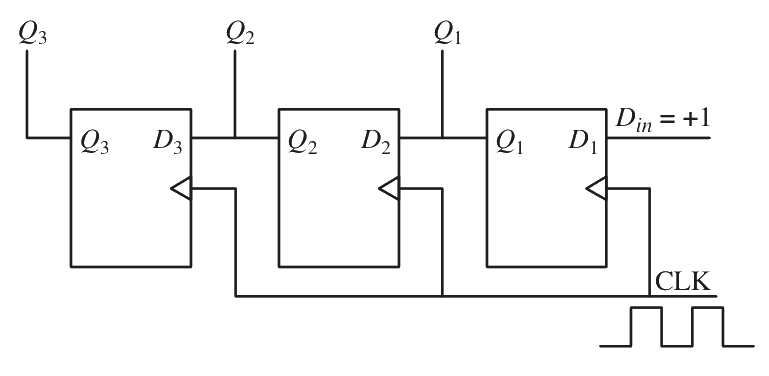
In the 3-bit register shown below, $Q_1$ and $Q_3$ are the least and the most significant bits of the output, respectively. If $Q_1$, $Q_2$ and $Q_3$ are set to zero initially, then the output after the arrival of the second falling clock (CLK) edge is
a.
001
b.
100
c.
011
d.
110
Correct Answer & Step-by-Step Solution Locked
Sign in free to reveal the correct answer and AI explanation for this question.
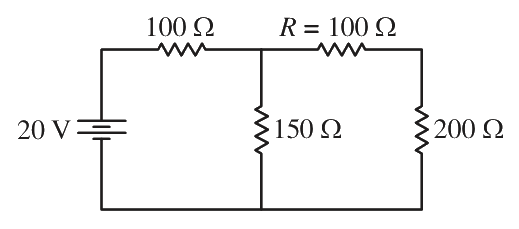
Two voltmeters A and B with internal resistances $2\text{ M}\Omega$ and $0.1\text{ k}\Omega$ are used to measure the voltage drops $V_A$ and $V_B$, respectively, across the resistor $R$ in the circuit shown below.
The ratio $V_A/V_B$ is
a.
0.58
b.
1.73
c.
1
d.
2
Correct Answer & Step-by-Step Solution Locked
Sign in free to reveal the correct answer and AI explanation for this question.
The temperatures of two perfect black bodies A and B are 400 K and 200 K respectively. If the surface area of A is twice that of B, the ratio of total power emitted by A to that by B is
a.
4
b.
2
c.
32
d.
16
Correct Answer & Step-by-Step Solution Locked
Sign in free to reveal the correct answer and AI explanation for this question.
Falling drops of rain break up and coalesce with each other and finally achieve an approximately spherical shape in the steady state. The radius of such a drop scales with the surface tension $\sigma$ as
a.
$1/\sqrt{\sigma}$
b.
$\sqrt{\sigma}$
c.
$\sigma$
d.
$\sigma^2$
Correct Answer & Step-by-Step Solution Locked
Sign in free to reveal the correct answer and AI explanation for this question.
Two coupled oscillators in a potential $V(x, y) = \frac{1}{2} kx^2 + 2kxy + \frac{1}{2} ky^2 (k > 2)$ can be decoupled into two independent harmonic oscillators (coordinates: $x', y'$) be means of an appropriate transformation $\begin{pmatrix} x' \\ y' \end{pmatrix} = S \begin{pmatrix} x \\ y \end{pmatrix}$. The transformation matrix $S$ is
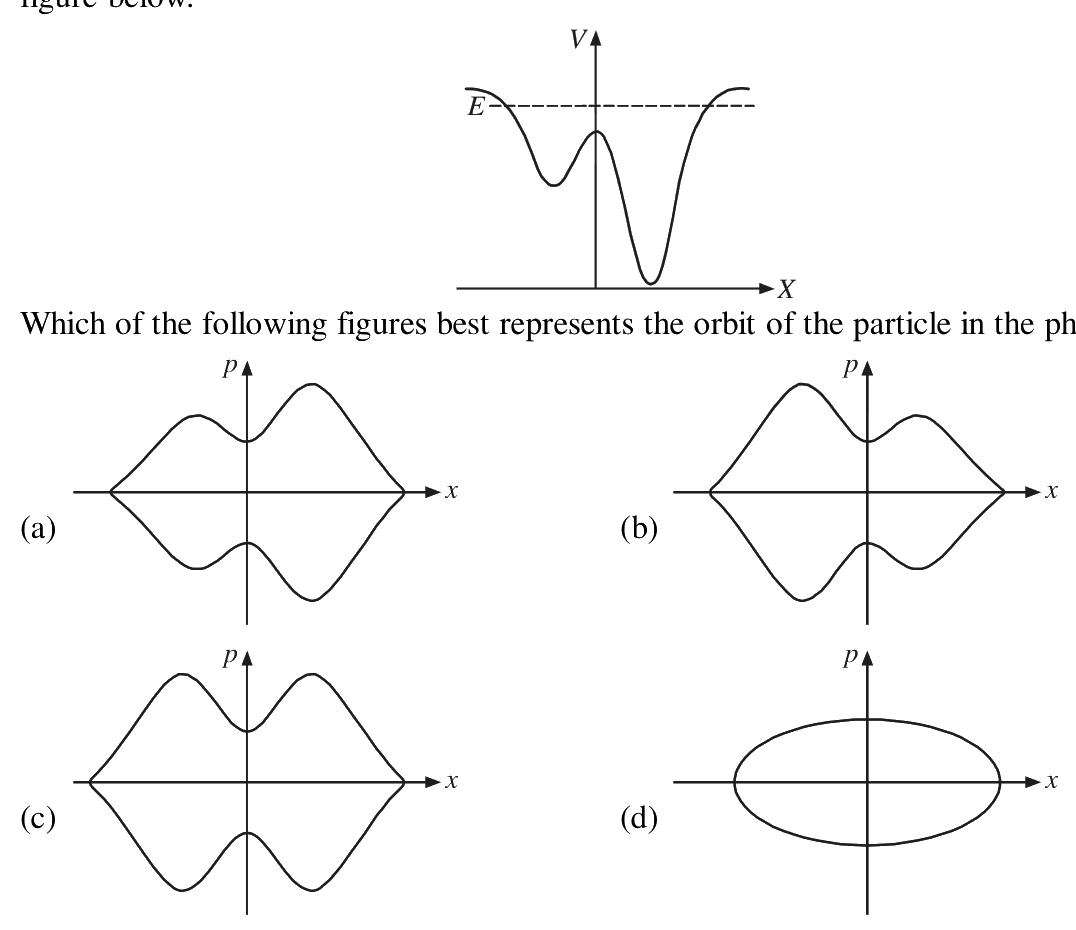
Consider a particle with total energy $E$ moving in one dimension in a potential $V(x)$ as shown in the figure below.
Which of the following figures best represents the orbit of the particle in the phase space ?
Correct Answer & Step-by-Step Solution Locked
Sign in free to reveal the correct answer and AI explanation for this question.
Two time dependent non-zero vectors $\vec{u}(t)$ and $\vec{v}(t)$, which are not initially parallel to each other, satisfy $\vec{u} \times \frac{d\vec{v}}{dt} - \vec{v} \times \frac{d\vec{u}}{dt} = 0$ at all time $t$. If the area of the parallelogram formed by $\vec{u}(t)$ and $\vec{v}(t)$ be $A(t)$ and the unit normal vector to it be $\hat{n}(t)$, then
a.
$A(t)$ increases linearly with $t$, but $\hat{n}(t)$ is a constant.
b.
$A(t)$ increases linearly with $t$, and $\hat{n}(t)$ rotates about $\vec{u}(t) \times \vec{v}(t)$.
c.
$A(t)$ is a constant, but $\hat{n}(t)$ rotates about $\vec{u}(t) \times \vec{v}(t)$.
d.
$A(t)$ and $\hat{n}(t)$ are constants.
Correct Answer & Step-by-Step Solution Locked
Sign in free to reveal the correct answer and AI explanation for this question.
A tight binding model of electrons in one dimension has the dispersion relation $\varepsilon(k) = -2t(1 - \cos ka)$, where $t > 0$, $a$ is the lattice constant and $-\frac{\pi}{a} < k < \frac{\pi}{a}$. Which of the following figures best represents the density of states over the range $\frac{\pi}{2a} \le k < \frac{\pi}{a}$?
a.
Figure (a)
b.
Figure (b)
c.
Figure (c)
d.
Figure (d)
Correct Answer & Step-by-Step Solution Locked
Sign in free to reveal the correct answer and AI explanation for this question.
A function of a complex variable $z$ is defined by the integral $f(z) = \oint_\Gamma \frac{w^2 - 2}{w - z} dw$, where $\Gamma$ is a circular contour of radius 3, centred at origin, running counter-clockwise in the $w$-plane. The value of the function at $z = (2 - i)$ is
a.
0
b.
$1 - 4i$
c.
$8\pi + 2\pi i$
d.
$-\frac{2}{\pi} - \frac{i}{2\pi}$
Correct Answer & Step-by-Step Solution Locked
Sign in free to reveal the correct answer and AI explanation for this question.
A quantum particle in a one-dimensional infinite potential well, with boundaries at $0$ and $a$, is perturbed by adding $H' = \varepsilon\delta\left(x - \frac{a}{2}\right)$ to the initial Hamiltonian. The correction to the energies of the ground and the first excited states (to first order in $\varepsilon$) are respectively
a.
$0$ and $0$
b.
$\frac{2\varepsilon}{a}$ and $0$
c.
$0$ and $\frac{2\varepsilon}{a}$
d.
$\frac{2\varepsilon}{a}$ and $\frac{2\varepsilon}{a}$
Correct Answer & Step-by-Step Solution Locked
Sign in free to reveal the correct answer and AI explanation for this question.
The Hamiltonian of a system of $N$ non-interacting particles, each of mass $m$, in one dimension is $$H = \sum_{i=1}^N \left[ \frac{p_i^2}{2m} + \frac{\lambda}{4} x_i^4 \right]$$ where $\lambda > 0$ is a constant and $p_i$ and $x_i$ are the momentum and position respectively of the $i$-th particle. The average internal energy of the system is
a.
$\frac{4}{3} k_B T$
b.
$\frac{3}{4} k_B T$
c.
$\frac{3}{2} k_B T$
d.
$\frac{1}{3} k_B T$
Correct Answer & Step-by-Step Solution Locked
Sign in free to reveal the correct answer and AI explanation for this question.
If we take the nuclear spin $I$ into account, the total angular momentum is $\vec{F} = \vec{L} + \vec{S} + \vec{I}$, where $\vec{L}$ and $\vec{S}$ are the orbital and spin angular momenta of the electron. The Hamiltonian of the hydrogen atom is corrected by the additional interaction $\lambda\vec{I}\cdot(\vec{L} + \vec{S})$, where $\lambda > 0$ is a constant. The total angular momentum quantum number $F$ of the $p$-orbital state with the lowest energy is
a.
$0$
b.
$1$
c.
$1/2$
d.
$3/2$
Correct Answer & Step-by-Step Solution Locked
Sign in free to reveal the correct answer and AI explanation for this question.
An angular momentum eigenstate $|j, 0\rangle$ is rotated by an infinitesimally small angle $\varepsilon$ about the positive $y$-axis in the counter-clockwise direction. The rotated state, to order $\varepsilon$ (Upto a normalisation constant), is
A spacecraft of mass $m = 1000\text{ kg}$ has a fully reflecting sail that is oriented perpendicular to the direction of the sun. The sun radiates $10^{26}\text{ W}$ and has a mass $M = 10^{30}\text{ kg}$. Ignoring the effect of the planets, for the gravitational pull of the sun to balance the radiation pressure on the sail, the area of the sail will be
a.
$10^2\text{ m}^2$
b.
$10^4\text{ m}^2$
c.
$10^8\text{ m}^2$
d.
$10^6\text{ m}^2$
Correct Answer & Step-by-Step Solution Locked
Sign in free to reveal the correct answer and AI explanation for this question.
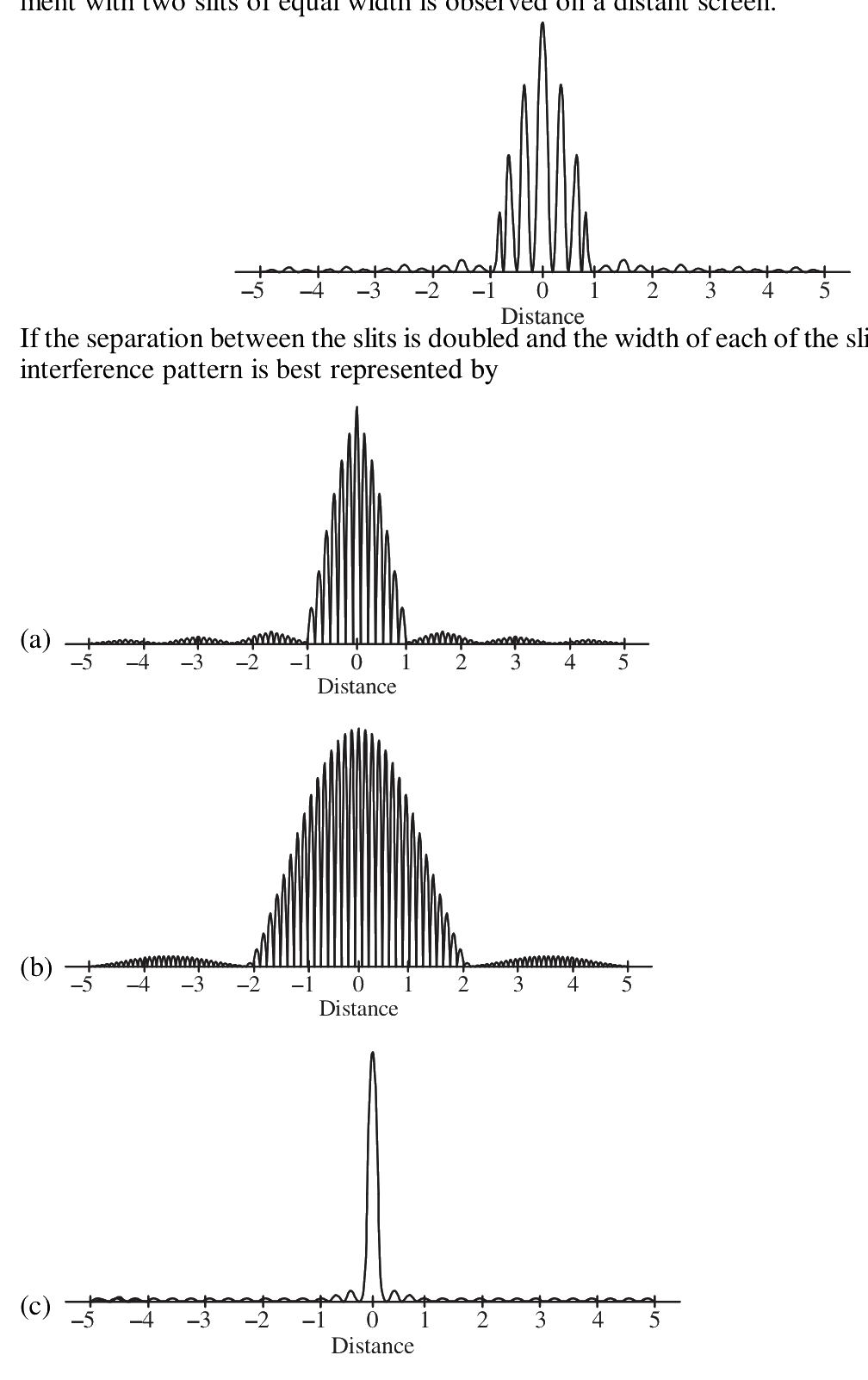
The following figure show the intensity of the interference pattern in the Young's double-slit experiment with two slits of equal width is observed on a distant screen.
If the separation between the slits is doubled and the width of each of the slits is halved, then the new interference pattern is best represented by
Correct Answer & Step-by-Step Solution Locked
Sign in free to reveal the correct answer and AI explanation for this question.
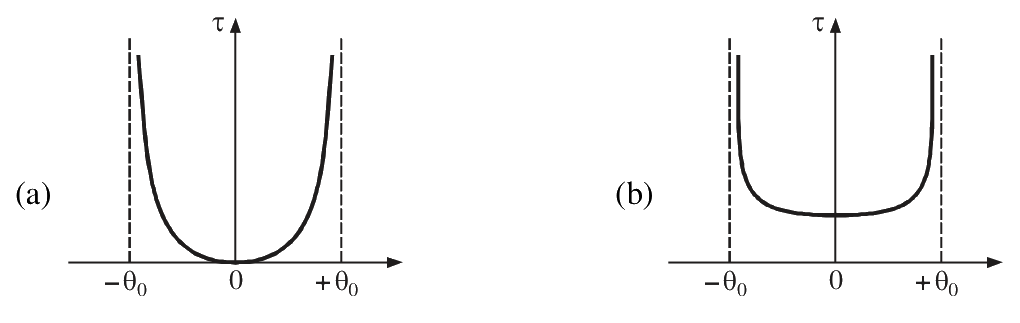
A pendulum executes small oscillations between angles $+\theta_0$ and $-\theta_0$. If $\tau(\theta)d\theta$ is the time spent between $\theta$ and $\theta + d\theta$, then $\tau(\theta)$ is best represented by
a.
Figure (a)
b.
Figure (b)
Correct Answer & Step-by-Step Solution Locked
Sign in free to reveal the correct answer and AI explanation for this question.
The state of an electron in a hydrogen atom is
$$|\psi\rangle = \frac{1}{\sqrt{16}}|1,0,0\rangle + \frac{1}{\sqrt{3}}|2,1,0\rangle + \frac{1}{\sqrt{2}}|3,1,-1\rangle$$
where $|n, l, m\rangle$ denotes common eigenstates of $\hat{H}$, $\hat{L}^2$ and $\hat{L}_z$ operators in the standard notation. In a measurement of $\hat{L}_z$ for the electron in this state, the result is recorded to be 0. Subsequently a measurement of energy is performed. The probability that the result is $E_2$ (the energy of the $n=2$ state) is
a.
1
b.
1/2
c.
2/3
d.
1/3
Correct Answer & Step-by-Step Solution Locked
Sign in free to reveal the correct answer and AI explanation for this question.
A heavy particle of rest mass $M$ while moving along the positive $z$-direction, decays into two identical light particles with rest mass $m$ (where $M > 2m$). The maximum value of the momentum that any one of the lighter particles can have in a direction perpendicular to the $z$-direction, is
a.
$\frac{1}{2}c\sqrt{M^2-4m^2}$
b.
$\frac{1}{2}c\sqrt{M^2-2m^2}$
c.
$c\sqrt{M^2-4m^2}$
d.
$\frac{1}{2}Mc$
Correct Answer & Step-by-Step Solution Locked
Sign in free to reveal the correct answer and AI explanation for this question.
The magnetic moments of a proton and a neutron are $2.792\ \mu_N$ and $-1.913\ \mu_N$, where $\mu_N$ is the nucleon magnetic moment. The values of the magnetic moments of the mirror nuclei ${}^{19}_{9}\text{F}_{10}$ and ${}^{19}_{10}\text{Ne}_9$, respectively, in the Shell model, are closest to
a.
$23.652\ \mu_N$ and $-18.873\ \mu_N$
b.
$26.283\ \mu_N$ and $-16.983\ \mu_N$
c.
$-2.628\ \mu_N$ and $1.887\ \mu_N$
d.
$2.628\ \mu_N$ and $-1.887\ \mu_N$
Correct Answer & Step-by-Step Solution Locked
Sign in free to reveal the correct answer and AI explanation for this question.
A point mass $m$, is constrained to move on the inner surface of a paraboloid of revolution $x^2 + y^2 = az$, (where $a > 0$ is a constant). When it spirals down the surface, under the influence of gravity (along $-z$ direction), the angular speed about the $z$-axis is proportional to
a.
$1$ (independent of $z$)
b.
$z$
c.
$z^{-1}$
d.
$z^{-2}$
Correct Answer & Step-by-Step Solution Locked
Sign in free to reveal the correct answer and AI explanation for this question.
For an ideal gas consisting of $N$ distinguishable particles in a volume $V$, the probability of finding exactly 2 particles in a volume $\delta V \ll V$, in the limit $N, V \to \infty$, is
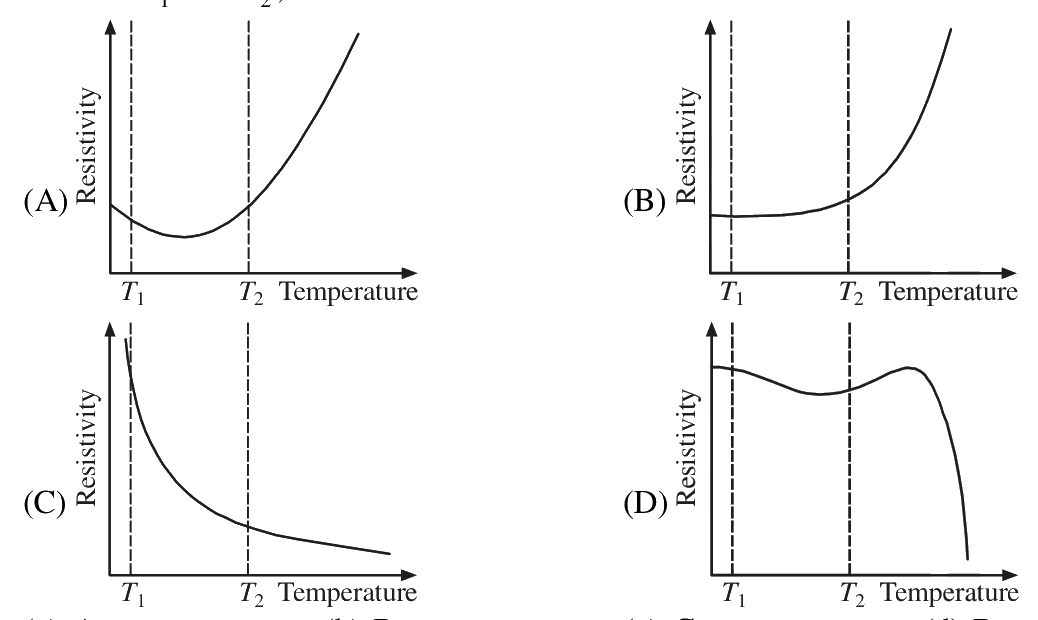
The temperature variation of the resistivity of four materials are shown in the following graphs. The material that would make the most sensitive temperature sensor, when used at temperature between $T_1$ and $T_2$, is
a.
A
b.
B
c.
C
d.
D
Correct Answer & Step-by-Step Solution Locked
Sign in free to reveal the correct answer and AI explanation for this question.
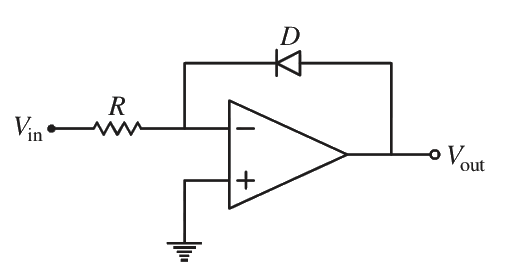
The I-V characteristics of the diode $D$ in the circuit below is given by $I = I_S\left(e^{qv/k_B T} - 1\right)$.where $I_S$ is the reverse saturation current, $v$ is the voltage across the diode and $T$ is the absolute temperature. If the input voltage is $V_{\text{in}}$, then the output voltage $V_{\text{out}}$ is
a.
$I_S R \ln\left(\frac{qV_{\text{in}}}{k_B T} + 1\right)$
b.
$\frac{1}{q}k_B T \ln\left(\frac{q(V_{\text{in}} + I_S R)}{k_B T}\right)$
c.
$\frac{1}{q}k_B T \ln\left(\frac{V_{\text{in}}}{I_S R} + 1\right)$
d.
$-\frac{1}{q}k_B T \ln\left(\frac{V_{\text{in}}}{I_S R} + 1\right)$
Correct Answer & Step-by-Step Solution Locked
Sign in free to reveal the correct answer and AI explanation for this question.
Let $|n\rangle$ denote the energy eigenstates of a particle in a one-dimensional simple harmonic potential $V(x) = \frac{1}{2}m\omega^2x^2$. If the particle is initially prepared in the state $|\psi(t = 0)\rangle = \sqrt{\frac{1}{2}}(|0\rangle + |1\rangle)$, the minimum time after which the oscillator will be found in the same state is
a.
$\frac{3\pi}{(2\omega)}$
b.
$\frac{\pi}{\omega}$
c.
$\frac{\pi}{(2\omega)}$
d.
$\frac{2\pi}{\omega}$
Correct Answer & Step-by-Step Solution Locked
Sign in free to reveal the correct answer and AI explanation for this question.
A lattice is defined by the unit vectors $\vec{a}_1 = a\hat{i}$, $\vec{a}_2 = -\frac{a}{2}\hat{i} + \frac{a\sqrt{3}}{2}\hat{j}$ and $\vec{a}_3 = a\hat{k}$, where $a > 0$ is a constant. The spacing between the (100) planes of the lattice is
a.
$\frac{\sqrt{3}a}{2}$
b.
$\frac{a}{2}$
c.
$a$
d.
$\sqrt{2}a$
Correct Answer & Step-by-Step Solution Locked
Sign in free to reveal the correct answer and AI explanation for this question.
Three point charges $q$ are placed at the corners of an equilateral triangle. Another point charge $-Q$ is placed at the centroid of the triangle. If the force on each of the charges $q$ vanishes, then the ratio $Q/q$ is
a.
$\sqrt{3}$
b.
$\frac{1}{\sqrt{3}}$
c.
$\frac{1}{3\sqrt{3}}$
d.
$\frac{1}{3}$
Correct Answer & Step-by-Step Solution Locked
Sign in free to reveal the correct answer and AI explanation for this question.
The energy density $I$ of a black body radiation at temperature $T$ is given by the Planck's distribution function
$$I(\nu, T) = \frac{8\pi\nu^2}{c^3} \left(\frac{h\nu}{e^{\frac{h\nu}{k_B T}} - 1}\right),$$
where $\nu$ is the frequency. The function $I(\nu, T)$ for two different temperatures $T_1$ and $T_2$ are shown below.
If the two curves coincide when $I(\nu, T)\nu^a$ is plotted against $\nu^b / T$, then the values of $a$ and $b$ are, respectively.
a.
$2$ and $1$
b.
$-2$ and $2$
c.
$3$ and $-1$
d.
$-3$ and $1$
Correct Answer & Step-by-Step Solution Locked
Sign in free to reveal the correct answer and AI explanation for this question.
Two ideal gases in a box are initially separated by a partition. Let $N_1, V_1$ and $N_2, V_2$ be the numbers of particles and volumes occupied by the two systems. When the partition is removed, the pressure of the mixture at an equilibrium temperature $T$, is
a.
$k_B T \left(\frac{N_1 + N_2}{2(V_1 + V_2)}\right)$
b.
$k_B T \left(\frac{N_1 + N_2}{V_1 + V_2}\right)$
c.
$k_B T \left(\frac{N_1}{V_1} + \frac{N_2}{V_2}\right)$
d.
$\frac{1}{2} k_B T \left(\frac{N_1}{V_1} + \frac{N_2}{V_2}\right)$
Correct Answer & Step-by-Step Solution Locked
Sign in free to reveal the correct answer and AI explanation for this question.
The Green's function for the differential equation $\frac{d^2x}{dt^2} + x = f(t)$, satisfying the initial conditions $x(0) = \frac{dx}{dt}(0) = 0$, is $G(t, \tau) = \begin{cases} 0 & \text{for } 0 < t < \tau \\ \sin(t - \tau) & \text{for } t > \tau \end{cases}$. The solution of the differential equation when the source $f(t) = \theta(t)$ (the Heaviside step function) is
a.
$\sin t$
b.
$1 - \sin t$
c.
$1 - \cos t$
d.
$\cos^2 t - 1$
Correct Answer & Step-by-Step Solution Locked
Sign in free to reveal the correct answer and AI explanation for this question.
The solution of the differential equation $\left(\frac{dy}{dx}\right)^2 - \frac{d^2y}{dx^2} = e^y$, with the boundary conditions $y(0) = 0$ and $y'(0) = -1$ is
a.
$-\ln\left(\frac{x^2}{2} + x + 1\right)$
b.
$-x \ln(e+x)$
c.
$-x e^{-x^2}$
d.
$-x(x+1)e^{-x}$
Correct Answer & Step-by-Step Solution Locked
Sign in free to reveal the correct answer and AI explanation for this question.
Spin $1/2$ fermions of mass $m$ and $4m$ are in a harmonic potential $V(x) = \frac{1}{2}kx^2$. Which configuration of 4 such particles has the lowest value of the ground state energy?
a.
4 particles of mass $m$
b.
4 particles of mass $4m$
c.
1 particle of mass $m$ and 3 particles of mass $4m$
d.
2 particles of mass $m$ and 2 particles of mass $4m$
Correct Answer & Step-by-Step Solution Locked
Sign in free to reveal the correct answer and AI explanation for this question.
The binding energy $B$ of a nucleus is approximated by a formula:
$$B = a_1 A - a_2 A^{2/3} - a_3 Z^2 A^{-1/3} - a_4 (A - 2Z)^2 A^{-1}$$
where $Z$ is the atomic number and $A$ is the mass number of the nucleus. If $\frac{a_4}{a_3} \simeq 30$, the atomic number $Z$ for naturally stable isobars (constant value of $A$) is
a.
$\frac{30A}{60 + A^{2/3}}$
b.
$\frac{30A}{30 + A^{2/3}}$
c.
$\frac{60A}{120 + A^{2/3}}$
d.
$\frac{120A}{60 + A^{2/3}}$
Correct Answer & Step-by-Step Solution Locked
Sign in free to reveal the correct answer and AI explanation for this question.
The velocity $v(x)$ of a particle moving in one dimension is given by $v(x) = v_0 \sin(\pi x / x_0)$, where $v_0$ and $x_0$ are positive constants of appropriate dimensions. If the particle is initially at $x / x_0 = \varepsilon$, where $|\varepsilon| \ll 1$, then, in the long time, it
a.
executes an oscillatory motion around $x = 0$.
b.
tends towards $x = 0$.
c.
tends towards $x = x_0$.
d.
executes an oscillatory motion around $x = x_0$.
Correct Answer & Step-by-Step Solution Locked
Sign in free to reveal the correct answer and AI explanation for this question.
Charged pions $\pi^-$ decay to muons $\mu^-$ and anti-muon neutrinos $\overline{\nu}_\mu$:
$$\pi^- \rightarrow \mu^- + \overline{\nu}_\mu$$
Take the rest masses of a muon and a pion to be $105\text{ MeV}$ and $140\text{ MeV}$, respectively. The probability that the measurement of the muon spin along the direction of its momentum is positive, is closest to
a.
0.5
b.
0.75
c.
1
d.
0
Correct Answer & Step-by-Step Solution Locked
Sign in free to reveal the correct answer and AI explanation for this question.