An object is dropped on a cushion from a height $10\text{m}$ above it. On being hit, the cushion is depressed by $0.1\text{m}$. Assuming that the cushion provides a constant resistive force, the deceleration of the object after hitting the cushion, in terms of the acceleration due to gravity $g$, is
a.
$10\ g$
b.
$50\ g$
c.
$100\ g$
Correct Answer
d.
$g$
Step-by-Step AI Explanation
Verified Method
Let the height of the fall be $h = 10\text{ m}$ and the depression be $d = 0.1\text{ m}$.
The velocity of the object just before hitting the cushion is $v = \sqrt{2gh}$.
Under a constant resistive force, the deceleration $a$ brings the object to rest from speed $v$ in distance $d$:
$$v^2 = 2ad \implies 2gh = 2ad \implies a = \frac{h}{d}g = \frac{10}{0.1}g = 100g.$$
Therefore, the deceleration of the object is $100g$.
Q22mcq
A turn-table is rotating with a constant angular velocity $\omega_0$. In the rotating frame fixed to the turn-table, a particle moves radially outwards at a constant speed $v_0$. The acceleration of the particle in the $r\theta$-coordinates, as seen from an inertial frame, the origin of which is at the centre of the turn-table, is
In polar coordinates $(r, \theta)$, the position of the particle at time $t$ is $r(t) = v_0 t$ and $\theta(t) = \omega_0 t$.
Thus, $\dot{r} = v_0$, $\ddot{r} = 0$, $\dot{\theta} = \omega_0$, and $\ddot{\theta} = 0$.
The acceleration in polar coordinates is given by:
$$\boldsymbol{a} = (\ddot{r} - r\dot{\theta}^2)\hat{r} + (r\ddot{\theta} + 2\dot{r}\dot{\theta})\hat{\theta}$$
Substituting the values:
$$\boldsymbol{a} = (0 - r\omega_0^2)\hat{r} + (0 + 2v_0\omega_0)\hat{\theta} = -r\omega_0^2\hat{r} + 2v_0\omega_0\hat{\theta}.$$
Thus, choice D is correct.
Q23mcq
Assume that the earth revolves in a circular orbit around the sun. Suppose the gravitational constant $G$ varies slowly as a function of time. In particular, it decreases to half its initial value in the course of one million years. Then during this time the
a.
radius of the earth's orbit will increase by a factor of two.
Correct Answer
b.
total energy of the earth remains constant.
c.
orbital angular momentum of the earth will increase.
d.
radius of the earth's orbit remains the same.
Step-by-Step AI Explanation
Verified Method
Because the gravitational constant $G(t)$ changes very slowly (adiabatically over one million years), the radial action variable or the angular momentum $L$ is conserved, as the central force remains central (torque is zero, so $L = mvr = \text{constant}$). For a circular orbit, the centripetal force is:
$$\frac{m v^2}{r} = \frac{G M m}{r^2} \implies v^2 r = G M.$$
Also, $L = m v r$, so $v = \frac{L}{m r}$. Substituting $v$ gives:
$$\left(\frac{L}{mr}\right)^2 r = GM \implies \frac{L^2}{m^2 r} = GM \implies r = \frac{L^2}{G M m^2} \propto \frac{1}{G}.$$
Since $G$ decreases to half its initial value ($G \to G/2$), the radius $r$ will double, i.e., increase by a factor of two.
Q24mcq
A particle of mass $m$ moves in one dimension in the potential $V(x) = kx^4$, ($k > 0$). At time $t = 0$, the particle starts from rest at $x = A$. For bounded motion, the time period of its motion is
a.
proportional to $A^{-1/2}$
b.
proportional to $A^{-1}$
Correct Answer
c.
independent of $A$
d.
not well-defined (the system is chaotic)
Step-by-Step AI Explanation
Verified Method
For a potential of the form $V(x) = k x^n$, the scaling of the period $T$ with amplitude $A$ can be obtained via dimensional analysis or by the integral:
$$T = 4 \int_0^A \frac{dx}{\sqrt{\frac{2}{m}(E - V(x))}} = 4 \int_0^A \frac{dx}{\sqrt{\frac{2}{m}(kA^n - kx^n)}}.$$
Substituting $u = x/A$, we have $dx = A du$, so:
$$T \propto A^{1 - n/2}.$$
For $n = 4$:
$$T \propto A^{1 - 4/2} = A^{-1}.$$
Thus, the time period is proportional to $A^{-1}$.
Q25mcq
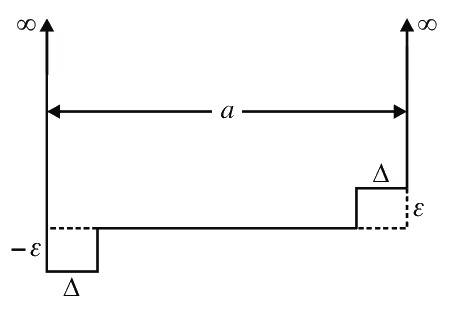
The infinite square-well potential of a particle in a box of size $a$ is modified as shown in the figure below (assume $\Delta \ll a$)
The energy of the ground state, compared to the ground state energy before the perturbation was added
a.
increases by a term of order $\varepsilon$
b.
decreases by a term of order $\varepsilon$
c.
increases by a term of order $\varepsilon^2$
d.
decreases by a term of order $\varepsilon^2$
Correct Answer
Step-by-Step AI Explanation
Verified Method
The ground state wavefunction of the unperturbed infinite square well of width $a$ (from $x=0$ to $x=a$) is:
$$\psi_1^{(0)}(x) = \sqrt{\frac{2}{a}} \sin\left(\frac{\pi x}{a}\right).$$
Notice that $\psi_1^{(0)}(x)$ is symmetric about the center $x = a/2$, so $|\psi_1^{(0)}(x)|^2 = |\psi_1^{(0)}(a-x)|^2$.
The perturbation $H'$ is:
$$H'(x) = \begin{cases} -\varepsilon & 0 < x < \Delta \\ 0 & \Delta < x < a - \Delta \\ +\varepsilon & a - \Delta < x < a \end{cases}$$
The first-order correction to the energy is:
$$E_1^{(1)} = \langle \psi_1^{(0)} | H' | \psi_1^{(0)} \rangle = -\varepsilon \int_0^\Delta |\psi_1^{(0)}(x)|^2 dx + \varepsilon \int_{a-\Delta}^a |\psi_1^{(0)}(x)|^2 dx.$$
Due to the symmetry $|\psi_1^{(0)}(x)|^2 = |\psi_1^{(0)}(a-x)|^2$, the two integrals are identical, which gives:
$$E_1^{(1)} = 0.$$
Therefore, the leading-order correction to the ground state energy is the second-order term:
$$E_1^{(2)} = \sum_{n \neq 1} \frac{|\langle \psi_n^{(0)} | H' | \psi_1^{(0)} \rangle|^2}{E_1^{(0)} - E_n^{(0)}}.$$
Since $E_1^{(0)}$ is the ground state energy, $E_1^{(0)} - E_n^{(0)} < 0$ for all $n > 1$. Thus, the second-order correction $E_1^{(2)}$ is strictly negative and proportional to $\varepsilon^2$. Hence, the ground state energy decreases by a term of order $\varepsilon^2$.
Q26mcq
A quantum particle of mass $m$ in one dimension, confined to a rigid box as shown in the figure, is in its ground state. An infinitesimally thin wall is very slowly raised to infinity at the centre of the box, in such a way that the system remains in its ground state at all times. Assuming that no energy is lost in raising the wall, the work done on the system when the wall is fully raised, eventually separating the original box into two compartments, is
a.
$\frac{3\pi^2\hbar^2}{8mL^2}$
Correct Answer
b.
$\frac{\pi^2\hbar^2}{8mL^2}$
c.
$\frac{\pi^2\hbar^2}{2mL^2}$
d.
$0$
Step-by-Step AI Explanation
Verified Method
Initially, the particle is in the ground state of a 1D rigid box of width $2L$ (or width $L$, let's check standard convention). Looking at the options with denominators containing $8mL^2$ or $2mL^2$:
If the box has width $2L$, the initial ground state energy is:
$$E_i = \frac{\pi^2 \hbar^2}{2m(2L)^2} = \frac{\pi^2 \hbar^2}{8mL^2}.$$
When a barrier is raised adiabatically at the center, dividing the box of size $2L$ into two compartments of size $L$ each, the adiabatic theorem ensures that the state evolves continuously without level crossing where possible, remaining in the ground state of the new system (confined to one of the halves of width $L$, or a symmetric combination of both). The ground state energy of a box of width $L$ is:
$$E_f = \frac{\pi^2 \hbar^2}{2m L^2} = \frac{4\pi^2 \hbar^2}{8mL^2}.$$
The work done on the system is the change in energy:
$$W = E_f - E_i = \frac{\pi^2 \hbar^2}{2m L^2} - \frac{\pi^2 \hbar^2}{8mL^2} = \frac{3\pi^2 \hbar^2}{8mL^2}.$$
This matches option A.
Q27mcq
The wavefunction of a free particle of mass $m$, constrained to move in the interval $-L \le x \le L$, is $\psi(x) = A(L+x)(L-x)$, where $A$ is the normalization constant. The probability that the particle will be found to have the energy $\frac{\pi^2\hbar^2}{2mL^2}$ is
a.
$0$
Correct Answer
b.
$\frac{1}{\sqrt{2}}$
c.
$\frac{1}{2\sqrt{3}}$
d.
$\frac{1}{\sqrt{\pi}}$
Step-by-Step AI Explanation
Verified Method
The particle is confined to the interval $[-L, L]$, so the potential is an infinite square well of width $a = 2L$ centered at the origin.
The energy eigenvalues of a particle in an infinite square well of width $2L$ are:
$$E_n = \frac{n^2 \pi^2 \hbar^2}{2m(2L)^2} = \frac{n^2 \pi^2 \hbar^2}{8mL^2}, \quad n = 1, 2, 3, \dots$$
The energy mentioned in the question is:
$$E = \frac{\pi^2 \hbar^2}{2mL^2} = \frac{4\pi^2 \hbar^2}{8mL^2},$$
which corresponds to the state $n = 2$.
The eigenstates of the symmetric box $[-L, L]$ have definite parity:
- $n = 1$: even parity, $\phi_1(x) = \frac{1}{\sqrt{L}} \cos\left(\frac{\pi x}{2L}\right)$
- $n = 2$: odd parity, $\phi_2(x) = \frac{1}{\sqrt{L}} \sin\left(\frac{2\pi x}{2L}\right) = \frac{1}{\sqrt{L}} \sin\left(\frac{\pi x}{L}\right)$
The given wavefunction is $\psi(x) = A(L+x)(L-x) = A(L^2 - x^2)$, which is strictly an **even** function of $x$ (i.e., $\psi(-x) = \psi(x)$).
Since $\phi_2(x)$ is an **odd** function, the projection (overlap) of $\psi(x)$ onto $\phi_2(x)$ is:
$$c_2 = \int_{-L}^L \phi_2^*(x) \psi(x) dx = 0,$$
because the integrand is the product of an odd function and an even function, which is odd.
Therefore, the probability of measuring the energy $E_2 = \frac{\pi^2\hbar^2}{2mL^2}$ is $|c_2|^2 = 0$.
Q28mcq
A particle moving in a central potential is described by a wavefunction $\psi(\boldsymbol{r}) = z f(r)$, where $\boldsymbol{r} = (x, y, z)$ is the position vector of the particle and $f(r)$ is a function of $r = |\boldsymbol{r}|$. If $\boldsymbol{L}$ is the total angular momentum of the particle, the value of $L^2$ must be
a.
$2\hbar^2$
Correct Answer
b.
$\hbar^2$
c.
$4\hbar^2$
d.
$\frac{3}{4}\hbar^2$
Step-by-Step AI Explanation
Verified Method
In spherical polar coordinates, $z = r \cos\theta$.
Therefore, the wavefunction can be written as:
$$\psi(\boldsymbol{r}) = z f(r) = r f(r) \cos\theta.$$
Since the spherical harmonic with $l = 1, m = 0$ is $Y_{1,0}(\theta, \phi) = \sqrt{\frac{3}{4\pi}} \cos\theta$, we have:
$$\psi(\boldsymbol{r}) = R(r) Y_{1,0}(\theta, \phi),$$
where $R(r) = \sqrt{\frac{4\pi}{3}} r f(r)$.
Thus, $\psi(\boldsymbol{r})$ is an eigenstate of the orbital angular momentum operator $L^2$ with orbital quantum number $l = 1$.
The eigenvalue of $L^2$ is:
$$L^2 \psi = l(l+1)\hbar^2 \psi = 1(1+1)\hbar^2 \psi = 2\hbar^2 \psi.$$
Hence, the value of $L^2$ is $2\hbar^2$.
Q29mcq
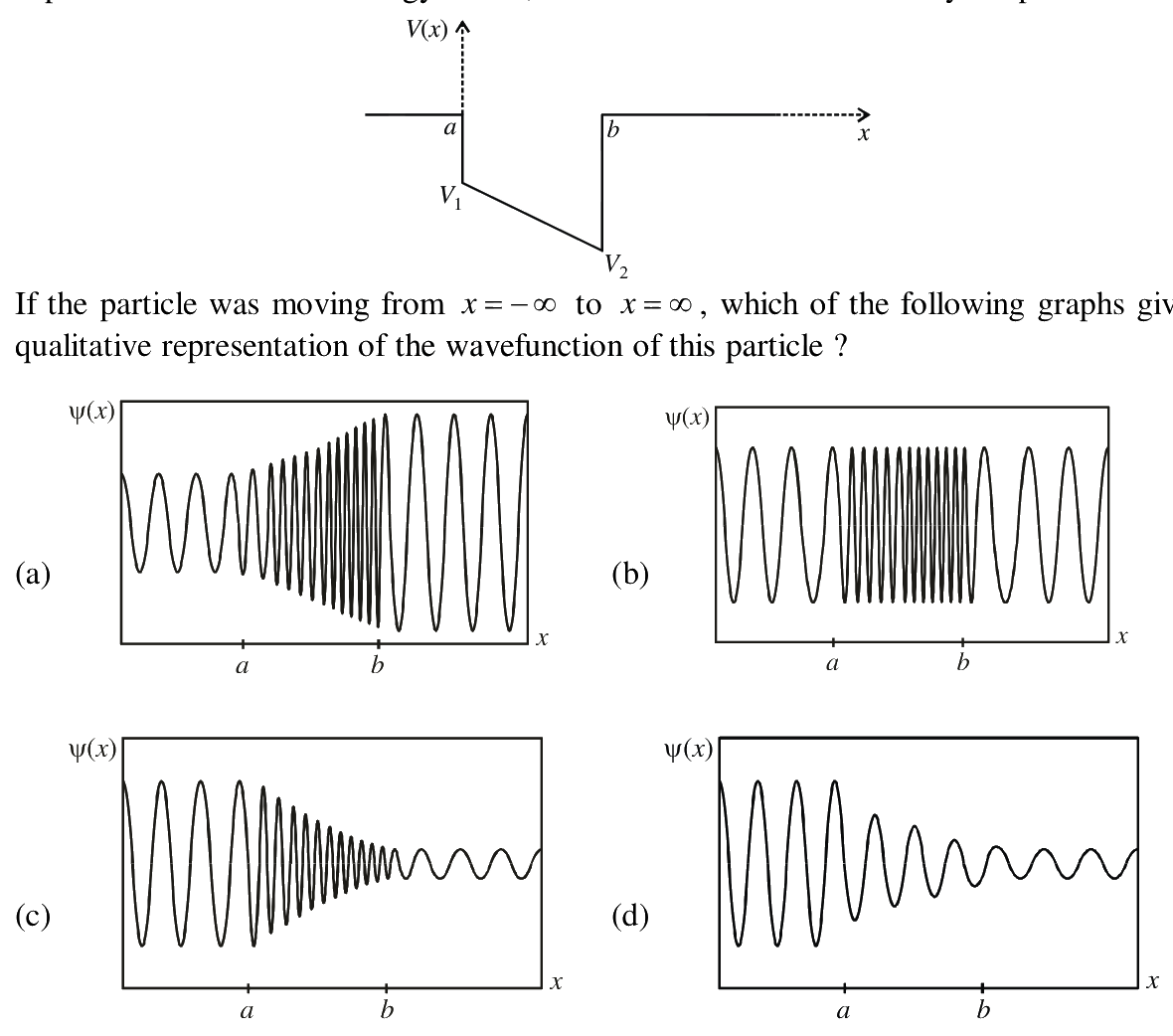
A particle of mass $m$ and energy $E > 0$, in one dimension is scattered by the potential shown below.
If the particle was moving from $x=-\infty$ to $x=\infty$, which of the following graphs gives the best qualitative representation of the wavefunction of this particle ?
Step-by-Step AI Explanation
Verified Method
To determine the correct qualitative representation of the wavefunction $\psi(x)$, we consider two main features governed by the WKB approximation and scattering boundary conditions:
1. **Wavelength / Local momentum:**
The local kinetic energy of the particle is $T(x) = E - V(x)$, so the local de Broglie wavelength is:
$$\lambda(x) = \frac{h}{p(x)} = \frac{h}{\sqrt{2m(E - V(x))}}$$
In the region $x < a$ and $x > b$, the potential is flat ($V=0$), so the wavelength is constant.
In the region $a < x < b$, the potential $V(x)$ decreases linearly from $V_1$ to $V_2$ (with $V_2 < V_1 < 0$). Thus, the kinetic energy $E - V(x)$ increases as $x$ goes from $a$ to $b$. Consequently, the momentum $p(x)$ increases, which causes the local de Broglie wavelength $\lambda(x)$ to **decrease** (the oscillations become more closely packed as $x$ approaches $b$).
2. **Amplitude:**
- According to the WKB approximation, the amplitude of the wavefunction is inversely proportional to the square root of the local momentum, $\text{Amplitude} \propto \frac{1}{\sqrt{p(x)}}$. As the kinetic energy increases from $x = a$ to $x = b$, the momentum increases, so the amplitude of the wavefunction must **decrease** in this region.
- Furthermore, since the particle is incident from the left ($x = -\infty$), for $x < a$ the wavefunction is a superposition of incident and reflected waves (giving a larger amplitude with interference), while for $x > b$ it consists only of the transmitted wave. Because the transmission probability $|T|^2 \le 1$, the amplitude of the transmitted wave for $x > b$ is generally smaller than the amplitude of the incident wave for $x < a$.
Comparing with the given choices:
- **(a)** shows the amplitude increasing from $a$ to $b$, which is incorrect.
- **(b)** shows a constant amplitude throughout, which is incorrect.
- **(d)** does not show the rapidly decreasing wavelength inside $[a, b]$.
- **(c)** correctly shows that inside the well $[a, b]$, the wavelength becomes shorter (higher frequency of oscillations) and the amplitude decreases, and the transmitted wave for $x > b$ has a smaller amplitude than the incident wave. Thus, graph **(c)** is the best representation.
Q30mcq
Consider a planar wire loop as an $n$-sided regular polygon, in which $R$ is the distance from the centre to a vertex. If a steady current $I$ flows through the wire, the magnitude of the magnetic field at the centre of the loop is
For a regular polygon with $n$ sides, the total angle subtended at the centre by the entire polygon is $2\pi$. Therefore, each side subtends an angle of $\theta = \frac{2\pi}{n}$ at the centre.
Let the distance from the centre to any vertex be $R$. Consider one side of the polygon, formed by a straight wire segment between two vertices subtending an angle $\theta = \frac{2\pi}{n}$ at the centre.
The perpendicular distance from the centre to this side is:
$$d = R \cos\left(\frac{\theta}{2}\right) = R \cos\left(\frac{\pi}{n}\right)$$
The angle that each half of the side makes with the perpendicular from the centre is $\alpha = \frac{\pi}{n}$.
The magnetic field produced by a single straight segment of length carrying current $I$ at a perpendicular distance $d$ is given by the Biot-Savart law:
$$B_1 = \frac{\mu_0 I}{4\pi d} (\sin\alpha_1 + \sin\alpha_2)$$
Since both ends subtend the same angle $\alpha = \frac{\pi}{n}$ with respect to the perpendicular:
$$B_1 = \frac{\mu_0 I}{4\pi d} \left(2\sin\left(\frac{\pi}{n}\right)\right) = \frac{\mu_0 I}{2\pi d} \sin\left(\frac{\pi}{n}\right)$$
Substitute $d = R \cos\left(\frac{\pi}{n}\right)$:
$$B_1 = \frac{\mu_0 I}{2\pi R \cos\left(\frac{\pi}{n}\right)} \sin\left(\frac{\pi}{n}\right) = \frac{\mu_0 I}{2\pi R} \tan\left(\frac{\pi}{n}\right)$$
Since the polygon has $n$ identical sides, and the magnetic fields from each side add constructively at the centre (by the right-hand rule):
$$B_{\text{total}} = n B_1 = \frac{\mu_0 nI}{2\pi R} \tan\left(\frac{\pi}{n}\right)$$
Thus, option D is the correct answer.
🎉 10 Free Sample Solutions Completed
Unlock All 55 Questions & Solutions
Sign up free in seconds to unlock step-by-step AI answers for the remaining 45 questions.
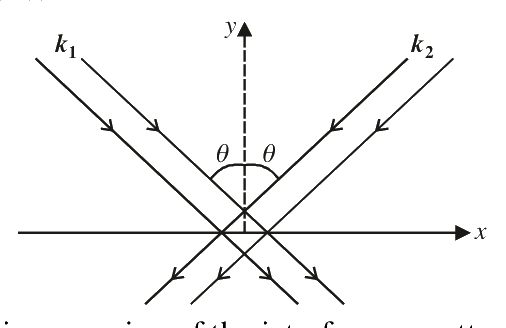
Two coherent plane electromagnetic waves of wavelength $0.5\text{ }\mu\text{m}$ (both have the same amplitude and are linearly polarized along the $z$-direction) fall on the $y = 0$ plane. Their wave vectors $\mathbf{k}_1$ and $\mathbf{k}_2$ are as shown in the figure.
If the angle $\theta$ is $30^\circ$, the fringe spacing of the interference pattern produced on the plane is
a.
$1.0\text{ }\mu\text{m}$
b.
$0.29\text{ }\mu\text{m}$
c.
$0.58\text{ }\mu\text{m}$
d.
$0.5\text{ }\mu\text{m}$
Correct Answer & Step-by-Step Solution Locked
Sign in free to reveal the correct answer and AI explanation for this question.
Which of the following is not a correct boundary condition at an interface between two homogeneous dielectric media ? (In the following $\hat{n}$ is a unit vector normal to the interface, $\sigma$ and $\mathbf{j}_s$ are the surface charge and current densities, respectively).
The permittivity tensor of a uniaxial anisotropic medium, in the standard Cartesian basis, is
$$\begin{pmatrix} 4\varepsilon_0 & 0 & 0 \\ 0 & 4\varepsilon_0 & 0 \\ 0 & 0 & 9\varepsilon_0 \end{pmatrix}, \text{ where } \varepsilon_0 \text{ is a constant.}$$
The wave number of an electromagnetic plane wave polarized along the $x$-direction, and propagating along the $y$-direction in this medium (in terms of the wave number $k_0$ of the wave in vacuum) is
a.
$4k_0$
b.
$2k_0$
c.
$9k_0$
d.
$3k_0$
Correct Answer & Step-by-Step Solution Locked
Sign in free to reveal the correct answer and AI explanation for this question.
The elements of a $3 \times 3$ matrix $A$ are the products of its row and column indices $A_{ij} = ij$ (where $i, j = 1, 2, 3$). The eigenvalues of $A$ are
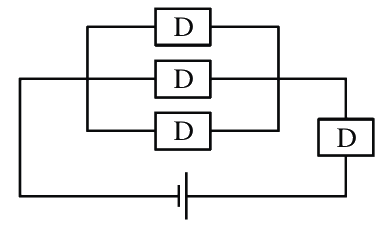
In the following circuit, each device $D$ may be an insulator with probability $p$, or a conductor with probability $(1 - p)$. The probability that a non-zero current flows through the circuit is
a.
$2 - p - p^3$
b.
$(1 - p)^4$
c.
$(1 - p)^2 p^2$
d.
$(1 - p)(1 - p^3)$
Correct Answer & Step-by-Step Solution Locked
Sign in free to reveal the correct answer and AI explanation for this question.
In a system comprising of approximately $10^{23}$ distinguishable particles, each particle may occupy any of $20$ distinct states. The maximum value of the entropy per particle is nearest to
a.
$20 k_B$
b.
$3 k_B$
c.
$10(\ln 2) k_B$
d.
$20(\ln 2) k_B$
Correct Answer & Step-by-Step Solution Locked
Sign in free to reveal the correct answer and AI explanation for this question.
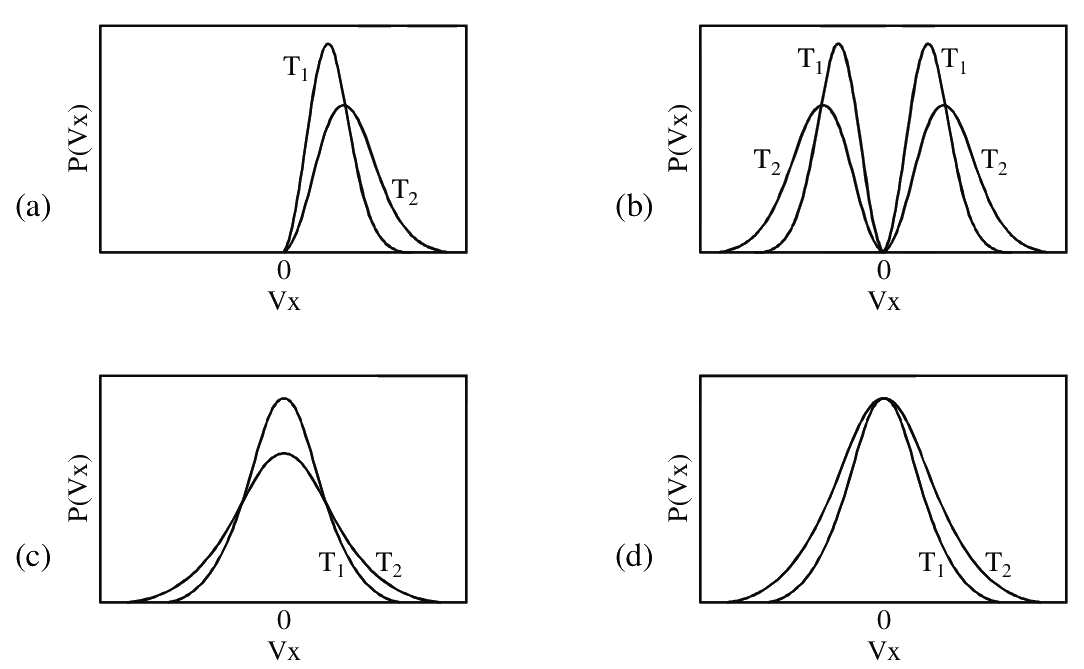
Consider a classical gas in thermal equilibrium at temperatures $T_1$ and $T_2$. Which of the following graphs correctly represents the qualitative behaviour of the probability density function of the $x$-component of the velocity ?
Correct Answer & Step-by-Step Solution Locked
Sign in free to reveal the correct answer and AI explanation for this question.
The equation of state of an ideal gas is $pV = RT$. At very low temperatures, the volume expansion coefficient $\frac{1}{V}\frac{\partial V}{\partial T}$ at constant pressure
a.
diverges as $1/T^2$
b.
diverges as $1/T$
c.
vanishes as $T$
d.
is independent of the temperature
Correct Answer & Step-by-Step Solution Locked
Sign in free to reveal the correct answer and AI explanation for this question.
The Hamiltonian of a classical nonlinear one dimensional oscillator is $H = \frac{1}{2m} p^2 + \lambda x^4$, where $\lambda > 0$ is a constant. The specific heat of a collection of $N$ independent such oscillators is
a.
$\frac{3Nk_B}{2}$
b.
$\frac{3Nk_B}{4}$
c.
$Nk_B$
d.
$\frac{Nk_B}{2}$
Correct Answer & Step-by-Step Solution Locked
Sign in free to reveal the correct answer and AI explanation for this question.
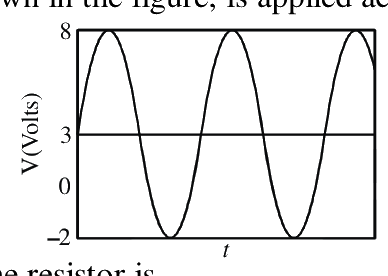
In an experiment to measure the acceleration due to gravity $g$ using a simple pendulum, the length and time period of the pendulum are measured to three significant figures. The mean value of $g$ and the uncertainty $\delta g$ of the measurements are then estimated using a calculator from a large number of measurements and found to be $9.82147\text{ m/s}$ and $0.02357\text{ m/s}^2$, respectively. Which of the following is the most accurate way of presenting the experimentally determined value of $g$?
a.
$9.82 \pm 0.02\text{ m/s}^2$
b.
$9.8215 \pm 0.02\text{ m/s}^2$
c.
$9.82147 \pm 0.02357\text{ m/s}^2$
d.
$9.82 \pm 0.02357\text{ m/s}^2$
Correct Answer & Step-by-Step Solution Locked
Sign in free to reveal the correct answer and AI explanation for this question.
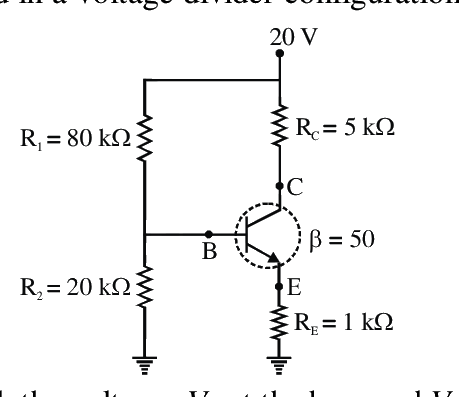
An $npn$-transistor is connected in a voltage divider configuration as shown in the figure below.
If the resistor $R_2$ is disconnected, the voltages $V_B$ at the base and $V_C$ at the collector change as follows.
a.
Both $V_B$ and $V_C$ increase
b.
Both $V_B$ and $V_C$ decrease
c.
$V_B$ decreases, but $V_C$ increase
d.
$V_B$ increases, but $V_C$ decreases
Correct Answer & Step-by-Step Solution Locked
Sign in free to reveal the correct answer and AI explanation for this question.
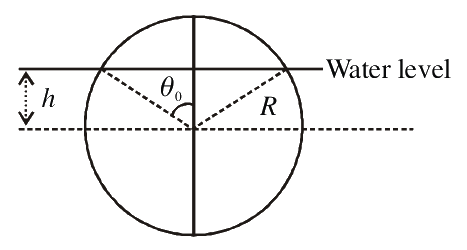
A solid spherical cork of radius R and specific gravity 0.5 floats on water. The cork is pushed down so that its centre of mass is at a distance $h$ (where $0 < h < R$) below the surface of water, and then released. The volume of the part of the cork above water level is $\pi R^3\left(\frac{2}{3} - \cos\theta_0 + \frac{1}{3}\cos^3\theta_0\right)$, where $\theta_0$ is the angle as shown in the figure.
At the moment of release, the dependence of the upward force on the cork on $h$ is
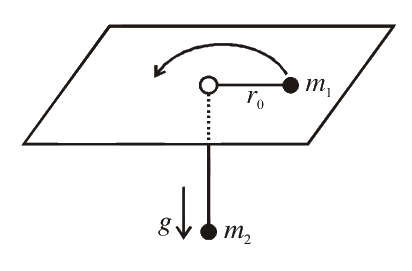
Two particles of masses $m_1$ and $m_2$ are connected by a massless thread of length $\ell$ as shown in figure below.
The particle of mass $m_1$ on the plane undergoes a circular motion with radius $r_0$ and angular momentum $L$. When a small radial displacement $\varepsilon$ (where $\varepsilon \ll r_0$) is applied, its radial coordinate is found to oscillate about $r_0$. The frequency of the oscillations is
The time evolution of a coordinate $x$ of a particle is described by the equation:
$$\frac{d^4 x}{dt^4} + 2\Omega^2 \frac{d^2 x}{dt^2} + (\Omega^4 - A^4)x = 0$$
For $\Omega > A$, the particle will
a.
eventually come to rest at the origin
b.
eventually drift to infinity ($|x| \to \infty$)
c.
oscillate about the origin
d.
eventually come to rest at $\Omega/A$ or $-\Omega/A$
Correct Answer & Step-by-Step Solution Locked
Sign in free to reveal the correct answer and AI explanation for this question.
The Hamiltonian of a quantum particle of mass $m$ is $H = \frac{p^2}{2m} + \alpha |x|^r$, where $\alpha$ and $r$ are positive constants. The energy $E_n$ of the $n^{\text{th}}$ level, for large $n$, depends on $n$ as
a.
$n^{2r}$
b.
$n^{r+2}$
c.
$n^{1/(r+2)}$
d.
$n^{2r/(r+2)}$
Correct Answer & Step-by-Step Solution Locked
Sign in free to reveal the correct answer and AI explanation for this question.
In the particle wave expansion, the differential scattering cross-section is given by
$$\frac{d\sigma}{d(\cos\theta)} = \left| \sum_l (2l+1) e^{i\delta_l} \sin \delta_l P_l(\cos\theta) \right|^2$$
where $\theta$ is the scattering angle. For a certain neutron-nucleus scattering, it is found that the two lowest phase shifts $\delta_0$ and $\delta_1$ corresponding to $s$-wave and $p$-wave, respectively, satisfy $\delta_1 \approx \delta_0 / 2$. Assuming that the other phase shifts are negligibly small, the differential cross-section reaches its minimum for $\cos\theta$ equal to
a.
$0$
b.
$\pm 1$
c.
$-\frac{2}{3}\cos^2\delta_1$
d.
$\frac{1}{3}\cos^2\delta_1$
Correct Answer & Step-by-Step Solution Locked
Sign in free to reveal the correct answer and AI explanation for this question.
A charged, spin-less particle of mass $m$ is subjected to an attractive potential
$$V(x, y, z) = \frac{1}{2}k(x^2 + y^2 + z^2),$$
where $k$ is a positive constant.
Now a perturbation in the form of a weak magnetic field $\mathbf{B} = B_0\hat{k}$ (where $B_0$ is a constant) is switched on. Into how many distinct levels will the second excited state of the unperturbed Hamiltonian split?
a.
$5$
b.
$4$
c.
$2$
d.
$1$
Correct Answer & Step-by-Step Solution Locked
Sign in free to reveal the correct answer and AI explanation for this question.
The elastic scattering of a charged particle of mass $m$ off an atom can be approximated by the potential $V(r) = \frac{\alpha}{r}e^{-r/R}$, where $\alpha$ and $R$ are positive constants. If the wave number of the incoming particle is $k$ and the scattering angle is $2\theta$, the differential cross-section in the Born approximation is
The wave number $k$ and the angular frequency $\omega$ of a wave are related by the dispersion relation $\omega^2 = \alpha k + \beta k^3$, where $\alpha$ and $\beta$ are positive constants. The wave number for which the phase velocity equals the group velocity, is
a.
$3\sqrt{\frac{\alpha}{\beta}}$
b.
$\sqrt{\frac{\alpha}{\beta}}$
c.
$\frac{1}{2}\sqrt{\frac{\alpha}{\beta}}$
d.
$\frac{1}{3}\sqrt{\frac{\alpha}{\beta}}$
Correct Answer & Step-by-Step Solution Locked
Sign in free to reveal the correct answer and AI explanation for this question.
An inertial observer A at rest measures the electric and magnetic field $E = (\alpha, 0, 0)$ and $B = (\alpha, 0, 2\alpha)$ in a region, where $\alpha$ is a constant. Another inertial observer B, moving with a constant velocity with respect to A, measures the field as $E' = (E'_x, \alpha, 0)$ and $B' = (\alpha, B'_y, \alpha)$. Then, in units $c = 1$, $E'_x$ and $B'_y$ are given, respectively, by
a.
$-2\alpha$ and $\alpha$
b.
$2\alpha$ and $-\alpha$
c.
$\alpha$ and $-2\alpha$
d.
$-\alpha$ and $2\alpha$
Correct Answer & Step-by-Step Solution Locked
Sign in free to reveal the correct answer and AI explanation for this question.
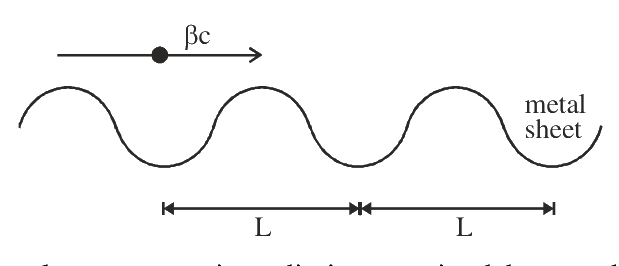
A point charge is moving with a uniform velocity $\beta c$ along the positive $x$-direction, parallel to and very close to a corrugated metal sheet (see the figure below).
The wavelength of the electromagnetic radiation received by an observer along the direction of motion is
a.
$\frac{L}{\beta}\sqrt{1-\beta^2}$
b.
$L\sqrt{1-\beta^2}$
c.
$L\beta\sqrt{1-\beta^2}$
d.
$L$
Correct Answer & Step-by-Step Solution Locked
Sign in free to reveal the correct answer and AI explanation for this question.
The equation of motion of a forced simple harmonic oscillator is $\ddot{x} + \omega^2 x = A\cos\Omega t$, where $A$ is a constant. At resonance $\Omega = \omega$, the amplitude of oscillations at large times.
a.
saturates to a finite value
b.
increases with time as $\sqrt{t}$
c.
increases linearly with time
d.
increases exponentially with time
Correct Answer & Step-by-Step Solution Locked
Sign in free to reveal the correct answer and AI explanation for this question.
The operator $A$ has a matrix representation $\begin{pmatrix} 2 & 1 \\ 1 & 2 \end{pmatrix}$ in the basis spanned by $\begin{pmatrix} 1 \\ 0 \end{pmatrix}$ and $\begin{pmatrix} 0 \\ 1 \end{pmatrix}$. In another basis spanned by $\frac{1}{\sqrt{2}}\begin{pmatrix} 1 \\ 1 \end{pmatrix}$ and $\frac{1}{\sqrt{2}}\begin{pmatrix} 1 \\ -1 \end{pmatrix}$, the matrix representation of $A$ is
a.
$\begin{pmatrix} 2 & 0 \\ 0 & 2 \end{pmatrix}$
b.
$\begin{pmatrix} 3 & 0 \\ 0 & 1 \end{pmatrix}$
c.
$\begin{pmatrix} 3 & 1 \\ 0 & 1 \end{pmatrix}$
d.
$\begin{pmatrix} 3 & 0 \\ 1 & 1 \end{pmatrix}$
Correct Answer & Step-by-Step Solution Locked
Sign in free to reveal the correct answer and AI explanation for this question.
The operator $x\frac{d}{dx}\delta(x)$, where $\delta(x)$ is the Dirac delta function, acts on the space of real-valued square-integrable functions on the real line. This operator is equivalent to
a.
$-\delta(x)$
b.
$\delta(x)$
c.
$x$
d.
$0$
Correct Answer & Step-by-Step Solution Locked
Sign in free to reveal the correct answer and AI explanation for this question.
At each time step, a random walker in one-dimension either remains at the same point with probability $\frac{1}{4}$, or moves by a distance $\Delta$ to the right or left with probabilities $3/8$ each. After $N$ time steps, its root mean squared displacement is
a.
$\Delta\sqrt{N}$
b.
$\Delta\sqrt{\frac{9N}{16}}$
c.
$\Delta\sqrt{\frac{3N}{4}}$
d.
$\Delta\sqrt{\frac{3N}{8}}$
Correct Answer & Step-by-Step Solution Locked
Sign in free to reveal the correct answer and AI explanation for this question.
The Hamiltonian of three Ising spins $S_1$, $S_2$ and $S_3$, each taking values $\pm 1$, is $H = -J(S_1 S_2 + S_2 S_3) - h S_1$, where $J$ and $h$ are positive constants. The mean value of $S_3$ in equilibrium at a temperatrue $T = 1/(k_B \beta)$, is
a.
$\tanh^3(\beta J)$
b.
$\tanh(\beta h)\tanh^2(\beta J)$
c.
$\sinh(\beta h)\sinh^2(\beta J)$
d.
0
Correct Answer & Step-by-Step Solution Locked
Sign in free to reveal the correct answer and AI explanation for this question.
The free energy of a magnetic system, as a function of its magnetisation $m$, is $F = \frac{1}{2}am^2 - \frac{1}{4}bm^4 + \frac{1}{6}m^6$, where $a$ and $b$ are positive constants. At a fixed value of $a$, the critical value of $b$, above which the minimum of $F$ will be at a non-zero value of magnetisation, is
a.
$\sqrt{10a/3}$
b.
$\sqrt{16a/3}$
c.
$\frac{10}{3}\sqrt{a}$
d.
$\frac{16}{3}\sqrt{a}$
Correct Answer & Step-by-Step Solution Locked
Sign in free to reveal the correct answer and AI explanation for this question.
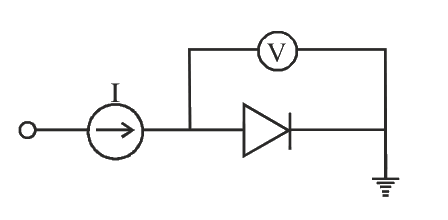
The forward diode current is given by $I = \kappa T^{\alpha} e^{-E_g / k_B T} (\exp(eV / k_B T) - 1)$, where $E_g$ is the band gap of the semiconductor, $V$ is the voltage drop across the diode, $T$ is the temperature of the diode operating near room temperature and, $\alpha$ and $\kappa$ are constants. A diode is used as a thermal sensor in the circuit shown below.
If $V$ is measured using an ideal voltmeter to estimate $T$, the variation of the voltage $V$ as a function of $T$ is best approximated by (in the following $a$ and $b$ are constants)
a.
$aT^2 + b$
b.
$aT + b$
c.
$aT^3 + b$
d.
$aT + bT^2$
Correct Answer & Step-by-Step Solution Locked
Sign in free to reveal the correct answer and AI explanation for this question.
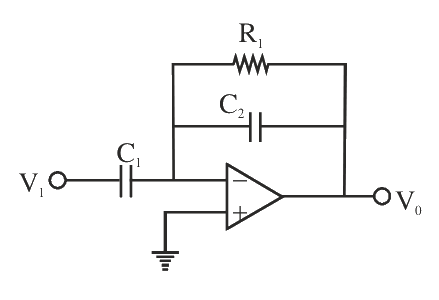
A circuit constructed using op-amp, resistor $R_1 = 1\text{ k}\Omega$ and capacitors $C_1 = 1\ \mu\text{F}$ and $C_2 = 0.1\ \mu\text{F}$, is shown in the figure below.
This circuit will act as a
a.
high pass filter
b.
low pass filter
c.
band pass filter
d.
band reject filter
Correct Answer & Step-by-Step Solution Locked
Sign in free to reveal the correct answer and AI explanation for this question.
A bound electron and hole pair interacting via Coulomb interaction in a semiconductor is called an exciton. The effective masses of an electron and a hole are about $0.1\ m_e$ and $0.5\ m_e$ respectively, where $m_e$ is the rest mass of the electron. The dielectric constant of the semiconductor is 10. Assuming that the energy levels of the excitons are hydrogen like, the binding energy of an exciton (in units of the Rydberg constant) is closest to
a.
$2 \times 10^{-3}$
b.
$2 \times 10^{-4}$
c.
$8 \times 10^{-4}$
d.
$3 \times 10^{-3}$
Correct Answer & Step-by-Step Solution Locked
Sign in free to reveal the correct answer and AI explanation for this question.
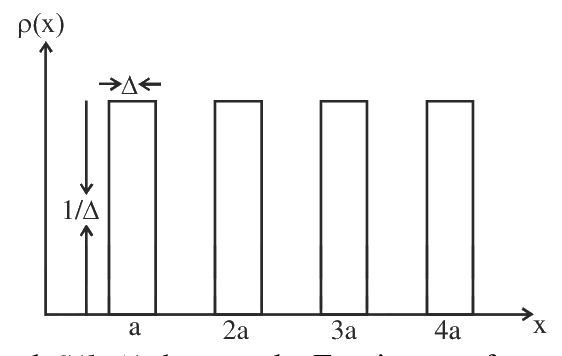
Consider an array of atoms in one dimension with an ensemble averaged periodic density distribution as shown in the figure.
If $k$ is the wave number and $S(k, \Delta)$ denotes the Fourier transform of the density-density correlation function, the ratio $S(k, \Delta) / S(k, 0)$ is
A doubly charged ion in the angular momentum state $(J=2, J_3 = 1)$ meets a gas of polarized electrons $(S_3 = 1/2)$ and gets neutralized. If the orbital angular momentum transferred in the process is zero, the probability that the neutral atom is in the $(J = 2, J_3 = 2)$ state is
a.
$2/5$
b.
$2/3$
c.
$1/5$
d.
$1/3$
Correct Answer & Step-by-Step Solution Locked
Sign in free to reveal the correct answer and AI explanation for this question.
The range of the inter-atomic potential in gaseous hydrogen is approximately $5\text{ \AA}$. In thermal equilibrium, the maximum temperature for which the atom-atom scattering is dominantly $s$-wave, is
a.
$500\text{ K}$
b.
$100\text{ K}$
c.
$1\text{ K}$
d.
$1\text{ mK}$
Correct Answer & Step-by-Step Solution Locked
Sign in free to reveal the correct answer and AI explanation for this question.
The energy levels corresponding to the rotational motion of a molecule are $E_J = B J(J+1)\text{cm}^{-1}$ where $J = 0, 1, 2, \ldots$ and $B$ is a constant. Pure rotational Raman transitions follow the selection rule $\Delta J = 0, \pm 2$. When the molecule is irradiated, the separation between the closest Stokes and anti-Stokes lines (in $\text{cm}^{-1}$) is
a.
$6\ B$
b.
$12\ B$
c.
$4\ B$
d.
$8\ B$
Correct Answer & Step-by-Step Solution Locked
Sign in free to reveal the correct answer and AI explanation for this question.
The cavity of a He-Ne laser emitting at $632.8\text{ nm}$, consists of two mirrors separated by a distance of $35\text{ cm}$. If the oscillations in the laser cavity occur at frequencies within the gain bandwidth of $1.3\text{ GHz}$, the number of longitudinal modes allowed in the cavity is
a.
1
b.
2
c.
3
d.
4
Correct Answer & Step-by-Step Solution Locked
Sign in free to reveal the correct answer and AI explanation for this question.
An excited state of a ${}^8_4\text{Be}$ nucleus decays into two $\alpha$ particles which are in a spin-parity $0^+$ state. If the mean life-time of this decay is $10^{-22}\text{ s}$, the spin-parity of the excited state of the nucleus is
a.
$2^+$
b.
$3^+$
c.
$0^-$
d.
$4^-$
Correct Answer & Step-by-Step Solution Locked
Sign in free to reveal the correct answer and AI explanation for this question.
The elastic scattering of a neutrino $\nu_e$ by an electron $e^-$, i.e. the reaction $\nu_e + e^- \to \nu_e + e^-$, can be described by the interaction Hamiltonian $H_{\text{int}} = \frac{1}{\sqrt{2}} G_F \int d^3x \left(\overline{\psi}_e(x)\gamma^\mu \psi_{\nu_e}(x)\right)\left(\overline{\psi}_{\nu_e}(x)\gamma_\mu \psi_e(x)\right)$. The cross-section of the above process depends on the centre of mass energy $E$, as depends on the centre of mass energy $E$, as
a.
$1/E^2$
b.
$E^2$
c.
$E$
d.
$\sqrt{E}$
Correct Answer & Step-by-Step Solution Locked
Sign in free to reveal the correct answer and AI explanation for this question.
The mean life-time of the following decays:
$$\rho_0 \to \pi^+ + \pi^-, \ \pi^0 \to \gamma + \gamma, \ \mu^- \to e^- + \overline{\nu}_e + \nu_\mu,$$
are $\tau_\rho, \tau_\pi$ and $\tau_\mu$, respectively. They satisfy
a.
$\tau_\pi < \tau_\rho < \tau_\mu$
b.
$\tau_\mu < \tau_\rho < \tau_\pi$
c.
$\tau_\rho < \tau_\pi < \tau_\mu$
d.
$\tau_\rho < \tau_\mu < \tau_\pi$
Correct Answer & Step-by-Step Solution Locked
Sign in free to reveal the correct answer and AI explanation for this question.