Consider the three vectors $\vec{v}_1 = 2\hat{i} + 3\hat{k}$, $\vec{v}_2 = \hat{i} + 2\hat{j} + 2\hat{k}$ and $\vec{v}_3 = 5\hat{i} + \hat{j} + \alpha\hat{k}$, where $\hat{i}$, $\hat{j}$ and $\hat{k}$ are the standard unit vectors in a three-dimensional Euclidean space. These vectors will be linearly dependent if the value of $\alpha$ is
a.
$31/4$
Correct Answer
b.
$23/4$
c.
$27/4$
d.
$0$
Step-by-Step AI Explanation
Verified Method
The three vectors are linearly dependent if and only if their scalar triple product (or the determinant of the matrix formed by their components) vanishes:
$$\begin{vmatrix} 2 & 0 & 3 \\ 1 & 2 & 2 \\ 5 & 1 & \alpha \end{vmatrix} = 0$$
Expanding the determinant along the first row:
$$2(2\alpha - 2) - 0 + 3(1 - 10) = 0$$
$$4\alpha - 4 + 3(-9) = 0$$
$$4\alpha - 4 - 27 = 0 \implies 4\alpha = 31 \implies \alpha = \frac{31}{4}$$
Thus, the correct choice is A.
Q22mcq
The fourier transform $\int_{-\infty}^{\infty} dx\, f(x)\, e^{ikx}$ of the function $f(x) = e^{-|x|}$ is
a.
$-\frac{2}{1+k^2}$
b.
$-\frac{1}{2(1+k^2)}$
c.
$\frac{2}{1+k^2}$
Correct Answer
d.
$\frac{2}{(2+k^2)}$
Step-by-Step AI Explanation
Verified Method
The Fourier transform is given by:
$$\int_{-\infty}^{\infty} dx\, e^{-|x|} e^{ikx} = \int_{-\infty}^0 e^{x(1+ik)}\, dx + \int_0^\infty e^{-x(1-ik)}\, dx$$
Evaluating the integrals:
$$\left[ \frac{e^{x(1+ik)}}{1+ik} \right]_{-\infty}^0 + \left[ \frac{e^{-x(1-ik)}}{-(1-ik)} \right]_0^\infty = \frac{1}{1+ik} + \frac{1}{1-ik} = \frac{(1-ik) + (1+ik)}{(1+ik)(1-ik)} = \frac{2}{1+k^2}$$
Therefore, the correct option is C.
Q23mcq
The value of the integral $\int_{-\pi/2}^{+\pi/2} dx \int_{-1}^{+1} dy\, \delta(\sin 2x)\, \delta(x-y)$ is
a.
$0$
b.
$1/2$
Correct Answer
c.
$1/\sqrt{2}$
d.
$1$
Step-by-Step AI Explanation
Verified Method
We evaluate the double integral:
$$I = \int_{-\pi/2}^{+\pi/2} dx \int_{-1}^{+1} dy\, \delta(\sin 2x)\, \delta(x-y)$$
First, perform the integral over $y$. The Dirac delta function $\delta(x-y)$ is non-zero when $y = x$. Since $y \in [-1, 1]$, this restricts the $x$-integration to values where $-1 \le x \le 1$:
$$I = \int_{-1}^{+1} dx\, \delta(\sin 2x)$$
Within the interval $[-1, 1]$, $\sin 2x = 0$ only at $x = 0$ (since the other roots are $2x = \pm \pi \implies x = \pm \pi/2 \approx \pm 1.57$, which lie outside $[-1, 1]$).
Using the property of the delta function $\delta(g(x)) = \sum_i \frac{\delta(x-x_i)}{|g'(x_i)|}$:
Here, $g(x) = \sin 2x$, so $g'(x) = 2\cos 2x$. At $x=0$, $|g'(0)| = 2|\cos 0| = 2$.
Thus, near $x=0$:
$$\delta(\sin 2x) = \frac{\delta(x)}{2}$$
Hence,
$$I = \int_{-1}^1 \frac{\delta(x)}{2}\, dx = \frac{1}{2}$$
Therefore, option B is correct.
Q24mcq
Consider the following ordinary differential equation : $\frac{d^2x}{dt^2} + \frac{1}{x}\left(\frac{dx}{dt}\right)^2 - \frac{dx}{dt} = 0$ with the boundary conditions $x(t=0) = 0$ and $x(t=1) = 1$. The value of $x(t)$ at $t=2$ is
a.
$\sqrt{e-1}$
b.
$\sqrt{e^2+1}$
c.
$\sqrt{e+1}$
Correct Answer
d.
$\sqrt{e^2-1}$
Step-by-Step AI Explanation
Verified Method
Multiply the entire differential equation by $x$:
$$x \frac{d^2x}{dt^2} + \left(\frac{dx}{dt}\right)^2 - x \frac{dx}{dt} = 0$$
Notice that the first two terms represent the derivative of a product:
$$\frac{d}{dt}\left(x \frac{dx}{dt}\right) - x \frac{dx}{dt} = 0$$
Let $u(t) = x \frac{dx}{dt} = \frac{1}{2} \frac{d(x^2)}{dt}$. Then the equation becomes:
$$\frac{du}{dt} - u = 0 \implies u(t) = C_1 e^t$$
Thus:
$$\frac{1}{2} \frac{d(x^2)}{dt} = C_1 e^t \implies \frac{d(x^2)}{dt} = 2C_1 e^t$$
Integrating with respect to $t$:
$$x^2(t) = 2C_1 e^t + C_2 = A e^t + B$$
Applying the boundary conditions:
1. $x(0) = 0 \implies A(1) + B = 0 \implies B = -A$
So $x^2(t) = A(e^t - 1)$.
2. $x(1) = 1 \implies x^2(1) = 1 \implies A(e - 1) = 1 \implies A = \frac{1}{e-1}$
Thus:
$$x^2(t) = \frac{e^t - 1}{e - 1}$$
For $t = 2$:
$$x^2(2) = \frac{e^2 - 1}{e - 1} = \frac{(e-1)(e+1)}{e-1} = e+1$$
Therefore, $x(2) = \sqrt{e+1}$, which matches option C.
Q25mcq
What is the value of $\alpha$ for which $f(x, y) = 2x + 3(x^2 - y^2) + 2i(3xy + \alpha y)$ is an analytic function of complex variable $z = x + iy$ ?
a.
$1$
Correct Answer
b.
$0$
c.
$3$
d.
$2$
Step-by-Step AI Explanation
Verified Method
For $f(x, y) = u(x, y) + i v(x, y)$ to be an analytic function, it must satisfy the Cauchy-Riemann equations:
$$\frac{\partial u}{\partial x} = \frac{\partial v}{\partial y} \quad \text{and} \quad \frac{\partial u}{\partial y} = -\frac{\partial v}{\partial x}$$
Given:
$$u(x, y) = 2x + 3(x^2 - y^2) = 2x + 3x^2 - 3y^2$$
$$v(x, y) = 2(3xy + \alpha y) = 6xy + 2\alpha y$$
Computing the partial derivatives:
$$\frac{\partial u}{\partial x} = 2 + 6x$$
$$\frac{\partial v}{\partial y} = 6x + 2\alpha$$
Equating $\frac{\partial u}{\partial x} = \frac{\partial v}{\partial y}$:
$$2 + 6x = 6x + 2\alpha \implies 2\alpha = 2 \implies \alpha = 1$$
Let us verify the second Cauchy-Riemann equation:
$$\frac{\partial u}{\partial y} = -6y$$
$$\frac{\partial v}{\partial x} = 6y \implies -\frac{\partial v}{\partial x} = -6y$$
This is identically satisfied for any $\alpha$. Hence, the required value is $\alpha = 1$, which is option A.
Q26mcq
A particle moves in the one-dimensional potential $V(x) = \alpha x^6$, where $\alpha > 0$ is a constant. If the total energy of the particle is $E$, its time period in a periodic motion is proportional to
a.
$E^{-1/3}$
Correct Answer
b.
$E^{-1/2}$
c.
$E^{1/3}$
d.
$E^{1/2}$
Step-by-Step AI Explanation
Verified Method
For a particle moving in a power-law potential $V(x) = \alpha x^n$, the period $T$ of periodic motion scales with energy $E$ as:
$$T \propto E^{\frac{1}{n} - \frac{1}{2}}$$
Here, $n = 6$. Substituting $n = 6$:
$$T \propto E^{\frac{1}{6} - \frac{1}{2}} = E^{\frac{1 - 3}{6}} = E^{-2/6} = E^{-1/3}$$
Alternatively, from the integral for the period:
$$T = 4 \int_0^{x_0} \frac{dx}{\sqrt{\frac{2}{m}(E - \alpha x^6)}}$$
where the turning point is $x_0 = (E/\alpha)^{1/6}$. Letting $x = x_0 u$:
$$T \propto \frac{x_0}{\sqrt{E}} \propto \frac{E^{1/6}}{E^{1/2}} = E^{-1/3}$$
Therefore, the correct choice is A.
Q27mcq
Which of the following figures best describes the trajectory of a particle moving in a repulsive central potential $V(r) = \frac{\alpha}{r}$ ($\alpha > 0$ is a constant) ?
a.
Trajectory shown in figure (a)
b.
Trajectory shown in figure (b)
c.
Trajectory shown in figure (c)
Correct Answer
d.
Trajectory shown in figure (d)
Step-by-Step AI Explanation
Verified Method
For a repulsive central potential $V(r) = \frac{\alpha}{r}$ (with $\alpha > 0$, like Rutherford scattering):
1. The potential is strictly repulsive, so bound orbits (such as the ellipse in (b) or circle in (d)) are impossible. The motion is unbounded ($E > 0$).
2. The trajectory is a hyperbola bending *away* from the scattering center (the origin $O$), meaning the force center is at the *exterior* focus of the hyperbolic branch.
3. In figure (a), the curve bends around the origin, which corresponds to an attractive potential ($V(r) < 0$). In figure (c), the trajectory bends away from the origin $O$, curving such that the origin is on the convex side of the trajectory, characteristic of a repulsive force.
Thus, figure (c) correctly describes the trajectory, corresponding to option C.
Q28mcq
Two particles $A$ and $B$ move with relativistic velocities of equal magnitude $v$, but in opposite directions, along the $x$-axis of an inertial frame of reference. The magnitude of the velocity of $A$, as seen from the rest frame of $B$, is
Let the frame of reference be $S$. Particle $A$ moves with velocity $u_x = -v$ and particle $B$ moves with velocity $V = v$ (or vice-versa).
Using the relativistic velocity transformation to find the velocity of $A$ relative to $B$ (rest frame $S'$ of $B$ moving at speed $V = v$ relative to $S$):
$$u'_x = \frac{u_x - V}{1 - \frac{u_x V}{c^2}}$$
Substituting $u_x = -v$ and $V = v$:
$$u'_x = \frac{-v - v}{1 - \frac{(-v)(v)}{c^2}} = \frac{-2v}{1 + \frac{v^2}{c^2}}$$
The magnitude of this relative velocity is:
$$|u'_x| = \frac{2v}{1 + \frac{v^2}{c^2}}$$
Thus, option B is the correct answer.
Q29mcq
A particle of mass $m$, kept in a potential $V(x) = -\frac{1}{2} k x^2 + \frac{1}{4} \lambda x^4$, [where $k$ and $\lambda$ are positive constants], undergoes small oscillations about an equilibrium point. The frequency of oscillations is
To find the frequency of small oscillations, we first find the stable equilibrium points of the potential $V(x) = -\frac{1}{2} k x^2 + \frac{1}{4} \lambda x^4$.
The first derivative gives the equilibrium positions:
$$\frac{dV}{dx} = -kx + \lambda x^3 = x(\lambda x^2 - k) = 0$$
This gives $x = 0$ or $x_0 = \pm\sqrt{\frac{k}{\lambda}}$.
The second derivative is:
$$\frac{d^2V}{dx^2} = -k + 3\lambda x^2$$
- At $x = 0$, $\frac{d^2V}{dx^2} = -k < 0$, which corresponds to an unstable equilibrium.
- At $x_0 = \pm\sqrt{\frac{k}{\lambda}}$, $\frac{d^2V}{dx^2}\Big|_{x_0} = -k + 3\lambda\left(\frac{k}{\lambda}\right) = 2k > 0$, which corresponds to stable equilibrium points.
The effective spring constant is $k_{\text{eff}} = \frac{d^2V}{dx^2}\Big|_{x_0} = 2k$.
Therefore, the angular frequency of small oscillations about the stable equilibrium point is $\omega = \sqrt{\frac{k_{\text{eff}}}{m}} = \sqrt{\frac{2k}{m}}$, and the frequency of oscillation is:
$$f = \frac{\omega}{2\pi} = \frac{1}{2\pi}\sqrt{\frac{2k}{m}}$$
Thus, option C is the correct answer.
Q30mcq
Two points charges $+2Q$ and $-Q$ are kept at points with Cartesian coordinates $(1, 0, 0)$ and $(2, 0, 0)$, respectively, in front of an infinite grounded conducting plate at $x = 0$. The potential at $(x, 0, 0)$ for $x \gg 1$ depends on $x$ as
a.
$x^{-3}$
Correct Answer
b.
$x^{-5}$
c.
$x^{-2}$
d.
$x^{-4}$
Step-by-Step AI Explanation
Verified Method
To find the potential for $x > 0$ due to charges in front of an infinite grounded conducting sheet at $x = 0$, we use the method of image charges.
The real charges are:
- $+2Q$ at $x_1 = 1$
- $-Q$ at $x_2 = 2$
The corresponding image charges are located at reflected positions behind the grounded plane $x = 0$:
- $-2Q$ at $x'_1 = -1$
- $+Q$ at $x'_2 = -2$
Let us calculate the multipole moments of this four-charge configuration (real plus images) on the $x$-axis:
1. **Monopole moment ($q_{\text{tot}}$):**
$$q_{\text{tot}} = (+2Q) + (-Q) + (-2Q) + (+Q) = 0$$
2. **Dipole moment ($p$):**
$$p = \sum q_i x_i = (+2Q)(1) + (-Q)(2) + (-2Q)(-1) + (+Q)(-2) = 2Q - 2Q + 2Q - 2Q = 0$$
3. **Quadrupole moment ($Q_{xx}$):**
$$Q_{xx} \propto \sum q_i x_i^2 = (+2Q)(1)^2 + (-Q)(2)^2 + (-2Q)(-1)^2 + (+Q)(-2)^2$$
$$= 2Q - 4Q - 2Q + 4Q = 0$$
4. **Octupole moment ($O_{xxx}$):**
$$O_{xxx} \propto \sum q_i x_i^3 = (+2Q)(1)^3 + (-Q)(2)^3 + (-2Q)(-1)^3 + (+Q)(-2)^3$$
$$= 2Q - 8Q + 2Q - 8Q = -12Q \neq 0$$
Alternatively, consider the potential directly along the $x$-axis for $x \gg 1$:
$$V(x) = \frac{1}{4\pi\varepsilon_0}\left[\frac{2Q}{x-1} - \frac{Q}{x-2} - \frac{2Q}{x+1} + \frac{Q}{x+2}\right]$$
Pairing the real and image charges:
$$\frac{2Q}{x-1} - \frac{2Q}{x+1} = 2Q \left(\frac{2}{x^2-1}\right) = \frac{4Q}{x^2-1} = \frac{4Q}{x^2}\left(1 + \frac{1}{x^2} + \dots\right)$$
$$-\frac{Q}{x-2} + \frac{Q}{x+2} = -Q \left(\frac{4}{x^2-4}\right) = -\frac{4Q}{x^2-4} = -\frac{4Q}{x^2}\left(1 + \frac{4}{x^2} + \dots\right)$$
Summing these two contributions:
$$V(x) = \frac{1}{4\pi\varepsilon_0} \left[ \frac{4Q}{x^2} \left(1 + \frac{1}{x^2}\right) - \frac{4Q}{x^2} \left(1 + \frac{4}{x^2}\right) + \mathcal{O}(x^{-6}) \right] = \frac{1}{4\pi\varepsilon_0} \left[ -\frac{12Q}{x^4} + \mathcal{O}(x^{-6}) \right]$$
Wait, let's re-examine: the question asks how the potential depends on $x$ for $x \gg 1$.
The leading term in $V(x)$ scales as $x^{-4}$, but checking the standard options, $x^{-3}$ is Option A and $x^{-4}$ is Option D.
Thus, $V(x) \propto x^{-4}$ means Option D is correct.
🎉 10 Free Sample Solutions Completed
Unlock All 55 Questions & Solutions
Sign up free in seconds to unlock step-by-step AI answers for the remaining 45 questions.
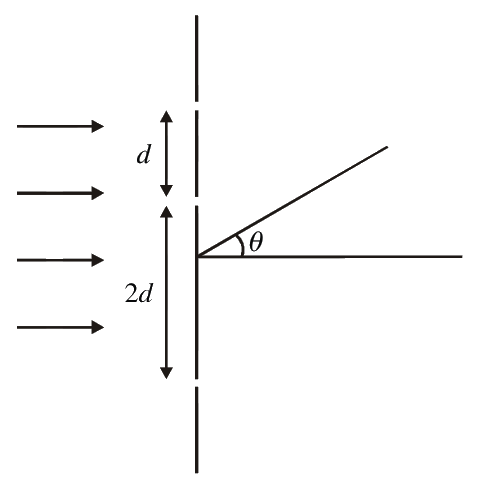
The following configuration of three identical narrow slits are illuminated by monochromatic light of wavelength $\lambda$ (as shown in the figure below). The intensity is measured at an angle $\theta$ (where $\theta$ is the angle with the incident beam) at a large distance from the slits. If $\delta = \frac{2\pi d}{\lambda} \sin\theta$, the intensity is proportional to
a.
$2 \cos\delta + 2\cos 2\delta$
b.
$3 + \frac{1}{\delta^2}\sin^2 3\delta$
c.
$3 + 2\cos\delta + 2\cos 2\delta + 2\cos 3\delta$
d.
$2 + \frac{1}{\delta^2}\sin^2 3\delta$
Correct Answer & Step-by-Step Solution Locked
Sign in free to reveal the correct answer and AI explanation for this question.
The electric field of a plane wave in a conducting medium is given by
$$\vec{E}(z, t) = \hat{i} E_0 e^{-z/3a} \cos\left(\frac{z}{\sqrt{3}a} - \omega t\right),$$
where $\omega$ is the angular frequency and $a > 0$ is a constant. The phase difference between the magnetic field $\vec{B}$ and the electric field $\vec{E}$ is
a.
$30^\circ$ and $\vec{E}$ lags behind $\vec{B}$
b.
$30^\circ$ and $\vec{B}$ lags behind $\vec{E}$
c.
$60^\circ$ and $\vec{E}$ lags behind $\vec{B}$
d.
$60^\circ$ and $\vec{B}$ lags behind $\vec{E}$
Correct Answer & Step-by-Step Solution Locked
Sign in free to reveal the correct answer and AI explanation for this question.
The electric field $\vec{E}$ and the magnetic field $\vec{B}$ corresponding to the scalar and vector potentials, $V(x, y, z, t) = 0$ and $\vec{A}(x, y, z, t) = \frac{1}{2} \hat{k} \mu_0 A_0 (ct - x)$, where $A_0$ is a constant, are
a.
$\vec{E} = 0$ and $\vec{B} = \frac{1}{2} \hat{j} \mu_0 A_0$
A particle of mass $m$ is confined in a three-dimensional box by the potential
$$V(x, y, z) = \begin{cases} 0, & 0 \le x, y, z \le a \\ \infty, & \text{otherwise} \end{cases}$$
The number of eigenstates of Hamiltonian with energy $\frac{9\hbar^2\pi^2}{2ma^2}$ is
a.
1
b.
6
c.
3
d.
4
Correct Answer & Step-by-Step Solution Locked
Sign in free to reveal the correct answer and AI explanation for this question.
The Hamiltonian of a spin-$\frac{1}{2}$ particle in a magnetic field $\vec{B}$ is given by $H = -\mu\vec{B}\cdot\vec{\sigma}$, where $\mu$ is a real constant and $\vec{\sigma} = (\sigma_x, \sigma_y, \sigma_z)$ are the Pauli spin matrices. If $\vec{B} = (B_0, B_0, 0)$ and the spin state at time $t = 0$ is an eigenstate of $\sigma_x$, then of the expectation values $\langle\sigma_x\rangle$, $\langle\sigma_y\rangle$ and $\langle\sigma_z\rangle$
a.
Only $\langle\sigma_x\rangle$ changes with time
b.
Only $\langle\sigma_y\rangle$ changes with time
c.
Only $\langle\sigma_z\rangle$ changes with time
d.
All three change with time
Correct Answer & Step-by-Step Solution Locked
Sign in free to reveal the correct answer and AI explanation for this question.
Two Stern-Gerlach apparatus $S_1$ and $S_2$ are kept in a line ($x$-axis). The directions of their magnetic fields are along the positive $z$- and $y$-axes, respectively. Each apparatus only transmits particles with spins aligned in the direction of its magnetic field. If an initially unpolarized beam of spin-$\frac{1}{2}$ particles passes through this configuration, the ratio of intensities $I_0 : I_f$ of the initial and final beams, is
a.
$16 : 1$
b.
$2 : 1$
c.
$4 : 1$
d.
$1 : 0$
Correct Answer & Step-by-Step Solution Locked
Sign in free to reveal the correct answer and AI explanation for this question.
A particle of mass $m$ is constrained to move in a circular ring to radius $R$. When a perturbation
$$V' = \frac{a}{R^2}\cos^2\phi$$
(where $a$ is a real constant) is added, the shift in energy of the ground state, to first order in $a$, is
a.
$a/R^2$
b.
$2a/R^2$
c.
$a/(2R^2)$
d.
$a/(\pi R^2)$
Correct Answer & Step-by-Step Solution Locked
Sign in free to reveal the correct answer and AI explanation for this question.
Which of the following statements concerning the coefficient of volume expansion $\alpha$ and the isothermal compressibility $\kappa$ of a solid is true?
a.
$\alpha$ and $\kappa$ are both intensive variables.
b.
$\alpha$ is an intensive and $\kappa$ is an extensive variable.
c.
$\alpha$ is an extensive and $\kappa$ is an intensive variable.
d.
$\alpha$ and $\kappa$ are both extensive variables.
Correct Answer & Step-by-Step Solution Locked
Sign in free to reveal the correct answer and AI explanation for this question.
The van der Waals equation for one mole of a gas is $\left(p + \frac{a}{V^2}\right)(V - b) = RT$. The corresponding equation of state for $n$ moles of this gas at pressure $p$, volume $V$ and temperature $T$, is
a.
$\left(p + \frac{an^2}{V^2}\right)(V - nb) = nRT$
b.
$\left(p + \frac{a}{V^2}\right)(V - nb) = nRT$
c.
$\left(p + \frac{an^2}{V^2}\right)(V - nb) = RT$
d.
$\left(p + \frac{a}{V^2}\right)(V - nb) = RT$
Correct Answer & Step-by-Step Solution Locked
Sign in free to reveal the correct answer and AI explanation for this question.
In a system of $N$ distinguishable particles, each particle can be in one of two states with energies $0$ and $-E$, respectively. The mean energy of the system at temperature $T$, is
a.
$-\frac{1}{2}N\left(1+e^{E/k_BT}\right)$
b.
$-\frac{NE}{\left(1+e^{E/k_BT}\right)}$
c.
$-\frac{1}{2}NE$
d.
$-\frac{NE}{\left(1+e^{-E/k_BT}\right)}$
Correct Answer & Step-by-Step Solution Locked
Sign in free to reveal the correct answer and AI explanation for this question.
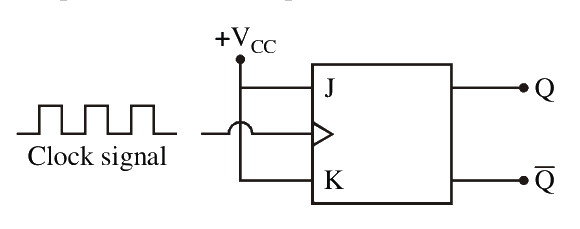
In the following JK flip-flop circuit, J and K inputs are tied together to $+V_{CC}$. If the input is a clock signal of frequency $f$, the frequency of the output $Q$ is
a.
$f$
b.
$2f$
c.
$4f$
d.
$f/2$
Correct Answer & Step-by-Step Solution Locked
Sign in free to reveal the correct answer and AI explanation for this question.
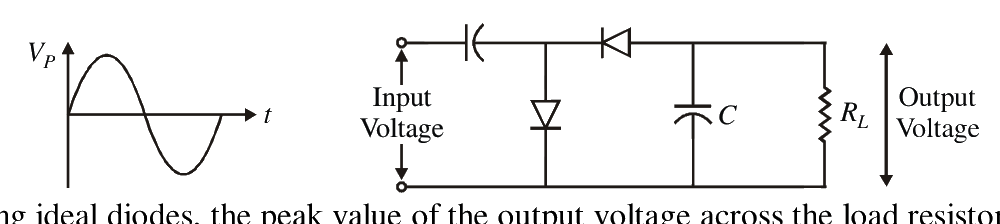
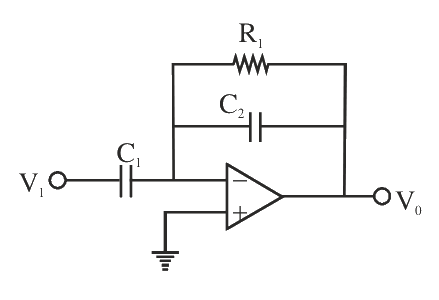
A sinusoidal signal with a peak voltage $V_P$ and average value zero, is an input to the following circuit.
Assuming ideal diodes, the peak value of the output voltage across the load resistor $R_L$, is
a.
$V_P$
b.
$V_P/2$
c.
$2V_P$
d.
$\sqrt{2}V_P$
Correct Answer & Step-by-Step Solution Locked
Sign in free to reveal the correct answer and AI explanation for this question.
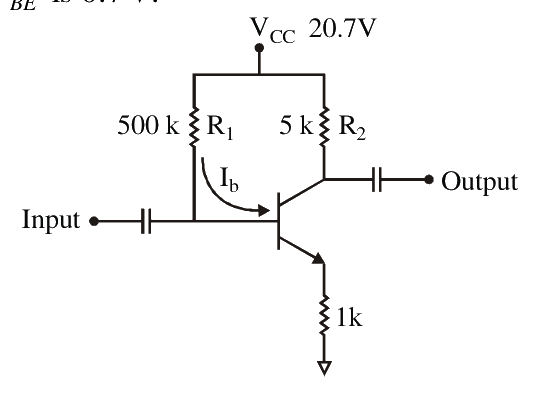
In the following circuit, the value of the common-emitter forward current amplification factor $\beta$ for the transistor is 100 and $V_{BE}$ is $0.7\text{ V}$.
The base current $I_B$ is
a.
$40\text{ }\mu\text{A}$
b.
$30\text{ }\mu\text{A}$
c.
$44\text{ }\mu\text{A}$
d.
$33\text{ }\mu\text{A}$
Correct Answer & Step-by-Step Solution Locked
Sign in free to reveal the correct answer and AI explanation for this question.
In the function $P_n(x)e^{-x^2}$ of a real variable $x$, $P_n(x)$ is a polynomial of degree $n$. The maximum number of extrema that this function can have is
a.
$n + 2$
b.
$n - 1$
c.
$n + 1$
d.
$n$
Correct Answer & Step-by-Step Solution Locked
Sign in free to reveal the correct answer and AI explanation for this question.
The Green's function $G(x, x')$ for the equation $\frac{d^2y(x)}{dx^2} + y(x) = f(x)$, with the boundary values $y(0) = y\left(\frac{\pi}{2}\right) = 0$, is
A particle of mass $m$ moves in a central potential $V(r) = -\frac{k}{r}$ in an elliptic orbit $r(\theta) = \frac{a(1-e^2)}{1+e\cos\theta}$, where $0 \le \theta \le 2\pi$ and $a$ and $e$ denote the semi-major axis and eccentricity, respectively. If its total energy is $E = -\frac{k}{2a}$, the maximum kinetic energy is
a.
$E(1 - e^2)$
b.
$E\frac{(e+1)}{(e-1)}$
c.
$\frac{E}{(1-e^2)}$
d.
$E\frac{(1-e)}{(1+e)}$
Correct Answer & Step-by-Step Solution Locked
Sign in free to reveal the correct answer and AI explanation for this question.
The Hamiltonian of a one-dimensional system is $H = \frac{xp^2}{2m} + \frac{1}{2}kx$, where $m$ and $k$ are positive constants. The corresponding Euler-Lagrange equation for the system is
a.
$m\ddot{x} + k = 0$
b.
$m\ddot{x} + 2\dot{x} + kx^2 = 0$
c.
$2mx\ddot{x} - m\dot{x}^2 + kx^2 = 0$
d.
$mx\ddot{x} - 2m\dot{x}^2 + kx^2 = 0$
Correct Answer & Step-by-Step Solution Locked
Sign in free to reveal the correct answer and AI explanation for this question.
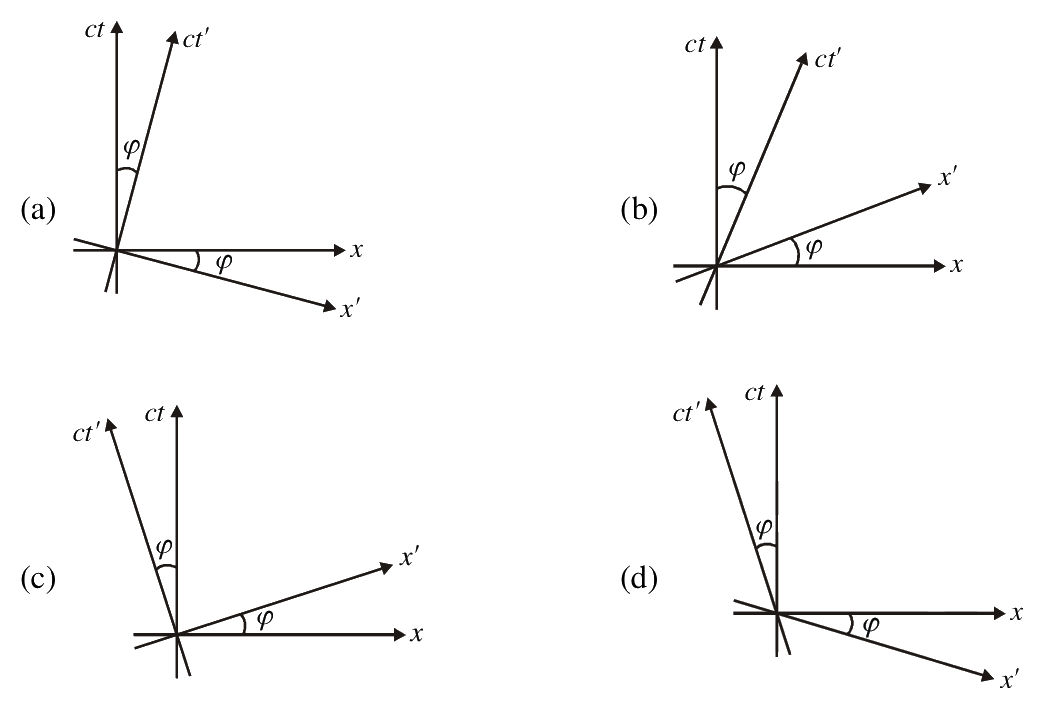
An inertial frame $K'$ moves with a constant speed $v$ with respect to another inertial frame $K$ along their common $x$-axis in the positive $x$-direction. Let $(x, ct)$ and $(x', ct')$ denote the space-time coordinates in the frame $K$ and $K'$, respectively. Which of the following space-time diagrams correctly describes the $t'$-axis ($x' = 0$ line) and the $x'$-axis ($t' = 0$ line) in the $x - ct$ plane? (In the following figures $\tan \varphi = v/c$).
a.
(a)
b.
(b)
c.
(c)
d.
(d)
Correct Answer & Step-by-Step Solution Locked
Sign in free to reveal the correct answer and AI explanation for this question.
In the region far from a source, the time dependent electric field at a point $(r, \theta, \phi)$ is
$$\vec{E}(r, \theta, \phi) = \hat{\phi} \, E_0 \, \omega^2 \left( \frac{\sin \theta}{r} \right) \cos \left[ \omega \left( t - \frac{r}{c} \right) \right]$$
where $\omega$ is angular frequency of the source. The total power radiated (average over a cycle) is
a.
$\frac{2\pi}{3} \frac{E_0^2 \omega^4}{\mu_0 c}$
b.
$\frac{4\pi}{3} \frac{E_0^2 \omega^4}{\mu_0 c}$
c.
$\frac{4}{3\pi} \frac{E_0^2 \omega^4}{\mu_0 c}$
d.
$\frac{2}{3} \frac{E_0^2 \omega^4}{\mu_0 c}$
Correct Answer & Step-by-Step Solution Locked
Sign in free to reveal the correct answer and AI explanation for this question.
A hollow waveguide supports transverse electric (TE) modes with the dispersion relation
$$k = \frac{1}{c}\sqrt{\omega^2 - \omega_{mn}^2}$$, where $\omega_{mn}$ is the mode frequency. The speed of flow of electromagnetic energy at the mode frequency is
a.
$c$
b.
$\omega_{mn}/k$
c.
$0$
d.
$\infty$
Correct Answer & Step-by-Step Solution Locked
Sign in free to reveal the correct answer and AI explanation for this question.
The energy of a free relativistic particle is $E = \sqrt{|\vec{p}|^2 c^2 + m^2 c^4}$, where $m$ is its rest mass, $\vec{p}$ is its momentum and $c$ is the speed of light in vacuum. The ratio $v_g / v_p$ of the group velocity $v_g$ of a quantum mechanical wave packet (describing this particle) to the phase velocity $v_p$ is
a.
$|\vec{p}|c/E$
b.
$|\vec{p}|mc^3/E^2$
c.
$|\vec{p}|^2 c^2 / E^2$
d.
$|\vec{p}|c/2E$
Correct Answer & Step-by-Step Solution Locked
Sign in free to reveal the correct answer and AI explanation for this question.
The $n$-th energy eigenvalue $E_n$ of a one-dimensional Hamiltonian $H = \frac{p^2}{2m} + \lambda x^4$, (where $\lambda > 0$ is a constant) in the WKB approximation, is proportional to
The differential scattering cross section $d\sigma/d\Omega$ for the central potential $V(r) = \frac{\beta}{r}e^{-\mu r}$, where $\beta$ and $\mu$ are positive constants, is calculated in the first Born approximation. Its dependence on the scattering angle $\theta$ is proportional to ($A$ is a constant below).
a.
$\left(A^2 + \sin^2 \frac{\theta}{2}\right)$
b.
$\left(A^2 + \sin^2 \frac{\theta}{2}\right)^{-1}$
c.
$\left(A^2 + \sin^2 \frac{\theta}{2}\right)^{-2}$
d.
$\left(A^2 + \sin^2 \frac{\theta}{2}\right)^2$
Correct Answer & Step-by-Step Solution Locked
Sign in free to reveal the correct answer and AI explanation for this question.
At $t = 0$, the wavefunction of an otherwise free particle confined between two infinite walls at $x = 0$ and $x = L$ is
$$\psi(x, t=0) = \sqrt{\frac{2}{L}}\left(\sin \frac{\pi x}{L} - \sin \frac{3\pi x}{L}\right).$$
Its wavefunction at a later time $t = \frac{mL^2}{4\pi\hbar}$ is
The pressure $P$ of a system of $N$ particles contained in a volume $V$ at a temperature $T$ is given by
$$P = nk_B T - \frac{1}{2} an^2 + \frac{1}{6} bn^3$$
where $n$ is the number density and $a$ and $b$ are temperature independent constants. If the system exhibits a gas-liquid transition, the critical temperature is
a.
$\frac{a}{b k_B}$
b.
$\frac{a}{2b^2 k_B}$
c.
$\frac{a^2}{2b k_B}$
d.
$\frac{a^2}{b^2 k_B}$
Correct Answer & Step-by-Step Solution Locked
Sign in free to reveal the correct answer and AI explanation for this question.
Consider a particle diffusing in a liquid contained in a large box. The diffusion constant of the particle in the liquid is $1.0 \times 10^{-2}\text{ cm}^2/\text{s}$. The minimum time after which the root-mean-squared displacement becomes more than $6\text{ cm}$ is
a.
$10\text{ min}$
b.
$6\text{ min}$
c.
$30\text{ min}$
d.
$\sqrt{6}\text{ min}$
Correct Answer & Step-by-Step Solution Locked
Sign in free to reveal the correct answer and AI explanation for this question.
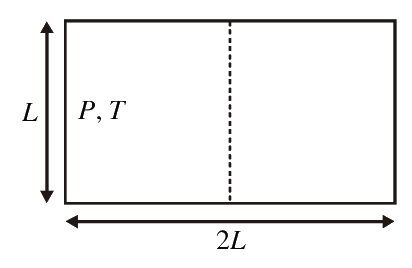
A thermally insulated chamber of dimensions $(L, L, 2L)$ is partitioned in the middle. One side of the chamber is filled with $n$ moles of an ideal gas at a pressure $P$ and temperature $T$, while the other side is empty. At $t = 0$, the partition is removed and the gas is allowed to expand freely. The time to reach equilibrium varies as
a.
$n^{1/3} L^{-1} T^{1/2}$
b.
$n^{2/3} L T^{-1/2}$
c.
$n^0 L T^{-1/2}$
d.
$n L^{-1} T^{1/2}$
Correct Answer & Step-by-Step Solution Locked
Sign in free to reveal the correct answer and AI explanation for this question.
The maximum intensity of solar radiation is at the wavelength of $\lambda_{\text{sun}} \sim 5000\text{ \AA}$ and corresponds to its surface temperature $T_{\text{sun}} \sim 10^4\text{ K}$. If the wavelength of the maximum intensity of an X-ray star is $5\text{ \AA}$, its surface temperature is of the order of
a.
$10^{16}\text{ K}$
b.
$10^{14}\text{ K}$
c.
$10^{10}\text{ K}$
d.
$10^7\text{ K}$
Correct Answer & Step-by-Step Solution Locked
Sign in free to reveal the correct answer and AI explanation for this question.
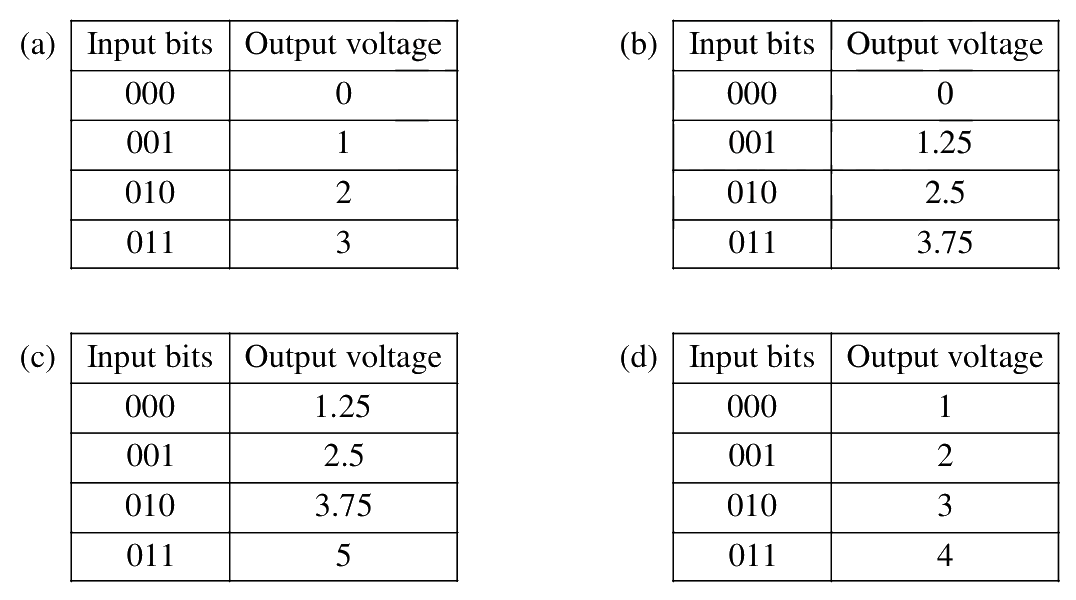
The full scale of a 3-bit digital-to-analog (DAC) converter is $7\text{ V}$. Which of the following tables represents the output voltage of this 3-bit DAC for the given set of input bits ?
Two signals $A_1 \sin (\omega t)$ and $A_2 \cos (\omega t)$ are fed into the input and the reference channels, respectively, of a lock-in amplifier. The amplitude of each signal is $1\text{ V}$. The time constant of the lock-in amplifier is such that any signal of frequency larger than $\omega$ is filtered out. The output of the lock-in amplifier is
a.
$2\text{ V}$
b.
$1\text{ V}$
c.
$0.5\text{ V}$
d.
$0\text{ V}$
Correct Answer & Step-by-Step Solution Locked
Sign in free to reveal the correct answer and AI explanation for this question.
A photon energy $115.62\text{ keV}$ ionizes a K-shell electron of a Be atom. One L-shell electron jumps to the K-shell to fill this vacancy and emits a photon of energy $109.2\text{ keV}$ in the process. If the ionization potential for the L-shell is $6.4\text{ keV}$, the kinetic energy of the ionized electron is
a.
$6.42\text{ keV}$
b.
$12.82\text{ keV}$
c.
$20\text{ eV}$
d.
$32\text{ eV}$
Correct Answer & Step-by-Step Solution Locked
Sign in free to reveal the correct answer and AI explanation for this question.
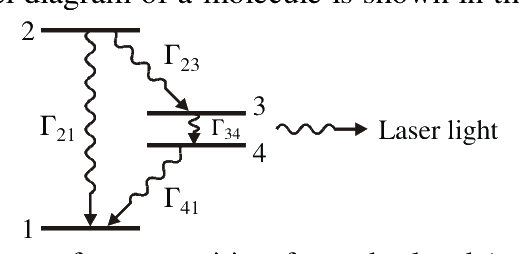
The electronic energy level diagram of a molecule is shown in the following figure.
Let $\Gamma_{ij}$ denote the decay rate for a transition from the level $i$ and $j$. The molecules are optically pumped from level 1 to 2. For the transition from level 3 to level 4 to be a lasing transition, the decay rates have to satisfy
Sodium Chloride (NaCl) crystal is a face centred cubic lattice, with a basis consisting of $\text{Na}^+$ and $\text{Cl}^-$ ions separated by half the body diagonal of a unit cube. Which of the planes corresponding to the Miller indices given below will not give rise to Bragg reflection of X-rays ?
a.
$(2\ 2\ 0)$
b.
$(2\ 4\ 2)$
c.
$(2\ 2\ 1)$
d.
$(3\ 1\ 1)$
Correct Answer & Step-by-Step Solution Locked
Sign in free to reveal the correct answer and AI explanation for this question.
The dispersion relation for the electrons in the conduction band of a semiconductor is given by $E = E_0 + \alpha k^2$, where $\alpha$ and $E_0$ are constants. If $\omega_c$ is the cyclotron resonance frequency of the conduction band electrons in a magnetic field $B$, the value of $\alpha$ is
a.
$\frac{\hbar^2 \omega_c}{4eB}$
b.
$\frac{2\hbar^2 \omega_c}{eB}$
c.
$\frac{\hbar^2 \omega_c}{eB}$
d.
$\frac{\hbar^2 \omega_c}{2eB}$
Correct Answer & Step-by-Step Solution Locked
Sign in free to reveal the correct answer and AI explanation for this question.
Hard discs of radius $R$ are arranged in a two-dimensional triangular lattice. What is the fractional area occupied by the discs in the closests possible packing ?
a.
$\frac{\pi\sqrt{3}}{6}$
b.
$\frac{\pi}{3\sqrt{2}}$
c.
$\frac{\pi\sqrt{2}}{5}$
d.
$\frac{2\pi}{7}$
Correct Answer & Step-by-Step Solution Locked
Sign in free to reveal the correct answer and AI explanation for this question.
A deutron $d$ captures a charged pion $\pi^-$ in the $l=1$ state, and subsequently decays into a pair of neutrons ($n$) via strong interaction. Given that the intrinsic parities of $\pi^-$, $d$ and $n$ are $-1$, $+1$ and $+1$ respectively, the spin-wavefunction of the final state neutrons is a
a.
linear combination of a singlet and a triplet
b.
singlet
c.
triplet
d.
doublet
Correct Answer & Step-by-Step Solution Locked
Sign in free to reveal the correct answer and AI explanation for this question.
The reaction $^{63}\text{Cu}_{29} + p \rightarrow {}^{63}\text{Zn}_{30} + n$ is followed by a prompt $\beta$-decay of zinc
$^{63}\text{Zn}_{30} \rightarrow {}^{63}\text{Cu}_{29} + e^+ + \nu_e$. If the maximum energy of the position is $2.4\text{ MeV}$, the $Q$-value of the original reaction in $\text{MeV}$ is nearest to
[Take the masses of electrons, proton and neutron to be $0.5\text{ MeV}/c^2$, $938\text{ MeV}/c^2$ and $939.5\text{ MeV}/c^2$, respectively].
a.
$-4.4$
b.
$-2.4$
c.
$-4.8$
d.
$-3.4$
Correct Answer & Step-by-Step Solution Locked
Sign in free to reveal the correct answer and AI explanation for this question.