A rectangular photo frame of size $30\text{ cm} \times 40\text{ cm}$ has a photograph mounted at the centre leaving a $5\text{ cm}$ border all around. The area of the border is
a.
$600\text{ cm}^2$
Correct Answer
b.
$350\text{ cm}^2$
c.
$400\text{ cm}^2$
d.
$700\text{ cm}^2$
Step-by-Step AI Explanation
Verified Method
The total area of the frame is $30\text{ cm} \times 40\text{ cm} = 1200\text{ cm}^2$.
Since there is a $5\text{ cm}$ border all around, the dimensions of the inner photograph are:
$$\text{Width} = 30 - 2(5) = 20\text{ cm}$$
$$\text{Length} = 40 - 2(5) = 30\text{ cm}$$
The area of the photograph is $20\text{ cm} \times 30\text{ cm} = 600\text{ cm}^2$.
Thus, the area of the border is:
$$\text{Area of frame} - \text{Area of photograph} = 1200 - 600 = 600\text{ cm}^2.$$
Q2mcq
At a birthday party, every child gets 2 chocolates, every mother gets 1 chocolate, while no father gets a chocolate. In total 69 persons get 70 chocolates. If the number of children is half of the number of mothers and fathers put together, then how many fathers are there ?
a.
22
Correct Answer
b.
23
c.
24
d.
69
Step-by-Step AI Explanation
Verified Method
Let $C$, $M$, and $F$ denote the number of children, mothers, and fathers, respectively.
From the given conditions:
1. The total number of people is $69$:
$$C + M + F = 69$$
2. The number of children is half the number of mothers and fathers combined:
$$C = \frac{M + F}{2} \implies M + F = 2C$$
Substitute $M + F = 2C$ into the total equation:
$$C + 2C = 69 \implies 3C = 69 \implies C = 23$$
Then, $M + F = 46$.
3. The total number of chocolates distributed is $70$:
$$2C + 1M + 0F = 70$$
$$2(23) + M = 70 \implies 46 + M = 70 \implies M = 24$$
Now find the number of fathers:
$$F = 46 - M = 46 - 24 = 22$$
Therefore, there are 22 fathers.
Q3mcq
What is the value of $1^2 - 2^2 + 3^2 - 4^2 + 5^2 - \cdots + 17^2 - 18^2 + 19^2$ ?
a.
$-5$
b.
12
c.
95
d.
190
Correct Answer
Step-by-Step AI Explanation
Verified Method
We can pair the terms of the alternating sum as follows:
$$S = 1^2 + (3^2 - 2^2) + (5^2 - 4^2) + \cdots + (19^2 - 18^2)$$
Using the difference of squares identity $a^2 - b^2 = (a-b)(a+b)$, for any $k$, $(k+1)^2 - k^2 = (k+1 - k)(k+1 + k) = 2k + 1 = k + (k+1)$. Thus, each consecutive pair equals their sum:
$$(3^2 - 2^2) = 2 + 3$$
$$(5^2 - 4^2) = 4 + 5$$
$$\vdots$$
$$(19^2 - 18^2) = 18 + 19$$
Therefore, the whole series is simply the sum of all integers from 1 to 19:
$$S = 1 + 2 + 3 + \dots + 19 = \frac{19 \times 20}{2} = 190.$$
Q4mcq
The curves of $y = 2x^2$ and $y = 4x$ intersect each other at
a.
only one point
b.
exactly two points
Correct Answer
c.
more than two points
d.
no point at all
Step-by-Step AI Explanation
Verified Method
To find the points of intersection, equate the two equations for $y$:
$$2x^2 = 4x$$
$$2x^2 - 4x = 0$$
$$2x(x - 2) = 0$$
This yields two distinct real solutions for $x$:
$$x = 0 \implies y = 0$$
$$x = 2 \implies y = 8$$
Thus, the curves intersect at exactly two points: $(0, 0)$ and $(2, 8)$.
Q5mcq
The diameters of the pinholes of two otherwise identical cameras A and B are $500\text{ }\mu\text{m}$ and $200\text{ }\mu\text{m}$, respectively. Then the image in camera A will be
a.
sharper than in B
b.
darker than in B
c.
less sharp and brighter than in B
Correct Answer
d.
sharper and brighter than in B
Step-by-Step AI Explanation
Verified Method
In a pinhole camera:
1. **Brightness:** A larger pinhole allows more light rays to enter, making the image brighter. Since camera A has a larger pinhole diameter ($500\text{ }\mu\text{m}$) than camera B ($200\text{ }\mu\text{m}$), the image in camera A is brighter.
2. **Sharpness:** A larger pinhole allows light from each point of the object to form a larger circle of confusion (blur circle) on the screen, resulting in a less sharp (more blurred) image.
Therefore, the image in camera A will be less sharp and brighter than in B.
Q6mcq
If $\text{D} = \text{ABC} + \text{BCA} + \text{CAB}$ where A, B and C are decimal digits, then D is divisible by
a.
37 and 29
b.
37 but not 29
Correct Answer
c.
29 but not 37
d.
neither 29 nor 37
Step-by-Step AI Explanation
Verified Method
The three-digit numbers represented by ABC, BCA, and CAB in base 10 are:
$$\text{ABC} = 100A + 10B + C$$
$$\text{BCA} = 100B + 10C + A$$
$$\text{CAB} = 100C + 10A + B$$
Summing these gives:
$$D = \text{ABC} + \text{BCA} + \text{CAB} = 111(A + B + C)$$
Notice that:
$$111 = 3 \times 37$$
Thus, $D = 3 \times 37 \times (A + B + C)$, which is always divisible by 37. However, $D$ is not necessarily divisible by 29 for arbitrary digits $A, B, C$ (for example, if $A=1, B=0, C=0$, then $D = 111$, which is not divisible by 29).
Hence, D is divisible by 37 but not necessarily 29.
Q7mcq
For the following set of observed values $\{60, 65, 65, 70, 70, 70, 70, 82, 85, 90, 95, 95, 100, 160, 160\}$. Which of the statements is TRUE ?
Let us compute the mode, median, and mean for the given 15 observations in sorted order:
$$\{60, 65, 65, 70, 70, 70, 70, 82, 85, 90, 95, 95, 100, 160, 160\}$$
1. **Mode:** The value 70 occurs 4 times, which is more frequent than any other value. Thus, $\text{mode} = 70$.
2. **Median:** There are $n = 15$ observations. The median is the 8th value: $\text{median} = 82$.
3. **Mean:** The sum of the observations is:
$$60 + 2(65) + 4(70) + 82 + 85 + 90 + 2(95) + 100 + 2(160) = 60 + 130 + 280 + 82 + 85 + 90 + 190 + 100 + 320 = 1337$$
$$\text{Mean} = \frac{1337}{15} \approx 89.13$$
Comparing the values:
$$\text{mode} (70) < \text{median} (82) < \text{mean} (89.13)$$
Therefore, the statement $\text{mode} < \text{median} < \text{mean}$ is TRUE.
Q8mcq
A circular running track has six lanes, each $1\text{ m}$ wide. How far ahead (in metres) should the runner in the outermost lane start from, so as to cover the same distance in one lap as the runner in the innermost lane ?
a.
$6\pi$
b.
$10\pi$
Correct Answer
c.
$12\pi$
d.
$36\pi$
Step-by-Step AI Explanation
Verified Method
Let $r$ be the radius of the running line in lane 1 (the innermost lane).
Since each lane is $1\text{ m}$ wide, the radius of lane 6 (the outermost lane) is:
$$r_6 = r + (6 - 1) \times 1\text{ m} = r + 5\text{ m}$$
The circumference of the outermost lane is:
$$C_6 = 2\pi r_6 = 2\pi (r + 5) = 2\pi r + 10\pi$$
The circumference of the innermost lane is:
$$C_1 = 2\pi r$$
The difference in distance covered in one lap between the outermost lane and the innermost lane is:
$$\Delta C = C_6 - C_1 = 10\pi\text{ m}$$
Therefore, the runner in the outermost lane must start $10\pi\text{ m}$ ahead to cover the same distance as the runner in the innermost lane.
Q9mcq
In an examination 100 questions of 1 mark each are given. After the examination, 20 questions are deleted from evaluation, leaving 80 questions with a total of 100 marks. Students A had answered 4 of the deleted questions correctly and got 40 marks, whereas student B had answered 10 of the deleted questions correctly and got 30 marks. In this situation
a.
A and B were equally benefitted.
b.
A and B lost equally.
c.
B lost more than A.
Correct Answer
d.
A lost more than B.
Step-by-Step AI Explanation
Verified Method
Originally, there were 100 questions of 1 mark each.
After removing 20 questions, each of the remaining 80 questions is worth $\frac{100}{80} = 1.25$ marks.
Student A got 40 marks from the remaining questions, which means A answered $\frac{40}{1.25} = 32$ of the retained questions correctly.
Originally, A's score would have been $32 + 4 = 36$ marks (out of 100).
With the deletion, A's new score is 40 marks, an increase of $+4$ marks.
Student B got 30 marks from the retained questions, which means B answered $\frac{30}{1.25} = 24$ of the retained questions correctly.
Originally, B's score would have been $24 + 10 = 34$ marks (out of 100).
With the deletion, B's new score is 30 marks, which is a loss of $-4$ marks.
Thus, student B lost marks whereas student A gained marks, meaning B lost more than A.
Q10mcq
A tourist drives $20\text{ km}$ towards east, turns right and drives $6\text{ km}$, then drives $6\text{ km}$ towards west. He then turns to his left and drives $4\text{ km}$ and finally turns right and drives $14\text{ km}$. Where is he from his starting point ?
a.
$6\text{ km}$ towards east
b.
$20\text{ km}$ towards west
c.
$14\text{ km}$ towards north
d.
$10\text{ km}$ towards south
Correct Answer
Step-by-Step AI Explanation
Verified Method
Let the starting point be the origin $(0, 0)$, with the positive $x$-axis representing East and the positive $y$-axis representing North.
1. Drives $20\text{ km}$ East: $(20, 0)$.
2. Turns right (facing South) and drives $6\text{ km}$: $(20, -6)$.
3. Drives $6\text{ km}$ West: $(20 - 6, -6) = (14, -6)$.
4. Turns left (facing South) and drives $4\text{ km}$: $(14, -6 - 4) = (14, -10)$.
5. Turns right (facing West) and drives $14\text{ km}$: $(14 - 14, -10) = (0, -10)$.
The final position is $(0, -10)$, which is $10\text{ km}$ directly South of the starting point.
🎉 10 Free Sample Solutions Completed
Unlock All 75 Questions & Solutions
Sign up free in seconds to unlock step-by-step AI answers for the remaining 65 questions.
An ideal pendulum oscillates with angular amplitude of $30^\circ$ from the vertical. If it is observed at a random instant of time, its angular deviation from the vertical is most likely to be
a.
$0^\circ$
b.
$\pm 10^\circ$
c.
$\pm 20^\circ$
d.
$\pm 30^\circ$
Correct Answer & Step-by-Step Solution Locked
Sign in free to reveal the correct answer and AI explanation for this question.
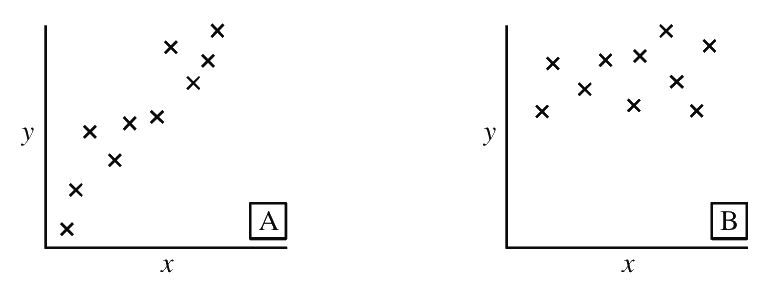
Scatter plots for pairs of observations on the variables $x$ and $y$ in samples A and B are shown in the figure :
Which of the following is suggested by the plots ?
a.
Correlation between $x$ and $y$ is stronger in A than in B.
b.
Correlation between $x$ and $y$ is absent in B.
c.
Correlation between $x$ and $y$ is weaker in A than B.
d.
$y$ and $x$ have a cause - effect relationship in A, but not in B.
Correct Answer & Step-by-Step Solution Locked
Sign in free to reveal the correct answer and AI explanation for this question.
Two solutions X and Y containing ingredients A, B and C in proportions $a : b : c$ and $c : b : a$, respectively, are mixed. For the resultant mixture to have A, B and C in equal proportion, it is necessary that
a.
$b = \frac{c - a}{2}$
b.
$c = \frac{a + b}{2}$
c.
$c = \frac{a - b}{2}$
d.
$b = \frac{c + a}{2}$
Correct Answer & Step-by-Step Solution Locked
Sign in free to reveal the correct answer and AI explanation for this question.
A student is free to choose only Chemistry, only Biology or both. If out of 32 students, Chemistry has been chosen by 16 and Biology by 25, then how many students have chosen Biology but not Chemistry ?
a.
9
b.
16
c.
25
d.
7
Correct Answer & Step-by-Step Solution Locked
Sign in free to reveal the correct answer and AI explanation for this question.
One of the eigenvalues of the matrix $e^A$ is $e^a$, where $A = \begin{pmatrix} a & 0 & 0 \\ 0 & 0 & a \\ 0 & a & 0 \end{pmatrix}$. The product of the other two eigenvalues of $e^A$ is
a.
$e^{2a}$
b.
$e^{-a}$
c.
$e^{-2a}$
d.
$1$
Correct Answer & Step-by-Step Solution Locked
Sign in free to reveal the correct answer and AI explanation for this question.
The polynomial $f(x) = 1 + 5x + 3x^2$ is written as a linear combination of the Legendre polynomials
$$\left( P_0(x) = 1, P_1(x) = x, P_2(x) = \frac{1}{2}(3x^2 - 1) \right)$$
as $\sum_n c_n P_n(x)$. The value of $c_0$ is
a.
$1/4$
b.
$1/2$
c.
$2$
d.
$4$
Correct Answer & Step-by-Step Solution Locked
Sign in free to reveal the correct answer and AI explanation for this question.
The value of the integral $\oint_C \frac{dz\, \tanh 2z}{z \sin \pi z}$, where $C$ is a circle of radius $\frac{\pi}{2}$, traversed counter-clockwise, with centre at $z = 0$, is
a.
$4$
b.
$4i$
c.
$2i$
d.
$0$
Correct Answer & Step-by-Step Solution Locked
Sign in free to reveal the correct answer and AI explanation for this question.
A particle of mass $m$, moving along the $x$-direction, experiences a damping force $-\gamma v^2$, where $\gamma$ is a constant and $v$ is its instantaneous speed. If the speed at $t = 0$ is $v_0$, the speed at time $t$ is
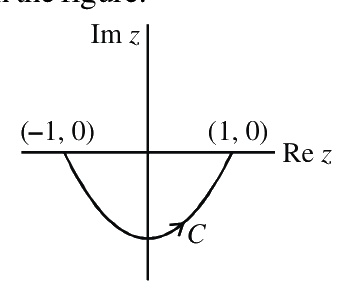
The integral $I = \int_C e^z\, dz$ is evaluated from the point $(-1, 0)$ to $(1, 0)$ along the contour $C$, which is an arc of the parabola $y = x^2 - 1$, as shown in the figure.
The value of $I$ is
a.
$0$
b.
$2 \sinh 1$
c.
$e^{2i} \sinh 1$
d.
$e + e^{-1}$
Correct Answer & Step-by-Step Solution Locked
Sign in free to reveal the correct answer and AI explanation for this question.
In terms of arbitrary constant $A$ and $B$, the general solution to the differential equation
$$x^2 \frac{d^2 y}{dx^2} + 5x \frac{dy}{dx} + 3y = 0\text{, is}$$
a.
$y = \frac{A}{x} + Bx^3$
b.
$y = Ax + \frac{B}{x^3}$
c.
$y = Ax + Bx^3$
d.
$y = \frac{A}{x} + \frac{B}{x^3}$
Correct Answer & Step-by-Step Solution Locked
Sign in free to reveal the correct answer and AI explanation for this question.
In the attractive Kepler problem described by the central potential $V(r) = -\frac{k}{r}$, where $k$ is a positive constant), a particle of mass $m$ with a non-zero angular momentum can never reach the centre due to the centrifugal barrier. If we modify the potential to
$$V(r) = -\frac{k}{r} - \frac{\beta}{r^3}$$
one finds that there is a critical value of the angular momentum $\ell_c$ below which there is no centrifugal barrier. This value of $\ell_c$ is
a.
$\left[ 12 k m^2 \beta \right]^{1/2}$
b.
$\left[ 12 k m^2 \beta \right]^{-1/2}$
c.
$\left[ 12 k m^2 \beta \right]^{1/4}$
d.
$\left[ 12 k m^2 \beta \right]^{-1/4}$
Correct Answer & Step-by-Step Solution Locked
Sign in free to reveal the correct answer and AI explanation for this question.
The time period of a particle of mass $m$, undergoing small oscillations around $x = 0$, in the potential
$$V = V_0 \cosh\left(\frac{x}{L}\right)\text{, is}$$
a.
$\pi \sqrt{\frac{mL^2}{V_0}}$
b.
$2\pi \sqrt{\frac{mL^2}{2V_0}}$
c.
$2\pi \sqrt{\frac{mL^2}{V_0}}$
d.
$2\pi \sqrt{\frac{2mL^2}{V_0}}$
Correct Answer & Step-by-Step Solution Locked
Sign in free to reveal the correct answer and AI explanation for this question.
Consider the decay $A \rightarrow B + C$ of a relativistic spin-$\frac{1}{2}$ particle $A$. Which of the following statements is true in the rest frame of the particle $A$ ?
a.
The spin of both $B$ and $C$ may be $1/2$
b.
The sum of the masses of $B$ and $C$ is greater than the mass of $A$
c.
The energy of $B$ is uniquely determined by the masses of the particles
d.
The spin of both $B$ and $C$ may be integral
Correct Answer & Step-by-Step Solution Locked
Sign in free to reveal the correct answer and AI explanation for this question.
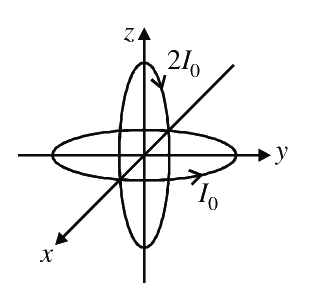
Two current-carrying circular loops, each of radius $R$, are placed perpendicular to each other, as shown in the figure below.
The loop in the $xy$-plane carries a current $I_0$ while that in the $xz$-plane carries a current $2I_0$. The resulting magnetic field $\vec{B}$ at the origin is
a.
$\frac{\mu_0 I_0}{2R} [2\hat{j} + \hat{k}]$
b.
$\frac{\mu_0 I_0}{2R} [2\hat{j} - \hat{k}]$
c.
$\frac{\mu_0 I_0}{2R} [-2\hat{j} + \hat{k}]$
d.
$\frac{\mu_0 I_0}{2R} [-2\hat{j} - \hat{k}]$
Correct Answer & Step-by-Step Solution Locked
Sign in free to reveal the correct answer and AI explanation for this question.
An electric dipole of dipole moment $\vec{P} = qb\,\hat{i}$ is placed at the origin in the vicinity of two charges $+q$ and $-q$ at $(L, b)$ and $(L, -b)$, respectively, as shown in the figure below. The electrostatic potential at the point $\left(\frac{L}{2}, 0\right)$ is
A monochromatic and linearly polarized light is used in a Young's double slit experiment. A linear polarizer, whose pass axis is at an angle $45^\circ$ to the polarization of the incident wave, is placed in front of one of the slits. If $I_{\max}$ and $I_{\min}$, respectively, denote the maximum and minimum intensities of the interference pattern on the screen, the visibility, defined as the ratio $\frac{I_{\max} - I_{\min}}{I_{\max} + I_{\min}}$, is
a.
$\frac{\sqrt{2}}{3}$
b.
$\frac{2}{3}$
c.
$\frac{2\sqrt{2}}{3}$
d.
$\sqrt{\frac{2}{3}}$
Correct Answer & Step-by-Step Solution Locked
Sign in free to reveal the correct answer and AI explanation for this question.
An electromagnetic wave propagates in a nonmagnetic medium with relative permittivity $\varepsilon = 4$. The magnetic field for this wave is
$$\vec{H}(x, y) = \hat{k} H_0 \cos(\omega t - \alpha x - \alpha\sqrt{3}y),$$
where $H_0$ is a constant. The corresponding electric field $\vec{E}(x, y)$ is
a.
$\frac{1}{4}\mu_0 H_0 c \left(-\sqrt{3}\hat{i} + \hat{j}\right) \cos(\omega t - \alpha x - \alpha\sqrt{3}y)$
b.
$\frac{1}{4}\mu_0 H_0 c \left(\sqrt{3}\hat{i} + \hat{j}\right) \cos(\omega t - \alpha x - \alpha\sqrt{3}y)$
c.
$\frac{1}{4}\mu_0 H_0 c \left(\sqrt{3}\hat{i} - \hat{j}\right) \cos(\omega t - \alpha x - \alpha\sqrt{3}y)$
d.
$\frac{1}{4}\mu_0 H_0 c \left(-\sqrt{3}\hat{i} - \hat{j}\right) \cos(\omega t - \alpha x - \alpha\sqrt{3}y)$
Correct Answer & Step-by-Step Solution Locked
Sign in free to reveal the correct answer and AI explanation for this question.
The ground state energy of an anisotropic harmonic oscillator described by the potential
$$V(x, y, z) = \frac{1}{2}m\omega^2 x^2 + 2m\omega^2 y^2 + 8m\omega^2 z^2$$
(in units of $\hbar\omega$) is
a.
$5/2$
b.
$7/2$
c.
$3/2$
d.
$1/2$
Correct Answer & Step-by-Step Solution Locked
Sign in free to reveal the correct answer and AI explanation for this question.
The product $\Delta x \Delta p$ of uncertainties in the position and momentum of a simple harmonic oscillator of mass $m$ and angular frequency $\omega$ in the ground state $|0\rangle$, is $\hbar/2$. The value of the product $\Delta x \Delta p$ in the state $e^{-i\hat{p}l/\hbar}|0\rangle$, where $l$ is a constant and $\hat{p}$ is the momentum operator) is
a.
$\frac{\hbar}{2}\sqrt{\frac{m\omega l^2}{\hbar}}$
b.
$\hbar$
c.
$\frac{\hbar}{2}$
d.
$\frac{\hbar^2}{m\omega l^2}$
Correct Answer & Step-by-Step Solution Locked
Sign in free to reveal the correct answer and AI explanation for this question.
Let the wavefunction of the electron in a hydrogen atom be
$$\psi(\vec{r}) = \frac{1}{\sqrt{6}}\phi_{200}(\vec{r}) + \sqrt{\frac{2}{3}}\phi_{21-1}(\vec{r}) - \frac{1}{\sqrt{6}}\phi_{100}(\vec{r})$$
where $\phi_{nlm}(\vec{r})$ are the eigenstates of the Hamiltonian in the standard notation. The expectation value of the energy in this state is
a.
$-10.8\text{ eV}$
b.
$-6.2\text{ eV}$
c.
$-9.5\text{ eV}$
d.
$-5.1\text{ eV}$
Correct Answer & Step-by-Step Solution Locked
Sign in free to reveal the correct answer and AI explanation for this question.
Three identical spin-$\frac{1}{2}$ particles of mass $m$ are confined to a one-dimensional box of length $L$, but are otherwise free. Assuming that they are non-interacting, the energies of the lowest two energy eigenstates, in units of $\frac{\pi^2\hbar^2}{2mL^2}$, are
a.
$3$ and $6$
b.
$6$ and $9$
c.
$6$ and $11$
d.
$3$ and $9$
Correct Answer & Step-by-Step Solution Locked
Sign in free to reveal the correct answer and AI explanation for this question.
The heat capacity $C_V$ at constant volume of a metal, as a function of temperature, is $\alpha T + \beta T^3$, where $\alpha$ and $\beta$ are constants. The temperature dependence of the entropy at constant volume is
a.
$\alpha T + \frac{1}{3}\beta T^3$
b.
$\alpha T + \beta T^3$
c.
$\frac{1}{2}\alpha T + \frac{1}{3}\beta T^3$
d.
$\frac{1}{2}\alpha T + \frac{1}{4}\beta T^3$
Correct Answer & Step-by-Step Solution Locked
Sign in free to reveal the correct answer and AI explanation for this question.
The rotational energy levels of a molecule are $E_l = \frac{\hbar^2}{2I_0}l(l+1)$, where $l = 0, 1, 2, \dots$ and $I_0$ is its moment of inertia. The contribution of the rotational motion to the Helmholtz free energy per molecule, at low temperature in a dilute gas of these molecules, is approximately
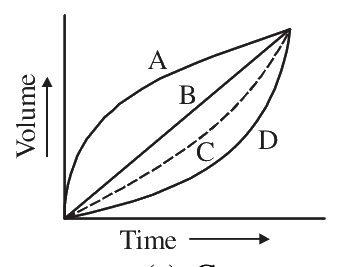
The vibrational motion of a diatomic molecule may be considered to be that of a simple harmonic oscillator with angular frequency $\omega$. If a gas of these molecules is at a temperature $T$, what is the probability that a randomly picked molecule will be found in its lowest vibrational state ?
Consider an ideal Fermi gas in a grand canonical ensemble at a constant chemical potential. The variance of the occupation number of the single particle energy level with mean occupation number $\overline{n}$ is
a.
$\overline{n}(1-\overline{n})$
b.
$\sqrt{\overline{n}}$
c.
$\overline{n}$
d.
$1/\sqrt{\overline{n}}$
Correct Answer & Step-by-Step Solution Locked
Sign in free to reveal the correct answer and AI explanation for this question.
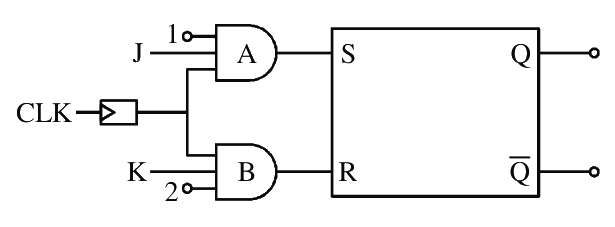
Consider the following circuit, consisting of an RS flip-flop and two AND gates.
Which of the following connections will allow the entire circuit to act as a JK flip-flop ?
a.
connect $\text{Q}$ to pin 1 and $\bar{\text{Q}}$ to pin 2
b.
connect $\text{Q}$ to pin 2 and $\bar{\text{Q}}$ to pin 1
c.
connect $\text{Q}$ to $\text{K}$ input and $\bar{\text{Q}}$ to $\text{J}$ input
d.
connect $\text{Q}$ to $\text{J}$ input and $\bar{\text{Q}}$ to $\text{K}$ input
Correct Answer & Step-by-Step Solution Locked
Sign in free to reveal the correct answer and AI explanation for this question.
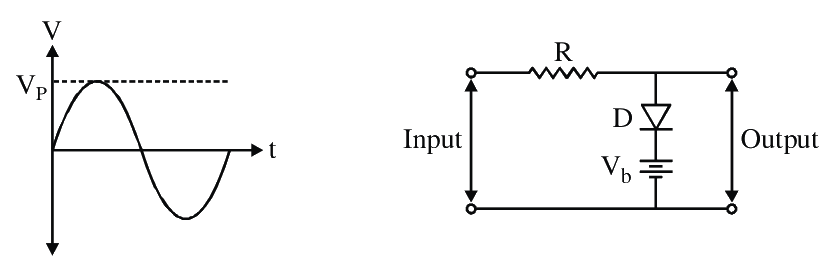
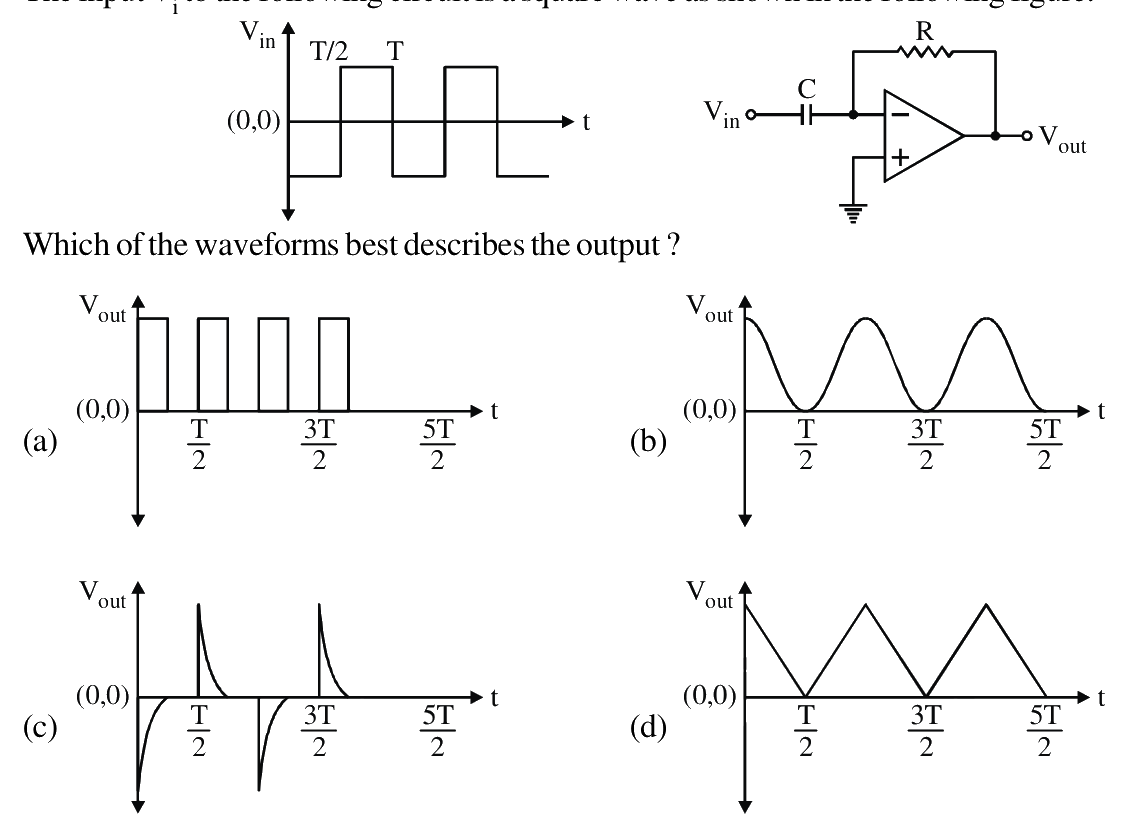
A sinusoidal voltage having a peak value of $\text{V}_\text{p}$ is an input to the following circuit, in which the DC voltage is $\text{V}_\text{b}$.
Assuming an ideal diode, which of the following best describes the output waveform ?
Correct Answer & Step-by-Step Solution Locked
Sign in free to reveal the correct answer and AI explanation for this question.
A $4 \times 4$ complex matrix $A$ satisfies the relation $A^\dagger A = 4I$, where $I$ is the $4 \times 4$ identify matrix. The number of independent real parameters of $A$ is
a.
32
b.
10
c.
12
d.
16
Correct Answer & Step-by-Step Solution Locked
Sign in free to reveal the correct answer and AI explanation for this question.
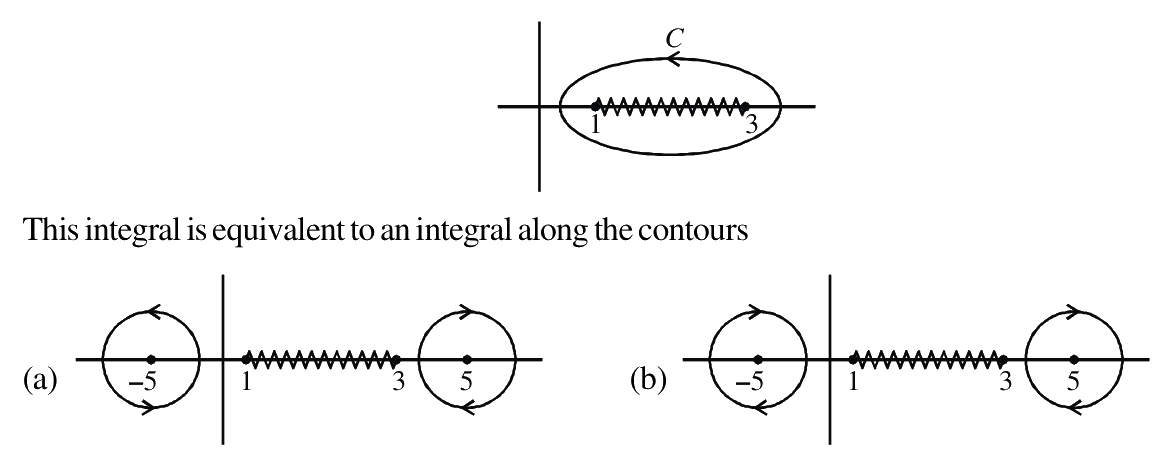
The contour $C$ of the following integral $\oint_C dz \frac{\sqrt{(z-1)(z-3)}}{(z^2 - 25)^3}$, in the complex $z$-plane is shown in the figure below.
This integral is equivalent to an integral along the contours
Correct Answer & Step-by-Step Solution Locked
Sign in free to reveal the correct answer and AI explanation for this question.
The motion of a particle in one-dimension is described by the Lagrangian
$$L = \frac{1}{2} \left[ \left(\frac{dx}{dt}\right)^2 - x^2 \right]$$
in suitable units. The value of the action along the classical path from $x = 0$ at $t = 0$ to $x = x_0$ at $t = t_0$, is
a.
$\frac{x_0^2}{2\sin^2 t_0}$
b.
$\frac{1}{2} x_0^2 \tan t_0$
c.
$\frac{1}{2} x_0^2 \cot t_0$
d.
$\frac{x_0^2}{2\cos^2 t_0}$
Correct Answer & Step-by-Step Solution Locked
Sign in free to reveal the correct answer and AI explanation for this question.
The Hamiltonian of a classical one-dimensional harmonic oscillator is $H = \frac{1}{2}\left(p^2 + x^2\right)$, in suitable units. The total time derivative of the dynamical variable $(p + \sqrt{2}x)$ is
a.
$\sqrt{2}p - x$
b.
p - \sqrt{2}x
c.
p + \sqrt{2}x
d.
x + \sqrt{2}p
Correct Answer & Step-by-Step Solution Locked
Sign in free to reveal the correct answer and AI explanation for this question.
A relativistic particle of mass $m$ and charge $e$ is moving in a uniform electric field of strength $\varepsilon$. Starting from rest at $t = 0$, how much time will it take to reach the speed $c/2$ ?
a.
$\frac{1}{\sqrt{3}} \frac{mc}{e\varepsilon}$
b.
$\frac{mc}{e\varepsilon}$
c.
$\sqrt{2} \frac{mc}{e\varepsilon}$
d.
$\sqrt{\frac{3}{2}} \frac{mc}{e\varepsilon}$
Correct Answer & Step-by-Step Solution Locked
Sign in free to reveal the correct answer and AI explanation for this question.
In an inertial frame, uniform electric and magnetic fields $\vec{E}$ and $\vec{B}$ are perpendicular to each other and satisfy $|\vec{E}|^2 - |\vec{B}|^2 = 29$ (in suitable units). In another inertial frame, which moves at a constant velocity with respect to the first frame, the magnetic field is $2\sqrt{5}\,\hat{k}$. In the second frame, an electric field consistent with the previous observations is
a.
$\frac{7}{\sqrt{2}}(\hat{i} + \hat{j})$
b.
$7(\hat{i} + \hat{k})$
c.
$\frac{7}{\sqrt{2}}(\hat{i} + \hat{k})$
d.
$7(\hat{i} + \hat{j})$
Correct Answer & Step-by-Step Solution Locked
Sign in free to reveal the correct answer and AI explanation for this question.
Electromagnetic wave of angular frequency $\omega$ is propagating in a medium in which, over a band of frequencies, the refractive index is $n(\omega) \approx 1 - \left(\frac{\omega}{\omega_0}\right)^2$, where $\omega_0$ is a constant. The ratio $\frac{v_g}{v_p}$ of the group velocity to the phase velocity at $\omega = \frac{\omega_0}{2}$ is
a.
3
b.
1/4
c.
2/3
d.
2
Correct Answer & Step-by-Step Solution Locked
Sign in free to reveal the correct answer and AI explanation for this question.
A rotating spherical shell of uniform surface charge and mass density has total mass $M$ and charge $Q$. If its angular momentum is $L$ and magnetic moment is $\mu$, then the ratio $\mu/L$ is
a.
$Q/3M$
b.
$2Q/3M$
c.
$Q/2M$
d.
$3Q/4M$
Correct Answer & Step-by-Step Solution Locked
Sign in free to reveal the correct answer and AI explanation for this question.
Consider the operator $A_x = L_y p_z - L_z p_y$, where $L_i$ and $p_i$ denote, respectively, the components of the angular momentum and momentum operators. The commutator $[A_x, x]$, where $x$ is the $x$-component of the position operator, is
a.
$-i\hbar(zp_z + yp_y)$
b.
$-i\hbar(zp_z - yp_y)$
c.
$i\hbar(zp_z + yp_y)$
d.
$i\hbar(zp_z - yp_y)$
Correct Answer & Step-by-Step Solution Locked
Sign in free to reveal the correct answer and AI explanation for this question.
A one-dimensional system is described by the Hamiltonian $H = \frac{p^2}{2m} + \lambda |x|$, where $\lambda > 0$. The ground state energy varies as a function of $\lambda$ as
a.
$\lambda^{5/3}$
b.
$\lambda^{2/3}$
c.
$\lambda^{4/3}$
d.
$\lambda^{1/3}$
Correct Answer & Step-by-Step Solution Locked
Sign in free to reveal the correct answer and AI explanation for this question.
If the position of the electron in the ground state of a hydrogen atom is measured, the probability that it will be found at a distance $r \ge a_0$ ($a_0$ being Bohr radius) is nearest to
a.
0.91
b.
0.66
c.
0.32
d.
0.13
Correct Answer & Step-by-Step Solution Locked
Sign in free to reveal the correct answer and AI explanation for this question.
A system of spin-$\frac{1}{2}$ particles is prepared to be in the eigenstate of $\sigma_z$ with eigenvalue $+1$. The system is rotated by an angle of $60^\circ$ about the $x$-axis. After the rotation, the fraction of the particles that will be measured to be in the eigenstate of $\sigma_z$ with eigenvalue $+1$ is
a.
1/3
b.
2/3
c.
1/4
d.
3/4
Correct Answer & Step-by-Step Solution Locked
Sign in free to reveal the correct answer and AI explanation for this question.
The Hamiltonian of a one-dimensional Ising model of $N$ spins ($N$ large) is
$$H = -J \sum_{i=1}^N \sigma_i \sigma_{i+1}$$
where the spin $\sigma_i = \pm 1$ and $J$ is a positive constant. At inverse temperature $\beta = \frac{1}{k_B T}$, the correlation function between the nearest neighbour spins $\langle \sigma_i \sigma_{i+1} \rangle$ is
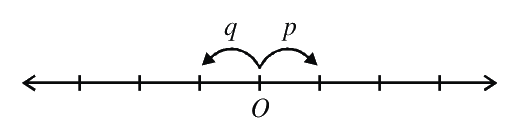
A particle hops on a one-dimensional lattice with lattice spacing $a$. The probability of the particle to hop to the neighbouring site to its right is $p$, while the corresponding probability to hop to the left is $q = 1 - p$. The root-mean-squared deviation $\Delta x = \sqrt{\langle x^2 \rangle - \langle x \rangle^2}$ in displacement after $N$ steps, is
a.
$a\sqrt{Npq}$
b.
$aN\sqrt{pq}$
c.
$2a\sqrt{Npq}$
d.
$a\sqrt{N}$
Correct Answer & Step-by-Step Solution Locked
Sign in free to reveal the correct answer and AI explanation for this question.
The energy levels accessible to a molecule have energies $E_1 = 0$, $E_2 = \Delta$ and $E_3 = 2\Delta$ (where $\Delta$ is a constant). A gas of these molecules is in thermal equilibrium at temperature $T$. The specific heat at constant volume in the high temperature limit ($k_B T \gg \Delta$) varies with temperature as
a.
$1/T^{3/2}$
b.
$1/T^3$
c.
$1/T$
d.
$1/T^2$
Correct Answer & Step-by-Step Solution Locked
Sign in free to reveal the correct answer and AI explanation for this question.
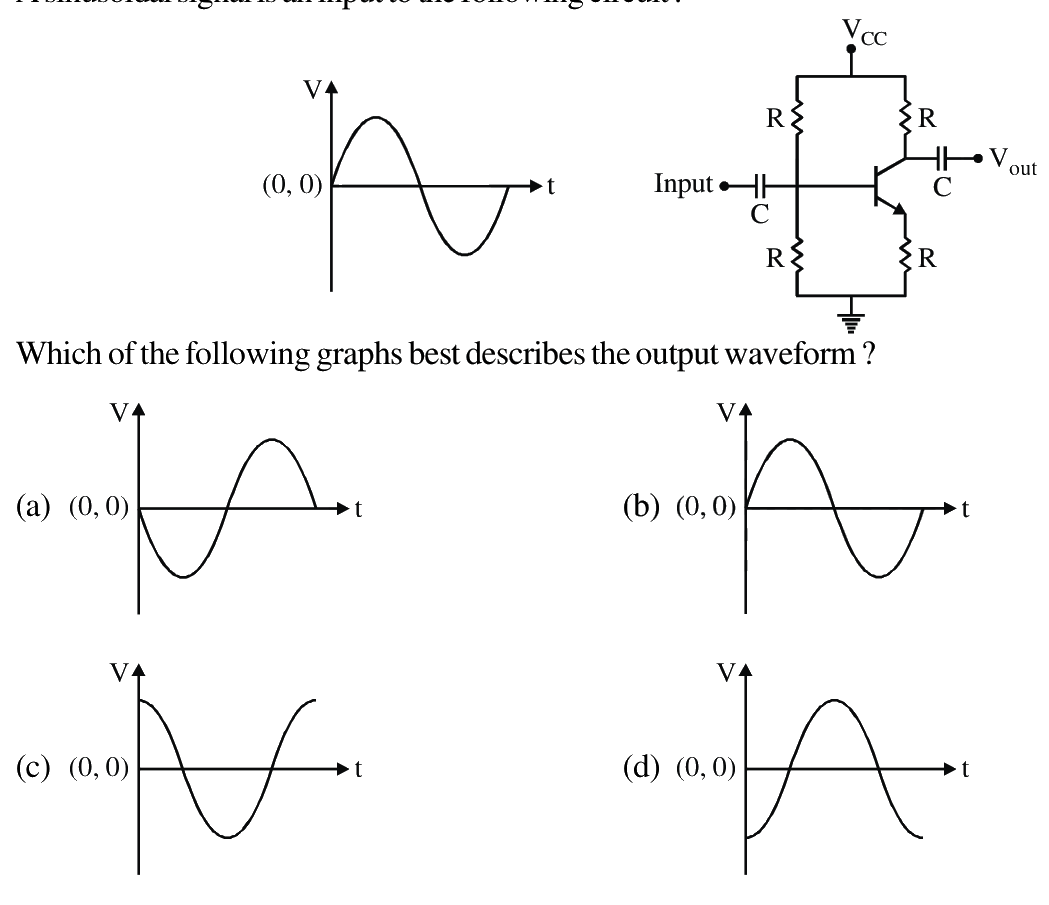
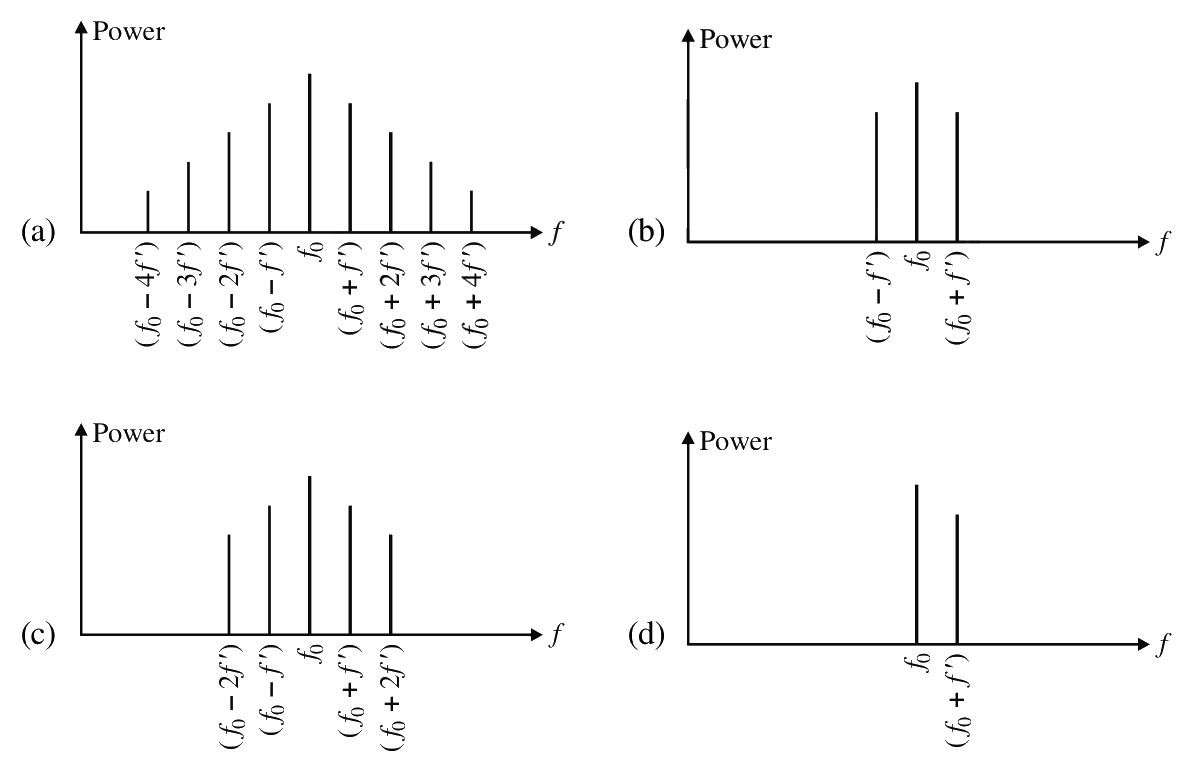
The amplitude of a carrier signal of frequency $f_0$ is sinusoidally modulated at a frequency $f' \ll f_0$. Which of the following graphs best describes its power spectrum ?
Correct Answer & Step-by-Step Solution Locked
Sign in free to reveal the correct answer and AI explanation for this question.
The diatomic molecule $\text{HF}$ has an absorption line in the rotational band at $40\text{ cm}^{-1}$ for the isotope $^{18}\text{F}$. The corresponding line for the isotope $^{19}\text{F}$ will be shifted by approximately
a.
$0.05\text{ cm}^{-1}$
b.
$0.11\text{ cm}^{-1}$
c.
$0.33\text{ cm}^{-1}$
d.
$0.01\text{ cm}^{-1}$
Correct Answer & Step-by-Step Solution Locked
Sign in free to reveal the correct answer and AI explanation for this question.
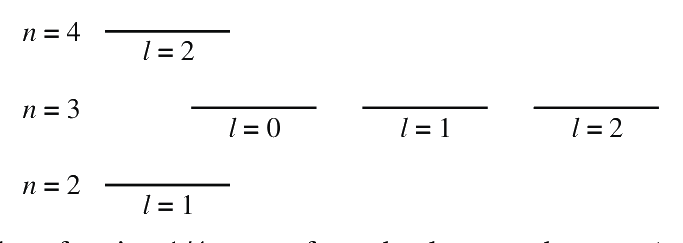
The excited state ($n = 4$, $l = 2$) of an electron in an atom may decay to one or more of the lower energy levels shown in the diagram below.
Of the total emitted light, a fraction $1/4$ comes from the decay to the state ($n = 2$, $l = 1$). Based on selection rules, the fractional intensity of the emission line due to the decay to the state ($n = 3$, $l = 1$), will be
a.
$3/4$
b.
$1/2$
c.
$1/4$
d.
$0$
Correct Answer & Step-by-Step Solution Locked
Sign in free to reveal the correct answer and AI explanation for this question.
The volume of an optimal cavity is $1\text{ cm}^3$. The number of modes it can support within a bandwidth of $0.1\text{ nm}$, centred at $\lambda = 500\text{ nm}$, is of the order of
a.
$10^3$
b.
$10^5$
c.
$10^{10}$
d.
$10^7$
Correct Answer & Step-by-Step Solution Locked
Sign in free to reveal the correct answer and AI explanation for this question.
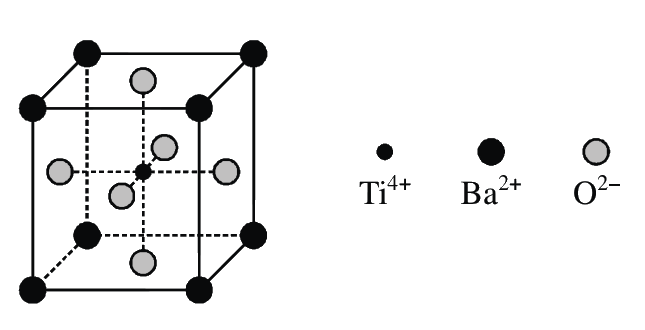
Barium Titanate ($\text{BaTiO}_3$) crystal has a cubic perovskite structure, where the $\text{Ba}^{2+}$ ions are at the vertices of a unit cube, the $\text{O}^{2-}$ ions are at the centres of the faces while the $\text{Ti}^{2+}$ is at the centre. The number of optical phonon modes of the crystal is
a.
$12$
b.
$15$
c.
$5$
d.
$18$
Correct Answer & Step-by-Step Solution Locked
Sign in free to reveal the correct answer and AI explanation for this question.
The dispersion relation of optical phonons in a cubic crystal is given by $\omega(k) = \omega_0 - ak^2$, where $\omega_0$ and $a$ are positive constants. The contribution to the density of states due to these phonons with frequencies just below $\omega_0$ is proportional to
a.
$(\omega_0 - \omega)^{1/2}$
b.
$(\omega_0 - \omega)^{3/2}$
c.
$(\omega_0 - \omega)^2$
d.
$(\omega_0 - \omega)$
Correct Answer & Step-by-Step Solution Locked
Sign in free to reveal the correct answer and AI explanation for this question.
A silicon crystal is doped with phosphorus atoms. (The binding energy of a $\text{H}$ atom is $13.6\text{ eV}$, the dielectric constant of silicon is $12$ and the effective mass of electron in the crystal is $0.4\text{ m}_e$). The gap between the donor energy level and the bottom of the conduction band is nearest to
a.
$0.01\text{ eV}$
b.
$0.08\text{ eV}$
c.
$0.02\text{ eV}$
d.
$0.04\text{ eV}$
Correct Answer & Step-by-Step Solution Locked
Sign in free to reveal the correct answer and AI explanation for this question.
Assume that pion-nucleon scattering at low energies, in which isospin is conserved, is described by the effective interaction potential $V_{\text{eff}} = F(r) \,\vec{I}_\pi \cdot \vec{I}_N$, where $F(r)$ is a function of the radial separation $r$ and $\vec{I}_\pi$ and $\vec{I}_N$ denote, respectively, the isospin vectors of a pion and the nucleon. The ratio $\sigma_{I=3/2}/\sigma_{I=1/2}$ of the scattering cross-sections corresponding to total isospins $I = 3/2$ and $1/2$, is
a.
$3/2$
b.
$1/4$
c.
$5/4$
d.
$1/2$
Correct Answer & Step-by-Step Solution Locked
Sign in free to reveal the correct answer and AI explanation for this question.
A nucleus decays by the emission of a gamma ray from an excited state of spin-parity $2^+$ to the ground state with spin-parity $0^+$. What is the type of the corresponding radiation ?
a.
magnetic dipole
b.
electric quadrupole
c.
electric dipole
d.
magnetic quadrupole
Correct Answer & Step-by-Step Solution Locked
Sign in free to reveal the correct answer and AI explanation for this question.
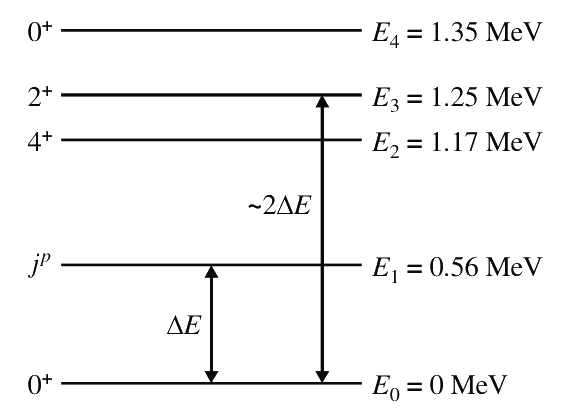
The low lying energy levels due to the vibrational excitations of an even-even nucleus are shown in the figure below.
The spin-parity $j^P$ of the level $E_1$ is
a.
$1^+$
b.
$1^-$
c.
$2^-$
d.
$2^+$
Correct Answer & Step-by-Step Solution Locked
Sign in free to reveal the correct answer and AI explanation for this question.