The radius of convergence of the Taylor series expansion of the function $\frac{1}{\cosh(x)}$ around $x = 0$, is
a.
$\infty$
b.
$\pi$
c.
$\frac{\pi}{2}$
Correct Answer
d.
$1$
Step-by-Step AI Explanation
Verified Method
The radius of convergence $R$ of the Taylor series of an analytic function around a point $z_0$ is the distance from $z_0$ to the nearest singularity of the function in the complex plane.
For $f(x) = \frac{1}{\cosh(x)}$, singularities occur where the denominator is zero:
$$\cosh(z) = 0 \implies \frac{e^z + e^{-z}}{2} = 0 \implies e^{2z} = -1 = e^{i(2n+1)\pi}$$
for any integer $n$. Thus,
$$z = i\left(n + \frac{1}{2}\right)\pi$$
The singularities closest to the expansion point $z_0 = 0$ are at $z = \pm i\frac{\pi}{2}$.
The distance from $z_0 = 0$ to these singularities is:
$$R = \left|\pm i\frac{\pi}{2} - 0\right| = \frac{\pi}{2}$$
Therefore, the radius of convergence is $\frac{\pi}{2}$.
Q22mcq
The value of the contour integral $\frac{1}{2\pi i}\oint_C \frac{e^{4z}-1}{\cosh(z)-2\sinh(z)}\,dz$ around the unit circle $C$ traversed in the anti-clockwise direction, is
a.
$0$
Correct Answer
b.
$2$
c.
$-\frac{8}{\sqrt{3}}$
d.
$-\tanh\left(\frac{1}{2}\right)$
Step-by-Step AI Explanation
Verified Method
We evaluate the integral using Cauchy's Residue Theorem. The integrand is $f(z) = \frac{e^{4z}-1}{\cosh(z)-2\sinh(z)}$.
The singularities occur when:
$$\cosh(z) - 2\sinh(z) = 0 \implies \tanh(z) = \frac{1}{2}$$
Using the relation $\tanh(z) = \frac{e^{2z}-1}{e^{2z}+1} = \frac{1}{2}$, we get:
$$2(e^{2z}-1) = e^{2z}+1 \implies e^{2z} = 3 \implies 2z = \ln(3) + 2ik\pi \implies z = \frac{1}{2}\ln(3) + ik\pi$$
For $k=0$, the pole is at $z_0 = \frac{1}{2}\ln(3) \approx 0.5493$, which lies inside the unit circle $|z|=1$ since $0.5493 < 1$.
For all other $k \neq 0$, $|z| \ge |k|\pi \ge \pi > 1$, which lie outside the unit circle.
Now, let us examine the numerator at $z = z_0 = \frac{1}{2}\ln(3)$:
$$e^{4z_0} - 1 = \left(e^{2z_0}\right)^2 - 1 = 3^2 - 1 = 8 \neq 0$$
Wait! Let's check the answer choices: 0, 2, $-8/\sqrt{3}$, $-\tanh(1/2)$.
Let's calculate the residue at $z_0$:
$$\text{Res}(f, z_0) = \frac{e^{4z_0}-1}{\frac{d}{dz}(\cosh z - 2\sinh z)\Big|_{z=z_0}} = \frac{8}{\sinh z_0 - 2\cosh z_0}$$
Since $\tanh(z_0) = 1/2$, we have:
$$\sinh z_0 - 2\cosh z_0 = \cosh z_0 (\tanh z_0 - 2) = \cosh z_0 \left(\frac{1}{2} - 2\right) = -\frac{3}{2}\cosh z_0$$
Since $e^{z_0} = \sqrt{3}$ and $e^{-z_0} = 1/\sqrt{3}$,
$$\cosh z_0 = \frac{\sqrt{3} + 1/\sqrt{3}}{2} = \frac{4}{2\sqrt{3}} = \frac{2}{\sqrt{3}}$$
Thus, the denominator is $-\frac{3}{2} \times \frac{2}{\sqrt{3}} = -\sqrt{3}$.
Then the residue is $\frac{8}{-\sqrt{3}} = -\frac{8}{\sqrt{3}}$.
Therefore, the value of the contour integral is:
$$\frac{1}{2\pi i}\oint_C f(z)\,dz = \text{Res}(f, z_0) = -\frac{8}{\sqrt{3}}$$
Q23mcq
The Gauss hypergeometric function $F(a, b, c; z)$, defined by the Taylor series expansion around $z = 0$ as
$$F(a, b, c; z) = \sum_{n=0}^{\infty} \frac{a(a+1)\dots(a+n-1)b(b+1)\dots(b+n-1)}{c(c+1)\dots(c+n-1)n!}z^n$$
satisfies the equation relation
The hypergeometric function is given by:
$$F(a, b, c; z) = \sum_{n=0}^{\infty} \frac{(a)_n (b)_n}{(c)_n n!} z^n$$
Taking the derivative with respect to $z$:
$$\frac{d}{dz}F(a, b, c; z) = \sum_{n=1}^{\infty} \frac{(a)_n (b)_n}{(c)_n (n-1)!} z^{n-1}$$
Let $m = n - 1$. When $n = 1$, $m = 0$. Since $(x)_n = x(x+1)_{n-1} = x(x+1)_m$:
$$(a)_n = a(a+1)_m, \quad (b)_n = b(b+1)_m, \quad (c)_n = c(c+1)_m$$
Substituting these into the derivative:
$$\frac{d}{dz}F(a, b, c; z) = \frac{ab}{c} \sum_{m=0}^{\infty} \frac{(a+1)_m (b+1)_m}{(c+1)_m m!} z^m = \frac{ab}{c} F(a+1, b+1, c+1; z)$$
Thus, the correct relation is (D).
Q24mcq
Let $X$ and $Y$ be two independent random variables, each of which follow a normal distribution with the same standard deviation $\sigma$, but with means $+\mu$ and $-\mu$, respectively. Then the sum $X + Y$ follows a
a.
distribution with two peaks at $\pm \mu$ and mean $0$ and standard deviation $\sigma\sqrt{2}$
b.
normal distribution with mean $0$ and standard deviation $2\sigma$
c.
distribution with two peaks at $\pm \mu$ and mean $0$ and standard deviation $2\sigma$
d.
normal distribution with mean $0$ and standard deviation $\sigma\sqrt{2}$
Correct Answer
Step-by-Step AI Explanation
Verified Method
If $X$ and $Y$ are independent normally distributed random variables, their sum $Z = X + Y$ is also normally distributed.
The mean of $Z$ is:
$$\mu_Z = E[X + Y] = E[X] + E[Y] = (+\mu) + (-\mu) = 0$$
The variance of $Z$, since $X$ and $Y$ are independent, is:
$$\sigma_Z^2 = \text{Var}(X + Y) = \text{Var}(X) + \text{Var}(Y) = \sigma^2 + \sigma^2 = 2\sigma^2$$
Thus, the standard deviation is:
$$\sigma_Z = \sqrt{2\sigma^2} = \sigma\sqrt{2}$$
Therefore, $X + Y$ follows a normal distribution with mean $0$ and standard deviation $\sigma\sqrt{2}$.
Q25mcq
Using dimensional analysis, Planck defined a characteristic temperature $T_p$ from powers of the gravitational constant $G$, Planck's constant $h$, Boltzmann constant $k_B$ and the speed of light $c$ in vacuum. The expression for $T_p$ is proportional to
a.
$\sqrt{\frac{hc^5}{k_B^2 G}}$
Correct Answer
b.
$\sqrt{\frac{hc^3}{k_B^2 G}}$
c.
$\sqrt{\frac{G}{hc^4 k_B^2}}$
d.
$\sqrt{\frac{hk_B^2}{Gc^3}}$
Step-by-Step AI Explanation
Verified Method
The Planck temperature $T_p$ is constructed from $G$, $h$ (or $\hbar$), $k_B$, and $c$.
The Planck energy is given by $E_p = \sqrt{\frac{\hbar c^5}{G}}$.
Since characteristic thermal energy is related to temperature via $E_p = k_B T_p$, we have:
$$T_p = \frac{E_p}{k_B} = \frac{1}{k_B}\sqrt{\frac{\hbar c^5}{G}} = \sqrt{\frac{\hbar c^5}{k_B^2 G}}$$
In terms of Planck's constant $h$:
$$T_p \propto \sqrt{\frac{hc^5}{k_B^2 G}}$$
This matches option (A).
Q26mcq
Let $(x, t)$ and $(x', t')$ be the coordinate systems used by the observers $O$ and $O'$, respectively. Observer $O'$ moves with a velocity $v = \beta c$ along their common positive $x$-axis. If $x_+ = x + ct$ and $x_- = x - ct$ are the linear combinations of the coordinates, the Lorentz transformation relating $O$ and $O'$ takes the form
The standard Lorentz transformation for a boost along the $x$-axis with speed $v = \beta c$ is:
$$x' = \gamma (x - \beta c t), \qquad c t' = \gamma (ct - \beta x)$$
where $\gamma = \frac{1}{\sqrt{1-\beta^2}}$.
Now compute the light-cone coordinates $x'_+ = x' + ct'$ and $x'_- = x' - ct'$:
$$x'_+ = \gamma (x - \beta c t + ct - \beta x) = \gamma (1 - \beta)(x + ct) = \frac{1 - \beta}{\sqrt{(1-\beta)(1+\beta)}} x_+ = \sqrt{\frac{1-\beta}{1+\beta}} x_+$$
$$x'_- = \gamma (x - \beta c t - ct + \beta x) = \gamma (1 + \beta)(x - ct) = \frac{1 + \beta}{\sqrt{(1-\beta)(1+\beta)}} x_- = \sqrt{\frac{1+\beta}{1-\beta}} x_-$$
Therefore, the correct choice is (D).
Q27mcq
A ball of mass $m$, initially at rest, is dropped from a height of $5\text{ meters}$. If the coefficient of restitution is $0.9$, the speed of the ball just before it hits the floor the second time is approximately (take $\text{g} = 9.8\text{ m/s}^2$)
a.
$9.80\text{ m/s}$
b.
$9.10\text{ m/s}$
c.
$8.91\text{ m/s}$
Correct Answer
d.
$7.02\text{ m/s}$
Step-by-Step AI Explanation
Verified Method
The speed of the ball just before its first impact with the ground is:
$$v_1 = \sqrt{2gh} = \sqrt{2 \times 9.8 \times 5} = \sqrt{98} \approx 9.8995\text{ m/s}$$
Upon impact, with coefficient of restitution $e = 0.9$, the speed of the ball just after the first collision is:
$$v_1' = e v_1$$
In the absence of air resistance, the ball rises to a maximum height and falls back, so its speed just before hitting the floor the second time is equal to its rebound speed after the first collision:
$$v_2 = v_1' = e v_1 = 0.9 \times \sqrt{98} \approx 0.9 \times 9.8995 \approx 8.91\text{ m/s}$$
Thus, the speed is approximately $8.91\text{ m/s}$.
Q28mcq
Four equal charges of $+Q$ each are kept at the vertices of a square of side $R$. A particle of mass $m$ and charge $+Q$ is placed in the plane of the square at a short distance $a (\ll R)$ from the center. If the motion of the particle is confined to the plane, it will undergo small oscillations with an angular frequency
Let the center of the square be the origin $(0,0)$. The four charges $+Q$ are at the four vertices of a square of side $R$.
The distance of each vertex from the center is $r_0 = \frac{R}{\sqrt{2}}$.
Due to four-fold symmetry, the electric potential near the origin for a small displacement in the plane, say along the $x$-axis by a distance $x$, can be expanded.
The vertices are located at $(\pm R/2, \pm R/2)$.
Let $\vec{r}_i = (x_i, y_i) = (\pm R/2, \pm R/2)$, so $r_i^2 = R^2/2$.
For a displacement $(x, 0)$ from the origin:
$$V(x) = \frac{Q}{4\pi \varepsilon_0} \sum_{i=1}^4 \frac{1}{|\vec{r} - \vec{r}_i|}$$
Using the Taylor expansion of $V(x, 0)$:
$$V(x) = V(0) + \frac{1}{2} x^2 \left(\frac{\partial^2 V}{\partial x^2}\right)_0 + \dots$$
For a single charge at $(x_i, y_i)$ with distance $r_0 = R/\sqrt{2}$:
$$\frac{\partial^2}{\partial x^2}\left(\frac{1}{r}\right)_{r=r_0} = \frac{3 x_i^2 - r_0^2}{r_0^5}$$
Summing over the four vertices where $x_i^2 = (R/2)^2 = R^2/4$ and $r_0^2 = R^2/2$:
$$\sum_{i=1}^4 (3 x_i^2 - r_0^2) = 4 \left(3 \frac{R^2}{4} - \frac{R^2}{2}\right) = 4 \left(\frac{R^2}{4}\right) = R^2$$
Thus:
$$k_{\text{eff}} = Q \left(\frac{\partial^2 V}{\partial x^2}\right)_0 = \frac{Q^2}{4\pi \varepsilon_0} \frac{R^2}{r_0^5}$$
Since $r_0 = R/\sqrt{2}$, we have $r_0^5 = \frac{R^5}{4\sqrt{2}}$, so:
$$\frac{R^2}{r_0^5} = \frac{R^2}{R^5 / (4\sqrt{2})} = \frac{4\sqrt{2}}{R^3}$$
Substituting this back:
$$k_{\text{eff}} = \frac{Q^2}{4\pi \varepsilon_0} \frac{4\sqrt{2}}{R^3} = \frac{\sqrt{2}\, Q^2}{\pi \varepsilon_0 R^3}$$
The angular frequency of small oscillations is:
$$\omega = \sqrt{\frac{k_{\text{eff}}}{m}} = \sqrt{\frac{\sqrt{2}\, Q^2}{\pi \varepsilon_0 R^3 m}}$$
This matches option (C).
Q29mcq
The Hamiltonian of a system with generalized coordinate and momentum $(q, p)$ is $H = p^2 q^2$. A solution of the Hamiltonian equation of motion is (in the following $A$ and $B$ are constants)
a.
$p = B e^{-2At}, q = \frac{A}{B} e^{2At}$
Correct Answer
b.
$p = A e^{-2At}, q = \frac{A}{B} e^{-2At}$
c.
$p = A e^{At}, q = \frac{A}{B} e^{-At}$
d.
$p = 2A e^{-A^2 t}, q = \frac{A}{B} e^{A^2 t}$
Step-by-Step AI Explanation
Verified Method
Hamilton's equations of motion are:
$$\dot{q} = \frac{\partial H}{\partial p} = 2 p q^2$$
$$\dot{p} = -\frac{\partial H}{\partial q} = -2 p^2 q$$
From these, we have $\frac{d}{dt}(pq) = \dot{p}q + p\dot{q} = -2p^2q^2 + 2p^2q^2 = 0$, so $pq = \text{constant} = A$.
Substituting $pq = A$ into the equations:
$$\dot{p} = -2 A p \implies p(t) = B e^{-2At}$$
$$\dot{q} = 2 A q \implies q(t) = C e^{2At}$$
Since $pq = A$, we find $B C = A$, which means $C = \frac{A}{B}$.
Thus, $p = B e^{-2At}$ and $q = \frac{A}{B} e^{2At}$, matching option A.
Q30mcq
Two parallel plate capacitors, separated by distances $x$ and $1.1x$ respectively, have a dielectric material of dielectric constant $3.0$ inserted between the plates, and are connected to a battery of voltage $V$. The difference in charge on the second capacitor compared to the first is
a.
$+66\%$
b.
$+20\%$
c.
$-3.3\%$
d.
$-10\%$
Correct Answer
Step-by-Step AI Explanation
Verified Method
The capacitance of a parallel plate capacitor of plate separation $d$ filled with a dielectric of constant $\varepsilon_r$ is $C = \frac{\varepsilon_r \varepsilon_0 A}{d}$.
For the two capacitors connected to the same voltage $V$:
$$Q_1 = C_1 V = \frac{\varepsilon_r \varepsilon_0 A}{x} V$$
$$Q_2 = C_2 V = \frac{\varepsilon_r \varepsilon_0 A}{1.1 x} V = \frac{Q_1}{1.1}$$
The relative difference in charge of the second capacitor compared to the first is:
$$\frac{Q_2 - Q_1}{Q_1} = \frac{1}{1.1} - 1 = \frac{1 - 1.1}{1.1} = -\frac{0.1}{1.1} \approx -9.09\% \approx -10\%$$
Among the given options, $-10\%$ is the closest and intended answer.
🎉 10 Free Sample Solutions Completed
Unlock All 55 Questions & Solutions
Sign up free in seconds to unlock step-by-step AI answers for the remaining 45 questions.
The half space regions $x > 0$ and $x < 0$ are filled with dielectric media of dielectric constants $\varepsilon_1$ and $\varepsilon_2$ respectively. There is a uniform electric field in each part. In the right half, the electric field makes an angle $\theta_1$ to the interface. The corresponding angle $\theta_2$ in the left half satisfies
The $x$- and $z$-components of a static magnetic field in a region are $B_x = B_0 ranspose(x^2 - y^2)$ and $B_z = 0$, respectively. Which of the following solutions for its $y$-component is consistent with the Maxwell equations ?
a.
$B_y = B_0 x y$
b.
$B_y = -2 B_0 x y$
c.
$B_y = -B_0 (x^2 - y^2)$
d.
$B_y = B_0 \left(\frac{1}{3} x^3 - x y^2\right)$
Correct Answer & Step-by-Step Solution Locked
Sign in free to reveal the correct answer and AI explanation for this question.
A magnetic field $\boldsymbol{B}$ is $B\hat{z}$ in the region $x > 0$ and zero elsewhere. A rectangular loop, in the $xy$-plane, of sides $l$ (along the $x$-direction) and $h$ (along the $y$-direction) is inserted into the $x > 0$ region from the $x < 0$ region at a constant velocity $\mathbf{v} = v\hat{x}$. Which of the following values of $l$ and $h$ will generate the largest EMF ?
a.
$l = 8,\ h = 3$
b.
$l = 4,\ h = 6$
c.
$l = 6,\ h = 4$
d.
$l = 12,\ h = 2$
Correct Answer & Step-by-Step Solution Locked
Sign in free to reveal the correct answer and AI explanation for this question.
The state of a particle of mass $m$ in a one-dimensional rigid box in the interval $0$ to $L$ is given by the normalised wavefunction
$$\psi(x) = \sqrt{\frac{2}{L}}\left[\frac{3}{5}\sin\left(\frac{2\pi x}{L}\right) + \frac{4}{5}\sin\left(\frac{4\pi x}{L}\right)\right].$$
If its energy is measured, the possible outcomes and the average value of energy are, respectively.
a.
$\frac{h^2}{2mL^2},\ \frac{2h^2}{mL^2}$ and $\frac{73}{50} \frac{h^2}{mL^2}$
b.
$\frac{h^2}{8mL^2},\ \frac{h^2}{2mL^2}$ and $\frac{19}{40} \frac{h^2}{mL^2}$
c.
$\frac{h^2}{2mL^2},\ \frac{2h^2}{mL^2}$ and $\frac{19}{10} \frac{h^2}{mL^2}$
d.
$\frac{h^2}{8mL^2},\ \frac{2h^2}{mL^2}$ and $\frac{73}{200} \frac{h^2}{mL^2}$
Correct Answer & Step-by-Step Solution Locked
Sign in free to reveal the correct answer and AI explanation for this question.
If $\hat{L}_x, \hat{L}_y$ and $\hat{L}_z$ are the components of the angular momentum operator in three dimensions, the commutator $\left[\hat{L}_x, \hat{L}_x\hat{L}_y\hat{L}_z\right]$ may be simplified to
Suppose that the Coulomb potential of the hydrogen atom is changed by adding an inverse-square term such that the total potential is $V(\vec{r}) = -\frac{ze^2}{r} + \frac{g}{r^2}$, where $g$ is a constant. The energy eigenvalues $E_{nlm}$ in the modified potential
a.
depend on $n$ and $l$, but not on $m$
b.
depend on $n$ but not on $l$ and $m$
c.
depend on $n$ and $m$, but not on $l$
d.
depend explicitly on all three quantum numbers $n$, $l$ and $m$
Correct Answer & Step-by-Step Solution Locked
Sign in free to reveal the correct answer and AI explanation for this question.
The eigenstates corresponding to eigenvalues $E_1$ and $E_2$ of a time-independent Hamiltonian are $|1\rangle$ and $|2\rangle$ respectively. If at $t = 0$, the system is in a state $|\psi(t = 0)\rangle = \sin\theta|1\rangle + \cos\theta|2\rangle$ the value of $\langle\psi(t)|\psi(t)\rangle$ at time $t$ will be
When an ideal monatomic gas is expanded adiabatically from an initial volume $V_0$ to $3V_0$, its temperature changes from $T_0$ to $T$. Then the ratio $T/T_0$ is
a.
$\frac{1}{3}$
b.
$\left(\frac{1}{3}\right)^{2/3}$
c.
$\left(\frac{1}{3}\right)^{1/3}$
d.
$3$
Correct Answer & Step-by-Step Solution Locked
Sign in free to reveal the correct answer and AI explanation for this question.
A box of volume $V$ containing $N$ molecules of an ideal gas, is divided by a wall with a hole into two compartments. If the volume of the smaller compartment is $V/3$, the variance of the number of particles in it, is
a.
$\frac{N}{3}$
b.
$\frac{2N}{9}$
c.
$\sqrt{N}$
d.
$\frac{\sqrt{N}}{3}$
Correct Answer & Step-by-Step Solution Locked
Sign in free to reveal the correct answer and AI explanation for this question.
A gas of non-relativistic classical particles in one-dimension is subjected to a potential $V(x) = \alpha |x|$, where $\alpha$ is a constant). The partition function is $\left(\beta = \frac{1}{k_BT}\right)$
a.
$\sqrt{\frac{4m\pi}{\beta^3\alpha^2 h^2}}$
b.
$\sqrt{\frac{2m\pi}{\beta^3\alpha^2 h^2}}$
c.
$\sqrt{\frac{8m\pi}{\beta^3\alpha^2 h^2}}$
d.
$\sqrt{\frac{3m\pi}{\beta^3\alpha^2 h^2}}$
Correct Answer & Step-by-Step Solution Locked
Sign in free to reveal the correct answer and AI explanation for this question.
The dependence of current $I$ on the voltage $V$ of a certain device is given by
$$I = I_0 \left(1 - \frac{V}{V_0}\right)^2$$
where $I_0$ and $V_0$ are constants. In an experiment the current $I$ is measured as the voltage $V$ applied across the device is increased. The parameters $V_0$ and $\sqrt{I_0}$ can be graphically determined as
a.
the slope and the $y$-intercept of the $I$-$V^2$ graph
b.
the negative of the ratio of the $y$-intercept and the slope, and the $y$-intercept of the $I$-$V^2$ graph
c.
the slope and the $y$-intercept of the $\sqrt{I}$-$V$ graph
d.
the negative of the ratio of the $y$-intercept and the slope, and the $y$-intercept of the $\sqrt{I}$-$V$ graph
Correct Answer & Step-by-Step Solution Locked
Sign in free to reveal the correct answer and AI explanation for this question.
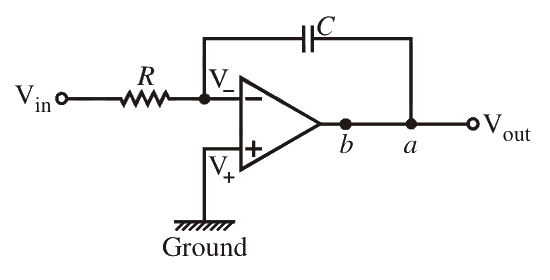
In the schematic figure given below, assume that the propagation delay of each logic gate is $t_{\text{gate}}$. The propagation delay of the circuit will be maximum when the logic inputs A and B make the transition
a.
$(0, 1) \rightarrow (1, 1)$
b.
$(1, 1) \rightarrow (0, 1)$
c.
$(0, 0) \rightarrow (1, 1)$
d.
$(0, 0) \rightarrow (0, 1)$
Correct Answer & Step-by-Step Solution Locked
Sign in free to reveal the correct answer and AI explanation for this question.
The intensity distribution of a red LED on an absorbing layer of material is a Gaussian centered at the wavelength $\lambda_0 = 660\text{ nm}$ and width $20\text{ nm}$. If the absorption coefficients varies with wavelength as $\alpha_0 - K(\lambda - \lambda_0)$, where $\alpha_0$ and $K$ are positive constants, the light emerging from the absorber will be
a.
blue shifted retaining the Gaussian intensity distribution
b.
blue shifted with an asymmetric intensity distribution
c.
red shifted retaining the Gaussian intensity distribution
d.
red shifted with an asymmetric intensity distribution
Correct Answer & Step-by-Step Solution Locked
Sign in free to reveal the correct answer and AI explanation for this question.
What is the Fourier transform $\int dx\, e^{ikx} f(x)$ of $f(x) = \delta(x) + \sum_{n=1}^\infty \frac{d^n}{dx^n}\delta(x)$, where $\delta(x)$ is the Dirac delta-function ?
a.
$\frac{1}{1-ik}$
b.
$\frac{1}{1+ik}$
c.
$\frac{1}{k+i}$
d.
$\frac{1}{k-i}$
Correct Answer & Step-by-Step Solution Locked
Sign in free to reveal the correct answer and AI explanation for this question.
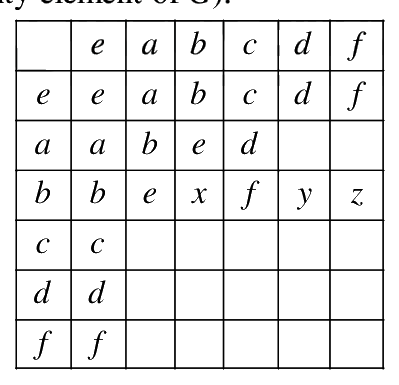
A part of the group multiplication table for a six element group $G = \{e, a, b, c, d, f\}$ is shown below. (In the following $e$ is the identity element of $G$).\n\nThe entries $x$, $y$ and $z$ should be
a.
$x = a$, $y = d$ and $z = c$
b.
$x = c$, $y = a$ and $z = d$
c.
$x = c$, $y = d$ and $z = a$
d.
$x = a$, $y = c$ and $z = d$
Correct Answer & Step-by-Step Solution Locked
Sign in free to reveal the correct answer and AI explanation for this question.
In finding the roots of the polynomial $f(x) = 3x^3 - 4x - 5$ using the iterative Newton-Raphson method, the initial guess is taken to be $x = 2$. In the next iteration its value is nearest to
a.
1.671
b.
1.656
c.
1.559
d.
1.551
Correct Answer & Step-by-Step Solution Locked
Sign in free to reveal the correct answer and AI explanation for this question.
For a particle of energy $E$ and momentum $\boldsymbol{p}$ (in a frame $F$), the rapidity $y$ is defined as $$y = \frac{1}{2} \ln \left(\frac{E + p_3 c}{E - p_3 c}\right)$$ In a frame $F'$ moving with velocity $\boldsymbol{v} = (0, 0, \beta c)$ with respect to $F$, the rapidity $y'$ will be
A canonical transformation $(q, p) \rightarrow (Q, P)$ is made through the generating function $F(q, P) = q^2 P$ on the Hamiltonian $H(q, p) = \frac{p^2}{2\alpha q^2} + \frac{\beta}{4}q^4$, where $\alpha$ and $\beta$ are constants. The equations of motion for $(Q, P)$ are
a.
$\dot{Q} = \frac{P}{\alpha}$ and $\dot{P} = -\beta Q$
b.
$\dot{Q} = \frac{4P}{\alpha}$ and $\dot{P} = \frac{-\beta Q}{2}$
c.
$\dot{Q} = \frac{P}{\alpha}$ and $\dot{P} = -\frac{2P^2}{Q} - \beta Q$
d.
$\dot{Q} = \frac{2P}{\alpha}$ and $\dot{P} = -\beta Q$
Correct Answer & Step-by-Step Solution Locked
Sign in free to reveal the correct answer and AI explanation for this question.
The Lagrangian of a system moving in three dimensions is
$$L = \frac{1}{2} m \dot{x}_1^2 + m(\dot{x}_2^2 + \dot{x}_3^2) - \frac{1}{2} k x_1^2 - \frac{1}{2} k (x_2 + x_3)^2$$
The independent constant(s) of motion is/are
a.
energy alone
b.
only energy, one component of the linear momentum and one component of the angular momentum
c.
only energy and one component of the linear momentum
d.
only energy and one component of the angular momentum
Correct Answer & Step-by-Step Solution Locked
Sign in free to reveal the correct answer and AI explanation for this question.
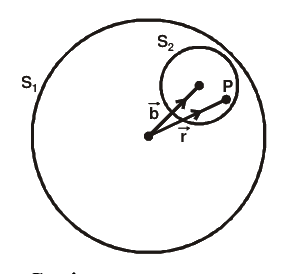
Consider a sphere $S_1$ of radius $R$ which carries a uniform charge of density $\rho$. A smaller sphere $S_2$ of radius $a < \frac{R}{2}$ is cut out and removed from it. The centers of the two spheres are separated by the vector $\vec{b} = \hat{n} \frac{R}{2}$, as shown in the figure.
The electric field at a point $P$ inside $S_2$ is
The values of the electric and magnetic fields in a particular reference frame (in Gaussian units) are $\boldsymbol{E} = 3\hat{x} + 4\hat{y}$ and $\boldsymbol{B} = 3\hat{z}$, respectively. An inertial observer moving with respect to this frame measures the magnitude of the electric field to be $|\boldsymbol{E}'| = 4$. The magnitude of the magnetic field $|\boldsymbol{B}'|$ measured by him is
a.
5
b.
9
c.
0
d.
1
Correct Answer & Step-by-Step Solution Locked
Sign in free to reveal the correct answer and AI explanation for this question.
A loop of radius $a$, carrying a current $I$, is placed in a uniform magnetic field $\boldsymbol{B}$. If the normal to the loop is denoted by $\hat{n}$, the force $\boldsymbol{F}$ and the torque $\boldsymbol{T}$ on the loop are
a.
$\boldsymbol{F} = 0$ and $\boldsymbol{T} = \pi a^2 I\,\hat{n}\times\boldsymbol{B}$
b.
$\boldsymbol{F} = \frac{\mu_0}{4\pi} \boldsymbol{I}\times\boldsymbol{B}$ and $\boldsymbol{T} = 0$
c.
$\boldsymbol{F} = \frac{\mu_0}{4\pi} \boldsymbol{I}\times\boldsymbol{B}$ and $\boldsymbol{T} = I\,\hat{n}\times\boldsymbol{B}$
d.
$\boldsymbol{F} = 0$ and $\boldsymbol{T} = \frac{1}{\mu_0 \varepsilon_0} \boldsymbol{I}\boldsymbol{B}$
Correct Answer & Step-by-Step Solution Locked
Sign in free to reveal the correct answer and AI explanation for this question.
A wavelength has a square cross-section of side $2a$. For the TM modes of wavevector $k$, the transverse electromagnetic modes are obtained in terms of a function $\psi(x, y)$ which obeys the equation
$$\left[\frac{\partial^2}{\partial x^2} + \frac{\partial^2}{\partial y^2} + \left(\frac{\omega^2}{c^2} - k^2\right)\right]\psi(x, y) = 0$$
with the boundary condition $\psi(\pm a, y) = \psi(x, \pm a) = 0$. The frequency $\omega$ of the lowest mode is given by
Consider a particle of mass $m$ in a potential $V(x) = \frac{1}{2}m\omega^2 x^2 + g\cos kx$. The change in the ground state energy, compared to the simple harmonic potential $\frac{1}{2}m\omega^2 x^2$, to first order in $g$ is
a.
$g\exp\left(-\frac{k^2\hbar}{2m\omega}\right)$
b.
$g\exp\left(\frac{k^2\hbar}{2m\omega}\right)$
c.
$g\exp\left(-\frac{2k^2\hbar}{m\omega}\right)$
d.
$g\exp\left(-\frac{k^2\hbar}{4m\omega}\right)$
Correct Answer & Step-by-Step Solution Locked
Sign in free to reveal the correct answer and AI explanation for this question.
The energy levels for a particle of mass $m$ in the potential $V(x) = \alpha|x|$, determined in the WKB approximation
$$\sqrt{2m}\int_a^b \sqrt{E - V(x)}\,dx = \left(n + \frac{1}{2}\right)\hbar\pi\text{, where } a, b \text{ are the turning points and } n = 0, 1, 2, ...\text{), are}$$
A particle of mass $m$ moves in one-dimension under the influence of the potential $V(x) = -\alpha \delta(x)$, where $\alpha$ is a positive constant. The uncertainty in the product $(\Delta x)(\Delta p)$ in its ground state is
a.
$2\hbar$
b.
$\frac{\hbar}{2}$
c.
$\frac{\hbar}{\sqrt{2}}$
d.
$\sqrt{2}\hbar$
Correct Answer & Step-by-Step Solution Locked
Sign in free to reveal the correct answer and AI explanation for this question.
The ground state energy of a particle of mass $m$ in the potential $V(x) = \frac{\hbar^2 \beta}{6m} x^4$, estimated using the normalized trial wavefunction $\psi(x) = \left(\frac{\alpha}{\pi}\right)^{1/4} e^{-\alpha x^2/2}$ is
[Use $\sqrt{\frac{\alpha}{\pi}} \int_{-\infty}^{\infty} dx\, x^2\, e^{-\alpha x^2} = \frac{1}{2\alpha}$ and $\sqrt{\frac{\alpha}{\pi}} \int_{-\infty}^{\infty} dx\, x^4\, e^{-\alpha x^2} = \frac{3}{4\alpha^2}$].
a.
$\frac{3}{2m} \hbar^2 \beta^{1/3}$
b.
$\frac{8}{3m} \hbar^2 \beta^{1/3}$
c.
$\frac{2}{3m} \hbar^2 \beta^{1/3}$
d.
$\frac{3}{8m} \hbar^2 \beta^{1/3}$
Correct Answer & Step-by-Step Solution Locked
Sign in free to reveal the correct answer and AI explanation for this question.
Consider a gas of Cs atoms at a number density of $10^{12}\text{ atoms/cc}$. When the typical inter-particle distance is equal to the thermal de-Broglie wavelength of the particles, the temperature of the gas is nearest to (Take the mass of a Cs atom to be $22.7 \times 10^{-26}\text{ kg}$).
a.
$1 \times 10^{-9}\text{ K}$
b.
$7 \times 10^{-5}\text{ K}$
c.
$1 \times 10^{-3}\text{ K}$
d.
$2 \times 10^{-8}\text{ K}$
Correct Answer & Step-by-Step Solution Locked
Sign in free to reveal the correct answer and AI explanation for this question.
The internal energy $E(T)$ of a system at a fixed volume is found to depend on the temperature $T$ as $E(T) = aT^2 + bT^4$. Then the entropy $S(T)$, as a function of temperature, is
a.
$\frac{1}{2} aT^2 + \frac{1}{4} bT^4$
b.
$2aT^2 + 4bT^4$
c.
$2aT + \frac{4}{3} bT^3$
d.
$2aT + 2bT^3$
Correct Answer & Step-by-Step Solution Locked
Sign in free to reveal the correct answer and AI explanation for this question.
A radioactive element $X$ decays to $Y$, which in turn decays to a stable element $Z$. The decay constant from $X$ to $Y$ is $\lambda_1$, and that from $Y$ to $Z$ is $\lambda_2$. If, to begin with, there are only $N_0$ atoms of $X$, at short times ($t \ll 1/\lambda_1$ as well as $1/\lambda_2$) the number of atoms of $Z$ will be
Two completely overlapping semi-circular parallel plates comprise a capacitive transducer. One of the plates is rotated by an angle of $10^\circ$ relative to their common center. Ignoring edge effects, the ratio, $I_n : I_o$ of sensitivity of the transducer in the new configuration with respect to the original one, is
a.
$8 : 9$
b.
$11 : 12$
c.
$17 : 18$
d.
$35 : 36$
Correct Answer & Step-by-Step Solution Locked
Sign in free to reveal the correct answer and AI explanation for this question.
The decay constants $f_p$ of the heavy pseudoscalar mesons, in the heavy quark limit, are related to their masses $m_p$ by the relation $f_p = \frac{a}{\sqrt{m_p}}$, where $a$ is an empirical parameter to be determined. The values $m_p = 6400 \pm 160\text{ MeV}$ and $f_p = 180 \pm 15\text{ MeV}$ correspond to uncorrelated measurement of a meson. The error on the estimate of $a$ is
a.
$175\text{ (MeV)}^{3/2}$
b.
$900\text{ (MeV)}^{3/2}$
c.
$1200\text{ (MeV)}^{3/2}$
d.
$2400\text{ (MeV)}^{3/2}$
Correct Answer & Step-by-Step Solution Locked
Sign in free to reveal the correct answer and AI explanation for this question.
Consider electrons in graphene, which is a planar monatomic layer of carbon atoms. If the dispersion relation of the electrons is taken to be $\varepsilon(k) = ck$ (where $c$ is constant) over the entire $k$-space, then the Fermi energy $\varepsilon_F$ depends on the number density of electrons $\rho$ as
a.
$\varepsilon_F \propto \rho^{1/2}$
b.
$\varepsilon_F \propto \rho$
c.
$\varepsilon_F \propto \rho^{2/3}$
d.
$\varepsilon_F \propto \rho^{1/3}$
Correct Answer & Step-by-Step Solution Locked
Sign in free to reveal the correct answer and AI explanation for this question.
Suppose the frequency of phonons in a one-dimensional chain of atoms is proportional to the wavevector. If $n$ is the number density of atoms and $c$ is the speed of the phonons, then the Debye frequency is
a.
$2\pi cn$
b.
$\sqrt{2}\pi cn$
c.
$\sqrt{3}\pi cn$
d.
$\frac{\pi cn}{2}$
Correct Answer & Step-by-Step Solution Locked
Sign in free to reveal the correct answer and AI explanation for this question.
The band energy of an electron in a crystal for a particular $k$-direction has the form $\varepsilon(k) = A - B\cos 2ka$, where $A$ and $B$ are positive constants and $0 < ka < \pi$. The electron has a hole-like behaviour over the following range of $k$ :
a.
$\frac{\pi}{4} < ka < \frac{3\pi}{4}$
b.
$\frac{\pi}{2} < ka < \pi$
c.
$0 < ka < \frac{\pi}{4}$
d.
$\frac{\pi}{2} < ka < \frac{3\pi}{4}$
Correct Answer & Step-by-Step Solution Locked
Sign in free to reveal the correct answer and AI explanation for this question.
The ground state electronic configuration of $^{22}\text{Ti}$ is $[\text{Ar}]3d^2 4s^2$. Which state, in the standard spectroscopic notations, is not possible in this configuration?
a.
$^1F_3$
b.
$^1S_0$
c.
$^1D_2$
d.
$^3P_0$
Correct Answer & Step-by-Step Solution Locked
Sign in free to reveal the correct answer and AI explanation for this question.
In a normal Zeeman effect experiment using a magnetic field of strength $0.3\text{ T}$, the splitting between the components of a $660\text{ nm}$ spectral line is
a.
$12\text{ pm}$
b.
$10\text{ pm}$
c.
$8\text{ pm}$
d.
$6\text{ pm}$
Correct Answer & Step-by-Step Solution Locked
Sign in free to reveal the correct answer and AI explanation for this question.
The separation between the energy levels of a two-level atom is $2\text{ eV}$. Suppose that $4 \times 10^{20}$ atoms are in the ground state and $7 \times 10^{20}$ atoms are pumped into the excited state just before lasing starts. How much energy will be released in a single laser pulse ?
a.
$24.6\text{ J}$
b.
$22.4\text{ J}$
c.
$98\text{ J}$
d.
$48\text{ J}$
Correct Answer & Step-by-Step Solution Locked
Sign in free to reveal the correct answer and AI explanation for this question.
In the large hadron collider (LHC), two equal energy proton beams traverse in opposite directions along a circular path of length $27\text{ km}$. If the total center of mass energy of a proton-proton pair is $14\text{ TeV}$, which of the following is the best approximation for the proper time taken by a proton to traverse the entire path ?
a.
$12\text{ ns}$
b.
$1.2\text{ }\mu\text{s}$
c.
$1.2\text{ ns}$
d.
$0.12\text{ }\mu\text{s}$
Correct Answer & Step-by-Step Solution Locked
Sign in free to reveal the correct answer and AI explanation for this question.
Let $E_S$ denote the contribution of the surface energy per nucleon in the liquid drop model. The ratio $E_S\left({}_{13}^{27}\text{Al}\right) : E_S\left({}_{30}^{64}\text{Zn}\right)$ is
a.
$2:3$
b.
$4:3$
c.
$5:3$
d.
$3:2$
Correct Answer & Step-by-Step Solution Locked
Sign in free to reveal the correct answer and AI explanation for this question.
According to the shell model, the nuclear magnetic moment of the ${}_{13}^{27}\text{Al}$ nucleus is (Given that for a proton $g_l = 1$, $g_s = 5.586$, and for a neutron $g_l = 0$, $g_s = -3.826$).
a.
$-1.913\ \mu_N$
b.
$14.414\ \mu_N$
c.
$4.793\ \mu_N$
d.
$0$
Correct Answer & Step-by-Step Solution Locked
Sign in free to reveal the correct answer and AI explanation for this question.