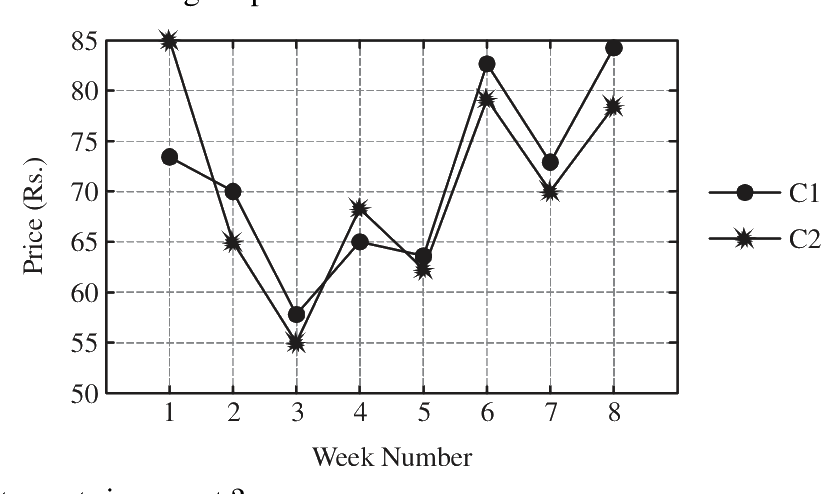
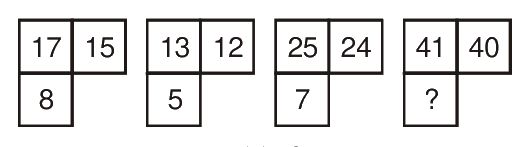
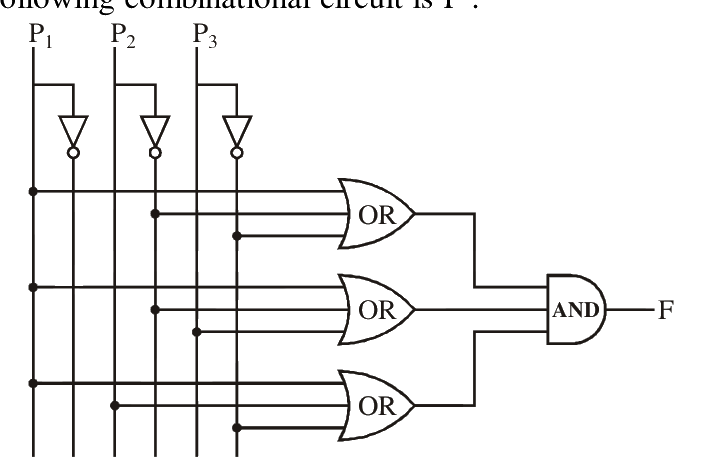
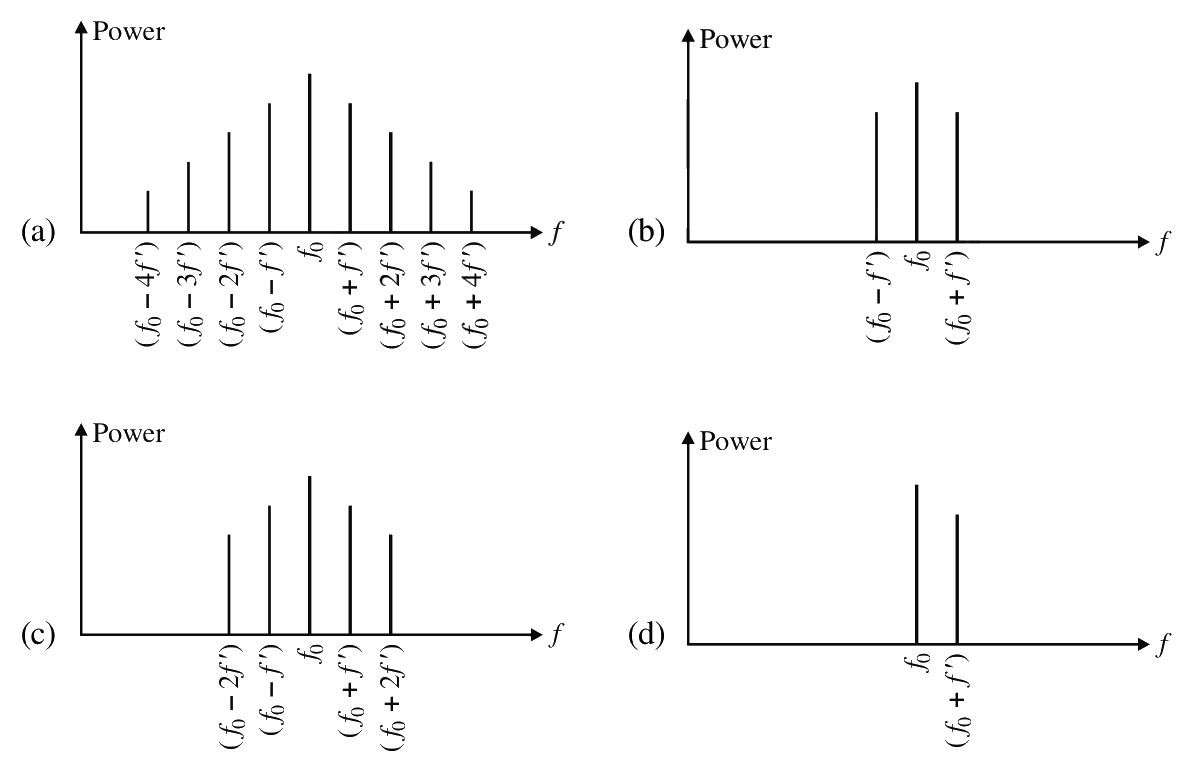
The random errors associated with the measurement of $P$ and $Q$ are $10\%$ and $2\%$, respectively. What is the percentage random error in $P/Q$ ?
a.
12.0
b.
9.8
c.
8.0
d.
10.2
Correct Answer
Step-by-Step AI Explanation
Verified Method
For independent random errors, the percentage error in a quotient $Z = P/Q$ is combined in quadrature:
$$\frac{\Delta Z}{Z} = \sqrt{\left(\frac{\Delta P}{P}\right)^2 + \left(\frac{\Delta Q}{Q}\right)^2}$$
Given $\frac{\Delta P}{P} = 10\%$ and $\frac{\Delta Q}{Q} = 2\%$, the percentage random error is:
$$\sqrt{10^2 + 2^2} = \sqrt{100 + 4} = \sqrt{104} \approx 10.198\% \approx 10.2\%$$
Thus, the correct choice is (D).
Q2mcq
In how many distinguishable ways can the letters of the word CHANCE be arranged ?
a.
120
b.
720
c.
360
Correct Answer
d.
240
Step-by-Step AI Explanation
Verified Method
The word CHANCE has $6$ letters in total, with the letter 'C' repeated $2$ times (C, H, A, N, C, E).
The number of distinguishable arrangements is given by:
$$\frac{6!}{2!} = \frac{720}{2} = 360$$
Therefore, the correct choice is (C).
Q3mcq
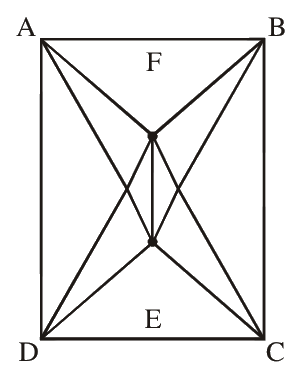
Find out the missing pattern.
Step-by-Step AI Explanation
Verified Method
Analyzing the geometric pattern inside the rectangle $ABCD$:
The lines connect the vertices $A, B$ to a point below the top edge and $C, D$ to a point above the bottom edge. By vertical and horizontal symmetry of the shape containing regions $E$ and $F$, the missing pattern corresponds to option (A).
Q4mcq
Seeds when soaked in water gain about $20\%$ by weight and $10\%$ by volume. By what factor does the density increase ?
a.
1.20
b.
1.10
c.
1.11
d.
1.09
Correct Answer
Step-by-Step AI Explanation
Verified Method
Density is defined as $\rho = \frac{M}{V}$.
When seeds gain $20\%$ by weight, the new mass is $M' = 1.20\, M$.
When they gain $10\%$ by volume, the new volume is $V' = 1.10\, V$.
The new density is:
$$\rho' = \frac{M'}{V'} = \frac{1.20 M}{1.10 V} = \frac{1.20}{1.10} \rho = \frac{12}{11}\rho \approx 1.0909\, \rho$$
Thus, the density increases by a factor of approximately $1.09$.
Q5mcq
Retarding frictional force, $f$, on a moving ball, is proportional to its velocity, $V$. Two identical balls roll down identical slopes (A and B) from different heights. Compare the retarding forces and the velocities of the balls at the bases of the slopes.
a.
$f_A > f_B$ ; $V_A > V_B$
Correct Answer
b.
$f_A > f_B$ ; $V_B > V_A$
c.
$f_B > f_A$ ; $V_B > V_A$
d.
$f_B > f_A$ ; $V_A > V_B$
Step-by-Step AI Explanation
Verified Method
A ball rolling down from a higher elevation has greater potential energy converted into kinetic energy, so it attains a greater velocity at the base ($V_A > V_B$, assuming slope A is the higher one). Since the retarding frictional force $f$ is directly proportional to velocity ($f \propto V$), the ball with the higher velocity experiences the greater retarding force ($f_A > f_B$). Therefore, $f_A > f_B$ and $V_A > V_B$.
Q6mcq
Two cockroaches of the same species have the same thickness but different lengths and widths. Their ability to survive in oxygen deficient environments will be compromised if
a.
their thickness increases, and the rest of the size remains the same.
Correct Answer
b.
their thickness remains unchanged, but their length increases.
c.
their thickness remains unchanged, but their width decreases.
d.
their thickness decreases, but the rest of the size remains unchanged.
Step-by-Step AI Explanation
Verified Method
Cockroaches rely on diffusion through their tracheal system and body surface for gas exchange. The rate of oxygen delivery to tissues depends on the surface area-to-volume ratio ($SA/V$) as well as the maximum diffusion distance. If thickness increases while length and width remain unchanged, the diffusion path length to the core increases and the surface-area-to-volume ratio decreases significantly, compromising their ability to survive in oxygen-deficient environments.
Q7mcq
The bar chart shows number of seats won by four political parties in a state legislative assembly.
Which of the following pie-charts correctly depicts this information ?
Step-by-Step AI Explanation
Verified Method
In the standard CSIR NET problem corresponding to these data, the distribution of seats won by the four political parties corresponds proportionally to the sectors in pie chart (B).
Q8mcq
Intravenous (IV) fluid has to be administered to a child of $12\text{ kg}$ with dehydration, at a dose of $20\text{ mg}$ of fluid per $\text{kg}$ of body weight, in $1\text{ hour}$. What should be the drip rate (in drops/min) of IV fluid) ? ($1\text{ mg} = 20\text{ drops}$)
a.
$7$
b.
$80$
Correct Answer
c.
$120$
d.
$4$
Step-by-Step AI Explanation
Verified Method
Total mass of fluid required:
$$\text{Total dose} = 12\text{ kg} \times 20\text{ mg/kg} = 240\text{ mg}$$
Total number of drops:
$$\text{Total drops} = 240\text{ mg} \times 20\text{ drops/mg} = 4800\text{ drops}$$
The fluid is to be administered in $1\text{ hour} = 60\text{ minutes}$.
Therefore, the drip rate is:
$$\text{Drip rate} = \frac{4800\text{ drops}}{60\text{ min}} = 80\text{ drops/min}$$
Q9mcq
A hall with a high roof is supported by an array of identical columns such that, to a person lying on the floor and looking at the ceiling, the columns *appear parallel to each other*. Which of the following designs conforms to this ?
Step-by-Step AI Explanation
Verified Method
Lines in three-dimensional space that are vertical will, in perspective projection from a point on the floor, appear to converge to a vanishing point directly overhead (the zenith). For columns to appear parallel to each other when viewed from a point on the floor looking up, their lines of sight must maintain equal visual angles or conform to parallel perspective rays along a single line, or geometrically they must lie in parallel planes passing through the eye (such as rows radiating from or aligned to the eye). In standard CSIR-NET problems of this type, the columns must be arranged along parallel straight lines in one direction, or aligned radially. More precisely, parallel lines in perspective only appear parallel if they are perpendicular to the line of sight or configured in parallel planes. Among the typical architectural layout options for this question, layout (C) has the columns arranged in rows that conform to this condition.
Q10mcq
Which of the following graphs correctly shows the speed and the corresponding distance covered by an object moving along a straight line ?
Speed: $-\cdot-\cdot-$
Distance: ———
Step-by-Step AI Explanation
Verified Method
The distance covered by a moving object is the integral of its speed over time, $s(t) = \int v(t)\,dt$. Since speed is non-negative ($v(t) \ge 0$), the distance $s(t)$ must be a non-decreasing function of time, meaning its slope must be positive whenever speed is non-zero, and zero when speed is zero. Additionally, the slope of the distance curve at any point equals the value of the speed curve at that point ($ds/dt = v$). In graph B, the distance increases with a varying slope that matches the height of the speed graph at all times.
🎉 10 Free Sample Solutions Completed
Unlock All 75 Questions & Solutions
Sign up free in seconds to unlock step-by-step AI answers for the remaining 65 questions.
A normal TV screen has a width to height ratio of $4 : 3$, while a high definition TV screen has a ratio of $16 : 9$. What is the approximate ratio of their diagonals, if the heights of the two types of screens are the same ?
a.
$5 : 9$
b.
$5 : 18$
c.
$5 : 15$
d.
$5 : 6$
Correct Answer & Step-by-Step Solution Locked
Sign in free to reveal the correct answer and AI explanation for this question.
A river is $4.1\text{ km}$ wide. A bridge built across it has $1/7$ of its length on one bank and $1/8$ of its length on the other bank. What is the total length of the bridge ?
a.
$5.1\text{ km}$
b.
$4.9\text{ km}$
c.
$5.6\text{ km}$
d.
$5.4\text{ km}$
Correct Answer & Step-by-Step Solution Locked
Sign in free to reveal the correct answer and AI explanation for this question.
Two iron spheres of radii $12\text{ cm}$ and $1\text{ cm}$ are melted and fused. Two new spheres are made without any loss of iron. Their possible radii could be
a.
$9$ and $4\text{ cm}$
b.
$9$ and $10\text{ cm}$
c.
$8$ and $5\text{ cm}$
d.
$2$ and $11\text{ cm}$
Correct Answer & Step-by-Step Solution Locked
Sign in free to reveal the correct answer and AI explanation for this question.
A man buys alcohol at Rs. $75/\text{cL}$, adds water, and sells it at Rs. $75/\text{cL}$ making a profit of $50\%$. What is the ratio of alcohol to water ?
a.
$2 : 1$
b.
$1 : 2$
c.
$3 : 2$
d.
$2 : 3$
Correct Answer & Step-by-Step Solution Locked
Sign in free to reveal the correct answer and AI explanation for this question.
The sum of digits of a two-digit number is $9$. If the fraction formed by taking $9$ less than the number as numerator and $9$ more than the number as denominator is $3/4$, what is the number ?
a.
$36$
b.
$63$
c.
$45$
d.
$54$
Correct Answer & Step-by-Step Solution Locked
Sign in free to reveal the correct answer and AI explanation for this question.
The distance between X and Y is $1000\text{ km}$. A person files from X at 8 AM local time and reaches Y at 10 AM local time. He flies back after a halt of 4 hours at Y and reaches X at 4 PM local time on the same day. What is his average speed for the duration he is in the air ?
a.
$500\text{ km/hour}$
b.
$250\text{ km/hour}$
c.
$750\text{ km/hour}$
d.
cannot be calculated with the given information
Correct Answer & Step-by-Step Solution Locked
Sign in free to reveal the correct answer and AI explanation for this question.
A and B walk up an escalator one step at a time, while the escalator itself moves up at a constant speed. A walks twice as fast as B. A reaches the top in $40$ steps and B in $30$ steps. How many steps of the escalator can be seen when it is not moving ?
a.
$30$
b.
$40$
c.
$50$
d.
$60$
Correct Answer & Step-by-Step Solution Locked
Sign in free to reveal the correct answer and AI explanation for this question.
Consider two radioactive atoms, each of which has a decay rate of 1 per year. The probability that at least one of them decays in the first two years is
a.
$\frac{1}{4}$
b.
$\frac{3}{4}$
c.
$1 - e^{-4}$
d.
$(1 - e^{-2})^2$
Correct Answer & Step-by-Step Solution Locked
Sign in free to reveal the correct answer and AI explanation for this question.
A ball of mass $m$ is dropped from a tall building with zero initial velocity. In addition to gravity, the ball experiences a damping force of the form $-\gamma v$, where $v$ is its instantaneous velocity and $\gamma$ is a constant. Given the values $m = 10\text{ kg}$, $\gamma = 10\text{ kg/s}$, and $g \approx 10\text{ m/s}^2$, the distance travelled (in metres) in time $t$ in seconds, is
a.
$10(t + 1 - e^{-t})$
b.
$10(t - 1 + e^{-t})$
c.
$5t^2 - (1 - e^t)$
d.
$5t^2$
Correct Answer & Step-by-Step Solution Locked
Sign in free to reveal the correct answer and AI explanation for this question.
A relativistic particle moves with a constant velocity $v$ with respect to the laboratory frame. In time $\tau$, measured in the rest frame of the particle, the distance that it travels in the laboratory frame is
a.
$v\tau$
b.
$\frac{c\tau}{\sqrt{1 - \frac{v^2}{c^2}}}$
c.
$v\tau \sqrt{1 - \frac{v^2}{c^2}}$
d.
$\frac{v\tau}{\sqrt{1 - \frac{v^2}{c^2}}}$
Correct Answer & Step-by-Step Solution Locked
Sign in free to reveal the correct answer and AI explanation for this question.
A particle in two dimensions is in a potential $V(x, y) = x + 2y$. Which of the following (apart from the total energy of the particle) is also a constant of motion?
a.
$p_y - 2p_x$
b.
$p_x - 2p_y$
c.
$p_x + 2p_y$
d.
$p_y + 2p_x$
Correct Answer & Step-by-Step Solution Locked
Sign in free to reveal the correct answer and AI explanation for this question.
The parabolic coordinates $(\xi, \eta)$ are related to the Cartesian coordinates $(x, y)$ by $x = \xi\eta$ and $y = \frac{1}{2}(\xi^2 - \eta^2)$. The Lagrangian of a two-dimensional simple harmonic oscillator of mass $m$ and angular frequency $\omega$ is
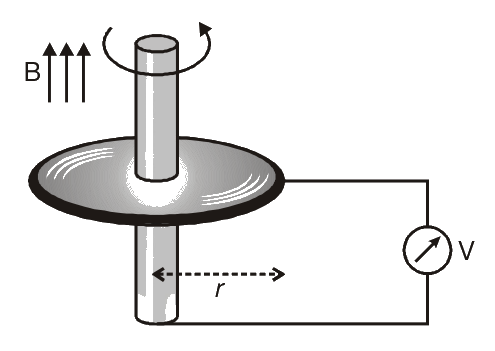
A conducting circular disc of radius $r$ and resistivity $\rho$ rotates with an angular velocity $\omega$ in a magnetic field $B$ perpendicular to it. A voltmeter is connected as shown in the figure below.
Assuming its internal resistance to be infinite, the reading on the voltmeter
a.
depends on $\omega$, $B$, $r$ and $\rho$
b.
depends on $\omega$, $B$ and $r$, but not on $\rho$
c.
is zero because the flux through the loop is not changing
d.
is zero because a current flows in the direction of B
Correct Answer & Step-by-Step Solution Locked
Sign in free to reveal the correct answer and AI explanation for this question.
The charge per unit length of a circular wire of radius $a$ in the $xy$-plane, with its center at the origin, is $\lambda = \lambda_0 \cos\theta$, where $\lambda_0$ is a constant and the angle $\theta$ is measured from the positive $x$-axis. The electric field at the center of the circle is
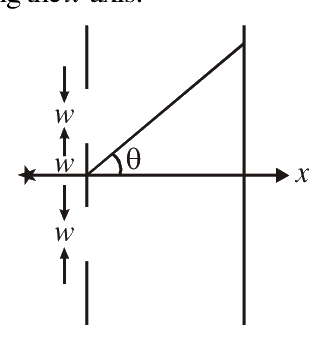
A screen has two slits, each of width $w$, with their centres at a distance $2w$ apart. It is illuminated by a monochromatic plane wave travelling along the $x$-axis.
The intensity of the interference pattern, measured on a distant screen, at an angle $\theta = n\lambda/w$ to the $x$-axis is
a.
zero for $n = 1, 2, 3...$
b.
maximum for $n = 1, 2, 3...$
c.
maximum for $n = \frac{1}{2}, \frac{3}{2}, \frac{5}{2}$
d.
zero for $n = 0$ only
Correct Answer & Step-by-Step Solution Locked
Sign in free to reveal the correct answer and AI explanation for this question.
The electric field of an electromagnetic wave is $\vec{E}(z,t) = E_0 \cos(kz+\omega t)\hat{i} + 2E_0 \sin(kz+\omega t)\hat{j}$, where $\omega$ and $k$ are positive constants. This represents
a.
a linearly polarised wave travelling in the positive $z$-direction
b.
a circularly polarised wave travelling in the negative $z$-direction
c.
an elliptically polarised wave travelling in the negative $z$-direction
d.
an unpolarised wave travelling in the positive $z$-direction
Correct Answer & Step-by-Step Solution Locked
Sign in free to reveal the correct answer and AI explanation for this question.
Consider the two lowest normalized energy eigenfunctions $\psi_0(x)$ and $\psi_1(x)$ of a one dimensional system. They satisfy $\psi_0(x) = \psi_0^*(x)$ and $\psi_1(x) = \alpha \frac{d\psi_0}{dx}$, where $\alpha$ is a real constant. The expectation value of the momentum operator in the state $\psi_1$ is
a.
$-\frac{\hbar}{\alpha^2}$
b.
$0$
c.
$\frac{\hbar}{\alpha^2}$
d.
$\frac{2\hbar}{\alpha^2}$
Correct Answer & Step-by-Step Solution Locked
Sign in free to reveal the correct answer and AI explanation for this question.
Let $a = \frac{1}{\sqrt{2}}(x+ip)$ and $a^\dagger = \frac{1}{\sqrt{2}}(x-ip)$ be the lowering and raising operators of a simple harmonic oscillator in units where the mass, angular frequency and $\hbar$ have been set to unity. If $|0\rangle$ is the ground state of the oscillator and $\lambda$ is a complex constant, the expectation value of $\langle \psi | x | \psi \rangle$ in the state $|\psi\rangle = \exp(\lambda a^\dagger - \lambda^* a)|0\rangle$, is
a.
$|\lambda|$
b.
$\sqrt{|\lambda|^2 + \frac{1}{|\lambda|^2}}$
c.
$\frac{1}{\sqrt{2}i}(\lambda - \lambda^*)$
d.
$\frac{1}{\sqrt{2}}(\lambda + \lambda^*)$
Correct Answer & Step-by-Step Solution Locked
Sign in free to reveal the correct answer and AI explanation for this question.
Consider the operator $\vec{\pi} = \vec{p} - q\vec{A}$, where $\vec{p}$ is the momentum operator, $\vec{A} = (A_x, A_y, A_z)$ is the vector potential and $q$ denotes the electric charge. If $\vec{B} = (B_x, B_y, B_z)$ denotes the magnetic field, the $z$-component of the vector operator $\vec{\pi}\times\vec{\pi}$ is
a.
$iq\hbar B_z + q(A_x p_y - A_y p_x)$
b.
$-iq\hbar B_z - q(A_x p_y - A_y p_x)$
c.
$-iq\hbar B_z$
d.
$iq\hbar B_z$
Correct Answer & Step-by-Step Solution Locked
Sign in free to reveal the correct answer and AI explanation for this question.
Consider a gas of $N$ classical particles in a two-dimensional square box of side $L$. If the total energy of the gas is $E$, the entropy (apart from an additive constant) is
a.
$N k_B \ln\left(\frac{L^2 E}{N}\right)$
b.
$N k_B \ln\left(\frac{LE}{N}\right)$
c.
$2N k_B \ln\left(\frac{L\sqrt{E}}{N}\right)$
d.
$L^2 k_B \ln\left(\frac{E}{N}\right)$
Correct Answer & Step-by-Step Solution Locked
Sign in free to reveal the correct answer and AI explanation for this question.
Consider a continuous time random walk. If a step has taken place at time $t = 0$, the probability that the next step takes place between $t$ and $t + dt$ is given by $bt\,dt$, where $b$ is a constant. What is the average time between successive steps ?
a.
$\sqrt{\frac{2\pi}{b}}$
b.
$\sqrt{\frac{\pi}{b}}$
c.
$\frac{1}{2}\sqrt{\frac{\pi}{b}}$
d.
$\sqrt{\frac{\pi}{2b}}$
Correct Answer & Step-by-Step Solution Locked
Sign in free to reveal the correct answer and AI explanation for this question.
A silica particle of radius $0.1\text{ }\mu\text{m}$ is put in a container of water at $T = 300\text{ K}$. The densities of silica and water are $2000\text{ kg/m}^3$ and $1000\text{ kg/m}^3$, respectively. Due to thermal fluctuations, the particle is not always at the bottom of the container. The average height of the particle above the base of the container is approximately
a.
$10^{-3}\text{ m}$
b.
$3 \times 10^{-4}\text{ m}$
c.
$10^{-4}\text{ m}$
d.
$5 \times 10^{-5}\text{ m}$
Correct Answer & Step-by-Step Solution Locked
Sign in free to reveal the correct answer and AI explanation for this question.
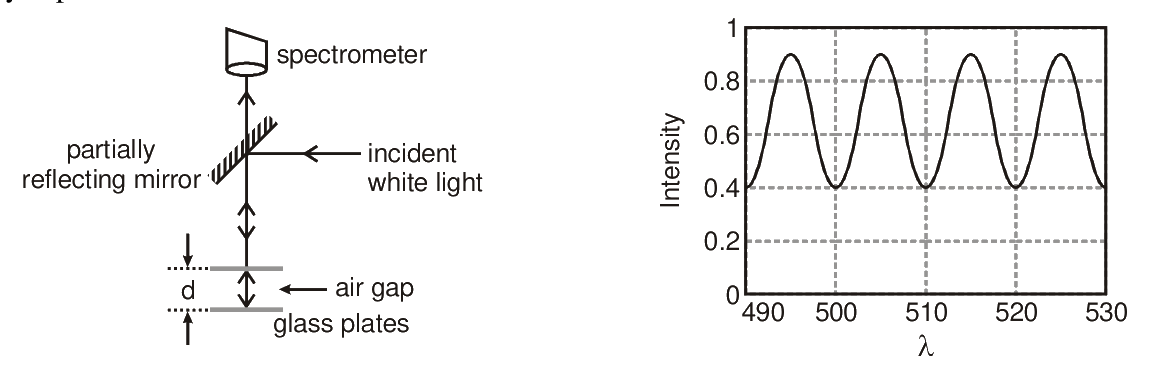
A pair of parallel glass plates separated by a distance $d$ is illuminated by white light as shown in the figure below. Also shown is the graph of the intensity of the reflected light light $I$ as a function of the wavelength $\lambda$ recorded by a spectrometer. Assuming that the interference takes place only between light reflected by the bottom surface of the top plate and the top surface of bottom plate, the distance $d$ is closest to
a.
$12\text{ }\mu\text{m}$
b.
$24\text{ }\mu\text{m}$
c.
$60\text{ }\mu\text{m}$
d.
$120\text{ }\mu\text{m}$
Correct Answer & Step-by-Step Solution Locked
Sign in free to reveal the correct answer and AI explanation for this question.
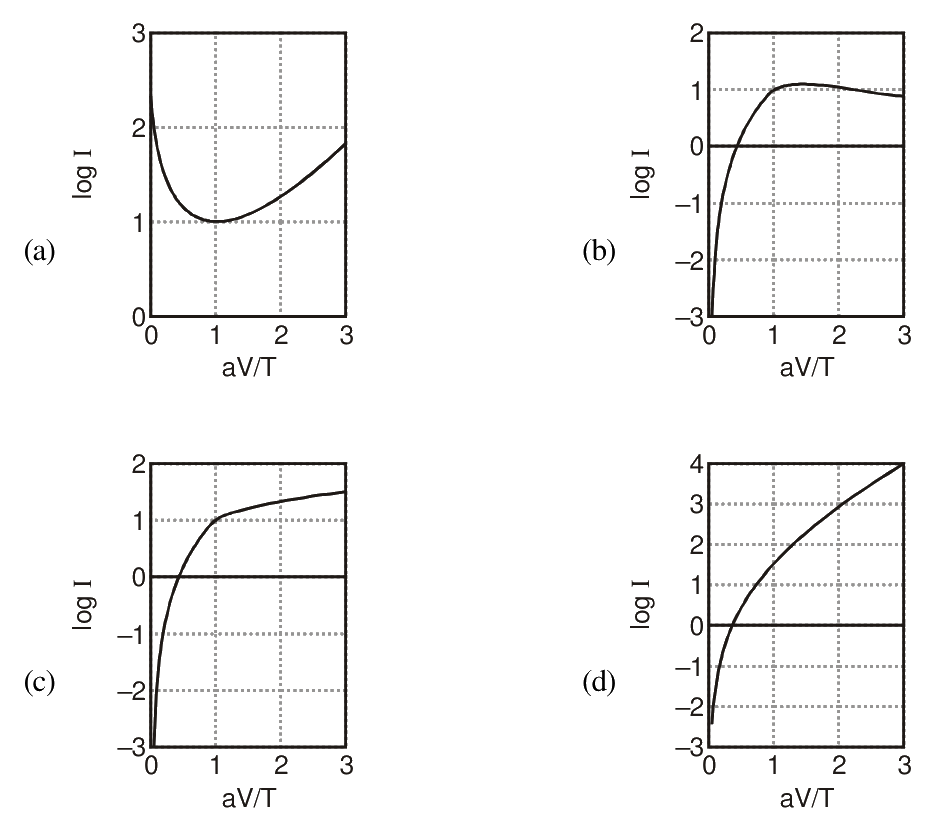
The $I$-$V$ characteristics of a device is $I = I_s \left[\exp\left(\frac{aV}{T}\right) - 1\right]$, where $T$ is the temperature and $a$ and $I_s$ are constants independent of $T$ and $V$. Which one of the following plots is correct for a fixed applied voltage $V$?
a.
(a)
b.
(b)
c.
(c)
d.
(d)
Correct Answer & Step-by-Step Solution Locked
Sign in free to reveal the correct answer and AI explanation for this question.
The active medium in a blue LED (Light Emitting Diode) is a $\text{Ga}_x\text{In}_{1-x}\text{N}$ alloy. The band gaps of $\text{GaN}$ and $\text{InN}$ are $3.5\text{ eV}$ and $1.5\text{ eV}$ respectively. If the band gap of $\text{Ga}_x\text{In}_{1-x}\text{N}$ varies approximately linearly with $x$, the value of $x$ required for the emission of blue light of wavelength $400\text{ nm}$ is (take $hc \approx 1200\text{ eV-nm}$)
a.
$0.95$
b.
$0.75$
c.
$0.50$
d.
$0.33$
Correct Answer & Step-by-Step Solution Locked
Sign in free to reveal the correct answer and AI explanation for this question.
A stable asymptotic solution of the equation $x_{n+1} = 1 + \frac{3}{1+x_n}$ is $x=2$. If we take $x_n = 2 + \varepsilon_n$ and $x_{n+1} = 2 + \varepsilon_{n+1}$, where $\varepsilon_n$ and $\varepsilon_{n+1}$ are both small, the ratio $\varepsilon_{n+1}/\varepsilon_n$ is approximately
a.
$-\frac{1}{2}$
b.
$-\frac{1}{4}$
c.
$-\frac{1}{3}$
d.
$-\frac{2}{3}$
Correct Answer & Step-by-Step Solution Locked
Sign in free to reveal the correct answer and AI explanation for this question.
The $2 \times 2$ identity matrix $I$ and the Pauli matrices $\sigma^x, \sigma^y, \sigma^z$ do not form a group under matrix multiplication. The minimum number of $2 \times 2$ matrices, which includes these four matrices, and form a group (under matrix multiplication) is
a.
$20$
b.
$8$
c.
$12$
d.
$16$
Correct Answer & Step-by-Step Solution Locked
Sign in free to reveal the correct answer and AI explanation for this question.
Given the values $\sin 45^\circ = 0.7071$, $\sin 50^\circ = 0.7660$, $\sin 55^\circ = 0.8192$ and $\sin 60^\circ = 0.8660$, the approximate value of $\sin 52^\circ$, computed by Newton's forward difference method, is
a.
0.804
b.
0.776
c.
0.788
d.
0.798
Correct Answer & Step-by-Step Solution Locked
Sign in free to reveal the correct answer and AI explanation for this question.
Let $f(x, t)$ be a solution of the heat equation $\frac{\partial f}{\partial t} = D \frac{\partial^2 f}{\partial x^2}$ in one dimension. The initial condition at $t = 0$ is $f(x, 0) = e^{-x^2}$ for $-\infty < x < \infty$. Then for all $t > 0$, $f(x, t)$ is given by
[Useful integral: $\int_{-\infty}^{\infty} dx\, e^{-\alpha x^2} = \sqrt{\frac{\pi}{\alpha}}$].
a.
$\frac{1}{\sqrt{1+Dt}} e^{-\frac{x^2}{1+Dt}}$
b.
$\frac{1}{\sqrt{1+2Dt}} e^{-\frac{x^2}{1+2Dt}}$
c.
$\frac{1}{\sqrt{1+4Dt}} e^{-\frac{x^2}{1+4Dt}}$
d.
$e^{-\frac{x^2}{1+Dt}}$
Correct Answer & Step-by-Step Solution Locked
Sign in free to reveal the correct answer and AI explanation for this question.
After a perfectly elastic collision of two identical balls, one of which was initially at rest, the velocities of both the balls are non-zero. The angle $\theta$ between the final velocities (in the lab frame) is
a.
$\theta = \frac{\pi}{2}$
b.
$\theta = \pi$
c.
$0 < \theta < \frac{\pi}{2}$
d.
$\frac{\pi}{2} < \theta \leq \pi$
Correct Answer & Step-by-Step Solution Locked
Sign in free to reveal the correct answer and AI explanation for this question.
Consider circular orbits in a central force potential $V(r) = -\frac{k}{r^n}$, where $k > 0$ and $0 < n < 2$. If the time period of a circular orbit of radius $R$ is $T_1$ and that of radius $2R$ is $T_2$, then $T_2/T_1$ is
a.
$2^{\frac{n}{2}}$
b.
$2^{\frac{2}{3}n}$
c.
$2^{\frac{n}{2} + 1}$
d.
$2^n$
Correct Answer & Step-by-Step Solution Locked
Sign in free to reveal the correct answer and AI explanation for this question.
Consider a radioactive nucleus that is travelling at a speed $c/2$ with respect to the lab frame. It emits $\gamma$-rays of frequency $\nu_0$ in its rest frame. There is a stationary detector (which is not on the path of the nucleus) in the lab. If a $\gamma$-ray photon is emitted when the nucleus is closest to the detector, its observed frequency at the detector is
a.
$\frac{\sqrt{3}}{2} \nu_0$
b.
$\frac{1}{\sqrt{3}} \nu_0$
c.
$\frac{1}{\sqrt{2}} \nu_0$
d.
$\sqrt{\frac{2}{3}} \nu_0$
Correct Answer & Step-by-Step Solution Locked
Sign in free to reveal the correct answer and AI explanation for this question.
Suppose that free charges are present in a material of dielectric constant $\varepsilon = 10$ and resistivity $\rho = 10^{11}\ \Omega\text{-m}$. Using Ohm's law and the equation of continuity for charge, the time required for the charge density inside the material to decay by $1/e$ is closest to
a.
$10^{-6}\text{ s}$
b.
$10^6\text{ s}$
c.
$10^{12}\text{ s}$
d.
$10\text{ s}$
Correct Answer & Step-by-Step Solution Locked
Sign in free to reveal the correct answer and AI explanation for this question.
A particle with charge $-q$ moves with a uniform angular velocity $\omega$ in a circular orbit of radius $a$ in the $xy$-plane, around a fixed charge $+q$, which is at the centre of the orbit at $(0, 0, 0)$. Let the intensity of radiation at the point $(0, 0, R)$ be $I_1$ and at $(2R, 0, 0)$ be $I_2$. The ratio $I_2/I_1$, for $R \gg a$, is
a.
4
b.
$\frac{1}{4}$
c.
$\frac{1}{8}$
d.
8
Correct Answer & Step-by-Step Solution Locked
Sign in free to reveal the correct answer and AI explanation for this question.
A parallel plate capacitor is formed by two circular conducting plates of radius $a$ separated by a distance $d$, where $d \ll a$. It is being slowly charged by a current that is nearly constant. At an instant when the current is $I$, the magnetic induction between the plates at a distance $a/2$ from the centre of the plate, is
a.
$\frac{\mu_0 I}{\pi a}$
b.
$\frac{\mu_0 I}{2\pi a}$
c.
$\frac{\mu_0 I}{a}$
d.
$\frac{\mu_0 I}{4\pi a}$
Correct Answer & Step-by-Step Solution Locked
Sign in free to reveal the correct answer and AI explanation for this question.
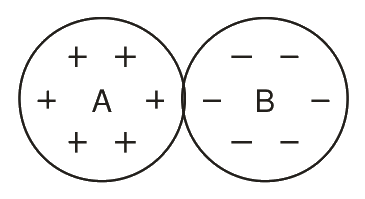
Two uniformly charged insulating solid spheres A and B, both of radius $a$, carry total charges $+Q$ and $-Q$, respectively. The spheres are placed touching each other as shown in the figure.
If the potential at the center of the sphere A is $V_A$ and that at the center of B is $V_B$, then the difference $V_A - V_B$ is
a.
$\frac{Q}{4\pi\varepsilon_0 a}$
b.
$\frac{-Q}{2\pi\varepsilon_0 a}$
c.
$\frac{Q}{2\pi\varepsilon_0 a}$
d.
$\frac{-Q}{4\pi\varepsilon_0 a}$
Correct Answer & Step-by-Step Solution Locked
Sign in free to reveal the correct answer and AI explanation for this question.
A particle is scattered by a central potential $V(r) = V_0 r e^{-\mu r}$, where $V_0$ and $\mu$ are positive constants. If the momentum transfer $\vec{q}$ is such that $q = |\vec{q}| \gg \mu$, the scattering cross-section in the Born approximation, as $q \to \infty$, depends on $q$ as
[You may use $\int x^n e^{ax} dx = \frac{d^n}{da^n} \int e^{ax} dx$]
a.
$q^{-8}$
b.
$q^{-2}$
c.
$q^2$
d.
$q^6$
Correct Answer & Step-by-Step Solution Locked
Sign in free to reveal the correct answer and AI explanation for this question.
A particle in one dimension is in a potential $V(x) = A\delta(x - a)$. Its wavefunction $\psi(x)$ is continuous everywhere. The discontinuity in $d\psi/dx$ at $x = a$ is
a.
$\frac{2m}{\hbar^2} A\psi(a)$
b.
$A(\psi(a) - \psi(-a))$
c.
$\frac{\hbar^2}{2m} A$
d.
$0$
Correct Answer & Step-by-Step Solution Locked
Sign in free to reveal the correct answer and AI explanation for this question.
The dynamics of a free relativistic particle of mass $m$ is governed by the Dirac Hamiltonian $H = c\vec{\alpha}\cdot\vec{p} + \beta mc^2$, where $\vec{p}$ is the momentum operator and $\vec{\alpha} = (\alpha_x, \alpha_y, \alpha_z)$ and $\beta$ are four $4 \times 4$ Dirac matrices. The acceleration operator can be expressed as
a.
$\frac{2ic}{\hbar} (c\vec{p} - \vec{\alpha}H)$
b.
$2ic^2\vec{\alpha}\beta$
c.
$\frac{ic}{\hbar} H\vec{\alpha}$
d.
$-\frac{2ic}{\hbar} (c\vec{p} + \vec{\alpha}H)$
Correct Answer & Step-by-Step Solution Locked
Sign in free to reveal the correct answer and AI explanation for this question.
A particle of charge $q$ in one dimension is in a simple harmonic potential with angular frequency $\omega$. It is subjected to a time dependent electric field $E(t) = A e^{-(t/\tau)^2}$, where $A$ and $\tau$ are positive constants and $\omega\tau \gg 1$. If in the distant past $t \to -\infty$ the particle was in its ground state, the probability that it will be in the first excited state as $t \to +\infty$ is proportional to
a.
$e^{-\frac{1}{2}(\omega\tau)^2}$
b.
$e^{\frac{1}{2}(\omega\tau)^2}$
c.
$0$
d.
$\frac{1}{(\omega\tau)^2}$
Correct Answer & Step-by-Step Solution Locked
Sign in free to reveal the correct answer and AI explanation for this question.
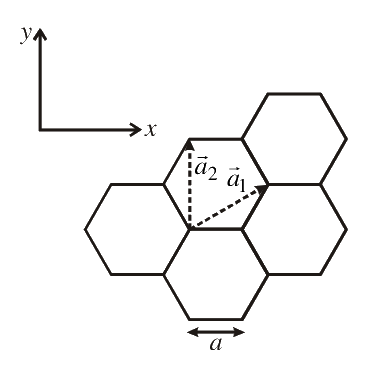
Consider a random walk on an infinite two-dimensional triangular lattice, a part of which is shown in the figure below. If the probabilities of moving to any of the nearest neighbour sites are equal, what is the probability that the walker returns to the starting position at the end of exactly three steps ?
a.
$\frac{1}{36}$
b.
$\frac{1}{216}$
c.
$\frac{1}{18}$
d.
$\frac{1}{12}$
Correct Answer & Step-by-Step Solution Locked
Sign in free to reveal the correct answer and AI explanation for this question.
An atom has a non-degenerate ground state and a doubly-degenerate excited state. The energy difference between the two states is $\varepsilon$. The specific heat at very low temperatures ($\beta\varepsilon \gg 1$) is given by
a.
$k_B (\beta\varepsilon)$
b.
$k_B e^{-\beta\varepsilon}$
c.
$2k_B (\beta\varepsilon)^2 e^{-\beta\varepsilon}$
d.
$k_B$
Correct Answer & Step-by-Step Solution Locked
Sign in free to reveal the correct answer and AI explanation for this question.
The electrons in graphene can be thought of as a two-dimensional gas with a linear energy-momentum relation $E = |\vec{p}|v$, where $\vec{p} = (p_x, p_y)$ and $v$ is a constant. If $\rho$ is the number of electrons per unit area, the energy per unit area is proportional to
a.
$\rho^{3/2}$
b.
$\rho$
c.
$\rho^{1/3}$
d.
$\rho^2$
Correct Answer & Step-by-Step Solution Locked
Sign in free to reveal the correct answer and AI explanation for this question.
In the circuit below, the input voltage $V_i$ is $2\text{ V}$, $V_{cc} = 16\text{ V}$, $R_2 = 2\text{ k}\Omega$ and $R_L = 10\text{ k}\Omega$.
The value of $R_1$ required to deliver $10\text{ mW}$ of power across $R_L$ is
a.
$12\text{ k}\Omega$
b.
$4\text{ k}\Omega$
c.
$8\text{ k}\Omega$
d.
$14\text{ k}\Omega$
Correct Answer & Step-by-Step Solution Locked
Sign in free to reveal the correct answer and AI explanation for this question.
Two sinusoidal signals are sent to an analog multiplier of scale factor $1\text{ V}^{-1}$ followed by a low pass filter (LPF).
If the roll-off frequency of the LPF is $f_c = 5\text{ Hz}$, the output voltage $V_{\text{out}}$ is
a.
$5\text{ V}$
b.
$25\text{ V}$
c.
$100\text{ V}$
d.
$50\text{ V}$
Correct Answer & Step-by-Step Solution Locked
Sign in free to reveal the correct answer and AI explanation for this question.
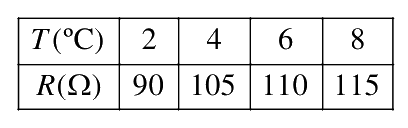
The resistance of a sample is measured as a function of temperature, and the data are shown below.
The slope of $R$ vs $T$ graphs, using a linear least-squares fit to the data, will be
a.
$6\,\Omega/^{\circ}\text{C}$
b.
$4\,\Omega/^{\circ}\text{C}$
c.
$2\,\Omega/^{\circ}\text{C}$
d.
$8\,\Omega/^{\circ}\text{C}$
Correct Answer & Step-by-Step Solution Locked
Sign in free to reveal the correct answer and AI explanation for this question.
Consider a one-dimensional chain of atoms with lattice constant $a$. The energy of an electron with wave-vector $k$ is $\varepsilon(k) = \mu - \gamma \cos (ka)$, where $\mu$ and $\gamma$ are constants. If an electric field $E$ is applied in the positive $x$-direction, the time dependent velocity of an electron is
(in the following $B$ is the constant)
a.
proportional to $\cos\left(B - \dfrac{eE}{\hbar}at\right)$
b.
proportional to $E$
c.
independent of $E$
d.
proportional to $\sin\left(B - \dfrac{eE}{\hbar}at\right)$
Correct Answer & Step-by-Step Solution Locked
Sign in free to reveal the correct answer and AI explanation for this question.
A thin rectangular conducting plate of length $a$ and width $b$ is placed in the $xy$-plane in two different orientations, as shown in the figures below. In both cases a magnetic field $B$ is applied in the $z$-direction and a current flows in the $x$-direction due to the applied voltage $V$.
If the Hall voltage across the $y$-direction in the two cases satisfy $V_2 = 2V_1$, the ratio $a:b$ must be
a.
$1:2$
b.
$1:\sqrt{2}$
c.
$2:1$
d.
$\sqrt{2}:1$
Correct Answer & Step-by-Step Solution Locked
Sign in free to reveal the correct answer and AI explanation for this question.
The total spin of a hydrogen atom is due to the contribution of the spins of the electron and the proton. In the high temperature limit, the ratio of the number of atoms in the spin-1 state to the number in the spin-0 state is
a.
$2$
b.
$3$
c.
$1/2$
d.
$1/3$
Correct Answer & Step-by-Step Solution Locked
Sign in free to reveal the correct answer and AI explanation for this question.
A two level system in a thermal (black body) environment can decay from the excited state by both spontaneous and thermally stimulated emission. At room temperature ($300\text{ K}$), the frequency below which thermal emission dominates over spontaneous emission is nearest to
a.
$10^{13}\text{ Hz}$
b.
$10^8\text{ Hz}$
c.
$10^5\text{ Hz}$
d.
$10^{11}\text{ Hz}$
Correct Answer & Step-by-Step Solution Locked
Sign in free to reveal the correct answer and AI explanation for this question.
What should be the minimum energy of a photon for it to split an $\alpha$-particle at rest into a tritium and a proton?
(The masses of ${}_2^4\text{He}$, ${}_1^3\text{H}$ and ${}_1^1\text{H}$ are $4.0026\text{ amu}$, $3.0161\text{ amu}$ and $1.0073\text{ amu}$, respectively, and $1\text{ amu} \approx 938\text{ MeV}$).
a.
$32.2\text{ MeV}$
b.
$3\text{ MeV}$
c.
$19.3\text{ MeV}$
d.
$931.5\text{ MeV}$
Correct Answer & Step-by-Step Solution Locked
Sign in free to reveal the correct answer and AI explanation for this question.