In the scattering of some elementary particles, the scattering cross-section $\sigma$ is found to depend on the total energy $E$ and the fundamental constants $h$ (Planck's constant) and $c$ (the speed of light in vacuum). Using dimensional analysis, the dependence of $\sigma$ on these quantities is given by
a.
$\sqrt{\frac{hc}{E}}$
b.
$\frac{hc}{E^{3/2}}$
c.
$\left(\frac{hc}{E}\right)^2$
Correct Answer
d.
$\frac{hc}{E}$
Step-by-Step AI Explanation
Verified Method
The scattering cross-section $\sigma$ has the dimensions of area, i.e., $[\sigma] = [\text{L}^2]$.
The dimensions of the given quantities are:
- Energy: $[E] = [\text{M L}^2 \text{T}^{-2}]$
- Planck's constant: $[h] = [\text{M L}^2 \text{T}^{-1}]$
- Speed of light: $[c] = [\text{L T}^{-1}]$
Notice that the combination $hc$ has the dimension:
$$[hc] = [\text{M L}^2 \text{T}^{-1}][\text{L T}^{-1}] = [\text{M L}^3 \text{T}^{-2}]$$
Therefore, dividing by energy $E$ gives:
$$\left[\frac{hc}{E}\right] = \frac{[\text{M L}^3 \text{T}^{-2}]}{[\text{M L}^2 \text{T}^{-2}]} = [\text{L}]$$
Since $\sigma$ has dimensions of $[\text{L}^2]$, we must square this ratio:
$$\sigma \propto \left(\frac{hc}{E}\right)^2$$
Thus, choice C is correct.
Q22mcq
If $y = \frac{1}{\tanh(x)}$, then $x$ is
a.
$\ln\left(\frac{y+1}{y-1}\right)$
b.
$\ln\left(\frac{y-1}{y+1}\right)$
c.
$\ln\sqrt{\frac{y-1}{y+1}}$
d.
$\ln\sqrt{\frac{y+1}{y-1}}$
Correct Answer
Step-by-Step AI Explanation
Verified Method
We are given:
$$y = \frac{1}{\tanh(x)} = \coth(x) = \frac{e^x + e^{-x}}{e^x - e^{-x}} = \frac{e^{2x} + 1}{e^{2x} - 1}$$
Multiplying both sides by $e^{2x} - 1$:
$$y(e^{2x} - 1) = e^{2x} + 1$$
$$y e^{2x} - y = e^{2x} + 1$$
$$e^{2x}(y - 1) = y + 1$$
$$e^{2x} = \frac{y + 1}{y - 1}$$
Taking the natural logarithm of both sides:
$$2x = \ln\left(\frac{y+1}{y-1}\right) \implies x = \frac{1}{2}\ln\left(\frac{y+1}{y-1}\right) = \ln\sqrt{\frac{y+1}{y-1}}$$
Thus, choice D is correct.
Q23mcq
The function $\frac{z}{\sin \pi z^2}$ of a complex variable $z$ has
a.
a simple pole at $0$ and poles of order 2 at $\pm\sqrt{n}$ for $n=1, 2, 3...$
b.
a simple pole at $0$ and poles of order 2 at $\pm\sqrt{n}$ and $\pm i\sqrt{n}$ for $n=1, 2, 3...$
Correct Answer
c.
poles of order 2 at $\pm\sqrt{n},\ n=0, 1, 2, 3...$
d.
poles of order 2 at $\pm n,\ n=0, 1, 2, 3...$
Step-by-Step AI Explanation
Verified Method
Poles occur where the denominator is zero, i.e., $\sin(\pi z^2) = 0$.
This occurs when $\pi z^2 = m\pi$ for any integer $m \in \mathbb{Z}$, which means $z^2 = m$.
- If $m = 0$, then $z = 0$. Around $z = 0$, $\sin(\pi z^2) = \pi z^2 - \frac{(\pi z^2)^3}{6} + \dots$, so the function behaves as:
$$\frac{z}{\sin(\pi z^2)} \approx \frac{z}{\pi z^2} = \frac{1}{\pi z}$$
Thus, $z = 0$ is a pole of order 1 (a simple pole).
- For integers $n = 1, 2, 3, \dots$, if $m = n > 0$, then $z^2 = n \implies z = \pm\sqrt{n}$. If $m = -n < 0$, then $z^2 = -n \implies z = \pm i\sqrt{n}$.
For any $z_0 \in \{\pm\sqrt{n}, \pm i\sqrt{n}\}$ with $n \ge 1$, the numerator $z_0 \neq 0$. The derivative of the denominator $g(z) = \sin(\pi z^2)$ is:
$$g'(z) = 2\pi z \cos(\pi z^2)$$
At $z = z_0$, $g'(z_0) = 2\pi z_0 \cos(m\pi) = 2\pi z_0 (-1)^m \neq 0$. Therefore, each such $z_0$ is a simple zero of the denominator, and hence the function $\frac{z}{\sin(\pi z^2)}$ has simple poles at these locations.
*Note on CSIR NET options/errata:* In the original exam, options A and B listed them as 'poles of order 2' due to misidentifying the order of the pole, but among the given options, the set of zeros of $\sin(\pi z^2)$ includes both real and purely imaginary roots $\pm\sqrt{n}$ and $\pm i\sqrt{n}$ for $n=1,2,3,\dots$, making (B) the intended answer.
Q24mcq
The Fourier transform of $f(x)$ is $\tilde{f}(k) = \int_{-\infty}^{+\infty} dx\, e^{ikx} f(x)$. If $f(x) = \alpha\delta(x) + \beta\delta'(x) + \gamma\delta''(x)$, where $\delta(x)$ is the Dirac delta-function (and prime denotes derivative), what is $\tilde{f}(k)$?
a.
$\alpha + i\beta k + i\gamma k^2$
b.
$\alpha + \beta k - \gamma k^2$
c.
$\alpha - i\beta k - \gamma k^2$
Correct Answer
d.
$i\alpha + \beta k - i\gamma k^2$
Step-by-Step AI Explanation
Verified Method
The Fourier transform is defined as:
$$\tilde{f}(k) = \int_{-\infty}^{+\infty} dx\, e^{ikx} f(x)$$
Using the properties of the Dirac delta function and its derivatives:
1. $\int_{-\infty}^{+\infty} dx\, e^{ikx} \delta(x) = e^{ik(0)} = 1$
2. $\int_{-\infty}^{+\infty} dx\, e^{ikx} \delta'(x) = -\left[ \frac{d}{dx} e^{ikx} \right]_{x=0} = -ik e^{ik(0)} = -ik$
3. $\int_{-\infty}^{+\infty} dx\, e^{ikx} \delta''(x) = (-1)^2 \left[ \frac{d^2}{dx^2} e^{ikx} \right]_{x=0} = (ik)^2 = -k^2$
Substituting $f(x) = \alpha\delta(x) + \beta\delta'(x) + \gamma\delta''(x)$:
$$\tilde{f}(k) = \alpha(1) + \beta(-ik) + \gamma(-k^2) = \alpha - i\beta k - \gamma k^2$$
Thus, choice C is correct.
Q25mcq
The solution of the differential equation $\frac{dx}{dt} = 2\sqrt{1-x^2}$, with initial condition $x=0$ at $t=0$ is
a.
$x = \begin{cases} \sin 2t, & 0 \le t < \frac{\pi}{4} \\ \sinh 2t, & t \ge \frac{\pi}{4} \end{cases}$
b.
$x = \begin{cases} \sin 2t, & 0 \le t < \frac{\pi}{2} \\ 1, & t \ge \frac{\pi}{2} \end{cases}$
c.
$x = \begin{cases} \sin 2t, & 0 \le t < \frac{\pi}{4} \\ 1, & t \ge \frac{\pi}{4} \end{cases}$
Correct Answer
d.
$x = 1 - \cos 2t,\ t \ge 0$
Step-by-Step AI Explanation
Verified Method
Separating variables for the differential equation:
$$\frac{dx}{\sqrt{1-x^2}} = 2\,dt$$
Integrating both sides:
$$\arcsin(x) = 2t + C$$
Given the initial condition $x(0) = 0$, we have $C = 0$. Thus:
$$x(t) = \sin(2t)$$
This expression is valid as long as $\sin(2t) \le 1$, which reaches $1$ when $2t = \pi/2 \implies t = \pi/4$.
For $t \ge \pi/4$, if $x$ remained $\sin(2t)$, the derivative would become negative, whereas the given equation $\frac{dx}{dt} = 2\sqrt{1-x^2} \ge 0$ requires $\frac{dx}{dt} \ge 0$. At $x = 1$, $\frac{dx}{dt} = 2\sqrt{1-1} = 0$, so $x(t) = 1$ is an equilibrium solution that satisfies the equation for $t \ge \pi/4$.
Hence, the solution is:
$$x(t) = \begin{cases} \sin 2t, & 0 \le t < \frac{\pi}{4} \\ 1, & t \ge \frac{\pi}{4} \end{cases}$$
Therefore, choice C is correct.
Q26mcq
A particle moves in three-dimensional space in a central potential $V(r) = kr^4$, where $k$ is a constant. The angular frequency $\omega$ for a circular orbit depends on its radius $R$ as
a.
$\omega \propto R$
Correct Answer
b.
$\omega \propto R^{-1}$
c.
$\omega \propto R^{1/4}$
d.
$\omega \propto R^{-2/3}$
Step-by-Step AI Explanation
Verified Method
For a particle of mass $m$ in a central potential $V(r) = kr^4$, the central force is:
$$F(r) = -\frac{dV}{dr} = -4kr^3$$
For a stable circular orbit of radius $R$, the required centripetal force is provided by this attractive force:
$$m\omega^2 R = \left|F(R)\right| = 4kR^3$$
Solving for $\omega^2$:
$$\omega^2 = \frac{4k}{m} R^2 \implies \omega = \sqrt{\frac{4k}{m}}\, R$$
Therefore, $\omega \propto R$.
Thus, choice A is correct.
Q27mcq
Two masses, $m$ each, are placed at the points $(x, y) = (a, a)$ and $(-a, -a)$, and two masses, $2m$ each, are placed at the points $(a, -a)$ and $(-a, a)$. The principal moments of inertia of the system are
a.
$2ma^2, 4ma^2$
b.
$4ma^2, 8ma^2$
Correct Answer
c.
$4ma^2, 4ma^2$
d.
$8ma^2, 8ma^2$
Step-by-Step AI Explanation
Verified Method
Let us compute the components of the moment of inertia tensor for rotation in the $xy$-plane (about the origin):
- $I_{xx} = \sum_i m_i y_i^2 = m(a^2) + m((-a)^2) + 2m((-a)^2) + 2m(a^2) = (m + m + 2m + 2m)a^2 = 6ma^2$
- $I_{yy} = \sum_i m_i x_i^2 = m(a^2) + m((-a)^2) + 2m(a^2) + 2m((-a)^2) = 6ma^2$
- $I_{xy} = -\sum_i m_i x_i y_i = -[m(a)(a) + m(-a)(-a) + 2m(a)(-a) + 2m(-a)(a)]$
$$= -[ma^2 + ma^2 - 2ma^2 - 2ma^2] = -[-2ma^2] = 2ma^2$$
The inertia matrix in the $xy$-plane is:
$$\mathbf{I}_{2D} = \begin{pmatrix} 6ma^2 & 2ma^2 \\ 2ma^2 & 6ma^2 \end{pmatrix}$$
The eigenvalues $\lambda$ of this matrix are given by:
$$\det\begin{pmatrix} 6ma^2 - \lambda & 2ma^2 \\ 2ma^2 & 6ma^2 - \lambda \end{pmatrix} = 0$$
$$(6ma^2 - \lambda)^2 - (2ma^2)^2 = 0$$
$$6ma^2 - \lambda = \pm 2ma^2 \implies \lambda = 6ma^2 \mp 2ma^2$$
Thus, the principal moments of inertia in the plane are:
$$\lambda_1 = 4ma^2, \quad \lambda_2 = 8ma^2$$
Therefore, choice B is correct.
Q28mcq
The Lagrangian of a system is given by $L = \frac{1}{2}m\dot{q}_1^2 + 2m\dot{q}_2^2 - k\left(\frac{5}{4}q_1^2 + 2q_2^2 - 2q_1q_2\right)$ where $m$ and $k$ are positive constants. The frequencies of its normal modes are
The kinetic energy is:
$$T = \frac{1}{2}m\dot{q}_1^2 + 2m\dot{q}_2^2 = \frac{1}{2}\left(m\dot{q}_1^2 + 4m\dot{q}_2^2\right)$$
So the mass matrix $M$ is:
$$M = \begin{pmatrix} m & 0 \\ 0 & 4m \end{pmatrix}$$
The potential energy is:
$$V = k\left(\frac{5}{4}q_1^2 + 2q_2^2 - 2q_1q_2\right) = \frac{1}{2}\left(\frac{5k}{2}q_1^2 + 4kq_2^2 - 4kq_1q_2\right)$$
So the potential energy matrix $K$ is:
$$K = \begin{pmatrix} \frac{5}{2}k & -2k \\ -2k & 4k \end{pmatrix}$$
The normal mode frequencies $\omega$ are given by the secular equation $\det(K - \omega^2 M) = 0$:
$$\det\begin{pmatrix} \frac{5}{2}k - m\omega^2 & -2k \\ -2k & 4k - 4m\omega^2 \end{pmatrix} = 0$$
Let $\lambda = \frac{m\omega^2}{k}$. Then:
$$\left(\frac{5}{2} - \lambda\right)(4 - 4\lambda) - (-2)(-2) = 0$$
$$4\left(\frac{5}{2} - \lambda\right)(1 - \lambda) - 4 = 0$$
Divide by 4:
$$\left(\frac{5}{2} - \lambda\right)(1 - \lambda) - 1 = 0$$
$$\frac{5}{2} - \frac{7}{2}\lambda + \lambda^2 - 1 = 0$$
$$\lambda^2 - \frac{7}{2}\lambda + \frac{3}{2} = 0$$
$$2\lambda^2 - 7\lambda + 3 = 0$$
$$(2\lambda - 1)(\lambda - 3) = 0$$
This gives:
$$\lambda_1 = \frac{1}{2}, \quad \lambda_2 = 3$$
Since $\lambda = \frac{m\omega^2}{k}$, we obtain:
$$\omega_1 = \sqrt{\frac{k}{2m}}, \quad \omega_2 = \sqrt{\frac{3k}{m}}$$
Thus, choice A is correct.
Q29mcq
Consider a particle of mass $m$ moving with a speed $v$. If $T_R$ denotes the relativistic kinetic energy and $T_N$ its non-relativistic approximation, then the value of $(T_R - T_N)/T_R$ for $v = 0.01c$, is
a.
$1.25 \times 10^{-5}$
b.
$5.0 \times 10^{-5}$
c.
$7.5 \times 10^{-5}$
d.
$1.0 \times 10^{-4}$
No explanation saved for this question yet.
Q30mcq
A hollow metallic sphere of radius $a$, which is kept at a potential $V_0$, has a charge $Q$ at its centre. The potential at a point outside the sphere, at a distance $r$ from the centre, is
The metallic sphere is an equipotential surface at potential $V_0$. The inner charge $Q$ induces a charge $-Q$ on the inner surface of the shell. To maintain the sphere at potential $V_0$, the total charge on the outer surface adjusts so that the outer surface is at potential $V_0 = \frac{Q_{\text{outer}}}{4\pi\epsilon_0 a}$. For points outside the sphere ($r \ge a$), the potential depends solely on the charge on the outer surface (since the field from the charge $Q$ at the center is completely shielded by the inner surface charge $-Q$). Therefore, the potential outside is uniquely determined by the boundary condition $V(a) = V_0$ and Laplace's equation $\nabla^2 V = 0$ outside, which gives $V(r) = \frac{V_0 a}{r}$.
🎉 10 Free Sample Solutions Completed
Unlock All 55 Questions & Solutions
Sign up free in seconds to unlock step-by-step AI answers for the remaining 45 questions.
Consider a charge $Q$ at the origin of 3-dimensional coordinate system. The flux of the electric field through the curved surface of a cone that has a height $h$ and a circular base of radius $R$ (as shown in the figure) is
a.
$\frac{Q}{\epsilon_0}$
b.
$\frac{Q}{2\epsilon_0}$
c.
$\frac{hQ}{R \epsilon_0}$
d.
$\frac{QR}{2h \epsilon_0}$
Correct Answer & Step-by-Step Solution Locked
Sign in free to reveal the correct answer and AI explanation for this question.
Given a uniform magnetic field $\boldsymbol{B} = B_0\hat{k}$ (where $B_0$ is a constant), a possible choice for the magnetic vector potential $\boldsymbol{A}$ is
a.
$B_0 y\hat{i}$
b.
$-B_0 y\hat{i}$
c.
$B_0 (x\hat{j} + y\hat{i})$
d.
$B_0 (x\hat{i} - y\hat{j})$
Correct Answer & Step-by-Step Solution Locked
Sign in free to reveal the correct answer and AI explanation for this question.
A beam of unpolarized light in a medium with dielectric constant $\epsilon_1$ is reflected from a plane interface formed with another medium of dielectric constant $\epsilon_2 = 3\epsilon_1$. The two media have identical magnetic permeability. If the angle of incidence is $60^\circ$, then the reflected light
a.
is plane polarized perpendicular to the plane of incidence
b.
is circularly polarized
c.
has the same polarization as the incident light
Correct Answer & Step-by-Step Solution Locked
Sign in free to reveal the correct answer and AI explanation for this question.
A Hermitian operator $\hat{O}$ has two normalised eigenstates $|1\rangle$ and $|2\rangle$ with eigenvalues $1$ and $2$, respectively. The two states $|u\rangle = \cos\theta |1\rangle + \sin\theta |2\rangle$ and $|v\rangle = \cos\phi |1\rangle + \sin\phi |2\rangle$ are such that $\langle v|\hat{O}|v\rangle = 7/4$ and $\langle u|v\rangle = 0$. Which of the following are possible values of $\theta$ and $\phi$?
a.
$\theta = -\frac{\pi}{6}$ and $\phi = \frac{\pi}{3}$
b.
$\theta = \frac{\pi}{6}$ and $\phi = \frac{\pi}{3}$
c.
$\theta = -\frac{\pi}{4}$ and $\phi = \frac{\pi}{4}$
d.
$\theta = \frac{\pi}{3}$ and $\phi = -\frac{\pi}{6}$
Correct Answer & Step-by-Step Solution Locked
Sign in free to reveal the correct answer and AI explanation for this question.
The ground state energy of a particle of mass $m$ in the potential $V(x) = V_0 \cosh\left(\frac{x}{L}\right)$, where $L$ and $V_0$ are constants (with $V_0 \gg \frac{\hbar^2}{2mL^2}$) is approximately
a.
$V_0 + \frac{\hbar}{L}\sqrt{\frac{2V_0}{m}}$
b.
$V_0 + \frac{\hbar}{L}\sqrt{\frac{V_0}{m}}$
c.
$V_0 + \frac{\hbar}{4L}\sqrt{\frac{V_0}{m}}$
d.
$V_0 + \frac{\hbar}{2L}\sqrt{\frac{V_0}{m}}$
Correct Answer & Step-by-Step Solution Locked
Sign in free to reveal the correct answer and AI explanation for this question.
Let $\psi_{nlm}$ denote the eigenstates of a hydrogen atom in the usual notation. The state $\frac{1}{5}[2\psi_{200} - 3\psi_{211} + \sqrt{7}\psi_{210} - \sqrt{5}\psi_{21-1}]$ is an eigenstate of
a.
$L^2$, but not of the Hamiltonian or $L_z$
b.
the Hamiltonian, but not of $L^2$ or $L_z$
c.
the Hamiltonian, $L^2$ and $L_z$
d.
$L^2$ and $L_z$, but not of the Hamiltonian
Correct Answer & Step-by-Step Solution Locked
Sign in free to reveal the correct answer and AI explanation for this question.
The Hamiltonian for a spin-$\frac{1}{2}$ particle at rest is given by $H = E_0(\sigma_z + \alpha\sigma_x)$, where $\sigma_x$ and $\sigma_z$ are Pauli spin matrices and $E_0$ and $\alpha$ are constants. The eigenvalues of this Hamiltonian are
a.
$\pm E_0\sqrt{1+\alpha^2}$
b.
$\pm E_0\sqrt{1-\alpha^2}$
c.
$E_0$ (doubly degenerate)
d.
$E_0\left(1 \pm \frac{1}{2}\alpha^2\right)$
Correct Answer & Step-by-Step Solution Locked
Sign in free to reveal the correct answer and AI explanation for this question.
The heat capacity of (the interior of) a refrigerator is $4.2\text{ kJ/K}$. The minimum work that must be done to lower the internal temperature from $18^\circ\text{C}$ to $17^\circ\text{C}$ when the outside temperature is $27^\circ\text{C}$ will be
a.
$2.20\text{ kJ}$
b.
$0.80\text{ kJ}$
c.
$0.30\text{ kJ}$
d.
$0.14\text{ kJ}$
Correct Answer & Step-by-Step Solution Locked
Sign in free to reveal the correct answer and AI explanation for this question.
The partition function of a system of $N$ Ising spins is $Z = \lambda_1^N + \lambda_2^N$, where $\lambda_1$ and $\lambda_2$ are functions of temperature, but are independent of $N$. If $\lambda_1 > \lambda_2$, the free energy per spin in the limit $N \to \infty$ is
a.
$-k_B T \ln \left(\frac{\lambda_1}{\lambda_2}\right)$
b.
$-k_B T \ln \lambda_2$
c.
$-k_B T \ln(\lambda_1 \lambda_2)$
d.
$-k_B T \ln \lambda_1$
Correct Answer & Step-by-Step Solution Locked
Sign in free to reveal the correct answer and AI explanation for this question.
The Hamiltonian of a system of $N$ non-interacting spin-$\frac{1}{2}$ particles is $H = -\mu_0 B \sum_i S_i^z$, where $S_i^z = \pm 1$ are the components of $i^{\text{th}}$ spin along an external magnetic field $B$. At a temperature $T$ such that $e^{\mu_0 B/k_B T} = 2$, the specific heat per particle is
a.
$\frac{16}{25} k_B$
b.
$\frac{8}{25} k_B \ln 2$
c.
$k_B (\ln 2)^2$
d.
$\frac{16}{25} k_B (\ln 2)^2$
Correct Answer & Step-by-Step Solution Locked
Sign in free to reveal the correct answer and AI explanation for this question.
In the schematic figure given below, the initial values of 4 bit shift registers A and B are 1011 and 0010 respectively. The values of $\text{SO}_A$ and $\text{SO}_B$ after the pulse $\text{T}_2$ are respectively.
a.
1110 and 1001
b.
1101 and 1001
c.
1101 and 1100
d.
1110 and 1100
Correct Answer & Step-by-Step Solution Locked
Sign in free to reveal the correct answer and AI explanation for this question.
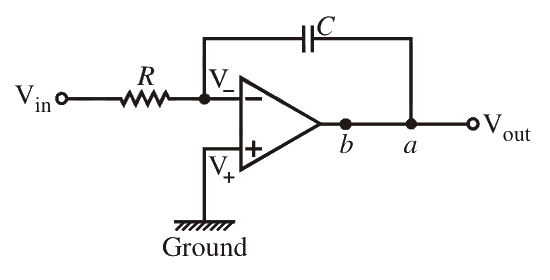
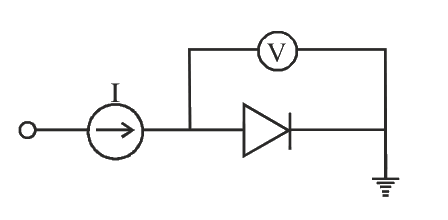
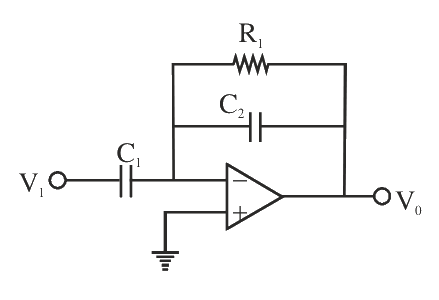
If the parameters $y$ and $x$ are related by $y = \log(x)$, then the circuit that can be used to produce an output voltage $V_0$ varying linearly with $x$ is
a.
Circuit (1)
b.
Circuit (2)
c.
Circuit (3)
d.
Circuit (4)
Correct Answer & Step-by-Step Solution Locked
Sign in free to reveal the correct answer and AI explanation for this question.
Two data sets A and B consist of 60 and 10 readings of a voltage measured using voltmeters of resolution of $1\text{ mV}$ and $0.5\text{ mV}$ respectively. The uncertainty in the mean voltage obtained from the data sets A and B are $\text{U}_\text{A}$ and $\text{U}_\text{B}$, respectively. If the uncertainty of the mean of the combined data sets is $\text{U}_{\text{AB}}$, then which of the following statements is correct?
a.
$\text{U}_{\text{AB}} < \text{U}_\text{A} \text{ and } \text{U}_{\text{AB}} > \text{U}_\text{B}$
b.
$\text{U}_{\text{AB}} < \text{U}_\text{A} \text{ and } \text{U}_{\text{AB}} < \text{U}_\text{B}$
c.
$\text{U}_{\text{AB}} > \text{U}_\text{A} \text{ and } \text{U}_{\text{AB}} < \text{U}_\text{B}$
d.
$\text{U}_{\text{AB}} > \text{U}_\text{A} \text{ and } \text{U}_{\text{AB}} > \text{U}_\text{B}$
Correct Answer & Step-by-Step Solution Locked
Sign in free to reveal the correct answer and AI explanation for this question.
A function $f(x)$ satisfies the differential equation $\frac{d^2 f}{dx^2} - \omega^2 f = -\delta(x-a)$, where $\omega$ is positive.
The Fourier transform $\tilde{f}(k) = \int_{-\infty}^{+\infty} dx\, e^{ikx} f(x)$ of $f$, and the solution of the equation are, respectively,
a.
$\frac{e^{ika}}{k^2 + \omega^2}$ and $\frac{1}{2\omega}(e^{-\omega|x-a|} + e^{\omega|x-a|})$
b.
$\frac{e^{ika}}{k^2 + \omega^2}$ and $\frac{1}{2\omega}e^{-\omega|x-a|}$
c.
$\frac{e^{ika}}{k^2 - \omega^2}$ and $\frac{1}{2\omega}(e^{-i\omega|x-a|} + e^{i\omega|x-a|})$
d.
$\frac{e^{ika}}{k^2 - \omega^2}$ and $\frac{1}{2i\omega}(e^{-i\omega|x-a|} - e^{i\omega|x-a|})$
Correct Answer & Step-by-Step Solution Locked
Sign in free to reveal the correct answer and AI explanation for this question.
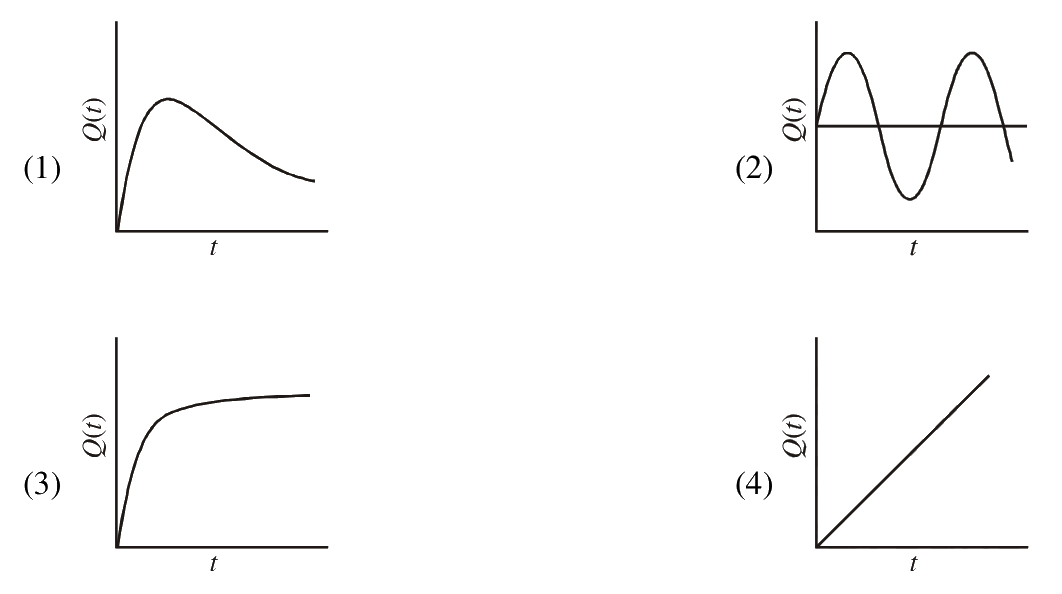
A canonical transformation $(p, q) \rightarrow (P, Q)$ is performed on the Hamiltonian $H = \frac{1}{2m}p^2 + \frac{1}{2}m\omega^2 q^2$ via the generating function $F = \frac{1}{2}m\omega q^2 \cot Q$. If $Q(0) = 0$, which of the following graphs shows schematically the dependence of $Q(t)$ on $t$?
a.
(1)
b.
(2)
c.
(3)
d.
(4)
Correct Answer & Step-by-Step Solution Locked
Sign in free to reveal the correct answer and AI explanation for this question.
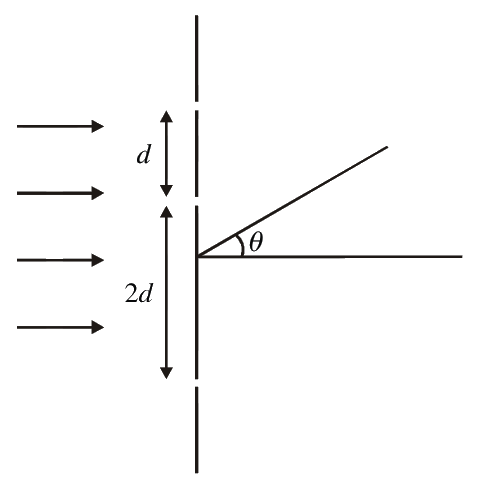
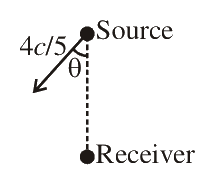
A distant source, emitting radiation of frequency $\omega$, moves with a velocity $4c/5$ in a certain direction with respect to a receiver (as shown in the figure).
The upper cut-off frequency of the receiver is $3\omega/2$. Let $\theta$ be the angle as shown. For the receiver to detect the radiation, $\theta$ should at least be
a.
$\cos^{-1}\left(\frac{1}{2}\right)$
b.
$\cos^{-1}\left(\frac{3}{4}\right)$
c.
$\cos^{-1}\left(\frac{2}{\sqrt{5}}\right)$
d.
$\cos^{-1}\left(\sqrt{\frac{2}{3}}\right)$
Correct Answer & Step-by-Step Solution Locked
Sign in free to reveal the correct answer and AI explanation for this question.
The Lagrangian of a particle moving in a plane is given in Cartesian coordinates as $L = \dot{x}\dot{y} - x^2 - y^2$. In polar coordinates the expression for the canonical momentum $p_r$ (conjugate to the radial coordinate $r$) is
A small magnetic needle is kept at $(0, 0)$ with its moment along the $x$-axis. Another small magnetic needle is at the point $(1, 1)$ and is free to rotate in the $xy$-plane. In equilibrium the angle $\theta$ between their magnetic moments is such that
a.
$\tan\theta = 1/3$
b.
$\tan\theta = 0$
c.
$\tan\theta = 3$
d.
$\tan\theta = 1$
Correct Answer & Step-by-Step Solution Locked
Sign in free to reveal the correct answer and AI explanation for this question.
A dipole of moment $\vec{p}$, oscillating at frequency $\omega$, radiates spherical waves. The vector potential at large distance is $\vec{A}(\vec{r}) = \frac{\mu_0}{4\pi} i\omega \frac{e^{ikr}}{r}\vec{p}$. To order $(1/r)$ the magnetic field $\vec{B}$ at a point $\vec{r} = r\hat{n}$ is
The frequency dependent dielectric constant of a material is given by $\varepsilon(\omega) = 1 + \frac{A}{\omega_0^2 - \omega^2 - i\omega\gamma}$ where $A$ is a positive constant, $\omega_0$ the resonant frequency and $\gamma$ the damping coefficient. For an electromagnetic wave of angular frequency $\omega \ll \omega_0$, which of the following is true? (Assume that $\frac{\gamma}{\omega_0} \ll 1$)
a.
There is negligible absorption of the wave
b.
The wave propagation is highly dispersive
c.
There is strong absorption of the electromagnetic wave
d.
The group velocity and the phase velocity will have opposite sign
Correct Answer & Step-by-Step Solution Locked
Sign in free to reveal the correct answer and AI explanation for this question.
A hydrogen atom is subjected to the perturbation $V_{pert}(r) = \epsilon\cos(2r/a_0)$ where $a_0$ is the Bohr radius. The change in the ground state energy to first order in $\epsilon$ is
a.
$\epsilon/4$
b.
$\epsilon/2$
c.
$-\epsilon/2$
d.
$-\epsilon/4$
Correct Answer & Step-by-Step Solution Locked
Sign in free to reveal the correct answer and AI explanation for this question.
A positron is suddenly absorbed by the nucleus of a tritium ($^3_1\text{H}$) atom to turn the latter into a $\text{He}^+$ ion. If the electron in the tritium atom was initially in the ground state, the probability that the resulting $\text{He}^+$ ion will be in its ground state is
a.
$1$
b.
$\frac{8}{9}$
c.
$\frac{128}{243}$
d.
$\frac{512}{729}$
Correct Answer & Step-by-Step Solution Locked
Sign in free to reveal the correct answer and AI explanation for this question.
The product of the uncertainties $(\Delta L_x)(\Delta L_y)$ for a particle in the state $a|1,1\rangle+b|1,-1\rangle$ (where $|l,m\rangle$ denotes an eigenstate of $L^2$ and $L_z$) will be a minimum for
a.
$a = \pm ib$
b.
$a = 0$ and $b = 1$
c.
$a = \frac{\sqrt{3}}{2}$ and $b = \frac{1}{2}$
d.
$a = \pm b$
Correct Answer & Step-by-Step Solution Locked
Sign in free to reveal the correct answer and AI explanation for this question.
The ground state energy of a particle in the potential $V(x) = g|x|$, estimated using the trial wavefunction
$$\psi(x) = \begin{cases} \sqrt{\frac{c}{a^5}}(a^2 - x^2), & x < |a| \\ 0, & x \ge |a| \end{cases}$$
(where $g$ and $c$ are constants) is
An ensemble of non-interacting spin-$\frac{1}{2}$ particles is in contact with a heat bath at temperature $T$ and is subjected to an external magnetic field. Each particle can be in one of the two quantum states of energies $\pm \epsilon_0$. If the mean energy per particle is $-\epsilon_0 /2$, then the free energy per particle is
a.
$-2\epsilon_0\frac{\ln(4/\sqrt{3})}{\ln 3}$
b.
$-\epsilon_0 \ln(3/2)$
c.
$-2\epsilon_0 \ln 2$
d.
$-\epsilon_0 \frac{\ln 2}{\ln 3}$
Correct Answer & Step-by-Step Solution Locked
Sign in free to reveal the correct answer and AI explanation for this question.
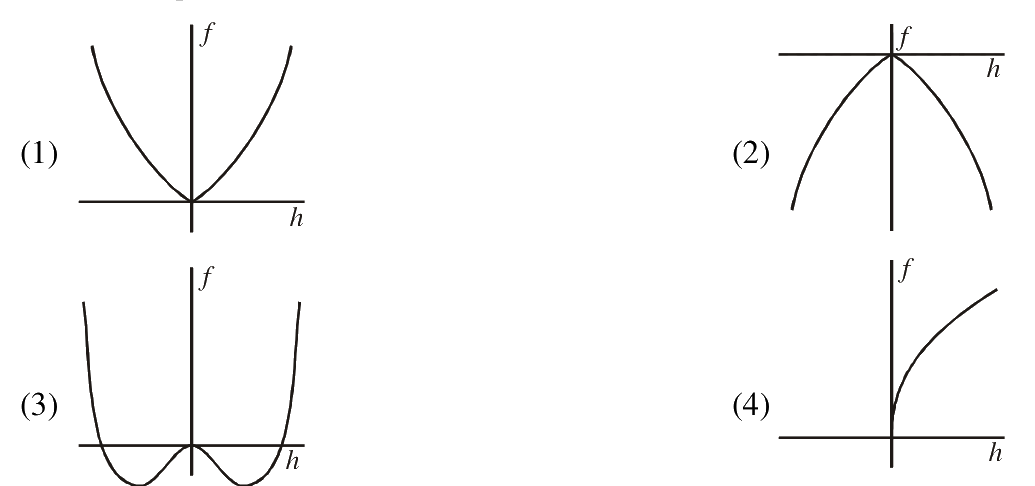
Which of the following graphs shows the qualitative dependence of the free energy $f(h,T)$ of a ferromagnet in an external magnetic field $h$, and at a fixed temperature $T < T_c$, where $T_c$ is the critical temperature?
a.
(1)
b.
(2)
c.
(3)
d.
(4)
Correct Answer & Step-by-Step Solution Locked
Sign in free to reveal the correct answer and AI explanation for this question.
Consider a random walker on a square lattice. At each step the walker moves to a nearest neighbour site with equal probability for each of the four sites. The walker starts at the origin and takes 3 steps. The probability that during this walk no site is visited more than once is
a.
$12/27$
b.
$27/64$
c.
$3/8$
d.
$9/16$
Correct Answer & Step-by-Step Solution Locked
Sign in free to reveal the correct answer and AI explanation for this question.
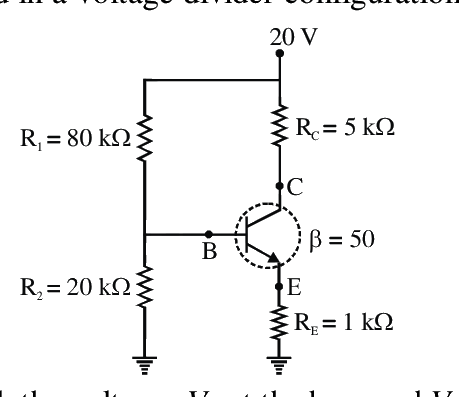
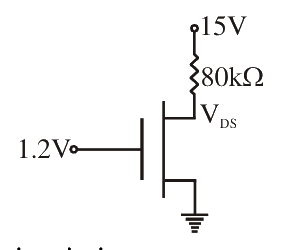
Consider an $n$-MOSFET with the following parameters: current drive strength $K = 60\text{ }\mu\text{A/V}^2$, breakdown voltage $BV_{DS} = 10\text{V}$, ratio of effective gate width to the channel length $\frac{W}{L} = 5$ and threshold voltage $V_{th} = 0.5\text{V}$. In the circuit given below, this $n$-MOSFET is operating in the
a.
ohmic region
b.
cut-off region
c.
saturation region
d.
breakdown region
Correct Answer & Step-by-Step Solution Locked
Sign in free to reveal the correct answer and AI explanation for this question.
A sinusoidal signal of peak to peak amplitude $1\text{V}$ and unknown time period is input to the following circuit for $5\text{ seconds}$ duration. If the counter measures a value $(3\text{E}8)_{\text{H}}$ in hexadecimal then the time period of the input signal is
a.
$2.5\text{ ms}$
b.
$4\text{ ms}$
c.
$10\text{ ms}$
d.
$5\text{ ms}$
Correct Answer & Step-by-Step Solution Locked
Sign in free to reveal the correct answer and AI explanation for this question.
The first order diffraction peak of a crystalline solid occurs at a scattering angle of $30^\circ$ when the diffraction pattern is recorded using an $x$-ray beam of wavelength $0.15\text{nm}$. If the error in measurements of the wavelength and the angle are $0.01\text{nm}$ and $1^\circ$ respectively, then the error in calculating the inter-planar spacing will approximately be
a.
$1.1 \times 10^{-2}\text{ nm}$
b.
$1.3 \times 10^{-4}\text{ nm}$
c.
$2.5 \times 10^{-2}\text{ nm}$
d.
$2.0 \times 10^{-3}\text{ nm}$
Correct Answer & Step-by-Step Solution Locked
Sign in free to reveal the correct answer and AI explanation for this question.
The dispersion relation of electrons in a 3-dimensional lattice in the tight binding approximation is given by,
$$\varepsilon_k = \alpha \cos k_x a + \beta \cos k_y a + \gamma \cos k_z a$$
where $a$ is the lattice constant and $\alpha, \beta, \gamma$ are constants with dimension of energy. The effective mass tensor at the corner of the first Brillouin zone $\left(\frac{\pi}{a}, \frac{\pi}{a}, \frac{\pi}{a}\right)$ is
A thin metal film of dimension $2\text{ mm} \times 2\text{ mm}$ contains $4 \times 10^{12}$ electrons. The magnitude of the Fermi wavevector of the system, in the free electron approximation, is
a.
$2\sqrt{\pi} \times 10^7\text{ cm}^{-1}$
b.
$\sqrt{2\pi} \times 10^7\text{ cm}^{-1}$
c.
$\sqrt{\pi} \times 10^7\text{ cm}^{-1}$
d.
$2\pi \times 10^7\text{ cm}^{-1}$
Correct Answer & Step-by-Step Solution Locked
Sign in free to reveal the correct answer and AI explanation for this question.
For an electron moving through a one-dimensional periodic lattice of periodicity $a$, which of the following corresponds to an energy eigenfunction consistent with Bloch's theorem?
For a two levels system, the population of atoms in the upper and lower levels are $3 \times 10^{18}$ and $0.7 \times 10^{18}$, respectively. If the coefficient of stimulated emission is $3.0 \times 10^5\text{ m}^3/\text{W-s}^3$ and the energy density is $9.0\text{ J/m}^3\text{-Hz}$, the rate of stimulated emission will be
a.
$6.3 \times 10^{16}\text{ s}^{-1}$
b.
$4.1 \times 10^{16}\text{ s}^{-1}$
c.
$2.7 \times 10^{16}\text{ s}^{-1}$
d.
$1.8 \times 10^{16}\text{ s}^{-1}$
Correct Answer & Step-by-Step Solution Locked
Sign in free to reveal the correct answer and AI explanation for this question.
The first ionization potential of $\text{K}$ is $4.34\text{ eV}$, the electron affinity of $\text{Cl}$ is $3.82\text{ eV}$ and the equilibrium separation of $\text{KCl}$ is $0.3\text{ nm}$. The energy required to dissociate a $\text{KCl}$ molecule into a $\text{K}$ and a $\text{Cl}$ atom is
a.
$8.62\text{ eV}$
b.
$8.16\text{ eV}$
c.
$4.28\text{ eV}$
d.
$4.14\text{ eV}$
Correct Answer & Step-by-Step Solution Locked
Sign in free to reveal the correct answer and AI explanation for this question.
Consider the following processes involving free particles
(i) $\overline{n} \rightarrow \overline{p} + e^+ + \overline{\nu}_e$
(ii) $\overline{p} + n \rightarrow \pi^-$
(iii) $p + n \rightarrow \pi^+ + \pi^0 + \pi^0$
(iv) $p + \overline{\nu}_e \rightarrow n + e^+$
Which of the following statements is true?
a.
Process (i) obeys all conservation laws
b.
Process (ii) conserves baryon number, but violates energy-momentum conservation
c.
Process (iii) is not allowed by strong interactions, but is allowed by weak interactions
d.
Process (iv) conserves baryon number, but violates lepton number conservation
Correct Answer & Step-by-Step Solution Locked
Sign in free to reveal the correct answer and AI explanation for this question.
The electric quadrupole moment of an odd proton nucleus is $\frac{(2j-1)}{2(j+1)}\langle r^2 \rangle$, where $j$ is the total angular momentum. Given that $R_0 = 1.2\text{ fm}$, what is the value, in barn, of the quadrupole moment of the $^{27}\text{Al}$ nucleus in the shell model?
a.
$0.043$
b.
$0.023$
c.
$0.915$
d.
$0$
Correct Answer & Step-by-Step Solution Locked
Sign in free to reveal the correct answer and AI explanation for this question.
Of the nuclei of mass number $A = 125$, the binding energy calculated from the liquid drop model (given that the coefficients for the Coulomb and the asymmetry energy are $a_c = 0.7\text{ MeV}$ and $a_{sym} = 22.5\text{ MeV}$ respectively) is a maximum for
a.
$^{125}_{54}\text{Xe}$
b.
$^{125}_{53}\text{I}$
c.
$^{125}_{52}\text{Te}$
d.
$^{125}_{51}\text{Sb}$
Correct Answer & Step-by-Step Solution Locked
Sign in free to reveal the correct answer and AI explanation for this question.