One gram of salt is dissolved in water that is filled to a height of $5\text{ cm}$ in a beaker of diameter $10\text{ cm}$. The accuracy of length measurement is $0.01\text{ cm}$ while that of mass measurement is $0.01\text{ mg}$. When measuring the concentration $C$, the fractional error $\Delta C/C$ is
a.
$0.8\%$
b.
$0.14\%$
c.
$0.5\%$
d.
$0.28\%$
Correct Answer
Step-by-Step AI Explanation
Verified Method
The concentration is defined as mass per unit volume, $C = \frac{m}{V}$, where the volume of a cylinder is $V = \pi r^2 h = \frac{\pi d^2 h}{4}$.
Thus, $C = \frac{4m}{\pi d^2 h}$.
The maximum fractional error in $C$ is given by:
$$\frac{\Delta C}{C} = \frac{\Delta m}{m} + 2\frac{\Delta d}{d} + \frac{\Delta h}{h}$$
Given:
- $m = 1\text{ g} = 1000\text{ mg}$, $\Delta m = 0.01\text{ mg} \implies \frac{\Delta m}{m} = \frac{0.01}{1000} = 10^{-5} = 0.001\%$
- $d = 10\text{ cm}$, $\Delta d = 0.01\text{ cm} \implies 2\frac{\Delta d}{d} = 2 \times \frac{0.01}{10} = 2 \times 10^{-3} = 0.2\%$
- $h = 5\text{ cm}$, $\Delta h = 0.01\text{ cm} \implies \frac{\Delta h}{h} = \frac{0.01}{5} = 2 \times 10^{-3} = 0.2\%$ (or if $\frac{\Delta h}{h} = 0.002 = 0.2\%$, wait: $0.2\% + 0.2\% = 0.4\%$, but wait, is $d$ diameter or radius? $V = \pi (d/2)^2 h$, so $2 \Delta d / d$).
Wait, let's recheck $\Delta d/d$: $\Delta d = 0.01\text{ cm}$, $d = 10\text{ cm} \implies \Delta d/d = 0.001 = 0.1\%$. So $2\Delta d/d = 0.2\%$.
$\Delta h/h = 0.01/5 = 0.002 = 0.2\%$.
Sum $= 0.001\% + 0.2\% + 0.2\% = 0.401\%$, not among the options ($0.8\%, 0.14\%, 0.5\%, 0.28\%$).
Wait, using quadrature (standard error propagation for independent errors):
$$\frac{\Delta C}{C} = \sqrt{\left(\frac{\Delta m}{m}\right)^2 + 4\left(\frac{\Delta d}{d}\right)^2 + \left(\frac{\Delta h}{h}\right)^2}$$
$$\frac{\Delta C}{C} = \sqrt{0 + 4(0.001)^2 + (0.002)^2} = \sqrt{4 \times 10^{-6} + 4 \times 10^{-6}} = \sqrt{8 \times 10^{-6}} = 2\sqrt{2} \times 10^{-3} \approx 2.828 \times 10^{-3} = 0.28\%$$
Therefore, the fractional error computed via root-mean-square propagation is $0.28\%$, which corresponds to option D.
Q22mcq
A system can have three energy levels: $E = 0, \pm \varepsilon$. The level $E = 0$ is doubly degenerate, while the others are non-degenerate. The average energy at inverse temperature $\beta$ is
The partition function $Z$ of the system is:
$$Z = \sum_i g_i e^{-\beta E_i} = 2 e^{0} + e^{-\beta \varepsilon} + e^{\beta \varepsilon} = 2 + 2\cosh(\beta \varepsilon)$$
The average energy is:
$$\langle E \rangle = -\frac{\partial \ln Z}{\partial \beta} = -\frac{1}{Z}\frac{\partial Z}{\partial \beta} = -\frac{1}{Z}\left( -\varepsilon e^{-\beta\varepsilon} + \varepsilon e^{\beta\varepsilon} \right) = -\frac{\varepsilon (e^{\beta\varepsilon} - e^{-\beta\varepsilon})}{2 + 2\cosh(\beta\varepsilon)}$$
Wait, the energy levels are $E = 0, +\varepsilon, -\varepsilon$. Let's check the thermal average directly:
$$\langle E \rangle = \frac{\sum_i g_i E_i e^{-\beta E_i}}{Z} = \frac{2\cdot 0 + (+\varepsilon)e^{-\beta\varepsilon} + (-\varepsilon)e^{\beta\varepsilon}}{2 + e^{-\beta\varepsilon} + e^{\beta\varepsilon}} = \frac{-\varepsilon(e^{\beta\varepsilon} - e^{-\beta\varepsilon})}{2 + 2\cosh(\beta\varepsilon)} = -\varepsilon \frac{2\sinh(\beta\varepsilon)}{2(1+\cosh(\beta\varepsilon))} = -\varepsilon \tanh\left(\frac{\beta\varepsilon}{2}\right)$$
Wait, let's look at option D: $-\varepsilon \tanh\left(\frac{\beta\varepsilon}{2}\right)$!
Using the identity $\frac{\sinh(x)}{1+\cosh(x)} = \frac{2\sinh(x/2)\cosh(x/2)}{2\cosh^2(x/2)} = \tanh(x/2)$, we find:
$$\langle E \rangle = -\varepsilon \tanh\left(\frac{\beta\varepsilon}{2}\right)$$
Therefore, option D is the correct choice.
Q23mcq
For a particular thermodynamics system the entropy $S$ is related to the internal energy $U$ and volume $V$ by
$$S = c U^{3/4} V^{1/4}$$
where $c$ is a constant. The Gibbs potential $G = U - TS + pV$ for this system is
a.
$\frac{3pU}{4T}$
b.
$\frac{cU}{3}$
c.
zero
Correct Answer
d.
$\frac{US}{4V}$
Step-by-Step AI Explanation
Verified Method
Given the fundamental relation $S = c U^{3/4} V^{1/4}$, we can express the internal energy as:
$$U = c^{-4/3} S^{4/3} V^{-1/3}$$
Since $U(\lambda S, \lambda V) = c^{-4/3} (\lambda S)^{4/3} (\lambda V)^{-1/3} = \lambda U(S, V)$, $U$ is a homogeneous function of degree 1 in its extensive variables $S$ and $V$.
By Euler's theorem for homogeneous functions:
$$U = S\left(\frac{\partial U}{\partial S}\right)_V + V\left(\frac{\partial U}{\partial V}\right)_S = TS - pV$$
Rearranging this gives:
$$G = U - TS + pV = 0$$
Thus, the Gibbs free energy $G$ is identically zero.
Q24mcq
An op-amp based voltage follower
a.
is useful for converting a low impedance source into a high impedance source
b.
is useful for converting a high impedance source into a low impedance source
Correct Answer
c.
has infinitely high closed loop output impedance
d.
has infinitely high closed loop gain
Step-by-Step AI Explanation
Verified Method
An op-amp voltage follower (buffer) has a very high (ideally infinite) input impedance and a very low (ideally zero) output impedance with a unity voltage gain ($A_v = 1$). Therefore, it is commonly used as a buffer to convert a high impedance source into a low impedance source to prevent loading effects.
Q25mcq
A particle of mass $m$ in three dimensions is in the potential
$$V(r) = \begin{cases} 0 & r < a \\ \infty & r \ge a \end{cases}$$
Its ground state energy is
a.
$\frac{\pi^2 \hbar^2}{2ma^2}$
Correct Answer
b.
$\frac{\pi^2 \hbar^2}{ma^2}$
c.
$\frac{3\pi^2 \hbar^2}{2ma^2}$
d.
$\frac{9\pi^2 \hbar^2}{2ma^2}$
Step-by-Step AI Explanation
Verified Method
For a 3D spherically symmetric infinite potential well of radius $a$, the radial Schrödinger equation for the reduced wave function $u(r) = rR(r)$ with angular momentum $l = 0$ (ground state) is:
$$-\frac{\hbar^2}{2m} \frac{d^2 u}{dr^2} = E u$$
with boundary conditions $u(0) = 0$ (so that $R(0)$ remains finite) and $u(a) = 0$.
This corresponds exactly to a 1D infinite square well of width $a$, giving the solution:
$$u(r) = A \sin(kr) \quad \text{with } k = \frac{n\pi}{a}$$
For the ground state, $n = 1$, so $k = \frac{\pi}{a}$.
The ground state energy is:
$$E = \frac{\hbar^2 k^2}{2m} = \frac{\pi^2 \hbar^2}{2ma^2}$$
Q26mcq
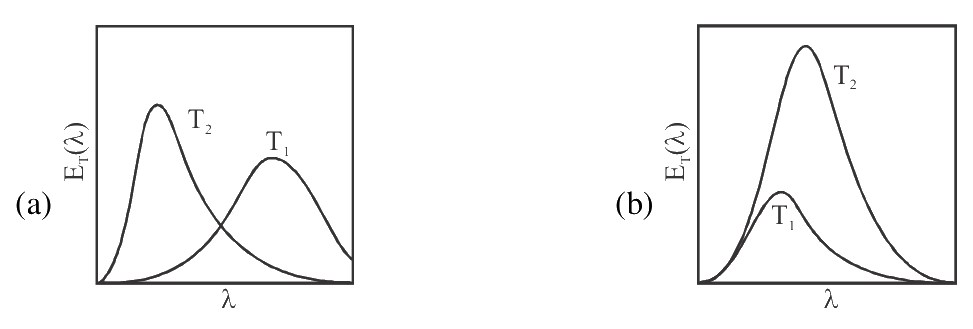
Which of the graphs below gives the correct qualitative behavior of the energy density $E_T(\lambda)$ of blackbody radiation of wavelength $\lambda$ at two temperatures $T_1$ and $T_2$ ($T_1 < T_2$)?
a.
Graph with $T_1$ peak shifted to larger $\lambda$ and lower height than $T_2$
Correct Answer
b.
Graph with $T_1$ peak at same $\lambda$ but lower height than $T_2$
According to Wien's displacement law, $\lambda_{\text{max}} T = b = \text{constant}$, meaning the peak wavelength is inversely proportional to temperature: as $T$ increases, the peak shifts towards shorter wavelengths (to the left). Since $T_1 < T_2$, the peak of $T_1$ must occur at a larger wavelength $\lambda$ than that of $T_2$. Furthermore, the total energy density (area under the curve) and the spectral maximum increase strongly with temperature ($E_{\text{max}} \propto T^5$), so the curve for $T_2$ must have a significantly higher peak than that for $T_1$. In graph (a), the peak for $T_2$ is shifted to a shorter wavelength and is higher, which is the correct qualitative behavior.
Q32mcq
A particle of mass m in the potential $V(x, y)=\frac{1}{2}m\omega^2\left(4x^2 + y^2\right)$, is in an eigenstate of energy $E = \frac{5}{2}\hbar\omega$. The corresponding un-normalized eigenfunction is
The potential is $V(x, y) = \frac{1}{2}m(2\omega)^2 x^2 + \frac{1}{2}m\omega^2 y^2$, which corresponds to an anisotropic two-dimensional harmonic oscillator with frequencies $\omega_x = 2\omega$ and $\omega_y = \omega$.
The energy eigenvalues are:
$$E = \left(n_x + \frac{1}{2}\right)\hbar\omega_x + \left(n_y + \frac{1}{2}\right)\hbar\omega_y = \left(2n_x + 1\right)\hbar\omega + \left(n_y + \frac{1}{2}\right)\hbar\omega = \left(2n_x + n_y + \frac{3}{2}\right)\hbar\omega$$
We are given $E = \frac{5}{2}\hbar\omega$, which implies:
$$2n_x + n_y + \frac{3}{2} = \frac{5}{2} \implies 2n_x + n_y = 1$$
Since $n_x, n_y \in \{0, 1, 2, \dots\}$, the only solution is $n_x = 1$ and $n_y = 0$.
The wave function for the state $(n_x = 1, n_y = 0)$ is:
$$\psi(x, y) \propto H_1\left(\sqrt{\frac{m\omega_x}{\hbar}}x\right) e^{-\frac{m\omega_x x^2}{2\hbar}} H_0\left(\sqrt{\frac{m\omega_y}{\hbar}}y\right) e^{-\frac{m\omega_y y^2}{2\hbar}}$$
Since $H_1(u) \propto u$ and $\omega_x = 2\omega$, $\omega_y = \omega$:
$$\psi(x, y) \propto x \exp\left[-\frac{m(2\omega)x^2}{2\hbar} - \frac{m\omega y^2}{2\hbar}\right] = x \exp\left[-\frac{m\omega}{2\hbar}\left(2x^2 + y^2\right)\right]$$
Thus, option B is the correct eigenfunction.
Q33mcq
A particle of mass $m$ and coordinate $q$ has the Lagrangian
$$L = \frac{1}{2}m\dot{q}^2 - \frac{\lambda}{2}q\dot{q}^2$$
where $\lambda$ is a constant. The Hamiltonian for the system is given by
The Lagrangian is:
$$L = \frac{1}{2}(m - \lambda q)\dot{q}^2$$
The generalized momentum $p$ is:
$$p = \frac{\partial L}{\partial \dot{q}} = (m - \lambda q)\dot{q} \implies \dot{q} = \frac{p}{m - \lambda q}$$
The Hamiltonian is obtained via the Legendre transform:
$$H = p\dot{q} - L = p\left(\frac{p}{m - \lambda q}\right) - \frac{1}{2}(m - \lambda q)\left(\frac{p}{m - \lambda q}\right)^2 = \frac{p^2}{2(m - \lambda q)}$$
Therefore, the correct choice is B.
Q34mcq
If $\vec{A} = yz\hat{i} + zx\hat{j} + xy\hat{k}$ and C is the circle of unit radius in the plane defined by $z = 1$, with the centre on the z-axis, then the value of the integral $\oint_C \vec{A}\cdot d\vec{\ell}$ is
a.
$\frac{\pi}{2}$
b.
$\pi$
c.
$\frac{\pi}{4}$
d.
$0$
Correct Answer
Step-by-Step AI Explanation
Verified Method
Using Stokes' Theorem, $\oint_C \vec{A}\cdot d\vec{\ell} = \iint_S (\nabla \times \vec{A})\cdot d\vec{S}$.
Let us compute $\nabla \times \vec{A}$:
$$\nabla \times \vec{A} = \begin{vmatrix} \hat{i} & \hat{j} & \hat{k} \\ \frac{\partial}{\partial x} & \frac{\partial}{\partial y} & \frac{\partial}{\partial z} \\ yz & zx & xy \end{vmatrix}$$
$$\hat{i}\left(\frac{\partial(xy)}{\partial y} - \frac{\partial(zx)}{\partial z}\right) - \hat{j}\left(\frac{\partial(xy)}{\partial x} - \frac{\partial(yz)}{\partial z}\right) + \hat{k}\left(\frac{\partial(zx)}{\partial x} - \frac{\partial(yz)}{\partial y}\right)$$
$$= \hat{i}(x - x) - \hat{j}(y - y) + \hat{k}(z - z) = 0$$
Since the curl of $\vec{A}$ is identically zero everywhere (indeed, $\vec{A} = \nabla(xyz)$ is a conservative field), the line integral along any closed path is zero:
$$\oint_C \vec{A}\cdot d\vec{\ell} = 0$$
Hence, the correct option is D.
Q35mcq
Given, $\sum_{n=0}^{\infty} P_n(x)t^n = (1-2xt+t^2)^{-1/2}$, for $|t| < 1$, the value of $P_5(-1)$ is
a.
$0.26$
b.
$1$
c.
$0.5$
d.
$-1$
Correct Answer
Step-by-Step AI Explanation
Verified Method
A well-known property of the Legendre polynomials is:
$$P_n(-1) = (-1)^n$$
For $n = 5$:
$$P_5(-1) = (-1)^5 = -1$$
Alternatively, substituting $x = -1$ into the generating function:
$$\sum_{n=0}^{\infty} P_n(-1) t^n = (1 + 2t + t^2)^{-1/2} = ((1+t)^2)^{-1/2} = (1+t)^{-1} = \sum_{n=0}^{\infty} (-1)^n t^n$$
Equating coefficients of $t^5$ gives $P_5(-1) = -1$.
Hence, the correct option is D.
🎉 10 Free Sample Solutions Completed
Unlock All 46 Questions & Solutions
Sign up free in seconds to unlock step-by-step AI answers for the remaining 36 questions.
A charged particle is at a distance $d$ from an infinite conducting plane maintained at zero potential. When released from rest, the particle reaches a speed u at a distance d/2 from the plane. At what distance from the plane will the particle reach the speed 2u?
a.
d/6
b.
d/3
c.
d/4
d.
d/5
Correct Answer & Step-by-Step Solution Locked
Sign in free to reveal the correct answer and AI explanation for this question.
Consider the differential equation $\frac{d^2x}{dt^2}+2\frac{dx}{dt}+x=0$ with the initial conditions $x(0)=0$ and $\dot{x}(0)=1$. The solution $x(t)$ attains its maximum value when 't' is
a.
1/2
b.
1
c.
2
d.
\infty
Correct Answer & Step-by-Step Solution Locked
Sign in free to reveal the correct answer and AI explanation for this question.
A light source is switched on and off at a constant frequency $f$. An observer moving with a velocity $u$ with respect to the light source will observe the freuqency of the switching to be
a.
$f\left(1-\frac{u^2}{c^2}\right)^{-1}$
b.
$f\left(1-\frac{u^2}{c^2}\right)^{-1/2}$
c.
$f\left(1-\frac{u^2}{c^2}\right)$
d.
$f\left(1-\frac{u^2}{c^2}\right)^{1/2}$
Correct Answer & Step-by-Step Solution Locked
Sign in free to reveal the correct answer and AI explanation for this question.
The time period of a simple pendulum under the influence of the acceleration due to gravity g is T. The bob is subjected to an additional acceleration of magnitude $\sqrt{3}g$ in the horizontal direction. Assuming small oscillations, the mean position and time period of oscillation, respectively, of the bob will be
a.
$0^\circ$ to the vertical and $\sqrt{3}T$
b.
$30^\circ$ to the vertical and $T/2$
c.
$60^\circ$ to the vertical and $T/\sqrt{2}$
d.
$0^\circ$ to the vertical and $T/\sqrt{3}$
Correct Answer & Step-by-Step Solution Locked
Sign in free to reveal the correct answer and AI explanation for this question.
Consider an electromagnetic wave at the interface between two homogeneouos dielectric media of the dielectric constants $\varepsilon_1$ and $\varepsilon_2$. Assuming $\varepsilon_2 > \varepsilon_1$ and non charges on the surface, the electric field vector $\vec{E}$ and the displacement vector $\vec{D}$ in the two media satisfy the following inequalities
a.
$|\vec{E}_2| > |\vec{E}_1|$ and $|\vec{D}_2| > |\vec{D}_1|$
b.
$|\vec{E}_2| < |\vec{E}_1|$ and $|\vec{D}_2| < |\vec{D}_1|$
c.
$|\vec{E}_2| < |\vec{E}_1|$ and $|\vec{D}_2| > |\vec{D}_1|$
d.
$|\vec{E}_2| > |\vec{E}_1|$ and $|\vec{D}_2| < |\vec{D}_1|$
Correct Answer & Step-by-Step Solution Locked
Sign in free to reveal the correct answer and AI explanation for this question.
If the electrostatic potential in spherical polar coordinates is
$$\varphi(r) = \varphi_0 e^{-r/r_0}$$
where $\varphi_0$ and $r_0$ are constants, then the charge density at a distance $r = r_0$ will be
a.
$\frac{\varepsilon_0\varphi_0}{er_0^2}$
b.
$\frac{e\varepsilon_0\varphi_0}{2r_0^2}$
c.
$-\frac{\varepsilon_0\varphi_0}{er_0^2}$
d.
$\frac{2e\varepsilon_0\varphi_0}{r_0^2}$
Correct Answer & Step-by-Step Solution Locked
Sign in free to reveal the correct answer and AI explanation for this question.
A current $i_p$ flows through the primary coil of a transformer. The graph of $i_p(t)$ as a function of time 't' is shown in figure below
Which of the following graph represents the current $i_s$ in the secondary coil?
Correct Answer & Step-by-Step Solution Locked
Sign in free to reveal the correct answer and AI explanation for this question.
A time-dependent current $\vec{I}(t) = Kt\hat{z}$ (where K is a constant) is switched on at $t = 0$ in an infinite current-carrying wire. The magnetic vector potential at a perpendicular distance 'a' from the wire is given (for time $t > a/c$) by
A doubel slit interference experiment uses a laser emitting light of two adjacent frequencies $\nu_1$ and $\nu_2$ ($\nu_1 < \nu_2$). The minimum path difference between the interfering beams for which the interference pattern disappears is
a.
$\frac{c}{\nu_2 + \nu_1}$
b.
$\frac{c}{\nu_2 - \nu_1}$
c.
$\frac{c}{2(\nu_2 - \nu_1)}$
d.
$\frac{c}{2(\nu_2 + \nu_1)}$
Correct Answer & Step-by-Step Solution Locked
Sign in free to reveal the correct answer and AI explanation for this question.
The recently-discovered Higgs boson at hte LHC experiment has a decay mode into a photon and a Z boson. If the rest masses of the Higgs and Z boson are $125\text{ GeV}/c^2$ and $90\text{ GeV}/c^2$ respectively, and the decaying Higgs particle is at rest, the energy of the photon will approximately be
a.
$35\sqrt{3}\text{ GeV}$
b.
$35\text{ GeV}$
c.
$30\text{ GeV}$
d.
$15\text{ GeV}$
Correct Answer & Step-by-Step Solution Locked
Sign in free to reveal the correct answer and AI explanation for this question.
In one dimension, a random walker takes a step with equal probability to the left or right. What is the probability that the walker returns to the starting point after 4 steps?
a.
$3/8$
b.
$5/16$
c.
$1/4$
d.
$1/16$
Correct Answer & Step-by-Step Solution Locked
Sign in free to reveal the correct answer and AI explanation for this question.
Consider an electron in a b.c.c. lattice with lattice constant $a$. A single particle wavefunction that satisfies the Bloch theorem will have the form $f(\vec{r})\exp(i\vec{k}\cdot\vec{r})$, with $f(\vec{r})$ being
The dispersion relation for electrons in an f.c.c. crystal is given, in the tight binding approximation by
$$\varepsilon(k)=-4\varepsilon_0\left[\cos\frac{k_x a}{2}\cos\frac{k_y a}{2}+\cos\frac{k_y a}{2}\cos\frac{k_z a}{2}+\cos\frac{k_z a}{2}\cos\frac{k_x a}{2}\right]$$
where '$a$' is the lattice constant and $\varepsilon_0$ is a constant with the dimension of energy. The $x$-component of the velocity of the electrons at $\left(\frac{\pi}{a}, 0, 0\right)$ is
a.
$-\frac{2\varepsilon_0 a}{\hbar}$
b.
$\frac{2\varepsilon_0 a}{\hbar}$
c.
$-\frac{4\varepsilon_0 a}{\hbar}$
d.
$\frac{4\varepsilon_0 a}{\hbar}$
Correct Answer & Step-by-Step Solution Locked
Sign in free to reveal the correct answer and AI explanation for this question.
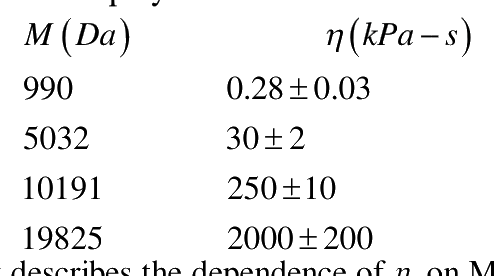
The following data is obtained in an expriment that measures the viscosity $\eta$ as a function of molecular weight $\text{M}$ for a set of polymers.
$$\begin{array}{cc}
M (\text{Da}) & \eta (\text{kPa}-\text{s}) \\
990 & 0.28 \pm 0.03 \\
5032 & 30 \pm 2 \\
10191 & 250 \pm 10 \\
19825 & 2000 \pm 200
\end{array}$$
The relation that best describes the dependence of $\eta$ on $\text{M}$ is
a.
$\eta \sim M^{4/9}$
b.
$\eta \sim M^{3/2}$
c.
$\eta \sim M^2$
d.
$\eta \sim M^3$
Correct Answer & Step-by-Step Solution Locked
Sign in free to reveal the correct answer and AI explanation for this question.
The integral $\int_0^1 \sqrt{x}dx$ is to be evaluated up to 3 decimal places using Simpson's 3-point rule. If the interval $[0, 1]$ is divided into 4 equal parts, the correct result is
a.
$0.683$
b.
$0.667$
c.
$0.657$
d.
$0.638$
Correct Answer & Step-by-Step Solution Locked
Sign in free to reveal the correct answer and AI explanation for this question.
In a classical model, a scalar (spin-0) meson consists of a quark and an antiquark bound by a potential
$$V(r) = ar + \frac{b}{r}$$
where $a = 200\text{ MeV fm}^{-1}$ and $b = 100\text{ MeV fm}$. If the masses of the quark and antiquark are negligible, the mass of the meson can be estimated as approximately
a.
$141\text{ MeV/c}^2$
b.
$283\text{ MeV/c}^2$
c.
$353\text{ MeV/c}^2$
d.
$425\text{ MeV/c}^2$
Correct Answer & Step-by-Step Solution Locked
Sign in free to reveal the correct answer and AI explanation for this question.
Let $y = \frac{1}{2}(x_1 + x_2) - \mu$, where $x_1$ and $x_2$ are independent and identically distributed Gaussian random variables of mean $\mu$ and standard deviation $\sigma$. Then $\frac{\langle y^4 \rangle}{\sigma^4}$ is
a.
1
b.
$\frac{3}{4}$
c.
$\frac{1}{2}$
d.
$\frac{1}{4}$
Correct Answer & Step-by-Step Solution Locked
Sign in free to reveal the correct answer and AI explanation for this question.
The graph of a real periodic function $f(x)$ for the range $[-\infty, \infty]$ is shown below
Which of the following graphs represents the real part of its Fourier transform?
a.
Option (a)
b.
Option (b)
c.
Option (c)
d.
Option (d)
Correct Answer & Step-by-Step Solution Locked
Sign in free to reveal the correct answer and AI explanation for this question.
The coordinates and momenta $x_i, p_i$ ($i = 1, 2, 3$) of a particle satisfy the canonical Poisson bracket relations $\{x_i, p_j\} = \delta_{ij}$. If $C_1 = x_2 p_3 + x_3 p_2$ and $C_2 = x_1 p_2 - x_2 p_1$ are constants of motion, and if $C_3 = \{C_1, C_2\} = x_1 p_3 + x_3 p_1$, then
a.
$\{C_2, C_3\} = C_1$ and $\{C_3, C_1\} = C_2$
b.
$\{C_2, C_3\} = -C_1$ and $\{C_3, C_1\} = -C_2$
c.
$\{C_2, C_3\} = -C_1$ and $\{C_3, C_1\} = C_2$
d.
$\{C_2, C_3\} = C_1$ and $\{C_3, C_1\} = -C_2$
Correct Answer & Step-by-Step Solution Locked
Sign in free to reveal the correct answer and AI explanation for this question.
A canonical transformation relates the old coordinates (q, p) to the new ones (Q, P) by the relations $Q = q^2$ and $P = p/2q$. The corresponding time-independent generating function is
a.
$\frac{P}{q^2}$
b.
$q^2 P$
c.
$q^2 / P$
d.
$q P^2$
Correct Answer & Step-by-Step Solution Locked
Sign in free to reveal the correct answer and AI explanation for this question.
The time evolution of a one-dimensional dynamical system is described by
$$\frac{dx}{dt} = -(x+1)(x^2 - b^2)$$
If this has one stable and two unstable fixed points, then the parameter 'b' satisfies
a.
$0 < b < 1$
b.
$b > 1$
c.
$b < -1$
d.
$b = 2$
Correct Answer & Step-by-Step Solution Locked
Sign in free to reveal the correct answer and AI explanation for this question.
A charge $(-e)$ is placed in vacuum at the point $(d, 0, 0)$, where $d > 0$. The region $x \le 0$ is filled uniformly with a metal. The electric field at the point $\left(\frac{d}{2}, 0, 0\right)$ is
a.
$-\frac{10e}{9\pi\varepsilon_0 d^2}(1,0,0)$
b.
$\frac{10e}{9\pi\varepsilon_0 d^2}(1,0,0)$
c.
$\frac{e}{\pi\varepsilon_0 d^2}(1,0,0)$
d.
$-\frac{e}{\pi\varepsilon_0 d^2}(1,0,0)$
Correct Answer & Step-by-Step Solution Locked
Sign in free to reveal the correct answer and AI explanation for this question.
A beam of light of frequency $\omega$ is reflected from a dielectric-metal interface at normal incidence. The refractive index of the dielectric medium is $n$ and that of the metal is $n_2 = n(1+i\rho)$. If the beam is polarised parallel to the interface, then the phase change experienced by the light upon reflection is
a.
$\tan\left(\frac{2}{\rho}\right)$
b.
$\tan^{-1}\left(\frac{1}{\rho}\right)$
c.
$\tan^{-1}\left(\frac{2}{\rho}\right)$
d.
$\tan^{-1}(2\rho)$
Correct Answer & Step-by-Step Solution Locked
Sign in free to reveal the correct answer and AI explanation for this question.
The scattering amplitude $f(\theta)$ for the potential $V(r) = \beta e^{-\mu r}$, where $\beta$ and $\mu$ are positive constants, is given, in the Born approximation by
(in the following $b = 2k\sin\frac{\theta}{2}$ and $E = \frac{\hbar^2 k^2}{2m}$)
The ground state eigenfunction for the potential $V(x)=-\delta(x)$, where $\delta(x)$ is the delta function, is given by $\psi(x)=Ae^{-\alpha|x|}$, where $A$ and $\alpha>0$ are constants. If a perturbation $H'=bx^2$ is applied, the first order correction to the energy of the ground state will be
a.
$\frac{b}{\sqrt{2}\alpha^2}$
b.
$\frac{b}{\alpha^2}$
c.
$\frac{2b}{\alpha^2}$
d.
$\frac{b}{2\alpha^2}$
Correct Answer & Step-by-Step Solution Locked
Sign in free to reveal the correct answer and AI explanation for this question.
A thin infinitely long solenoid placed along the $z$-axis contains a magnetic flux $\phi$. Which of the following vector potentials corresponds to the magnetic field at an arbitrary point $(x, y, z)$?
The van der Waals equation of state for a gas is given by
$$\left(P+\frac{a}{V^2}\right)(V-b)=RT$$
where, $P$, $V$ and $T$ represent the pressure, volume and temperature respectively, and $a$ and $b$ are constant parameters. At the critical point, where all the roots of the above cubic equation are degenerate, the volume is given by
a.
$\frac{a}{9b}$
b.
$\frac{a}{27b^2}$
c.
$\frac{8a}{27bR}$
d.
$3b$
Correct Answer & Step-by-Step Solution Locked
Sign in free to reveal the correct answer and AI explanation for this question.
An electromagnetically-shielded room is designed so that at a frequency $\omega=10^7\text{ rad/s}$ the intensity of the external radiation that penetrates the room is $1\%$ of the incident radiation. If $\sigma=\frac{1}{2\pi}\times 10^6\,(\Omega m)^{-1}$ is the conductivity of the shielding material, its minimum thickness should be (given that $\ln 10=2.3$)
a.
$4.60\text{ mm}$
b.
$2.30\text{ mm}$
c.
$0.23\text{ mm}$
d.
$0.46\text{ mm}$
Correct Answer & Step-by-Step Solution Locked
Sign in free to reveal the correct answer and AI explanation for this question.