A particle of mass $m$ is moving in the potential $V(x)=-\frac{1}{2}ax^2+\frac{1}{4}bx^4$ where $a$, $b$ are positive constants. The frequency of small oscillations about a point of stable equilibrium is
a.
$\sqrt{a/m}$
b.
$\sqrt{2a/m}$
Correct Answer
c.
$\sqrt{3a/m}$
d.
$\sqrt{6a/m}$
Step-by-Step AI Explanation
Verified Method
To find the equilibrium points, we set the first derivative of the potential to zero:
$$\frac{dV}{dx} = -ax + bx^3 = x(bx^2 - a) = 0$$
The equilibrium points are $x = 0$ and $x = \pm\sqrt{a/b}$.
The second derivative of the potential is:
$$\frac{d^2V}{dx^2} = -a + 3bx^2$$
At $x = 0$, $V''(0) = -a < 0$, which is an unstable equilibrium.
At $x = \pm\sqrt{a/b}$, $V''(\pm\sqrt{a/b}) = -a + 3b(a/b) = 2a > 0$, which are points of stable equilibrium.
The angular frequency of small oscillations about the stable equilibrium point is:
$$\omega = \sqrt{\frac{V''(x_0)}{m}} = \sqrt{\frac{2a}{m}}$$
Thus, option B is correct.
Q22mcq
The radius of Earth is approximately $6400\text{ km}$. The height $h$ at which the acceleration due to Earth's gravity differs from $g$ at the Earth's surface by approximately $1\%$ is
a.
$64\text{ km}$
b.
$48\text{ km}$
c.
$32\text{ km}$
Correct Answer
d.
$16\text{ km}$
Step-by-Step AI Explanation
Verified Method
The acceleration due to gravity at a height $h$ above the Earth's surface ($h \ll R$) is given by:
$$g(h) = g\left(1 + \frac{h}{R}\right)^{-2} \approx g\left(1 - \frac{2h}{R}\right)$$
The fractional difference is:
$$\frac{\Delta g}{g} = \frac{2h}{R}$$
Given that $\frac{\Delta g}{g} = 1\% = 0.01$ and $R = 6400\text{ km}$:
$$0.01 = \frac{2h}{6400\text{ km}} \implies h = \frac{0.01 \times 6400}{2} = 32\text{ km}$$
Thus, option C is correct.
Q23mcq
According to the special theory of relativity, the speed $v$ of a free particle of mass $m$ and total energy $E$ is:
In special relativity, the total energy of a free particle of rest mass $m$ is related to its speed $v$ by:
$$E = \gamma m c^2 = \frac{mc^2}{\sqrt{1 - v^2/c^2}}$$
Rearranging for $v$:
$$\sqrt{1 - \frac{v^2}{c^2}} = \frac{mc^2}{E}$$
$$1 - \frac{v^2}{c^2} = \left(\frac{mc^2}{E}\right)^2$$
$$\frac{v^2}{c^2} = 1 - \left(\frac{mc^2}{E}\right)^2$$
$$v = c\sqrt{1 - \left(\frac{mc^2}{E}\right)^2}$$
(Note: Option C contains a minor typo where $E$ is printed as $R$, but it represents this exact relation). Thus, option C is the intended correct choice.
Q24mcq
Let $\vec{r}$ denote the position vector of any point in three-dimensional space, and $r=|\vec{r}|$. Then
a.
$\vec{\nabla}\cdot\vec{r}=0$ and $\vec{\nabla}\times\vec{r}=\vec{r}/r$
b.
$\vec{\nabla}\cdot\vec{r}=0$ and $\nabla^2 r=0$
c.
$\vec{\nabla}\cdot\vec{r}=3$ and $\nabla^2\vec{r}=\vec{r}/r^2$
d.
$\vec{\nabla}\cdot\vec{r}=3$ and $\vec{\nabla}\times\vec{r}=0$
Correct Answer
Step-by-Step AI Explanation
Verified Method
Let $\vec{r} = x\hat{i} + y\hat{j} + z\hat{k}$.
The divergence of $\vec{r}$ is:
$$\vec{\nabla}\cdot\vec{r} = \frac{\partial x}{\partial x} + \frac{\partial y}{\partial y} + \frac{\partial z}{\partial z} = 1 + 1 + 1 = 3$$
The curl of $\vec{r}$ is:
$$\vec{\nabla}\times\vec{r} = \begin{vmatrix} \hat{i} & \hat{j} & \hat{k} \\ \partial/\partial x & \partial/\partial y & \partial/\partial z \\ x & y & z \end{vmatrix} = 0$$
Therefore, $\vec{\nabla}\cdot\vec{r}=3$ and $\vec{\nabla}\times\vec{r}=0$, which corresponds to option D.
Q25mcq
The column vector $\begin{pmatrix} a \\ b \\ a \end{pmatrix}$ is a simultaneous eigenvector of $A = \begin{pmatrix} 0 & 0 & 1 \\ 0 & 1 & 0 \\ 1 & 0 & 0 \end{pmatrix}$ and $B = \begin{pmatrix} 0 & 1 & 1 \\ 1 & 0 & 1 \\ 1 & 1 & 0 \end{pmatrix}$ if
a.
$b=0$ or $a=0$
b.
$b=a$ or $b=-2a$
Correct Answer
c.
$b=2a$ or $b=-a$
d.
$b=a/2$ or $b=-a/2$
Step-by-Step AI Explanation
Verified Method
Let $v = \begin{pmatrix} a \\ b \\ a \end{pmatrix}$.
First, test $A v$:
$$A v = \begin{pmatrix} 0 & 0 & 1 \\ 0 & 1 & 0 \\ 1 & 0 & 0 \end{pmatrix} \begin{pmatrix} a \\ b \\ a \end{pmatrix} = \begin{pmatrix} a \\ b \\ a \end{pmatrix} = 1\cdot v$$
So $v$ is always an eigenvector of $A$ with eigenvalue $\lambda_A = 1$ for any $a, b$.
Now, for $v$ to be an eigenvector of $B$:
$$B v = \begin{pmatrix} 0 & 1 & 1 \\ 1 & 0 & 1 \\ 1 & 1 & 0 \end{pmatrix} \begin{pmatrix} a \\ b \\ a \end{pmatrix} = \begin{pmatrix} a+b \\ 2a \\ a+b \end{pmatrix}$$
For $v$ to be an eigenvector of $B$ with eigenvalue $\lambda$, we must have:
$$\begin{pmatrix} a+b \\ 2a \\ a+b \end{pmatrix} = \lambda \begin{pmatrix} a \\ b \\ a \end{pmatrix}$$
This implies:
1) $a+b = \lambda a$
2) $2a = \lambda b$
From (1), $\lambda = 1 + \frac{b}{a}$ (assuming $a \neq 0$).
Substituting into (2):
$$2a = \left(1 + \frac{b}{a}\right)b = b + \frac{b^2}{a} \implies b^2 + ab - 2a^2 = 0$$
Factoring the quadratic equation:
$$(b - a)(b + 2a) = 0$$
This gives $b = a$ or $b = -2a$.
(If $a = 0$, then $b=0$ to satisfy the equations, which is a trivial zero vector).
Thus, option B is correct.
Q26mcq
The principal value of the integral $\int_{-\infty}^\infty \frac{\sin(2x)}{x^3}\,dx$ is
a.
$-2\pi$
Correct Answer
b.
$-\pi$
c.
$\pi$
d.
$2\pi$
Step-by-Step AI Explanation
Verified Method
To evaluate the Cauchy principal value of the integral $I = \text{P.V.} \int_{-\infty}^\infty \frac{\sin(2x)}{x^3}\,dx$, we consider the complex contour integral of $f(z) = \frac{e^{2iz} - 1 - 2iz}{z^3}$ or use the standard contour around the pole at $z=0$.
Notice that $\sin(2x) = 2x - \frac{(2x)^3}{3!} + \dots$, so near $x=0$, $\frac{\sin(2x)}{x^3} = \frac{2}{x^2} - \frac{4}{3} + O(x^2)$, which has a non-integrable singularity of order 2. However, the principal value of this divergent integral in the Hadamard/distributional sense can be evaluated using integration by parts:
$$\int_{-\infty}^\infty \frac{\sin(2x)}{x^3}\,dx = \left[ -\frac{\sin(2x)}{2x^2} \right]_{-\infty}^\infty + \int_{-\infty}^\infty \frac{2\cos(2x)}{2x^2}\,dx = \int_{-\infty}^\infty \frac{\cos(2x)}{x^2}\,dx$$
Integrating by parts once more:
$$\int_{-\infty}^\infty \frac{\cos(2x)}{x^2}\,dx = \left[ -\frac{\cos(2x)}{x} \right]_{-\infty}^\infty - \int_{-\infty}^\infty \frac{2\sin(2x)}{x}\,dx = -2 \int_{-\infty}^\infty \frac{\sin(2x)}{x}\,dx$$
Since $\int_{-\infty}^\infty \frac{\sin(2x)}{x}\,dx = \pi$, we obtain:
$$I = -2\pi$$
Thus, the principal value is $-2\pi$, corresponding to option A.
Q27mcq
Two independent random variables $m$ and $n$, which can take the integer values $0, 1, 2, \dots, \infty$, follow the Poisson distribution, with distinct mean values $\mu$ and $\nu$ respectively. Then
a.
the probability distribution of the random variable $l=m+n$ is a binomial distribution
b.
the probability distribution of the random variable $r=m-n$ is also a Poisson distribution
c.
the variance of the random variable $l=m+n$ is equal to $\mu+\nu$
Correct Answer
d.
the mean value of the random variable $r=m-n$ is equal to $0$.
Step-by-Step AI Explanation
Verified Method
For two independent Poisson random variables $m \sim \text{Poisson}(\mu)$ and $n \sim \text{Poisson}(\nu)$:
1. The variance of the sum of independent random variables is the sum of their variances: $\text{Var}(l) = \text{Var}(m+n) = \text{Var}(m) + \text{Var}(n)$. Since the variance of a Poisson distribution equals its mean, $\text{Var}(m) = \mu$ and $\text{Var}(n) = \nu$, hence $\text{Var}(l) = \mu + \nu$.
2. The sum $l = m+n$ follows a Poisson distribution with mean $\mu+\nu$, not a binomial distribution (so A is false).
3. The difference $r = m-n$ can take negative values, so it cannot be a Poisson distribution (B is false).
4. The mean of $r$ is $E[r] = E[m] - E[n] = \mu - \nu \neq 0$ since $\mu$ and $\nu$ are distinct (D is false).
Thus, option C is correct.
Q28mcq
The Laurent series expansion of the function $f(z)=e^z+e^{1/z}$ about $z=0$ is given by
a.
$\sum_{n=-\infty}^\infty \frac{z^n}{n!}$ for all $|z|<\infty$
b.
$\sum_{n=0}^\infty \left(z^n+\frac{1}{z^n}\right)\frac{1}{n!}$ only if $0<|x|<1$
c.
$\sum_{n=0}^\infty \left(z^n+\frac{1}{z^n}\right)\frac{1}{n!}$ for all $0<|z|<\infty$
Correct Answer
d.
$\sum_{n=-\infty}^\infty \frac{z^n}{n!}$, only if $|z|<1$
Step-by-Step AI Explanation
Verified Method
The Taylor series of $e^z$ valid for all $|z| < \infty$ is:
$$e^z = \sum_{n=0}^\infty \frac{z^n}{n!}$$
The expansion of $e^{1/z}$ is obtained by replacing $z$ with $1/z$, which is valid for all $0 < |z| < \infty$:
$$e^{1/z} = \sum_{n=0}^\infty \frac{1}{n! z^n}$$
Adding both series together:
$$f(z) = e^z + e^{1/z} = \sum_{n=0}^\infty \left(z^n + \frac{1}{z^n}\right) \frac{1}{n!}$$
This Laurent series expansion is valid in the region where both series converge, which is the punctured complex plane $0 < |z| < \infty$.
Thus, option C is correct.
Q29mcq
The equation of motion of a system described by the time-dependent Lagrangian $$L = e^{\gamma t}\left[\frac{1}{2}m\dot{x}^2 - V(x)\right]$$ is
The Euler-Lagrange equation of motion is $\frac{d}{dt}\left(\frac{\partial L}{\partial \dot{x}}\right) - \frac{\partial L}{\partial x} = 0$.
Given $L = e^{\gamma t}\left[\frac{1}{2}m\dot{x}^2 - V(x)\right]$, we have:
$$\frac{\partial L}{\partial \dot{x}} = e^{\gamma t} m\dot{x}$$
$$\frac{d}{dt}\left(\frac{\partial L}{\partial \dot{x}}\right) = \gamma e^{\gamma t} m\dot{x} + e^{\gamma t} m\ddot{x}$$
$$\frac{\partial L}{\partial x} = -e^{\gamma t} \frac{dV}{dx}$$
Substituting these into the equation of motion gives:
$$e^{\gamma t}\left(m\ddot{x} + \gamma m\dot{x} + \frac{dV}{dx}\right) = 0$$
Dividing through by the non-zero factor $e^{\gamma t}$ yields:
$$m\ddot{x} + \gamma m\dot{x} + \frac{dV}{dx} = 0$$, which corresponds to option A.
Q30mcq
A solid sphere of radius $R$ has a charge density, given by $\rho(r) = \rho_0 \left(1 - \frac{ar}{R}\right)$, where $r$ is the radial coordinate and $\rho_0, a$ and $R$ are positive constants. If the magnitude of the electric field at $r = R/2$ is $1.25$ times that at $r = R$, then the value of $a$ is
a.
$2$
b.
$1$
Correct Answer
c.
$\frac{1}{2}$
d.
$\frac{1}{4}$
Step-by-Step AI Explanation
Verified Method
Using Gauss's Law, the electric field at a distance $r$ inside a spherically symmetric charge distribution is given by:
$$E(r) = \frac{1}{4\pi \epsilon_0 r^2} Q_{\text{encl}}(r)$$
where
$$Q_{\text{encl}}(r) = 4\pi \int_0^r \rho(r') r'^2 dr' = 4\pi \rho_0 \left[\frac{r^3}{3} - \frac{a r^4}{4R}\right]$$
Thus,
$$E(r) = \frac{\rho_0}{\epsilon_0} \left(\frac{r}{3} - \frac{a r^2}{4R}\right)$$
At $r = R/2$:
$$E(R/2) = \frac{\rho_0 R}{\epsilon_0} \left(\frac{1}{6} - \frac{a}{16}\right)$$
At $r = R$:
$$E(R) = \frac{\rho_0 R}{\epsilon_0} \left(\frac{1}{3} - \frac{a}{4}\right)$$
We are given $|E(R/2)| = 1.25 |E(R)| = \frac{5}{4} E(R)$. Assuming the field directions are consistent:
$$\frac{1}{6} - \frac{a}{16} = \frac{5}{4}\left(\frac{1}{3} - \frac{a}{4}\right) = \frac{5}{12} - \frac{5a}{16}$$
Rearranging the terms:
$$\frac{5a}{16} - \frac{a}{16} = \frac{5}{12} - \frac{1}{6} = \frac{3}{12} = \frac{1}{4}$$
$$\frac{4a}{16} = \frac{a}{4} = \frac{1}{4} \implies a = 1$$.
🎉 10 Free Sample Solutions Completed
Unlock All 55 Questions & Solutions
Sign up free in seconds to unlock step-by-step AI answers for the remaining 45 questions.
The electrostatic lines of force due to a system of four point charges is sketched below.
At a large distance $r$, the leading asymptotic behaviour of the electrostatic potential is proportional to
a.
$r$
b.
$r^{-1}$
c.
$r^{-2}$
d.
$r^{-3}$
Correct Answer & Step-by-Step Solution Locked
Sign in free to reveal the correct answer and AI explanation for this question.
A charged particle moves in a helical path under the influence of a constant magnetic field. The initial velocity is such that the component along the magnetic field is twice the component in the plane normal to the magnetic field. The ratio $l/R$ of the pitch $l$ to the radius $R$ of the helical path is
a.
$\pi / 2$
b.
$4\pi$
c.
$2\pi$
d.
$\pi$
Correct Answer & Step-by-Step Solution Locked
Sign in free to reveal the correct answer and AI explanation for this question.
A parallel beam of light of wavelength $\lambda$ is incident normally on a thin polymer film with air on both sides. If the film has a refractive index $n > 1$, then second-order bright fringes can be observed in reflection when the thickness of the film is
a.
$\lambda / 4n$
b.
$\lambda / 2n$
c.
$3\lambda / 4n$
d.
$\lambda / n$
Correct Answer & Step-by-Step Solution Locked
Sign in free to reveal the correct answer and AI explanation for this question.
Consider the normalized wavefunction $\phi = a_1\psi_{11} + a_2\psi_{10} + a_3\psi_{1-1}$ where $\psi_{lm}$ is a simultaneous normalized eigenfunction of the angular momentum operators $L^2$ and $L_z$, with eigenvalues $l(l+1)\hbar^2$ and $m\hbar$ respectively. If $\phi$ is an eigenfunction of the operator $L_x$ with eigenvalue $\hbar$, then
Let $x$ and $p$ denote, respectively, the coordinate and momentum operators satisfying the canonical commutation relation $[x, p] = i$ in natural units $(\hbar = 1)$. Then the commutator $[x, pe^{-p}]$ is
a.
$i(1-p)e^{-p}$
b.
$i(1-p^2)e^{-p}$
c.
$i(1-e^{-p})$
d.
$ipe^{-p}$
Correct Answer & Step-by-Step Solution Locked
Sign in free to reveal the correct answer and AI explanation for this question.
Suppose the Hamiltonian of a conservative system in classical mechanics is $H = \omega xp$, where $\omega$ is a constant and $x$ and $p$ are the position and momentum respectively. The corresponding Hamiltonian in quantum mechanics, in the coordinate representation, is
Let $\psi_1$ and $\psi_2$ denote, the normalized eigenstates of a particle with energy eigenvalues $E_1$ and $E_2$ respectively, with $E_2 > E_1$. At time $t = 0$ the particle is prepared in a state $\Psi(t = 0) = \frac{1}{\sqrt{2}}(\psi_1 + \psi_2)$. The shortest time $T$ at which $\Psi(t = T)$ will be orthogonal to $\Psi(t = 0)$ is
a.
$\frac{2\hbar\pi}{(E_2 - E_1)}$
b.
$\frac{\hbar\pi}{(E_2 - E_1)}$
c.
$\frac{\hbar\pi}{2(E_2 - E_1)}$
d.
$\frac{\hbar\pi}{4(E_2 - E_1)}$
Correct Answer & Step-by-Step Solution Locked
Sign in free to reveal the correct answer and AI explanation for this question.
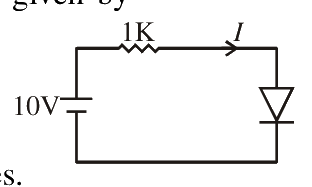
The $I-V$ characteristics of the diode in the circuit below is given by
$$I = \begin{cases} (V - 0.7)/500 & \text{for } V \ge 0.7 \\ 0 & \text{for } V < 0.7 \end{cases}$$
where $V$ is measured in volts and $I$ is measured in amperes.
The current $I$ in the circuit is
a.
$10.0\text{ mA}$
b.
$9.3\text{ mA}$
c.
$6.2\text{ mA}$
d.
$6.7\text{ mA}$
Correct Answer & Step-by-Step Solution Locked
Sign in free to reveal the correct answer and AI explanation for this question.
A junction is made between a metal of work function $W_M$, and a doped semiconductor of work function $W_S$ with $W_M > W_S$. If the electric field at the interface has to be increased by a factor of 3, then the dopant concentration in the semiconductor would have to be
a.
increased by a factor of 9
b.
decreased by a factor of 3
c.
increased by a factor of 3
d.
decreased by a factor of $\sqrt{3}$
Correct Answer & Step-by-Step Solution Locked
Sign in free to reveal the correct answer and AI explanation for this question.
In a measurement of the viscous drag force experienced by spherical particles in a liquid, the force is found to be proportional to $V^{1/3}$ where $V$ is the measured volume of each particle. If $V$ is measured to be $30\text{ mm}^3$, with an uncertainty of $2.7\text{ mm}^3$, the resulting relative percentage uncertainty in the measured force is
a.
2.08
b.
0.09
c.
6
d.
3
Correct Answer & Step-by-Step Solution Locked
Sign in free to reveal the correct answer and AI explanation for this question.
The pressure $P$ of a fluid is related to its number density $\rho$ by the equation of state $P = a\rho + b\rho^2$ where $a$ and $b$ are constants. If the initial volume of the fluid is $V_0$, the work done on the system when it is compressed so as to increase the number density from an initial value of $\rho_0$ to $2\rho_0$ is
The Hamiltonian of a classical particle moving in one dimension is $H = \frac{p^2}{2m} + \alpha q^4$ where $\alpha$ is a positive constant and $p$ and $q$ are its momentum and position respectively. Given that its total energy $E \le E_0$ the available volume of phase space depends on $E_0$ as
a.
$E_0^{3/4}$
b.
$E_0$
c.
$\sqrt{E_0}$
d.
is independent of $E_0$
Correct Answer & Step-by-Step Solution Locked
Sign in free to reveal the correct answer and AI explanation for this question.
An ideal Bose gas is confined inside a container that is connected to a particle reservoir. Each particle can occupy a discrete set of single-particle quantum states. If the probability that a particular quantum state is unoccupied is $0.1$, then the average number of bosons in that state is
a.
8
b.
9
c.
10
d.
11
Correct Answer & Step-by-Step Solution Locked
Sign in free to reveal the correct answer and AI explanation for this question.
In low density oxygen gas at low temperature, only the translational and rotational modes of the molecules are excited. The specific heat per molecule of the gas is
a.
$\frac{1}{2}k_B$
b.
$k_B$
c.
$\frac{3}{2}k_B$
d.
$\frac{5}{2}k_B$
Correct Answer & Step-by-Step Solution Locked
Sign in free to reveal the correct answer and AI explanation for this question.
Consider the amplifier circuit comprising of the two op-amps $\text{A}_1$ and $\text{A}_2$ as shown in the figure If the input ac signal source has an impedance of $50\text{k}\Omega$, which of the following statements is true?
a.
$\text{A}_1$ is required in the circuit because the source impedance is much greater than $r$
b.
$\text{A}_1$ is required in the circuit because the source impedance is much less than $R$
c.
$\text{A}_1$ can be eliminated from the circuit without affecting the overall gain
d.
$\text{A}_1$ is required in the circuit if the output has to follow the phase of the input signal
Correct Answer & Step-by-Step Solution Locked
Sign in free to reveal the correct answer and AI explanation for this question.
A plane electromagnetic wave incident normally on the surface of a material is partially reflected. Measurements on the standing wave in the region in front of the interface show that the ratio of the electric field amplitude at the maxima and the minima is 5. The ratio of the reflected intensity to the incident intensity is
a.
$4/9$
b.
$2/3$
c.
$2/5$
d.
$1/5$
Correct Answer & Step-by-Step Solution Locked
Sign in free to reveal the correct answer and AI explanation for this question.
The scalar and vector potentials $\varphi(\vec{x},t)$ and $\vec{A}(\vec{x},t)$ are determined up to a gauge transformation $\varphi \rightarrow \varphi' = \varphi - \frac{\partial\xi}{\partial t}$ and $\vec{A} \rightarrow \vec{A}' = \vec{A} + \vec{\nabla}\xi$ where $\xi$ is an arbitrary continuous and differentiable function of $\vec{x}$ and $t$. If we further impose the Lorenz gauge condition $\vec{\nabla}\cdot\vec{A} + \frac{1}{c}\frac{\partial\varphi}{\partial t} = 0$ then a possible choice for the gauge function $\xi(\vec{x},t)$ is (where $\omega, \vec{k}$ are nonzero constants with $\omega = c|\vec{k}|$)
a.
$\cos\omega t \cosh\vec{k}\cdot\vec{x}$
b.
$\sinh\omega t \cos\vec{k}\cdot\vec{x}$
c.
$\cosh\omega t \cos\vec{k}\cdot\vec{x}$
d.
$\cosh\omega t \cosh\vec{k}\cdot\vec{x}$
Correct Answer & Step-by-Step Solution Locked
Sign in free to reveal the correct answer and AI explanation for this question.
A non-relativistic particle of mass $m$ and charge $e$, moving with a velocity $\vec{v}$ and acceleration $\vec{a}$, emits radiation of intensity $I$. What is the intensity of the radiation emitted by a particle of mass $m/2$, charge $2e$, velocity $\vec{v}/2$ and acceleration $2\vec{a}$?
a.
$16\ I$
b.
$8\ I$
c.
$4\ I$
d.
$2\ I$
Correct Answer & Step-by-Step Solution Locked
Sign in free to reveal the correct answer and AI explanation for this question.
The expression $\sum_{i,j,k=1}^{3} \epsilon_{ijk} \{x_i, \{p_j, L_k\}\}$ (where $\epsilon_{ijk}$ is the Levi-Civita symbol, $\vec{x}$, $\vec{p}$, $\vec{L}$ are the position, momentum and angular momentum respectively, and $\{A, B\}$ represents the Poisson bracket of A and B) simplifies to
a.
$0$
b.
$6$
c.
$\vec{x}\cdot(\vec{p}\times\vec{L})$
d.
$\vec{x}\times\vec{p}$
Correct Answer & Step-by-Step Solution Locked
Sign in free to reveal the correct answer and AI explanation for this question.
A mechanical system is described by the Hamiltonian $H(q,p) = \frac{p^2}{2m} + \frac{1}{2}m\omega^2 q^2$. As a result of the canonical transformation generated by $F(q,Q) = -\frac{Q}{q}$, the Hamiltonian in the new coordinate $Q$ and momentum $P$ becomes
a.
$\frac{1}{2m}Q^2 P^2 + \frac{m\omega^2}{2}Q^2$
b.
$\frac{1}{2m}Q^2 P^2 + \frac{m\omega^2}{2}P^2$
c.
$\frac{1}{2m}P^2 + \frac{m\omega^2}{2}Q^2$
d.
$\frac{1}{2m}Q^2 P^4 + \frac{m\omega^2}{2}P^{-2}$
Correct Answer & Step-by-Step Solution Locked
Sign in free to reveal the correct answer and AI explanation for this question.
Let $\vec{\sigma} = (\sigma_1, \sigma_2, \sigma_3)$, where $\sigma_1, \sigma_2, \sigma_3$ are the Pauli matrices. If $\vec{a}$ and $\vec{b}$ are two arbitrary constant vectors in three dimensions, the commutator $[\vec{a}\cdot\vec{\sigma}, \vec{b}\cdot\vec{\sigma}]$ is equal to (in the following $I$ is the identity matrix)
Consider the function $f(z) = \frac{1}{z}\ln(1-z)$ of a complex variable $z = re^{i\theta}\,(r \ge 0, -\infty < \theta < \infty)$. The singularities of $f(z)$ are as follows:
a.
branch points at $z=1$ and $z=\infty$; and a pole at $z=0$ only for $0 \le \theta < 2\pi$
b.
branch points at $z=1$ and $z=\infty$; and a pole at $z=0$ for all $\theta$ other than $0 \le \theta < 2\pi$
c.
branch points at $z=1$ and $z=\infty$; and a pole at $z=0$ for all $\theta$
d.
branch points at $z=0$, $z=1$ and $z=\infty$
Correct Answer & Step-by-Step Solution Locked
Sign in free to reveal the correct answer and AI explanation for this question.
The probe *Mangalyaan* was sent recently to explore the planet Mars. The inter-planetary parts of the trajectory is approximately a half-ellipse with the Earth (at the time of launch), Sun and Mars (at the time the probe reaches the destination) forming the major axis. Assuming that the orbits of Earth and Mars are approximately circular with radii $R_E$ and $R_M$, respectively, the velocity (with respect to the Sun) of the probe during its voyage when it is at a distance $r(R_E \ll r \ll R_M)$ from the Sun, neglecting the effect of Earth and Mars, is
a.
$\sqrt{2GM\frac{(R_E+R_M)}{r(R_E+R_M-r)}}$
b.
$\sqrt{2GM\frac{(R_E+R_M-r)}{r(R_E+R_M)}}$
c.
$\sqrt{2GM\frac{R_E}{rR_M}}$
d.
$\sqrt{\frac{2GM}{r}}$
Correct Answer & Step-by-Step Solution Locked
Sign in free to reveal the correct answer and AI explanation for this question.
A large MOS transistor consists of $N$ individual transistors connected in parallel. If the only form of noise in each transistor is $1/f$ noise, then the equivalent voltage noise spectral density for the MOS transistor is
a.
$1/N$ times that of a single transistor
b.
$1/N^2$ times that of a single transistor
c.
$N$ times that of a single transistor
d.
$N^2$ times that of a single transistor
Correct Answer & Step-by-Step Solution Locked
Sign in free to reveal the correct answer and AI explanation for this question.
Consider a particle of mass $m$ in the potential $V(x) = a|x|, a > 0$. The energy eigen-values $E_n (n = 0, 1, 2, \dots)$, in the WKB approximation, are
When laser light of wavelength $\lambda$ falls on a metal scale with $1\text{ mm}$ engravings at a grazing angle of incidence, it is diffracted to form a vertical chain of diffraction spots on a screen kept perpendicular to the scale. if the wavelength of the laser is increased by $200\text{ nm}$, the angle of the first-order diffraction spot changes from $5^\circ$ to
a.
$6.60^\circ$
b.
$5.14^\circ$
c.
$5.018^\circ$
d.
$5.21^\circ$
Correct Answer & Step-by-Step Solution Locked
Sign in free to reveal the correct answer and AI explanation for this question.
Let $|\psi\rangle = c_0|0\rangle + c_1|1\rangle$ (where $c_0$ and $c_1$ are constants with $c_0^2 + c_1^2 = 1$) be a linear combination of the wavefunctions of the ground and first excited states of the one-dimensional harmonic oscillator. For what value of $c_0$ is the expectation value $\langle x \rangle$ a maximum?
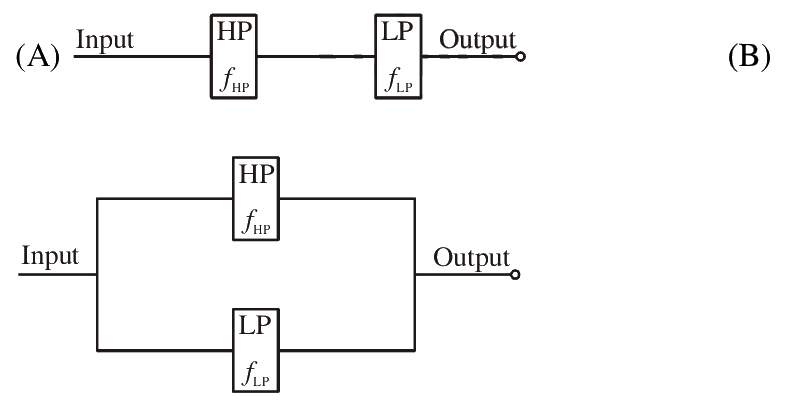
Consider a Low Pass (LP) and a High Pass (HP) filter with cut-off frequencies $f_{LP}$ and $f_{HP}$, respectively, connected in series or in parallel configurations as shown in the Figures A and B below.
Which of the following statements is correct?
a.
For $f_{HP} < f_{LP}$, A acts as a Band Pass filter and B acts as a Band Reject filter
b.
For $f_{HP} > f_{LP}$, A stops the signal from passing through and B passes the signal without filtering
c.
For $f_{HP} < f_{LP}$, A acts as a Band Pass filter and B passes the signal without filtering
d.
For $f_{HP} > f_{LP}$, A passes the signal without filtering and B acts as a Band Reject filter
Correct Answer & Step-by-Step Solution Locked
Sign in free to reveal the correct answer and AI explanation for this question.
A collection $N$ of non-interacting spins $S_i$, $i = 1,2,\dots, N$, ($S_i = \pm 1$) is kept in an external magnetic field $B$ at a temperature $T$. The Hamiltonian of the system is $H = -\mu B \sum_i S_i$. What should be the minimum value of $\frac{\mu B}{k_B T}$ for which the mean value $\langle S_i \rangle \ge \frac{1}{3}$?
a.
$\frac{1}{2} N \ln 2$
b.
$2 \ln 2$
c.
$\frac{1}{2} \ln 2$
d.
$N \ln 2$
Correct Answer & Step-by-Step Solution Locked
Sign in free to reveal the correct answer and AI explanation for this question.
When a gas expands adiabatically from volume $V_1$ to $V_2$ by a quasi-static reversible process, it cools from temperature $T_1$ to $T_2$. If now the same process is carried out adiabatically and irreversibly, and $T_2'$ is the temperature of the gas when it has equilibrated, then
a.
$T_2' = T_2$
b.
$T_2' > T_2$
c.
$T_2' = T_2 \left(\frac{V_2 - V_1}{V_2}\right)$
d.
$T_2' = \frac{T_2 V_1}{V_2}$
Correct Answer & Step-by-Step Solution Locked
Sign in free to reveal the correct answer and AI explanation for this question.
A random walker takes a step of unit length in the positive direction with probability $2/3$ and a step of unit length in the negative direction with probability $1/3$. The mean displacement of the walker after $n$ steps is
a.
$n/3$
b.
$n/8$
c.
$2n/3$
d.
$0$
Correct Answer & Step-by-Step Solution Locked
Sign in free to reveal the correct answer and AI explanation for this question.
The Hamiltonian $H_0$ for a three-state quantum system is given by the matrix $H_0 = \begin{pmatrix} 1 & 0 & 0 \\ 0 & 2 & 0 \\ 0 & 0 & 2 \end{pmatrix}$.
When perturbed by $H' = \epsilon \begin{pmatrix} 0 & 1 & 0 \\ 1 & 0 & 1 \\ 0 & 1 & 0 \end{pmatrix}$ where $\epsilon \ll 1$, the resulting shift in the energy eigenvalue $E_0 = 2$ is
a.
$\epsilon, -2\epsilon$
b.
$-\epsilon, 2\epsilon$
c.
$\pm \epsilon$
d.
$\pm 2\epsilon$
Correct Answer & Step-by-Step Solution Locked
Sign in free to reveal the correct answer and AI explanation for this question.
The ground state energy of the attractive delta function potential $V(x) = -b\delta(x)$, where $b > 0$, calculated with the variational trial function $\psi(x) = \begin{cases} A \cos \frac{\pi x}{2a}, & \text{for } -a < x < a, \\ 0, & \text{otherwise}, \end{cases}$ is
a.
$-\frac{mb^2}{\pi^2 \hbar^2}$
b.
$-\frac{2mb^2}{\pi^2 \hbar^2}$
c.
$-\frac{mb^2}{2\pi^2 \hbar^2}$
d.
$-\frac{mb^2}{4\pi^2 \hbar^2}$
Correct Answer & Step-by-Step Solution Locked
Sign in free to reveal the correct answer and AI explanation for this question.
If the binding energy $B$ of a nucleus (mass number $A$ and charge $Z$) is given by
$$B = a_v A - a_s A^{2/3} - a_{\text{sym}} \frac{(2Z - A)^2}{A} - \frac{a_c Z^2}{A^{1/3}}$$
where $a_v = 16\text{ MeV}$, $a_s = 16\text{ MeV}$, $a_{\text{sym}} = 24\text{ MeV}$ and $a_c = 0.75\text{ MeV}$, then the $Z$ for the most stable isobar for a nucleus with $A = 216$ is
a.
$68$
b.
$72$
c.
$84$
d.
$92$
Correct Answer & Step-by-Step Solution Locked
Sign in free to reveal the correct answer and AI explanation for this question.
Consider the crystal structure of sodium chloride which is modeled as a set of touching spheres. Each sodium atom has a radius $r_1$ and each chlorine atom has a radius $r_2$. The centres of the spheres form a simple cubic lattice. The packing fraction of this system is
Consider two crystalline solids, one of which has a simple cubic structure, and the other has a tetragonal structure. The effective spring constant between atoms in the $c$-direction is half the effective spring constant between atoms in the $a$ and $b$ directions. At low temperatures, the behaviour of the lattice contribution to the specific heat will depend as a function of temperature $T$ as
a.
$T^2$ for the tetragonal solid, but as $T^3$ for the simple cubic solid
b.
$T$ for the tetragonal solid and as $T^3$ for the simple cubic solid
c.
$T$ for both solids
d.
$T^3$ for both solids
Correct Answer & Step-by-Step Solution Locked
Sign in free to reveal the correct answer and AI explanation for this question.
An atomic transition $^1\text{P} \rightarrow \, ^1\text{S}$ in a magnetic field $1\text{ Tesla}$ shows Zeeman splitting. Given that the Bohr magneton $\mu_{\text{B}} = 9.27 \times 10^{-24}\text{ J/T}$, and the wavelength corresponding to the transition is $250\text{ nm}$, the separation in the Zeeman spectral lines is approximately
a.
$0.01\text{ nm}$
b.
$0.1\text{ nm}$
c.
$1.0\text{ nm}$
d.
$10\text{ nm}$
Correct Answer & Step-by-Step Solution Locked
Sign in free to reveal the correct answer and AI explanation for this question.
If the leading anharmonic correction to the energy of the $n$-th vibrational level of a diatomic molecule is $-x_e \left(n + \frac{1}{2}\right)^2 \hbar\omega$ with $x_e = 0.001$, the total number of energy levels possible is approximately
a.
$500$
b.
$1000$
c.
$250$
d.
$750$
Correct Answer & Step-by-Step Solution Locked
Sign in free to reveal the correct answer and AI explanation for this question.
A superconducting ring carries a steady current in the presence of a magnetic field $\vec{B}$ normal to the plane of the ring. Identify the \underline{incorrect} statement.
a.
The flux passing through the superconductor is quantized in units of $hc/e$
b.
The current and the magnetic field in the superconductor are time independent
c.
The current density $\vec{J}$ and $\vec{B}$ are related by the equation $\vec{\nabla} \times \vec{J} + \Lambda^2 \vec{B} = 0$, where $\Lambda$ is a constant
d.
The superconductor shows an energy gap which is proportional to the transition temperature of the superconductor
Correct Answer & Step-by-Step Solution Locked
Sign in free to reveal the correct answer and AI explanation for this question.
The effective spin-spin interaction between the electron spin $\vec{s}_e$ and the proton spin $\vec{s}_p$ in the ground state of the Hydrogen atom is given by $H' = a\vec{s}_e \cdot \vec{s}_p$. As a result of this interaction, the energy levels split by an amount
a.
$\frac{1}{2} a\hbar^2$
b.
$2 a\hbar^2$
c.
$a\hbar^2$
d.
$\frac{3}{2} a\hbar^2$
Correct Answer & Step-by-Step Solution Locked
Sign in free to reveal the correct answer and AI explanation for this question.
In deep inelastic scattering electrons are scattered off protons to determine if a proton has any internal structure. The energy of the electron for this must be at least
a.
$1.25 \times 10^9\text{ eV}$
b.
$1.25 \times 10^{12}\text{ eV}$
c.
$1.25 \times 10^6\text{ eV}$
d.
$1.25 \times 10^8\text{ eV}$
Correct Answer & Step-by-Step Solution Locked
Sign in free to reveal the correct answer and AI explanation for this question.
The power density of sunlight incident on a solar cell is $100\text{ mW/cm}^2$. Its short circuit current density is $30\text{ mA/cm}^2$ and the open circuit voltage is $0.7\text{ V}$. If the fill factor of the solar cell decreases from $0.8$ to $0.5$ then the percentage efficiency will decrease from
a.
$42.0\text{ to }26.2$
b.
$24.0\text{ to }16.8$
c.
$21.0\text{ to }10.5$
d.
$16.8\text{ to }10.5$
Correct Answer & Step-by-Step Solution Locked
Sign in free to reveal the correct answer and AI explanation for this question.
Consider the four processes
(i) $p^+ \rightarrow n+e^++\nu_e$
(ii) $\Lambda^0 \rightarrow p^++e^++\nu_e$
(iii) $\pi^+ \rightarrow e^++\nu_e$
(iv) $\pi^0 \rightarrow \gamma+\gamma$
Which of the above is/are forbidden for free particles?
a.
only (ii)
b.
(ii) and (iv)
c.
(i) and (iv)
d.
(i) and (ii)
Correct Answer & Step-by-Step Solution Locked
Sign in free to reveal the correct answer and AI explanation for this question.