Two identical bosons of mass $m$ are placed in a one-dimensional potential $V(x) = \frac{1}{2}m\omega^2 x^2$. The bosons interact via a weak potential, $V_{12} = V_0 \exp[-m\Omega(x_1 - x_2)^2 / 4\hbar]$ where $x_1$ and $x_2$ denote coordinates of the particles. Given that the ground state wavefunction of the harmonic oscillator is $\psi_0(x) = \left(\frac{m\omega}{\pi\hbar}\right)^{\frac{1}{4}} e^{-\frac{m\omega x^2}{2\hbar}}$. The ground state energy of the two-boson system, to the first order in $V_0$, is:
The unperturbed ground state for two non-interacting bosons is $\Psi_0(x_1, x_2) = \psi_0(x_1)\psi_0(x_2)$ with energy $E^{(0)} = \frac{1}{2}\hbar\omega + \frac{1}{2}\hbar\omega = \hbar\omega$.
The first-order correction to the ground state energy is the expectation value of the perturbation $V_{12}$:
$$E^{(1)} = \langle \Psi_0 | V_{12} | \Psi_0 \rangle = V_0 \left(\frac{m\omega}{\pi\hbar}\right) \int_{-\infty}^\infty dx_1 \int_{-\infty}^\infty dx_2 \exp\left[-\frac{m\omega}{\hbar}(x_1^2 + x_2^2) - \frac{m\Omega}{4\hbar}(x_1 - x_2)^2\right]$$
Let us transform to center-of-mass and relative coordinates:
$$X = \frac{x_1 + x_2}{\sqrt{2}}, \quad x = \frac{x_1 - x_2}{\sqrt{2}}$$
Then $x_1^2 + x_2^2 = X^2 + x^2$, $(x_1 - x_2)^2 = 2x^2$, and the Jacobian is $1$. The integral factorizes:
$$E^{(1)} = V_0 \left(\frac{m\omega}{\pi\hbar}\right) \left(\int_{-\infty}^\infty e^{-\frac{m\omega}{\hbar}X^2} dX\right) \left(\int_{-\infty}^\infty e^{-\left(\frac{m\omega}{\hbar} + \frac{m\Omega}{2\hbar}\right)x^2} dx\right)$$
Evaluating the Gaussian integrals:
$$\int_{-\infty}^\infty e^{-\frac{m\omega}{\hbar}X^2} dX = \sqrt{\frac{\pi\hbar}{m\omega}}$$
$$\int_{-\infty}^\infty e^{-\frac{m}{\hbar}\left(\omega + \frac{\Omega}{2}\right)x^2} dx = \sqrt{\frac{\pi\hbar}{m\left(\omega + \frac{\Omega}{2}\right)}}$$
Multiplying these gives:
$$E^{(1)} = V_0 \left(\frac{m\omega}{\pi\hbar}\right) \sqrt{\frac{\pi\hbar}{m\omega}} \sqrt{\frac{\pi\hbar}{m\omega\left(1 + \frac{\Omega}{2\omega}\right)}} = V_0 \left(1 + \frac{\Omega}{2\omega}\right)^{-1/2}$$
Thus, the ground state energy to first order is $E = \hbar\omega + V_0 \left(1 + \frac{\Omega}{2\omega}\right)^{-1/2}$.
Q22mcq
Ten grams of ice at $0^\circ\text{C}$ is added to a beaker containing $30\text{ grams}$ of water at $25^\circ\text{C}$. What is the final temperature of the system when it comes to thermal equilibrium? (The specific heat of water is $1\text{ cal/gm/}^\circ\text{C}$ and latent heat of melting of ice is $80\text{ cal/gm}$)
a.
$0^\circ\text{C}$
Correct Answer
b.
$7.5^\circ\text{C}$
c.
$12.5^\circ\text{C}$
d.
$-1.25^\circ\text{C}$
Step-by-Step AI Explanation
Verified Method
The heat required to completely melt $10\text{ g}$ of ice at $0^\circ\text{C}$ is:
$$Q_{\text{req}} = m_{\text{ice}} L_f = 10\text{ g} \times 80\text{ cal/g} = 800\text{ cal}$$
The heat released by $30\text{ g}$ of water cooling from $25^\circ\text{C}$ to $0^\circ\text{C}$ is:
$$Q_{\text{rel}} = m_w c_w \Delta T = 30\text{ g} \times 1\text{ cal/g}^\circ\text{C} \times (25 - 0)^\circ\text{C} = 750\text{ cal}$$
Since $Q_{\text{rel}} < Q_{\text{req}}$, the heat released by cooling the water to $0^\circ\text{C}$ is not sufficient to melt all the ice. Therefore, the system reaches a phase equilibrium containing a mixture of ice and water at $0^\circ\text{C}$.
Q23mcq
A vessel has two compartments of volume $V_1$ and $V_2$, containing an ideal gas at pressures $p_1$ and $p_2$, and temperatures $T_1$ and $T_2$ respectively. If the wall separating the compartments is removed, the resulting equilibrium temperature will be
Assuming the vessel is thermally insulated, the total internal energy and the total number of moles of the ideal gas are conserved:
$$U_{\text{total}} = U_1 + U_2$$
Since $U = n C_v T = \frac{C_v}{R} pV$ (assuming the same gas or same degrees of freedom), we have:
$$n_{\text{total}} T = n_1 T_1 + n_2 T_2 \implies \left(\frac{p_1 V_1}{R T_1} + \frac{p_2 V_2}{R T_2}\right) T = \frac{p_1 V_1}{R} + \frac{p_2 V_2}{R}$$
Solving for the final temperature $T$:
$$T = \frac{p_1 V_1 + p_2 V_2}{\frac{p_1 V_1}{T_1} + \frac{p_2 V_2}{T_2}}$$
This matches option C.
Q24mcq
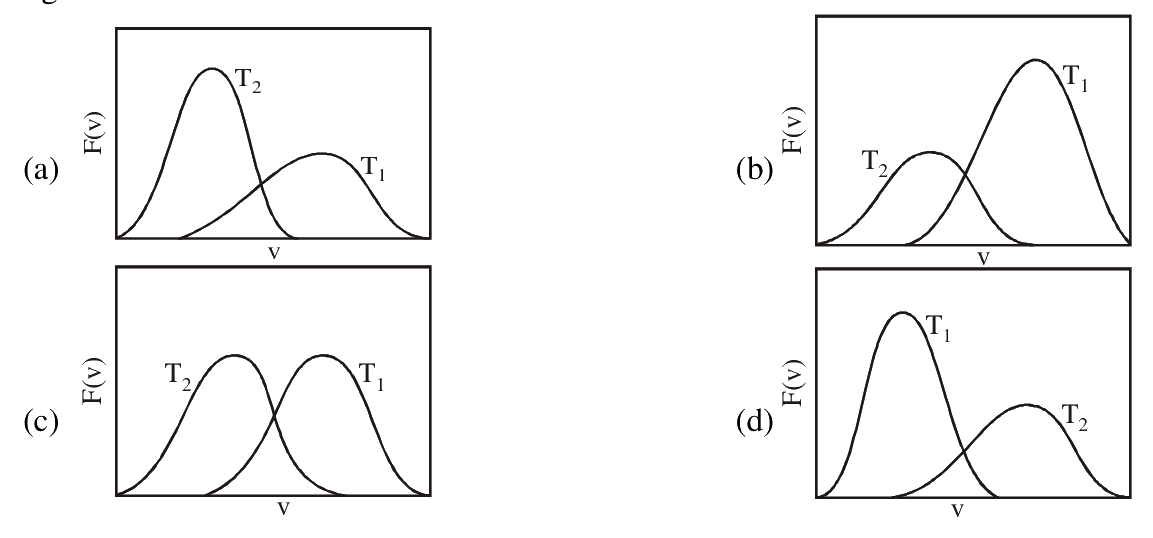
For temperature $T_1 > T_2$, the qualitative temperature dependence of the probability distribution $F(v)$ of the speed $v$ of a molecule in three dimensions is correctly represented by the following figure:
Step-by-Step AI Explanation
Verified Method
The Maxwell-Boltzmann speed distribution is given by $F(v) = 4\pi \left(\frac{m}{2\pi k_B T}\right)^{3/2} v^2 e^{-mv^2 / (2k_B T)}$.
As temperature increases ($T_1 > T_2$):
1. The most probable speed $v_p = \sqrt{\frac{2k_B T}{m}}$ increases, shifting the peak to higher speeds (further to the right for $T_1$).
2. The height of the peak at $v_p$, $F(v_p) \propto \frac{1}{\sqrt{T}}$, decreases because the distribution broadens while the total area under $F(v)$ remains normalized to 1.
Thus, the curve for $T_1$ must have a lower peak located at a larger speed $v$ compared to the curve for $T_2$. Diagram (a) accurately depicts this behavior.
Q25mcq
A system of non-interacting spin-$1/2$ charged particles are placed in an external magnetic field. At low temperature $T$, the leading behavior of the excess energy above the ground state energy, depends on $T$ as: ($c$ is a constant)
a.
$cT$
b.
$cT^3$
c.
$e^{-c/T}$
Correct Answer
d.
$c$ (is independent of $T$)
Step-by-Step AI Explanation
Verified Method
For a system of non-interacting spin-$1/2$ particles in a magnetic field $B$, each particle has two energy states: ground state $-\mu B$ and excited state $+\mu B$, separated by an energy gap $\Delta = 2\mu B$.
The average excess energy per particle above the ground state is:
$$\Delta E = \frac{\Delta e^{-\Delta / k_B T}}{1 + e^{-\Delta / k_B T}}$$
At low temperatures ($k_B T \ll \Delta$), $e^{-\Delta / k_B T} \ll 1$, so the leading behavior of the excess energy is exponentially suppressed as:
$$\Delta E \approx \Delta e^{-\Delta / k_B T} \propto e^{-c/T}$$
where $c = \Delta / k_B$ is a constant. Hence, the correct option is C.
Q26mcq
The acceleration due to gravity $g$ is determined by measuring the time period $T$ and the length $L$ of a simple pendulum. If the uncertainties in the measurements of $T$ and $L$ are $\Delta T$ and $\Delta L$ respectively, the fractional error $\Delta g/g$ in measuring $g$ is best approximated by
The time period of a simple pendulum is given by $T = 2\pi \sqrt{\frac{L}{g}}$, which gives $g = 4\pi^2 \frac{L}{T^2}$.
Taking the natural logarithm: $\ln g = \ln(4\pi^2) + \ln L - 2\ln T$.
For independent, random experimental errors $\Delta L$ and $\Delta T$, the errors add in quadrature according to standard error propagation:
$$\frac{\Delta g}{g} = \sqrt{\left(\frac{\Delta L}{L}\right)^2 + \left(\frac{2\Delta T}{T}\right)^2}$$
Thus, option D is the correct choice.
Q27mcq
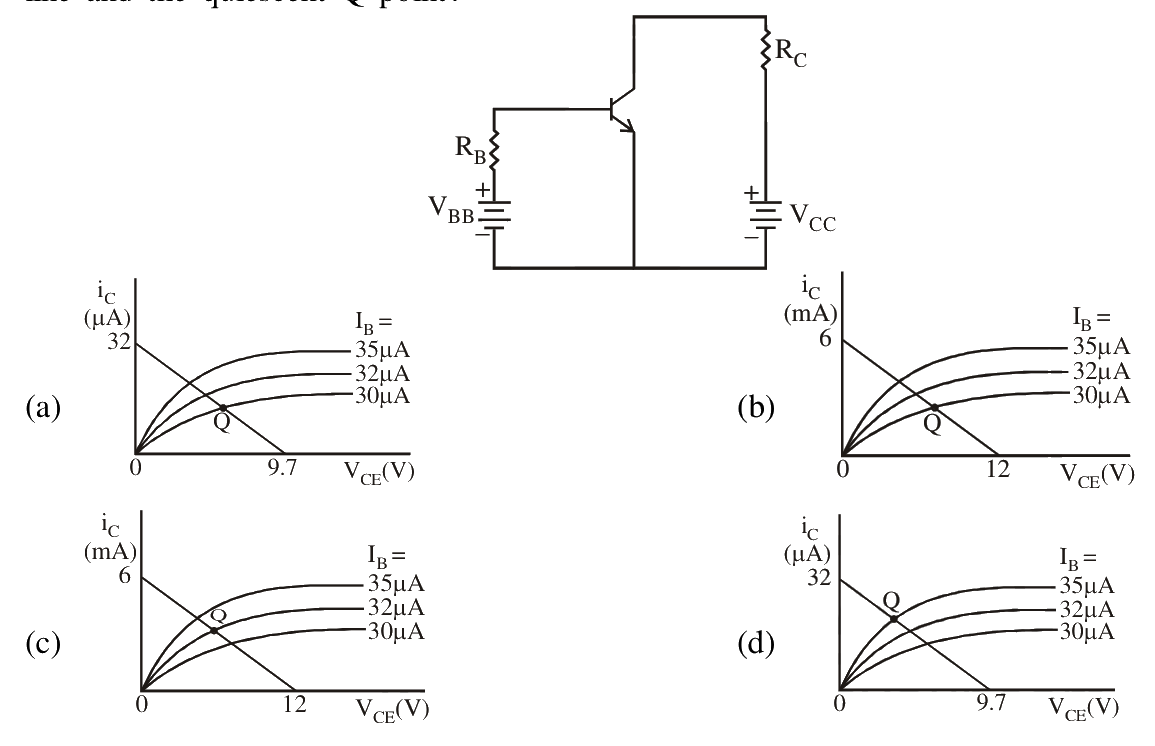
A silicon transistor with built-in voltage $0.7\text{ V}$ is used in the circuit shown, with $V_{\text{BB}} = 9.7\text{ V}$, $R_{\text{B}} = 300\text{ k}\Omega$, $V_{\text{CC}} = 12\text{ V}$ and $R_{\text{C}} = 2\text{ k}\Omega$. Which of the following figures correctly represents the load line and the quiescent Q point?
a.
(a)
b.
(b)
Correct Answer
c.
(c)
d.
(d)
Step-by-Step AI Explanation
Verified Method
1. **Base Current ($I_{\text{B}}$):**
Applying KVL to the base-emitter loop:
$$V_{\text{BB}} - I_{\text{B}} R_{\text{B}} - V_{\text{BE}} = 0$$
$$I_{\text{B}} = \frac{V_{\text{BB}} - V_{\text{BE}}}{R_{\text{B}}} = \frac{9.7\text{ V} - 0.7\text{ V}}{300\text{ k}\Omega} = \frac{9.0\text{ V}}{300\text{ k}\Omega} = 30\ \mu\text{A}$$
Thus, the quiescent operating point Q must lie on the curve corresponding to $I_{\text{B}} = 30\ \mu\text{A}$.
2. **Load Line on the Collector Characteristics:**
Applying KVL to the collector-emitter loop:
$$V_{\text{CC}} - I_{\text{C}} R_{\text{C}} - V_{\text{CE}} = 0$$
- When $I_{\text{C}} = 0$, $V_{\text{CE}} = V_{\text{CC}} = 12\text{ V}$ (x-intercept).
- When $V_{\text{CE}} = 0$, $I_{\text{C}} = \frac{V_{\text{CC}}}{R_{\text{C}}} = \frac{12\text{ V}}{2\text{ k}\Omega} = 6\text{ mA}$ (y-intercept).
Among the choices, figure (b) has the load line with intercepts at $V_{\text{CE}} = 12\text{ V}$ and $I_{\text{C}} = 6\text{ mA}$, and the Q-point is located on the $I_{\text{B}} = 30\ \mu\text{A}$ curve. (Figure (c) places the Q-point incorrectly at $I_B = 32\ \mu\text{A}$). Thus, (b) is correct.
Q28mcq
If the analog input to an 8-bit successive approximation ADC is increased from $1.0\text{ V}$ to $2.0\text{ V}$, then the conversion time will
a.
remain unchanged
Correct Answer
b.
double
c.
decrease to half its original value
d.
increase four times
Step-by-Step AI Explanation
Verified Method
In a successive approximation register (SAR) ADC, the conversion is performed bit by bit starting from the most significant bit (MSB) to the least significant bit (LSB). For an $N$-bit SAR ADC, the conversion always takes $N$ clock cycles (or $N+1$ cycles depending on the specific implementation), which depends only on the number of bits and clock frequency, and is completely independent of the magnitude of the analog input voltage. Therefore, changing the input voltage from $1.0\text{ V}$ to $2.0\text{ V}$ leaves the conversion time unchanged.
Q29mcq
The insulation resistance $R$ of an insulated cable is measured by connecting it in parallel with a capacitor $C$, a voltmeter, and battery $B$ as shown. The voltage across the cable dropped from $150\text{ V}$ to $15\text{ V}$, $1000\text{ seconds}$ after the switch $S$ is closed. If the capacitance of the cable is $5\,\mu\text{F}$ then its insulation resistance is approximately
a.
$10^9\,\Omega$
b.
$10^8\,\Omega$
Correct Answer
c.
$10^7\,\Omega$
d.
$10^6\,\Omega$
Step-by-Step AI Explanation
Verified Method
The discharge of the capacitor through the insulation resistance of the cable is governed by the relation $V(t) = V_0 e^{-t / (RC)}$.
Here, $V_0 = 150\text{ V}$, $V(t) = 15\text{ V}$, $t = 1000\text{ s}$, and $C = 5\,\mu\text{F} = 5 \times 10^{-6}\text{ F}$.
Taking the natural logarithm:
$$\frac{V(t)}{V_0} = \frac{15}{150} = 0.1 = e^{-t / (RC)}$$
$$\ln(10) = \frac{t}{RC} \implies RC = \frac{t}{\ln(10)} = \frac{1000}{2.3026} \approx 434.3\text{ s}$$
Now, solving for $R$:
$$R = \frac{434.3}{5 \times 10^{-6}\text{ F}} \approx 8.7 \times 10^7\,\Omega \approx 10^8\,\Omega$$
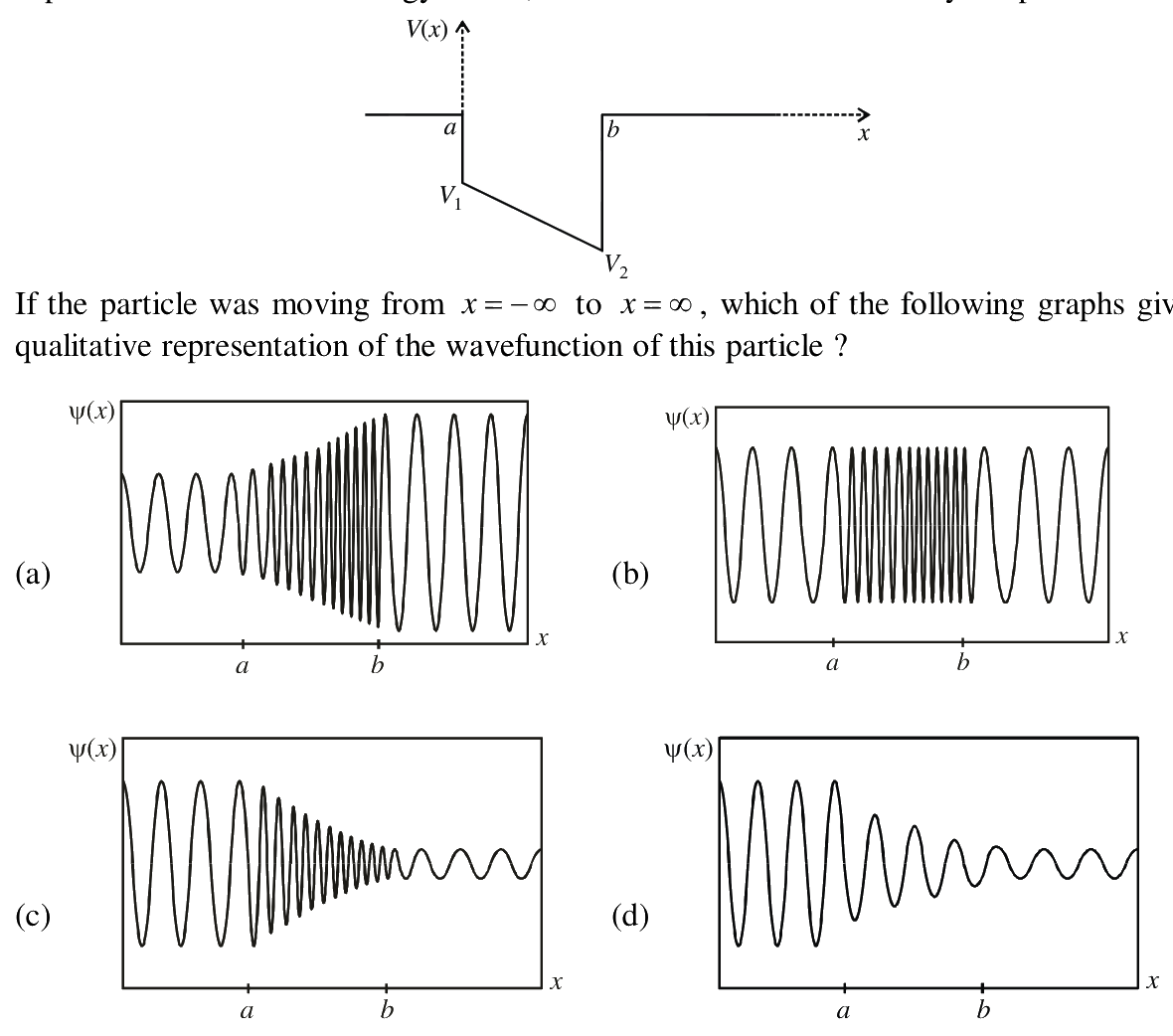
Thus, the insulation resistance is of the order of $10^8\,\Omega$, which corresponds to option B. (Note: Image #1 attached to this item appears to be an unrelated image from a quantum mechanics question; the text fully specifies the circuit problem).
Q36mcq
In a basis in which the z-component $S_z$ of the spin is diagonal, an electron is in a spin state
$$\psi = \begin{pmatrix} (1+i)/\sqrt{6} \\ \sqrt{2/3} \end{pmatrix}$$
The probabilities that a measurement of $S_z$ will yield the values $\hbar/2$ and $-\hbar/2$ are, respectively.
a.
$1/2$ and $1/2$
b.
$2/3$ and $1/3$
c.
$1/4$ and $3/4$
d.
$1/3$ and $2/3$
Correct Answer
Step-by-Step AI Explanation
Verified Method
The spin state is given in the $S_z$ eigenbasis as:
$$\psi = \begin{pmatrix} c_1 \\ c_2 \end{pmatrix} = \begin{pmatrix} \frac{1+i}{\sqrt{6}} \\ \sqrt{\frac{2}{3}} \end{pmatrix}$$
The probability of obtaining $S_z = +\hbar/2$ is:
$$P(+\hbar/2) = |c_1|^2 = \left|\frac{1+i}{\sqrt{6}}\right|^2 = \frac{1^2 + 1^2}{6} = \frac{2}{6} = \frac{1}{3}$$
The probability of obtaining $S_z = -\hbar/2$ is:
$$P(-\hbar/2) = |c_2|^2 = \left|\sqrt{\frac{2}{3}}\right|^2 = \frac{2}{3}$$
Therefore, the probabilities are $1/3$ and $2/3$, respectively.
🎉 10 Free Sample Solutions Completed
Unlock All 49 Questions & Solutions
Sign up free in seconds to unlock step-by-step AI answers for the remaining 39 questions.
Consider the normalized state $|\psi\rangle$ of a particle in a one-dimensional harmonic oscillator:
$$|\psi\rangle = b_1 |0\rangle + b_2 |1\rangle$$
where $|0\rangle$ and $|1\rangle$ denote the ground and first excited states respectively, and $b_1$ and $b_2$ are real constants. The expectation value of the displacement x in the state $|\psi\rangle$ will be a minimum when
a.
$b_2 = 0, (b_1 = 1)$
b.
$b_2 = \frac{1}{\sqrt{2}} b_1$
c.
$b_2 = \frac{1}{2} b_1$
d.
$b_2 = b_1$
Correct Answer & Step-by-Step Solution Locked
Sign in free to reveal the correct answer and AI explanation for this question.
A muon ($\mu^-$) from cosmic rays is trapped by a proton to form a hydrogen-like atom. Given that a muon is approximately 200 times heavier than an electron, the longest wavelength of the spectral line (in the analogue of the Lyman series) of such an atom will be
a.
$5.62\text{ \AA}$
b.
$6.67\text{ \AA}$
c.
$3.75\text{ \AA}$
d.
$13.3\text{ \AA}$
Correct Answer & Step-by-Step Solution Locked
Sign in free to reveal the correct answer and AI explanation for this question.
The un-normalized wavefunction of a particle in a spherically symmetric potential is given by $\psi(\vec{r}) = z f(r)$ where $f(r)$ is a function of the radial variable $r$. The eigenvalue of the operator $\vec{L}^2$ (namely the square of the orbital angular momentum) is
a.
$\hbar^2 / 4$
b.
$\hbar^2 / 2$
c.
$\hbar^2$
d.
$2\hbar^2$
Correct Answer & Step-by-Step Solution Locked
Sign in free to reveal the correct answer and AI explanation for this question.
A unit vector $\hat{n}$ on the xy-plane is at an angle of $120^\circ$ with respect to $\hat{i}$. The angle between the vectors $\vec{u} = a\hat{i} + b\hat{n}$ and $\vec{v} = a\hat{n} + b\hat{i}$ will be $60^\circ$ if
a.
$b = \sqrt{3} a / 2$
b.
$b = 2a / \sqrt{3}$
c.
$b = a/2$
d.
$b = a$
Correct Answer & Step-by-Step Solution Locked
Sign in free to reveal the correct answer and AI explanation for this question.
A planet of mass $m$ and an angular momentum $L$ moves in a circular orbit in a potential, $V(r) = -k/r$, where $k$ is a constant. If it is slightly perturbed radially, the angular frequency of radial oscillations is
a.
$mk^2 / \sqrt{2} L^3$
b.
$mk^2 / L^3$
c.
$\sqrt{2}mk^2 / L^3$
d.
$\sqrt{3}mk^2 / L^3$
Correct Answer & Step-by-Step Solution Locked
Sign in free to reveal the correct answer and AI explanation for this question.
The Lagrangian of a particle of mass $m$ moving in one dimensions is given by
$$L = \frac{1}{2} m\dot{x}^2 - bx$$
where $b$ is a positive constant. The coordinate of the particle $x(t)$ at time $t$ is given by: (in the following $c_1$ and $c_2$ are constants)
A uniform cylinder of radius $\mathrm{r}$ and length $\ell$, and a uniform sphere of radius $\mathrm{R}$ are released on an inclined plane when their centres of mass are at the same height. If they roll down without slipping, and if the sphere reaches the bottom of the plane with a speed $\mathrm{V}$, then the speed of the cylinder when it reaches the bottom is:
The components of a vector potential $\mathrm{A}_\mu \equiv (\mathrm{A}_0, \mathrm{A}_1, \mathrm{A}_2, \mathrm{A}_3)$ are given by $\mathrm{A}_\mu = \mathrm{k}(-\mathrm{xyz}, \mathrm{yzt}, \mathrm{zxt}, \mathrm{xyt})$ where $\mathrm{k}$ is a constant. The three components of the electric field are
In the Born approximation, the scattering amplitude $\mathrm{f}(\theta)$ for the Yukawa potential $\mathrm{V}(\mathrm{r}) = \frac{\beta \mathrm{e}^{-\mu \mathrm{r}}}{\mathrm{r}}$ is given by: (in the following $\mathrm{b} = 2\mathrm{k} \sin\frac{\theta}{2}$, $\mathrm{E} = \hbar^2 \mathrm{k}^2 / 2\mathrm{m}$)
If $\psi_{n\ell m}$ denotes the eigenfunction of the Hamiltonian with a potential $\mathrm{V} = \mathrm{V}(\mathrm{r})$ then the expectation value of the operator $\mathrm{L}_\mathrm{x}^2 + \mathrm{L}_\mathrm{y}^2$ in the state $\psi = \frac{1}{5}[3\psi_{211} + \psi_{210} - \sqrt{15}\psi_{21-1}]$ is
a.
$39\hbar^2 / 25$
b.
$13\hbar^2 / 25$
c.
$2\hbar^2$
d.
$26\hbar^2 / 25$
Correct Answer & Step-by-Step Solution Locked
Sign in free to reveal the correct answer and AI explanation for this question.
An oscillating current $\mathrm{I}(\mathrm{t}) = \mathrm{I}_0 \exp(-\mathrm{i}\omega \mathrm{t})$ flows in the direction of the y-axis through a thin metal sheet of area $1.0\text{ cm}^2$ kept in the xy-plane. The rate of total energy radiated per unit area from the surfaces of the metal sheet at a distance of $100\text{m}$ is
Consider a two-dimensional infinite square well $\mathrm{V}(\mathrm{x}, \mathrm{y}) = \begin{cases} 0 & 0 < \mathrm{x} < \mathrm{a},\quad 0 < \mathrm{y} < \mathrm{a} \\ \infty & \text{otherwise} \end{cases}$. Its normalized eigenfunctions are $\psi_{\mathrm{n}_\mathrm{x}, \mathrm{n}_\mathrm{y}}(\mathrm{x}, \mathrm{y}) = \frac{2}{\mathrm{a}} \sin\left(\frac{\mathrm{n}_\mathrm{x}\pi \mathrm{x}}{\mathrm{a}}\right) \sin\left(\frac{\mathrm{n}_\mathrm{y}\pi \mathrm{y}}{\mathrm{a}}\right)$ where $\mathrm{n}_\mathrm{x}, \mathrm{n}_\mathrm{y} = 1, 2, 3, \dots$ If a perturbation $\mathrm{H}' = \begin{cases} \mathrm{V}_0 & 0 < \mathrm{x} < \frac{\mathrm{a}}{2},\quad 0 < \mathrm{y} < \frac{\mathrm{a}}{2} \\ 0 & \text{otherwise} \end{cases}$ is applied, then the correction to the energy of the first excited state to order $V_0$ is
a.
$\frac{V_0}{4}$
b.
$\frac{V_0}{4}\left[1\pm\frac{64}{9\pi^2}\right]$
c.
$\frac{V_0}{4}\left[1\pm\frac{16}{9\pi^2}\right]$
d.
$\frac{V_0}{4}\left[1\pm\frac{32}{9\pi^2}\right]$
Correct Answer & Step-by-Step Solution Locked
Sign in free to reveal the correct answer and AI explanation for this question.
Consider a system of two Ising spins $S_1$ and $S_2$ taking value $\pm 1$ with interaction energy given by $\varepsilon = -JS_1S_2$, when it is in thermal equilibrium at temperature $T$. For large $T$, the average energy of the system varies as $C/k_BT$, with $C$ given by
a.
$-2J^2$
b.
$-J^2$
c.
$J^2$
d.
$4J$
Correct Answer & Step-by-Step Solution Locked
Sign in free to reveal the correct answer and AI explanation for this question.
Consider three particles A, B and C, each with an attribute $S$ that can take two value $\pm 1$. Let $S_A = 1$, $S_B = 1$ and $S_C = -1$ at a given instant. In the next instant, each $S$ value can change to $-S$ with probability $1/3$. The probability that $S_A + S_B + S_C$ remains unchanged is
a.
$2/3$
b.
$1/3$
c.
$2/9$
d.
$4/9$
Correct Answer & Step-by-Step Solution Locked
Sign in free to reveal the correct answer and AI explanation for this question.
The bound on the ground state energy of the Hamiltonian with an attractive delta-function potential, namely
$$H = -\frac{\hbar^2}{2m} \frac{d^2}{dx^2} - \alpha\delta(x)$$
using the variational principle with the trial wavefunction $\Psi(x) = A \exp(-bx^2)$ is
$$\left[\text{Note}: \int_0^\infty e^{-t} t^a dt = \Gamma(a+1)\right]$$
a.
$-m\alpha^2 / 4\pi\hbar^2$
b.
$-m\alpha^2 / 2\pi\hbar^2$
c.
$-m\alpha^2 / \pi\hbar^2$
d.
$-m\alpha^2 / \sqrt{5}\pi\hbar^2$
Correct Answer & Step-by-Step Solution Locked
Sign in free to reveal the correct answer and AI explanation for this question.
Consider two different systems each with three identical non-interacting particles. Both have single particle states with energies $\varepsilon_0$, $3\varepsilon_0$ and $5\varepsilon_0$, ($\varepsilon_0 > 0$). One system is populated by spin-$\frac{1}{2}$ fermions and the other by bosons. What is the value of $E_F - E_B$ where $E_F$ and $E_B$ are the ground state energies of the fermionic and bosonic systems respectively?
a.
$6\varepsilon_0$
b.
$2\varepsilon_0$
c.
$4\varepsilon_0$
d.
$\varepsilon_0$
Correct Answer & Step-by-Step Solution Locked
Sign in free to reveal the correct answer and AI explanation for this question.
The input to a lock-in amplifier has the form $V_i(t) = V_i\sin(\omega t + \theta_i)$ where $V_i$, $\omega$, $\theta_i$ are the amplitude, frequency and phase of the input signal respectively. This signal is multiplied by a reference signal of the same frequency $\omega$, amplitude $V_r$ and phase $\theta_r$. If the multiplied signal is fed to a low pass filter of cut-off frequency $\omega$, then the final output signal is
Consider the hydrogen deuterium molecule $\text{HD}$. If the mean distance between the two atoms is $0.08\text{ nm}$ and the mass of the hydrogen atom is $938\text{ MeV}/c^2$, then the energy difference $\Delta E$ between the two lowest rotational states is approximately
a.
$10^{-1} \text{eV}$
b.
$10^{-2} \text{eV}$
c.
$2 \times 10^{-2} \text{eV}$
d.
$10^{-3} \text{eV}$
Correct Answer & Step-by-Step Solution Locked
Sign in free to reveal the correct answer and AI explanation for this question.
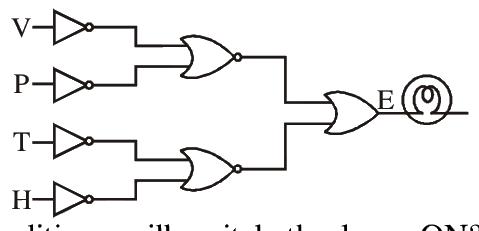
Four digital outputs $\text{V}$, $\text{P}$, $\text{T}$ and $\text{H}$ monitor the speed $\text{v}$, tyre pressure $\text{p}$, temperature $\text{t}$ and relative humidity $\text{h}$ of a car. These outputs switch from $0$ to $1$ when the values of the parameters exceed $85\text{ km/hr}$, $2\text{ bar}$, $40^\circ\text{C}$ and $50\%$, respectively. A logic circuit that is used to switch $\text{ON}$ a lamp at the output $\text{E}$ is shown below.
Which of the following conditions will switch the lamp $\text{ON}$?
The solution of the differential equation $\frac{\text{dx}}{\text{dt}} = x^2$ with the initial condition $x(0) = 1$ will blow up as $\text{t}$ tends to
a.
$1$
b.
$2$
c.
$1/2$
d.
$\infty$
Correct Answer & Step-by-Step Solution Locked
Sign in free to reveal the correct answer and AI explanation for this question.
Let $\text{u}$ be a random variable uniformly distributed in the interval $[0, 1]$ and $\text{V} = -\text{c} \ln\text{u}$, where $\text{c}$ is a real constant. If $\text{V}$ is to be exponentially distributed in the interval $[0, \infty)$ with unit standard deviation, then the value of $\text{c}$ should be
a.
$\ln 2$
b.
$1/2$
c.
$1$
d.
$-1$
Correct Answer & Step-by-Step Solution Locked
Sign in free to reveal the correct answer and AI explanation for this question.
A particle of mass m is at the stable equilibrium position of its potential energy $V(x) = ax - bx^3$ where a, b are positive constants. The minimum velocity that has to be imparted to the particle to render its motion unstable is
a.
$(64a^3 / 9m^2b)^{1/4}$
b.
$(64a^3 / 27m^2b)^{1/4}$
c.
$(16a^3 / 27m^2b)^{1/4}$
d.
$(3a^3 / 64m^2b)^{1/4}$
Correct Answer & Step-by-Step Solution Locked
Sign in free to reveal the correct answer and AI explanation for this question.
A system is governed by the Hamiltonian $H = \frac{1}{2}(p_x - ay)^2 + \frac{1}{2}(p_y - bx)^2$ where a and b are constants and $p_x$, $p_y$ are momenta conjugate to x and y respectively. For what values of a and b will the quantities $(p_x - 3y)$ and $(p_y + 2x)$ be conserved?
a.
$a = -3, b = 2$
b.
$a = 3, b = -2$
c.
$a = 2, b = -3$
d.
$a = -2, b = 3$
Correct Answer & Step-by-Step Solution Locked
Sign in free to reveal the correct answer and AI explanation for this question.
Using the frequency-dependent Drude formula, what is the effective kinetic inductance of a metallic wire that is to be used as a transmission line? [In the following, the electron mass is m, density of electrons is n, and the length and cross-sectional area of the wire are $\ell$ and A respectively]
a.
$mA / (ne^2\ell)$
b.
zero
c.
$m\ell / (ne^2A)$
d.
$m\sqrt{A} / (ne^2\ell^2)$
Correct Answer & Step-by-Step Solution Locked
Sign in free to reveal the correct answer and AI explanation for this question.
The phonon dispersion for the following one-dimensional diatomic lattice with masses $M_1$ and $M_2$ (as shown in the figure)
is given by
$$\omega^2(q) = K\left(\frac{1}{M_1} + \frac{1}{M_2}\right)\left[1 \pm \sqrt{1 - \frac{4M_1M_2}{(M_1+M_2)^2}\sin^2\left(\frac{qa}{2}\right)}\right]$$
where $a$ is the lattice parameter and K is spring constant. The velocity of sound is
a.
$\sqrt{\frac{K(M_1+M_2)}{2M_1M_2}}a$
b.
$\sqrt{\frac{K}{2(M_1+M_2)}}a$
c.
$\sqrt{\frac{K(M_1+M_2)}{M_1M_2}}a$
d.
$\sqrt{\frac{KM_1M_1}{2(M_1+M_2)^3}}a$
Correct Answer & Step-by-Step Solution Locked
Sign in free to reveal the correct answer and AI explanation for this question.
The binding energy of a light nucleus (Z, A) in MeV is given by the approximate formula
$$B(A, Z) \approx 16A - 20A^{2/3} - \frac{3}{4}Z^2A^{-1/3} + 30\frac{(N-Z)^2}{A}$$
where $N = A - Z$ is the neutron number. The value of Z of the most stable isobar for a given A is
Muons are produced through the annihilation of particle a and its antiparticle, namely the process $\text{a} + \bar{\text{a}} \rightarrow \mu^+ + \mu^-$. A muon has a rest mass of $105\text{ MeV/c}^2$ and its proper life time is $2\,\mu\text{s}$. If the center of mass energy of the collision is $2.1\text{ GeV}$ in the laboratory frame that coincides with the center-of-mass frame, then the fraction of muons that will decay before they reach a detector placed $6\text{km}$ away from the interaction point is
a.
$\text{e}^{-1}$
b.
$1 - \text{e}^{-1}$
c.
$1 - \text{e}^{-2}$
d.
$\text{e}^{-10}$
Correct Answer & Step-by-Step Solution Locked
Sign in free to reveal the correct answer and AI explanation for this question.
The conductors in a $0.75\text{ km}$ long two-wire transmission line are separated by a centre-to-centre distance of $0.2\text{m}$. If each conductor has a diameter of $4\text{cm}$, then the capacitance of the line is
a.
$8.85\text{ }\mu\text{F}$
b.
$88.5\text{ nF}$
c.
$8.85\text{ pF}$
d.
$8.85\text{ nF}$
Correct Answer & Step-by-Step Solution Locked
Sign in free to reveal the correct answer and AI explanation for this question.
The electron dispersion relation for a one-dimensional metal is given by $\varepsilon_\text{k} = 2\varepsilon_0 \left[ \sin^2 \frac{\text{ka}}{2} - \frac{1}{6}\sin^2 \text{ka} \right]$ where $\text{k}$ is the momentum, $\text{a}$ is the lattice constant, $\varepsilon_0$ is a constant having dimensions of energy and $|\text{ka}| \le \pi$. If the average number of electrons per atom in the conduction band is $1/3$, then the Fermi energy is
a.
$\varepsilon_0 / 4$
b.
$\varepsilon_0$
c.
$2\varepsilon_0 / 3$
d.
$5\varepsilon_0 / 3$
Correct Answer & Step-by-Step Solution Locked
Sign in free to reveal the correct answer and AI explanation for this question.
The electronic energy levels in a hydrogen atom are given by $\text{E}_\text{n} = -13.6/\text{n}^2\text{ eV}$. If a selective excitation to the $\text{n} = 100$ level is to be made using a laser, the maximum allowed frequency line-width of the laser is
a.
$6.5\text{ MHz}$
b.
$6.5\text{ GHz}$
c.
$6.5\text{ Hz}$
d.
$6.5\text{ kHz}$
Correct Answer & Step-by-Step Solution Locked
Sign in free to reveal the correct answer and AI explanation for this question.
If the energy dispersion of a two-dimensional electron system is $\text{E} = \text{u}\hbar\text{k}$ where $\text{u}$ is the velocity and $\text{k}$ is the momentum, then the density of states $\text{D(E)}$ depends on the energy as
a.
$1/\sqrt{\text{E}}$
b.
$\sqrt{\text{E}}$
c.
$\text{E}$
d.
$\text{constant}$
Correct Answer & Step-by-Step Solution Locked
Sign in free to reveal the correct answer and AI explanation for this question.
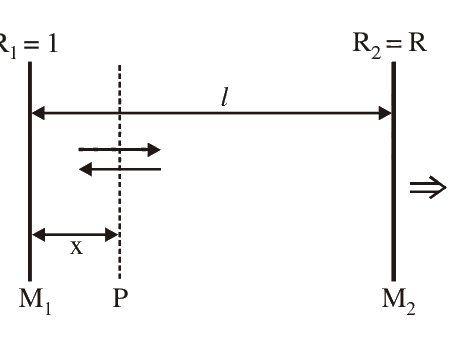
Consider the laser resonator cavity shown in the figure.
If $\text{I}_1$ is the intensity of the radiation at mirror $\text{M}_1$ and $\alpha$ is the gain coefficient of the medium between the mirrors, then the energy density of photons in the plane $\text{P}$ at a distance $\text{x}$ from $\text{M}_1$ is
A spin-1/2 particle $\text{A}$ undergoes the decay $\text{A} \rightarrow \text{B} + \text{C} + \text{D}$ where it is known that $\text{B}$ and $\text{C}$ are also spin-1/2 particles. The complete set of allowed values of the spin of the particle $\text{D}$ is