A horizontal metal disc rotates about the vertical axis in a uniform magnetic field pointing up as shown in the figure. A circuit is made by connecting one end A of a resistor to the centre of the disc and the other end B to its edge through a sliding contact S. The current that flows through the resistor is
a.
zero
b.
DC from A to B
Correct Answer
c.
DC from B to A
d.
AC
Step-by-Step AI Explanation
Verified Method
This device is a Faraday disc (homopolar generator). As the metal disc rotates in a constant magnetic field pointing upwards, free electrons inside the disc experience a Lorentz force $\mathbf{F} = q(\mathbf{v} \times \mathbf{B})$. Assuming the rotation is counterclockwise when viewed from above ($
\mathbf{\omega} = \omega\hat{z}$ and $\mathbf{B} = B\hat{z}$), $\mathbf{v} = \mathbf{\omega} \times \mathbf{r} = \omega r \hat{\theta}$, so $\mathbf{v} \times \mathbf{B} = (\omega r \hat{\theta}) \times (B \hat{z}) = \omega r B \hat{r}$, pointing radially outward. For positive charges, the force is directed radially outwards towards the rim (and for electrons, towards the centre). This produces a steady radial motional EMF with the rim at a higher potential than the centre, or vice versa depending on the direction of rotation. Since the magnetic field and rotation speed are constant, the induced electromotive force is continuous and steady, driving a direct current (DC) through the external circuit. By convention in such standard problems (or specifically with counterclockwise/clockwise rotation), the current is DC; in standard textbook versions of this question with clockwise rotation seen from below, the current flows as DC from A to B through the resistor.
Q22mcq
A spin-$\frac{1}{2}$ particle is in the state $\chi = \frac{1}{\sqrt{11}}\begin{pmatrix} 1+i \\ 3 \end{pmatrix}$ in the eigenbasis of $S^2$ and $S_z$. If we measure $S_z$ the probabilities of getting $+\frac{\hbar}{2}$ and $-\frac{\hbar}{2}$, respectively, are
a.
$\frac{1}{2}$ and $\frac{1}{2}$
b.
$\frac{2}{11}$ and $\frac{9}{11}$
Correct Answer
c.
$0$ and $1$
d.
$\frac{1}{11}$ and $\frac{3}{11}$
Step-by-Step AI Explanation
Verified Method
The given state vector in the eigenbasis of $S_z$ is:
$$\chi = \begin{pmatrix} c_+ \\ c_- \end{pmatrix} = \frac{1}{\sqrt{11}}\begin{pmatrix} 1+i \\ 3 \end{pmatrix}$$
The probability of measuring $S_z = +\frac{\hbar}{2}$ is given by:
$$P\left(+\frac{\hbar}{2}\right) = |c_+|^2 = \left|\frac{1+i}{\sqrt{11}}\right|^2 = \frac{1^2 + 1^2}{11} = \frac{2}{11}$$
The probability of measuring $S_z = -\frac{\hbar}{2}$ is given by:
$$P\left(-\frac{\hbar}{2}\right) = |c_-|^2 = \left|\frac{3}{\sqrt{11}}\right|^2 = \frac{9}{11}$$
Thus, the probabilities are $\frac{2}{11}$ and $\frac{9}{11}$.
Q23mcq
Which of the following functions cannot be the real part of a complex analytic function of $z = x+iy$?
a.
$x^2 y$
Correct Answer
b.
$x^2 - y^2$
c.
$x^3 - 3xy^2$
d.
$3x^2 y - y - y^3$
Step-by-Step AI Explanation
Verified Method
The real part $u(x,y)$ of any complex analytic function $f(z) = u(x,y) + i v(x,y)$ must be harmonic, meaning it satisfies Laplace's equation:
$$\nabla^2 u = \frac{\partial^2 u}{\partial x^2} + \frac{\partial^2 u}{\partial y^2} = 0$$
Let us test the given functions:
- For (A) $u = x^2 y$:
$$\frac{\partial^2 u}{\partial x^2} = 2y, \quad \frac{\partial^2 u}{\partial y^2} = 0 \implies \nabla^2 u = 2y \neq 0$$
Since it is not harmonic, it cannot be the real part of an analytic function.
- For (B) $u = x^2 - y^2$: $\nabla^2 u = 2 - 2 = 0$ (harmonic).
- For (C) $u = x^3 - 3xy^2$: $\nabla^2 u = 6x - 6x = 0$ (harmonic).
- For (D) $u = 3x^2 y - y - y^3$: $\nabla^2 u = 6y - 6y = 0$ (harmonic).
Q24mcq
The motion of a particle of mass $m$ in one dimension is described by the Hamiltonian $H = \frac{p^2}{2m} + \frac{1}{2}m\omega^2 x^2 + \lambda x$. What is the difference between the (quantized) energies of the first two levels? (In the following, $\langle x \rangle$ is the expectation value of $x$ in the ground state)
a.
$\hbar\omega - \lambda\langle x\rangle$
b.
$\hbar\omega + \lambda\langle x\rangle$
c.
$\hbar\omega + \frac{\lambda^2}{2m\omega^2}$
d.
$\hbar\omega$
Correct Answer
Step-by-Step AI Explanation
Verified Method
The given Hamiltonian is:
$$H = \frac{p^2}{2m} + \frac{1}{2}m\omega^2 x^2 + \lambda x$$
We can complete the square for the spatial coordinates:
$$\frac{1}{2}m\omega^2 x^2 + \lambda x = \frac{1}{2}m\omega^2 \left(x + \frac{\lambda}{m\omega^2}\right)^2 - \frac{\lambda^2}{2m\omega^2}$$
Defining a shifted coordinate $x' = x + \frac{\lambda}{m\omega^2}$, the Hamiltonian becomes that of a simple harmonic oscillator shifted by a constant energy:
$$H = \frac{p^2}{2m} + \frac{1}{2}m\omega^2 (x')^2 - \frac{\lambda^2}{2m\omega^2}$$
The energy eigenvalues are:
$$E_n = \left(n + \frac{1}{2}\right)\hbar\omega - \frac{\lambda^2}{2m\omega^2}, \quad n = 0, 1, 2, \dots$$
The difference between the first two levels ($n=1$ and $n=0$) is:
$$E_1 - E_0 = \left(1 + \frac{1}{2}\right)\hbar\omega - \left(0 + \frac{1}{2}\right)\hbar\omega = \hbar\omega$$
Q25mcq
Let $\psi_{nlm}$ denote the eigenfunctions of a Hamiltonian for a spherically symmetric potential $V(r)$. The expectation value of $L_z$ in the state
$$\psi = \frac{1}{6}\left[\psi_{200} + \sqrt{5}\,\psi_{210} + \sqrt{10}\,\psi_{21-1} + \sqrt{20}\,\psi_{211}\right]$$
is
a.
$-\frac{5}{18}\hbar$
b.
$\frac{5}{6}\hbar$
c.
$\hbar$
d.
$\frac{5}{18}\hbar$
Correct Answer
Step-by-Step AI Explanation
Verified Method
The state $\psi$ is:
$$\psi = \frac{1}{6}\left[\psi_{200} + \sqrt{5}\,\psi_{210} + \sqrt{10}\,\psi_{21-1} + \sqrt{20}\,\psi_{211}\right]$$
First, check the normalization of $\psi$:
$$\langle \psi | \psi \rangle = \frac{1}{36}\left(1^2 + (\sqrt{5})^2 + (\sqrt{10})^2 + (\sqrt{20})^2\right) = \frac{1}{36}(1 + 5 + 10 + 20) = \frac{36}{36} = 1$$
Since $L_z \psi_{nlm} = m\hbar \psi_{nlm}$, the expectation value $\langle L_z \rangle$ is:
$$\langle L_z \rangle = \sum_m m\hbar |c_{nlm}|^2$$
$$\langle L_z \rangle = \frac{1}{36}\Big[ 0\cdot 1 + 0\cdot 5 + (-1\hbar)\cdot 10 + (1\hbar)\cdot 20 \Big] = \frac{-10\hbar + 20\hbar}{36} = \frac{10\hbar}{36} = \frac{5}{18}\hbar$$
Q26mcq
Three identical spin $-\frac{1}{2}$ fermions are to be distributed in two non-degenerate distinct energy levels. The number of ways this can be done is
a.
$8$
b.
$4$
Correct Answer
c.
$3$
d.
$2$
Step-by-Step AI Explanation
Verified Method
For a spin-$\frac{1}{2}$ fermion, each spatial energy level has $g = 2s+1 = 2$ available single-particle states (spin up and spin down).
With two non-degenerate spatial levels, the total number of available single-particle states is:
$$N = 2 \times 2 = 4$$
According to the Pauli exclusion principle, each single-particle state can be occupied by at most one fermion. Thus, placing 3 identical fermions into these 4 single-particle states can be done in:
$$\binom{4}{3} = 4\text{ ways}$$
Q27mcq
Let $\text{A}$, $\text{B}$ and $\text{C}$ be functions of phase space variables (coordinates and momenta of a mechanical system). If $\{,\}$ represents the Poisson bracket, the value of $\{\text{A}, \{\text{B},\text{C}\}\} - \{\{\text{A},\text{B}\},\text{C}\}$ is given by
a.
$0$
b.
$\{\text{B},\{\text{C},\text{A}\}\}$
c.
$\{\text{A},\{\text{C},\text{B}\}\}$
d.
$\{\{\text{C},\text{A}\},\text{B}\}$
No explanation saved for this question yet.
Q28mcq
If $\text{A}$, $\text{B}$ and $\text{C}$ are non-zero Hermitian operators, which of the following relations must be false?
a.
$[\text{A}, \text{B}] = \text{C}$
Correct Answer
b.
$\text{AB} + \text{BA} = \text{C}$
c.
$\text{ABA} = \text{C}$
d.
$\text{A}+\text{B} = \text{C}$
Step-by-Step AI Explanation
Verified Method
Let $A$, $B$, and $C$ be non-zero Hermitian operators, so $A^\dagger = A$, $B^\dagger = B$, and $C^\dagger = C$.
Consider the commutator $[A, B]$:
$$[A, B]^\dagger = (AB - BA)^\dagger = B^\dagger A^\dagger - A^\dagger B^\dagger = BA - AB = -[A, B]$$
Thus, the commutator of two Hermitian operators is always anti-Hermitian (skew-Hermitian).
If $[A, B] = C$, then:
$$C^\dagger = [A, B]^\dagger = -[A, B] = -C$$
For $C$ to be Hermitian, we must have $C^\dagger = C$. Therefore, $C = -C \implies C = 0$.
However, it is given that $C$ is a non-zero operator. Hence, the relation $[A, B] = C$ must be false.
All the other relations can be true for Hermitian operators:
- (B) $(AB+BA)^\dagger = BA+AB = AB+BA$, which is Hermitian.
- (C) $(ABA)^\dagger = A^\dagger B^\dagger A^\dagger = ABA$, which is Hermitian.
- (D) $(A+B)^\dagger = A+B$, which is Hermitian.
Q29mcq
The expression
$$\left(\frac{\partial^2}{\partial x_1^2} + \frac{\partial^2}{\partial x_2^2} + \frac{\partial^2}{\partial x_3^2} + \frac{\partial^2}{\partial x_4^2}\right) \frac{1}{(x_1^2 + x_2^2 + x_3^2 + x_4^2)}$$ is proportional to
a.
$\delta(x_1 + x_2 + x_3 + x_4)$
b.
$\delta(x_1)\delta(x_2)\delta(x_3)\delta(x_4)$
c.
$(x_1^2 + x_2^2 + x_3^2 + x_4^2)^{-3/2}$
d.
$(x_1^2 + x_2^2 + x_3^2 + x_4^2)^{-2}$
Step-by-Step AI Explanation
Verified Method
In an $n$-dimensional Euclidean space, the Laplacian of $r^{2-n}$ is proportional to the $n$-dimensional Dirac delta function $\delta^{(n)}(\mathbf{x})$ for $n \ge 3$.
Specifically, the Green's function for the Laplacian in $n$ dimensions satisfies:
$$\nabla_n^2 \left(\frac{1}{r^{n-2}}\right) = -(n-2) S_{n-1} \delta^{(n)}(\mathbf{x})$$
where $S_{n-1} = \frac{2\pi^{n/2}}{\Gamma(n/2)}$ is the surface area of the unit sphere in $\mathbb{R}^n$.
Here, the dimension is $n = 4$, and the distance from the origin is:
$$r = \sqrt{x_1^2 + x_2^2 + x_3^2 + x_4^2}$$
The given expression contains:
$$\frac{1}{x_1^2 + x_2^2 + x_3^2 + x_4^2} = \frac{1}{r^2} = \frac{1}{r^{4-2}}$$
Therefore, applying the 4-dimensional Laplacian gives:
$$\nabla_4^2 \left(\frac{1}{r^2}\right) \propto \delta^{(4)}(\mathbf{x}) = \delta(x_1)\delta(x_2)\delta(x_3)\delta(x_4)$$
Thus, the expression is proportional to $\delta(x_1)\delta(x_2)\delta(x_3)\delta(x_4)$.
Q30mcq
Given that the integral $\int\limits_0^\infty \frac{dx}{y^2+x^2} = \frac{\pi}{2y}$, the value of $\int\limits_0^\infty \frac{dx}{(y^2+x^2)^2}$ is
a.
$\frac{\pi}{y^3}$
b.
$\frac{\pi}{4y^3}$
Correct Answer
c.
$\frac{\pi}{8y^3}$
d.
$\frac{\pi}{2y^3}$
Step-by-Step AI Explanation
Verified Method
We can differentiate the given integral with respect to the parameter $y$:
$$\frac{d}{dy} \int_0^\infty \frac{dx}{y^2+x^2} = \int_0^\infty \frac{\partial}{\partial y}\left(\frac{1}{y^2+x^2}\right) dx = \int_0^\infty \frac{-2y}{(y^2+x^2)^2}\,dx$$
From the given formula, the integral equals $\frac{\pi}{2y}$, so its derivative is:
$$\frac{d}{dy}\left(\frac{\pi}{2y}\right) = -\frac{\pi}{2y^2}$$
Equating the two expressions gives:
$$-2y \int_0^\infty \frac{dx}{(y^2+x^2)^2} = -\frac{\pi}{2y^2} \implies \int_0^\infty \frac{dx}{(y^2+x^2)^2} = \frac{\pi}{4y^3}$$
Thus, option B is correct.
🎉 10 Free Sample Solutions Completed
Unlock All 55 Questions & Solutions
Sign up free in seconds to unlock step-by-step AI answers for the remaining 45 questions.
The force between two long and parallel wires carrying currents $\text{I}_1$ and $\text{I}_2$ and separated by a distance $\text{D}$ is proportional to
a.
$\text{I}_1\text{I}_2 / \text{D}$
b.
$(\text{I}_1 + \text{I}_2) / \text{D}$
c.
$(\text{I}_1 \text{I}_2 / \text{D})^2$
d.
$\text{I}_1 \text{I}_2 / \text{D}^2$
Correct Answer & Step-by-Step Solution Locked
Sign in free to reveal the correct answer and AI explanation for this question.
A loaded dice has the probabilities $\frac{1}{21}, \frac{2}{21}, \frac{3}{21}, \frac{4}{21}, \frac{5}{21}$ and $\frac{6}{21}$ of turning up $1, 2, 3, 4, 5$ and $6$, respectively. If it is thrown twice, what is the probability that the sum of the numbers that turn up is even?
a.
$\frac{144}{441}$
b.
$\frac{225}{441}$
c.
$\frac{221}{441}$
d.
$\frac{220}{441}$
Correct Answer & Step-by-Step Solution Locked
Sign in free to reveal the correct answer and AI explanation for this question.
The Hamiltonian of a relativistic particle of rest mass $m$ and momentum $p$ is given by $H = \sqrt{p^2 + m^2} + V(x)$, in units in which the speed of light $c = 1$. The corresponding Lagrangian is
a.
$L = m\sqrt{1 + \dot{x}^2} - V(x)$
b.
$L = -m\sqrt{1 - \dot{x}^2} - V(x)$
c.
$L = \sqrt{1 + m\dot{x}^2} - V(x)$
d.
$L = \frac{1}{2}m\dot{x}^2 - V(x)$
Correct Answer & Step-by-Step Solution Locked
Sign in free to reveal the correct answer and AI explanation for this question.
A ring of mass $m$ and radius $R$ rolls (without slipping) down an inclined plane starting from rest. If the centre of the ring is initially at a height $h$, the angular velocity when the ring reaches the base is
a.
$\sqrt{g/(h-R)\tan\theta}$
b.
$\sqrt{g/(h-R)}$
c.
$\sqrt{g(h-R)/R^2}$
d.
$\sqrt{2g/(h-R)}$
Correct Answer & Step-by-Step Solution Locked
Sign in free to reveal the correct answer and AI explanation for this question.
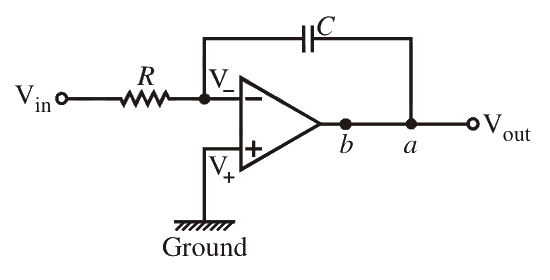
Consider the op-amp circuit shown in the figure.
If the input is a sinusoidal wave $V_i = 5\sin(1000t)$, then the amplitude of the output $\text{V}_0$ is
a.
$\frac{5}{2}$
b.
$5$
c.
$\frac{5\sqrt{2}}{2}$
d.
$5\sqrt{2}$
Correct Answer & Step-by-Step Solution Locked
Sign in free to reveal the correct answer and AI explanation for this question.
Two monochromatic sources, $\text{L}_1$, and $\text{L}_2$, emit light at $600$ and $700\text{ nm}$, respectively. If their frequency bandwidths are $10^{-1}$ and $10^{-3}\text{ GHz}$, respectively, then the ratio of linewidth of $\text{L}_1$ and $\text{L}_2$ is approximately
a.
$100 : 1$
b.
$1 : 85$
c.
$75 : 1$
d.
$1 : 75$
Correct Answer & Step-by-Step Solution Locked
Sign in free to reveal the correct answer and AI explanation for this question.
Let $(V, A)$ and $(V', A')$ denote two sets of scalar and vector potentials, and $\psi$ a scalar function. Which of the following transformations leave the electric and magnetic fields (and hence Maxwell's equations) unchanged?
a.
$A' = A + \nabla\psi$ and $V = V - \frac{\partial\psi}{\partial t}$
b.
$A' = A - \nabla\psi$ and $V' = V + 2\frac{\partial\psi}{\partial t}$
c.
$A' = A + \nabla\psi$ and $V' = V + \frac{\partial\psi}{\partial t}$
d.
$A' = A - 2\nabla\psi$ and $V' = V - \frac{\partial\psi}{\partial t}$
Correct Answer & Step-by-Step Solution Locked
Sign in free to reveal the correct answer and AI explanation for this question.
Consider the melting transition of ice into water at constant pressure. Which of the following thermodynamic quantities does not exhibit a discontinuous change across the phase transition?
a.
internal energy
b.
Helmholtz free energy
c.
Gibbs free energy
d.
entropy
Correct Answer & Step-by-Step Solution Locked
Sign in free to reveal the correct answer and AI explanation for this question.
Two different thermodynamic systems are described by the following equations of state:
$$\frac{1}{T^{(1)}} = \frac{3RN^{(1)}}{2U^{(1)}} \quad \text{and} \quad \frac{1}{T^{(2)}} = \frac{5RN^{(2)}}{2U^{(2)}}$$
where $T^{(1,2)}$, $N^{(1,2)}$ and $U^{(1,2)}$ are respectively, the temperatures, the mole numbers and the internal energies of the two systems, and $R$ is the gas constant. Let $U_{tot}$ denote the total energy when these two systems are put in contact and attain thermal equilibrium. The ratio $\frac{U^{(1)}}{U_{tot}}$ is
a.
$\frac{5N^{(2)}}{3N^{(1)} + 5N^{(2)}}$
b.
$\frac{3N^{(1)}}{3N^{(1)} + 5N^{(2)}}$
c.
$\frac{N^{(1)}}{N^{(1)} + N^{(2)}}$
d.
$\frac{N^{(2)}}{N^{(1)} + N^{(2)}}$
Correct Answer & Step-by-Step Solution Locked
Sign in free to reveal the correct answer and AI explanation for this question.
The speed $v$ of the molecules of mass $m$ of an ideal gas obeys Maxwell's velocity distribution law at an equilibrium temperature $T$. Let $(v_x, v_y, v_z)$ denote the components of the velocity and $k_B$ the Boltzmann constant. The average value of $(\alpha v_x - \beta v_y)^2$, where $\alpha$ and $\beta$ are constants, is
a.
$(\alpha^2 - \beta^2)k_B T / m$
b.
$(\alpha^2 + \beta^2)k_B T / m$
c.
$(\alpha + \beta)^2 k_B T / m$
d.
$(\alpha - \beta)^2 k_B T / m$
Correct Answer & Step-by-Step Solution Locked
Sign in free to reveal the correct answer and AI explanation for this question.
The entropy $S$ of a thermodynamic system as a function of energy $E$ is given by the following graph
The temperatures of the phases $\text{A}$, $\text{B}$ and $\text{C}$, denoted by $T_A, T_B$ and $T_C$, respectively, satisfy the following inequalities:
a.
$T_C > T_B > T_A$
b.
$T_A > T_C > T_B$
c.
$T_B > T_C > T_A$
d.
$T_B > T_A > T_C$
Correct Answer & Step-by-Step Solution Locked
Sign in free to reveal the correct answer and AI explanation for this question.
Two identical Zener diodes are placed back to back in series and are connected to a variable DC power supply. The best representation of the I-V characteristics of the circuit is
c.
Graph (c)
d.
Graph (d)
Correct Answer & Step-by-Step Solution Locked
Sign in free to reveal the correct answer and AI explanation for this question.
A pendulum consists of a ring of mass M and radius R suspended by a massless rigid rod of length $l$ attached to its rim. When the pendulum oscillates in the plane of the ring, the time period of oscillation is
a.
$2\pi\sqrt{\frac{l+R}{g}}$
b.
$\frac{2\pi}{\sqrt{g}}(l^2+R^2)^{1/4}$
c.
$2\pi\sqrt{\frac{2R^2+2Rl+l^2}{g(R+l)}}$
d.
$\frac{2\pi}{\sqrt{g}}(2R^2+2Rl+l^2)^{1/4}$
Correct Answer & Step-by-Step Solution Locked
Sign in free to reveal the correct answer and AI explanation for this question.
Spherical particles of a given material of density $p$ are released from rest inside a liquid medium of lower density. The viscous drag force may be approximated by the Stoke's law, i.e, $F_d = 6\pi\eta Rv$, where $\eta$ is the viscosity of the medium, R the radius of a particle and $v$ its instantaneous velocity. If $\tau(m)$ is the time taken by a particle of mass $m$ to reach half its terminal velocity, then the ratio $\tau(8m)/\tau(m)$ is
a.
8
b.
1/8
c.
4
d.
1/4
Correct Answer & Step-by-Step Solution Locked
Sign in free to reveal the correct answer and AI explanation for this question.
A system of N classical non-interacting particles, each of mass $m$, is at a temperature T and is confined by the external potential $V(r) = \frac{1}{2}Ar^2$ (where A is a constant) in three dimensions. The internal energy of the system is
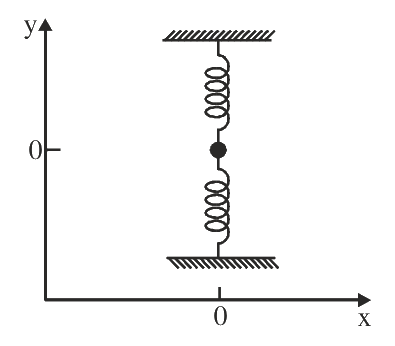
Consider a particle of mass $m$ attached to two identical springs each of length $l$ and spring constant k (see the figure below). The equilibrium configuration is the one where the springs are unstretched. There are no other external forces on the system. If the particle is given a small displacement along the x-axis, which of the following describes the equation of motion for small oscillations?
a.
$m\ddot{x} + \frac{kx^3}{l^2} = 0$
b.
$m\ddot{x} + kx = 0$
c.
$m\ddot{x} + 2kx = 0$
d.
$m\ddot{x} + \frac{kx^2}{l} = 0$
Correct Answer & Step-by-Step Solution Locked
Sign in free to reveal the correct answer and AI explanation for this question.
If $\psi(x) = A\exp(-x^4)$ is the eigenfunction of a one dimensional Hamiltonian with eigenvalue $\text{E} = 0$, the potential $V(x)$ (in units where $\hbar = 2m = 1$) is
a.
$12x^2$
b.
$16x^6$
c.
$16x^6 + 12x^2$
d.
$16x^6 - 12x^2$
Correct Answer & Step-by-Step Solution Locked
Sign in free to reveal the correct answer and AI explanation for this question.
The electric field of an electromagnetic wave is given by $\vec{E} = E_0 \cos[\pi(0.3x + 0.4y - 1000t)]\hat{k}$. The associated magnetic field $\vec{B}$ is
The energy of an electron in a band as a function of its wave vector $k$ is given by $E(k) = E_0 - B(\cos k_x a + \cos k_y a + \cos k_z a)$, where $E_0, B$ and $a$ are constants. The effective mass of the electron near the bottom of the band is
a.
$\frac{2\hbar^2}{3Ba^2}$
b.
$\frac{\hbar^2}{3Ba^2}$
c.
$\frac{\hbar^2}{2Ba^2}$
d.
$\frac{\hbar^2}{Ba^2}$
Correct Answer & Step-by-Step Solution Locked
Sign in free to reveal the correct answer and AI explanation for this question.
A DC voltage V is applied across a Josephson junction between two superconductors with a phase difference $\phi_0$. If $I_0$ and $k$ are constants that depend on the properties of the junction, the current flowing through it has the form
Consider the following ratios of the partial decay widths $R_1 = \frac{\Gamma(\rho^+ \to \pi^+ + \pi^0)}{\Gamma(\rho^- \to \pi^- + \pi^0)}$ and $R_2 = \frac{\Gamma(\Delta^{++} \to \pi^+ + p)}{\Gamma(\Delta^- \to \pi^- + n)}$. If the effects of electromagnetic and weak interactions are neglected, then $R_1$ and $R_2$ are, respectively,
a.
$1$ and $\sqrt{2}$
b.
$1$ and $2$
c.
$2$ and $1$
d.
$1$ and $1$
Correct Answer & Step-by-Step Solution Locked
Sign in free to reveal the correct answer and AI explanation for this question.
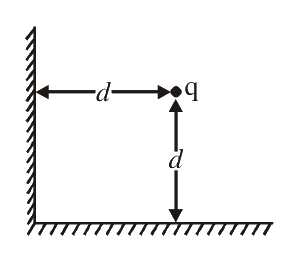
A point charge $q$ is placed symmetrically at a distance $d$ from two perpendicularly placed grounded conducting infinite plates as shown in the figure. The net force on the charge (in units of $1/4\pi \epsilon_0$) is
a.
$\frac{q^2}{8d^2}(2\sqrt{2}-1)$ away from the corner
b.
$\frac{q^2}{8d^2}(2\sqrt{2}-1)$ towards the corner
c.
$\frac{q^2}{2\sqrt{2}d^2}$ towards the corner
d.
$\frac{3q^2}{8d^2}$ away from the corner
Correct Answer & Step-by-Step Solution Locked
Sign in free to reveal the correct answer and AI explanation for this question.
Let four point charges $q$, $-q/2$, $q$ and $-q/2$ be placed at the vertices of a square of side $a$. Let another point charge $-q$ be placed at the centre of the square (see the figure).
Let $V(r)$ be the electrostatic potential at a point $\text{P}$ at a distance $r \gg a$ from the centre of the square. Then $V(2r) / V(r)$ is
a.
1
b.
$\frac{1}{2}$
c.
$\frac{1}{4}$
d.
$\frac{1}{8}$
Correct Answer & Step-by-Step Solution Locked
Sign in free to reveal the correct answer and AI explanation for this question.
A particle is in the ground state of an infinite square well potential given by,
$$V(x) = \begin{cases} 0 & \text{for } -a \le x \le a \\ \infty & \text{otherwise} \end{cases}$$
The probability to find the particle in the interval between $-\frac{a}{2}$ and $\frac{a}{2}$ is
a.
$\frac{1}{2}$
b.
$\frac{1}{2} + \frac{1}{\pi}$
c.
$\frac{1}{2} - \frac{1}{\pi}$
d.
$\frac{1}{\pi}$
Correct Answer & Step-by-Step Solution Locked
Sign in free to reveal the correct answer and AI explanation for this question.
The expectation value of the x-component of the orbital angular momentum $L_x$ in the state
$$\psi = \frac{1}{5}\left[ 3\psi_{2,1,-1} + \sqrt{5}\psi_{2,1,0} - \sqrt{11}\psi_{2,1,+1} \right]$$
(where $\psi_{nlm}$ are the eigenfunctions in usual notation), is
a.
$-\frac{\hbar\sqrt{10}}{25}(\sqrt{11}-3)$
b.
$0$
c.
$\frac{\hbar\sqrt{10}}{25}(\sqrt{11}+3)$
d.
$\hbar\sqrt{2}$
Correct Answer & Step-by-Step Solution Locked
Sign in free to reveal the correct answer and AI explanation for this question.
A particle is prepared in a simultaneous eigenstate of $L^2$ and $L_z$. If $\ell(\ell+1)\hbar^2$ and $m\hbar$ are respectively the eigenvalues of $L^2$ and $L_z$, then the expectation value $\langle L_x^2\rangle$ of the particle in this state satisfies
If the electrostatic potential $V(r,\theta,\phi)$ in a charge free region has the form $V(r,\theta,\phi) = f(r)\cos\theta$, then the functional form of $f(r)$ (in the following $a$ and $b$ are constants) is
a.
$ar^2 + \frac{b}{r}$
b.
$ar + \frac{b}{r^2}$
c.
$ar + \frac{b}{r}$
d.
$a\ln\left(\frac{r}{b}\right)$
Correct Answer & Step-by-Step Solution Locked
Sign in free to reveal the correct answer and AI explanation for this question.
If $\mathbf{A} = \hat{i}yz + \hat{j}xz + \hat{k}xy$, then the integral $\oint_C \mathbf{A}\cdot d\mathbf{l}$ (where $C$ is along the perimeter of a rectangular area bounded by $x=0$, $x=a$ and $y=0$, $y=b$) is
a.
$\frac{1}{2}(a^3+b^3)$
b.
$\pi(ab^2+a^2b)$
c.
$\pi(a^3+b^3)$
d.
$0$
Correct Answer & Step-by-Step Solution Locked
Sign in free to reveal the correct answer and AI explanation for this question.
Consider an $n\times n (n>1)$ matrix $\text{A}$, in which $\text{A}_{ij}$ is the product of the indices $i$ and $j$ (namely $\text{A}_{ij} = ij$). The matrix $\text{A}$
a.
has one degenerate eigenvalue with degeneracy $(n-1)$
b.
has two degenerate eigenvalues with degeneracies $2$ and $(n-2)$
c.
has one degenerate eigenvalue with degeneracy $n$
d.
does not have any degenerate eigenvalue
Correct Answer & Step-by-Step Solution Locked
Sign in free to reveal the correct answer and AI explanation for this question.
A child makes a random walk on a square lattice of lattice constant a taking a step in the north, east, south, or west directions with probabilities $0.255$, $0.255$, $0.245$, and $0.245$, respectively. After a large number of steps, N, the expected position of the child with respect to the starting point is at a distance
a.
$\sqrt{2}\times 10^{-2}Na$ in the north-east direction
b.
$\sqrt{2N}\times 10^{-2}a$ in the north-east direction
c.
$2\sqrt{2}\times 10^{-2}Na$ in the south-east direction
d.
$0$
Correct Answer & Step-by-Step Solution Locked
Sign in free to reveal the correct answer and AI explanation for this question.
A Carnot cycle operates as a heat engine between two bodies of equal heat capacity until their temperatures become equal. If the initial temperatures of the bodies are $T_1$ and $T_2$, respectively, and $T_1 > T_2$ then their common final temperature is
a.
$T_1^2/T_2$
b.
$T_2^2/T_1$
c.
$\sqrt{T_1 T_2}$
d.
$\frac{1}{2}(T_1+T_2)$
Correct Answer & Step-by-Step Solution Locked
Sign in free to reveal the correct answer and AI explanation for this question.
Three sets of data $A$, $B$ and $C$ from an experiment, represented by $\times$, $\square$ and $\bigcirc$, are plotted on a log-log scale. Each of these are fitted with straight lines as shown in the figure.
The functional dependence $y(x)$ for the sets A, B and C are, respectively
a.
$\sqrt{x}, x$ and $x^2$
b.
$-\frac{x}{2}, x$ and $2x$
c.
$\frac{1}{x^2}, x$ and $x^2$
d.
$\frac{1}{\sqrt{x}}, x$ and $x^2$
Correct Answer & Step-by-Step Solution Locked
Sign in free to reveal the correct answer and AI explanation for this question.
A sample of Si has electron and hole mobilities of $0.13$ and $0.05\text{ m}^2/\text{V-s}$ respectively at $300\text{K}$. It is doped with P and Al with doping densities of $1.5 \times 10^{21}/\text{m}^3$ and $2.5 \times 10^{21}/\text{m}^3$ respectively. The conductivity of the doped Si sample at $300\text{K}$ is
a.
$8\Omega^{-1}\text{m}^{-1}$
b.
$32\Omega^{-1}\text{m}^{-1}$
c.
$20.8\Omega^{-1}\text{m}^{-1}$
d.
$83.2\Omega^{-1}\text{m}^{-1}$
Correct Answer & Step-by-Step Solution Locked
Sign in free to reveal the correct answer and AI explanation for this question.
A 4-variable switching function is given by $f = \Sigma(5,7,8,10,13,15) + d(0,1,2)$, where $d$ is the do-not-care-condition. The minimized form of $f$ in sum of products (SOP) form is
a.
$\bar{A}\bar{C} + \bar{B}\bar{D}$
b.
$A\bar{B} + C\bar{D}$
c.
$AD + BC$
d.
$\bar{B}\bar{D} + BD$
Correct Answer & Step-by-Step Solution Locked
Sign in free to reveal the correct answer and AI explanation for this question.
A perturbation $V_{\text{pert}} = aL^2$ is added to the Hydrogen atom potential. The shift in the energy level of the $2\text{P}$ state, when the effects of spin are neglected up to second order in $a$, is
a.
$0$
b.
$2a\hbar^2 + a^2\hbar^4$
c.
$2a\hbar^2$
d.
$a\hbar^2 + \frac{3}{2}a^2\hbar^4$
Correct Answer & Step-by-Step Solution Locked
Sign in free to reveal the correct answer and AI explanation for this question.
A gas laser cavity has been designed to operate at $\lambda = 0.5\mu\text{m}$ with a cavity length of $1\text{m}$. With this set-up, the frequency is found to be larger than the desired frequency by $100\text{ Hz}$. The change in the effective length of the cavity required to retune the laser is
a.
$-0.334 \times 10^{-12}\text{ m}$
b.
$0.334 \times 10^{-12}\text{ m}$
c.
$0.167 \times 10^{-12}\text{ m}$
d.
$-0.167 \times 10^{-12}\text{ m}$
Correct Answer & Step-by-Step Solution Locked
Sign in free to reveal the correct answer and AI explanation for this question.
The spectroscopic symbol for the ground state of $_{13}\text{Al}$ is $^2P_{1/2}$. Under the action of a strong magnetic field (when L-S coupling can be neglected) the ground state energy level will split into
a.
$3$ levels
b.
$4$ levels
c.
$5$ levels
d.
$6$ levels
Correct Answer & Step-by-Step Solution Locked
Sign in free to reveal the correct answer and AI explanation for this question.
A uniform linear monoatomic chain is modeled by a spring-mass system of masses $m$ separated by nearest neighbor distance $a$ and spring constant $m\omega_0^2$. The dispersion relation for this system is