A vector perpendicular to any vector that lies on the plane defined by $x + y + z = 5$, is
a.
$\hat{i} + \hat{j}$
b.
$\hat{j} + \hat{k}$
c.
$\hat{i} + \hat{j} + \hat{k}$
Correct Answer
d.
$2\hat{i} + 3\hat{j} + 5\hat{k}$
Step-by-Step AI Explanation
Verified Method
The equation of the plane is $x + y + z = 5$. The normal vector to this plane is given by the gradient of the function $f(x, y, z) = x + y + z - 5$, which is $\nabla f = \hat{i} + \hat{j} + \hat{k}$. Since the normal vector is perpendicular to every vector lying in the plane, the vector perpendicular to any vector on this plane is $\hat{i} + \hat{j} + \hat{k}$ (or any scalar multiple thereof).
Q22mcq
The eigenvalues of the matrix, $A = \begin{pmatrix} 1 & 2 & 3 \\ 2 & 4 & 6 \\ 3 & 6 & 9 \end{pmatrix}$ are
a.
$(1, 4, 9)$
b.
$(0, 7, 7)$
c.
$(0, 1, 13)$
d.
$(0, 0, 14)$
Correct Answer
Step-by-Step AI Explanation
Verified Method
The given matrix is $A = \begin{pmatrix} 1 & 2 & 3 \\ 2 & 4 & 6 \\ 3 & 6 & 9 \end{pmatrix}$. Notice that the second row is $2 \times$ (first row) and the third row is $3 \times$ (first row). Thus, the rank of matrix $A$ is 1, which means at least two of its eigenvalues are zero: $\lambda_1 = 0, \lambda_2 = 0$. The trace of $A$ is the sum of the diagonal elements: $\text{Tr}(A) = 1 + 4 + 9 = 14$. Since $\text{Tr}(A) = \lambda_1 + \lambda_2 + \lambda_3$, we have $0 + 0 + \lambda_3 = 14 \implies \lambda_3 = 14$. Therefore, the eigenvalues are $(0, 0, 14)$.
Q23mcq
The first few terms in the Laurent series for $\frac{1}{(z-1)(z-2)}$ in the region $1 \le |z| \le 2$, and around $z = 1$ is
Using partial fractions:
$$\frac{1}{(z-1)(z-2)} = \frac{1}{z-2} - \frac{1}{z-1} = -\frac{1}{1 - (z-1)} - \frac{1}{z-1} = \frac{1}{1-z} - \frac{1}{1 - (z-1)}$$
Expanding around $z = 1$ for $|z-1| < 1$ (or rewriting powers of $(1-z)$):
$$-\frac{1}{1 - (z-1)} = -[1 + (z-1) + (z-1)^2 + \dots] = -1 + (1-z) - (1-z)^2 + \dots$$
Among the given options, option (B) represents an expansion around $z=1$ containing the pole term $\frac{1}{1-z}$ and subsequent polynomial terms in powers of $(1-z)$, which correctly identifies the form of the Laurent series around $z=1$.
Q24mcq
The radioactive decay of a certain material satisfies Poisson statistics with a mean rate of $\lambda$ per second, what should be the minimum duration of counting (in seconds) so that the relative error is less than $1\%$ ?
a.
$100/\lambda$
b.
$10^4/\lambda^2$
c.
$10^4/\lambda$
Correct Answer
d.
$1/\lambda$
Step-by-Step AI Explanation
Verified Method
For a Poisson process with rate $\lambda$ observed for a duration $t$, the mean number of counts is $N = \lambda t$, and the standard deviation is $\sigma = \sqrt{N} = \sqrt{\lambda t}$. The relative error is given by:
$$\frac{\sigma}{N} = \frac{\sqrt{\lambda t}}{\lambda t} = \frac{1}{\sqrt{\lambda t}}$$
For the relative error to be less than $1\% = 0.01 = 10^{-2}$:
$$\frac{1}{\sqrt{\lambda t}} < 10^{-2} \implies \sqrt{\lambda t} > 10^2 \implies \lambda t > 10^4 \implies t > \frac{10^4}{\lambda}$$
Thus, the minimum duration of counting is $10^4/\lambda$.
Q25mcq
Let $u(x, y) = x + \frac{1}{2}(x^2 - y^2)$ be the real part of an analytic function $f(z)$ of the complex variable $z = x + iy$. The imaginary part of $f(z)$ is
a.
$y + xy$
Correct Answer
b.
$xy$
c.
$y$
d.
$y^2 - x^2$
Step-by-Step AI Explanation
Verified Method
For an analytic function $f(z) = u(x, y) + i v(x, y)$, the Cauchy-Riemann equations must hold:
$$\frac{\partial u}{\partial x} = \frac{\partial v}{\partial y} \quad \text{and} \quad \frac{\partial u}{\partial y} = -\frac{\partial v}{\partial x}$$
Given $u(x, y) = x + \frac{1}{2}(x^2 - y^2)$:
$$\frac{\partial u}{\partial x} = 1 + x \implies \frac{\partial v}{\partial y} = 1 + x \implies v(x, y) = y + xy + g(x)$$
$$\frac{\partial u}{\partial y} = -y \implies -\frac{\partial v}{\partial x} = -y \implies \frac{\partial v}{\partial x} = y$$
From $v(x, y) = y + xy + g(x)$, we have $\frac{\partial v}{\partial x} = y + g'(x) = y \implies g'(x) = 0$, so $g(x) = C$ (a constant, which can be taken as 0).
Therefore, $v(x, y) = y + xy$.
Q26mcq
Let $y(x)$ be a continuous real function in the range $0$ and $2\pi$, satisfying the inhomogeneous differential equaltion:
$$\sin x \frac{d^2 y}{dx^2} + \cos x \frac{dy}{dx} = \delta\left(x - \frac{\pi}{2}\right).$$
The value of $dy/dx$ at the point $x = \pi/2$
a.
is continuous
b.
has a discontinuity of 3
c.
has a discontinuity of 1/3
d.
has a discontinuity of 1
Correct Answer
Step-by-Step AI Explanation
Verified Method
The given differential equation can be written as:
$$\frac{d}{dx}\left(\sin x \frac{dy}{dx}\right) = \delta\left(x - \frac{\pi}{2}\right)$$
Integrating across the infinitesimal interval $\left[\frac{\pi}{2} - \epsilon, \frac{\pi}{2} + \epsilon\right]$ as $\epsilon \to 0$:
$$\left[\sin x \frac{dy}{dx}\right]_{\frac{\pi}{2}^-}^{\frac{\pi}{2}^+} = \int_{\frac{\pi}{2} - \epsilon}^{\frac{\pi}{2} + \epsilon} \delta\left(x - \frac{\pi}{2}\right) dx = 1$$
At $x = \pi/2$, $\sin(\pi/2) = 1$. Since $\sin x$ is continuous and equals 1 at $x = \pi/2$, we obtain:
$$\left.\frac{dy}{dx}\right|_{\frac{\pi}{2}^+} - \left.\frac{dy}{dx}\right|_{\frac{\pi}{2}^-} = 1$$
Thus, $dy/dx$ has a discontinuity of 1 at $x = \pi/2$.
Q27mcq
A ball is picked at random from one of two boxes that contain 2 black and 3 white and 3 black and 4 white balls respectively. What is the probability that it is white?
a.
$34/70$
b.
$41/70$
Correct Answer
c.
$36/70$
d.
$29/70$
Step-by-Step AI Explanation
Verified Method
Let $B_1$ be the event of choosing the first box and $B_2$ be the event of choosing the second box, each having probability $P(B_1) = P(B_2) = 1/2$.
- Box 1 contains 2 black and 3 white balls (total 5 balls). The probability of picking a white ball is $P(W|B_1) = 3/5$.
- Box 2 contains 3 black and 4 white balls (total 7 balls). The probability of picking a white ball is $P(W|B_2) = 4/7$.
By the law of total probability:
$$P(W) = P(B_1)P(W|B_1) + P(B_2)P(W|B_2) = \frac{1}{2} \left(\frac{3}{5}\right) + \frac{1}{2} \left(\frac{4}{7}\right) = \frac{1}{2} \left(\frac{21 + 20}{35}\right) = \frac{41}{70}$$
Q28mcq
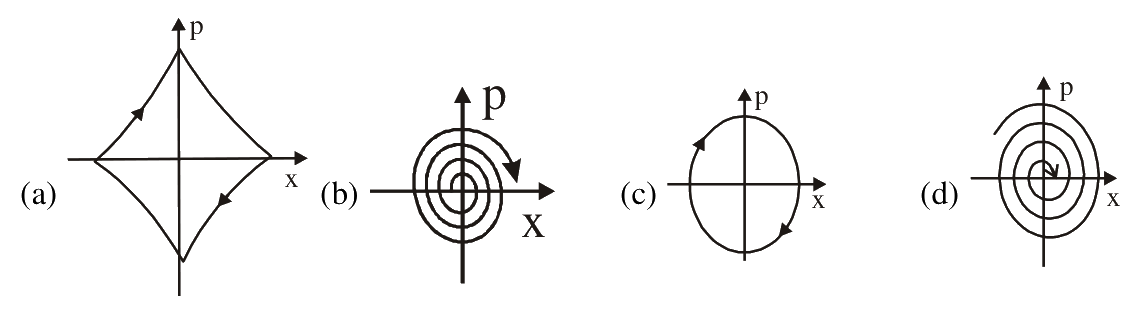
The bob of a simple pendulum,which undergoes small oscillations, is immersed in water. Which of the following figures best represents the phase space diagram for the pendulum?
a.
(a)
b.
(b)
c.
(c)
d.
(d)
Correct Answer
Step-by-Step AI Explanation
Verified Method
When the pendulum bob is immersed in water, it experiences damping due to the viscosity of the fluid (damped harmonic oscillator). As time progresses, the energy of the system dissipates, so the amplitude of oscillation and momentum decrease toward zero, resulting in a trajectory that spirals inwards towards the origin $(0, 0)$. In the $(x, p)$ phase space, since $\dot{x} = p/m > 0$ when $p > 0$, the position $x$ must increase in the upper half-plane ($p > 0$), meaning the motion must be clockwise. Diagram (d) correctly shows a spiral that moves clockwise and winds inwards toward the origin $(0,0)$.
Q29mcq
Two events, separated by a (spatial) distance $9\times 10^9\text{ m}$, are simultaneous in one inertial frame. The time interval between these two events in a frame moving with a constant speed $0.8c$ (where the speed of light $c = 3\times 10^8\text{ m/s}$) is:
a.
$60\text{ s}$
b.
$40\text{ s}$
Correct Answer
c.
$20\text{ s}$
d.
$0\text{ s}$
Step-by-Step AI Explanation
Verified Method
According to the Lorentz transformation for the time interval between two events:
$$\Delta t' = \gamma \left(\Delta t - \frac{v\Delta x}{c^2}\right)$$
In the initial frame, the events are simultaneous, so $\Delta t = 0$, and their spatial separation is $\Delta x = 9\times 10^9\text{ m}$.
Here, $v = 0.8c$, so:
$$\gamma = \frac{1}{\sqrt{1 - (v/c)^2}} = \frac{1}{\sqrt{1 - 0.8^2}} = \frac{1}{0.6} = \frac{5}{3}$$
Taking the magnitude of the time interval:
$$|\Delta t'| = \gamma \frac{v\Delta x}{c^2} = \frac{5}{3} \times \frac{0.8 c \times 9\times 10^9}{c^2} = \frac{5}{3} \times \frac{0.8 \times 9\times 10^9}{3\times 10^8} = \frac{5}{3} \times 24 = 40\text{ s}$$
Q30mcq
If the Lagrangian of a particle moving in one dimension is given by $L = \frac{\dot{x}^2}{2x} - V(x)$, the Hamiltonian is:
a.
$\frac{1}{2}xp^2 + V(x)$
Correct Answer
b.
$\frac{\dot{x}^2}{2x} + V(x)$
c.
$\frac{1}{2}\dot{x}^2 + V(x)$
d.
$\frac{p^2}{2x} + V(x)$
Step-by-Step AI Explanation
Verified Method
The given Lagrangian is:
$$L = \frac{\dot{x}^2}{2x} - V(x)$$
The canonical momentum conjugate to $x$ is:
$$p = \frac{\partial L}{\partial \dot{x}} = \frac{\dot{x}}{x} \implies \dot{x} = x p$$
The Hamiltonian $H$ is obtained via the Legendre transformation:
$$H = p\dot{x} - L = p(xp) - \left(\frac{(xp)^2}{2x} - V(x)\right) = x p^2 - \frac{1}{2}x p^2 + V(x) = \frac{1}{2}x p^2 + V(x)$$
Thus, option A is correct.
🎉 10 Free Sample Solutions Completed
Unlock All 55 Questions & Solutions
Sign up free in seconds to unlock step-by-step AI answers for the remaining 45 questions.
A horizontal circular platform rotates with a constant angular velocity $\Omega$ directed vertically upwards. A person seated at the centre shoots a bullet of mass 'm' horizontally with speed 'v'. The acceleration of the bullet, in the reference frame of the shooter, is
a.
$2v\Omega$ to his right
b.
$2v\Omega$ to his left
c.
$v\Omega$ to his right
d.
$v\Omega$ to his left
Correct Answer & Step-by-Step Solution Locked
Sign in free to reveal the correct answer and AI explanation for this question.
The magnetic field corresponding to the vector potential, $\vec{A} = \frac{1}{2}\vec{F}\times\vec{r} + \frac{10}{r^3}\vec{r}$ where $\vec{F}$ is a constant vector, is
a.
$\vec{F}$
b.
$-\vec{F}$
c.
$\vec{F} + \frac{30}{r^4}\vec{r}$
d.
$\vec{F} - \frac{30}{r^4}\vec{r}$
Correct Answer & Step-by-Step Solution Locked
Sign in free to reveal the correct answer and AI explanation for this question.
An electromagnetic wave is incident on a water-air interface. The phase of the perpendicular component of the electric field, $E_\perp$, of the reflected wave into the water is found to remain the same for all angles of incidence. The phase of the magnetic field $H$,
a.
does not change
b.
changes by $3\pi/2$
c.
changes by $\pi/2$
d.
changes by $\pi$
Correct Answer & Step-by-Step Solution Locked
Sign in free to reveal the correct answer and AI explanation for this question.
The component along an arbitrary direction $\hat{\text{n}}$, with direction cosines $(n_x,n_y,n_z)$, of the spin of a spin-½ particle is measured. The result is:
a.
$0$
b.
$\pm\frac{\hbar}{2}n_z$
c.
$\pm\frac{\hbar}{2}(n_x,n_y,n_z)$
d.
$\pm\frac{\hbar}{2}$
Correct Answer & Step-by-Step Solution Locked
Sign in free to reveal the correct answer and AI explanation for this question.
A particle of mass $m$ is in a cubic box of size $a$. The potential inside the box ($0 \le x < a, 0 \le y < a, 0 \le z < a$) is zero and infinite outside. If the particle is in an eigenstate of energy $E = \frac{14\pi^2\hbar^2}{2ma^2}$, its wave function is:
Let $\Psi_{n\ell m}$ denote the eigenfunctions of a Hamiltonian for a spherically symmetric potential $V(r)$. The wavefunction $\Psi = \frac{1}{4}\left[\Psi_{210} + \sqrt{5}\Psi_{21-1} + \sqrt{10}\Psi_{213}\right]$ is an eigenfunction only of
a.
$H$, $L^2$ and $L_z$
b.
$H$ and $L_z$
c.
$H$ and $L^2$
d.
$L^2$ and $L_z$
Correct Answer & Step-by-Step Solution Locked
Sign in free to reveal the correct answer and AI explanation for this question.
Consider a system of non-interacting particles in d dimensions obeying the dispersion relation $\varepsilon = Ak^s$, where $\varepsilon$ is the energy, $k$ is the wavevector, '$s$' is an integer and $A$ a constant. The density of states, $N(\varepsilon)$, is proportional to
a.
$\varepsilon^{\frac{1}{d}-1}$
b.
$\varepsilon^{\frac{d}{s}+1}$
c.
$\varepsilon^{\frac{d}{s}-1}$
d.
$\varepsilon^{\frac{s}{d}-s}$
Correct Answer & Step-by-Step Solution Locked
Sign in free to reveal the correct answer and AI explanation for this question.
The free energy of a gas $N$ particles in a volume $V$ and at a temperature $T$ is $F = N k_B T \ln\left[a_0 V (k_B T)^{5/2} / N\right]$, where $a_0$ is a constant and $k_B$ denotes the Boltzmann constant. The internal energy of gas is
a.
$\frac{3}{2}Nk_B T$
b.
$\frac{5}{2}Nk_B T$
c.
$N k_B T \ln\left[a_0 V (k_B T)^{5/2} / N\right] - \frac{3}{2}Nk_B T$
d.
$N k_B T \ln\left[a_0 V / (k_B T)^{5/2}\right]$
Correct Answer & Step-by-Step Solution Locked
Sign in free to reveal the correct answer and AI explanation for this question.
An LED operates at $1.5\text{ V}$ and $5\text{ mA}$ in forward bias. Assuming an $80\,\%$ external efficiency of the LED, how many photons are emitted per second?
a.
$5.0\times10^{16}$
b.
$1.5\times10^{16}$
c.
$0.8\times10^{16}$
d.
$2.5\times10^{16}$
Correct Answer & Step-by-Step Solution Locked
Sign in free to reveal the correct answer and AI explanation for this question.
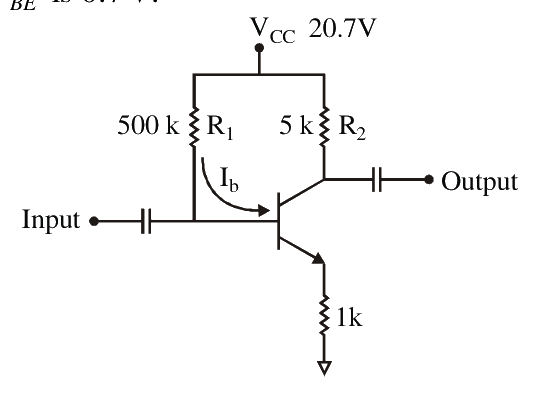
The transistor in the given circuit has $\text{h}_{\text{fe}} = 35\,\Omega$ and $\text{h}_{\text{ie}} = 1000\,\Omega$. If the load resistance $\text{R}_{\text{L}} = 1000\,\Omega$, the voltage and current gain are, respectively.
a.
$-35, +35$
b.
$35, -35$
c.
$35, -0.97$
d.
$0.98, -35$
Correct Answer & Step-by-Step Solution Locked
Sign in free to reveal the correct answer and AI explanation for this question.
The experimentally measured transmission spectra of metal, insulator and semiconductor thin films are shown in the figure. It can be inferred that I, II and III correspond respectively, to
a.
Insulator, semiconductor and metal
b.
Semiconductor, metal and insulator
c.
Metal, semiconductor and insulator
d.
Insulator, metal and semiconductor
Correct Answer & Step-by-Step Solution Locked
Sign in free to reveal the correct answer and AI explanation for this question.
The eigenvalues of the antisymmetric matrix, $A = \begin{pmatrix} 0 & -n_3 & n_2 \\ n_3 & 0 & -n_1 \\ -n_2 & n_1 & 0 \end{pmatrix}$ where $n_1, n_2$ and $n_3$ are the components of a unit vector, are
a.
$0, \text{i}, -\text{i}$
b.
$0, 1, -1$
c.
$0, 1 + \text{i}, -1 - \text{i}$
d.
$0, 0, 0$
Correct Answer & Step-by-Step Solution Locked
Sign in free to reveal the correct answer and AI explanation for this question.
A bag contains many balls, each with a number painted on it. There are exactly $n$ balls which have the number $n$ (namely one ball with 1, two balls with 2, and so on until $N$ balls with $N$ on them). An experiment consists of choosing a ball at random, noting the number on it and returning it to the bag. If the experiment is repeated a large number of times, the average value of the number will tend to
a.
$\frac{2N+1}{3}$
b.
$\frac{N}{2}$
c.
$\frac{N+1}{2}$
d.
$\frac{N(N+1)}{2}$
Correct Answer & Step-by-Step Solution Locked
Sign in free to reveal the correct answer and AI explanation for this question.
Consider the motion of a classical particle in a one dimensional double-well potential $V(x) = \frac{1}{4}(x^2 - 2)^2$. If the particle is displaced infinitesimally from the minimum the positive x-axis (and friction is neglected), then
a.
the particle will execute simple harmonic motion in the right well with an angular frequency $\omega = \sqrt{2}$
b.
the particle will execute simple harmonic motion in the right well with an angular frequency $\omega = 2$
c.
the particle will switch between the right and left wells
d.
the particle will approach the bottom of the right well and settle there
Correct Answer & Step-by-Step Solution Locked
Sign in free to reveal the correct answer and AI explanation for this question.
What is the proper time interval between the occurence of two events if in one inertial frame the events are separated by $7.5 \times 10^5\text{ m}$ and occur $6.5\text{ s}$ apart?
a.
$6.50\text{ s}$
b.
$6.00\text{ s}$
c.
$5.75\text{ s}$
d.
$5.00\text{ s}$
Correct Answer & Step-by-Step Solution Locked
Sign in free to reveal the correct answer and AI explanation for this question.
A free particle described by a plane wave and moving in the positive z-direction undergoes scattering by a potential $V(r) = \begin{cases} V_0 & \text{if } r \le R \\ 0 & \text{if } r > R \end{cases}$. If $V_0$ is changes to $2V_0$, keeping $R$ fixed, then the differential scattering cross-section, in the Born approximation,
a.
increases to four times the original value
b.
increases to twice the original value
c.
decreases to half the original value
d.
decreases to one fourth the original value
Correct Answer & Step-by-Step Solution Locked
Sign in free to reveal the correct answer and AI explanation for this question.
A variational calculation is done with the normalized trial wavefunction $\psi(x) = \frac{\sqrt{15}}{4a^{5/2}}(a^2 - x^2)$ for the one dimensional potential well
$$V(x) = \begin{cases} 0 & \text{if } |x| \le a \\ \infty & \text{if } |x| > a \end{cases}$$
The ground state energy is estimated to be
a.
$\frac{5\hbar^2}{3ma^2}$
b.
$\frac{3\hbar^2}{2ma^2}$
c.
$\frac{3\hbar^2}{5ma^2}$
d.
$\frac{5\hbar^2}{4ma^2}$
Correct Answer & Step-by-Step Solution Locked
Sign in free to reveal the correct answer and AI explanation for this question.
A particle in one-dimension is in the potential
$$V(x) = \begin{cases} \infty & \text{if } x < 0 \\ -V_0 & \text{if } 0 \le x \le \ell \\ 0 & \text{if } x > \ell \end{cases}$$
If there is at least one bound state, the minimum depth of the potential is
a.
$\frac{\hbar^2\pi^2}{8m\ell^2}$
b.
$\frac{\hbar^2\pi^2}{2m\ell^2}$
c.
$\frac{2\hbar^2\pi^2}{m\ell^2}$
d.
$\frac{\hbar^2\pi^2}{m\ell^2}$
Correct Answer & Step-by-Step Solution Locked
Sign in free to reveal the correct answer and AI explanation for this question.
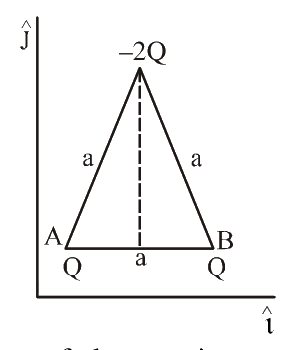
Charges $Q$, $Q$ and $-2Q$ are placed on the vertices of an equilateral triangle $ABC$ of sides of length $a$, as shown in the figure
The dipole moment of this configuration of charges, irrespective of the choice of origin, is
a.
$+2aQ\,\hat{\text{i}}$
b.
$+\sqrt{3}aQ\,\hat{\text{j}}$
c.
$-\sqrt{3}aQ\,\hat{\text{j}}$
d.
$0$
Correct Answer & Step-by-Step Solution Locked
Sign in free to reveal the correct answer and AI explanation for this question.
The vector potential $\vec{A}$ due to a magnetic moment '$\vec{m}$' at a point '$r$' is given by $\vec{A} = \frac{\vec{m} \times \vec{r}}{r^3}$. If $\vec{m}$ is directed along the positive $z$-axis, the $x$-component of the magnetic field, at the point $r$, is
a.
$\frac{3myz}{r^5}$
b.
$-\frac{3mxy}{r^5}$
c.
$\frac{3mxz}{r^5}$
d.
$\frac{3m(z^2 - xy)}{r^5}$
Correct Answer & Step-by-Step Solution Locked
Sign in free to reveal the correct answer and AI explanation for this question.
A system has two normal modes of vibration, with frequencies $\omega_1$ and $\omega_2 = 2\omega_1$. What is the probability that at temperature T, the system has an energy less than $4\hbar\omega_1$? [In the following $x = e^{-\beta\hbar\omega}$ and Z is the partition function]
a.
$x^{3/2}\left(x + 2x^2\right)/Z$
b.
$x^{3/2}\left(1 + x + x^2\right)/Z$
c.
$x^{3/2}\left(1 + 2x^2\right)/Z$
d.
$x^{3/2}\left(1 + x + 2x^2\right)/Z$
Correct Answer & Step-by-Step Solution Locked
Sign in free to reveal the correct answer and AI explanation for this question.
The magnetization $M$ of a ferromagnet, as a function of the temperature $T$ and the magnetic field $H$, is described by the equaltion $M = \tanh\left(\frac{T_c}{T}M + \frac{H}{T}\right)$. In these units, the zero-field magnetic susceptibility in terms of $M(0) = M(H=0)$ is given by
a.
$\frac{1 - M^2(0)}{T - T_c(1 - M^2(0))}$
b.
$\frac{1 - M^2(0)}{T - T_c}$
c.
$\frac{1 - M^2(0)}{T + T_c}$
d.
$\frac{1 - M^2(0)}{T}$
Correct Answer & Step-by-Step Solution Locked
Sign in free to reveal the correct answer and AI explanation for this question.
Bose condensation occurs in liquid $\text{He}^4$ kept at ambient pressure at $2.17\text{ K}$. At which temperature will Bose condensation occur in $\text{He}^4$ in gaseous state, the density of which is 1000 times smaller than that of liquid $\text{He}^4$? (Assume that it is a perfect Bose gas)
a.
$2.17\text{ mK}$
b.
$21.7\text{ mK}$
c.
$21.7\ \mu\text{K}$
d.
$2.17\ \mu\text{K}$
Correct Answer & Step-by-Step Solution Locked
Sign in free to reveal the correct answer and AI explanation for this question.
Consider black body radiation contained in a cavity whose walls are at temperature $T$. The radiation is in equilibrium with the walls of the cavity. If the temperature of the walls is increased to $2T$ and the radiation is allowed to come to equilibrium at the new temperature, the entropy of the radiation increases by a factor of
a.
2
b.
4
c.
8
d.
16
Correct Answer & Step-by-Step Solution Locked
Sign in free to reveal the correct answer and AI explanation for this question.
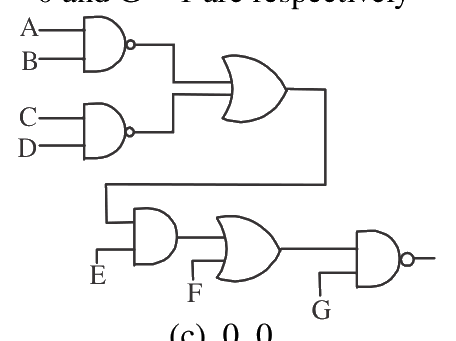
The output O, of the given circuit in cases I and II, where
Case I : $\text{A}, \text{B} = 1\text{; } \text{C}, \text{D} = 0\text{; } \text{E}, \text{F} = 1 \text{ and } \text{G} = 0$
Case II : $\text{A}, \text{B} = 0\text{; } \text{C}, \text{D} = 0\text{; } \text{E}, \text{F} = 0 \text{ and } \text{G} = 1$ are respectively
a.
1, 0
b.
0, 1
c.
0, 0
d.
1, 1
Correct Answer & Step-by-Step Solution Locked
Sign in free to reveal the correct answer and AI explanation for this question.
A resistance strain gauge is fastened to a steel fixture and subjected to a stress of $1000\text{ kg/m}^2$. If the gauge factor is 3 and the modulus of elasticity of steel is $2\times 10^{10}\text{ kg / m}^2$, then the fractional change in resistance of the strain gauge due to the applied stress is:
(Note: The gauge factor is defined as the ratio of the fractional change in resistance to the fractional change in length. )
a.
$1.5\times 10^{-7}$
b.
$3.0\times 10^{-7}$
c.
$0.16\times 10^{-10}$
d.
$0.5\times 10^{-7}$
Correct Answer & Step-by-Step Solution Locked
Sign in free to reveal the correct answer and AI explanation for this question.
Consider a sinusoidal waveform of amplitude $1\text{V}$ and frequency $f_0$. Starting from an arbitrary intial time, the waveform is sampled at intervals of $1/(2f_0)$. If the corresponding Fourier spectrum peaks at a frequency $\overline{f}$ and an amplitude $\overline{A}$, then
a.
$\overline{f} = 2f_0$ and $\overline{A} = 1\text{V}$
b.
$\overline{f} = f_0$ and $0\le \overline{A}\le 1\text{V}$
c.
$\overline{f} = 0$ and $\overline{A} = 1\text{V}$
d.
$\overline{f} = \frac{f_0}{2}$ and $\overline{A} = \frac{1}{\sqrt{2}}\text{V}$
Correct Answer & Step-by-Step Solution Locked
Sign in free to reveal the correct answer and AI explanation for this question.
The first absorption spectrum of $^{12}\text{C}^{16}\text{O}$ is at $3.842\text{ cm}^{-1}$ while that of $^{13}\text{C}^{16}\text{O}$ is at $3.673\text{ cm}^{-1}$. The ratio of their moments of inertia is
a.
1.851
b.
1.286
c.
1.046
d.
1.038
Correct Answer & Step-by-Step Solution Locked
Sign in free to reveal the correct answer and AI explanation for this question.
The spin-orbit interaction in an atom is given by $H = a\,\vec{L}.\vec{S}$, where $L$ and $S$ denote the orbital and spin angular moment, respectively of electron. The splitting between the levels $^{2}\text{P}_{3/2}$ and $^{2}\text{P}_{1/2}$ is:
a.
$\frac{3}{2}a\hbar^2$
b.
$\frac{1}{2}a\hbar^2$
c.
$3a\hbar^2$
d.
$\frac{5}{2}a\hbar^2$
Correct Answer & Step-by-Step Solution Locked
Sign in free to reveal the correct answer and AI explanation for this question.
The spectral line corresponding to an atomic transition from $J = 1$ to $J = 0$ states splits in a magnetic field of $1\text{ KG}$ into three components seperated by $1.6\times 10^{-3}\text{ \AA}$. If the zero field spectral line corresponding to $1849\text{\AA}$, what is the g-factor corresponding to the $J = 1$ state? (You may use $\frac{hc}{\mu_0} \approx 2\times 10^4\text{ cm}$.)
a.
2
b.
3/2
c.
1
d.
1/2
Correct Answer & Step-by-Step Solution Locked
Sign in free to reveal the correct answer and AI explanation for this question.
The energy required to create a lattice vacancy in a crystal is equal to $1\text{ eV}$. The ratio of the number densities of vacancies $n(1200\text{ K})/n(300\text{ K})$, when the crystal is at equilibrium at $1200\text{ K}$ and $300\text{ K}$, respectively is approximately
a.
$\exp(-30)$
b.
$\exp(-15)$
c.
$\exp(15)$
d.
$\exp(30)$
Correct Answer & Step-by-Step Solution Locked
Sign in free to reveal the correct answer and AI explanation for this question.
The dispersion relation of phonons in a solid is given by
$$\omega^2(k) = \omega_0^2(3 - \cos k_x a - \cos k_y a - \cos k_z a)$$
The velocity of the phonons at large wavelength is
a.
$\omega_0 a / \sqrt{3}$
b.
$\omega_0 a$
c.
$\sqrt{3}\omega_0 a$
d.
$\omega_0 a / \sqrt{2}$
Correct Answer & Step-by-Step Solution Locked
Sign in free to reveal the correct answer and AI explanation for this question.
Consider an electron in a box of lenght L with periodic boundary condition $\psi(x) = \psi(x + L)$. If the electron is in the $\psi_k(x) = \frac{1}{\sqrt{L}}e^{jkx}$ with energy $\varepsilon_k = \frac{\hbar^2 k^2}{2m}$, what is the correction to its energy, to second order of perturbation theory, when it is subjected to weak periodic potential $V(x) = V_0 \cos gx$, where g is an integral multiple of the $2\pi/L$?
The ground state of $^{207}_{82}\text{Pb}$ nucleus has spin-parity $J^P = \frac{1^-}{2}$, while the first excited state has $J^P = \frac{5^-}{2}$. The electromagnetic radiation emitted when the nucleus makes a transition from the first excited state to the ground state are
a.
E2 and E3
b.
M2 and E3
c.
E2 and M3
d.
M2 and M3
Correct Answer & Step-by-Step Solution Locked
Sign in free to reveal the correct answer and AI explanation for this question.
The dominant interactions underlying the following processes
A. $K^- + p \rightarrow \Sigma^- + \pi^+$, B. $\mu^- + \mu^+ \rightarrow K^- + K^+$, C. $\Sigma^+ \rightarrow p + \pi^0$ are
a.
A: strong, B: electromagnetic and C: weak
b.
A: strong, B: weak and C: weak
c.
A: weak, B: electromagnetic and C: strong
d.
A: weak, B: electromagnetic and C: weak
Correct Answer & Step-by-Step Solution Locked
Sign in free to reveal the correct answer and AI explanation for this question.
If a Higgs boson of mass $m_H$ with a speed $\beta = \frac{v}{c}$ decays into a pair photons, then the invariant mass of the photon pair is
[**Note:** The invariant mass of a system of two particles, with four-momenta $p_1$ and $p_2$ is $(p_1 + p_2)^2$ ]
a.
$\beta m_H$
b.
$m_H$
c.
$m_H / \sqrt{1 - \beta^2}$
d.
$\beta m_H / \sqrt{1 - \beta^2}$
Correct Answer & Step-by-Step Solution Locked
Sign in free to reveal the correct answer and AI explanation for this question.