A $2\times2$ matrix A has eigenvalues $e^{i\pi/5}$ and $e^{i\pi/6}$. The smallest value of ‘$n$’ such that $\text{A}^n = 1$ is:
a.
20
b.
30
c.
60
Correct Answer
d.
120
Step-by-Step AI Explanation
Verified Method
For $\text{A}^n = I$, both eigenvalues raised to the power $n$ must equal 1:
$$(e^{i\pi/5})^n = e^{i n\pi/5} = 1 \implies \frac{n}{5} \in 2\mathbb{Z} \implies n \text{ is a multiple of } 10$$
$$(e^{i\pi/6})^n = e^{i n\pi/6} = 1 \implies \frac{n}{6} \in 2\mathbb{Z} \implies n \text{ is a multiple of } 12$$
The smallest positive integer $n$ that is a multiple of both 10 and 12 is $\text{lcm}(10, 12) = 60$.
Q22mcq
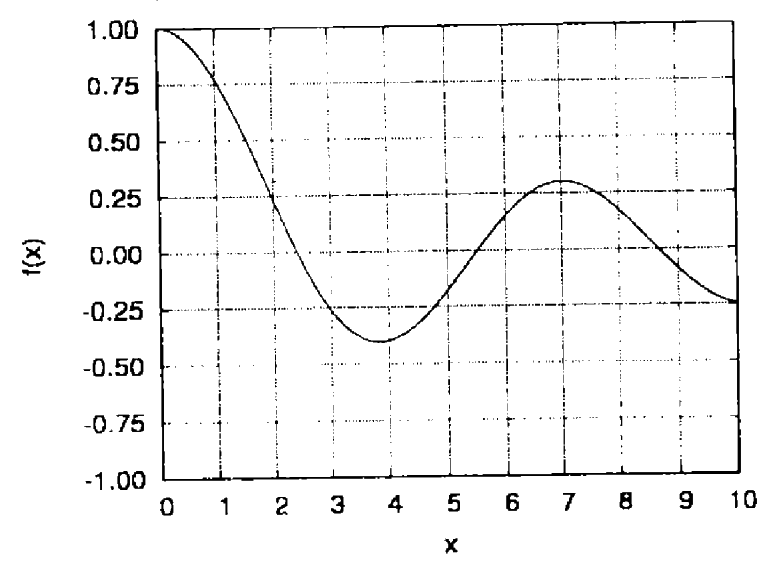
The graph of the function $f(x)$ as shown below is best described by
a.
The bessel function $\text{J}_0(x)$
Correct Answer
b.
$\cos x$
c.
$e^{-x}\cos x$
d.
$\frac{1}{x}\cos x$
Step-by-Step AI Explanation
Verified Method
At $x = 0$, the function equals $1$. As $x$ increases, it exhibits damped oscillations. Looking at the roots, the first zero is at approximately $x \approx 2.4$, which is the well-known first zero of the zeroth-order Bessel function of the first kind, $J_0(x) \approx 2.4048$. In contrast, $\cos x$ has its first zero at $\pi/2 \approx 1.57$, and $x^{-1}\cos x$ diverges at $x = 0$. Hence, the graph best describes the Bessel function $J_0(x)$.
Q23mcq
In a series of five cricket matches, one of the captains calls “Heads” every time when the toss is taken. The probability that he will win 3 times and lose 2 times is
a.
1/8
b.
5/8
c.
3/16
d.
5/16
Correct Answer
Step-by-Step AI Explanation
Verified Method
Each toss has two equally likely outcomes (win or lose the toss) with $p = 1/2$. The number of wins follows a binomial distribution with $n = 5$ and $p = 1/2$. The probability of winning exactly $k = 3$ times is:
$$P(X = 3) = \binom{5}{3} p^3 (1-p)^{5-3} = 10 \left(\frac{1}{2}\right)^5 = \frac{10}{32} = \frac{5}{16}$$
Q24mcq
The unit normal vector at the point $\left(\frac{a}{\sqrt{3}}, \frac{b}{\sqrt{3}}, \frac{c}{\sqrt{3}}\right)$ on the surface of the ellipsoid $\frac{x^2}{a^2} + \frac{y^2}{b^2} + \frac{z^2}{c^2} = 1$, is
Let the surface be defined by $F(x, y, z) = \frac{x^2}{a^2} + \frac{y^2}{b^2} + \frac{z^2}{c^2} - 1 = 0$. The normal vector is given by the gradient:
$$\nabla F = \left(\frac{2x}{a^2}, \frac{2y}{b^2}, \frac{2z}{c^2}\right)$$
At the point $\left(\frac{a}{\sqrt{3}}, \frac{b}{\sqrt{3}}, \frac{c}{\sqrt{3}}\right)$, we have:
$$\nabla F = \frac{2}{\sqrt{3}} \left(\frac{1}{a}\hat{i} + \frac{1}{b}\hat{j} + \frac{1}{c}\hat{k}\right) = \frac{2}{\sqrt{3}abc} \left(bc\hat{i} + ca\hat{j} + ab\hat{k}\right)$$
The unit normal vector is:
$$\hat{n} = \frac{\nabla F}{|\nabla F|} = \frac{bc\hat{i} + ca\hat{j} + ab\hat{k}}{\sqrt{(bc)^2 + (ca)^2 + (ab)^2}}$$
In the question options, option (A) gives the numerator as $bc\hat{i} + ca\hat{j} + ab\hat{k}$, which corresponds to option A.
Q25mcq
A solid cylinder of height $H$, radius $R$ and density $\rho$, floats vertically on the surface of a liquid of density $\rho_0$. The cylinder will be set into oscillatory motion when a small instantaneous downward force is applied. The frequency of oscillation is
a.
$\frac{\rho g}{\rho_0 H}$
b.
$\frac{\rho}{\rho_0}\sqrt{\frac{g}{H}}$
c.
$\sqrt{\frac{\rho g}{\rho_0 H}}$
d.
$\sqrt{\frac{\rho_0 g}{\rho H}}$
Correct Answer
Step-by-Step AI Explanation
Verified Method
Let $A$ be the cross-sectional area of the cylinder. The total mass of the cylinder is $M = \rho A H$.
When the cylinder is displaced downward by a small distance $z$, the extra restoring buoyant force is:
$$F = -\rho_0 A g z$$
The equation of motion is:
$$M \ddot{z} = -\rho_0 A g z \implies \rho A H \ddot{z} + \rho_0 A g z = 0$$
$$\ddot{z} + \left(\frac{\rho_0 g}{\rho H}\right) z = 0$$
Thus, the angular frequency of oscillation is $\omega = \sqrt{\frac{\rho_0 g}{\rho H}}$.
Q26mcq
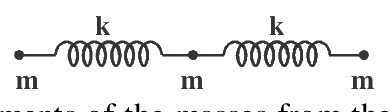
Three particles of equal mass '$m$' are connected by two identical massless springs of stiffness constant '$k$' as shown in the figure.
If $x_1$, $x_2$ and $x_3$ denote the displacements of the masses from their respective equilibrium positions, the potential energy of the system is:
a.
$\frac{1}{2} k \left(x_1^2 + x_2^2 + x_3^2\right)$
The extension of the first spring is $(x_2 - x_1)$ and of the second spring is $(x_3 - x_2)$.
The total potential energy of the system is the sum of the potential energies of the two springs:
$$V = \frac{1}{2} k (x_2 - x_1)^2 + \frac{1}{2} k (x_3 - x_2)^2$$
Expanding the terms:
$$V = \frac{1}{2} k \left[(x_2^2 - 2x_1 x_2 + x_1^2) + (x_3^2 - 2x_2 x_3 + x_2^2)\right]$$
$$V = \frac{1}{2} k \left[x_1^2 + 2x_2^2 + x_3^2 - 2x_2(x_1 + x_3)\right]$$
This matches option D.
Q27mcq
Let $v$, $p$ and $E$ denotes the speed, the magnitude of the momentum, and the energy of a free particle of rest mass '$m$'. Then
In relativistic mechanics, the energy-momentum relation is $E = \sqrt{p^2 c^2 + m^2 c^4} = \gamma m c^2$ and momentum is $p = \gamma m v$.
From these relations, we have:
$$v = \frac{p c^2}{E} = \frac{p c^2}{\sqrt{p^2 c^2 + m^2 c^4}} = \frac{c p}{\sqrt{p^2 + m^2 c^2}}$$
Thus, option C is correct.
Q28mcq
A binary star system consists of two stars $\text{S}_1$ and $\text{S}_2$, with masses $m$ and $2m$ respectively separated by a distannce '$r$'. If both $\text{S}_1$ and $\text{S}_2$ individually follow circular orbits around the centre of the mass with intantaneous speeds $\text{v}_1$ and $\text{v}_2$ respectively, the ratio of speeds $\text{v}_1/\text{v}_2$ is:
a.
$\sqrt{2}$
b.
$1$
c.
$1/2$
d.
$2$
Correct Answer
Step-by-Step AI Explanation
Verified Method
For two stars orbiting their common centre of mass, both stars have the same angular frequency $\omega$.
The distances of the two stars from the centre of mass are:
$$r_1 = \frac{m_2}{m_1 + m_2} r = \frac{2m}{3m} r = \frac{2}{3} r$$
$$r_2 = \frac{m_1}{m_1 + m_2} r = \frac{m}{3m} r = \frac{1}{3} r$$
Since the speeds are given by $v_1 = \omega r_1$ and $v_2 = \omega r_2$, their ratio is:
$$\frac{v_1}{v_2} = \frac{r_1}{r_2} = \frac{2/3}{1/3} = 2$$
Q29mcq
Three charges are located on the circumference of a circle of radius '$R$' as shown in the figure below. The two charges $\text{Q}$ subtend an angle $90^\circ$ at the centre of the circle .The charge '$q$' is symmetrically placed with respect to the charges $\text{Q}$. If the electric field at the centre of the circle is zero, what is the magnitude of $\text{Q}$?
a.
$q/\sqrt{2}$
Correct Answer
b.
$\sqrt{2}q$
c.
$2q$
d.
$4q$
Step-by-Step AI Explanation
Verified Method
Let the centre of the circle be the origin. The two identical charges $Q$ subtend an angle of $90^\circ$ at the centre, so they can be placed at angles $+45^\circ$ and $-45^\circ$ (or $\pm \pi/4$) relative to the $x$-axis. The charge $q$ is symmetrically placed, which means it is located along the opposite direction on the circumference, at an angle of $180^\circ$. The electric field at the centre due to the two charges $Q$ is directed away from them along the $-x$-axis (assuming $Q > 0$) with magnitude $E_Q = 2 \times \frac{1}{4\pi\varepsilon_0}\frac{Q}{R^2} \cos(45^\circ) = \frac{\sqrt{2}Q}{4\pi\varepsilon_0 R^2}$. The electric field due to $q$ at the centre is along the $+x$-axis with magnitude $E_q = \frac{q}{4\pi\varepsilon_0 R^2}$. For the net field to be zero, these magnitudes must be equal: $\sqrt{2}Q = q \implies Q = q/\sqrt{2}$.
Q30mcq
Consider a hollow charged shell of inner radius '$a$' and outer radius '$b$'. The volume charge density is $\rho(r) = \frac{k}{r^2}$ (where $k$ is a constant) in the region $a < r < b$. The magnitude of the electric field produced at distance $r > a$ is:
a.
$\frac{k(b-a)}{\varepsilon_0 r^2} \text{ for } r > a$
b.
$\frac{k(b-a)}{\varepsilon_0 r^2} \text{ for } a < r < b \text{ and } \frac{kb}{\varepsilon_0 r^2} \text{ for } r > b$
c.
$\frac{k(r-a)}{\varepsilon_0 r^2} \text{ for } a < r < b \text{ and } \frac{k(b-a)}{\varepsilon_0 r^2} \text{ for } r > b$
Correct Answer
d.
$\frac{k(r-a)}{\varepsilon_0 a^2} \text{ for } a < r < b \text{ and } \frac{k(b-a)}{\varepsilon_0 a^2} \text{ for } r > b$
Step-by-Step AI Explanation
Verified Method
By Gauss's law, the electric field at a radius $r$ is given by $\oint \vec{E} \cdot d\vec{A} = E(r) 4\pi r^2 = \frac{Q_{\text{enc}}}{\varepsilon_0}$. For $a < r < b$, the enclosed charge is $Q_{\text{enc}} = \int_a^r \rho(r') 4\pi r'^2 dr' = \int_a^r \frac{k}{r'^2} 4\pi r'^2 dr' = 4\pi k (r - a)$. Thus, $E(r) = \frac{k(r - a)}{\varepsilon_0 r^2}$. For $r > b$, the total enclosed charge is $Q_{\text{enc}} = 4\pi k (b - a)$, so $E(r) = \frac{k(b - a)}{\varepsilon_0 r^2}$.
🎉 10 Free Sample Solutions Completed
Unlock All 55 Questions & Solutions
Sign up free in seconds to unlock step-by-step AI answers for the remaining 45 questions.
Consider the interference of two coherent electromagnetic waves whose electric field vectors are given by $\vec{E}_1 = \hat{i}E_0 \cos \omega t$ and $\vec{E}_2 = \hat{j}E_0 \cos (\omega t + \varphi)$ where $\varphi$ is the phase difference. The intensity of the resulting wave is given by $\frac{\varepsilon_0}{2} \left\langle E^2 \right\rangle$, where $\left\langle E^2 \right\rangle$ is the time average of $E^2$. The total intensity is
a.
$0$
b.
$\varepsilon_0 E_0^2$
c.
$\varepsilon_0 E_0^2 \sin^2 \varphi$
d.
$\varepsilon_0 E_0^2 \cos^2 \varphi$
Correct Answer & Step-by-Step Solution Locked
Sign in free to reveal the correct answer and AI explanation for this question.
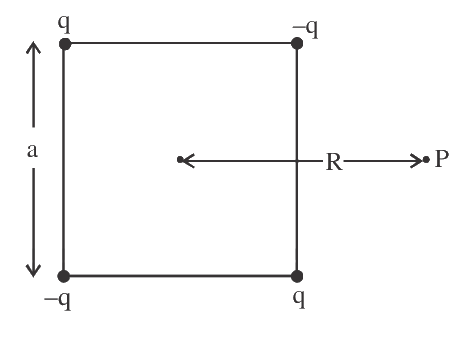
Four charges (two $+q$ and two $-q$) are kept fixed at the four vertices of a square of side '$a$' as shown
At the point $P$ which is at a distance $R$ from the centre ($R \gg a$), the potential is proportional to
a.
$\frac{1}{R}$
b.
$\frac{1}{R^2}$
c.
$\frac{1}{R^3}$
d.
$\frac{1}{R^4}$
Correct Answer & Step-by-Step Solution Locked
Sign in free to reveal the correct answer and AI explanation for this question.
A point charge '$q$' of mass '$m$' is kept at a distance '$d$' below a grounded infinite conducting sheet which lies in the $xy$-plane. What is the value of '$d$' for which the charge remains stationary?
a.
$q/4\sqrt{mg\pi\varepsilon_0}$
b.
$q/\sqrt{mg\pi\varepsilon_0}$
c.
There is no finite value of '$d$'
d.
$\sqrt{mg\pi\varepsilon_0}/q$
Correct Answer & Step-by-Step Solution Locked
Sign in free to reveal the correct answer and AI explanation for this question.
The wave function of a state of the hydrogen atom is given by
$$\psi = \psi_{200} + 2\psi_{211} + 3\psi_{210} + \sqrt{2}\psi_{21-1}$$
where $\psi_{n\ell m}$ denotes the normalized eigen function of the state with quantum numbers $n$, $l$ and $m$ in the usual notation. The expectation value of $L_z$ in the state $\psi$ is:
a.
$\frac{15\hbar}{16}$
b.
$\frac{11\hbar}{16}$
c.
$\frac{3\hbar}{8}$
d.
$\frac{\hbar}{8}$
Correct Answer & Step-by-Step Solution Locked
Sign in free to reveal the correct answer and AI explanation for this question.
If a particle is represented by the normalized wave function
$$\psi(x) = \begin{cases} \frac{\sqrt{15}(a^2 - x^2)}{4a^{5/2}} & \text{for } -a < x < a \\ 0 & \text{otherwise} \end{cases}$$
the uncertainty $\Delta p$ in its momentum is
a.
$\frac{2\hbar}{5a}$
b.
$\frac{5\hbar}{2a}$
c.
$\frac{\sqrt{10}\,\hbar}{a}$
d.
$\frac{\sqrt{5}\,\hbar}{\sqrt{2}\,a}$
Correct Answer & Step-by-Step Solution Locked
Sign in free to reveal the correct answer and AI explanation for this question.
Given the usual canonical commutation relations, the commutator $[\text{A}, \text{B}]$ of $\text{A} = \text{i}(x p_y - y p_x)$ and $\text{B} = (y p_z + z p_y)$ is :
a.
$\hbar(x p_z - p_x z)$
b.
$-\hbar(x p_z - p_x z)$
c.
$\hbar(x p_z + p_x z)$
d.
$-\hbar(x p_z + p_x z)$
Correct Answer & Step-by-Step Solution Locked
Sign in free to reveal the correct answer and AI explanation for this question.
The entropy of a system, $\text{S}$, is related to the accessible phase space volume $\Gamma$ by $\text{S} = \text{k}_\text{B} \ln \Gamma(\text{E}, \text{N}, \text{V})$ where $\text{E}$, $\text{N}$ and $\text{V}$ are the energy, number of particles and volume respectively. From this one can conclude that $\Gamma$
a.
does not change during evolution to equilibrium
b.
Oscillates during evolution to equilibrium
c.
Is a maximum in equilibrium
d.
Is a minimum in equilibrium
Correct Answer & Step-by-Step Solution Locked
Sign in free to reveal the correct answer and AI explanation for this question.
Let $\Delta \text{W}$ be the work done in a quasistatic reversible thermodynamics process. Which of the following statements about $\Delta \text{W}$ is correct?
a.
$\Delta \text{W}$ is a perfect differential if the process is isothermal
b.
$\Delta \text{W}$ is a perfect differential if the process is adiabatic
c.
$\Delta \text{W}$ is always a perfect differential
d.
$\Delta \text{W}$ cannot be a perfect differential
Correct Answer & Step-by-Step Solution Locked
Sign in free to reveal the correct answer and AI explanation for this question.
Consider a system of three spins $\text{S}_1$, $\text{S}_2$ and $\text{S}_3$ each of which can take values $+1$ and $-1$. The energy of the system is given by $\text{E} = -\text{J}[\text{S}_1\text{S}_2 + \text{S}_2\text{S}_3 + \text{S}_3\text{S}_1]$, where $\text{J}$ is a positive constant. The minimum energy and the corresponding number of spin configurations are, respectively,
a.
$\text{J}$ and $1$
b.
$-3\text{J}$ and $1$
c.
$-3\text{J}$ and $2$
d.
$-6\text{J}$ and $2$
Correct Answer & Step-by-Step Solution Locked
Sign in free to reveal the correct answer and AI explanation for this question.
The minimum energy of a collection of 6 non-interacting electrons of spin $-\frac{1}{2}$ placed in a one dimensional infinite square well potential of width $\text{L}$ is
a.
$14\pi^2\hbar^2 / \text{mL}^2$
b.
$91\pi^2\hbar^2 / \text{mL}^2$
c.
$7\pi^2\hbar^2 / \text{mL}^2$
d.
$3\pi^2\hbar^2 / \text{mL}^2$
Correct Answer & Step-by-Step Solution Locked
Sign in free to reveal the correct answer and AI explanation for this question.
A live music broadcast consists of a radio-wave of frequency $7\text{ MHz}$, amplitude-modulated by a microphone output consisting of signals with a maximum frequency of $10\text{ KHz}$. The spectrum of modulated output will be zero outside the frequency band
a.
$7.00\text{ MHz to } 7.01\text{ MHz}$
b.
$6.99\text{ MHz to } 7.01\text{ MHz}$
c.
$6.99\text{ MHz to } 7.00\text{ MHz}$
d.
$6.995\text{ MHz to } 7.005\text{ MHz}$
Correct Answer & Step-by-Step Solution Locked
Sign in free to reveal the correct answer and AI explanation for this question.
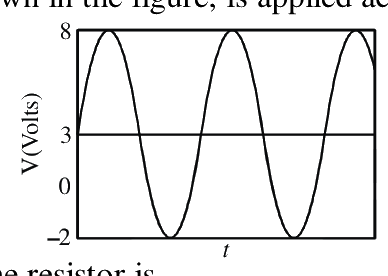
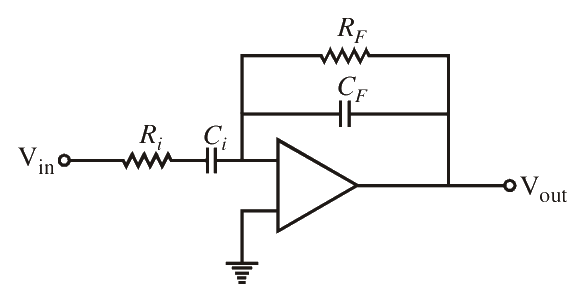
In the op-amp circuit shown in the figure, $\text{V}_i$ is a sinusoidal input signal of frequency $10\text{ Hz}$ and $\text{V}_0$ is the output signal. The magnitude of the gain and the phase shift, respectively, are close to the values
a.
$5\sqrt{2}\text{ and }\frac{\pi}{2}$
b.
$5\sqrt{2}\text{ and }\frac{-\pi}{2}$
c.
$10\text{ and zero}$
d.
$10\text{ and }\pi$
Correct Answer & Step-by-Step Solution Locked
Sign in free to reveal the correct answer and AI explanation for this question.
A diode $\text{D}$ as shown in the circuit as an $\text{i}-\text{v}$ relation which can be proximated by $$i_\text{D} = \begin{cases} v_\text{D}^2 + 2v_\text{D}, & \text{for } v_\text{D} > 0 \\ 0, & \text{for } v_\text{D} \le 0 \end{cases}$$ The value of $v_\text{D}$ in the circuit is:
a.
$(-1+\sqrt{11})\text{V}$
b.
$8\text{V}$
c.
$5\text{V}$
d.
$2\text{V}$
Correct Answer & Step-by-Step Solution Locked
Sign in free to reveal the correct answer and AI explanation for this question.
Given a $2 \times 2$ unitary matrix $\text{U}$ satisfying $\text{U}'\text{U} = \text{UU}' = 1$ with $\det\text{U} = \text{e}^{i\varphi}$, one can construct a unitary matrix $\text{V} (\text{V}'\text{V} = \text{VV}' = 1)$ with $\det\text{V} = 1$ from it by
a.
Multiplying $\text{U}$ by $\text{e}^{-i\varphi/2}$
b.
Multiplying any single element of $\text{U}$ by $\text{e}^{-i\varphi}$
c.
Multiplying any row or column of $\text{U}$ by $\text{e}^{-i\varphi/2}$
d.
Multiplying $\text{U}$ by $\text{e}^{-i\varphi}$.
Correct Answer & Step-by-Step Solution Locked
Sign in free to reveal the correct answer and AI explanation for this question.
The value of the integral $\int_\text{C} \frac{z^3\text{d}z}{z^2 - 5z + 6}$, where $\text{C}$ is a closed contour defined by the equation $2|z| - 5 = 0$, traversed in the anti-clockwise direction, is:
a.
$-16\pi i$
b.
$16\pi i$
c.
$8\pi i$
d.
$2\pi i$
Correct Answer & Step-by-Step Solution Locked
Sign in free to reveal the correct answer and AI explanation for this question.
A function $\text{f}(x)$ obeys the differential equation $\frac{\text{d}^2\text{f}}{\text{d}x^2} - (3 - 2i)\text{f} = 0$ and satisfies the conditions $\text{f}(0) = 1$ and $\text{f}(x) \rightarrow 0$ as $x \rightarrow \infty$. The value of $\text{f}(\pi)$ is :
a.
$\text{e}^{2\pi}$
b.
$\text{e}^{-2\pi}$
c.
$-\text{e}^{-2\pi}$
d.
$-\text{e}^{2\pi i}$
Correct Answer & Step-by-Step Solution Locked
Sign in free to reveal the correct answer and AI explanation for this question.
A planet of mass '$\text{m}$' moves in the gravitational field of the Sun (mass $\text{M}$). If the semi-major and semi-minor axes of the orbit are '$\text{a}$' and '$\text{b}$' respectively, the angular momentum of the planet is:
The Hamiltonian of a simple pendulum consisting of a mass '$\text{m}$' attached to a massless string of length $l$ is $\text{H} = \frac{\text{p}_\theta^2}{2\text{m}\ell^2} + \text{mg}\ell(1 - \cos\theta)$. If $\text{L}$ denotes the Lagrangian, the value of $\frac{\text{dL}}{\text{dt}}$ is :
Which of the following set of phase-space trajectories which one is not possible for a particle obeying Hamilton's equations of motion (for a time-independent Hamiltonian)?
Two bodies of equal mass '$\text{m}$' are connected by a massless rigid rod of length '$l$' lying in the xy-plane with the centre of the rod at the origin. If this system is rotating about the z-axis with a frequency $\omega$, its angular momentum is
a.
$\text{m}l^2\omega/4$
b.
$\text{m}l^2\omega/2$
c.
$\text{m}l^2\omega$
d.
$2\text{m}l^2\omega$
Correct Answer & Step-by-Step Solution Locked
Sign in free to reveal the correct answer and AI explanation for this question.
An infinite solenoid with its axis of symmetry along the z-direction carries a steady current I.
The vector potential $\vec{A}$ at a distance R from the axis.
a.
Is constant inside and varies as R outside the solenoid.
b.
Varies as R inside and is constant outside the solenoid.
c.
Varies as 1/R inside and as R outside the solenoid.
d.
Varies as R inside and as 1/R outside the solenoid.
Correct Answer & Step-by-Step Solution Locked
Sign in free to reveal the correct answer and AI explanation for this question.
Consider an infinite conducting sheet in the xy-plane with a time dependent current density $Kt\hat{i}$, where K is a constant. The vector potential at $(x, y, z)$ is given by
$$\vec{A} = \frac{\mu_0 K}{4c}(ct-z)^2\hat{i}$$
The magnetic field $\vec{B}$ is:
a.
$\frac{\mu_0 K t}{2}\hat{j}$
b.
$-\frac{\mu_0 K z}{2c}\hat{j}$
c.
$-\frac{\mu_0 K}{2c}(ct-z)\hat{i}$
d.
$-\frac{\mu_0 K}{2c}(ct-z)\hat{j}$
Correct Answer & Step-by-Step Solution Locked
Sign in free to reveal the correct answer and AI explanation for this question.
When a charged particle emits electromagnetic radiation, the electric field $\vec{E}$ and the Poynting vector $\vec{S} = \frac{1}{\mu_0}\vec{E}\times\vec{B}$ at a large distance 'r' from the emitter vary as $\frac{1}{r^n}$ and $\frac{1}{r^m}$ respectively. Which of the following choices for 'n' and 'm' are correct?
a.
$n = 1$ and $m = 1$
b.
$n = 2$ and $m = 2$
c.
$n = 1$ and $m = 2$
d.
$n = 2$ and $m = 4$
Correct Answer & Step-by-Step Solution Locked
Sign in free to reveal the correct answer and AI explanation for this question.
The energies in the ground state and first excited state of a particle of mass $m = \frac{1}{2}$ in a potential $V(x)$ are $-4$ and $-1$, respectively, (in units in which $\hbar = 1$). If the corresponding wavefunctions are related by $\psi_1(x) = \psi_0(x)\sinh x$, then the ground state eigenfunction is
a.
$\psi_0(x) = \sqrt{\operatorname{sech} x}$
b.
$\psi_0(x) = \operatorname{sech} x$
c.
$\psi_0(x) = \operatorname{sech}^2 x$
d.
$\psi_0(x) = \operatorname{sech}^3 x$
Correct Answer & Step-by-Step Solution Locked
Sign in free to reveal the correct answer and AI explanation for this question.
The perturbation
$$H' = \begin{cases} b(a-x) & -a < x < a \\ 0 & \text{otherwise} \end{cases}$$
acts on a particle of mass 'm' confined in an infinite square well potential
$$V(x) = \begin{cases} 0 & -a < x < a \\ \infty & \text{otherwise} \end{cases}$$ The first order correction to the ground state energy of the particle is
a.
$\frac{ba}{2}$
b.
$\frac{ba}{\sqrt{2}}$
c.
$2ba$
d.
$ba$
Correct Answer & Step-by-Step Solution Locked
Sign in free to reveal the correct answer and AI explanation for this question.
Let $|0\rangle$ and $|1\rangle$ denote the normalized eigenstates corresponding to the ground and the first excited states of a one-dimensional harmonic oscillator. The uncertainty $\Delta x$ in the state $\frac{1}{\sqrt{2}}(|0\rangle + |1\rangle)$ is:
a.
$\Delta x = \sqrt{\hbar / 2m\omega}$
b.
$\Delta x = \sqrt{\hbar / m\omega}$
c.
$\Delta x = \sqrt{2\hbar / m\omega}$
d.
$\Delta x = \sqrt{\hbar / 4m\omega}$
Correct Answer & Step-by-Step Solution Locked
Sign in free to reveal the correct answer and AI explanation for this question.
What would be the ground state energy of the Hamiltonian
$$H = -\frac{\hbar^2}{2m} \frac{\mathrm{d}^2}{\mathrm{d}x^2} - \alpha\delta(x)$$
if vibrational principle is used to estimate it with the trial wavefunction $\psi(x) = A \mathrm{e}^{-bx^2}$ with b as the variational parameter?
$$\left[\text{Hint: } \int_{-\infty}^\infty x^{2n} \mathrm{e}^{-2bx^2} \mathrm{d}x = (2b)^{-n-\frac{1}{2}} \Gamma\left(n+\frac{1}{2}\right)\right]$$
a.
$-m\alpha^2 / 2\hbar^2$
b.
$-2m\alpha^2 / \pi\hbar^2$
c.
$-m\alpha^2 / \pi\hbar^2$
d.
$m\alpha^2 / \pi\hbar^2$
Correct Answer & Step-by-Step Solution Locked
Sign in free to reveal the correct answer and AI explanation for this question.
The free energy difference between the superconducting and the normal states of a material is given by $\Delta F = F_S - F_N = \alpha |\psi|^2 + \frac{\beta}{2}|\psi|^4$, where $\psi$ is an order parameter and $\alpha$ and $\beta$ are constants such that $\alpha > 0$ in the normal and $\alpha < 0$ in the superconducting state, while $\beta > 0$ always. The minimum value of $\Delta F$ in the superconducting state is
a.
$-\alpha^2 / \beta$
b.
$-\alpha^2 / 2\beta$
c.
$-3\alpha^2 / 2\beta$
d.
$-5\alpha^2 / 2\beta$
Correct Answer & Step-by-Step Solution Locked
Sign in free to reveal the correct answer and AI explanation for this question.
A given quantity of gas is taken from the state $\text{A} \rightarrow \text{C}$ reversibly, by two paths, $\text{A} \rightarrow \text{C}$ directly and $\text{A} \rightarrow \text{B} \rightarrow \text{C}$ as shown in the figure below.
During the $\text{A} \rightarrow \text{C}$ the work done by the gas is $100\text{ J}$ and the heat absorbed is $150\text{ J}$. If during the process $\text{A} \rightarrow \text{B} \rightarrow \text{C}$ the work done by the gas is $30\text{ J}$, the heat absorbed is:
a.
$20\text{J}$
b.
$80\text{J}$
c.
$220\text{ J}$
d.
$280\text{ J}$
Correct Answer & Step-by-Step Solution Locked
Sign in free to reveal the correct answer and AI explanation for this question.
Consider a one-dimensional Ising model with N spins, at very low temperatures when almost all the spins are aligned parallel to each other. There will be a few spin flips with each flip costing an energy 2J. In a configuration with r spin flips, the energy of the system is $\text{E} = -\text{NJ} + 2r\text{J}$ and the number of configuration is $^N\text{C}_r$; r varies from 0 to N. The partition function is
A magnetic field sensor based on the Hall effect is to be fabricated by implanting. As into a Si film of thickness $1\text{ }\mu\text{m}$. The specifications require a magnetic field sensitivity of $500\text{ mV/Tesla}$ at an excitation current of $1\text{ mA}$. The implanation dose is to be adjusted such that the average carrier density, after activation, is
a.
$1.25\times10^{26}\text{ m}^{-3}$
b.
$1.25\times10^{22}\text{ m}^{-3}$
c.
$4.1\times10^{21}\text{ m}^{-3}$
d.
$4.1\times10^{20}\text{ m}^{-3}$
Correct Answer & Step-by-Step Solution Locked
Sign in free to reveal the correct answer and AI explanation for this question.
Band-pass and band-reject filters can be implemented by combining a low pass and a high pass filter in series and in parallel, respectively. If the cut-off frequencies of the low pass and high pass filters are $\omega_0^{\text{LP}}$ and $\omega_0^{\text{HP}}$, respectively, the condition required to implement the band-pass and band-reject filters are respectively.
a.
$\omega_0^{\text{HP}} < \omega_0^{\text{LP}}$ and $\omega_0^{\text{HP}} < \omega_0^{\text{LP}}$
b.
$\omega_0^{\text{HP}} < \omega_0^{\text{LP}}$ and $\omega_0^{\text{HP}} > \omega_0^{\text{LP}}$
c.
$\omega_0^{\text{HP}} > \omega_0^{\text{LP}}$ and $\omega_0^{\text{HP}} < \omega_0^{\text{LP}}$
d.
$\omega_0^{\text{HP}} > \omega_0^{\text{LP}}$ and $\omega_0^{\text{HP}} > \omega_0^{\text{LP}}$
Correct Answer & Step-by-Step Solution Locked
Sign in free to reveal the correct answer and AI explanation for this question.
The output characteristics of a solar panel at a certain level of irradiance is shown in the figure below.
If the solar cell is to power a load of $5\text{ }\Omega$, the power drawn by the load is:
a.
$97\text{W}$
b.
$73\text{ W}$
c.
$50\text{ W}$
d.
$45\text{ W}$
Correct Answer & Step-by-Step Solution Locked
Sign in free to reveal the correct answer and AI explanation for this question.
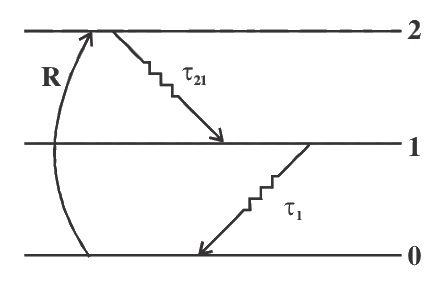
Consider the energy level diagram shown below, which corresponds to the molecular nitrogen laser.
If the pump rate $\text{R}$ is $10^{20}\text{ atoms cm}^{-3}\text{ s}^{-1}$ and the decay routes are as shown with $\tau_{21} = 20\text{ ns}$ and $\tau_1 = 1\text{ }\mu\text{s}$, the equilibrium populations of states 2 and 1 are, respectively,
a.
$10^{14}\text{ cm}^{-3}$ and $2\times10^{12}\text{ cm}^{-3}$
b.
$2\times10^{12}\text{ cm}^{-3}$ and $10^{14}\text{ cm}^{-3}$
c.
$2\times10^{12}\text{ cm}^{-3}$ and $2\times10^{6}\text{ cm}^{-3}$
d.
zero and $10^{20}\text{ cm}^{-3}$
Correct Answer & Step-by-Step Solution Locked
Sign in free to reveal the correct answer and AI explanation for this question.
Consider a hydrogen atom undergoing a $2\text{P}\rightarrow 1\text{S}$ transition. The lifetime $\text{t}_{\text{sp}}$ of the $2\text{P}$ state for spontaneous emission is $1.6\text{ ns}$ and the energy difference between the levels is $10.2\text{ eV}$. Assuming that the refractive index of the medium $\text{n}_0 = 1$, the ratio of the Einstein coefficients for stimulated emission $\text{B}_{21}(\omega)/\text{A}_{21}(\omega)$ is given by
Consider a He-Ne laser cavity consisting of two mirrors of reflectivities $R_1 = 1$ and $R_2 = 0.98$. The mirrors are separated by a distance $d = 20\text{ cm}$ and the medium in between has a refractive index $n_0 = 1$ and absorption coefficient $\alpha = 0$. The values of the separation between the modes $\delta\nu$ and the width $\Delta\nu_p$ of each mode of the laser cavity are:
Non-interacting bosons undergo Bose-Einstein Condensation (BEC) when trapped in a three-dimensional isotropic simple harmonic potential. For BEC to occur, the chemical potential must be equal to
a.
$\hbar\omega/2$
b.
$\hbar\omega$
c.
$3\hbar\omega/2$
d.
$0$
Correct Answer & Step-by-Step Solution Locked
Sign in free to reveal the correct answer and AI explanation for this question.
In a band structure calculation, the dispersion relation for electrons is found to be
$$\varepsilon_k = \beta(\cos k_x a + \cos k_y a + \cos k_z a)$$
where $\beta$ is a constant and $a$ is the lattice constant. The effective mass at the boundary of the first Brilliouin zone is
a.
$\frac{2\hbar^2}{5\beta a^2}$
b.
$\frac{4\hbar^2}{5\beta a^2}$
c.
$\frac{\hbar^2}{2\beta a^2}$
d.
$\frac{\hbar^2}{3\beta a^2}$
Correct Answer & Step-by-Step Solution Locked
Sign in free to reveal the correct answer and AI explanation for this question.
The muon has mass $105\text{ MeV/c}^2$ and mean lifetime $2.2\text{ }\mu\text{s}$ in its rest frame. The mean distance traversed by muon of energy $315\text{ MeV/c}^2$ before decaying is approximately
a.
$3\times 10^5\text{ km}$
b.
$2.2\text{ cm}$
c.
$6.6\text{ }\mu\text{m}$
d.
$1.98\text{ km}$
Correct Answer & Step-by-Step Solution Locked
Sign in free to reveal the correct answer and AI explanation for this question.
Consider the following particles: the proton $\text{p}$, the neutron $\text{n}$, the neutral pion $\pi^0$ and the delta resonance $\Delta^+$. When ordered in terms of decreasing lifetime, the correct arrangement is as follows:
a.
$\pi^0, \text{n}, \text{p}, \Delta^+$
b.
$\text{p}, \text{n}, \Delta^+, \pi^0$
c.
$\text{p}, \text{n}, \pi^0, \Delta^+$
d.
$\Delta^+, \text{n}, \pi^0, \text{p}$
Correct Answer & Step-by-Step Solution Locked
Sign in free to reveal the correct answer and AI explanation for this question.
The single particle energy difference between the p-orbitals (i.e. $\text{p}_{3/2}$ and $\text{p}_{1/2}$) of the nucleus $^{114}_{\ 50}\text{Sn}$ is $3\text{ MeV}$. The energy difference between the states in its $1\text{f}$ orbital is
a.
$-7\text{ MeV}$
b.
$7\text{ MeV}$
c.
$5\text{ MeV}$
d.
$-5\text{ MeV}$
Correct Answer & Step-by-Step Solution Locked
Sign in free to reveal the correct answer and AI explanation for this question.