Consider the following subset of $\mathbb{R}$ :
Which one of the following statements is true?
a.
$\inf U = 5$
b.
$\inf U = 4$
c.
$\inf U = 3$
d.
$\inf U = 2$
Correct Answer
Step-by-Step AI Explanation
Verified Method
In Question ID 120351, the set $U$ is given (typically from the original CSIR NET paper as $U = \{x + \frac{1}{x} : x > 0\}$ or a similar set where $\inf U = 2$, e.g., $x + 1/x \ge 2$ by the AM-GM inequality, achieving equality at $x=1$). Thus, $\inf U = 2$, so option D is correct.
Q22mcq
Let $X$ be a non-empty finite set and $Y = \{f^{-1}(0) : f \text{ is a real-valued function on } X\}$. Which one of the following statements is true?
a.
$Y$ is an infinite set
b.
$Y$ has $2^{|X|}$ elements
Correct Answer
c.
There is a bijective function from $X$ to $Y$
d.
There is a surjective function from $X$ to $Y$
Step-by-Step AI Explanation
Verified Method
For any subset $S \subseteq X$, we can define a function $f: X \to \mathbb{R}$ by the indicator function $f(x) = 0$ if $x \in S$ and $f(x) = 1$ if $x \notin S$. Then $f^{-1}(0) = S$. Since $S$ can be any arbitrary subset of $X$, the collection of all such preimages is precisely the power set $\mathcal{P}(X)$. Thus, $Y = \mathcal{P}(X)$. Since $X$ is finite, the number of elements in $Y$ is $|\mathcal{P}(X)| = 2^{|X|}$. Therefore, option B is correct.
Q23mcq
Consider the following infinite series:
(a) $\sum_{n=1}^\infty \frac{\sin(n\pi/2)}{\sqrt{n}}$, \quad (b) $\sum_{n=1}^\infty \log\left(1+\frac{1}{n^2}\right)$
Which one of the following statements is true?
a.
(a) is convergent, but (b) is not convergent
b.
(a) is not convergent, but (b) is convergent.
c.
Both (a) and (b) are convergent
Correct Answer
d.
Neither (a) nor (b) is convergent.
Step-by-Step AI Explanation
Verified Method
For series (a), the sequence of partial sums of $\sin(n\pi/2)$ is bounded, and $\frac{1}{\sqrt{n}}$ decreases monotonically to $0$. By Dirichlet's test, $\sum_{n=1}^\infty \frac{\sin(n\pi/2)}{\sqrt{n}}$ converges.
For series (b), since $\log(1+x) \le x$ for all $x > 0$, we have $0 < \log\left(1+\frac{1}{n^2}\right) < \frac{1}{n^2}$. Since $\sum_{n=1}^\infty \frac{1}{n^2}$ converges by the $p$-series test ($p=2 > 1$), by the direct comparison test, $\sum_{n=1}^\infty \log\left(1+\frac{1}{n^2}\right)$ also converges.
Hence, both series (a) and (b) are convergent, making option C correct.
Q24mcq
Consider the sequence $(a_n)_{n\ge 1}$, where $a_n = \cos\left( (-1)^n \frac{n\pi}{2} + \frac{n\pi}{3} \right)$. Which one of the following statements is true ?
a.
$\limsup_{n\to\infty} a_n = \frac{\sqrt{3}}{2}$
b.
$\limsup_{n\to\infty} a_{2n} = 1$
Correct Answer
c.
$\limsup_{n\to\infty} a_{2n} = \frac{1}{2}$
d.
$\limsup_{n\to\infty} a_{3n} = 0$
Step-by-Step AI Explanation
Verified Method
Consider the subsequence $a_{2n}$:
$$a_{2n} = \cos\left( (-1)^{2n} \frac{2n\pi}{2} + \frac{2n\pi}{3} \right) = \cos\left( n\pi + \frac{2n\pi}{3} \right) = \cos\left( \frac{5n\pi}{3} \right).$$
For $n = 6k$ (where $k \in \mathbb{N}$), we have:
$$a_{2(6k)} = \cos(10k\pi) = \cos(0) = 1.$$
Since the maximum possible value of the cosine function is $1$, we have $\limsup_{n\to\infty} a_{2n} = 1$. Thus, option B is true.
Q25mcq
Let $f : \mathbb{R} \to \mathbb{R}$ be a differentiable function such that $f$ and its derivative $f'$ have no common zeros in $[0,1]$. Which one of the following statements is true?
a.
$f$ never vanishes in $[0,1]$
b.
$f$ has at most finitely many zeros in $[0,1]$
Correct Answer
c.
$f$ has infinitely many zeros in $[0,1]$
d.
$f(1/2) = 0$
Step-by-Step AI Explanation
Verified Method
Suppose $f$ has infinitely many zeros in the compact interval $[0,1]$. By the Bolzano-Weierstrass theorem, the set of zeros must have an accumulation point $x_0 \in [0,1]$. Since $f$ is continuous, $f(x_0) = 0$. Moreover, since $x_0$ is a limit point of zeros of $f$, the derivative $f'(x_0) = \lim_{x \to x_0} \frac{f(x) - f(x_0)}{x - x_0} = 0$. This implies that $f(x_0) = 0$ and $f'(x_0) = 0$, contradicting the assumption that $f$ and $f'$ have no common zeros in $[0,1]$. Therefore, $f$ can have at most finitely many zeros in $[0,1]$. Hence, option B is correct.
Q26mcq
Let $f(x)$ be a cubic polynomial with real coefficients. Suppose that $f(x)$ has exactly one real root and that this root is simple. Which one of the following statements holds for ALL antiderivatives $F(x)$ of $f(x)$?
a.
$F(x)$ has exactly one real root
b.
$F(x)$ has exactly four real roots
c.
$F(x)$ has at most two real roots
Correct Answer
d.
$F(x)$ has at most one real root
Step-by-Step AI Explanation
Verified Method
Let $F(x)$ be an antiderivative of $f(x)$. Since $f(x)$ is a cubic polynomial, $F(x)$ is a polynomial of degree 4. The critical points of $F(x)$ are the roots of $F'(x) = f(x)$.
Since $f(x)$ has exactly one real root, $F'(x)$ has exactly one real root, say $c$. By Rolle's Theorem, between any two real roots of $F(x)$, there must be at least one real root of $F'(x)$. Since $F'(x)$ has only one real root, $F(x)$ can have at most two real roots. Thus, option C is correct.
Q27mcq
We denote by $I_n$ the $n \times n$ identity matrix. Which one of the following statements is true?
a.
If $A$ is a real $3\times 2$ matrix and $B$ is a real $2\times 3$ matrix such that $BA = I_2$, then $AB = I_3$.
b.
Let $A$ be the real matrix $\begin{pmatrix} 3 & 3 \\ 1 & 2 \end{pmatrix}$. Then there is a matrix $B$ with integer entries such that $AB = I_2$
c.
Let $A$ be the matrix $\begin{pmatrix} 3 & 1 \\ 1 & 2 \end{pmatrix}$ with entries in $\mathbb{Z}/6\mathbb{Z}$. Then there is a matrix $B$ with entries in $\mathbb{Z}/6\mathbb{Z}$ such that $AB = I_2$
Correct Answer
d.
If $A$ is a real non-zero $3\times 3$ diagonal matrix, then there is a real matrix $B$ such that $AB = I_3$
Step-by-Step AI Explanation
Verified Method
A $2\times 2$ matrix $A$ over a commutative ring $R$ is invertible if and only if its determinant $\det(A)$ is a unit in $R$.
Here, $R = \mathbb{Z}/6\mathbb{Z}$. The units of $\mathbb{Z}/6\mathbb{Z}$ are $1$ and $5 \equiv -1 \pmod 6$.
For $A = \begin{pmatrix} 3 & 1 \\ 1 & 2 \end{pmatrix}$, we have:
$$\det(A) = 3(2) - 1(1) = 6 - 1 = 5 \equiv -1 \pmod 6.$$
Since $\det(A) = 5$ is a unit in $\mathbb{Z}/6\mathbb{Z}$, $A$ is invertible over $\mathbb{Z}/6\mathbb{Z}$. Thus, there exists a matrix $B$ with entries in $\mathbb{Z}/6\mathbb{Z}$ such that $AB = I_2$. Therefore, option C is correct.
Q28mcq
Let $A = (a_{i,j})$ be the $n \times n$ real matrix with $a_{i,j} = ij$ for all $1 \le i, j \le n$. If $n \ge 3$, which one of the following is an eigenvalue of $A$?
a.
$1$
b.
$n$
c.
$n(n+1)/2$
d.
$n(n+1)(2n+1)/6$
Correct Answer
Step-by-Step AI Explanation
Verified Method
The matrix $A$ can be written as the outer product $A = u v^T$, where $u = v = \begin{pmatrix} 1 & 2 & \dots & n \end{pmatrix}^T$.
Since $A$ is a rank-1 matrix, its non-zero eigenvalue is equal to its trace:
$$\operatorname{Tr}(A) = \sum_{i=1}^n a_{i,i} = \sum_{i=1}^n i^2 = \frac{n(n+1)(2n+1)}{6}.$$
All other eigenvalues of $A$ are $0$. Thus, $\frac{n(n+1)(2n+1)}{6}$ is an eigenvalue of $A$, so option D is correct.
Q29mcq
Which one of the following statements is FALSE?
a.
The product of two $2\times 2$ real matrices of rank $2$ is of rank $2$
b.
The product of two $3\times 3$ real matrices of rank $2$ is of rank at most $2$
c.
The product of two $3\times 3$ real matrices of rank $2$ is of rank at least $2$
Correct Answer
d.
The product of two $2\times 2$ real matrices of rank $1$ can be the zero matrix
Step-by-Step AI Explanation
Verified Method
By Sylvester's rank inequality, for any two $n \times n$ matrices $A$ and $B$, $\operatorname{rank}(AB) \ge \operatorname{rank}(A) + \operatorname{rank}(B) - n$. For $n=3$ and $\operatorname{rank}(A) = \operatorname{rank}(B) = 2$, this gives $\operatorname{rank}(AB) \ge 2 + 2 - 3 = 1$. Thus, the rank of the product can be $1$, which means it does not have to be at least $2$.
For example, let $A = \begin{pmatrix} 1 & 0 & 0 \\ 0 & 1 & 0 \\ 0 & 0 & 0 \end{pmatrix}$ and $B = \begin{pmatrix} 0 & 0 & 0 \\ 0 & 1 & 0 \\ 0 & 0 & 1 \end{pmatrix}$. Both have rank $2$, but their product $AB = \begin{pmatrix} 0 & 0 & 0 \\ 0 & 1 & 0 \\ 0 & 0 & 0 \end{pmatrix}$ has rank $1 < 2$. Hence statement (C) is FALSE.
Q30mcq
Let $A$ be an $n \times n$ matrix with complex entries. If $n \ge 4$, which one of the following statement is True ?
a.
$A$ does not have any non-zero invariant subspace in $\mathbb{C}^n$.
b.
$A$ has an invariant subspace in $\mathbb{C}^n$ of dimension $n-3$.
Correct Answer
c.
All eigenvalues of $A$ are real numbers.
d.
$A^2$ does not have any invariant subspace in $\mathbb{C}^n$ of dimension $n-1$.
Step-by-Step AI Explanation
Verified Method
Since the field is $\mathbb{C}$, which is algebraically closed, any $n \times n$ complex matrix $A$ can be triangularized (by Schur's triangularization theorem or Jordan canonical form). Hence, $A$ has an invariant flag of subspaces $0 = V_0 \subset V_1 \subset V_2 \subset \dots \subset V_n = \mathbb{C}^n$, where $\dim(V_k) = k$ for every $k = 0, 1, \dots, n$.
In particular, for any dimension $k \in \{0, 1, \dots, n\}$, including $k = n-3$ (since $n \ge 4 \implies n-3 \ge 1$), there exists an invariant subspace of dimension $k$. Thus, (B) is true.
- (A) is false because any eigenvector spans a $1$-dimensional invariant subspace.
- (C) is false as a complex matrix can have arbitrary complex eigenvalues.
- (D) is false because $A^2$ also has invariant subspaces of every dimension between $0$ and $n$ (any $A$-invariant subspace is also $A^2$-invariant).
🎉 10 Free Sample Solutions Completed
Unlock All 70 Questions & Solutions
Sign up free in seconds to unlock step-by-step AI answers for the remaining 60 questions.
Let $(-, -)$ be a symmetric bilinear form on $\mathbb{R}^2$ such that there exist nonzero $v, w \in \mathbb{R}^2$ such that $(v, v) > 0 > (w, w)$ and $(v, w) = 0$. Let $A$ be the $2 \times 2$ real symmetric matrix representing this bilinear form with respect to the standard basis. Which one of the following statements is true ?
a.
$A^2 = 0$
b.
$\operatorname{rank} A = 1$
c.
$\operatorname{rank} A = 0$
d.
There exists $u \in \mathbb{R}^2$, $u \ne 0$ such that $(u, u) = 0$
Correct Answer & Step-by-Step Solution Locked
Sign in free to reveal the correct answer and AI explanation for this question.
For $a \in \mathbb{R}$, let $A_a = \begin{pmatrix} 2 & -1 & 0 \\ -1 & 2 & -1 \\ 0 & -1 & a \end{pmatrix}$. Which one of the following statements is true?
a.
$A_a$ is positive definite for all $a < 3$
b.
$A_a$ is positive definite for all $a > 3$
c.
$A_a$ is positive definite for all $a \ge -2$
d.
$A_a$ is positive definite only for finitely many values of $a$.
Correct Answer & Step-by-Step Solution Locked
Sign in free to reveal the correct answer and AI explanation for this question.
Let $\mathbb{H} = \{z \in \mathbb{C} : \text{Im}(z) > 0\}$ denote the upper half plane and let $f : \mathbb{C} \to \mathbb{C}$ be defined by $f(z) = e^{iz}$. Which one of the following statements is true?
a.
$f(\mathbb{H}) = \mathbb{C} \setminus \{0\}$
b.
$f(\mathbb{H}) \cap \mathbb{H}$ is countable.
c.
$f(\mathbb{H})$ is bounded
d.
$f(\mathbb{H})$ is a convex subset of $\mathbb{C}$.
Correct Answer & Step-by-Step Solution Locked
Sign in free to reveal the correct answer and AI explanation for this question.
Let $f$ be a meromorphic function on an open set containing the unit circle $C$ and its interior. Suppose that $f$ has no zeros and no poles on $C$, and let $n_p$ and $n_0$ denote the number of poles and zeros of $f$ inside $C$, respectively. Which one of the following is true ?
Let $f: \mathbb{C} \to \mathbb{C}$ be a real-differentiable function. Define $u, v: \mathbb{R}^2 \to \mathbb{R}$ by
$$u(x, y) = \text{Re}\, f(x+iy) \text{ and } v(x, y) = \text{Im}\, f(x+iy), \quad x, y \in \mathbb{R}$$
Let $\nabla u = (u_x, y_y)$ denote the gradient. Which one of the following is necessarily true ?
a.
For $c_1, c_2 \in \mathbb{C}$, the level curves $u = c_1$, and $v = c_2$, are orthogonal wherever they intersect.
b.
$\nabla u \cdot \nabla v = 0$ at every point.
c.
If $f$ is an entire function, then $\nabla u \cdot \nabla v = 0$ at every point.
d.
If $\nabla u \cdot \nabla v = 0$ at every point, then $f$ is an entire function.
Correct Answer & Step-by-Step Solution Locked
Sign in free to reveal the correct answer and AI explanation for this question.
Consider the field $\mathbb{C}$ together with the Euclidean topology. Let $K$ be a proper subfield of $\mathbb{C}$ that is not contained in $\mathbb{R}$. Which one of the following statements is hecessarily true ?
a.
$K$ is dense in $\mathbb{C}$.
b.
$K$ is an algebraic extension of $\mathbb{Q}$.
c.
$\mathbb{C}$ is an algebraic extension of $K$.
d.
The smallest closed subset of $\mathbb{C}$ containing $K$ is NOT a field
Correct Answer & Step-by-Step Solution Locked
Sign in free to reveal the correct answer and AI explanation for this question.
Let $f : \mathbb{R} \to \mathbb{R}$ be defined by
$$f(x) = \begin{cases} (1-x)^2 \sin(x^2), & x \in (0,1) \\ 0, & \text{otherwise} \end{cases}$$
and $f'$ be its derivative. Let $S = \{c \in \mathbb{R} : f'(x) \le cf(x) \text{ for all } x \in \mathbb{R}\}$.
Which one of the following is true ?
a.
$S = \phi$
b.
$S \ne \phi$ and $S$ is a proper subset of $(1,\infty)$
c.
$(2,\infty)$ is a proper subset of $S$
d.
$S \cap (0,1) \ne \phi$
Correct Answer & Step-by-Step Solution Locked
Sign in free to reveal the correct answer and AI explanation for this question.
Consider the Cauchy problem for the wave equation
$$\frac{\partial^2 u}{\partial t^2} - 4\frac{\partial^2 u}{\partial x^2} = 0, -\infty < x < \infty, t > 0,$$
$$u(x,0) = \begin{cases} e^{-\left(\frac{1}{x^2}\right)}, & x \neq 0 \\ 0 & x = 0 \end{cases}$$
$$\frac{\partial u}{\partial t}(x,0) = xe^{-x^2}, x \in \mathbb{R}$$
Which one of the following is true ?
a.
$\lim_{t \to \infty} u(5,t) = 1$
b.
$\lim_{t \to \infty} u(5,t) = 2$
c.
$\lim_{t \to \infty} u(5,t) = \frac{1}{2}$
d.
$\lim_{t \to \infty} u(5,t) = 0$
Correct Answer & Step-by-Step Solution Locked
Sign in free to reveal the correct answer and AI explanation for this question.
Using Euler's method with the step size $0.05$, the approximate value of the solution for the initial value problem
$$\frac{dy}{dx} = \sqrt{3x + 2y + 1}, \quad y(1) = 1$$
at $x = 1.1$ (rounded off to two decimal places), is
a.
$1.50$
b.
$1.65$
c.
$1.25$
d.
$1.15$
Correct Answer & Step-by-Step Solution Locked
Sign in free to reveal the correct answer and AI explanation for this question.
Let $g$ denote the acceleration due to gravity and $a > 0$. A particle of mass $m$ glides (without friction) on the cycloid given by $x = a(\theta - \sin\theta), \quad y = a(1 + \cos\theta)$, with $0 \le \theta \le 2\pi$. Then the equation of motion of the particle is
Let $(X, Y)$ be a random vector with the joint moment generating function
$$M_{X, Y} (t_1, t_2) = \left( \frac{3}{4} + \frac{1}{4} e^{t_1} \right)^2 \left( \frac{5}{6} + \frac{1}{6} e^{t_2} \right)^3, \quad (t_1, t_2) \in \mathbb{R}^2$$
Then $P(X + 2Y > 1)$ is equal to
a.
$\frac{1581}{3456}$
b.
$\frac{1875}{3456}$
c.
$\frac{125}{3456}$
d.
$\frac{3331}{3456}$
Correct Answer & Step-by-Step Solution Locked
Sign in free to reveal the correct answer and AI explanation for this question.
Consider the linear programming problem:
Maximize $z = 3x + 4y$
subject to $x + y \le 12$, $2x + 3y \le 30$, $x + 4y \le 36$, $x \ge 0, y \ge 0$.
Then the optimal solution of the given problem is
a.
$x^* = 6, y^* = 6$
b.
$x^* = 7, y^* = 5$
c.
$x^* = 3, y^* = 8$
d.
$x^* = 4, y^* = 8$
Correct Answer & Step-by-Step Solution Locked
Sign in free to reveal the correct answer and AI explanation for this question.
Let $\{A_n\}_{n \ge 1}$ be a collection of non-empty subsets of $\mathbb{Z}$ such that $A_n \cap A_m = \phi$ for $m \neq n$. If $\mathbb{Z} = \bigcup_{n \ge 1} A_n$, then which of the following statements are necessarily true ?
a.
$A_n$ is finite for every integer $n \ge 1$.
b.
$A_n$ is finite for same integer $n \ge 1$.
c.
$A_n$ is infinite for some integer $n \ge 1$.
d.
$A_n$ is countable (finite or infinite) for every integer $n \ge 1$
Correct Answer & Step-by-Step Solution Locked
Sign in free to reveal the correct answer and AI explanation for this question.
Let $f : \mathbb{R} \to \mathbb{R}$ be a continuous function such that $|f(x) - f(y)| \ge \log(1 + |x - y|)$ for all $x, y \in \mathbb{R}$. Which of the following statements are true ?
a.
$f$ is necessarily one-one
b.
$f$ need not be one-one
c.
$f$ is necessarily onto
d.
$f$ need not be onto
Correct Answer & Step-by-Step Solution Locked
Sign in free to reveal the correct answer and AI explanation for this question.
Let $f : [0, \infty) \to \mathbb{R}$ be the periodic function of period 1 given by $f(x) = 1 - |2x - 1|$ for $x \in [0, 1]$
Further, define $g : [0, \infty) \to \mathbb{R}$ by $g(x) = f(x^2)$. Which of the following statements are true ?
a.
$f$ is continuous on $[0, \infty)$
b.
$f$ is uniformly continuous on $[0, \infty)$
c.
$g$ is continuous on $[0, \infty)$
d.
$g$ is uniformly continuous on $[0, \infty)$
Correct Answer & Step-by-Step Solution Locked
Sign in free to reveal the correct answer and AI explanation for this question.
Let $(f_n)_{n\ge 1}$ be the sequence of functions defined on $[0,1]$ by
$$f_n(x) = x^n \log\left(\frac{1+\sqrt{x}}{2}\right)$$
Which of the following statements are true?
a.
$(f_n)$ converges pointwise on $[0,1]$
b.
$(f_n)$ converges uniformly on compact subsets of $[0,1)$ but not on $[0,1)$
c.
$(f_n)$ converges uniformly on $[0,1)$ but not on $[0,1]$
d.
$(f_n)$ converges uniformly on $[0,1]$
Correct Answer & Step-by-Step Solution Locked
Sign in free to reveal the correct answer and AI explanation for this question.
For a real number $\lambda$, consider the improper integrals
$$I_\lambda = \int_0^1 \frac{dx}{(1-x)^\lambda}, \quad K_\lambda = \int_1^\infty \frac{dx}{x^\lambda}$$
Which of the following statements are true ?
a.
There exists $\lambda$ such that $I_\lambda$ converges, but $K_\lambda$ does not converge
b.
There exists $\lambda$ such that $K_\lambda$ converges, but $I_\lambda$ does not converge
c.
There exists $\lambda$ such that $I_\lambda, K_\lambda$ both converge
d.
There exists $\lambda$ such that neither $I_\lambda$ nor $K_\lambda$ converges
Correct Answer & Step-by-Step Solution Locked
Sign in free to reveal the correct answer and AI explanation for this question.
The function $f : \mathbb{R} \to \mathbb{R}$ defined by
$$f(x) = \begin{cases} [x]\sin 1/x & \text{for } x \neq 0 \\ 0 & \text{for } x = 0 \end{cases}$$
has a discontinuity at 0 which is removable
b.
The function $f : [0,\infty) \to \mathbb{R}$ defined by
$$f(x) = \begin{cases} \sin(\log x) & \text{for } x \neq 0 \\ 0 & \text{for } x = 0 \end{cases}$$
has a discontinuity at 0 which is NOT removable.
c.
The function $f : \mathbb{R} \to \mathbb{R}$ defined by
$$f(x) = \begin{cases} e^{1/x} & \text{for } x < 0 \\ e^{1/(x+1)} & \text{for } x \ge 0 \end{cases}$$
has a jump discontinuity at 0
d.
Let $f, g : [0,1] \to \mathbb{R}$ be two functions of bounded variation. Then the product $fg$ has at most countably many discontinuities
Correct Answer & Step-by-Step Solution Locked
Sign in free to reveal the correct answer and AI explanation for this question.
For real numbers $a,b,c,d,e,f$, consider the function $F : \mathbb{R}^2 \to \mathbb{R}^2$ given by
$$F(x, y) = (ax + by + c, dx + ey + f), \text{ for } x, y \in \mathbb{R}$$
Which of the following statements are true?
a.
$F$ is continuous.
b.
$F$ is uniformly continuous.
c.
$F$ is differentiable.
d.
$F$ has partial derivatives of all orders
Correct Answer & Step-by-Step Solution Locked
Sign in free to reveal the correct answer and AI explanation for this question.
For a differentiable surjective function $f: (0,1) \to (0,1)$, consider the function $$F : (0,1) \times (0,1) \to (0,1) \times (0,1)$$ given by $$F(x, y) = (f(x), f(y)), \quad x, y \in (0,1).$$ If $f'(x) \neq 0$ for every $x \in (0,1)$, then which of the following statements are true ?
a.
$F$ is injective
b.
$F$ is increasing
c.
For every $(x', y') \in (0,1) \times (0,1)$, there exists a unique $(x, y) \in (0,1) \times (0,1)$ such that $F(x, y) = (x', y')$.
d.
The total derivative $DF(x, y)$ is invertible for all $(x, y) \in (0,1) \times (0,1)$
Correct Answer & Step-by-Step Solution Locked
Sign in free to reveal the correct answer and AI explanation for this question.
Let $T : \mathbb{R}^5 \to \mathbb{R}^5$ be a $\mathbb{R}$-linear transformation. Suppose that $(1, -1, 2, 4, 0)$, $(4, 6, 1, 6, 0)$ and $(5, 5, 3, 9, 0)$ span the null space of $T$. Which of the following statements are true ?
a.
The rank of $T$ is equal to 2
b.
Suppose that for every vector $v \in \mathbb{R}^5$, there exists $n$ such that $T^n v = 0$. Then $T^2$ must be zero
c.
Suppose that for every vector $v \in \mathbb{R}^5$, there exists $n$ such that $T^n v = 0$. Then $T^3$ must be zero
d.
$(-2, -8, 3, 2, 0)$ is contained in the null space of $T$
Correct Answer & Step-by-Step Solution Locked
Sign in free to reveal the correct answer and AI explanation for this question.
Consider $A = \begin{bmatrix} 1 & 4 \\ 2 & 3 \end{bmatrix}$. Suppose $A^5 - 4A^2 - 7A^3 + 11A^2 - A - 10I = aA + bI$ for some $a, b \in \mathbb{Z}$. Which of the following statements are true ?
a.
$a + b > 8$
b.
$a + b < 7$
c.
$a + b$ is divisible by 2
d.
$a > b$
Correct Answer & Step-by-Step Solution Locked
Sign in free to reveal the correct answer and AI explanation for this question.
Suppose a $7\times 7$ block diagonal complex $A$ has blocks
$(0)$, $(1)$, $\begin{pmatrix} 0 & 1 \\ 0 & 0 \end{pmatrix}$, and $\begin{pmatrix} 2\pi i & 1 & 0 \\ 0 & 2\pi i & 0 \\ 0 & 0 & 2\pi i \end{pmatrix}$ along the diagonal
Which of the following statements are true ?
a.
The characteristic polynomial of $A$ is $x^3 (x - 1)(x - 2\pi i)^3$
b.
The minimal polynomial of $A$ is $x^2 (x - 1)(x - 2\pi i)^3$.
c.
The dimensions of the eigenspaces for $0$, $1$, $2\pi i$ are $2$, $1$, $3$ respectively
d.
The dimensions of the eigenspaces for $0$, $1$, $2\pi i$ are $2$, $1$, $2$ respectively
Correct Answer & Step-by-Step Solution Locked
Sign in free to reveal the correct answer and AI explanation for this question.
Let $A$ be a real diagonal matrix with characteristic polynomial $\lambda^3 - 2\lambda^2 - \lambda + 2$. Define a bilinear form $\langle v, w \rangle = v^t A w$ on $\mathbb{R}^3$. Which of the following statements are true ?
a.
$A$ is positive definite.
b.
$A^2$ is positive definite.
c.
There exists a non zero $v \in \mathbb{R}^3$ such that $\langle v, v \rangle = 0$.
d.
$\operatorname{rank} A = 2$
Correct Answer & Step-by-Step Solution Locked
Sign in free to reveal the correct answer and AI explanation for this question.
Consider the quadratic form $Q(x, y, z) = x^2 + xy + y^2 + xz + yz + z^2$. Which of the following statements are true ?
a.
There exists a non-zero $u \in \mathbb{Q}^3$ such that $Q(u) = 0$.
b.
There exists a non-zero $u \in \mathbb{R}^3$ such that $Q(u) = 0$.
c.
There exist a non-zero $u \in \mathbb{C}^3$ such that $Q(u) = 0$.
d.
The real symmetric $3\times 3$ matrix $A$ which satisfies
$$Q(x, y, z) = \begin{bmatrix} x & y & z \end{bmatrix} A \begin{bmatrix} x \\ y \\ z \end{bmatrix} \text{ for all } x, y, z \in \mathbb{R}$$
is invertible.
Correct Answer & Step-by-Step Solution Locked
Sign in free to reveal the correct answer and AI explanation for this question.
Let $X$ be an uncountable subset of $\mathbb{C}$ and let $f : \mathbb{C} \to \mathbb{C}$ be an entire function. Assume that for every $z \in X$, there exists an integer $n \ge 1$ such that $f^{(n)}(z) = 0$. Which of the following statements are necessarily true?
a.
$f = 0$.
b.
$f$ is a constant function.
c.
There exists a compact subset $K$ of $\mathbb{C}$ such that $f^{-1}(k)$ is not compact
d.
$f$ is a polynomial
Correct Answer & Step-by-Step Solution Locked
Sign in free to reveal the correct answer and AI explanation for this question.
Let $G_1$ and $G_2$ be finite groups such that their orders $|G_1|$ and $|G_2|$ are coprime. Then any homomorphism from $G_1$ to $G_2$ is trivial.
b.
Let $G$ be a finite group. Let $f : G \to G$ be a group homomorphism such that $f$ fixes more than half of the elements of $G$. Then $f(x) = x$ for all $x \in G$.
c.
Let $G$ be a finite group having exactly 3 subgroups. Then $G$ is of order $p^2$ for some prime $p$.
d.
Any finite abelian group $G$ has at least $d(|G|)$ subgroups in $G$, where $d(m)$ denotes the number of positive divisors of $m$.
Correct Answer & Step-by-Step Solution Locked
Sign in free to reveal the correct answer and AI explanation for this question.
Let $G$ be the group (under matrix multiplication) of $2\times 2$ invertible matrices with entries from $\mathbb{Z}/9\mathbb{Z}$. Let $a$ be the order of $G$. Which of the following statements are True?
a.
$a$ is divisible by $3^4$
b.
$a$ is divisible by $2^4$
c.
$a$ is not divisible by $48$
d.
$a$ is divisible by $3^6$
Correct Answer & Step-by-Step Solution Locked
Sign in free to reveal the correct answer and AI explanation for this question.
Let $f(X) = X^3 - 2 \in \mathbb{Q}[X]$ and let $K \subset \mathbb{C}$ be the splitting field of $f(X)$ over $\mathbb{Q}$. Let $\omega = e^{2\pi i/3}$. Which of the following statements are true?
a.
The Galois group of $K$ over $\mathbb{Q}$ is the symmetric group $S_3$.
b.
The Galois group of $K$ over $\mathbb{Q}(\omega)$ is the symmetric group $S_3$.
c.
The Galois group of $K$ over $\mathbb{Q}$ is $\mathbb{Z}/3\mathbb{Z}$.
d.
The Galois group of $K$ over $\mathbb{Q}(\omega)$ is $\mathbb{Z}/3\mathbb{Z}$
Correct Answer & Step-by-Step Solution Locked
Sign in free to reveal the correct answer and AI explanation for this question.
Consider $\mathbb{R}^2$ with the Euclidean topology and consider $\mathbb{Q}^2 \subset \mathbb{R}^2$ with the subspace topology. Which of the following statements are true?
a.
$\mathbb{Q}^2$ is connected.
b.
If $A$ is a non-empty connected subset of $\mathbb{Q}^2$, then $A$ has exactly one element
c.
$\mathbb{Q}^2$ is Hausdorff
d.
$\{(x, y) \in \mathbb{Q}^2 \mid x^2 + y^2 = 1\}$ is compact in the subspace topology.
Correct Answer & Step-by-Step Solution Locked
Sign in free to reveal the correct answer and AI explanation for this question.
Let $p : \mathbb{R}^2 \to \mathbb{R}$ be the function defined by $p(x, y) = x$. Which of the following statements are true?
a.
Let $A_1 = \{(x, y) \in \mathbb{R}^2 \mid x^2 + y^2 < 1\}$. Then for each $\gamma \in p(A_1)$, there exists a positive real number $\varepsilon$ such that $(\gamma - \varepsilon, \gamma + \varepsilon) \subseteq p(A_1)$.
b.
Let $A_2 = \{(x, y) \in \mathbb{R}^2 \mid x^2 + y^2 \le 1\}$. Then for each $\gamma \in p(A_2)$, there exists a positive real number $\varepsilon$ such that $(\gamma - \varepsilon, \gamma + \varepsilon) \subseteq p(A_2)$
c.
Let $A_3 = \{(x, y) \in \mathbb{R}^2 \mid xy = 0\}$. Then for each $\gamma \in p(A_3)$, there exists a positive real number $\varepsilon$ such that $(\gamma - \varepsilon, \gamma + \varepsilon) \subseteq p(A_3)$.
d.
Let $A_4 = \{(x, y) \in \mathbb{R}^2 \mid xy = 1\}$. Then for each $\gamma \in p(A_4)$, there exists a positive real number $\varepsilon$ such that $(\gamma - \varepsilon, \gamma + \varepsilon) \subseteq p(A_4)$
Correct Answer & Step-by-Step Solution Locked
Sign in free to reveal the correct answer and AI explanation for this question.
Consider the problem
$$y' = (1 - y^2)^{10} \cos y, \quad y(0) = 0$$
Let $J$ be the maximal interval of existence and $K$ be the range of the solution of the above problem. Then which of the following statements are true?
a.
$J = \mathbb{R}$
b.
$K = (-1, 1)$
c.
$J = (-1, 1)$
d.
$K = [-1, 1]$
Correct Answer & Step-by-Step Solution Locked
Sign in free to reveal the correct answer and AI explanation for this question.
Consider the following initial value problem
$$y' = y + \frac{1}{2} |\sin(y^2)|, \quad x > 0, \quad y(0) = -1$$
Which of the following statements are true ?
a.
there exists an $\alpha \in (0, \infty)$ such that $\lim_{x \to \alpha^-} |y(x)| = \infty$
b.
$y(x)$ exists on $(0, \infty)$ and it is monotone
c.
$y(x)$ exists on $(0, \infty)$, but not bounded below
d.
$y(x)$ exists on $(0, \infty)$, but not bounded above
Correct Answer & Step-by-Step Solution Locked
Sign in free to reveal the correct answer and AI explanation for this question.
Consider the initial value problem
$$x^2 y'' - 2x^2 y' + (4x - 2)y = 0, \quad y(0) = 0$$
Suppose $y = \varphi(x)$ is a polynomial solution satisfying $\varphi(1) = 1$. Which of the following statements are true ?
a.
$\varphi(4) = 16$
b.
$\varphi(2) = 2$
c.
$\varphi(5) = 25$
d.
$\varphi(3) = 3$
Correct Answer & Step-by-Step Solution Locked
Sign in free to reveal the correct answer and AI explanation for this question.
Consider the Cauchy problem
$$u \frac{\partial u}{\partial x} + \frac{\partial u}{\partial y} = 1, \quad (x, y) \in \mathbb{R} \times (0, \infty)$$
$$u(x, 0) = kx, \quad x \in \mathbb{R},$$
with a given real parameter $k$. For which of the following values of $k$ does the above problem have a solution defined on $\mathbb{R} \times (0, \infty)$ ?
a.
$k = 0$
b.
$k = -2$
c.
$k = 4$
d.
$k = 1$
Correct Answer & Step-by-Step Solution Locked
Sign in free to reveal the correct answer and AI explanation for this question.
Let $B = \{(x, y) \in \mathbb{R}^2 : x^2 + y^2 < 1\}$ be the open unit disc in $\mathbb{R}^2$, $\partial B = \{(x, y) \in \mathbb{R}^2 : x^2 + y^2 = 1\}$ be its boundary and $\overline{B} = B \cup \partial B$. For $\lambda \in (0, \infty)$, let $S_\lambda$ be the set of twice continuously differentiable functions in $B$, that are continuous on $\overline{B}$ and satisfy
$$\left(\frac{\partial u}{\partial u}\right)^2 + \lambda \left(\frac{\partial u}{\partial y}\right)^2 = 1, \text{ in } B$$
$$u(x, y) = 0 \text{ on } \partial B$$
Then which of the following statements are true?
a.
$S_1 = \phi$
b.
$S_2 = \phi$
c.
$S_1$ has exactly one element and $S_2$ has exactly two elements.
d.
$S_1$ and $S_2$ are both infinite
Correct Answer & Step-by-Step Solution Locked
Sign in free to reveal the correct answer and AI explanation for this question.
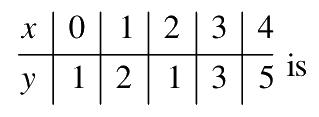
The coefficient of $x^3$ in the interpolating polynomial for the data
$$\begin{array}{c|c|c|c|c|c} x & 0 & 1 & 2 & 3 & 4 \\ \hline y & 1 & 2 & 1 & 3 & 5 \end{array}$$
is
a.
$-\dfrac{1}{3}$
b.
$-\dfrac{1}{2}$
c.
$\dfrac{5}{6}$
d.
$\dfrac{17}{6}$
Correct Answer & Step-by-Step Solution Locked
Sign in free to reveal the correct answer and AI explanation for this question.
Consider the initial value problam
$$\frac{dy}{dx} = f(x, y), y(x_0) = y_0,$$
where $f$ is a twice continuously differentiable function on a rectangle containing the point $(x_0, y_0)$. With the step-size $h$, let the first iterate of a second order scheme to "approximate the solution of the above initial value problem be given by
$$y_1 = y_0 + P k_1 + Q k_2,$$
where $k_1 = h f(x_0, y_0), k_2 = h f(x_0 + \alpha_0 h, y_0 + \beta_0 k_1)$ and $P, Q, \alpha_0, \beta_0 \in \mathbb{R}$.
Which of the following statements are correct?
a.
If $\alpha_0 = 2$, then $\beta_0 = 2, P = \dfrac{3}{4}, Q = \dfrac{1}{4}$
b.
If $\beta_0 = 3$, then $\alpha_0 = 3, P = \dfrac{5}{6}, Q = \dfrac{1}{6}$
c.
If $\alpha_0 = 2$, then $\beta_0 = 2, P = \dfrac{1}{4}, Q = \dfrac{3}{4}$
d.
If $\beta_0 = 3$, then $\alpha_0 = 3, P = \dfrac{1}{6}, Q = \dfrac{5}{6}$
Correct Answer & Step-by-Step Solution Locked
Sign in free to reveal the correct answer and AI explanation for this question.
Among the curves connecting the points $(1,2)$ and $(2,8)$, let $\gamma$ be the curve on which an extremal of the functional
$$J[y] = \int_1^2 (1 + x^3 y') y' \, dx$$
can be attained. Then which of the following points lie on the curve $\gamma$?
a.
$(\sqrt{2}, 3)$
b.
$(\sqrt{2}, 6)$
c.
$\left(\sqrt{3}, \dfrac{22}{3}\right)$
d.
$\left(\sqrt{3}, \dfrac{23}{3}\right)$
Correct Answer & Step-by-Step Solution Locked
Sign in free to reveal the correct answer and AI explanation for this question.
Consider the following Fredholm integral equation
$$y(x) - 3\int_0^1 t x y(t)\,dt = f(x)$$
where $f(x)$ is a continuous function defined on the interval $[0,1]$. Which of the following choices for $f(x)$ have the property that the above integral equation admits at least one solution?
a.
$f(x) = x^2 - \frac{1}{2}$
b.
$f(x) = e^x$
c.
$f(x) = 2 - 3x$
d.
$f(x) = x - 1$
Correct Answer & Step-by-Step Solution Locked
Sign in free to reveal the correct answer and AI explanation for this question.