For each natural number $n \geq 1$, let $a_n = \frac{n}{10^{\lceil\log_{10} n\rceil}}$, where $[x] = \text{smallest integer greater than or equal to } x$.
Which of the following statements are true ?
a.
$\lim \inf_{n \to \infty} a_n = 0$
b.
$\lim \inf_{n \to \infty} a_n \text{ does not exist}$
c.
$\lim \inf_{n \to \infty} a_n = 0.15$
d.
$\lim \sup_{n \to \infty} a_n = 1$
Step-by-Step AI Explanation
Verified Method
For any $n \ge 1$, let $k = \lceil \log_{10} n \rceil$. Then $10^{k-1} < n \le 10^k$, which implies:
$$0.1 < a_n = \frac{n}{10^k} \le 1$$
Taking the sequence $n_k = 10^k$, we have $a_{n_k} = \frac{10^k}{10^k} = 1$ for all $k \in \mathbb{N}$, so $\limsup_{n\to\infty} a_n = 1$.
Taking $n_k = 10^{k-1} + 1$, we have $a_{n_k} = \frac{10^{k-1}+1}{10^k} = 0.1 + 10^{-k} \to 0.1$, so $\liminf_{n\to\infty} a_n = 0.1$.
Hence, option (D) is true.
Q1mcq
For $t \in \mathbb{R}$, define $M(t) = \begin{pmatrix} 1 & t & 0 \\ 1 & 1 & t^2 \\ 0 & 1 & 1 \end{pmatrix}$.
Then which of the following statements is TRUE ?
a.
$\det M(t)$ is a polynomial function of degree $3$ in $t$.
b.
$\det M(t) = 0$ for all $t \in \mathbb{R}$.
c.
$\det M(t)$ is zero for infinitely many $t \in \mathbb{R}$.
d.
$\det M(t)$ is zero for exactly two $t \in \mathbb{R}$.
Step-by-Step AI Explanation
Verified Method
Compute the determinant of $M(t)$:
$$\det M(t) = 1(1 - t^2) - t(1 - 0) + 0 = 1 - t^2 - t = -(t^2 + t - 1)$$
This is a quadratic polynomial of degree $2$ in $t$.
Setting $\det M(t) = 0$ gives $t^2 + t - 1 = 0$. The discriminant is $\Delta = 1^2 - 4(1)(-1) = 5 > 0$, so it has exactly two distinct real roots, $t = \frac{-1 \pm \sqrt{5}}{2}$.
Thus, $\det M(t) = 0$ for exactly two $t \in \mathbb{R}$, making (D) the correct choice.
Q2mcq
Let $n$ be a fixed natural number. Then the series $\sum_{m \geq n} \frac{(-1)^m}{m}$ is :
a.
Absolutely convergent
b.
Divergent
c.
Absolutely convergent if $n > 100$
d.
Convergent
Step-by-Step AI Explanation
Verified Method
The given series is $\sum_{m = n}^{\infty} \frac{(-1)^m}{m}$.
By Leibniz's Alternating Series Test, since $a_m = \frac{1}{m}$ is positive, strictly decreasing, and $\lim_{m\to\infty} a_m = 0$, the series converges for any fixed $n \in \mathbb{N}$.
However, it is conditionally convergent because $\sum_{m=n}^\infty \left|\frac{(-1)^m}{m}\right| = \sum_{m=n}^\infty \frac{1}{m}$ diverges. Hence it is convergent, but not absolutely convergent.
Q2mcq
Let $\le$ be the usual order on the field $\mathbb{R}$ of real numbers. Define an order $\le$ on $\mathbb{R}^2$ by $(a, b) \le (c, d)$ if $(a < c)$, or $(a = c \text{ and } b \le d)$. Consider the subset $E = \left\{\left(\frac{1}{n}, 1 - \frac{1}{n}\right) \in \mathbb{R}^2 : n \in \mathbb{N}\right\}$. With respect to $\le$ which of the following statements is TRUE ?
a.
$\inf(E) = (0, 1)$ and $\sup(E) = (1, 0)$
b.
$\inf(E)$ does not exist but $\sup(E) = (1, 0)$
c.
$\inf(E) = (0, 1)$ but $\sup(E)$ does not exist
d.
Both $\inf(E)$ and $\sup(E)$ do not exist
Step-by-Step AI Explanation
Verified Method
Under the lexicographic order on $\mathbb{R}^2$:
1. For any element $p_n = \left(\frac{1}{n}, 1 - \frac{1}{n}\right) \in E$, the largest first coordinate in $E$ occurs when $n=1$, where $p_1 = (1, 0)$. Since for all $n > 1$, $\frac{1}{n} < 1$, we have $p_n < (1, 0)$ for all $n > 1$. Therefore, $(1, 0) = \max(E) = \sup(E)$.
2. For the infimum, any lower bound $(a, b)$ must satisfy $(a, b) \le \left(\frac{1}{n}, 1 - \frac{1}{n}\right)$ for all $n \in \mathbb{N}$. Since $\frac{1}{n} > 0$ for all $n$, any $(a, b)$ with $a < 0$ or $(0, b)$ with any $b \in \mathbb{R}$ satisfies $(0, b) < \left(\frac{1}{n}, 1 - \frac{1}{n}\right)$ because $0 < \frac{1}{n}$. Thus, every $(0, b)$ is a lower bound of $E$. Since there is no greatest element among the set of lower bounds of the form $(0, b)$ (as $b$ can be arbitrarily large), the set of lower bounds has no maximum. Hence, $\inf(E)$ does not exist.
Therefore, $\inf(E)$ does not exist but $\sup(E) = (1, 0)$, which corresponds to option B.
Q3mcq
Let $N \geq 5$ be an integer. Then which of the following statements are \textit{true} ?
a.
$\sum_{n=1}^N \frac{1}{n} \leq 1 + \log N$
b.
$\sum_{n=1}^N \frac{1}{n} < 1 + \log N$
c.
$\sum_{n=1}^N \frac{1}{n} \leq \log N$
d.
$\sum_{n=1}^N \frac{1}{n} \geq \log N$
Step-by-Step AI Explanation
Verified Method
Using the standard integral comparison test, for $n \ge 2$, $\frac{1}{n} < \int_{n-1}^n \frac{1}{x} dx$.
Summing from $n = 2$ to $N$:
$$\sum_{n=2}^N \frac{1}{n} < \int_1^N \frac{1}{x} dx = \log N$$
Adding $1$ to both sides yields:
$$\sum_{n=1}^N \frac{1}{n} < 1 + \log N$$
Thus statement B is strictly true (and in this single-choice question, statement B is the standard and most precise upper bound).
Q3mcq
For a quadratic form in 3 variables over $\mathbb{R}$, let '$r$' be the rank and '$s$' be the signature. The number of possible pairs $(r, s)$ is :
a.
$13$
b.
$9$
c.
$10$
d.
$16$
Step-by-Step AI Explanation
Verified Method
Let $p$ be the number of positive eigenvalues and $q$ be the number of negative eigenvalues of the quadratic form in 3 variables.
Then $p, q \ge 0$ and $p + q \le 3$.
The rank is $r = p + q$ and the signature can be defined either as $s = p - q$ or as the tuple $(p, q)$.
In either case, each pair $(r, s)$ corresponds bijectively to a valid pair of non-negative integers $(p, q)$ such that $p + q \le 3$:
- For $r = 0$: $(p, q) = (0, 0)$ (1 pair)
- For $r = 1$: $(1, 0), (0, 1)$ (2 pairs)
- For $r = 2$: $(2, 0), (1, 1), (0, 2)$ (3 pairs)
- For $r = 3$: $(3, 0), (2, 1), (1, 2), (0, 3)$ (4 pairs)
Total number of possible pairs is $1 + 2 + 3 + 4 = 10$.
Q4mcq
Let $E = \left\{ \frac{1}{n} \;\middle|\; n \in \mathbb{N} \right\}$. For each $m \in \mathbb{N}$ define $f_m : E \to \mathbb{R}$ by:
$$f_m(x) = \begin{cases} \cos(mx) & \text{if } x \ge \frac{1}{m} \\ 0 & \text{if } \frac{1}{m+10} < x < \frac{1}{m} \\ x & \text{if } x \le \frac{1}{m+10} \end{cases}$$
Then which of the following statements is true ?
a.
No subsequence of $(f_m)_{m\ge 1}$ converges at every point of $E$.
b.
Every subsequence of $(f_m)_{m\ge 1}$ converges at every point of $E$.
c.
There exist infinitely many subsequence of $(f_m)_{m\ge 1}$ which converge at every point of $E$.
d.
There exists a subsequence of $(f_m)_{m\ge 1}$ which converges to $0$ at every point of $E$.
Step-by-Step AI Explanation
Verified Method
The set $E = \{1/n : n \in \mathbb{N}\}$ is countable. For each $x \in E$, the sequence of values $(f_m(x))_{m=1}^\infty$ is bounded, as $|f_m(x)| \le 1$ for all $m$.
By Cantor's diagonal argument (or Bolzano-Weierstrass applied successively to each point of the countable set $E$), there exists a subsequence $(f_{m_k})$ that converges at every point of $E$.
Furthermore, from any such convergent subsequence, one can pass to infinitely many different subsequences (e.g., by omitting elements), each of which also converges at every point of $E$. Thus, there exist infinitely many subsequences of $(f_m)_{m\ge 1}$ which converge at every point of $E$.
Q4mcq
Let $A \in M_3(\mathbb{R})$ and let $X = \{C \in GL_3(\mathbb{R}) \mid CAC^{-1} \text{ is triangular}\}$. Then
a.
$X \neq \phi$
b.
If $X = \phi$, then $A$ is not diagonalizable over $\mathbb{C}$.
c.
If $X = \phi$, then $A$ is diagonalizable over $\mathbb{C}$.
d.
If $X = \phi$, then $A$ has no real eigenvalue.
Step-by-Step AI Explanation
Verified Method
By Schur's triangularization theorem (over $\mathbb{R}$), an operator/matrix in $M_3(\mathbb{R})$ is triangularizable over $\mathbb{R}$ (i.e., $X \neq \emptyset$) if and only if all its eigenvalues lie in $\mathbb{R}$.
Therefore, $X = \emptyset$ occurs if and only if $A$ does not have all real eigenvalues.
Since the characteristic polynomial of $A \in M_3(\mathbb{R})$ is a real cubic polynomial, it always has at least one real eigenvalue. Hence, if not all eigenvalues are real, $A$ must have exactly one real eigenvalue and a pair of non-real complex conjugate eigenvalues $\lambda, \bar{\lambda}$ with $\text{Im}(\lambda) \neq 0$.
This means $A$ has 3 distinct eigenvalues in $\mathbb{C}$, which implies $A$ is diagonalizable over $\mathbb{C}$.
Thus, if $X = \emptyset$, $A$ is diagonalizable over $\mathbb{C}$, making (C) the correct option.
Q5mcq
Let $M_4(\mathbb{R})$ be the space of all $(4 \times 4)$ matrices over $\mathbb{R}$. Let
$$W = \left\{ (a_{ij}) \in M_4(\mathbb{R}) \;\middle|\; \sum_{i+j=k} a_{ij} = 0, \text{ for } k = 2, 3, 4, 5, 6, 7, 8 \right\}$$
Then $\dim(W)$ is :
a.
$7$
b.
$8$
c.
$9$
Correct Answer
d.
$10$
Step-by-Step AI Explanation
Verified Method
The space $M_4(\mathbb{R})$ has dimension $4 \times 4 = 16$. The subspace $W$ is defined by linear equations: for each $k \in \{2, 3, 4, 5, 6, 7, 8\}$, $\sum_{i+j=k} a_{ij} = 0$. Each equation involves disjoint sets of entries of the matrix (the anti-diagonals where $i+j=k$), so these $7$ linear equations are mutually independent. Thus, the number of independent constraints is $7$. Therefore, $\dim(W) = 16 - 7 = 9$.
Q5mcq
Let $U \subseteq \mathbb{R}^n$ be an open subset of $\mathbb{R}^n$ and $f : U \to \mathbb{R}^n$ be a $C^\infty$ - function. Suppose that for every $x \in U$, the derivative at $x$, $df_x$, is non singular. Then which of the following statements are true ?
a.
If $V \subset U$ is open then $f(V)$ is open in $\mathbb{R}^n$.
Correct Answer
b.
$f : U \to f(U)$ is a homeomorphism.
c.
$f$ is one-one.
d.
If $V \subset U$ is closed, then $f(V)$ is closed in $\mathbb{R}^n$.
Step-by-Step AI Explanation
Verified Method
Since the derivative $df_x$ is non-singular for every $x \in U$, by the Inverse Function Theorem, $f$ is a local diffeomorphism at every point $x \in U$. Consequently, $f$ is an open map: for any open subset $V \subset U$, the image $f(V)$ is open in $\mathbb{R}^n$. However, $f$ is not necessarily globally injective (e.g., $f(x, y) = (e^x \cos y, e^x \sin y)$ from $\mathbb{R}^2$ to $\mathbb{R}^2$ has invertible derivative everywhere but is not injective, hence not a homeomorphism onto its image), nor is it necessarily a closed map.
🎉 10 Free Sample Solutions Completed
Unlock All 100 Questions & Solutions
Sign up free in seconds to unlock step-by-step AI answers for the remaining 90 questions.
Let $V$ be a vector space of dimension $3$ over $\mathbb{R}$. Let $T : V \to V$ be a linear transformation, given by the matrix
$$A = \begin{pmatrix} 1 & -1 & 0 \\ 1 & -4 & 3 \\ -2 & 5 & -3 \end{pmatrix}$$
with respect to an ordered basis $\{v_1, v_2, v_3\}$ of $V$. Then which of the following statements is TRUE ?
a.
$T(v_3) = 0$
b.
$T(v_1 + v_2) = 0$
c.
$T(v_1 + v_2 + v_3) = 0$
d.
$T(v_1 + v_3) = T(v_2)$
Correct Answer & Step-by-Step Solution Locked
Sign in free to reveal the correct answer and AI explanation for this question.
Let $X$ be a finite dimensional inner product space over $\mathbb{C}$. Let $T : X \rightarrow X$ be any linear transformation. Then which of the following statements are true ?
a.
$T$ is unitary $\Rightarrow T$ is self adjoint.
b.
$T$ is self adjoint $\Rightarrow T$ is normal.
c.
$T$ is unitary $\Rightarrow T$ is normal.
d.
$T$ is normal $\Rightarrow T$ is unitary.
Correct Answer & Step-by-Step Solution Locked
Sign in free to reveal the correct answer and AI explanation for this question.
Let $(X, d)$ be a compact metric space. Let $T : X \rightarrow X$ be a continuous function satisfying $\inf_{n\in\mathbb{N}} d(T^n(x), T^n(y)) \neq 0$ for every $x, y \in X$ with $x \neq y$. Then which of the following statements are true ?
a.
$T$ is a one-one function.
b.
$T$ is not a one-one function.
c.
Image of $T$ is closed in $X$.
d.
If $X$ is finite, then $T$ is onto.
Correct Answer & Step-by-Step Solution Locked
Sign in free to reveal the correct answer and AI explanation for this question.
Let $C[0, 1]$ be the space of continuous real valued functions on $[0, 1]$. Define
$$\langle f, g \rangle = \int_0^1 f(t)(g(t))^2 \, dt \text{ for all } f, g \in C[0, 1]$$
Then which of the following statements is true ?
a.
$\langle\ ,\ \rangle$ is an inner product on $C[0,1]$.
b.
$\langle\ ,\ \rangle$ is a bilinear form on $C[0,1]$ but is not an inner product on $C[0,1]$.
c.
$\langle\ ,\ \rangle$ is not a bilinear form on $C[0,1]$.
d.
$\langle f, f \rangle \ge 0$ for all $f \in C[0,1]$.
Correct Answer & Step-by-Step Solution Locked
Sign in free to reveal the correct answer and AI explanation for this question.
Let $f : [0, 1] \rightarrow \mathbb{R}$ be a monotonic function with $f\left(\frac{1}{4}\right) f\left(\frac{3}{4}\right) < 0$. Suppose $\sup \{x \in [0, 1] : f(x) < 0\} = \alpha$. Which of the following statements are correct ?
a.
$f(\alpha) < 0$
b.
If $f$ is increasing, then $f(\alpha) \le 0$
c.
If $f$ is continuous and $\frac{1}{4} < \alpha < \frac{3}{4}$, then $f(\alpha) = 0$
d.
If $f$ is decreasing, then $f(\alpha) < 0$
Correct Answer & Step-by-Step Solution Locked
Sign in free to reveal the correct answer and AI explanation for this question.
What is the sum of the following series ?
$$\left(\frac{1}{2 \cdot 3} + \frac{1}{2^2 \cdot 3}\right) + \left(\frac{1}{2^2 \cdot 3^2} + \frac{1}{2^3 \cdot 3^2}\right) + \dots + \left(\frac{1}{2^a \cdot 3^a} + \frac{1}{2^{a+1} \cdot 3^a}\right) + \dots$$
a.
$\frac{3}{8}$
b.
$\frac{3}{10}$
c.
$\frac{3}{14}$
d.
$\frac{3}{16}$
Correct Answer & Step-by-Step Solution Locked
Sign in free to reveal the correct answer and AI explanation for this question.
Let $p(x)$ be a polynomial function in one variable of odd degree and $g$ be a continuous function from $\mathbb{R}$ to $\mathbb{R}$. Then which of the following statements are true ?
a.
$\exists$ a point $x_0 \in \mathbb{R}$ such that $p(x_0) = g(x_0)$.
b.
If $g$ is a polynomial function then there exists $x_0 \in \mathbb{R}$ such that $p(x_0) = g(x_0)$.
c.
If $g$ is a bounded function there exists $x_0 \in \mathbb{R}$ such that $p(x_0) = g(x_0)$.
d.
There is a unique point $x_0 \in \mathbb{R}$ such that $p(x_0) = g(x_0)$.
Correct Answer & Step-by-Step Solution Locked
Sign in free to reveal the correct answer and AI explanation for this question.
A permutation $\sigma$ of $[n] = \{1, 2, \dots, n\}$ is called irreducible, if the restriction $\sigma|_{[k]}$ is not a permutation of $[k]$ for any $1 \le k < n$. Let $a_n$ be the number of irreducible permutations of $[n]$. Then $a_1 = 1$, $a_2 = 1$ and $a_3 = 3$. The value of $a_4$ is :
a.
12
b.
13
c.
14
d.
15
Correct Answer & Step-by-Step Solution Locked
Sign in free to reveal the correct answer and AI explanation for this question.
Let $n \geq 1$ and $\alpha, \beta \in \mathbb{R}$ with $\alpha \neq \beta$. Suppose $A_n(\alpha, \beta) = [a_{ij}]$ is an $n \times n$ matrix such that $a_{ii} = \alpha$ and $a_{ij} = \beta$ for $i \neq j, 1 \leq i, j \leq n$. Let $D_n$ be the determinant of $A_n(\alpha, \beta)$. Which of the following statements are true ?
Let $f(x)$ be a real polynomial of degree 4. Suppose $f(-1) = 0$, $f(0) = 0$, $f(1) = 1$ and $f^{(1)}(0) = 0$, where $f^{(k)}(a)$ is the value of $k^{\text{th}}$ derivative of $f(x)$ at $x = a$. Which of the following statements are true ?
a.
There exists $a \in (-1, 1)$ such that $f^{(3)}(a) \geq 3$.
b.
$f^{(3)}(a) \geq 3$ for all $a \in (-1, 1)$.
c.
$0 < f^{(3)}(0) \leq 2$
d.
$f^3(0) \geq 3$
Correct Answer & Step-by-Step Solution Locked
Sign in free to reveal the correct answer and AI explanation for this question.
Let $X$ be an infinite set. Consider the topology $\tau$ on $X$ whose non-empty open sets are complements of finite sets. Then which of the following statements is true ?
a.
$X$ is disconnected
b.
$X$ is compact
c.
No sequence in $X$ converges in $X$
d.
Every sequence in $X$ converges to a unique point in $X$
Correct Answer & Step-by-Step Solution Locked
Sign in free to reveal the correct answer and AI explanation for this question.
Let $T : \mathbb{R}^4 \to \mathbb{R}^4$ be a linear transformation with characteristic polynomial $(x - 2)^4$ and minimal polynomial $(x - 2)^2$. Jordan canonical form of $T$ can be :
Let $T : \mathbb{C} \to \text{M}_2(\mathbb{R})$ be the map given by:
$$T(z) = T(x+iy) = \begin{bmatrix} x & y \\ -y & x \end{bmatrix}$$
Then which of the following statements is false ?
a.
$T(z_1 z_2) = T(z_1)T(z_2)$ for all $z_1, z_2 \in \mathbb{C}$
b.
$T(z)$ is singular if and only if $z = 0$
c.
There does not exist non-zero $A \in \text{M}_2(\mathbb{R})$ such that the trace of $T(z)A$ is zero for all $z \in \mathbb{C}$
d.
$T(z_1 + z_2) = T(z_1) + T(z_2)$ for all $z_1, z_2 \in \mathbb{C}$
Correct Answer & Step-by-Step Solution Locked
Sign in free to reveal the correct answer and AI explanation for this question.
Let $L^2([-\pi, \pi])$ be the metric space of Lebesgue square integrable functions on $[-\pi, \pi]$ with a metric $d$ given by:
$$d(f, g) = \left[ \int_{-\pi}^{\pi} (f(x) - g(x))^2 \, dx \right]^{1/2} \text{ for } f, g \in L^2([-\pi, \pi])$$
Consider the subset, $S = \left\{ \sin(2^n x) : n \in \mathbb{N} \right\}$ of $L^2([-\pi, \pi])$. Which of the following statements are true ?
a.
$S$ is bounded
b.
$S$ is closed
c.
$S$ is compact
d.
$S$ is non-compact
Correct Answer & Step-by-Step Solution Locked
Sign in free to reveal the correct answer and AI explanation for this question.
Consider the polynomial $f(z) = z^2 + az + p^{11}$, where $a \in \mathbb{Z} \setminus \{0\}$ and $p \ge 13$ is a prime. Suppose that $a^2 \le 4p^{11}$. Which of the following statements is true ?
a.
$f$ has a zero on the imaginary axis.
b.
$f$ has a zero for which the real and imaginary parts are equal.
c.
$f$ has distinct roots.
d.
$f$ has exactly one real root.
Correct Answer & Step-by-Step Solution Locked
Sign in free to reveal the correct answer and AI explanation for this question.
Let $f : [0, 1]^2 \to \mathbb{R}$ be a function defined by:
$$f(x, y) = \begin{cases} \frac{xy}{x^2 + y^2} & \text{if } \text{either } x \neq 0 \text{ or } y \neq 0 \\ 0 & \text{if } x = y = 0 \end{cases}$$
Then which of the following statements are true ?
Let $f : \mathbb{C} \to \mathbb{C}$ be an entire function with $f\left(\frac{1}{n}\right) = \frac{1}{n^2}$ for all $n \in \mathbb{N}$. Then which of the following statements is true ?
a.
No such $f$ exists
b.
Such an $f$ is not unique
c.
$f(z) = z^2$ for all $z \in \mathbb{C}$
d.
$f$ need not be a polynomial function
Correct Answer & Step-by-Step Solution Locked
Sign in free to reveal the correct answer and AI explanation for this question.
Let $C[0, 1]$ be the ring of all real valued continuous function on $[0, 1]$.
Let $A = \{f \in C[0, 1] : f(1/4) = f(3/4) = 0\}$. Then which of the following statements are true ?
a.
$A$ is an ideal in $C[0, 1]$ but is not a prime ideal in $C[0, 1]$.
b.
$A$ is a prime ideal in $C[0, 1]$.
c.
$A$ is a maximal ideal in $C[0, 1]$.
d.
$A$ is a prime ideal in $C[0, 1]$, but is not a maximal ideal in $C[0, 1]$.
Correct Answer & Step-by-Step Solution Locked
Sign in free to reveal the correct answer and AI explanation for this question.
For $z \in \mathbb{C}$, let $f(z) = \begin{cases} \frac{\overline{z}^2}{z} & \text{if } z \ne 0 \\ 0 & \text{otherwise} \end{cases}$
Then which of the following statements is false ?
a.
$f(z)$ is continuous everywhere.
b.
$f(z)$ is not analytic in any open neighbourhood of zero.
c.
$zf(z)$ satisfies the Cauchy-Riemann equations at zero.
d.
$f(z)$ is analytic in some open subset of $\mathbb{C}$.
Correct Answer & Step-by-Step Solution Locked
Sign in free to reveal the correct answer and AI explanation for this question.
Let $x = \xi$ be a solution of $x^4 - 3x^2 + x - 10 = 0$. The rate of convergence for the iterative method $x_{n+1} = 10 - x_n^4 + 3x_n^2$ is equal to:
a.
1
b.
2
c.
3
d.
4
Correct Answer & Step-by-Step Solution Locked
Sign in free to reveal the correct answer and AI explanation for this question.
For the following system of ordinary differential equations:
$$\frac{dx}{dt} = x(3 - 2x - 2y), \quad \& \quad \frac{dy}{dt} = y(2 - 2x - y)$$
the critical point $(0, 2)$ is:
a.
a stable spiral
b.
an unstable spiral
c.
a stable node
d.
an unstable node
Correct Answer & Step-by-Step Solution Locked
Sign in free to reveal the correct answer and AI explanation for this question.
Let $y = \phi(x)$ be the extremizing function for the functional $I(y) = \int_0^1 y^2 \left(\frac{dy}{dx}\right)^2 dx$, subject to $y(0) = 0$, $y(1) = 1$. Then $\phi\left(\frac{1}{4}\right)$ is equal to:
a.
$\frac{1}{2}$
b.
$\frac{1}{4}$
c.
$\frac{1}{8}$
d.
$\frac{1}{12}$
Correct Answer & Step-by-Step Solution Locked
Sign in free to reveal the correct answer and AI explanation for this question.
Consider the system of ordinary differential equations:
$$\frac{dx}{dt} = 4x^3 y^2 - x^5 y^4, \quad \& \quad \frac{dy}{dt} = x^4 y^5 + 2x^2 y^3$$
Then for this system there exists
a.
a closed path in $\{(x, y) \in \mathbb{R}^2 \mid x^2 + y^2 \le 5\}$
b.
a closed path in $\{(x, y) \in \mathbb{R}^2 \mid 5 < x^2 + y^2 \le 10\}$
c.
a closed path in $\{(x, y) \in \mathbb{R}^2 \mid x^2 + y^2 > 10\}$
d.
no closed path in $\mathbb{R}^2$
Correct Answer & Step-by-Step Solution Locked
Sign in free to reveal the correct answer and AI explanation for this question.
Let $u(x, y)$ be the solution of $\frac{\partial^2 u}{\partial x^2} + \frac{\partial^2 u}{\partial y^2} = 64$ in the unit disc $\{(x, y) \mid x^2 + y^2 < 1\}$ and such that $u$ vanishes on the boundary of the disc. Then $u\left(\frac{1}{4}, \frac{1}{\sqrt{2}}\right)$ is equal to:
a.
7
b.
16
c.
$-7$
d.
$-16$
Correct Answer & Step-by-Step Solution Locked
Sign in free to reveal the correct answer and AI explanation for this question.
Consider a mass-less infinite straight wire with one end fixed at $O$. Assume that the wire is rotating in a plane about the point $O$ with constant angular velocity $\omega$. Consider a bead of mass $m$ sliding along the wire in the absence of external forces. Let $r(t)$ denote the distance of the bead from $O$ at time $t \ge 0$, and $\frac{dr}{dt}(0) = 0$.
Then which of the following statements is true ?
a.
$\exists M > 0, \alpha > 0$ such that $r(t) > M e^{\alpha t}, t > 0$
b.
$r(t) \to 0$ as $t \to \infty$
c.
$r(t)$ is a constant function
d.
$\frac{dr(t)}{dt}$ changes its sign for some $t > 0$
Correct Answer & Step-by-Step Solution Locked
Sign in free to reveal the correct answer and AI explanation for this question.
Consider $[n] = \{1, 2, ..., n\}$ with the discrete topology and let $X = \prod_{n \ge 1} [n]$ be the product space with the product topology. For $x = (a_1, a_2, ...) \in X$, define $T(x) = (1, a_1, a_2, ...)$. Then which of the following statements are true ?
a.
Let $x_n \in X$ for $n = 1, 2, 3, ...$ be a sequence in $X$. Then it is convergent.
b.
$X$ is a compact, Hausdorff space
c.
The map $T : X \to X$ is continuous.
d.
The map $T : X \to X$ has a unique fixed point.
Correct Answer & Step-by-Step Solution Locked
Sign in free to reveal the correct answer and AI explanation for this question.
Let $U \subset \mathbb{C}$ be an open connected set and $f : U \to \mathbb{C}$ be a non-constant analytic function. Consider the following two sets:
$$X = \{z \in U : f(z) = 0\}$$
$$Y = \{z \in U : f \text{ vanishes on an open neighbourhood of } z \text{ in } U\}$$
Then which of the following statements are true ?
a.
$X$ is closed in $U$
b.
$Y$ is closed in $U$
c.
$X$ has empty interior
d.
$Y$ is open in $U$
Correct Answer & Step-by-Step Solution Locked
Sign in free to reveal the correct answer and AI explanation for this question.
In a $2^3$ factorial design, the treatment combinations of three treatments A, B and C are allotted to 2 blocks of 4 plots each. Suppose the key block is as follows:
Key block (1), a, bc, abc
Then the confounded treatment combination is :
a.
AB
b.
AC
c.
BC
d.
ABC
Correct Answer & Step-by-Step Solution Locked
Sign in free to reveal the correct answer and AI explanation for this question.
Suppose data $(X_1, Y_1), (X_2, Y_2), ..., (X_n, Y_n)$ are generated as follows: $Y_1, Y_2, ..., Y_n \sim$ i.i.d. $\text{Bernoulli}\left(\frac{1}{2}\right)$ and $X_i \mid Y_i = y \sim \text{Uniform}(0, y+1)$. Define $h(x) = \begin{cases} 1 & \text{if } x \ge 1 \\ 0 & \text{otherwise} \end{cases}$
Then, which of the following is a correct linear regression model for $m(x) = E(Y_i \mid X_i = x)$, in the sense that the true $m(x)$ is obtained for some values of the parameters $\alpha_0$, $\alpha_1$, $\alpha_2$ for all $x$?
a.
$m(x) = \alpha_0 + \alpha_1 x$
b.
$m(x) = \alpha_0 + \alpha_1 x + \alpha_2 x^2$
c.
$m(x) = \alpha_0 + \alpha_1 x + \alpha_2 x h(x)$
d.
$m(x) = \alpha_0 + \alpha_1 x + \alpha_2 h(x)$
Correct Answer & Step-by-Step Solution Locked
Sign in free to reveal the correct answer and AI explanation for this question.
Let $X_1$ and $X_2$ be a random sample of size 2 from uniform $[0, \theta]$ distribution, $\theta > 0$.
Define $M = \max\{X_1, X_2\}$. What is the confidence coefficient of the confidence interval $\left[\frac{3}{7}M, 2M\right]$ for $\theta$ ?
a.
$0.6285$
b.
$0.75$
c.
$0.8333$
d.
$0.95$
Correct Answer & Step-by-Step Solution Locked
Sign in free to reveal the correct answer and AI explanation for this question.
Consider the eigenvalue problem
$$\left((1+x^4)y'\right)' + \lambda y = 0, \ x \in (0, 1),$$
$$y(0) = 0, \ y(1) + 2y'(1) = 0.$$
Then which of the following statements are true ?
a.
all the eigenvalues are negative.
b.
all the eigenvalues are positive.
c.
there exist some negative eigenvalues and some positive eigenvalues.
d.
there are no eigenvalues.
Correct Answer & Step-by-Step Solution Locked
Sign in free to reveal the correct answer and AI explanation for this question.
Suppose $\begin{pmatrix} X_1 \\ Y_1 \end{pmatrix}, \begin{pmatrix} X_2 \\ Y_2 \end{pmatrix}, \begin{pmatrix} X_3 \\ Y_3 \end{pmatrix}$ are i.i.d. observations from the Uniform distribution on the unit square $[0, 1] \times [0, 1]$. What is the probability that the rank correlation between the $X_i$ and the $Y_i$ values is 1 ?
a.
$0$
b.
$\frac{1}{2}$
c.
$\frac{1}{3}$
d.
$\frac{1}{6}$
Correct Answer & Step-by-Step Solution Locked
Sign in free to reveal the correct answer and AI explanation for this question.
A possible initial strip $(x_0, y_0, z_0, p_0, q_0)$ for the Cauchy problem $pq = 1$, where $p = \frac{\partial z}{\partial x}$, $q = \frac{\partial z}{\partial y}$ and $x_0(s) = s$, $y_0(s) = \frac{1}{s}$, $z_0(s) = 1$ for $s > 1$ is :
Let $X$ and $Y$ be independent Exponential random variable with means $\frac{1}{\lambda}$ and $\frac{1}{\mu}$ respectively with $\lambda \neq \mu$. Let $f_z(z)$ denote the density function of $Z = X + Y$. Then for $z > 0$.
Let $u(x, t)$ be the solution of
$$\frac{\partial^2 u}{\partial t^2} - \frac{\partial^2 u}{\partial x^2} = xt, \quad (-\infty < x < \infty, t > 0)$$
$$u(x, 0) = \frac{\partial u}{\partial t}(x, 0) = 0, \quad (-\infty < x < \infty)$$
Then $u(2, 3)$ is equal to:
a.
9
b.
1
c.
27
d.
12
Correct Answer & Step-by-Step Solution Locked
Sign in free to reveal the correct answer and AI explanation for this question.
Let $X_1, X_2, ..., X_n$ ($n \geq 2$) be a random sample from a distribution with probability density function $f_\theta$, $\theta > 0$, unknown, where
$$f_\theta(x) = \begin{cases} \frac{2(\theta - x)}{\theta^2}, & 0 \leq x \leq \theta \\ 0, & \text{otherwise} \end{cases}$$
Let $\bar{X}_n$ be the sample mean and $X_{(n)} = \max \{X_1, X_2, ..., X_n\}$.
Then which of the following statements is \textit{correct}?
a.
$X_{(n)}$ is sufficient for $\theta$.
b.
$X_{(n)}$ is unbiased for $\theta$.
c.
$3\bar{X}_n$ is unbiased for $\theta$.
d.
$3\bar{X}_n$ is sufficient for $\theta$.
Correct Answer & Step-by-Step Solution Locked
Sign in free to reveal the correct answer and AI explanation for this question.
The values of $\alpha, A, B, C$ for which the quadrature formula:
$$\int_{-1}^1 (1-x) f(x) dx = Af(-\alpha) + Bf(0) + Cf(\alpha)$$
is exact for polynomials of highest possible degree, are:
To draw a sample of size $n (\geq 5)$ using a without replacement scheme from a finite population $\{U_1, U_2, ..., U_N\}$ of size $N$, the first unit is chosen using $PPS(p_1, p_2, ... p_N)$ scheme and the remaining $(n - 1)$ units are drawn using SRSWOR. Then the probability that $U_2$ is incident in the sample is :
a.
$\frac{N-n}{N-1} p_2 + \frac{1}{N-1}$
b.
$\frac{N-n}{N-1} p_2 + \frac{n-2}{N-1}$
c.
$\frac{N-n}{N-1} p_2 + \frac{N-n}{N-1}$
d.
$\frac{N-n}{N-1} p_2 + \frac{n-1}{N-1}$
Correct Answer & Step-by-Step Solution Locked
Sign in free to reveal the correct answer and AI explanation for this question.
Assume that $h_1, h_2, g_1$ and $g_2 \in C([a, b])$.
Let $\phi(x) = f(x) + \lambda \int_a^b [h_1(t) g_1(x) + h_2(t) g_2(x)] \phi(t) dt$
be an integral equation. Consider the following statements:
$S_1$: If the given integral equation has a solution for some $f \in C([a, b])$, then
$$\int_a^b f(t) g_1(t) dt = 0 = \int_a^b f(t) g_2(t) dt$$ $\text{S}_2$: The given integral equation has a unique solution for every $f \in C([a, b])$ if $\lambda$ is not a characteristic number of the corresponding homogeneous equation.
Then,
a.
Both $\text{S}_1$ and $\text{S}_2$ are true
b.
$\text{S}_1$ is true but $\text{S}_2$ is false
c.
$\text{S}_1$ is false but $\text{S}_2$ is true
d.
Both $\text{S}_1$ and $\text{S}_2$ are false
Correct Answer & Step-by-Step Solution Locked
Sign in free to reveal the correct answer and AI explanation for this question.
The minimum value of the functional $I(y) = \int_{0}^{\pi} \left(\frac{dy}{dx}\right)^2 dx$, subject to $\int_{0}^{\pi} y^2(x) dx = 1$, $y(0) = 0 = y(\pi)$ is equal to
a.
$\frac{1}{2}$
b.
$1$
c.
$2$
d.
$\frac{1}{3}$
Correct Answer & Step-by-Step Solution Locked
Sign in free to reveal the correct answer and AI explanation for this question.
Consider a mechanical system whose position is described using the generalized coordinates $q_1, \dots, q_n$. Let $T(q_1, \dots, q_n, \dot{q}_1, \dots, \dot{q}_n)$ be the kinetic energy of the system. If the generalized force $Q_j, 1 \le j \le n$, acting on the system is zero, then the Lagrange equations of motion are:
There are three urns $U_1, U_2, U_3$, each with balls of two colours. $U_1$ contains 2 white balls and 3 black balls, $U_2$ contains 3 white balls and 2 black balls and $U_3$ contains 5 white balls and 5 black balls. An urn is chosen at random and a ball is drawn from that urn at random. What is the probability that $U_2$ was chosen given that the ball picked is black in colour ?
a.
$\frac{1}{3}$
b.
$\frac{4}{15}$
c.
$\frac{2}{15}$
d.
$\frac{1}{6}$
Correct Answer & Step-by-Step Solution Locked
Sign in free to reveal the correct answer and AI explanation for this question.
Let $(X_1, Y_1), (X_2, Y_2) \dots (X_n, Y_n), n \geq 5$, be a random sample from a Bivariate Normal $(\mu_1, \mu_2, \sigma_1, \sigma_2, \rho)$ distribution with all parameters unknown. For testing $H_0 : \rho = 0$ against $H_1 : \rho \neq 0$ if you use the usual t-test and your observed sample correlation coefficient is $0$, then what is the $p$-value ?
a.
$0$
b.
$0.05$
c.
$0.5$
d.
$1$
Correct Answer & Step-by-Step Solution Locked
Sign in free to reveal the correct answer and AI explanation for this question.
Let $\{X_n : n \geq 0\}$ be a two state Markov chain with state space $S. \{0, 1\}$ and transition matrix $P = \begin{bmatrix} 1/2 & 1/2 \\ 1/3 & 2/3 \end{bmatrix}$.
Assuming $X_0 = 0$, the expected return time to $0$ is :
a.
$\frac{5}{2}$
b.
$\frac{9}{4}$
c.
$\frac{3}{2}$
d.
$3$
Correct Answer & Step-by-Step Solution Locked
Sign in free to reveal the correct answer and AI explanation for this question.
Let $y = y(x) \in C^4([0, 1])$ be an extremizing function for the functional $I(y) = \int_{0}^{1} \left[ \left(\frac{d^2 y}{dx^2}\right)^2 - 2y \right] dx$, satisfying $y(0) = 0 = y(1)$. Then an extremal $y(x)$, satisfying the given conditions at 0 and 1 together with the natural boundary conditions, is given by :
a.
$\frac{x}{24}(x-1)^3$
b.
$\frac{x^2}{24}(x-1)^2$
c.
$\frac{x}{24}(x^3 - 2x^2 + 1)$
d.
$\frac{x}{24}(x^3 + x^2 - 2)$
Correct Answer & Step-by-Step Solution Locked
Sign in free to reveal the correct answer and AI explanation for this question.
Consider the ordinary differential equation (ODE)
$$\begin{cases} y'(x) + y(x) = 0, & x > 0, \\ y(0) = 1 \end{cases}$$
and the following numerical scheme to solve the ODE $$\begin{cases} \frac{Y_{n+1}-Y_{n-1}}{2h} + Y_{n-1} = 0, & n \ge 1, \\ Y_0 = 1, Y_1 = 1 \end{cases}$$
If $0 < h < \frac{1}{2}$, then which of the following statements are true ?
Consider the random effect model $y_{ij} = \mu + b_i + \varepsilon_{ij}$, $i = 1, \dots, 5$; $j = 1, \dots, 10$, where $b_i \sim \text{i.i.d. } N(0, \tau^2)$ and $\varepsilon_{ij} \sim \text{i.i.d. } N(0, \sigma^2)$ are all independent of each other. The parameter space for the model is $(\mu, \sigma^2, \tau^2) \in \mathbb{R} \times [0, \infty) \times [0, \infty)$. Let $\hat{\sigma}_u^2$ and $\hat{\tau}_u^2$ be the usual unbiased ANOVA estimators of $\sigma^2$ and $\tau^2$ respectively, and $\hat{\sigma}_m^2$ and $\hat{\tau}_m^2$ be the maximum likelihood estimators of $\sigma^2$ and $\tau^2$ respectively. Then, which of the following events can happen with positive probability for some parameter values ?
a.
$\hat{\sigma}_u^2$ is negative
b.
$\hat{\tau}_u^2$ is negative
c.
$\hat{\sigma}_m^2$ is negative
d.
$\hat{\tau}_m^2$ is negative
Correct Answer & Step-by-Step Solution Locked
Sign in free to reveal the correct answer and AI explanation for this question.
Let $\{X_n : n \ge 0\}$ be a Markov chain with state space $\mathbb{N} \cup \{0\}$ such that the transition probabilities are given by:
$$p_{ij} = \begin{cases} q & \text{for } j = 0 \\ 1-q & \text{for } j = i+1 \\ 0 & \text{otherwise} \end{cases}$$
for $i = 0, 1, 2, \dots$, where $0 < q < 1$. Then which of the following statements are correct ?
a.
The Markov chain is irreducible.
b.
The Markov chain is aperiodic.
c.
$p_{00}^{(n)} = q$ for all $n \ge 1$
d.
The Markov chain is positive recurrent.
Correct Answer & Step-by-Step Solution Locked
Sign in free to reveal the correct answer and AI explanation for this question.
A random variable $T$ has a symmetric distribution if $T$ and $-T$ have the same distribution. Let $X$ and $Y$ be independent random variables. Then which of the following statements are correct ?
a.
If $X$ and $Y$ have the same distribution then $X - Y$ has a symmetric distribution.
b.
If $X \sim N(3, 1)$ and $Y \sim N(2, 2)$, then $2X - 3Y$ has a symmetric distribution.
c.
If $X$ and $Y$ have the same symmetric distribution, then $X + Y$ has a symmetric distribution.
d.
If $X$ has a symmetric distribution, then $XY$ has a symmetric distribution.
Correct Answer & Step-by-Step Solution Locked
Sign in free to reveal the correct answer and AI explanation for this question.
Consider a Balanced Incomplete Block Design $(v, b, r, k, \lambda)$ of $v$ treatments and $b$ blocks of $k$ plots each. Let $N$ be the $v \times b$ incidence matrix of the design. Then which of the following statements are correct?
a.
$\lambda(k-1) = r(v-1)$
b.
$b \ge v$
c.
$\text{rank}\,(NN') = v$
d.
$\text{trace}\,(NN') = bk$
Correct Answer & Step-by-Step Solution Locked
Sign in free to reveal the correct answer and AI explanation for this question.
Suppose in a single service queue, customers arrive at a Poisson rate of one per ten minutes, and the service time is exponential at a rate of one service per five minutes. Let $P_n$ be the probability that there are $n$ customers in the system in steady state. Then which of the following statements are correct?
a.
$P_{n+1} = \dfrac{1}{2} P_n$ for all $n \ge 0$
b.
The expected number of customers in the system is $1$ in steady state.
c.
The expected number of customers in the system is $2$ in steady state.
d.
The expected amount of time a customer spends in the system in steady state is $10$ minutes.
Correct Answer & Step-by-Step Solution Locked
Sign in free to reveal the correct answer and AI explanation for this question.
Suppose the conditional p.d.f. of a random variable $X$ given $\theta$ is,
$$f(x|\theta) = \begin{cases} 2x/\theta^2 & ; & 0 < x < \theta \\ 0 & ; & \text{otherwise} \end{cases}$$
where the prior distribution of $\theta$ is uniform $(0, 1)$. Based on a single observation $x$ from $X$, which of the following statements are correct?
a.
The Bayes estimates for $\theta$ under squared error loss function is $-x \log_e x$.
b.
The Bayes estimates for $\theta$ under squared error loss function is $-\dfrac{x \log_e x}{1-x}$.
c.
The Bayes estimates for $\theta$ under absolute error loss function is $x$.
d.
The Bayes estimates for $\theta$ under absolute error loss function is $\dfrac{2x}{1+x}$.
Correct Answer & Step-by-Step Solution Locked
Sign in free to reveal the correct answer and AI explanation for this question.
Let $\{X_i : i \ge 1\}$ be i.i.d. observations with $E(X_i) = 0$ and $\text{Var}\,(X_i) = \sigma^2 > 0$. Then which of the following statements are correct?
a.
$\dfrac{1}{n} \sum_{i=1}^n (X_{2i-1} - X_{2i})^2$ is consistent for $\sigma^2$
b.
$\dfrac{1}{n} \sum_{i=1}^n (X_i - \bar{X})^2$ is consistent for $\sigma^2$
c.
$\dfrac{1}{n} \sum_{i=1}^n X_i^2$ is consistent for $\sigma^2$
d.
$\dfrac{1}{n-1} \sum_{i=1}^n (X_i - \bar{X})^2$ is consistent for $\sigma^2$
Correct Answer & Step-by-Step Solution Locked
Sign in free to reveal the correct answer and AI explanation for this question.
Suppose that $M_{p \times p} \sim \text{Wishart}_p(I, m)$ and $Z \sim N_p(0, \Sigma)$ are independent where $\Sigma$ is positive definite. Let $a \in \mathbb{R}^p$ be a fixed $p$-vector such that $a \neq 0$ and define $d = \dfrac{Z}{\|Z\|}$. Then which of the following random variables has a $\chi^2$ distribution, possibly after being scaled by a constant factor?
a.
$d' M^{-1} d$
b.
$(d' M^{-1} d)^{-1}$
c.
$a' M a$
d.
$(a' M a)^{-1}$
Correct Answer & Step-by-Step Solution Locked
Sign in free to reveal the correct answer and AI explanation for this question.
Let $X_1, X_2$ and $X_3$ be i.i.d. Normal random variables with mean $\theta$ and variance $\theta^2$ where $\theta \in \mathbb{R}$ is unknown. Then which of the following statements are correct ?
a.
$\frac{X_1 + 2X_2 + 3X_3}{6}$ is unbiased for $\theta$
b.
$\frac{X_1^2 + 4X_2^2 + 9X_3^2}{14}$ is unbiased for $\theta^2$
c.
$\frac{2X_1 + X_3^2}{2}$ is unbiased for $\theta(1 + \theta)$
d.
$X_2\left(1 - \frac{X_2}{2}\right)$ is unbiased for $\theta(1 - \theta)$
Correct Answer & Step-by-Step Solution Locked
Sign in free to reveal the correct answer and AI explanation for this question.
Suppose $X_1, X_2, ..., X_n$ are i.i.d. $\text{Uniform} (\theta, 2\theta), \theta > 0$.
Let $X_{(1)} = \min \{X_1, ..., X_n\}$ and $X_{(n)} = \max \{X_1, ..., X_n\}$
Then which of the following statements are correct ?
a.
$(X_{(1)}, X_{(n)})$ is jointly sufficient and complete for $\theta$.
b.
$(X_{(1)}, X_{(n)})$ is jointly sufficient but not complete for $\theta$.
c.
$\frac{X_{(n)}}{2}$ is a maximum likelihood estimator for $\theta$.
d.
$X_{(1)}$ is a maximum likelihood estimator for $\theta$.
Correct Answer & Step-by-Step Solution Locked
Sign in free to reveal the correct answer and AI explanation for this question.
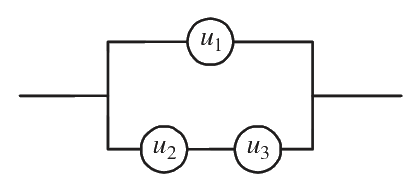
Consider the following system with three independent components $u_1, u_2$ and $u_3$.
Suppose that the failure probability of each component is $p$, and let $f(p)$ be the probability that the whole system is still functioning. Then which of the following statements are correct ?
a.
$f\left(\frac{1}{2}\right) = \frac{5}{8}$
b.
$f\left(\frac{1}{2}\right) = \frac{3}{8}$
c.
$f\left(\frac{1}{3}\right) = \frac{22}{27}$
d.
$f\left(\frac{1}{4}\right) = \frac{50}{64}$
Correct Answer & Step-by-Step Solution Locked
Sign in free to reveal the correct answer and AI explanation for this question.
Given that $\{(x_i, y_i) : i = 1, 2, ..., n\}$ where $n \ge 2$ and not all $x_i$'s are identical, the sample linear regression model $y = \alpha + \beta x + \varepsilon$ is fit. Let $h_{ii}$ be the $i$-th diagonal element of the Hat matrix $H = X(X'X)^{-1}X'$ where $X_{n \times 2}$ is the corresponding model matrix. Then which of the following are possible for some choice of $n$ and $x_1, x_2, ..., x_n$ ?
a.
$h_{ii} = -1$ for some $i$
b.
$h_{ii} = 0$ for some $i$
c.
$h_{ii} = 1$ for some $i$
d.
All $h_{ii}$ are equal
Correct Answer & Step-by-Step Solution Locked
Sign in free to reveal the correct answer and AI explanation for this question.
Let $X$ be a discrete random variable with sample space $\chi = \{1, 2, \dots, 10\}$ and probability mass function $p(x)$, $x \in \chi$. Consider testing the hypothesis.
$$H_0 : p(x) = \frac{1}{10}, \ x \in \chi \text{ against}$$
$$H_1 : p(x) \propto x, \ x \in \chi$$
Based on a single observation $X$. Then which of the following statements are correct ?
a.
The test with critical region $\{X \ge 2\}$ is most powerful of its size.
b.
The test with critical region $\{X < 2\}$ is unbiased at level $a = 0.1$
c.
If $X = 7$ the $p$-value of the most powerful test is $0.6$
d.
There exists a non-randomized test of size $0.05$
Correct Answer & Step-by-Step Solution Locked
Sign in free to reveal the correct answer and AI explanation for this question.
Let $X$ and $Y$ be real-valued independent random variable on $\Omega$. Then which of the following statements are correct ?
a.
$E[\cos(tX + uY)] = E[\cos(tX)] E[\cos(uY)] - E[\sin(tX)] E[\sin(uY)]$ for all $t, u \in \mathbb{R}$.
b.
If $X \sim N(2, 1)$ and $Y \sim N(0, 2)$, then $\text{Var}(X + Y) = 3$ where $N(\mu, \sigma^2)$ represents normal distribution with mean $\mu$ and variance $\sigma^2$.
c.
$\{X = a\} \cap \{Y = b\} = \phi$ for all $a, b \in \mathbb{R}$
d.
$P(\{X = a\} \cap \{Y = b\}) = P(\{X = a\}) P(\{Y = b\})$ for all $a, b \in \mathbb{R}$
Correct Answer & Step-by-Step Solution Locked
Sign in free to reveal the correct answer and AI explanation for this question.
Let $\{X_n : n \ge 1\}$ be i.i.d. with common unknown continuous distribution function $F(x - \theta)$, where $\theta$ is the unique median of $F$. Define, $Y_i = \begin{cases} 1 & \text{if } X_i > 1 \\ 0 & \text{if } X_i \le 1 \end{cases}$ and $S_n = \sum_{i=1}^n Y_i$
For testing $H_0 : \theta = 1$ against $H_1 : \theta > 1$, which of the following statements are correct ?
a.
$S_n \sim \text{Binomial}\left(n, \frac{1}{2}\right)$ under $H_0$
b.
Test based on $S_n$ is distribution free under $H_1$
c.
Right-tailed test based on $S_n$ is unbiased
d.
The sequence of right-tailed tests based on $S_n, n \ge 1$, is consistent
Correct Answer & Step-by-Step Solution Locked
Sign in free to reveal the correct answer and AI explanation for this question.
To estimate the population total $Y = \sum_{i=1}^N y_i$, where $y_1, y_2, \dots, y_N$ are study variables and $N$ is the size of the finite population, a sample of size $n$ is drawn using $PPSWR\,(p_1, p_2, \dots, p_N)$ scheme. If $\hat{Y}_{HH}$ is the Hansen-Hurwitz estimator for $Y$, then which of the following are correct ?