Choose the most appropriate pH at which the net charge is zero for the molecule from the data shown below:
a.
2.02
b.
2.91
Correct Answer
c.
5.98
d.
6.87
Step-by-Step AI Explanation
Verified Method
For an acidic amino acid or molecule like aspartate/glutamate, the isoelectric point ($pI$) at which the net charge is zero is calculated as the average of the two lowest $pK_a$ values that flank the neutral zwitterionic form: $pI = \frac{pK_{a1} + pK_{aR}}{2}$. With typical carboxylic acid $pK_a$ values around $2.1$ and $3.9$ (for example, aspartic acid has $pK_{a1} = 2.09$ and $pK_{aR} = 3.86$), the average is $\frac{2.09 + 3.86}{2} \approx 2.98$ or $2.91$ depending on the specific molecule. Hence, the correct $pI$ value where the net charge is zero is approximately $2.91$.
Q22mcq
Choose the correct statement about peptides in the Ramachandran plot.
a.
Peptides that are unstructured will have all the backbone dihedral angles in the disallowed regions.
b.
It is not possible to conclude whether a peptide adopts entirely helix or entirely beta sheet conformation.
c.
The occurrence of beta turn conformation in a peptide can be deduced.
Correct Answer
d.
The sequence of a peptide can be deduced.
Step-by-Step AI Explanation
Verified Method
A Ramachandran plot displays the allowed combinations of backbone dihedral angles $(\phi, \psi)$. Distinct secondary structures occupy characteristic regions: alpha-helices in one region, beta-sheets in another, and specific types of beta-turns have characteristic $(\phi, \psi)$ angles for their residues (such as residues $i+1$ and $i+2$), allowing their deduction. Peptides that are unstructured explore generally allowed regions rather than disallowed ones, and sequence cannot be directly deduced from a Ramachandran plot alone.
Q23mcq
Equilibrium constant ($K'_{eq}$) of a reaction is a ratio of product to substrate concentrations. The relation between ($K'_{eq}$) and free energy change in a reaction ($\Delta G'$) is as follows $\Delta G' = -\text{RT} \ln K'_{eq}$
Reaction A and Reaction B have $K'_{eq}$ values of 10 and 100, respectively. Which of the following statements is correct with respect to $\Delta G'$?
a.
$\Delta G' \text{ of A} = \Delta G' \text{ of B}$
b.
$\Delta G' \text{ of A} > \Delta G' \text{ of B}$
Correct Answer
c.
$\Delta G' \text{ of B} > \Delta G' \text{ of A}$
d.
$\Delta G' \text{ of A} \simeq \Delta G' \text{ of B}$
Step-by-Step AI Explanation
Verified Method
The relationship is given by $\Delta G' = -RT \ln K'_{eq}$. For Reaction A ($K'_{eq} = 10$), $\Delta G'_A = -RT \ln(10) \approx -2.303 RT$. For Reaction B ($K'_{eq} = 100$), $\Delta G'_B = -RT \ln(100) \approx -4.605 RT$. Since both values are negative, $-2.303 RT > -4.605 RT$, which means $\Delta G'\text{ of A} > \Delta G'\text{ of B}$.
Q24mcq
Excess oxygen consumed after a vigorous exercise is
a.
to pump out lactic acid from muscle.
b.
to increase the concentration of lactic acid in muscle.
c.
to reduce dissolved carbon dioxide in blood.
d.
to make ATP for gluconeogenesis.
Correct Answer
Step-by-Step AI Explanation
Verified Method
After vigorous muscular exercise, excess post-exercise oxygen consumption (EPOC, or oxygen debt) occurs largely to provide the ATP needed to convert accumulated lactic acid back to glucose/glycogen in the liver via gluconeogenesis (the Cori cycle), as well as to replenish ATP and creatine phosphate stores.
Q25mcq
Which one of the following describes the primary function of flippases ?
a.
Help in increasing lipid-protein interaction in the outer leaflet of the bilayer
b.
Move certain phospholipids from one leaflet of the membrane to another
Correct Answer
c.
Localize more negatively charged membrane proteins in the lipid bilayer
d.
cause uncoupling of v -SNARES and t-SNARES after fusion of incoming vesicle with target membrane
Step-by-Step AI Explanation
Verified Method
Flippases (as well as floppases and scramblases) are transmembrane lipid transporter proteins. Their primary function is to catalyze the movement (flip-flop) of specific phospholipid molecules from one leaflet of a biological lipid bilayer to the opposite leaflet, thereby establishing or maintaining membrane lipid asymmetry.
Q26mcq
Mitotic cyclin-CDK activity peaks in M phase. This is because
a.
Mitotic cyclin is synthesised only in M phase.
b.
Threshold level of mitotic cyclin accumulates only in late $\text{G}_2$.
c.
Cyclin subunit is activated by phosphorylation only in M phase.
d.
The kinase subunit is activated by dephosphorylation only in M phase.
Correct Answer
Step-by-Step AI Explanation
Verified Method
During $\text{G}_2$, mitotic cyclin (Cyclin B) binds to CDK1 (Cdc2), but the complex is held inactive by inhibitory phosphorylation at Thr14 and Tyr15 catalyzed by the kinase Wee1. At the $\text{G}_2/\text{M}$ transition, the activating phosphatase Cdc25 dephosphorylates these residues, rapidly activating the mitotic cyclin-CDK (MPF) complex, causing its activity to peak in M phase.
Q27mcq
The gel to liquid crystalline phase transition temperature in phosphatidyl choline (PC) lipids composed of dioleoyl (DO), dipalmitoyl (DP), disteroyl (DS) and palmitoyl oleoyl (PO) fatty acids in increasing order will be
The phase transition temperature ($T_m$) increases with fatty acid chain length and decreases with the introduction of cis-double bonds (unsaturation). DSPC (distearoyl, 18:0/18:0) has the highest $T_m$ (~$55^\circ\text{C}$), followed by DPPC (dipalmitoyl, 16:0/16:0, ~$41^\circ\text{C}$), POPC (palmitoyloleoyl, 16:0/18:1, ~$-2^\circ\text{C}$), and DOPC (dioleoyl, 18:1/18:1, ~$-17^\circ\text{C}$). Note that although the question asks for 'increasing order', choice (B) represents the correct ranked series ($T_m$: $\text{DSPC} > \text{DPPC} > \text{POPC} > \text{DOPC}$).
Q28mcq
Which of the following is NOT an example of transmembrane transport between different subecllular compartments ?
a.
Transport from cytoplasm into the lumen of the endoplasmic reticulum
b.
Transport from endoplasmic reticulum to the Golgi complex
Correct Answer
c.
Transport from stroma into thylakoid space
d.
Transport from mitochondrial intermembrane space into the mitochondrial matrix
Step-by-Step AI Explanation
Verified Method
Transport from the endoplasmic reticulum to the Golgi apparatus occurs via vesicular transport (transport vesicles budding from the ER and fusing with the cis-Golgi network), not via transmembrane transport (which involves protein translocators moving proteins directly across a membrane bilayer, as occurs in imports into ER lumen, mitochondria, or chloroplast compartments).
Q29mcq
Which of the following are NOT transcribed by RNA polymerase II?
a.
miRNA and some snRNA
b.
miRNA and snoRNA
c.
mRNA and snoRNA
d.
tRNA and 5S rRNA
Correct Answer
Step-by-Step AI Explanation
Verified Method
In eukaryotes, RNA Polymerase III is responsible for transcribing transfer RNA (tRNA) and 5S ribosomal RNA (5S rRNA), along with U6 snRNA. RNA Polymerase II transcribes protein-coding genes (mRNA), most snRNAs, miRNAs, and snoRNAs (often within introns). Therefore, tRNA and 5S rRNA are NOT transcribed by RNA polymerase II.
Q30mcq
RNA editing, a post-transcriptional process, is achieved with the help of guide RNA (g-RNA). Which one of the following statements about the process is NOT true?
a.
g-RNA dependent RNA editing happens in the kinetoplast DNA
b.
g-RNA is involved in chemical modification of t-RNA
Correct Answer
c.
This process involves insertion or deletion of uridines
d.
Sequences edited once may be re-edited using a second g-RNA
Step-by-Step AI Explanation
Verified Method
Guide RNAs (gRNAs) direct uridylate (U) insertion and deletion in mitochondrial mRNAs of kinetoplastid protozoa (such as *Trypanosoma* and *Leishmania*). They do not mediate the chemical modifications of tRNAs (which are carried out by specific tRNA-modifying enzymes). Thus, statement B is incorrect and the correct answer.
🎉 10 Free Sample Solutions Completed
Unlock All 102 Questions & Solutions
Sign up free in seconds to unlock step-by-step AI answers for the remaining 92 questions.
Consider a short double-stranded linear DNA molecule of 10 complete turns with 10.5 bp/turn. The ends of the DNA molecule are sealed together to make a relaxed circle. This relaxed circle will have a linking number of
a.
105
b.
20.5
c.
10.0
d.
10.5
Correct Answer & Step-by-Step Solution Locked
Sign in free to reveal the correct answer and AI explanation for this question.
Apical ectodermal ridge induction is essential tetrapod limb development. Which of the following is NOT essential for the formation of a functional limb?
a.
Tbx genes and Wnt
b.
Androsterone
c.
Apoptotic gene
d.
Fibroblast growth factor
Correct Answer & Step-by-Step Solution Locked
Sign in free to reveal the correct answer and AI explanation for this question.
Which one of the following plant derived signalling molecules induces hyphal branching of arbuscular mycorrhizal fungi, a phenomenon that is observed at the initial stages of colonization by these fungi?
a.
Salicylic acid
b.
Abscisic acid
c.
Strigolactones
d.
Systemin
Correct Answer & Step-by-Step Solution Locked
Sign in free to reveal the correct answer and AI explanation for this question.
The electrotherapy ionization spectrum of a mixture of two peptides show peaks with m/z values 301, 401, 501 and 601. The molecular weights of the peptides are
a.
1200 and 1250
b.
1200 and 1500
c.
1350 and 1500
d.
1250 and 1350
Correct Answer & Step-by-Step Solution Locked
Sign in free to reveal the correct answer and AI explanation for this question.
An optical measurement of a protein is taken both before and after digestion of the protein by a protease. In which of the following spectroscopic measurements the signal change, i.e., before \textit{vs} after protease treatment, could be the maximum ?
a.
Absorbance at 280 nm
b.
Circular dichroism
c.
Absorbance at 340 nm
d.
Fluorescence value
Correct Answer & Step-by-Step Solution Locked
Sign in free to reveal the correct answer and AI explanation for this question.
From the following statements,
A. Hydrogen, Deuterium and Tritium differ in the number of protons.
B. Hydrogen, Deuterium and Tritium differ in the number of neutrons.
C. Both Deuterium and Tritium are radioactive and decay to Hydrogen and Deuterium, respectively.
D. Tritium is radioactive and decays to Helium.
E. Carbon-14 decays to Nitrogen-14
F. Carbon-14 decays to Carbon-13
pick the combination with ALL correct statements.
a.
A, B and F
b.
B, D and E
c.
A, C and D
d.
C, E and F
Correct Answer & Step-by-Step Solution Locked
Sign in free to reveal the correct answer and AI explanation for this question.
From the following statements,
A. For a reaction to occur spontaneously the free energy change must be negative.
B. The interaction between two nitrogen molecules in the gaseous state is predominantly electrostatic.
C. By knowing bond energies, it is possible to deduce whether the bond is covalent bond or hydrogen bond.
D. Hydrophobic interactions are not important in a folded globular protein.
pick the combination with ALL WRONG statements.
a.
A and B
b.
B and C
c.
C and D
d.
B and D
Correct Answer & Step-by-Step Solution Locked
Sign in free to reveal the correct answer and AI explanation for this question.
The following are four statements on peptide/protein conformation:
A. Glycine has the largest area of conformationally allowed space in the Ramachandran plot of $\phi$ and $\psi$.
B. A 20-residue peptide that is acetylated at the N-terminus and amidated at the C-terminus has $\phi = -60^\circ\ (\pm 5)$, $\psi = -30^\circ\ (\pm 5)$ for all the residues. It can be concluded that conformation of the peptide is helix-turn-strand.
C. The allowed values of $\phi$, $\psi$ for amino acids in a protein are not valid for short peptides.
D. A peptide $\text{Acetyl-A}_1\text{-A}_2\text{-A}_3\text{-A}_4\text{-CONH}_2$ ($\text{A}_1-\text{A}_4$ are amino acids) adopts a well defined $\beta$-turn. The dihedral angles of $\text{A}_2$ and $\text{A}_3$ determine the type of $\beta$-turn.
Choose the combination of correct statements.
a.
A and B
b.
B and C
c.
A and D
d.
C and D
Correct Answer & Step-by-Step Solution Locked
Sign in free to reveal the correct answer and AI explanation for this question.
A researcher investigated a set of conditions for a protein with an isoelectric point of 6.5 and also binds to calcium. This protein was subjected to four independent treatments: (i) pH 6.4, (ii) 10% glycerol, (iii) $10\text{ mM }\text{CaCl}_2$, (iv) 40% ammonium sulphate. This was followed by centrifugation and estimation of the protein in the supernatant. The results are depicted in the graph below :
Which of the following treatments best represents the result shown in the graph?
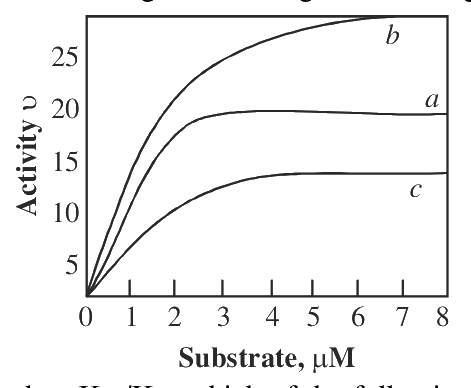
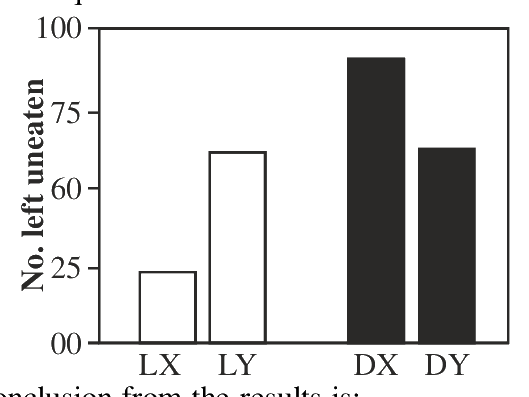
A researcher was investigating the substrate specificity of two different enzymes, X and Y, on the same substrate. Both the enzymes were subjected to treatment with either heat or an inhibitor which inhibits the enzyme activity. Following are the results obtained where a = inhibitor treatment, b = heat treatment and c = control.
Which of the following statements is correct?
a.
Only protein X is specific for the substrate, S
b.
Only protein Y is specific for the substrate, S
c.
Both X and Y are specific for the substrate, S
d.
Both X and Y are non-specific for the substrate, S
Correct Answer & Step-by-Step Solution Locked
Sign in free to reveal the correct answer and AI explanation for this question.
In an experiment, red blood cells were subjected to lysis and any unbroken cells were removed by centrifugation at 600g. The supernatant was taken and centrifuged at 100,000 g. The pellet was extracted with 5M NaCl and again centrifuged at 100,000 g. Which of the following proteins would be present in the supernatant ?
a.
Band 3
b.
Glycophorin
c.
G protein-coupled receptor
d.
Spectrin
Correct Answer & Step-by-Step Solution Locked
Sign in free to reveal the correct answer and AI explanation for this question.
In order to study the intracellular trafficking of protein 'A', it was tagged with GFP (A-GFP). Fluorescence microscopy showed that A-GFP co-localizes with LAMP1. In the presence of bafilomycin A, an inhibitor of $\text{H}^+$-ATPase, A-GFP does not co-localize with LAMP1. Instead, it co-localizes with LC3 puncta.
Which one of the following statements is TRUE ?
a.
A-GFP targets to the ER in the absence of bafilomycin A.
b.
Autophagy is required for trafficking of A-GFP to lysosomes.
c.
Bafilomycin A facilitates targeting of A-GFP to the ER.
d.
Bafilomycin A facilitates targeting of A-GFP to the mitochondria.
Correct Answer & Step-by-Step Solution Locked
Sign in free to reveal the correct answer and AI explanation for this question.
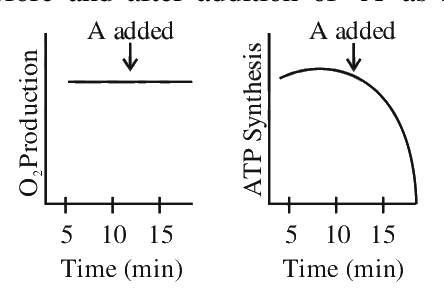
'A' is an ihibitor of chloroplast function. The production of $\text{O}_2$ and the synthesis of ATP are measured in illuminated chloroplasts before and after addition of 'A' as shown below :
Which statement is correct
a.
'A' inhibits the reduction of $\text{NADP}^+$
b.
'A' inhibits the proton gradient and the reduction of $\text{NADP}^+$
c.
'A' inhibits the proton gradient but not the reduction of $\text{NADP}^+$
d.
'A' inhibits neither the proton gradient nor the reduction of $\text{NADP}^+$
Correct Answer & Step-by-Step Solution Locked
Sign in free to reveal the correct answer and AI explanation for this question.
During cell cycle progression from $\text{G}_1$ to S, cyclin D-CDK4 phosphorylates Rb and reduces its affinity for E2F, E2F dissociates from Rb and activates S-phase gene expression. Overexpression of protein 'A' arrests $\text{G}_1$ phase progression.
Which of the following statements is TRUE ?
a.
'A' inhibits Rb-E2F interaction
b.
'A' inhibits CDK4 activity
c.
'A' phosphorylates E2F
d.
'A' degrades Rb
Correct Answer & Step-by-Step Solution Locked
Sign in free to reveal the correct answer and AI explanation for this question.
In mammals, CG rich sequences are usually methylated at C, which is a way for marking genes for silencing. Although the promoters of housekeeping genes are often associated with CpG islands yet they are expressed in mammals. Which one of the following best explains it ?
a.
Methylation of cytosine does not prevent the binding of RNA Pol II with the promoter, so housekeeping genes are expressed
b.
During housekeeping gene expression, the enzyme methyltransferase is temporarily silenced by miRNA, thus shutting down global methylation
c.
Unlike within the coding region of a gene, CG rich sequences present in the promoters of active genes are usually not methylated
d.
As soon as the cytosine is methylated in the promoter region, the enzymes of DNA repair pathway remove the methyl group, thereby ensuring gene expression
Correct Answer & Step-by-Step Solution Locked
Sign in free to reveal the correct answer and AI explanation for this question.
Telomerase, a protein-RNA complex, has a special reverse transcriptase activity that completes replication of telomeres during DNA synthesis. Although it has many properties similar to DNA polymerase, some of them are also different. Which one of the following properties of telomerase is different from that of DNA polymerase?
a.
Telomerase requires a template to direct the addition of nucleotides
b.
Telomerase can only extend a $3'$-OH end of DNA
c.
Telomerase does not carry out lagging strand synthesis
d.
Telomerase acts in a processive manner
Correct Answer & Step-by-Step Solution Locked
Sign in free to reveal the correct answer and AI explanation for this question.
In eukaryotes, a specific cyclin dependent kinase (CDK) activity is required for the activation of loaded helicases to initiate replication. On the contrary, this CDK activity inhibits the loading of helicases onto the origin of replication. Considering the fact that during each cycle, there is only one opportunity for helicases to be loaded onto origins and only opportunity for these loaded helicases to be activated, which one of the following graphs best depicts this CDK activity in $\text{G}_1$ and $\text{S}$ phases of the cell cycle?
a.
Low CDK activity in $\text{G}_1$ and high in $\text{S}$
b.
Low CDK activity in both $\text{G}_1$ and $\text{S}$
c.
High CDK activity in $\text{G}_1$ and low in $\text{S}$
d.
High CDK activity in both $\text{G}_1$ and $\text{S}$
Correct Answer & Step-by-Step Solution Locked
Sign in free to reveal the correct answer and AI explanation for this question.
In Trypanosomes, a 35 base leader sequence is joined with several different transcripts making functional mRNAs. The leader sequence is joined with the other RNAs by
a.
a specific RNA ligase
b.
the process of trans-splicing
c.
a nucleophilic attack caused by a free guanine nucleotide
d.
a nucleophilic attack caused by a $2'$ OH of an internal A present in the leader sequence
Correct Answer & Step-by-Step Solution Locked
Sign in free to reveal the correct answer and AI explanation for this question.
Following are the list of some of the pathogens (column A) and the unique mechanisms they employ for evading immune response (column B).
\begin{tabular}{|l|l|l|l|}
\hline
\multicolumn{2}{|c|}{\textbf{A}} & \multicolumn{2}{c|}{\textbf{B}} \\
\hline
a & \textit{Trypanosoma brucei} & I & Capable of employing unusual genetic processes by which they generate extensive variations in their variant surface glycoproteins (VSG) \\
\hline
b & \textit{Plasmodium falciparum} & II & Capable of continually undergoing maturational changes in transformation to different forms which allow the organism to change its surface molecules \\
\hline
c & \textit{Haemophilus influenzae} & III & Capable of evading immune response by frequent antigenic changes in its hemagglutinin and neuraminidase glycoproteins \\
\hline
\end{tabular}
Which of the following is the correct match between the organisms and their respective mechanism to evade immune response?
a.
a - (i), b - (ii), c - (iii)
b.
a - (ii), b - (iii), c - (i)
c.
a - (iii), b - (i), c - (ii)
d.
a - (i), b - (iii), c - (ii)
Correct Answer & Step-by-Step Solution Locked
Sign in free to reveal the correct answer and AI explanation for this question.
Two steroid hormone receptors X and Y both contain a ligand binding domain and a DNA binding domain. Using recombinant DNA technology, a modified hybrid receptor H is prepared such that it contains the ligand binding domain of X and DNA binding domain of Y. Three sets of cells over-expressing receptors X, Y and H were then treated separately either with hormone X or with hormone Y. Assuming that there is no cross-reactivity, which one of the following graphs best represent the receptor-ligand binding in each case?
a.
(a)
b.
(b)
c.
(c)
d.
(d)
Correct Answer & Step-by-Step Solution Locked
Sign in free to reveal the correct answer and AI explanation for this question.
A protein X is kept in an inactive state in cytosol as complexed with protein Y. Under certain stress stimuli, Y gets phosphorylated resulting in its proteasomal degradation. X becomes free, translocates to nucleus and results in the transcription of a gene which causes cell death by apoptosis. Stress stimuli were given to following four different cases.
Case A: Protein Y has a mutation such that phosphorylation leading to proteasomal degradation does not occur.
Case B : Cells are transfected with a gene which encodes for a protein L that inhibits the translocation of protein Y to the nucleus.
Case C : Cell are transfected only with empty vector used to transfect the gene for protein L.
Case D : Cells are treated with Z-VAD-FMK, a broad spectrum caspase inhibitor.
Which one of the following graphs best describes the apoptotic state of the cells in the above cases?
Y-axis represent % apoptotic cells.
a.
(a)
b.
(b)
c.
(c)
d.
(d)
Correct Answer & Step-by-Step Solution Locked
Sign in free to reveal the correct answer and AI explanation for this question.
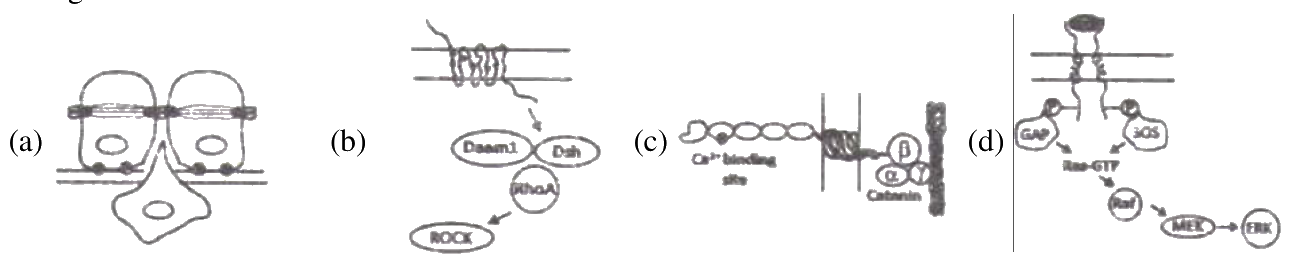
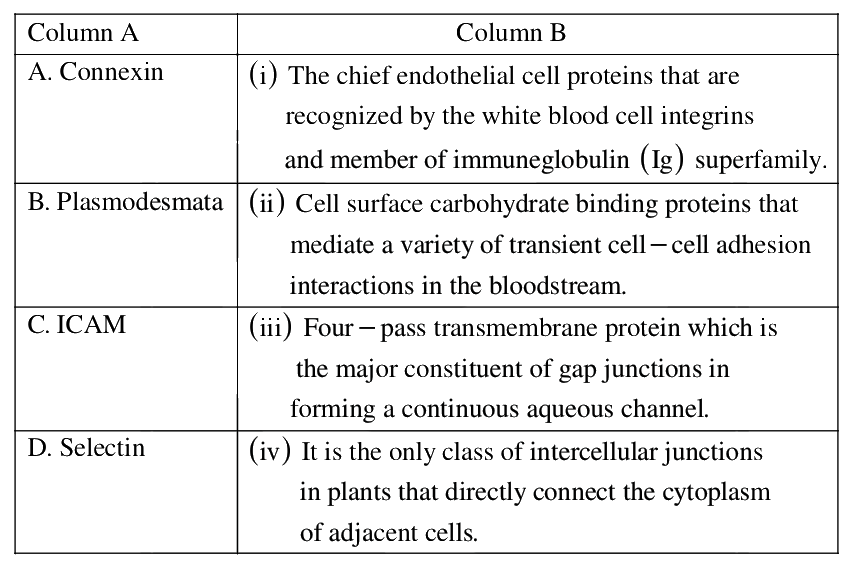
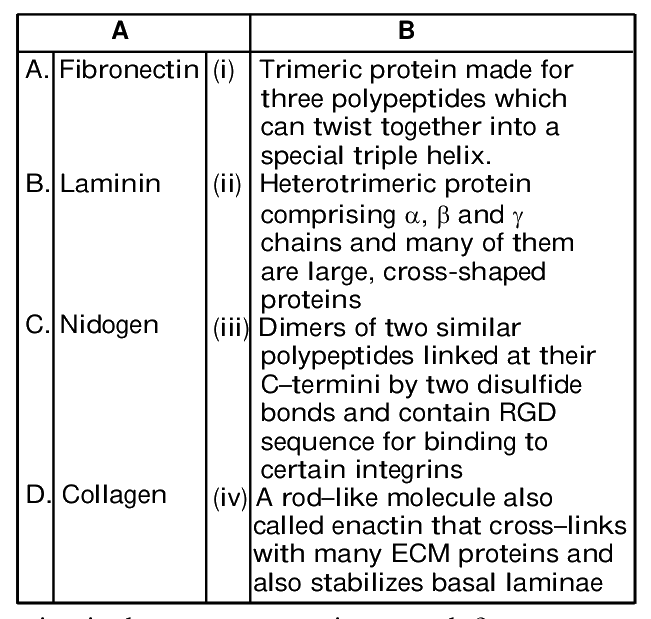
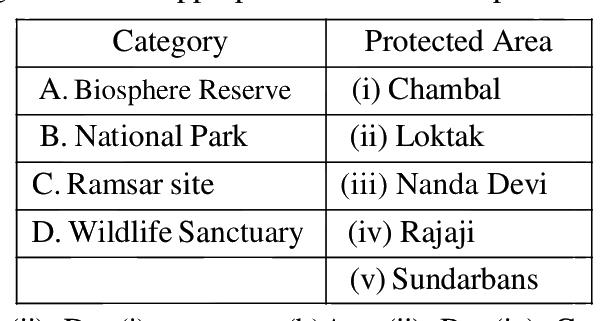
In animals, four separate families of cell-cell adhesion proteins are listed in Column A and their functional characteristics are given in Column B.
Which one of the following is the correct combination ?
a.
a - (i), b - (ii), c - (iii), d - (iv)
b.
a - (ii), b - (iii), c - (iv), d - (i)
c.
a - (iii), b - (iv), c - (i), d - (ii)
d.
a - (iv), b - (iii), c - (ii), d - (i)
Correct Answer & Step-by-Step Solution Locked
Sign in free to reveal the correct answer and AI explanation for this question.
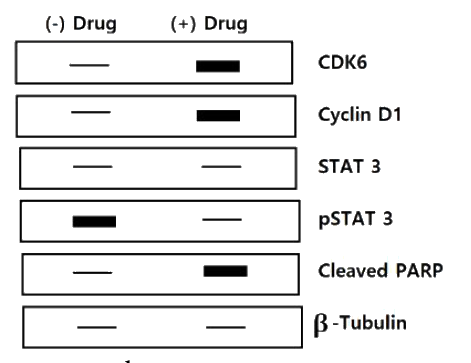
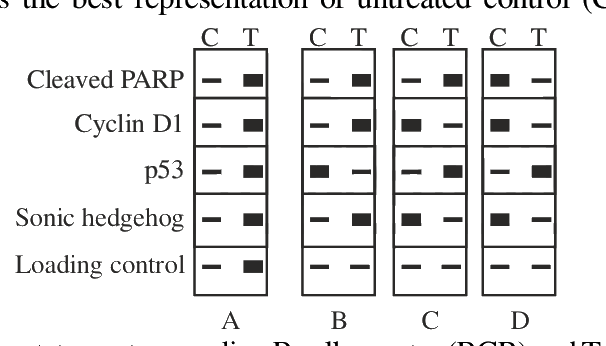
A student treated cancer cells with an anti-cancer drug and performed western blot analysis. Which one of the following blots is the best representation of untreated control (C) and treated (T) samples ?
a.
A
b.
B
c.
C
d.
D
Correct Answer & Step-by-Step Solution Locked
Sign in free to reveal the correct answer and AI explanation for this question.
In case amphibians, the dorsal cells and their derivatives are called as “Spemann – Mangold organizer”. Following statements are related to the “organizer” were made:
A. It induces the host’s ventral tissues to change their fates to form neural tube and dorsal mesodermal tissues.
B. It cannot organize the host and donor tissues into a secondary embryo.
C. It does not have the ability to self-differentiate into dorsal mesoderm
D. It has ability to initiate the movements of gastrulation.
E. Both $\beta$-catenin and Chordin are produced by the organizer Which of the above statements are correct?
a.
A and D
b.
D and E
c.
A and E
d.
B and C
Correct Answer & Step-by-Step Solution Locked
Sign in free to reveal the correct answer and AI explanation for this question.
Driesch performed famous “pressure plate” experiments involving intricate recombination with 8-celled Sea urchin embryo. This procedure reshuffled the nuclei that normally would have been in the region destined to form endoderm into the presumptive ectoderm region. If segregation of nuclear determinants had occurred, resulting embryo should have been disordered. However, Driesch obtained normal larvae form these embryos possible interpretations regarding the 8-celled sea urchin embryo are:
A. The prospective potency of an isolated blastomere is greater than its actual prospective fate
B. The prospective potency and prospective fate of blastomere were identical
C. Sea-urchin embryo is a “harmoniously equipotential system” because all of its potentially independent parts interacted together to form single embryo.
D. Regulative development occurs where location of a cell in the embryo determines its fate.
Which of the interpretation(s) is/are true?
a.
Only A
b.
Only D
c.
Only A and B
d.
A, C and D
Correct Answer & Step-by-Step Solution Locked
Sign in free to reveal the correct answer and AI explanation for this question.
Consider the following events which occur during fertilization of sea urchin eggs.
A. Resact/Speract are peptides released from the egg jelly and help in sperm attraction.
B. Bindin, an acrosomal protein interacts in a species specific manner, with eggs.
C. A “respiratory burst” occurs during cross-linking of the fertilization envelope, where a calcium-dependent increase in oxygen level is observed.
D. $\text{IP}_3$, which is formed at site of sperm entry, sequesters calcium leading to cortical granule exocytosis.
Which of the above statement(s) is NOT true?
Both C and D statements are FALSE.
a.
Only C
b.
A and C
c.
Only D
d.
B and D
Correct Answer & Step-by-Step Solution Locked
Sign in free to reveal the correct answer and AI explanation for this question.
Following statement were given regarding decisions taken during development of mammalian embryos
A. Pluripotency of inner cell mass is maintain by a core of three transcription factors, Oct 4, Sox 2 and nanog.
B. Prior to blastocyst formation each blastomere expresses both Cdx 2 and the Oct 4 transcription factors and appears to be capable of becoming either ICM or trophoblast .
C. Both ICM and trophoblast cells synthesize transcription factors Cdx 2.
D. Oct4 activates Cdx2 expression enabling some cells to become trophoblast and other cells to become ICM.
Which of the above statement are true?
a.
A and B
b.
A and C
c.
B and D
d.
B and C
Correct Answer & Step-by-Step Solution Locked
Sign in free to reveal the correct answer and AI explanation for this question.
Apoptosis during early development is essential for proper formation of different structures. In *C. elegans*, apoptosis is accentuated by ced-3 and ced-4 genes, which in turn are negatively regulated by ced-9 and eventually Egl-1. When compared to mammals, functionally similar homolog has been identified. Accordingly, which one of the following statements is NOT correct?
a.
CED-4 resembles Apaf-1
b.
CED-9 resembles Bcl-XL
c.
CED-3 resembles caspase-3
d.
CED-4 resembles caspase-9
Correct Answer & Step-by-Step Solution Locked
Sign in free to reveal the correct answer and AI explanation for this question.
Individual and overlapping expression of homoeotic genes in adjacent whorls of a flower determine the pattern of floral organ development. In an *Arabidopsis* mutant, floral organs are distributed as follows:
Whorl 1 (outer most) – carpel
Whorl 2 – stamens
Whorl 3 - stamens
Whorl 4 (inner most) – carpel
Loss of function mutation in which one of the following genes would have caused the above pattern of floral organ development?
a.
APETALA 2
b.
APETALA 3
c.
PISTILLATA
d.
AGAMOUS
Correct Answer & Step-by-Step Solution Locked
Sign in free to reveal the correct answer and AI explanation for this question.
In photosynthetic electron transport, electrons travel through carriers organized in the "Z-scheme". The following are indicated as directions of electron flow :
A. $\text{P680} \rightarrow \text{PQ}_\text{A} \rightarrow \text{PQ}_\text{B} \rightarrow \text{Cybt}_6\text{f} \rightarrow \text{Pheo} \rightarrow \text{PC} \rightarrow \text{P700}$
B. $\text{P700} \rightarrow \text{A}_0 \rightarrow \text{A}_1 \rightarrow \text{FeS}_\text{x} \rightarrow \text{FeS}_\text{A} \rightarrow \text{FeS}_\text{B} \rightarrow \text{Fd}$
C. $\text{P680} \rightarrow \text{Pheo} \rightarrow \text{PQ}_\text{A} \rightarrow \text{PQ}_\text{B} \rightarrow \text{Cytb}_6\text{f} \rightarrow \text{PC} \rightarrow \text{P700}$
D. $\text{P700} \rightarrow \text{A}_1 \rightarrow \text{A}_0 \rightarrow \text{FeS}_\text{B} \rightarrow \text{FeS}_\text{A} \rightarrow \text{FeS}_\text{x} \rightarrow \text{Fd}$
Which one of the following combinations is correct ?
a.
A and B
b.
B and C
c.
C and D
d.
A and D
Correct Answer & Step-by-Step Solution Locked
Sign in free to reveal the correct answer and AI explanation for this question.
Phytochrome-mediated control of photomorphogenesis is linked to many other gene functions. The following statements are made on the mechanism of phytochrome action :
A. Phytochrome function requires COP1, an E3 ubiquitin ligase that brings about protein degradation
B. COP1 is slowly exported from the nucleus to the cytoplasm in the presence of light
C. HY5 is targeted by COP1 for defraudation in the presence of light
D. HY5 is a transcription factor involved in photomorphogenetic response
Which one of the following combinations is correct?
a.
A, B and C
b.
B, C and D
c.
A, B and D
d.
A, C and D
Correct Answer & Step-by-Step Solution Locked
Sign in free to reveal the correct answer and AI explanation for this question.
The $\text{C}_4$ carbon cycle is a $\text{CO}_2$ concentrating mechanism evolved to reduce photorespiration. The following are stated as important features of the $\text{C}_4$ Pathway :
A. The leaves of $\text{C}_4$ plants have Kranz anatomy that distinguishes mesophyll and bundle sheath cells.
B. In the peripheral mesophyll cells, atmospheric $\text{CO}_2$ is fixed by phosphoenol pyruvate carboxylase yielding a four-carbon acid.
C. In the inner layer of mesophyll, NAD-malic enzyme decarboxylates four-carbon acid and releases $\text{CO}_2$
D. $\text{CO}_2$ is again re-fixed though Calvin cycle in the bundle sheath cells.
Which one of the following combinations is correct?
a.
B, C and D
b.
A, B and C
c.
A, B and D
d.
A, C and D
Correct Answer & Step-by-Step Solution Locked
Sign in free to reveal the correct answer and AI explanation for this question.
Read the following statements related to plant-pathogen interaction
A. Systemic acquired resistance is observed following infection by compatible pathogen.
B. Induced systemic resistance is activated following infection by compatible pathogen.
C. A bacterial infection can induce effector triggered immunity (ETI) leading to hypersensitive response locally.
D. NPR1 monomers that are released in cytosol due to salicylic acid accumulation is rapidly translocated to nucleus.
Which combination of above statements is correct ?
a.
A, B and C
b.
A, C and D
c.
A, B and D
d.
B, C and D
Correct Answer & Step-by-Step Solution Locked
Sign in free to reveal the correct answer and AI explanation for this question.
Given below are statements describing various features of solute transport and photoassimilate translocation in plants.
A. Apoplastic phloem loading of sucrose happens between cells with no plasmodesmatal connections.
B. Growing vegetative sinks (e.g., young leaves and roots) usually undergo symplastic phloem unloading.
C. Movement of water between the phloem and xylem occurs only at the source and sink regions.
D. Symplastic loading of sugars into the phloem occurs in the absence of plasmodesmatal connection.
Select the option that given a combination of correct statements : A. $\text{N}_2\text{O}$ does not chemically combine with proteins in blood but equilibrate rapidly between alveolar gas and blood.
B. $\text{CO}$ has high solubility in blood.
C. $\text{CO}$ has high solubility in the alveolar capillary membrane.
D. The dispersion of $\text{N}_2\text{O}$ between alveolar gas and blood is considered as diffusion limited.
Which of the above statement(s) is/are INCORRECT?
a.
Only A and C
b.
Only B and C
c.
Only B and D
d.
Only A and B
Correct Answer & Step-by-Step Solution Locked
Sign in free to reveal the correct answer and AI explanation for this question.
External pressure given on a mixed nerve causes loss of touch sensation while pain sensation remains relatively intact. On the other hand application of local anesthetics on the same nerve, induces loss of pain sensation keeping touch sensation least affected. These observations can be explained by the following statements :
A. External pressure causes loss of conduction of impulses in small diameter sensory nerve fibres.
B. Local anaesthetics depress the conduction of impulses in large diameter sensory nerve fibres.
C. Touch-induced impulses are carried by fibre type A.
D. Fibre type C is responsible for pain sensation.
Which of the above statement(s) is/are INCORRECT?
a.
A and B
b.
C and D
c.
Only C
d.
Only D
Correct Answer & Step-by-Step Solution Locked
Sign in free to reveal the correct answer and AI explanation for this question.
Inversions are considered as cross-over suppressors because
a.
Homozygous inversion are lethal and thus they do not appear in next generation
b.
Inversion heterozygotes, i.e., one copy having normal chromosome and its homologue having inversion, does not allow crossing over to occur as they cannot pair at all
c.
Due to inversion present, four chromosomes take part in the pairing and crossing over events and make the structure difficult for separation and gamete formation
d.
The pairing and crossing covers do occur in inversion heterozygotes but the gametes having cross over products are lethal
Correct Answer & Step-by-Step Solution Locked
Sign in free to reveal the correct answer and AI explanation for this question.
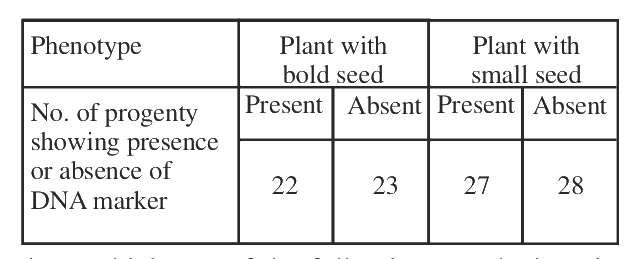
A pair of alleles govern seed size in a crop plant. 'B' allele responsible for bold seed is dominant over 'b' allele controlling small seed. An experiment was carried out to test if an identified dominant DNA marker (5kb band) is linked to alleles controlling seed size. A plant heterozygous for the marker and the alleles was crossed to a small seeded plant lacking the 5kb band. 100 progeny obtained from the cross were analysed for the presence and absence of the DNA marker. The results are tabulated below :
Based on the above observations which one of the following conclusions is correct ?
a.
The DNA marker assorts independently of the phenotype
b.
The 5 kb band is linked to the allele 'B'
c.
The 5 kb band is linked to the allele 'b'
d.
The DNA marker assorts independently with bold seed but is linked to the small seed trait
Correct Answer & Step-by-Step Solution Locked
Sign in free to reveal the correct answer and AI explanation for this question.
Three met $E.coli$ mutant strains were isolated. To study the nature of mutation these mutant strains were treated with mutagens EMS or proflavine and scored for revertants. The results obtained are summarized below :
(+ stands for revertants of the original mutants and - stands for no revertants obtained)
Based on the above and the typical mutagenic effects of EMS and proflavin, what was the nature of the original mutation in each strain?
a.
A - Transversion
B - Insertion or deletion of a single base
C - Deletion of multiple bases
b.
A - Transition
B - Transversion
C - Insertion or deletion of a single base
c.
A - Insertion or deletion of a single base
B - Transition
C - Deletion of multiple bases
d.
A - Transition
B - Insertion or deletion of multiple bases
C - Transversion
Correct Answer & Step-by-Step Solution Locked
Sign in free to reveal the correct answer and AI explanation for this question.
The following scheme represents deletions (1 - 4) in the $rII$ locus of phage T4 from a common reference point :
Deletion 1 -------
Deletion 2 -----------
Deletion 3 ---------------
Deletion 4 -------------------
(The bars represent the extent of deletion in each case)
Four point mutations (a to d) are tested against four deletions for ability (+) or inability (-) to give will type ($rII^+$) recombinants. The results are summarized below :
$$\begin{array}{|c|c|c|c|c|}\hline & a & b & c & d \\\hline 1 & + & + & + & + \\\hline 2 & + & + & + & - \\\hline 3 & + & - & + & - \\\hline 4 & - & - & + & - \\\hline \end{array}$$
Based on the above the predicted order of the point mutations is
a.
b - d - a - c
b.
d - b - a - c
c.
d - b - c - a
d.
c - d - a - b
Correct Answer & Step-by-Step Solution Locked
Sign in free to reveal the correct answer and AI explanation for this question.
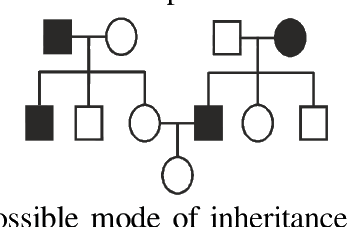
The following pedigree shows the inheritance pattern of a trait.
From the following select the possible mode of inheritance and the probability that the daughter in generation III will show the trait.
a.
X-linked recessive, probability is 1/2
b.
X-linked recessive, probability is 1/4
c.
Autosomal recessive, probability is 1/2
d.
Autosomal recessive, probability is 1/3
Correct Answer & Step-by-Step Solution Locked
Sign in free to reveal the correct answer and AI explanation for this question.
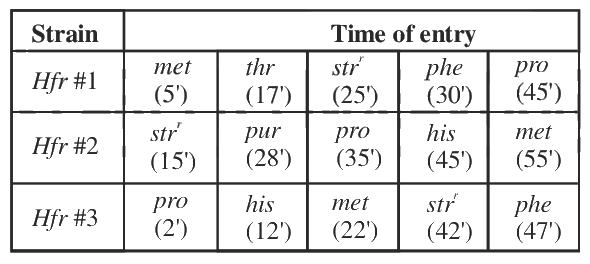
Interrupted mating experiments were performed using three different $Hfr$ strains (1 - 3). The three strains have different combinations of selectable markers. The time of entry for markers for each strain is shown in the table below :
$$\begin{array}{|c|c|c|c|c|c|}\hline \text{Strain} & \multicolumn{5}{c|}{\text{Time of entry}} \\\hline Hfr \text{ \#1} & met \ (5') & thr \ (17') & str^r \ (25') & phe \ (30') & pro \ (45') \\\hline Hfr \text{ \#2} & str^r \ (15') & pur \ (28') & pro \ (35') & his \ (45') & met \ (55') \\\hline Hfr \text{ \#3} & pro \ (2') & his \ (12') & met \ (22') & str^r \ (42') & phe \ (47') \\\hline \end{array}$$
Using the above data, predict the correct sequence of markers on the E. coli chromosome.
Peripatus is an interesting living animal having unjointed legs, nephridia, haemocoel, trachea, dorsal tubular heart, claws, jaws, continuous muscle layers in body wall. This is considered as a connecting link between
a.
Nematoda and Annelida: continuous muscle layers in body wall, unjointed legs and nephriadia being nematode characters while haemocoel, trachea and dorsal tubular heart being annelid characters
b.
Annelida and Arthropoda: unjointed legs and nephridia being annelid characters while claws, jaws, haemocoel, trachea and dorsal tubular heart being arthropod characters
c.
Arthropoda and Millusca: unjointed legs and nephridia being mollusca characters while claws, jaws, trachea and dorsal tubular heart being arthropod characters
d.
Nematoda and Arthropoda: continuous muscle layers, unjointed legs and nephridia being nematode characters while claws, jaws, trachea and dorsal tubular heart being partropod characters.
Correct Answer & Step-by-Step Solution Locked
Sign in free to reveal the correct answer and AI explanation for this question.
The following schematic diagram represents secondary growth in the angiosperms.
Based on the above scheme, which of the following options represents the correct identify of cambia labelled as A, B, C and D.
a.
A - Inter-fascicular, B - Fascicular, C - Vascular, D - Cork
b.
A - Fascicular, B - Inter-fascicular, C - Vascular, D - Cork
c.
A - Cork, B - Inter-fascicular, C - Fascicular, D - Vascular
d.
A - Cork, B - Fascicular, C - Fascicular, D - Vascular
Correct Answer & Step-by-Step Solution Locked
Sign in free to reveal the correct answer and AI explanation for this question.
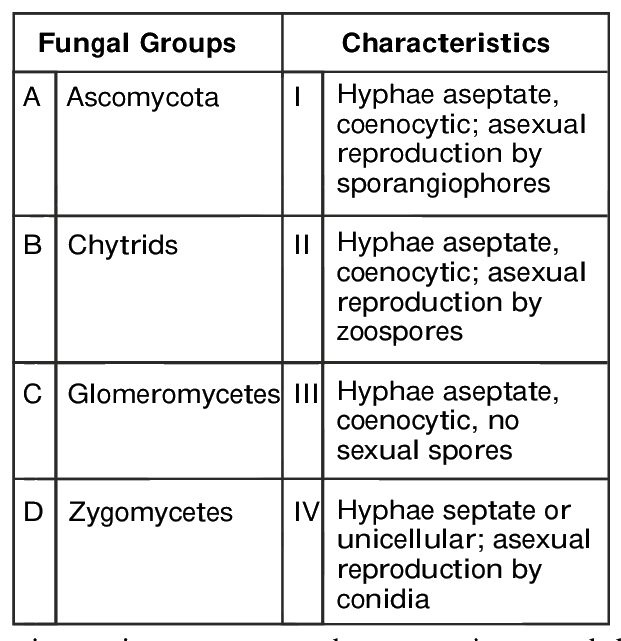
The table below lists the major fungal groups and their characteristics :
Which one of the following options represents the appropriate match between the fungal group and their characteristics ?
a.
A - (ii), B - (iii), C - (i), D - (iv)
b.
A - (iv), B - (ii), C - (iii), D - (i)
c.
A - (i), B - (iv), C - (iii), D - (ii)
d.
A - (ii), B - (iv), C - (iii), D - (i)
Correct Answer & Step-by-Step Solution Locked
Sign in free to reveal the correct answer and AI explanation for this question.
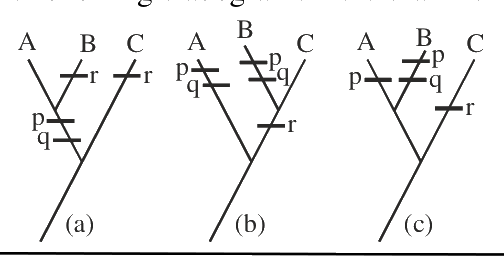
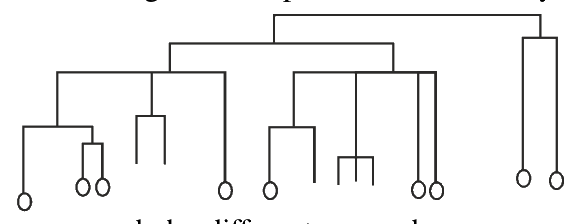
As a biologist, you want to classify three taxa, A, B and C. You have the information on three trains, p, q and r. The trait that is ancestral is counted '0' and the trait that is derived is counted as '1'. The distribution of traits found in three taxa is given below :
Based on the above table, the following cladograms were drawn : Based on the trait distribution and principle of parsimony, select the correct option.
a.
Both 'a' and 'b' cladograms are possible
b.
Only 'b' cladogram is possible
c.
Only 'c' cladogram is possible
d.
Only 'a' cladogram is possible
Correct Answer & Step-by-Step Solution Locked
Sign in free to reveal the correct answer and AI explanation for this question.
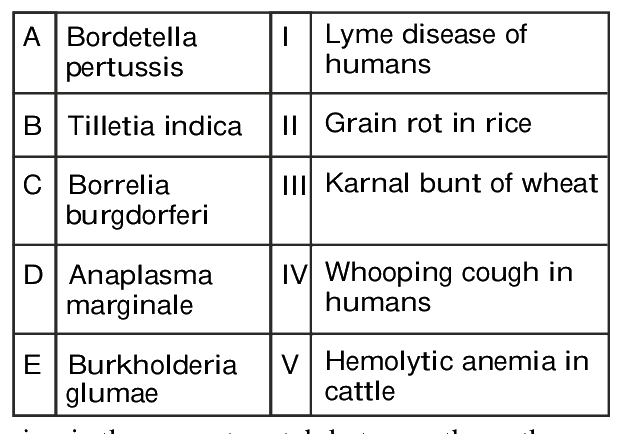
Given below are some pathogens and diseases of humans, animals and plants.
Which one of the following is the correct match between the pathogen and disease caused?
a.
A - (iv), B - (iii), C - (i), D - (v), E - (ii)
b.
A - (iv), B - (v), C - (i), D - (ii), E - (iii)
c.
A - (iii), B - (iv), C - (v), D - (i), E - (ii)
d.
A - (ii), B - (v), C - (i), D - (iii), E - (iv)
Correct Answer & Step-by-Step Solution Locked
Sign in free to reveal the correct answer and AI explanation for this question.
You observed that two species of barnacles, species 1 and species 2, occupy upper and lower strata of intertidal rocks, respectively. Only when species 2 was removed by you from the lower strata, species 1 could occupy both the upper and lower strata. From the choices given below, what would be your inference from these observations ?
a.
Upper strata of the intertidal rock is the realized niche of species 1
b.
Upper strata of the intertidal rock is the fundamental niche of species 1
c.
Species 1 and species 2 exhibit mutualism
d.
Species 1 can compete out species 2
Correct Answer & Step-by-Step Solution Locked
Sign in free to reveal the correct answer and AI explanation for this question.
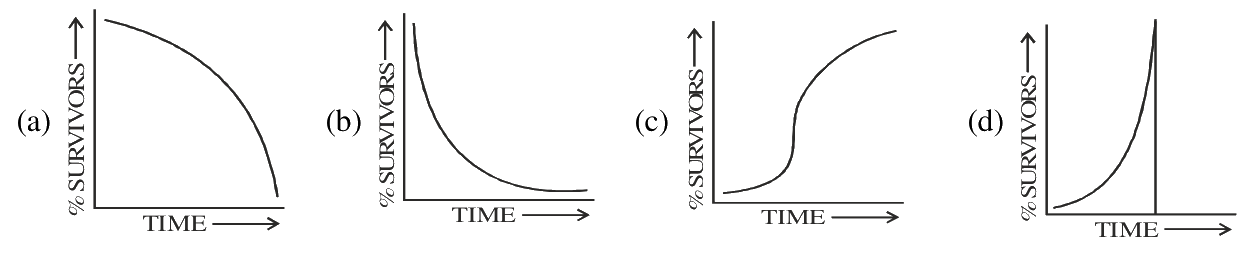
In a natural system, a species producing large numbers of offsprings, with little or no parental care, generally exhibits which one of the following kind of survivorship curves ?
a.
(a)
b.
(b)
c.
(c)
d.
(d)
Correct Answer & Step-by-Step Solution Locked
Sign in free to reveal the correct answer and AI explanation for this question.
Which one of the following statements is true for the trends of Dissolved Oxygen (DO) and Biological Oxygen Demand (BOD) in a water stream receiving pollutants from a point source ?
a.
In septic zone, both DO and BOD levels remain stationary
b.
In recovery zone, both DO and BOD levels increase rapidly
c.
In decomposition zone, DO level drops rapidly, whereas BOD level remains more or less stable
d.
In septic zone, DO level decreases and BOD level increases whereas in recovery zone DO increases and BOD decreases
Correct Answer & Step-by-Step Solution Locked
Sign in free to reveal the correct answer and AI explanation for this question.
Following are the graphical representations of various hypotheses proposed for explaining the possible relationships between species richness (X-axis) and community services (Y-axis).
a.
(a)
b.
(b)
c.
(c)
d.
(d)
Correct Answer & Step-by-Step Solution Locked
Sign in free to reveal the correct answer and AI explanation for this question.
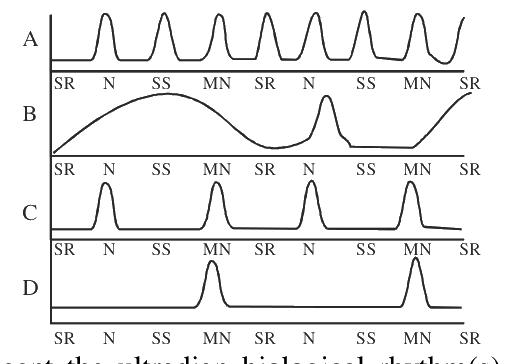
Following are the plots representing biological rhythms at different time points depicated as: $\text{SR} = \text{Sunrise}$; $\text{N} = \text{Noon}$; $\text{SS} = \text{Sunset}$; $\text{MN} = \text{Midnight}$
Which of the plot(s) represent the ultradian biological rhythm(s) ?
a.
Plots B
b.
Plots A and C
c.
Plots C and D
d.
Plot D
Correct Answer & Step-by-Step Solution Locked
Sign in free to reveal the correct answer and AI explanation for this question.
A population of non-poisonous butterflies have the same colour pattern as some highly poisonous butterflies. Assume that the population of non-poisonous butterflies is higher than the population of poisonous butterflies. Given this, what will be impact of this mimicry on the fitness of the population of the poisonous butterflies in the presence of the predator ?
a.
It will lower the fitness, that is, fitness of the mimic is negatively frequency-dependent
b.
It will increase the fitness, that is, fitness of the mimic is positively frequency-dependent
c.
It will not affect the fitness, that is, fitness of the mimic is frequency independent
d.
It will increase the fitness, that is, fitness of the mimic is negatively frequency-dependent
Correct Answer & Step-by-Step Solution Locked
Sign in free to reveal the correct answer and AI explanation for this question.
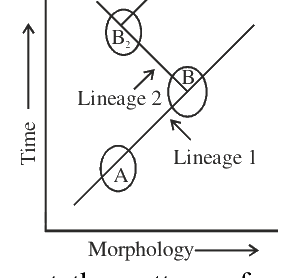
Given below is a graphical representation of changes in morphological features over a period of geological time scale, where population A accumulates heritable morphological changes and give rise to a distinct species B. Population B splits into a distinct species $\text{B}_2$.
Which of the above lineages represent the pattern of speciation by cladogenesis?
a.
Lineage 1
b.
Both the lineages 1 and 2
c.
Lineage 2
d.
Neither of the lineages 1 and 2
Correct Answer & Step-by-Step Solution Locked
Sign in free to reveal the correct answer and AI explanation for this question.
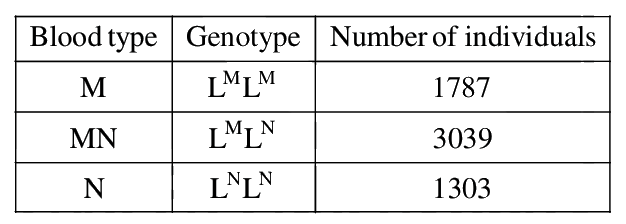
Red hair is a recessive trait in humans. In a randomly mating population in Hardy-Weinberg equilibrium, approximately 9% of individuals are red-haired. What is the frequency of heterozygotes?
a.
81%
b.
49%
c.
42%
d.
18%
Correct Answer & Step-by-Step Solution Locked
Sign in free to reveal the correct answer and AI explanation for this question.
\textit{Mayfair genes} (hypothetical) consist of a super family of transcription factors. They are found in 4 clusters in mammals; in 2 clusters in insects; and in a single cluster in an ancestor to insects. These data are consistent with all of the following explanations EXCEPT:
a.
Two successive genome duplication events occurred between ancestral organism and vertebrates
b.
The first duplication may have taken place before divergence of vertebrates
c.
Exon shuffling exclusively produced such cluster
d.
Whole genome duplications could lead to such observations
Correct Answer & Step-by-Step Solution Locked
Sign in free to reveal the correct answer and AI explanation for this question.
Fluorescence recovery after photobleaching (FRAP) is a method to estimate the diffusion of molecules in a membrane. Fluorescently labelled molecules such as
i. a receptor tagged with green fluorescent protein (GFP).
ii. a receptor labelled with GFP which interacts with cytoskeleton.
iii. a labelled lipid.
iv. a labelled protein that binds to the membrane surface are photobleached and the recovery profiles (a - d) were obtained to estimate their diffusion coefficients. The following data were obtained :
Which one of the combinations is correct?
a.
a = i; b = ii
b.
b = iii; a = iv
c.
c = iii; d = iv
d.
d = ii; b = i
Correct Answer & Step-by-Step Solution Locked
Sign in free to reveal the correct answer and AI explanation for this question.
\textit{Agrobacterium} Ti plasmid vectors are used to generate transgenic plants. The following are examples of \textit{vir} gene-encoded proteins that are important for the transfer of T-DNA into plants:
A. Vir E, a single-stranded DNA binding protein.
B. Vir D2 that generates T-strands.
C. Vir A that senses plant phenolic compounds.
D. Vir F which directs T-complex proteins for destruction in proteasomes.
Which one of the following combinations of proteins functions inside the plant cells?
a.
Only A and C
b.
A, B and C
c.
Only B and C
d.
A, B and D
Correct Answer & Step-by-Step Solution Locked
Sign in free to reveal the correct answer and AI explanation for this question.
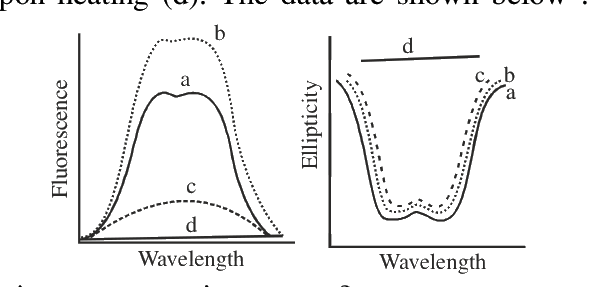
A researcher is investigating structural changes in a protein by following tryptophanfluorescence and by circular dicrotism (CD). Fluorescence and CD spectra of a pure protein were obtained in the absence of any treatment (a), in the presence of $0.5\text{ M}$ Urea (b), upon adding acrylamide, a drencher of tryptophan (c) and upon heating (d). The data are shown below :
Which one of the following statement is correct?
a.
CD is more sensitive to structural changes than fluorescence
b.
Fluorescence is more sensitive to structural changes than CD
c.
Both methods are equally responsive to structural changes
d.
Acrylmaide alters the secondary structure of the protein
Correct Answer & Step-by-Step Solution Locked
Sign in free to reveal the correct answer and AI explanation for this question.
Polynucleotide kinase (PNK) is frequently used for radiolabeling DNA or RNA by phosphorylating $5'$-end of non-phosphorylated polynucleotide chains. Which of the following statement about PNK is NOT true?
a.
PNK catalyzes the transfer of $\alpha$-phosphate from ATP to $5'$-end of polynucleotide chains (DNA or RNA)
b.
PNK has $3'$-phosphatase activity
c.
PNK is inhibited by small amount of ammonium ions
d.
PNK is a T4 bacteriophage-encoded enzyme
Correct Answer & Step-by-Step Solution Locked
Sign in free to reveal the correct answer and AI explanation for this question.
A gene concluding for protein X was cloned in an expression vector under the T7 RNA polymerase promoter and $lac$ operator. Cells were induced by the addition of $1\text{ mM IPTG}$ at $37^\circ\text{C}$ for $6\text{ h}$. Cells were lysed and fractionated into insoluble bodies and cell-free supernatant by centrifugation. Protein X is present in the insoluble bodies. Which one of the following strategies would you use to express protein X in the soluble fraction (cell-free supernatant)?
a.
Increase the duration of induction with $1\text{mM IPTG}$
b.
Grow cell at lower temperature after induction with $1\text{ mM IPTG}$
c.
Increase the concentration of IPTG
d.
Grow cells at higher temperature after induction with $1\text{ mM IPTG}$
Correct Answer & Step-by-Step Solution Locked
Sign in free to reveal the correct answer and AI explanation for this question.
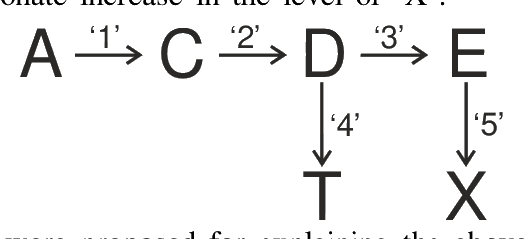
Engineering of metabolic pathways in plants can be achieved by introduction and over expression of appropriate candidate gene(s) using transgenic technology. The figure given below represents a biochemical pathway in plants where a precursor molecule 'A' is converted into products 'T' and 'X' through a series of enzymatic reactions. Enzymes 1-5 are involved in this pathway. Scientists attempted to increase the level of 'X' by introducing an additional copy of the gene for enzyme '5' under transcriptional control of a strong constitutive promoter. However, the developed transgenic plants did not display a proportionate increase in the level of 'X'.
The following statements were proposed for explaining the above results:
A. Enzyme '4' has greater affinity for D than enzyme '3'.
B. Feedback inhibition of enzyme '5' by compound X.
C. Substrate limitation for enzyme '5'.
Which of the above statements could represent probable reasons for NOT obtaining a proportionate increase in the amount of X in the transgenic plants?
a.
Only C
b.
Only A and B
c.
Only A
d.
A, B and C
Correct Answer & Step-by-Step Solution Locked
Sign in free to reveal the correct answer and AI explanation for this question.
A single copy homozygous transgenic plant containing the transgene 'A' for fungal resistance was subsequently re-transformed with another gene 'B' for conferring resistance to salt-stress. The selection marker genes used for both the transformation experiments were different. Transgenic plants obtained following the re-transformation experiment were screened for salt-stress resistance and single copy events were identified by Southern hybridization. These single copy events were self-pollinated. In the event of the two T-DNAs (containing the A and B transgenes) getting integrated in unliked locations in all the transpenic plants, the phenotypic ratios among the $\text{T}_1$ progeny would be :
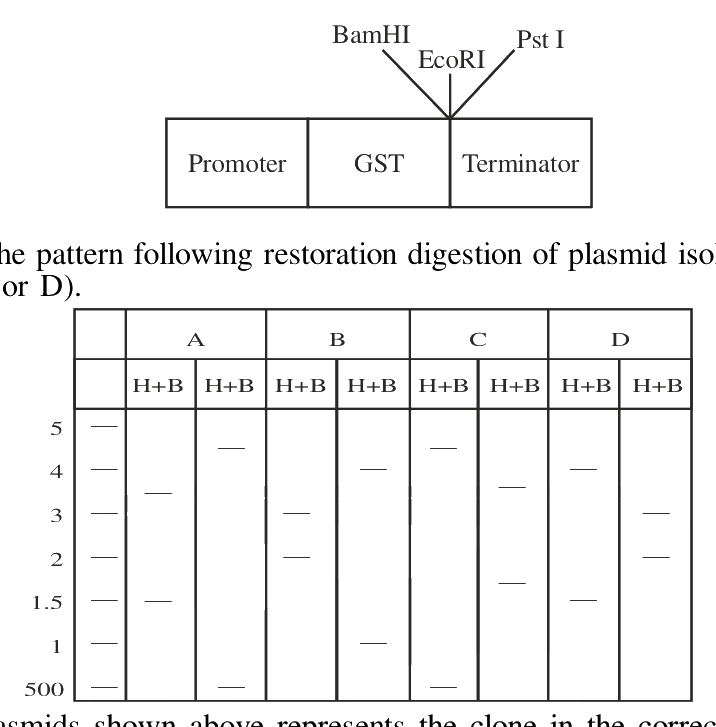
You are inserting a gene of 2kb length into a vector of 3kb make a GST fusion protein. The gene is being inserted at the EcoRI site and the insert has a HindIII site 500bp downstream of the first codon. You are screening for the clone with the correct orientation by restriction digestion of the plasmid using HindIII plus BamHI (H + B) and HindIII puls Pstl (H + P). The map of the relevant region of teh vector is shown below:
Given below is the pattern following restoration digestion of plasmid isolated from four independent clones (A, B, C or D).
Which of the plasmids shown above represents the clone in the correct orientation?
a.
A
b.
B
c.
C
d.
D
Correct Answer & Step-by-Step Solution Locked
Sign in free to reveal the correct answer and AI explanation for this question.