The initial monthly salaries of employees John, Riya and Sunil were in the proportion $4 : 3 : 5$. After an increase of Rs. $10000$ monthly to all, the new proportion becomes $6 : 5 : 7$. What was the initial salary of Sunil?
a.
Rs. $20000$
b.
Rs. $25000$
Correct Answer
c.
Rs. $30000$
d.
Rs. $35000$
Step-by-Step AI Explanation
Verified Method
Let the initial monthly salaries of John, Riya, and Sunil be $4x$, $3x$, and $5x$, respectively. After each receives an increase of Rs. $10000$, their salaries become $4x + 10000$, $3x + 10000$, and $5x + 10000$. The new ratio is given as $6 : 5 : 7$. Taking the ratio for John and Riya: $\frac{4x + 10000}{3x + 10000} = \frac{6}{5} \implies 5(4x + 10000) = 6(3x + 10000) \implies 20x + 50000 = 18x + 60000 \implies 2x = 10000 \implies x = 5000$. Thus, Sunil's initial salary was $5x = 5 \times 5000 = \text{Rs. } 25000$.
Q2mcq
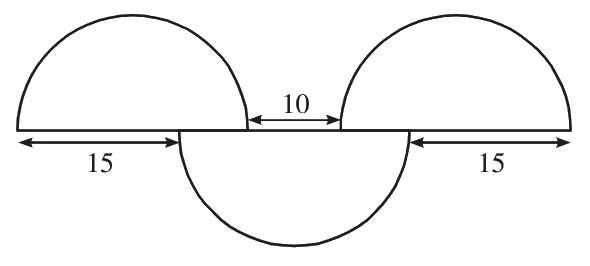
Three identical semi-circles are arranged as shown. What is the diameter of the semi-circles ?
a.
$5\pi$
b.
$20$
Correct Answer
c.
$\frac{15\pi}{2}$
d.
$25$
Step-by-Step AI Explanation
Verified Method
Let $D$ be the diameter of each semicircle. Looking at the horizontal baseline shared by the straight edges of the semicircles: The total span from the left tip of the first semicircle to the right tip of the second semicircle is $D + 10 + D = 2D + 10$. From the lower semicircle, this total span is composed of the left overhang ($15$), the diameter of the bottom semicircle ($D$), and the right overhang ($15$), giving $15 + D + 15 = D + 30$. Equating the two expressions for the total horizontal length: $2D + 10 = D + 30 \implies D = 20$.
Q3mcq
The value of a company is measured as the total value of its shares owned by different investors. Rakesh owns $2/15$ of the shares of a company. He sells $1/3$ of his shares for Rs. $75,000$. What is the total value of the company at that time ?
a.
Rs. $15,75,800$
b.
Rs. $16,87,500$
Correct Answer
c.
Rs. $17,75,800$
d.
Rs. $18,27,500$
Step-by-Step AI Explanation
Verified Method
Rakesh owns $\frac{2}{15}$ of the company's total shares. He sells $\frac{1}{3}$ of his shares, which is $\frac{1}{3} \times \frac{2}{15} = \frac{2}{45}$ of the entire company's shares. This fraction corresponds to Rs. $75,000$. Therefore, the total value of the company is $\frac{75000 \times 45}{2} = 37500 \times 45 = \text{Rs. } 16,87,500$.
Q4mcq
A stock market trader has lost two-thirds of her investment on a day. Next day she recovered one-third of the previous day's loss. What fraction of her initial investment is she left with ?
a.
$\frac{1}{3}$
b.
$\frac{2}{3}$
c.
$\frac{2}{9}$
d.
$\frac{5}{9}$
Correct Answer
Step-by-Step AI Explanation
Verified Method
Let her initial investment be $1$. On the first day, she loses $\frac{2}{3}$ of her investment, leaving her with $1 - \frac{2}{3} = \frac{1}{3}$. The next day, she recovers $\frac{1}{3}$ of the previous day's loss, which is $\frac{1}{3} \times \frac{2}{3} = \frac{2}{9}$. Thus, the fraction of her initial investment she is left with is $\frac{1}{3} + \frac{2}{9} = \frac{3}{9} + \frac{2}{9} = \frac{5}{9}$.
Q5mcq
Three friends, Mr. Rahman, Mr. George and Mr. Vedant, met after a long time. They were wearing red, green and violet colour shirts. Mr. Rahman and the person wearing violet shirt noticed that none of the three is wearing a colour that starts with same letter as his name. Which one of the following is the correct match of the persons with the colour of their shirts ?
The condition states that no person wears a shirt of the colour starting with the initial of his name. Hence, Rahman cannot wear Red, George cannot wear Green, and Vedant cannot wear Violet. Furthermore, "Mr. Rahman and the person wearing violet shirt noticed..." implies that Mr. Rahman is not the person wearing the violet shirt. Since Rahman cannot wear Red or Violet, Rahman must wear Green. Next, George cannot wear Green (since Rahman wears it) and George cannot wear Green by the initial rule anyway, so George can wear Red or Violet. Vedant cannot wear Violet, so the person wearing Violet must be Mr. Rahman (contradiction) or Mr. George. Thus, George must wear Violet, and Vedant must wear Red. But checking the given options: Option A gives Rahman-Violet (violates "Rahman and the person wearing violet"), Option B gives Rahman-Green, George-Violet, Vedant-Red. Let's re-verify: with Rahman-Green, George-Violet, Vedant-Red: none has the same starting letter (R $\ne$ G, G $\ne$ V, V $\ne$ R), and Rahman is distinct from the person wearing violet (George). Therefore, Option B correctly matches the solution.
Q6mcq
A circle of radius $1$ unit is divided into four quarters and rejoined as shown below:
What is the area of this shape ?
a.
$\pi$
Correct Answer
b.
$1$
c.
$2$
d.
$4$
Step-by-Step AI Explanation
Verified Method
The shape is formed merely by cutting a circle of radius $1$ into four quadrants and rearranging (rejoining) them without overlap or stretching. Because area is invariant under dissection and rearrangement, the total area of the rejoined shape is equal to the area of the original circle: $\text{Area} = \pi r^2 = \pi (1)^2 = \pi$.
Q7mcq
What will be the digit at the unit's place of $1^3 + 2^3 + 3^3 + 4^3 + 5^3 + 6^3 + 7^3 + 8^3 + 9^3$ ?
a.
0
b.
5
Correct Answer
c.
7
d.
9
Step-by-Step AI Explanation
Verified Method
The sum of the first $n$ cubes is given by $\sum_{k=1}^n k^3 = \left(\frac{n(n+1)}{2}\right)^2$. For $n = 9$, $\sum_{k=1}^9 k^3 = \left(\frac{9 \times 10}{2}\right)^2 = 45^2 = 2025$. The digit at the unit's place is $5$.
Q8mcq
A car has wheels of diameter $36\text{ cm}$. If it runs at a speed of $60\text{ km/h}$, then the rotation per minute (RPM) will be closest to :
a.
884
Correct Answer
b.
898
c.
906
d.
986
Step-by-Step AI Explanation
Verified Method
The diameter of the wheel is $d = 36\text{ cm} = 0.36\text{ m}$. The circumference of the wheel is $C = \pi d = 0.36\pi\text{ m}$. The speed of the car is $60\text{ km/h} = \frac{60 \times 1000}{60}\text{ m/min} = 1000\text{ m/min}$. The rotations per minute (RPM) is given by $\text{RPM} = \frac{\text{speed in m/min}}{\text{circumference in m}} = \frac{1000}{0.36\pi} \approx \frac{1000}{0.36 \times 3.14159} = \frac{1000}{1.13097} \approx 884.19$, which is closest to $884$.
Q9mcq
Consider the following statements:
Statement-I : All Booklets are Manuals.
Statement-II : All Manuals are Catalogues.
If statements-I and II are True, which one of the following conclusions can be conclusively drawn ?
a.
All Manuals are Booklets.
b.
All Catalogues are Booklets.
c.
All Booklets are Catalogues.
Correct Answer
d.
All Catalogues are Manuals.
Step-by-Step AI Explanation
Verified Method
From the given premises:
1. All Booklets are Manuals ($B \subseteq M$).
2. All Manuals are Catalogues ($M \subseteq C$).
By the transitive property of subset inclusion, $B \subseteq C$, which means 'All Booklets are Catalogues'. Therefore, conclusion (C) can be conclusively drawn. The converse statements (A, B, D) are not necessarily true.
Q10mcq
Sum of the digits of a two-digit number ‘$ab$’ is subtracted from the number and the result is divided by 9. Then the result of this will be :
a.
always $a$
Correct Answer
b.
always $b$
c.
neither $a$ nor $b$
d.
either $a$ or $b$ depending on $a + b$
Step-by-Step AI Explanation
Verified Method
A two-digit number with tens digit $a$ and units digit $b$ is equal to $10a + b$.
The sum of its digits is $a + b$.
Subtracting the sum of the digits from the number gives:
$$(10a + b) - (a + b) = 9a$$
Dividing this result by 9 gives:
$$\frac{9a}{9} = a$$
Thus, the result is always $a$.
🎉 10 Free Sample Solutions Completed
Unlock All 120 Questions & Solutions
Sign up free in seconds to unlock step-by-step AI answers for the remaining 110 questions.
The given Venn diagram shows numbers of players playing one or more than one sport.
The percentage of players who play exactly two sports is closest to _____ %.
a.
5
b.
14
c.
28
d.
32
Correct Answer & Step-by-Step Solution Locked
Sign in free to reveal the correct answer and AI explanation for this question.
Rahul and his father started jogging on a circular track of radius $r$ ($r > 2$). Rahul completed one round and stopped. His father got tired half-way into the first round and returned to his starting point along a straight line. What is the ratio of the distances covered by Rahul and his father ?
a.
$\pi r/(\pi + 2)$
b.
$2\pi/(\pi + 2)$
c.
1
d.
2
Correct Answer & Step-by-Step Solution Locked
Sign in free to reveal the correct answer and AI explanation for this question.
Suresh asked Ramesh to identify the person in a photo that the latter is holding. Ramesh responds, "I have no brothers or sisters. However, that man's father is my father's son". Who is the person in the photo?
a.
Suresh
b.
Ramesh
c.
Ramesh's son
d.
Ramesh's cousin
Correct Answer & Step-by-Step Solution Locked
Sign in free to reveal the correct answer and AI explanation for this question.
Kavita starts from her house and walks $200\text{ m}$ northward, then turns $45^\circ$ right and walks $70\text{ m}$. After that, she turns $90^\circ$ right and walks $70\text{ m}$. Which of the following is the closest value of the shortest distance between Kavita's current location and her house?
a.
$296\text{ m}$
b.
$240\text{ m}$
c.
$200\text{ m}$
d.
$223\text{ m}$
Correct Answer & Step-by-Step Solution Locked
Sign in free to reveal the correct answer and AI explanation for this question.
The market share (\%) and annual production of scooters from five automobile companies $\text{P}$, $\text{Q}$, $\text{R}$, $\text{S}$ and $\text{T}$ are shown in graphs.
If the profit of a company is directly proportional to the ratio of market share to production, then which of the following statements is/are correct?
Statement $\text{X}$: Companies $\text{T}$ and $\text{P}$ have same profit.
Statement $\text{Y}$: Company $\text{R}$ has the maximum profit.
Statement $\text{Z}$: Company $\text{S}$ has the minimum profit.
a.
$\text{X}$ and $\text{Y}$
b.
$\text{X}$ and $\text{Z}$
c.
$\text{Y}$ and $\text{Z}$
d.
Only $\text{Z}$
Correct Answer & Step-by-Step Solution Locked
Sign in free to reveal the correct answer and AI explanation for this question.
A cylindrical container of radius $20\text{ cm}$ was filled with water up to $25\text{ cm}$ height. A solid spherical ball of radius $7\text{ cm}$ was then immersed in the water. What would be the approximate increase in water level in the container after the ball was fully immersed?
a.
$1.14\text{ cm}$
b.
$2.28\text{ cm}$
c.
$5.50\text{ cm}$
d.
$7.00\text{ cm}$
Correct Answer & Step-by-Step Solution Locked
Sign in free to reveal the correct answer and AI explanation for this question.
Numbers of Rose, Lotus, and Marigold plants in a garden are in the proportion $8 : 5 : 7$. Later, $75\%$, $40\%$ and $50\%$ more plants of their respective categories were added. What will be the now proportion of plants, in the same order?
a.
$5 : 3 : 4$
b.
$4 : 2 : 3$
c.
$5 : 4 : 3$
d.
$7 : 4 : 5$
Correct Answer & Step-by-Step Solution Locked
Sign in free to reveal the correct answer and AI explanation for this question.
The correct statements about $\text{SnCl}_4$ and $\text{SnMe}_4$.
A. $\text{SnCl}_4$ forms $\text{SnCl}_6^{2-}$
B. $\text{SnMe}_4$ does not form $\text{SnMe}_6^{2-}$
C. $\text{SnCl}_4$ does not undergo hydrolysis
D. $\text{SnMe}_4$ readily hydrolysis
Are
a.
A and B only
b.
B and C only
c.
A and D only
d.
B and D only
Correct Answer & Step-by-Step Solution Locked
Sign in free to reveal the correct answer and AI explanation for this question.
The correct statements about the copper-containing protein, hemocyanin, from the following
\textbf{A.} It is an extracellular protein.
\textbf{B.} It has an oligomeric structure with each sub-unit containing a pair of two copper atoms.
\textbf{C.} In deoxy form, the two $\text{Cu(I)}$ atoms are separated by $2.8\text{ \AA}$.
\textbf{D.} The blue colour of oxy form is due to charge-transfer from superoxide-to-$\text{Cu(II)}$ ion.
Are
a.
A and B only
b.
A and C only
c.
B and C only
d.
C and D only
Correct Answer & Step-by-Step Solution Locked
Sign in free to reveal the correct answer and AI explanation for this question.
The correct option for a real solution formed by mixing liquid A with liquid B is :
[Here $\text{K}_\text{B}$ is Henry's law constant and solid line represents real solution]
a.
(a)
b.
(b)
c.
(c)
d.
(d)
Correct Answer & Step-by-Step Solution Locked
Sign in free to reveal the correct answer and AI explanation for this question.
Two conformations, A and B, of a single molecule have energies $5\,k_B T$ and $9\,k_B T$, respectively, at a temperature $T$. The fraction of molecules in conformation B is
a.
$\frac{e^{-9}}{(1 + e^{-9})}$
b.
$\frac{e^{-5}}{(1 + e^{-5})}$
c.
$\frac{1}{(1 + e^{-4})}$
d.
$\frac{1}{(1 + e^{4})}$
Correct Answer & Step-by-Step Solution Locked
Sign in free to reveal the correct answer and AI explanation for this question.
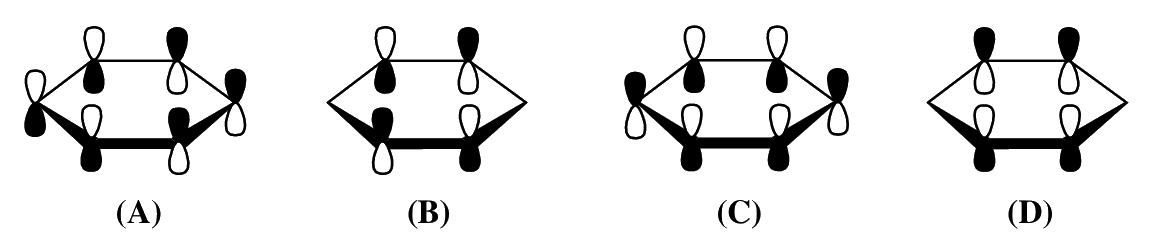
Among the following linear combination of determinants (written with the spatial wavefunctions $1s$ and $2s$ and electronic spin wavefunctions $\alpha$ and $\beta$, using 1 and 2 as labels of the two electrons), the one that denotes the un-normalized wavefunction of a triplet excited state ($1s^1 2s^1$) of $\text{He}$, is :
The correct statements about $\text{C}_{60}$ from the following:
A. It exhibits greater degree of delocalization than benzene.
B. It is susceptible towards addition reactions than substitution reactions.
C. The spherical structure of $\text{C}_{60}$ makes the $\text{C=C}$ bonds more reactive.
D. Its overall reactivity is more likely cycloalkenes than benzene.
are
a.
B, C and D only
b.
A, B and C only
c.
A, B and D only
d.
C and D only
Correct Answer & Step-by-Step Solution Locked
Sign in free to reveal the correct answer and AI explanation for this question.
The density, mass and unit cell edge length of a crystalline solid X are $2.7\text{ g cm}^{-3}$, $27\text{ g mol}^{-1}$ and $400\text{ pm}$, respectively. The crystal lattice of X is
a.
FCC
b.
BCC
c.
Simple cubic
d.
Tetragonal
Correct Answer & Step-by-Step Solution Locked
Sign in free to reveal the correct answer and AI explanation for this question.
A radioactive element $\text{X}$ emits two $\alpha$ and one $\gamma$ particles to yield element $\text{Y}$ of mass number 82. $\text{X}$ also emits one $\alpha$ and one $\beta$ particles to yield element $\text{Z}$ with an atomic number 44.
$${}_{44}\text{Z} + \alpha + \beta \longleftarrow \text{X} \longrightarrow {}^{82}\text{Y} + 2\alpha + \gamma$$
The element $\text{X}$, $\text{Y}$ and $\text{Z}$, respectively, are:
a.
$^{90}_{45}\text{X}$, $^{82}_{42}\text{Y}$ and $^{88}_{44}\text{Z}$
b.
$^{90}_{45}\text{X}$, $^{82}_{41}\text{Y}$ and $^{86}_{44}\text{Z}$
c.
$^{91}_{45}\text{X}$, $^{82}_{41}\text{Y}$ and $^{86}_{44}\text{Z}$
d.
$^{91}_{45}\text{X}$, $^{82}_{42}\text{Y}$ and $^{86}_{44}\text{Z}$
Correct Answer & Step-by-Step Solution Locked
Sign in free to reveal the correct answer and AI explanation for this question.
Consider the following statements about $\text{NO}$ and $\text{NO}_2$.
A. The unpaired electron is in $\pi^*$ orbital of $\text{NO}$ while it is in $\sigma_{\text{nb}}$ orbital of $\text{NO}_2$.
B. $\text{NO}$ does not prefer dimerization, whereas $\text{NO}_2$ does.
C. The reduction of $\text{NO}$ is comparatively easier than $\text{NO}_2$.
D. There is a center of inversion in $\text{NO}_2$.
The option with the correct statements is:
a.
A and B only
b.
A and D only
c.
C and D only
d.
C and B only
Correct Answer & Step-by-Step Solution Locked
Sign in free to reveal the correct answer and AI explanation for this question.
Considering the potential energy at the equilibrium position ($x_e$) to be zero, the internuclear potential, $V(x)$ as a function of distances, $x$ between two atoms in a diatomic molecule is given by:
$$V(x) = D_e\left[1 - e^{-\alpha(x - x_e)}\right]^2,$$
where $D_e$ and $\alpha$ are two constants. The force constant of the bond between the two atoms is:
a.
$D_e\alpha^2$
b.
$2D_e\alpha^2$
c.
$\frac{1}{2}D_e\alpha^2$
d.
$2D_e\alpha$
Correct Answer & Step-by-Step Solution Locked
Sign in free to reveal the correct answer and AI explanation for this question.
The wavefunction, $\Psi(x)$, of a one-dimensional quantum system is given by:
$$\Psi(x) = Ax\exp\left(-\frac{x^2}{a^2}\right)$$
The dimension of $A$ is : [$L$ is the dimension of length]
a.
$L^{-1/2}$
b.
$L^{-3}$
c.
$L^{-3/2}$
d.
$L^0$ (dimensionless)
Correct Answer & Step-by-Step Solution Locked
Sign in free to reveal the correct answer and AI explanation for this question.
The activation energy and enthalpy change in the reaction $\text{H}_2 + \text{I}_2 \rightarrow 2\text{HI}$, respectively, are $167\text{ kJ mol}^{-1}$ and $-8\text{ kJ mol}^{-1}$. Assuming the pre-exponential factors for production and decomposition of $\text{HI}$ to be same at all temperatures, the correct option is :
[$k_p$ and $k_d$ are the rate constants for production and decomposition of $\text{HI}$, respectively]
a.
$k_p$ and $k_d$ have the same temperature dependence.
b.
$k_d$ changes more rapidly with temperature then $k_p$.
c.
$k_p$ changes more rapidly with temperature than $k_d$.
d.
The activation energies of production and decomposition reaction of $\text{HI}$ are same.
Correct Answer & Step-by-Step Solution Locked
Sign in free to reveal the correct answer and AI explanation for this question.
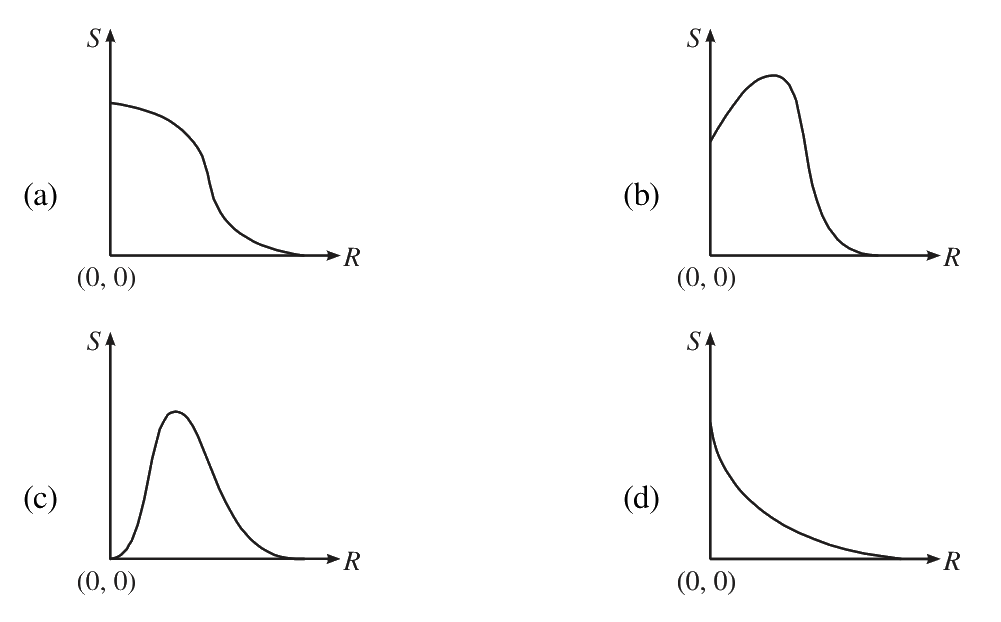
For a diatomic molecule AB, the internuclear distance is $R$ and the internuclear axis is along the z-direction. The plot of the overlap integral $S$ for the $p_x$ orbital of A and $d_{zx}$ orbital of B, against $R$, is :
Correct Answer & Step-by-Step Solution Locked
Sign in free to reveal the correct answer and AI explanation for this question.
For the reaction $\text{K} + \text{Br}_2 \rightarrow \text{KBr} + \text{Br}$, the rate constant can be described as $k = A \exp\left(-\frac{E_a}{RT}\right)$. Choose the correct option regarding activation energy ($E_a$) and pre-exponential factor ($A_E$ : obtained from experiment and $A_T$ : estimated using collision theory)
a.
$E_a > 0;\ A_T > A_E$
b.
$E_a < 0;\ A_T < A_E$
c.
$E_a = 0;\ A_T < A_E$
d.
$E_a \ge 0;\ A_T > A_E$
Correct Answer & Step-by-Step Solution Locked
Sign in free to reveal the correct answer and AI explanation for this question.
The complete combustion of $9.83\text{ mg}$ of an organic compound ($\text{C}_X\text{H}_Y\text{O}_Z$) gives $23.26\text{ mg}$ of $\text{CO}_2$ and $9.52\text{ mg}$ of $\text{H}_2\text{O}$. The ESI-MS analysis of this compound gave a molecular ion peak at $130\text{ (m/z)}$. The value of X is
[Given: Atomic weight: $\text{C} = 12;\ \text{H} = 1,\ \text{O} = 16$]
a.
7
b.
3
c.
4
d.
8
Correct Answer & Step-by-Step Solution Locked
Sign in free to reveal the correct answer and AI explanation for this question.
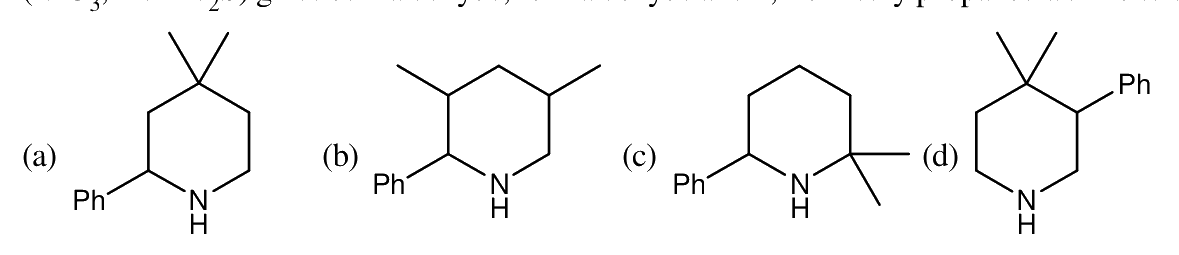
Compound A on Hofmann exhaustive N-methylation procedure (involving two cycles), followed by ozonolysis (I. $\text{O}_3$, II. $\text{Me}_2\text{S}$) gives benzaldehyde, formaldehyde and 2,2-dimethylpropanedial. The structure of A is :
Correct Answer & Step-by-Step Solution Locked
Sign in free to reveal the correct answer and AI explanation for this question.
Consider the following unbalanced chemical reactions:
A. $\text{NH}_3 \rightarrow \text{NO}_2^-$
B. $\text{O}_2 \rightarrow \text{H}_2\text{O}_2$
C. $\text{NO}_2^- \rightarrow \text{NO}_3^-$
D. $\text{H}_2\text{S} \rightarrow \text{S}_8$
E. $\text{CO}_2 \rightarrow \text{CO}$
The reactions that are brought about by the chemolithotropic bacteria, are
a.
B, C and D only
b.
A, C and D only
c.
A, B and E only
d.
B, C and E only
Correct Answer & Step-by-Step Solution Locked
Sign in free to reveal the correct answer and AI explanation for this question.
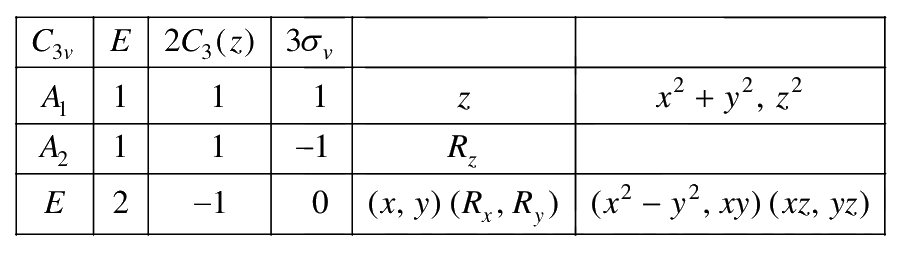
The character table of $C_{3v}$ point group is as follows:
For normal modes of vibration of $\text{NH}_3$, the correct statement, among the following, is :
a.
Some of the normal modes are IR-inactive.
b.
At least one normal mode is both IR and Raman-inactive.
c.
Mixing of normal modes by the symmetry operations is not possible.
d.
For some of the normal modes, the wavefunction of first vibrational excited state is totally symmetric.
Correct Answer & Step-by-Step Solution Locked
Sign in free to reveal the correct answer and AI explanation for this question.
The dielectric constants of electrolyte solution, $\text{A}$ and $\text{B}$, are $\varepsilon$ and $2\varepsilon$, respectively. At a given temperature $\text{T}$, the ratio, $\lambda_{\text{D}}(\text{A})/\lambda_{\text{D}}(\text{B})$ of two Debye (ionic) screening lengths $\lambda_{\text{D}}(\text{A})$ and $\lambda_{\text{D}}(\text{B})$, is
a.
1
b.
2
c.
$\sqrt{2}$
d.
$1/\sqrt{2}$
Correct Answer & Step-by-Step Solution Locked
Sign in free to reveal the correct answer and AI explanation for this question.
The correct number of stereoisomers and the correct number of enantiomeric pairs of $[\text{Co(trien)Br}_2]^+$ ($\text{trien} = \text{triethylenetetraamine}$), respectively, are:
a.
5 and 2
b.
4 and 2
c.
5 and 4
d.
6 and 4
Correct Answer & Step-by-Step Solution Locked
Sign in free to reveal the correct answer and AI explanation for this question.
Double logarithmic plot of the intrinsic viscosity and the molar mass of polymers in solution is linear with slope $3/4$. The ratio of molar mass of two solutions of the same polymer of different molar mass is 16. The expected ratio of their measured intrinsic viscosity in an experiment will be:
a.
2
b.
4
c.
8
d.
16
Correct Answer & Step-by-Step Solution Locked
Sign in free to reveal the correct answer and AI explanation for this question.
The correct statements about agostic interactions from the following:
A. It involves a three-center-two-electron interaction with a $\text{C}-\text{H}$ bond of the ligand.
B. The $\text{C}-\text{H}$ bond of the ligand involved in agostic interaction is lengthened.
C. Its presence is identified by an upfield chemical shift of the $\text{C}-\text{H}$ bond of the ligand.
D. It lowers the $\text{pK}_\text{a}$ of the $\text{C}-\text{H}$ bond of the ligand.
are
a.
A, B, C and D
b.
A, B and C only
c.
B, C and D only
d.
A, C and D only
Correct Answer & Step-by-Step Solution Locked
Sign in free to reveal the correct answer and AI explanation for this question.
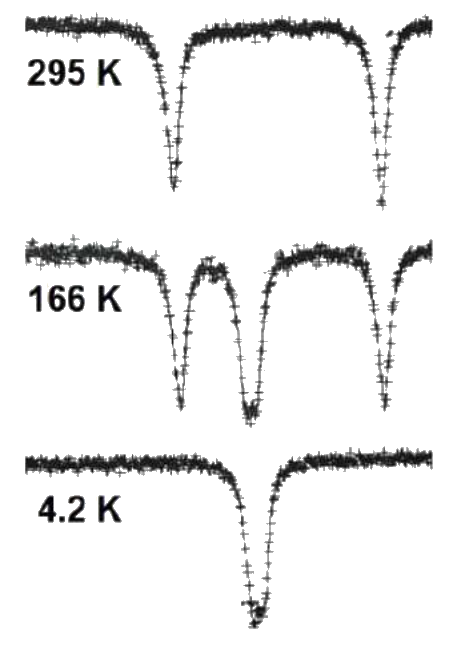
The Mössbauer spectra of $[\text{Fe(L)}_2]\text{I}_2$ ($\text{L} = 3,5\text{-dimethyl-tris-pyrazolylborate}$), shown below, exhibit temperature-dependent spin-transition behaviour. The correct statements from the following.
A. At $295\text{ K}$, the $\text{Fe(II)}$ center is high-spin.
B. At $4.2\text{ K}$, the $\text{Fe(II)}$ center is low-spin.
C. At $295\text{ K}$, the $\text{Fe(II)}$ center is low-spin.
D. At $4.2\text{ K}$, the $\text{Fe(II)}$ center is high-spin.
E. At $166\text{ K}$, it represents a mixture of low-spin and high-spin $\text{Fe(II)}$ complexes.
are
a.
A, B and C only
b.
B, C and E only
c.
C, D and E only
d.
A, B and E only
Correct Answer & Step-by-Step Solution Locked
Sign in free to reveal the correct answer and AI explanation for this question.
Let $H(x)$ be the Hamiltonian defined by $H(x) = \frac{p_x^2}{2m} + V(x)$.
Given: $[H, x] = \frac{\hbar}{im} p_x$ and $H\phi_j = \varepsilon_j \phi_j$ ($j = 0, 1, 2, \dots$) $\varepsilon_0 < \varepsilon_1 < \varepsilon_2 < \cdots$ the correct statement, for $j \neq 0$, is
The unnormalized probability density distribution of a continuous variable $x$ is given by :
$$p(x) = e^{-ax^2}; \quad -\infty \le x \le \infty \quad (a \text{ is a constant})$$
The average of $x^2$ over the normalized distribution is:
a.
$a^2$
b.
$2a$
c.
$a^2/2$
d.
$1/2a$
Correct Answer & Step-by-Step Solution Locked
Sign in free to reveal the correct answer and AI explanation for this question.
The magnitude of the orbital angular momentum vector of a quantum mechanical system is $\sqrt{6}\hbar$. The smallest possible angle between its orbital angular momentum vector and the z-axis is:
a.
$\cos^{-1}\left(\frac{1}{\sqrt{2}}\right)$
b.
$\tan^{-1}\left(\frac{1}{\sqrt{2}}\right)$
c.
$\cos^{-1}\left(\frac{1}{\sqrt{3}}\right)$
d.
$\sin^{-1}\left(\frac{1}{\sqrt{3}}\right)$
Correct Answer & Step-by-Step Solution Locked
Sign in free to reveal the correct answer and AI explanation for this question.
At $100\text{ Pa}$ and $500\text{ K}$, the number of collisions $\text{Ar}$ atoms make on a solid surface of area $1.0\text{ cm}^2$ in $10\text{ s}$ is closest to:
[Molar mass of $\text{Ar}$ is $40\text{ g mol}^{-1}$, assume $\text{Ar}$ to behave as a perfect gas]
a.
$1.9 \times 10^{21}$
b.
$2.1 \times 10^{23}$
c.
$3.5 \times 10^{19}$
d.
$4.7 \times 10^{17}$
Correct Answer & Step-by-Step Solution Locked
Sign in free to reveal the correct answer and AI explanation for this question.
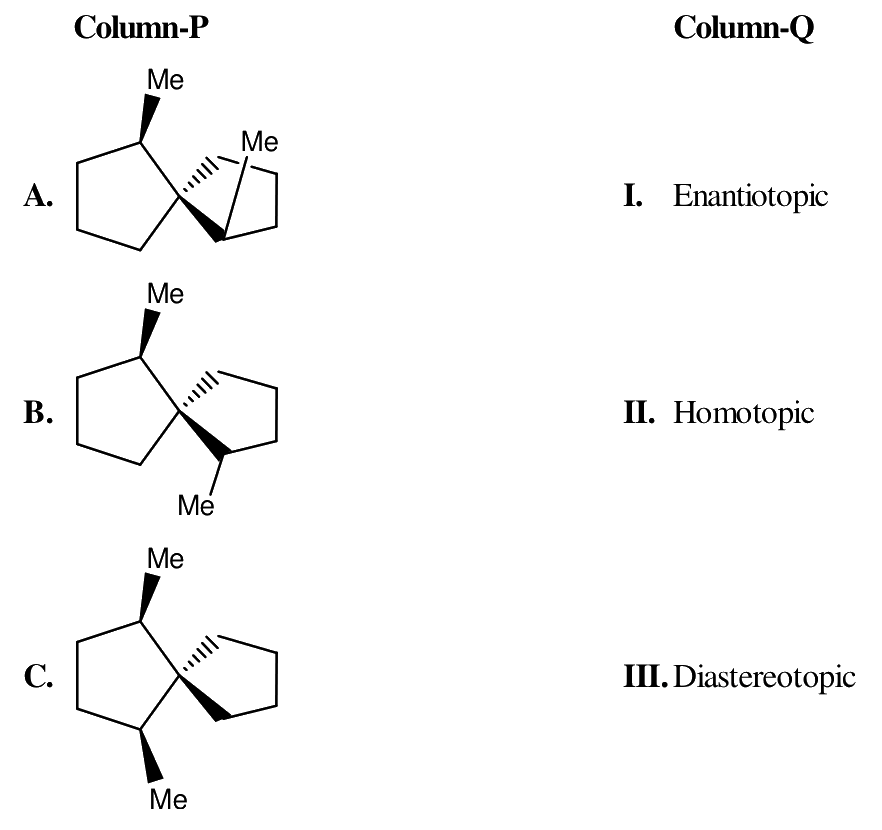
The correct match for methyl groups of molecules in Column P with their topicity in Column Q is:
\textbf{Column-P}
\textbf{A.} Spiro compound with two methyl groups
\textbf{B.} Spiro compound with three methyl groups
\textbf{C.} Spiro compound with three methyl groups
\textbf{Column-Q}
\textbf{I.} Enantiotopic
\textbf{II.} Homotopic
\textbf{III.} Diastereotopic
a.
A-I, B-II, C-III
b.
A-II, B-III, C-I
c.
A-II, B-I, C-III
d.
A-III, B-II, C-I
Correct Answer & Step-by-Step Solution Locked
Sign in free to reveal the correct answer and AI explanation for this question.
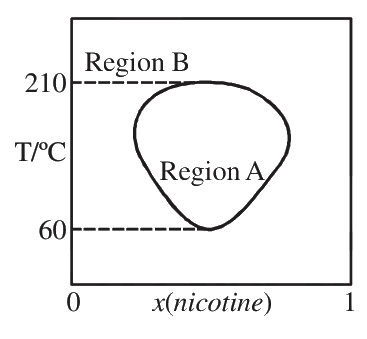
Consider the following temperature-composition diagram for water and nicotine.
The correct option is :
a.
The system has two critical solution temperature; both nicotine and water are completely miscible at $100^{\circ}\text{C}$ and $x(\text{nicotine}) = 0.5$.
b.
At $75^{\circ}\text{C}$ and $x(\text{nicotine}) = 0.5$, nicotine and water form a strong complex which does not dissociate.
c.
Nicotine and water form weak complex at $50^{\circ}\text{C}$, the number of phases (P) in the region A is 2.
d.
Thermal motion homogenises the mixture in the entire region B where $\text{P} = 1$.
Correct Answer & Step-by-Step Solution Locked
Sign in free to reveal the correct answer and AI explanation for this question.
Consider the following statements regarding corrin ring (P) and porphyrin ring (Q)
\textbf{A.} P is fully conjugated, rigid and bigger in size than Q.
\textbf{B.} P is fully conjugated, more flexible and ring size is same as Q.
\textbf{C.} P is partially reduced, more flexible and smaller in size than Q.
\textbf{D.} The flexibility of P supports multiple oxidation states of cobalt.
The correct statements are:
a.
A and B only
b.
C and D only
c.
A and D only
d.
B and D only
Correct Answer & Step-by-Step Solution Locked
Sign in free to reveal the correct answer and AI explanation for this question.
The $\theta$-dependent part of an un-normalized atomic orbital is $\Theta(\theta) = \cos\theta$. In the range $0^\circ \le \theta \le 90^\circ$, the maximum probability of finding an electron in this orbital, between $\theta$ and $\theta + d\theta$, is for $\theta =$
a.
$0^\circ$
b.
$35.3^\circ$
c.
$54.7^\circ$
d.
$90^\circ$
Correct Answer & Step-by-Step Solution Locked
Sign in free to reveal the correct answer and AI explanation for this question.
The correct statements regarding the inner-transition elements from the following:
A. The absorptions in the electronic spectra involve $4f \rightarrow 4f$ and $4f \rightarrow 5d$ transitions.
B. The experimental magnetic moment of $\text{Eu}^{3+}$ ion is greater than the calculated spin-only magnetic moment.
C. The $4f \rightarrow 4f$ transitions are sharp while $4f \rightarrow 5d$ transitions are broad.
D. The peak positions for the $4f \rightarrow 4f$ transitions are marginally affected by the ligand environment.
are
a.
A, B and C only
b.
B, C and D only
c.
A, C and D only
d.
A, B, C and D
Correct Answer & Step-by-Step Solution Locked
Sign in free to reveal the correct answer and AI explanation for this question.
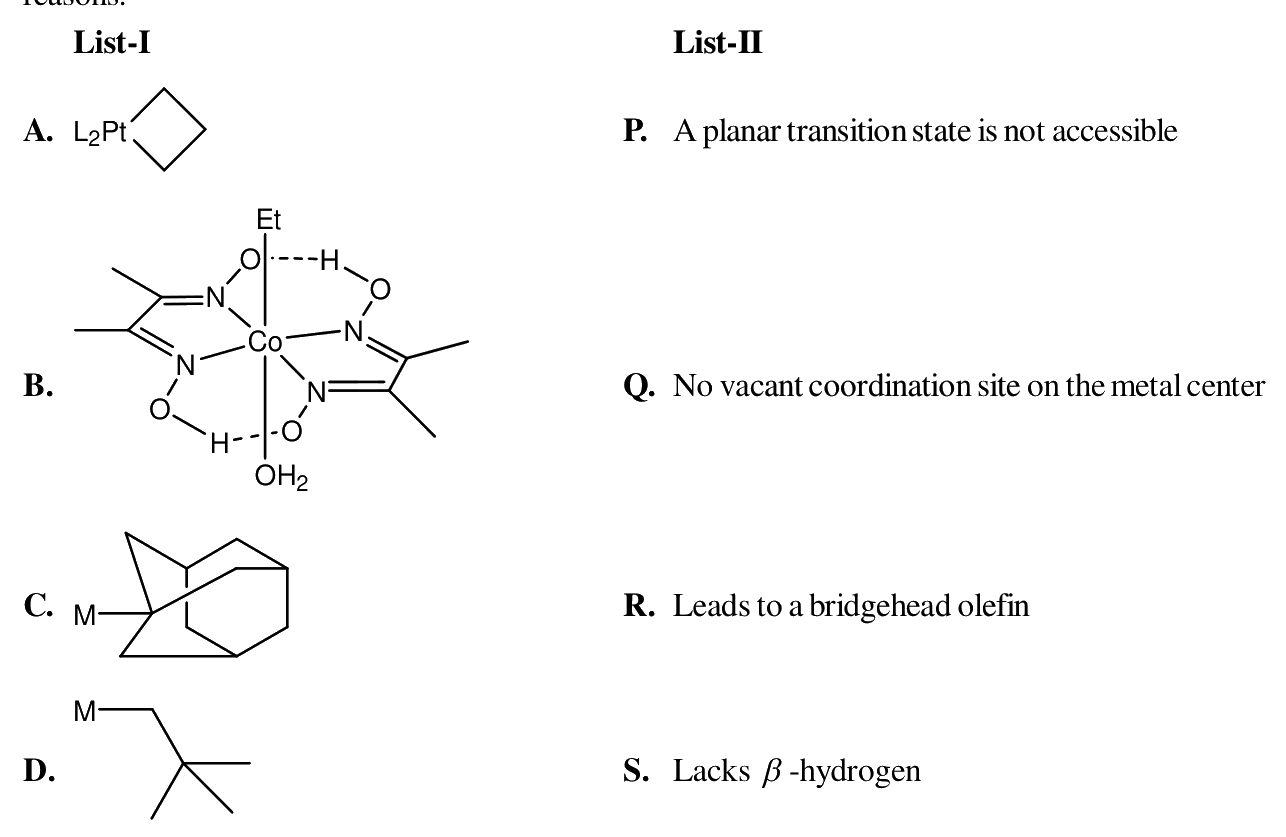
List-I contains metal-alkyl compounds which do not undergo $\beta$-hydride elimination step and List-II gives the reasons.
The option containing the correct match as:
a.
A-P, B-Q, C-R, D-S
b.
A-Q, B-R, C-S, D-P
c.
A-R, B-S, C-P, D-Q
d.
A-S, B-P, C-R, D-Q
Correct Answer & Step-by-Step Solution Locked
Sign in free to reveal the correct answer and AI explanation for this question.
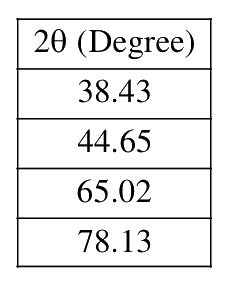
The XRD pattern of a crystalline material, measured using $\text{Cu}\,\text{K}\alpha$ radiation ($\lambda = 1.54\text{ \AA}$), is as follows:
\begin{tabular}{|c|}
\hline
$2\theta$ (Degree) \\
\hline
38.43 \\
\hline
44.65 \\
\hline
65.02 \\
\hline
78.13 \\
\hline
\end{tabular}
Considering the cubic edge length $\sim 4\text{\AA}$, the Miller indices and Bravais lattice of this material are:
a.
(111) (200) (220) (311), BCC
b.
(111) (200) (220) (311), FCC
c.
(110) (200) (211) (220), BCC
d.
(110) (200) (211) (220), FCC
Correct Answer & Step-by-Step Solution Locked
Sign in free to reveal the correct answer and AI explanation for this question.
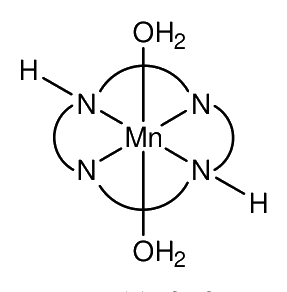
The total number of lines expected in the EPR spectrum of a high-spin $\text{Mn(II)}$ complex [Given: $I_{\text{Mn}} = 5/2; I_{\text{N}} = 1$], for which the schematic diagram is shown below:
a.
6
b.
54
c.
270
d.
30
Correct Answer & Step-by-Step Solution Locked
Sign in free to reveal the correct answer and AI explanation for this question.
The rate law for the reaction $\text{N}_2\text{O}_2 \rightarrow 2\text{NO(g)}$ is first order in the concentration of $\text{N}_2\text{O}_2$ is $1.0\text{ mol dm}^{-3}$, the expression for time-dependent behavior of concentration of $\text{NO}$ (in $\text{mol dm}^{-3}$) is
a.
$2(1 - e^{-kt})$
b.
$1 - e^{-kt}$
c.
$0.5(1 - e^{-kt})$
d.
$1 + e^{-kt}$
Correct Answer & Step-by-Step Solution Locked
Sign in free to reveal the correct answer and AI explanation for this question.
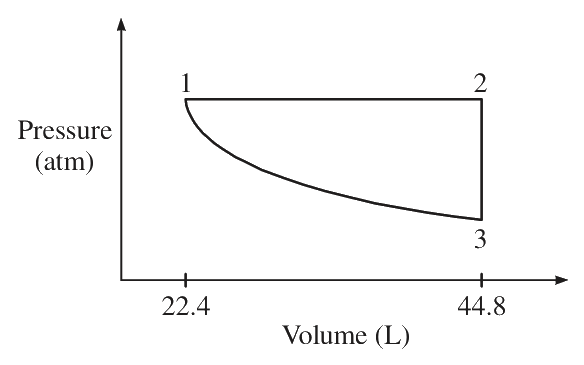
One mole of a monoatomic ideal gas at $1\text{ atm}$ pressure is taken through the $p\text{-}V$ cycle as shown below.
For the process $1 \rightarrow 2$, the reversible work done and the change in enthalpy (in $\text{kJ}$), respectively, are:
a.
$-2.27$ and $5.67$
b.
$3.40$ and $2.27$
c.
$3.40$ and $-5.67$
d.
$-2.27$ and $3.40$
Correct Answer & Step-by-Step Solution Locked
Sign in free to reveal the correct answer and AI explanation for this question.
The correct statements regarding olefin polymerization involving metallocene and alkyl aluminium species, from the following.
A. Trace amounts of water cause a significant increase in the rates of ethylene polymerization by the $\text{Cp}_2\text{TiEtCl}/\text{AlEt}_2\text{Cl}$ system.
B. Methylaluminoxane (MAO) is employed as an activator for the catalyst, $\text{Cp}_2\text{ZrMe}_2$.
C. $\text{B}(\text{C}_6\text{F}_5)_3$ is an activator for $\text{Cp}_2\text{ZrMe}_2$.
D. The termination step of the polymerization reaction is $\beta$-hydride elimination.
are,
a.
A, B, C and D
b.
A, B and C only
c.
A, B and D only
d.
B, C and D only
Correct Answer & Step-by-Step Solution Locked
Sign in free to reveal the correct answer and AI explanation for this question.
The rotational constant of a diatomic molecule is $2.0\text{ cm}^{-1}$. The wavelength of the excitation laser is $333\text{ nm}$. Assuming rigid rotor model of diatomic molecule, the first three Stokes lines (in $\text{cm}^{-1}$) in the rotational Raman spectrum are predicted to be closest to
a.
30018, 30010, 30002
b.
30058, 30050, 30042
c.
30018, 30014, 30010
d.
30034, 30030, 30026
Correct Answer & Step-by-Step Solution Locked
Sign in free to reveal the correct answer and AI explanation for this question.
The free ion ground term, the calculated spin plus orbital magnetic moment value, the calculated spin-orbit magnetic moment value and the observed magnetic moment value (300 K), for a gaseous $3d^5$ ion, respectively, are:
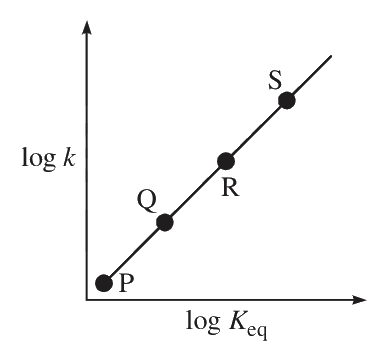
The plot shown below is for the rate of acid hydrolysis reaction of $[\text{Co}(\text{NH}_3)_5\text{X}]^{2+}$ at $25\text{ }^{\circ}\text{C}$, where $\text{X}$ is an anionic ligand ($\text{F}^-$, $\text{Cl}^-$, $\text{NO}_3^-$, $\text{H}_2\text{PO}_4^-$).
The correct option is :
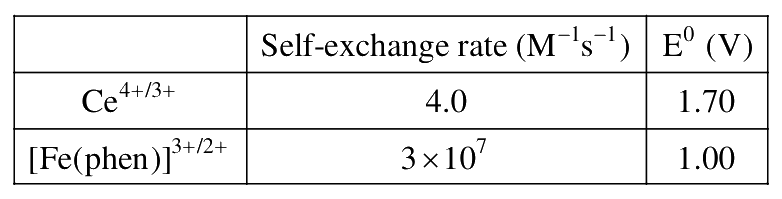
The self-exchange rate and the reduction potential for the following redox couples are given below.
($\mathrm{R} = 8.314\text{ JK}^{-1}\text{ mol}^{-1}$, Faraday constant $= 96485\text{ C mol}^{-1}$)
$$\mathrm{Ce}^{4+} + [\mathrm{Fe(phen)}]^{2+} \longrightarrow \mathrm{Ce}^{3+} + [\mathrm{Fe(phen)}]^{3+}$$
For the above reaction, the approximate rate constant (in $\mathrm{M}^{-1}\mathrm{s}^{-1}$) at $25\ ^\circ\mathrm{C}$ is:
a.
$1.1 \times 10^{10}$
b.
$1.1 \times 10^5$
c.
$1.2 \times 10^{20}$
d.
$3.5 \times 10^{26}$
Correct Answer & Step-by-Step Solution Locked
Sign in free to reveal the correct answer and AI explanation for this question.
The wavefunction of a quantum mechanical system with the Hamiltonian $H$ is $\Psi = c_1 f_1 + c_2 f_2$, where $c_1, c_2$ are constants and $f_1, f_2$ are orthogonal basis functions.
If $H_{11} = H_{22} = 5\text{ eV}$ and $H_{12} = H_{21} = 2\text{ eV}$, where $H_{ij} = \langle f_i | H | f_j \rangle$, the ground state energy (in $\text{eV}$) of the system obtained by variation method is:
a.
$7$
b.
$5$
c.
$3$
d.
$2$
Correct Answer & Step-by-Step Solution Locked
Sign in free to reveal the correct answer and AI explanation for this question.
For a heteronuclear diatomic molecule $AB$, the un-normalized wavefunctions for HOMO and one of the two degenerate LUMOs, respectively are:
$$\psi_{\text{HOMO}} = 0.9\left(\phi_{2s}^A + 3\phi_{2p_z}^A\right) + 0.1\phi_{2p_z}^B$$
$$\psi_{\text{LUMO}} = 0.1\phi_{2p_x}^A + 0.9\phi_{2p_x}^B$$
(Atomic orbitals of $A$ and $B$ are denoted by $\phi$. The internuclear axis is along the $z$-direction)
$AB$ is a
a.
$\sigma$ - donor through $A$, $\pi$ - acceptor through $A$.
b.
$\sigma$ - donor through $B$, $\pi$ - acceptor through $B$.
c.
$\sigma$ - donor through $A$, $\pi$ - acceptor through $B$.
d.
$\sigma$ - donor through $B$, $\pi$ - acceptor through $A$.
Correct Answer & Step-by-Step Solution Locked
Sign in free to reveal the correct answer and AI explanation for this question.
The number of microstates, the ground term, the energy separation between the ground term and the next excited state term of identical multiplicity, and the $j$ value for the lowest energy spin-orbit state for the ground state for a $\mathrm{d}^3$ configuration, respectively, are:
A particle of mass $m$ is confined for a one-dimensional box of unit length. The wave-function of the system is
$$\psi(x) = \sqrt{\frac{8}{5}} \sin (\pi x) [1 + \cos (\pi x)]$$
for $0 \le x \le 1$, and zero elsewhere. The average value of the energy in this state is :
a.
$\frac{h^2}{5m}$
b.
$\frac{h^2}{3m}$
c.
$\frac{h^2}{8m}$
d.
$\frac{h^2}{10m}$
Correct Answer & Step-by-Step Solution Locked
Sign in free to reveal the correct answer and AI explanation for this question.
For complex $[\text{Ni}(\text{RNH}_2)_6]^{2+}$ ($\text{R} = \text{alkyl}$), $\Delta_0$ is $12,600\text{ cm}^{-1}$. The spin-orbit coupling constant ($\lambda$) for $\text{NiNi}^{2+}$ ion is $-315\text{ cm}^{-1}$. The $\mu_{\text{eff}}$ (in BM) for the complex is closest to :
a.
3.11
b.
2.97
c.
2.83
d.
2.55
Correct Answer & Step-by-Step Solution Locked
Sign in free to reveal the correct answer and AI explanation for this question.
The solubility of $\text{Bi}_2\text{S}_3$ in aqueous solution at $25\ ^\circ\text{C}$ is $1.4 \times 10^{-20}\text{ M}$. Given that $\text{E}^0(\text{Bi}^{3+}/\text{Bi}) = 0.226\text{ V}$, the value of $\text{E}^0(\text{Bi}_2\text{S}_3/\text{Bi}, \text{S}^{2-})$ (in V) at $25\ ^\circ\text{C}$ is closest to :
a.
1.18
b.
-0.73
c.
-0.96
d.
0.23
Correct Answer & Step-by-Step Solution Locked
Sign in free to reveal the correct answer and AI explanation for this question.
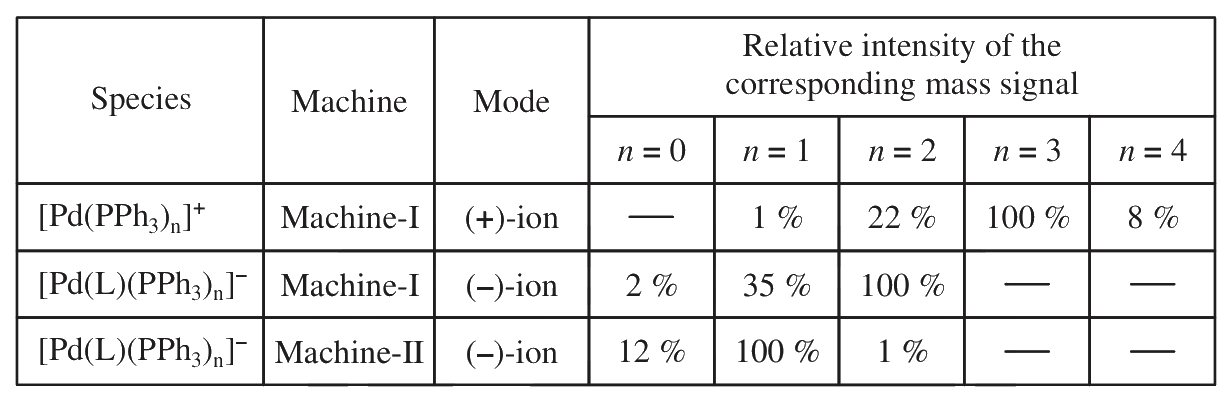
The mass spectra of $\text{Pd}(\text{PPh}_3)_4$ alone and a mixture of $\text{Pd}(\text{PPh}_3)_4$ and sulfonated triphenylphosphine, $[\text{L}]^-$, are recorded on two different machines. The relevant data is given below:
Consider the following statements based on the above data:
\textbf{A.} Machine-I provides a softer ionization conditions that Machine-II.
\textbf{B.} In Machine-I, the stable species under the MS conditions contain three phosphine ligands.
\textbf{C.} Mass data reveal ligand exchange reaction.
\textbf{D.} The increased prevalence of monophosphine ion, $[\text{Pd}(\text{L})]^{-}$, in Machine-II is attributed to ion fragmentation.
The option containing the correct statements is :
a.
A, B, C and D
b.
A, B and C only
c.
B, C and D only
d.
A, C and D only
Correct Answer & Step-by-Step Solution Locked
Sign in free to reveal the correct answer and AI explanation for this question.
In the photochemical reaction $\text{A} \rightarrow \text{B}$, $2.5\text{ mmol}$ of $\text{A}$ is converted into $\text{B}$ on irradiation with $100\text{ W}$ light of wavelength $300\text{ nm}$ for $66\text{ s}$. The quantum yield of the reaction is closest to :
a.
0.05
b.
0.15
c.
0.25
d.
0.35
Correct Answer & Step-by-Step Solution Locked
Sign in free to reveal the correct answer and AI explanation for this question.
The correct match between the enzymes (Column P) and the biological functions (Column Q) from the table below:
\begin{tabular}{ll}
\textbf{Column P} & \textbf{Column Q} \\
A. Cytochrome C Oxidase & 1. DNA biosynthesis \\
B. Tyrosinase & 2. Hydrolysis \\
C. Purple acid phosphatase & 3. Oxidation of phenols \\
D. Galactose oxidase & 4. Oxidation of alcohols \\
E. Ribonucleotide reductase & 5. Reduction of $\text{O}_2$ to water
\end{tabular}
is
a.
A-3, B-1, C-4, D-2, E-5
b.
A-1, B-2, C-3, D-4, E-5
c.
A-5, B-3, C-2, D-4, E-1
d.
A-2, B-4, C-5, D-1, E-3
Correct Answer & Step-by-Step Solution Locked
Sign in free to reveal the correct answer and AI explanation for this question.