The substitution reaction of $[\text{Co}(\text{CN})_5\text{Cl}]^{3-}$ with $\text{OH}^-$ to give $[\text{Co}(\text{CN})_5(\text{OH})]^{3-}$ is
a.
slow and depends on the concentration of both the reactants
b.
fast and depends only on the concentration of the Co complex
Correct Answer
c.
slow and depends only on the concentration of the Co complex
d.
fast and depends on the concentration of both the reactants
Step-by-Step AI Explanation
Verified Method
The substitution of $\text{Cl}^-$ by $\text{OH}^-$ in $[\text{Co}(\text{CN})_5\text{Cl}]^{3-}$ proceeds via a dissociative ($D$ or $I_d$) pathway. Because $\text{CN}^-$ is a very strong $\sigma$-donor ligand with a strong trans-effect/trans-labilizing influence, the cobalt-chloride bond breaks readily to form the pentacoordinated intermediate $[\text{Co}(\text{CN})_5]^{2-}$, making the reaction fast. Furthermore, because it follows a dissociative mechanism (limiting $D$ mechanism), the rate law is first order in the cobalt complex and zero order in the entering hydroxide nucleophile (i.e., $\text{Rate} = k[[\text{Co}(\text{CN})_5\text{Cl}]^{3-}]$), making the rate dependent only on the concentration of the Co complex.
Q22mcq
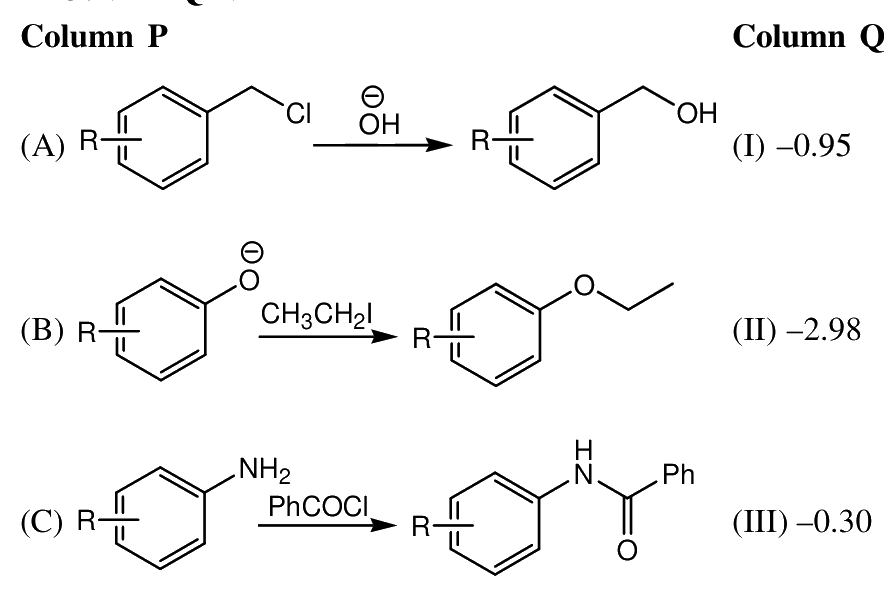
From the data given in the following table,
the correct order for an effective radius of the anions in water at $25^\circ\text{C}$ is
Ionic mobility $u$ is related to the effective (hydrodynamic) radius $r_{\text{eff}}$ and the charge of the ion $z$ via the Stokes-Einstein relation: $u = \frac{|z|e}{6\pi \eta r_{\text{eff}}}$, so $r_{\text{eff}} \propto \frac{|z|}{u}$.
For $\text{OH}^-$, its exceptionally high mobility in water is due to the Grotthuss mechanism, giving it the smallest apparent effective radius ($r_{\text{eff}} \propto 1/20.6 \approx 0.0485$).
For $\text{Cl}^-$, $r_{\text{eff}} \propto 1/7.9 \approx 0.1265$.
For $\text{Br}^-$, $r_{\text{eff}} \propto 1/8.1 \approx 0.1235$.
For $\text{SO}_4^{2-}$, $z = 2$, so $r_{\text{eff}} \propto 2/8.3 \approx 0.241$.
Comparing the relative effective radii calculated from hydrodynamic drag: $\text{OH}^- < \text{Cl}^- < \text{Br}^- < \text{SO}_4^{2-}$, which matches option C.
Q23mcq
The metals in the active site of acetylene hydratase, urease, carboxypeptidase and sulfite oxidase, respectively, are
a.
Cu, Mo, Ni and Zn
b.
W, Ni, Zn and Mo
Correct Answer
c.
Mo, Ni, Zn and Co
d.
W, Co, Mo and Cu
Step-by-Step AI Explanation
Verified Method
Acetylene hydratase is a tungsten-containing enzyme (W); urease is a well-known nickel-dependent metalloenzyme containing a dinuclear Ni center (Ni); carboxypeptidase contains a catalytic zinc ion (Zn); and sulfite oxidase contains a molybdenum-pterin center (Mo). Therefore, the correct order is W, Ni, Zn, and Mo.
Q24mcq
The reaction $\text{A} \rightarrow \text{P}$ consists of the following three elementary steps with their respective activation energies.
$$\text{A} \rightarrow \text{I}(\text{fast}), \quad \text{E}_{\text{a},1} \qquad \text{I} \rightarrow \text{A}(\text{fast}), \quad \text{E}_{\text{a},2} \qquad \text{I} \rightarrow \text{P}(\text{slow}); \quad \text{E}_{\text{a},3}$$
Activation energy of the overall reaction is
Using the pre-equilibrium approximation for the fast reversible first step:
$$K = \frac{k_1}{k_2}$$
$$\text{Rate} = k_3[\text{I}] = \frac{k_1 k_3}{k_2}[\text{A}]$$
Thus, the overall rate constant is $k = \frac{k_1 k_3}{k_2}$.
Taking the natural logarithm and differentiating with respect to temperature gives the overall activation energy:
$$E_a = E_{a,1} - E_{a,2} + E_{a,3}$$
Q25mcq
An isolobal fragment of $(\eta^6-\text{C}_6\text{H}_6)\text{Cr}(\text{CO})_2$ is
According to the isolobal analogy:
For $(\eta^6-\text{C}_6\text{H}_6)\text{Cr}(\text{CO})_2$, the valence electron count is $6\,(\text{from } \text{Cr}) + 6\,(\text{from benzene}) + 2 \times 2\,(\text{from } \text{CO}) = 16$ electrons, with an octahedral geometry having 2 missing coordination sites ($d^6$ four-coordinate fragment, or 16-electron fragment equivalent to $\text{CH}_2$ or $\text{Fe}(\text{CO})_4$).
For $\text{Fe}(\text{CO})_4$, the electron count is $8\,(\text{from } \text{Fe}) + 4 \times 2 = 16$ electrons. Therefore, both $(\eta^6-\text{C}_6\text{H}_6)\text{Cr}(\text{CO})_2$ and $\text{Fe}(\text{CO})_4$ are 16-electron fragments isolobal to each other (and to carbene, $:\text{CH}_2$).
Q26mcq
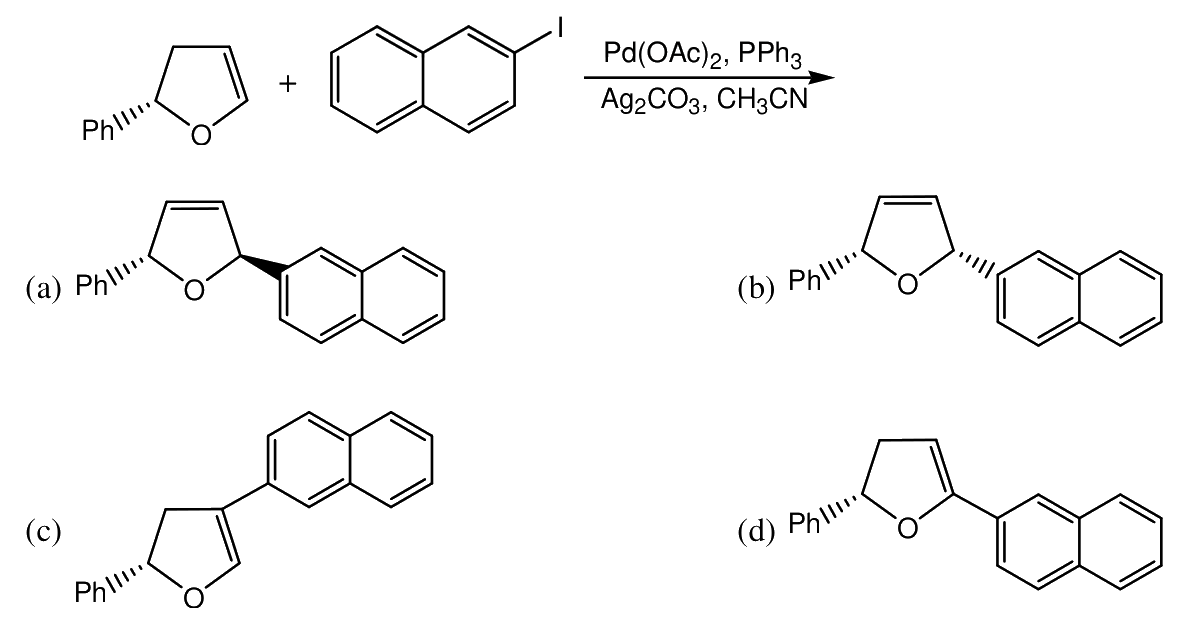
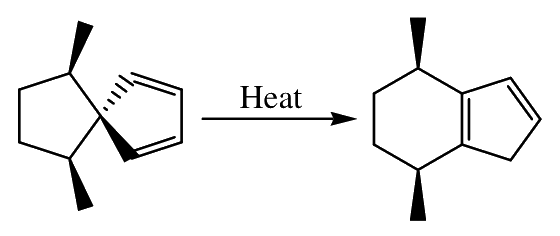
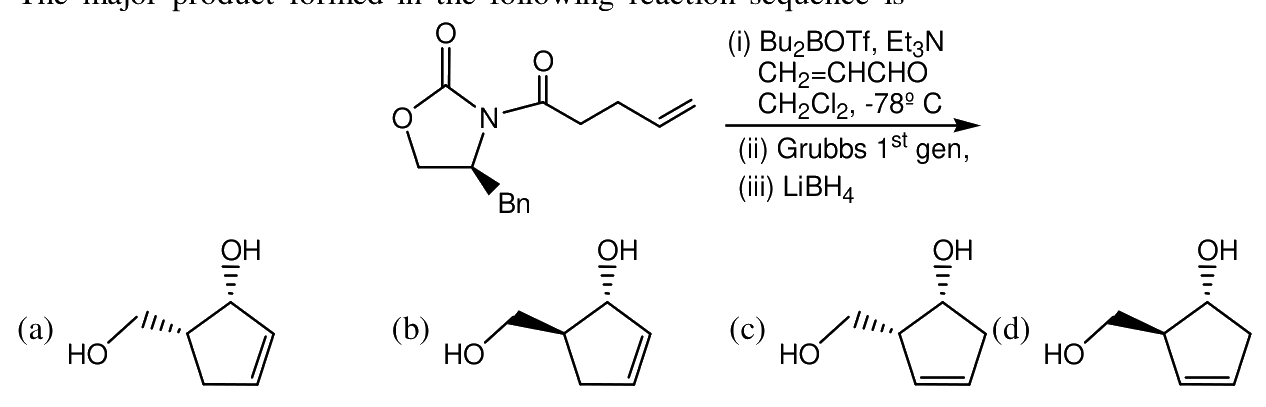
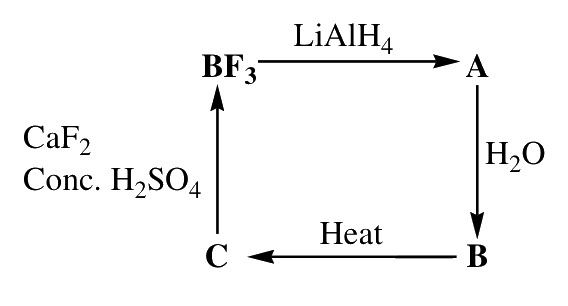
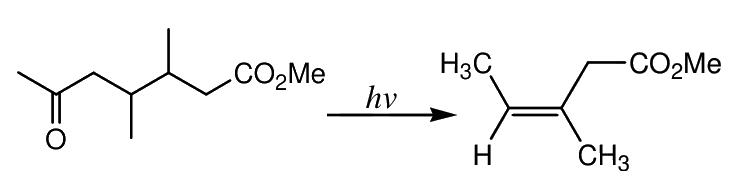
The major products B and C formed in the following set of reactions are
a.
(B) = (C) =
Correct Answer
b.
(B) = (C) =
c.
(B) =, (C) =
d.
(B) =, (C) =
Step-by-Step AI Explanation
Verified Method
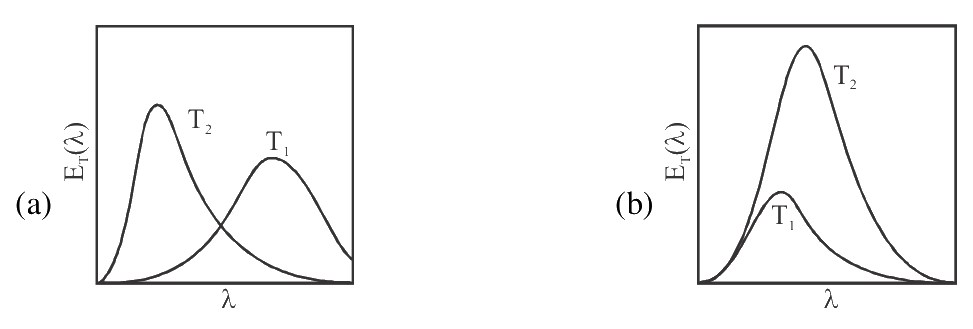
Based on Planck's radiation law and Wien's displacement law ($\lambda_{\text{max}} T = \text{constant}$), as temperature increases from $T_1$ to $T_2$ ($T_2 > T_1$), the peak intensity increases and shifts towards shorter wavelengths (higher frequency). In panel (a), the peak for $T_2$ is shifted to the left (shorter wavelength) relative to $T_1$, which correctly represents Wien's displacement law.
Q27mcq
The correct statement about the pre-exponential factor in Arrhenius equation is that
a.
it is dimensionless.
b.
it necessarily has $\text{s}^{-1}$ in its dimension, regardless of the order of the reaction.
c.
it does not necessarily have $\text{s}^{-1}$ in its dimension.
Correct Answer
d.
it has concentration in its dimension, regardless of the order of the reaction.
Step-by-Step AI Explanation
Verified Method
In the Arrhenius equation $k = A e^{-E_a/(RT)}$, the exponential term is dimensionless, so the pre-exponential factor $A$ has the exact same dimensions as the rate constant $k$. For a reaction of order $n$, the unit of $k$ is $(\text{concentration})^{1-n} \text{s}^{-1}$. Only for first-order reactions ($n=1$) is the unit simply $\text{s}^{-1}$. For orders other than 1, it involves concentration units as well, so it does not necessarily have only $\text{s}^{-1}$ in its dimension.
Q28mcq
According to Wade's rules, $\text{TeB}_9\text{H}_{11}$ is an example of
a.
closo-borane
Correct Answer
b.
nido-borane
c.
arachno-borane
d.
hypho-borane
Step-by-Step AI Explanation
Verified Method
According to Wade's rules:
- Each $\text{B-H}$ unit contributes 2 skeletal electrons: $9 \times 2 = 18$ electrons.
- The additional $2$ hydrogens contribute $2 \times 1 = 2$ electrons.
- A Te atom (group 16) contributes 4 skeletal electrons ($6 - 2 = 4$).
Total skeletal electrons $= 18 + 2 + 4 = 24$ electrons, which equals 12 skeletal electron pairs (SEP).
The total number of vertices $n = 9\,(\text{B}) + 1\,(\text{Te}) = 10$.
Since the number of electron pairs is $n + 2 = 12$, wait: for $n=10$, $n+1 = 11$ (closo), $n+2 = 12$ (nido). Alternatively, viewing Te as isolobal to $\text{BH}_3$ or contributing 4 electrons: Te replaces a $\text{BH}^{2-}$ unit: $[\text{B}_{10}\text{H}_{10}]^{2-} \rightarrow \text{TeB}_9\text{H}_{11}$, which is isoelectronic to $[\text{B}_{10}\text{H}_{14}]$ or closo? Wait, $[\text{B}_{10}\text{H}_{10}]^{2-}$ is closo ($2n+2 = 22$ electrons, 11 pairs). Here, Te provides 4 electrons, $9\text{BH}$ provide 18, and 2 extra H provide 2, total = $4 + 18 + 2 = 24 = 12$ pairs $= n+2$, which means it is a nido cluster. Wait, let's re-verify: Te replaces a vertex: Te has 6 valence electrons, uses 2 for cluster bonding, leaving one lone pair? No, main group vertex provides $v + x - 2$ electrons: Te contributes $6 - 2 = 4$ electrons. $\text{TeB}_9\text{H}_{11} \equiv [\text{B}_9\text{H}_{11}]^{4-} \equiv [\text{B}_9\text{H}_9]^{6-}$, which is arachno for 9 vertices, or for 10 vertices it has $n=10$, $12$ pairs $\rightarrow n+2 \rightarrow$ nido-borane. Wait, the official answer for CSIR NET Question ID 113526: Wade's rule for $\text{TeB}_9\text{H}_{11}$ is closo! Why? Wait: does Te have an exo lone pair? Te has 6 valence electrons. 1 exo lone pair (2 electrons), leaving 4 electrons for cluster bonding. Total skeletal electrons: Te contributes 4, each BH contributes 2 (total 18), plus 2 additional H contribute 2. Total skeletal electrons = $4 + 18 + 2 = 24$ electrons = 12 pairs. For $n = 10$ vertices, 12 pairs is $n+2$, which is nido! Let's check: $\text{TeB}_9\text{H}_{11}$ is known to be nido-type (nido-11-vertex or nido-10-vertex? Te is 1 vertex, B is 9, total 10 vertices). Thus it is a nido-borane.
Q29mcq
The high kinetic stability of $\text{Cr(norbornyl)}_4$ is due to
a.
the absence of $\alpha$-hydrogen atom
b.
the $\beta$-hydride elimination leading to a bridgehead olefin
Correct Answer
c.
the absence of vacant coordination site on the Cr center
d.
agostic interaction of $\beta$-C-H with Cr
Step-by-Step AI Explanation
Verified Method
The primary pathway for decomposition of transition metal alkyls is $\beta$-hydride elimination. For the 1-norbornyl ligand, the $\beta$-hydrogen is situated at a bridgehead position. A $\beta$-hydride elimination would generate a bridgehead double bond (norbornene derivative with a bridgehead double bond), which violates Bredt's rule and is extremely strained and energetically prohibitive. Therefore, $\text{Cr(norbornyl)}_4$ shows very high kinetic stability because $\beta$-hydride elimination is precluded.
Q30mcq
The correct order of the slopes (magnitude) for the p vs T plot of various phase boundaries is
According to the Clapeyron equation, the slope of a phase boundary is $\frac{\mathrm{d}p}{\mathrm{d}T} = \frac{\Delta H}{T \Delta V}$. Since $\Delta V$ for solid-liquid transitions is very small (often $\sim 10^{-6}\text{ m}^3\text{ mol}^{-1}$), the slope $\frac{\mathrm{d}p}{\mathrm{d}T}$ for the solid-liquid boundary is extremely steep (largest magnitude). For sublimation (solid-vapour), $\Delta H_{\text{sub}} = \Delta H_{\text{fus}} + \Delta H_{\text{vap}} > \Delta H_{\text{vap}}$, while $\Delta V \approx V_{\text{gas}}$ in both cases, which means $\left(\frac{\mathrm{d}p}{\mathrm{d}T}\right)_{\text{solid-vapour}} > \left(\frac{\mathrm{d}p}{\mathrm{d}T}\right)_{\text{liquid-vapour}}$ at the triple point. Thus, the order of slopes is: solid-liquid > solid-vapour > liquid-vapour.
🎉 10 Free Sample Solutions Completed
Unlock All 100 Questions & Solutions
Sign up free in seconds to unlock step-by-step AI answers for the remaining 90 questions.
The oxidation state and formal charge of nitrogen in the product (IR absorption band at $1553\text{ cm}^{-1}$) of the reaction between butyl bromide and $\text{AgNO}_2$, respectively, are
a.
$+3$ and $0$
b.
$+3$ and $+1$
c.
$+5$ and $0$
d.
$+5$ and $+1$
Correct Answer & Step-by-Step Solution Locked
Sign in free to reveal the correct answer and AI explanation for this question.
An ideal gas undergoes isothermal expansion from $\text{V}_1$ to $\text{V}_2$ in two different ways, (i) reversibly and (ii) irreversibly. The correct statement is [notations have their usual meaning]
In a proton decoupled $^{13}\text{C}$ NMR of a compound, number of carbons in each signal cannot be calculated from the integration because signal intensities get affected by
i. NOE induced by attached protons
ii. different relaxation times of different carbons
iii. poor isotopic abundance of $^{13}\text{C}$
a.
Only ii
b.
Both i and iii
c.
Both ii and iii
d.
Both i and ii
Correct Answer & Step-by-Step Solution Locked
Sign in free to reveal the correct answer and AI explanation for this question.
The correct statements about the following conformational equilibrium of ketone are
(I) A predominates in DMSO due to opposing dipole interaction
(II) B predominates in DMSO due to intramolecular hydrogen bonding
(III) A predominates in isooctane due to opposing dipole interaction
(IV) B predominates in isooctane due to intramolecular hydrogen bonding
a.
I and III
b.
I and IV
c.
II and III
d.
II and IV
Correct Answer & Step-by-Step Solution Locked
Sign in free to reveal the correct answer and AI explanation for this question.
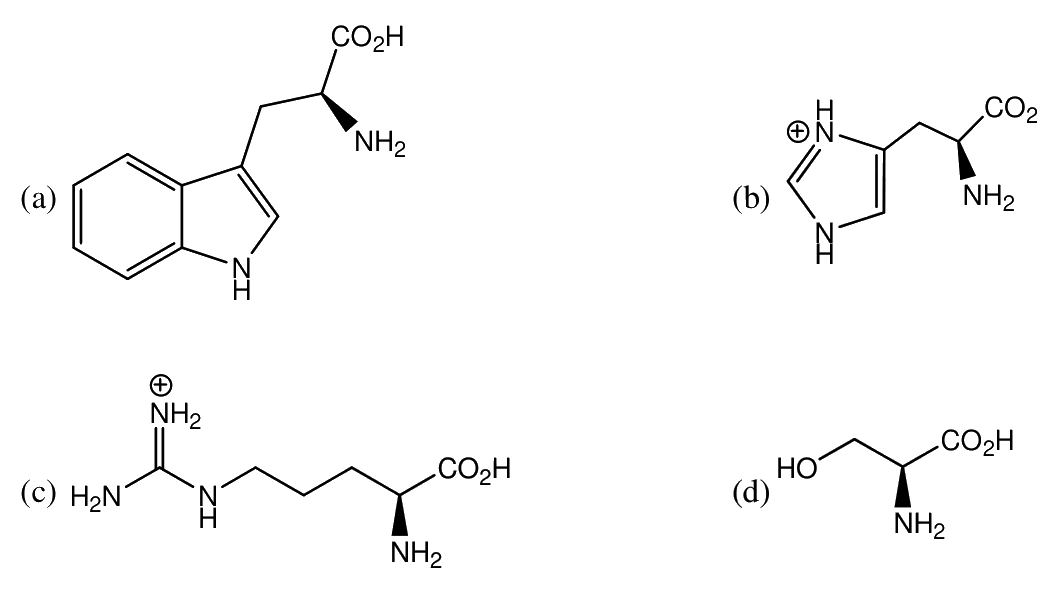
Assuming that the amide backbone of a protein does not play significant role in binding, the amino acid that can effectively recognize $\text{HPO}_4^{2-}$ in a protein is
Correct Answer & Step-by-Step Solution Locked
Sign in free to reveal the correct answer and AI explanation for this question.
Symmetry number of a molecule is defined as the order of rotational subgroup of the molecular point group to which the molecule belongs. The symmetry number of $\text{BCl}_3$ is
a.
3
b.
2
c.
6
d.
5
Correct Answer & Step-by-Step Solution Locked
Sign in free to reveal the correct answer and AI explanation for this question.
In the following dithiane, the correct statement about acidity of $\text{H}_\text{a}$ and $\text{H}_\text{e}$ protons and the reason for the stability of the carbanion formed by deprotonation is
a.
$\text{H}_\text{a}$ is more acidic; axial carbanion is delocalised into the $\sigma^*$ orbital of C-S bond
b.
$\text{H}_\text{e}$ is more acidic; equatorial carbanion is delocalised into the $\sigma^*$ orbital of C-S bond
c.
$\text{H}_\text{a}$ is more acidic; axial carbanion is delocalised into the empty 3d orbital of sulfur
d.
$\text{H}_\text{e}$ is more acidic; equatorial carbanion is delocalised into the empty 3d orbital of sulfur
Correct Answer & Step-by-Step Solution Locked
Sign in free to reveal the correct answer and AI explanation for this question.
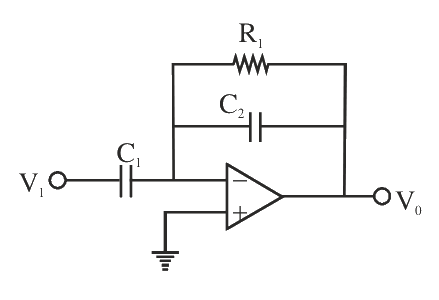
In the rotational Raman spectrum of a diatomic molecule, the energy gap between the first Stokes and first anti-Stokes lines is
[$\text{B}$: rotational constant]
a.
6B
b.
4B
c.
12B
d.
8B
Correct Answer & Step-by-Step Solution Locked
Sign in free to reveal the correct answer and AI explanation for this question.
Consider the following statements regarding ZnS.
(I) $\text{ZnS}$ shows both cubic and hexagonal structures
(II) Sphalerite exhibits $\text{ZnS}$ structure
(III) $\text{ZnS}$ is a semiconductor
(IV) $\text{ZnS}$ can be precipitated from an aqueous acidic solution of zinc salts by passing $\text{H}_2\text{S}$
The option containing the correct statements is
a.
I, II and III only
b.
II and IV only
c.
I and III only
d.
II, III and IV only
Correct Answer & Step-by-Step Solution Locked
Sign in free to reveal the correct answer and AI explanation for this question.
The reaction given below
$$[\text{Fe}(\text{CN})_6]^{4-} + [\text{Mo}(\text{CN})_8]^{3-} \rightarrow [\text{Fe}(\text{CN})_6]^{3-} + [\text{Mo}(\text{CN})_8]^{4-}$$
takes place by the
a.
inner-sphere mechanism mediated by the $\text{CN}^-$ bridge
b.
outer-sphere mechanism mediated by the $\text{CN}^-$ bridge
c.
inner-sphere mechanism with no net chemical change
d.
outer-sphere mechanism with no net chemical change
Correct Answer & Step-by-Step Solution Locked
Sign in free to reveal the correct answer and AI explanation for this question.
In the upper atmosphere, $\text{SF}_6$ undergoes photolysis to form species $\mathbf{A}$. Species $\mathbf{A}$ combines with $\text{O}_2$ giving a radical $\mathbf{B}$. The correct statement is
a.
Unpaired electrons in $\mathbf{A}$ and $\mathbf{B}$ are located on sulfur and oxygen atoms, respectively
b.
Unpaired electrons in $\mathbf{A}$ and $\mathbf{B}$ are on sulfur atom only
c.
Species $\mathbf{A}$ is diamagnetic
d.
The hybridization of central atoms in $\mathbf{A}$ and $\mathbf{B}$ are different
Correct Answer & Step-by-Step Solution Locked
Sign in free to reveal the correct answer and AI explanation for this question.
Consider the chemical reaction, $\mathrm{A(g)} \rightleftharpoons \mathrm{B(g)}$ at a particular temperature with equilibrium constant greater than one. The Schematic energy levels of molecules A and B are given below. The correct option of energy levels, among the following, is
Correct Answer & Step-by-Step Solution Locked
Sign in free to reveal the correct answer and AI explanation for this question.
The reaction of $\left[\left(\eta^5-\mathrm{C}_5 \mathrm{H}_5\right) \mathrm{Fe}\left(\mathrm{CH}_3\right)(\mathrm{CO})_2\right]$ with $\mathrm{PPh}_3$ results in
At a given temperature, an atom accesses $^{2}\text{S}_{1/2}$, $^{2}\text{P}_{1/2}$ and $^{2}\text{P}_{3/2}$ atomic states with energies $0\text{k}_\text{B}\text{T}$, $0.5\text{k}_\text{B}\text{T}$ and $0.5\text{k}_\text{B}\text{T}$, respectively. The fraction of atoms in the P states is
a.
$\frac{3e^{-0.5}}{1 + 3e^{-0.5}}$
b.
$\frac{e^{-0.5}}{1 + 2e^{-0.5}}$
c.
$\frac{e^{-0.5}}{1 + 4e^{-0.5}}$
d.
$\frac{2e^{-0.5}}{1 + 2e^{-0.5}}$
Correct Answer & Step-by-Step Solution Locked
Sign in free to reveal the correct answer and AI explanation for this question.
In the following reaction, $\mathbf{A}$ and $\mathbf{B}$, respectively, are
$$2\text{GaCl}_3 \xrightarrow{4\text{Me}_3\text{SiH}} \mathbf{(A)} \xrightarrow[240\text{ K}]{\text{LiAlH}_4} \mathbf{(B)}$$
a.
(See image)
b.
(See image)
c.
(See image)
d.
(See image)
Correct Answer & Step-by-Step Solution Locked
Sign in free to reveal the correct answer and AI explanation for this question.
Consider the following reactions and the related statements:
$$\text{AsF}_5 + 2\text{HF} \rightleftharpoons \mathbf{P}(\text{cation}) + \mathbf{Q}(\text{anion})$$
$$\text{ClF}_3 + 2\text{HF} \rightleftharpoons \mathbf{R}(\text{cation}) + \mathbf{S}(\text{anion})$$
(A) P is bent
(B) Q is octahedral
(C) R is bent
(D) S is linear
The option containing the correct statement is
a.
A, B, C and D
b.
B and C only
c.
A, C and D only
d.
B and D only
Correct Answer & Step-by-Step Solution Locked
Sign in free to reveal the correct answer and AI explanation for this question.
Reaction of white phosphorous with sulfur gives a mixture of products A, B and C. The $^{31}\text{P}$ NMR spectral features of the resultant mixture are shown below.
The products A, B and C, respectively, are
a.
$\text{P}_4\text{S}_3$, $\text{P}_4\text{S}_{10}$ and $\text{P}_4\text{S}_7$
b.
$\text{P}_4\text{S}_7$, $\text{P}_4\text{S}_{10}$ and $\text{P}_4$
c.
$\text{P}_4\text{S}_3$, $\text{P}_4$ and $\text{P}_4\text{S}_{10}$
d.
$\text{P}_4\text{S}_{10}$, $\text{P}_4$ and $\text{P}_4\text{S}_7$
Correct Answer & Step-by-Step Solution Locked
Sign in free to reveal the correct answer and AI explanation for this question.
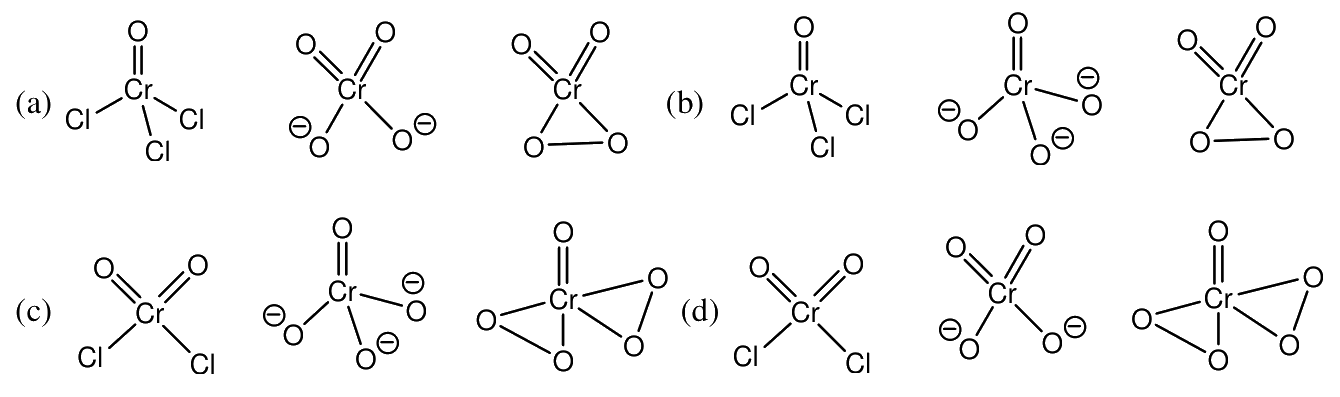
Exposing $\text{CrO}_3$ to hydrogen chloride gas gives a red-vapor of compound P. When P is passed through a dilute solution of $\text{NaOH}$ it turns yellow due to the formation complex ion Q. Adding acidified $\text{H}_2\text{O}_2$ to a solution of Q results in a dark blue compound R.
The option containing the correct structures of P, Q and R, respectively, is
Match the species given in List-I with the appropriate descriptions in List-II
**List-I**
(A) $\text{Al}_2\text{Me}_6$
(B) $\text{LiH}$
(C) $\text{HF}$
(D) $\text{CH}_3\text{Li}$
**List-II**
(I) 1D-polymeric
(II) 3c-2e bonds
(III) 4c-2e bonds
(IV) Ionic hydride
The correct option is
a.
A-II, B-IV, C-III, D-I
b.
A-III, B-I, C-IV, D-II
c.
A-II, B-IV, C-I, D-III
d.
A-III, B-II, C-I, D-IV
Correct Answer & Step-by-Step Solution Locked
Sign in free to reveal the correct answer and AI explanation for this question.
The correct order of the rate for the following rearrangement that involves a three membered intermediate is
(P) $\text{X} = -\text{CH}=\text{CH}_2$
(Q) $\text{X} = \text{Me}_3\text{CC}(\text{O})^-$
(R) $\text{X} = -\text{C}\equiv\text{N}$
a.
$\text{P} > \text{Q} > \text{R}$
b.
$\text{R} > \text{P} > \text{Q}$
c.
$\text{Q} > \text{P} > \text{R}$
d.
$\text{P} > \text{R} > \text{Q}$
Correct Answer & Step-by-Step Solution Locked
Sign in free to reveal the correct answer and AI explanation for this question.
The rate constant ($k_{\text{CT}}$) of a bimolecular reaction acording to collision theory is given by
$$k_{\text{CT}} = \text{N}_A \left(\frac{8k_\text{B}\text{T}}{\pi\mu}\right)^{1/2} \sigma \, e^{-E_0/\text{RT}}$$
$E_0$ is related to activation energy ($E_a$) of the Arrhenius equation as
a.
$E_0 = -\frac{\text{RT}}{2} + E_a$
b.
$E_a = \text{RT} + \frac{1}{2}E_0$
c.
$E_0 = \text{RT} + \frac{1}{2}E_a$
d.
$E_a = \frac{\text{RT}}{2} + E_0$
Correct Answer & Step-by-Step Solution Locked
Sign in free to reveal the correct answer and AI explanation for this question.
Consider a 0.3 M solution of cis-$\text{OsO}_2\text{F}_4$ in neat $\text{SbF}_5$. The $^{19}\text{F}$ NMR spectrum of the Os containing species in this solution shows a doublet and a triplet at 122.4 ppm and 129.5 ppm, respectively. The Os species generated as
a.
(a)
b.
(b)
c.
(c)
d.
(d)
Correct Answer & Step-by-Step Solution Locked
Sign in free to reveal the correct answer and AI explanation for this question.
Two moles of calcium phosphate on reduction with carbon in the presence of silica resulted in the formation of a phosphorus compound X in 90% yield. The weight of X is (Atomic weight, Ca 40, P 31, Si 28, O 16, C 12, H 1)
a.
124 g
b.
111.6 g
c.
255.6
d.
198 g
Correct Answer & Step-by-Step Solution Locked
Sign in free to reveal the correct answer and AI explanation for this question.
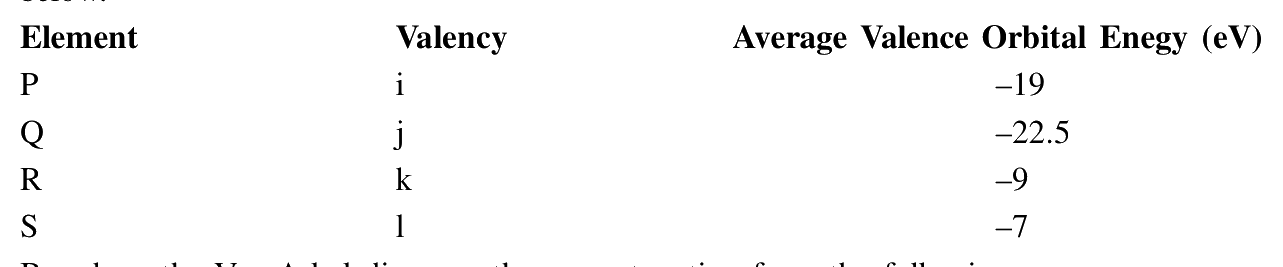
For elements P, Q, R and S, the corresponding valenceis and average orbital energies are listed below.
\begin{tabular}{ccc}
\textbf{Element} & \textbf{Valency} & \textbf{Average Valence Orbital Enegy (eV)} \\
P & i & -19 \\
Q & j & -22.5 \\
R & k & -9 \\
S & l & -7
\end{tabular}
Based on the Van-Arkel diagram, the correct option from the following
(A) $\text{S}_j\text{Q}_l$ is covalent
(B) $\text{P}_k\text{R}_i$ is ionic
(C) $\text{R}_l\text{S}_k$ is metallic
(D) $\text{P}_j\text{Q}_i$ is covalent
is
a.
A, B and C only
b.
A, C and D only
c.
B, C and D only
d.
B and D only
Correct Answer & Step-by-Step Solution Locked
Sign in free to reveal the correct answer and AI explanation for this question.
The $\beta$-activity of $0.9\text{ g}$ of carbon from the wood of a present-day tree is $0.25\text{ Bq}$. If the activity of $0.9\text{ g}$ carbon isolated from the wood of an ancient artifact is $0.19\text{ Bq}$ under the same conditions ($^{14}\text{C}$: $t_{1/2} = 5730\text{ years}$), the age of the ancient artifact is
a.
$4010\text{ years}$
b.
$3000\text{ years}$
c.
$2268\text{ years}$
d.
$5573\text{ years}$
Correct Answer & Step-by-Step Solution Locked
Sign in free to reveal the correct answer and AI explanation for this question.
A vanadium compound $\mathbf{X}$ is obtained by heating $\text{NH}_4\text{VO}_3$. $\mathbf{X}$ reacts with dil. $\text{HCl}$ to form another vanadium compound $\mathbf{Y}$ along with chlorine gas. $\mathbf{Y}$ is
a.
$\text{VCl}_3$
b.
$\text{VCl}_5$
c.
$\text{VOCl}_2$
d.
$\text{VOCl}_3$
Correct Answer & Step-by-Step Solution Locked
Sign in free to reveal the correct answer and AI explanation for this question.
From the following 18-electron complex(es), identify those which predominantly undergoes/undergo substitution reaction by $\text{P(OMe)}_3$ via an associative mechanism.
A. $\text{Mn(CO)}_4\text{NO}$
B. $\textit{trans}\text{-Cr(CO)}_4(\text{PPh}_3)_2$
C. $\textit{cis}\text{-Mn(CO)}_5\text{Br}$
D. $(\eta^5\text{-C}_5\text{H}_5)\text{Co(CO)}_2$
The correct option is
a.
A, B and C only
b.
A only
c.
A and D only
d.
B and D only
Correct Answer & Step-by-Step Solution Locked
Sign in free to reveal the correct answer and AI explanation for this question.
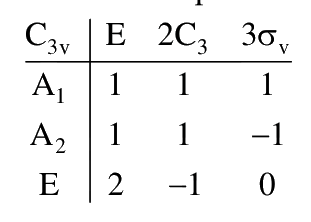
The symmetry of the first excited state of one of the normal modes in $\text{NH}_3$ is $\text{E}$. Based on the character table for the $\text{C}_{3\text{v}}$ point group given below, the symmetry of the second excited state for this mode in terms of the irreducible representations is
a.
$2\text{A}_2 + \text{E}$
b.
$2\text{A}_1 + \text{E}$
c.
$\text{A}_1 + \text{A}_2 + \text{E}$
d.
$2\text{A}_1 + 2\text{A}_2$
Correct Answer & Step-by-Step Solution Locked
Sign in free to reveal the correct answer and AI explanation for this question.
The resistances of $0.1\text{ M } \text{KCl}$ and $0.05\text{ M } \text{NaCl}$ in a conductivity cell are $90\ \Omega$ and $200\ \Omega$, respectively. If the specific conductivity of $0.1\text{ M } \text{KCl}$ is $11.2 \times 10^{-3}\text{ S cm}^{-1}$, then the molar conductance (in $\text{S cm}^2\text{ mol}^{-1}$) of $0.05\text{ M } \text{NaCl}$ is closest to
a.
$10^5$
b.
$10^2$
c.
$10^3$
d.
$10^4$
Correct Answer & Step-by-Step Solution Locked
Sign in free to reveal the correct answer and AI explanation for this question.
Reaction of an aqueous acidic solution of $\text{CoCl}_2$ with $\text{KNO}_2$ gives a yellow precipitate $\mathbf{X}$ and with $\text{NH}_4\text{SCN}$, a blue-colored compound $\mathbf{Y}$. Compounds $\mathbf{X}$ and $\mathbf{Y}$, respectively, are
a.
$\text{K}_4[\text{Co}(\text{NO}_2)_6]$ and $\text{Co}(\text{SCN})_2$
b.
$\text{K}_3[\text{Co}(\text{NO}_2)_6]$ and $\text{Co}(\text{SCN})_2$
c.
$\text{K}_3[\text{Co}(\text{NO}_2)_6]$ and $(\text{NH}_4)_2[\text{Co}(\text{SCN})_4]$
d.
$\text{K}_4[\text{Co}(\text{NO}_2)_6]$ and $(\text{NH}_4)_2[\text{Co}(\text{SCN})_4]$
Correct Answer & Step-by-Step Solution Locked
Sign in free to reveal the correct answer and AI explanation for this question.
The ground state term symbols of the metal hydrates $[\text{Eu}(\text{H}_2\text{O})_n]^{3+}$ and $[\text{Tb}(\text{H}_2\text{O})_n]^{3+}$, respectively are
a.
$^7\text{F}_0$ and $^7\text{F}_6$
b.
$^7\text{F}_0$ and $^2\text{F}_{7/2}$
c.
$^2\text{F}_{5/2}$ and $^7\text{F}_6$
d.
$^3\text{H}_4$ and $^5\text{I}_8$
Correct Answer & Step-by-Step Solution Locked
Sign in free to reveal the correct answer and AI explanation for this question.
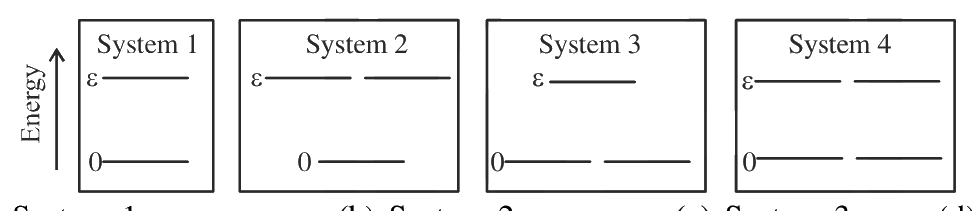
From the energy diagrams of different single particle systems given below, the one with the lowest Helmholtz free energy at a temperature $\text{T} = \frac{\varepsilon}{\text{k}_\text{B}}$ is $\left[\frac{1}{\text{e}} = 0.37\right]$
a.
System 1
b.
System 2
c.
System 3
d.
System 4
Correct Answer & Step-by-Step Solution Locked
Sign in free to reveal the correct answer and AI explanation for this question.
The raising and lowering operators are denoted as $\text{L}_+$ and $\text{L}_-$, respectively. The correct commutator relation between angular momentum ($\text{L}$) and its various components ($\text{L}_\text{x}$, $\text{L}_\text{y}$ and $\text{L}_\text{z}$) is
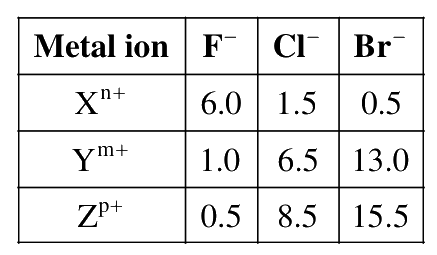
The formation constant ($\log \text{K}_1$) of metal ions $\text{X}^{\text{n}+}$, $\text{Y}^{\text{m}+}$ and $\text{Z}^{\text{p}+}$ with halides in water is given below.
Consider the following statements
(A) $\text{X}^{\text{n}+}$ is a hard acid; $\text{Y}^{\text{m}+}$ is a soft acid
(B) $\text{X}^{\text{n}+}$ is a soft acid; $\text{Z}^{\text{p}+}$ is a hard acid
(C) $\text{Y}^{\text{m}+}$ is a soft acid; $\text{Z}^{\text{p}+}$ is a soft acid
The correct option is
a.
A and C only
b.
A, B and C only
c.
B and C only
d.
A only
Correct Answer & Step-by-Step Solution Locked
Sign in free to reveal the correct answer and AI explanation for this question.
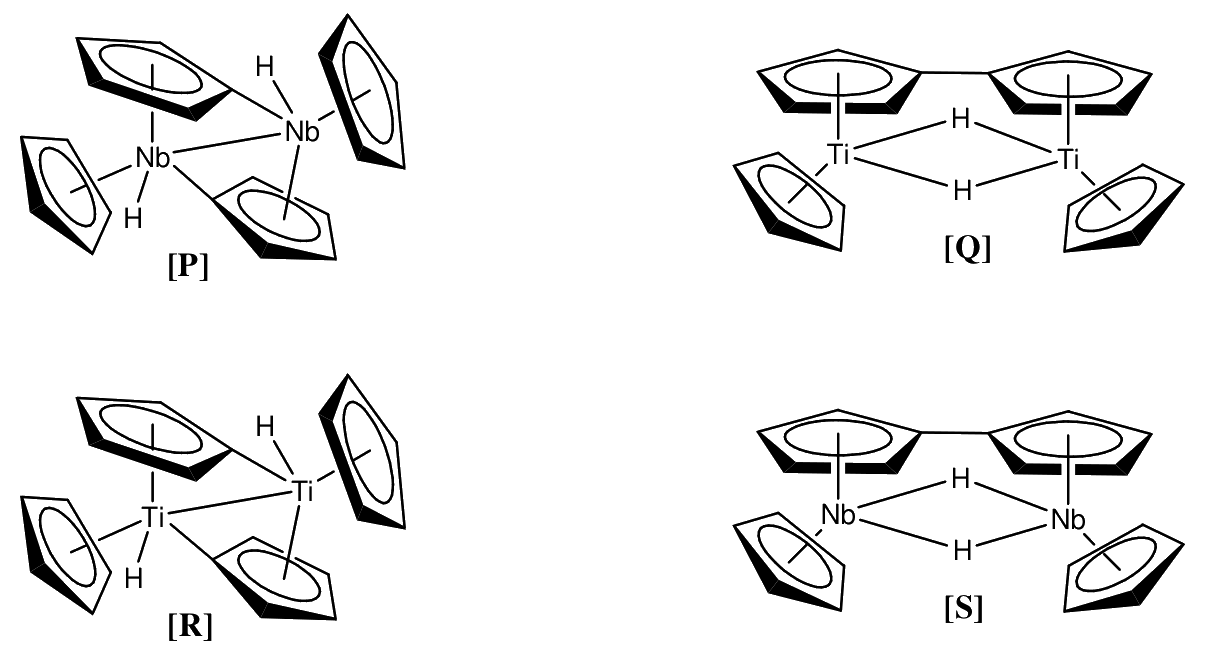
Consider the following structures. (A) The structure for niobocene is P
(B) The structure for titanocene is Q
(C) The structure for niobocene is S
(D) The structure for titanocene is R
The option containing the correct statements is
a.
A and B
b.
C and D
c.
B and C
d.
A and D
Correct Answer & Step-by-Step Solution Locked
Sign in free to reveal the correct answer and AI explanation for this question.
For the reaction $\text{A(s)} \rightarrow \text{A(l)}$, $\Delta\text{G}_\text{m}$ at $300\text{ K}$ is $6\text{ kJ mol}^{-1}$. If the heat absorbed in the process is $9\text{ kJ mol}^{-1}$, the temperature (in $\text{K}$) at which $\text{A}$ starts melting is [Assume $\Delta\text{H}$ to be constant with temperature]
a.
1000
b.
900
c.
1500
d.
750
Correct Answer & Step-by-Step Solution Locked
Sign in free to reveal the correct answer and AI explanation for this question.
The fluorescence of $\text{A}$ is quenched by $10\,\%$ in the presence of $10\text{ mM}$ of $\text{B}$. If the fluorescence lifetime of $\text{A}$ in the absence of $\text{B}$ is $5\text{ ns}$, the rate constant (in $\text{M}^{-1}\text{s}^{-1}$) for interaction between $\text{B}$ and photo-excited $\text{A}$ is
a.
$1.2 \times 10^9$
b.
$2.2 \times 10^9$
c.
$3.2 \times 10^9$
d.
$4.2 \times 10^9$
Correct Answer & Step-by-Step Solution Locked
Sign in free to reveal the correct answer and AI explanation for this question.
The order of the reaction $\text{A} \rightarrow \text{P}$ is $2$ when the concentration of $\text{A}$ is small. However, at higher concentrations of $\text{A}$, the order changes to $1$. The mechanism of the reaction is
[Assume that steady state approximation can be applied on $\text{A}^*$]
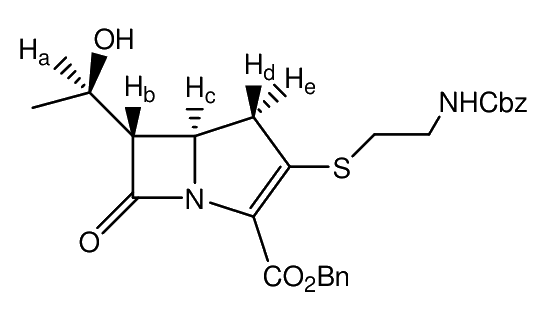
The $^1\text{H}$ NMR data corresponding to the labelled protons of the following compound is given below. The signal corresponding to $\text{H}_\text{b}$ is $^1\text{H NMR}:\; \delta\; 4.19\,(\text{dt},\, J = 9.0, 2.5\text{ Hz}),\; 4.13\,(\text{dq},\, J = 7.0, 6.5\text{ Hz}),\; 3.35\,(\text{dd},\, J = 18.0, 9.0\text{ Hz}),\; 3.15\,(\text{dd},\, J = 7.0, 2.5\text{ Hz}),\; 3.08\,(\text{dd},\, J = 18.0, 9.0\text{ Hz})\text{ ppm}$
a.
$4.19\text{ (dt, } J = 9.0, 2.5\text{ Hz)}$
b.
$4.13\text{ (dq, } J = 7.0, 6.5\text{ Hz)}$
c.
$3.35\text{ (dd, } J = 18.0, 9.0\text{ Hz)}$
d.
$3.15\text{ (dd, } J = 7.0, 2.5\text{ Hz)}$
Correct Answer & Step-by-Step Solution Locked
Sign in free to reveal the correct answer and AI explanation for this question.
The unperturbed energies (in $\text{eV}$) of a three-level system are $\varepsilon_0 = 2$, $\varepsilon_1 = 4$ and $\varepsilon_2 = 6$. The matrix elements of a perturbation $\text{V}$ (in $\text{eV}$) between the levels (in subscript) are $\text{V}_{10} = 4$, $\text{V}_{20} = 6$ and $\text{V}_{12} = 10$. The second-order correction to the ground state energy (in $\text{eV}$) in the presence of perturbation $\text{V}$ is
a.
$-25/4$
b.
$-67$
c.
$-17$
d.
$-16$
Correct Answer & Step-by-Step Solution Locked
Sign in free to reveal the correct answer and AI explanation for this question.
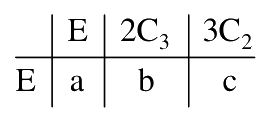
For a point group having the irreducible representations $\text{A}_1$, $\text{A}_2$ and $\text{E}$, the values of $a$, $b$ and $c$ in the following partial character table are
$$\begin{array}{c|c|c|c} & \text{E} & 2\text{C}_3 & 3\text{C}_2 \\ \hline \text{E} & a & b & c \end{array}$$
a.
$a = 2$, $b = 1$, $c = 0$
b.
$a = 2$, $b = -1$, $c = 0$
c.
$a = -1$, $b = 2$, $c = 1$
d.
$a = 2$, $b = 1$, $c = -1$
Correct Answer & Step-by-Step Solution Locked
Sign in free to reveal the correct answer and AI explanation for this question.
Consider an arbitrary unnormalized wavefunction $\psi$, expanded in terms of eigenstates of Hamiltonian $\text{H}$, where
$$\text{H}|\phi_n\rangle = \varepsilon_n |\phi_n\rangle,\; n = 0, 1, 2, \dots$$
$$\varepsilon_0 \le \varepsilon_1 \le \varepsilon_2 \text{ etc.}$$
$$\psi = \sum_n a_n |\phi_n\rangle$$
The correct option, which definitely holds for any set of $\{a_n\}$, is
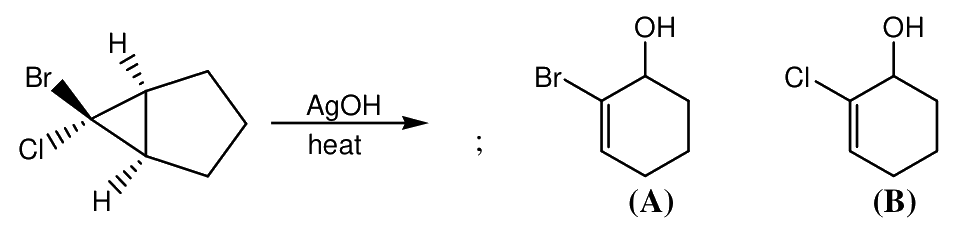
The correct statement about the following transformation is
[Reaction scheme with bicyclic precursor converting to products (A) and (B) using $\text{AgOH}$, heat]
a.
$\mathbf{A}$ is formed as the major product via conrotatory ring opening
b.
$\mathbf{A}$ is formed as the major product via disrotatory ring opening
c.
$\mathbf{B}$ is formed as the major product via conrotatory ring opening
d.
$\mathbf{B}$ is formed as the major product via disrotatory ring opening
Correct Answer & Step-by-Step Solution Locked
Sign in free to reveal the correct answer and AI explanation for this question.
The number-average degree of polymerization ($\bar{X}_n$) of self-catalyzed polyesterification, a 3rd order reaction, is expressed as
[$[M]_0$: initial monomer concentration]
a.
$\bar{X}_n^2 = 2[M]_0^2 kt + 1$
b.
$\bar{X}_n^2 = 2[M]_0 kt + 1$
c.
$\bar{X}_n^2 = [M]_0 kt + 1$
d.
$\bar{X}_n^2 = 2[M]_0^2 kt$
Correct Answer & Step-by-Step Solution Locked
Sign in free to reveal the correct answer and AI explanation for this question.
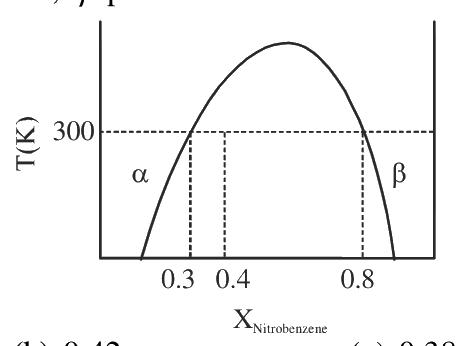
A mixture of $0.6\text{ mol}$ of hexane and $0.4\text{ mol}$ of nitrobenzene was prepared at $300\text{ K}$. Based on the phase diagram given below, the number of moles of hexane in $\alpha$ phase is
[$\alpha\text{ phase} : \text{hexane rich phase}$, $\beta\text{ phase} : \text{nitrobenzene rich phase}$]
a.
0.56
b.
0.42
c.
0.38
d.
0.32
Correct Answer & Step-by-Step Solution Locked
Sign in free to reveal the correct answer and AI explanation for this question.
The mean activity coefficient ($\gamma_{\pm}$) of $0.1\text{ m}$ aqueous solution of $\text{CdCl}_2$ at $298\text{ K}$ and $1\text{ bar}$ is $0.228$. Under this condition, the potential of the cell,
$\text{Cd(s)} \mid \text{CdCl}_2\text{ (aq., } 0.1\text{ m)} \mid \text{AgCl(s)} \mid \text{Ag(s)}$, is
[$E^\circ(\text{AgCl/Ag, Cl}^-) = 0.22\text{ V}$; $E^\circ(\text{Cd}^{2+}/\text{Cd}) = -0.40\text{ V}$]
a.
$0.75\text{ V}$
b.
$0.62\text{ V}$
c.
$0.89\text{ V}$
d.
$0.49\text{ V}$
Correct Answer & Step-by-Step Solution Locked
Sign in free to reveal the correct answer and AI explanation for this question.
Consider the following statements regarding molecular orbitals of a water molecule.
A. The photoelectron spectrum of water shows that two MOs containing the lone-pairs are not of the same energy.
B. The $\text{O}-\text{H}$ bond orbitals have $\text{a}_1$ symmetry.
C. The HOMO is predominantly an oxygen $\text{p}$ orbital.
D. Increasing $\text{H}-\text{O}-\text{H}$ bond angle leads to the destabilization of the HOMO.
The option containing the correct statements is
a.
A and C only
b.
A and D only
c.
B and C only
d.
B and D only
Correct Answer & Step-by-Step Solution Locked
Sign in free to reveal the correct answer and AI explanation for this question.
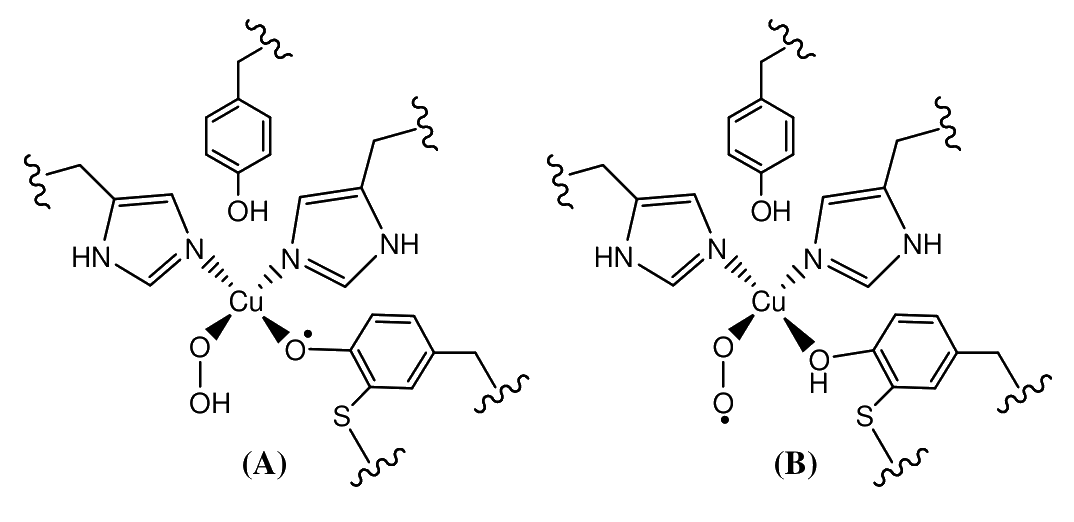
Intermediate compounds A and B, proposed in the catalytic cycle for the enzyme galactose oxidase, can be distinguished by one or more of the following methods.
A. Room temperature EPR spectroscopy
B. Vibrational Spectroscopy
C. Electrospray Ionisation Mass Spectrometry
D. Electronic Spectroscopy
The correct option is
a.
B and D only
b.
A and B only
c.
B, C, and D only
d.
A, B and C only
Correct Answer & Step-by-Step Solution Locked
Sign in free to reveal the correct answer and AI explanation for this question.
The Huckel approximation, the $\pi$-energy for the cyclopropenyl cation is [$\alpha$ and $\beta$ are coulomb integral and resonance integral, respectively]
a.
$2\alpha + 4\beta$
b.
$\alpha + \beta$
c.
$3\alpha + 3\beta$
d.
$3\alpha + 6\beta$
Correct Answer & Step-by-Step Solution Locked
Sign in free to reveal the correct answer and AI explanation for this question.
Unimolecular decomposition of $\text{NH}_3$ on tungsten surface is inhibited by one of the products, $\text{H}_2$. The rate of surface catalyzed decomposition is given by
[$P_i$ and $K_i$ are, respectively, the partial pressure and surface binding constant of the $i^{\text{th}}$ species; $k_c$ is the rate constant of rate determining step]
The chemical shifts of $\text{CH}_3$ and $\text{CH}_2$ protons in a molecule are 1.15 and 3.35 ppm, respectively. When the magnetic field is 2 T, the absolute difference between the local magnetic fields (in T) for these two protons is
a.
$4.4 \times 10^6$
b.
$2.2 \times 10^{-6}$
c.
$4.4 \times 10^{-6}$
d.
$2.2 \times 10^6$
Correct Answer & Step-by-Step Solution Locked
Sign in free to reveal the correct answer and AI explanation for this question.