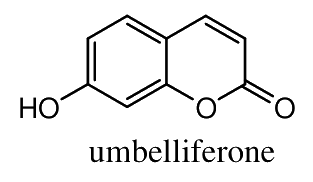
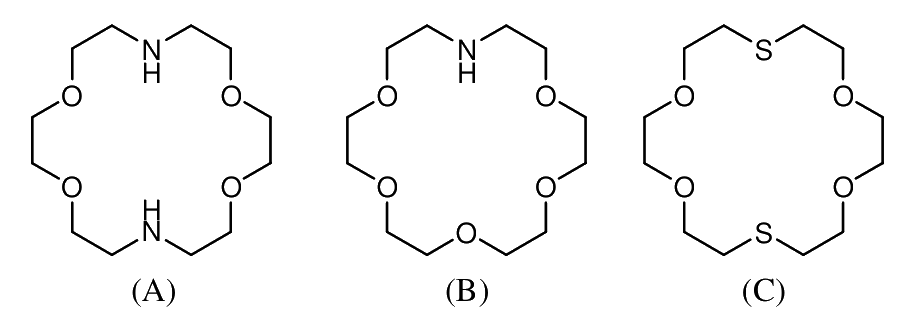
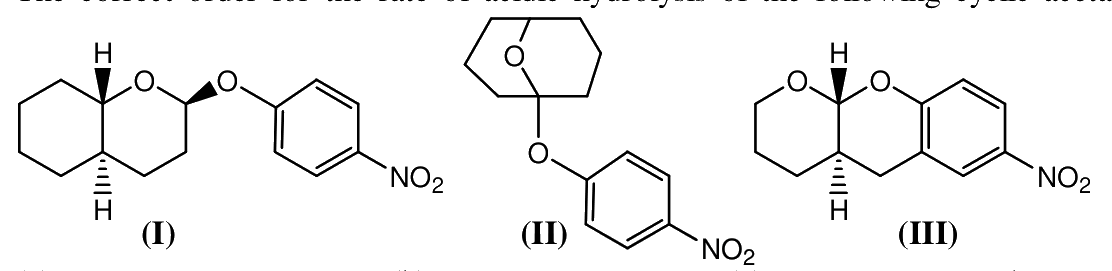
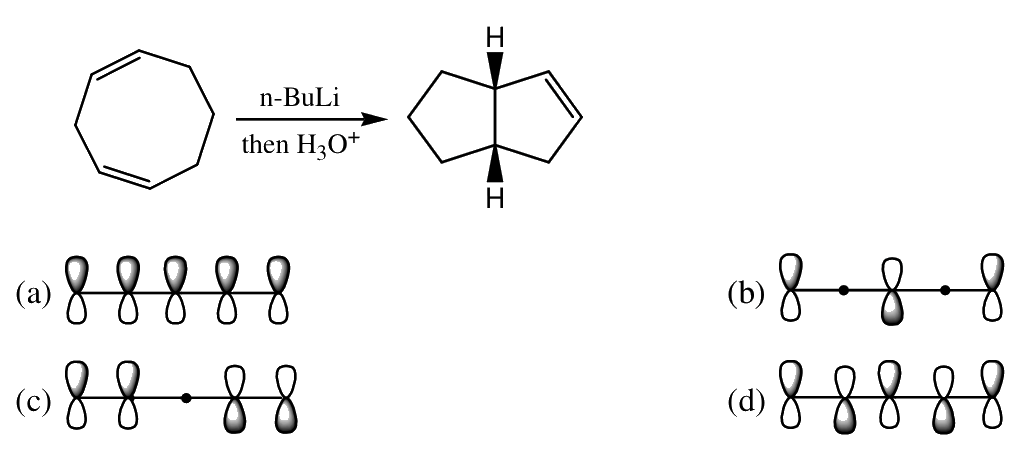
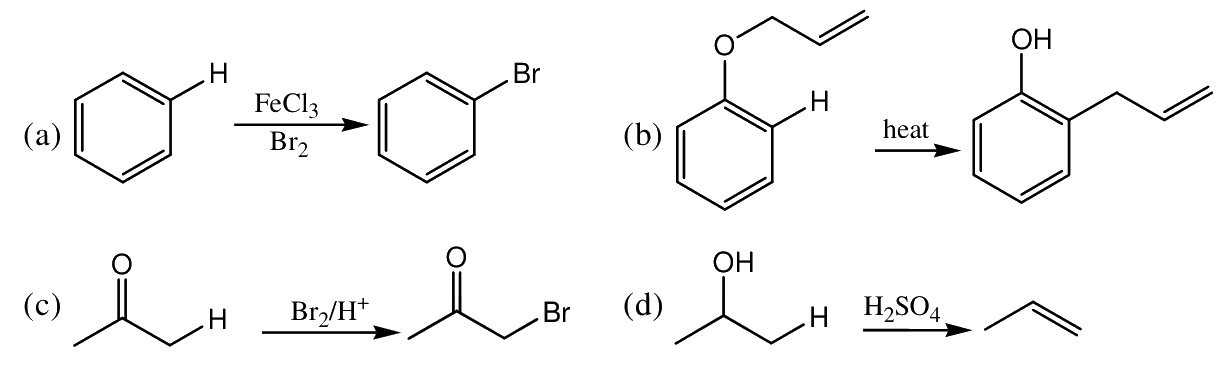
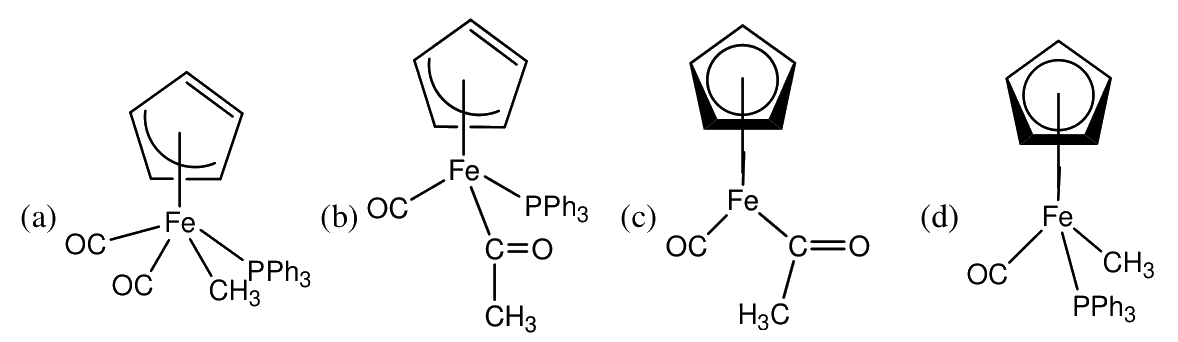
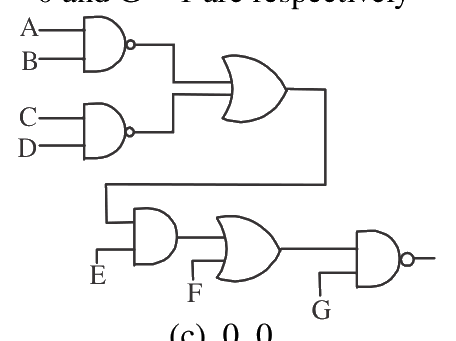
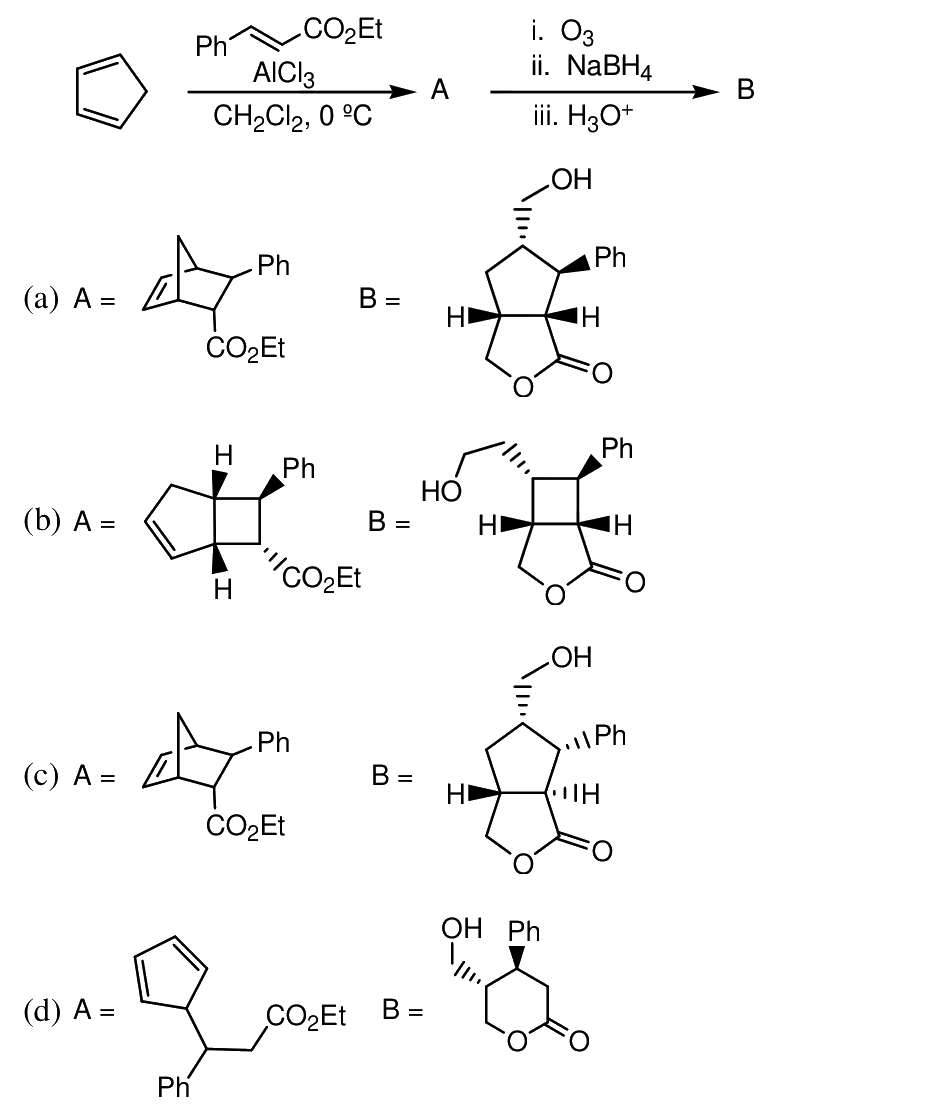
in any nanometer scale and always in one particular dimension
c.
between 1 to 500 nm and always in one particular dimension
d.
between 1 to 100 nm in any dimension
Correct Answer
Step-by-Step AI Explanation
Verified Method
According to the standard definition (e.g., IUPAC and ISO), nanoparticles are defined as objects with all three external dimensions in the nanoscale, typically ranging from $1\text{ to }100\text{ nm}$ in any dimension.
Q22mcq
The correct order for the X-H bond dissociation energies (BDE) in the following compounds is
Down group 14, atomic size increases ($ ext{C} < ext{Si} < ext{Sn}$), leading to poorer orbital overlap with hydrogen's $1s$ orbital. As a result, the $\text{X}-\text{H}$ bond length increases and the bond dissociation energy decreases in the order: $\text{Me}_3\text{C}-\text{H} > \text{Me}_3\text{Si}-\text{H} > \text{Me}_3\text{Sn}-\text{H}$.
Q23mcq
The correct option for the pKa of following pairs of compounds is
a.
$\text{I} > \text{II}$ and $\text{III} > \text{IV}$
Correct Answer
b.
$\text{I} > \text{II}$ and $\text{IV} > \text{III}$
c.
$\text{II} > \text{I}$ and $\text{III} > \text{IV}$
d.
$\text{II} > \text{I}$ and $\text{IV} > \text{III}$
Step-by-Step AI Explanation
Verified Method
In standard pairs of carboxylic acids or phenols compared in typical CSIR NET problems, acidity increases with greater stabilization of the conjugate base. A higher $\text{p}K_a$ corresponds to a weaker acid. Here, $\text{I} > \text{II}$ and $\text{III} > \text{IV}$ correctly reflects the relative $\text{p}K_a$ values for the given pairs.
Q24mcq
In the following reaction, A and B, respectively, are
$$\text{B}_2\text{H}_6 + \text{NH}_2\text{CH}_3 \longrightarrow \text{A}$$
$$\text{B}_2\text{H}_6 + \text{NMe}_3 \longrightarrow \text{B}$$
a.
$\text{H}_3\text{BNH}_2\text{CH}_3$ and $\text{H}_3\text{BNMe}_3$
b.
$[\text{BH}_2(\text{NH}_2\text{CH}_3)_2]^+[\text{BH}_4]^-$ and $\text{H}_3\text{BNMe}_3$
Correct Answer
c.
$\text{H}_3\text{BNH}_2\text{CH}_3$ and $[\text{BH}_2(\text{NMe}_3)_2]^+[\text{BH}_4]^-$
d.
$[\text{BH}_2(\text{NH}_2\text{CH}_3)_2]^+[\text{BH}_4]^-$ and $[\text{BH}_2(\text{NMe}_3)_2]^+[\text{BH}_4]^-$
Step-by-Step AI Explanation
Verified Method
Small, unhindered bases like primary amines (e.g., $\text{MeNH}_2$) cause unsymmetrical cleavage of diborane ($\text{B}_2\text{H}_6$), giving the ionic complex $[\text{BH}_2(\text{NH}_2\text{CH}_3)_2]^+[\text{BH}_4]^-$. In contrast, bulky Lewis bases like tertiary amines (e.g., $\text{NMe}_3$) undergo symmetrical cleavage of diborane, affording the Lewis acid-base adduct $\text{H}_3\text{B}\cdot\text{NMe}_3$.
Q25mcq
The co-enzymes involved in the following biosynthesis are
(A) Pyridoxal phosphate (PLP)
(B) S-Adenosylmethionine (SAM)
(C) Pyridoxamine phosphate (PMP)
(D) Adenosine triphosphate (ATP)
a.
A and B
Correct Answer
b.
B and C
c.
A and D
d.
C and D
Step-by-Step AI Explanation
Verified Method
The biosynthesis shown corresponds to 1-aminocyclopropane-1-carboxylic acid (ACC) synthesis from S-adenosylmethionine (SAM) catalyzed by ACC synthase, which is a pyridoxal phosphate (PLP)-dependent enzyme. Therefore, the cofactors/substrates involved are PLP (A) and SAM (B).
Q26mcq
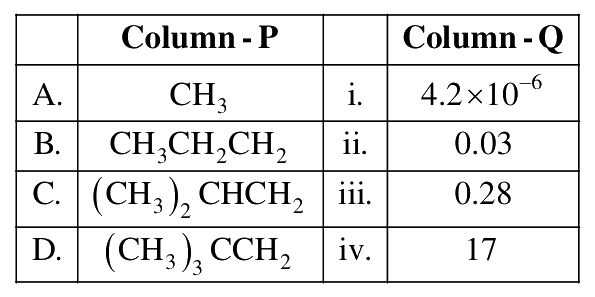
For the reaction of $\text{RBr}$ with $\text{EtONa/EtOH}$, the correct match for the $\text{R}$ groups in **Column P** with the relative rates in **Column Q** is
(for $\text{R} = \text{CH}_3\text{CH}_2$, relative rate $= 1$)
| Column - P | Column - Q |
| :--- | :--- |
| A. $\text{CH}_3$ | i. $4.2\times10^{-6}$ |
| B. $\text{CH}_3\text{CH}_2\text{CH}_2$ | ii. $0.03$ |
| C. $(\text{CH}_3)_2\text{CHCH}_2$ | iii. $0.28$ |
| D. $(\text{CH}_3)_3\text{CCH}_2$ | iv. $17$ |
a.
A-iv; B-iii; C-ii; D-i
Correct Answer
b.
A-iv; B-i; C-iii; D-ii
c.
A-iii; B-ii; C-iv; D-i
d.
A-ii; B-iii; C-i; D-iv
Step-by-Step AI Explanation
Verified Method
The reaction of primary alkyl bromides with sodium ethoxide is predominantly an $\text{S}_\text{N}2$ nucleophilic substitution. Due to steric hindrance around the reaction center, the relative rate decreases dramatically with increasing steric bulk at the $\alpha$ and $\beta$ positions: methyl (A) is the fastest ($17$, iv); n-propyl (B) is slower than ethyl ($0.28$, iii); isobutyl (C) has more $\beta$-branching ($0.03$, ii); and neopentyl (D) has extreme neopentyl steric hindrance, reacting extremely slowly ($4.2\times 10^{-6}$, i). Thus, the correct matching is A-iv, B-iii, C-ii, D-i.
Q27mcq
The option showing the correct structural types for $\text{ZnFe}_2\text{O}_4$ and $\text{KMnF}_3$, respectively, is
a.
Perovskite and Fluorite
b.
Perovskite and Antifluorite
c.
Spinel and Perovskite
Correct Answer
d.
Spinel and Fluorite
Step-by-Step AI Explanation
Verified Method
$\text{ZnFe}_2\text{O}_4$ possesses the normal spinel structure where $\text{Zn}^{2+}$ occupies tetrahedral sites and $\text{Fe}^{3+}$ occupies octahedral sites of the close-packed oxide lattice. $\text{KMnF}_3$ has the cubic perovskite structure of type $\text{ABX}_3$.
Q28mcq
In a 3-dimensional isotropic harmonic oscillator, the degeneracy of the state with energy equal to $(9/2)\ \hbar\omega$ is [$\omega$ is the angular frequency]
a.
3
b.
9
c.
6
d.
10
Correct Answer
Step-by-Step AI Explanation
Verified Method
The energy levels of a 3D isotropic quantum harmonic oscillator are given by $E = \left(n_x + n_y + n_z + \frac{3}{2}\right)\hbar\omega = \left(N + \frac{3}{2}\right)\hbar\omega$, where $N = n_x + n_y + n_z$ ($n_x, n_y, n_z \in \{0, 1, 2, \dots\}$). Given $E = \frac{9}{2}\hbar\omega$, we have $N + \frac{3}{2} = \frac{9}{2} \implies N = 3$. The degeneracy of state $N$ is given by $g_N = \frac{(N + 1)(N + 2)}{2}$. For $N = 3$, $g_3 = \frac{(3 + 1)(3 + 2)}{2} = \frac{4 \times 5}{2} = 10$.
Q29mcq
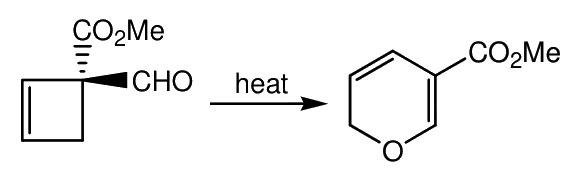
The following reaction occurs under
a.
photochemical conditions via a disrotatory ring-opening
b.
photochemical conditions via a conrotatory ring-opening
c.
thermal conditions via a disrotatory ring-opening
Correct Answer
d.
thermal conditions via a conrotatory ring-opening
Step-by-Step AI Explanation
Verified Method
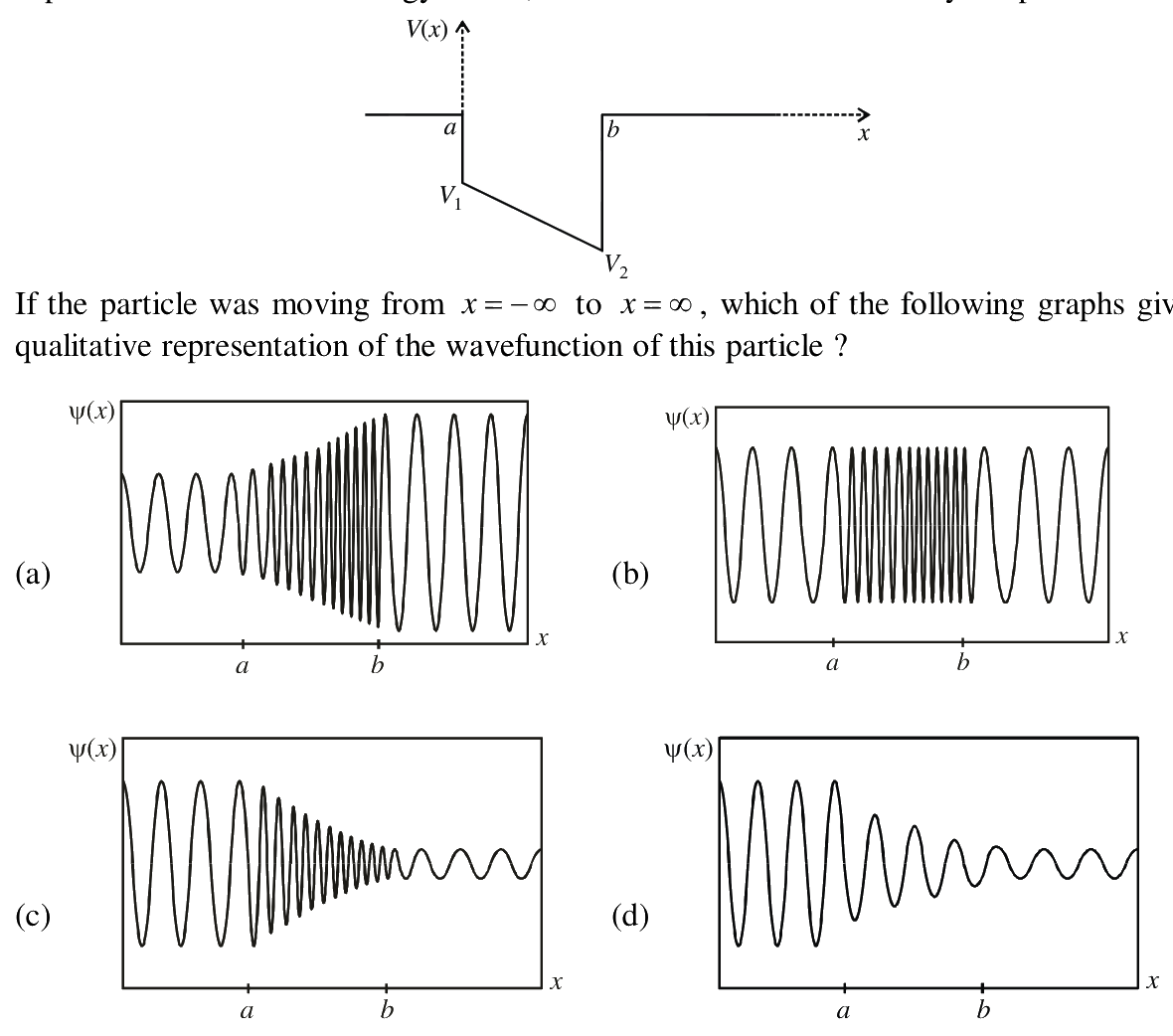
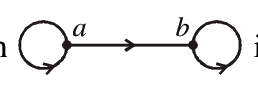
Note: The text for Question ID 113427 corresponds to a pericyclic electrocyclic ring-opening reaction, but the attached diagram displays a 1D quantum mechanics problem where a particle moves from $x = -\infty$ to $x = \infty$ through a potential well from $a$ to $b$ that decreases linearly ($V_2 < V_1 < 0$).
1. **For the Quantum Mechanical problem shown in Image #1:**
- As the potential energy $V(x)$ decreases in the region between $a$ and $b$, the kinetic energy $T = E - V(x)$ increases, reaching its maximum at $x = b$.
- Since the local de Broglie wavelength is $\lambda = \frac{h}{\sqrt{2m(E-V)}}$, higher kinetic energy means a shorter wavelength (higher frequency of oscillations) from $a$ to $b$.
- The amplitude of the wavefunction is inversely proportional to the square root of the classical velocity: $A \propto (E-V)^{-1/4}$. As kinetic energy increases, the particle spends less time in that region, which causes the amplitude to decrease from $a$ to $b$.
- For $x > b$, some portion of the wave is transmitted while some is reflected back to the left (superposition of incident and reflected waves for $x < a$ gives a larger amplitude than the purely transmitted wave for $x > b$). Thus, the transmitted wave for $x > b$ has a lower amplitude than the wave for $x < a$, and has a longer wavelength than inside the well.
- This behavior—decreasing amplitude and decreasing wavelength (higher oscillation frequency) across $a$ to $b$, followed by a lower transmitted amplitude for $x > b$—is correctly depicted in graph **(c)**.
2. **If interpreted via the typical electrocyclic question text:**
A cyclobutene ring-opening to a 1,3-butadiene is a $4\pi$-electron system. Under thermal conditions, the Woodward-Hoffmann rules dictate a conrotatory pathway, whereas under photochemical conditions, it occurs via a disrotatory pathway.
Q30mcq
The order of acceptor strength towards $\text{Me}_2\text{S}$ donor is
Dimethyl sulfide ($ ext{Me}_2 ext{S}$) is a soft Lewis base due to the presence of the sulfur donor atom. According to Pearson's Hard-Soft Acid-Base (HSAB) principle, soft bases prefer to bind to softer Lewis acids. Among the group 13 halides, as we go down the group, the Lewis acid becomes softer ($ ext{Ga}^{3+} > ext{Al}^{3+} > ext{B}^{3+}$). Therefore, the acceptor strength towards a soft sulfur donor like $ ext{Me}_2 ext{S}$ follows the order: $ ext{GaCl}_3 > ext{AlCl}_3 > ext{BCl}_3$.
🎉 10 Free Sample Solutions Completed
Unlock All 100 Questions & Solutions
Sign up free in seconds to unlock step-by-step AI answers for the remaining 90 questions.
The solvent that shifts the Schlenk equilibrium to the right side is
$$2\text{RMgX} \rightleftharpoons \text{MgR}_2 + \text{MgX}_2$$
($\text{R} = \text{isopropyl}$)
a.
hexane
b.
tetrahydrofuran
c.
dioxane
d.
diethyl ether
Correct Answer & Step-by-Step Solution Locked
Sign in free to reveal the correct answer and AI explanation for this question.
Consider the statements for the complexes $[\text{RhCl}_3(\text{H}_2\text{O})_3]$ ($\mathbf{X}$) and $[\text{Ir}(\text{CO})(\text{Cl})(\text{PPh}_3)_2]$ ($\mathbf{Y}$)
(A) $\mathbf{X}$ has two isomers
(B) $\mathbf{Y}$ has two isomers
(C) Both $\mathbf{X}$ and $\mathbf{Y}$ are prone to oxidative addition
(D) $\text{d}_{z^2}$ orbital is most destabilized in $\mathbf{Y}$
The correct option is
a.
A, B and C only
b.
B, C and D only
c.
A and B only
d.
A and C only
Correct Answer & Step-by-Step Solution Locked
Sign in free to reveal the correct answer and AI explanation for this question.
The enzyme nitrogenase converts one mole of $\text{N}_2$ to $\mathbf{x}$ mole of $\text{NH}_3$ and $\mathbf{y}$ mole of $\text{H}_2$ using $\mathbf{z}$ mole of protons and $\mathbf{w}$ mole of electrons. The values of $\mathbf{x}$, $\mathbf{y}$, $\mathbf{z}$, and $\mathbf{w}$, respectively, are
a.
2, 0, 6, and 6
b.
1, 0, 6, and 6
c.
1, 2, 8, and 8
d.
2, 1, 8, and 8
Correct Answer & Step-by-Step Solution Locked
Sign in free to reveal the correct answer and AI explanation for this question.
The steps involved in the reaction of acetaldehyde with formaldehyde in the presence of $\text{NaOH}$ to produce pentaerythritol $[\text{C}(\text{CH}_2\text{OH})_4]$ are
a.
Claisen condensation followed by Knoevenagel condensation
b.
Cannizzaro reaction followed by Claisen condensation
c.
Knoevenagel condensation followed by aldol reactions
d.
aldol reactions followed by Cannizzaro reaction
Correct Answer & Step-by-Step Solution Locked
Sign in free to reveal the correct answer and AI explanation for this question.
The radii of the cation and anion of an ionic compound are $74\text{ pm}$ and $170\text{ pm}$, respectively. The coordination number of the cation and the best possible geometry of the compound are, respectively
a.
4, tetrahedral
b.
6, octahedral
c.
8, cubic
d.
4, square planar
Correct Answer & Step-by-Step Solution Locked
Sign in free to reveal the correct answer and AI explanation for this question.
The half-lives for the forward and reverse reactions that are first order in both directions, are $24\text{ ms}$ and $39\text{ ms}$, respectively. The relaxation time for return to equilibrium after a temperature jump is closest to
a.
$21\text{ ms}$
b.
$32\text{ ms}$
c.
$43\text{ ms}$
d.
$11\text{ ms}$
Correct Answer & Step-by-Step Solution Locked
Sign in free to reveal the correct answer and AI explanation for this question.
For an electron in a hydrogen atom, with azimuthal quantum number, $l = 1$ and magnetic quantum number, $m = 1$, the angle (in degrees) between the z-axis and the orbital angular momentum vctor is
a.
0
b.
45
c.
54.7
d.
90
Correct Answer & Step-by-Step Solution Locked
Sign in free to reveal the correct answer and AI explanation for this question.
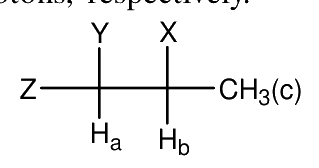
In the $^{1}\text{H NMR}$, the methylene protons of $\text{ClCH}_2\text{-C(Cl)(Br)CH}_3$ ($\mathbf{X}$) and $\text{CH}_3\text{CH}_2\text{-C(Cl}_2\text{)CH}_3$ ($\mathbf{Y}$) appear as
Consider the statements
(A) Decomposition of $\text{H}_2\text{O}_2$ in aqueous solution catalyzed by bromide ion is a homogeneous catalytic reaction.
(B) Hydrogenation of ethene to ethane accelerated by $\text{Pd}$ or $\text{Ni}$ particles is a heterogeneous catalytic reaction.
(C) Enzymes increase the equilibrium constants of the reactions.
(D) Turnover number is the number of catalytic cycles till the catalyst becomes inactive
The set of correct statements is
a.
(A), (B) and (C) only
b.
(B), (C) and (D) only
c.
(A), (B) and (D) only
d.
(C), (D) and (A) only
Correct Answer & Step-by-Step Solution Locked
Sign in free to reveal the correct answer and AI explanation for this question.
A two-level system consists of a double degenerate excited state which is $\epsilon$ energy above the ground state. The y-intercept of the $\ln(\text{P}_e/\text{P}_g)$ vs $1/\text{T}$ plot is ($\text{P}_e$ and $\text{P}_g$ are the probabilities associated with the excited and ground states, respectively.)
a.
$0$
b.
$2$
c.
$2\ln 2$
d.
$\ln 2$
Correct Answer & Step-by-Step Solution Locked
Sign in free to reveal the correct answer and AI explanation for this question.
The rotational quantum number associated with the most intense transition in the microwave spectrum of a diatomic molecule varies with temperature ($\text{T}$) as
a.
$\text{T}$
b.
$\sqrt{\text{T}}$
c.
$\text{T}^2$
d.
$1/\sqrt{\text{T}}$
Correct Answer & Step-by-Step Solution Locked
Sign in free to reveal the correct answer and AI explanation for this question.
The order of polarity of the $\text{B—C}$ bond for the following compounds
$$\text{B}(\text{C}\equiv\text{CH})_3 \text{ (P)} ; \text{B}(\text{CH}=\text{CH}_2)_3 \text{ (Q)} ; \text{B}(\text{CH}_2-\text{CH}_3)_3 \text{ (R)} ; \text{B}(\text{CH}_2-\text{C}_6\text{H}_5)_3 \text{ (S)}$$
a.
$\text{R} < \text{S} < \text{Q} < \text{P}$
b.
$\text{S} < \text{R} < \text{Q} < \text{P}$
c.
$\text{R} < \text{S} < \text{P} < \text{Q}$
d.
$\text{P} < \text{Q} < \text{R} < \text{S}$
Correct Answer & Step-by-Step Solution Locked
Sign in free to reveal the correct answer and AI explanation for this question.
The reaction of dipeptide, $\text{H}_2\text{N-Gly-Ala-CO}_2\text{H}$, with $\text{PhNCS}$ at $\text{pH } 8$ followed by treatment with $\text{CF}_3\text{COOH}$ produces
a.
A and D
b.
B and C
c.
A and B
d.
C and D
Correct Answer & Step-by-Step Solution Locked
Sign in free to reveal the correct answer and AI explanation for this question.
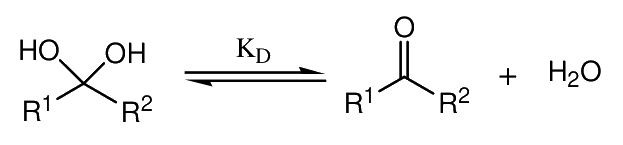
For the following equilibrium, the correct match for the carbonyl compounds in Column P with the equilibrium constant $\text{K}$ in Column Q is
$$\text{R}_2\text{C=O} + \text{H}_2\text{O} \rightleftharpoons \text{R}_2\text{C(OH)}_2$$
a.
A-iii; B-ii; C-i
b.
A-ii; B-iii; C-i
c.
A-ii; B-i; C-iii
d.
A-i; B-iii; C-ii
Correct Answer & Step-by-Step Solution Locked
Sign in free to reveal the correct answer and AI explanation for this question.
A correct statement, which \textbf{always} holds good, involving the zeroth-order $\left(\mathrm{E}_0^0\right)$, first-order $\left(\mathrm{E}_0^1\right)$ and second-order $\left(\mathrm{E}_0^2\right)$ perturbed energies for the ground state is [$E_0$ is the exact ground state energy]
The expression for d-orbitals with $n = 3$, $l = 2$ and $m = \pm 2$ is $\psi_{32\pm 2} = \mathrm{N}\mathrm{R}'(\mathrm{r})\,\mathrm{r}^2\sin^2\theta\,\mathrm{e}^{\pm 2\mathrm{i}\phi}$ where $N$ is a constant, $r, \theta, \phi$ are spherical polar co-ordinate. $\mathrm{R}'(\mathrm{r})$ is a function of $r$. The orbital generated from a linear combination of $\psi_{322}$ and $\psi_{32-2}$ orbitals, $\frac{1}{\mathrm{i}}\left(\psi_{322} - \psi_{32-2}\right)$, is
a.
$\mathrm{d}_{z^2}$
b.
$\mathrm{d}_{xy}$
c.
$\mathrm{d}_{yz}$
d.
$\mathrm{d}_{zx}$
Correct Answer & Step-by-Step Solution Locked
Sign in free to reveal the correct answer and AI explanation for this question.
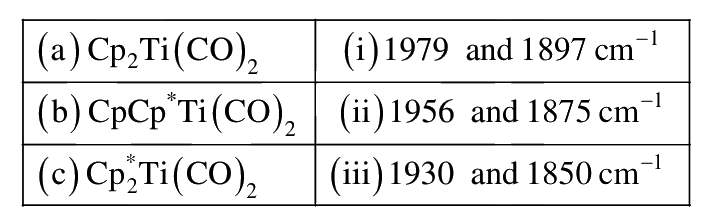
Match the correct set of IR bands to the given compounds ($\text{Cp} = \text{C}_5\text{H}_5$, $\text{Cp}^* = \text{C}_5\text{Me}_5$)
\begin{tabular}{|l|l|}
\hline
(a) $\text{Cp}_2\text{Ti(CO)}_2$ & (i) 1979 and $1897\text{ cm}^{-1}$ \\
\hline
(b) $\text{CpCp}^*\text{Ti(CO)}_2$ & (ii) 1956 and $1875\text{ cm}^{-1}$ \\
\hline
(c) $\text{Cp}^*_2\text{Ti(CO)}_2$ & (iii) 1930 and $1850\text{ cm}^{-1}$ \\
\hline
\end{tabular}
a.
a-ii, b-iii, c-i
b.
a-iii, b-i, c-ii
c.
a-i, b-iii, c-ii
d.
a-i, b-ii, c-iii
Correct Answer & Step-by-Step Solution Locked
Sign in free to reveal the correct answer and AI explanation for this question.
One mole of a monoatomic ideal gas at $1\text{ atm}$ pressure undergoes compression from $49.2\text{ L}$ to $24.6\text{ L}$ under adiabatic reversible conditions. The final temperature (in $\text{K}$) of the gas is closest to
a.
952
b.
848
c.
756
d.
1697
Correct Answer & Step-by-Step Solution Locked
Sign in free to reveal the correct answer and AI explanation for this question.
A chromium carbonyl compound $\text{Cr(CO)}_6$ reacts with $\text{NaBH}_4$ to give $\textbf{A}$. The Lewis base $\textbf{A}$ reacts with another molecule of $\text{Cr(CO)}_6$ to form compound $\textbf{B}$ with the release of $\text{CO}$. In another reaction, compound $\textbf{A}$ reacts with $\text{BH}_3$ to produce $\textbf{C}$. Compounds $\textbf{A}$, $\textbf{B}$ and $\textbf{C}$, respectively, are
a.
$[\text{Cr(CO)}_5(\text{BH}_4)]^-$, $[(\text{CO})_5\text{Cr(BH}_4)\text{-Cr(CO)}_5]^-$ and $[\text{Cr(CO)}_4\text{B}_2\text{H}_7]^-$
b.
$[\text{Cr(CO)}_5\text{H}]^-$, $[(\text{CO})_5\text{Cr-H-Cr(CO)}_5]^-$ and $[\text{Cr(CO)}_4\text{BH}_4]^-$
c.
$[\text{Cr(CO)}_5(\text{BH}_4)]^-$, $[(\text{CO})_5\text{Cr-BH}_4\text{-Cr(CO)}_5]^-$ and $[\text{Cr(CO)}_5\text{BH}_4]^-$
d.
$[\text{Cr(CO)}_5\text{H}]^-$, $[(\text{CO})_4\text{Cr-H-Cr(CO)}_6]^-$ and $[\text{Cr(CO)}_5\text{BH}_4]^-$
Correct Answer & Step-by-Step Solution Locked
Sign in free to reveal the correct answer and AI explanation for this question.
A particle, confined in a one-dimensional box between $x = 0$ to $x = L$ is perturbed by a constant potential $V$ on the left half of the box ($x = 0$ to $x = L / 2$) and by $V/3$ on the right half ($x = L / 2$ to $x = L$). The first-order perturbation correction to the ground state energy is
a.
$V/2$
b.
$2V/3$
c.
$3V/4$
d.
$3V/2$
Correct Answer & Step-by-Step Solution Locked
Sign in free to reveal the correct answer and AI explanation for this question.
The average time for which a hydrogen atom remains adsorbed on a given surface is $35\%$ shorter at $1000\text{ K}$ than at $600\text{ K}$. The activation energy (in $\text{kJ mol}^{-1}$) for desorption is closest to
a.
$2.3$
b.
$3.4$
c.
$4.5$
d.
$5.4$
Correct Answer & Step-by-Step Solution Locked
Sign in free to reveal the correct answer and AI explanation for this question.
Mark-Houwink equation can be used to determine molecular weight of a polymer. The values of empirical constants are $1.6\times 10^{-4}\text{ dL g}^{-1}$ and $0.60$. If the intrinsic viscosity of the polymer solution is $0.04\text{ dL g}^{-1}$, the molar mass (in $\text{g mol}^{-1}$) of the polymer is closest to
a.
$10000$
b.
$1101$
c.
$16000$
d.
$9600$
Correct Answer & Step-by-Step Solution Locked
Sign in free to reveal the correct answer and AI explanation for this question.
The correct catalyst for conversion of acetophenone to (S)-1-phenylethanol under high pressure of hydrogen is
[DPEN = 1,2-diphenyl-1,2-ethylenediamine]
In a diffusion-controlled reaction in benzene between two species with similar radii having $2.0\text{ mol m}^{-3}$ initial concentrations, the time (in ns) required for the concentration of the species to fall to half of their initial values at $320\text{ K}$ is closest to
[The viscosity coefficient of benzene is $0.601\text{ cP}$ and $1\text{ cP}=10^{-3}\text{ kg m}^{-1}\text{s}^{-1}$]
a.
$26$
b.
$76$
c.
$42$
d.
$62$
Correct Answer & Step-by-Step Solution Locked
Sign in free to reveal the correct answer and AI explanation for this question.
Match the complexes with their correct electronic configuration and bond order:
**Complex:**
a. $[\text{Mo}_2(\text{SO}_4)_4]^{4-}$
b. $[\text{Mo}_2(\text{HPO}_4)_4]^{2-}$
c. $[\text{Mo}_2(\text{SO}_4)_4]^{3-}$
**Configuration:**
i. $\sigma^2 \pi^4$
ii. $\sigma^2 \pi^4 \delta^1$
iii. $\sigma^2 \pi^4 \delta^2$
**M-M bond order:**
p. $3$
q. $4$
r. $3.5$
The option showing complexes with their correct electronic configuration and bond order is
a.
a-iii-q; b-i-p; c-ii-r
b.
a-i-p; b-iii-r; c-ii-q
c.
a-ii-r; b-iii-q; c-i-p
d.
a-ii-q; b-i-r; c-iii-p
Correct Answer & Step-by-Step Solution Locked
Sign in free to reveal the correct answer and AI explanation for this question.
In the extraction of lanthanides, when an aqueous solution of $\text{Ln}^{3+}$ is poured into a cation exchange resin column, the $\text{Ln}^{3+}$ that moves fastest through the resin is
a.
$\text{Lu}^{3+}$
b.
$\text{La}^{3+}$
c.
$\text{Gd}^{3+}$
d.
$\text{Sm}^{3+}$
Correct Answer & Step-by-Step Solution Locked
Sign in free to reveal the correct answer and AI explanation for this question.
At $0\text{ }^\circ\text{C}$, the standard volume of transition from ice to water is $-1.6\text{ cm}^3\text{ mol}^{-1}$ and the corresponding standard entropy of transition is $22\text{ JK}^{-1}\text{mol}^{-1}$. An increase in pressure by $100\text{ bar}$ would result in lowering of freezing point (in $\text{K}$) of water by ($1\text{ bar} = 10^5\text{ Pa}$)
a.
$1.23$
b.
$0.56$
c.
$0.73$
d.
$1.46$
Correct Answer & Step-by-Step Solution Locked
Sign in free to reveal the correct answer and AI explanation for this question.
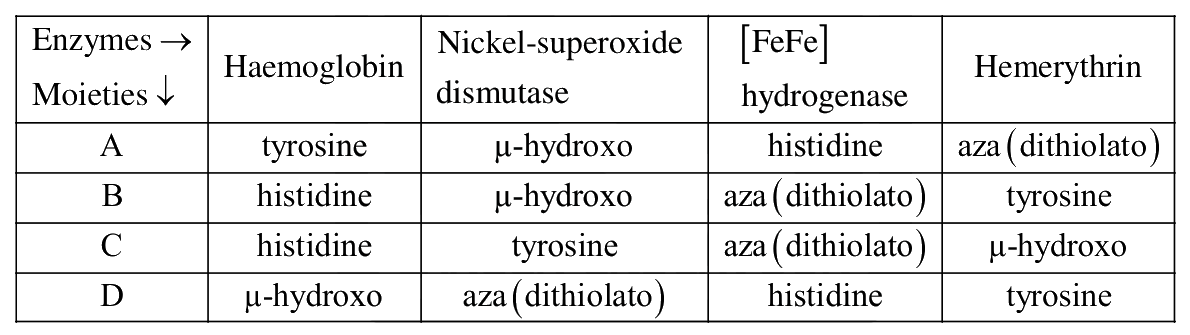
Consider the reactions in List I and related enzymes in List II
**List I**
(a) superoxide to oxygen
(b) hydrolysis of peptide
(c) hydroxylation of camphor
(d) primary amine to aldehyde
**List II**
(i) amine oxidase
(ii) Ni-superoxide dismutase
(iii) carboxypeptidase
(iv) cytochrome P450
The option showing the correct match is
a.
a-ii, b-iii, c-iv, d-i
b.
a-iv, b-i, c-ii, d-iii
c.
a-iii, b-ii, c-i, d-iv
d.
a-ii, b-i, c-iv, d-iii
Correct Answer & Step-by-Step Solution Locked
Sign in free to reveal the correct answer and AI explanation for this question.
Consider the following statements regarding the magnetic properties of lanthanide ions.
A. Observed magnetic moments are highly dependent on the ligand field
B. Only ground J state is populated
C. Spin-orbit couplings are in the order of $\sim 1000\text{ cm}^{-1}$ while the ligand field effects are only about $\sim 100\text{ cm}^{-1}$
D. The spin-only formula cannot be used to calculate the magnetic moment of $\text{f}^7$ configuration
The option showing the correct statements is
a.
A and B only
b.
B and C only
c.
A and D only
d.
C and D only
Correct Answer & Step-by-Step Solution Locked
Sign in free to reveal the correct answer and AI explanation for this question.
Given are the statements regarding the overall stability constants $(\log \beta)$ for the formation of $[\text{M(en)}_3]^{2+}$ and $[\text{M (EDTA)}]^{2-}$ ($\text{en} = \text{ethylene diamine}$, $\text{EDTA} = \text{ethylenediamine tetraacetate}$), where $\text{M}^{2+}$ is a divalent metal ion $(\text{M}^{2+} = \text{Mn}^{2+}, \text{Fe}^{2+}, \text{Co}^{2+}, \text{Ni}^{2+}, \text{Cu}^{2+}, \text{Zn}^{2+})$
A. The $(\log \beta)$ is lowest for $\text{Mn}^{2+}$ in both $[\text{M(en)}_3]^{2+}$ and $[\text{M(EDTA)}]^{2-}$ series ($\text{Mn}^{2+}$ to $\text{Zn}^{2+}$)
B. The $(\log \beta)$ value for $[\text{Mn(EDTA)}]^{2-}$ is lower than $[\text{Mn(en)}_3]^{2+}$
C. The $(\log \beta)$ values increase in the series ($\text{Mn}^{2+}$ to $\text{Zn}^{2+}$) for both EDTA and "en" complexes
D. $\Delta S^0$ remains nearly constant along the series
The option with the correct statements is
a.
B and C only
b.
A, B and D only
c.
A and D only
d.
A, B and C only
Correct Answer & Step-by-Step Solution Locked
Sign in free to reveal the correct answer and AI explanation for this question.
The atomic mass of $\text{X}$ and $\text{Y}$ are $5\text{ amu}$ and $40\text{ amu}$, respectively. For the diatomic molecule $\text{XY}$, the spacing between any two successive lines is $8\text{ cm}^{-1}$ in the microwave spectrum. The bond length of $\text{XY}$ (in $\text{\AA}$) is closest to $\left(\frac{\text{h}}{8\pi^2\text{c}} = 2.8\times 10^{-44}\text{ Js}^2\text{m}^{-1}, 1\text{ amu} = 1.667\times 10^{-27}\text{ kg}\right)$
a.
0.688
b.
0.974
c.
1.377
d.
1.948
Correct Answer & Step-by-Step Solution Locked
Sign in free to reveal the correct answer and AI explanation for this question.
The fundamental vibrational frequencies of $\text{H}_2$ and $\text{H}^{37}\text{Cl}$ are $4395\text{ cm}^{-1}$ and $2988\text{ cm}^{-1}$ respectively. Considering all molecules are in their respective ground vibrational state, the energy change (in $\text{cm}^{-1}$) of the reaction below
$$\text{HD} + \text{H}^{37}\text{Cl} \rightarrow \text{H}_2 + \text{D}^{37}\text{Cl}$$
is closest to
[Assume that force constant remains same with isotopic substitution]
a.
$-65$
b.
$-130$
c.
$-260$
d.
$-520$
Correct Answer & Step-by-Step Solution Locked
Sign in free to reveal the correct answer and AI explanation for this question.
For the given cell,
$$\text{Zn(s)} \mid \text{Zn}^{2+}(\text{aq}, 0.5\text{ M}) \parallel \text{Ag}^+(\text{aq}., 0.1\text{ M}) \mid \text{Ag(s)}$$
the emf (in V) of the cell at $25\text{ }^\circ\text{C}$ is closest to
$[\text{At } 25^\circ\text{C},\, \text{E}^0_{\text{Zn}^{2+}/\text{Zn}} = -0.76\text{ V}\text{ and }\text{E}^0_{\text{Ag}^+/\text{Ag}} = +0.80\text{ V}]$
a.
0.05
b.
0.04
c.
1.56
d.
1.51
Correct Answer & Step-by-Step Solution Locked
Sign in free to reveal the correct answer and AI explanation for this question.
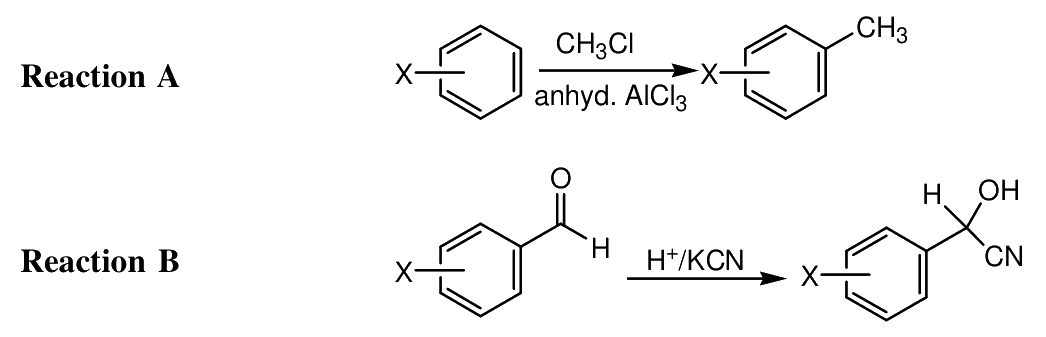
The slope of the Hammett plot (r) of $\log \mathrm{k}_\mathrm{x}/\mathrm{k}_\mathrm{H}$ against the substituent constant (s) for the reactions $\mathbf{A}$ and $\mathbf{B}$ will, respectively, be
a.
negative and positive
b.
negative and negative
c.
positive and negative
d.
positive and positive
Correct Answer & Step-by-Step Solution Locked
Sign in free to reveal the correct answer and AI explanation for this question.
The option showing the correct statements about radioactive decay is
A. All radioactive processes are 1st order
B. Radioactive decay is dependent on temperature
C. Activation energy of a radioactive process is zero
D. The rate of decay depends on the amount of radioactive materials
a.
A, B, and D only
b.
A, C and D only
c.
B, C and D only
d.
A, B, and C only
Correct Answer & Step-by-Step Solution Locked
Sign in free to reveal the correct answer and AI explanation for this question.
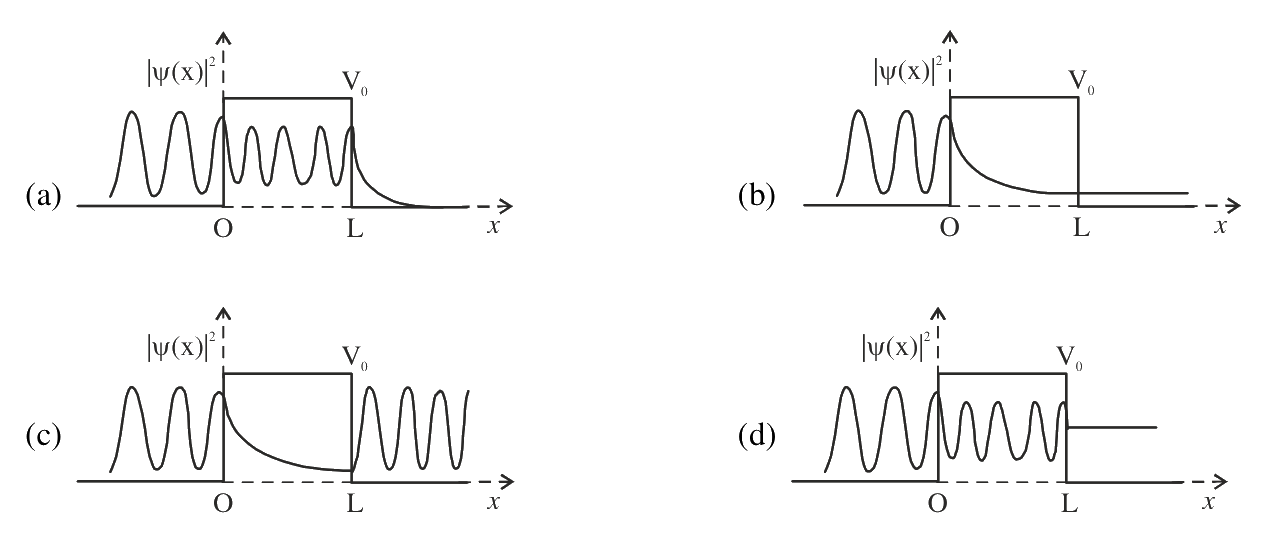
A particle incident from the region $x < 0$ is under a potential barrier with finite height $\text{V}_0$, and finite width $L$, as in the diagrams. When the total energy ($E$) of the incident particle is less than $\text{V}_0$, the correct plot of the probability density ($|\psi(x)|^2$) with distance ($x$) is
a.
(a)
b.
(b)
c.
(c)
d.
(d)
Correct Answer & Step-by-Step Solution Locked
Sign in free to reveal the correct answer and AI explanation for this question.
A mixture of $\text{CaO}$ and $\text{CaCO}_3$ is analyzed using thermogravimetry (TG) technique. The TG curve of the sample indicates that there is a mass change from $155.2\text{ mg}$ to $125.3\text{ mg}$. The percentage of $\text{CaCO}_3$ in the mixture is close to
a.
$54.2\%$
b.
$27.1\%$
c.
$43.8\%$
d.
$29.9\%$
Correct Answer & Step-by-Step Solution Locked
Sign in free to reveal the correct answer and AI explanation for this question.
Match the given metal species in **List I** with the corresponding properties in **List II**
**List-I**
(A) $[\text{Co}(\text{H}_2\text{O})_6]^{2+}$
(B) $[\text{Cr}(\text{H}_2\text{O})_6]^{3+}$
(C) $\text{NiCl}_2(\text{PPh}_3)_2$
(D) $\text{Pd}(\text{PPh}_3)_4$
**List-II**
(I) magnetic moment higher than spin-only value and weak JT distortion
(II) spin-only magnetic moment and absence of JT distortion
(III) paramagnetic and tetrahedral
(IV) diamagnetic and tetrahedral
The correct option is
a.
A-II, B-III, C-I, D-IV
b.
A-I, B-II, C-III, D-IV
c.
A-III, B-II, C-IV, D-I
d.
A-I, B-IV, C-II, D-III
Correct Answer & Step-by-Step Solution Locked
Sign in free to reveal the correct answer and AI explanation for this question.
For a quantum particle in a one-dimensional simple harmonic oscillator, $\langle x^2 \rangle = \hbar(n + 1/2)/m\omega$ and $\langle p_x^2 \rangle = m\hbar\omega(n + 1/2)$ for the quantum number $n$. The product of uncertainty of position and momentum for $n = 1$ is
a.
$3\hbar/2$
b.
$\hbar/2$
c.
$2\hbar$
d.
$\hbar$
Correct Answer & Step-by-Step Solution Locked
Sign in free to reveal the correct answer and AI explanation for this question.
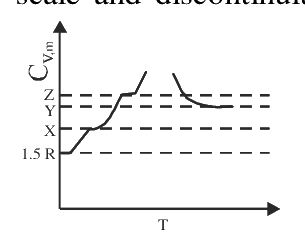
The variation of molar heat capacity at constant volume ($C_{\text{v,m}}$) with temperature (T) of a gaseous diatomic molecule is shown in the diagram below. The values of $\mathbf{X}$, $\mathbf{Y}$ and $\mathbf{Z}$, respectively, are [the diagram is not to the scale and discontinuity in the diagram represents dissociation]
a.
$2.0\text{ R},\ 2.5\text{ R},\ 3.0\text{ R}$
b.
$2.5\text{ R},\ 3.0\text{ R},\ 3.5\text{ R}$
c.
$3.5\text{ R},\ 4.0\text{ R},\ 4.5\text{ R}$
d.
$3.0\text{ R},\ 3.5\text{ R},\ 4.0\text{ R}$
Correct Answer & Step-by-Step Solution Locked
Sign in free to reveal the correct answer and AI explanation for this question.
At $25^\circ\text{C}$, the total volume, $V$ (in $\text{cm}^3$) of an ethanol solution containing $1.0\text{ kg}$ of water fits the following expression $V / \text{cm}^3 = 1000 + 60\left(\frac{m}{m^0}\right) - 0.5\left(\frac{m}{m^0}\right)^2$. Here $m$ is molality and $m^0 = 1\text{ mol kg}^{-1}$. The partial molar volume of ethanol (in $\text{cm}^3\text{ mol}^{-1}$) in the solution prepared by mixing $460\text{ g}$ of ethanol and $2\text{ kg}$ of water is [Molar mass of ethanol = $46\text{ g mol}^{-1}$]
a.
50
b.
40
c.
55
d.
45
Correct Answer & Step-by-Step Solution Locked
Sign in free to reveal the correct answer and AI explanation for this question.
List I and List II give the molecular formula and the geometry of the species, respectively.
**List-I**
(A) $\left[\text{Zn}\left\{\text{N}\left(\text{CH}_2\text{CH}_2\text{NH}_2\right)_3\right\}\text{Cl}\right]^+
(B) $\left[\text{Cu}(2,2-\text{bpy})\left\{\text{NH}\left(\text{CH}_2\text{COO}\right)_2\right\}\right]$
(C) $\left[\text{ZrF}_7\right]^{3-}$
(D) $\left[\text{AgTe}_7\right]^{3-}$
**List-II**
(I) Trigonal bipyramidal
(II) Square pyramidal
(III) Monocapped trigonal prism
(IV) Trigonal planar
The option showing the correct match of species in List I and metal geometry in List II is
a.
A-I, B-II, C-III, D-IV
b.
A-I, B-II, C-IV, D-III
c.
A-I, B-III, C-II, D-IV
d.
A-II, B-I, C-III, D-IV
Correct Answer & Step-by-Step Solution Locked
Sign in free to reveal the correct answer and AI explanation for this question.
The correct match of the labelled protons for ethyl vinyl ether in Column P with their chemical shift in Column Q is
**Column P**
(A) $\text{H}_\text{a}$
(B) $\text{H}_\text{b}$
(C) $\text{H}_\text{c}$
**Column Q**
(I) $6.45\text{ (dd, } J = 13,\, 7\text{ Hz)}$
(II) $4.05\text{ (dd, } J = 7,\, 2\text{ Hz)}$
(III) $4.20\text{ (dd, } J = 13,\, 2\text{ Hz)}$
a.
A-I, B-III, C-II
b.
A-I, B-II, C-III
c.
A-III, B-I, C-II
d.
A-II, B-I, C-III
Correct Answer & Step-by-Step Solution Locked
Sign in free to reveal the correct answer and AI explanation for this question.
To an aqueous solution of $\mathrm{NaX}$ and $\mathrm{NaY}$, the addition of sulphamic acid $(\mathrm{H_2NSO_3H})$ followed by acidification releases a nitrogen-containing gas $\mathbf{P}$. Addition of $\mathrm{KI}$ and a starch solution does not yield a blue color, indicating complete removal of $\mathrm{NaX}$. However, the blue color appears when a piece of granulated $\mathrm{Zn}$ is added. The reaction proceeds with the evolution of a nitrogen containing gas $\mathbf{Q}$.
The correct option of $\mathbf{X}$, $\mathbf{Y}$, $\mathbf{P}$ and $\mathbf{Q}$, respectively, is
Consider the following statements regarding the electronic spectra of lanthanide complexes.
A. They exhibit fewer absorption bands due to a small number of microstates
B. Their spectra are dependent on coordination number and geometry
C. Molar extinction coefficients (e) are smaller compared to transition metal complexes
D. Their absorption bands are sharp due to weak vibronic coupling
E. Ligand field effects are negligible
The option with correct statements is
a.
A, B, D only
b.
A, C, D only
c.
C, D, E only
d.
B, C, E only
Correct Answer & Step-by-Step Solution Locked
Sign in free to reveal the correct answer and AI explanation for this question.
$\mathrm{Cu}$ crystallizes in face-centred cubic lattice. Considering each $\mathrm{Cu}$ atom as hard sphere and in contact with its nearest neighbors, the fraction of volume of the unit cell occupied by $\mathrm{Cu}$ atoms is
a.
0.16
b.
0.56
c.
0.74
d.
0.36
Correct Answer & Step-by-Step Solution Locked
Sign in free to reveal the correct answer and AI explanation for this question.
A molybdenum compound A is obtained by the $\mathrm{CO}$ displacement reaction of $\mathrm{Mo(CO)_6}$ with $\mathrm{P^iPr_3}$, reacts with $\mathrm{H_2}$ to give compound B. The compounds A and B are
a.
$[\mathrm{Mo}(\mathrm{P^iPr_3})_6]$ and $[\mathrm{Mo}(\mathrm{P^iPr_3})_5(\eta^2\text{-}\mathrm{H_2})]$
b.
$[\mathrm{Mo(CO)_3}(\mathrm{P^iPr_3})_2]$ and $[\mathrm{Mo(CO)_3}(\mathrm{P^iPr_3})_2(\eta^2\text{-}\mathrm{H_2})]$
c.
$[\mathrm{Mo(CO)_3}(\mathrm{P^iPr_3})_3]$ and $[\mathrm{Mo(CO)_3}(\mathrm{P^iPr_3})_2(\eta^2\text{-}\mathrm{H_2})]$
d.
$[\mathrm{Mo(CO)_4}(\mathrm{P^iPr_3})_2]$ and $[\mathrm{Mo(CO)_4}(\mathrm{P^iPr_3})_2(\mathrm{H})_2]$
Correct Answer & Step-by-Step Solution Locked
Sign in free to reveal the correct answer and AI explanation for this question.