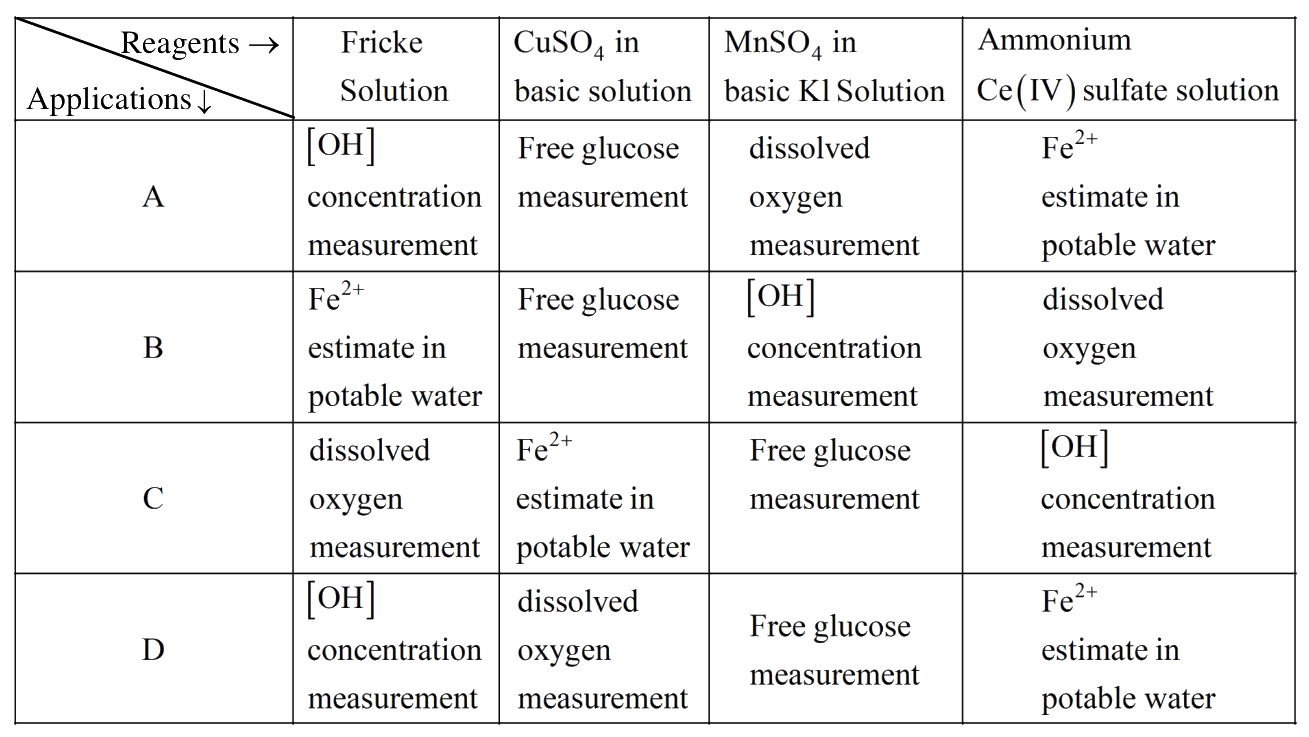
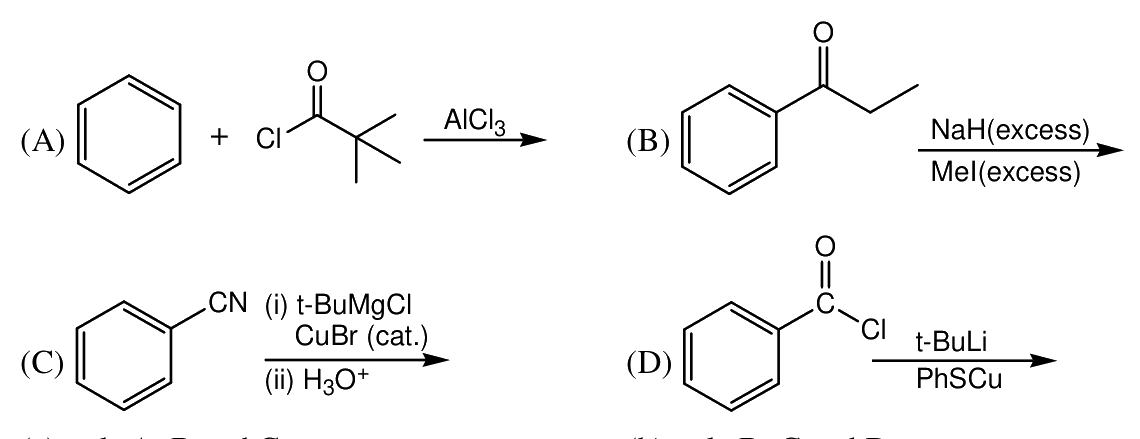
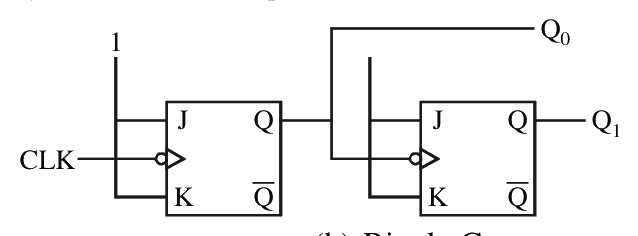
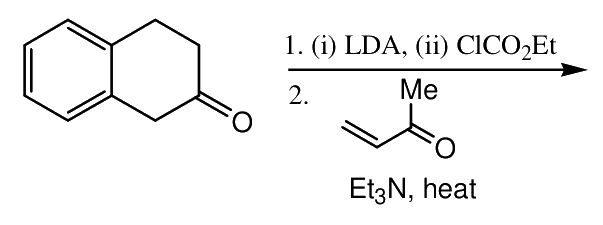
The thermodynamic variable 'X' in the equation
$$\left(\frac{\partial S}{\partial P}\right)_T = \frac{1}{T}\left[ X + \left(\frac{\partial H}{\partial P}\right)_T \right]$$
is
a.
$V$
b.
$S$
c.
$-V$
Correct Answer
d.
$C_p$
Step-by-Step AI Explanation
Verified Method
From the fundamental thermodynamic relation $dH = TdS + VdP$, dividing by $dP$ at constant temperature $T$ yields:
$$\left(\frac{\partial H}{\partial P}\right)_T = T\left(\frac{\partial S}{\partial P}\right)_T + V$$
Rearranging this gives:
$$\left(\frac{\partial S}{\partial P}\right)_T = \frac{1}{T}\left[ -V + \left(\frac{\partial H}{\partial P}\right)_T \right]$$
Comparing with the given equation, the thermodynamic variable $X = -V$. Thus, option C is correct.
Q2mcq
The difference in the second ionization energies of $\text{Li/Na}$, $\text{Be/Mg}$, $\text{B/Al}$ and $\text{N/P}$ are $\text{X}_1$, $\text{X}_2$, $\text{X}_3$ and $\text{X}_4$ respectively. The *correct* order of the difference in the second ionization energies is
The second ionization energies ($IE_2$) correspond to removing an electron from the singly-charged cation:
- $\text{Li}^+ (1s^2)$ has an extremely high $IE_2$ (noble gas shell, principal quantum number $n=1$), while $\text{Na}^+ (2s^2 2p^6)$ has a significantly lower $IE_2$. The difference $X_1 = IE_2(\text{Li}) - IE_2(\text{Na}) \approx 75.6 - 47.3 = 28.3\text{ eV}$ is extremely large.
- For $\text{Be}/\text{Mg}$: $\text{Be}^+ (1s^2 2s^1)$ vs $\text{Mg}^+ (2p^6 3s^1)$, $X_2 = 18.21 - 15.04 = 3.17\text{ eV}$.
- For $\text{B}/\text{Al}$: $\text{B}^+ (2s^2)$ vs $\text{Al}^+ (3s^2)$, $X_3 = 25.15 - 18.83 = 6.32\text{ eV}$.
- For $\text{N}/\text{P}$: $\text{N}^+ (2s^2 2p^2)$ vs $\text{P}^+ (3s^2 3p^2)$, $X_4 = 29.60 - 19.77 = 9.83\text{ eV}$.
Looking at the values of differences: $X_1 (\sim 28.3\text{ eV}) > X_4 (\sim 9.8\text{ eV}) > X_3 (\sim 6.3\text{ eV}) > X_2 (\sim 3.2\text{ eV})$.
Therefore, the correct order is $\text{X}_1 > \text{X}_4 > \text{X}_3 > \text{X}_2$, which corresponds to option A.
Q3mcq
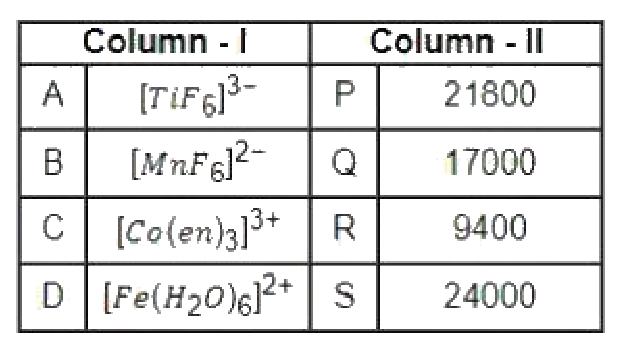
The option showing the *correct* match of metal complexes in Column-I with the corresponding $\Delta_0\ (\text{cm}^{-1})$ values in Column-II is
Let us evaluate the crystal field splitting energy ($\Delta_0$) for the given complexes:
1. $\text{C: }[\text{Co(en)}_3]^{3+}$: $\text{Co}^{3+}$ is a low-spin $d^6$ ion with ethylenediamine (a strong-field chelating ligand), giving the highest $\Delta_0$ among the choices. Hence, $\text{C} \rightarrow \text{S}\ (24000\text{ cm}^{-1})$.
2. $\text{B: }[\text{MnF}_6]^{2-}$: $\text{Mn}^{4+}$ has a high oxidation state (+4), which significantly increases $\Delta_0$. Thus, $\text{B} \rightarrow \text{P}\ (21800\text{ cm}^{-1})$.
3. $\text{A: }[\text{TiF}_6]^{3-}$: $\text{Ti}^{3+}$ (+3 metal ion with fluoride), $\text{A} \rightarrow \text{Q}\ (17000\text{ cm}^{-1})$.
4. $\text{D: }[\text{Fe(H}_2\text{O)}_6]^{2+}$: $\text{Fe}^{2+}$ is a divalent metal ion with weak-field water ligands, giving the lowest $\Delta_0$. Hence, $\text{D} \rightarrow \text{R}\ (9400\text{ cm}^{-1})$.
This matching gives $\text{A} \rightarrow \text{Q},\ \text{B} \rightarrow \text{P},\ \text{C} \rightarrow \text{S},\ \text{D} \rightarrow \text{R}$, which corresponds to option A.
Q4mcq
The *correct* match for the protons of ethyl acrylate given in Column P with chemical shifts ($\sigma$ ppm) given in Column Q is
a.
A-i, B-ii, C-iii
b.
A-iii, B-ii, C-i
Correct Answer
c.
A-iii, B-i, C-ii
d.
A-ii, B-iii, C-i
Step-by-Step AI Explanation
Verified Method
For ethyl acrylate ($ ext{CH}_2= ext{CH}- ext{COOCH}_2 ext{CH}_3$):
The olefinic protons are:
- $\text{H}_A$ (geminal to ester carbonyl, i.e., $-\text{CH}=\text{CH}_2$ internal proton $\alpha$ to carbonyl): It is strongly deshielded by the carbonyl group via inductive and anisotropic effects, appearing at the highest $\delta$ (around $6.4$ ppm, match iii).
- $\text{H}_B$ (trans to ester carbonyl group): Due to resonance, the terminal $\beta$-carbon is electron-deficient, and trans orientation gives a larger downfield shift than cis, appearing at around $6.1$ ppm (match ii).
- $\text{H}_C$ (cis to ester carbonyl group): Appears at around $5.8$ ppm (match i).
Therefore, the correct assignment is A-iii, B-ii, C-i (Option B).
Q5mcq
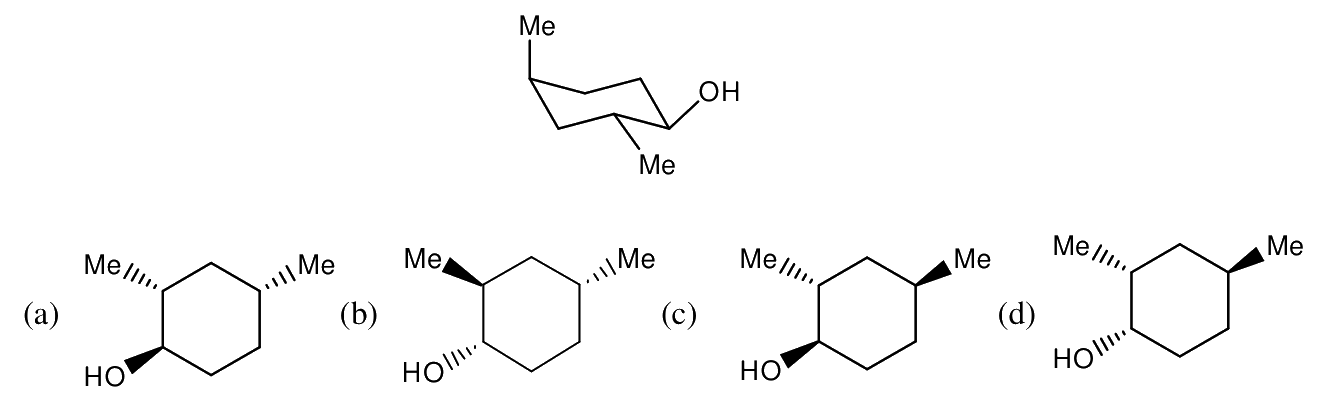
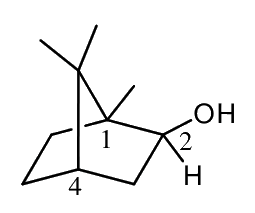
The structure that corresponds to the following compound is
a.
(a)
b.
(b)
Correct Answer
c.
(c)
d.
(d)
Step-by-Step AI Explanation
Verified Method
Let us determine the stereochemical orientation of substituents on the chair conformation of the cyclohexane ring:
- Number the ring carbons: let C1 bear the $-\text{OH}$ group, which is in an equatorial position pointing 'up'.
- C2 has a hydrogen pointing up and an equatorial/axial group pointing down. Here, at C2 (front-left), there is a methyl group pointing down (axial/equatorial 'down'). Specifically, looking at the chair: the C2 carbon has a $-\text{Me}$ pointing down.
- At C4 (back-left), the methyl group is axial pointing up.
- In planar (wedge-dash) projection with $-\text{OH}$ at C1, if $-\text{OH}$ is 'down' (dashed) or 'up' (wedged), relative configurations are:
- C1 $-\text{OH}$ and C2 $-\text{Me}$ are trans to each other (one up, one down).
- C1 $-\text{OH}$ (up) and C4 $-\text{Me}$ (up) are cis to each other.
- Looking at structure (b): at C1, OH is dashed (down); at C2, Me is wedged (up) — thus C1 and C2 are trans; at C4, Me is dashed (down) — thus C1 and C4 are cis. This matches the relative stereochemistry of the chair conformation completely.
Q6mcq
The calculated magnetic moment of $\text{Eu}^{3+}\ (4\text{f}^6)$ is 0 (zero) BM. The experimental value is $3.4 - 3.6\text{ BM}$ at 298 K. The deviation is due to the
a.
mixing of 4f and 4d orbitals
b.
large spin-orbit coupling constant ($\lambda$)
c.
large orbital angular momentum
d.
populated ground and the excited states
Correct Answer
Step-by-Step AI Explanation
Verified Method
For $\text{Eu}^{3+}$ ($4f^6$), the ground state term symbol determined by Hund's rules is $^7F_0$, for which $J = 0$, giving a theoretical ground-state magnetic moment $\mu = g_J \sqrt{J(J+1)} = 0\text{ BM}$. However, the energy separation between the ground state ($^7F_0$) and the first excited state ($^7F_1$) is comparable to thermal energy $k_B T$ at room temperature (298 K). Consequently, the low-lying excited states ($^7F_1, ^7F_2$) are thermally populated, leading to an experimental magnetic moment of $3.4 - 3.6\text{ BM}$. Thus, the deviation is due to the thermally populated ground and excited states (Option D).
Q7mcq
If $H = \frac{p_x^2}{2m} + V(x)$, then $[H, p_x]$ is
a.
$i\hbar \frac{dV}{dx}$
Correct Answer
b.
0
c.
$-i\hbar$
d.
$\frac{i\hbar p_x}{m}$
Step-by-Step AI Explanation
Verified Method
The commutator $[H, p_x]$ is given by:
$$[H, p_x] = \left[\frac{p_x^2}{2m} + V(x), p_x\right] = \left[\frac{p_x^2}{2m}, p_x\right] + [V(x), p_x]$$
Since any operator commutes with itself and its powers, $\left[\frac{p_x^2}{2m}, p_x\right] = 0$.
Now evaluate $[V(x), p_x]$ acting on a test function $\psi(x)$:
$$[V(x), p_x]\psi = V(x)\left(-i\hbar \frac{d\psi}{dx}\right) - \left(-i\hbar \frac{d}{dx}(V(x)\psi)\right)$$
$$= -i\hbar V \frac{d\psi}{dx} + i\hbar \left( \frac{dV}{dx}\psi + V\frac{d\psi}{dx} \right) = i\hbar \frac{dV}{dx}\psi$$
Therefore, $[H, p_x] = [V(x), p_x] = i\hbar \frac{dV}{dx}$, which corresponds to option A.
Q8mcq
In a flame photometric analysis of a blood serum sample for $\text{K}^+$ ion, a band is obtained at $766nm$. This band is due to
a.
absorption by $\text{K}^+$ ion only
b.
absorption by $\text{K}$ atom only
c.
emission by $\text{K}^+$ ion only
d.
emission by $\text{K}$ atom only
Correct Answer
Step-by-Step AI Explanation
Verified Method
In flame photometry (flame emission spectroscopy), the sample solution containing metal ions (such as $\text{K}^+$) is aspirated into the flame, where the solvent evaporates, the salt vaporizes and dissociates into neutral gaseous atoms ($\text{K}^+ + e^- \rightarrow \text{K}^0$). These neutral potassium atoms are thermally excited to higher electronic states. When they return to the ground state, they emit radiation at characteristic wavelengths, notably the resonance doublet at $766.5\text{ nm}$ and $769.9\text{ nm}$. Therefore, the band at $766\text{ nm}$ is due to emission by neutral potassium ($\text{K}$) atoms only (Option D).
Q9mcq
The correct option for the oxidation state(s) of Nb in the cluster $\text{Na}_4[\text{Nb}_6\text{Cl}_{18}]$ is
a.
two are in +3 state and four are in +2 state
Correct Answer
b.
all are in +2 state
c.
all are in +3 state
d.
three are in +2 state and three are in +3 state
Step-by-Step AI Explanation
Verified Method
In the cluster $\text{Na}_4[\text{Nb}_6\text{Cl}_{18}]$, the complex anion is $[\text{Nb}_6\text{Cl}_{18}]^{4-}$. The total charge contributed by the 18 chloride ligands is $-18$. Thus, the total oxidation state of the six Nb atoms is $+18 - 4 = +14$. Since the niobium atoms have integer oxidation states, a total charge of $+14$ across 6 atoms corresponds to two Nb in the $+3$ oxidation state and four Nb in the $+2$ oxidation state ($2 \times (+3) + 4 \times (+2) = 6 + 8 = +14$).
Q10mcq
$[\text{Fe}(\text{CO})_5]$ on reaction with $\text{C}_3\text{H}_5\text{I}$ gives Y with the elimination of two molecules of CO. Consider the following statements
A. Y obeys the 18-electron rule
B. The reaction is an example of oxidative addition
C. Allyl moiety shows $\eta^1$ coordination in Y
D. Y adopts pentagonal bipyramidal geometry
The correct option is
a.
A, B and C only
b.
A and B only
Correct Answer
c.
A, B and D only
d.
B and D only
Step-by-Step AI Explanation
Verified Method
The reaction of $[\text{Fe}(\text{CO})_5]$ with allyl iodide ($\text{C}_3\text{H}_5\text{I}$) proceeds via oxidative addition accompanied by the loss of two CO molecules to yield the $\eta^3$-allyl complex $[(\eta^3\text{-C}_3\text{H}_5)\text{Fe}(\text{CO})_3\text{I}]$:
1. Valence electron count of Y: Fe(II) has $d^6$ configuration (6 electrons), $\eta^3$-allyl ligand donates 3 electrons, iodide ligand donates 1 electron, and three CO ligands donate $3 \times 2 = 6$ electrons. Total $= 6 + 3 + 1 + 6 = 18$ electrons. Thus, statement A is correct.
2. Iron is oxidized from Fe(0) in $[\text{Fe}(\text{CO})_5]$ to Fe(II) in Y, making this an oxidative addition reaction. Thus, statement B is correct.
3. The allyl ligand acts as an $\eta^3$ (trihapto) donor, not $\eta^1$, to satisfy the 18-electron rule. Thus, statement C is incorrect.
4. With a coordination number of 6 (treating $\eta^3$-allyl as occupying two coordination sites or viewing it as an octahedral derivative), it forms an octahedral/pseudooctahedral complex, not pentagonal bipyramidal. Thus, statement D is incorrect.
Therefore, only statements A and B are correct.
🎉 10 Free Sample Solutions Completed
Unlock All 100 Questions & Solutions
Sign up free in seconds to unlock step-by-step AI answers for the remaining 90 questions.
For $0.001\text{ M}$ aqueous solutions of $\text{AlCl}_3$, $\text{CaCl}_2$ and $\text{KCl}$ at $25^\circ\text{C}$, the *correct* order of Debye length is
a.
$\text{AlCl}_3 < \text{CaCl}_2 < \text{KCl}$
b.
$\text{KCl} < \text{CaCl}_2 < \text{AlCl}_3$
c.
$\text{CaCl}_2 < \text{KCl} < \text{AlCl}_3$
d.
$\text{AlCl}_3 < \text{KCl} < \text{CaCl}_2$
Correct Answer & Step-by-Step Solution Locked
Sign in free to reveal the correct answer and AI explanation for this question.
The following statements are given with respect to the copper-containing *nitrite reductase*.
A. It contains both Type - II and Type - III copper proteins
B. Type - I copper protein is involved in the electron transfer process
C. Nitrite ion is reduced to $\text{NO}$
D. Nitrite ion is reduced to $\text{NH}_3$
The option with *correct* statements is:
a.
A and B only
b.
B and C only
c.
A and C only
d.
A and D only
Correct Answer & Step-by-Step Solution Locked
Sign in free to reveal the correct answer and AI explanation for this question.
The number of skeletal electron pairs (SEP) and the cluster type for $[\text{B}_{10}\text{H}_{10}]^{2-}$ and $[\text{B}_6\text{H}_9]^-$, respectively, are
a.
$11$, closo and $8$, nido
b.
$11$, nido and $8$, nido
c.
$10$, closo and $6$, arachno
d.
$10$, closo and $8$, nido
Correct Answer & Step-by-Step Solution Locked
Sign in free to reveal the correct answer and AI explanation for this question.
For a proton, the gyromagnetic ratio is $26.752 \times 10^7\text{ rad T}^{-1}\text{ s}$. The Larmor frequency for a proton (in $\text{MHz}$) in a $21.1\text{ T}$ magnetic field is, approximately
a.
$400$
b.
$500$
c.
$600$
d.
$900$
Correct Answer & Step-by-Step Solution Locked
Sign in free to reveal the correct answer and AI explanation for this question.
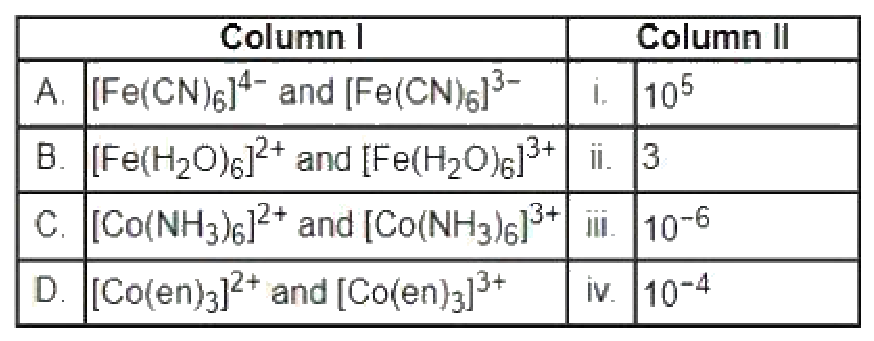
The option showing the correct match for the reactants in Column-I with the second-order rate constants ($1\text{ mol}^{-1}\text{ s}^{-1}$) in Column-II for the outer-sphere reactions in water at $25^\circ\text{C}$ is
a.
A-(i), B-(ii), C-(iii), D-(iv)
b.
A-(iv), B-(iii), C-(ii), D-(i)
c.
A-(i), B-(ii), C-(iv), D-(iii)
d.
A-(iv), B-(ii), C-(iii), D-(i)
Correct Answer & Step-by-Step Solution Locked
Sign in free to reveal the correct answer and AI explanation for this question.
The reaction of $\text{V}_2\text{O}_5$ with an ethanolic $\text{HCl}$ produces a species $\text{X}$, which gives an EPR spectrum with an eight-line $^{51}\text{V}$ hyperfine coupling ($^{51}\text{V} : I = 7/2$) and a strong infra-red absorption in the region of 950-1035 $\text{cm}^{-1}$. $\text{X}$ contains a
a.
$[\text{V} - (\text{O})_2 - \text{V}]^{6+}$ unit
b.
$[\text{VO}]^{2+}$ unit
c.
$[\text{V}(\text{O})(\text{O}_2)]^{+}$ unit
d.
$[(\text{O})\text{V} - \text{O} - \text{V}(\text{O})]^{4+}$ unit
Correct Answer & Step-by-Step Solution Locked
Sign in free to reveal the correct answer and AI explanation for this question.
2-Methylbut-2-ene is used in Pinnick oxidation $[\text{R-CHO} \rightarrow \text{R-CO}_2\text{H} \text{ using } \text{NaClO}_2, \text{Na}_2\text{HPO}_4, \text{ in } \text{t-BuOH}/\text{H}_2\text{O}]$ to scavenge
a.
$\text{HCl}$
b.
$\text{H}_3\text{PO}_4$
c.
$\text{HClO}_2$
d.
$\text{HOCl}$
Correct Answer & Step-by-Step Solution Locked
Sign in free to reveal the correct answer and AI explanation for this question.
Consider the following statements,
I. Micelles form above the critical micelle concentration
II. Micelles form above the Krafft temperature
The correct option is
a.
Only I is true
b.
Only II is true
c.
Both I and II are true
d.
Both I and II are false
Correct Answer & Step-by-Step Solution Locked
Sign in free to reveal the correct answer and AI explanation for this question.
The molecule $\text{MX}_5$ belongs to the point group $\text{D}_{3\text{h}}$. Elongation of both the axial M-X bonds yields A and elongation of one of the M-X equatorial bonds yields B.
The point groups of A and B, respectively, are
a.
$\text{C}_{3\text{v}}$ and $\text{D}_{3\text{h}}$
b.
$\text{D}_{3\text{h}}$ and $\text{C}_{3\text{v}}$
c.
$\text{C}_{3\text{v}}$ and $\text{C}_{2\text{v}}$
d.
$\text{D}_{3\text{h}}$ and $\text{C}_{2\text{v}}$
Correct Answer & Step-by-Step Solution Locked
Sign in free to reveal the correct answer and AI explanation for this question.
The d-orbitals of a hydrogenic atom with $n = 3$, $l = 2$, and $m = \pm 2$ are given by
$$\psi_{3, 2, \pm 2} = N \cdot R(r) \sin^2 \theta\; e^{\pm 2i\phi}$$
where, $N$ is the normalization constant and $R(r)$ is the radial part of the wavefunction. An appropriate linear combination of these two wavefunctions yields the real orbitals
a.
$d_{z^2}$
b.
$d_{xy}$
c.
$d_{yz}$
d.
$d_{zx}$
Correct Answer & Step-by-Step Solution Locked
Sign in free to reveal the correct answer and AI explanation for this question.
A molecule shows two absorption at 896 and 960 MHz in its $^{13}\text{C}$ NMR spectrum in a magnetic field of 3T. The corresponding chemical shifts in ppm are ($^{13}\text{C}$ magnetogyric ratio $\gamma = 6.72 \times 10^7\text{ rad}\cdot\text{T}^{-1}\text{s}^{-1}$; $I = \frac{1}{2}$)
a.
12.8 and 13.7
b.
14 and 15
c.
32 and 34
d.
28 and 30
Correct Answer & Step-by-Step Solution Locked
Sign in free to reveal the correct answer and AI explanation for this question.
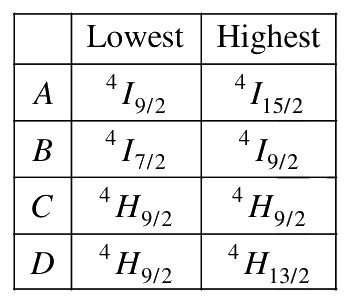
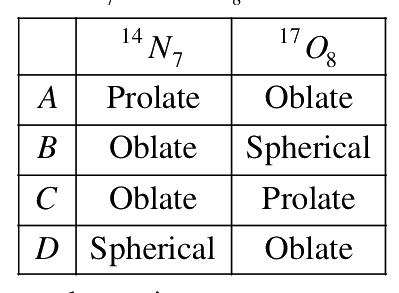
Consider the following data with respect to J-J coupled states in $\text{Nd}^{3+}$ (atomic number = 60) ion
The option showing the correct lowest and highest states of $\text{Nd}^{3+}$, is
a.
A
b.
B
c.
C
d.
D
Correct Answer & Step-by-Step Solution Locked
Sign in free to reveal the correct answer and AI explanation for this question.
Complete hydrolysis of $\text{XeF}_6$ gives $\mathbf{P}$, whereas alkaline hydrolysis of $\text{XeF}_6$ gives $\mathbf{Q}$ and $\mathbf{R}$ as the major products. $\mathbf{P}$, $\mathbf{Q}$ and $\mathbf{R}$, respectively, are
a.
$\text{XeO}_3$, $\text{XeO}_6^{4-}$, and $\text{Xe}$
b.
$\text{XeO}_4$, $\text{HXeO}_6^{4-}$ and $\text{Xe}$
c.
$\text{XeO}_4$, $\text{Xe}$ and $\text{XeO}_6^{4-}$
d.
$\text{HXeO}_4^-$, $\text{XeO}_3$ and $\text{XeO}_6^{4-}$
Correct Answer & Step-by-Step Solution Locked
Sign in free to reveal the correct answer and AI explanation for this question.
A particle of mass $m$ is confined in a rectangular box with $\text{L}_x = 2\text{L}_y$. The state with the energy $\frac{10\text{h}^2}{8m\text{L}_y^2}$ has a degeneracy of
a.
1
b.
2
c.
3
d.
4
Correct Answer & Step-by-Step Solution Locked
Sign in free to reveal the correct answer and AI explanation for this question.
For a diatomic molecule, which is an anharmonic oscillator, $\overline{\nu}_\text{e}\text{ (vibrational wavenumber)} = 536.2\text{ cm}^{-1}$. The observed $\left(\overline{\nu}_\text{obs}\right)$ value of fundamental frequency is $529.4\text{ cm}^{-1}$. The magnitude of $\overline{\nu}_\text{obs}\left(\text{in cm}^{-1}\right)$ for $3^\text{rd}$ overtone is closest to
a.
2076.8
b.
1588.2
c.
1567.8
d.
2117.2
Correct Answer & Step-by-Step Solution Locked
Sign in free to reveal the correct answer and AI explanation for this question.
The oxy-hemocyanin exhibits a resonance Raman signal at $744\text{ cm}^{-1}$ for $^{16}\text{O}-\,^{16}\text{O}$ stretch, following its excitation at $575\text{ nm}$. The value of the $^{18}\text{O}-\,^{18}\text{O}$ stretch for an $^{18}\text{O}_2$ substituted oxy-hemocyanin, and the origin of the absorption band, are
a.
$702\text{ cm}^{-1}\text{ and }\text{O}_2^- \rightarrow \text{Cu(II) charge transfer}$
b.
$702\text{ cm}^{-1}\text{ and }\text{O}_2^{2-} \rightarrow \text{Cu(II) charge transfer}$
c.
$664\text{ cm}^{-1}\text{ and }\text{O}_2^- \rightarrow \text{Cu(II) charge transfer}$
d.
$792\text{ cm}^{-1}\text{ and }\text{O}_2^{2-} \rightarrow \text{Cu(II) charge transfer}$
Correct Answer & Step-by-Step Solution Locked
Sign in free to reveal the correct answer and AI explanation for this question.
$[\text{Co}(\text{NH}_3)_5(\text{X})]\text{Cl}_2\,(\mathbf{1})$ on reaction with aqueous $\text{NH}_3$ followed by the addition of $\text{NaNO}_2/\text{conc. HCl}$ yields $[\text{Co}(\text{NH}_3)_5(\text{Y})]\text{Cl}_2\,(\mathbf{2})$. Reaction of $1$ with $\text{NaNO}_2$ results in $[\text{Co}(\text{NH}_3)_5(\text{Z})]\text{Cl}_2\,(\mathbf{3})$. Complex 2 shows two IR spectral bands at $1310$ and $1430\text{ cm}^{-1}$, whereas complex 3 shows the same at $1065$ and $1470\text{ cm}^{-1}$. $\text{X}$, $\text{Y}$ and $\text{Z}$, respectively are
1 and 2 are the labels of two electrons. If $\phi_{1\text{s}}$ and $\phi_{2\text{s}}$ are the 1s and 2s wavefunctions of He atom and $\alpha$ and $\beta$ are the spin wavefunction of an electron. The Slater determinant that correctly describes one of the symmetry-adapted excited states of He atom is
The following statements are given with respect to the symmetry operations and symmetry elements.
(A) $\text{BF}_3$ possesses $\text{S}_3$ axis
(B) $\text{C}_2\text{H}_6$ in a staggered conformation possesses an $\text{S}_6$ axis.
(C) Benzene molecule possesses three $\sigma_\text{v}$-planes
(D) Water molecule possesses $\text{C}_2$ axis and $\sigma_\text{h}$-plane
The option giving the correct statements, is
a.
B, C and D only
b.
A, B and C only
c.
A, B and D only
d.
A, B, C and D
Correct Answer & Step-by-Step Solution Locked
Sign in free to reveal the correct answer and AI explanation for this question.
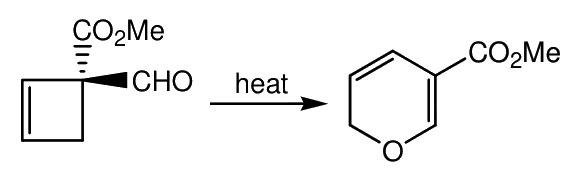
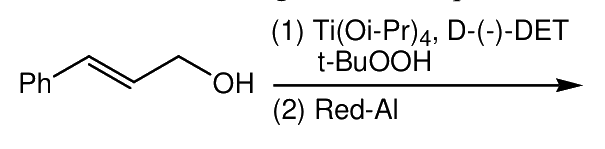
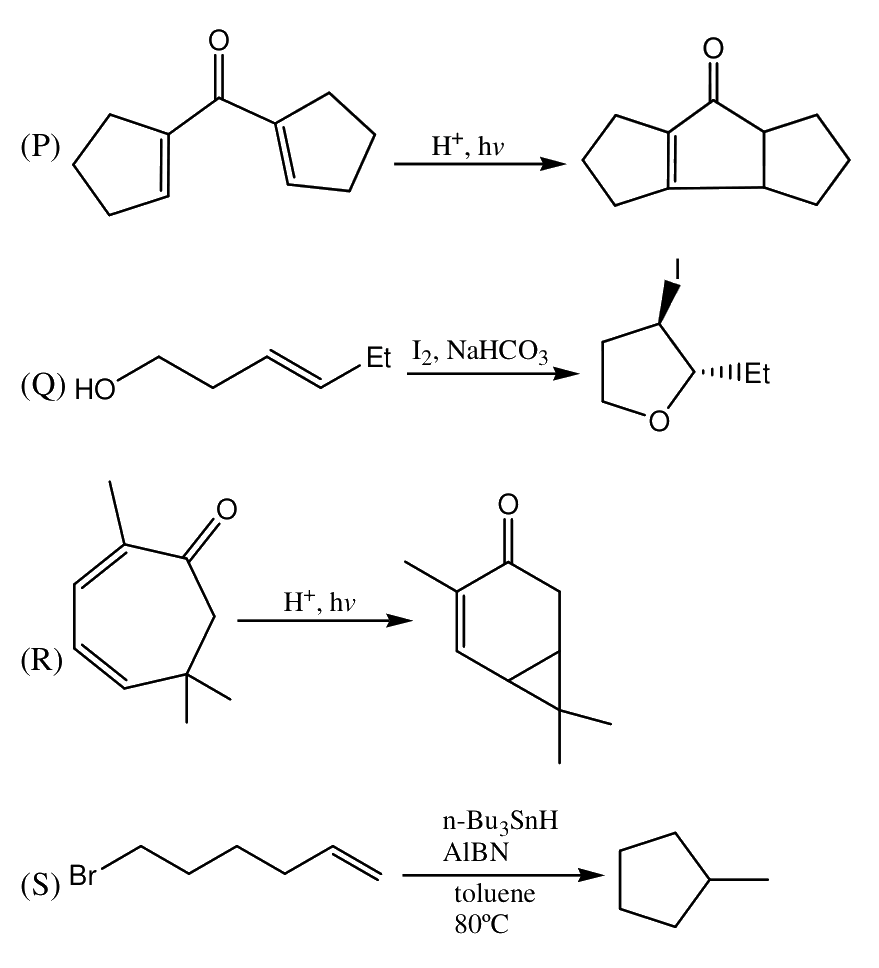
The mechanism of the following reaction involves
(A) 4 electron conrotatory electrocyclic reaction
(B) [2+2] cycloreversion
(C) 6 electron disrotatory electrocyclic reaction
(D) [4+2] cycloaddition
a.
A and B
b.
A and C
c.
B and D
d.
C and D
Correct Answer & Step-by-Step Solution Locked
Sign in free to reveal the correct answer and AI explanation for this question.
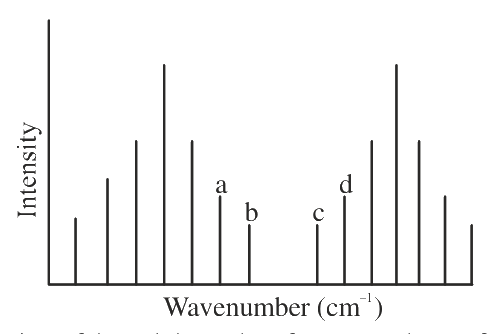
A schematic rotational-vibrational spectrum is depicted below and four lines of this spectrum for two diatomic molecules ($\text{M}_1$ and $\text{M}_2$) are tabulated.
If the reduced mass of $\text{M}_1$ is 3-times that of $\text{M}_2$, the ratio of bond length of $\text{M}_1$ to that of $\text{M}_2$ is
a.
2/3
b.
3/2
c.
4/9
d.
9/4
Correct Answer & Step-by-Step Solution Locked
Sign in free to reveal the correct answer and AI explanation for this question.
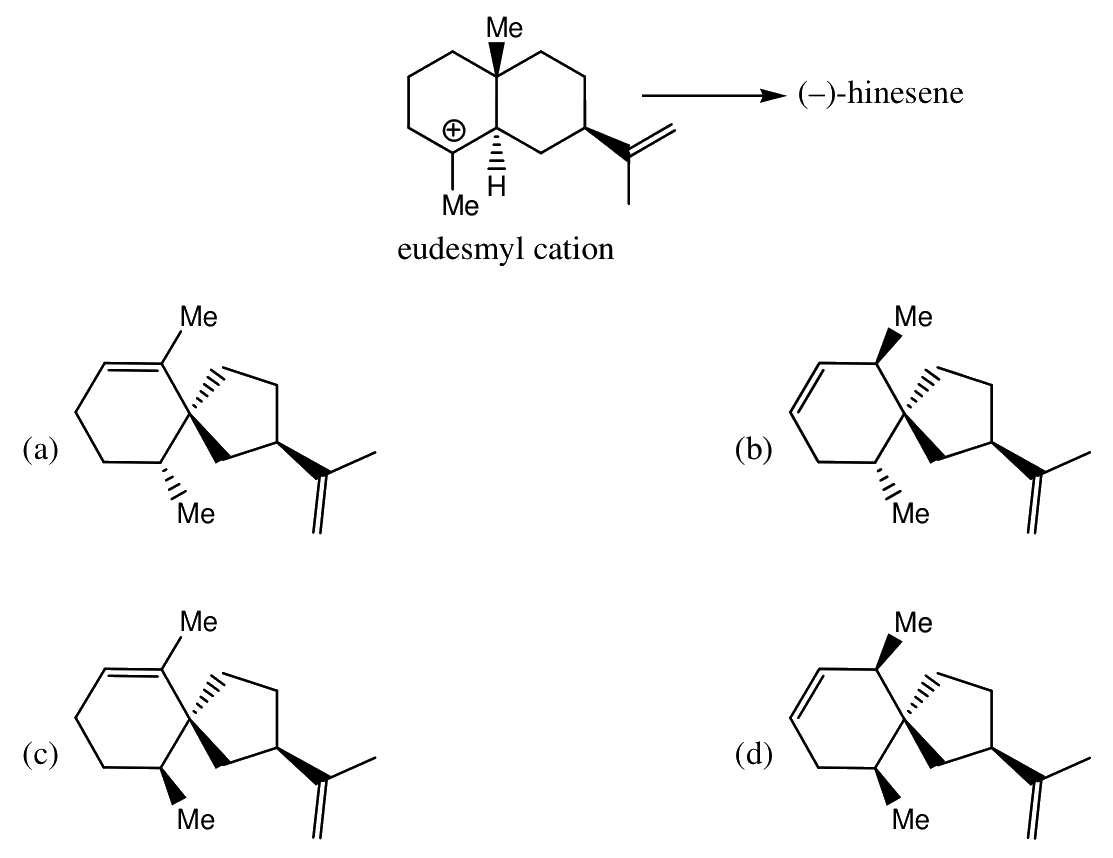
Upon catalysis by hinesene synthase, eudesmyl cation shown below undergoes a sequential hydride shift, ring contraction and loss of proton to form (–)-hinesene. The correct structure of (–)-hinesene is
Correct Answer & Step-by-Step Solution Locked
Sign in free to reveal the correct answer and AI explanation for this question.
Reaction of an aqueous solution of X with $\text{NaOH}$ forms a white gelatinous precipitate. Dissolution of this precipitate in excess $\text{NaOH}$ gives Y. Bubbling $\text{H}_2\text{S}$ gas into Y results in the formation of a white precipitate Z. Reaction of Z with dil. $\text{H}_2\text{SO}_4$ gives X. The X, Y and Z, respectively are
$\sigma_g$ and $\sigma_u$ are respectively the bonding and anti-bonding molecule orbitals formed by linear combination of two 1s atomic orbitals of H-atom. The spatial part of a purely covalent wavefunction for $\text{H}_2$ molecule obtained according to molecular orbital theory is
a.
$\sigma_g(1)\sigma_g(2) + \sigma_g(1)\sigma_u(2)$
b.
$\sigma_g(1)\sigma_g(2) - \sigma_g(1)\sigma_u(2)$
c.
$\sigma_g(1)\sigma_g(2) + \sigma_u(1)\sigma_u(2)$
d.
$\sigma_g(1)\sigma_g(2) - \sigma_u(1)\sigma_u(2)$
Correct Answer & Step-by-Step Solution Locked
Sign in free to reveal the correct answer and AI explanation for this question.
The percentage error in the measurements of mass and linear velocity of a particle, respectively, are $3\%$ and $4\%$. The maximum percentage error in the kinetic energy of the particle is
a.
$5\%$
b.
$7\%$
c.
$11\%$
d.
$24\%$
Correct Answer & Step-by-Step Solution Locked
Sign in free to reveal the correct answer and AI explanation for this question.
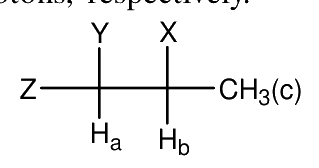
Consider the following compound where $^3J_{\text{ab}}$ and $^3J_{\text{bc}}$ represent three bond coupling between $\text{H}_a$ and $\text{H}_b$ and $\text{H}_b$ and $\text{H}_c$ protons, respectively.
in two different scenarios, (I) $^3J_{\text{ab}} < {}^3J_{\text{bc}}$ and (II) $^3J_{\text{ab}} = {}^3J_{\text{bc}}$
the multiplicity of $\text{H}_b$ proton, respectively, will be
a.
$\text{I} = \text{quintet}$ ; $\text{II} = \text{quartet of doublets}$
b.
$\text{I} = \text{quartet of doublets}$; $\text{II} = \text{quintet}$
c.
$\text{I} = \text{triplet of triplets}$; $\text{II} = \text{quartet of doublets}$
d.
$\text{I} = \text{triplet of triplets}$ ; $\text{II} = \text{quintet}$
Correct Answer & Step-by-Step Solution Locked
Sign in free to reveal the correct answer and AI explanation for this question.
In the oxidative addition of trans-$[\text{IrCl}(\text{CO})(\text{PPh}_3)_2]$ with $\text{H}_2$ (path A) and with $\text{CH}_3\text{I}$ (path B), the d-orbitals involved in the electron transfer from iridium to $\text{H}_2$ and $\text{CH}_3\text{I}$, respectively are
a.
$d_{x^2-y^2}\text{ (In A); } d_{z^2}\text{ (In B)}$
b.
$d_{z^2}\text{ (In A); } d_{xy}\text{ or } d_{xz}\text{ or } d_{yz}\text{ (In B)}$
c.
$d_{xy}\text{ or } d_{xz}\text{ or } d_{yz}\text{ (In A); } d_{z^2}\text{ (In B)}$
d.
$d_{z^2}\text{ (In A); } d_{x^2-y^2}\text{ (In B)}$
Correct Answer & Step-by-Step Solution Locked
Sign in free to reveal the correct answer and AI explanation for this question.
If $\mathrm{E}^0$ for $\mathrm{OCl}^-(\mathrm{aq}) \mid \mathrm{Cl}^-(\mathrm{aq})$ and $\mathrm{Cl}^-(\mathrm{aq}) \mid \frac{1}{2}\mathrm{Cl}_2(\mathrm{g})$ half-cells, respectively, are $0.94\text{ V}$ and $-1.36\text{ V}$, then $\mathrm{E}^0$ (in $\mathrm{V}$) for the $\mathrm{OCl}^-(\mathrm{aq}) \mid \frac{1}{2}\mathrm{Cl}_2(\mathrm{g})$ half cell is
a.
$-0.42$
b.
$-2.20$
c.
$0.52$
d.
$1.04$
Correct Answer & Step-by-Step Solution Locked
Sign in free to reveal the correct answer and AI explanation for this question.
Two reactions have same pre-exponential factor, but $\mathrm{E}_\mathrm{a}$ (activation energy) of the first reaction is lower than that of the second reaction by $5\text{ kcal mol}^{-1}$. Given $\mathrm{R} = 1.987 \times 10^{-3}\text{ kcal mol}^{-1}\mathrm{K}^{-1}$. The ratio of the rate constants of the first and second reactions at $298\text{K}$ is closest to
a.
$4650$
b.
$22025$
c.
$5$
d.
$150$
Correct Answer & Step-by-Step Solution Locked
Sign in free to reveal the correct answer and AI explanation for this question.
The isomerization of cyclopropane to propene follows Lindemann mechanism and is carried out in the high-pressure limit. The ratio of the rate constants of activation to deactivation steps is 10, and that of product formation to deactivation step is 15. Given the effective rate constant as $150\text{ s}^{-1}$, the rate constant (in $\text{s}^{-1}$) for the deactivation step is
a.
1.5
b.
1.0
c.
10.0
d.
7.0
Correct Answer & Step-by-Step Solution Locked
Sign in free to reveal the correct answer and AI explanation for this question.
A linear variation is performed using two orthogonal basis functions $\phi_1$ and $\phi_2$ to generate two optimised energies $\varepsilon_1$ and $\varepsilon_2$ ($\varepsilon_1 \le \varepsilon_2$). If the exact ground and the first excited state energies are $\text{E}_1$ and $\text{E}_2$, respectively, the correct statement is
a.
Both $\varepsilon_1$ and $\varepsilon_2$ are lower than $\text{E}_1$
b.
$\varepsilon_1$ lies between $\text{E}_1$ and $\text{E}_2$
c.
$\varepsilon_1 > \text{E}_2$
d.
$\varepsilon_2 > \text{E}_2$
Correct Answer & Step-by-Step Solution Locked
Sign in free to reveal the correct answer and AI explanation for this question.
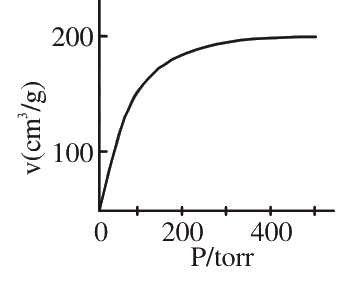
The rate of a surface catalyzed reaction between $\text{CO(g)}$ and $\text{O}_2\text{(g)}$ follows Langmuir-Hinshelwood mechanism. If $\text{O}_2$ gets dissociated during adsoption, the rate of the reaction is [where, $\text{p}$ represents the partial pressure and $K$ represents the surface binding constant on the species, $\text{k}$ is a proportionality constant]
The correct option with respect to the metal-metal distance (d) and the magnetic property of $[\text{Cr}_2\text{Cl}_9]^{3-}$ (A) and $[\text{W}_2\text{Cl}_9]^{3-}$ (B) is
a.
$d_{\text{Cr}\dots\text{Cr}} > d_{\text{W}\dots\text{W}}$; A is paramagnetic and B is diamagnetic
b.
$d_{\text{Cr}\dots\text{Cr}} > d_{\text{W}\dots\text{W}}$; A is diamagnetic and B is paramagnetic
c.
$d_{\text{W}\dots\text{W}} > d_{\text{Cr}\dots\text{Cr}}$; A is diamagnetic and B is paramagnetic
d.
$d_{\text{W}\dots\text{W}} > d_{\text{Cr}\dots\text{Cr}}$; A is paramagnetic and B is diamagnetic
Correct Answer & Step-by-Step Solution Locked
Sign in free to reveal the correct answer and AI explanation for this question.
The application of Euler's reciprocity relation (cross-derivative rule) to the volume of 1 mole of an ideal gas results in mixed second derivative of V equal to
a.
$-\frac{R}{P^2}$
b.
$-\frac{RT}{P^2}$
c.
$\frac{R}{P}$
d.
$\frac{2RT}{P^3}$
Correct Answer & Step-by-Step Solution Locked
Sign in free to reveal the correct answer and AI explanation for this question.
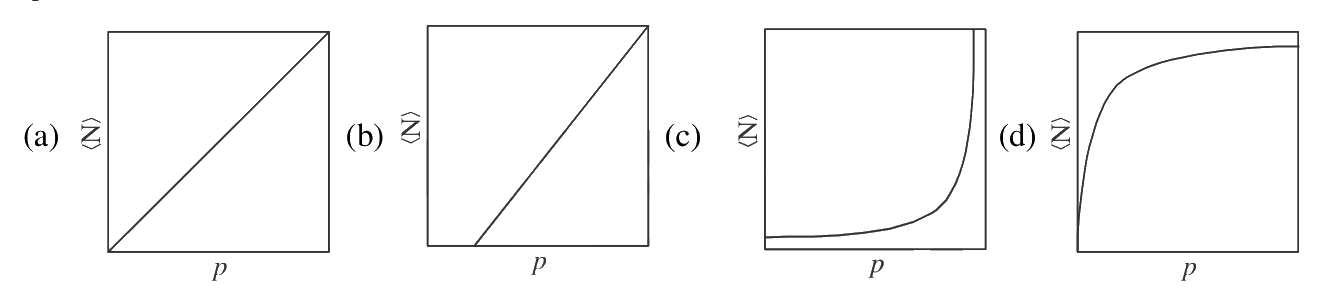
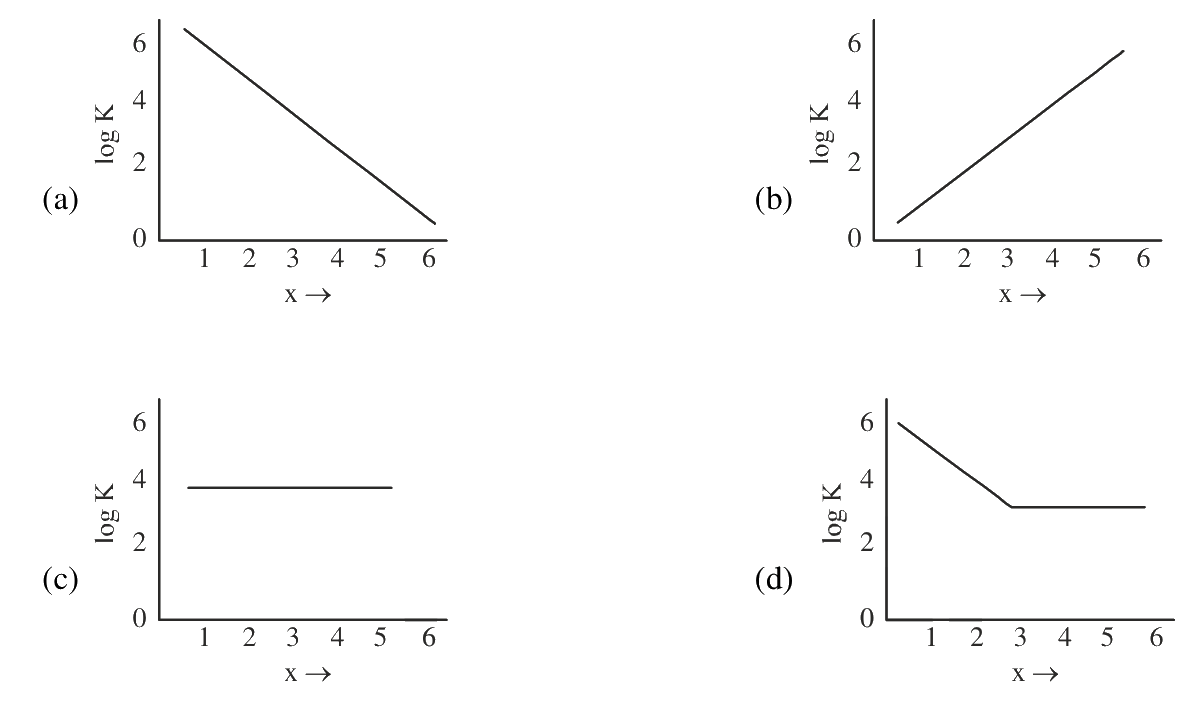
The correct plot of $\log K$ vs $x$ ($K = \text{stepwise stability constant}$) for the complex
$$\left[Al(OH_2)_{6-x} F_x\right]^{(3-x)^+}\quad (x = 1-6)$$
is
a.
Graph showing $\log K$ linearly decreasing from $x=1$ to $x=6$
b.
Graph showing $\log K$ linearly increasing from $x=1$ to $x=6$
c.
Graph showing $\log K$ constant from $x=1$ to $x=6$
d.
Graph showing $\log K$ decreasing from $x=1$ to $x=3$ and then staying constant up to $x=6$
Correct Answer & Step-by-Step Solution Locked
Sign in free to reveal the correct answer and AI explanation for this question.
The absorption spectrum of $\text{Ln}^{3+}$ is normally sharp and weak in intensity. However, $\text{Sm}^{3+}(4\text{f}^5)$ in dil. acidic solution shows a broad and moderately intense transition at $495\text{ nm}$. The transition is
a.
$^6H_{5/2} \longrightarrow {}^6H_{7/2}$
b.
$^6H_{5/2} \longrightarrow {}^4G_{5/2}$
c.
$^6H_{5/2} \longrightarrow {}^6H_{9/2}$
d.
$^4G_{5/2} \longrightarrow {}^4G_{7/2}$
Correct Answer & Step-by-Step Solution Locked
Sign in free to reveal the correct answer and AI explanation for this question.
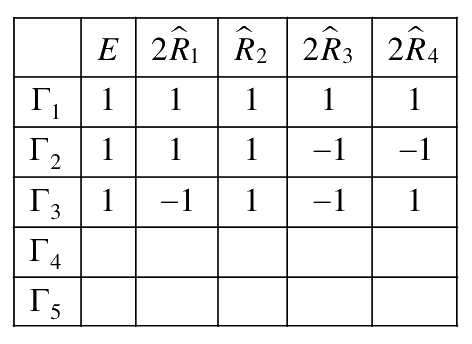
The character table for a particular point group is given below. The characters in the irreducible representation $\Gamma_4$ and $\Gamma_5$, respectively are
a.
$\{1, 1, -1, 1, -1\}$ and $\{2, -2, 1, 0, 0\}$
b.
$\{1, -1, 1, 1, -1\}$ and $\{2, 0, -2, 0, 0\}$
c.
$\{1, 2, 0, -2, 1\}$ and $\{1, 1, 1, 1, -1\}$
d.
$\{2, 0, -2, 0, 0\}$ and $\{2, 1, -1, 1, -1\}$
Correct Answer & Step-by-Step Solution Locked
Sign in free to reveal the correct answer and AI explanation for this question.
Consider a matrix representation A of the water molecule in the basis $\{\vec{V}_1, \vec{V}_2\}$, where $\vec{V}_1$ and $\vec{V}_2$, are the bond vectors along the two $\text{O}-\text{H}$ bonds. Consider another matrix representation B of the same molecule in a new basis set $\{\vec{U}_1, \vec{U}_2\}$, such that $\vec{U}_1 = \frac{1}{\sqrt{2}}\left(\vec{V}_1 + \vec{V}_2\right), \vec{U}_2 = \frac{1}{\sqrt{2}}\left(\vec{V}_1 - \vec{V}_2\right)$. The character table for $C_{2v}$ point group is given below:
a.
$\text{A}_1$ and $\text{B}_1$
b.
$\text{A}_1$ and $\text{B}_2$
c.
$\text{A}_2$ and $\text{B}_1$
d.
$\text{A}_1$ and $\text{A}_2$
Correct Answer & Step-by-Step Solution Locked
Sign in free to reveal the correct answer and AI explanation for this question.
In the following nuclear reaction, X, Y and Z, respectively are
$${^{238}\text{U}} \xrightarrow{\quad\text{X}\quad} {^{239}\text{U}} \xrightarrow{\quad\text{Z}\quad} {^{239}\text{Pu}}$$
a.
$(n), -\beta$, and $+\beta$
b.
$(n,\gamma), +\beta$, and $+\beta$
c.
(+\beta), (n,\gamma)$, and $-\beta$
d.
$(n,\gamma), -\beta$ and $-\beta$
Correct Answer & Step-by-Step Solution Locked
Sign in free to reveal the correct answer and AI explanation for this question.
Consider a two-level system at thermal equilibrium. The ratios of the excited state population to the ground state population are $0.50$ and $0.25$ at $600\text{ K}$ and $300\text{ K}$, respectively. The energy gap between the two levels (in unit of $10^{-21}\text{ J}$) is closest to [$k_{\text{B}} = 1.38\times 10^{-23}\text{ JK}^{-1}$]
a.
$1.44$
b.
$2.87$
c.
$5.74$
d.
$11.48$
Correct Answer & Step-by-Step Solution Locked
Sign in free to reveal the correct answer and AI explanation for this question.