What is the order of decreasing carbonyl stretching frequencies in the following species (A-D)?
(A) $[\text{Mn}(\text{CO})_6]^+$
(B) $[\text{Os}(\text{CO})_6]^{2+}$
(C) $[\text{Ir}(\text{CO})_6]^{3+}$
(D) $\text{Free CO}$
Carbonyl stretching frequency $\nu_{\text{CO}}$ increases as $\pi$-backbonding from the metal to CO decreases and electrostatic/polarization effects increase. For cationic carbonyl complexes with high positive charges, back-donation is extremely weak or absent, and the polarizing power of the metal cation increases the C-O force constant, resulting in $\nu_{\text{CO}} > \nu_{\text{CO}}(\text{free CO}) = 2143\text{ cm}^{-1}$. For $[ ext{Ir}( ext{CO})_6]^{3+}$, $\nu_{\text{CO}} \approx 2254\text{ cm}^{-1}$; for $[ ext{Os}( ext{CO})_6]^{2+}$, $\nu_{\text{CO}} \approx 2190\text{ cm}^{-1}$; free CO has $\nu_{\text{CO}} = 2143\text{ cm}^{-1}$; and for $[ ext{Mn}( ext{CO})_6]^+$, $\nu_{\text{CO}} \approx 2090\text{ cm}^{-1}$. Thus, the decreasing order is $\text{C} > \text{B} > \text{D} > \text{A}$.
Q22mcq
An octahedral $d^6$ complex has a single spin-allowed absorption band. The spin-only magnetic moment (B.M.) and the electronic transition for this complex, respectively, are
a.
$0$ and ${}^1\text{T}_{1\text{g}} \leftarrow {}^1\text{A}_{1\text{g}}$
b.
$4.9$ and ${}^5\text{T}_{2\text{g}} \leftarrow {}^5\text{E}_{\text{g}}$
c.
$4.9$ and ${}^5\text{E}_{\text{g}} \leftarrow {}^5\text{T}_{2\text{g}}$
Correct Answer
d.
$0$ and ${}^1\text{T}_{2\text{g}} \leftarrow {}^1\text{A}_{1\text{g}}$
Step-by-Step AI Explanation
Verified Method
A high-spin octahedral $d^6$ complex (ground state term ${}^5\text{D}$, split into ground state ${}^5\text{T}_{2\text{g}}$ and excited state ${}^5\text{E}_{\text{g}}$) has 4 unpaired electrons ($t_{2\text{g}}^4 e_{\text{g}}^2$). Its spin-only magnetic moment is $\mu_{\text{eff}} = \sqrt{4(4+2)} = \sqrt{24} \approx 4.90\text{ B.M.}$ It displays only a single spin-allowed absorption band corresponding to the transition ${}^5\text{E}_{\text{g}} \leftarrow {}^5\text{T}_{2\text{g}}$. Low-spin $d^6$ complexes (${}^1\text{A}_{1\text{g}}$) have two spin-allowed transitions (${}^1\text{T}_{1\text{g}} \leftarrow {}^1\text{A}_{1\text{g}}$ and ${}^1\text{T}_{2\text{g}} \leftarrow {}^1\text{A}_{1\text{g}}$).
Q23mcq
In the solid state, the stable structure of the metal cluster $[\text{Ru}_3(\text{CO})_{10}(\text{PPh}_3)_2]$ is
a.
Structure as shown in option (a)
Correct Answer
b.
Structure as shown in option (b)
c.
Structure as shown in option (c)
d.
Structure as shown in option (d)
Step-by-Step AI Explanation
Verified Method
In $\text{Ru}_3(\text{CO})_{10}(\text{PPh}_3)_2$, the cluster retains the basic $\text{Ru}_3(\text{CO})_{12}$ core structure (having $D_{3h}$ symmetry with all terminal COs, unlike $\text{Fe}_3(\text{CO})_{12}$ which has bridging COs), where the two bulky $\text{PPh}_3$ ligands occupy equatorial positions on different ruthenium atoms to minimize steric hindrance.
Q24mcq
In the stratosphere, the radical $\text{Cl}^\bullet$ produced from chlorofluorocarbons reacts with $\text{O}_3$ as follows.
$$\text{Cl}^\bullet + \text{O}_3 \longrightarrow \text{X} + \text{colourless gas}$$
$$2\text{X} \longrightarrow \text{X}_2$$
$$\text{X}_2 \longrightarrow \text{Cl}^\bullet + \text{Y}$$
$\text{X}, \text{Y}$ are, respectively.
In the catalytic destruction of stratospheric ozone by chlorine radicals:
1) $\text{Cl}^\bullet + \text{O}_3 \longrightarrow \text{ClO}^\bullet + \text{O}_2$
Here, $\text{X} = \text{ClO}^\bullet$, and the colourless gas is $\text{O}_2$.
2) $2\text{ClO}^\bullet \longrightarrow \text{ClOOCl}$ (dichlorine dioxide, $\text{X}_2$).
3) Upon photolysis or thermal cleavage: $\text{ClOOCl} \longrightarrow \text{Cl}^\bullet + \text{ClOO}^\bullet$, so $\text{Y} = \text{Cl}-\text{O}-\dot{\text{O}}$.
Q25mcq
For the following nuclear decay series segment,
$${}^{234}_{90}\text{Th} \longrightarrow \longrightarrow \longrightarrow {}^{230}_{90}\text{Th}$$
the overall emitted particles are
a.
one $\beta$, one $\alpha$ and one neutron
b.
two $\beta$ and one $\alpha$
Correct Answer
c.
three $\beta$
d.
two $\beta$ and one neutron
Step-by-Step AI Explanation
Verified Method
The change in mass number is $\Delta A = 234 - 230 = 4$. Since each $\alpha$-particle decreases $A$ by 4 and $\beta$-particles leave $A$ unchanged, exactly one $\alpha$-particle ($^4_2\text{He}$) is emitted. The emission of one $\alpha$-particle reduces the atomic number $Z$ by 2 (from 90 to 88). To reach the final atomic number of $Z = 90$, two $\beta^-$ particles ($^0_{-1}\beta$) must be emitted ($88 + 2 = 90$). Thus, the overall emitted particles are two $\beta$ and one $\alpha$.
Q26mcq
The known oxidation state(s) of $\text{Eu}$ in aqueous solution is/are
a.
+2 and +3
Correct Answer
b.
+3 and +4
c.
+2, +3 and +4
d.
+3 only
Step-by-Step AI Explanation
Verified Method
Europium has the ground-state electron configuration $[ ext{Xe}] 4f^7 6s^2$. Due to the stability of the half-filled $4f^7$ shell, $\text{Eu}^{2+}$ is relatively stable in addition to the common lanthanide $+3$ state ($\text{Eu}^{3+}$). Both $+2$ and $+3$ are known and well-characterized oxidation states for europium in aqueous solution.
Q27mcq
Among $\text{Si}_3\text{N}_4$, $\alpha-\text{BN}$, $\text{AlN}$ and $(\text{SN})_x$, the compound with the highest conductivity is
a.
$\text{Si}_3\text{N}_4$
b.
$\alpha-\text{BN}$
c.
$\text{AlN}$
d.
$(\text{SN})_x$
Correct Answer
Step-by-Step AI Explanation
Verified Method
Polythiazyl, $(\text{SN})_x$, is an inorganic polymer that possesses metallic conductivity at room temperature and becomes a superconductor at very low temperatures ($T_c \approx 0.26\text{ K}$). In contrast, $\text{Si}_3\text{N}_4$, $\alpha-\text{BN}$, and $\text{AlN}$ are wide band-gap electrical insulators.
Q28mcq
Consider the following statements about Infrared (IR) spectroscopy.
A. It is used to determine the band gap, the band structure and the charge carrier concentration of a compound.
B. It is used to identify functional group(s) of a compound.
C. It is used to characterize different stretching and bending modes of vibration in molecules.
D. Heteronuclear diatomic molecules are IR active.
The correct statements are
a.
A, B, C and D
b.
B, C and D only
Correct Answer
c.
A, B and C only
d.
B and C only
Step-by-Step AI Explanation
Verified Method
Statement A is incorrect because band gap, band structure, and charge carrier concentrations of semiconductors/materials are typically investigated using UV-Vis-NIR spectroscopy, angle-resolved photoemission spectroscopy (ARPES), or Hall effect measurements, not standard IR vibrational spectroscopy. Statements B, C, and D are standard correct features of IR spectroscopy: it identifies functional groups via characteristic frequencies (B), probes stretching and bending vibrational modes (C), and heteronuclear diatomic molecules have a non-zero dynamic dipole moment during vibration, making them IR active (D). Therefore, only B, C, and D are correct.
Q29mcq
The geometry around $\text{Te}$ in the symmetrical trimeric species of $[\text{TeO}_2\text{F}]^-$ is
a.
Square planar
b.
Tetrahedral
c.
Trigonal bipyramidal
d.
Octahedral
Correct Answer
Step-by-Step AI Explanation
Verified Method
In the symmetrical cyclic trimeric anion $[\text{Te}_3\text{O}_6\text{F}_3]^{3-}$, each tellurium atom is surrounded by six coordination sites (forming a $[ ext{TeO}_4\text{F}_2]$ or $[ ext{TeO}_5\text{F}]$ distorted octahedral environment depending on bridging oxygens/fluorines; specifically, tellurium has an octahedral geometry around it due to bridging oxygen atoms and terminal fluorine/oxygen atoms).
Q30mcq
The base ionization constant, $\text{K}_b$, of ammonia in water is $1.8 \times 10^{-5}$. The value of acid ionization constant, $\text{K}_a$, of the conjugate acid is closest to
a.
$5.6 \times 10^{-10}$
Correct Answer
b.
$1.8 \times 10^9$
c.
$7.0 \times 10^{-7}$
d.
$5.6 \times 10^4$
Step-by-Step AI Explanation
Verified Method
The relationship between $K_a$ and $K_b$ for a conjugate acid-base pair in water at $25^\circ\text{C}$ is $K_a \times K_b = K_w = 1.0 \times 10^{-14}$. Therefore, $$K_a = \frac{K_w}{K_b} = \frac{1.0 \times 10^{-14}}{1.8 \times 10^{-5}} \approx 5.56 \times 10^{-10} \approx 5.6 \times 10^{-10}$$. Thus, choice A is correct.
🎉 10 Free Sample Solutions Completed
Unlock All 100 Questions & Solutions
Sign up free in seconds to unlock step-by-step AI answers for the remaining 90 questions.
The $^1\text{H-NMR}$ spectrum of $[(\text{C}_5\text{H}_5)_2\text{Fe}(\text{CO})_2]$ exhibits two peaks of equal intensity at room temperature, but four resonances of relative intensities 5:2:2:1 at lower temperature. The hapticities of $\text{C}_5\text{H}_5^-$ are
a.
$\eta^5$ and $\eta^1$
b.
$\eta^5$ and $\eta^3$
c.
$\eta^3$ and $\eta^1$
d.
$\eta^3$ and $\eta^3$
Correct Answer & Step-by-Step Solution Locked
Sign in free to reveal the correct answer and AI explanation for this question.
The products of the following reaction of a sample of 2-butanol ($\text{ee} = \text{X}\%$) show two doublets in ${}^1\text{H}$ NMR spectrum in the ratio of 3:2. The value of $\text{X}$ is _____
a.
40
b.
60
c.
20
d.
80
Correct Answer & Step-by-Step Solution Locked
Sign in free to reveal the correct answer and AI explanation for this question.
The structure that corresponds to the following 1H NMR spectral data is $^1\text{H NMR} : \delta 3.64(\text{s}, 6\text{H}), 2.02(\text{dd}, 2\text{H}), 1.62(\text{td}, 1\text{H}), 1.20(\text{td}, 1\text{H})$
Correct Answer & Step-by-Step Solution Locked
Sign in free to reveal the correct answer and AI explanation for this question.
The energy of an electron in a hydrogenetic atom is $-13.6\ Z^2/n^2\text{ eV}$, where $Z$ is the atomic number and $n$ is the principal quantum number. Neglecting inter-electronic repulsion, the energy of the first excited state of the $\text{He}$ atom is
a.
$-68.0\text{ eV}$
b.
$-13.6\text{ eV}$
c.
$-27.2\text{ eV}$
d.
$-108.8\text{ eV}$
Correct Answer & Step-by-Step Solution Locked
Sign in free to reveal the correct answer and AI explanation for this question.
The eigenfunctions of a particle in a cubic box with potential $\text{V} = 0$ in the region $0 \le x \le L$, $0 \le y \le L$ and $0 \le z \le L$ and $\text{V} = \infty$ outside are denoted as $\psi_{n_x n_y n_z}$. Which of the following is also an eigenfunction of the Hamiltonian?
a.
$\phi_1 = \psi_{123} - \psi_{312}$
b.
$\phi_2 = \psi_{111} + \psi_{222}$
c.
$\phi_3 = \psi_{121} - \psi_{122}$
d.
$\phi_4 = \psi_{212} + \psi_{113}$
Correct Answer & Step-by-Step Solution Locked
Sign in free to reveal the correct answer and AI explanation for this question.
Given that the commutator $\left[\hat{A}^2, \hat{B}\right] = \left[\hat{A}, \hat{B}\right]\hat{A} + \hat{A}\left[\hat{A}, \hat{B}\right]$, the value of $\left[x, \left[\hat{p}_x^2, x\right]\right]$ is
a.
$2i\hbar^2$
b.
$2\hbar^2$
c.
$-2\hbar^2$
d.
$-2i\hbar^2$
Correct Answer & Step-by-Step Solution Locked
Sign in free to reveal the correct answer and AI explanation for this question.
For a zero-order reaction $\text{A} \xrightarrow{\ \ k\ \ } \text{P}$, if the initial concentration of $\text{A}$ is $[\text{A}]_0$, the time required to consume all the reactant is
a.
$2[\text{A}]_0 / k$
b.
$[\text{A}]_0 / k$
c.
$([\text{A}] - [\text{A}]_0) / k$
d.
$k[\text{A}]_0$
Correct Answer & Step-by-Step Solution Locked
Sign in free to reveal the correct answer and AI explanation for this question.
For a system of two fermionic particles that can be in any one of three possible quantum states each, the ratio of the probability that two particles are in the same state to that when the two particles are in different states is
a.
$1$
b.
$1/2$
c.
$0$
d.
$1/3$
Correct Answer & Step-by-Step Solution Locked
Sign in free to reveal the correct answer and AI explanation for this question.
Two schematic potential energy surfaces for bond bending motions are indicated as A and B in the accompanying diagram
The out-of-plane C-H wags in iodoform and chloroform would respectively correspond to the potential energy surfaces.
a.
A and B
b.
A and A
c.
B and A
d.
B and B
Correct Answer & Step-by-Step Solution Locked
Sign in free to reveal the correct answer and AI explanation for this question.
During the phase transition, at constant temperature, of a solid from one form to another, the change in molar volume, $\Delta V_m = 1.0\text{ cm}^3\text{mol}^{-1}$ is independent of pressure. The change in molar Gibbs free energy, in units of $\text{J mol}^{-1}$, when the pressure is increased from $1\text{ bar}$ to $3\text{ bars}$ is
a.
$4\times 10^{-1}$
b.
$3\times 10^{-1}$
c.
$2\times 10^{-1}$
d.
$1\times 10^{-1}$
Correct Answer & Step-by-Step Solution Locked
Sign in free to reveal the correct answer and AI explanation for this question.
The effective activation energy for the reaction:
$$A + B \underset{k_{a'}}{\overset{k_a}{\rightleftharpoons}} I \xrightarrow{k_b} P$$
with the following potential energy versus reaction coordinate plot is
a.
$E_a - E_{a'} - E_b$
b.
$E_a + E_b - E_{a'}$
c.
$-E_a + E_{a'} - E_b$
d.
$E_a + E_{a'} - E_b$
Correct Answer & Step-by-Step Solution Locked
Sign in free to reveal the correct answer and AI explanation for this question.
Given that at $298.15\text{ K}$, $E^0_{\text{Fe}^{+3}/\text{Fe}} = -0.04\text{V}$; $E^0_{\text{Fe}^{+2}/\text{Fe}} = -0.44\text{V}$. At this temperature, the value of $E^0_{\text{Fe}^{+3}/\text{Fe}^{+2}}$ is
a.
$1.24\text{ V}$
b.
$1.00\text{ V}$
c.
$0.40\text{ V}$
d.
$0.76\text{ V}$
Correct Answer & Step-by-Step Solution Locked
Sign in free to reveal the correct answer and AI explanation for this question.
In the process of polyesterification, the average length of polymer formed by a stepwise process grows linearly with time. The fraction condensed (extent of reaction) and the degree of polymerization at time $t = 1.0\text{ hour}$, of a polymer formed with $k_r = 1.80\times 10^{-2}\text{ dm}^3\text{mol}^{-1}\text{s}^{-1}$ and initial monomer concentration of $3.00\times 10^{-2}\text{ mol}\text{dm}^{-3}$, are respectively.
a.
0.66 and 2.94
b.
0.33 and 1.50
c.
0.16 and 1.19
d.
0.33 and 2.94
Correct Answer & Step-by-Step Solution Locked
Sign in free to reveal the correct answer and AI explanation for this question.
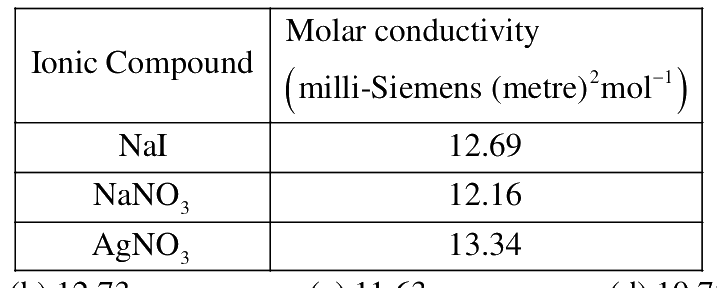
The limiting molar conductivities, at $25^\circ\text{C}$, of few ionic compounds are given in the table below. The limiting molar conductivity of $\text{AgI}$, in units of milli-Siemens $(\text{metre})^2\text{mol}^{-1}$, at $25^\circ\text{C}$ is
$$\begin{array}{|c|c|}
\hline
\text{Ionic Compound} & \begin{array}{c} \text{Molar conductivity} \\ (\text{milli-Siemens (metre)}^2\text{mol}^{-1}) \end{array} \\
\hline
\text{NaI} & 12.69 \\
\hline
\text{NaNO}_3 & 12.16 \\
\hline
\text{AgNO}_3 & 13.34 \\
\hline
\end{array}$$
a.
13.87
b.
12.73
c.
11.63
d.
10.78
Correct Answer & Step-by-Step Solution Locked
Sign in free to reveal the correct answer and AI explanation for this question.
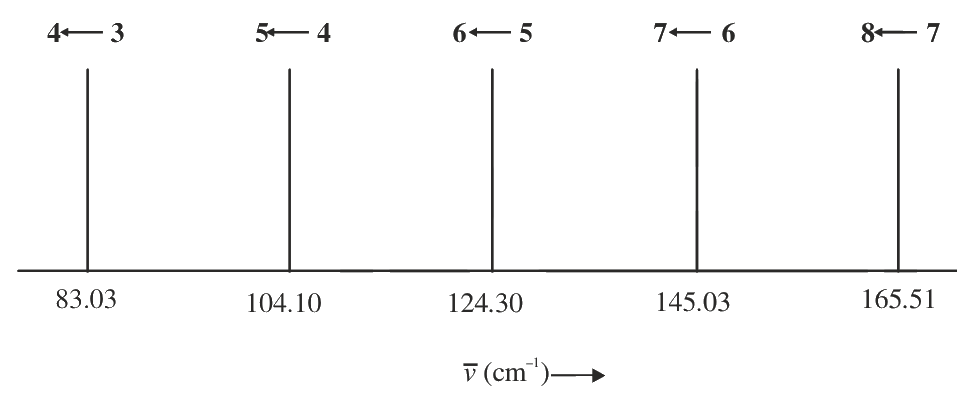
The rotational absorption spectum of $\text{H}^{35}\text{Cl}$ shows the following lines
Neglecting centrifugal distortion, the value of the rotational constant in units of $\text{cm}^{-1}$ is estimated as
a.
3
b.
5
c.
10
d.
20
Correct Answer & Step-by-Step Solution Locked
Sign in free to reveal the correct answer and AI explanation for this question.
Consider the following pairs of compounds.
(i) $\text{NH}_4\text{Cl}$ and $\text{FeO}$
(ii) $\text{H}_3\text{N}\cdot\text{BF}_3$ and $\text{BCl}_3$
(iii) $\text{HSO}_3\text{F}$ and $\text{HF}$
The more acidic species in (i), (ii) and (iii) are, respectively
a.
$\text{FeO}$, $\text{BCl}_3$ and $\text{HF}$
b.
$\text{NH}_4\text{Cl}$, $\text{H}_3\text{N}\cdot\text{BF}_3$ and $\text{HF}$
c.
$\text{FeO}$, $\text{H}_3\text{N}\cdot\text{BF}_3$ and $\text{HSO}_3\text{F}$
d.
$\text{NH}_4\text{Cl}$, $\text{BCl}_3$ and $\text{HSO}_3\text{F}$
Correct Answer & Step-by-Step Solution Locked
Sign in free to reveal the correct answer and AI explanation for this question.
Consider the statements about the following species, $\text{ClF}$, $[\text{ClF}_2]^+$, $\text{ClF}_3$, $[\text{ClF}_4]^+$ and $\text{ClF}_5$.
(A) There are 9 lone pairs of electrons on the chlorine atoms in the five species.
(B) The species $[\text{ClF}_4]^+$ has a tetrahedral shape
(C) The compound $\text{ClF}_3$ is a very strong fluorinating agent.
The correct statements are
a.
B and C only
b.
A and C only
c.
A and B only
d.
A, B and C
Correct Answer & Step-by-Step Solution Locked
Sign in free to reveal the correct answer and AI explanation for this question.
The second order rate constants for the outer sphere self-exchange electron transfer reactions for $[\text{Ru}(\text{NH}_3)_6]^{2+}/[\text{Ru}(\text{NH}_3)_6]^{3+}$ and $[\text{Co}(\text{NH}_3)_6]^{2+}/[\text{Co}(\text{NH}_3)_6]^{3+}$ are $9.2\times 10^2\text{ M}^{-1}\text{sec}^{-1}$ and $\le 10^{-9}\text{ M}^{-1}\text{ sec}^{-1}$, respectively. The correct rationale for the above data is
a.
The change in the number of $\sigma^*$-electrons in $\text{Co(II)/Co(III)}$ system.
b.
The change in the number of $\pi^*$-electrons in $\text{Co(II)/Co(III)}$ system.
c.
The change in the number of both $\sigma^*$ and $\pi^*$-electrons in $\text{Co(II)/Co(III)}$ system
d.
The change in the number of $\sigma^*$-electrons in $\text{Ru(II)/Ru(III)}$ system
Correct Answer & Step-by-Step Solution Locked
Sign in free to reveal the correct answer and AI explanation for this question.
Consider the following molecules/ions
(A) $[\text{Mn}(\text{H}_2\text{O})_6]^{3+}$
(B) $[\text{Ni}(\text{H}_2\text{O})_6]^{2+}$
(C) $\text{VCl}_4$
The Jahn-Teller effect is expected for
a.
A and C only
b.
A only
c.
C only
d.
A and B only
Correct Answer & Step-by-Step Solution Locked
Sign in free to reveal the correct answer and AI explanation for this question.
The electronic spectrum of an aqueous solution of $[\text{Ni}(\text{H}_2\text{O})_6]^{2+}$ shows three distinct bands:
(A) (~400 nm)
(B) (~690 nm) and
(C) (~1070 nm)
The transitions assigned to A, B and C, respectively, are
a.
$\text{T}_{1\text{g}}(\text{P}) \leftarrow \text{A}_{2\text{g}}$, $\text{T}_{2\text{g}} \leftarrow \text{A}_{2\text{g}}$, and $\text{T}_{1\text{g}} \leftarrow \text{A}_{2\text{g}}$
b.
$\text{T}_{1\text{g}}(\text{P}) \leftarrow \text{A}_{2\text{g}}$, $\text{T}_{1\text{g}} \leftarrow \text{A}_{2\text{g}}$, and $\text{T}_{2\text{g}} \leftarrow \text{A}_{2\text{g}}$
c.
$\text{T}_{2\text{g}} \leftarrow \text{A}_{2\text{g}}$, $\text{T}_{1\text{g}} \leftarrow \text{A}_{2\text{g}}$ and $\text{T}_{1\text{g}}(\text{P}) \leftarrow \text{A}_{2\text{g}}$
The statement(s) that correctly describe(s) the molecular orbital (MO) diagram of $\text{HO}^\bullet$ (hydroxyl radical) is/are (consider the $\text{O}-\text{H}$ bond to be along the x-axis).
(A) The highest Occupied Molecular Orbital (HOMO) is a non-bonded MO that is predominantly formed with $2\text{p}_z$ and $2\text{p}_y$ atomic orbitals (AOs) of O-atom.
(B) The HOMO is a $\sigma$-bonded MO that is predominantly formed by the overlap of $\text{H}(1\text{s})$ and $\text{O}(2\text{s})$ AOs.
(C) The $\sigma$-bonding MO is formed by the overlap of $\text{H}(1\text{s})$ and $\text{O}(2\text{p}_z)$ AOs.
(D) The $\sigma$-bonding MO is formed by the overlap of $\text{H}(1\text{s})$ and $\text{O}(2\text{p}_x)$ AOs.
a.
A and C only
b.
A and D only
c.
B only
d.
D only
Correct Answer & Step-by-Step Solution Locked
Sign in free to reveal the correct answer and AI explanation for this question.
A solute $\text{S}$ has partition coefficient ($KD$) of $5.0$ between water and chloroform. A $50\text{ mL}$ sample of a $0.050\text{ M}$ aqueous solution of the solute is extracted with $15\text{ mL}$ of chloroform. The extraction efficiency for the separation is
a.
$50\%$
b.
$60\%$
c.
$30\%$
d.
$40\%$
Correct Answer & Step-by-Step Solution Locked
Sign in free to reveal the correct answer and AI explanation for this question.
Consider the following statements about nanoparticles.
A. The energy gap between the valence and conduction bands is greater for semiconductor nanoparticles than that in metal nanoparticles.
B. Metal nanoparticles exhibit surface plasmon resonance.
C. Top-down and bottom-up synthetic methods are used to prepare nanoparticles.
The correct statements are
a.
B and C only
b.
A and B only
c.
A and C only
d.
A, B and C
Correct Answer & Step-by-Step Solution Locked
Sign in free to reveal the correct answer and AI explanation for this question.
Hydrolysis of the purple isomer of the complex $[\text{Co}(\text{tren})(\text{NH}_3)\text{Cl}]^{2+}$ [$\text{tren} = \text{Tris(2-aminoethyl)amine}$] under basic conditions results in two products. The geometry of the intermediate involved in this reaction is
a.
Trigonal bipyramidal
b.
square pyramidal
c.
pentagonal planar
d.
tetrahedral
Correct Answer & Step-by-Step Solution Locked
Sign in free to reveal the correct answer and AI explanation for this question.
The number of electrons involved in the enzymatic action of cytochrome $c$ oxidase, carbonic anhydrase and photosynthetic oxygen evolving complex, respectively, are
a.
$2, 0, 4$
b.
$4, 0, 4$
c.
$4, 1, 0$
d.
$2, 0, 2$
Correct Answer & Step-by-Step Solution Locked
Sign in free to reveal the correct answer and AI explanation for this question.
Consider the following statements describing the properties of $(\text{CF}_3)_3\text{B}\boldsymbol{\cdot}\text{CO}$.
(A) The $\text{CO}$ stretching frequency in IR is less than $2143\text{ cm}^{-1}$.
(B) The $^{19}\text{F}$ NMR spectrum shows one singlet resonance only
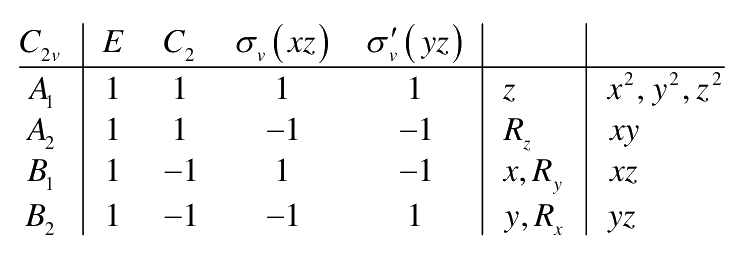
(C) The point group of $(\text{CF}_3)_3\text{B}\boldsymbol{\cdot}\text{CO}$ is $\text{C}_{3\text{v}}$.
(D) $(\text{CF}_3)_3\text{B}\boldsymbol{\cdot}\text{CO}$ reacts with $\text{KF}$ to form $\text{K}[(\text{CF}_3)_3\text{BC}(\text{O})\text{F}]$
The correct statements are
a.
A, C and D only
b.
C and D only
c.
A, B and C only
d.
A and D only
Correct Answer & Step-by-Step Solution Locked
Sign in free to reveal the correct answer and AI explanation for this question.
The reaction of $\text{HF}$ with $\text{SnO}$ produces $\mathbf{P}$ and with $\text{SnCl}_4$ produces $\mathbf{Q}$. Reaction of one of them ($\mathbf{P}, \mathbf{Q}$) with $\text{NaF}$ yields the species $\text{Na}_4[\text{Sn}_3\text{F}_{10}]$. Among the following
(A) $[\text{Sn}_3\text{F}_{10}]^{4-}$ is obtained from $\mathbf{P}$.
(B) In the solid state, $\mathbf{P}$ exhibits a ring structure
(C) Stereogenic lone pairs of electron are present in both $\mathbf{P}$ and $\mathbf{Q}$.
(D) $\mathbf{Q}$ is a weaker Lewis acid than $\mathbf{P}$. Identify the correct statements.
a.
A and B only
b.
C and D only
c.
A, B and C only
d.
B, C and D only
Correct Answer & Step-by-Step Solution Locked
Sign in free to reveal the correct answer and AI explanation for this question.
The nucleophilic substitution of $\text{RR}'\text{R}''\text{SiX}(\text{R}, \text{R}', \text{R}'' = \text{alkyl groups})$ by a nucleophile $\text{Y}$ gives the product $\text{RR}'\text{R}''\text{SiY}$. Among the following.
(A) Silylium cation is formed during the reaction
(B) It is a second order reaction
(C) The cleavage of the $\text{Si-X}$ bond is not the rate determining step
(D) The product always shows inversion of configuration
Identify the correct statements.
a.
B and C only
b.
A and B only
c.
C and D only
d.
B, C and D only
Correct Answer & Step-by-Step Solution Locked
Sign in free to reveal the correct answer and AI explanation for this question.
Consider the following statements about the Oxo-process:
A. The reaction is first order with respect to olefin.
B. The rate is faster for terminal olefins compared to internal olefins.
C. The rate is faster for internal olefins compared to terminal olefins.
D. Excess of $\text{CO}$ inhibits the reaction.
The correct statements are
a.
A, B and D only
b.
C and D only
c.
A and B only
d.
A and D only
Correct Answer & Step-by-Step Solution Locked
Sign in free to reveal the correct answer and AI explanation for this question.
The reaction of $\text{MoCl}_2$ with $[\text{Et}_4\text{N}]\text{Cl}$ in dil. $\text{HCl}$ and $\text{EtOH}$ produces a dianionic hexanuclear metal cluster.
(A) The cluster is $[\text{Mo}_6\text{Cl}_{14}]^{2-}$
(B) The cluster has 136 valence electrons.
(C) Each metal centre has 4 metal-metal bonds
Identify the correct statement(s) about the cluster
a.
B only
b.
A and C only
c.
B and C only
d.
A, B and C
Correct Answer & Step-by-Step Solution Locked
Sign in free to reveal the correct answer and AI explanation for this question.
The correct statement for the following reaction is The reaction shown below:
$$\text{Reaction of } \beta\text{-hydroxy ketone with } \mathrm{Me_4N[BH(OAc)_3]} \text{ in } \mathrm{CH_3CN, AcOH}$$
a.
involves intermolecular hydride transfer and the product is achiral
b.
involves intramolecular hydride transfer and the product is achiral
c.
involves intramolecular hydride transfer and the product is chiral
d.
involves intermolecular hydride transfer and the product is chiral
Correct Answer & Step-by-Step Solution Locked
Sign in free to reveal the correct answer and AI explanation for this question.
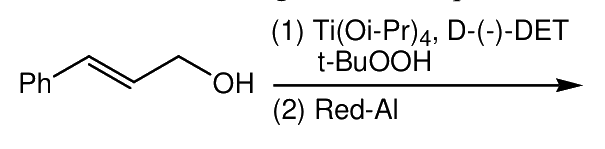
The major product formed in the following reaction sequence is
$$\text{Ph} \sim \sim \text{OH} \xrightarrow[(2)\text{ Red-Al}]{(1)\text{ Ti(Oi-Pr)}_4, \text{ D-(-)-DET, } t\text{-BuOOH}}$$
Correct Answer & Step-by-Step Solution Locked
Sign in free to reveal the correct answer and AI explanation for this question.
Given below are the bond dissociation energy ($\text{BDE; kJ}\text{ mol}^{-1}$) values. Based on the data, the correct statement about the following equilibrium is
a.
A is more stable than B by $70\text{ kJ mol}^{-1}$
b.
A is more stable than B by $130\text{ kJ mol}^{-1}$
c.
B is more stable than A by $70\text{ kJ mol}^{-1}$
d.
B is more stable than A by $130\text{ kJ mol}^{-1}$
Correct Answer & Step-by-Step Solution Locked
Sign in free to reveal the correct answer and AI explanation for this question.
The correct match for the molecules given in Column-P with the spectral data given in Column Q is
\begin{tabular}{ll}
\textbf{Column-P} & \textbf{Column-Q} \\
(A) Ethyl acetate & (I) Two singlets in $^{1}\text{H NMR}$ \\
(B) 2-chloropentane & (II) Peak intensity at $\text{M}:(\text{M} + 2)$ is $3:1$ in EI-MS \\
(C) 1, 2-dibromo-2-methylpropane & (III) Absorption band at $1740\text{ cm}^{-1}$ in IR
\end{tabular}
a.
A-III, B-I, C-II
b.
A-I, B-III, C-II
c.
A-II, B-III, C-I
d.
A-III, B-II, C-I
Correct Answer & Step-by-Step Solution Locked
Sign in free to reveal the correct answer and AI explanation for this question.
1 mole of $^{16}\text{O}_2$ and 1 mole of $^{18}\text{O}_2$ in two different containers of the same volume have the same entropy. Assuming there are no rotational and vibrational contributions to the entropy, if the temperature of $^{16}\text{O}_2$ is $300\text{ K}$ what is the temperature of $^{18}\text{O}_2$ in K?
a.
37.54
b.
300.10
c.
266.66
d.
273.48
Correct Answer & Step-by-Step Solution Locked
Sign in free to reveal the correct answer and AI explanation for this question.
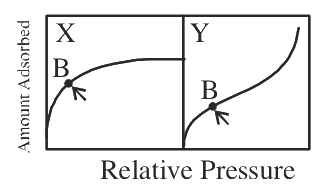
Which of the following statement/s corresponding to the accompanying figures displaying isotherms is/are corect?
(A) Figure X represents an isotherm of type II and point B shows near complete coverage of the surface
(B) Figure Y represents an isotherm of type II and point B shows near complete coverage of the surface
(C) Figure X represents an isotherm of type I and point B shows near complete coverage of the surface
(D) Figure Y represents an isotherm of type III and point B shows beginning of the multilayer formation.
a.
Only statement D is correct
b.
Statements C and D are correct
c.
Statements B and C are correct
d.
Statements A and B are correct.
Correct Answer & Step-by-Step Solution Locked
Sign in free to reveal the correct answer and AI explanation for this question.
The partition function for a gas is given by
$$Q(N,V,T) = \frac{1}{N!}\left(\frac{2\pi m}{h^2\beta}\right)^{3N/2}(V-Nb)^N e^{\frac{\beta a N^2}{V}}$$
The internal energy of the gas is
a.
$\frac{3}{2}Nk_BT + \frac{2aN}{V}$
b.
$\frac{1}{2}Nk_BT - \frac{aN^2}{V}$
c.
$\frac{3}{2}Nk_BT - \frac{aN^2}{V}$
d.
$\frac{3}{2}NRT - \frac{2aN}{V}$
Correct Answer & Step-by-Step Solution Locked
Sign in free to reveal the correct answer and AI explanation for this question.
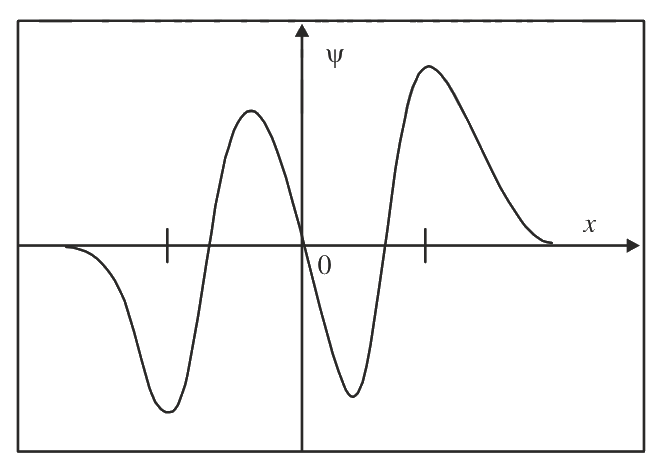
For a particle exhibiting simple harmonic motion in 1-dimension, the uncertainty in its position in the state having the following schematic wave function is (zero point energy, $E_0 = \frac{1}{2}\hbar\omega$ )
a.
$\frac{7E_0}{k}$
b.
$\sqrt{\frac{14E_0}{k}}$
c.
$\frac{14E_0}{k}$
d.
$\sqrt{\frac{7E_0}{k}}$
Correct Answer & Step-by-Step Solution Locked
Sign in free to reveal the correct answer and AI explanation for this question.
For a C–H bond with a stretching frequency $3000\text{ cm}^{-1}$, what is the expected isotope (deuterium) effect $k_{\text{H}}/k_{\text{D}}$ at $298\text{ K}$ for a full bond homolysis? Given: $h = 6.63\times 10^{-34}\text{ Js}$, $c = 3\times 10^{10}\text{ cm/s}$, $k_{\text{B}} = 1.38\times 10^{-23}\text{ J/K}$.
a.
$e$
b.
$1$
c.
$e^4$
d.
$e^2$
Correct Answer & Step-by-Step Solution Locked
Sign in free to reveal the correct answer and AI explanation for this question.
A protein has 3 tyrosine residues and ‘n’ tryptophan residues both of which are the only amino acids absorbing at 280 nm. If the absorbance of the protein having a concentration of $10\mu\text{M}$ (in a cuvette of path length 2 cm) is 0.59, the number of tryptophan residues in the protein must be
[Given: $\varepsilon_{280}\text{ (Tyrosine)} = 1500\text{ M}^{-1}\text{cm}^{-1}$; $\varepsilon_{280}\text{ (Tryptophan)} = 5000\text{ M}^{-1}\text{cm}^{-1}$]
a.
11
b.
5
c.
2
d.
7
Correct Answer & Step-by-Step Solution Locked
Sign in free to reveal the correct answer and AI explanation for this question.
What is the cell potential (in V) at 298K and 1 bar for the following cell?
$$\text{Zn}(s)|\text{ZnBr}_2(aq, 0.20\text{ mol}/\text{kg})||\text{AgBr}(s)|\text{Ag}(s)|\text{Cu}$$
(Given: $E^0_{\text{Zn}^{+2}/\text{Zn}} = -0.762\text{ V}$, $E^0_{\text{AgBr}/\text{Ag}} = +0.730\text{ V}$ and assuming $\gamma_\pm$ of $\text{ZnBr}_2$ solution $= 0.462$)?
a.
0.298
b.
2.198
c.
0.531
d.
1.566
Correct Answer & Step-by-Step Solution Locked
Sign in free to reveal the correct answer and AI explanation for this question.
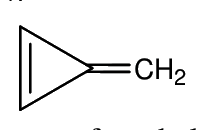
For the molecule methylenecyclopropene (structure given below), the roots obtained from the Huckel secular determinant can be approximated as $x = -2.0, -0.30, +1.0, +1.5$, where $x = \frac{\alpha - E}{\beta}$, with $E$ being the energy of a $\pi$ orbital.
The delocalization energy of methylenecyclopropene is:
[Given: the energy of the ground state $\pi$ orbital of ethyelene is $E = \alpha + \beta$]
a.
$2\alpha + 2.6\beta$
b.
$-(2\alpha + 1.7\beta)$
c.
$0.6\beta$
d.
$0.3\beta$
Correct Answer & Step-by-Step Solution Locked
Sign in free to reveal the correct answer and AI explanation for this question.
A symmetric top molecule with moments of inertia $I_x = I_y$ and $I_z$ in the body-fixed axes is described by the Hamiltonian $H = \frac{1}{2I_x}(L_x^2 + L_y^2) + \frac{1}{2I_z}L_z^2$, the eigenvalues for the levels with quantum numbers $\ell = 1, m_\ell = 1$ and $\ell = 1, m_\ell = 0$ are, respectively.
a.
$\frac{3\hbar^2}{2}$ and $-\hbar^2$
b.
$\hbar^2$ and $-\hbar^2$
c.
$\frac{3\hbar^2}{2}$ and $\hbar^2$
d.
$-\hbar^2$ and $\hbar^2$
Correct Answer & Step-by-Step Solution Locked
Sign in free to reveal the correct answer and AI explanation for this question.
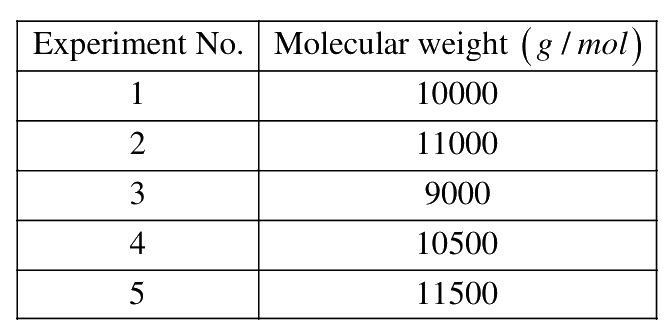
The molecular weight of polyethene determined in five individual experiments is given below:
\begin{tabular}{|c|c|}
\hline
Experiment No. & Molecular weight ($g/mol$) \\
\hline
1 & 10000 \\
\hline
2 & 11000 \\
\hline
3 & 9000 \\
\hline
4 & 10500 \\
\hline
5 & 11500 \\
\hline
\end{tabular}
The standard deviations in the above measurements is closest to
a.
$850\text{ g/mol}$
b.
$2000\text{ g/mol}$
c.
$1600\text{ g/mol}$
d.
$500\text{ g/mol}$
Correct Answer & Step-by-Step Solution Locked
Sign in free to reveal the correct answer and AI explanation for this question.
Given below is a conjugated system of 11 carbon atoms
Assume the average C-C bond length to be $1.5\text{ \AA}$ and treat the system as a 1-dimensional box. The frequency of radiation required to cause a transition from the ground state of the system to the first excited state (take $\frac{h^2}{8m} = k$) is
a.
$\frac{13}{225} \frac{k}{h}$
b.
$\frac{11}{225} \frac{k}{h}$
c.
$\frac{9}{225} \frac{k}{h}$
d.
$\frac{7}{225} \frac{k}{h}$
Correct Answer & Step-by-Step Solution Locked
Sign in free to reveal the correct answer and AI explanation for this question.
The Gibbs free energy of mixing for a regular binary solution of components A and B, at temperature T, on the basis of the Margules equation for activity coefficient, is (in standard notation)
The effective rate constants for a gaseous unimolecular reaction:
$A \rightarrow P$ following the Lindemann-Hinshelwood mechanism are $1.70\times 10^{-3} \text{ s}^{-1}$ and $2.20\times 10^{-4} \text{ s}^{-1}$ at $[A] = 4.37\times 10^{-4} \text{ mol dm}^{-3}$ and $1.00\times 10^{-5} \text{ mol dm}^{-3}$, respectively. The rate constant for the activation step in the mechanism is approximately equal to (in $\text{dm}^3\text{mol}^{-1}\text{s}^{-1}$)
a.
12.3
b.
49.4
c.
6.1
d.
24.7
Correct Answer & Step-by-Step Solution Locked
Sign in free to reveal the correct answer and AI explanation for this question.
Six distinguishable particles are distributed over 3 non-degenerate levels, of energies $0$, $\varepsilon$ and $2\varepsilon$. The most probable value for the total energy is
a.
$5\varepsilon$
b.
$7\varepsilon$
c.
$8\varepsilon$
d.
$6\varepsilon$
Correct Answer & Step-by-Step Solution Locked
Sign in free to reveal the correct answer and AI explanation for this question.
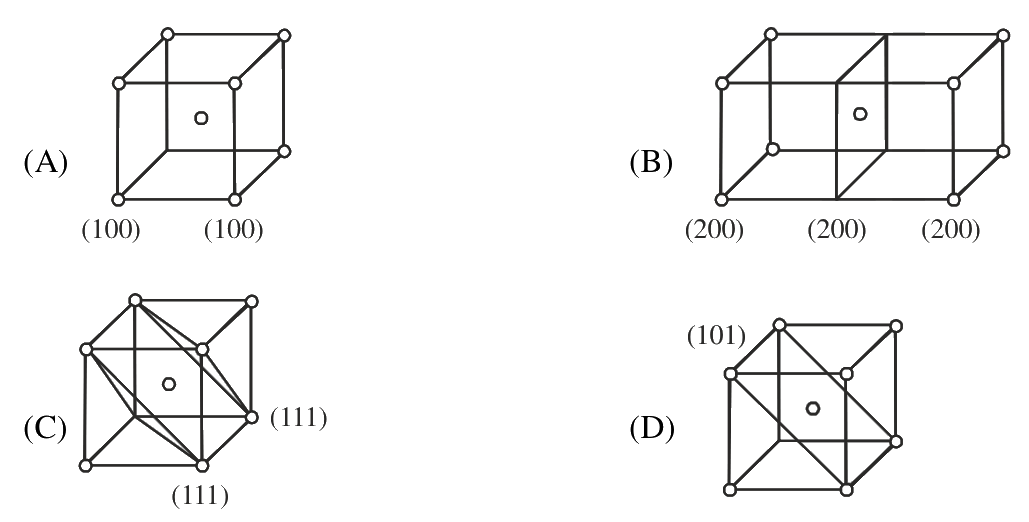
The lattice structure of $\alpha\text{-Fe}$ (BCC) with some lattice planes are shown in the figure.
The planes that will not show X-ray reflections are
a.
A and D
b.
A and C
c.
B and C
d.
C and D
Correct Answer & Step-by-Step Solution Locked
Sign in free to reveal the correct answer and AI explanation for this question.
Carbonic anhydrase ($2.5\times 10^{-9} \text{ mol dm}^{-3}$) catalyses hydration of $\text{CO}_2$ in red blood cells at pH 7.1 and 274 K. The rate of the reaction, $v$ (in $\text{mol dm}^{-3} \text{ s}^{-1}$) reaches its maximum value when varied with the substrate (S) concentration (in $\text{mmol dm}^{-3}$) according to the following equation
$$\frac{1}{v} = 4\left\{1 + \frac{10}{[S]_0}\right\}$$
The catalytic efficiency of the enzyme (in $\text{dm}^3\text{mol}^{-1}\text{s}^{-1}$) is
a.
$4\times 10^5$
b.
$10^6$
c.
$10^7$
d.
$10^4$
Correct Answer & Step-by-Step Solution Locked
Sign in free to reveal the correct answer and AI explanation for this question.
In the reaction between two ions, the rate constant is $k_r$ when the ionic strength ($I$) is 0.004. And the rate constant is $k_r^0$ when the activity coefficient is 1. The ratio $k_r / k_r^0 = 0.884$. If the charge of one ion is $+1$, the charge of other ion is close to
(Debye-Huckel constant = 0.509 at 298K; $\log 0.884 = -0.05$)
a.
$-1.554$
b.
$-1.395$
c.
$-0.777$
d.
$-0.389$
Correct Answer & Step-by-Step Solution Locked
Sign in free to reveal the correct answer and AI explanation for this question.
The vibrational energy of the $\text{n}^{\text{th}}$ state of $\text{HCl}$ is approximately given as
$$G(n) = 3000\left(n + \frac{1}{2}\right) - 50\left(n + \frac{1}{2}\right)^2 \quad (\text{in cm}^{-1})$$
The vibrational quantum number, $\text{n}_{\max}$, beyond which $\text{HCl}$ undergoes dissociation is
a.
29
b.
59
c.
119
d.
19
Correct Answer & Step-by-Step Solution Locked
Sign in free to reveal the correct answer and AI explanation for this question.
The state of an electron in a hydrogenic atom is given by the un-normalised wavefunction.
$$\Phi = \left\{ Y_{10}(\theta, \phi) + \frac{1}{\sqrt{2}} Y_{11}(\theta, \phi) \right\} R(r)$$
where $Y_{\ell m}(\theta, \phi)$ are spherical harmonics and $R(r)$ is the radial function. The probability that a measurement of $\text{L}_z$ will give an eigenvalue of $\hbar$ is
a.
$1/2$
b.
$\frac{1}{\sqrt{2}}$
c.
$1/3$
d.
$\frac{1}{\sqrt{3}}$
Correct Answer & Step-by-Step Solution Locked
Sign in free to reveal the correct answer and AI explanation for this question.