The reaction of $\text{XeF}_6$ with a limited amount of quartz gives compound A. Then on reaction with an equivalent amount of $\text{XeO}_3$, A gives B. The products A and B are, respectively.
a.
$\text{XeOF}_2$ and $\text{XeO}_2\text{F}_2$
b.
$\text{XeOF}_4$ and $\text{XeO}_2\text{F}_2$
c.
$\text{XeOF}_2$ and $\text{XeOF}_4$
d.
$\text{XeO}_2\text{F}_2$ and $\text{XeOF}_4$
Step-by-Step AI Explanation
Verified Method
Reaction of $\text{XeF}_6$ with quartz (a limited amount of $\text{SiO}_2$) yields xenon oxytetrafluoride:
$$2\text{XeF}_6 + \text{SiO}_2 \longrightarrow 2\text{XeOF}_4\text{ (A)} + \text{SiF}_4$$
Subsequent reaction of $\text{XeOF}_4$ with an equivalent amount of $\text{XeO}_3$ yields xenon dioxydifluoride:
$$\text{XeOF}_4 + \text{XeO}_3 \longrightarrow 2\text{XeO}_2\text{F}_2\text{ (B)}$$
Thus, A is $\text{XeOF}_4$ and B is $\text{XeO}_2\text{F}_2$.
Q1mcq
For the given reaction,
$$[{}^*\mathrm{Co(L)}_n]^{2+} + [\mathrm{Co(L)}_n]^{3+} \longrightarrow [{}^*\mathrm{Co(L)}_n]^{3+} + [\mathrm{Co(L)}_n]^{2+}$$
the correct statement with respect to the rate of electron transfer process is
$o$-phen = $o$-phenanthroline; ${}^*\mathrm{Co}$ is labeled atom.
a.
fast electron transfer; $\mathrm{L = NH_3}$; $\mathrm{n = 6}$
b.
slow electron transfer; $\mathrm{L} = o\text{-phen}$; $\mathrm{n = 3}$
c.
very slow electron transfer; $\mathrm{L = NH_3}$; $\mathrm{n = 6}$
d.
very slow electron transfer; $\mathrm{L} = o\text{-phen}$; $\mathrm{n = 3}$
No explanation saved for this question yet.
Q2mcq
The geometry/shape of the $\text{Fe}_4$ core of the cluster $[\text{Fe}_4\text{C}(\text{CO})_{12}]^{2-}$ is
a.
tetrahedron
b.
square pyramid
c.
butterfly
d.
trigonal bipyramid
Step-by-Step AI Explanation
Verified Method
Using Wade-Mingos rules for the cluster $[\text{Fe}_4\text{C}(\text{CO})_{12}]^{2-}$:
Total valence electrons (TVE) = $4 \times 8\text{ (Fe)} + 4\text{ (C)} + 12 \times 2\text{ (CO)} + 2\text{ (charge)} = 32 + 4 + 24 + 2 = 62$.
For a tetranuclear cluster:
- $n = 4$
- TVE $= 60$ corresponds to a tetrahedron (closo, 6 skeletal pairs).
- TVE $= 62$ corresponds to an arachno structure with 4 vertices, which is a butterfly (an edge-opened tetrahedron).
Q2mcq
Correct statement(s) among the following with respect to ionization energy (IE) is/are
(i) $(\mathrm{IE}_1 + \mathrm{IE}_2 + \mathrm{IE}_3)$ for indium is more than that of aluminium
(ii) $\mathrm{IE}_1$ of scandium is higher than that of cobalt
(iii) $\mathrm{IE}_1$ of gallium is lower than that of selenium
(iv) $\mathrm{IE}_1$ of nitrogen is greater than that of oxygen
a.
(ii) and (iv)
b.
(iii) and (iv)
c.
(i) and (iv)
d.
(ii) and (iii)
Step-by-Step AI Explanation
Verified Method
Statement (iii): Along a period, ionization energy generally increases; Ga (Group 13) has a significantly lower first ionization energy ($579\text{ kJ/mol}$) than Se (Group 16, $941\text{ kJ/mol}$). Thus, statement (iii) is correct.
Statement (iv): Nitrogen has a stable, exactly half-filled $2p^3$ subshell, so its $\mathrm{IE}_1$ ($1402\text{ kJ/mol}$) is greater than that of oxygen ($1314\text{ kJ/mol}$), which has a $2p^4$ configuration where electron-electron pairing repulsion lowers $\mathrm{IE}_1$. Thus, statement (iv) is correct.
Statements (i) and (ii) are incorrect, making (iii) and (iv) the correct pair.
Q3mcq
The energies of interaction for (i) ion pair, (ii) ion-dipole, and (iii) dipole-dipole interactions are inversely proportional to
a.
$r$, $r^2$ and $r^3$ respectively
b.
$r^2$, $r$ and $r^3$ respectively
c.
$r$, $r^2$ and $r^6$ respectively
d.
$r^2$, $r$ and $r^6$ respectively
Step-by-Step AI Explanation
Verified Method
Based on classical electrostatics:
(i) Ion–ion (ion pair) interaction energy is governed by Coulomb's law and is proportional to $1/r$.
(ii) Ion–dipole interaction energy is proportional to $1/r^2$.
(iii) Stationary dipole–dipole interaction energy is proportional to $1/r^3$.
Therefore, the interaction energies are inversely proportional to $r$, $r^2$, and $r^3$, respectively.
Q3mcq
Correct statement for ‘Inductively Coupled Plasma Atomic Emission Spectroscopy’ is
a.
It is unsuitable for all non-metals
b.
Simultaneous determination of only metals is possible
c.
Induction coil stabilizes plasma
d.
Oxide formation lowers atomization of metals.
Step-by-Step AI Explanation
Verified Method
In Inductively Coupled Plasma Atomic Emission Spectroscopy (ICP-AES), the radiofrequency (RF) induction coil generates a time-varying magnetic field that couples energy into the argon gas, sustaining and stabilizing the high-temperature plasma. The other options are incorrect: ICP can determine many non-metals (e.g., P, S, halogens), simultaneous multielement analysis includes metalloids/non-metals, and the extremely high plasma temperature ($6000–10000\text{ K}$) effectively prevents oxide formation and ensures complete atomization.
Q4mcq
During the binding of $\mathrm{O}_2$ to myoglobin (consider ‘heme’ in xy-plane), the molecular orbital of $\mathrm{O}_2$ and atomic orbital of $\mathrm{Fe}$ involved in the formation of the $\sigma$-bond is
a.
$\pi^*$ and $\mathrm{d}_{z^2}$
b.
$\pi^*$ and $\mathrm{d}_{xz}$
c.
$\pi$ and $\mathrm{d}_{xz}$
d.
$\pi$ and $\mathrm{d}_{z^2}$
Step-by-Step AI Explanation
Verified Method
With the heme porphyrin ring situated in the $xy$-plane, the axial coordination sites lie along the $z$-axis. The vacant or partially occupied iron atomic orbital oriented along this axis is $\mathrm{d}_{z^2}$. In the bent $\text{Fe}-\text{O}_2$ complex, $\mathrm{O}_2$ coordinates in an end-on fashion using its singly occupied $\pi^*$ antibonding molecular orbital to donate electron density into/form a $\sigma$-type bond with the $\mathrm{Fe}(\mathrm{d}_{z^2})$ orbital. Thus, the $\sigma$-bond is formed between the $\pi^*$ orbital of $\mathrm{O}_2$ and the $\mathrm{d}_{z^2}$ orbital of iron.
Q4mcq
The correct electronic configuration of frontier MO's of $Mn(\eta^5\text{-C}_5\text{Me}_5)_2$ is
a.
$e_{2g}^2 a_{1g}^1 e_{1g}^2$
b.
$e_{2g}^4 a_{1g}^1$
c.
$e_{2g}^3 a_{1g}^2$
d.
$a_{1g}^2 e_{2g}^3$
Step-by-Step AI Explanation
Verified Method
Decamethylmanganocene, $\mathrm{Mn}(\eta^5\text{-C}_5\text{Me}_5)_2$, is a low-spin $d^5$ 17-electron metallocene because the permethylated rings ($ ext{Cp}^*$) provide a stronger ligand field than unsubstituted $\text{Cp}$. In metallocenes ($D_{5d}/D_{5h}$ symmetry), the metal $d$-orbitals split into $a_{1g} (d_{z^2})$, $e_{2g} (d_{x^2-y^2}, d_{xy})$, and $e_{1g}^* (d_{xz}, d_{yz})$. Due to ring methylation and steric/electronic effects in $\text{MnCp}^*_2$, the ground-state low-spin configuration is $^2E_{2g}$, corresponding to the electronic configuration $a_{1g}^2 e_{2g}^3$ (often written as $e_{2g}^3 a_{1g}^2$).
Q5mcq
The pair of compounds in which both members show LMCT band in their electronic spectra is
a.
$[\mathrm{FeCl}_4]^{2-}$ and $[\mathrm{Fe(bpy)}_3]^{2+}$
b.
$[\mathrm{FeBr}_4]^{2-}$ and $[\mathrm{TcO}_4]^-$
c.
$[\mathrm{ReO}_4]^-$ and $[\mathrm{Ru(bpy)}_3]^{2+}$
d.
$[\mathrm{Fe(phen)}_3]^{2-}$ and $[\mathrm{FeCl}_4]^{2-}$
No explanation saved for this question yet.
Q5mcq
The correct match for Column-A with Column-B is
\begin{tabular}{ll}
\textbf{Column-A} & \textbf{Column-B} \\
(A) $f \not\to f$ transition & (i) $\text{Tb}^{3+}$ \\
(B) ${}^5D_0 \to {}^7F_n$ emission & (ii) $\text{Lu}^{3+}$ \\
(C) ${}^5D_4 \to {}^7F_n$ emission & (iii) $\text{Sm}^{3+}$ \\
(D) Overlapping J levels & (iv) $\text{Eu}^{3+}$
\end{tabular}
(A) $\text{Lu}^{3+}$ has a completely filled $4f^{14}$ shell, so $f \to f$ transitions are not possible ($f \not\to f$).
(B) $\text{Eu}^{3+}$ ($4f^6$) shows characteristic luminescence corresponding to ${}^5D_0 \to {}^7F_n$ transitions (red emission).
(C) $\text{Tb}^{3+}$ ($4f^8$) shows characteristic luminescence corresponding to ${}^5D_4 \to {}^7F_n$ transitions (green emission).
(D) $\text{Sm}^{3+}$ and $\text{Eu}^{3+}$ have low-lying excited $J$-levels where the energy gap is comparable to $k_B T$, leading to populated/overlapping $J$ levels at room temperature.
Therefore, the correct match is (A)-(ii), (B)-(iv), (C)-(i), (D)-(iii).
🎉 10 Free Sample Solutions Completed
Unlock All 100 Questions & Solutions
Sign up free in seconds to unlock step-by-step AI answers for the remaining 90 questions.
On heating $[\text{Mo}(\text{N}_2)_2(\text{PMe}_2\text{Ph})_4]$ and $[\text{ReCl}(\text{N}_2)(\text{PMe}_2\text{Ph})_4]$, the products formed are respectively
a.
$[(\eta^6\text{-PhPMe}_2)\text{Mo}(\text{PMe}_2\text{Ph})_3]$ and $[(\eta^6\text{-PhPMe}_2)\text{Re}(\text{PMe}_2\text{Ph})_3]\text{Cl}$
b.
$[(\text{PMe}_2\text{Ph})_4\text{Mo}(\mu\text{-N}_2)_2\text{Mo}(\text{PMe}_2\text{Ph})_4]$ and $[(\text{PMe}_2\text{Ph})_4\text{Re}(\mu\text{-Cl})_2\text{Re}(\text{PMe}_2\text{Ph})_4]$
c.
$[(\eta^6\text{-PhPMe}_2)\text{Mo}(\text{PMe}_2\text{Ph})_3]$ and $[(\text{PMe}_2\text{Ph})_4\text{Re}(\mu\text{-Cl})_2\text{Re}(\text{PMe}_2\text{Ph})_4]$
d.
$[(\text{PMe}_2\text{Ph})_4\text{Mo}(\mu\text{-N}_2)_2\text{Mo}(\text{PMe}_2\text{Ph})_4]$ and $[(\eta^6\text{-PhPMe}_2)\text{Re}(\text{PMe}_2\text{Ph})_3]\text{Cl}$
Correct Answer & Step-by-Step Solution Locked
Sign in free to reveal the correct answer and AI explanation for this question.
Consider the following statements for Allred-Rochow electronegativity ($\chi_{\text{AR}}$):
(I) $\chi_{\text{AR}}$ is directly proportional to $Z_{\text{eff}}$.
(II) $\chi_{\text{AR}}$ is inversely proportional to $Z_{\text{eff}}$.
(III) $\chi_{\text{AR}}$ is inversely proportional to $r(\text{covalent})$
(IV) $\chi_{\text{AR}}$ is inversely proportional to $r^2(\text{covalent})$
The correct statements are
a.
(I) and (IV)
b.
(II) and (IV)
c.
(I) and (III)
d.
(II) and (III)
Correct Answer & Step-by-Step Solution Locked
Sign in free to reveal the correct answer and AI explanation for this question.
Among the following complexes, the one showing the highest rate of substitution of a $\text{CO}$ ligand on heating with one equivalent of $\text{PPh}_3$ in decalin, is
In the following sequence of reactions the correct (P), (Q) and (R) are respectively
$$\underset{\text{in dil. AcOH}}{\textbf{(P)}} \xrightarrow[\text{thiourea}]{\text{solid}} \text{N}_2\text{ gas}\!\uparrow + \text{ Solution} \xrightarrow{\text{dil. }\text{FeCl}_3} \underset{\text{blood red}}{\textbf{(Q)}} \text{ soln.} \xrightarrow{\text{dil. }\text{HgCl}_2} \underset{\text{Colourless}}{\textbf{(R)}}$$
The value of magnetic moment will be independent of temperature for ($\text{acac} = \text{acetylacetonato}$; $\text{OAc} = \text{acetate}$; $o\text{-phen} = o\text{-phenanthroline}$; $\text{Pz} = \text{pyrazolyl}$)
$\text{I}_2$ is violet in the solid as well as in gas phase. However in acetone or ethanol, it turns brown. Choose the correct statement(s) for this colour change:
(A) Dissociation of $\text{I}_2$ in atomic state.
(B) Interaction of low-lying $\sigma^*$-orbital of iodine with lone pair of $\text{O}$ (solvent)
(C) Formation of a charge-transfer complex.
a.
(A) only
b.
(B) only
c.
(A) and (B) only
d.
(B) and (C) only
Correct Answer & Step-by-Step Solution Locked
Sign in free to reveal the correct answer and AI explanation for this question.
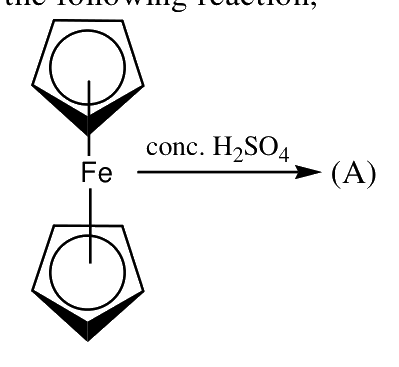
The infrared (IR) spectrum of the product (A) for the following reaction,
shows three STRONG bands at 1986, 1935 and $1601\text{ cm}^{-1}$. The correct structure of 'A' is
Correct Answer & Step-by-Step Solution Locked
Sign in free to reveal the correct answer and AI explanation for this question.
Thermometric titration gives best results when
(A) $|\Delta\text{H}|$ is high
(B) $\Delta\text{G} < 0$
(C) Heat of mixing of titrant with titrand is high
(D) Titrant is used as dilute solution
The answer is
a.
A and B
b.
B and C
c.
C and D
d.
A and D
Correct Answer & Step-by-Step Solution Locked
Sign in free to reveal the correct answer and AI explanation for this question.
The products (A) and (B) for the given reaction
$$[\text{Co}(\text{NH}_3)_5\text{Cl}]^{2+} + [\text{Cr}(\text{OH}_2)_6]^{2+} + 5\text{H}_3\text{O}^+ \longrightarrow (\text{A}) + (\text{B})$$
are, respectively
In the catalytic cycle of Cytochrome P450, the generation of $[(\text{porphyrin})^{+\bullet} \text{Fe}^{\text{IV}}(\text{O})]$ from $[(\text{porphyrin})\text{Fe}^{\text{III}}(\text{OOH})]$ involves
a.
one electron oxidation of $[(\text{porphyrin})\text{Fe}^{\text{III}}(\text{OOH})]$
b.
formation of the intermediate $[(\text{porphyrin})\text{Fe}^{\text{IV}}(\text{OH})]$
c.
homolytic $\text{O}-\text{O}$ cleavage of $[(\text{porphyrin})\text{Fe}^{\text{IV}}(\text{OOH})]$
d.
heterolytic $\text{O}-\text{O}$ cleavage of $[(\text{porphyrin})\text{Fe}^{\text{III}}(\text{OOH})]$
Correct Answer & Step-by-Step Solution Locked
Sign in free to reveal the correct answer and AI explanation for this question.
The number of expected electronic transitions in $[\text{Cr}(\text{en})_3]^{3+}$ and $\text{trans-}[\text{Cr}(\text{en})_2\text{F}_2]^+$ at $4\text{ K}$ is, respectively ($\text{en}=\text{ethylenediamine}$)
a.
$3$ and $3$
b.
$3$ and $4$
c.
$3$ and $5$
d.
$3$ and $6$
Correct Answer & Step-by-Step Solution Locked
Sign in free to reveal the correct answer and AI explanation for this question.
Choose the correct statement(s) for the group 15 halides
(I) $\text{AsCl}_3$ can form complexes of type $[\text{AsCl}_4]^-$ in the presence of a chloride source.
(II) $\text{PF}_3$ acts as a strong $\sigma$-donor ligand towards d-metals
(III) In the solid state, $\text{SbF}_5$ has a trigonal bipyramidal structure
(IV) The reaction of $\text{SbF}_5$ with anhdrous $\text{HF}$ generates $[\text{H}_2\text{F}]^+$ ions
a.
(I) and (IV)
b.
(II), (III) and (IV)
c.
(I), (III) and (IV)
d.
(II) and (III)
Correct Answer & Step-by-Step Solution Locked
Sign in free to reveal the correct answer and AI explanation for this question.
The number of peaks with relative intensities observed in the $^1\text{H}$ NMR spectra of $[(\text{Cp})_2\text{Fe}(\text{CO})_2]$ at $+30^\circ\text{C}$ and $-80\ ^\circ\text{C}$ in diethyl ether are respectively,
a.
two peaks ($1 : 1$) and four peaks ($5 : 2 : 2 : 1$)
b.
One peak and two peaks ($1 : 1$)
c.
two peaks ($1 : 1$) at both the temperatures
d.
one peak and four peaks ($5 : 2 : 2 : 1$)
Correct Answer & Step-by-Step Solution Locked
Sign in free to reveal the correct answer and AI explanation for this question.
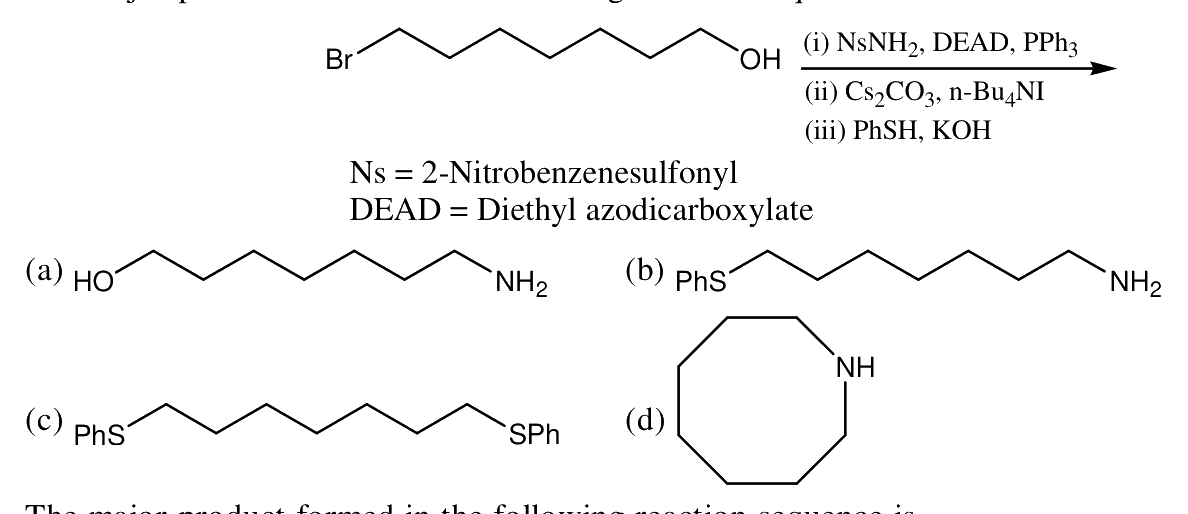
The major product formed in the following reaction sequene is
$\text{Ns} = \text{2-Nitrobenzenesulfonyl}$
$\text{DEAD} = \text{Diethyl azodicarboxylate}$
a.
(a)
b.
(b)
c.
(c)
d.
(d)
Correct Answer & Step-by-Step Solution Locked
Sign in free to reveal the correct answer and AI explanation for this question.
For the reaction, $\text{N}_2(\text{g}) + 3\text{H}_2(\text{g}) \longrightarrow 2\text{NH}_3(\text{g})$, the thermodynamic quantity which depends upon the pressure at which equilibrium is arrived at is (superscript 'o' represents standard state)
a.
$\Delta\text{G}^0$
b.
$\Delta\text{H}^0$
c.
$\text{K}_\text{p}$
d.
ratio of mole fractions, $\frac{x_{\text{NH}_3}^2}{x_{\text{N}_2}x_{\text{H}_2}^3}$, at equilibrium
Correct Answer & Step-by-Step Solution Locked
Sign in free to reveal the correct answer and AI explanation for this question.
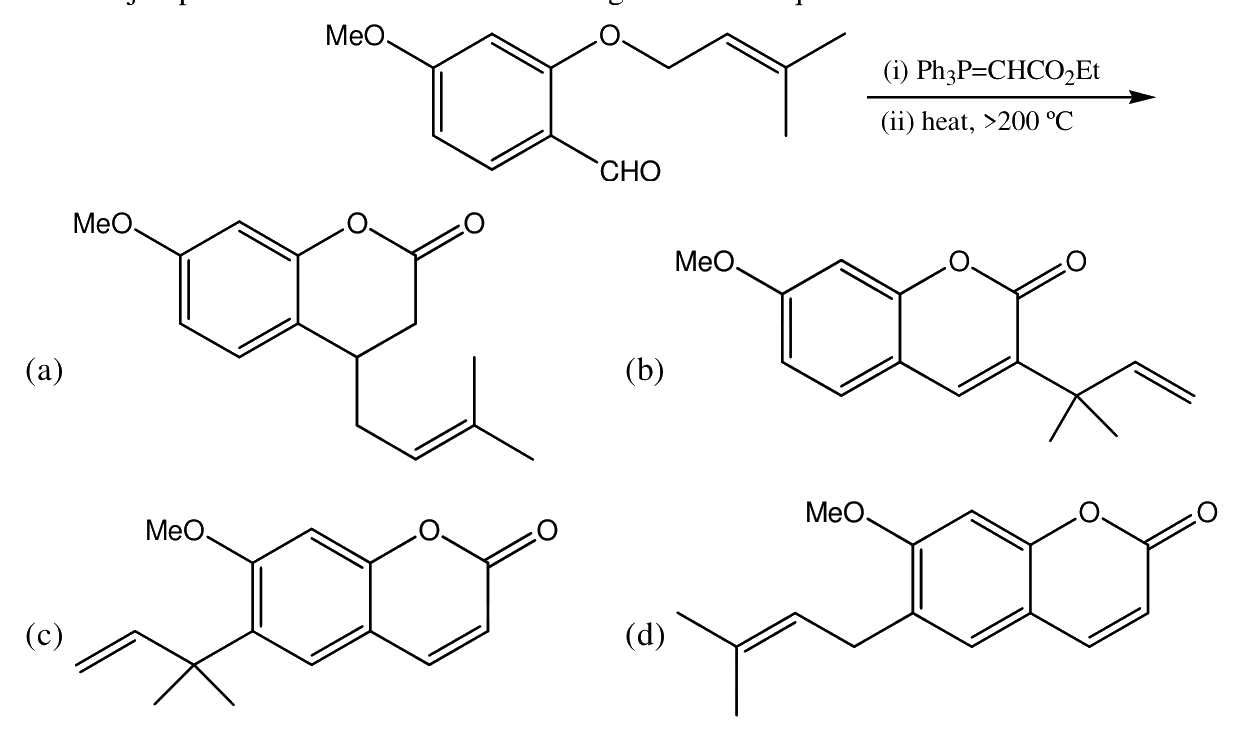
The major product formed in the following reaction is
$\text{TBSOTf} = \text{t-Butyldimethylsilyl triflate}$
$\text{TBAF} = \text{tetra-n-butylammonium fluoride}$
a.
(a)
b.
(b)
c.
(c)
d.
(d)
Correct Answer & Step-by-Step Solution Locked
Sign in free to reveal the correct answer and AI explanation for this question.
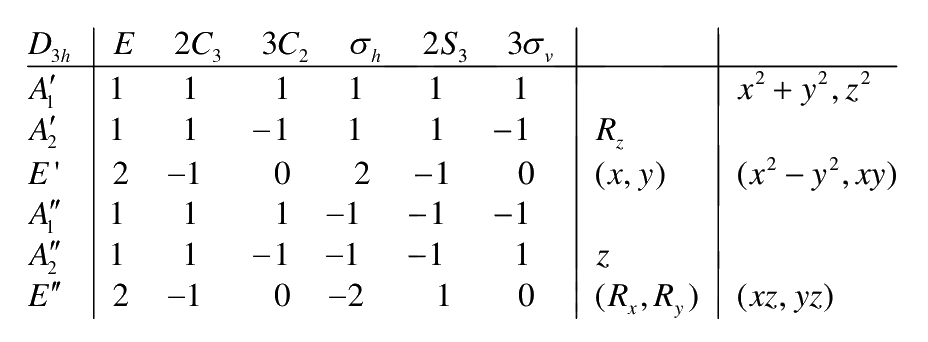
The following is the character TABLE for the $\text{C}_{2\text{v}}$ point group
There are two functions $f_1$ and $f_2$ belonging to $A_2$ and $B_1$ representations, respectively. The correct option for the product of two functions $f_1$ and $f_2$ and the integral $\int f_1 f_2 \text{d}\tau$ is
a.
The product belongs to $\text{A}_2$ representation and the integral is non-zero
b.
The product belongs to $\text{B}_2$ representation and the integral is zero
c.
The product belongs to $\text{A}_1$ representation and the integral is zero
d.
The product belongs to $\text{B}_1$ representation and the integral is non-zero.
Correct Answer & Step-by-Step Solution Locked
Sign in free to reveal the correct answer and AI explanation for this question.
For a reaction, raising the temperature from $200\text{K}$ to $300\text{K}$ results in the increase of rate constant by a factor of 2. The activation energy for this reaction in $\text{kJ mol}^{-1}$ is closest to ($\ln 2 = 0.69$)
a.
7.0
b.
3.5
c.
14.0
d.
0.83
Correct Answer & Step-by-Step Solution Locked
Sign in free to reveal the correct answer and AI explanation for this question.
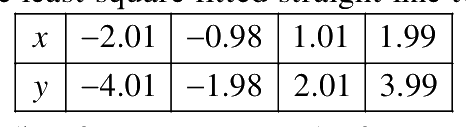
The y-intercept of the least square fitted straight line to the data in the table is closest to
$$\begin{array}{|c|c|c|c|c|} \hline x & -2.01 & -0.98 & 1.01 & 1.99 \\ \hline y & -4.01 & -1.98 & 2.01 & 3.99 \\ \hline \end{array}$$
a.
$-0.2$
b.
$-0.1$
c.
$0$
d.
$0.2$
Correct Answer & Step-by-Step Solution Locked
Sign in free to reveal the correct answer and AI explanation for this question.
The equilibrium dissociation eneryg of a diatomic molecule is $4.75\text{ eV}$ and its stretching frequency corresponds to $0.5\text{ eV}$. The minimum energy required to dissociate the mmolecule in $\text{eV}$ is
a.
$4.75$
b.
$4.25$
c.
$4.50$
d.
$5.00$
Correct Answer & Step-by-Step Solution Locked
Sign in free to reveal the correct answer and AI explanation for this question.
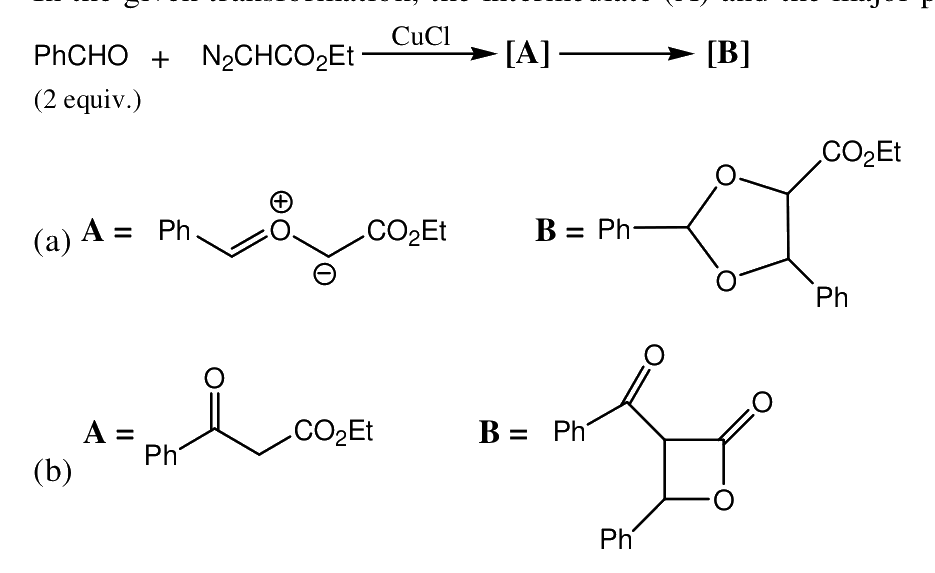
In the given transformation, the intermediate (A) and the major product (B) are
$$\underset{(2\text{ equiv.})}{\text{PhCHO}} + \text{N}_2\text{CHCO}_2\text{Et} \xrightarrow{\text{CuCl}} [\textbf{A}] \longrightarrow [\textbf{B}]$$
Correct Answer & Step-by-Step Solution Locked
Sign in free to reveal the correct answer and AI explanation for this question.
A monatomic perfect gas undergoes expansion from $(p_1, V_1)$ to $(p_2, V_2)$ under isothermal or adiabatic conditions. The pressure of the gas will fall more rapidly under adibatic conditions because
a.
$p \propto \frac{1}{V}$
b.
$p \propto \frac{1}{V^{7/5}}$
c.
$p \propto \frac{1}{V^{3/2}}$
d.
$p \propto \frac{1}{V^{5/3}}$
Correct Answer & Step-by-Step Solution Locked
Sign in free to reveal the correct answer and AI explanation for this question.
The y-intercept obtained from the plot of viscosity of a series of polymer solutions against the concenration is $0.05$. The proportionally constant $\text{K}$ and exponent $\text{a}$ for this polymer-solvent pair are $5\times 10^{-5}$ and $0.5$, respectively. The molar mass of the polymer in $\text{g mol}^{-1}$ is
a.
$10^9$
b.
$10^5$
c.
$10^6$
d.
$10^7$
Correct Answer & Step-by-Step Solution Locked
Sign in free to reveal the correct answer and AI explanation for this question.
The expectation value of $p^2$ of a particle in a cubic box of side $\ell$, having the wavefunction
$$\psi_{n_x, n_y, n_z}(x, y, z) = \left(\frac{2}{\ell}\right)^{3/2} \sin \frac{2\pi x}{\ell} \sin \frac{3\pi y}{\ell} \sin \frac{2\pi z}{\ell},\text{ is}$$
a.
$\frac{17h^2}{4\ell^2}$
b.
$\frac{7h^2}{4\ell^2}$
c.
$\frac{3h^2}{\ell^2}$
d.
$\frac{13h^2}{4\ell^2}$
Correct Answer & Step-by-Step Solution Locked
Sign in free to reveal the correct answer and AI explanation for this question.
The $E^0(M^+/M)$ of the cell, $\text{SHE} \parallel \text{MX} \mid \text{M}$ can be obtained from the plot of ($E_{\text{cell}}$ is the cell potential and $m$ is the molality of ideal dilute solution of $\text{MX}$)
a.
$E_{\text{cell}}$ against $(T \log m)$
b.
$E_{\text{cell}}$ against $\left(\frac{1}{T}\log m\right)$
c.
$E_{\text{cell}}$ against $(T\sqrt{m})$
d.
$E_{\text{cell}}$ against $\left(\frac{\sqrt{m}}{T}\right)$
Correct Answer & Step-by-Step Solution Locked
Sign in free to reveal the correct answer and AI explanation for this question.
Molar conductivities of an electrolyte are are $100$ and $50\text{ mS cm}^2\text{ mol}^{-1}$ when concentrations are $4$ and $9\text{ mM}$, respectively. The limiting molar conductivity of this electrolyte in $\text{mS cm}^2\text{ mol}^{-1}$ is closest to
a.
150
b.
200
c.
250
d.
300
Correct Answer & Step-by-Step Solution Locked
Sign in free to reveal the correct answer and AI explanation for this question.
Consider a particle on a ring that is perturbed by interacting with an applied electric field (E) with the perturbation being $H' = \mu E \cos\phi$, where $\mu$ is the dipole moment. The energy levels correct upto first order are
A gas is known to satisfy Langmuir isotherm when adsorbed on a certain metal surface. If the fractional coverage of the gas is $0.5$ when the gas pressure is $1.0\text{ Pa}$, the fractional coverage at $3.0\text{ Pa}$ would be closest to
a.
0.67
b.
0.75
c.
0.80
d.
1.0
Correct Answer & Step-by-Step Solution Locked
Sign in free to reveal the correct answer and AI explanation for this question.
The degree of polymerization at $t = 10\text{ h}$ of a polymer formed by a stepwise process with polymerization rate constant of $3\times 10^{-2}\text{ M}^{-1}\text{s}^{-1}$ and an initial monomer concentration of $50\text{ mM}$ is
a.
55
b.
65
c.
550
d.
505
Correct Answer & Step-by-Step Solution Locked
Sign in free to reveal the correct answer and AI explanation for this question.
Substance 'A' is exposed to $600\text{ nm}$, $100\text{ W}$ light source for $6626\text{ s}$, with $50\%$ of the incident light being absorbed. 'A' decomposes according to the reaction $\text{A} \rightarrow 2\text{B}$ . As a result of irradiation, $0.2\text{ mol}$ of B is produced. The quantum yield of the reaction is closest to
a.
$6\times 10^6$
b.
$6\times 10^{-4}$
c.
$6\times 10^{-2}$
d.
6
Correct Answer & Step-by-Step Solution Locked
Sign in free to reveal the correct answer and AI explanation for this question.
The energy separation of $^{12}\text{C}^{16}\text{O}$ rotational energy levels between $J'' = 3$ and $J'' = 9$ is $24\text{ cm}^{-1}$. The rotational constant of $^{13}\text{C}^{16}\text{O}$ in $\text{cm}^{-1}$ is closest to
a.
2.98
b.
0.88
c.
1.90
d.
2.08
Correct Answer & Step-by-Step Solution Locked
Sign in free to reveal the correct answer and AI explanation for this question.
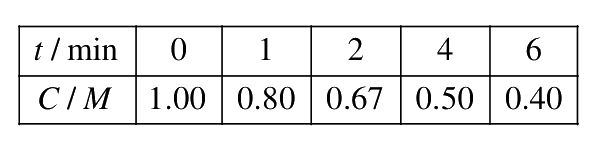
The concentration of (C) of a compound undergoing decomposition as a function of time (t) is given below
$$\begin{array}{|c|c|c|c|c|c|} \hline t / \text{min} & 0 & 1 & 2 & 4 & 6 \\ \hline C / M & 1.00 & 0.80 & 0.67 & 0.50 & 0.40 \\ \hline \end{array}$$
The order of reaction is
a.
0
b.
1
c.
2
d.
3
Correct Answer & Step-by-Step Solution Locked
Sign in free to reveal the correct answer and AI explanation for this question.
For a model system of three non-interacting electrons confined in a two dimensional square box of length L, the ground state energy in units of $\left(\frac{h^2}{8mL^2}\right)$ is
a.
14
b.
6
c.
4
d.
9
Correct Answer & Step-by-Step Solution Locked
Sign in free to reveal the correct answer and AI explanation for this question.
The entropy in terms of internal enregy $\{U-U(0)\}$, and canonical partition function (Q) is given by $S = \frac{U-U(0)}{T} + k\ln Q$. Assuming that the atoms are distinguishable, the corresponding expression for a monatomic perfect gas is
[Here $n, m, N_A, k$ and $h$ represent number of moles, mass of atom, Avogadro constant, Boltzmann constant and Planck constant, respectively, $U(0)$ is internal energy at $T = 0$]
The vibrational transition energies of a diatomic molecule corresponding to $v = 1 \leftarrow v = 0$ and $v = 2 \leftarrow v = 1$ are $2143.1\text{ cm}^{-1}$ and $2116.1\text{ cm}^{-1}$, respectively. The anharmonic constant $(\omega_e x_e)$ of the molecule in $\text{cm}^{-1}$ is
a.
27
b.
13.5
c.
10
d.
54
Correct Answer & Step-by-Step Solution Locked
Sign in free to reveal the correct answer and AI explanation for this question.
The excess molar entropy of mixing of liquid A with liquid B is $-R\ln 2$. The experimentally observed change in entropy upon mixing $1.0\text{ mol}$ of liquid A with $1.0\text{ mol}$ of liquid B is
a.
$-2R\ln 2$
b.
$+4R\ln 2$
c.
0
d.
$+R\ln 2$
Correct Answer & Step-by-Step Solution Locked
Sign in free to reveal the correct answer and AI explanation for this question.
An aqueous solution contains $0.02\text{ mol kg}^{-1}\text{ NaCl}$ and $0.03\text{ mol kg}^{-1}\text{Ca(NO}_3)_2$. The logarithm of the mean ionic activity coefficient $(\log \gamma_\pm)$ of this solution at $25^\circ\text{C}$ is
a.
$-\sqrt{0.095}$
b.
$\sqrt{0.154}$
c.
$-\sqrt{0.033}$
d.
$-\sqrt{0.11}$
Correct Answer & Step-by-Step Solution Locked
Sign in free to reveal the correct answer and AI explanation for this question.
The change in chemical potential (in J) of one mole of an ideal gas, when it is compressed isothermally at $300\text{K}$ from $1.0\text{ atm}$ to $2.0\text{ atm}$, is closest to $(\ln 2 = 0.69)$
a.
1225
b.
1725
c.
2425
d.
2725
Correct Answer & Step-by-Step Solution Locked
Sign in free to reveal the correct answer and AI explanation for this question.