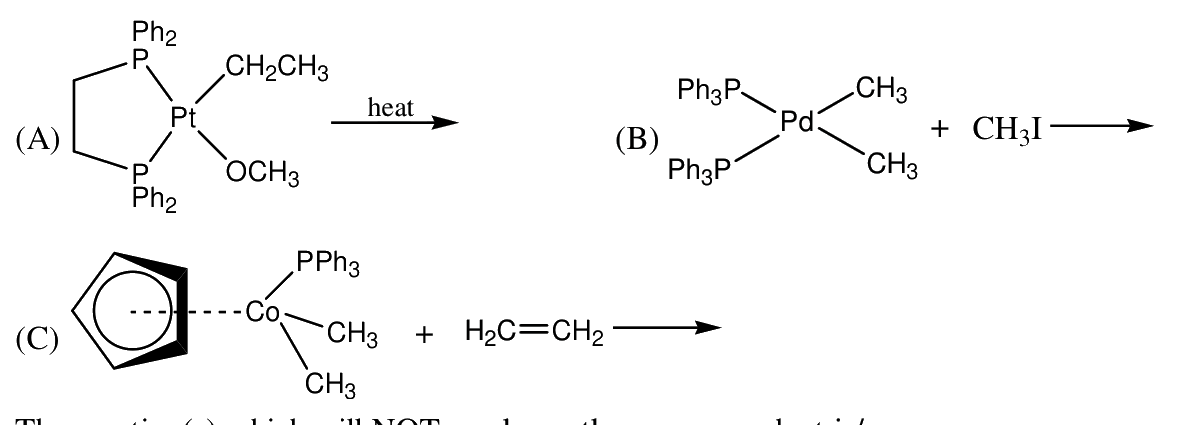
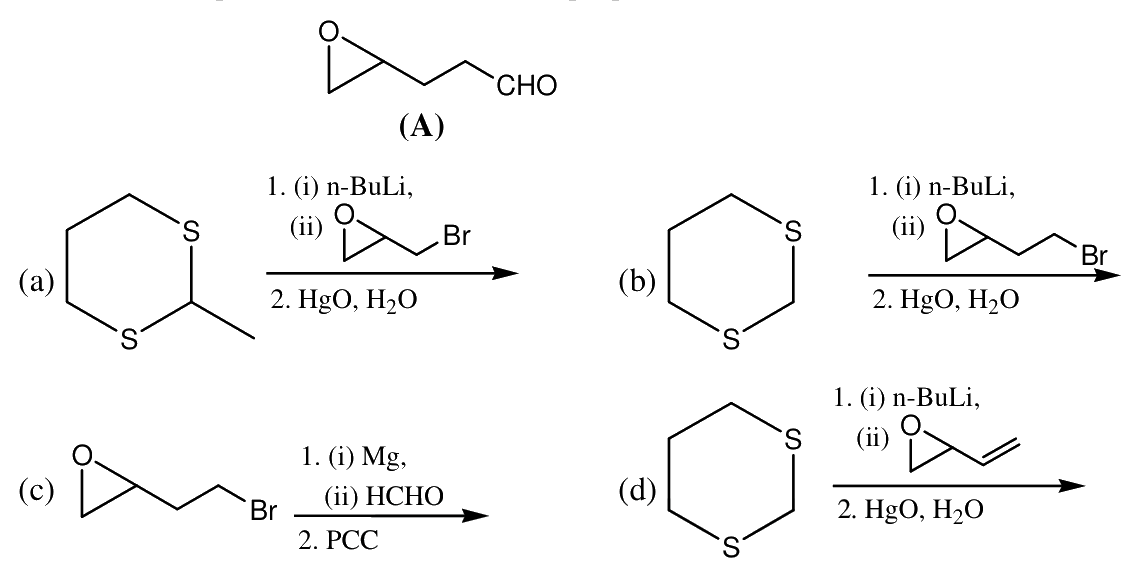
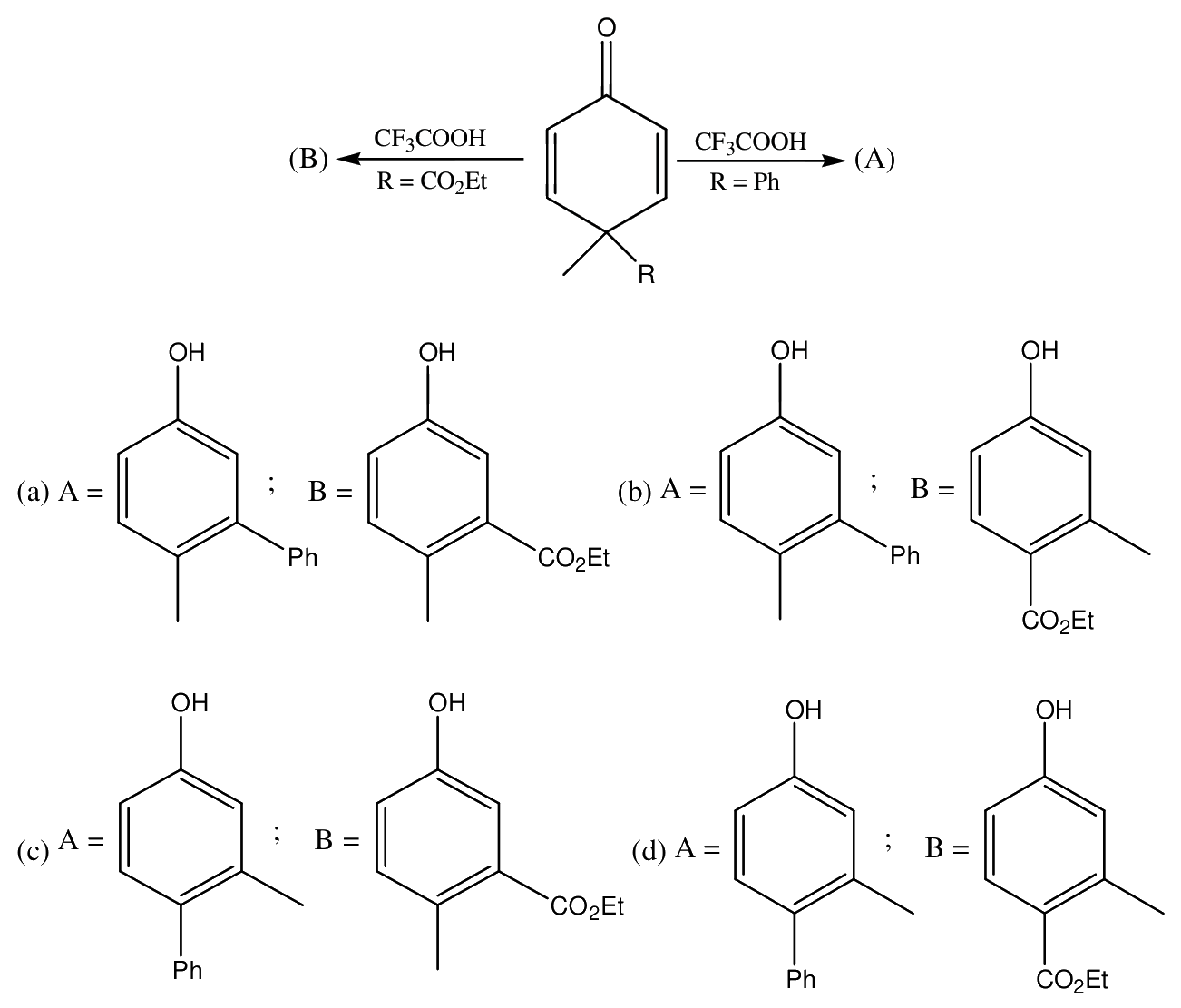
The role of $\text{H}_3\text{PO}_4$ in the estimation of $\text{Fe(II)}$ with $\text{K}_2\text{Cr}_2\text{O}_7$ using diphenylamine sulphonate as indicator is to
a.
avoid aerial oxidation of $\text{Fe(II)}$
b.
reduce the electrode potential of $\text{Fe}^{3+} \rightarrow \text{Fe}^{2+}$
Correct Answer
c.
stabilize the indicator
d.
stabilize $\text{K}_2\text{Cr}_2\text{O}_7$
Step-by-Step AI Explanation
Verified Method
Phosphoric acid ($ ext{H}_3 ext{PO}_4$) complexes with $ ext{Fe}^{3+}$ ions to form a stable, colorless complex $[ ext{Fe}( ext{HPO}_4)]^+$. This significantly decreases the concentration of free $ ext{Fe}^{3+}$ ions in solution, which lowers the formal reduction potential of the $ ext{Fe}^{3+}/ ext{Fe}^{2+}$ couple according to the Nernst equation. This ensures that the potential at the equivalence point matches the potential range of the diphenylamine sulfonate indicator, leading to a sharp and accurate color change.
Q22mcq
$\text{O}_2^-$ is
a.
having a shorter O-O bond length than that in $\text{O}_2$
b.
a stronger oxidising agent than $\text{O}_2$
c.
IR active
Correct Answer
d.
unable to abstract proton from weak acids
Step-by-Step AI Explanation
Verified Method
Neutral dioxygen ($ ext{O}_2$) is a homonuclear diatomic molecule with no permanent or dynamic dipole moment upon vibration, making it IR inactive. However, the superoxide ion $ ext{O}_2^-$ in salts or complexes experiences an asymmetric environment (or interacts with a countercation/surface), and more importantly, coordinated or matrix-isolated superoxide exhibits an IR active O-O stretch (typically around $1100-1150\text{ cm}^{-1}$). Moreover, the bond order of $ ext{O}_2^-$ is 1.5, meaning it has a longer bond length than $ ext{O}_2$ (bond order 2), and it is not a stronger oxidizing agent than $ ext{O}_2$ under standard conditions.
Q23mcq
In neutron activation analysis the radiation commonly detected is
a.
$\alpha$-rays
b.
$\beta$-rays
c.
$\gamma$-rays
Correct Answer
d.
X-rays
Step-by-Step AI Explanation
Verified Method
In Neutron Activation Analysis (NAA), a sample is bombarded with neutrons, creating radioactive isotopes. As these unstable radionuclides decay, they emit characteristic $\gamma$-rays (gamma rays). The energy and intensity of these emitted gamma rays are measured with high-resolution gamma-ray spectrometers to qualitatively and quantitatively determine the elemental composition of the sample.
Q24mcq
The metal transferred by bacteria and fungi using siderophores/siderochromes is
a.
$\text{Mo}$
b.
$\text{Cu}$
c.
$\text{Fe}$
Correct Answer
d.
$\text{Zn}$
Step-by-Step AI Explanation
Verified Method
Siderophores (or siderochromes) are high-affinity, iron-chelating compounds secreted by microorganisms such as bacteria and fungi to scavenge and transport iron ($ ext{Fe}^{3+}$) from the external environment into the cell.
Self-exchange electron transfer in $[ ext{Ru}( ext{NH}_3)_6]^{2+/3+}$ involves low-spin $d^6$ ($t_{2g}^6$) to low-spin $d^5$ ($t_{2g}^5$). Because the transferred electron resides entirely in the non-bonding $t_{2g}$ orbitals, there is minimal structural rearrangement (very low inner-sphere reorganization energy, $\lambda_i$). Consequently, the self-exchange rate is extremely fast ($k \approx 10^3 - 10^4 \text{ M}^{-1}\text{s}^{-1}$). In contrast, cobalt, chromium, and high-spin iron couples involve changes in the occupation of anti-bonding $e_g$ orbitals (and/or spin-state changes as in Co), which lead to large reorganization energies and much slower electron transfer.
Q26mcq
The number of $\text{Ni}-\text{Ni}$ bonds in $[\text{CpNi}(\mu\text{-PPh}_2)]_2$ complex obeying the 18 electron rule is
a.
0
Correct Answer
b.
1
c.
2
d.
3
Step-by-Step AI Explanation
Verified Method
To determine the number of $\text{Ni}-\text{Ni}$ bonds, we can use the 18-electron rule for the dinuclear complex $[\text{CpNi}(\mu\text{-PPh}_2)]_2$:
- Total valence electron count ($V$):
- Each $\text{Ni}$ atom (Group 10) contributes $10\, e^- \times 2 = 20\, e^-$
- Each $\text{Cp}^-$ (or neutral $\eta^5$-Cp) contributes $5\, e^- \times 2 = 10\, e^-$
- Each bridging phosphido ligand ($\mu\text{-PPh}_2$) contributes $3\, e^- \times 2 = 6\, e^-$
Total valence electrons, $V = 20 + 10 + 6 = 36\, e^-$.
- The number of metal-metal bonds is given by:
$$\text{Bond count} = \frac{2 \times 18 - V}{2} = \frac{36 - 36}{2} = 0$$
Thus, each $\text{Ni}$ atom already has 18 valence electrons without any $\text{Ni}-\text{Ni}$ bond. Therefore, the number of $\text{Ni}-\text{Ni}$ bonds is 0.
Q27mcq
For the reaction of \textit{trans}-$[\text{IrX}(\text{CO})(\text{PPh}_3)_2]$ ($\text{X} = \text{F}, \text{Cl}, \text{Br}, \text{I}$) with $\text{O}_2$, correct order of variation of rate with $\text{X}$ is
The reaction of $\textit{trans}\text{-}[\text{IrX}(\text{CO})(\text{PPh}_3)_2]$ with $\text{O}_2$ is an oxidative addition. The rate of oxidative addition increases with increasing electron density at the metal center, making it more nucleophilic. Because iodide is the least electronegative and most polarizable (best electron-donating halide ligand), the metal center is most electron-rich when $\text{X} = \text{I}$. The nucleophilicity of Ir(I) and the rate of reaction follow the order: $\text{I} > \text{Br} > \text{Cl} > \text{F}$.
Q28mcq
The species that results by replacing one quarter of $\text{Si(IV)}$ in pyrophyllite $[\text{Al}_2(\text{OH})_2\text{Si}_4\text{O}_{10}]$ with $\text{Al(III)}$ [charge balance by $\text{K(I)}$] is
a.
muscovite
Correct Answer
b.
phlogopite
c.
montmorillonite
d.
talc
Step-by-Step AI Explanation
Verified Method
Pyrophyllite has the formula $\text{Al}_2(\text{OH})_2[\text{Si}_4\text{O}_{10}]$. Replacing one-quarter of the $\text{Si}^{4+}$ ions by $\text{Al}^{3+}$ gives the composition $[\text{Al}_2(\text{OH})_2(\text{AlSi}_3\text{O}_{10})]^{-}$. Balancing this negative charge with a $\text{K}^+$ interlayer cation yields $\text{KAl}_2(\text{OH})_2[\text{AlSi}_3\text{O}_{10}]$, which is the formula of the mica group mineral **muscovite**.
Q29mcq
The reaction of $\text{IO}_3^-$ with $\text{I}^-$ in aqueous acidic medium results in
a.
$\text{I}_2$ and $\text{H}_2\text{O}$
Correct Answer
b.
$\text{I}_2$ and $\text{H}_2\text{O}_2$
c.
$\text{IO}^-$ and $\text{H}_2\text{O}$
d.
$\text{IO}^-$ and $\text{H}_2\text{O}_2$
Step-by-Step AI Explanation
Verified Method
In aqueous acidic solution, iodate ($ ext{IO}_3^-$) reacts with iodide ($ ext{I}^-$) via a comproportionation redox reaction:$$\text{IO}_3^- + 5\text{I}^- + 6\text{H}^+ \rightarrow 3\text{I}_2 + 3\text{H}_2\text{O}$$Thus, the reaction produces iodine ($\text{I}_2$) and water ($\text{H}_2\text{O}$).
Q30mcq
The organic species isolobal to $[\text{Fe}(\text{CO})_2(\text{PPh}_3)]^-$ is
a.
$\text{CH}_2^+$
b.
$\text{CH}^-$
c.
$\text{CH}_3$
Correct Answer
d.
$\text{CH}$
Step-by-Step AI Explanation
Verified Method
To determine the isolobal fragment, calculate the valence electron count of the transition metal complex fragment: For $[\text{Fe}(\text{CO})_2(\text{PPh}_3)]^-$, Fe is in group 8 ($d^8$). The total valence electrons are: $8\,(\text{Fe}) + 2 \times 2\,(\text{CO}) + 2\,(\text{PPh}_3) + 1\,(\text{negative charge}) = 8 + 4 + 2 + 1 = 15$ electrons. A 15-electron transition metal fragment requires $18 - 15 = 3$ electrons to achieve an 18-electron configuration, which is isolobal to an organic fragment requiring $8 - 5 = 3$ electrons (a 5-valence-electron fragment). For $\text{CH}_3$, carbon has 4 valence electrons and 3 hydrogens contribute 3, giving 7 valence electrons? Wait, let's recount: 15-electron transition metal fragment is isolobal to a 7-electron main group fragment ($18 - 15 = 3$ holes, $8 - 7 = 1$ hole? No, the rule is $n$ valence electrons in metal fragment is isolobal to $n - 10$ valence electrons in main group fragment: $15 - 10 = 5$ valence electrons, which is $\text{CH}$? Wait! In Hoffman's isolobal analogy: 17 e- $\leftrightarrow$ 7 e- (CH3); 16 e- $\leftrightarrow$ 6 e- (CH2); 15 e- $\leftrightarrow$ 5 e- (CH). Wait, let's re-calculate electrons: Fe has 8 electrons, 2 CO donate 4, PPh3 donates 2, minus charge is 1: total = $8 + 4 + 2 + 1 = 15$ electrons! Wait, does Fe have 8 valence electrons? Yes, group 8. But is it Fe(CO)3? The prompt says $[\text{Fe}(\text{CO})_2(\text{PPh}_3)]^-$ or maybe something else? Wait, if 15 e- then CH (5 valence electrons). Let's check: CH has $4+1 = 5$ valence electrons! Wait, $\text{CH}_3$ has $4+3=7$ e-. $\text{CH}^-$ has $4+1+1 = 6$ e-. $\text{CH}_2^+$ has $4+2-1 = 5$ e-. Wait, both $\text{CH}_2^+$ and $\text{CH}$ have 5 electrons! Wait, is $[\text{Fe}(\text{CO})_2(\text{PPh}_3)]^-$ a typo in the paper or is it a 17-electron species? Wait, what if it was $[\text{Fe}(\text{CO})_3(\text{PPh}_3)]^-$ or something? No, let's check CSIR NET June 2017: Question: 'The organic species isolobal to [Fe(CO)2(PPh3)]- is...' Wait, in CSIR NET Dec 2016 or June 2017: 'The organic species isolobal to [Fe(CO)2(PPh3)]-' — wait, Fe is 8, 2 CO is 4, PPh3 is 2: 14 + 1 = 15 e-. A 15-electron fragment with 3 ligands is isolobal to a 5-electron fragment with 1 ligand, which is $\text{CH}$! Both are $C_{3v}$ / pyramidal fragments with 3 frontier orbitals and 3 missing electrons ($18-15=3$, $8-5=3$). Therefore, it is isolobal to $\text{CH}$.
🎉 10 Free Sample Solutions Completed
Unlock All 100 Questions & Solutions
Sign up free in seconds to unlock step-by-step AI answers for the remaining 90 questions.
Consider the following reaction:
$$\text{Hg}^{2+}(\text{aq}) + \text{X}^-(\text{aq}) = [\text{HgX}]^+(\text{aq})$$
The stability constants for $[\text{HgX}]^+(\text{aq})$ for $\text{X} = \text{F}, \text{Cl}$ and $\text{Br}$ follow the order
a.
$\text{F} < \text{Cl} < \text{Br}$
b.
$\text{Br} < \text{Cl} < \text{F}$
c.
$\text{Cl} < \text{Br} < \text{F}$
d.
$\text{Br} < \text{F} < \text{Cl}$
Correct Answer & Step-by-Step Solution Locked
Sign in free to reveal the correct answer and AI explanation for this question.
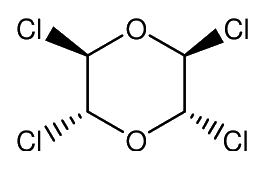
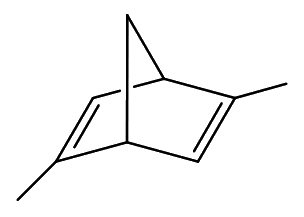
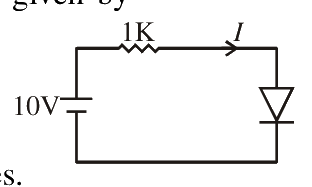
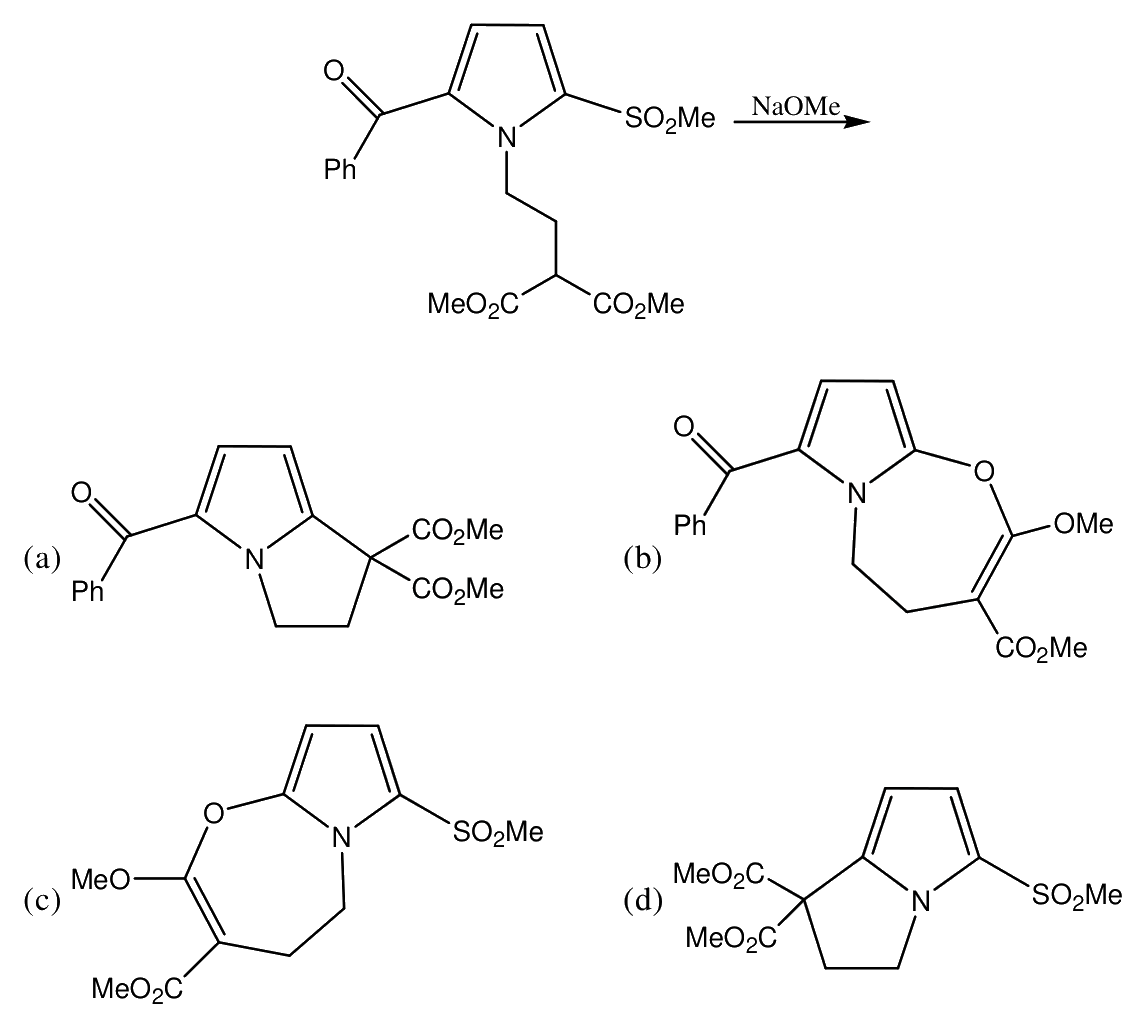
Reaction of deoxymonosaccharide $\mathbf{A}$ with 2 equivalents of $\text{HIO}_4$ affords propanedial, formic acid and formaldehyde. The structure of $\mathbf{A}$ is
Correct Answer & Step-by-Step Solution Locked
Sign in free to reveal the correct answer and AI explanation for this question.
The mobility of a divalent cation in water is $8\times 10^{-8}\text{ m}^2\text{ V}^{-1}\text{ s}^{-1}$. The effective radius of the ion is (viscosity of water = $1\text{ cP}$; $\text{e} = 1.6\times 10^{-19}\text{ C}$)
a.
$106\text{ pm}$
b.
$212\text{ pm}$
c.
$424\text{ pm}$
d.
$318\text{ pm}$
Correct Answer & Step-by-Step Solution Locked
Sign in free to reveal the correct answer and AI explanation for this question.
The lowest energy unnormalized wave function of $\text{H}_2^+$ molecule is ($r_1$ and $r_2$ are the distances between the electron and nuclei 1 and 2, respectively)
a.
$\psi = \left(e^{-r_1/a_0} + e^{-r_2/a_0}\right)$
b.
$\psi = \left(e^{-r_1/a_0} - e^{-r_2/a_0}\right)$
c.
$\psi = e^{-r_1/a_0}$
d.
$\psi = e^{-r_2/a_0}$
Correct Answer & Step-by-Step Solution Locked
Sign in free to reveal the correct answer and AI explanation for this question.
One mole of a mono-atomic ideal gas is transformed from $300\text{K}$ and $2\text{ atm}$ to $600\text{K}$ and $4\text{ atm}$. The entropy change for this process is
a.
$\frac{3}{2}R\ln 2$
b.
$\frac{1}{2}R\ln 2$
c.
$\frac{7}{2}R\ln 2$
d.
$\frac{5}{2}R\ln 2$
Correct Answer & Step-by-Step Solution Locked
Sign in free to reveal the correct answer and AI explanation for this question.
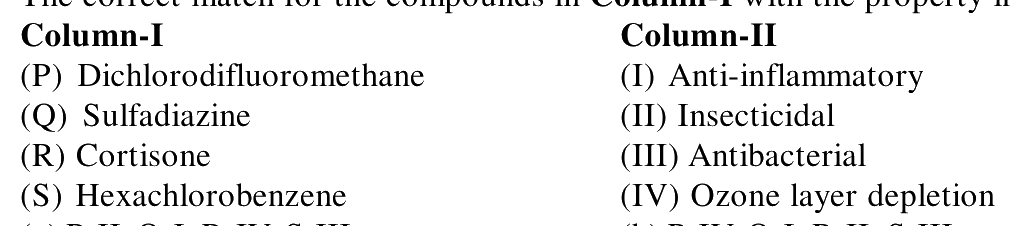
The correct match for the compounds in Column-I with the property in Column-II is
\begin{tabular}{ll}
\textbf{Column-I} & \textbf{Column-II} \\
(P) Dichlorodifluoromethane & (I) Anti-inflammatory \\
(Q) Sulfadiazine & (II) Insecticidal \\
(R) Cortisone & (III) Antibacterial \\
(S) Hexachlorobenzene & (IV) Ozone layer depletion
\end{tabular}
a.
P-II, Q-I, R-IV, S-III
b.
P-IV, Q-I, R-II, S-III
c.
P-I, Q-III, R-II, S-IV
d.
P-IV, Q-III, R-I, S-II
Correct Answer & Step-by-Step Solution Locked
Sign in free to reveal the correct answer and AI explanation for this question.
The correct statements about $[\text{Ru}_6\text{C}(\text{CO})_{17}]$ cluster from the following
(1) it is an 86 electron cluster
(2) it is a \textit{closo} structure type
(3) its shape is capped square pyramid
(4) carbon interacts with all the Ru centres in the cluster
are
a.
1, 2, 3 and 4
b.
1 and 2 only
c.
1, 2 and 3
d.
1, 2 and 4
Correct Answer & Step-by-Step Solution Locked
Sign in free to reveal the correct answer and AI explanation for this question.
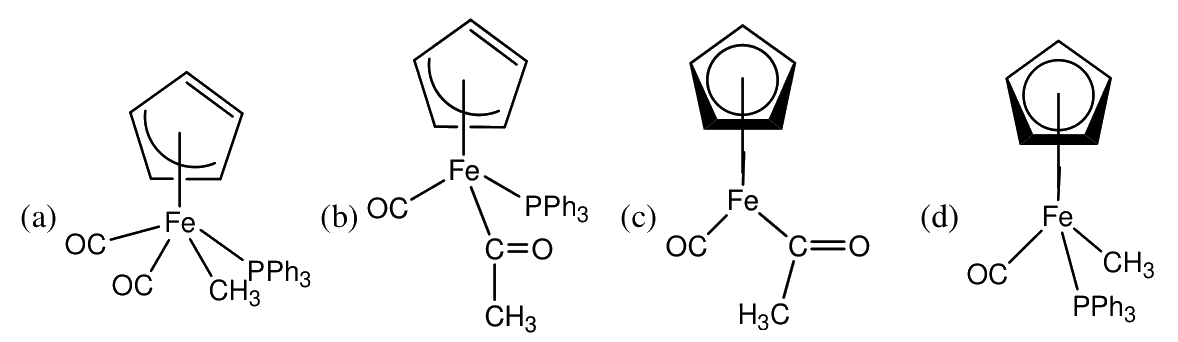
A plausible structure of the intermediate involved in the following reaction
$$[\text{Fe}(\eta^5\text{-C}_5\text{H}_5)(\text{CH}_3)(\text{CO})_2] + \text{PPh}_3 \longrightarrow [\text{Fe}(\eta^5\text{-C}_5\text{H}_5)(\text{C}(=\text{O})\text{CH}_3)(\text{CO})(\text{PPh}_3)]$$
is
a.
(a)
b.
(b)
c.
(c)
d.
(d)
Correct Answer & Step-by-Step Solution Locked
Sign in free to reveal the correct answer and AI explanation for this question.
Consider the following statements with respect to Cytochrome P-450
(A) It has histidine coordinated to iron centre
(B) It is a membrane bound metalloenzyme
(C) It has Fe(III) ion in the resting state of the enzyme
The correct statement(s) is/are
a.
A, B
b.
A, C
c.
B, C
d.
A only
Correct Answer & Step-by-Step Solution Locked
Sign in free to reveal the correct answer and AI explanation for this question.
Consider the following transformation reactions in the context of co-enzyme $\text{B}_{12}$
(A) 1, 2-Carbon shift
(B) Hydration of $\text{CO}_2$
(C) Benzene to phenol
(D) Dimethyl sulfide to dimethyl sulfoxide
The correct statement(s) for co-enzyme $\text{B}_{12}$ is/are
a.
A, C, D
b.
A, B only
c.
B, C only
d.
A only
Correct Answer & Step-by-Step Solution Locked
Sign in free to reveal the correct answer and AI explanation for this question.
The correct statements regarding B among the following
(I) Nuclear spin of $^{11}\text{B}$ is greater than that of $^{10}\text{B}$
(II) The polarities of B-H bond and C-H bonds are opposite
(III) Cross-section of neutron absorption for $^{10}\text{B}$ is much more than that of $^{11}\text{B}$
(IV) B reacts with boiling aq. $\text{NaOH}$ solution to form $\text{NaB(OH)}_4$
are
a.
II and III
b.
I and II
c.
III and IV
d.
II and IV
Correct Answer & Step-by-Step Solution Locked
Sign in free to reveal the correct answer and AI explanation for this question.
Choose the correct statement(s) among the following
(I) $\text{LiF}$ is more soluble than $\text{LiClO}_4$ in water.
(II) The standard reduction potential [$\text{E}^\circ$] of $\text{Li}$ is more negative than that of $\text{Na}$.
(III) The heat of hydration of $\text{Li}^+(\text{g})$ is greater than that of $\text{Na}^+(\text{g})$
a.
I and II
b.
I and III
c.
II and III
d.
III only
Correct Answer & Step-by-Step Solution Locked
Sign in free to reveal the correct answer and AI explanation for this question.
Choose the correct statement(s) among the following
(I) The dihedral angle in $\text{O}_2\text{F}_2$ is $0^\circ$.
(II) $\text{OF}_2$ is generally prepared by reacting fluorine gas with dilute ($2\%$) aq. $\text{NaOH}$ solution
(III) $\text{O}_2\text{F}_2$ can be readily reduced by $\text{H}_2\text{S}$.
a.
I and II only
b.
I, II and III
c.
II and III only
d.
II only
Correct Answer & Step-by-Step Solution Locked
Sign in free to reveal the correct answer and AI explanation for this question.
Consider the following statements regarding electronic spectra of high spin complexes
(A) $\text{Ti}^{3+}$ complexes exhibit one sharp band.
(B) $\text{Co}^{2+}$ and $\text{Cr}^{3+}$ complexes exhibit two broad bands.
(C) $\text{Mn}^{2+}$ complexes exhibit a series of very weak and sharp bands.
(D) $\text{Ni}^{2+}$ complexes exhibit three broad bands.
The correct statements are
a.
A and C
b.
A, C and D
c.
C and D
d.
B, C and D
Correct Answer & Step-by-Step Solution Locked
Sign in free to reveal the correct answer and AI explanation for this question.
Match the appropriate geometry on the right with each of the speices on the left
(A) $\text{FXeO(OSO}_2\text{F)}$ (I) linear
(B) $\text{FXeN(SO}_2\text{F)}_2$ (II) pyramidal
(C) $\text{XeO}_3$ (III) T-shaped
(D) $\text{XeOF}_2$ (IV) bent
a.
A-I, B-I, C-II, D-III
b.
A-I, B-I, C-II, D-IV
c.
A-IV, B-I, C-II, D-III
d.
A-I, B-IV, C-II, D-III
Correct Answer & Step-by-Step Solution Locked
Sign in free to reveal the correct answer and AI explanation for this question.
Hydrolysis of $\text{trans-}[\text{CoLCl}(\text{en})_2]^+$ ($\text{L} = \text{NO}_2^-, \text{NCS}^-, \text{OH}^-, \text{Cl}^-$) results in a product (A). The tendency to form $cis$-isomer of the product (A) follows the order
Among the following reactions, those that are feasible in liquid $\text{NH}_3$ are
(I) $\text{KNO}_3 + \text{AgCl} \rightarrow \text{KCl} + \text{AgNO}_3$
(II) $\text{NH}_4\text{Br} + \text{KNH}_2 \rightarrow \text{KBr} + 2\text{NH}_3$
(III) $\text{Fe(CO)}_5 + 2e^- \rightarrow [\text{Fe(CO)}_4]^{2-} + \text{CO}$
a.
I, II and III
b.
I and II only
c.
I and III only
d.
II and III only
Correct Answer & Step-by-Step Solution Locked
Sign in free to reveal the correct answer and AI explanation for this question.
Donor mode of NO ligand depends on the metal. Now, consider the following complexes (in gaseous state).
(A) $[\text{IrCl}(\text{CO})(\text{PPh}_3)_2(\text{NO})]^+$
(B) $[\text{RuCl}(\text{PPh}_3)_2(\text{NO})_2]^+$
(C) $[\text{Co}(\text{NCS})(\text{diars})_2(\text{NO})]^+$, where $\text{diars} = o\text{-(Me}_2\text{As})_2\text{C}_6\text{H}_4$
(D) $[\text{Cr}(\text{CN})_5(\text{NO})]^{3-}$
The complex (es) that do NOT exhibit bent NO coordination mode is/are
a.
A and B
b.
C and D
c.
D only
d.
B only
Correct Answer & Step-by-Step Solution Locked
Sign in free to reveal the correct answer and AI explanation for this question.
An aqueous solution of metal ion (A) gives a blood-red colored product (B) upon reaction with $\text{KSCN}$. Upon dropwise addition of $\text{NaF}$, the complex turns to a colorless compound (C). Identify A, B and C
a.
aq. $\text{Fe(II)}$, $[\text{Fe(SCN)}(\text{H}_2\text{O})_5]^+$ and $[\text{Fe}(\text{H}_2\text{O})_6]^{2+}$
b.
aq. $\text{Fe(III)}$, $[\text{Fe(SCN)}(\text{H}_2\text{O})_5]^{2+}$ and $[\text{FeF}_6]^{3-}$
c.
aq. $\text{Fe(II)}$, $[\text{Fe(SCN)}(\text{H}_2\text{O})_5]^+$ and $\text{FeF}_3$
d.
aq. $\text{Fe(III)}$, $[\text{Fe(SCN)}_3(\text{H}_2\text{O})_3]^+$ and $\text{FeF}_3$
Correct Answer & Step-by-Step Solution Locked
Sign in free to reveal the correct answer and AI explanation for this question.
Considering $\sigma$-bonding only, in the MO diagram of a metal complex with trigonal bipyramidal (TBP) geometry, the d-orbitals which remain non-bonding are
a.
$d_{z^2}$ and $d_{xz}$
b.
$d_{xz}$ and $d_{yz}$
c.
$d_{x^2-y^2}$ and $d_{xy}$
d.
$d_{z^2}$ and $d_{yz}$
Correct Answer & Step-by-Step Solution Locked
Sign in free to reveal the correct answer and AI explanation for this question.
The major products (\mathbf{A}) and (\mathbf{B}) in the following reaction sequence are
$$2\text{PhCHO} \xrightarrow[2.\text{ MnO}_2]{1.\text{ NaCN}} (\mathbf{A}) \xrightarrow{\text{NaOH}} (\mathbf{B})$$
Reaction of styrene ($\text{PhCH=CH}_2$) with $\text{HBr}$ gives a mixture of regioisomers $\mathbf{A}$ (major) and $\mathbf{B}$ (minor). The $^{1}\text{H NMR}$ spectrum of the mixture shows four signals, amongst others, at $\delta\ 5.17, 3.53, 3.15$ and $2.00\text{ ppm}$ with relative integration of $2 : 1 : 1 : 6$, respectively. The molar ratio of $\mathbf{A}$ and $\mathbf{B}$ is
a.
$3 : 2$
b.
$4 : 1$
c.
$2 : 1$
d.
$3 : 1$
Correct Answer & Step-by-Step Solution Locked
Sign in free to reveal the correct answer and AI explanation for this question.
An unnormalized wave function of the hydrogen atom is given by $r^2 e^{-\frac{r}{3}}(3\cos^2\theta - 1)$. The three quantum numbers, $n, \ell$ and $m$, associated with this orbital are, respectively.
a.
2, 2, 0
b.
2, 1, 1
c.
3, 2, 0
d.
3, 1, 1
Correct Answer & Step-by-Step Solution Locked
Sign in free to reveal the correct answer and AI explanation for this question.
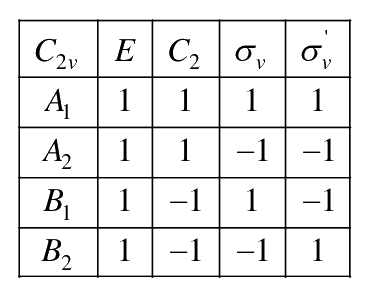
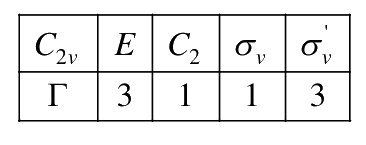
The number of times the $A_1$ representation appears in the representation $\Gamma$ of the $C_{2v}$ point group given below is
$$\begin{array}{|c|c|c|c|c|}\hline C_{2v} & E & C_2 & \sigma_v & \sigma_v' \\\hline \Gamma & 3 & 1 & 1 & 3 \\\hline \end{array}$$
a.
1
b.
2
c.
3
d.
4
Correct Answer & Step-by-Step Solution Locked
Sign in free to reveal the correct answer and AI explanation for this question.
The populations of proton spins in the highest energy level of a sample in magnetic fields of $1.5\text{ T}$ and $7.0\text{ T}$ are $N'$ and $N$, respectively. The value of $\ln \frac{N'}{N}$ is ($\gamma, \hbar, k, T$ are gyromagnetic ratio of the proton, Planck's constant, Boltzmann constant and temperature of the sample, respectively; assume that the partition functions for both systems can be approximated as 1)
a.
$5.5\gamma\hbar/kT$
b.
$\frac{3}{14}\gamma\hbar/kT$
c.
$\frac{14}{3}\gamma\hbar/kT$
d.
$8.5\gamma\hbar/kT$
Correct Answer & Step-by-Step Solution Locked
Sign in free to reveal the correct answer and AI explanation for this question.
The difference between standard molar entropies of two mono-atomic gases (A) and (B) $\left(S_{m,A}^0 - S_{m,B}^0\right)$ at a given temperature is (given that the molar mass of (A) is twice the molar mass of (B))
a.
$\frac{3}{2}R\ln 2$
b.
$R\ln 2$
c.
$\frac{5}{2}R\ln 2$
d.
$\frac{7}{2}R\ln 2$
Correct Answer & Step-by-Step Solution Locked
Sign in free to reveal the correct answer and AI explanation for this question.
A non-ideal gas follows the equation,
$$P = \frac{RT}{V_m}\left[1 + \frac{B}{V_m}\right]$$
where $B$ is a function of temperature only. The deviation in internal energy from that of an ideal gas, $U - U_{\text{ideal}}$, is given by
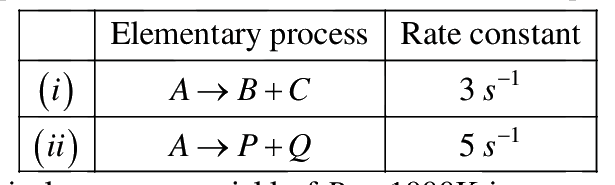
The gas phase decomposition of A at $1000\text{K}$ follows two decomposition paths
$$\begin{array}{|c|c|c|} \hline & \text{Elementary process} & \text{Rate constant} \\ \hline (i) & A \rightarrow B + C & 3\text{ s}^{-1} \\ \hline (ii) & A \rightarrow P + Q & 5\text{ s}^{-1} \\ \hline \end{array}$$
The maximum theoretical percentage yield of $P$ at $1000\text{K}$ is
a.
$62.5$
b.
$60$
c.
$166$
d.
$37.5$
Correct Answer & Step-by-Step Solution Locked
Sign in free to reveal the correct answer and AI explanation for this question.
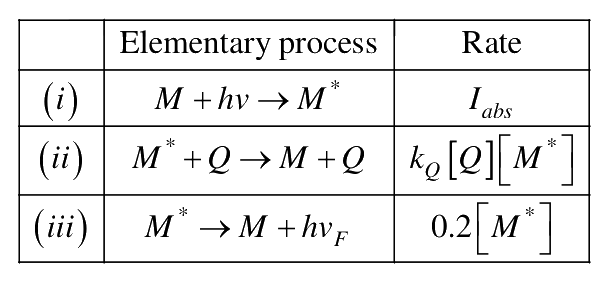
Photochemistry of a molecule, M, is described as by the mechanism
$$\begin{array}{|c|c|c|} \hline & \text{Elementary process} & \text{Rate} \\ \hline (i) & M + h\nu \rightarrow M^* & I_{\text{abs}} \\ \hline (ii) & M^* + Q \rightarrow M + Q & k_Q [Q][M^*] \\ \hline (iii) & M^* \rightarrow M + h\nu_F & 0.2[M^*] \\ \hline \end{array}$$
The intercept at $[Q] = 0$ is $4$ for the inverse of fluorescence intensity ($1/I_F$) vs $[Q]$ plot. The value of $I_{\text{abs}}$ is
a.
$4$
b.
$0.25$
c.
$20$
d.
$0.8$
Correct Answer & Step-by-Step Solution Locked
Sign in free to reveal the correct answer and AI explanation for this question.
Above the critical micelle concentration (CMC), the option which correctly describes the variation of molar conductivity with increase in concentration of sodium dodecylsulphate in aqueous solution is
a.
molar conductivity increases sharply, but the solution does not remain colloidal
b.
molar conductivity decreases sharply, but the solution remains colloidal
c.
molar conductivity decreases sharply and dissociation into monomers also occurs sharply
d.
molar conductivity increases sharply with large loss of entropy
Correct Answer & Step-by-Step Solution Locked
Sign in free to reveal the correct answer and AI explanation for this question.
When two moles of liquid A are mixed with two moles of liquid B at $300\text{ K}$, the excess molar Gibbs energy of the solution is $-1.5\text{ kJ mol}^{-1}$. The corresponding value of Gibbs energy of mixing (in $\text{kJ}$) is closest to ($R = 8.3\text{ J K}^{-1}\text{ mol}^{-1}$)
a.
$-12.9$
b.
$-6.0$
c.
$-1.5$
d.
$-0.9$
Correct Answer & Step-by-Step Solution Locked
Sign in free to reveal the correct answer and AI explanation for this question.
A sample of $2.0\text{ moles}$ of $\text{O}_2(\text{g})$ (assumed ideal) at $500\text{ K}$ is expanded from $5\text{ L}$ to $50\text{ L}$ under adiabatic and reversible conditions. The change in its internal energy (in $\text{kJ}$) is close to
$$\left(R = 8.3\text{ JK}^{-1}mol^{-1}; C_{V,m} = \frac{5}{2}R\right)$$
a.
$-22.5$
b.
$-12.5$
c.
$-19.1$
d.
$-7.5$
Correct Answer & Step-by-Step Solution Locked
Sign in free to reveal the correct answer and AI explanation for this question.
The reaction rate of a self-catalyzed polyesterification reaction is given as
$$-\frac{d[COOH]}{dt} = k[COOH]^2[OH]$$
If $[M]_0$ is the initial concentration of hydroxyl and carboxyl monomers, then the degree of polymerization, $\langle N \rangle$ is given by
a.
$\langle N \rangle = 2[M]_0^2kt$
b.
$\langle N \rangle^2 = 2[M]_0^2kt$
c.
$\langle N \rangle^2 = 2[M]_0^2kt + 1$
d.
$\langle N \rangle^2 = 2[M]_0kt + 1$
Correct Answer & Step-by-Step Solution Locked
Sign in free to reveal the correct answer and AI explanation for this question.
If the overpotential of an electrolysis process is increased from $0.5\text{ V}$ to $0.6\text{ V}$, then the ratio of current densities $\left(\ln\frac{J_{0.6}}{J_{0.5}}\right)$ of the electrolysis will be equal to (given transfer co-efficient $= 0.5$)
a.
$0.5\frac{F}{RT}$
b.
$0.05\frac{F}{RT}$
c.
$0.1\frac{F}{RT}$
d.
$0.01\frac{F}{RT}$
Correct Answer & Step-by-Step Solution Locked
Sign in free to reveal the correct answer and AI explanation for this question.
The chemical potential $(\mu)$ of a $2\text{ molar }\text{Na}_2\text{SO}_4$ solution is expressed in terms of mean ionic activity co-efficient $(\gamma_\pm)$ as
a.
$\mu^0 + 5RT\ln 2 + 3RT\ln\gamma_\pm$
b.
$\mu^0 + 3RT\ln 2 + 3RT\ln\gamma_\pm$
c.
$\mu^0 + 3RT\ln\gamma_\pm$
d.
$\mu^0 + 4RT\ln\gamma_\pm$
Correct Answer & Step-by-Step Solution Locked
Sign in free to reveal the correct answer and AI explanation for this question.
The Birge-Sponer plot between $\Delta G_{v+\frac{1}{2}} = (\varepsilon_{v+1} - \varepsilon_v)$ and $(v+1)$ for $\text{CO}$ is a straight line with slope of $-14\text{ cm}^{-1}$ and intercept of $2170\text{ cm}^{-1}$. The approximate value of dissociation energy of $\text{CO}$ (in $\text{cm}^{-1}$) is (Assume $\text{CO}$ as an anharmonic oscillater with the energy expression)
$$\varepsilon_v = \left(v+\frac{1}{2}\right)\omega - \left(v+\frac{1}{2}\right)^2 x_e \omega; D = \frac{\omega}{4x_e}$$
a.
$42044$
b.
$84088$
c.
$168175$
d.
$336350$
Correct Answer & Step-by-Step Solution Locked
Sign in free to reveal the correct answer and AI explanation for this question.