For an octahedral $\mathrm{Cu^{2+}}$ complex depicting axial EPR spectrum $\left(g_{\parallel} > g_{\perp}\right)$, the geometry of $\mathrm{Cu^{2+}}$ and the orbital containing the unpaired electron are, respectively
For an axially symmetric $\mathrm{Cu^{2+}}$ ($d^9$) complex with $g_\parallel > g_\perp > 2.0023$, the unpaired electron resides in the $d_{x^2-y^2}$ orbital ($^2B_{1g}$ ground state), which corresponds to an elongated tetragonal octahedron ($D_{4h}$). When the complex is tetragonally compressed, the ground state is $d_{z^2}$ ($^2A_{1g}$), which yields $g_\perp > g_\parallel \approx 2.00$.
Q22mcq
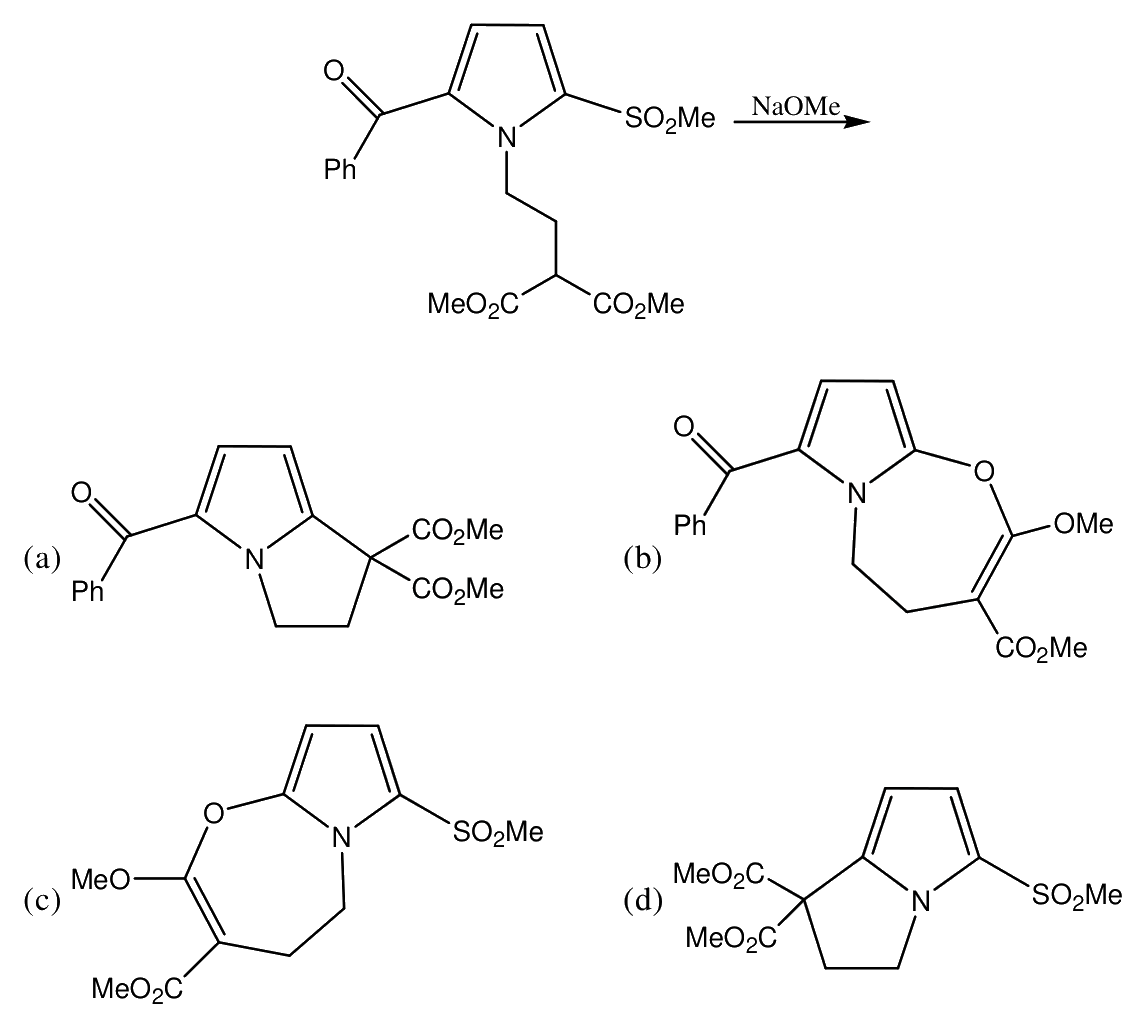
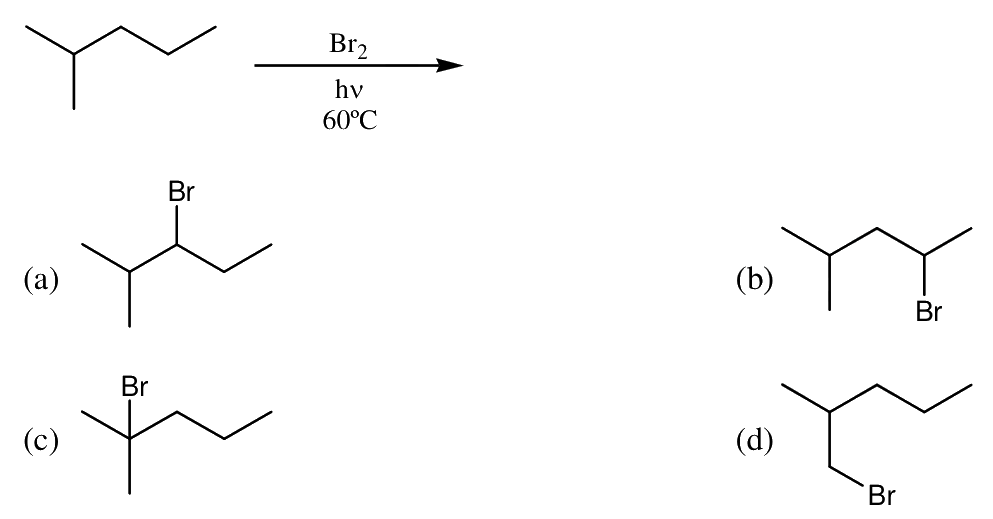
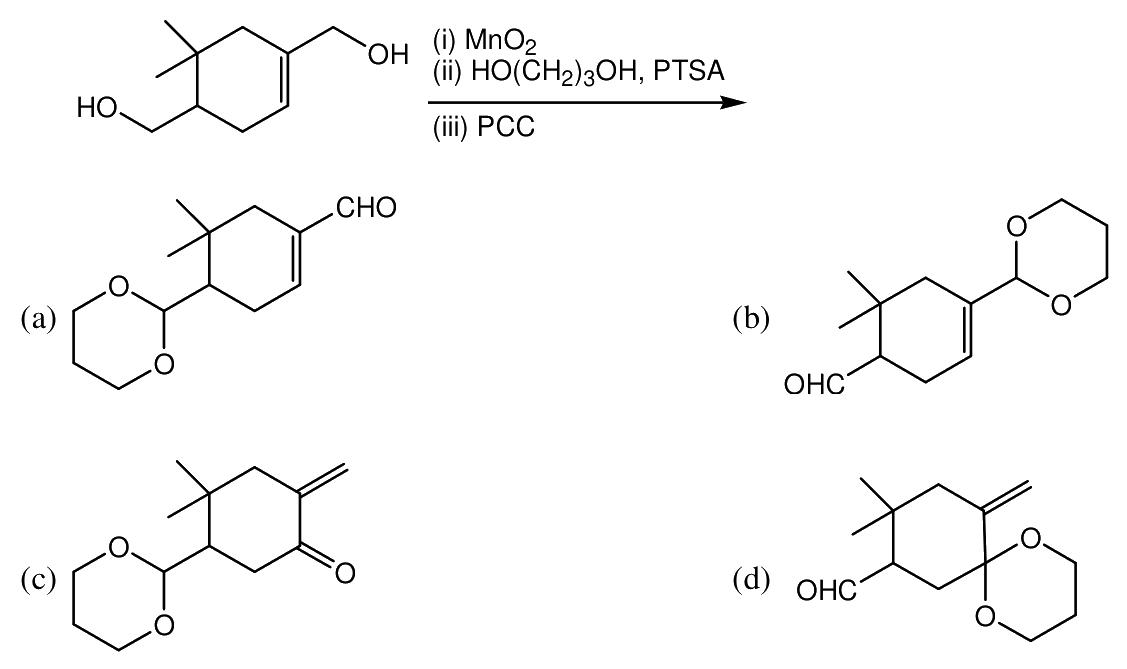
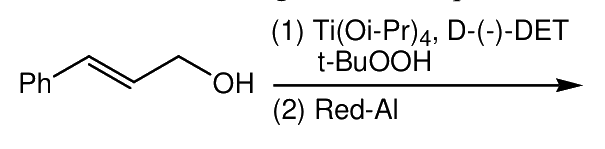
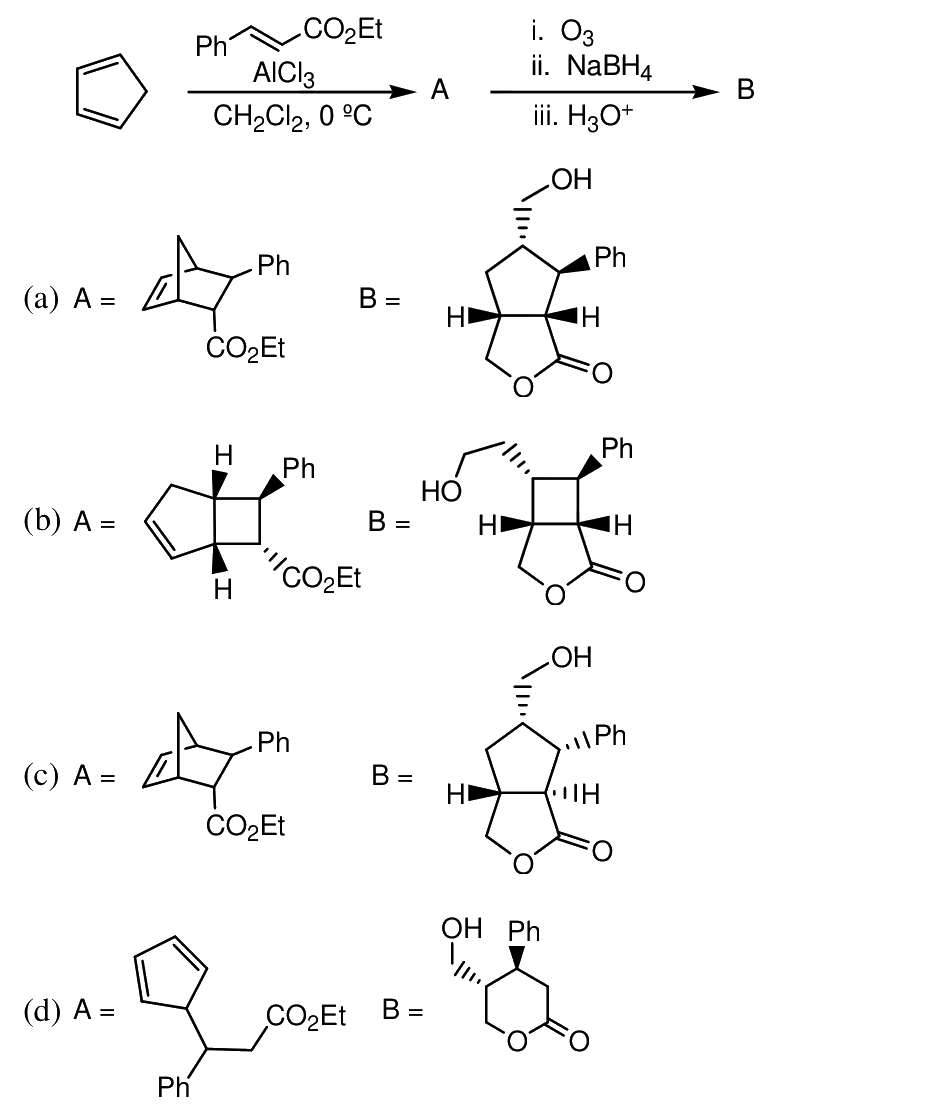
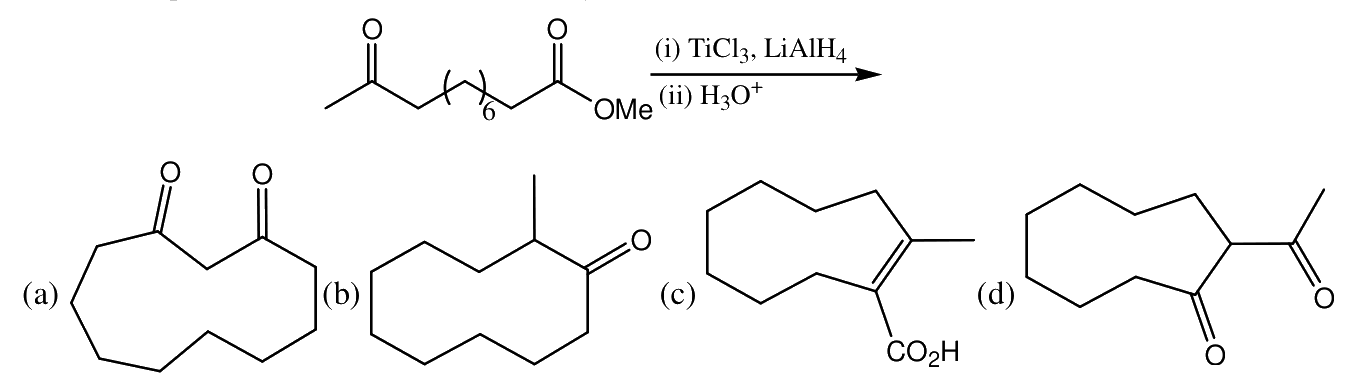
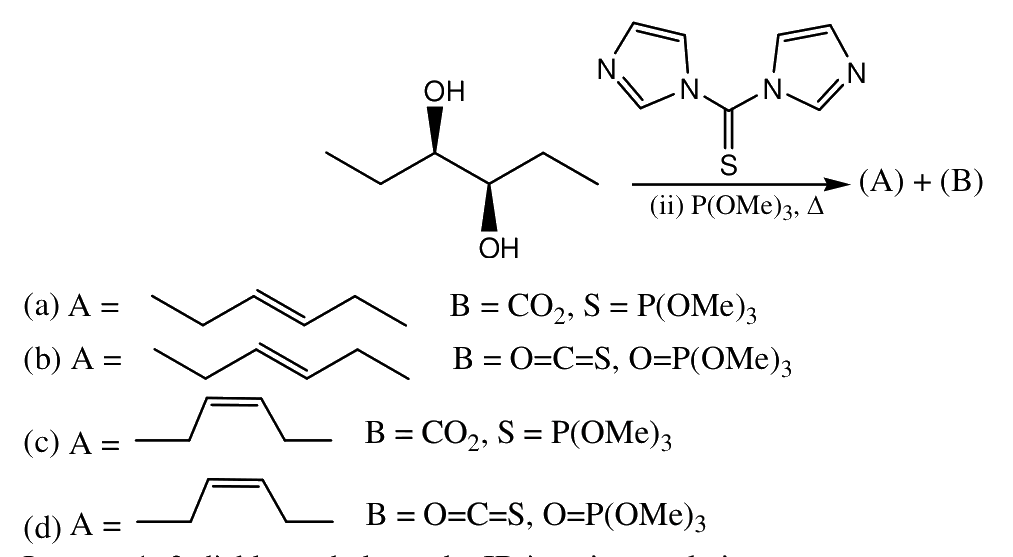
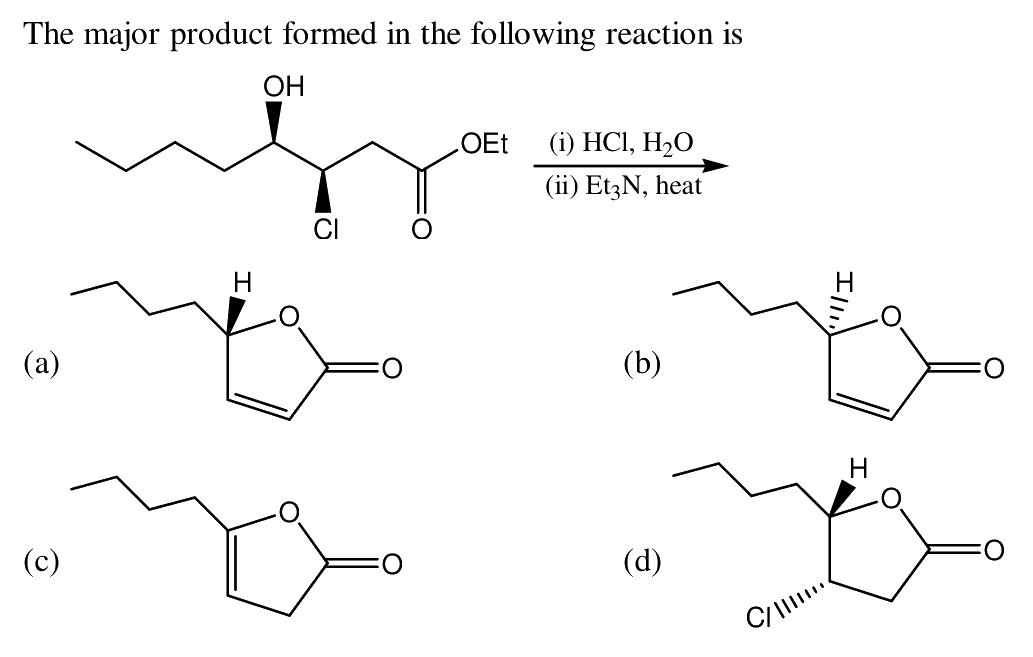
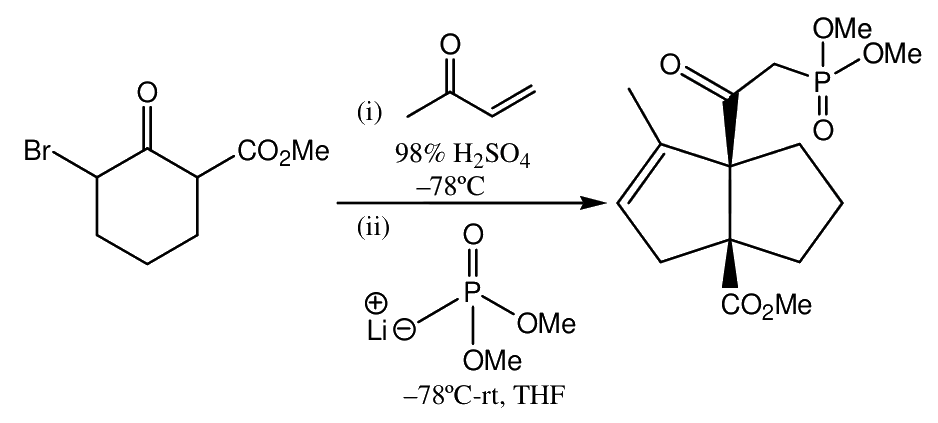
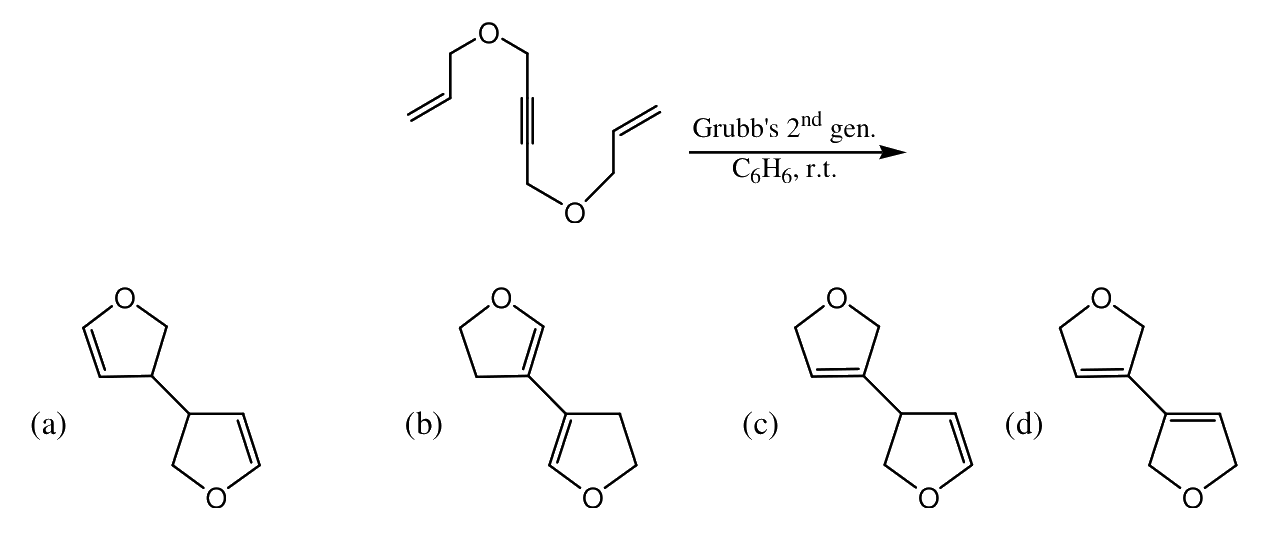
The major product formed in the following reaction is
a.
(a)
Correct Answer
b.
(b)
c.
(c)
d.
(d)
Step-by-Step AI Explanation
Verified Method
The attached diagram is mismatched with the question text, but this corresponds to a standard organic reaction question from the CSIR NET exam where option (a) represents the correct major product.
Q23mcq
The correct match of $^{13}\mathrm{C}\text{ NMR}$ chemical shift values ($\delta\text{ppm}$) for pyridine is
a.
C2:136; C3:124; C4:150
b.
C2:124; C3:150; C4:136
c.
C2:150; C3:124; C4:136
Correct Answer
d.
C2:150; C3:136; C4:124
Step-by-Step AI Explanation
Verified Method
In pyridine, the ring nitrogen is electron-withdrawing by both inductive and resonance effects. Due to the electronegativity of nitrogen and resonance descreening at the ortho (C2/C6) and para (C4) positions, C2 is strongly downfield at $\delta \approx 150\text{ ppm}$. The meta-position (C3/C5) does not experience resonance deshielding and is the most shielded at $\delta \approx 124\text{ ppm}$. The para-carbon (C4) appears between them at $\delta \approx 136\text{ ppm}$. Therefore, the correct values are C2: 150, C3: 124, C4: 136 ppm.
Q24mcq
Molar composition of a mixture of $\mathrm{P}$ and $\mathrm{Q}$ at equilibrium is $3:1$ ($\mathrm{P}:\mathrm{Q}$). A small disturbance in composition results in change of chemical potential of $\mathrm{P}$ by $10\text{ J mol}^{-1}$. The chemical potential of $\mathrm{Q}$ will change (in $\text{J mol}^{-1}$) by:
a.
$30$
b.
$3.3$
c.
$-30$
Correct Answer
d.
$-3.3$
Step-by-Step AI Explanation
Verified Method
According to the Gibbs-Duhem equation at constant temperature and pressure:
$$n_{\mathrm{P}} d\mu_{\mathrm{P}} + n_{\mathrm{Q}} d\mu_{\mathrm{Q}} = 0$$
Given $n_{\mathrm{P}} : n_{\mathrm{Q}} = 3 : 1$, we have:
$$3(d\mu_{\mathrm{P}}) + 1(d\mu_{\mathrm{Q}}) = 0$$
$$d\mu_{\mathrm{Q}} = -3 d\mu_{\mathrm{P}} = -3(10\text{ J mol}^{-1}) = -30\text{ J mol}^{-1}$$
Q25mcq
E1cb mechanism is followed in the reaction of
a.
2-bromopentane with t-BuOK to give pent-2-ene
b.
nitromethane with benzaldehyde in the presence of KOH to give $\beta$-nitrostyrene
c.
bormobenzene with $\mathrm{NaNH}_2$ to give aniline
d.
$p$-chloronitrobenzene with $\mathrm{NaOMe}$ to give $p$-nitroanisole
No explanation saved for this question yet.
Q26mcq
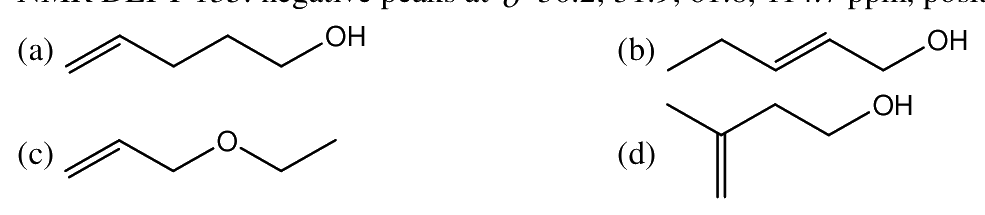
For the complex shown below in non-fluxional state, the expected $^{31}\text{P}\{^1\text{H}\}$ NMR resonance(s) is/are [$^{31}\text{P}: I = 1/2$]
a.
one singlet
b.
one doublet
c.
two singlets
d.
two doublets
Correct Answer
Step-by-Step AI Explanation
Verified Method
In the static (non-fluxional) low-temperature state of the standard five-coordinate or bridged phosphorus complex typically set in this CSIR NET problem (such as $\mathrm{Fe(CO)_3(PPh_3)_2}$ or an asymmetric coordination environment with two inequivalent phosphorus nuclei coupling to each other), the two distinct $^{31}\mathrm{P}$ environments exhibit mutual $^{31}\mathrm{P}-^{31}\mathrm{P}$ spin-spin coupling ($J_{\mathrm{P-P}}$), resulting in a pair of doublets (two doublets).
Q27mcq
The value of a physical variable was found to be $196$, $198$, $194$, $199$ and $198$ in a set of five independent measurements. The average value and the standard deviation would be closest, respectively to
a.
$198$ and $2$
b.
$197$ and $4$
c.
$197$ and $2$
Correct Answer
d.
$198$ and $4$
Step-by-Step AI Explanation
Verified Method
The measurements are $196, 198, 194, 199, 198$.
1. **Average (mean):**
$$\bar{x} = \frac{196 + 198 + 194 + 199 + 198}{5} = \frac{985}{5} = 197$$
2. **Standard deviation ($s$):**
The deviations $(x_i - \bar{x})$ are $-1, +1, -3, +2, +1$.
$$\sum (x_i - \bar{x})^2 = (-1)^2 + 1^2 + (-3)^2 + 2^2 + 1^2 = 1 + 1 + 9 + 4 + 1 = 16$$
Using the sample standard deviation formula with $N - 1 = 4$ degrees of freedom:
$$s = \sqrt{\frac{16}{4}} = \sqrt{4} = 2$$
Thus, the average is $197$ and the standard deviation is $2$.
Q28mcq
The frequency of $\text{O}-\text{H}$ stretch occurs at $\sim 3600\text{ cm}^{-1}$. The $\text{O}-\text{D}$ stretch frequency (in $\text{cm}^{-1}$)
a.
$3000$
b.
$2600$
Correct Answer
c.
$1800$
d.
$900$
Step-by-Step AI Explanation
Verified Method
The vibrational stretching frequency is proportional to $\sqrt{1/\mu}$, where $\mu$ is the reduced mass:
$$\bar{\nu} \propto \sqrt{\frac{1}{\mu}}$$
For $\text{O}-\text{H}$:
$$\mu_{\mathrm{OH}} = \frac{16 \times 1}{16 + 1} = \frac{16}{17} \approx 0.941$$
For $\text{O}-\text{D}$:
$$\mu_{\mathrm{OD}} = \frac{16 \times 2}{16 + 2} = \frac{32}{18} \approx 1.778$$
Taking the ratio:
$$\frac{\bar{\nu}_{\mathrm{OD}}}{\bar{\nu}_{\mathrm{OH}}} = \sqrt{\frac{\mu_{\mathrm{OH}}}{\mu_{\mathrm{OD}}}} = \sqrt{\frac{0.941}{1.778}} \approx \sqrt{0.529} \approx 0.727$$
$$\bar{\nu}_{\mathrm{OD}} \approx 3600 \times 0.727 \approx 2618\text{ cm}^{-1} \approx 2600\text{ cm}^{-1}$$
Q29mcq
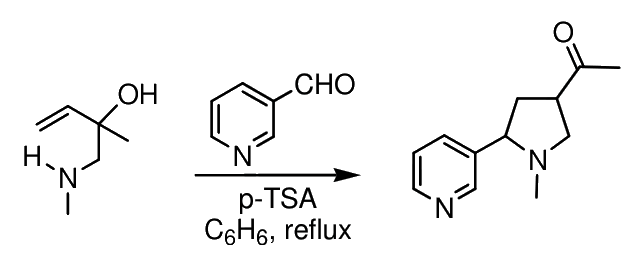
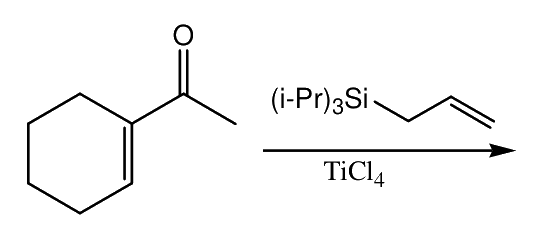
The major product formed in the following reaction is
In 4-nitrobenzoic acid ($ ext{O}_2 ext{N}- ext{C}_6 ext{H}_4- ext{CO}_2 ext{H}$), reduction of the nitro group ($ ext{NO}_2$) by catalytic hydrogenation or chemical reducing agents selectively reduces $- ext{NO}_2$ to an amino group ($- ext{NH}_2$) without affecting the carboxylic acid group ($- ext{CO}_2 ext{H}$) or the aromatic ring, giving 4-aminobenzoic acid, $ ext{H}_2 ext{N}-( ext{C}_6 ext{H}_4)- ext{CO}_2 ext{H}$.
Q30mcq
The ion having the highest bond order is
a.
$\text{NO}^+$
Correct Answer
b.
$\text{O}_2^+$
c.
$\text{N}_2^+$
d.
$\text{C}_2^+$
Step-by-Step AI Explanation
Verified Method
We can determine the bond order of each species using Molecular Orbital Theory:
- $\text{NO}^+$ has $7 + 8 - 1 = 14$ valence/total electrons, isoelectronic with $\text{N}_2$, giving a bond order of $\frac{10 - 4}{2} = 3.0$.
- $\text{O}_2^+$ has $8 + 8 - 1 = 15$ electrons, with configuration $\sigma_{2p_z}^2 \pi_{2p_x}^2 \pi_{2p_y}^2 \pi^*_{2p_x}^1$, giving a bond order of $\frac{8 - 3}{2} = 2.5$.
- $\text{N}_2^+$ has $7 + 7 - 1 = 13$ electrons, giving a bond order of $\frac{9 - 4}{2} = 2.5$.
- $\text{C}_2^+$ has $6 + 6 - 1 = 11$ electrons, giving a bond order of $\frac{7 - 4}{2} = 1.5$.
Thus, $\text{NO}^+$ has the highest bond order (3.0).
🎉 10 Free Sample Solutions Completed
Unlock All 100 Questions & Solutions
Sign up free in seconds to unlock step-by-step AI answers for the remaining 90 questions.
The cell potential (in $\text{V}$) of a $\text{Ag/AgCl/KCl}$ electrode connected to the standard hydrogen electrode at $298\text{ K}$ is closest to (Given: $\text{E}^0_{(\text{AgCl/AgCl}^-)} = 0.222\text{ V}$ and assume that the activity of $\text{KCl}$ is $0.01$)
a.
$0.197$
b.
$0.297$
c.
$0.340$
d.
$0.440$
Correct Answer & Step-by-Step Solution Locked
Sign in free to reveal the correct answer and AI explanation for this question.
The titration of $4.4\text{ g}$ of a polymer having carboxylic acid end group requires $11\text{ mL}$ of $0.02\text{ M NaOH}$. The average molar mass (in $\text{kg mol}^{-1}$) of the polymer is
a.
$40$
b.
$20$
c.
$15$
d.
$10$
Correct Answer & Step-by-Step Solution Locked
Sign in free to reveal the correct answer and AI explanation for this question.
A liquid of density $1.1\text{ g cm}^{-3}$ climbs to a height of $5.0\text{ cm}$ when a capillary with internal radius of $0.2\text{ mm}$ is dipped into it. The surface tension (in $\text{Nm}^{-1}$) of the liquid is closest to
a.
0.05
b.
0.108
c.
0.018
d.
0.005
Correct Answer & Step-by-Step Solution Locked
Sign in free to reveal the correct answer and AI explanation for this question.
The expected number of $\nu_{\text{CO}}$ bands in the IR spectra of \textit{fac}-$[\text{Mo}(\text{PPh}_3)_3(\text{CO})_3]$ and \textit{trans}-$[\text{Mo}(\text{PPh}_3)_2(\text{CO})_4]$ are, respectively.
a.
one and one
b.
two and two
c.
two and one
d.
three and one
Correct Answer & Step-by-Step Solution Locked
Sign in free to reveal the correct answer and AI explanation for this question.
Consider the entropy changes in a system undergoing transformation, as depicted in the diagram, below
$$\begin{array}{ccccc}
25^\circ\text{C} & \xrightarrow{\Delta\text{S}_1} & 50^\circ\text{C} & \xrightarrow{\Delta\text{S}_2} & 75^\circ\text{C} \\
\Big\downarrow & & \xrightarrow{\quad\Delta\text{S}\quad} & & \Big\uparrow
\end{array}$$
The correct statement among the following is
Choose the correct statements for oxymyoglobin and cytochrome $\text{P}_{450}$ (resting state) from the following
(A) Both contain dianion of protoporphyrin-IX
(B) They have same fifth-ligand bonded to metal centre from the protein backbone
(C) They contain single active site
(D) They contain metal ion in +3 oxidation state
Answer is
a.
A, B and C
b.
A, C and D
c.
A, B and D
d.
B and C only
Correct Answer & Step-by-Step Solution Locked
Sign in free to reveal the correct answer and AI explanation for this question.
Pair of lanthanide ions which show significant deviation between the experimental and calculated magnetic moments, considering contribution from the ground state only (Given: $\mu_{\text{eff}} = g[J(J+1)]^{1/2}$) is
a.
$\text{Gd}^{3+}$ and $\text{Lu}^{3+}$
b.
$\text{Sm}^{3+}$ and $\text{Tb}^{3+}$
c.
$\text{Eu}^{3+}$ and $\text{Tb}^{3+}$
d.
$\text{Sm}^{3+}$ and $\text{Eu}^{3+}$
Correct Answer & Step-by-Step Solution Locked
Sign in free to reveal the correct answer and AI explanation for this question.
If the rate constant for a base catalyzed estser hydrolysis reaction is $0.20\text{ L mol}^{-1}\text{ s}^{-1}$, half-life (in s) of the ester (Given $[\text{ester}]_\text{o} = [\text{base}]_\text{o} = 0.05\text{ mol. L}^{-1}$) would be closest to
a.
40
b.
100
c.
140
d.
200
Correct Answer & Step-by-Step Solution Locked
Sign in free to reveal the correct answer and AI explanation for this question.
Consider four species A, B, C and D
$$\text{A} + \text{B} \xrightarrow{\text{KI, H}^+} \text{C}$$
Oxidation of A with C in an acidic medium gives D, A, B, C and D are, respectively
a.
$\text{S}_4\text{O}_6^{2-}$, $\text{I}_2$, $\text{KIO}_3$ and $\text{SO}_4^{2-}$
b.
$\text{S}_4\text{O}_6^{2-}$, $\text{KIO}_3$, $\text{I}_2$ and $\text{SO}_4^{2-}$
c.
$\text{S}_2\text{O}_3^{2-}$, $\text{KIO}_3$, $\text{I}_2$ and $\text{S}_4\text{O}_6^{2-}$
d.
$\text{S}_2\text{O}_3^{2-}$, $\text{KIO}_3$, $\text{I}_2$ and $\text{SO}_4^{2-}$
Correct Answer & Step-by-Step Solution Locked
Sign in free to reveal the correct answer and AI explanation for this question.
Consider a two-level system in which the excited state, separated from the ground state by energy $\varepsilon$, is doubly degenerate. The fraction of the molecules in the excited state, as $\text{T} \rightarrow \infty$, is
a.
$\frac{1}{3}$
b.
$\frac{1}{2}$
c.
$\frac{2}{3}$
d.
$1$
Correct Answer & Step-by-Step Solution Locked
Sign in free to reveal the correct answer and AI explanation for this question.
In IR spectrum, recorded neat, a compound shows a strong and broad band at $3300\text{ cm}^{-1}$. The band becomes sharp and shifts to $3600\text{ cm}^{-1}$ when the spectrum is recorded in $\text{CCl}_4$ at high dilution. This proves that the compound has
a.
OH group, which is involved in intramolecular H-bonding
b.
OH group, which is involved in intermolecular H-bonding
c.
a terminal alkyne group
d.
OH group, present in severely sterically hindered environment
Correct Answer & Step-by-Step Solution Locked
Sign in free to reveal the correct answer and AI explanation for this question.
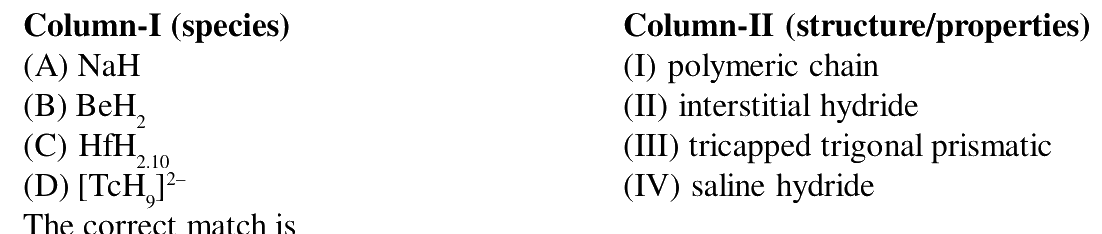
Match the items in Column-I with those of Column-II
\begin{tabular}{ll}
\textbf{Column-I (species)} & \textbf{Column-II (structure/properties)} \\
(A) $\text{NaH}$ & (I) polymeric chain \\
(B) $\text{BeH}_2$ & (II) interstitial hydride \\
(C) $\text{HfH}_{2.10}$ & (III) tricapped trigonal prismatic \\
(D) $[\text{TcH}_9]^{2-}$ & (IV) saline hydride
\end{tabular}
The correct match is
a.
A-IV, B-II, C-III, D-I
b.
A-I, B-IV, C-II, D-III
c.
A-IV, B-I, C-II, D-III
d.
A-IV, B-I, C-III, D-II
Correct Answer & Step-by-Step Solution Locked
Sign in free to reveal the correct answer and AI explanation for this question.
The cluster types of $\left[\mathrm{Fe}_{5}(\mathrm{CO})_{14} \mathrm{~N}\right]^{-}$ and $\left[\mathrm{Co}_{6}(\mathrm{CO})_{13} \mathrm{~N}\right]^{-}$ are, respectively
a.
nido-, nido-
b.
nido-, closo-
c.
closo-, nido-
d.
closo-, closo-
Correct Answer & Step-by-Step Solution Locked
Sign in free to reveal the correct answer and AI explanation for this question.
Match the items in Column-I with those of Column-II
**Column-I**
(A) Conductometric titration
(B) Amperometric titrations
(C) pH metric titration
(D) Differential pulse polarography
**Column-II**
(I) Voltage
(II) Resistance
(III) $\Delta\mathrm{I}$
(IV) $\mathrm{I}_{\mathrm{d}}$
Correct match is
a.
A-II, B-IV, C-I, D-III
b.
A-III, B-I, C-II, D-IV
c.
A-III, B-II, C-IV, D-I
d.
A-I, B-III, C-IV, D-II
Correct Answer & Step-by-Step Solution Locked
Sign in free to reveal the correct answer and AI explanation for this question.
Complex(es) which has/have unpaired electron(s) that is equal to that of iron center in oxymyoglobin is/are
(A) $\left[\mathrm{Fe}(\mathrm{ox})_{3}\right]^{3-}$
(B) $\left[\mathrm{Fe}(\mathrm{CN})_{6}\right]^{3-}$
(C) $\left[\mathrm{NiCl}_{4}\right]^{2-}$
(D) $\left[\mathrm{Cu}\left(\mathrm{NH}_{3}\right)_{4}\right]^{2+}$
[Given: ox = oxalato]
Correct answer is
a.
A and B
b.
B and D
c.
C only
d.
C and D
Correct Answer & Step-by-Step Solution Locked
Sign in free to reveal the correct answer and AI explanation for this question.
In Mössbauer spectrum of a sample containing iron recorded in the presence of a static magnetic field, the number of possible allowed transitions(s) is
a.
Two
b.
Four
c.
Six
d.
Eight
Correct Answer & Step-by-Step Solution Locked
Sign in free to reveal the correct answer and AI explanation for this question.
The oxidation of $\mathrm{NO}$ to $\mathrm{NO}_{2}$ occurs via the mechanism given below
$$2\mathrm{NO} \underset{k_{-1}}{\stackrel{k_{1}}{\rightleftharpoons}} \mathrm{N}_{2}\mathrm{O}_{2}; \quad \mathrm{N}_{2}\mathrm{O}_{2} + \mathrm{O}_{2} \xrightarrow{k_{2}} 2\mathrm{NO}_{2}$$
$\frac{\mathrm{d}[\mathrm{NO}_{2}]}{\mathrm{dt}}$ in the presence of large excess of $\mathrm{O}_{2}$ can be written as
a.
$2k_{1}(\mathrm{NO})^{2}$
b.
$2k_{1}k_{2}(\mathrm{NO})^{2}(\mathrm{O}_{2})$
c.
$\frac{k_{1}}{k_{2}}(\mathrm{NO})^{2}$
d.
$2k_{2}(\mathrm{NO})^{2}$
Correct Answer & Step-by-Step Solution Locked
Sign in free to reveal the correct answer and AI explanation for this question.
In linear variation method using two orthogonal basis functions, the two roots obtained are $\epsilon_{0}$ and $\epsilon_{1} (\epsilon_{0} < \epsilon_{1})$. The correct relation of these with exact ground and first excited state energies, $\mathrm{E}_{0}$ and $\mathrm{E}_{1}$, respectively, is
a.
$\epsilon_{0} \geq \mathrm{E}_{0}$ and $\epsilon_{1} < \mathrm{E}_{1}$
b.
$\epsilon_{0} < \mathrm{E}_{1}$ and $\epsilon_{1} \geq \mathrm{E}_{1}$
c.
$\epsilon_{0} < \mathrm{E}_{0}$ and $\epsilon_{1} < \mathrm{E}_{1}$
d.
$\epsilon_{0} \geq \mathrm{E}_{0}$ and $\epsilon_{1} \geq \mathrm{E}_{1}$
Correct Answer & Step-by-Step Solution Locked
Sign in free to reveal the correct answer and AI explanation for this question.
Consider the gas phase reaction, $2\mathrm{A(g)} + 3\mathrm{B(g)} \rightleftharpoons 2\mathrm{C(g)}$ at a given temperature. When $2.0\text{ moles}$ of $\mathrm{A(g)}$ are reacted with $2.0\text{ moles}$ of $\mathrm{B(g)}$, $0.8\text{ moles}$ of $\mathrm{C(g)}$ are formed at equilibrium at a total pressure of $2.0\text{ bar}$. The value of the equilibrium constant, $\mathrm{K_p}$ of this reaction at the given temperature is closest to
a.
0.3
b.
0.9
c.
2.4
d.
19.1
Correct Answer & Step-by-Step Solution Locked
Sign in free to reveal the correct answer and AI explanation for this question.
$1.0\text{ mol}$ of a perfect monatomic gas is put through the cycle shown in the figure. The total work (in $\text{J}$) done during the cycle is
(Use: $1\text{ L-bar} = 100\text{ J}$, $\mathrm{R} = 8.3\text{ JK}^{-1}\text{ mol}^{-1} = 0.083\text{ L-bar K}^{-1}\text{ mol}^{-1}$, $\ln 2 = 0.7$)
a.
930
b.
$-4183$
c.
8831
d.
$-5113$
Correct Answer & Step-by-Step Solution Locked
Sign in free to reveal the correct answer and AI explanation for this question.
Among $\mathrm{SO_2(OH)F}$, $\mathrm{CH_3CO_2H}$, $\mathrm{LiF}$ and $\mathrm{H_2O}$, the compound(s) which behave(s) as a base in liquid $\mathrm{HF}$ is/are
a.
$\mathrm{CH_3CO_2H}$ and $\mathrm{LiF}$ only
b.
$\mathrm{LiF}$ only
c.
$\mathrm{SO_2(OH)F}$ and $\mathrm{LiF}$ only
d.
$\mathrm{CH_3CO_2H}$, $\mathrm{LiF}$ and $\mathrm{H_2O}$
Correct Answer & Step-by-Step Solution Locked
Sign in free to reveal the correct answer and AI explanation for this question.
In the pure rotational microwave spectrum of a XY molecule, the adjacent lines are separated by $4\text{ cm}^{-1}$. If the molecule is irradiated by a radiation of $30,000\text{ cm}^{-1}$, the first Stokes line (in $\text{cm}^{-1}$) appears at
a.
29988
b.
30012
c.
30004
d.
29996
Correct Answer & Step-by-Step Solution Locked
Sign in free to reveal the correct answer and AI explanation for this question.
For the reaction $\mathrm{K} + \mathrm{Br}_2 \rightarrow \mathrm{KBr} + \mathrm{Br}$, which follows the harpoon mechanism, the reactive cross-section is closest to $\left[\text{Given: } \frac{\mathrm{e}^2}{4\pi\varepsilon_0} = 2.3 \times 10^{-28}\text{ J m},\text{ Ionization energy of of } \mathrm{K} = 422.5\text{ kJmol}^{-1},\text{ electron affinity of } \mathrm{Br}_2 = 250\text{ kJ mol}^{-1} \text{ and } \mathrm{N}_{\mathrm{A}} = 6 \times 10^{23}\text{ mol}^{-1}\right]$
a.
$50 \times 10^{18}\text{ m}^2$
b.
$2 \times 10^{-18}\text{ m}^2$
c.
$64 \times 10^{-18}\text{ m}^2$
d.
$16 \times 10^{-18}\text{ m}^2$
Correct Answer & Step-by-Step Solution Locked
Sign in free to reveal the correct answer and AI explanation for this question.
For the electrochemical cell $\mathrm{Ag} \mid \mathrm{AgCl} \mid \mathrm{MCl}\ (0.01\text{ M}) \mid \mathrm{MCl}(0.02\text{ M}) \mid \mathrm{AgCl} \mid \mathrm{Ag}$, the junction potential is the highest when $\mathrm{M}^+$ is
a.
$\mathrm{H}^+$
b.
$\mathrm{Li}^+$
c.
$\mathrm{Na}^+$
d.
$\mathrm{K}^+$
Correct Answer & Step-by-Step Solution Locked
Sign in free to reveal the correct answer and AI explanation for this question.
X-rays of $173\text{ pm}$ wavelength are reflected by the $(111)$ plane of a cubic primitive crystal at $\theta = 30^\circ$. The unit cell length (in $\text{pm}$) is closest to
a.
$173$
b.
$300$
c.
$346$
d.
$600$
Correct Answer & Step-by-Step Solution Locked
Sign in free to reveal the correct answer and AI explanation for this question.
$(\text{C}_\text{P} - \text{C}_\text{V})$ for a non-ideal gas differes from $(\text{C}_\text{P} - \text{C}_\text{V})$ for a perfect gas by the expression
Choose the equilibria from the following that are NOT favoured to go to right.
(A) $\text{As}_2\text{S}_5 + 5\text{HgO} \rightleftharpoons \text{As}_2\text{O}_5 + 5\text{HgS}$
(B) $\text{La}_2(\text{CO}_3)_3 + \text{Bi}_2\text{S}_3 \rightleftharpoons \text{La}_2\text{S}_3 + \text{Bi}_2(\text{CO}_3)_3$
(C) $\text{CdSO}_4 + \text{CaS} \rightleftharpoons \text{CdS} + \text{CaSO}_4$
(D) $\text{BeF}_2 + \text{HgI}_2 \rightleftharpoons \text{BeI}_2 + \text{HgF}_2$
a.
A and B
b.
A and C
c.
B and C
d.
B and D
Correct Answer & Step-by-Step Solution Locked
Sign in free to reveal the correct answer and AI explanation for this question.
In spectrofluorimetric determination in solution
(A) absorbance of analyte solution is kept near to 0.05
(B) oxygen is eradicated from solution
(C) pH of solution is controlled
(D) wavelength of incident light is always above 400 nm
Correct from the above is
a.
A, B and D
b.
B, C and D
c.
A, B and C
d.
A, C and D
Correct Answer & Step-by-Step Solution Locked
Sign in free to reveal the correct answer and AI explanation for this question.
The correct match of spin-only magnetic moment for the complexes $cis\text{-}[\text{Fe}(\text{phen})_2(\text{NCS-N})_2]$ (A) and $[\text{Fe}(\text{phen})_3]\text{Cl}_2$ (B) at $300\text{ K}$ is (phen = 1, 10-phenanthroline)
a.
$4.89\text{ BM}$ for both A and B
b.
$0\text{ BM}$ for both A and B
c.
$4.89\text{ BM}$ for A and $0\text{ BM}$ for B
d.
$0\text{ BM}$ for A and $4.89\text{ BM}$ for B
Correct Answer & Step-by-Step Solution Locked
Sign in free to reveal the correct answer and AI explanation for this question.
The correct statements for dithionite and dithionate anions from the following are
(A) both have S-S bond
(B) both are dianionic
(C) oxidation state of sulphur is +3 and +5, respectively
(D) sulphur in dithionate has lone pair of electrons
a.
A, B and C
b.
A, B and D
c.
B, C and D
d.
A and B only
Correct Answer & Step-by-Step Solution Locked
Sign in free to reveal the correct answer and AI explanation for this question.
Consider the following statements:
(A) The highest oxidation state of Group 8 elements is more readily shown in their oxides than in fluorides
(B) $\text{Fe}$ can exist in $-2$ formal oxidation state also
(C) $\text{Mn}$, $\text{Tc}$ and $\text{Re}$ easily form $\text{M(II)}$ compounds
The correct statement(s) is/are
a.
A and B
b.
A and C
c.
B and C
d.
C only
Correct Answer & Step-by-Step Solution Locked
Sign in free to reveal the correct answer and AI explanation for this question.
The species for which the shapes (geometry) can be predicted by VSEPR theory is/are
(A) $[\text{PtCl}_4]^{2-}$
(B) $[\text{TeCl}_6]^{2-}$
(C) $\text{PF}_3$ and $\text{SF}_6$
a.
A and C
b.
B and C
c.
C only
d.
A and B
Correct Answer & Step-by-Step Solution Locked
Sign in free to reveal the correct answer and AI explanation for this question.
The rate constant of a second order reaction $2\text{A} \rightarrow \text{Z}$ is $k_2$. If the initial concentration of the reactant is $a_0$ and the concentration of the product at time $t$ is $x$, then a linear function of t with the slope $k_2 a_0$ is
a.
$\ln\left(\frac{x}{a_0 - x}\right)$
b.
$\frac{x}{a_0(a_0 - x)}$
c.
$\frac{x}{a_0 - x}$
d.
$\ln\left(\frac{x}{a_0(a_0 - x)}\right)$
Correct Answer & Step-by-Step Solution Locked
Sign in free to reveal the correct answer and AI explanation for this question.