Dinuclear anion $[\text{I}_2(\text{OH})_2\text{O}_8]^{4-}$ has two bridging oxo groups. The geometry around each iodine is
a.
octahedral
Correct Answer
b.
monocapped octahedral
c.
square pyramidal
d.
pentagonal bipyramidal
Step-by-Step AI Explanation
Verified Method
In the dinuclear anion $[\text{I}_2(\text{OH})_2\text{O}_8]^{4-}$ (also formulated as di-periodate $[\text{H}_2\text{I}_2\text{O}_{10}]^{4-}$), two iodine atoms are connected through two bridging oxygen atoms (oxo ligands, $\mu_2\text{-O}$). Each iodine center is coordinated to 2 bridging oxo ligands and 4 terminal oxygen/hydroxyl ligands (specifically, three terminal oxo and one hydroxyl, or two terminal oxo, one OH, etc., totaling 6 oxygen donors per iodine). Thus, each iodine atom has a coordination number of 6, resulting in an octahedral coordination geometry sharing an edge.
Q22mcq
Using a double beam UV-visible spectrophotometer, Beer's law fails for $\text{K}_2\text{Cr}_2\text{O}_7$ solution when
a.
intensity of light source is changed
b.
detector is not a photomultiplier tube
c.
cuvette of $2\text{ cm}$ size is used
d.
pH is not kept same in all measurements
Correct Answer
Step-by-Step AI Explanation
Verified Method
Potassium dichromate in aqueous solution exists in a pH-dependent chemical equilibrium: $\text{Cr}_2\text{O}_7^{2-} + \text{H}_2\text{O} \rightleftharpoons 2\text{HCrO}_4^- \rightleftharpoons 2\text{CrO}_4^{2-} + 2\text{H}^+$. Because the dichromate and chromate species have significantly different molar absorptivities at a given wavelength, any change in pH shifts the equilibrium and alters the apparent concentration of the absorbing species, leading to a failure (apparent deviation) of Beer's law.
Q23mcq
Trivalent lanthanide ion having isotropic magnetic susceptibility is
a.
$\text{Eu}^{3+}$
b.
$\text{Gd}^{3+}$
Correct Answer
c.
$\text{Yb}^{3+}$
d.
$\text{Lu}^{3+}$
Step-by-Step AI Explanation
Verified Method
$\text{Gd}^{3+}$ has a half-filled $4f^7$ electronic configuration with the ground state term symbol $^8 ext{S}_{7/2}$ ($L = 0$). Since the total orbital angular momentum is zero ($L = 0$), the magnetic dipole interaction lacks orbital anisotropy, resulting in an isotropic magnetic susceptibility (or isotropic $g$-factor). In contrast, $\text{Eu}^{3+}$ ($J=0$ ground state with Van Vleck paramagnetism) and other non-S-state ions (like $\text{Yb}^{3+}$) exhibit magnetic anisotropy.
Q24mcq
The structure of $\text{CaB}_6$ is close to that of
a.
cesium chloride
Correct Answer
b.
nickel arsenide
c.
rock salt
d.
zinc blende
Step-by-Step AI Explanation
Verified Method
Calcium hexaboride ($ ext{CaB}_6$) crystallizes in a structure where $ ext{Ca}^{2+}$ cations and rigid, octahedral $ ext{B}_6$ clusters occupy the lattice sites. The $ ext{Ca}^{2+}$ ions form a simple cubic lattice, with the octahedral $[ ext{B}_6]^{2-}$ units occupying the body centers (or vice versa), which is directly analogous to the CsCl structure type.
Q25mcq
The correct order of $\text{C}-\text{O}$ bond length is
The extent of metal-to-ligand $\pi$-backbonding determines the $\text{C}-\text{O}$ bond length: greater $\pi$-backdonation into the $\pi^*$ orbital of $\text{CO}$ weakens and lengthens the $\text{C}-\text{O}$ bond. In the isoelectronic series $[\text{V}(\text{CO})_6]^-$, $[\text{Cr}(\text{CO})_6]$, and $[\text{Mn}(\text{CO})_6]^+$, the electron density on the metal decreases as the positive charge increases: $\text{V}^- > \text{Cr}^0 > \text{Mn}^+$. Thus, $\pi$-backdonation is strongest in $[\text{V}(\text{CO})_6]^-$, giving it the longest $\text{C}-\text{O}$ bond, followed by $[\text{Cr}(\text{CO})_6]$ and $[\text{Mn}(\text{CO})_6]^+$. In $\text{H}_3\text{B}\cdot\text{CO}$, boron has no $d$-electrons to backbond, resulting in the shortest $\text{C}-\text{O}$ bond. Therefore, the order of $\text{C}-\text{O}$ bond length is $[\text{V}(\text{CO})_6]^- > [\text{Cr}(\text{CO})_6] > [\text{Mn}(\text{CO})_6]^+ > \text{H}_3\text{B}\cdot\text{CO}$.
Q26mcq
Among the elements Zn, Ga, Ge and As, the one with the lowest first ionisation energy is
a.
As
b.
Zn
c.
Ga
Correct Answer
d.
Ge
Step-by-Step AI Explanation
Verified Method
The electronic configurations of the given 4th-period elements are: $\text{Zn}: [\text{Ar}]\,3d^{10}4s^2$, $\text{Ga}: [\text{Ar}]\,3d^{10}4s^2 4p^1$, $\text{Ge}: [\text{Ar}]\,3d^{10}4s^2 4p^2$, and $\text{As}: [\text{Ar}]\,3d^{10}4s^2 4p^3$. Gallium has a single electron in the higher-energy $4p$ subshell, which is shielded by the completely filled $3d^{10}$ and $4s^2$ subshells. Consequently, removing this lone $4p$ electron requires the lowest energy, making Ga possess the lowest first ionization energy among the four elements (Ga: $\sim 579\text{ kJ/mol}$, Ge: $\sim 762\text{ kJ/mol}$, Zn: $\sim 906\text{ kJ/mol}$, As: $\sim 947\text{ kJ/mol}$).
Q27mcq
The total degeneracy of the ground term of $\text{Co}^{\text{II}}$ (high spin) in octahedral geometry is
a.
18
b.
12
Correct Answer
c.
28
d.
9
Step-by-Step AI Explanation
Verified Method
High-spin $\text{Co}^{\text{II}}$ is a $d^7$ system. In an octahedral weak field, the free ion ground term $^4\text{F}$ splits into $^4\text{T}_{1g}$, $^4\text{T}_{2g}$, and $^4\text{A}_{2g}$, where the ground term in an octahedral crystal field is $^4\text{T}_{1g}$. The total degeneracy is given by the product of the spin degeneracy ($2S + 1$) and the orbital degeneracy. Here, $S = 3/2$, so the spin multiplicity is $2(3/2) + 1 = 4$, and a T-term has an orbital degeneracy of 3. Therefore, the total degeneracy is $4 \times 3 = 12$.
Q28mcq
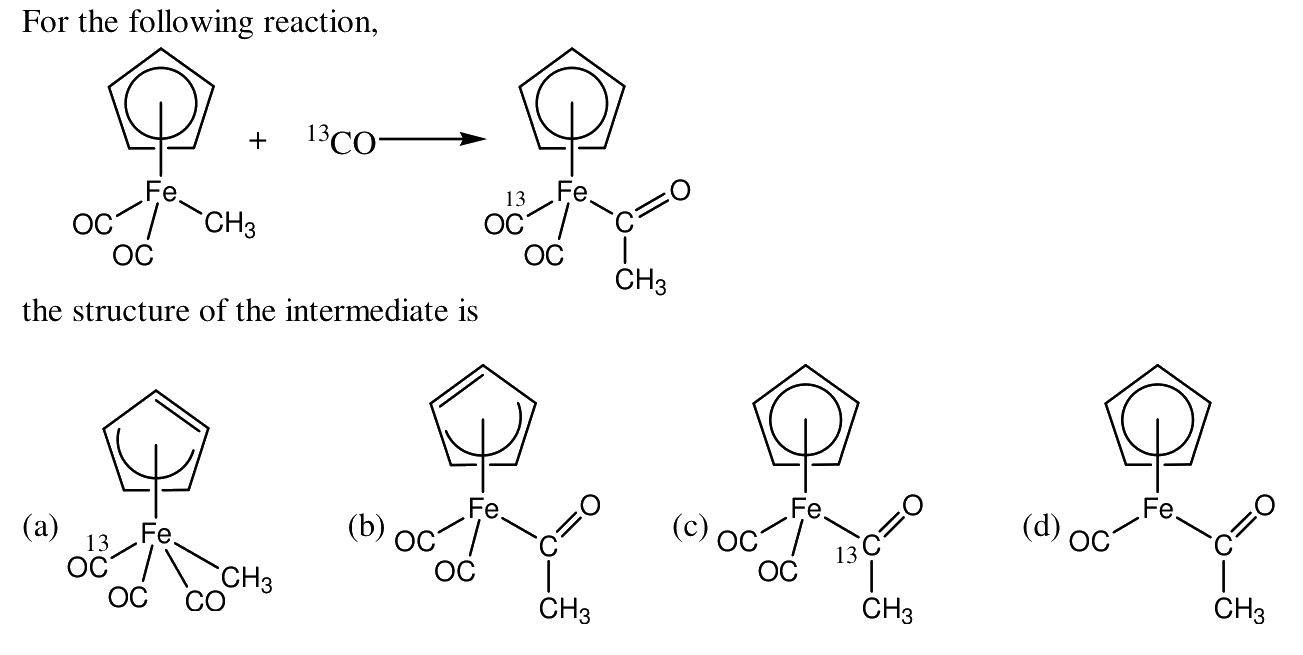
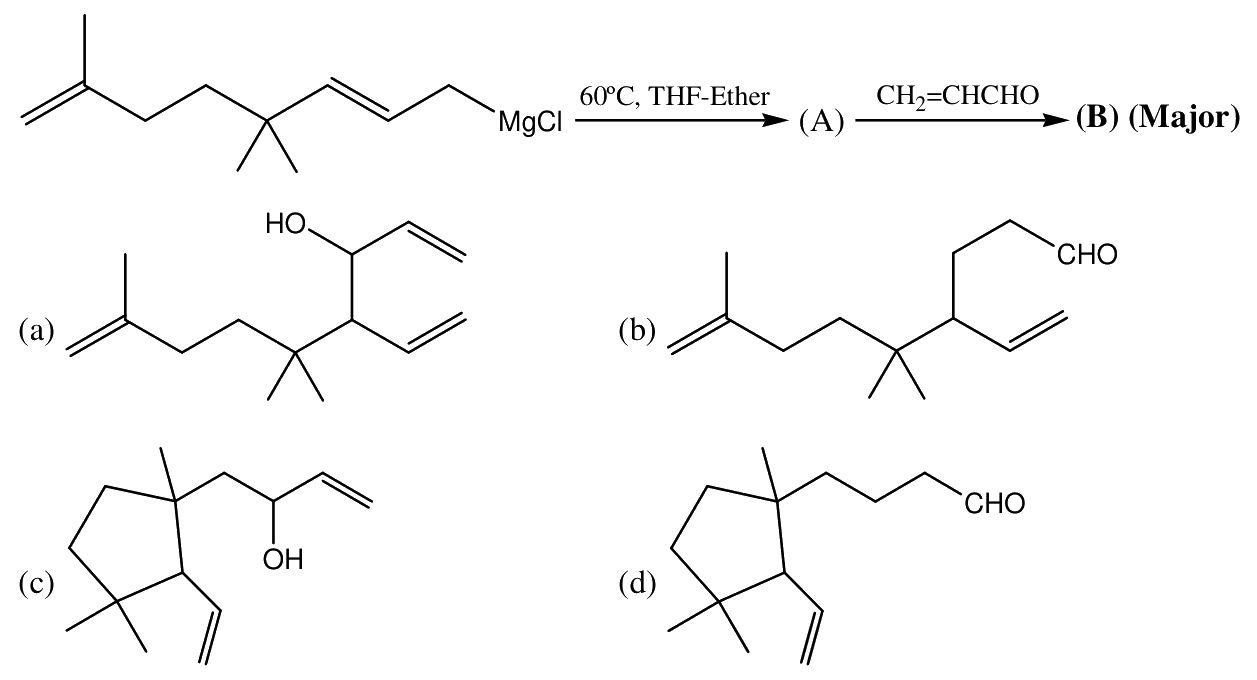
For the following reaction,
the structure of the intermediate is
a.
(a)
b.
(b)
c.
(c)
d.
(d)
Correct Answer
Step-by-Step AI Explanation
Verified Method
The reaction of $\text{CpFe}(\text{CO})_2(\text{CH}_3)$ with $^{13}\text{CO}$ to give an acyl complex proceeds via migratory insertion of an existing coordinated $\text{CO}$ ligand into the Fe–methyl bond (methyl migration to a coordinated $\text{CO}$), generating an unsaturated 16-electron acyl intermediate: $\text{CpFe}(\text{CO})[\text{C}(=\text{O})\text{CH}_3]$. This 16-electron intermediate then traps the incoming $^{13}\text{CO}$ to form the final product. Thus, structure (d) is the correct intermediate.
Q29mcq
High spin complex of a 3d metal ion $\mathbf{M}$ has a magnetic moment of 2.9 B.M. in octahedral coordination environment and 4.1 B.M. in tetrahedral environment. The $\mathbf{M}$ ion is
a.
$\text{Co}^{\text{III}}$
b.
$\text{Ni}^{\text{II}}$
Correct Answer
c.
$\text{Cu}^{\text{II}}$
d.
$\text{Co}^{\text{II}}$
Step-by-Step AI Explanation
Verified Method
For $\text{Ni}^{\text{II}}$ ($d^8$ configuration):
- In an octahedral coordination environment, the ground state is $^3A_{2g}$ with 2 unpaired electrons ($S = 1$). The spin-only magnetic moment is $\mu_{so} = \sqrt{2(2+2)} = 2.83\text{ B.M.}$, and due to spin-orbit coupling mixing with excited $T$ states, the magnetic moment typically falls in the range of $2.9 - 3.2\text{ B.M.}$
- In a tetrahedral coordination environment, the ground state is $^3T_1$, which has an unquenched orbital angular momentum contribution, leading to higher magnetic moments, typically around $3.5 - 4.2\text{ B.M.}$ (around 4.1 B.M.).
Therefore, the metal ion $\mathbf{M}$ is $\text{Ni}^{\text{II}}$.
Q30mcq
For electronic spectra of $\text{K}_2\text{CrO}_4\text{ (A)}$ and $\text{K}_2\text{MoO}_4\text{ (B)}$ the correct combination is
a.
transition is d-d and $\lambda_{\max}$ for $\text{A} < \text{B}$
b.
transition is LMCT and $\lambda_{\max}$ for $\text{A} < \text{B}$
c.
transition is LMCT and $\lambda_{\max}$ for $\text{A} > \text{B}$
Correct Answer
d.
transition is MLCT and $\lambda_{\max}$ for $\text{A} > \text{B}$
Step-by-Step AI Explanation
Verified Method
Both $\text{CrO}_4^{2-}$ and $\text{MoO}_4^{2-}$ have metals in the $d^0$ oxidation state, so $d\text{-}d$ transitions are not possible; the electronic transitions are ligand-to-metal charge transfer (LMCT, $\text{O}^{2-} \to \text{M}^{6+}$).
As we go down the group from $\text{Cr(VI)}$ to $\text{Mo(VI)}$, the energy of the metal $d$ orbitals increases because 4d orbitals are higher in energy than 3d orbitals. Hence, the energy required for LMCT increases ($\Delta E_{\text{LMCT}}(\text{Mo}) > \Delta E_{\text{LMCT}}(\text{Cr})$), which means the wavelength of the transition decreases: $\lambda_{\max}(\text{CrO}_4^{2-}) > \lambda_{\max}(\text{MoO}_4^{2-})$.
🎉 10 Free Sample Solutions Completed
Unlock All 100 Questions & Solutions
Sign up free in seconds to unlock step-by-step AI answers for the remaining 90 questions.
Removal of an electron from NO molecule results in
(A) an increase in the $\nu(\text{NO})$ in the IR spectrum
(B) an EPR active species
(C) electrons in HOMO's being closer to the oxygen than to nitrogen 2p orbitals
(D) electrons in HOMOs being closer to the nitrogen than to oxygen 2p orbitals
The correct answer is
a.
A only
b.
A and C
c.
B and D
d.
A, B and C
Correct Answer & Step-by-Step Solution Locked
Sign in free to reveal the correct answer and AI explanation for this question.
Consider the nature of solvents in Column-I and the corresponding $\lambda_{\max}$ for $\text{I}_2$ in various solvents given in Column-II. (for $\text{I}_2$ vapor $\lambda_{\max}$ is $520\text{ nm}$). Match Column-I with Column-II
\begin{tabular}{ll}
\textbf{Column-I} & \textbf{Column-II ($\lambda_{\max}$, nm)} \\
(A) non-donor & (I) 520 \\
(B) weak donor & (II) 500 \\
(C) strong donor & (III) 450 \\
(D) $\pi$ electron donor & (IV) 360
\end{tabular}
The correct match is
a.
A-I, B-II, C-III, D-IV
b.
A-III, B-IV, C-II, D-I
c.
A-I, B-III, C-IV, D-II
d.
A-IV, B-III, C-II, D-I
Correct Answer & Step-by-Step Solution Locked
Sign in free to reveal the correct answer and AI explanation for this question.
For the catalytic activity of Cu and Zn containing enzyme, superoxide dismutase, what is/are the correct statement(s)?
(A) Cu and Zn both are essential
(B) only Cu is essential
(C) Zn is essential and Cu may be replaced by any other divalent metal atom
(D) Zn may be replaced by any other divalent metal atom
a.
A only
b.
C only
c.
D only
d.
B and D
Correct Answer & Step-by-Step Solution Locked
Sign in free to reveal the correct answer and AI explanation for this question.
Elementary steps of a reaction are as follows
$$\text{A} + \text{B} \underset{k_{-1}}{\overset{k_1}{\rightleftharpoons}} 2\text{C} \, ; \quad 2\text{C} \xrightarrow{k_2} \text{D}$$
If steady state approximation is applicable to C, the rate of product formation in the reaction is
a.
proportional to $[\text{A}][\text{B}]$
b.
proportional to $[\text{A}]^2[\text{B}]^2$
c.
proportional to $[\text{A}]^{1/2}[\text{B}]^{1/2}$
d.
independent of $[\text{A}][\text{B}]$
Correct Answer & Step-by-Step Solution Locked
Sign in free to reveal the correct answer and AI explanation for this question.
The standard cell potential for the reaction
$$\text{Zn}(s) + \text{Cu}^{2+}(aq) \rightleftharpoons \text{Zn}^{2+}(aq) + \text{Cu}(s)$$
is $+1.10\text{ V}$. The Gibbs free energy change during the reaction is ($\text{F} = 96500\text{ coulomb mol}^{-1}$)
a.
$-21.2\text{ kJ mol}^{-1}$
b.
$+212\text{ kJ mol}^{-1}$
c.
$-212\text{ kJ mol}^{-1}$
d.
$-212\text{ J mol}^{-1}$
Correct Answer & Step-by-Step Solution Locked
Sign in free to reveal the correct answer and AI explanation for this question.
A $5\text{ g/L}$ polymer solution is prepared with a polymer whose molar mass is $25\text{ kg}$. The osmotic pressure (in $\text{atm}$) of this solution at $25^\circ\text{C}$ is (consider $\text{RT} = 2500\text{ J mole}^{-1}$)
a.
0.002
b.
0.05
c.
0.005
d.
0.008
Correct Answer & Step-by-Step Solution Locked
Sign in free to reveal the correct answer and AI explanation for this question.
Correct match for the coenzymes in Column-A with their function in Column-B is
\begin{tabular}{ll}
\textbf{Column-A} & \textbf{Column-B} \\
(P) NADH & (I) Oxidation \\
(Q) FAD & (II) Acyl group transfer \\
(R) CoASH & (III) Reduction
\end{tabular}
a.
P-I, Q-II, R-III
b.
P-III, Q-I, R-II
c.
P-III, Q-II, R-I
d.
P-II, Q-I, R-III
Correct Answer & Step-by-Step Solution Locked
Sign in free to reveal the correct answer and AI explanation for this question.
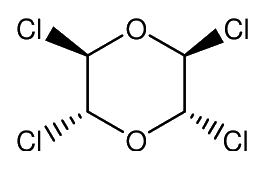
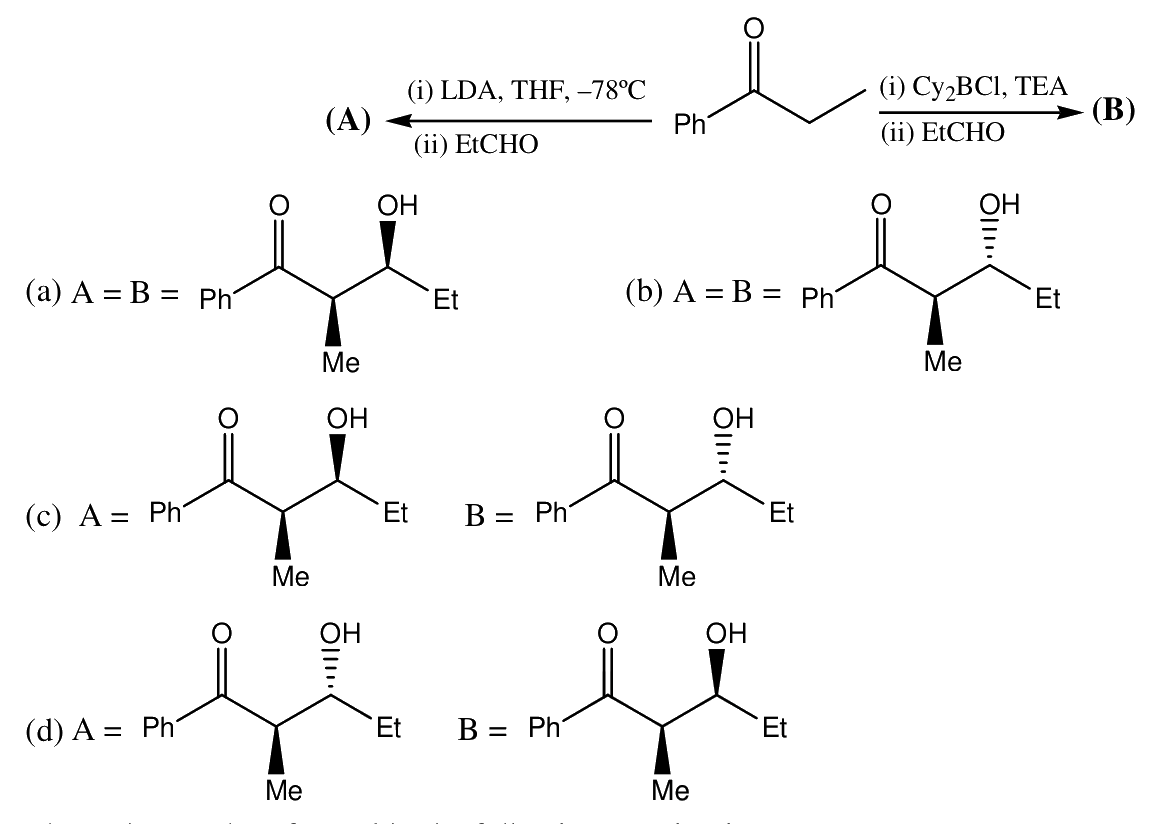
One of the products formed in the $\text{bis}(\eta^3\text{-allyl})\text{nickel}$ complex catalyzed cyclo-dimerization of butadiene in the presence of $\text{PR}_3$ is compound A given below. Identify its percursor.
Correct Answer & Step-by-Step Solution Locked
Sign in free to reveal the correct answer and AI explanation for this question.
The transformation are given in Column-I and reagent in Column-II. Match the items of Column-I with those of Column-II
**Column-I**
(A) $[\text{MnO}_4]^- \rightarrow [\text{MnO}_4]^{2-}$
(B) $\text{Me}_3\text{CH} \rightarrow [\text{Me}_3\text{C}]^+$
(C) $\text{Ag} + \text{Au} \rightarrow \text{Ag}[\text{AuF}_4]$
(D) $\text{H}_3\text{PO}_4 \rightarrow [\text{P(OH)}_4]^+$
**Column-II**
(I) $\text{H}_2\text{SO}_4$
(II) $\text{Na in liquid NH}_3$
(III) $[\text{H}_2\text{SO}_3\text{F}]^+$ (super acid)
(IV) $\text{Liquid BrF}_3$
The correct match is
a.
A-I, B-II, C-III, D-IV
b.
A-II, B-III, C-IV, D-I
c.
A-III, B-II, C-I, D-IV
d.
A-III, B-I, C-IV, D-II
Correct Answer & Step-by-Step Solution Locked
Sign in free to reveal the correct answer and AI explanation for this question.
Consider the following statements for the oxygenation of hemocyanine
(A) oxidation state of both copper atoms changes by two
(B) it becomes intense blue from colourless
(C) dioxygen is reduced to $\text{O}_2^{2-}$
(D) the $\mu\text{-}\eta^2:\eta^2$ bond forms between each oxygen and copper atoms.
The correct statements are
a.
A and C
b.
B and C
c.
A, B and C
d.
B, C and D
Correct Answer & Step-by-Step Solution Locked
Sign in free to reveal the correct answer and AI explanation for this question.
The correct increasing order of C–C bond length in the following molecules (A-D)
$[\text{PtCl}_3(\text{C}_2\text{H}_4)]^-$ (A), $[\text{Pt}(\text{PPh}_3)_2(\text{C}_2\text{H}_4)]$ (B), $[\text{Pt}(\text{PPh}_3)_2\{\text{C}_2(\text{CN})_4\}]$ (C), is
a.
C < A < B
b.
A < B < C
c.
B < C < A
d.
C < B < A
Correct Answer & Step-by-Step Solution Locked
Sign in free to reveal the correct answer and AI explanation for this question.
Which of the following are NOT closo clusters?
$[\{\text{Co}(\eta^5\text{-C}_5\text{H}_5)\}_2(\text{C}_2\text{B}_6\text{H}_8)]$ (A), $[\text{B}_4\text{C}_2\text{H}_8]$ (B), $[\text{B}_{10}\text{H}_{13}\{\text{Au}(\text{PPh}_3)\}]$ (C), $[\text{C}_2\text{B}_8\text{H}_{10}]$ (D)
The correct answer is
a.
C and (D)
b.
A and B
c.
A and C
d.
B and C
Correct Answer & Step-by-Step Solution Locked
Sign in free to reveal the correct answer and AI explanation for this question.
Identify the pair of molecules which are isoelectronic as well as isostructural from the following:
$[\text{Pd}(\text{PPh}_3)_4]$ (A), $[\text{V}(\text{CO})_6]$ (B), $[\text{Cr}(\text{CO})_6]$ (C), $[\text{Rh}(\text{PPh}_3)_3\text{Cl}]$ (D), $[(\eta^5\text{-C}_5\text{H}_5)\text{Ni}(\text{NO})]$ (E), $\text{Ni}(\text{CO})_4$ (F)
a.
B and C
b.
A and F
c.
A and D
d.
C and E
Correct Answer & Step-by-Step Solution Locked
Sign in free to reveal the correct answer and AI explanation for this question.
For the following reaction, correct statement(s) is/are (A) Oxidation state of iridium increases from I to III
(B) It is $\beta$-hydride elimination reaction
(C) I and II both are diamagnetic
(D) It is migratory insertion reaction
The correct answer is
a.
A only
b.
A and C
c.
C and D
d.
B, C and D
Correct Answer & Step-by-Step Solution Locked
Sign in free to reveal the correct answer and AI explanation for this question.
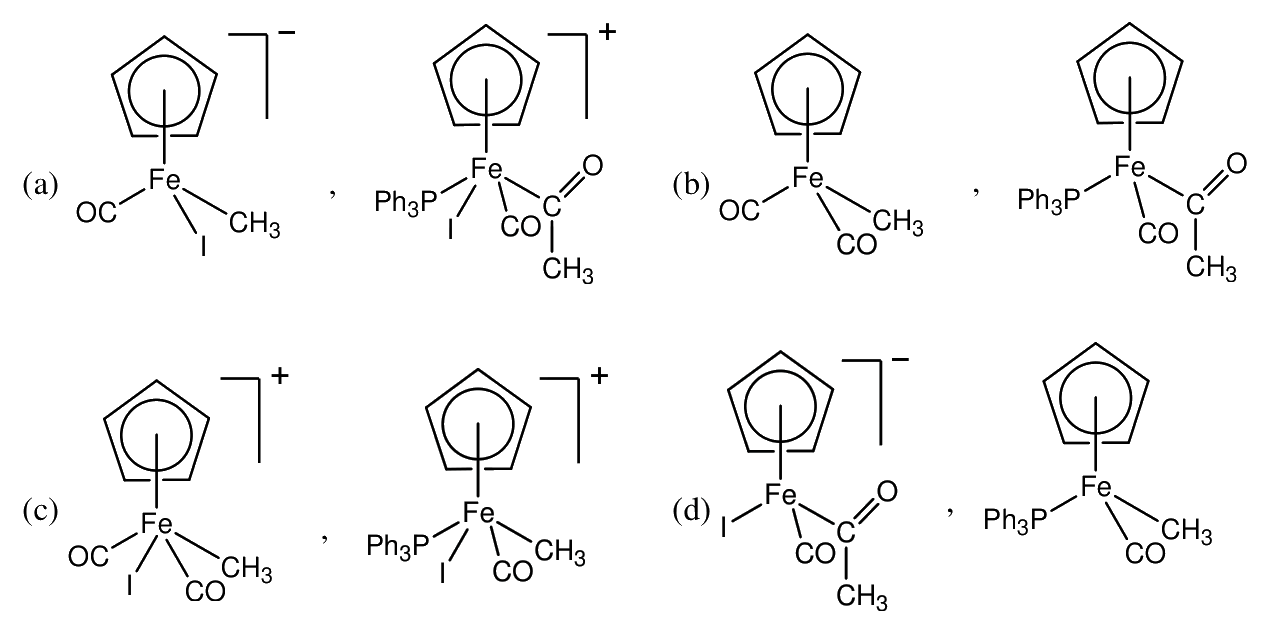
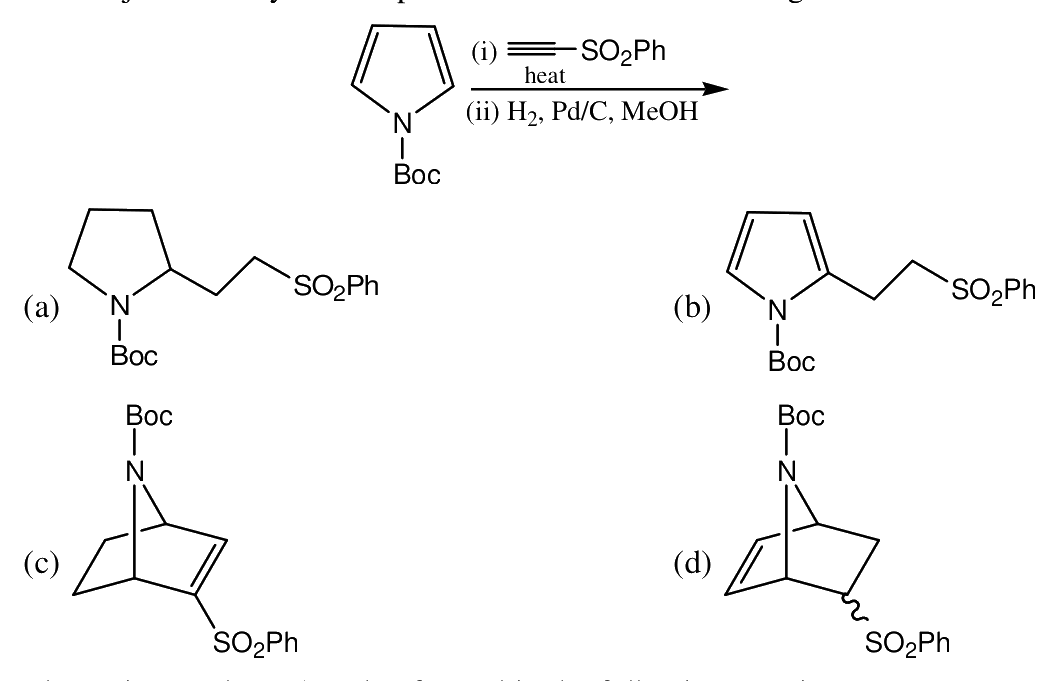
The reaction $[(\eta^5\text{-C}_5\text{H}_5)\text{Fe}(\text{CO})_2]^-$ with $\text{CH}_3\text{I}$ gives compound $\mathbf{A}$. The $^1\text{H}$ NMR spectrum of $\mathbf{A}$ shows two singlets in an integrated intensity ratio of $3 : 5$. Compound $\mathbf{A}$ upon reaction with $\text{PPh}_3$ gives compound $\mathbf{B}$. The $^1\text{H}$ NMR spectrum of $\mathbf{B}$ shows 3 sets of signals in an integrated intensity ratio of $3 : 5 : 15$. Compounds $\mathbf{A}$ and $\mathbf{B}$ respectively, are
a.
See image
b.
See image
c.
See image
d.
See image
Correct Answer & Step-by-Step Solution Locked
Sign in free to reveal the correct answer and AI explanation for this question.
Identify the correct statements about the electronegativity of groups given below.
(A) $\text{CF}_3$ group has greater value than that of $\text{NF}_2$
(B) $\text{NH}_2$ group has lower value than that of $\text{NF}_2$
(C) $\text{OH}$ group has greater value than that of $\text{NF}_2$
(D) $\text{CH}_3$ and $\text{C}_2\text{H}_5$ groups have almost similar values
Correct answer is
a.
A, B and D
b.
B and C
c.
B, C and D
d.
B and D
Correct Answer & Step-by-Step Solution Locked
Sign in free to reveal the correct answer and AI explanation for this question.
Height equivalent to theoretical plate (HETP) in gas-liquid chromatography depends significantly on which of the following?
(A) Temperature of column
(B) Velocity of carrier gas
(C) Packing of column
(D) Column material
Correct answer is
a.
A, B and C
b.
C and D
c.
B, C and D
d.
A and C
Correct Answer & Step-by-Step Solution Locked
Sign in free to reveal the correct answer and AI explanation for this question.
A binary fluoride $\mathbf{Z}$ of xenon combines with two moles of $\text{NaF}$ to give a product which on heating to $100^\circ\text{C}$ affords compound $\mathbf{A}$. The alkaline hydrolysis of $\mathbf{A}$ gives perxenate salt. $\mathbf{Z}$ and $\mathbf{A}$ are, respectively
a.
$\text{XeF}_2$ and $\text{XeF}_4$
b.
$\text{XeF}_4$ and $\text{XeF}_6$
c.
$\text{XeF}_6$ and $\text{XeF}_4$
d.
$\text{XeF}_6$ and $\text{XeF}_6$
Correct Answer & Step-by-Step Solution Locked
Sign in free to reveal the correct answer and AI explanation for this question.
Match fluorescence colours given in Column- A with lanthanide ions given in Column-B
\begin{tabular}{ll}
\textbf{Column-A} & \textbf{Column-B} \\
(I) Pink & (A) $\text{Sm(III)}$ \\
(II) Red & (B) $\text{Tb(III)}$ \\
(III) Green & (C) $\text{Eu(III)}$ \\
(IV) Blue & (D) $\text{Tm(III)}$
\end{tabular}
Correct match is
a.
I-A, II-C, III-B, IV-D
b.
I-D, II-C, III-B, IV-A
c.
I-A, II-B, III-C, IV-D
d.
I-C, II-B, III-D, IV-A
Correct Answer & Step-by-Step Solution Locked
Sign in free to reveal the correct answer and AI explanation for this question.
Choose the correct set of statements for \textit{cis}-platin.
(A) It can be prepared from $\text{K}_2[\text{PtCl}_4]$
(B) It can be prepared from $[\text{Pt}(\text{NH}_3)_4]\text{Cl}_2$
(C) In its preparation, the observed \textit{trans} effect for $\text{Cl}^-$ is greater than that of $\text{NH}_3$.
(D) In blood it stays in equilibrium with \textit{cis}-$[\text{Pt}(\text{NH}_3)_2\text{Cl}(\text{H}_2\text{O})]^+$
(E) In DNA strand, it binds to two adjacent cytosine bases
The correct set is
a.
A, C and D
b.
A, C, D and E
c.
B, C and D
d.
B, C, D and E
Correct Answer & Step-by-Step Solution Locked
Sign in free to reveal the correct answer and AI explanation for this question.
In fission of $^{235}\text{U}$ atom the energy released is $200\text{ MeV}$. In one day fission of $1\text{kg}$ $^{235}\text{U}$ will give power (in MW) approximately
a.
550
b.
650
c.
950
d.
1250
Correct Answer & Step-by-Step Solution Locked
Sign in free to reveal the correct answer and AI explanation for this question.
The structures of $[\text{Re}_2\text{Cl}_8]^{2-}$ $(\mathbf{A})$ and $[\text{Os}_2\text{Cl}_8]^{2-}$ $(\mathbf{B})$ are made up of two $\text{MCl}_4$ units. For these structures, which statement is correct?
a.
$(\mathbf{A})$ and $(\mathbf{B})$ both have $\text{MCl}_4$ units eclipsed
b.
$(\mathbf{A})$ and $(\mathbf{B})$ both have $\text{MCl}_4$ units staggered
c.
$(\mathbf{A})$ has both $\text{MCl}_4$ units staggered and $(\mathbf{B})$ has both $\text{MCl}_4$ unit eclipsed
d.
$(\mathbf{A})$ has both $\text{MCl}_4$ units eclipsed and $(\mathbf{B})$ has both $\text{MCl}_4$ units staggered.
Correct Answer & Step-by-Step Solution Locked
Sign in free to reveal the correct answer and AI explanation for this question.
For the Wacker process, pick the correct statement(s) from the following
(A) $\text{Pd(II)}$ is reduced to $\text{Pd}(0)$ by $\text{Cu(I)}$
(B) $\text{Pd}(0)$ is oxidized to $\text{Pd(II)}$ by $\text{Cu(II)}$
(C) $\text{Cu(II)}$ promotes the reductive elimination
Correct answer is
a.
A and C
b.
B and C
c.
A and B
d.
B only
Correct Answer & Step-by-Step Solution Locked
Sign in free to reveal the correct answer and AI explanation for this question.
Consider the following statements
(I) $\mathbf{AsCl}_5$ is thermally less stable than $\mathbf{PCl}_5$
(II) Size of $\mathbf{As}$ is more than that of $\mathbf{P}$
Choose the correct answer from the following
a.
Statements I and II are true and II is the correct explanation of I
b.
Statements I and II are true but II is not the correct explanation for I
c.
Statement I is true and statement II is false
d.
Both the statements I and II are false.
Correct Answer & Step-by-Step Solution Locked
Sign in free to reveal the correct answer and AI explanation for this question.
Consider the following statements for $\text{Be}_2\text{Cl}_4\text{ (I)}$, $\text{B}_2\text{Cl}_4\text{ (II)}$ and $\text{Ga}_2\text{Cl}_4\text{ (III)}$:
(A) There is an $\text{M}-\text{M}\ (\text{M} = \text{Be, B, Ga})$ bond in all
(B) The oxidation state of $\text{Be, B}$ and $\text{Ga}$ is $+2$
(C) The oxidation around the central atom is planar for all
(D) The geometry around the central atom is planar in I and II only
The correct statement(s) is/are
a.
A, B and C
b.
A and B
c.
D only
d.
B, C and D
Correct Answer & Step-by-Step Solution Locked
Sign in free to reveal the correct answer and AI explanation for this question.
Consider the following statements
(A) $\text{Cr}^{2+}$ is easier to oxidise than $\text{V}^{2+}$ in the gas phase
(B) $\text{Cr}^{2+}(\text{aq})$ is a more powerful reducing agent than $\text{V}^{2+}(\text{aq})$
(C) The rate of water exchange for $\text{Cr}^{2+}(\text{aq})$ is much faster than for $\text{V}^{2+}(\text{aq})$
The correct statements are
a.
A and B
b.
A and C
c.
B and C
d.
A, B and C
Correct Answer & Step-by-Step Solution Locked
Sign in free to reveal the correct answer and AI explanation for this question.
Consider the statements A-D regarding equation **I-III**:
(I) $[\text{Fe}(\text{CN})_6]^{3-} + [\text{Co}(\text{CN})_5]^{3-} \rightarrow [\text{Fe}(\text{CN})_6]^{4-} + [\text{Co}(\text{CN})_5]^{2-}$
(II) $[\text{Co}(\text{bipy})_3]^{2+} + [\text{Co}^*(\text{bipy})_3]^{3+} \rightarrow [\text{Co}(\text{bipy})_3]^{3+} + [\text{Co}^*(\text{bipy})_3]^{2-}$
(III) $[\text{Co}(\text{NH}_3)_5\text{F}]^{2+} + [\text{Cr}(\text{H}_2\text{O})_6]^{2+} \rightarrow [\text{Co}(\text{NH}_3)_5(\text{H}_2\text{O})]^{2+} + [\text{Cr}(\text{H}_2\text{O})_5\text{F}]^{2+}$
(A) Marcus equation is applicable to I and II
(B) Marcus equation is applicable to II only
(C) Equations I and II involve inner sphere electron transfer
(D) Equations I and III involve inner sphere electron transfer
The correct statements are
a.
A and B
b.
B and C
c.
B and D
d.
C and D
Correct Answer & Step-by-Step Solution Locked
Sign in free to reveal the correct answer and AI explanation for this question.
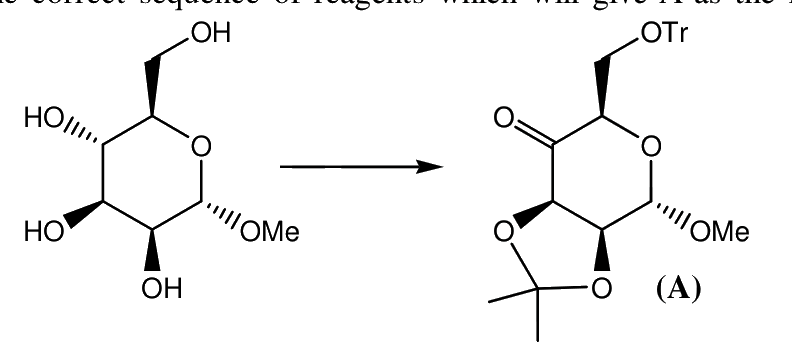
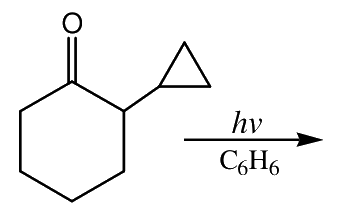
Reaction of D-glucose with following reagents produces
Reagents : (1) Acetone, $\text{H}^+$ ; (2) PDC; (3) $(\text{EtO})_2\text{P}(\text{O})\text{CH}_2\text{CO}_2\text{Et}$, NaH
Correct Answer & Step-by-Step Solution Locked
Sign in free to reveal the correct answer and AI explanation for this question.
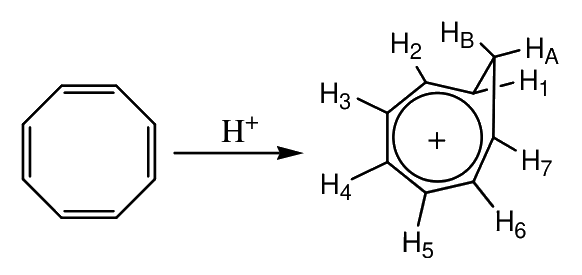
The correct match of protons in Column-A with the $^1\text{H}$ NMR chemical shifts in Column-B for the product of the following reaction is
\begin{tabular}{ll}
Column-A & Column-B ($\delta$ ppm) \\
(P) $\text{H}_\text{A}$ & (I) $-0.3$ \\
(Q) $\text{H}_\text{B}$ & (II) $5.1$ \\
(R) $\text{H}_{1\&7}$ & (III) $6.4$ \\
(S) $\text{H}_{2-6}$ & (IV) $8.5$
\end{tabular}
a.
P-II, Q-I, R-III, S-IV
b.
P-I, Q-II, R-IV, S-III
c.
P-IV, Q-I, R-III, S-II
d.
P-II, Q-IV, R-I, S-III
Correct Answer & Step-by-Step Solution Locked
Sign in free to reveal the correct answer and AI explanation for this question.
Two opposite sides (in the $y$-direction) of a square box of side $L$ are slightly stretched. Consider the following four statements
(A) The point group changes from $D_{4h}$ to $D_{2h}$.
(B) The $(1, 2)$ and $(2, 1)$ energy levels remain doubly degenerate
(C) Both the energy levels are lowered and the energy of the $(1, 2)$ level is higher than that of the $(2, 1)$ level.
(D) Both the energy levels are lowered and the energy of the $(1, 2)$ level is lower than that of the $(2, 1)$ level
The two correct statements are
a.
A and B
b.
A and C
c.
B and C
d.
A and D
Correct Answer & Step-by-Step Solution Locked
Sign in free to reveal the correct answer and AI explanation for this question.
Consider a model system of five non-interacting fermions in a single 3-dimensional harmonic oscillator. The Hamiltonian of a single particle is
$$\hat{H} = \frac{1}{2m}\left(\hat{p}_x^2 + \hat{p}_y^2 + \hat{p}_z^2\right) + \frac{1}{2}m\omega^2\left(x^2 + y^2 + z^2\right)$$
where $m$ is the mass of the partice, $\omega$ is the angular frequency, $\hat{p}_x, \hat{p}_y$ and $\hat{p}_z$ are the momentum operators. The ground state energy of the system of 5 non-interacting fermions is
a.
$\frac{21}{2}\hbar\omega$
b.
$\frac{15}{2}\hbar\omega$
c.
$\frac{5}{2}\hbar\omega$
d.
$\frac{25}{2}\hbar\omega$
Correct Answer & Step-by-Step Solution Locked
Sign in free to reveal the correct answer and AI explanation for this question.
A particle is in a state $\phi = \psi_1 + 3\psi_2$, where $\psi_1$ and $\psi_2$ are eigenfunctions of the Hamiltonian of the particle with eigenvalues $E_1$ and $E_2$, respectively. The average energy of the particle in the state $\phi$ is
a.
$(E_1 + 9E_2)/10$
b.
$(E_1 + 3E_2)$
c.
$(E_1 + 9E_2)/4$
d.
$(E_1 + 3E_2)/10$
Correct Answer & Step-by-Step Solution Locked
Sign in free to reveal the correct answer and AI explanation for this question.
Which of the following statements on ground state perturbation theory, involving the zeroth order energy $E_0^{(0)}$, first order energy correction $E_0^{(1)}$ and second order energy correction $E_0^{(2)}$, is false?
a.
$E_0^{(1)}$ is the average value of perurbation operator with respect to the ground state of the zeroth order Hamiltonian
b.
$E_0^{(1)}$ is necessarily negative
c.
$E_0^{(2)}$ is necessarily negative
d.
$E_0^{(0)} + E_0^{(1)}$ is an upper bound to the exact ground state energy
Correct Answer & Step-by-Step Solution Locked
Sign in free to reveal the correct answer and AI explanation for this question.
Difference between activation energies of the reverse and forward steps of a reversible reaction is $9.212\text{RT}$. If the pre-exponential factor of the forward reaction is double that of the reverse reaction at the same temperature, the equilibrium constant for the reaction at that temperature will be ($\ln 10 = 2.303$)
a.
$1\times 10^4$
b.
$2\times 10^4$
c.
$1\times 10^{-4}$
d.
$2\times 10^{-4}$
Correct Answer & Step-by-Step Solution Locked
Sign in free to reveal the correct answer and AI explanation for this question.
For an enzyme-substrate reaction,
$$E + S \underset{k_{-1}}{\overset{k_1}{\rightleftharpoons}} ES; \qquad ES \xrightarrow{k_2} E + P,$$
the slope and the intercept of the plot between $\frac{1}{r}$ and $\frac{1}{[S]}$ are $10^{-2}\text{ s}$ and $10^2\text{ M}^{-1}\text{s}$, respectively. If $E_0 = 10^{-6}\text{ M}$ and $\frac{k_{-1}}{k_2} = 1000$, the value of $k_1$ will be close to (in units of $\text{M}^{-1}\text{s}^{-1}$) [$r$ is the rate of the reaction and $E_0$ is the initial concentration of the enzyme]
a.
$1\times 10^{11}$
b.
$1\times 10^4$
c.
$1\times 10^8$
d.
$1\times 10^6$
Correct Answer & Step-by-Step Solution Locked
Sign in free to reveal the correct answer and AI explanation for this question.
Translational partition function of a $\text{D}_2$ molecule confined in a $100\text{ cm}^3$ vessel at $25^\circ\text{C}$ is ($h = 6.626\times 10^{-34}\text{ J.s}$, $k = 1.381\times 10^{-23}\text{ JK}^{-1}$)
a.
$3.8\times 10^{22}$
b.
$5.8\times 10^{24}$
c.
$7.8\times 10^{26}$
d.
$9.8\times 10^{28}$
Correct Answer & Step-by-Step Solution Locked
Sign in free to reveal the correct answer and AI explanation for this question.
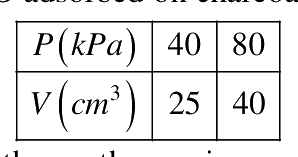
The volume ($\text{cm}^3$) of $\text{CO}$ adsorbed on charcoal ($273\text{ K}$) at two different pressures is given below
$$\begin{array}{|c|c|c|} \hline P(\text{kPa}) & 40 & 80 \\ \hline V(\text{cm}^3) & 25 & 40 \\ \hline \end{array}$$
Assuming Langmuir isotherm, the maximum possible volume ($\text{cm}^3$) $\text{CO}$ that can be adsorbed is
a.
50
b.
100
c.
150
d.
200
Correct Answer & Step-by-Step Solution Locked
Sign in free to reveal the correct answer and AI explanation for this question.
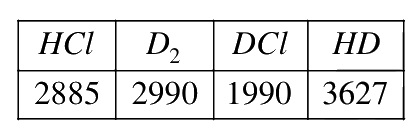
Assuming harmonic approximation, the energy change for the reaction $HCl + D_2 \to DCl + HD$ in $\text{cm}^{-1}$ is (the vibrational frequency data in $\text{cm}^{-1}$ is given in the table below)
$$\begin{array}{|c|c|c|c|} \hline HCl & D_2 & DCl & HD \\ \hline 2885 & 2990 & 1990 & 3627 \\ \hline \end{array}$$
a.
$-258$
b.
$+258$
c.
$-129$
d.
$+129$
Correct Answer & Step-by-Step Solution Locked
Sign in free to reveal the correct answer and AI explanation for this question.
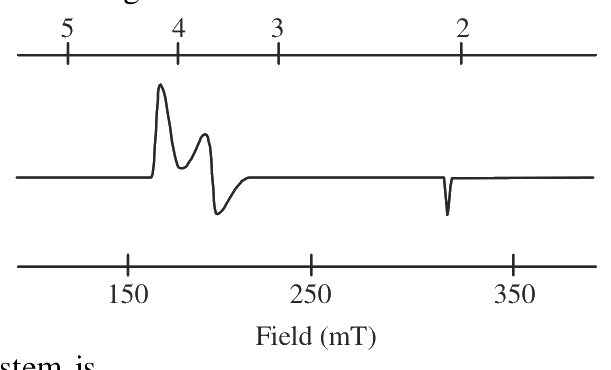
The transition moment integral for rotational transition between $\text{J} = 1$; $\text{M}_\text{J} = 0$ and $\text{J} = 2$; $\text{M}_\text{J} = 0$ states for a diatomic molecule along the z-axis is proportional to
At $300\text{K}$, the thermal expansion coefficient and the isothermal compressibility of liquid water are $2\times 10^4\text{ K}^{-1}$ and $5\times 10^{-5}\text{ bar}^{-1}$, respectively. $\left(\frac{\partial U}{\partial V}\right)_T$ (in kbar) for water at $320\text{ K}$ and $1\text{ bar}$ will be
a.
2.4
b.
1.2
c.
0.6
d.
12.0
Correct Answer & Step-by-Step Solution Locked
Sign in free to reveal the correct answer and AI explanation for this question.
The standard cell potential of cell, $Pt ∣ H_2(g) ∣ HBr(aq) ∣ AgBr(s) ∣ Ag(s)$, was measured over a range of temperatures and the data was fitted as $E^0(volt) = 0.01 - 1 \times 10^{-4}(T - 298) - 2 \times 10^{-6}(T - 298)^2$. The standard reaction entropy ($\text{J}\text{K}^{-1}\text{ mol}^{-1}$) and enthalpy ($\text{kJ}\text{mol}^{-1}$) at 298K are
a.
$-9.65$ and $-3.84$
b.
$-3.84$ and $-9.65$
c.
$-18.3$ and $-7.68$
d.
$-7.68$ and $-18.3$
Correct Answer & Step-by-Step Solution Locked
Sign in free to reveal the correct answer and AI explanation for this question.
The (002) plane of an elemental FCC crystal diffracts X-rays ($\lambda = 0.154 nm$) at Bragg angle $90^\circ$. The density of the crystal is $4 \times 10^4\text{ kg m}^{-3}$. The atomic weight of the elemental solid is
a.
22
b.
44
c.
88
d.
66
Correct Answer & Step-by-Step Solution Locked
Sign in free to reveal the correct answer and AI explanation for this question.
A solution of $\text{Fe}^{3+}$ is titrated potentiometrically using $\text{Ce}^{3+}$ solution at $25^\circ\text{C}$. The emf (in V) of the redox system thus formed when, (i) 50 % of $\text{Fe}^{3+}$ and (ii) 80% of $\text{Fe}^{3+}$ are titrated, would respectively be
(Given : $E^0_{\text{Fe}^{3+}|\text{Fe}^{2+}} = 0.77\text{V}$, $\log_{10} 2 = 0.301$)
a.
0.734 and 0.77
b.
0.77 and 0.385
c.
0.77 and 0.734
d.
0.385 and 0.37
Correct Answer & Step-by-Step Solution Locked
Sign in free to reveal the correct answer and AI explanation for this question.