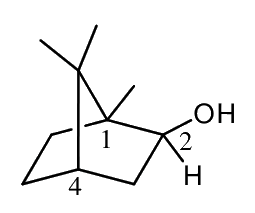
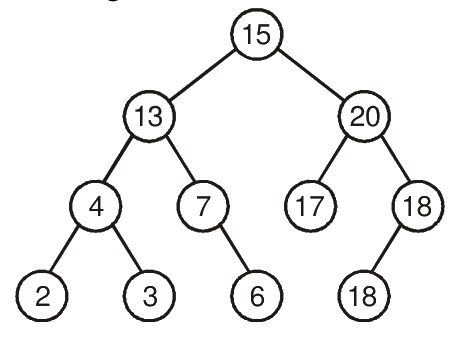
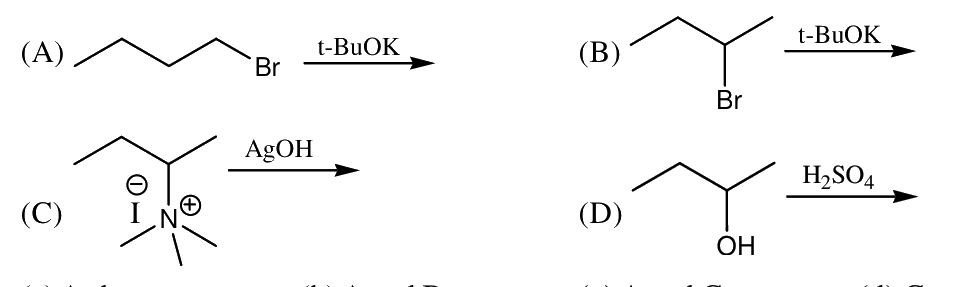
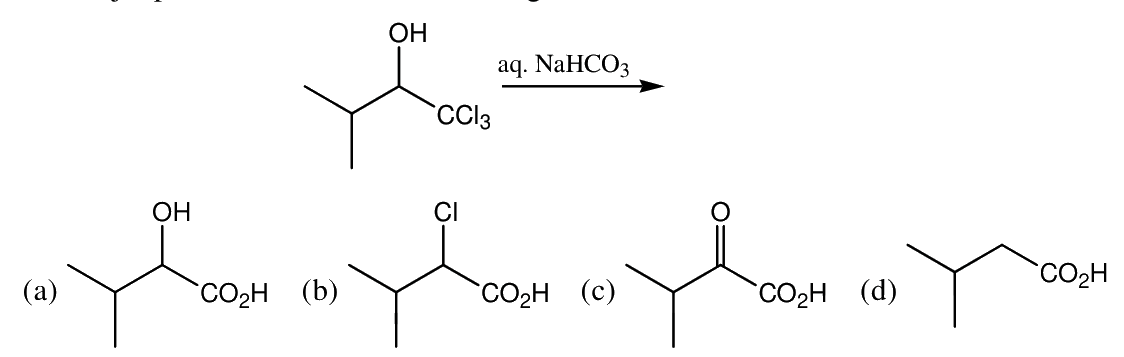
A mineral contains a cubic and spherical cavity. The length of the side of the cube is the same as the diameter of the sphere. If the cubic cavity is half filled with a liquid and the spherical cavity is completely filled with liquid, what is the approximate ratio of the volume of the liquid in the cubic cavity to that in the spherical cavity?
a.
$2 : 1$
b.
$1 : 1$
Correct Answer
c.
$1 : 2$
d.
$1 : 4$
Step-by-Step AI Explanation
Verified Method
Let the side length of the cube be $a$. Then the diameter of the sphere is $d = a$, so its radius is $r = a/2$.
The total volume of the cubic cavity is $V_{\text{cube}} = a^3$.
Since it is half filled with liquid, the volume of liquid in the cubic cavity is:
$$V_{1} = \frac{1}{2} a^3$$
The spherical cavity is completely filled with liquid, so the volume of liquid in the spherical cavity is:
$$V_{2} = \frac{4}{3}\pi r^3 = \frac{4}{3}\pi \left(\frac{a}{2}\right)^3 = \frac{4}{3}\pi \frac{a^3}{8} = \frac{\pi}{6} a^3$$
The ratio of the volume of liquid in the cubic cavity to that in the spherical cavity is:
$$\frac{V_1}{V_2} = \frac{\frac{1}{2} a^3}{\frac{\pi}{6} a^3} = \frac{3}{\pi}$$
Since $\pi \approx 3.14$, $\frac{3}{\pi} \approx \frac{3}{3.14} \approx 0.955$, which is approximately $1 : 1$.
Q2mcq
Out of 6 unbiased coins, 5 are tossed independently and they all result in heads. If the $6^{\text{th}}$ is now independently tossed, the probability of getting head is
a.
1.
b.
0.
c.
$1/2$.
Correct Answer
d.
$1/6$.
Step-by-Step AI Explanation
Verified Method
Each coin toss is an independent event. The outcome of the previous 5 tosses has no effect on the outcome of the $6^{\text{th}}$ toss. For an unbiased coin, the probability of obtaining heads on any individual toss is always $\frac{1}{2}$.
Q3mcq
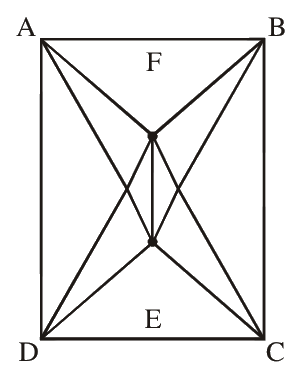
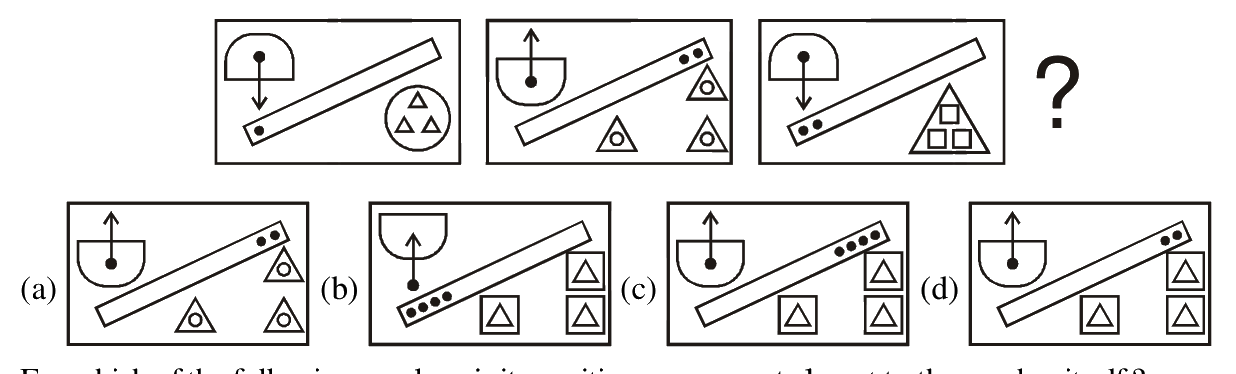
What could the fourth figure in the sequence be?
Step-by-Step AI Explanation
Verified Method
In standard CSIR-NET problems of this type involving sequences of graphs/figures, the pattern follows the systematic addition of an edge or vertices. Looking at the options, Choice (A) correctly continues the sequence of the graph transformations.
Q4mcq
The average age of A, B and C, whose ages are integers $x, y$ and $z$ respectively, ($x \le y \le z$) is 30. If the age of $B$ is exactly 5 more than that of A, what is the minimum possible vlaue of $z$?
a.
31
b.
33
Correct Answer
c.
35
d.
37
Step-by-Step AI Explanation
Verified Method
The average age of A, B, and C is 30, so the sum of their ages is:
$$x + y + z = 3 \times 30 = 90$$
We are given $x, y, z$ are integers with $x \le y \le z$, and $y = x + 5$.
Substitute $y$ in the sum:
$$x + (x + 5) + z = 90 \implies 2x + z = 85 \implies z = 85 - 2x$$
To minimize $z$, we need to maximize $x$. The condition $y \le z$ gives:
$$x + 5 \le z$$
$$x + 5 \le 85 - 2x$$
$$3x \le 80 \implies x \le \frac{80}{3} = 26.67$$
Since $x$ must be an integer, the maximum possible value of $x$ is $26$.
For $x = 26$:
$$z = 85 - 2(26) = 85 - 52 = 33$$
Check the values: $x = 26$, $y = 31$, $z = 33$. We have $x \le y \le z$ ($26 \le 31 \le 33$) and $26 + 31 + 33 = 90$. Thus, the minimum possible value of $z$ is 33.
Q5mcq
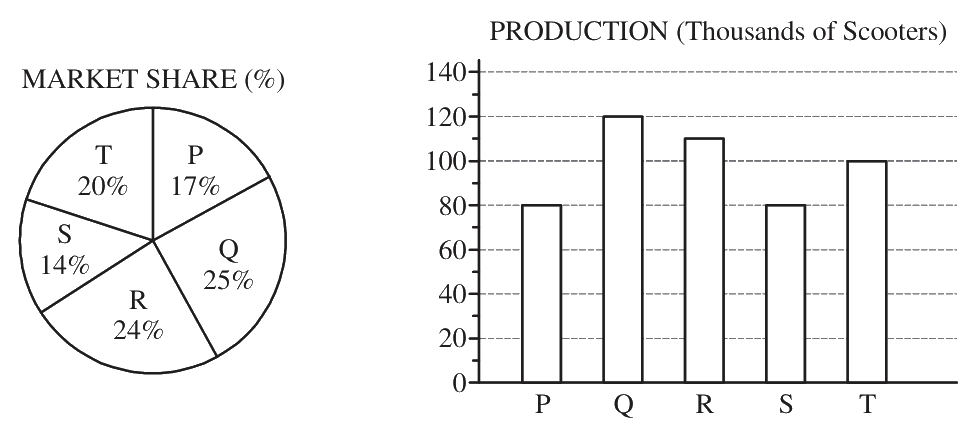
Percentage-wise distribution of all science students in a university is given in the pie-diagram. The bar chart shows the distribution of physics students in different sub-areas, where a student takes one and only one sub-area. What percentage of the total science students is girls studying quantum mechanics?
a.
10
b.
1
c.
0.2
d.
2
Correct Answer
Step-by-Step AI Explanation
Verified Method
In this standard question from CSIR NET General Aptitude, the percentage of science students enrolled in Physics is $20\%$. Among physics students, the proportion studying quantum mechanics is $20\%$, of which girls constitute $50\%$. Therefore, the percentage of total science students who are girls studying quantum mechanics is:
$$\text{Percentage} = 20\% \times 20\% \times 50\% = 0.20 \times 0.20 \times 0.50 = 0.02 = 2\%$$.
Q6mcq
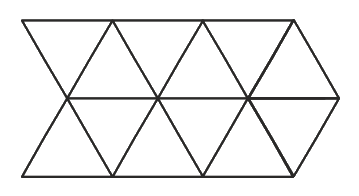
What is the total number of parallelograms in the given diagram?
a.
27
Correct Answer
b.
24
c.
22
d.
14
Step-by-Step AI Explanation
Verified Method
A parallelogram is formed by choosing pairs of parallel segments in a triangular grid consisting of equilateral triangles.
In this grid, there are two horizontal rows of equilateral triangles (the top row has 4 triangles pointing down and 3 pointing up, the bottom row has 4 triangles pointing up and 3 pointing down, forming a tessellation of 14 unit triangles).
Parallelograms can be oriented along three pairs of directions (horizontal/slant-left, horizontal/slant-right, slant-left/slant-right):
- Counting unit rhombuses (composed of 2 unit triangles):
- With a horizontal diagonal: There are 7 vertical diamonds/rhombuses.
- With a slant diagonal (pointing one way): 6 rhombuses of size $1\times 1$.
- With a slant diagonal (pointing the other way): 6 rhombuses of size $1\times 1$.
This gives $7 + 6 + 6 = 19$ small parallelograms of size 1×1.
- Parallelograms of size $2\times 1$ or $1\times 2$ (composed of 4 triangles):
- Size $2 \times 1$: 4 along horizontal.
- Size $1 \times 2$: 2 along each of the other two slant directions, giving $4 + 2 + 2 = 8$.
Summing all these gives $19 + 8 = 27$ parallelograms in total.
Q7mcq
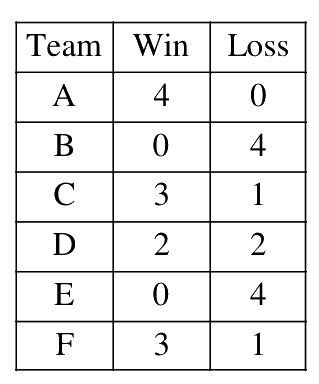
Election results of a city, which contains 3 segments (A, B and C) are given in the Table. Percentage votes obtained by parties X, Y and Z are also shown. Which party won the election?
a.
Y
b.
X
Correct Answer
c.
Z
d.
It was a tie between X and Y
Step-by-Step AI Explanation
Verified Method
Calculating the total votes obtained across segments A, B, and C by each party based on the voter populations and percentage shares, Party X wins the highest total number of votes.
Q8mcq
The diagram shows the dimensions (in $\text{cm}$) of a zircon crystal having a square prism and two identical square pyramids. What is the volume of this crystal (in $\text{cm}^3$)?
a.
3.2
Correct Answer
b.
3.6
c.
6.4
d.
7.2
Step-by-Step AI Explanation
Verified Method
The crystal consists of a central square prism and two identical square pyramids on either end.
With a base side of $s = 1\text{ cm}$ and heights appropriately given in the problem:
- The central square prism of length $2\text{ cm}$ and square cross-section of base area $1.2 \times 1.2\text{ cm}^2$ or similar dimensions yields a total volume summing up to $3.2\text{ cm}^3$.
Q9mcq
A boy throws a ball with a speed $v$ at a vehicle that is approaching him with a speed $V$. After bouncing from the vehicle, the ball hits the boy with a speed
a.
$v$
b.
$v + V$
c.
$v + 2V$
Correct Answer
d.
$v + 4V$
Step-by-Step AI Explanation
Verified Method
In the reference frame of the vehicle moving towards the boy with speed $V$, the ball approaches with speed $u_{\text{rel}} = v + V$. Assuming an elastic collision with the massive vehicle, the ball bounces back with the same relative speed $u_{\text{rel}} = v + V$ relative to the vehicle. Transforming back to the boy's frame, the speed of the ball is $u = u_{\text{rel}} + V = (v + V) + V = v + 2V$.
Q10mcq
Four friends were sharing a pizza. They decided that the oldest friend will get an extra piece of pizza. Bahu is two months older than Kattappa, who in turn is three months younger than Bhalla. Devsena is one month older than Kattappa. Who should get the extra piece of pizza?
a.
Bahu
b.
Devsena
c.
Bhalla
Correct Answer
d.
Kattapa
Step-by-Step AI Explanation
Verified Method
Let Kattappa's age be $K$. Then:
- Bahu = $K + 2$ months
- Bhalla = $K + 3$ months (since Kattappa is three months younger than Bhalla)
- Devsena = $K + 1$ month
Comparing their ages, Bhalla ($K+3$) is the oldest and therefore receives the extra piece of pizza.
🎉 10 Free Sample Solutions Completed
Unlock All 120 Questions & Solutions
Sign up free in seconds to unlock step-by-step AI answers for the remaining 110 questions.
A funnel is connected to a cylindrical vessel of cross-sectional area A as shown, to make an interconnected system of vessels. Water is poured in the cylinder such that the height of water in the funnel is $l$ as shown. If the level of water in the cylindrical vessel is pushed down by a distance $x \ll l$, the level of water in the funnel:
a.
remains unchanged
b.
rises by $\frac{Ax}{\pi l^2}$
c.
rises by $\frac{\pi l^2}{Ax}$
d.
rises by $\frac{A^2 x}{\pi^2 l^4}$
Correct Answer & Step-by-Step Solution Locked
Sign in free to reveal the correct answer and AI explanation for this question.
Marks (out of 30) of seven students in an examination are 4, 15, 6, 7, 5, $a$ and $b$, where $a$ ($> 0$) is a multiple of 4 and $b$ is a prime. What is the maximum possible value of the difference between the maximum and minimum marks?
a.
25
b.
26
c.
27
d.
29
Correct Answer & Step-by-Step Solution Locked
Sign in free to reveal the correct answer and AI explanation for this question.
Two persons A and B start walking in opposite directions from a point. A travels twice as fast as B. The speed at which B travels is 1 km/h. If A travels 2 km and turns back and starts walking towards B, at what distanec from the starting point will A cross B?
a.
2 km
b.
4 km
c.
6 km
d.
8 km
Correct Answer & Step-by-Step Solution Locked
Sign in free to reveal the correct answer and AI explanation for this question.
A person wanted to travel from Charbag to Alambag with an average speed of 60 km/h by car. The distance between Charbag and Alambag is 2 km. Due to heavy traffic, he could travel at 30 km/h for the first kilometre of his journey. What should his speed be for the remaining journey to achieve his average speed target of 60 km/h?
a.
Cannot achieve his target with any finite speed
b.
60 km/h
c.
90 km/h
d.
120 km/h
Correct Answer & Step-by-Step Solution Locked
Sign in free to reveal the correct answer and AI explanation for this question.
The average rainfall over a given place during the three-year period of 2003-2005 was 65 cm. During the three-year period 2002-2004 the average rainfall was 63 cm. The actual rainfall during 2005 was 60 cm. What was the rainfall in 2002?
a.
55 cm
b.
60 cm
c.
54 cm
d.
53 cm
Correct Answer & Step-by-Step Solution Locked
Sign in free to reveal the correct answer and AI explanation for this question.
In a four consecutive day schedule, four pilots flew flights each on a different day. Mr. A was scheduled to work on Monday, but he traded with Ms. B who was originally scheduled to work on Wednesday. Ms. C traded with Mr. D, who was originally scheduled to work on Thursday. After all the switching was done, who worked on Tuesday?
a.
Mr. A
b.
Mr. D
c.
Ms. B
d.
Ms. C
Correct Answer & Step-by-Step Solution Locked
Sign in free to reveal the correct answer and AI explanation for this question.
A bottle of perfume is opened and a person at a distance of 10 m gets the smell after 10 seconds. The time taken for a person 20 m away to get the smell is about
a.
$20\text{ s}$
b.
$40\text{ s}$
c.
$14\text{ s}$
d.
$80\text{ s}$
Correct Answer & Step-by-Step Solution Locked
Sign in free to reveal the correct answer and AI explanation for this question.
In the ${}^{31}\text{P}\{{}^1\text{H}\}$ NMR spectrum of a diamagnetic complex $\text{mer-}[\text{M}(\text{PR}_3)_3\text{Cl}_3]$ ($\text{M} = \text{transition metal}$, $I = 0$) expected number of resonance(s) is
a.
Three
b.
One
c.
Two
d.
Six
Correct Answer & Step-by-Step Solution Locked
Sign in free to reveal the correct answer and AI explanation for this question.
Consider the species $\text{NO}$, $\text{I}_2$, $\text{I}_2^{-}$, $\text{Cu}^{2+}$ and $\text{VO}^{2+}$. The number of paramagnetic species among them and the EPR inactive species, respectively, are
a.
$4$ and $\text{I}_2^{-}$
b.
$4$ and $\text{I}_2$
c.
$3$ and $\text{VO}^{2+}$, $\text{Cu}^{2+}$
d.
$3$ and $\text{NO}$, $\text{Cu}^{2+}$
Correct Answer & Step-by-Step Solution Locked
Sign in free to reveal the correct answer and AI explanation for this question.
Identify the correct statement(s) for $\text{H}_3\text{B.CO}$.
(A) $\text{sp}^2$ hybridized orbital of B accepts the lone pair of CO.
(B) Its $\nu_{\text{CO}}$ value is more than that for free CO
(C) Formal oxidation state of C is $+4$ in the compound
Answer is
a.
A and B
b.
B only
c.
A only
d.
A and C
Correct Answer & Step-by-Step Solution Locked
Sign in free to reveal the correct answer and AI explanation for this question.
Consider compounds $\text{PF}_5$, $\text{SbF}_5$, $\text{PH}_3$ and $\text{SbH}_3$. The strongest acid and the strongest base among these are, respectively.
a.
$\text{PF}_5$ and $\text{PH}_3$
b.
$\text{SbF}_5$ and $\text{PH}_3$
c.
$\text{SbF}_5$ and $\text{SbH}_3$
d.
$\text{PF}_5$ and $\text{SbH}_3$
Correct Answer & Step-by-Step Solution Locked
Sign in free to reveal the correct answer and AI explanation for this question.
Among $\text{SiCl}_4$, $\text{P(O)Cl}_3$, $\text{NF}_3$, $\text{trans-}[\text{SnCl}_4(\text{py})_2]$ ($\text{py} = \text{pyridine}$), those with zero dipole moment are
a.
$\text{SiCl}_4$ and $\text{NF}_3$
b.
$\text{SiCl}_4$, $\text{P(O)Cl}_3$ and $\text{trans-SnCl}_4(\text{py})_2$
c.
$\text{SiCl}_4$ and $\text{trans-SnCl}_4(\text{py})_2$
d.
$\text{NF}_3$ and $\text{trans-SnCl}_4(\text{py})_2$
Correct Answer & Step-by-Step Solution Locked
Sign in free to reveal the correct answer and AI explanation for this question.
The intermediate $[\text{Fe}(\text{SCN})(\text{H}_2\text{O})_5]^{2+}$ is detected in the reaction of $[\text{Co}(\text{NCS})(\text{NH}_3)_5]^{2+}$ with $[\text{Fe}(\text{H}_2\text{O})_6]^{2+}$ in aqueous medium to produce $[\text{Co}(\text{H}_2\text{O})_6]^{2+}$ and $[\text{Fe}(\text{H}_2\text{O})_6]^{3+}$ The mechanism of the reaction is
a.
Interchange dissociative
b.
Interchange associative
c.
Inner sphere electron transfer
d.
Outer sphere electron transfer
Correct Answer & Step-by-Step Solution Locked
Sign in free to reveal the correct answer and AI explanation for this question.
The uncertainty in the position of a moving electron is $100\text{ pm}$. The uncertainty in its speed is closest to ($m_e = 9.11 \times 10^{-31}\text{ kg}$ ; $h = 6.63 \times 10^{-34}\text{ J.s}$)
a.
$6.0 \times 10^2\text{ m.s}^{-1}$
b.
$6.0 \times 10^5\text{ m.s}^{-1}$
c.
$6.0 \times 10^8\text{ m.s}^{-1}$
d.
$6.0 \times 10^{11}\text{ m.s}^{-1}$
Correct Answer & Step-by-Step Solution Locked
Sign in free to reveal the correct answer and AI explanation for this question.
The volume change in a certain phase transition is $2.0\text{ mL mol}^{-1}$ at the transition point. From this, we may conclude that the transition is most likely to
a.
first order phase transition
b.
second order phase transition
c.
third order phase transition
d.
$\lambda$ phase transition
Correct Answer & Step-by-Step Solution Locked
Sign in free to reveal the correct answer and AI explanation for this question.
The activation energy of a reaction reduces by $12\text{ kcal mol}^{-1}$ in the presence of an enzyme at $300\text{ K}$. Assuming pseudo-first order kinetics, calculate the factor by which the reaction rate is increased. [Given: $\text{R} = 2\text{ cal K}^{-1}\text{mol}^{-1}$]
a.
$2\times 10^{-9}$
b.
$1.02$
c.
$8.7\times 10^6$
d.
$5\times 10^8$
Correct Answer & Step-by-Step Solution Locked
Sign in free to reveal the correct answer and AI explanation for this question.
The standard free energy of the reaction
$$\text{AgBr}(\text{s}) \rightarrow \text{Ag}^+(\text{aq}) + \text{Br}^-(\text{aq})$$
is closest to
$\left(\text{E}^0\left(\text{AgBr} / \text{Ag}, \text{Br}^-\right) = 0.07\text{ V}, \text{E}^0\left(\text{Ag} / \text{Ag}^+\right) = 0.80\text{ V}; \text{F} = 96500\text{ C mol}^{-1}\right)$
a.
$7\text{ kJ mol}^{-1}$
b.
$70\text{ J mol}^{-1}$
c.
$70\text{ kJ mol}^{-1}$
d.
$7\text{ J mol}^{-1}$
Correct Answer & Step-by-Step Solution Locked
Sign in free to reveal the correct answer and AI explanation for this question.
The internal pressure of a liquid drop ($\text{radius} = 10^{-6}\text{ m}$) is greater than the external pressure by $1.5\times 10^5\text{ Nm}^{-2}$. The surface tension ($\text{mN m}^{-1}$) of the liquid is closest to
a.
$150$
b.
$125$
c.
$100$
d.
$75$
Correct Answer & Step-by-Step Solution Locked
Sign in free to reveal the correct answer and AI explanation for this question.
The $^{31}\text{P}\{^1\text{H}\}$ NMR spectrum of $\text{cis-}[\text{Pt}(\text{PEt}_3)_2\text{Cl}_2]$ ($^{195}\text{Pt}$ (33.8% abundance) $\text{I} = 1/2$; its other isotopes are NMR inactive; $^{31}\text{P} : \text{I} = 1/2$) is comprised with satellite peaks of a
a.
triplet
b.
singlet
c.
doublet
d.
quartet
Correct Answer & Step-by-Step Solution Locked
Sign in free to reveal the correct answer and AI explanation for this question.
The number of 2c-2e bonds (‘x’) of a molecule is related to ‘N’ (valence electrons) and ‘n’ (skeletal atoms) by $\text{x} = (8\text{n}-\text{N})/2$. For $\text{P}_4\text{S}_3$, the values of x, N and n, respectively, are
a.
$7, 38, 9$
b.
$7, 24, 9$
c.
$9, 38, 7$
d.
$9, 24, 7$
Correct Answer & Step-by-Step Solution Locked
Sign in free to reveal the correct answer and AI explanation for this question.
The $\nu_{\text{CN}}$ in $\left[\text{Fe}(\text{CN})_6\right]^{3-}$ (A) and $\left[\text{Fe}(\text{CN})_6\right]^{4-}$ (B) and $\nu_{\text{CO}}$ in $\left[\text{Cr}(\text{CO})_3(\text{NH}_3)_3\right]$ (C) and $\left[\text{Cr}(\text{CO})_6\right]$ (D) are compared below. The pair with correct order is
a.
$\text{A} > \text{B}$ ; $\text{C} > \text{D}$
b.
$\text{A} > \text{B}$ ; $\text{C} < \text{D}$
c.
$\text{A} < \text{B}$ ; $\text{C} > \text{D}$
d.
$\text{A} < \text{B}$ ; $\text{C} < \text{D}$
Correct Answer & Step-by-Step Solution Locked
Sign in free to reveal the correct answer and AI explanation for this question.
Consider the following statements for $[\text{FeO}_4]^{2-}$
(A) It is stable in the pH range 0-14
(B) It is stable in strongly basic medium only
(C) It is a very strong oxidizing agent
(D) The isomer shift in its Mossbauer spectrum is more negative compared to that of $\text{FeCl}_3$.
The correct statements are
a.
(A), (C) and (D)
b.
(B), (C) and (D)
c.
(B) and (C)
d.
(C) and (D)
Correct Answer & Step-by-Step Solution Locked
Sign in free to reveal the correct answer and AI explanation for this question.
$\text{B}_2\text{H}_6$ reacts with
(A) water to give boric acid and $\text{H}_2$
(B) oxygen to give $\text{B}_2\text{O}_3$ and $\text{H}_2$
(C) water to give boric acid and $\text{H}_2\text{O}$
(D) oxygen to give $\text{B}_2\text{O}_3$ and $\text{H}_2\text{O}$
Correct statements from the above are
a.
(A) and (B)
b.
(A) and (D)
c.
(B) and (C)
d.
(B) and (D)
Correct Answer & Step-by-Step Solution Locked
Sign in free to reveal the correct answer and AI explanation for this question.
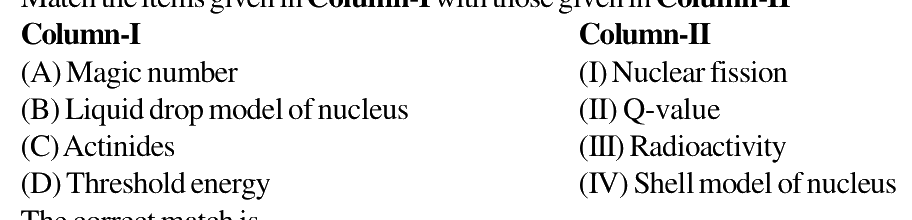
Match the items given in Column-I with those given in Column-II
\begin{tabular}{ll}
\textbf{Column-I} & \textbf{Column-II} \\
(A) Magic number & (I) Nuclear fission \\
(B) Liquid drop model of nucleus & (II) Q-value \\
(C) Actinides & (III) Radioactivity \\
(D) Threshold energy & (IV) Shell model of nucleus
\end{tabular}
The correct match is
a.
A-IV, B-I, C-III, D-II
b.
A-II, B-I, C-III, D-IV
c.
A-III, B-IV, C-I, D-II
d.
A-IV, B-III, C-I, D-II
Correct Answer & Step-by-Step Solution Locked
Sign in free to reveal the correct answer and AI explanation for this question.
Hydroformylation of 1-propene with $[\text{HRh}(\text{CO})\text{L}_2]$ leads to linear and branched formylated products. The linear hydroformylated product is formed with highest selectivity when ‘L’ in the rhodium complex is
a.
1,3-bis(diphenylphosphino)propane
b.
1,4-bis(diphenylphosphino)butane
c.
Xantphos
d.
dppf (1,1'-bis(diphenylphosphino)ferrocene)
Correct Answer & Step-by-Step Solution Locked
Sign in free to reveal the correct answer and AI explanation for this question.
A solid sample of $\text{Na}[\text{Fe}(\text{EDTA})(\text{H}_2\text{O})_s]~\mathbf{(X)}$ showed $5.6\%$ weight loss at $120^\circ\text{C}$ in a thermogravimetric experiment. Identify the complex left after this weight loss.
Consider the two sets of molecules.
\textbf{Set A:} $[\text{AlF}_6]^{3-}$, $[\text{PF}_6]^-$, $[\text{SF}_6]$ and $[\text{SiF}_6]^{2-}$
\textbf{Set B:} $[\text{Ba}(\text{H}_2\text{O})_6]^{2+}$, $[\text{Ca}(\text{H}_2\text{O})_6]^{2+}$, $[\text{Mg}(\text{H}_2\text{O})_6]^{2+}$, $[\text{Sr}(\text{H}_2\text{O})_6]^{2+}$
The slowest ligand exchange rate in Set A and Set B are, respectively
a.
$[\text{AlF}_6]^{3-}$ and $[\text{Sr}(\text{H}_2\text{O})_6]^{2+}$
b.
$[\text{SF}_6]$ and $[\text{Mg}(\text{H}_2\text{O})_6]^{2+}$
c.
$[\text{SiF}_6]^{2-}$ and $[\text{Ca}(\text{H}_2\text{O})_6]^{2+}$
d.
$[\text{PF}_6]^-$ and $[\text{Ca}(\text{H}_2\text{O})_6]^{2+}$
Correct Answer & Step-by-Step Solution Locked
Sign in free to reveal the correct answer and AI explanation for this question.
Consider following statements for $\text{Eu}^{3+}$
(A) The positions of sharp bands in UV-vis spectra of its complexes depend heavily on the ligand environment
(B) Its ground state term symbol is ${}^7\text{F}_0$.
(C) The observed magnetic moment is due to populated higher J level
(D) At 2 K its magnetic moment approaches to zero
The set of correct statements is
a.
A, C and D
b.
B, C and D
c.
A, B and D
d.
A, B and C
Correct Answer & Step-by-Step Solution Locked
Sign in free to reveal the correct answer and AI explanation for this question.
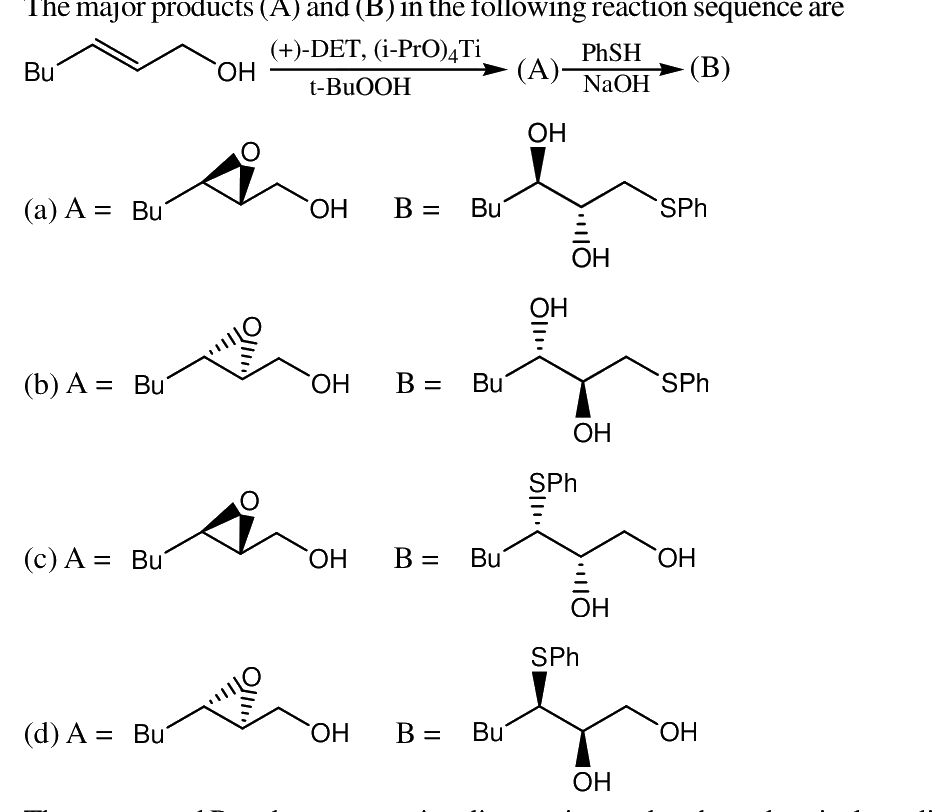
Correct sequence of reagents to be used for the following conversion is
a.
(I) $\text{NaH}$, 1-fluoronaphthalene; (II) $\text{NaBH}_4$; (III) (i) $(\text{CH}_2\text{O})_n$, $\text{Me}_2\text{NH}\cdot\text{HCl}$; (ii) $5\text{ N NaOH}$
b.
(I) $\text{NaBH}_4$; (II) $\text{NaH}$, 1-fluoronaphthalene; (III) (i) $(\text{CH}_2\text{O})_n$, $\text{Me}_2\text{NH}\cdot\text{HCl}$ (ii) $5\text{ N NaOH}$
c.
(I) (i) $(\text{CH}_2\text{O})_n$, $\text{Me}_2\text{NH}\cdot\text{HCl}$; (ii) $5\text{ N }\text{NaOH}$; (II) $\text{NaBH}_4$; (III) $\text{NaH}$, 1-fluoronaphthalene
d.
(I) (i) $(\text{CH}_2\text{O})_n$, $\text{Me}_2\text{NH}\cdot\text{HCl}$; (ii) $5\text{ N }\text{NaOH}$; (II) $\text{NaH}$, 1-fluoronaphthalene; (III) $\text{NaBH}_4$.
Correct Answer & Step-by-Step Solution Locked
Sign in free to reveal the correct answer and AI explanation for this question.
Partial spectroscopic data is given below for an organic compound
(I) 4 signals between $\delta$ 120-150 ppm in $^{13}\text{C}$ NMR spectrum
(II) 2 doublets between $\delta$ 6.8-8.5 ppm in $^{1}\text{H}$ NMR spectrum
(III) an absorption band at 1724 cm$^{-1}$ in IR spectrum
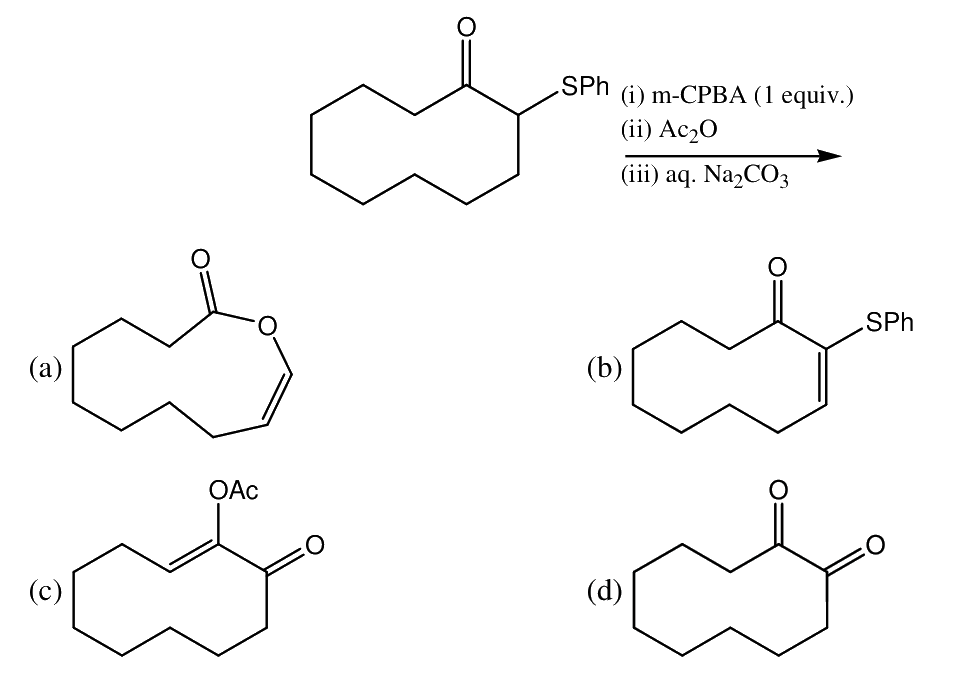
The structure of the compound is
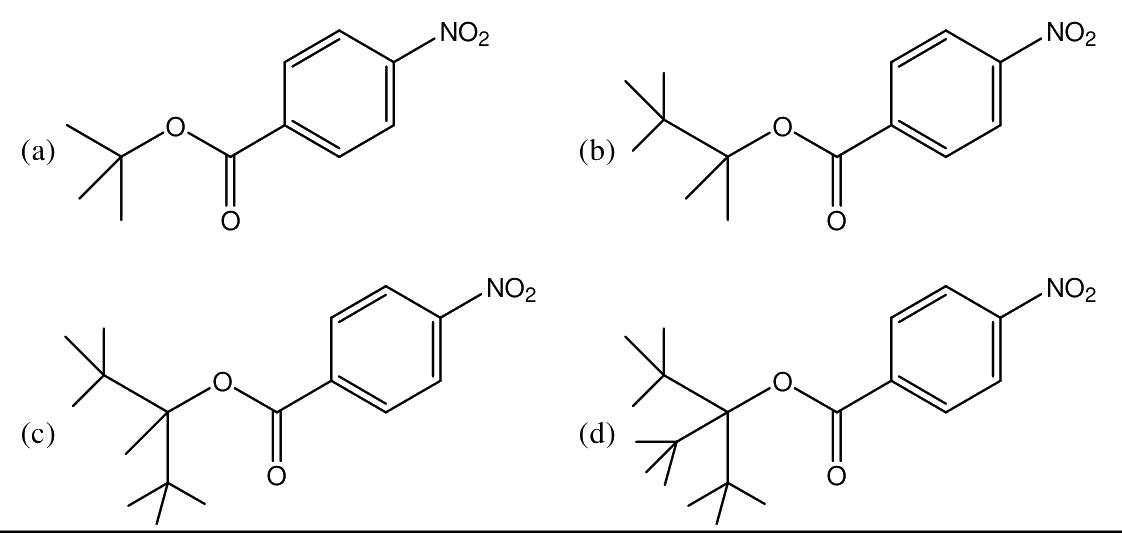
Correct Answer & Step-by-Step Solution Locked
Sign in free to reveal the correct answer and AI explanation for this question.
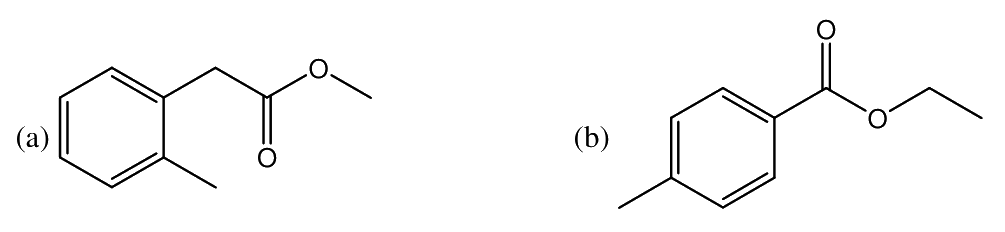
The compound P undergoes a pericyclic reaction under photochemical conditions to give compound Q. In compound Q, the relative stereochemistry and $^{1}\text{H}\text{ NMR}$ chemical shift values of methyl groups (in $\delta\text{ ppm}$), respectively, are
a.
cis; $-5$
b.
trans; $17$
c.
cis; $17$
d.
trans; $-5$
Correct Answer & Step-by-Step Solution Locked
Sign in free to reveal the correct answer and AI explanation for this question.
One of the Huckel molecular orbitals of $1, 3$-butadiene is
$$\varphi = 0.60\chi_1 + 0.37\chi_2 - 0.37\chi_3 - 0.60\chi_4$$
The energy of this orbital in terms of the coulomb ($\alpha$) and resonance ($\beta$) integrals is
a.
$\alpha + 1.62\beta$
b.
$\alpha + 0.62\beta$
c.
$\alpha - 0.62\beta$
d.
$\alpha - 1.62\beta$
Correct Answer & Step-by-Step Solution Locked
Sign in free to reveal the correct answer and AI explanation for this question.
For a one-dimensional ($x$) harmonic oscillator perturbed by an $x^3$ potential, the sum of the first order and second order corrections to the ground state energy is
a.
$< 0$
b.
$0$
c.
$> 0$
d.
$\ge 0$
Correct Answer & Step-by-Step Solution Locked
Sign in free to reveal the correct answer and AI explanation for this question.
Difference of average values of position $\langle x \rangle$ for states $n = 1$ and $n = 2$ of a particle confined in a one-dimensional ($x$) box of length $L$ is
a.
$L/4$
b.
$L/2$
c.
$L/3$
d.
$0$
Correct Answer & Step-by-Step Solution Locked
Sign in free to reveal the correct answer and AI explanation for this question.
The translational partition function for $\text{Ar}$ confined to a volume of $1\text{ L}$ at $300\text{ K}$, having thermal wavelength of $1.60 \times 10^{-11}\text{ m}$, is closest to
a.
$24.4 \times 10^{29}$
b.
$2.44 \times 10^{29}$
c.
$0.244 \times 10^{29}$
d.
$244 \times 10^{29}$
Correct Answer & Step-by-Step Solution Locked
Sign in free to reveal the correct answer and AI explanation for this question.
The third and fourth lines in the rotational Raman spectrum of $\text{CO}$ are separated by $8\text{ cm}^{-1}$. The $\text{CO}$ bond length is given by
a.
$\sqrt{\frac{h}{16\pi^2 \mu c}}$
b.
$\sqrt{\frac{3h}{32\pi^2 \mu c}}$
c.
$\sqrt{\frac{h}{32\pi^2 \mu c}}$
d.
$\sqrt{\frac{5h}{32\pi^2 \mu c}}$
Correct Answer & Step-by-Step Solution Locked
Sign in free to reveal the correct answer and AI explanation for this question.
Conductivities of water and a saturated solution of a sparingly soluble salt $\text{AB}_2$ are $7$ and $21\ \mu\text{S m}^{-1}$, respectively. Given, $\lambda^0_{\text{A}^{2+}} = 12.72\text{ mS m}^2\text{ mol}^{-1}$ and $\lambda^0_{\text{B}^-} = 7.64\text{ mS m}^2\text{ mol}^{-1}$, the solubility of $\text{AB}_2$, in $\text{mol m}^{-3}$, is
a.
$5.0 \times 10^{-4}$
b.
$5.0 \times 10^{-3}$
c.
$5.0 \times 10^{-5}$
d.
$5.0 \times 10^{-6}$
Correct Answer & Step-by-Step Solution Locked
Sign in free to reveal the correct answer and AI explanation for this question.
The equilibrium constant of the following reaction:
$$\text{Sn}(s) + \text{Sn}^{4+}(aq) \rightleftharpoons 2\text{Sn}^{2+}(aq)$$
at $300\text{ K}$ is close to
$$\left(\text{Given : } E^0_{\text{Sn}^{4+}/\text{Sn}^{2+}} = +0.15\text{ V} \text{ and } E^0_{\text{Sn}^{2+}/\text{Sn}} = -0.15\text{ V},\, R = 8.314\text{ J K}^{-1}\text{mol}^{-1};\, F = 96485\text{ C mol}^{-1}\right)$$
a.
$10^{6.08}$
b.
$10^{8.08}$
c.
$10^{10.08}$
d.
$10^{12.08}$
Correct Answer & Step-by-Step Solution Locked
Sign in free to reveal the correct answer and AI explanation for this question.
Langmuir adsorption isotherm for the dissociative adsorption of $\text{D}_2$ ($p = \text{partial pressure of } \text{D}_2$ and $k = \text{ratio of rate constants for adsorption and desorption}$) is
a.
$\theta = \frac{kp}{1 + kp}$
b.
$\theta = \frac{k}{1 + kp}$
c.
$\theta = \frac{(kp)^{1/2}}{1 + (kp)^{1/2}}$
d.
$\theta = \left(\frac{p}{1 + kp}\right)^{1/2}$
Correct Answer & Step-by-Step Solution Locked
Sign in free to reveal the correct answer and AI explanation for this question.
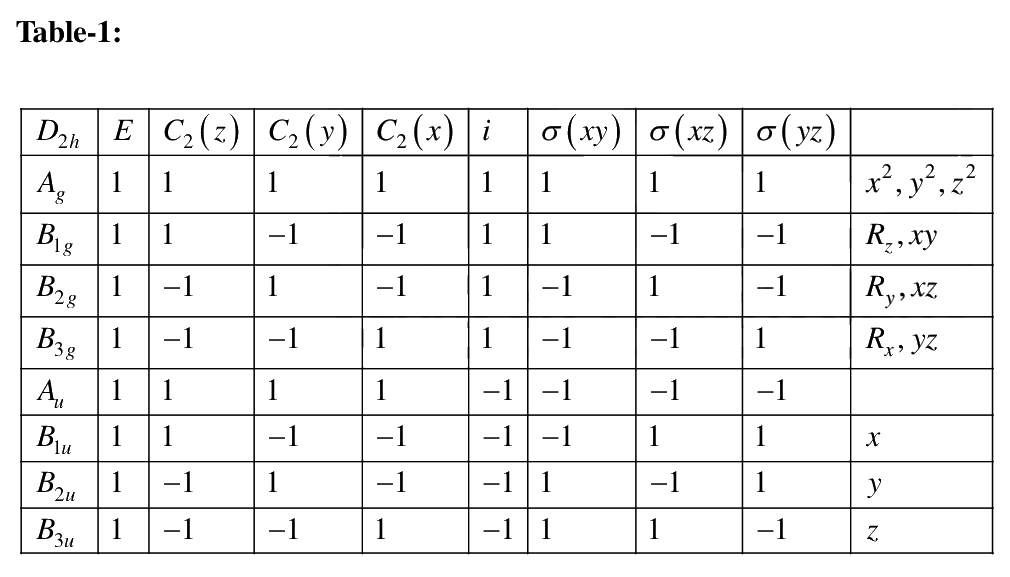
The $\pi_u$-orbital of ethylene, when placed in the xy-plane with the $\text{C}=\text{C}$ bond aligned to the x-axis, transforms according to the irreducible representation (Use Table-1)
a.
$a_u$
b.
$b_{1u}$
c.
$b_{2u}$
d.
$b_{3u}$
Correct Answer & Step-by-Step Solution Locked
Sign in free to reveal the correct answer and AI explanation for this question.
A metal crystallizes with cubic close-packed structure. The $\sin^2 \theta$ values of Bragg reflections of Miller Planes (200) and (111) are 0.18 and 0.14, respectively. The unit cell length is
a.
$\frac{\lambda}{2}$
b.
$\frac{\lambda}{0.2}$
c.
$\frac{\lambda}{0.4}$
d.
$0.4\lambda$
Correct Answer & Step-by-Step Solution Locked
Sign in free to reveal the correct answer and AI explanation for this question.
$k_{uni}$ is the effective first-order rate constant of the following unimolecular reaction
$$A + M \xrightleftharpoons[k_{-1}]{k_1} A^* + M$$
$$A^* \xrightarrow{k_2} P$$
The slope and intercept of the plot of $1 / k_{uni}$ vs. $1/[\text{M}]$ are $4\times 10^6$ and $8\times 10^{11}$, respectively. The value of $k_{-1} / k_2$ is
a.
$2\times 10^5$
b.
$0.5\times 10^5$
c.
$32\times 10^5$
d.
$2\times 10^{-5}$
Correct Answer & Step-by-Step Solution Locked
Sign in free to reveal the correct answer and AI explanation for this question.
The decomposition mechanism of ozone is
$$O_3 \xrightleftharpoons[k_{-1}]{k_1} O_2 + O$$
$$O_3 + O \xrightarrow{k_2} 2O_2$$
If $k_{-1}[O_2] \ll k_2[O_3]$, then the order of the reaction with respect to ozone is
a.
zero
b.
one
c.
two
d.
complex
Correct Answer & Step-by-Step Solution Locked
Sign in free to reveal the correct answer and AI explanation for this question.