Which one of the following pairs has two magic numbers for closed nuclear shells ?
a.
8, 10
b.
10, 20
c.
50, 82
Correct Answer
d.
82, 130
Step-by-Step AI Explanation
Verified Method
In nuclear physics, the magic numbers representing completely filled nuclear shells (for protons or neutrons) are $2, 8, 20, 28, 50, 82,$ and $126$. Among the given options, the pair containing two magic numbers is $50$ and $82$.
Q22mcq
Identify the correct statement(s) for phosphorimetric measurement from the following :
A. It is done after a time delay when fluorescence, if present becomes negligible
B. Immobilization of analytic increases phosphorescence
C. Phosphorescence decreases in the presence of heavy atoms
a.
A only
b.
A and B
Correct Answer
c.
A and C
d.
B and C
Step-by-Step AI Explanation
Verified Method
Statement A is correct: because phosphorescence has a much longer lifetime (typically milliseconds to seconds) compared to fluorescence (nanoseconds), phosphorimetric measurements typically use a time delay to eliminate interfering fluorescence and scattered light.
Statement B is correct: rigidifying or immobilizing the analyte reduces non-radiative decay via collisional quenching and vibrational relaxation, thereby increasing phosphorescence quantum yield.
Statement C is incorrect: the presence of heavy atoms increases spin-orbit coupling, which enhances the rate of intersystem crossing and phosphorescence (external heavy atom effect), rather than decreasing it.
Therefore, statements A and B are correct.
Q23mcq
Choose the isoelectronic pair among the following :
A. $[\text{V}(\text{CO})_6]$
B. $[\text{Cu}(\eta^5-\text{C}_5\text{H}_5)(\text{CO})]$
C. $[\text{Co}(\text{CO})_4]^-$
D. $[\text{IrCl}(\text{CO})(\text{PPh}_3)_2]$
a.
A and B
b.
B and C
Correct Answer
c.
C and D
d.
A and D
Step-by-Step AI Explanation
Verified Method
To find the isoelectronic pair, we calculate the valence electron count for each complex:
- **A. $[\text{V}(\text{CO})_6]$:**
Valence electrons $= 5\,(\text{V}) + 6 \times 2\,(\text{CO}) = 5 + 12 = 17\text{ e}^-$
- **B. $[\text{Cu}(\eta^5-\text{C}_5\text{H}_5)(\text{CO})]$:**
Valence electrons $= 11\,(\text{Cu}) + 5\,(\eta^5-\text{C}_5\text{H}_5) + 2\,(\text{CO}) = 18\text{ e}^-$
- **C. $[\text{Co}(\text{CO})_4]^-$:**
Valence electrons $= 9\,(\text{Co}) + 4 \times 2\,(\text{CO}) + 1\,(\text{negative charge}) = 18\text{ e}^-$
- **D. $[\text{IrCl}(\text{CO})(\text{PPh}_3)_2]$ (Vaska's complex):**
Valence electrons $= 9\,(\text{Ir}) + 1\,(\text{Cl}) + 2\,(\text{CO}) + 2 \times 2\,(\text{PPh}_3) = 16\text{ e}^-$
Complexes **B** and **C** both have 18 valence electrons, making them an isoelectronic pair. Therefore, the correct option is **B**.
Q24mcq
An organometallic fragment that is isolobal to $\text{CH}_3^+$ is
a.
$[\text{Fe}(\text{CO})_5]$
b.
$[\text{Mn}(\text{CO})_5]$
c.
$[\text{Cr}(\text{CO})_5]$
Correct Answer
d.
$[\text{Ni}(\text{CO})_3]^+$
Step-by-Step AI Explanation
Verified Method
According to the Hoffmann isolobal analogy:
- $\text{CH}_3^+$ is a 6-valence-electron fragment with 3 frontier orbitals (or can be seen as an 8-electron closed shell minus 2 electrons, thus an empty frontier orbital, isolobal to a $d^6-\text{ML}_5$ fragment having 16 valence electrons).
- Let us check the electron counts of the metal fragments:
- $[\text{Fe}(\text{CO})_5]$: $8 + 10 = 18\text{ e}^-$
- $[\text{Mn}(\text{CO})_5]$: $7 + 10 = 17\text{ e}^-$, isolobal to $\text{CH}_3^\bullet$ (7-electron radical)
- $[\text{Cr}(\text{CO})_5]$: $6 + 10 = 16\text{ e}^-$, isolobal to $\text{CH}_3^+$ (6-electron cation)
- $[\text{Ni}(\text{CO})_3]^+$: $10 - 1 + 6 = 15\text{ e}^-$
Therefore, $[\text{Cr}(\text{CO})_5]$ is isolobal to $\text{CH}_3^+$.
Q25mcq
The calculated and observed magnetic moments (in B.M.) of aqua complex of a lanthanide ion are $0$ and $\sim 3.5$, respectively. The lanthanide ion is
a.
$\text{Pm}^{3+}$
b.
$\text{Pr}^{3+}$
c.
$\text{Eu}^{3+}$
Correct Answer
d.
$\text{Sm}^{3+}$
Step-by-Step AI Explanation
Verified Method
For $\text{Eu}^{3+}$ ($4f^6$), the ground state term symbol determined by Hund's rules is $^7F_0$ ($S = 3$, $L = 3$, $J = |L - S| = 0$).
Because $J = 0$, the theoretical ground-state magnetic moment is:
$$\mu = g_J \sqrt{J(J + 1)} = 0\text{ B.M.}$$
However, the first excited states ($^7F_1$, $^7F_2$) are very close in energy to the ground state (small spin-orbit splitting $\Delta E \approx k_BT$), so they are thermally populated at room temperature. This leads to an observed magnetic moment of approximately $3.4 - 3.6\text{ B.M.}$ at room temperature.
Q26mcq
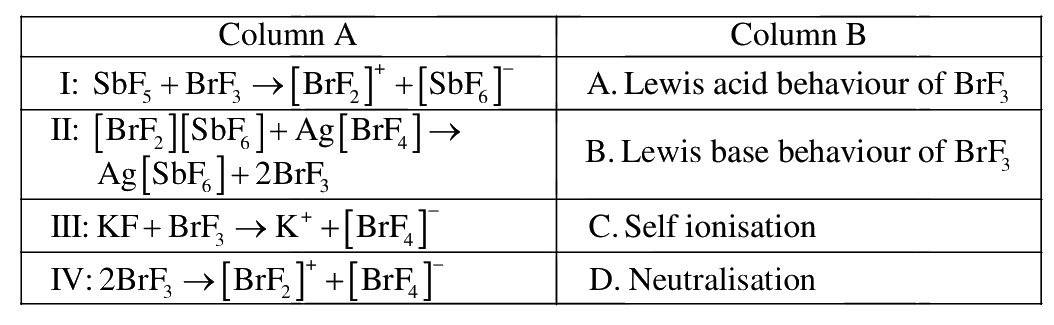
The compound that gives a basic solution in $\text{HF}$ is :
a.
$\text{AsF}_5$
b.
$\text{PF}_5$
c.
$\text{BF}_3$
d.
$\text{BrF}_3$
Correct Answer
Step-by-Step AI Explanation
Verified Method
In liquid hydrogen fluoride ($ ext{HF}$), the autoionization equilibrium is:
$$2\text{HF} \rightleftharpoons \text{H}_2\text{F}^+ + \text{F}^-$$
- Fluoride ion acceptors (Lewis acids like $\text{AsF}_5$, $\text{PF}_5$, and $\text{BF}_3$) react with $\text{HF}$ by accepting $\text{F}^-$ to form anions like $\text{AsF}_6^-$, $\text{PF}_6^-$, and $\text{BF}_4^-$, thereby increasing the concentration of the solvated proton $\text{H}_2\text{F}^+$, acting as acids.
- In contrast, $\text{BrF}_3$ acts as a fluoride donor towards strong Lewis acids, but in pure $\text{HF}$, it accepts a proton or transfers fluoride to act as a weak base, behaving as a base in $\text{HF}$ solution: $\text{BrF}_3 + \text{HF} \rightleftharpoons [\text{BrF}_2]^+[\text{HF}_2]^-$, yielding solvated fluoride ions ($ ext{F}^-$ / $ ext{HF}_2^-$).
Q27mcq
Based on VSEPR theory, the predicted shapes of $[\text{XeF}_5]^-$ and $\text{BrF}_5$ respectively, are
a.
pentagonal planar and square pyramidal
Correct Answer
b.
square pyramidal and trigonal bipyramidal
c.
trigonal bipyramidal and square pyramidal
d.
square pyramidal and pentagonal planar
Step-by-Step AI Explanation
Verified Method
- For $[\text{XeF}_5]^-$: Xenon has 8 valence electrons, $+1$ from negative charge, and 5 bonding electrons with fluorines $\implies$ total electron pairs $= (8 + 1 + 5)/2 = 7$. There are 5 bonding pairs and 2 lone pairs ($AX_5E_2$). The steric arrangement is pentagonal bipyramidal with the two lone pairs occupying the axial positions to minimize repulsions. Thus, the molecular geometry (shape) is **pentagonal planar**.
- For $\text{BrF}_5$: Bromine has 7 valence electrons and forms 5 single bonds with fluorines $\implies$ total electron pairs $= (7 + 5)/2 = 6$. There are 5 bonding pairs and 1 lone pair ($AX_5E$). The steric geometry is octahedral, making the molecular shape **square pyramidal**.
Q28mcq
Both potassium and sulfuric acid form intercalation compounds with graphite. The graphite layers are
a.
reduced in both the cases
b.
oxidized in both the cases
c.
oxidized in the case of potassium and reduced in the case of sulphuric acid
d.
reduced in the case of potassium and oxidized in the case of sulphuric acid
Correct Answer
Step-by-Step AI Explanation
Verified Method
In graphite intercalation compounds (GICs):
- With electropositive alkali metals like potassium, potassium acts as an electron donor (reducing agent), transferring electrons to the conduction $\pi$-band of graphite. Thus, potassium is oxidized to $\text{K}^+$ and graphite layers are **reduced** (forming donor-type intercalation compounds like $\text{KC}_8$).
- With strong oxidizing acids like concentrated sulfuric acid (in the presence of an oxidant), electrons are accepted from the graphite layers. Thus, graphite is **oxidized** into polycarbon cations $[\text{C}_n]^+$, and bisulfate anions ($\text{HSO}_4^-$) are intercalated (forming acceptor-type intercalation compounds, e.g., graphite bisulfate).
Q29mcq
The resonance Raman stretching frequencies (in $\text{cm}^{-1}$) of the bound $\text{O}_2$ species in oxy-hemerthyrin and oxy-hemoglobin, respectively, are
a.
$\sim 850$ and $1100$
Correct Answer
b.
$\sim 750$ and $850$
c.
$\sim 850$ and $850$
d.
$\sim 1100$ and $850$
Step-by-Step AI Explanation
Verified Method
In **oxy-hemerythrin**, oxygen is bound as a hydroperoxo species ($\text{O}_2^{2-}$ or $\text{HO}_2^-$). The $\text{O}-\text{O}$ stretching frequency of peroxide species is typically in the range of $800 - 900\text{ cm}^{-1}$ (specifically around $\sim 844 - 850\text{ cm}^{-1}$).
In **oxy-hemoglobin**, oxygen is bound in an end-on fashion primarily described as a superoxo species ($\text{O}_2^-$). The $\text{O}-\text{O}$ stretching frequency of superoxide species is characteristically around $\sim 1100 - 1150\text{ cm}^{-1}$ (specifically $\sim 1105\text{ cm}^{-1}$).
Thus, the resonance Raman stretching frequencies for oxy-hemerythrin and oxy-hemoglobin are $\sim 850\text{ cm}^{-1}$ and $\sim 1100\text{ cm}^{-1}$, respectively, which corresponds to option **A**.
Q30mcq
$\text{CdS}$, $\text{HgS}$ and $\text{BiI}_3$, are coloured due to
a.
$\text{L} \rightarrow \text{M}$ charge transfer transitions
Correct Answer
$\text{M} \rightarrow \text{L}$ charge transfer transitions
d.
combination of $\text{L} \rightarrow \text{M}$ charge transfer and $\text{d} \rightarrow \text{d}$ electronic transitions
Step-by-Step AI Explanation
Verified Method
$ ext{Cd}^{2+}$ ($d^{10}$), $ ext{Hg}^{2+}$ ($d^{10}$), and $ ext{Bi}^{3+}$ ($d^{10}s^2$) have completely filled $d$-subshells, which rules out $d\rightarrow d$ electronic transitions. The intense colours of $ ext{CdS}$ (yellow), $ ext{HgS}$ (red/black), and $ ext{BiI}_3$ (dark brown/black) arise from ligand-to-metal charge transfer ($ ext{LMCT}$) transitions, where an electron is transferred from the ligand ($ ext{S}^{2-}$ or $ ext{I}^-$) to the metal center.
🎉 10 Free Sample Solutions Completed
Unlock All 100 Questions & Solutions
Sign up free in seconds to unlock step-by-step AI answers for the remaining 90 questions.
The relative rates of water exchange for the hydrated complexes of (1) $\text{Ni}^{2+}$, (2) $\text{V}^{2+}$ and (3) $\text{Cr}^{3+}$ ions follows the trend
a.
$(1) > (2) > (3)$
b.
$(1) < (2) < (3)$
c.
$(1) > (2) < (3)$
d.
$(1) < (2) > (3)$
Correct Answer & Step-by-Step Solution Locked
Sign in free to reveal the correct answer and AI explanation for this question.
Consider the following sulfur donor atom bearing bidentate ligand where $\text{X}$ and name of ligands are given in following columns :
\begin{tabular}{ll}
\textbf{X} & \textbf{Ligand name} \\
A. $\text{NR}_2$ & I. Dithiocarbonate \\
B. $\text{OR}$ & II. Dithiocarbamate \\
C. $\text{O}^-$ & III. Xanthate \\
D. $\text{SR}$ & IV. Thioxanthate
\end{tabular}
Correct match of entries given in two columns is
a.
A-II, B-III, C-I, D-IV
b.
A-III, B-II, C-IV, D-I
c.
A-I, B-II, C-III, D-IV
d.
A-IV, B-I, C-II, D-III
Correct Answer & Step-by-Step Solution Locked
Sign in free to reveal the correct answer and AI explanation for this question.
The correct match of natural products in Column-I with their biosynthetic precursors in Column-II is
**Column-I**
A. (structure)
B. (structure)
**Column-II**
I. L-Lysine
II. L-Ornithine
III. Farnesyl IV. Geranyl pyrophosphate
a.
A-IV, B-I
b.
A-IV, B-II
c.
A-III, B-I
d.
A-III, B-II
Correct Answer & Step-by-Step Solution Locked
Sign in free to reveal the correct answer and AI explanation for this question.
Consider a particle in its ground state confined to a one-dimensional box in the interval $(0, 8)$. The probability of finding it between $4.0 - \frac{\delta}{2}$ and $4.0 + \frac{\delta}{2}$ is close to ($\delta$ is sufficiently small so that the wavefunction can be taken as a constant in this interval).
a.
$\frac{\delta}{4}$
b.
$\frac{\delta}{3}$
c.
$\frac{\delta}{2}$
d.
$\delta$
Correct Answer & Step-by-Step Solution Locked
Sign in free to reveal the correct answer and AI explanation for this question.
Metallic silver crystallizes in face-centred-cubic lattice structure with a unit cell of length $40\text{ nm}$. The first order diffraction angle of X-ray beam from $(2, 1, 0)$ plane of silver is $30^\circ$. The wavelength of X-ray used is close to
a.
$11\text{ nm}$
b.
$18\text{ nm}$
c.
$25\text{ nm}$
d.
$32\text{ nm}$
Correct Answer & Step-by-Step Solution Locked
Sign in free to reveal the correct answer and AI explanation for this question.
If the pre-exponential factor in Arrhenius equation is $1.6 \times 10^{12}\text{ s}^{-1}$, the value of the rate constant at extremely high temperature will be close to
a.
$1.6 \times 10^{12}\text{ s}^{-1}$
b.
$4.2 \times 10^{12}\text{ s}^{-1}$
c.
$2.4 \times 10^9\text{ s}^{-1}$
d.
$1.2 \times 10^6\text{ s}^{-1}$
Correct Answer & Step-by-Step Solution Locked
Sign in free to reveal the correct answer and AI explanation for this question.
In kinetic study of a chemical reaction, slopes are drawn at different times in the plot of concentration of reactants versus time. The magnitude of slopes with increase of time
a.
remains unchanged
b.
increases
c.
decreases
d.
increases and decreases periodically
Correct Answer & Step-by-Step Solution Locked
Sign in free to reveal the correct answer and AI explanation for this question.
The electrochemical cell potential (E), after the reactants and products reach equilibrium, is ($E^0$ is the standard cell potential and $n$ is the number of electrons involved)
a.
$E = E^0 + nF/RT$
b.
$E = E^0 - RT/nF$
c.
$E = E^0$
d.
$E = 0$
Correct Answer & Step-by-Step Solution Locked
Sign in free to reveal the correct answer and AI explanation for this question.
The $v = 0$ to $1$ vibration-rotation spectrum of a diatomic molecule exhibits transitions for $R(0), R(1), P(1)$ and $P(2)$ lines at $2241, 2254, 2216$ and $2203\text{ cm}^{-1}$, respectively. From this data, we can conclude that the molecule
a.
has rigid rotation and harmonic vibration
b.
has anharmonic vibration
c.
has rotational-vibrational interaction
d.
is affected by nuclear spin-statistics
Correct Answer & Step-by-Step Solution Locked
Sign in free to reveal the correct answer and AI explanation for this question.
Consider aqueous solutions of two compounds A and B of identical concentrations. The surface tension of the solution of A is smaller than that of pure water while for B it is greater than that of pure water under identical conditions. From this one infers that
a.
surface concentration of A is smaller than its bulk concentration
b.
surface concentration of B is larger than its bulk concentration
c.
surface concentration of A is larger than that of B
d.
surface concentration of A is smaller than that of B
Correct Answer & Step-by-Step Solution Locked
Sign in free to reveal the correct answer and AI explanation for this question.
Identify correct statements from the following:
A. Area of differential thermal analysis peak is proportional to amount of sample.
B. Area of differential thermogravimetric analysis curve is proportional to mass loss.
C. Phase transition cannot be studied with differential scanning calorimetry.
D. Simulatneous determination of two metal ions is possible with thermogravimetric analysis.
Answer is
a.
A, B and C
b.
A, B and D
c.
B, C and D
d.
A, C and D
Correct Answer & Step-by-Step Solution Locked
Sign in free to reveal the correct answer and AI explanation for this question.
Consider following statements for fission of $^{235}\text{U}$ with thermal neutrons.
A. The % of nuclei undergoing unsymmetrical fission is maximum.
B. In each fission, one thermal neutron is produced.
C. Magnitude of energy released per fission is of the order $200\text{ MeV}$
Correct statement(s) is/are
a.
A and B
b.
A and C
c.
B and C
d.
C only
Correct Answer & Step-by-Step Solution Locked
Sign in free to reveal the correct answer and AI explanation for this question.
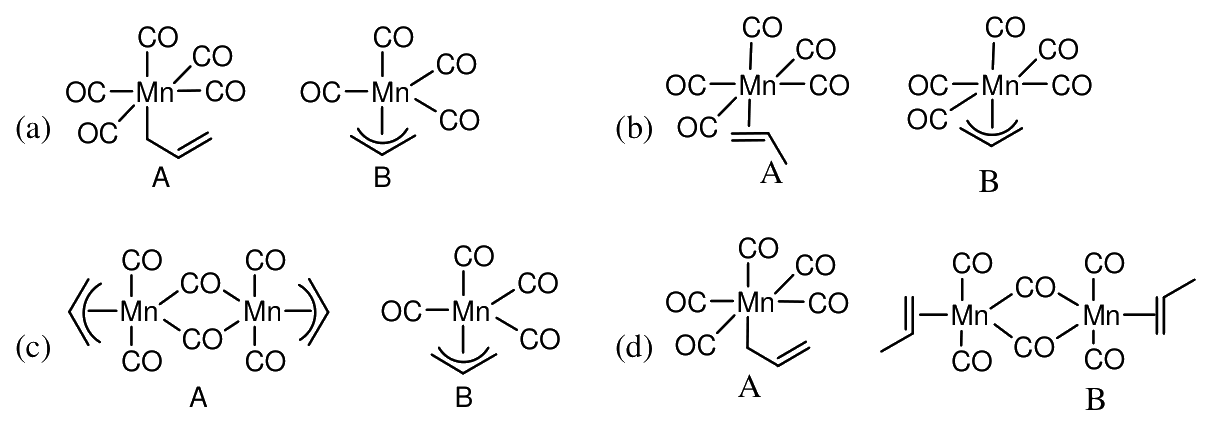
Reaction of $\text{Na}\left[\text{Mn}(\text{CO})_5\right]$ with $\text{H}_2\text{C}=\text{CHCH}_2\text{Cl}$ gives $\textbf{A}$ along with $\text{NaCl}$. Photolysis of compound $\textbf{A}$ results in compound $\textbf{B}$ together with elimination of $\text{CO}$. the correct structural formulations of compounds $\textbf{A}$ and $\textbf{B}$ are respectively,
a.
See image
b.
See image
c.
See image
d.
See image
Correct Answer & Step-by-Step Solution Locked
Sign in free to reveal the correct answer and AI explanation for this question.
A copper(II) complex having distorted octahedral geometry shows an absorption band at $625\text{ nm}$. Given spin-orbit coupling of the complex as $-625\text{ cm}^{-1}$, the $\mu_{\text{eff}}$ (in B.M.) is
a.
$1.73$
b.
$1.81$
c.
$1.63$
d.
$1.93$
Correct Answer & Step-by-Step Solution Locked
Sign in free to reveal the correct answer and AI explanation for this question.
Mössbauer spectrum of complex $\left[\text{Fe}(1,10-\text{phenanthroline})_2(\text{NCS})_2\right]$ shows two lines at $300\text{ K}$, four lines at $186\text{ K}$, and again two lines at $77\text{ K}$. This can be attributed to
A. change in the coordination mode of NCS
B. change in the spin-state of iron
C. cis-trans isomerisation
D. change in metal-ligand bond distances
The correct statements are
a.
A and B
b.
B and C
c.
A and C
d.
B and D
Correct Answer & Step-by-Step Solution Locked
Sign in free to reveal the correct answer and AI explanation for this question.
$(\text{R}_3\text{Ge})_2$ on photolysis gives a radical which shows ESR spectrum. The ESR signals carrying the signature of $^{73}\text{Ge}(I=9/2)$ are in terms of
a.
Nine lines
b.
Ten lines
c.
Two lines
d.
One line
Correct Answer & Step-by-Step Solution Locked
Sign in free to reveal the correct answer and AI explanation for this question.
Mass fragment of $[\text{IrCl}]^+$ in mass spectrometry shows three mass peaks at $\text{m/z} = 226, 228,$ and $230$.
Given that natural abundances of $^{191}\text{Ir}$, $^{193}\text{Ir}$, $^{35}\text{Cl}$ and $^{37}\text{Cl}$ are $37\%, 63\%, 76\%,$ and $24\%$ respectively, the intensities of the mass peaks are in the order
a.
$49.5 : 100 : 26.6$
b.
$100 : 49.5 : 26.6$
c.
$26.6 : 100 : 49.5$
d.
$26.6 : 49.5 : 100$
Correct Answer & Step-by-Step Solution Locked
Sign in free to reveal the correct answer and AI explanation for this question.
Consider the following statements for metallothioneins:
A. the contain about $30\%$ cysteine residues
B. they prefer to bind soft metal ions such as $\text{Cd(II)}, \text{Hg(II)}$ and $\text{Zn(II)}$
C. they are involved in electron transfer reactions
D. they are low molecular weight proteins
Correct statements are
a.
A, B and C
b.
A, B and D
c.
A, C and D
d.
B and C
Correct Answer & Step-by-Step Solution Locked
Sign in free to reveal the correct answer and AI explanation for this question.
Consider the following statements for deoxy-hemerythrin and deoxy-hemocyanin:
A. they are involved in $\text{O}_2$ transport in biological systems
B. they contain two metal ions in their active site
C. active site metal centres are bridged by amino acid residues
D. they prefer to bind only one $\text{O}_2$ per active site
The correct statements are
a.
A, B and D
b.
A, C and D
c.
B, C and D
d.
A and C
Correct Answer & Step-by-Step Solution Locked
Sign in free to reveal the correct answer and AI explanation for this question.
Consider the following statements for octahedral complexes, (a) $[\text{CrF}_6]^{3-}$, (b) $[\text{Cr}(\text{ox})_3]^{3-}$ and (c) $[\text{Cr}(\text{en})_3]^{3+}$:
A. their $\text{d}\rightarrow\text{d}$ transitions are at $14900, 17500,$ and $21800\text{ cm}^{-1}$, respectively
B. their spin-only magnetic moments are same
C. two of them have optical isomers
D. all of them show Jahn-Teller distortion
The correct statements are
a.
A, B, and C
b.
A, C, and D
c.
B, C, and D
d.
B and D
Correct Answer & Step-by-Step Solution Locked
Sign in free to reveal the correct answer and AI explanation for this question.
The $\mu_{\text{eff}}$ of $[\mathrm{Fe}(\mathrm{S}_2\mathrm{CNEt}_2)_3]$ changes with temperature with the involvement of two electronic states. The states are
a.
low spin ${}^2\mathrm{T}_{2\mathrm{g}}$ and high-spin ${}^6\mathrm{A}_{1\mathrm{g}}$.
b.
low spin ${}^1\mathrm{A}_{1\mathrm{g}}$ and high-spin ${}^3\mathrm{T}_{2\mathrm{g}}$
c.
low spin ${}^2\mathrm{E}_{\mathrm{g}}$ and high-spin ${}^6\mathrm{A}_{1\mathrm{g}}$.
d.
low spin ${}^2\mathrm{T}_{2\mathrm{g}}$ and high-spin ${}^4\mathrm{T}_{1\mathrm{g}}$.
Correct Answer & Step-by-Step Solution Locked
Sign in free to reveal the correct answer and AI explanation for this question.
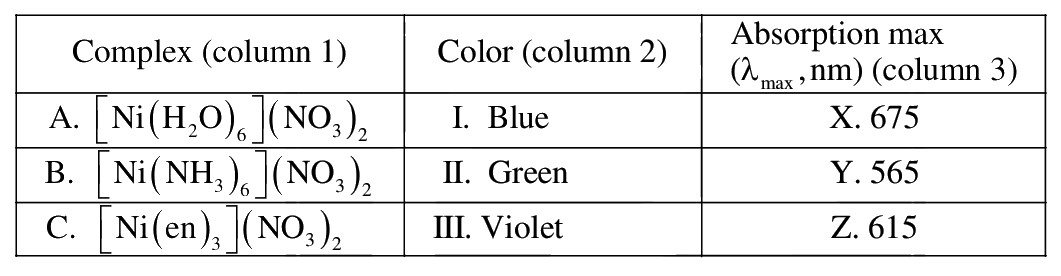
Match the items in the three columns.
\begin{tabular}{|l|l|c|}
\hline
Complex (column 1) & Color (column 2) & \begin{tabular}{@{}c@{}}Absorption max\\ $(\lambda_{\max}, \text{nm})$ (column 3)\end{tabular} \\
\hline
A. $[\mathrm{Ni}(\mathrm{H}_2\mathrm{O})_6](\mathrm{NO}_3)_2$ & I. Blue & X. 675 \\
\hline
B. $[\mathrm{Ni}(\mathrm{NH}_3)_6](\mathrm{NO}_3)_2$ & II. Green & Y. 565 \\
\hline
C. $[\mathrm{Ni}(\mathrm{en})_3](\mathrm{NO}_3)_2$ & III. Violet & Z. 615 \\
\hline
\end{tabular}
The correct answer is
a.
A-II-X; B-I-Z; C-III-Y
b.
A-I-X; B-II-Y; C-III-Z
c.
A-III-Y; B-I-Z; C-II-X
d.
A-I-X; B-II-Z; C-III-Y
Correct Answer & Step-by-Step Solution Locked
Sign in free to reveal the correct answer and AI explanation for this question.
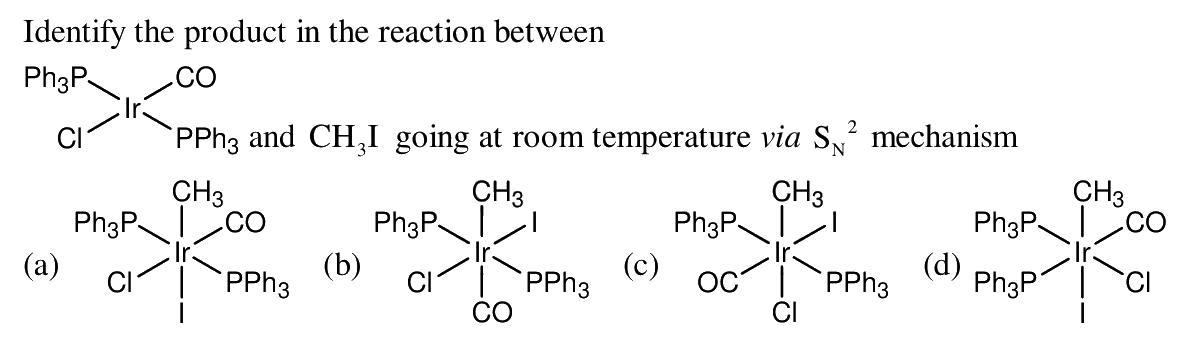
Identify the product in the reaction between $\text{trans-}[\mathrm{Ir}(\mathrm{CO})\mathrm{Cl}(\mathrm{PPh}_3)_2]$ and $\mathrm{CH}_3\mathrm{I}$ going at room temperature via $\mathrm{S_N2}$ mechanism
a.
(a)
b.
(b)
c.
(c)
d.
(d)
Correct Answer & Step-by-Step Solution Locked
Sign in free to reveal the correct answer and AI explanation for this question.
The specific rotation $[\alpha]_\text{D}$ for $(\text{S})-(+)-2-$butanol is $10^\circ\text{ mL/g dm}$. The observed optical rotation $(\alpha_\text{obs})$ of a sample composed of a mixture of $(\text{R})$- and $(\text{S})-2$-butanol is $-0.45^\circ$. If the cell path length is $0.6\text{ dm}$ and the concentration of $2$-butanol in the sample is $0.15\text{ g/mL}$, the percentages of $(\text{R})$ and $(\text{S})$ enantiomers in the sample are
a.
$(\text{R}) = 25\%$, $(\text{S}) = 75\%$
b.
$(\text{R}) = 40\%$, $(\text{S}) = 60\%$
c.
$(\text{R}) = 60\%$, $(\text{S}) = 40\%$
d.
$(\text{R}) = 75\%$, $(\text{S}) = 25\%$
Correct Answer & Step-by-Step Solution Locked
Sign in free to reveal the correct answer and AI explanation for this question.
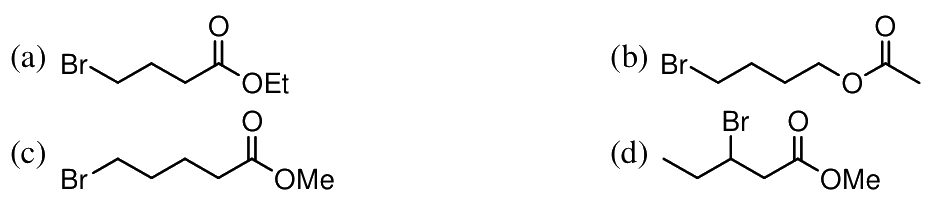
The correct structure of the compound based on the following characteristic spectral data is
IR: $1736\text{ cm}^{-1}$
$^1\text{H NMR}$: $\delta\ 3.59\text{ (s, 3H)}, 3.32\text{ (t, 2H)}, 2.25\text{ (t, 2H)}, 1.85\text{-}1.75\text{ (m, 2H)}, 1.73\text{-}1.62\text{ (m, 2H)}$
$^{13}\text{C NMR}$: $\delta\ 174.0, 51.0, 32.9, 32.9, 32.8, 31.0, 23.0$
Correct Answer & Step-by-Step Solution Locked
Sign in free to reveal the correct answer and AI explanation for this question.
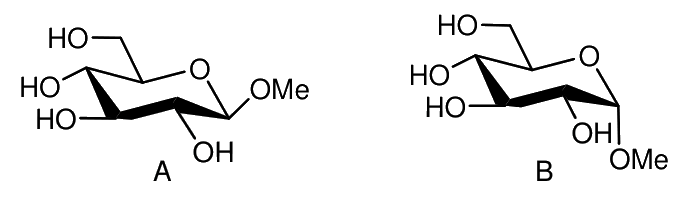
The major product formed in the reaction of D-glucose with $\text{ZnCl}_2$ in $\text{MeOH}$ is a methyl glucopyranoside (A or B). The structure of this product and the molecular orbital interaction present between ring-oxygen and the anomeric C-O bond responsible for its stability, respectively, are
a.
A and $n \rightarrow \sigma*$
b.
A and $n \rightarrow \sigma$
c.
B and $n \rightarrow \sigma*$
d.
B and $n \rightarrow \sigma$
Correct Answer & Step-by-Step Solution Locked
Sign in free to reveal the correct answer and AI explanation for this question.
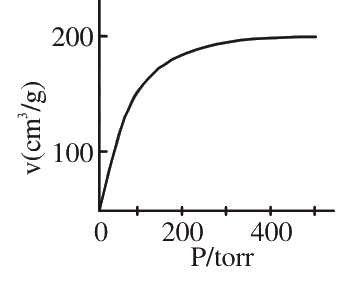
The figure below depicts an adsorption isotherm of $\text{O}_2$ on charcoal at $90\text{ K}$.
At a pressure 25 torr, only 10% of charcoal sites are occupied by $\text{O}_2$. Therefore, the ratio of adsorption to desorption rate constants (in $\text{torr}^{-1}$) is close to
a.
0.003
b.
0.004
c.
0.006
d.
0.015
Correct Answer & Step-by-Step Solution Locked
Sign in free to reveal the correct answer and AI explanation for this question.
Polonium is the only metal known to exist in a simple cubic lattice form. The density of polonium at $0^\circ\text{C}$ is measured to be $10.00\text{ g/cm}^3$. The atomic radius of polonium would then be (assume the mass of a polonium atom $= 2.7 \times 10^{-22}\text{ g}$)
a.
$1.1\text{ \AA}$
b.
$1.9\text{ \AA}$
c.
$1.5\text{ \AA}$
d.
$2.3\text{ \AA}$
Correct Answer & Step-by-Step Solution Locked
Sign in free to reveal the correct answer and AI explanation for this question.
The specific conductance of a solution is $0.176\ \Omega^{-1}\text{cm}^{-1}$. If the cell constant is $0.255\text{ cm}^{-1}$, the conductance $(\Omega^{-1})$ of that solution is
a.
1.449
b.
0.690
c.
0.045
d.
0.431
Correct Answer & Step-by-Step Solution Locked
Sign in free to reveal the correct answer and AI explanation for this question.
Photochemical decomposition of HI takes place with the following mechanism
$$\text{HI} + h\nu\ (\text{I}_a) \longrightarrow \text{H} + \text{I}$$
$$\text{H} + \text{HI} \xrightarrow{\quad k_1\quad} \text{H}_2 + \text{I}$$
$$\text{I} + \text{I} + \text{M} \xrightarrow{\quad k_2\quad} \text{I}_2 + \text{M}$$
Considering hydrogen (H) and iodine (I) atoms as intermediates, the rate of removal of HI is
a.
$\text{I}_a / 2$
b.
$\text{I}_a$
c.
$2\text{I}_a$
d.
$\text{I}_a^2$
Correct Answer & Step-by-Step Solution Locked
Sign in free to reveal the correct answer and AI explanation for this question.
In an enzyme-catalysed reaction
$$\text{E} + \text{S} \xrightleftharpoons[k_{-1}]{k_1} \text{ES} \xrightarrow{\quad k_2\quad} \text{E} + \text{P}$$
$k_2 = 3.42 \times 10^4\text{ s}^{-1}$. If $[\text{E}]_0 = 1 \times 10^{-2}\text{ mol dm}^{-3}$, the magnitude of maximum velocity and turn over number using Michaelis-Menten kinetics are
The fugacity of a real gas is less than the pressure (P) of an ideal gas at the same temperature (T) only when ($T_b$ is the Boyle temperature of the real gas)
a.
high $P$, $T < T_b$
b.
low $P$, $T < T_b$
c.
high $P$, $T > T_b$
d.
low $P$, $T > T_b$
Correct Answer & Step-by-Step Solution Locked
Sign in free to reveal the correct answer and AI explanation for this question.
For the reaction $\text{H}_2\text{O}(\text{g}) \rightleftharpoons \text{H}_2(\text{g}) + \frac{1}{2}\text{O}_2(\text{g})$, the equilibrium constant $K_p$ depends on the degree of dissociation $\alpha (\alpha \ll 1)$ and total pressure $P$ as
a.
$K_p \propto \alpha^2 P$
b.
$K_p \propto \alpha^{3/2} P^{1/2}$
c.
$K_p \propto \alpha^{1/2} P^{3/2}$
d.
$K_p \propto \alpha P^2$
Correct Answer & Step-by-Step Solution Locked
Sign in free to reveal the correct answer and AI explanation for this question.
A polydisperse polymer sample has ten molecules of molar mass $20,000\text{ g mol}^{-1}$ and fifteen molecules of molar mass $10,000\text{ g mol}^{-1}$. The number-average molar mass $\left(\text{g mol}^{-1}\right) (\overline{M}_n)$ of the sample is
a.
$13,000$
b.
$14,000$
c.
$15,000$
d.
$16,000$
Correct Answer & Step-by-Step Solution Locked
Sign in free to reveal the correct answer and AI explanation for this question.
Consider a system of three particles which can occupy energy levels with energy $0$, $\varepsilon$ and $2\varepsilon$, such that the total energy $E = 4\varepsilon$. Cases A, B and C correspond to spin $\frac{1}{2}$ fermions, spin $0$ bosons, and classically distinguishable particles, respectively. The correct ordering of entropy is
a.
$S_A > S_B > S_C$
b.
$S_B > S_A > S_C$
c.
$S_C > S_B > S_A$
d.
$S_C > S_A > S_B$
Correct Answer & Step-by-Step Solution Locked
Sign in free to reveal the correct answer and AI explanation for this question.
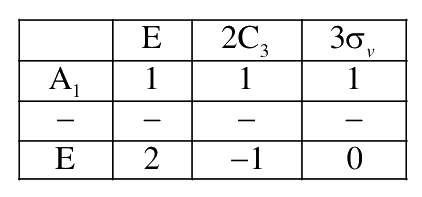
For a point group, an incomplete character table is given below with one irreducible representation missing
The Mulliken symbol and characters of the missing representation are
a.
$A_1' \quad 1 \quad -1 \quad 1$
b.
$B_1 \quad 1 \quad -1 \quad -1$
c.
$A_2 \quad 1 \quad 1 \quad -1$
d.
$B_2 \quad 1 \quad -1 \quad 1$
Correct Answer & Step-by-Step Solution Locked
Sign in free to reveal the correct answer and AI explanation for this question.
Given below is a specific vibrational mode of $\text{BCl}_3$ with $\oplus$ and $\ominus$ denoting movements of the respective atoms above and below the plane of the molecule respectively. The irreducible representation of the vibrational mode and its $IR$ / Raman activity are
a.
$A_2'$; neither $IR$ nor Raman active
b.
$E'$; both $IR$ and Raman active
c.
$A_1'$; Raman active
d.
$A_2''$; $IR$ active
Correct Answer & Step-by-Step Solution Locked
Sign in free to reveal the correct answer and AI explanation for this question.
The first excited state $\left({ }^2 P_{1/2}\right)$ of fluorine lies at an energy of $400\text{ cm}^{-1}$ above the ground state $\left({ }^2 P_{3/2}\right)$. The fraction of Fluorine atoms in the first excited state at $k_B T = 420\text{ cm}^{-1}$ is close to
a.
$\frac{1}{1+e}$
b.
$\frac{1}{2+e}$
c.
$\frac{1}{1+4e}$
d.
$\frac{1}{1+2e}$
Correct Answer & Step-by-Step Solution Locked
Sign in free to reveal the correct answer and AI explanation for this question.
The two limiting wavefunctions of the ground state of $\text{H}_2^+$ molecular ion, as the internuclear separation $\text{R}$ goes to (i) $\infty$ (infinity) and (ii) $0$ (zero) are ($1\text{s}_\text{a}$, $1\text{s}_\text{b}$ are $1\text{s}$-orbital wave functions of hydrogen atoms $a$ and $b$ in $\text{H}_2^+$, and $1\text{s}_{\text{He}}$ is the wave function of the $1\text{s}$ orbital of $\text{He}^+$)
a.
(i) $1\text{s}_\text{a}(\text{r})$; (ii) $1\text{s}_\text{b}(\text{r})$
b.
(i) $1\text{s}_\text{b}(\text{r})$; (ii) $1\text{s}_\text{a}(\text{r})$
c.
(i) $1\text{s}_\text{a}(\text{r}_1)1\text{s}_\text{b}(\text{r}_2)$; (ii) $1\text{s}_{\text{He}}(\text{r}_1)1\text{s}_{\text{He}}(\text{r}_2)$
d.
(i) $1\text{s}_\text{a}(\text{r}) + 1\text{s}_\text{b}(\text{r})$; (ii) $1\text{s}_{\text{He}}(\text{r})$
Correct Answer & Step-by-Step Solution Locked
Sign in free to reveal the correct answer and AI explanation for this question.
For a certain magnetic field strength, a free proton spin transition occurs at $700\text{ MHz}$. Keeping the magnetic field strength constant the $^{14}\text{N}$ nucleus will resonate at $\left(g(p) \simeq 5.6 \text{ and } g(^{14}\text{N}) \simeq 0.4\right)$
a.
$700\text{ MHz}$
b.
$400\text{ MHz}$
c.
$200\text{ MHz}$
d.
$50\text{ MHz}$
Correct Answer & Step-by-Step Solution Locked
Sign in free to reveal the correct answer and AI explanation for this question.
The first electronic absorption band maximum of a polar and relatively rigid aromatic molecule appears at $310\text{ nm}$ but its fluorescence maximum in acetonitrile solution appears with a large Stokes shift at $450\text{ nm}$. The most likely reason for the Stokes shift is
a.
large change in molecular geometry in the excited state
b.
increase in dipole moment of the molecule in the excited state
c.
decrease in polarizability of the molecule in the excited state
d.
lowered interaction of the excited molecule with polar solvent
Correct Answer & Step-by-Step Solution Locked
Sign in free to reveal the correct answer and AI explanation for this question.
Given a trial wave function $\psi_t = C_1\phi_1 + C_2\phi_2$, and the Hamiltonian matrix elements, $\int \phi_1^* H \phi_1 dv = 0$, $\int \phi_1^* H \phi_2 dv = 2.5$, $\int \phi_2^* H \phi_2 dv = 12.0$, the variationally determined ground state energy is
a.
$-0.52$
b.
$-0.50$
c.
$12.50$
d.
$12.52$
Correct Answer & Step-by-Step Solution Locked
Sign in free to reveal the correct answer and AI explanation for this question.