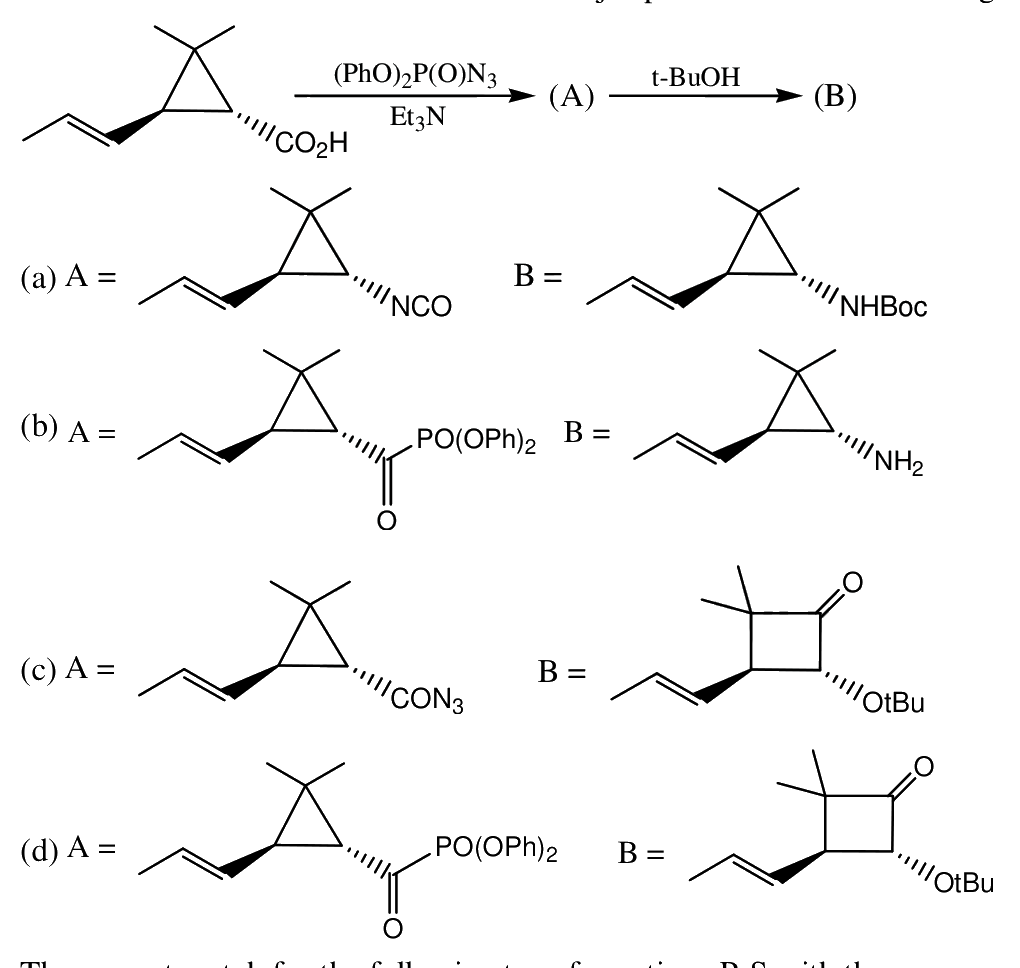
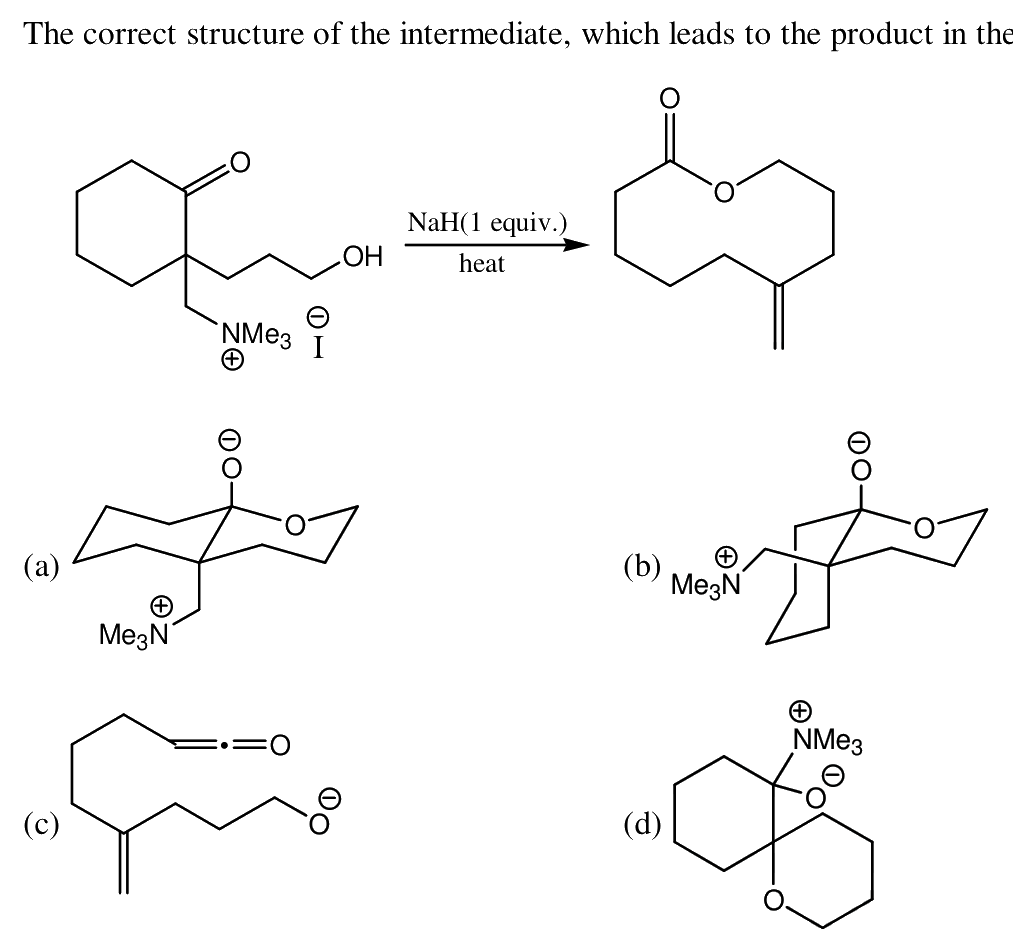
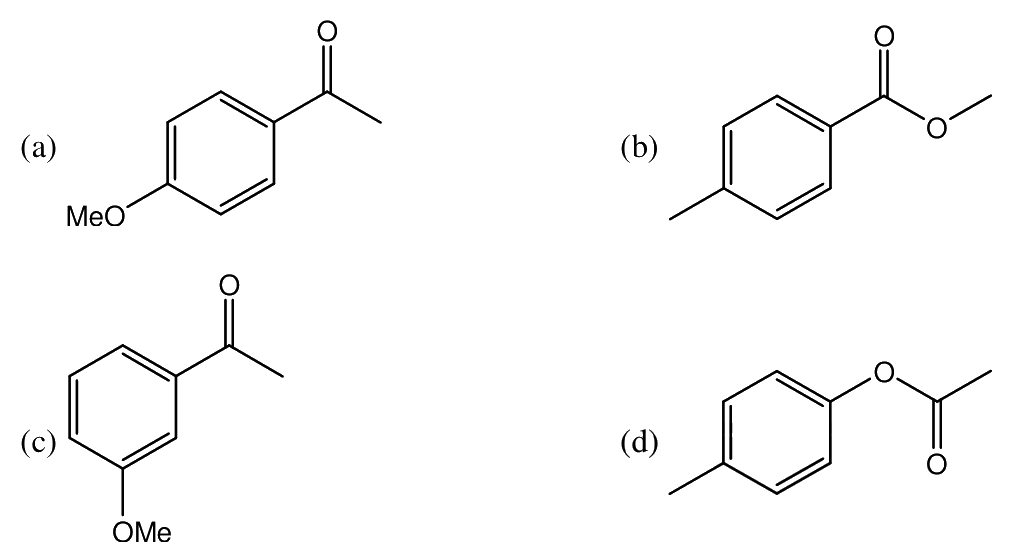
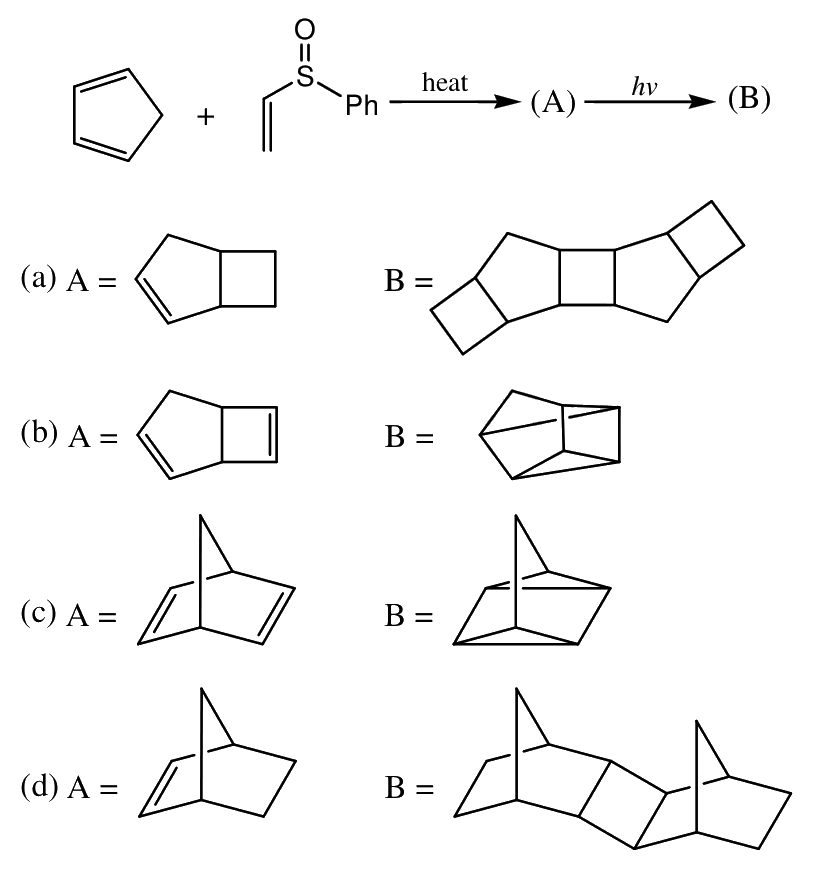
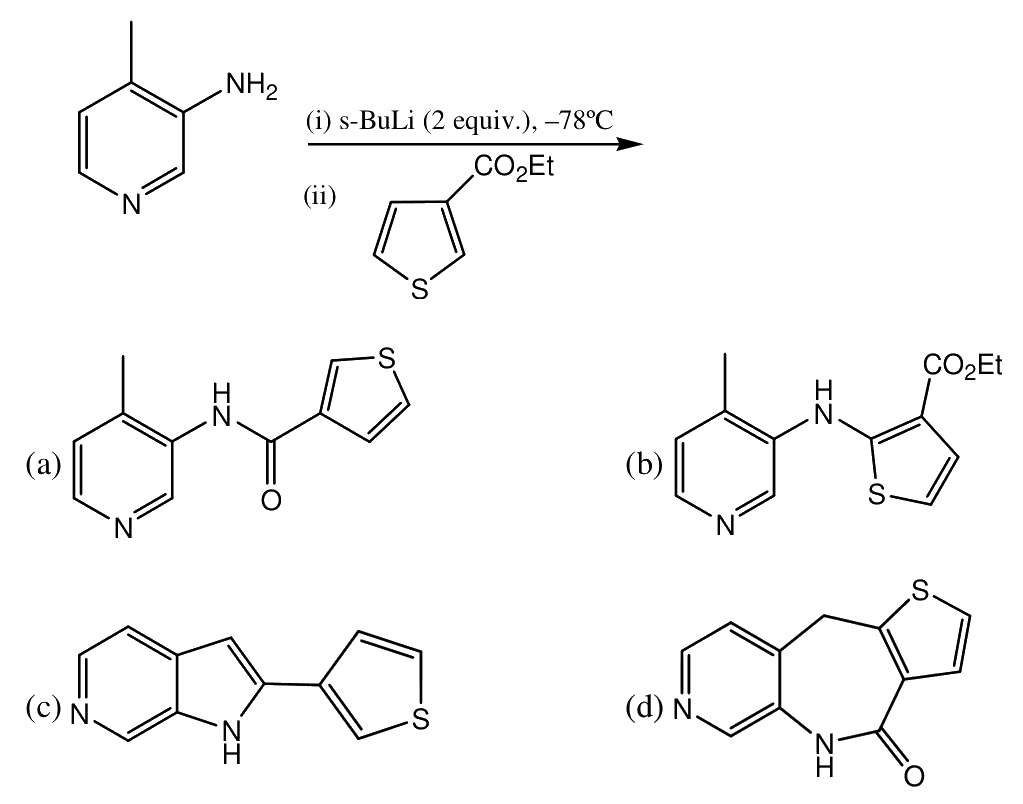
Identify the species, those obey the 18 electron rule, from the following:
a.
A and B
b.
B and C
Correct Answer
c.
C and D
d.
A and D
Step-by-Step AI Explanation
Verified Method
In standard CSIR NET problems involving 18-electron rule verification of four organometallic complexes (typically labelled A, B, C, D), evaluating the valence electron count gives 18 electrons for complexes B and C.
Q22mcq
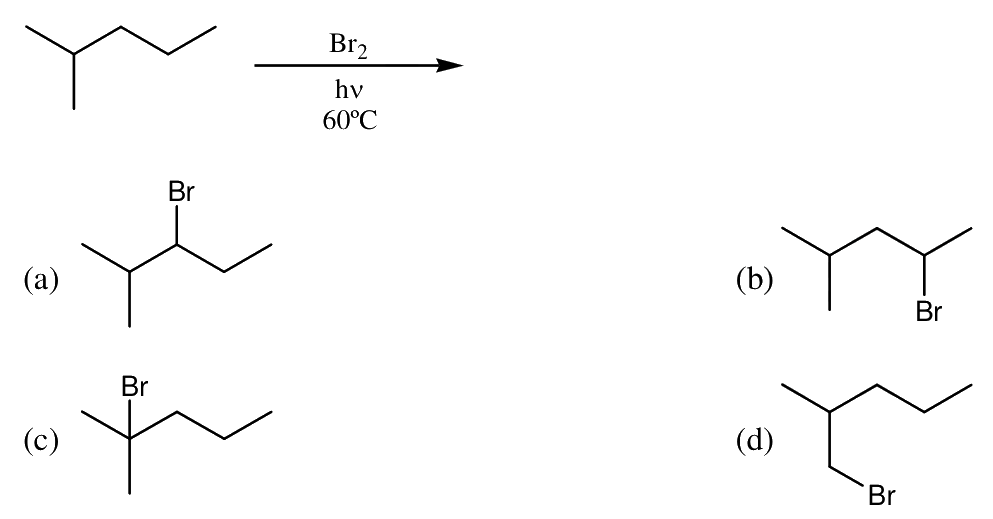
The following transformation is an example of
a.
oxidative addition
b.
insertion
c.
$\beta$-hydride elimination
Correct Answer
d.
reductive elimination
Step-by-Step AI Explanation
Verified Method
The standard organometallic reaction typically featured here converts an alkyl-metal species to a metal-hydride alkene complex via transfer of a hydride from the beta-carbon to the metal center, which is a classic $\beta$-hydride elimination reaction.
Q23mcq
$[\text{Ni}^{\text{II}}\text{L}_6]^{\text{n+ or n-}}$ shows absorption bands at $8500$, $15400$, and $26000\text{ cm}^{-1}$ whereas $[\text{Ni}^{\text{II}}\text{L}'_6]^{\text{n+ or n-}}$, at $10750$, $17500$ and $28200\text{ cm}^{-1}$. $\text{L}$ and $\text{L}'$ are respectively
a.
$\text{OH}^-$ and $\text{N}_3^-$
b.
$\text{Cl}^-$ and $\text{I}^-$
c.
$\text{NCS}^-$ and $\text{RCO}_2^-$
d.
$\text{H}_2\text{O}$ and $\text{NH}_3$
Correct Answer
Step-by-Step AI Explanation
Verified Method
For octahedral $\text{Ni(II)}$ ($d^8$) complexes, the lowest energy band corresponds to $\Delta_o$ ($^3A_{2g} \to {^3T_{2g}}$). For $[\text{NiL}_6]^{n\pm}$, $\Delta_o = 8500\text{ cm}^{-1}$, and for $[\text{NiL}'_6]^{n\pm}$, $\Delta_o = 10750\text{ cm}^{-1}$. According to the spectrochemical series, $\text{NH}_3$ is a stronger field ligand than $\text{H}_2\text{O}$ (typical $\Delta_o$ values for $[\text{Ni}(\text{H}_2\text{O})_6]^{2+}$ and $[\text{Ni}(\text{NH}_3)_6]^{2+}$ are $8500\text{ cm}^{-1}$ and $10750\text{ cm}^{-1}$, respectively). Thus, $\text{L} = \text{H}_2\text{O}$ and $\text{L}' = \text{NH}_3$.
Q24mcq
The number of microstates present in $^3\text{F}$ term is
a.
3
b.
21
Correct Answer
c.
9
d.
28
Step-by-Step AI Explanation
Verified Method
The number of microstates for an atomic term symbol $^{2S+1}L$ is given by $(2S+1)(2L+1)$. For the $^3\text{F}$ term, the spin multiplicity is $(2S+1) = 3$, and for an $\text{F}$ state, the orbital angular momentum quantum number is $L = 3$. Therefore, the total number of microstates is $3 \times (2(3) + 1) = 3 \times 7 = 21$.
Q25mcq
$\text{CpM} \left[\text{Cp is } (\eta^5\text{-C}_5\text{H}_5)\right]$ fragment isolobal with a $\text{BH}$ fragment is
a.
$\text{CpGe}$
b.
$\text{CpMn}$
c.
$\text{CpRu}$
d.
$\text{CpCo}$
Correct Answer
Step-by-Step AI Explanation
Verified Method
A $\text{BH}$ fragment has 3 (from B) + 1 (from H) = 4 valence electrons, which is 4 electrons short of an octet (requires 4 electrons). In transition metal fragments, an isolobal fragment needs $(18 - 4) = 14$ valence electrons. For $\text{CpCo}$: $\text{Co}$ has 9 valence electrons and $\text{Cp}$ donates 5 electrons, giving $9 + 5 = 14$ valence electrons. Thus, $\text{CpCo}$ is isolobal with $\text{BH}$.
Q26mcq
The number of metal-metal bonds in $[\text{Co}_2\text{Fe}_2(\text{CO})_{11}(\mu_4-\text{PPh})_2]$ is
a.
3
b.
4
Correct Answer
c.
5
d.
6
Step-by-Step AI Explanation
Verified Method
To determine the number of metal-metal bonds, calculate the total valence electron count (TEC):
- $2 \times \text{Co} = 2 \times 9 = 18$
- $2 \times \text{Fe} = 2 \times 8 = 16$
- $11 \times \text{CO} = 11 \times 2 = 22$
- $2 \times (\mu_4\text{-PPh}) = 2 \times 4 = 8$
$$\text{TEC} = 18 + 16 + 22 + 8 = 64$$
The total number of metal-metal bonds is given by:
$$\text{M-M bonds} = \frac{(18 \times n) - \text{TEC}}{2} = \frac{(18 \times 4) - 64}{2} = \frac{72 - 64}{2} = 4$$
Q27mcq
Correct combination for $\pi$ and $\pi^*$ orbitals in $\text{B}_2$ molecule is
a.
$\pi$: Gerade, $\pi^*$: Ungerade
b.
$\pi$: Ungerade, $\pi^*$: Gerade
Correct Answer
c.
$\pi$: Gerade, $\pi^*$: Gerade
d.
$\pi$: Ungerade, $\pi^*$: Ungerade
Step-by-Step AI Explanation
Verified Method
In homonuclear diatomic molecules, $\pi$ bonding molecular orbitals formed by side-on overlap of $p$-orbitals change sign upon inversion through the center of symmetry and are therefore ungerade ($u$). In contrast, $\pi^*$ antibonding molecular orbitals retain their sign under inversion and are gerade ($g$). Thus, the combination is $\pi$: Ungerade, $\pi^*$: Gerade.
Q28mcq
The correct shape of $[\text{TeF}_5]^-$ ion on the basis of VSEPR theory is
a.
trigonal bipyramidal
b.
square pyramidal
Correct Answer
c.
pentagonal planar
d.
see-saw
Step-by-Step AI Explanation
Verified Method
For $[\text{TeF}_5]^-$, the central atom is tellurium (group 16, 6 valence electrons). With 1 additional electron from the negative charge, Te has 7 electrons. It forms 5 single bonds with 5 fluorine atoms, leaving $7 - 5 = 2$ non-bonding electrons (1 lone pair). The steric number is $5 + 1 = 6$ (pseudo-octahedral geometry). With five bonding pairs and one lone pair, the molecular geometry (shape) according to VSEPR theory is square pyramidal.
Q29mcq
The numbers of P-S and P-P bonds in the compound $\text{P}_4\text{S}_3$ are, respectively
a.
6 and 3
Correct Answer
b.
4 and 3
c.
3 and 6
d.
6 and 2
Step-by-Step AI Explanation
Verified Method
In $\text{P}_4\text{S}_3$, the structure has a basal triangle of three phosphorus atoms connected to each other by three P-P bonds. The fourth phosphorus atom acts as an apical apex and is connected to each of the three basal phosphorus atoms via bridging sulfur atoms (three P-S-P bridges). Thus, there are $3 \times 2 = 6$ P-S bonds and 3 P-P bonds.
Q30mcq
In the iodometric titration of sodium thiosulfate ($\text{Na}_2\text{S}_2\text{O}_3$) with acidic dichromate solution, 25 mL of 0.1 M dichromate requires 25 mL of 'x' M thiosulfate. The value of 'x' is
a.
0.2
b.
0.1
c.
0.6
Correct Answer
d.
0.4
Step-by-Step AI Explanation
Verified Method
In an acidic medium, dichromate acts as an oxidizing agent: $\text{Cr}_2\text{O}_7^{2-} + 14\text{H}^+ + 6e^- \rightarrow 2\text{Cr}^{3+} + 7\text{H}_2\text{O}$, so its $n$-factor is 6. In iodometric titration, $\text{Cr}_2\text{O}_7^{2-}$ liberates an equivalent amount of $\text{I}_2$ from $\text{I}^-$, which is then titrated with $\text{S}_2\text{O}_3^{2-}$. The reaction is $2\text{S}_2\text{O}_3^{2-} + \text{I}_2 \rightarrow \text{S}_4\text{O}_6^{2-} + 2\text{I}^-$, meaning the $n$-factor for thiosulfate is 1. Equating equivalents: $N_1 V_1 = N_2 V_2 \implies (6 \times M_1) V_1 = (1 \times M_2) V_2$. Given $M_1 = 0.1\text{ M}$, $V_1 = 25\text{ mL}$, and $V_2 = 25\text{ mL}$, we have $6 \times 0.1 \times 25 = x \times 25 \implies x = 0.6\text{ M}$.
🎉 10 Free Sample Solutions Completed
Unlock All 125 Questions & Solutions
Sign up free in seconds to unlock step-by-step AI answers for the remaining 115 questions.
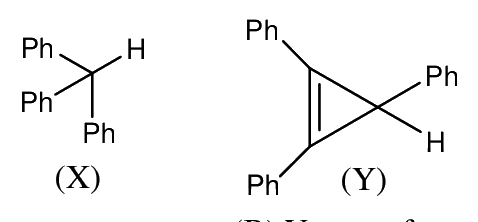
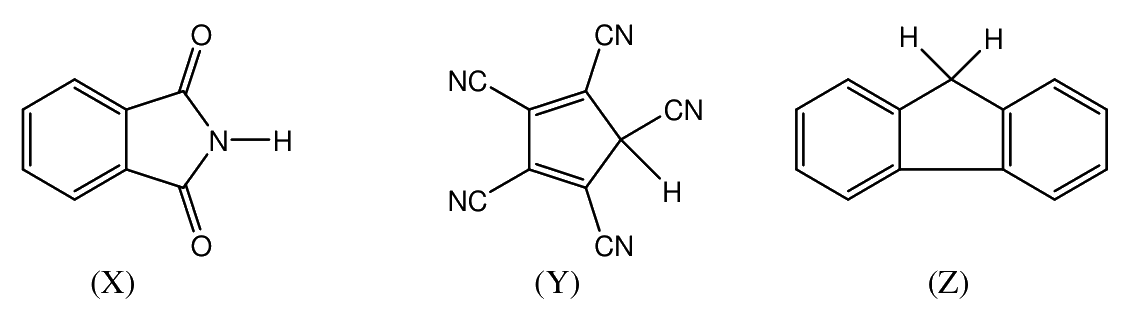
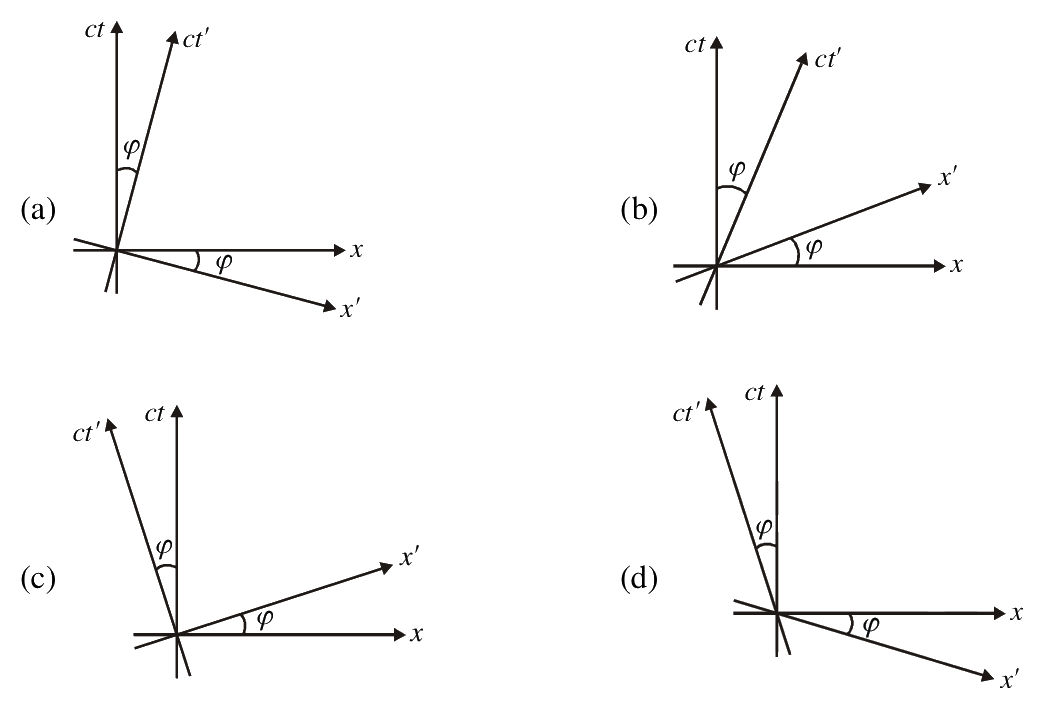
The correct statement are about the reaction of $\text{X}$ and $\text{Y}$ with $\text{NaNH}_2$ are
(A) $\text{X}$ reacts faster than $\text{Y}$
(B) $\text{Y}$ reacts faster than $\text{X}$
(C) $\text{X}$ and $\text{Y}$ behave as Lewis acids
(D) $\text{X}$ is stronger Bronsted acid than $\text{Y}$
a.
A and C
b.
A and D
c.
B and C
d.
B and D
Correct Answer & Step-by-Step Solution Locked
Sign in free to reveal the correct answer and AI explanation for this question.
The correct statements about conformations $\text{X}$ and $\text{Y}$ of 2-butanone are
(A) $\text{X}$ is more stable than $\text{Y}$
(B) $\text{Y}$ is more stable than $\text{X}$
(C) Methyl groups in $\text{X}$ are anti
(D) Methyl groups in $\text{Y}$ are gauche
a.
A and D
b.
A and C
c.
B and C
d.
A, C and D
Correct Answer & Step-by-Step Solution Locked
Sign in free to reveal the correct answer and AI explanation for this question.
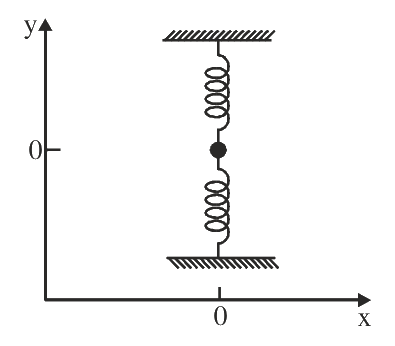
An ideal gas is composed of particles of mass $\text{M}$ in thermal equilibrium at a temperature $\text{T}$ in one container. Another container contains ideal gas particles of mass $2\text{M}$ at a temperature $2\text{T}$. The correct statement about the two gases is
a.
average kinetic energy and average speed will be same in the two cases
b.
both the averages will be doubled in the second case
c.
only the average kinetic energy will be doubled in the second case
d.
only the average speed will be doubled in the second case
Correct Answer & Step-by-Step Solution Locked
Sign in free to reveal the correct answer and AI explanation for this question.
If the rates of a reaction are $\text{R}_1$ and $\text{R}_2$ at concentrations $\text{C}_1$ and $\text{C}_2$ of a reactant respectively, the order of reaction, 'n' (assuming that the concentrations of all other reactants and $\text{T}$ remain constant) with respect to that reactant is given by
Experimentally determined rate law for the chemical reaction,
$$2\text{NO}_2\text{F} \rightarrow 2\text{NO}_2 + \text{F}_2 \text{ is } \text{R} = \text{k}[\text{NO}_2\text{F}]$$
The rate determining step consistent with the rate law is
The eigenfunctions of the Hamiltonian $\text{H}$ ($\text{H} = \text{T} + \text{V}$) of a harmonic oscillator are (where $\text{T}$ and $\text{V}$ are kinetic energy and potential energy operators, respectively)
a.
eigenfunctions of $\text{T}$ as well as $\text{V}$
b.
eigenfunctions of $\text{T}$, but not of $\text{V}$
c.
eigenfunctions of $\text{V}$, but not of $\text{T}$
d.
eigenfunctions of neither $\text{T}$ nor $\text{V}$
Correct Answer & Step-by-Step Solution Locked
Sign in free to reveal the correct answer and AI explanation for this question.
In a potentiometric titration, the end point is characterised by
where $\text{E}$ is the emf of the titration cell and $\text{V}$ is the volume of the titrant added
a.
$\frac{dE}{dV} = 0, \frac{d^2E}{dV^2} = 0$
b.
$\frac{dE}{dV} \neq 0, \frac{d^2E}{dV^2} = 0$
c.
$\frac{dE}{dV} = 0, \frac{d^2E}{dV^2} \neq 0$
d.
$\frac{dE}{dV} \neq 0, \frac{d^2E}{dV^2} \neq 0$
Correct Answer & Step-by-Step Solution Locked
Sign in free to reveal the correct answer and AI explanation for this question.
On titrating conductometrically a $\mathrm{NaOH}$ solution with a mixture of $\mathrm{HCl}$ and $\mathrm{CH_3CO_2H}$ solutions, plot of the volume of mixed acid added (b) in y-axis against the conductance (a) in x-axis is expected to look like
Correct Answer & Step-by-Step Solution Locked
Sign in free to reveal the correct answer and AI explanation for this question.
In a titration, the percentage uncertainties in the measured aliquot volume and the measured titre volume are $\pm x$ and $\pm y$ respectively. The percentage error in the calculated concentration of aliquot is
a.
$x + y$
b.
$xy$
c.
$(xy)^{1/2}$
d.
$\left(x^2 + y^2\right)^{1/2}$
Correct Answer & Step-by-Step Solution Locked
Sign in free to reveal the correct answer and AI explanation for this question.
Match the metal given in Column-A with its medicinal use as a compound in Column-B
\begin{tabular}{ll}
\textbf{Column-A} & \textbf{Column-B} \\
(A) Gd & (I) Cancer \\
(B) Au & (II) Maniac depression \\
(C) Pt & (III) MRI contrast agent \\
(D) Li & (IV) Arthritis \\
\end{tabular}
Correct match is
a.
A-II; B-III; C-IV; D-I
b.
A-IV; B-II; C-I, D-III
c.
A-III; B-IV; C-I; D-II
d.
A-I; B-II; C-III; D-IV
Correct Answer & Step-by-Step Solution Locked
Sign in free to reveal the correct answer and AI explanation for this question.
Consider the following reactions:
(A) $\text{NOCl} + \text{Sn} \xrightarrow{\text{N}_2\text{O}_4}$
(B) $\text{NOCl} + \text{AgNO}_3 \longrightarrow$
(C) $\text{NOCl} + \text{BrF}_3 \longrightarrow$
(D) $\text{NOCl} + \text{SbCl}_5 \longrightarrow$
Reactions which will give $[\text{NO}]^+$ as a major product are:
a.
A and B
b.
C and D
c.
A and C
d.
B and D
Correct Answer & Step-by-Step Solution Locked
Sign in free to reveal the correct answer and AI explanation for this question.
Correct order of M-C bond length of metallocenes (a-c)
(A) $\left[\text{Fe}\left(\eta^5-\text{Cp}\right)_2\right]$
(B) $\left[\text{Ni}\left(\eta^5-\text{Cp}\right)_2\right]$
(C) $\left[\text{Co}\left(\eta^5-\text{Cp}\right)_2\right]$ is
a.
$\text{A} > \text{B} > \text{C}$
b.
$\text{B} > \text{C} > \text{A}$
c.
$\text{C} > \text{B} > \text{A}$
d.
$\text{A} > \text{C} > \text{B}$
Correct Answer & Step-by-Step Solution Locked
Sign in free to reveal the correct answer and AI explanation for this question.
A $100\text{ mL}$ solution of $2.5\times 10^{-3}\text{ M}$ in $\text{Bi(III)}$ and $\text{Cu(II)}$ each, is photometrically titrated at $745\text{ nm}$ with $0.1\text{ M}$ EDTA solution. Identify correct statements for this titration
(A) Total volume of EDTA solution used in $5\text{ mL}$
(B) $3\text{ mL}$ of EDTA is required to complex $\text{Bi(III)}$ and $2\text{ mL}$ for $\text{Cu(II)}$
(C) $2.5\text{ mL}$ of EDTA is used for each metal ion
(D) First break in titration curve is for $\text{Cu(II)}$
Correct statements are
a.
A and B
b.
A and C
c.
A, B and C
d.
B, C and D
Correct Answer & Step-by-Step Solution Locked
Sign in free to reveal the correct answer and AI explanation for this question.
On continuous exposure of $^{10}\text{B}$ sample to a slow neutron flux of $10^{16}\text{ m}^2\text{s}^{-1}$, its $3\%$ weight fraction disappears in $3\times 10^7\text{ s}$. Cross section for neutron capture (in barns) by $^{10}\text{B}$ is
a.
$1000$
b.
$3000$
c.
$10,000$
d.
$30,000$
Correct Answer & Step-by-Step Solution Locked
Sign in free to reveal the correct answer and AI explanation for this question.
The $^1\text{H}$ NMR spectrum of $\left[\text{Ru}\left(\eta^4-\text{C}_8\text{H}_8\right)(\text{CO})_3\right]$ at $23^\circ\text{C}$ consists of a sharp single line. The number of signals observed at low temperature ($-140^\circ\text{C}$) in its spectrum is
a.
$8$
b.
$6$
c.
$4$
d.
$2$
Correct Answer & Step-by-Step Solution Locked
Sign in free to reveal the correct answer and AI explanation for this question.
The room temperature magnetic moment ($\mu_{\text{eff}}$ in BM) for a monomeric $\text{Cu(II)}$ complex is greater than $1.73$. This may be explained using the expression:
The numbers of skeletal electrons present in the compounds $\text{C}_2\text{B}_3\text{H}_5$, $\text{C}_2\text{B}_4\text{H}_6$ and $\text{B}_5\text{H}_9$ are, respectively
a.
$10$, $12$ and $12$
b.
$12$, $14$ and $14$
c.
$10$, $12$ and $14$
d.
$12$, $14$ and $12$
Correct Answer & Step-by-Step Solution Locked
Sign in free to reveal the correct answer and AI explanation for this question.
Identify correct statements for the EPR spectrum of $\text{VO}(\text{acac})_2$ [with square pyramidal geometry at vanadium] at $77\text{K}$ [$\text{I}(^{51}\text{V}) = 7/2$].
(A) It has two g values
(B) It has 8 lines only
(C) It has one g value
(D) It has two patterns of 8 lines each.
a.
A and D
b.
A and C
c.
B and C
d.
B and D
Correct Answer & Step-by-Step Solution Locked
Sign in free to reveal the correct answer and AI explanation for this question.
The numbers of lines shown by the $\mathrm{BH}_3$ part of the molecule $\mathrm{Ph}_3\mathrm{P}\cdot {}^{11}\mathrm{BH}_3$ in the ${}^1\mathrm{H}$ and ${}^{11}\mathrm{B}$ NMR spectra are, respectively [$I({}^{11}\mathrm{B}) = 3/2$; $I({}^{31}\mathrm{P}) = 1/2$]
a.
8 and 8
b.
4 and 8
c.
3 and 6
d.
6 and 3
Correct Answer & Step-by-Step Solution Locked
Sign in free to reveal the correct answer and AI explanation for this question.
To record Mössbauer spectrum of $\mathrm{Fe}$ containing samples, a source 'X' is used. X after a nuclear transformation (Y), gives $\gamma$-radiation used in Mössbauer spectroscopy.
a.
${}^{57}\mathrm{Fe}$, $\beta$-emission
b.
${}^{57}\mathrm{Co}$, $\beta$-emission
c.
${}^{57}\mathrm{Co}$, electron capture
d.
${}^{57}\mathrm{Fe}$, electron capture
Correct Answer & Step-by-Step Solution Locked
Sign in free to reveal the correct answer and AI explanation for this question.
In the following reaction sequence
$$\mathrm{HNEt}_2 + \mathrm{CS}_2 \xrightarrow{\mathrm{KOH}} \mathrm{P} \xrightarrow[\mathrm{I}_2]{\text{aq. soln}} \mathrm{R} \xrightarrow{[\mathrm{CpMo(CO)}_3]_2} \mathrm{S}$$
where dtc = dithiocarbamate and tds = thiuramdisulfide.
Identify P, R and S. $\mathrm{Cp} = \eta^5-\mathrm{C}_5\mathrm{H}_5$
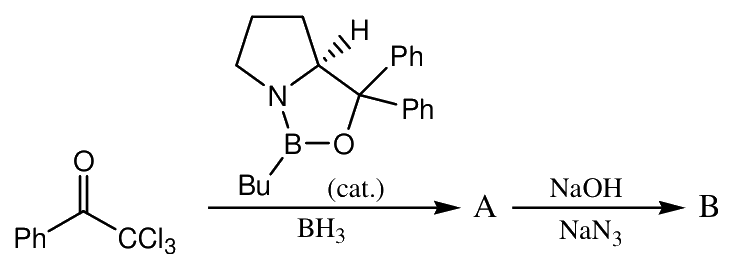
Reaction of $\text{Cr(CO)}_6$ with $\text{LiC}_6\text{H}_5$ gives A which reacts with $[\text{Me}_3\text{O}][\text{BF}_4]$ to give B. The structures of A and B respectively, are
Correct Answer & Step-by-Step Solution Locked
Sign in free to reveal the correct answer and AI explanation for this question.
Heating a sample of $\left[\left(\eta^5-\text{C}_5\text{H}_5\right)\text{Mo(CO)}_3\right]_2$ results in the formation of $\left[\left(\eta^5-\text{C}_5\text{H}_5\right)\text{Mo(CO)}_2\right]_2$ with elimination of 2 equivalents of $\text{CO}$. The Mo-Mo bond order in this reaction changes from
a.
2 to 3
b.
1 to 2
c.
1 to 3
d.
2 to 4
Correct Answer & Step-by-Step Solution Locked
Sign in free to reveal the correct answer and AI explanation for this question.
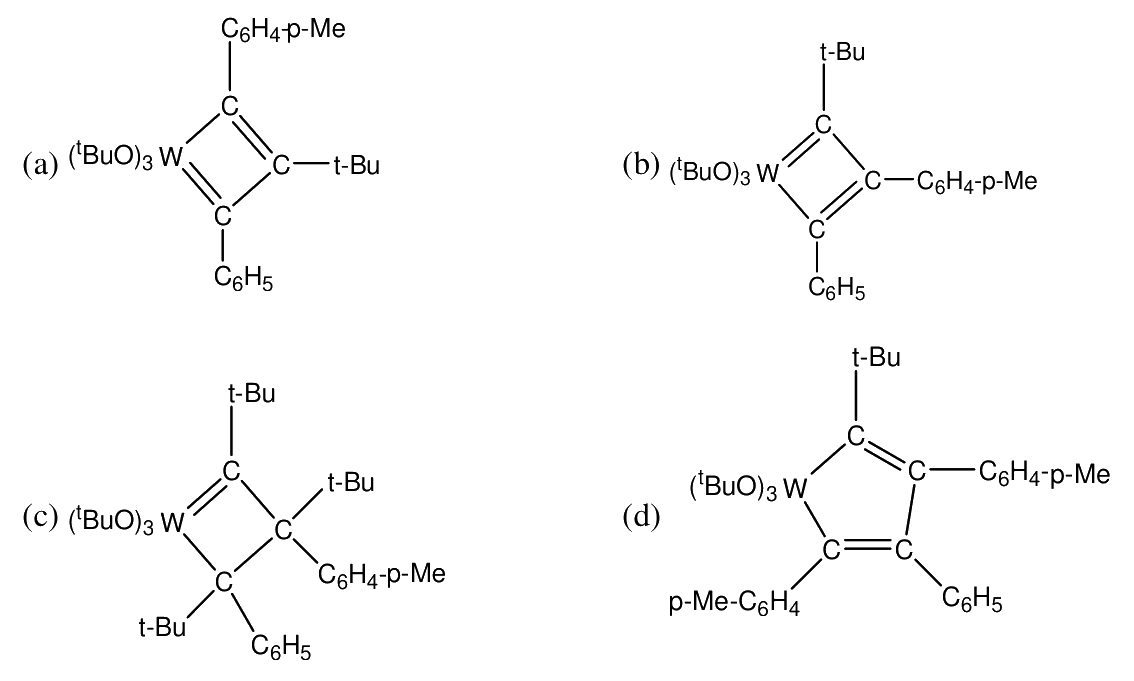
A plausible intermediate involved in the self metathesis reaction of $\text{C}_6\text{H}_5-\text{C}\equiv\text{C}-\text{C}_6\text{H}_4-p-\text{Me}$ catalyzed by $\left[(\text{}^t\text{BuO})_3\text{W}\equiv\text{C}-\text{}^t\text{Bu}\right]$ is
Correct Answer & Step-by-Step Solution Locked
Sign in free to reveal the correct answer and AI explanation for this question.
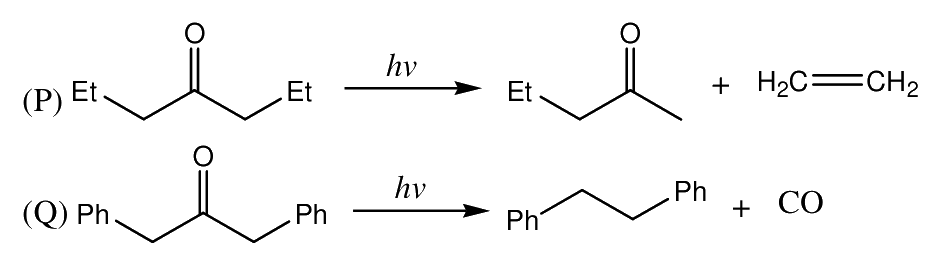
The correct match for the following transformations P-S with the processes I-IV is
Reactions:
(P) $\text{Et}\text{—}\text{CH}_2\text{—}\text{CO}\text{—}\text{CH}_2\text{—}\text{Et} \xrightarrow{h\nu} \text{Et}\text{—}\text{CO}\text{—}\text{CH}_3 + \text{H}_2\text{C}=\text{CH}_2$
(Q) $\text{Ph}\text{—}\text{CH}_2\text{—}\text{CO}\text{—}\text{CH}_2\text{—}\text{Ph} \xrightarrow{h\nu} \text{Ph}\text{—}\text{CH}_2\text{—}\text{CH}_2\text{—}\text{Ph} + \text{CO}$ Processes:
(I) Diels-Alder
(II) Norrish Type-I
(III) Photocycloaddition followed by Diels-Alder
(IV) Norrish Type-II
a.
P-II; Q-IV; R-III; S-I
b.
P-II; Q-IV; R-I; S-II
c.
P-IV; Q-II; R-III; S-I
d.
P-IV; Q-II; R-I; S-III
Correct Answer & Step-by-Step Solution Locked
Sign in free to reveal the correct answer and AI explanation for this question.
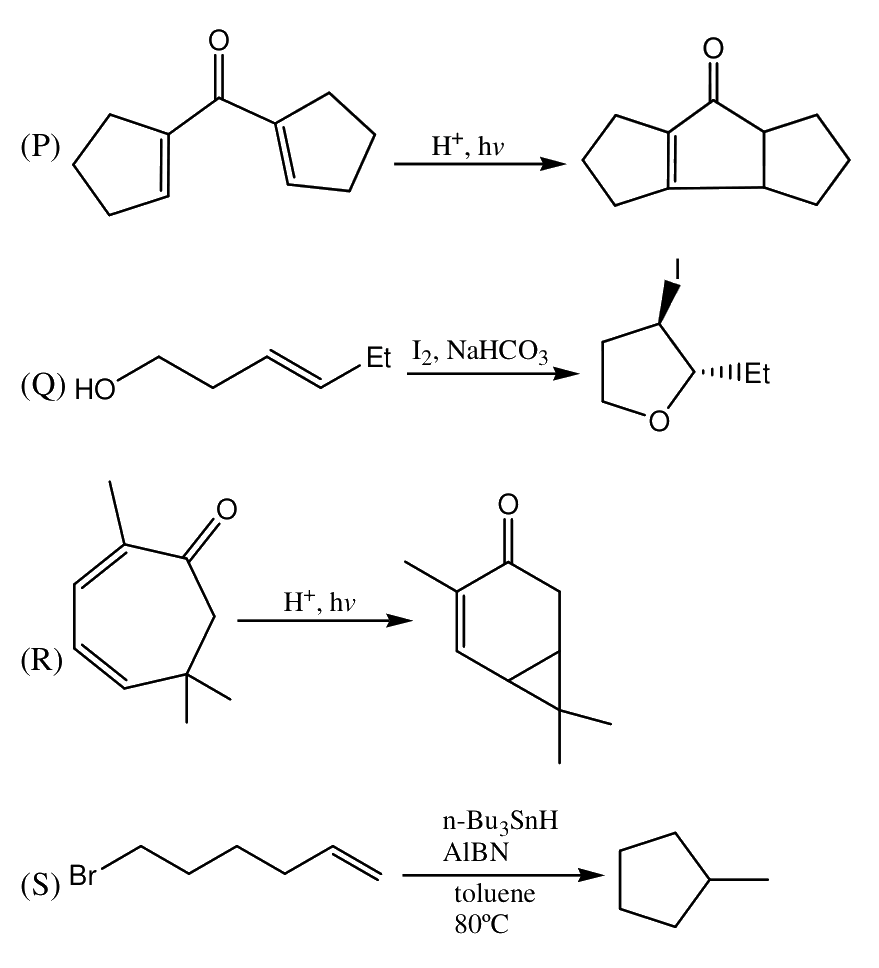
The correct match for the reactions P-S with the names of cyclizations I-IV is
Reactions: Name of Cyclizations:
(I) halocyclization
(II) Nazarov cyclization
(III) radical cyclization
(IV) electrocyclization
a.
P-IV; Q-I; R-II, S-II
b.
P-II; Q-I; R-IV; S-III
c.
P-IV; Q-II; R-III; S-I
d.
P-II; Q-I; R-III; S-IV
Correct Answer & Step-by-Step Solution Locked
Sign in free to reveal the correct answer and AI explanation for this question.
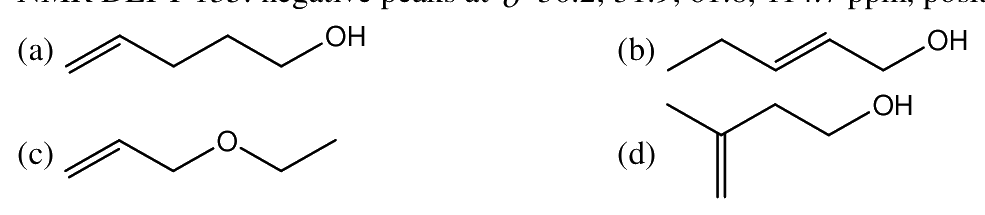
The correct structure of the compound, which shows following $^{13}\text{C}$ NMR DEPT-135 data is $^{13}\text{C}$ NMR DEPT-135: negative peaks at $\delta$ 30.2, 31.9, 61.8, 114.7 ppm; positive peak at 130.4 ppm
Correct Answer & Step-by-Step Solution Locked
Sign in free to reveal the correct answer and AI explanation for this question.
The single-particle translational partition function (f) for an ideal gas in a fixed volume $\mathrm{V}$ depends on the thermal de-Broglie wavelength $\lambda_{\mathrm{th}}$ as $\mathrm{f} \sim\left(\lambda_{\mathrm{th}}\right)^{\mathrm{n}}$ where
a.
$\mathrm{n}=3$
b.
$\mathrm{n}=1$
c.
$\mathrm{n}=-1$
d.
$\mathrm{n}=-3$
Correct Answer & Step-by-Step Solution Locked
Sign in free to reveal the correct answer and AI explanation for this question.
In an NMR spectrometer containing a $2.5\text{T}$ magnet, Larmor precession frequency of $^{1}\text{H}$ is $100\text{ MHz}$. The radiofrequency used in this spectrometer has an associated magnetic field strength of $2.5 \times 10^{-4}\text{T}$. The duration of a $90^\circ$ pulse in this instrument is
a.
$25 \times 10^{-6}\text{ s}$
b.
$50 \times 10^{-6}\text{ s}$
c.
$25 \times 10^{-5}\text{ s}$
d.
$50 \times 10^{-5}\text{ s}$
Correct Answer & Step-by-Step Solution Locked
Sign in free to reveal the correct answer and AI explanation for this question.
Upon application of a weak magnetic field, a line in the microwave absorption spectrum of rigid rotor splits into 3 lines. The quantum number $(\text{J})$ of the rotational energy level from which the transition originates is
a.
0
b.
1
c.
2
d.
3
Correct Answer & Step-by-Step Solution Locked
Sign in free to reveal the correct answer and AI explanation for this question.
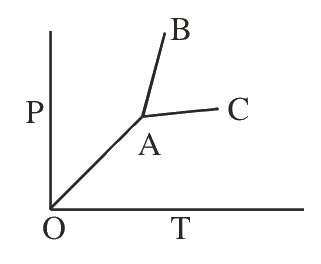
Phase diagram of a compound is shown below
The slopes of the lines OA, AC and AB are $\tan \frac{\pi}{4}$, $\tan \frac{\pi}{6}$ and $\tan \frac{\pi}{3}$, respectively. If melting point and $\Delta\text{H}$ of melting are $300\text{ K}$ and $3\text{ kJ mole}^{-1}$ respectively, the change in the volume on melting is
a.
$10\tan \frac{\pi}{3}$
b.
$10\tan \frac{\pi}{4}$
c.
$10\cot \frac{\pi}{3}$
d.
$10\cot \frac{\pi}{4}$
Correct Answer & Step-by-Step Solution Locked
Sign in free to reveal the correct answer and AI explanation for this question.
For a particle of mass $m$ confined in a rectangular box with sides $2a$ and $a$, the energy and degeneracy of the first excited state, respectively, are
The ionization energy of hydrogen atom in its ground state is approximately $13.6\text{ eV}$. The potential energy of $\text{He}^+$, in its ground state is approximately
a.
$-54.4\text{ eV}$
b.
$-27.2\text{ eV}$
c.
$-13.6\text{ eV}$
d.
$-108.8\text{ eV}$
Correct Answer & Step-by-Step Solution Locked
Sign in free to reveal the correct answer and AI explanation for this question.
Suppose $\psi_1, \psi_2, \psi_3......$ are wavefunctions of an anharmonic oscillator and $\phi_0, \phi_1, \phi_2,.......$ are wavefunctions of a harmonic oscillator with increasing order of energy. The subscripts denote vibrational quantum numbers in both the cases. Given
$$\psi_0 = a_1\phi_0 + a_2\phi_2 + a_3\phi_4$$
$$\psi_1 = b_1\phi_0 + b_2\phi_4 + b_3\phi_6$$
$$\psi_2 = c_1\phi_1 + c_2\phi_4$$
$$\psi_3 = d_1\phi_3 + d_2\phi_5$$
the FORBIDDEN electric dipole (assuming the dipole operator is linear in normal coordinates) transition among the following is
a.
$\psi_0 \rightarrow \psi_1$
b.
$\psi_0 \rightarrow \psi_2$
c.
$\psi_0 \rightarrow \psi_3$
d.
$\psi_1 \rightarrow \psi_2$
Correct Answer & Step-by-Step Solution Locked
Sign in free to reveal the correct answer and AI explanation for this question.
If $\text{U}$ is a function of $\text{V}$ and $\text{T}$, $\left(\frac{\partial\text{U}}{\partial\text{T}}\right)_\text{P}$ is equal to ($\pi$ and $\alpha$ are the internal pressure and the coefficient of thermal expansion, respectively)
a.
$\text{C}_\text{p}$
b.
$\text{C}_\text{v}$
c.
$\text{C}_\text{p} - \pi\text{V}\alpha$
d.
$\text{C}_\text{p} + \pi\text{V}\alpha$
Correct Answer & Step-by-Step Solution Locked
Sign in free to reveal the correct answer and AI explanation for this question.
For the chemical reaction in aqueous solution,
$$\text{CH}_2\text{ClCOO}^- + \text{OH}^- \longrightarrow \text{CH}_2\text{OHCOO}^- + \text{Cl}^-$$
the correct statement is
a.
increase of pressure increases the rate constant
b.
increase of dielectric constant increases the rate constant
c.
increase of ionic strength decreases the rate constant
d.
the entropy of activation is positive
Correct Answer & Step-by-Step Solution Locked
Sign in free to reveal the correct answer and AI explanation for this question.
If experimentally observed rate constant is greater than the maximum value of rate constant obtained using hard-sphere model of collision theory, then relation between the impact parameter (b) and sum of the radii of two reactants is
a.
$\text{b} = \text{r}_1 + \text{r}_2$
b.
$\text{b} < \text{r}_1 + \text{r}_2$
c.
$\text{b} > \text{r}_1 + \text{r}_2$
d.
$\text{b} \le \text{r}_1 + \text{r}_2$
Correct Answer & Step-by-Step Solution Locked
Sign in free to reveal the correct answer and AI explanation for this question.
Half-life $t_{1/2}$ for a third order rection $3\text{C} \rightarrow \text{products}$, where $\text{C}_0$ is the initial concentration of $\text{C}$, will be
a.
$\frac{3}{2\text{k}\text{C}_0^2}$
b.
$\frac{3}{\text{k}\text{C}_0}$
c.
$\frac{3}{2\text{k}\text{C}_0}$
d.
$\frac{2}{3\text{k}\text{C}_0^2}$
Correct Answer & Step-by-Step Solution Locked
Sign in free to reveal the correct answer and AI explanation for this question.
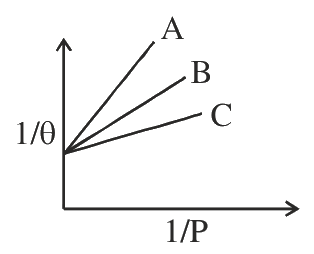
Adsorption isotherm of three gases A, B and C are shown in the following figure, where $\theta$ is the percentage of surface coverage
The correct order of the extent of adsorption of these gases is
a.
$\text{A} > \text{B} > \text{C}$
b.
$\text{B} > \text{A} > \text{C}$
c.
$\text{C} > \text{A} > \text{B}$
d.
$\text{C} > \text{B} > \text{A}$
Correct Answer & Step-by-Step Solution Locked
Sign in free to reveal the correct answer and AI explanation for this question.
Choosing some Hamiltonian $\text{H}$ and an orthonormal basis, a linear variation is carried out to get approximately energies $\bar{\text{E}}_{\text{j}}$. With 2 basis functions, one obtains $\bar{\text{E}}_1(2) \le \bar{\text{E}}_2(2)$. Taking 3 basis functions, similarly three ordered energies $\bar{\text{E}}_1(3) \le \bar{\text{E}}_2(3) \le \bar{\text{E}}_3(3)$ are found. The relation which holds from the following is?
For a hermitian operator $\text{A}$, which does NOT commute with the Hamiltonian $\text{H}$, let $\psi_1$ be an eigenfunction of $\text{A}$ and $\psi_2$ be an eigenfunction of $\text{H}$. The correct statement regarding the average value of the commutator of $\text{A}$ with $\text{H} ([\text{A}, \text{H}])$ is
a.
both $\langle \psi_1 | [\text{A}, \text{H}] | \psi_1 \rangle$ and $\langle \psi_2 | [\text{A}, \text{H}] | \psi_2 \rangle$ are non-zero
b.
only $\langle \psi_1 | [\text{A}, \text{H}] | \psi_1 \rangle$ is zero, but $\langle \psi_2 | [\text{A}, \text{H}] | \psi_2 \rangle$ is non-zero
c.
only $\langle \psi_2 | [\text{A}, \text{H}] | \psi_2 \rangle$ is zero, but $\langle \psi_1 | [\text{A}, \text{H}] | \psi_1 \rangle$ is non-zero
d.
both $\langle \psi_1 | [\text{A}, \text{H}] | \psi_1 \rangle$ and $\langle \psi_2 | [\text{A}, \text{H}] | \psi_2 \rangle$ are zero
Correct Answer & Step-by-Step Solution Locked
Sign in free to reveal the correct answer and AI explanation for this question.
The condensation of a hydroxy acid produces a polyster with the probability of linkage at both ends being $p$. The mole fraction of $k$-mer chain formation is
a.
$p^k$
b.
$p(1-p)^{k-1}$
c.
$p^{k-1}(1-p)$
d.
$p^{k-1}$
Correct Answer & Step-by-Step Solution Locked
Sign in free to reveal the correct answer and AI explanation for this question.
In simple molecular orbital theory of hydrogen molecule, bonding $\sigma_{\mathrm{g}}$ and anti-bonding $\sigma_{\mathrm{u}}$ molecular orbitals are constructed as linear combinations of atomic orbitals of two hydrogen atoms. The spatial part of a purely covalent singlet wavefunction is obtained by
Two aqueous 1:1 electrolyte systems A and B are at different temperatures $\mathrm{T_A}$ and $\mathrm{T_B}$ and $\mathrm{C_A}$ and $\mathrm{C_B}$ concentrations, respectively. Their Debye lengths will be equal if
a.
$\mathrm{T_A} = 2\mathrm{T_B}$ and $\mathrm{C_A} = 2\mathrm{C_B}$
b.
$\mathrm{T_A} = 2\mathrm{T_B}$ and $\mathrm{C_A} = \mathrm{C_B} / 2$
c.
$\mathrm{T_A} = \sqrt{2}\mathrm{T_B}$ and $\mathrm{C_A} = 2\mathrm{C_B}$
d.
$\mathrm{T_A} = 2\mathrm{T_B}$ and $\mathrm{C_A} = \sqrt{2}\mathrm{C_B}$
Correct Answer & Step-by-Step Solution Locked
Sign in free to reveal the correct answer and AI explanation for this question.
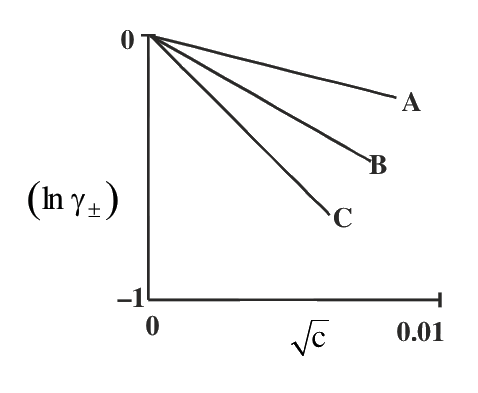
Aqueous solutions of $\mathrm{NaCl}$, $\mathrm{CaCl_2}$ and $\mathrm{LaCl_3}$ show the following plots of logarithms of mean ionic activity coefficient $(\ln \gamma_{\pm})$ vs molar concentration ($c$)
The correct option is then
a.
$\mathrm{NaCl}$: C, $\mathrm{CaCl_2}$: B, $\mathrm{LaCl_3}$: A
b.
$\mathrm{NaCl}$: A, $\mathrm{CaCl_2}$: B, $\mathrm{LaCl_3}$: C
c.
$\mathrm{NaCl}$: A, $\mathrm{CaCl_2}$: C, $\mathrm{LaCl_3}$: B
d.
$\mathrm{NaCl}$: C, $\mathrm{CaCl_2}$: A, $\mathrm{LaCl_3}$: B
Correct Answer & Step-by-Step Solution Locked
Sign in free to reveal the correct answer and AI explanation for this question.