The biological functions of carbonic anhydrase and carboxypeptidase A, respectively, are
a.
interconversion of $\text{CO}_2$ and carbonates, and hydrolysis of peptide bond
b.
gene regulation and interconversion of $\text{CO}_2$ and carbonates
c.
gene regulation and hydrolysis of peptide bond
d.
interconversion of $\text{CO}_2$ and carbonates and gene regulation
Step-by-Step AI Explanation
Verified Method
Carbonic anhydrase is a zinc metalloenzyme that catalyzes the reversible interconversion of carbon dioxide and water to bicarbonate/carbonates. Carboxypeptidase A is also a zinc-containing metalloenzyme that functions as an exopeptidase, hydrolyzing the peptide bond at the C-terminal end of proteins/peptides.
Q22mcq
The $\text{Fe–N}_{\text{porphyrin}}$ bond distances in the deoxy and oxy-hemoglobin, respectively, are
a.
$\sim 2.1\text{ and } 2.0\text{ \AA}$
b.
$\sim 2.0\text{ and } 2.0\text{ \AA}$
c.
$\sim 2.2\text{ and } 2.3\text{ \AA}$
d.
$\sim 2.3\text{ and } 2.5\text{ \AA}$
Step-by-Step AI Explanation
Verified Method
In deoxyhemoglobin, the iron center is in a high-spin $\text{Fe(II)}$ state ($t_{2g}^4 e_g^2$), where electrons occupy the antibonding $e_g$ orbitals ($\,d_{x^2-y^2}\,$, $d_{z^2}$). This makes the iron ion too large to fit in the porphyrin cavity, resulting in longer $\text{Fe-N}_{\text{porphyrin}}$ distances of approximately $2.1\text{ \AA}$ (iron displaced out of plane). In oxyhemoglobin, oxygen binds to form a low-spin species where the iron atom shrinks and slips into the plane of the porphyrin ring, shortening the $\text{Fe-N}_{\text{porphyrin}}$ distance to about $2.0\text{ \AA}$.
Q23mcq
The binding modes of $\text{NO}$ in 18 electron compounds $[\text{Co(CO)}_3(\text{NO})]$ and $[\text{Ni}(\eta^5\text{-Cp}) (\text{NO})]$, respectively, are
a.
linear and bent
b.
bent and linear
c.
linear and linear
d.
bent and bent
Step-by-Step AI Explanation
Verified Method
Both complexes obey the 18-electron rule:
1. For $[\text{Co(CO)}_3(\text{NO})]$: Cobalt has 9 valence electrons, three $\text{CO}$ ligands contribute $3 \times 2 = 6$ electrons. For the total to be 18 electrons, the nitrosyl ($\text{NO}$) ligand must contribute 3 electrons, which corresponds to a linear binding mode ($\text{NO}^+$).
2. For $[\text{Ni}(\eta^5\text{-Cp})(\text{NO})]$: Nickel has 10 valence electrons, $\eta^5\text{-Cp}$ donates 5 electrons. To achieve an 18-electron count, the $\text{NO}$ group must donate 3 electrons ($10 + 5 + 3 = 18$), which is also the linear binding mode.
Therefore, both complexes have linear $\text{NO}$ coordination.
Q24mcq
The role of copper salt as co-catalyst in Wacker process is
a.
oxidation of $\text{Pd(0)}$ by $\text{Cu(II)}$
b.
oxidation of $\text{Pd(0)}$ by $\text{Cu(I)}$
c.
oxidation of $\text{Pd(II)}$ by $\text{Cu(I)}$
d.
oxidation of $\text{Pd(II)}$ by $\text{Cu(II)}$
Step-by-Step AI Explanation
Verified Method
In the catalytic cycle of the Wacker process, $\text{Pd(II)}$ oxidizes ethylene to acetaldehyde and is reduced to $\text{Pd(0)}$. The role of $\text{Cu(II)}$ (as $\text{CuCl}_2$) is to reoxidize $\text{Pd(0)}$ back to $\text{Pd(II)}$, itself being reduced to $\text{Cu(I)}$:
$$\text{Pd}(0) + 2\text{Cu(II)} \rightarrow \text{Pd(II)} + 2\text{Cu(I)}$$
Then, oxygen reoxidizes $\text{Cu(I)}$ back to $\text{Cu(II)}$.
Q25mcq
For typical Fischer and Schrock carbenes, consider the following statements
A. Oxidation state of metal is low in Fischer carbene and high in Schrock carbene
B. Auxilliary ligands are $\pi$-acceptor in Fischer carbene and non-$\pi$-acceptor in Schrock carbene
C. Substituents on carbene carbon are non-$\pi$-donor in Fischer carbene and $\pi$-donor in Schrock carbene
D. Carbene carbon is electrophilic in Fischer carbene and nucleophilic in Schrock carbene
The correct statements are
a.
A, B and C
b.
A, B and D
c.
B, C and D
d.
A, C and D
Step-by-Step AI Explanation
Verified Method
Let us evaluate the statements:
- **A is correct**: Fischer carbenes typically have middle-to-late transition metals in low oxidation states, whereas Schrock carbenes feature early transition metals in high oxidation states.
- **B is correct**: Fischer carbenes typically have strong $\pi$-acceptor ancillary ligands (such as $\text{CO}$), while Schrock carbenes possess non-$\pi$-acceptor ligands (e.g., alkyls, $\text{Cp}$, halides).
- **C is incorrect**: Carbene carbon substituents in Fischer carbenes possess $\pi$-donor heteroatom substituents (like $-\text{OMe}$, $-\text{NR}_2$), while in Schrock carbenes, the substituents are non-$\pi$-donors (such as $\text{H}$ or alkyl groups).
- **D is correct**: The carbene carbon is electrophilic in Fischer carbenes and nucleophilic in Schrock carbenes.
Thus, statements A, B, and D are correct.
Q26mcq
The species having the strongest gas phase proton affinity among the following,
a.
$\text{N}^{3-}$
b.
$\text{NF}_3$
c.
$\text{NH}_3$
d.
$\text{N(CH}_3)_3$
Step-by-Step AI Explanation
Verified Method
Proton affinity is defined as the negative of the enthalpy change for the protonation reaction in the gas phase: $\text{B} + \text{H}^+ \rightarrow \text{BH}^+$. Due to the high negative charge ($-3$) and strong electrostatic attraction towards a proton, the nitride trianion $\text{N}^{3-}$ has an extremely large, exothermic proton affinity compared to neutral amine species.
Q27mcq
Consider the following statements regarding the diffusion current at dropping mercury electrode
A. It does not depend on mercury flow rate
B. It depends on drop time
C. It depends on temperature
Correct statement(s) is/are
a.
A only
b.
B only
c.
A and B
d.
B and C
Step-by-Step AI Explanation
Verified Method
According to the Ilkovič equation for diffusion current at a dropping mercury electrode (DME):
$$i_d = 607 \, n \, D^{1/2} \, C \, m^{2/3} \, t^{1/6}$$
where:
- $m$ is the mercury flow rate (mass flow rate)
- $t$ is the drop time
- $D$ is the diffusion coefficient, which depends strongly on temperature
Therefore:
- Statement A is false (it *does* depend on flow rate $m$ as $m^{2/3}$).
- Statement B is true (it depends on drop time $t$ as $t^{1/6}$).
- Statement C is true (diffusion coefficients increase with temperature, typically $\sim 1.5 - 2\%$ per $^\circ\text{C}$).
Hence, B and C are the correct statements.
Q28mcq
Q value for the reaction $^{13}\text{N(n, p)}^{13}\text{C}$ is $3.236\text{ MeV}$. The threshold energy (in MeV) for the reaction $^{13}\text{C(p, n)}^{13}\text{N}$ is
a.
$-3.236$
b.
$-3.485$
c.
$3.485$
d.
$3.845$
Step-by-Step AI Explanation
Verified Method
The forward reaction $^{13}\text{N(n, p)}^{13}\text{C}$ has a $Q$-value of $+3.236\text{ MeV}$, which is exoergic ($Q > 0$).
The reverse reaction $^{13}\text{C(p, n)}^{13}\text{N}$ is therefore endoergic with $Q_{\text{rev}} = -3.236\text{ MeV}$, i.e., $|Q| = 3.236\text{ MeV}$.
The threshold energy ($E_{\text{th}}$) for an endoergic nuclear reaction is given by:
$$E_{\text{th}} = |Q| \left( 1 + \frac{m_{\text{projectile}}}{M_{\text{target}}} \right)$$
For $^{13}\text{C(p, n)}^{13}\text{N}$, the projectile is a proton ($m \approx 1$) and the target is $^{13}\text{C}$ ($M \approx 13$):
$$E_{\text{th}} = 3.236 \times \left(1 + \frac{1}{13}\right) = 3.236 \times \frac{14}{13} \approx 3.485\text{ MeV}$$
Threshold energy is defined as a positive quantity of kinetic energy required in the laboratory frame, so $E_{\text{th}} = 3.485\text{ MeV}$.
Q29mcq
The $^{119}\text{Sn}$ NMR chemical shift (approximately in ppm) corresponding to $(\eta^5\text{-Cp})_2\text{Sn}$ (relative to $\text{Me}_4\text{Sn}$) is
a.
$-4$
b.
$+137$
c.
$+346$
d.
$-2200$
Correct Answer
Step-by-Step AI Explanation
Verified Method
Stannocene, $(\eta^5\text{-Cp})_2\text{Sn}$, possesses a divalent tin atom ($ ext{Sn(II)}$) with a non-bonding lone pair of electrons. Divalent tin compounds typically have significantly shielded $^{119}\text{Sn}$ NMR chemical shifts compared to standard $\text{Sn(IV)}$ compounds (like $\text{Me}_4\text{Sn}$ at $0\text{ ppm}$). The $^{119}\text{Sn}$ NMR chemical shift of $(\eta^5\text{-Cp})_2\text{Sn}$ appears at an extremely upfield position around $-2200\text{ ppm}$ (specifically, around $-2199$ to $-2200\text{ ppm}$) due to substantial shielding effects.
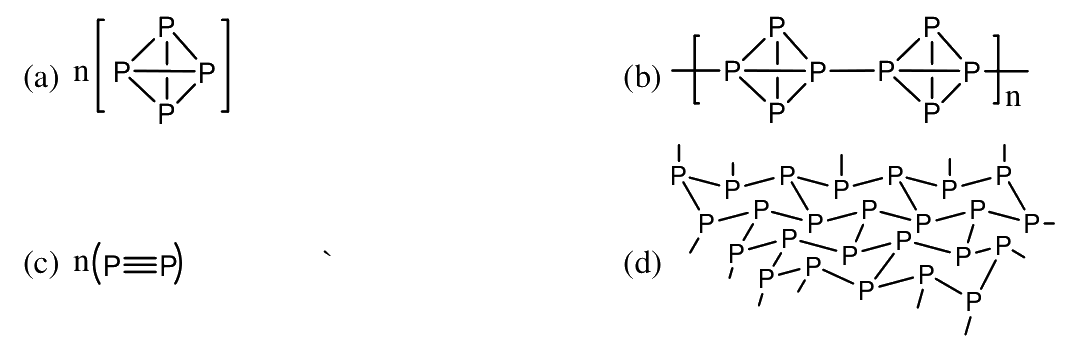
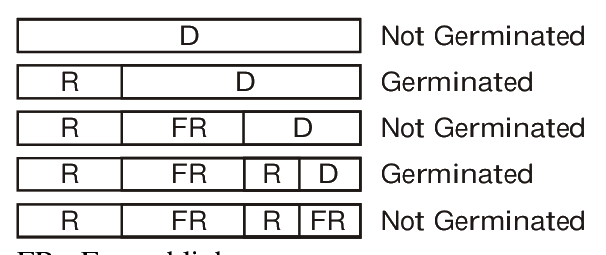
All allotropes of phosphorus (white, red, black) upon melting form a liquid containing discrete, monomeric tetrahedral $\text{P}_4$ molecules ($n[\text{P}_4]$). Thus, upon melting, they all exist as monomeric tetrahedral units, corresponding to structure (a).
🎉 10 Free Sample Solutions Completed
Unlock All 125 Questions & Solutions
Sign up free in seconds to unlock step-by-step AI answers for the remaining 115 questions.
For the oxidation state(s) of sulphur atoms in $\text{S}_2\text{O}$, consider the following
A. $-2$ and $+4$
B. $0$ and $+2$
C. $+4$ and $0$
The correct answer(s) is/(are)
a.
A and B
b.
A and C
c.
B and C
d.
C only
Correct Answer & Step-by-Step Solution Locked
Sign in free to reveal the correct answer and AI explanation for this question.
The refluxing of $\text{RhCl}_3 \cdot 3\text{H}_2\text{O}$ with an excess of $\text{PPh}_3$ in ethanol gives a complex A. Complex A and the valence electron count on rhodium are, respectively,
a.
$[\text{RhCl}(\text{PPh}_3)_3]$, 16
b.
$[\text{RhCl}(\text{PPh}_3)_5]$, 16
c.
$[\text{RhCl}(\text{PPh}_3)_3]$, 18
d.
$[\text{RhCl}(\text{PPh}_3)_5]$, 18
Correct Answer & Step-by-Step Solution Locked
Sign in free to reveal the correct answer and AI explanation for this question.
The $^1\text{H}$ NMR spectrum of a dilute solution of a mixture of acetone and dichloromethane in $\text{CDCl}_3$ exhibits two singlet of $1:1$ intensity. Molar ratio of acetone to dichloromethane in the solution is
a.
$3 : 1$
b.
$1 : 3$
c.
$1 : 1$
d.
$1 : 2$
Correct Answer & Step-by-Step Solution Locked
Sign in free to reveal the correct answer and AI explanation for this question.
Among the following, the correct statement(s) about ribose is (are)
(A) on reduction with $\mathrm{NaBH}_4$ it gives optically inactive product.
(B) on reaction with methanolic $\mathrm{HCl}$ it gives a furanoside
(C) on reaction with $\mathrm{Br}_2\text{–}\mathrm{CaCO}_3\text{–}\text{water}$ it gives optically inactive product.
(D) it gives positive Tollen's test
a.
A, B and D
b.
A, B and C
c.
B and C
d.
D only
Correct Answer & Step-by-Step Solution Locked
Sign in free to reveal the correct answer and AI explanation for this question.
A particle is in a one-dimensional box with a potential $\text{V}_0$ inside the box and infinite outside. An energy state corresponding to $\text{n} = 0$ ($\text{n}$ : quantum number) is not allowed because
a.
the total energy becomes zero
b.
the average momentum becomes zero
c.
the wave function becomes zero everywhere
d.
the potential $\text{V}_0 \neq 0$
Correct Answer & Step-by-Step Solution Locked
Sign in free to reveal the correct answer and AI explanation for this question.
The intensity of a light beam decreases by $50\%$ when it passes through a sample of $1.0\text{ cm}$ path length. The percentage of transmission of the light passing through the same sample, but of $3.0\text{ cm}$ path length, would be
a.
50.0
b.
25.0
c.
16.67
d.
12.5
Correct Answer & Step-by-Step Solution Locked
Sign in free to reveal the correct answer and AI explanation for this question.
The product $\text{C}_2^x \sigma_{xy}$ ($\text{C}_2^x$ is the two-fold rotation axis around the $x$-axis and $\sigma_{xy}$ is the $xy$ mirror plane) is
a.
$\sigma_{xz}$
b.
$\sigma_{yz}$
c.
$\text{C}_2^y$
d.
$\text{C}_2^z$
Correct Answer & Step-by-Step Solution Locked
Sign in free to reveal the correct answer and AI explanation for this question.
The simplest ground-state VB wave function of a diatomic molecule like $\text{HCl}$ is written as $\psi = \psi_H(1s, 1)\psi_{Cl}(3p_z, 2) + B$, where $B$ stands for
a.
$\psi_H(3p_z, 2)\psi_{Cl}(1s, 1)$
b.
$\psi_H(1s, 2)\psi_{Cl}(3p_z, 1)$
c.
$\psi_{Cl}(1s, 2)\psi_{Cl}(3p_z, 1)$
d.
$\psi_{Cl}(1s, 2)\psi_H(3p_z, 1)$
Correct Answer & Step-by-Step Solution Locked
Sign in free to reveal the correct answer and AI explanation for this question.
In a chemical reaction : $\mathrm{PCl}_5(\mathrm{g}) \rightleftharpoons \mathrm{PCl}_3(\mathrm{g}) + \mathrm{Cl}_2(\mathrm{g})$, xenon gas is added at constant volume. The equilibrium
a.
will shift towards the reactant
b.
will shift towards the products
c.
will not change the amount of reactant and products
d.
will increase both reactant and products
Correct Answer & Step-by-Step Solution Locked
Sign in free to reveal the correct answer and AI explanation for this question.
The temperature-dependence of a reaction is given by $\mathrm{k} = \mathrm{AT}^2 \exp(-\mathrm{E}_0 / \mathrm{RT})$
The activation energy $(\mathrm{E}_\mathrm{a})$ of the reaction is given by
a.
$\mathrm{E}_0 + \frac{1}{2}\mathrm{RT}$
b.
$\mathrm{E}_0$
c.
$\mathrm{E}_0 + 2\mathrm{RT}$
d.
$2\mathrm{E}_0 + \mathrm{RT}$
Correct Answer & Step-by-Step Solution Locked
Sign in free to reveal the correct answer and AI explanation for this question.
For a reaction, $2\mathrm{A} + \mathrm{B} \rightarrow 3\mathrm{Z}$, if the rate of consumption of $\mathrm{A}$ is $2 \times 10^{-4}\text{ mol dm}^{-3}\text{s}^{-1}$ the rate of formation of $\mathrm{Z}$ (in $\text{mol dm}^{-3}\text{ s}^{-1}$) will be
a.
$3 \times 10^{-4}$
b.
$2 \times 10^{-4}$
c.
$\frac{4}{3} \times 10^{-4}$
d.
$4 \times 10^{-4}$
Correct Answer & Step-by-Step Solution Locked
Sign in free to reveal the correct answer and AI explanation for this question.
The intrinsic viscosity depends on the molar mass as $[\eta] = \mathrm{KM}^\mathrm{a}$
The empirical constants $\mathrm{K}$ and $\mathrm{a}$ are dependent on
a.
solvent only
b.
polymer only
c.
polymer solvent pair
d.
polymer-polymer interaction
Correct Answer & Step-by-Step Solution Locked
Sign in free to reveal the correct answer and AI explanation for this question.
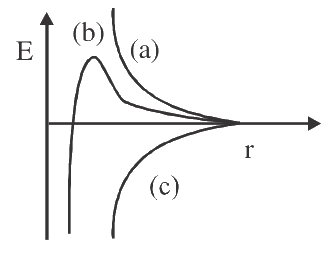
Energy of interaction of colloidal particles as a function of distance of separation can be identified as (1) vander Waals, (2) double layer, (3) vander Waals and double layer. The correct order of interactions in the figure corresponding to curves (a) , (b) and (c), respectively, is
a.
1, 2, 3
b.
2, 3, 1
c.
3, 1, 2
d.
1, 3, 2
Correct Answer & Step-by-Step Solution Locked
Sign in free to reveal the correct answer and AI explanation for this question.
Differential pulse polarography (DPP) is more sensitive than D.C. Polarography (DCP). Consider following reasons for it
(A) non-faradic current is less in DPP in comparison to DCP
(B) non-faradic current is more in DPP in comparison to DCP
(c) polarogram of DPP is of different shape than that of DCP
Correct reason(s) is/are
a.
A and C
b.
B and C
c.
B only
d.
A only
Correct Answer & Step-by-Step Solution Locked
Sign in free to reveal the correct answer and AI explanation for this question.
Considering the following parameters with reference to the fluorescence of a solution:
(A) molar absorptivity of fluorescent molecule
(B) intensity of light source used excitation
(C) dissolved oxygen
The correct answer for the enhancement of fluorescence with the increase in these parameters is/are
a.
A and B
b.
B and C
c.
A and C
d.
C only
Correct Answer & Step-by-Step Solution Locked
Sign in free to reveal the correct answer and AI explanation for this question.
Considering the inert pair effect on lead, the most probable structure of $\text{PbR}_2 [\text{R} = 2,\text{ 6-C}_6\text{H}_3(2,\text{ 6-Pr}_2\text{C}_6\text{H}_3)_2]$ is
Correct Answer & Step-by-Step Solution Locked
Sign in free to reveal the correct answer and AI explanation for this question.
The reaction of $\text{SbCl}_3$ with 3 equivalents of $\text{EtMgBr}$ yields compound X. Two equivalents of $\text{SbI}_3$ react with one equivalent of X to give Y. In the solid state, Y has a 1D-polymeric structure in which each Sb is in a square pyramidal environment. Compounds X and Y respectively, are
a.
$\text{SbEt}_3$ and $[\text{Sb}(\text{Et})\text{I}_2]_n$
b.
$\text{Sb}(\text{Et}_2)\text{Cl}$ and $[\text{Sb}(\text{Et}_2)\text{Cl}]_n$
c.
$\text{SbEt}_3$ and $[\text{SbEt}_2\text{Br}_2]_n$
d.
$\text{Sb}(\text{Et})\text{Br}_2$ and $[\text{SbEt}(\text{I})(\text{Br})]_n$
Correct Answer & Step-by-Step Solution Locked
Sign in free to reveal the correct answer and AI explanation for this question.
Match the complexes given in column I with the electronic transitions (mainly responsible for their colours) listed in column II
**Column-I**
(I) $\text{Fe(II)-protoporphyrin IX}$
(II) $[\text{Mn}(\text{H}_2\text{O})_6]\text{Cl}_2$
(III) $[\text{Co}(\text{H}_2\text{O})_6]\text{Cl}_2$
**Column-II**
(A) $\pi \to \pi^*$
(B) spin allowed $\text{d} \to \text{d}$
(C) spin forbidden $\text{d} \to \text{d}$
(D) $\text{M} \to \text{L}$ charge transfer
The correct answe is
a.
I-A, II-C and III-B
b.
I-D, II-B and III-C
c.
I-A, II-C and III-D
d.
I-A, II-B and III-C
Correct Answer & Step-by-Step Solution Locked
Sign in free to reveal the correct answer and AI explanation for this question.
The following statements are given regardng the agostic interaction $\text{C}-\text{H}\cdots\text{Ir}$ observed in $[\text{Ir}(\text{Ph}_3\text{P})_3\text{Cl}]$.
(A) Upfield shift of $\text{C}-\text{H}$ proton in $^1\text{H}\text{ NMR}$ spectrum
(B) Increased acid character of $\text{C}-\text{H}$
(C) $\nu_{\text{C}-\text{H}}$ in IR spectrum shifts to higher wavenumber
The correct answer is/are
a.
A and C
b.
B and C
c.
A and B
d.
C only
Correct Answer & Step-by-Step Solution Locked
Sign in free to reveal the correct answer and AI explanation for this question.
Amongst the following (A) $[\text{Mn}(\eta^5-\text{Cp})(\text{CO})_3]$, (B) $[\text{Os}(\eta^5-\text{Cp})_2]$, (C) $[\text{Ru}(\eta^5-\text{Cp})_2]$ and (D) $[\text{Fe}(\eta^5-\text{Cp})_2]$, the compounds with most shielded and deshielded Cp protons respectively, are
a.
D and A
b.
D and B
c.
C and A
d.
C and B
Correct Answer & Step-by-Step Solution Locked
Sign in free to reveal the correct answer and AI explanation for this question.
Total number of vertices in metal clusters $[\text{Ru}_6(\text{C})(\text{CO})_{17}]$, $[\text{Os}_5(\text{C})(\text{CO})_{15}]$ and $[\text{Ru}_5(\text{C})(\text{CO})_{16}]$ are 6, 5 and 5, respectively. The predicted structures of these complexes, respectively are
a.
closo, nido and nido
b.
closo, nido and arachno
c.
arachno, closo and nido
d.
arachno, nido and closo
Correct Answer & Step-by-Step Solution Locked
Sign in free to reveal the correct answer and AI explanation for this question.
Among the complexes, (A) $\text{K}_4[\text{Cr}(\text{CN})_6]$, $\text{K}_4[\text{Fe}(\text{CN})_6]$, (C) $\text{K}_3[\text{Co}(\text{CN})_6]$ and $\text{K}_4[\text{Mn}(\text{CN})_6]$, Jahn-Teller distortion is expected in
a.
A, B and C
b.
B, C and D
c.
A and D
d.
B and C
Correct Answer & Step-by-Step Solution Locked
Sign in free to reveal the correct answer and AI explanation for this question.
Match the action of $\text{H}_2\text{O}_2$ in aqueous medium given in column A with the oxidation/reduction listed in column B
\begin{tabular}{ll}
\textbf{A : action of } $\mathbf{H_2O_2}$ & \textbf{B : type of reaction} \\
(I) Oxidation in acid & (A) $[\text{Fe}(\text{CN})_6]^{3-} \rightarrow [\text{Fe}(\text{CN})_6]^{4-}$ \\
(II) Oxidation in base & (B) $[\text{Fe}(\text{CN})_6]^{4-} \rightarrow [\text{Fe}(\text{CN})_6]^{3-}$ \\
(III) Reduction in acid & (C) $\text{MnO}_4^- \rightarrow \text{Mn}^{2+}$ \\
(IV) Reduction in base & (D) $\text{Mn}^{2+} \rightarrow \text{Mn}^{4+}$
\end{tabular}
The correct answer is
a.
I-A, II-B, III-C, IV-D
b.
I-B, II-D, III-C, IV-A
c.
I-C, II-D, III-B, IV-A
d.
I-D, II-A, III-C, IV-B
Correct Answer & Step-by-Step Solution Locked
Sign in free to reveal the correct answer and AI explanation for this question.
The reduced form of a metal ion $\text{M}$ in a complex is NMR active. On oxidation, the complex gives an EPR signal with $g_\parallel \approx 2.2$ and $g_\perp \approx 2.0$. Mossbauer spectroscopy cannot characteristic the metal complex. The $\text{M}$ is
a.
$\text{Zn}$
b.
$\text{Sn}$
c.
$\text{Cu}$
d.
$\text{Fe}$
Correct Answer & Step-by-Step Solution Locked
Sign in free to reveal the correct answer and AI explanation for this question.
Water plays different roles in the following reactions.
(i) $2\text{H}_2\text{O} + \text{Ca} \rightarrow \text{Ca}^{2+} + 2\text{OH}^- + \text{H}_2$
(ii) $n\text{H}_2\text{O} + \text{Cl}^- \rightarrow [\text{Cl}(\text{H}_2\text{O})_n]^-$
(iii) $6\text{H}_2\text{O} + \text{Mg}^{2+} \rightarrow [\text{Mg}(\text{H}_2\text{O})_6]^{2+}$
(iv) $2\text{H}_2\text{O} + 2\text{F}_2 \rightarrow 4\text{HF} + \text{O}_2$
The correct role of water in each reaction is,
a.
(i) oxidant, (ii) acid, (iii) base and (iv) reductant
b.
(i) oxidant, (ii) base, (iii) acid and (iv) reductant
c.
(i) acid, (ii) oxidant, (iii) reductant and (iv) base
d.
(i) base, (ii) reductant, (iii) oxidant and (iv) base
Correct Answer & Step-by-Step Solution Locked
Sign in free to reveal the correct answer and AI explanation for this question.
The complex $[\text{Fe}(\text{phen})_2(\text{NCS})_2] (\text{phen} = 1,10-\text{phenanthroline})$ shows spin cross-over behaviour CFSE and $\mu_{\text{eff}}$ at $250$ and $150\text{ K}$, respectively are
a.
$0.4\Delta_0$, $4.90\text{ BM}$ and $2.4\Delta_0$, $0.00\text{ BM}$
b.
$2.4\Delta_0$, $2.90\text{ BM}$ and $0.4\Delta_0$, $1.77\text{ BM}$
c.
$2.4\Delta_0$, $0.00\text{ BM}$ and $0.4\Delta_0$, $4.90\text{ BM}$
d.
$1.2\Delta_0$, $4.90\text{ BM}$ and $2.4\Delta_0$, $0.00\text{ BM}$
Correct Answer & Step-by-Step Solution Locked
Sign in free to reveal the correct answer and AI explanation for this question.
Consider the following statements with respect to uranium
(A) $\text{UO}_2^+$ disproportionates more easily than $\text{UO}_2^{2+}$
(B) $\text{U}_3\text{O}_8$ is its most stable oxide of $\text{U}$
(C) Coordination number of $\text{U}$ in $[\text{UO}_2(\text{NO}_3)_2(\text{H}_2\text{O})_2]\cdot 4\text{H}_2\text{O}$ is six.
(D) $\text{UO}_2^{2+}$ is linear
The correct set of statements is
a.
A, B and D
b.
A, C and D
c.
B, C and D
d.
A, B and C
Correct Answer & Step-by-Step Solution Locked
Sign in free to reveal the correct answer and AI explanation for this question.
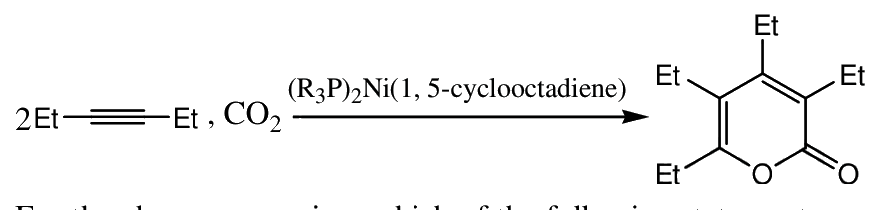
For the reaction:
$$2\text{Et}\overline{\overline{=}}\text{Et}, \text{CO}_2 \xrightarrow{(\text{R}_3\text{P})_2\text{Ni}(1,\text{ }5-\text{cyclooctadiene})} \text{[Product as shown in image]}$$
For the above conversion, which of the following statements are correct?
(A) $\text{CO}_2$ combines with $\text{Ni}(\text{PR}_3)_2$ ($1$, $5$-cyclooctadiene)
(B) Insertion of $\text{CO}_2$ occurs
(C) Insertion of $\text{Et}\overline{\overline{=}}\text{Et}$ takes place
The correct answer is
a.
A and B
b.
B and C
c.
C and A
d.
A, B and C
Correct Answer & Step-by-Step Solution Locked
Sign in free to reveal the correct answer and AI explanation for this question.
Consider the following statements for $(\text{NH}_4)_2[\text{Ce}(\text{NO}_3)_6](\text{Z})$
(A) Coordination number of Ce is $12$
(B) $\text{Z}$ is paramagnetic
(C) $\text{Z}$ is an oxidising agent
(D) Reaction of $\text{Ph}_3\text{PO}$ with $\text{Z}$ gives a complex having coordination number $10$ for $\text{Ce}$.
The correct statements are
a.
A, B and C
b.
B, A and D
c.
B, C and D
d.
A, C and D
Correct Answer & Step-by-Step Solution Locked
Sign in free to reveal the correct answer and AI explanation for this question.
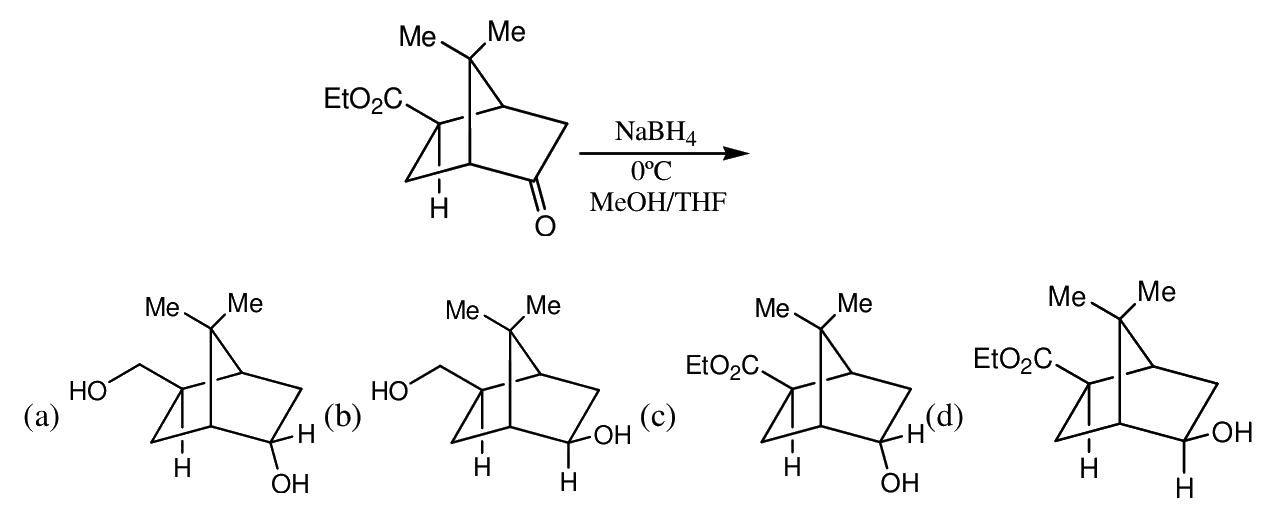
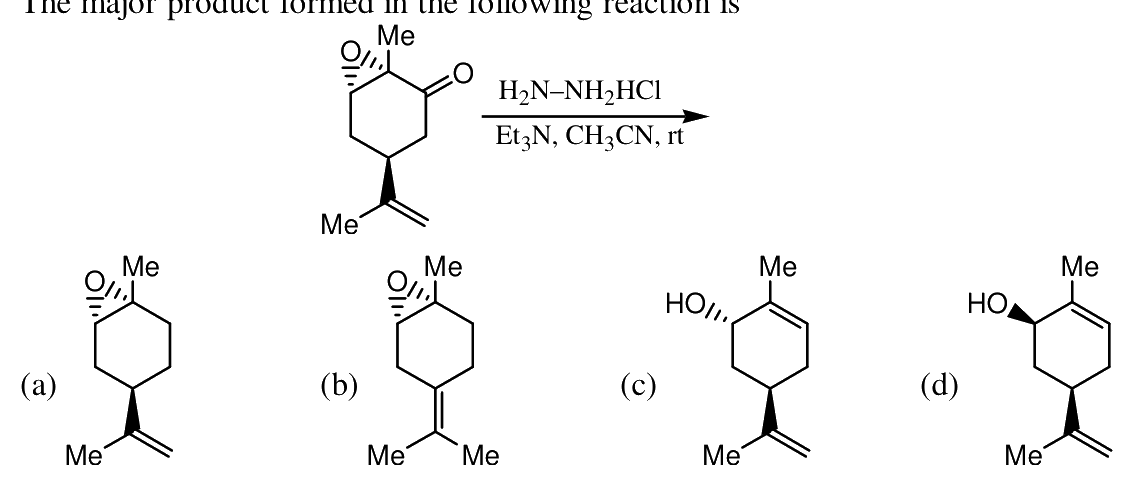
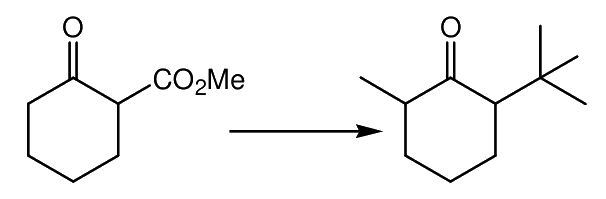
The correct set of reagents to effect the following transformation is
a.
(I) (i) $\text{NaOMe}$, $\text{MeI}$; (ii) $\text{NaCl}$, wet $\text{DMSO}$, $160^\circ\text{C}$; (II) (i) $\text{LDA}$, $-78^\circ\text{C}$, $\text{TMSCl}$; (ii) $\text{t-BuCl}$, $\text{TiCl}_4$, $50^\circ\text{C}$
b.
(I) (i) $\text{NaOMe}$, $\text{MeI}$; (ii) aq. $\text{NaOH}$ then $\text{HCl}$, heat; (II) (i) $\text{Et}_3\text{N}$, $\text{TMSCl}$, rt; (ii) $\text{t-BuCl}$, $\text{TiCl}_4$, $50^\circ\text{C}$
c.
(i) $\text{LDA}$, $\text{t-BuCl}$, (ii) $\text{LDA}$, $\text{MeI}$; (iii) aq. $\text{NaOH}$ then $\text{HCl}$, heat
d.
(I) (i) $\text{NaCl}$, wet $\text{DMSO}$, $160^\circ\text{C}$; (ii) $\text{NaH}$, $\text{t-BuCl}$; (II) (i) morpholine, $\text{H}^+$; (ii) $\text{MeI}$ then $\text{H}_3\text{O}^+$.
Correct Answer & Step-by-Step Solution Locked
Sign in free to reveal the correct answer and AI explanation for this question.
The nuclear g-factors of $^{1}\text{H}$ and $^{14}\text{N}$ are $5.6$ and $0.40$ respectively. If the magnetic field in an NMR spectrometer is set such that the proton resonates at $700\text{ MHz}$, the $^{14}\text{N}$ nucleus would resonate at
a.
$1750\text{ MHz}$
b.
$700\text{ MHz}$
c.
$125\text{ MHz}$
d.
$50\text{ MHz}$
Correct Answer & Step-by-Step Solution Locked
Sign in free to reveal the correct answer and AI explanation for this question.
Compare the difference of energies of the first excited and ground states of a particle confined in (i) a 1-d box $(\Delta_1)$, (ii) a 2-d square box $(\Delta_2)$ and (iii) a 3-d cubic box $(\Delta_3)$. Assume the length of each of the boxes is the same. The correct relation between the energy differences $\Delta_1, \Delta_2$ and $\Delta_3$ for the three states is
a.
$\Delta_1 > \Delta_2 > \Delta_3$
b.
$\Delta_1 = \Delta_2 = \Delta_3$
c.
$\Delta_3 > \Delta_2 > \Delta_1$
d.
$\Delta_3 > \Delta_1 > \Delta_2$
Correct Answer & Step-by-Step Solution Locked
Sign in free to reveal the correct answer and AI explanation for this question.
The correct statement about both the average value of position $(\langle x \rangle)$ and momentum $(\langle p \rangle)$ of a 1-d harmonic oscillator wavefunction is
a.
$\langle x \rangle \neq 0$ and $\langle p \rangle \neq 0$
b.
$\langle x \rangle = 0$ but $\langle p \rangle \neq 0$
c.
$\langle x \rangle = 0$ and $\langle p \rangle = 0$
d.
$\langle x \rangle \neq 0$ but $\langle p \rangle = 0$
Correct Answer & Step-by-Step Solution Locked
Sign in free to reveal the correct answer and AI explanation for this question.
The equilibrium constants for the reactions $\text{CH}_4(\text{g}) + 2\text{H}_2\text{O}(\text{g}) \rightleftharpoons \text{CO}_2(\text{g}) + 4\text{H}_2(\text{g})$ and $\text{CO}(\text{g}) + \text{H}_2\text{O}(\text{g}) \rightleftharpoons \text{CO}_2(\text{g}) + \text{H}_2(\text{g})$ are $\text{K}_1$ and $\text{K}_2$, respectively. The equilibrium constant for the reaction $\text{CH}_4(\text{g}) + \text{H}_2\text{O}(\text{g}) \rightleftharpoons \text{CO}(\text{g}) + 3\text{H}_2(\text{g})$ is
a.
$\text{K}_1 \cdot \text{K}_2$
b.
$\text{K}_1 - \text{K}_2$
c.
$\text{K}_1 / \text{K}_2$
d.
$\text{K}_2 - \text{K}_1$
Correct Answer & Step-by-Step Solution Locked
Sign in free to reveal the correct answer and AI explanation for this question.
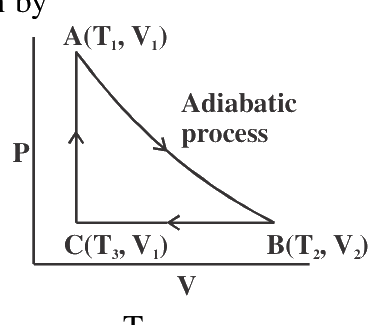
Consider the progress of a system along the path shown in the figure. $\Delta\text{S}(\text{B} \rightarrow \text{C})$ for one mole of an ideal gas is then given by
a.
$\text{R} \ln \dfrac{\text{T}_1}{\text{T}_3}$
b.
$\text{R} \ln \dfrac{\text{T}_3}{\text{T}_1}$
c.
$\text{R} \ln \dfrac{\text{V}_2}{\text{V}_1}$
d.
$\text{R} \ln \dfrac{\text{V}_1}{\text{V}_2}$
Correct Answer & Step-by-Step Solution Locked
Sign in free to reveal the correct answer and AI explanation for this question.
According to transition state theory, the temperature-dependence of pre-exponential factor (A) for a reaction between a linear and a non-linear molecule, that forms products through a non-linear transition state, is given by
a.
$T$
b.
$T^2$
c.
$T^{-2}$
d.
$T^{-1.5}$
Correct Answer & Step-by-Step Solution Locked
Sign in free to reveal the correct answer and AI explanation for this question.
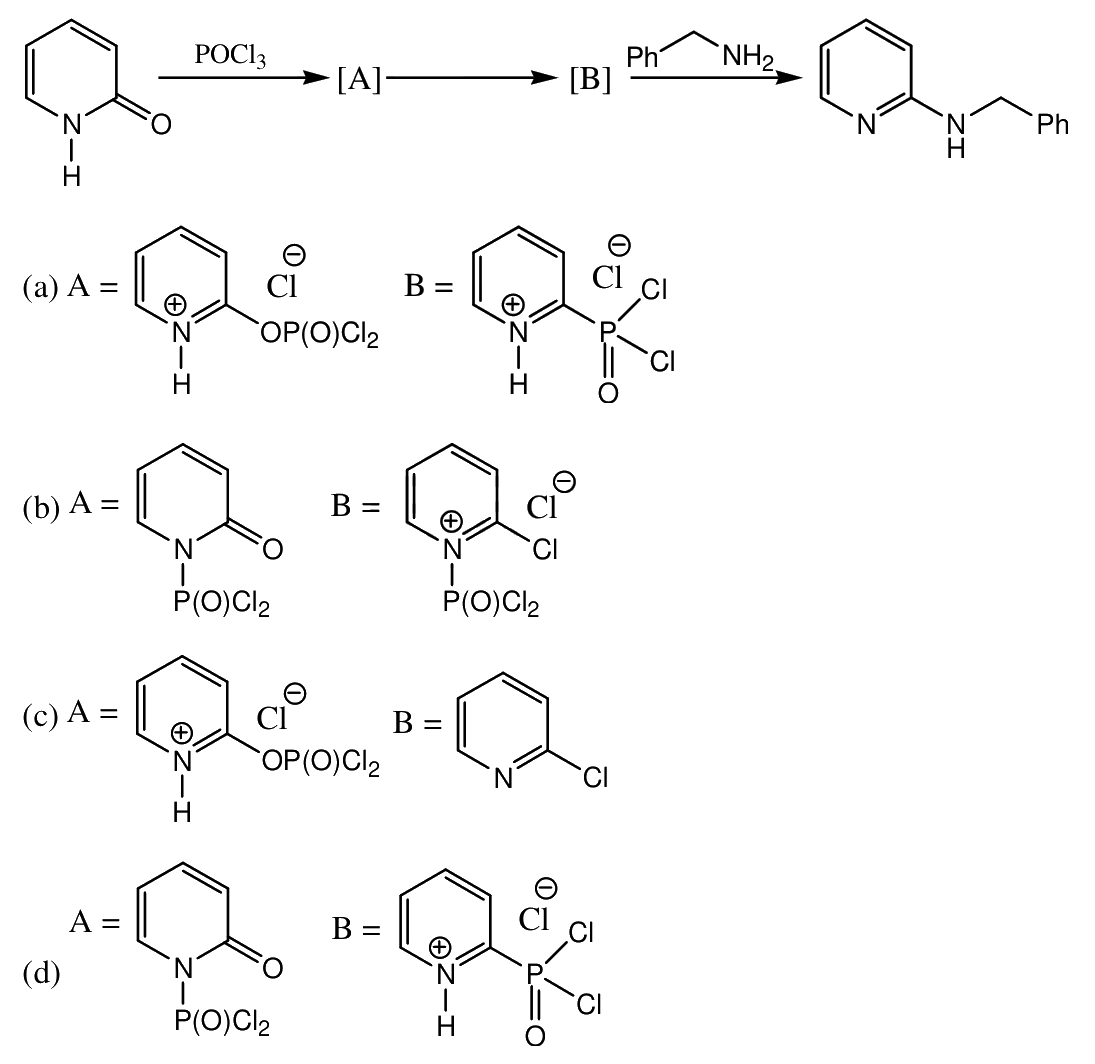
For a given ionic strength, (I) rate of reaction is given by
$$\log \frac{k}{k_0} = -4 \times 0.51(\mathrm{I})^{1/2}$$.
Which of the following reactions follows the above equation?
The single-particle partition function (f) for a certain system has the form $\mathrm{f} = \mathrm{AVe}^{\mathrm{BT}}$. The average energy per particle will then be ($k$ is the Boltzmann constant)
a.
$\mathrm{B}kT$
b.
$\mathrm{B}kT^2$
c.
$kT / \mathrm{B}$
d.
$kT / \mathrm{B}^2$
Correct Answer & Step-by-Step Solution Locked
Sign in free to reveal the correct answer and AI explanation for this question.
The indistinguishability correction in the Boltzmann formulation is incorporated in the following way : ($\mathrm{N} = \text{total number of particles}$, $\mathrm{f} = \text{single-particle partition function}$)
a.
replace $\mathrm{f}$ by $\mathrm{f}/\mathrm{N}!$
b.
replace $\mathrm{f}^\mathrm{N}$ by $\mathrm{f}^\mathrm{N}/\mathrm{N}!$
c.
replace $\mathrm{f}$ by $\mathrm{f}/\ln(\mathrm{N}!)$
d.
replace $\mathrm{f}^\mathrm{N}$ by $\mathrm{f}^\mathrm{N}/\ln(\mathrm{N}!)$
Correct Answer & Step-by-Step Solution Locked
Sign in free to reveal the correct answer and AI explanation for this question.
In a photochemical reaction, radicals are formed according to the equation
$$\mathrm{C}_4\mathrm{H}_{10} + h\nu \rightleftharpoons 2\mathrm{C}_2\mathrm{H}_5$$
$$\mathrm{C}_2\mathrm{H}_5 + \mathrm{C}_2\mathrm{H}_5 \xrightarrow{k_2} \mathrm{C}_2\mathrm{H}_6 + \mathrm{C}_2\mathrm{H}_4$$
If I is the intensity of light absorbed, the rate of the overall reaction is proportional to
In a conductometric experiment for estimation of acid dissociation constant of acetic acid, the following values were obtained in four sets of measurements.
$1.71\times 10^{-5}$, $1.77\times 10^{-5}$, $1.79\times 10^{-5}$ and $1.73\times 10^5$
The standard deviation of the data would be in the range of
a.
$0.010\times 10^{-5} - 0.019\times 10^{-5}$
b.
$0.020\times 10^{-5} - 0.029\times 10^{-5}$
c.
$0.030\times 10^{-5} - 0.039\times 10^{-5}$
d.
$0.040\times 10^{-5} - 0.049\times 10^{-5}$
Correct Answer & Step-by-Step Solution Locked
Sign in free to reveal the correct answer and AI explanation for this question.
Silver crystallizes in face-centered cubic structure. The $2^{\text{nd}}$ order diffraction angle of a beam of X-ray ($\lambda = 1\text{ \AA}$) of (111) plane of the crystal is $30^\circ$. Therefore, the unit cell length of the crystal would be
a.
$\text{a} = 3.151\text{ \AA}$
b.
$\text{a} = 3.273\text{ \AA}$
c.
$\text{a} = 3.034\text{ \AA}$
d.
$\text{a} = 3.464\text{ \AA}$
Correct Answer & Step-by-Step Solution Locked
Sign in free to reveal the correct answer and AI explanation for this question.