← Joint CSIR UGC NET Exam
CSIR NET · Chemical Sciences

December

2015 · 125 questions · First 10 Solutions Free
Questions 1–10 have full step-by-step solutions visible. Sign in to unlock all 125 →
Q21 mcq
The biological functions of cytochrome $\text{P}_{450}$ and myoglobin are, respectively
a.
oxidation of alkene and $\text{O}_2$ storage Correct Answer
b.
$\text{O}_2$ trasnport and $\text{O}_2$ storage
c.
$\text{O}_2$ storage and electron carrier
d.
electron carrier and $\text{O}_2$ transport
Step-by-Step AI Explanation
Verified Method
Cytochrome $\text{P}_{450}$ is a monooxygenase enzyme that catalyzes the insertion of an oxygen atom into unactivated C-H bonds as well as the epoxidation (oxidation) of alkenes. Myoglobin is a hemoprotein found in muscle tissue responsible for the storage of dioxygen ($\text{O}_2$). Therefore, the correct pair of biological functions is oxidation of alkene and $\text{O}_2$ storage, matching option A.
Q22 mcq
Deoxy-hemocyanin is
a.
heme protein and paramagnetic
b.
colorless and diamagnetic Correct Answer
c.
$\text{O}_2$ transporter and paramagnetic
d.
blue colored and diamagnetic
Step-by-Step AI Explanation
Verified Method
Hemocyanin is a non-heme copper protein. In the deoxy form (deoxy-hemocyanin), both copper centers are present as $\text{Cu(I)}$ ($d^{10}$ configuration). Because all electrons are paired ($d^{10}$), it is diamagnetic. Furthermore, without any $d$-$d$ transitions or low-energy charge-transfer bands, deoxy-hemocyanin is colorless. (In contrast, oxy-hemocyanin contains two $\text{Cu(II)}$ centers bridged by a peroxo group and is blue in color and diamagnetic due to strong antiferromagnetic coupling).
Q23 mcq
The oxidizing power of $[\text{CrO}_4]^{2-}$, $[\text{MnO}_4]^{2-}$, and $[\text{FeO}_4]^{2-}$ follows the order
a.
$[\text{CrO}_4]^{2-} < [\text{MnO}_4]^{2-} < [\text{FeO}_4]^{2-}$ Correct Answer
b.
$[\text{FeO}_4]^{2-} < [\text{MnO}_4]^{2-} < [\text{CrO}_4]^{2-}$
c.
$[\text{MnO}_4]^{2-} < [\text{FeO}_4]^{2-} < [\text{CrO}_4]^{2-}$
d.
$[\text{CrO}_4]^{2-} < [\text{FeO}_4]^{2-} < [\text{MnO}_4]^{2-}$
Step-by-Step AI Explanation
Verified Method
In all three tetrahedral oxoanions, $[\text{CrO}_4]^{2-}$, $[\text{MnO}_4]^{2-}$, and $[\text{FeO}_4]^{2-}$, the metal is in the $+6$ oxidation state: $\text{Cr(VI)}$, $\text{Mn(VI)}$, and $\text{Fe(VI)}$. As we move across the 3d transition series from left to right ($ ext{Cr} \to \text{Mn} \to \text{Fe}$), the effective nuclear charge ($Z_{\text{eff}}$) increases, making high oxidation states increasingly unstable and easier to reduce. Consequently, the tendency to gain electrons (oxidizing power) increases in the order: $$[\text{CrO}_4]^{2-} < [\text{MnO}_4]^{2-} < [\text{FeO}_4]^{2-}$$
Q24 mcq
Using crystal field theory, identify from the following complex ions that shows same $\mu_{\text{eff}}$ (spin only) values (A) $[\text{CoF}_6]^{3-}$ (B) $[\text{IrCl}_6]^{3-}$ (C) $[\text{Fe}(\text{H}_2\text{O})_6]^{2+}$
a.
A and B
b.
B and C
c.
A and C Correct Answer
d.
A, B and C
Step-by-Step AI Explanation
Verified Method
To find which complexes have the same $\mu_{\text{eff}}$ (spin-only) value, determine the number of unpaired electrons ($n$) for each complex using crystal field theory: 1. **$[\text{CoF}_6]^{3-}$**: - Oxidation state of $\text{Co}$ is $+3$, which corresponds to a $3d^6$ configuration. - $\text{F}^-$ is a weak-field ligand, giving a high-spin octahedral arrangement: $t_{2g}^4 e_g^2$. - Number of unpaired electrons, $n = 4$. 2. **$[\text{IrCl}_6]^{3-}$**: - Oxidation state of $\text{Ir}$ is $+3$, corresponding to a $5d^6$ configuration. - Since $\text{Ir}^{3+}$ is a $5d$ transition metal, the crystal field splitting parameter $\Delta_o$ is very large, so it is always low-spin, regardless of ligand: $t_{2g}^6 e_g^0$. - Number of unpaired electrons, $n = 0$. 3. **$[\text{Fe}(\text{H}_2\text{O})_6]^{2+}$**: - Oxidation state of $\text{Fe}$ is $+2$, corresponding to a $3d^6$ configuration. - $\text{H}_2\text{O}$ is a weak-field ligand, giving a high-spin octahedral arrangement: $t_{2g}^4 e_g^2$. - Number of unpaired electrons, $n = 4$. Since both (A) and (C) have $n = 4$ unpaired electrons, they exhibit the same spin-only magnetic moment: $\mu_{\text{eff}} = \sqrt{4(4+2)} = \sqrt{24} \approx 4.90\text{ BM}$. Therefore, the correct pair is A and C.
Q25 mcq
The W-W bond order in $[\text{W}(\eta^5-\text{C}_5\text{H}_5)(\mu-\text{Cl})(\text{CO})_2]_2$ is
a.
three
b.
two
c.
one Correct Answer
d.
zero
Step-by-Step AI Explanation
Verified Method
To determine the $\text{W}-\text{W}$ bond order, we apply the 18-electron rule to the dimer $[\text{W}(\eta^5-\text{C}_5\text{H}_5)(\mu-\text{Cl})(\text{CO})_2]_2$: 1. **Total valence electron count ($VEC$) for the dimer**: - Each $\text{W}$ (Group 6) contributes: $2 \times 6 = 12\, e^-$ - Two $\eta^5-\text{C}_5\text{H}_5$ ligands contribute: $2 \times 5 = 10\, e^-$ - Two bridging $\mu-\text{Cl}$ ligands contribute: $2 \times 3 = 6\, e^-$ - Four terminal $\text{CO}$ ligands contribute: $4 \times 2 = 8\, e^-$ $$\text{Total } VEC = 12 + 10 + 6 + 8 = 36\, e^-$$ 2. **Number of metal-metal bonds ($n$)**: $$n = \frac{18 \times 2 - VEC}{2} = \frac{36 - 36}{2} = 0$$ Wait, let's check the valence electron contribution of bridging chloride in neutral counting: A neutral bridging halogen ($\mu_2-\text{Cl}$) provides 3 electrons in total (one covalent single bond contributing 1 electron to one metal, and a dative lone pair contributing 2 electrons to the other metal, totaling 3 electrons per bridging $\text{Cl}$). Two $\mu-\text{Cl}$ ligands contribute $2 \times 3 = 6\, e^-$. That gives 36 electrons, leading to 0 metal-metal bonds. However, let's verify if $\mu-\text{Cl}$ is 3-electron or if the question considers a single bond: Is $[\text{W}(\eta^5-\text{C}_5\text{H}_5)(\mu-\text{Cl})(\text{CO})_2]_2$ possessing a $\text{W}-\text{W}$ single bond? Wait, $\text{W}$ has 6 electrons, $\text{Cp}$ has 5, $2\,\text{CO}$ have 4, one bridging $\text{Cl}$ contributes 3/2 = 1.5 per metal (or one $\mu-\text{Cl}$ gives 3 electrons shared between two metals). Total electrons per tungsten atom without M-M bond: $6 + 5 + 4 + 3 = 18\, e^-$ (if each bridging Cl donates 3 electrons to the dimer, total from two bridging chlorines is 6 electrons, so each W receives 3 electrons from the two chlorines). Thus, each $\text{W}$ has: $6 (\text{W}) + 5 (\text{Cp}) + 4 (2\,\text{CO}) + 3 (\text{two } \mu-\text{Cl}) = 18\, e^-$. Since each tungsten already achieves an 18-electron configuration without any $\text{W}-\text{W}$ bond, the $\text{W}-\text{W}$ bond order is zero.
Q26 mcq
The correct statement for Mn–O bond lengths in $[\text{Mn}(\text{H}_2\text{O})_6]^{2+}$ is
a.
all bonds are equal Correct Answer
b.
four bonds are longer than two others
c.
two bonds are longer than four others
d.
they are shorter than the Mn-O bond in $[\text{MnO}_4]^-$
Step-by-Step AI Explanation
Verified Method
In $[ ext{Mn}( ext{H}_2 ext{O})_6]^{2+}$, manganese is in the $+2$ oxidation state with a $d^5$ high-spin electronic configuration: $t_{2 ext{g}}^3 e_{ ext{g}}^2$. Because both the $t_{2 ext{g}}$ and $e_{ ext{g}}$ subshells are symmetrically (singly) occupied, there is no electronic degeneracy and hence no Jahn-Teller distortion. Consequently, the complex adopts a regular octahedral geometry where all six $\text{Mn}-\text{O}$ bond lengths are equal. (Option D is incorrect because $\text{Mn}^{2+}$ has a much larger ionic radius and weaker bonding than $\text{Mn}^{7+}$ in $[\text{MnO}_4]^-$, so its bonds are longer, not shorter).
Q27 mcq
For the reaction of $[\text{Fe}(\eta^5-\text{C}_5\text{H}_5)(\text{CH}_3)(\text{CO})_2]$ with $\text{PMe}_3$, the main intermediate is
a.
$[\text{Fe}(\eta^5-\text{C}_5\text{H}_5)(\text{CH}_3)(\text{CO})_2(\text{PMe}_3)]$
b.
$[\text{Fe}(\eta^5-\text{C}_5\text{H}_5)(\text{COCH}_3)(\text{CO})]$ Correct Answer
c.
$[\text{Fe}(\eta^3-\text{C}_5\text{H}_5)(\text{CH}_3)(\text{CO})_2]$
d.
$[\text{Fe}(\eta^3-\text{C}_5\text{H}_5)(\text{COCH}_3)(\text{CO})(\text{PMe}_3)]$
Step-by-Step AI Explanation
Verified Method
The reaction of $[\text{Fe}(\eta^5-\text{C}_5\text{H}_5)(\text{CH}_3)(\text{CO})_2]$ with a Lewis base such as $\text{PMe}_3$ is a classic alkyl migratory insertion reaction (carbonylation). 1. The starting 18-electron complex $[\text{Fe}(\eta^5-\text{C}_5\text{H}_5)(\text{CH}_3)(\text{CO})_2]$ undergoes intramolecular migration of the methyl group onto an adjacent coordinated $\text{CO}$ ligand to form a 16-electron acyl intermediate: $$[\text{Fe}(\eta^5-\text{C}_5\text{H}_5)(\text{CH}_3)(\text{CO})_2] \rightleftharpoons [\text{Fe}(\eta^5-\text{C}_5\text{H}_5)(\text{COCH}_3)(\text{CO})]$$ 2. The incoming nucleophile ($\text{PMe}_3$) then rapidly attacks the vacant coordination site of this 16-electron intermediate to yield the 18-electron product $[\text{Fe}(\eta^5-\text{C}_5\text{H}_5)(\text{COCH}_3)(\text{CO})(\text{PMe}_3)]$. Therefore, the main intermediate is the coordinatively unsaturated acyl complex $[\text{Fe}(\eta^5-\text{C}_5\text{H}_5)(\text{COCH}_3)(\text{CO})]$, which corresponds to option B.
Q28 mcq
Identify the complex ions in sequential order when ferroin is used as an indicator in the titration of iron(II) with potassium dichromate, (phen = 1, 10-phenathroline)
a.
$[\text{Fe}(\text{phen})_3]^{2+}$ and $[\text{Fe}(\text{phen})_3]^{3+}$ Correct Answer
b.
$[\text{Fe}(\text{phen})_3]^{3+}$ and $[\text{Fe}(\text{phen})_3]^{2+}$
c.
$[\text{Fe}(\text{CN})_6]^{4-}$ and $[\text{Fe}(\text{CN})_6]^{3-}$
d.
$[\text{Fe}(\text{CN})_6]^{3-}$ and $[\text{Fe}(\text{CN})_6]^{4-}$
Step-by-Step AI Explanation
Verified Method
Ferroin is the complex tris(1,10-phenanthroline)iron(II), which has the formula $[\text{Fe}(\text{phen})_3]^{2+}$ and displays an intense red color. During redox titration of $\text{Fe}^{2+}$ with an oxidizing agent like potassium dichromate ($\text{K}_2\text{Cr}_2\text{O}_7$), ferroin initially exists in its reduced form, $[\text{Fe}(\text{phen})_3]^{2+}$. At the end point, the excess oxidant oxidizes ferroin to ferriin, which is the pale blue iron(III) complex $[\text{Fe}(\text{phen})_3]^{3+}$. Therefore, the complex ions in sequential order are $[\text{Fe}(\text{phen})_3]^{2+}$ followed by $[\text{Fe}(\text{phen})_3]^{3+}$, making option A correct.
Q29 mcq
The structures of $\text{XeF}_2$ and $\text{XeO}_2\text{F}_2$ respectively are
a.
bent, tetrahedral
b.
linear, square planar
c.
linear, see-saw Correct Answer
d.
bent, see-saw
Step-by-Step AI Explanation
Verified Method
For $\text{XeF}_2$, Xe has 8 valence electrons, forms 2 single bonds with fluorine, leaving 3 lone pairs. The steric number is $2 + 3 = 5$ (trigonal bipyramidal electron geometry with 3 equatorial lone pairs), giving a **linear** molecular geometry. For $\text{XeO}_2\text{F}_2$, Xe has 8 valence electrons. It forms 2 double bonds to O atoms and 2 single bonds to F atoms, leaving 1 lone pair ($8 - 4 - 2 = 2$ electrons = 1 lone pair). The steric number is $4 \text{ bonded atoms} + 1 \text{ lone pair} = 5$ (trigonal bipyramidal electron geometry with 1 equatorial lone pair), giving a **see-saw** molecular geometry.
Q30 mcq
Spin motion of which of the following gives magnetic moment (A) electron, (B) proton (C) neutron Correct answer is
a.
A and B
b.
B and C
c.
A and C
d.
A, B and C Correct Answer
Step-by-Step AI Explanation
Verified Method
All three subatomic particles possess an intrinsic spin angular momentum ($S = 1/2$) and a non-zero magnetic moment: - **Electron:** As a charged fundamental particle with spin, it has a significant magnetic moment (approximately $-1\ \mu_B$). - **Proton:** As a charged composite baryon consisting of quarks with spin, it has a magnetic moment of approximately $+2.79\ \mu_N$. - **Neutron:** Although electrically neutral overall, the neutron is composed of charged quarks (one up quark and two down quarks). The spin motion of these constituent charged quarks gives the neutron an intrinsic magnetic dipole moment of approximately $-1.91\ \mu_N$. Thus, spin motion gives a magnetic moment to all three: electron, proton, and neutron (A, B, and C).
🎉 10 Free Sample Solutions Completed

Unlock All 125 Questions & Solutions

Sign up free in seconds to unlock step-by-step AI answers for the remaining 115 questions.

Q31 mcq
Correct statement for coulometry is
a.
it is based on Faraday's law of electrolysis
b.
it is a type of voltammetry
c.
it is based on Ohm's law
d.
it uses ion selective electrode
Correct Answer & Step-by-Step Solution Locked

Sign in free to reveal the correct answer and AI explanation for this question.

Q32 mcq
The order of increasing Bronsted acidity for boron hydrides is
a.
$\text{B}_5\text{H}_9 < \text{B}_6\text{H}_{10} < \text{B}_{10}\text{H}_{14}$
b.
$\text{B}_{10}\text{H}_{14} < \text{B}_5\text{H}_9 < \text{B}_6\text{H}_{10}$
c.
$\text{B}_6\text{H}_{10} < \text{B}_{10}\text{H}_{14} < \text{B}_5\text{H}_9$
d.
$\text{B}_{10}\text{H}_{14} < \text{B}_6\text{H}_{10} < \text{B}_5\text{H}_9$
Correct Answer & Step-by-Step Solution Locked

Sign in free to reveal the correct answer and AI explanation for this question.
Q33 mcq
Among the following, species expected to show fluxional behaviour are (A) $[\text{NiCl}_4]^{2-}$ (tetrahedral) (B) $\text{IF}_7$ (pentagonal bipyramidal) (C) $[\text{CoF}_6]^{3-}$ (octahedral) (D) $\text{Fe(CO)}_5$ (trigonal bipyramidal)
a.
B and C
b.
B and D
c.
C and D
d.
A and D
Correct Answer & Step-by-Step Solution Locked

Sign in free to reveal the correct answer and AI explanation for this question.
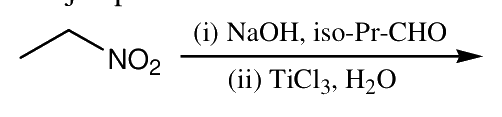
Q34 mcq
The ring size and the number of linked tetrahedral present in $[\text{Si}_6\text{O}_{18}]^{12-}$ are, respectively
a.
6 and 6
b.
12 and 6
c.
12 and 12
d.
6 and 12
Correct Answer & Step-by-Step Solution Locked

Sign in free to reveal the correct answer and AI explanation for this question.
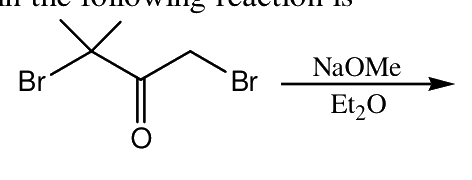
Q35 mcq
The molecule $\text{C}_3\text{O}_2$ has a linear structure. This compound has
a.
$4\sigma$ and $4\pi$ bonds.
b.
$3\sigma$ and $2\pi$ bonds
c.
$2\sigma$ and $3\pi$ bonds
d.
$3\sigma$ and $4\pi$ bonds.
Correct Answer & Step-by-Step Solution Locked

Sign in free to reveal the correct answer and AI explanation for this question.
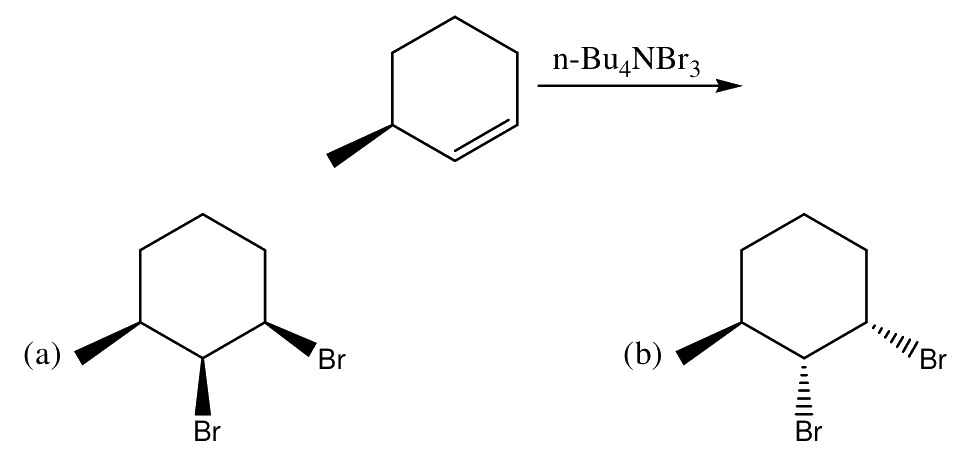
Q36 mcq
The metallic radii are abnormally high for which of the following pairs?
a.
Eu, Yb
b.
Sm, Tm
c.
Gd, Lu
d.
Nd, Ho
Correct Answer & Step-by-Step Solution Locked

Sign in free to reveal the correct answer and AI explanation for this question.
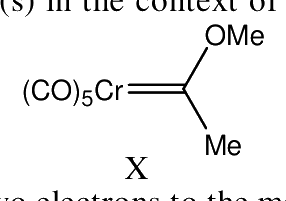
Q37 mcq
Identify two enantiomers among the following compounds
Question 17 image
a.
A and B
b.
A and C
c.
B and D
d.
C and D
Correct Answer & Step-by-Step Solution Locked

Sign in free to reveal the correct answer and AI explanation for this question.
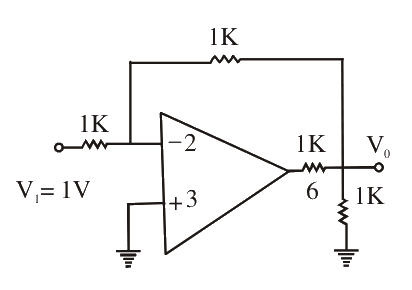
Q38 mcq
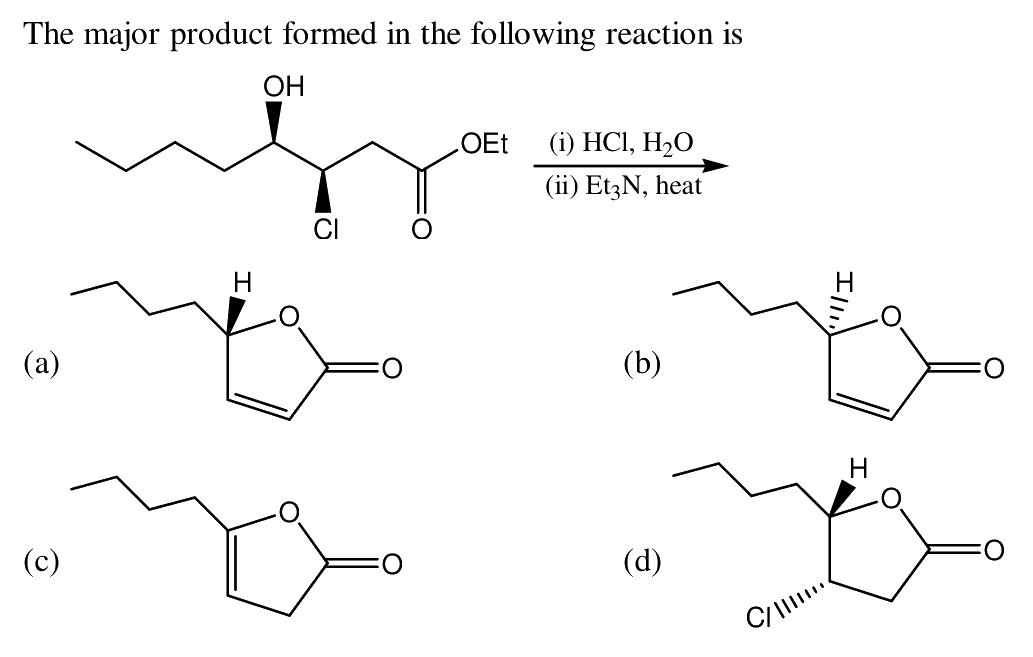
The major product formed in the following reaction is
Question 18 image
a.
(a)
b.
(b)
c.
(c)
d.
(d)
Correct Answer & Step-by-Step Solution Locked

Sign in free to reveal the correct answer and AI explanation for this question.
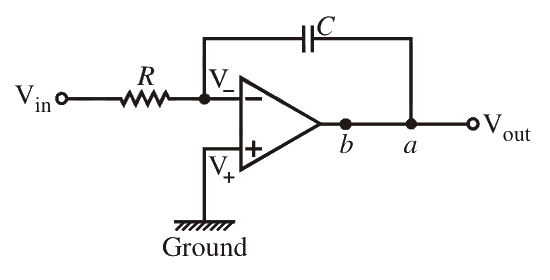
Q39 mcq
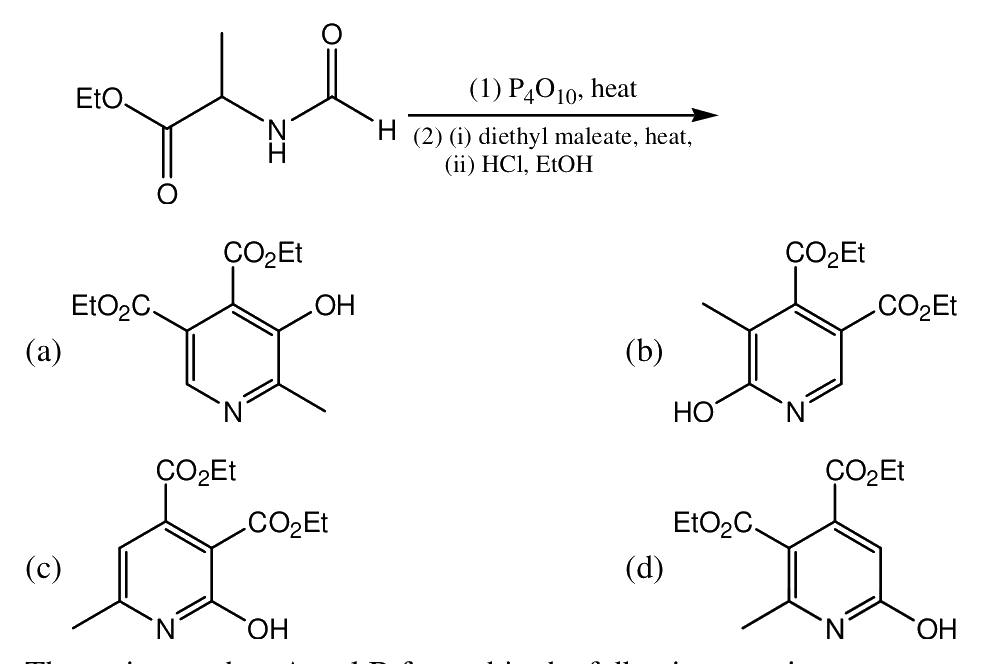
The major product formed in the following reaction is
Question 19 image
Correct Answer & Step-by-Step Solution Locked

Sign in free to reveal the correct answer and AI explanation for this question.
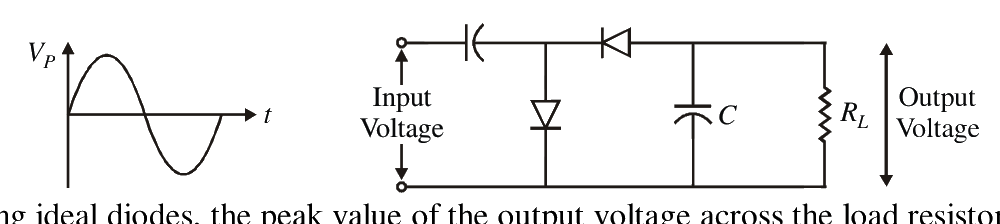
Q40 mcq
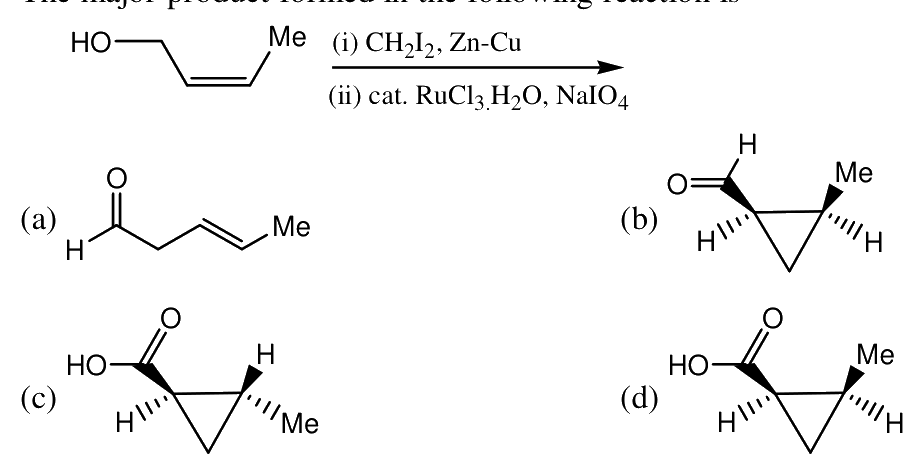
The major product formed in the following reaction is
Question 20 image
Correct Answer & Step-by-Step Solution Locked

Sign in free to reveal the correct answer and AI explanation for this question.
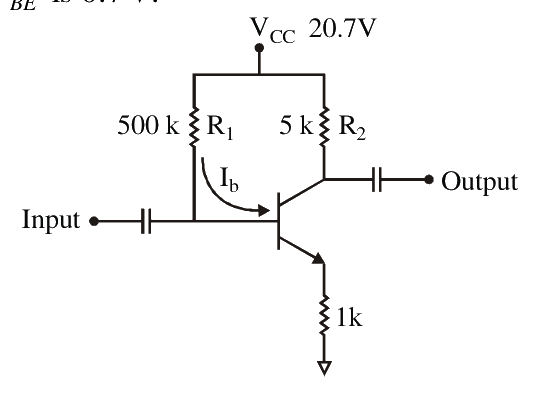
Q41 mcq
The major product formed in the following reaction is
Question 21 image
Correct Answer & Step-by-Step Solution Locked

Sign in free to reveal the correct answer and AI explanation for this question.
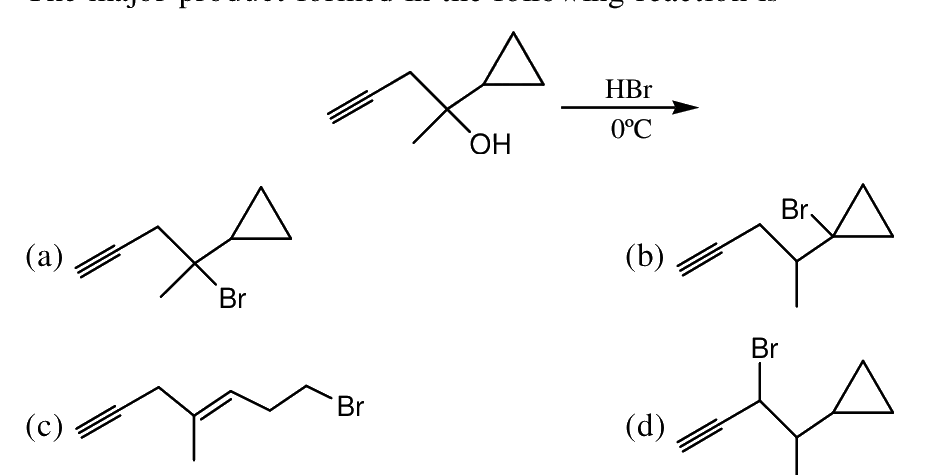
Q42 mcq
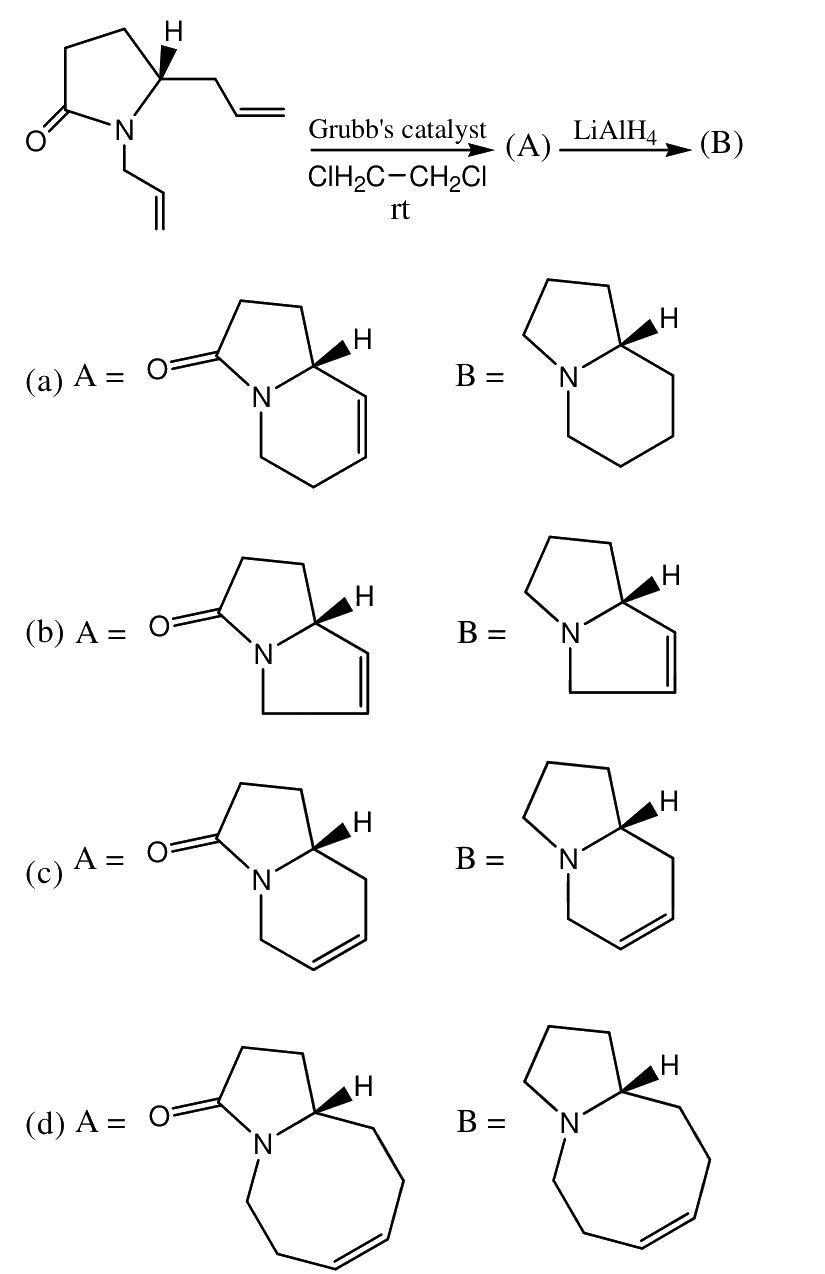
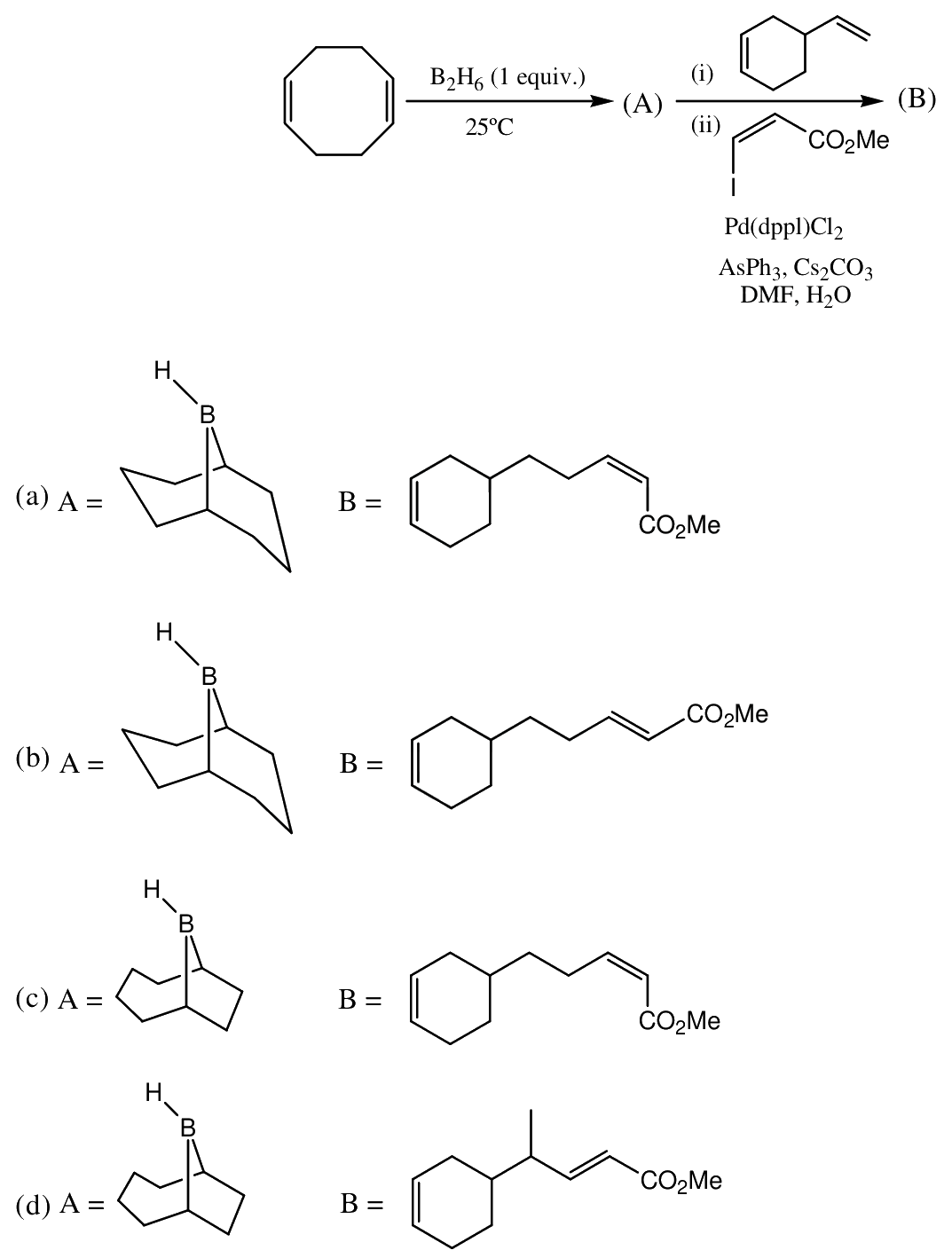
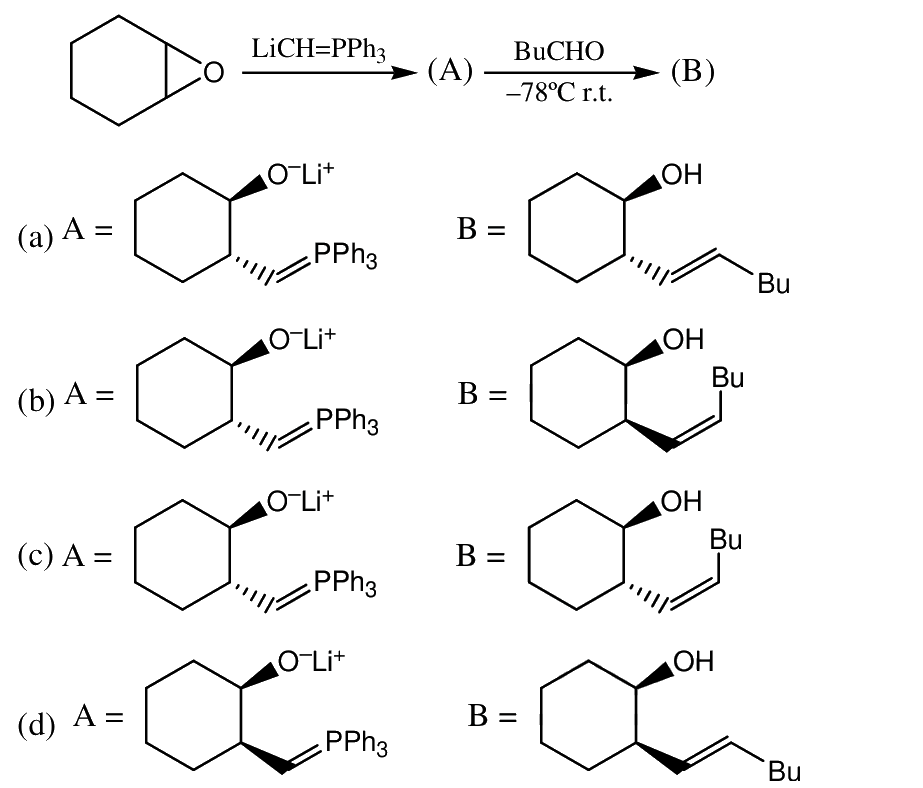
The major product A and B in the following reactions are
Question 22 image
d.
$A = B =$ [image]
Correct Answer & Step-by-Step Solution Locked

Sign in free to reveal the correct answer and AI explanation for this question.
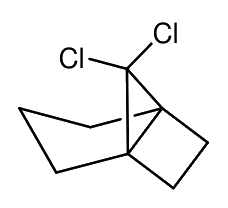
Q43 mcq
D-Mannose upon refluxing in acetone with $\text{CuSO}_4$ and $\text{H}_2\text{SO}_4$ gives
Question 23 image
Correct Answer & Step-by-Step Solution Locked

Sign in free to reveal the correct answer and AI explanation for this question.
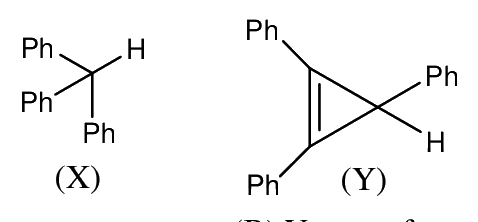
Q44 mcq
The major product formed by photochemical reaction of (2E, 4Z, 6E)-decatriene is
Question 24 image
Correct Answer & Step-by-Step Solution Locked

Sign in free to reveal the correct answer and AI explanation for this question.
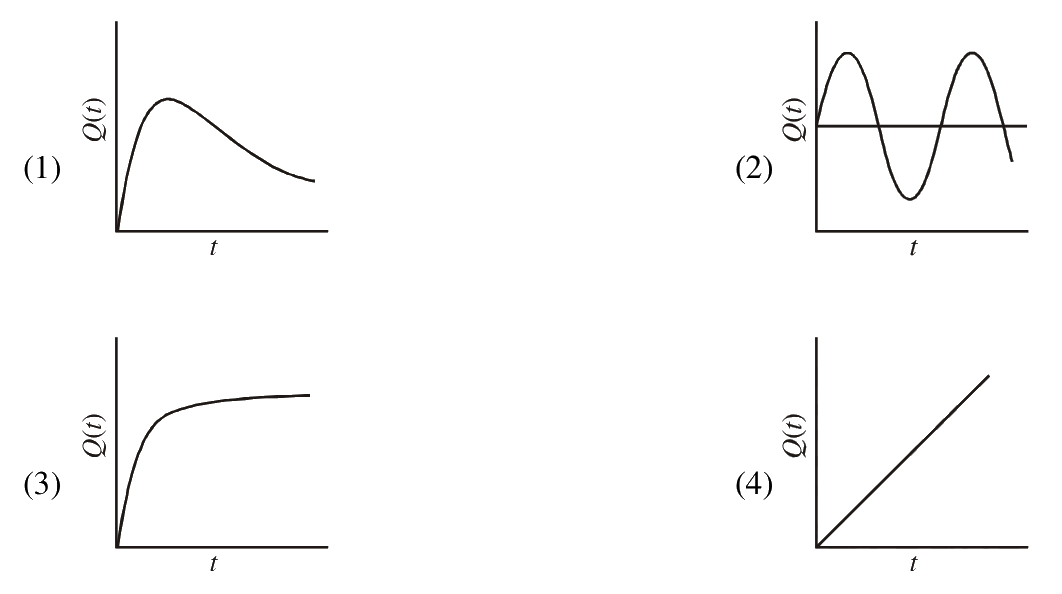
Q45 mcq
The correct statement about the following reaction is that
Question 25 image
a.
and the reaction proceeds through carbene intermediate.
b.
and the reaction proceeds through nitrene intermediate.
c.
and the reaction proceeds through Norrish type II path.
d.
and the reaction proceeds through Norrish type I path.
Correct Answer & Step-by-Step Solution Locked

Sign in free to reveal the correct answer and AI explanation for this question.
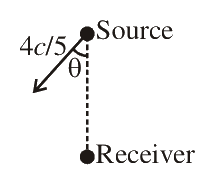
Q46 mcq
The structure of the compounds that matches the $^{1}\text{H NMR}$ data given below is $^{1}\text{H NMR} (\text{DMSO}-d_6): \delta\ 7.75\ (\text{dd}, J = 8.8, 2.4\text{ Hz}, 1\text{H}),\ 7.58\ (\text{d}, J = 2.4\text{ Hz}, 1\text{H}),\ 6.70\ (\text{d}, J = 8.8\text{ Hz}, 1\text{H}),\ 6.50\ (\text{broad s}, 2\text{H}),\ 3.80\ (\text{s}, 3\text{H})$.
Question 26 image
Correct Answer & Step-by-Step Solution Locked

Sign in free to reveal the correct answer and AI explanation for this question.
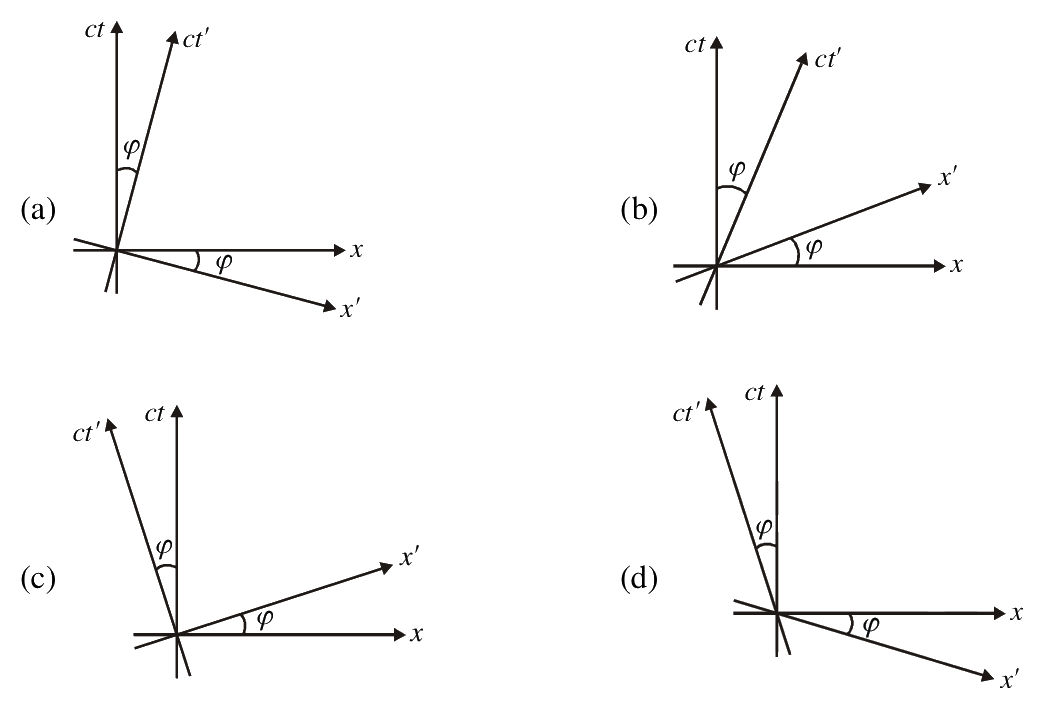
Q47 mcq
Correctly matched structure and carbonyl stretching frequency set is \begin{tabular}{cc} \textbf{COLUMN - A} & \textbf{COLUMN - B} \\ (P) & (X) $1750\text{ cm}^{-1}$ \\ (Q) & (Y) $1770\text{ cm}^{-1}$ \\ (R) & (Z) $1800\text{ cm}^{-1}$ \\ \end{tabular}
Question 27 image
a.
P-Y, Q-Z, R-X
b.
P-Y, Q-X, R-Z
c.
P-Z, Q-Y, R-X
d.
P-X, Q-Z, R-Y
Correct Answer & Step-by-Step Solution Locked

Sign in free to reveal the correct answer and AI explanation for this question.
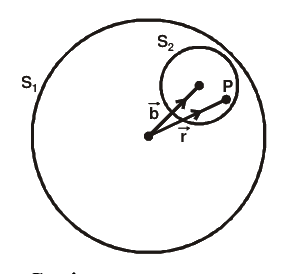
Q48 mcq
The number of chemical shift non-equivalent protons expected in $^{1}\text{H NMR}$ spectrum of $\alpha$-pinene is
Question 28 image
a.
7
b.
8
c.
9
d.
10
Correct Answer & Step-by-Step Solution Locked

Sign in free to reveal the correct answer and AI explanation for this question.
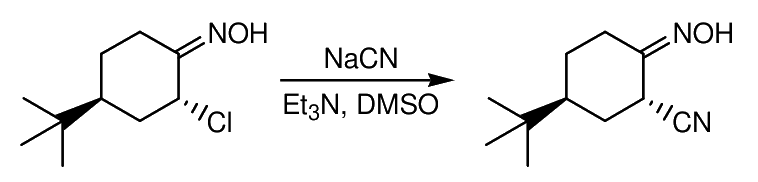
Q49 mcq
In the mass spectrum of 1, 2-dichloroethane, approximate ratio of peaks at m/z values 98, 100, 102 will be
a.
$3 : 1 : 1$
b.
$9 : 6 : 1$
c.
$1 : 1 : 2$
d.
$1 : 2 : 1$
Correct Answer & Step-by-Step Solution Locked

Sign in free to reveal the correct answer and AI explanation for this question.
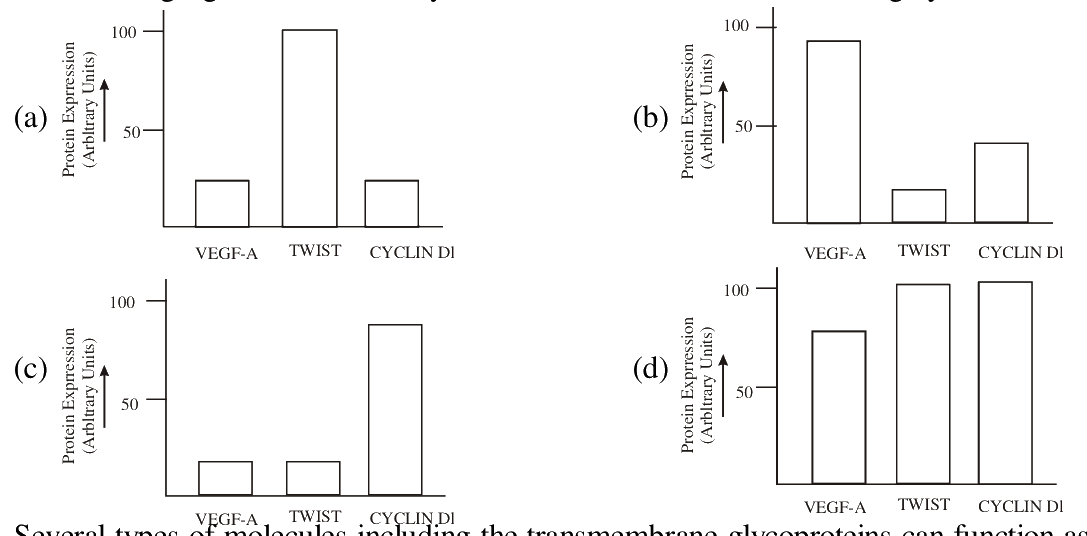
Q50 mcq
The major product formed in the following reaction is
Question 30 image
a.
(a)
b.
(b)
c.
(c)
d.
(d)
Correct Answer & Step-by-Step Solution Locked

Sign in free to reveal the correct answer and AI explanation for this question.
Q51 mcq
The major product formed in the following reaction is
Question 31 image
a.
(a)
b.
(b)
c.
(c)
d.
(d)
Correct Answer & Step-by-Step Solution Locked

Sign in free to reveal the correct answer and AI explanation for this question.
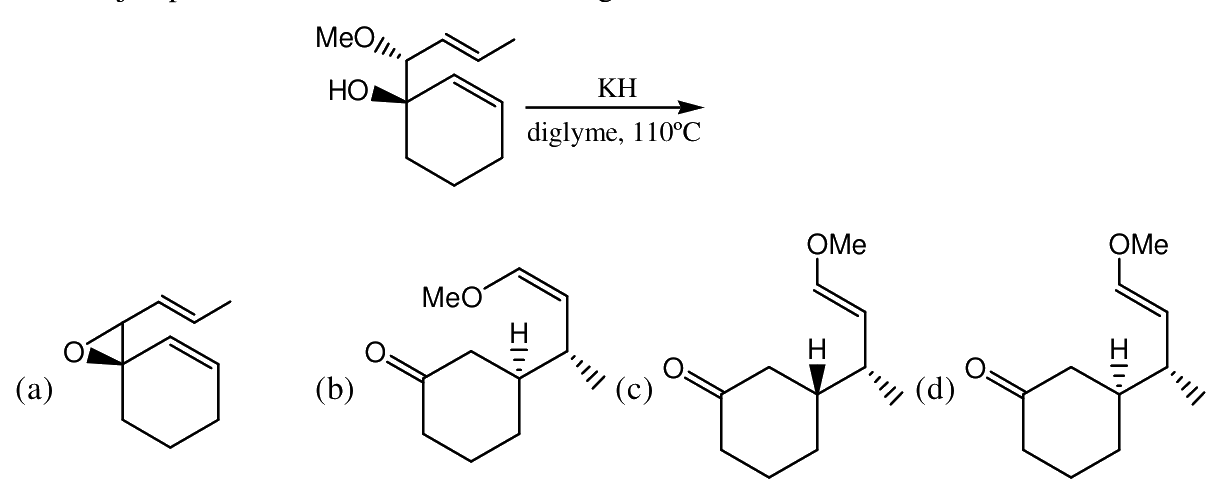
Q52 mcq
The major product formed in the following reaction is
Question 32 image
a.
(a)
b.
(b)
Correct Answer & Step-by-Step Solution Locked

Sign in free to reveal the correct answer and AI explanation for this question.
Q53 mcq
The concentration of a reactant R varies with time for two different reactions as shown in the following plots : The orders of these two reactions I and II, respectively are
Question 33 image
a.
zero and one
b.
one and zero
c.
zero and two
d.
two and zero
Correct Answer & Step-by-Step Solution Locked

Sign in free to reveal the correct answer and AI explanation for this question.
Q54 mcq
For a simple cubic crystal lattice, the angle between the $[2 ext{ }0 ext{ }1]$, plane and the $xy$ plane is
a.
less than $30^\circ$
b.
between $30^\circ$ and $45^\circ$
c.
between $45^\circ$ and $60^\circ$
d.
greater than $60^\circ$
Correct Answer & Step-by-Step Solution Locked

Sign in free to reveal the correct answer and AI explanation for this question.
Q55 mcq
For the following reaction, $$\text{A} \xrightleftharpoons[k_{-1}]{k_1} 2\text{B} ; \quad \text{B} \xrightarrow{k_2} \text{C}$$ $\frac{\mathrm{d}[\text{B}]}{\mathrm{dt}}$ is given by
a.
$k_1[\text{A}] - k_{-1}[\text{B}]^2 - 2k_2[\text{B}]$
b.
$2k_1[\text{A}] - k_{-1}[\text{B}]^2 - k_2[\text{B}]$
c.
$\frac{1}{2}k_1[\text{A}] - \frac{1}{2}k_{-1}[\text{B}]^2 - k_2[\text{B}]$
d.
$2k_1[\text{A}] - 2k_{-1}[\text{B}]^{1/2} - k_2[\text{B}]$
Correct Answer & Step-by-Step Solution Locked

Sign in free to reveal the correct answer and AI explanation for this question.
Q56 mcq
If the reduced mass of a diatomic molecule is doubled without changing its force constant, the vibrational frequency of the molecule will be
a.
$\sqrt{2}$ times the original frequency
b.
$\frac{1}{\sqrt{2}}$ times the vibrational frequency
c.
twice the original frequency
d.
unchanged
Correct Answer & Step-by-Step Solution Locked

Sign in free to reveal the correct answer and AI explanation for this question.
Q57 mcq
The standard deviation of speed ($\sigma_c$) for Maxwell's distribution satisfies the relation
a.
$\sigma_c \propto \text{T}$
b.
$\sigma_c \propto \sqrt{\text{T}}$
c.
$\sigma_c \propto 1/\text{T}$
d.
$\sigma_c \propto 1/\sqrt{\text{T}}$
Correct Answer & Step-by-Step Solution Locked

Sign in free to reveal the correct answer and AI explanation for this question.
Q58 mcq
The value of $\Delta\text{U} - \Delta\text{H}$ for the reaction $\text{Fe}_2\text{O}_3(\text{s}) + 3\text{C}(\text{s}) \longrightarrow 2\text{Fe}(\text{s}) + 3\text{CO}(\text{g})$ is
a.
-3RT
b.
+3RT
c.
+RT
d.
-RT
Correct Answer & Step-by-Step Solution Locked

Sign in free to reveal the correct answer and AI explanation for this question.
Q59 mcq
If the pressusre $p(\text{system})$ is greater than the $p(\text{surroundings})$, then
a.
work is done on the system by the surroundings
b.
work is down on the surroundigs by the systems
c.
work done on the system by the surroundings is equal to the work done on the surroundings by the system
d.
internal energy of the system increases
Correct Answer & Step-by-Step Solution Locked

Sign in free to reveal the correct answer and AI explanation for this question.
Q60 mcq
Two different non-zero operators $\hat{\text{A}}$ and $\hat{\text{B}} (\hat{\text{A}} \neq \hat{\text{B}})$ satisfy the relation $(\hat{\text{A}} + \hat{\text{B}})(\hat{\text{A}} - \hat{\text{B}}) = \hat{\text{A}}^2 - \hat{\text{B}}^2$
a.
$\hat{\text{A}}\hat{\text{B}} = \hat{\text{A}}^2$ and $\hat{\text{B}}\hat{\text{A}} = \hat{\text{B}}^2$
b.
$\hat{\text{A}}\hat{\text{B}} + \hat{\text{B}}\hat{\text{A}} = 0$
c.
$\hat{\text{A}}$ and $\hat{\text{B}}$ are arbitrary
d.
$\hat{\text{A}}\hat{\text{B}} - \hat{\text{B}}\hat{\text{A}} = 0$
Correct Answer & Step-by-Step Solution Locked

Sign in free to reveal the correct answer and AI explanation for this question.
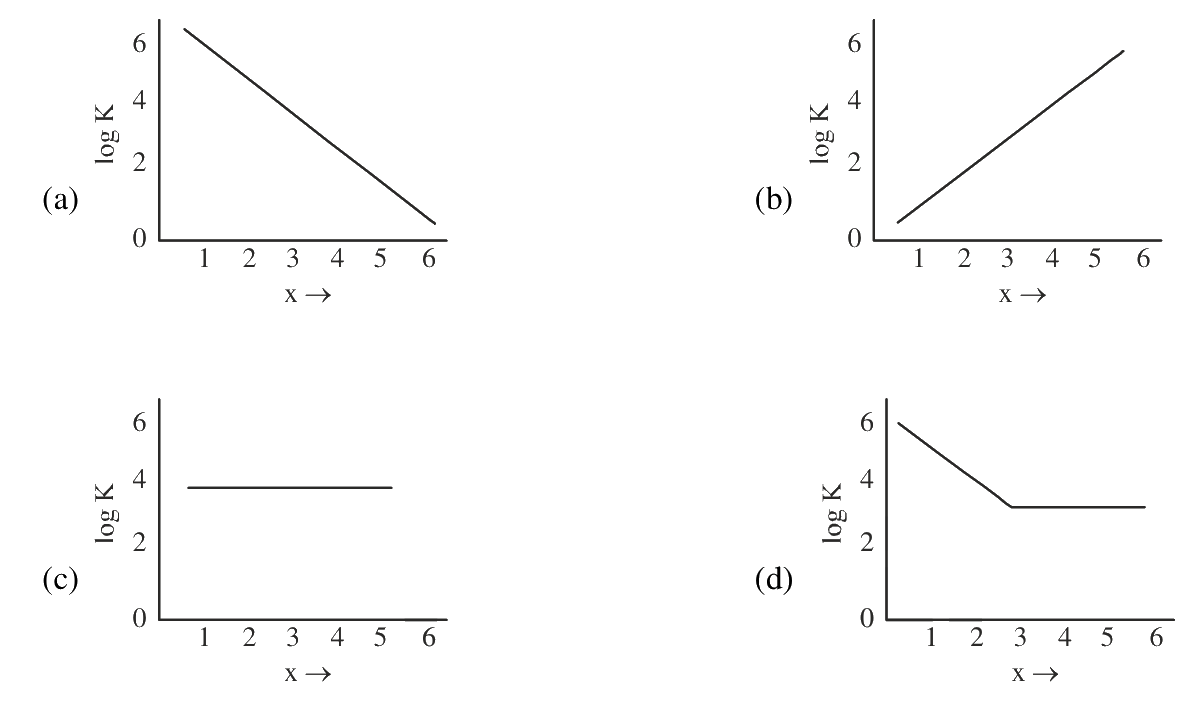
Q61 mcq
The degeneracy of an excited state of a particle in 3-dimensional cubic box with energy 3 times its ground state energy is
a.
3
b.
2
c.
1
d.
4
Correct Answer & Step-by-Step Solution Locked

Sign in free to reveal the correct answer and AI explanation for this question.
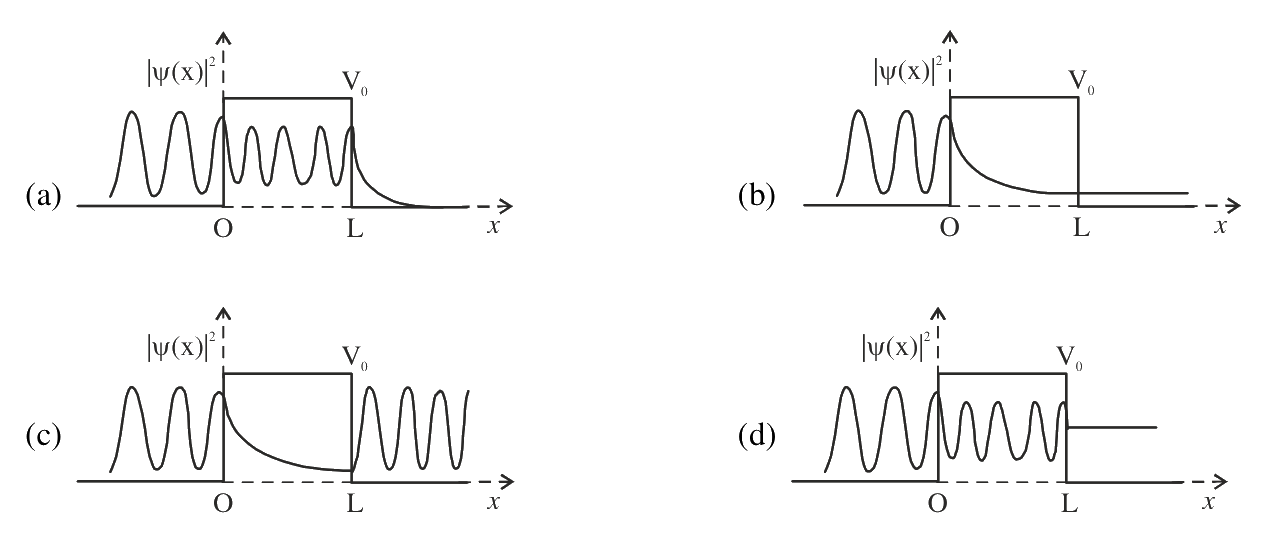
Q62 mcq
$\Delta\text{H}$ of a reaction is equal to slope of the plot of
a.
$\Delta\text{G}$ versus $(1/\text{T})$
b.
$\Delta\text{G}$ versus $\text{T}$
c.
$(\Delta\text{G}/\text{T})$ versus $\text{T}$
d.
$(\Delta\text{G}/\text{T})$ versus $(1/\text{T})$
Correct Answer & Step-by-Step Solution Locked

Sign in free to reveal the correct answer and AI explanation for this question.
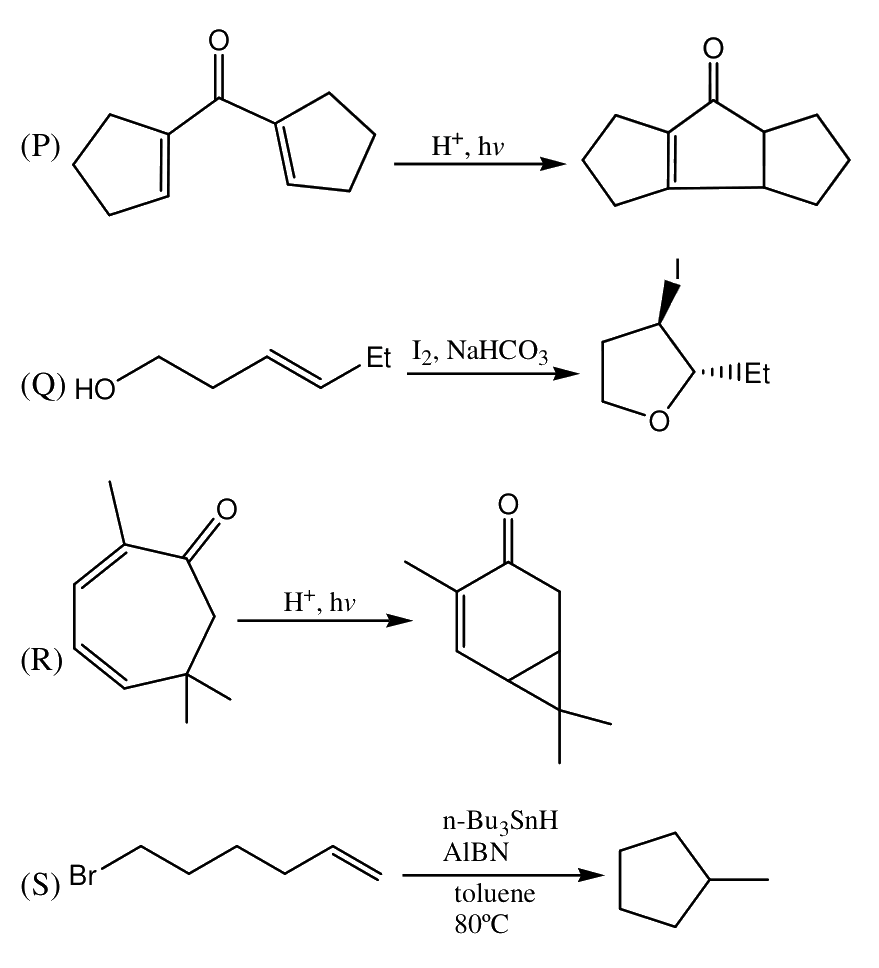
Q63 mcq
The correct form for a simple Langmuir isotherm is
a.
$\theta = \text{Kp}$
b.
$\theta = (\text{Kp})^{1/2}$
c.
$\theta = \text{Kp}/(1 + \text{Kp})$
d.
$\theta = (1 + \text{Kp})/\text{Kp}$
Correct Answer & Step-by-Step Solution Locked

Sign in free to reveal the correct answer and AI explanation for this question.
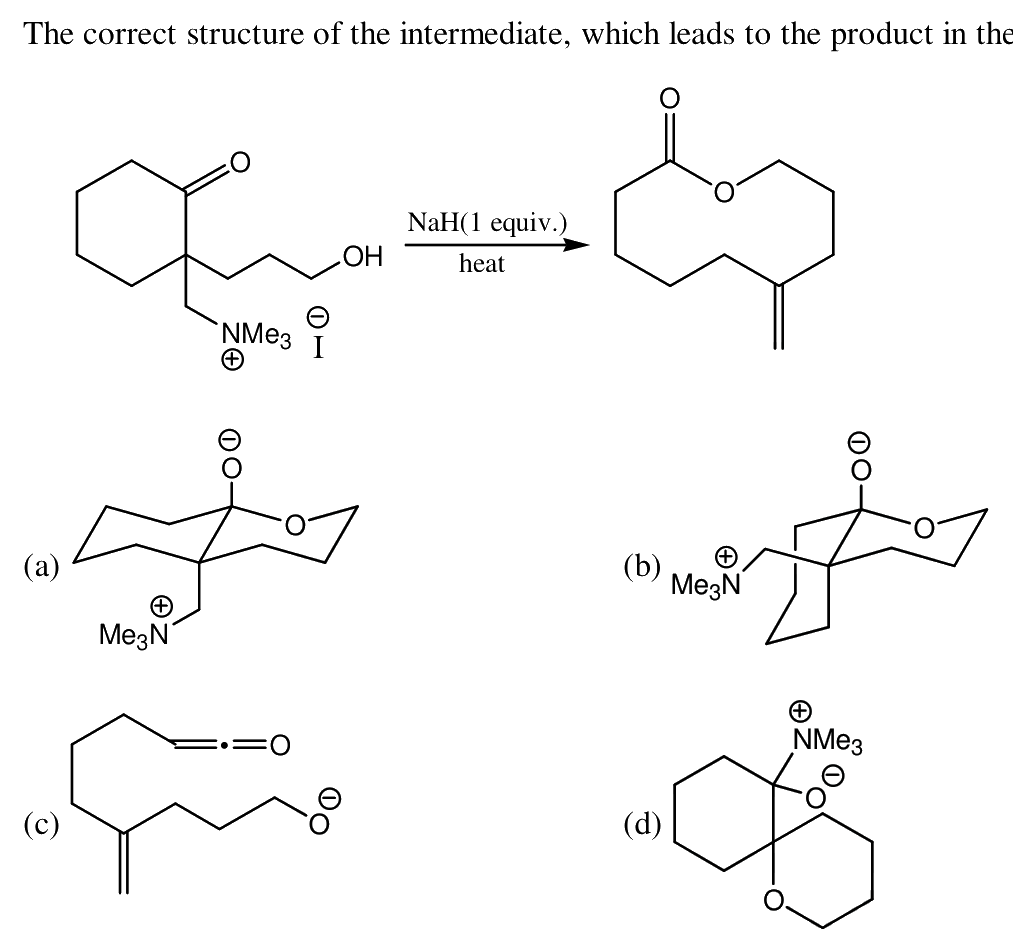
Q64 mcq
In Kohlrausch law, $\Lambda_{\text{m}} = \Lambda_{\text{m}}^0 - \kappa\sqrt{\text{c}}$, $\Lambda_{\text{m}}^0$ and $\kappa$
a.
depend only on stoichiometry
b.
depend only on specific identify of the electrolyte
c.
are independent of specific identify of the electrolyte
d.
are mainly dependent on specific identity of the electrolyte and stoichiometry, respectively
Correct Answer & Step-by-Step Solution Locked

Sign in free to reveal the correct answer and AI explanation for this question.
Q65 mcq
The correct expression for the product $((\overline{\text{M}}_{\text{n}}) \cdot (\overline{\text{M}}_{\text{w}}))$ [ $\overline{\text{M}}_{\text{n}}$ and $\overline{\text{M}}_{\text{w}}$ are the number-average and weight average molar masses, respectively, of a polymer] is
a.
$\text{N}^{-1}\sum_i \text{N}_i\text{M}_i$
b.
$\text{N}^{-1}\sum_i \text{N}_i\text{M}_i^2$
c.
$\text{N}/\sum_i \text{N}_i\text{M}_i$
d.
$\text{N}/\sum_i \text{N}_i\text{M}_i^2$
Correct Answer & Step-by-Step Solution Locked

Sign in free to reveal the correct answer and AI explanation for this question.
Q66 mcq
The concentration of a $\text{MgSO}_4$ solution having the same ionic strength as that of a $0.1\text{ M } \text{Na}_2\text{SO}_4$ solution is
a.
$0.05\text{ M}$
b.
$0.067\text{ M}$
c.
$0.075\text{ M}$
d.
$0.133\text{ M}$
Correct Answer & Step-by-Step Solution Locked

Sign in free to reveal the correct answer and AI explanation for this question.

Q67 mcq
$\text{sp}$ hybrid orbitals are of the form $\text{C}_1 2\text{s} + \text{C}_2 2\text{p}_{\text{z}}$ ($2\text{s}$ and $2\text{p}_{\text{z}}$ are normalised individually). The coefficients of the normalized form fo the above sp hybrid orbitals are
a.
$\text{C}_1 = \frac{1}{\sqrt{2}}, \text{C}_2 = \pm\frac{1}{\sqrt{2}}$
b.
$\text{C}_1 = \frac{1}{2}, \text{C}_2 = \pm\frac{1}{2}$
c.
$\text{C}_1 = \frac{1}{\sqrt{2}}, \text{C}_2 = \pm\frac{1}{2}$
d.
$\text{C}_1 = \frac{1}{2}, \text{C}_2 = \pm\frac{1}{\sqrt{2}}$
Correct Answer & Step-by-Step Solution Locked

Sign in free to reveal the correct answer and AI explanation for this question.
Q68 mcq
The correct statement among the following is
a.
$\text{N}_2$ has higher bond order than $\text{N}_2^+$ and hence has larger bond length compared to $\text{N}_2^+$.
b.
$\text{N}_2^+$ has higher bond order than $\text{N}_2$ and hence has larger bond length compared to $\text{N}_2$.
c.
$\text{N}_2$ has higher bond order than $\text{N}_2^+$ and hence has higher dissociation energy compared to $\text{N}_2^+$.
d.
$\text{N}_2$ has lower bond order than $\text{N}_2^+$ and hence has lower dissociation energy compared to $\text{N}_2^+$ energy.
Correct Answer & Step-by-Step Solution Locked

Sign in free to reveal the correct answer and AI explanation for this question.
Q69 mcq
The formation constant for the complexation of $\text{M}^+$ ($\text{M} = \text{Li}, \text{Na}, \text{K}$ and $\text{Cs}$) with cryptand, C222 follows the order
a.
$\text{Li}^+ < \text{Cs}^+ < \text{Na}^+ < \text{K}^+$
b.
$\text{Li}^+ < \text{Na}^+ < \text{K}^+ < \text{Cs}^+$
c.
$\text{K}^+ < \text{Cs}^+ < \text{Li}^+ < \text{Na}^+$
d.
$\text{Cs}^+ < \text{K}^+ < \text{Li}^+ < \text{Na}^+$
Correct Answer & Step-by-Step Solution Locked

Sign in free to reveal the correct answer and AI explanation for this question.
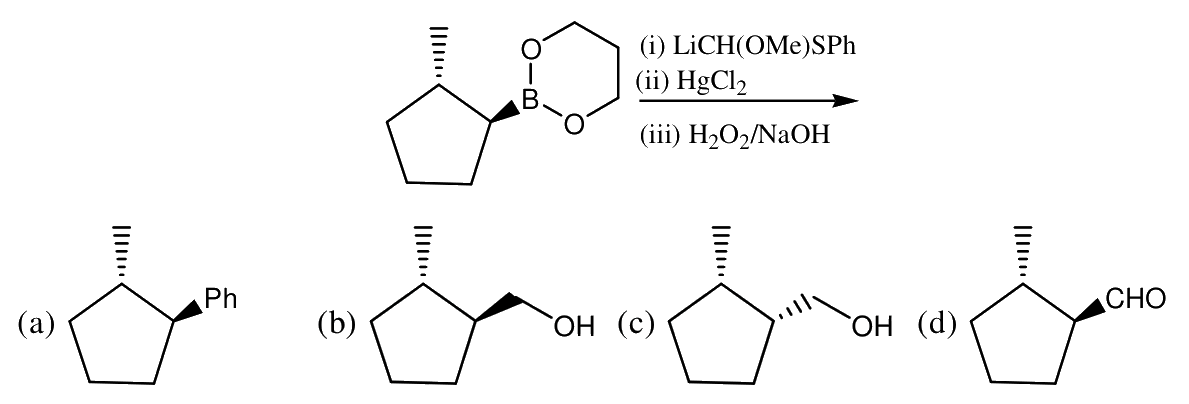
Q70 mcq
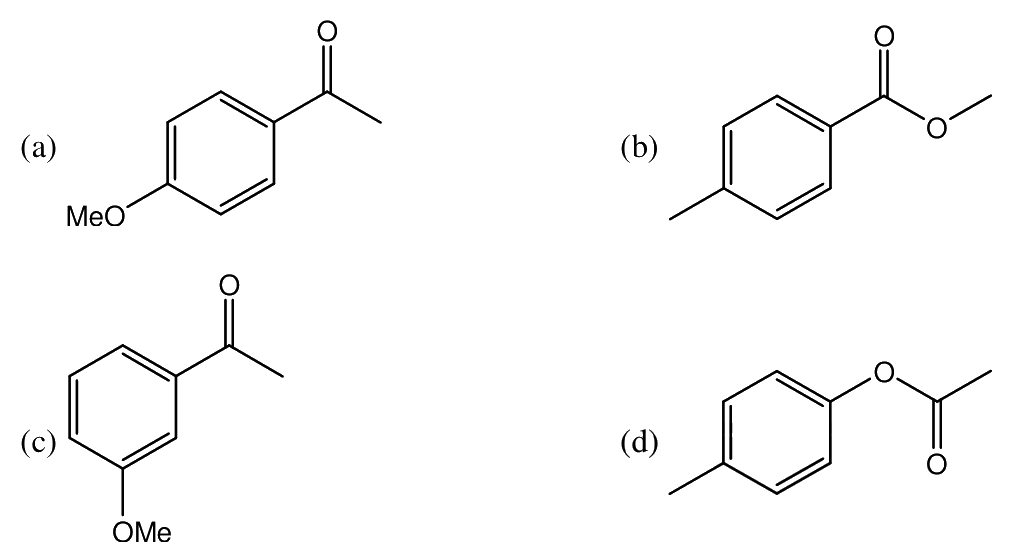
The correct match for the compounds in column A with the description in column B is **Column - A** (P) (Q) (R) **Column - B** (X) Oil of Wintergreen (Y) Aspirin (Z) Ibuprofen
Question 50 image
a.
P-Y, Q-Z, R-X
b.
P-Z, Q-X, R-Y
c.
P-Z, Q-Y, R-X
d.
P-X, Q-Z, R-Y
Correct Answer & Step-by-Step Solution Locked

Sign in free to reveal the correct answer and AI explanation for this question.
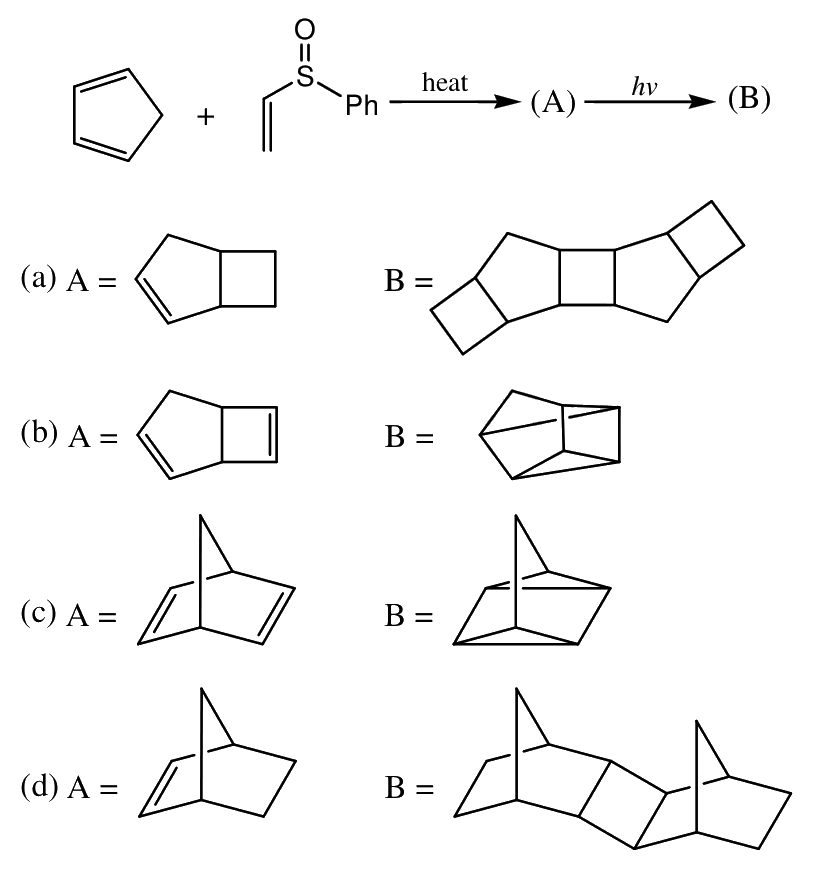
Q71 mcq
The resonance Raman stretching frequency ($v_{\text{O}-\text{O}}$, in $\text{cm}^{-1}$) of $\text{O}_2$ is 1580. The $v_{\text{O}-\text{O}}$ for $\text{O}_2$ in bound oxy-hemoglobin is close to
a.
1600
b.
1900
c.
800
d.
1100
Correct Answer & Step-by-Step Solution Locked

Sign in free to reveal the correct answer and AI explanation for this question.
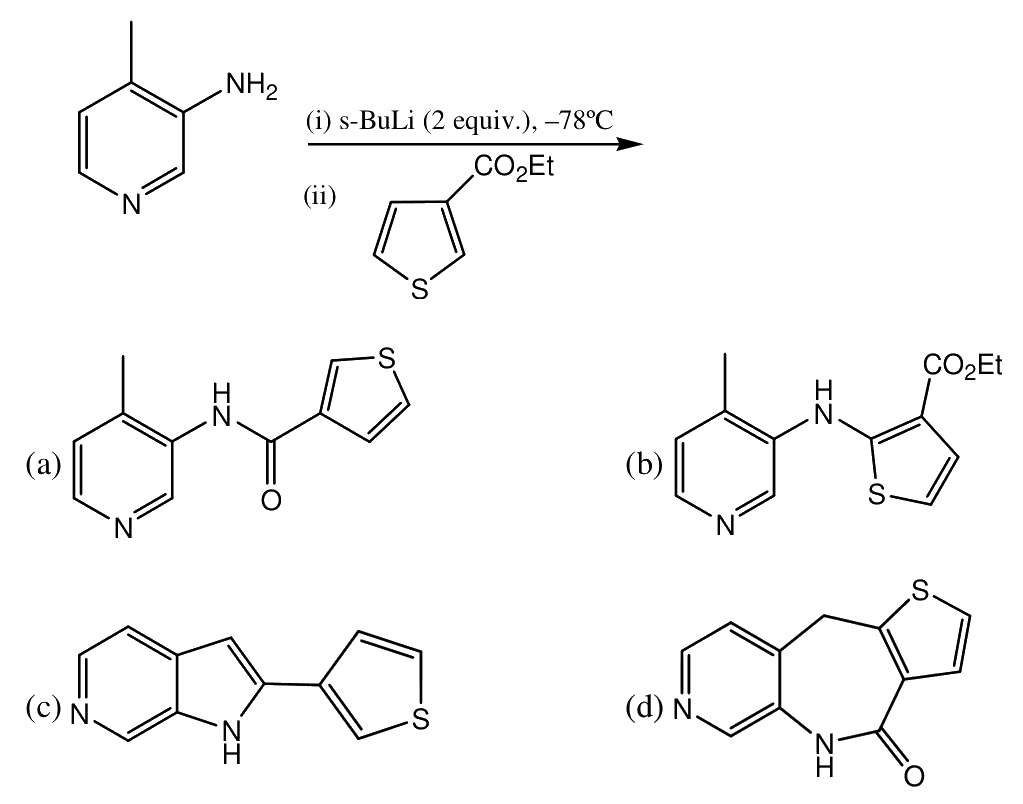
Q72 mcq
Match the metalloprotein in Column-A with its biological function and metal centre in Column-B. **Column-A** (A) hemoglobin (B) cytochrome b (C) vitamin $\text{B}_{12}$ (D) hemocyanin **Column-B** (I) electron carrier and iron (II) electron carrier and copper (III) $\text{O}_2$ transport and copper (IV) Group transfer reactions and cobalt (V) $\text{O}_2$ storage and cobalt (VI) $\text{O}_2$ transport and iron The correct match is
a.
A-VI, B-I, C-IV and D-III
b.
A-V, B-I, C-IV and D-III
c.
A-VI, B-V, C-I and D-II
d.
A-V, B-VI, C-II and D-IV
Correct Answer & Step-by-Step Solution Locked

Sign in free to reveal the correct answer and AI explanation for this question.
Q73 mcq
Pick the correct statements about Atomic Absorption Spectrometry (AAS) from the following (A) Hg lamp is not a suitable source for AAS (B) Graphite furnace is the best atomizer for AAS (C) Non-metals cannot be determined with AAS (d) AAS is better than ICP-AES for simultaneous determination of metal ions. Correct answer is
a.
A, B and C
b.
B, C and D
c.
C, D and A
d.
D, A and B
Correct Answer & Step-by-Step Solution Locked

Sign in free to reveal the correct answer and AI explanation for this question.
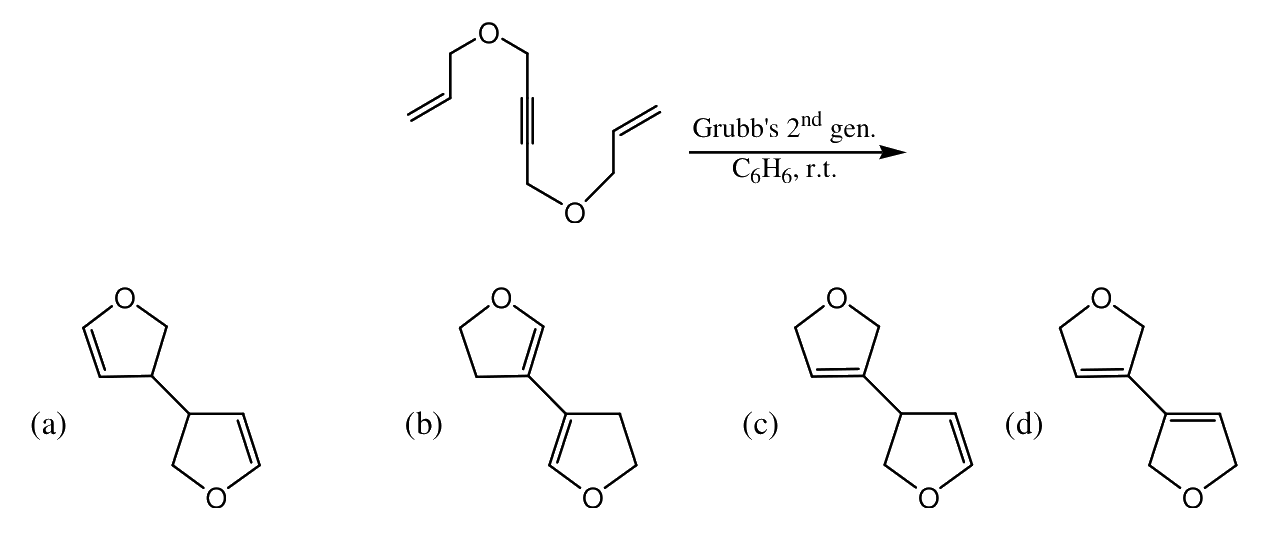
Q74 mcq
Identify radioactive capture from the following nuclear reactions
a.
$^9\text{Be}(\gamma \cdot \text{n})\, ^8\text{Be}$
b.
$^{23}\text{Na}(\text{n} \cdot \gamma)\, ^{24}\text{Na}$
c.
$^{63}\text{Cu}(\text{p} \cdot \text{p } 3\text{n } 9\alpha)\, ^{24}\text{Na}$
d.
$^{107}\text{Ag}(\text{n} \cdot \text{n})\, ^{107}\text{Ag}$
Correct Answer & Step-by-Step Solution Locked

Sign in free to reveal the correct answer and AI explanation for this question.
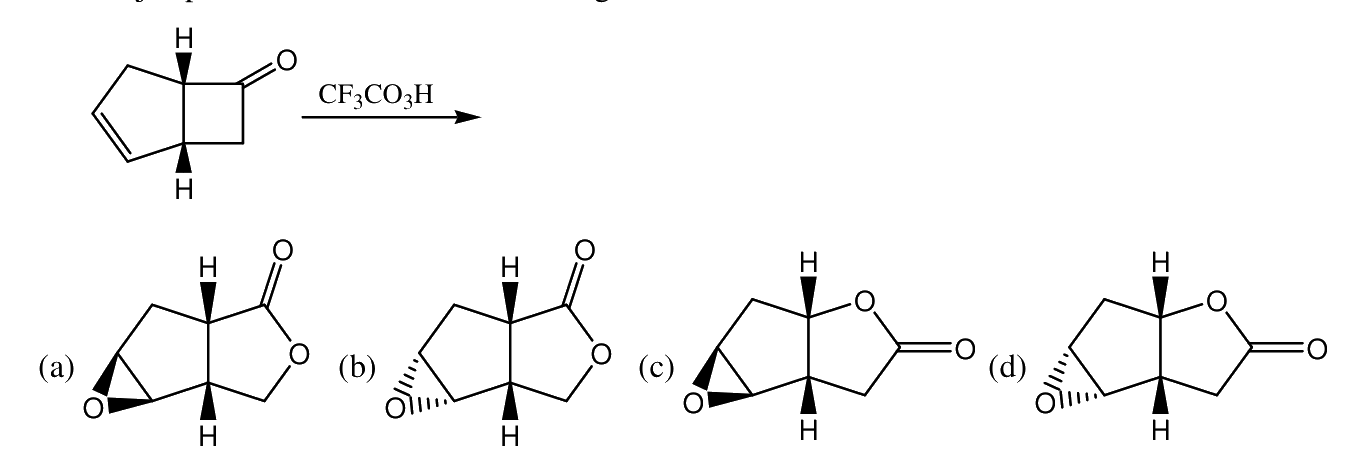
Q75 mcq
The calibration curve in spectrofluorimetric analysis becomes non-linear when
a.
molecular weight of analyte is high
b.
intensity of light source is high
c.
concentration of analyte is high
d.
molar absorptivity of analyte is high
Correct Answer & Step-by-Step Solution Locked

Sign in free to reveal the correct answer and AI explanation for this question.
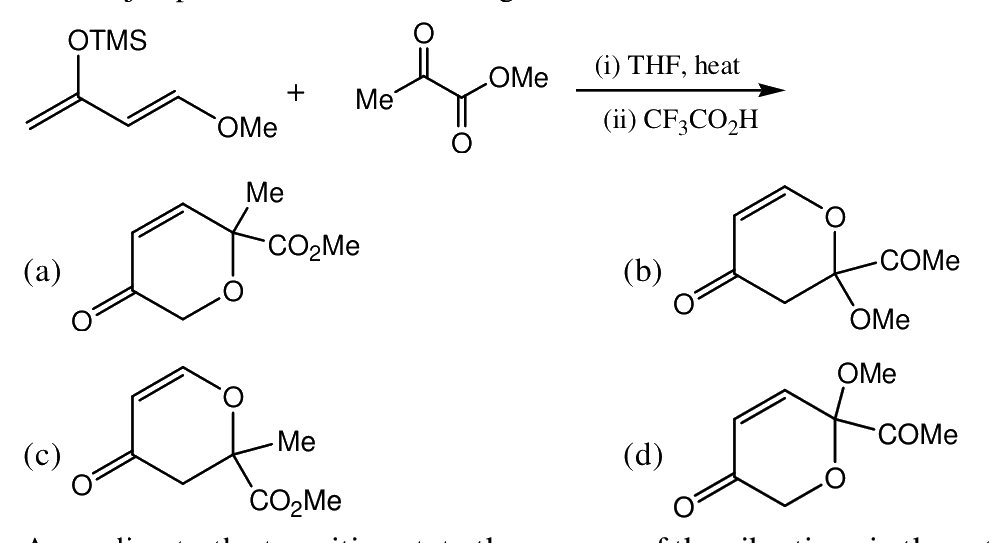
Q76 mcq
$[\text{MnO}_4]^-$ is deep purple in color whereas $[\text{ReO}_4]^-$ is colorless. This is due to greater energy required for
a.
d-d transitions in the Re compound compared to the Mn compound
b.
d-d transitions in the Mn compound compared to the Re compound
c.
charge transfer from O to Re compared to O to Mn
d.
charge transfer from O to Mn compared to O to Re
Correct Answer & Step-by-Step Solution Locked

Sign in free to reveal the correct answer and AI explanation for this question.

Q77 mcq
$[(\eta^3-\text{C}_3\text{H}_5)\text{Mn}(\text{CO})_4]$ shows fluxional behavior. The $^1\text{H}$ NMR spectrum of this compound when it is in the non-fluxional state shows
a.
one signal
b.
two signals in the intensity ratio of $4 : 1$
c.
three signals in the intensity ratio of $2 : 2 : 1$
d.
five signals of equal intensity.
Correct Answer & Step-by-Step Solution Locked

Sign in free to reveal the correct answer and AI explanation for this question.

Q78 mcq
The number of lone pair(s) of electrons on the central atom in $[\text{BrF}_4]^-$, $\text{XeF}_6$ and $[\text{SbCl}_6]^{3-}$ are, respectively
a.
$2, 0$ and $1$
b.
$1, 0$ and $0$
c.
$2, 1$ and $1$
d.
$2, 1$ and $0$
Correct Answer & Step-by-Step Solution Locked

Sign in free to reveal the correct answer and AI explanation for this question.

Q79 mcq
Consider the following reaction : $$\text{N}_3\text{P}_3\text{Cl}_6 + 6\text{HNMe}_2 \rightarrow \underset{\text{[A]}}{\text{N}_3\text{P}_3\text{Cl}_3(\text{NMe}_2)_3} + 3\text{Me}_2\text{NH}\cdot\text{HCl}$$ The number of possible isomers for [A] is
a.
4
b.
3
c.
2
d.
5
Correct Answer & Step-by-Step Solution Locked

Sign in free to reveal the correct answer and AI explanation for this question.

Q80 mcq
Using Wade's rules predict the structure type of $[\text{C}_2\text{B}_5\text{H}_7]$
a.
nido
b.
closos
c.
arachno
d.
hypho
Correct Answer & Step-by-Step Solution Locked

Sign in free to reveal the correct answer and AI explanation for this question.

Q81 mcq
Among the following complexes (A) $[\text{Co}(\text{ox})_3]^{3-}$ (B) $\text{trans}-[\text{CoCl}_2(\text{en})_2]^+$ (C) $[\text{Cr}(\text{EDTA})]^-$ the chiral one(s) is/are
a.
A and B
b.
C and B
c.
C only
d.
A and C
Correct Answer & Step-by-Step Solution Locked

Sign in free to reveal the correct answer and AI explanation for this question.

Q82 mcq
Mössbauer spectrum of a metal complex gives information about (A) oxidation state and spin state of metal (B) types of ligands coordinated to metal (C) nuclear spin state of metal (D) geometrey of metal Correct answer is
a.
A and C
b.
B and C
c.
A, B and D
d.
B and D
Correct Answer & Step-by-Step Solution Locked

Sign in free to reveal the correct answer and AI explanation for this question.

Q83 mcq
For uranocene, the correct statement(s) is/are (A) oxidation state of uranium is '$+4$' (B) it has cyclooctatetraenide ligands (C) it is bent sandwich compound (D) it has '$-2$' charge Correct answer is
a.
A and B
b.
B and C
c.
A and D
d.
B only
Correct Answer & Step-by-Step Solution Locked

Sign in free to reveal the correct answer and AI explanation for this question.

Q84 mcq
The final products of the reaction of carbonyl metalates $\left[\mathrm{V}(\mathrm{CO})_6\right]^-$ and $\left[\mathrm{Co}(\mathrm{CO})_4\right]^-$ with $\mathrm{H}_3\mathrm{PO}_4$, respectaively, are
a.
$\mathrm{V}(\mathrm{CO})_6$ and $\mathrm{HCo}(\mathrm{CO})_4$
b.
$\mathrm{HV}(\mathrm{CO})_6$ and $\mathrm{Co}_2(\mathrm{CO})_8$
c.
$\left[\mathrm{H}_2\mathrm{V}(\mathrm{CO})_6\right]^+$ and $\mathrm{HCo}(\mathrm{CO})_4$
d.
$\mathrm{V}(\mathrm{CO})_6$ and $\mathrm{Co}_2(\mathrm{CO})_8$
Correct Answer & Step-by-Step Solution Locked

Sign in free to reveal the correct answer and AI explanation for this question.

Q85 mcq
The correct statement about the substitution reaction of $\left[\mathrm{Co}(\mathrm{CN})_5 \mathrm{Cl}\right]^{3-}$ with $\mathrm{OH}^-$ to give $\left[\mathrm{Co}(\mathrm{CN})_5(\mathrm{OH})\right]^{3-}$ is,
a.
it obeys first order kinetics
b.
its rate is proportional to the concentration of both the the reactants
c.
it follows the $\mathrm{S}_\mathrm{N}^1\mathrm{CB}$ mechanism
d.
its rate is dependent only on the concentration of $[\mathrm{OH}]^-$
Correct Answer & Step-by-Step Solution Locked

Sign in free to reveal the correct answer and AI explanation for this question.

Q86 mcq
Aqueous $\mathrm{Cr}^{2+}$ effects one electron reduction of $\left[\mathrm{Co}\left(\mathrm{NH}_3\right)_5 \mathrm{Cl}\right]^{2+}$ giving compound Y. Compound Y undergoes rapid hydrolysis. Y is ,
a.
$\left[\mathrm{Co}\left(\mathrm{NH}_3\right)_5\right]^{2+}$
b.
$\left[\mathrm{Co}\left(\mathrm{NH}_3\right)_5(\mathrm{OH})\right]^+$
c.
$\left[\mathrm{Co}\left(\mathrm{NH}_3\right)_4(\mathrm{OH})_2\right]$
d.
$\left[\mathrm{Cr}\left(\mathrm{H}_2 \mathrm{O}\right)_5 \mathrm{Cl}\right]^{2+}$
Correct Answer & Step-by-Step Solution Locked

Sign in free to reveal the correct answer and AI explanation for this question.

Q87 mcq
The reaction of $\mathrm{BCl}_3$ with $\mathrm{NH}_4 \mathrm{Cl}$ gives product A which upon reduction by $\mathrm{NaBH}_4$ gives product B. Product B upon reacting with $\mathrm{HCl}$ affords compound C, which is
a.
$\mathrm{Cl}_3\mathrm{B}_3\mathrm{N}_3\mathrm{H}_9$
b.
$[\mathrm{ClBNH}]_3$
c.
$[\mathrm{HBNH}]_3$
d.
$(\mathrm{ClH})_3 \mathrm{B}_3 \mathrm{N}_3(\mathrm{ClH})_3$
Correct Answer & Step-by-Step Solution Locked

Sign in free to reveal the correct answer and AI explanation for this question.

Q88 mcq
The number of valence electrons provided by $\left[\mathrm{Ru}(\mathrm{CO})_3\right]$ fragment towards cluster bonding is
a.
1
b.
14
c.
6
d.
2
Correct Answer & Step-by-Step Solution Locked

Sign in free to reveal the correct answer and AI explanation for this question.

Q89 mcq
Choose the correct statements about Tanabe-Sugano diagrams (A) $\mathrm{E/B}$ is plotted against $\Delta_0 / \mathrm{B}$ (B) The zero energy is taken as that of the lowest term (C) Terms of the same symmetry cross each other (D) Two terms of the same symmetry upon increases of ligand field strength bend apart from each other. Correct answer is
a.
A and B
b.
A and C
c.
A, B and D
d.
A, B, C and D
Correct Answer & Step-by-Step Solution Locked

Sign in free to reveal the correct answer and AI explanation for this question.

Q90 mcq
Which of the following statements are TRUE for the lanthanides? (A) the observed magnetic moment of $\mathrm{Eu}^{3+}$ at room temperature is higher than that calculated from spin-orbit coupling (B) Lanthanide oxides are predominantly acidic in nature (C) The stability of $\mathrm{Sm(II)}$ is due to its half-filled sub-shell. (D) Lanthanide (III) ions can be separated by ion exchange chromatography Correct answer is
a.
A and D
b.
A and B
c.
A and C
d.
B and C
Correct Answer & Step-by-Step Solution Locked

Sign in free to reveal the correct answer and AI explanation for this question.

Q91 mcq
The intermediate and the final major product of photolysis of $\mathbf{Z}$. From the following: are
Question 71 image
a.
A and D
b.
B and D
c.
B and C
d.
A and C
Correct Answer & Step-by-Step Solution Locked

Sign in free to reveal the correct answer and AI explanation for this question.

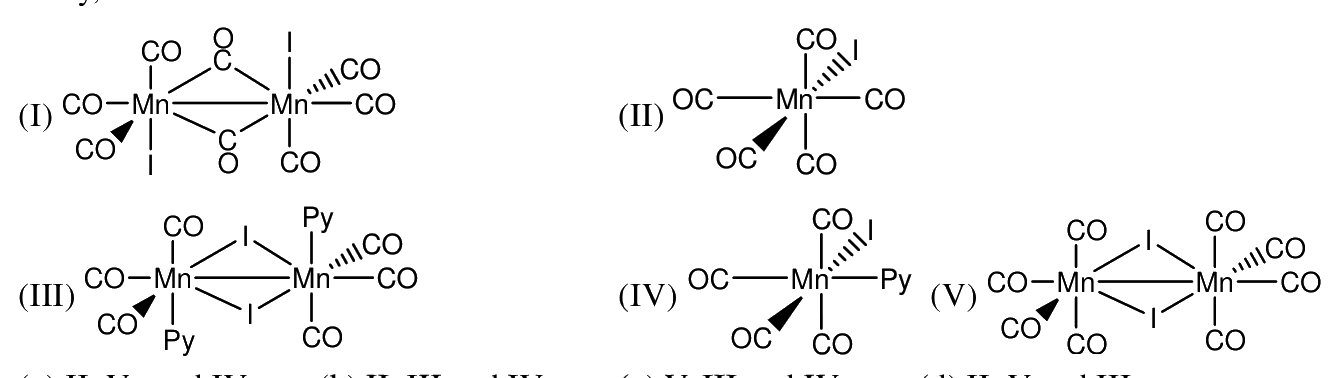
Q92 mcq
Reaction of $[\text{Mn}_2(\text{CO})_{10}]$ with $\text{I}_2$ results in A without loss of CO. Compound A, on heating ot $120^\circ\text{C}$ loses a CO ligand to give B, which does not have a Mn–Mn bond. Compound B reacts with pyridine to give 2 equivalents of C. Compounds A, B and C from the following respectively, are
Question 72 image
a.
II, V anad IV
b.
II, III and IV
c.
V, III and IV
d.
II, V and III
Correct Answer & Step-by-Step Solution Locked

Sign in free to reveal the correct answer and AI explanation for this question.

Q93 mcq
The approximate positions of $\nu_{\text{CO}}$ bands ($\text{cm}^{-1}$) in the solid-state infrared spectrum and the Fe-Fe bond order in $[\text{Fe}(\eta^5-\text{C}_5\text{H}_5)(\mu-\text{CO})(\text{CO})]_2$ (non-centrosymmetric) respectively, are
a.
(2020, 1980, 1800) and one
b.
(2020, 1980, 1800) and two
c.
(2020, 1980) and one
d.
(2143) and one
Correct Answer & Step-by-Step Solution Locked

Sign in free to reveal the correct answer and AI explanation for this question.

Q94 mcq
Protonated form of ZSM-5 catalyzes the reaction of ethene with benzene to produce ethylbenzene. The correct statement for this catalytic process is
a.
alkyl carbocation is formed
b.
carbanion is formed
c.
benzene is converted to $(\text{C}_6\text{H}_5)^+$ group
d.
vinyl radical is formed
Correct Answer & Step-by-Step Solution Locked

Sign in free to reveal the correct answer and AI explanation for this question.

Q95 mcq
Three electronic transitions at 14900, 22700 and $34400\text{ cm}^{-1}$ are observed in the absorption spectrum of $[\text{CrF}_6]^{3-}$. The $\Delta_0$ value (in $\text{cm}^{-1}$) and the corresponding transition are
a.
7800 and ${^4\text{A}_{2\text{g}}} \rightarrow {^4\text{T}_{2\text{g}}}$
b.
14900 and ${^4\text{A}_{2\text{g}}} \rightarrow {^4\text{T}_{2\text{g}}}$
c.
14900 and ${^4\text{T}_{2\text{g}}} \rightarrow {^4\text{T}_{1\text{g}}}\text{ (F)}$
d.
7800 and ${^4\text{T}_{2\text{g}}} \rightarrow {^4\text{T}_{1\text{g}}}\text{ (F)}$
Correct Answer & Step-by-Step Solution Locked

Sign in free to reveal the correct answer and AI explanation for this question.

Q96 mcq
The major product formed in the following reaction is
Question 76 image
Correct Answer & Step-by-Step Solution Locked

Sign in free to reveal the correct answer and AI explanation for this question.

Q97 mcq
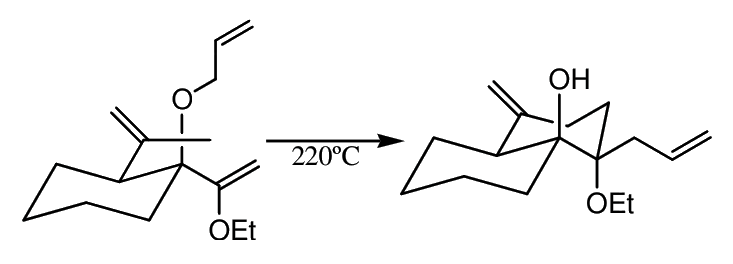
The following transformation involves sequential
Question 77 image
a.
Claisen rearrangement - Cope rearrangement - ene reaction
b.
Cope rearrangement - Claisen rearrangement - ene reaction
c.
Cope rearrangement – ene reaction - Claisen rearrangement.
d.
ene reaction - Claisen rearrangement - Cope rearrangement.
Correct Answer & Step-by-Step Solution Locked

Sign in free to reveal the correct answer and AI explanation for this question.

Q98 mcq
The major product formed in the following reaction sequence is
Question 78 image
Correct Answer & Step-by-Step Solution Locked

Sign in free to reveal the correct answer and AI explanation for this question.

Q99 mcq
The major products A and B in the following reaction sequence are
Question 79 image
Correct Answer & Step-by-Step Solution Locked

Sign in free to reveal the correct answer and AI explanation for this question.

Q100 mcq
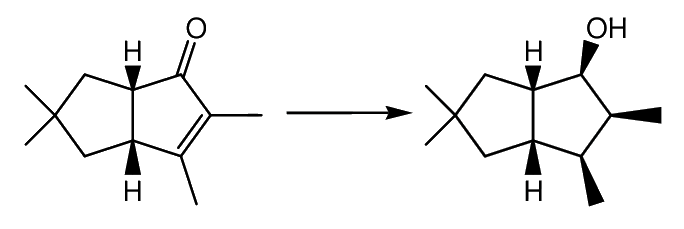
The major product formed in the following reaction is
Question 80 image
Correct Answer & Step-by-Step Solution Locked

Sign in free to reveal the correct answer and AI explanation for this question.

Q101 mcq
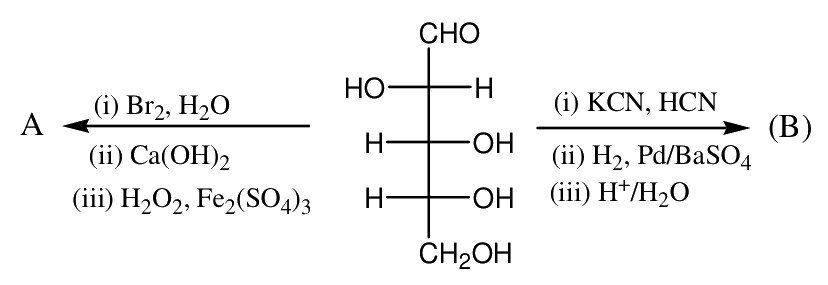
The major products A and B in the following reaction sequences are
Question 81 image
a.
A = D-threose; B = D-glucose
b.
A = D-etythrose; B = D-glucose + D-mannose
c.
A = D-threose; B = D-glucose + D-mannose
d.
A = D-tartaric acid; B = D-glucose
Correct Answer & Step-by-Step Solution Locked

Sign in free to reveal the correct answer and AI explanation for this question.

Q102 mcq
The major products A and B in the following reaction sequence are
Question 82 image
a.
$A = \overset{\ominus}{\text{Br}}\ \overset{\oplus}{\text{Ph}_3\text{P}}\text{CH}=\text{CH}_2$, B as shown
b.
$A = \text{Ph}_3\text{P}=\text{CH}-\text{CH}=\text{PPh}_3$, B as shown
c.
$A = \text{Ph}_3\text{P}=\text{CH}-\text{CH}=\text{PPh}_3$, B as shown
d.
$A = \overset{\ominus}{\text{Br}}\ \overset{\oplus}{\text{Ph}_3\text{P}}\text{CH}=\text{CH}_2$, B as shown
Correct Answer & Step-by-Step Solution Locked

Sign in free to reveal the correct answer and AI explanation for this question.

Q103 mcq
The major products A and B in the following reaction sequence are
Question 83 image
a.
A and B as shown in (a)
b.
A and B as shown in (b)
Correct Answer & Step-by-Step Solution Locked

Sign in free to reveal the correct answer and AI explanation for this question.

Q104 mcq
The major products A and B in the following reactions sequence are
Question 84 image
Correct Answer & Step-by-Step Solution Locked

Sign in free to reveal the correct answer and AI explanation for this question.

Q105 mcq
The major products A and B in the following reaction sequence are
Question 85 image
Correct Answer & Step-by-Step Solution Locked

Sign in free to reveal the correct answer and AI explanation for this question.

Q106 mcq
The major product formed in the following reaction is
Question 86 image
Correct Answer & Step-by-Step Solution Locked

Sign in free to reveal the correct answer and AI explanation for this question.

Q107 mcq
The major product formed in the following reaction is
Question 87 image
Correct Answer & Step-by-Step Solution Locked

Sign in free to reveal the correct answer and AI explanation for this question.

Q108 mcq
The major products A and B in the following reaction sequence are
Question 88 image
a.
A = 2-((dimethylamino)methyl)-1-methyl-1H-pyrrole, B = 1,2-dimethyl-1H-pyrrole-3-carbonitrile
b.
A = 2-((dimethylamino)methyl)-1-methyl-1H-pyrrole, B = 2-(1-methyl-1H-pyrrol-2-yl)acetonitrile
c.
A = 3-((dimethylamino)methyl)-1-methyl-1H-pyrrole, B = 1,3-dimethyl-1H-pyrrole-2-carbonitrile
d.
A = 3-((dimethylamino)methyl)-1-methyl-1H-pyrrole, B = 2-(1-methyl-1H-pyrrol-3-yl)acetonitrile
Correct Answer & Step-by-Step Solution Locked

Sign in free to reveal the correct answer and AI explanation for this question.

Q109 mcq
The major products A and B in the following reaction sequence are ($E = \text{CO}_2\text{Me}$)
Question 89 image
a.
A with $N=N$ bridge/dimer; B with $N=N$ backbone
b.
A with $N$-chloro amine; B = $\text{HO}-\text{CH}_2\text{CH}_2\text{CH}(\text{CH}_3)\text{CH}(\text{NH}_2)E$
c.
See image for structures of A and B
d.
See image for structures of A and B
Correct Answer & Step-by-Step Solution Locked

Sign in free to reveal the correct answer and AI explanation for this question.

Q110 mcq
The correct reagent combination to effect the following transformation is
Question 90 image
a.
$\text{A} = \text{NaBH}_4, \text{BF}_3\cdot\text{OEt}_2; \text{B} = \text{MeMgBr (2.5 equiv.)}, \text{THF then } \text{H}_3\text{O}^+$
b.
$\text{A} = \text{BH}_3\cdot\text{THF}; \text{B} = \text{MeLi (2.5 equiv.)}, \text{THF then } \text{H}_3\text{O}^+$
c.
$\text{A} = \text{BH}_3\cdot\text{THF}; \text{B} = \text{(i) aq. NaOH then } \text{H}_3\text{O}^+, \text{(ii) MeLi (2.5 equiv.), THF then } \text{H}_3\text{O}^+$
d.
$\text{A} = \text{(i) Me}_3\text{Al}, \text{MeNHOMe}, \text{(ii) MeMgBr}, \text{THF then } \text{H}_3\text{O}^+; \text{B} = \text{LiAlH}_4, \text{THF}$
Correct Answer & Step-by-Step Solution Locked

Sign in free to reveal the correct answer and AI explanation for this question.

Q111 mcq
The mechanism and the product formed in the following reaction, respectively, are
Question 91 image
a.
$\text{S}_\text{N}2$
b.
$\text{S}_\text{N}1$
c.
$\text{S}_\text{N}2$
d.
$\text{S}_\text{N}1$
Correct Answer & Step-by-Step Solution Locked

Sign in free to reveal the correct answer and AI explanation for this question.

Q112 mcq
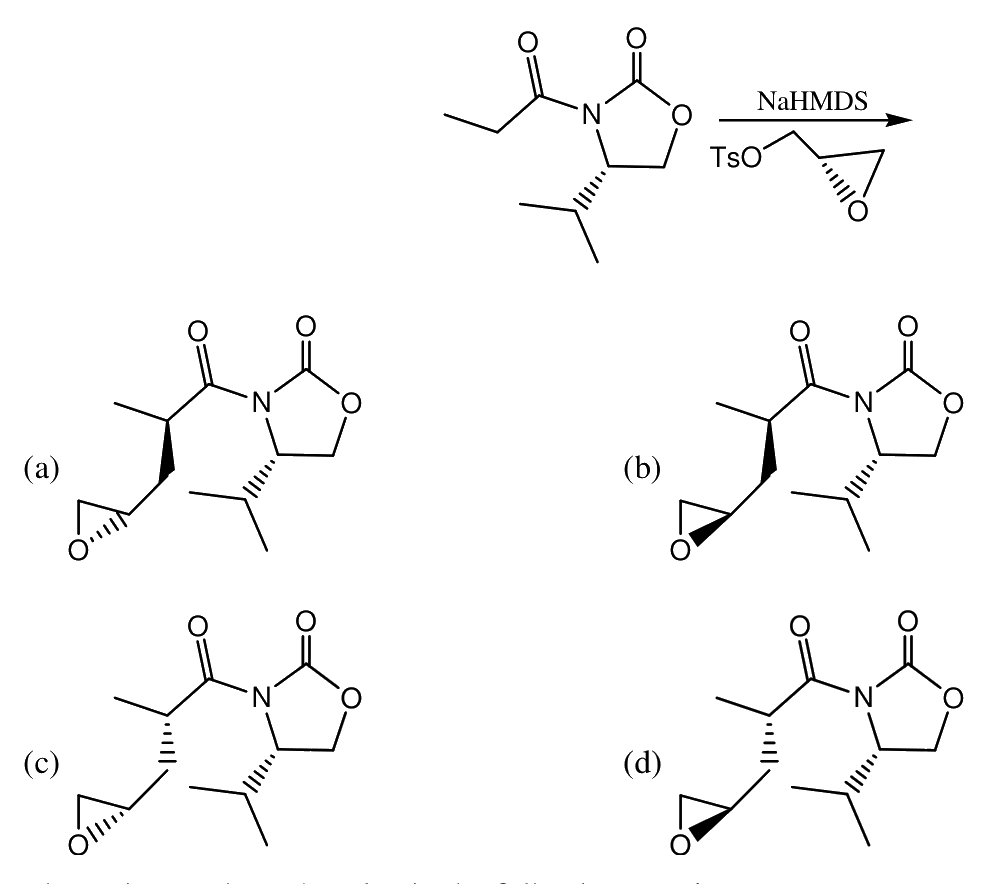
A concerted [1, 3]-sigmatropic rearrangement took place in the reaction shown below. The structure of the resulting product is
Question 92 image
a.
(a)
b.
(b)
c.
(c)
d.
(d)
Correct Answer & Step-by-Step Solution Locked

Sign in free to reveal the correct answer and AI explanation for this question.

Q113 mcq
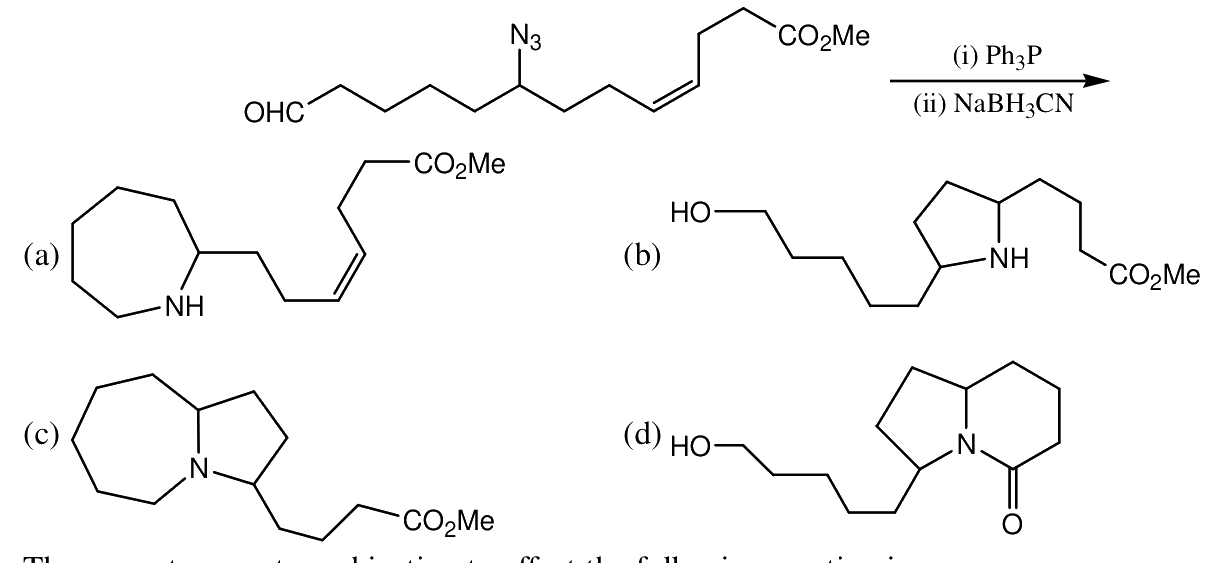
The major products A and B in the following reaction sequence are
Question 93 image
a.
(a)
b.
(b)
c.
(c)
d.
(d)
Correct Answer & Step-by-Step Solution Locked

Sign in free to reveal the correct answer and AI explanation for this question.

Q114 mcq
The major product formed in the following reaction sequence is
Question 94 image
a.
(a)
b.
(b)
c.
(c)
d.
(d)
Correct Answer & Step-by-Step Solution Locked

Sign in free to reveal the correct answer and AI explanation for this question.

Q115 mcq
The major product formed in the following reaction is
Question 95 image
a.
(a)
b.
(b)
c.
(c)
d.
(d)
Correct Answer & Step-by-Step Solution Locked

Sign in free to reveal the correct answer and AI explanation for this question.

Q116 mcq
The major products A and B in the following reaction sequence are
Question 96 image
Correct Answer & Step-by-Step Solution Locked

Sign in free to reveal the correct answer and AI explanation for this question.

Q117 mcq
The major product of the following reaction is
Question 97 image
Correct Answer & Step-by-Step Solution Locked

Sign in free to reveal the correct answer and AI explanation for this question.

Q118 mcq
The major product A and B in the following reaction sequence are
Question 98 image
a.
A = semicarbazone derivative, B = alkene as shown
b.
A = semicarbazone derivative, B = alkene as shown
c.
A = semicarbazone derivative, B = cyclopropane derivative as shown
d.
A = hydrazine derivative, B = amine derivative as shown
Correct Answer & Step-by-Step Solution Locked

Sign in free to reveal the correct answer and AI explanation for this question.

Q119 mcq
The major products A and B in the following reaction sequence are
Question 99 image
a.
A and B as shown in option (a)
b.
A and B as shown in option (b)
c.
A and B as shown in option (c)
d.
(d) A = ..., B = ...
Correct Answer & Step-by-Step Solution Locked

Sign in free to reveal the correct answer and AI explanation for this question.

Q120 mcq
The major product of the following reaction is
Question 100 image
Correct Answer & Step-by-Step Solution Locked

Sign in free to reveal the correct answer and AI explanation for this question.

Q121 mcq
According to the transition state theory, one of the vibrations in the activated complex is a loose vibration. The partition function for this loose vibration is equal to ($k_B$ is the Boltzmann's constant and $h$ is the Planck's constant)
a.
$\frac{k_B T}{h}$
b.
$\frac{h\nu}{k_B T}$
c.
$k_B T$
d.
$\frac{k_B T}{h\nu}$
Correct Answer & Step-by-Step Solution Locked

Sign in free to reveal the correct answer and AI explanation for this question.

Q122 mcq
Possible term symbol(s) of the excited states of $\text{Na}$ atom with the electronic configuration $\left[1s^2 2s^2 2p^6 3p^1\right]$ is/are
a.
$^2S_{1/2}$
b.
$^2P_{3/2}\text{ and }^2P_{1/2}$
c.
$^1S_0\text{ and }^1P_1$
d.
$^3P_0\text{ and }^3P_1$
Correct Answer & Step-by-Step Solution Locked

Sign in free to reveal the correct answer and AI explanation for this question.

Q123 mcq
For a simple cubic crystal, X-ray diffraction shows intense reflections for angles $\theta_1$ and $\theta_2$ which are assigned to $\left[1\ 0\ 1\right]$ and $\left[1\ 1\ 1\right]$ planes, respectively. The ratio $\frac{\sin\theta_1}{\sin\theta_2}$ is
a.
$1.5$
b.
$1.22$
c.
$0.82$
d.
$0.67$
Correct Answer & Step-by-Step Solution Locked

Sign in free to reveal the correct answer and AI explanation for this question.

Q124 mcq
Stability of lyophobic dispersions is determined by
a.
inter-particle electric double layer repulsion and intra-particle van der waals attraction
b.
inter-particle electric double layer attraction and intra-particle van der waals repulsion
c.
inter-particle excluded volume repulsion and intra-particle van der waals attraction
d.
inter-particle excluded volume attraction and intra-particle van der waals repulsion.
Correct Answer & Step-by-Step Solution Locked

Sign in free to reveal the correct answer and AI explanation for this question.

Q125 mcq
A certain 2-level system has stationary state energies $E_1$ and $E_2$ ($E_1 < E_2$) with normalized wave functions $\varphi_1$ and $\varphi_2$ respectively. In the presence of a perturbation V, the second-order correction to the energy for the first state ($\varphi_1$) will be
a.
$\frac{\langle\varphi_1|V|\varphi_2\rangle}{E_1 - E_2}$
b.
$\frac{\langle\varphi_1|V|\varphi_2\rangle}{E_2 - E_1}$
c.
$\frac{|\langle\varphi_1|V|\varphi_2\rangle|^2}{E_1 - E_2}$
d.
$\frac{|\langle\varphi_1|V|\varphi_2\rangle|^2}{(E_1 - E_2)^2}$
Correct Answer & Step-by-Step Solution Locked

Sign in free to reveal the correct answer and AI explanation for this question.

Q126 mcq
The $^{1}\text{H}$ NMR frequency at $1.0\text{ T}$ is $42.4\text{ MHz}$. If the gyromagnetic ratios of $^{1}\text{H}$ and $^{13}\text{C}$ are $27\times 10^7$ and $6.75\times 10^7\text{ T}^{-1}\text{S}^{-1}$, respectively, what will be the $^{13}\text{C}$ frequency at $1.0\text{ T}$?
a.
$10.6\text{ MHz}$
b.
$169.9\text{ MHz}$
c.
$42.6\text{ MHz}$
d.
$21.3\text{ MHz}$
Correct Answer & Step-by-Step Solution Locked

Sign in free to reveal the correct answer and AI explanation for this question.

Q127 mcq
$10\text{ mL}$ aliquots of a mixture of $\text{HCl}$ and $\text{HNO}_3$ are titrated conductometrically using a $0.1\text{M } \text{NaOH}$ and a $0.1\text{M } \text{AgNO}_3$ separately. The titre volumes are $\text{V}_1$ and $\text{V}_2\text{ mL}$, respectively. The concentration of $\text{HNO}_3$ in the mixture is obtained from the combination.
a.
$V_1 - V_2$
b.
$2V_1 - V_2$
c.
$V_2 - V_1$
d.
$2V_2 - V_1$
Correct Answer & Step-by-Step Solution Locked

Sign in free to reveal the correct answer and AI explanation for this question.

Q128 mcq
Given that $E^0\left(\text{Cl}_2 / \text{Cl}^-\right) = 1.35\text{ V}$ and $K_{sp}\left(\text{AgCl}\right) = 10^{-10}$ at $25^\circ\text{C}$, $\text{E}^0$ corresponding to the electrode reaction $$\frac{1}{2}\text{Cl}_2(g) + \text{Ag}^+(soln.) + e^- \rightarrow \text{AgCl}(s)$$ is $\left[\frac{2.303RT}{F} = 0.06\text{V}\right]$
a.
$0.75\text{V}$
b.
$1.05\text{V}$
c.
$1.65\text{V}$
d.
$1.95\text{V}$
Correct Answer & Step-by-Step Solution Locked

Sign in free to reveal the correct answer and AI explanation for this question.

Q129 mcq
The standard EMF of the cell $Pt, \text{H}_2(g)|\text{HCl}(soln.)|\text{AgCl}(s), \text{Ag}(s)$
a.
increases with T
b.
decreases with T
c.
remains unchanged with T
d.
decreases with [HCl]
Correct Answer & Step-by-Step Solution Locked

Sign in free to reveal the correct answer and AI explanation for this question.

Q130 mcq
The molecule with the smallest rotational constant (in the microwave spectrum) among the following is
a.
$N \equiv CH$
b.
$HC \equiv CCl$
c.
$CCl \equiv CF$
d.
$B \equiv CCl$
Correct Answer & Step-by-Step Solution Locked

Sign in free to reveal the correct answer and AI explanation for this question.

Q131 mcq
The spectroscopic technique that can distinguish unambiguously between trans-1, 2-dichloroethylene and cis-1, 2-dichloroethylene without any numerical calculation is
a.
microwave spectroscopy
b.
UV-visible spectroscopy
c.
X-ray photoelectron spectroscopy
d.
$\gamma$-ray spectroscopy
Correct Answer & Step-by-Step Solution Locked

Sign in free to reveal the correct answer and AI explanation for this question.

Q132 mcq
The ground state electronic configuration of $\text{C}_2$ using all electron is
a.
$\sigma_{1s}^2 \sigma_{1s}^{*2} \sigma_{2s}^2 \sigma_{2s}^{*2} \pi_{2p}^2$
b.
$\sigma_{1s}^2 \sigma_{1s}^{*2} \sigma_{2s}^2 \sigma_{2s}^{*2} \sigma_{2p}^2 \sigma_{2p}^{*2}$
c.
$\sigma_{1s}^2 \sigma_{1s}^{*2} \sigma_{2s}^2 \pi_{2p}^2 \sigma_{2p}^1 \sigma_{2p}^{*1}$
d.
$\sigma_{1s}^2 \sigma_{1s}^{*2} \sigma_{2s}^2 \sigma_{2s}^{*2} \pi_{2p}^4$
Correct Answer & Step-by-Step Solution Locked

Sign in free to reveal the correct answer and AI explanation for this question.

Q133 mcq
$v_{\max}$ and $K_m$ for an enzyme catalyzed reaction are $2.0\times 10^{-3}\text{ Ms}^{-1}$ and $1.0\times 10^{-6}\text{M}$, respectively. The rate of the reaction when the substrate concentration is $1.0\times 10^{-6}\text{M}$ is
a.
$3.0\times 10^{-3}\text{ s}^{-1}$
b.
$1.0\times 10^{-3}\text{ s}^{-1}$
c.
$2.0\times 10^{-3}\text{ s}^{-1}$
d.
$0.5\text{ s}^{-1}$
Correct Answer & Step-by-Step Solution Locked

Sign in free to reveal the correct answer and AI explanation for this question.

Q134 mcq
The first order rate constant for a unimolecular gas phase reaction $A \rightarrow \text{products}$ that follows Lindemann mechanism is $2.0\text{ s}^{-1}$ at $p_A = 1\text{ atm}$ and $4.0\text{ s}^{-1}$ at $p_A = 2\text{ atm}$. The rate constant for the activation step is
a.
$1.0\text{ atm}^{-1}\text{s}^{-1}$
b.
$2.0\text{ atm}^{-1}\text{s}^{-1}$
c.
$4.0\text{ atm}^{-1}\text{s}^{-1}$
d.
$8.0\text{ atm}^{-1}\text{s}^{-1}$
Correct Answer & Step-by-Step Solution Locked

Sign in free to reveal the correct answer and AI explanation for this question.

Q135 mcq
The molecule diborane belongs to the symmetry point group
a.
$C_{2v}$
b.
$C_{2h}$
c.
$D_{2d}$
d.
$D_{2h}$
Correct Answer & Step-by-Step Solution Locked

Sign in free to reveal the correct answer and AI explanation for this question.

Q136 mcq
Though a constant shift of energy levels of a system changes the partition function, the properties that do not change are
a.
average energy, entropy and heat capacity
b.
average energy and entropy
c.
average energy and heat capacity
d.
entropy and heat capacity
Correct Answer & Step-by-Step Solution Locked

Sign in free to reveal the correct answer and AI explanation for this question.

Q137 mcq
The vibrational frequency of a homo-nuclear diatomic molecule is $\nu$. The temperature at which the population of the first excited state will be half that of the ground state is given by
a.
$h\nu \cdot \ln 2 / k_B$
b.
$h\nu / (\ln 2 \cdot k_B)$
c.
$\ln 2 / (h\nu \cdot k_B)$
d.
$h\nu \cdot \log 2 / k_B$
Correct Answer & Step-by-Step Solution Locked

Sign in free to reveal the correct answer and AI explanation for this question.

Q138 mcq
The irreducible representations of $C_{2h}$ are $\text{A}_g$, $\text{B}_g$, $\text{A}_u$ and $\text{B}_u$. The Raman active modes of trans-1, 3-butadiene belong to the irreducible representations
a.
$\text{A}_g$ and $\text{B}_g$
b.
$\text{A}_g$ and $\text{A}_u$
c.
$\text{A}_u$ and $\text{B}_g$
d.
$\text{B}_g$ and $\text{B}_u$
Correct Answer & Step-by-Step Solution Locked

Sign in free to reveal the correct answer and AI explanation for this question.

Q139 mcq
The symmetry-allowed atomic transition among the following is
a.
${}^3F \rightarrow {}^1D$
b.
${}^3F \rightarrow {}^3D$
c.
${}^3F \rightarrow {}^1P$
d.
${}^3F \rightarrow {}^3P$
Correct Answer & Step-by-Step Solution Locked

Sign in free to reveal the correct answer and AI explanation for this question.

Q140 mcq
The average end-to-end distance of a random coil polymer $10^6$ monomers (in units of segment length) is
a.
$10^6$
b.
$10^5$
c.
$10^4$
d.
$10^3$
Correct Answer & Step-by-Step Solution Locked

Sign in free to reveal the correct answer and AI explanation for this question.

Q141 mcq
A reversible expansion of $1.0\text{ mol}$ of an ideal gas is carried out from $1.0\text{ L}$ to $4.0\text{ L}$ under isothermal condition at $300\text{K}$. $\Delta G$ for this process is
a.
$300R \cdot \ln 2$
b.
$600R \cdot \ln 2$
c.
$-600R \cdot \ln 2$
d.
$-300R \cdot \ln 2$
Correct Answer & Step-by-Step Solution Locked

Sign in free to reveal the correct answer and AI explanation for this question.

Q142 mcq
The temperature-dependence of the vapour pressurse of solid A can be represented by $\log p = 10.0 - \frac{1800}{T}$, and that of liquid A by $\log p = 8.0 - \frac{1400}{T}$. The temperature of the triple point of $A$ is
a.
$200\text{ K}$
b.
$300\text{ K}$
c.
$400\text{ K}$
d.
$500\text{ K}$
Correct Answer & Step-by-Step Solution Locked

Sign in free to reveal the correct answer and AI explanation for this question.

Q143 mcq
The non-spontaneous process among the following is
a.
vapourisation of superhead water at $105^\circ\text{C}$ and $1\text{ atm}$ pressure
b.
expansion of a gas into vacuum freezing
c.
freezing of supercooled water at $-10^\circ\text{C}$ and $1\text{ atm}$ pressure
d.
freezing of water at $0^\circ\text{C}$ and $1\text{ atm}$ pressure.
Correct Answer & Step-by-Step Solution Locked

Sign in free to reveal the correct answer and AI explanation for this question.

Q144 mcq
The radial part of a hydrogenic wave function is given as $r(\alpha - r)e^{-\beta r}$ ($\alpha, \beta$ are constants). This function is then indentifiable as
a.
$2\text{s}$
b.
$3\text{p}$
c.
$4\text{d}$
d.
$5\text{f}$
Correct Answer & Step-by-Step Solution Locked

Sign in free to reveal the correct answer and AI explanation for this question.

Q145 mcq
A normalised state $\phi$ is constructed as a linear combination of the ground state ($\psi_0$) and the first excited state ($\psi_1$) of some harmonic oscillator with energies $1/2$ and $3/2$ units, respectively. If the average energy of the state $\phi$ is $7/6$, the probability of finding $\psi_0$ in $\phi$ will be
a.
$1/2$
b.
$1/3$
c.
$1/4$
d.
$1/5$
Correct Answer & Step-by-Step Solution Locked

Sign in free to reveal the correct answer and AI explanation for this question.