← Joint CSIR UGC NET Exam
CSIR NET · Chemical Sciences

June

2014 · 125 questions · First 10 Solutions Free
Questions 1–10 have full step-by-step solutions visible. Sign in to unlock all 125 →
Q21 mcq
The correct order of basicity for the following anions is
Question 1 image
a.
$\text{II} > \text{III} > \text{I}$ Correct Answer
b.
$\text{I} > \text{II} > \text{III}$
c.
$\text{II} > \text{I} > \text{III}$
d.
$\text{III} > \text{II} > \text{I}$
Step-by-Step AI Explanation
Verified Method
In the standard CSIR NET question on basicity of anions (typically involving cyclopentadienyl anion, indenyl anion, and fluorenyl anion or similar conjugated/aromatic carbanions): the more stable the conjugate carbanion (due to resonance or aromaticity), the weaker its basicity. Specifically, cyclopentadienyl anion is less resonance-delocalized across multiple rings, hence the order of basicity decreases with increasing aromatic resonance stabilization, giving $\text{II} > \text{III} > \text{I}$.
Q22 mcq
The major product formed in the reaction of 2, 5-hexanedione with $\text{P}_2\text{O}_5$ is
Question 2 image
Step-by-Step AI Explanation
Verified Method
The reaction of 2,5-hexanedione (a 1,4-diketone) with a dehydrating agent like $\text{P}_2\text{O}_5$ is the classical Paal-Knorr furan synthesis, yielding 2,5-dimethylfuran as the major product.
Q23 mcq
The absolute configuration of the two stereogenic (chiral) centres in the following molecule is
Question 3 image
a.
5R, 6R
b.
5R, 6S Correct Answer
c.
5S 6R
d.
5S, 6S
Step-by-Step AI Explanation
Verified Method
By applying the Cahn-Ingold-Prelog (CIP) priority rules to the chiral carbons at positions 5 and 6 of the bicyclic/ring skeleton, the priorities of the substituents establish that C5 has the $(R)$ configuration and C6 has the $(S)$ configuration, giving (5R, 6S).
Q24 mcq
The correct statement about the following molecule is
Question 4 image
a.
Molecular is chiral and possesses a chiral plane
b.
Molecule is chiral and possesses a chiral axis. Correct Answer
c.
Molecule is achiral as it possesses a plane of symmetry.
d.
Molecule is achiral as it possesses a centre of symmetry.
Step-by-Step AI Explanation
Verified Method
Molecules such as sterically hindered biaryls, alkylidene cyclohexanes, or spiranes/allenes exhibit axial chirality. The molecule possesses a chiral axis (stereogenic axis) and lacks a plane or center of symmetry, making it chiral.
Q25 mcq
Consider the following statements about cis- and trans-decalins (A) cis-isomer is more stable than trans-isomer (B) trans-isomer is more stable than cis-isomer (C) trans-isomer undergoes ring-flip (D) cis-isomer undergoes ring-flip The correct statements among the above are
a.
B and D Correct Answer
b.
A and C
c.
A and D
d.
B and C
Step-by-Step AI Explanation
Verified Method
For decalins: trans-decalin has two fused chair cyclohexanes locked in diequatorial positions, so it is conformationally rigid and cannot undergo ring-flip. In contrast, cis-decalin is flexible and rapidly undergoes ring-flipping. Furthermore, trans-decalin has zero butane-gauche interactions between the two rings whereas cis-decalin has three, making trans-decalin more stable than cis-decalin by about $2.7\text{ kcal/mol}$. Thus, statements (B) and (D) are correct.
Q26 mcq
In bis(dimethylglyoximato)nickel(II), the number of $\text{Ni}-\text{N}$, $\text{Ni}-\text{O}$ and intramolecular hydrogen bond(s), respectively are
a.
4, 0 and 2 Correct Answer
b.
2, 2 and 2
c.
2, 2 and 0
d.
4, 0 and 1
Step-by-Step AI Explanation
Verified Method
In the square-planar bis(dimethylglyoximato)nickel(II) complex, $\text{[Ni(dmgH)}_2\text{]}$, nickel is coordinated to four nitrogen atoms (forming four $\text{Ni}-\text{N}$ bonds and zero $\text{Ni}-\text{O}$ bonds), and the structure is stabilized by two intramolecular $\text{O}-\text{H}\cdots\text{O}$ hydrogen bonds. Therefore, the numbers are 4, 0, and 2, respectively.
Q27 mcq
Among the following species, (A) $\text{Ni(II)}$ as dimethylglyoximate, (B) $\text{Al(III)}$ as oximate, (C) $\text{Ag(I)}$ as chloride, those that precipitate with the urea hydrolysis method are
a.
A, B and C
b.
A and B Correct Answer
c.
A and C
d.
B and C
Step-by-Step AI Explanation
Verified Method
Urea hydrolysis generates ammonia slowly in solution (homogeneous precipitation via pH increase): $\text{(NH}_2\text{)}_2\text{CO} + \text{H}_2\text{O} \to 2\text{NH}_3 + \text{CO}_2$. Precipitation of nickel as dimethylglyoximate and aluminum as oximate (8-hydroxyquinolate) are carried out by gradually raising the pH using urea hydrolysis to achieve controlled, crystalline precipitation. Silver chloride, on the other hand, is precipitated by generating chloride ions (e.g., using allyl chloride or 2-chloroethanol), not by pH adjustment via urea hydrolysis. Thus, only A and B precipitate via the urea hydrolysis method.
Q28 mcq
If an enzyme fixes $\text{N}_2$ in plants by evolving $\text{H}_2$, the number of electrons and protons associated with that, respectively are
a.
6 and 6
b.
8 and 8 Correct Answer
c.
6 and 8
d.
8 and 6
Step-by-Step AI Explanation
Verified Method
The biological nitrogen fixation catalyzed by the enzyme nitrogenase follows the stoichiometry: $\text{N}_2 + 8\text{H}^+ + 8\text{e}^- + 16\text{MgATP} \to 2\text{NH}_3 + \text{H}_2 + 16\text{MgADP} + 16\text{P}_i$. Thus, the reduction of one molecule of $\text{N}_2$ with obligate evolution of one molecule of $\text{H}_2$ requires 8 electrons and 8 protons.
Q29 mcq
The particles postulated to always accompany the positron emission among (A) neutrino, (B) anti-neutrino, (C) electron, are
a.
A, B and C
b.
A and B
c.
A and C Correct Answer
d.
B and C
Step-by-Step AI Explanation
Verified Method
In $\beta^+$ decay (positron emission), a proton converts into a neutron inside the nucleus, emitting a positron and an electron neutrino: $$p \to n + e^+ + \nu_e$$ Simultaneously, the atom must lose an orbital electron to maintain electrical neutrality, as the atomic number decreases by 1 ($Z \to Z - 1$). Thus, along with the neutrino (A), an orbital electron (C) is lost. Therefore, both the neutrino and the electron (A and C) accompany the positron emission process.
Q30 mcq
Toxicity of cadmium and mercury in the body is being reversed by proteins, mainly using the amino acid residue,
a.
Glycine
b.
Leucine
c.
Lysine
d.
Cysteine Correct Answer
Step-by-Step AI Explanation
Verified Method
Cadmium ($ ext{Cd}^{2+}$) and mercury ($ ext{Hg}^{2+}$) are soft Lewis acids with a very high affinity for soft Lewis bases such as thiols/sulfhydryl groups ($- ext{SH}$). Metallothioneins are cysteine-rich proteins that sequester these toxic heavy metal ions in the body through coordination with cysteine residues.
🎉 10 Free Sample Solutions Completed

Unlock All 125 Questions & Solutions

Sign up free in seconds to unlock step-by-step AI answers for the remaining 115 questions.

Q31 mcq
$\text{NiBr}_2$ reacts with $(\text{Et})(\text{Ph}_2)\text{P}$ at $-78^\circ\text{C}$ in $\text{CS}_2$ to give red compound 'A', which upon standing at room temperature turns green to give compound, 'B' of the same formula. The measured magnetic moments of 'A' and 'B' are $0.0$ and $3.2\text{ BM}$, respectively. The geometries of 'A' and 'B' are
a.
square planar and tetrahedral
b.
tetrahedral and square planar
c.
square planar and octahedral
d.
tetrahedral and octahedral
Correct Answer & Step-by-Step Solution Locked

Sign in free to reveal the correct answer and AI explanation for this question.

Q32 mcq
The correct non-linear and iso-structural pair is
a.
$\text{SCl}_2$ and $\text{I}_3^-$
b.
$\text{SCl}_2$ and $\text{I}_3^+$
c.
$\text{SCl}_2$ and $\text{ClF}_2^-$
d.
$\text{I}_3^+$ and $\text{ClF}_2^-$
Correct Answer & Step-by-Step Solution Locked

Sign in free to reveal the correct answer and AI explanation for this question.
Q33 mcq
Ozone present in upper atmosphere protects people on the earth
a.
due to its diamagnetic nature
b.
due to its blue colour
c.
due to absorption of radiation of wavelength at 255nm
d.
by destroying chlorofluoro carbons
Correct Answer & Step-by-Step Solution Locked

Sign in free to reveal the correct answer and AI explanation for this question.
Q34 mcq
If $\text{L}$ is a neutral monodentate ligand, the species, $[\text{AgL}_4]^{2+}$, $[\text{AgL}_6]^{2+}$ and $[\text{AgL}_4]^{3+}$, respectively are
a.
paramagnetic, paramagnetic and dimagnetic
b.
paramagnetic, diamagnetic and paramagnetic
c.
diamagnetic, paramagnetic and diamagnetic
d.
paramagnetic, diamagnetic and diamagnetic
Correct Answer & Step-by-Step Solution Locked

Sign in free to reveal the correct answer and AI explanation for this question.
Q35 mcq
Chromite ore on fusion with sodium carbonate gives
a.
$\text{Na}_2\text{CrO}_4$ and $\text{Fe}_2\text{O}_3$
b.
$\text{Na}_2\text{Cr}_2\text{O}_7$ and $\text{Fe}_2\text{O}_3$
c.
$\text{Cr}_2(\text{CO}_3)_3$ and $\text{Fe}(\text{OH})_3$
d.
$\text{Na}_2\text{CrO}_4$ and $\text{Fe}_2(\text{CO}_3)_3$
Correct Answer & Step-by-Step Solution Locked

Sign in free to reveal the correct answer and AI explanation for this question.
Q36 mcq
The ligand(s) that is (are) fluxional in $[(\eta^5-\text{C}_5\text{H}_5)(\eta^1-\text{C}_5\text{H}_5)\text{Fe}(\text{CO})_2]$ in the temperature range 221–298K, is (are)
a.
$\eta^5-\text{C}_5\text{H}_5$
b.
$\eta^1-\text{C}_5\text{H}_5$
c.
$\eta^5-\text{C}_5\text{H}_5$ and $\text{CO}$
d.
$\eta^1-\text{C}_5\text{H}_5$ and $\text{CO}$
Correct Answer & Step-by-Step Solution Locked

Sign in free to reveal the correct answer and AI explanation for this question.
Q37 mcq
$[\text{CoL}_6]^3$ is red in colour whereas $[\text{CoL}'_6]^{3+}$ is green. $\text{L}$ and $\text{L}'$ respectively corresponds to,
a.
$\text{NH}_3$ and $\text{H}_2\text{O}$
b.
$\text{NH}_3$ and 1, 10-phenanthroline
c.
$\text{NH}_3$ and 1, 10-phenanthroline
d.
$\text{H}_2\text{O}$ and $\text{NH}_3$
Correct Answer & Step-by-Step Solution Locked

Sign in free to reveal the correct answer and AI explanation for this question.
Q38 mcq
The oxidation state of $\text{Ni}$ and the number of metal-metal bonds in $[\text{Ni}_2(\text{CO})_6]^{2-}$ that are consistent with the 18 electron rule are
a.
$\text{Ni}(-\text{II})$, 1 bond
b.
$\text{Ni}(\text{IV})$, 2 bonds
c.
$\text{Ni}(-\text{I})$, 1 bond
d.
$\text{Ni}(\text{IV})$, 3 bonds
Correct Answer & Step-by-Step Solution Locked

Sign in free to reveal the correct answer and AI explanation for this question.
Q39 mcq
Structures of $\text{SbPh}_5$ and $\text{PPh}_5$ respectively are
a.
trigonal bipyramidal, square pyramidal
b.
square pyramidal, trigonal bipyramidal
c.
trigonal bipyramidal, trigonal bipyramidal
d.
square pyramidal, square pyramidal
Correct Answer & Step-by-Step Solution Locked

Sign in free to reveal the correct answer and AI explanation for this question.
Q40 mcq
The typical electronic configurations of the transition metal centre for oxidative addition
a.
$\text{d}^0$ and $\text{d}^8$
b.
$\text{d}^6$ and $\text{d}^8$
c.
$\text{d}^8$ and $\text{d}^{10}$
d.
$\text{d}^5$ and $\text{d}^{10}$
Correct Answer & Step-by-Step Solution Locked

Sign in free to reveal the correct answer and AI explanation for this question.
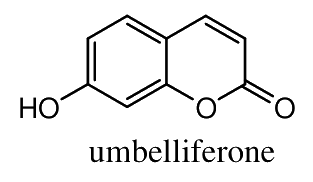
Q41 mcq
Gelatin added during the polarographic measurement carried out using dropping mercury electrode
a.
reduces streaming motion of $\text{Hg}$ drop
b.
decreases viscosity of the solution
c.
eliminates migrating current
d.
prevents oxidation of $\text{Hg}$
Correct Answer & Step-by-Step Solution Locked

Sign in free to reveal the correct answer and AI explanation for this question.
Q42 mcq
The $\text{pK}_\text{a}$ values of the following salt of aspartic acid are indicated below. The predominant species that would exist at $\text{pH} = 5$ is
Question 22 image
Correct Answer & Step-by-Step Solution Locked

Sign in free to reveal the correct answer and AI explanation for this question.
Q43 mcq
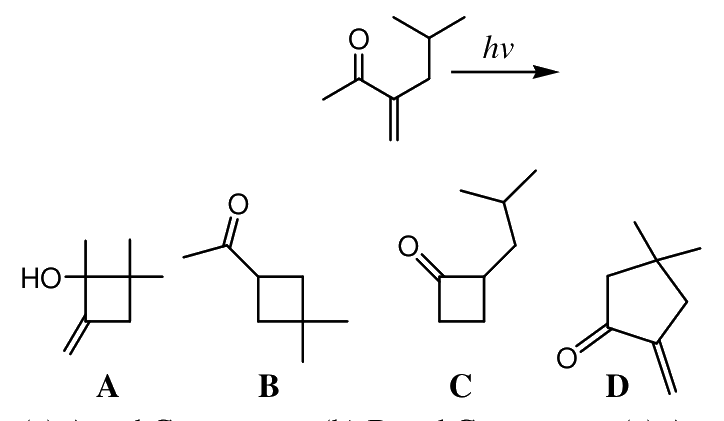
The major product formed in the following photochemical reaction is
Question 23 image
Correct Answer & Step-by-Step Solution Locked

Sign in free to reveal the correct answer and AI explanation for this question.
Q44 mcq
The pair of solvents in which $\text{PCl}_5$ does NOT ionize, is
a.
$\text{CH}_3\text{CN}, \text{CH}_3\text{NO}_2$
b.
$\text{CH}_3\text{CN}, \text{CCl}_4$
c.
$\text{C}_6\text{H}_6, \text{CCl}_4$
d.
$\text{CH}_3\text{CN}, \text{C}_6\text{H}_6$
Correct Answer & Step-by-Step Solution Locked

Sign in free to reveal the correct answer and AI explanation for this question.
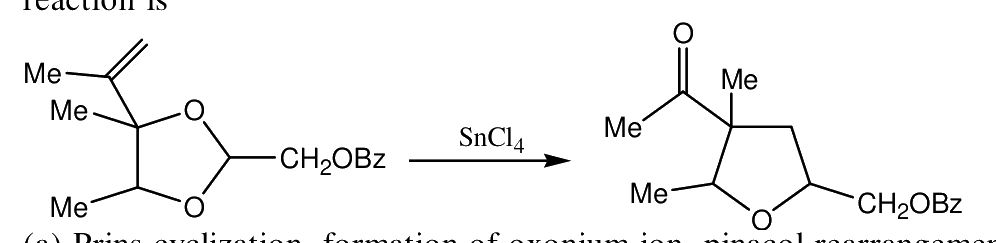
Q45 mcq
The major product formed in the following reaction is
Question 25 image
Correct Answer & Step-by-Step Solution Locked

Sign in free to reveal the correct answer and AI explanation for this question.
Q46 mcq
The correct order for the rates of electrophilic aromatic substitution of the following compound is
Question 26 image
a.
$\text{I} > \text{II} > \text{III}$
b.
$\text{II} > \text{I} > \text{III}$
c.
$\text{III} > \text{II} > \text{I}$
d.
$\text{I} > \text{III} > \text{II}$
Correct Answer & Step-by-Step Solution Locked

Sign in free to reveal the correct answer and AI explanation for this question.
Q47 mcq
The commutator of the kinetic energy operator, $\hat{\mathrm{T}}_{\mathrm{x}}$ and the momentum operator, $\hat{\mathrm{p}}_{\mathrm{x}}$ for the one-dimensional case is
a.
$i\hbar$
b.
$i\hbar\dfrac{\mathrm{d}}{\mathrm{dx}}$
c.
$0$
d.
$i\hbar x$
Correct Answer & Step-by-Step Solution Locked

Sign in free to reveal the correct answer and AI explanation for this question.
Q48 mcq
The major product formed in the reaction of trans-1-bromo-3-methylcyclobutane with sodium iodide in DMF is
Question 28 image
Correct Answer & Step-by-Step Solution Locked

Sign in free to reveal the correct answer and AI explanation for this question.
Q49 mcq
When $\mathrm{Si}$ is doped with a Group $\mathrm{V}$ element,
a.
donor levels are created close to the valence band
b.
donor levels are created close to the conduction band
c.
acceptor levels are created close to the valence bond
d.
acceptor levels are created close to the conduction band
Correct Answer & Step-by-Step Solution Locked

Sign in free to reveal the correct answer and AI explanation for this question.
Q50 mcq
The symmetry point group of propyne is
a.
$\mathrm{C}_3$
b.
$\mathrm{C}_{3\mathrm{v}}$
c.
$\mathrm{D}_3$
d.
$\mathrm{D}_{3\mathrm{d}}$
Correct Answer & Step-by-Step Solution Locked

Sign in free to reveal the correct answer and AI explanation for this question.
Q51 mcq
For a first order reaction $\mathrm{A} \rightarrow \text{products}$, the plot of $\ln\dfrac{[\mathrm{A}]_{\mathrm{t}}}{[\mathrm{A}]_0}$ vs time, where $[\mathrm{A}]_0$ and $[\mathrm{A}]_{\mathrm{t}}$ refer to concentration at time $t = 0$ and $t$ respectively, is
a.
a straight line with a positive slope passing through origin
b.
a straight line with a negative slope passing through origin.
c.
an exponential curve asymptotic to the time axis
d.
a curve asymptotic to the $\ln\left(\dfrac{[\mathrm{A}]_{\mathrm{t}}}{[\mathrm{A}]_0}\right)$ axis.
Correct Answer & Step-by-Step Solution Locked

Sign in free to reveal the correct answer and AI explanation for this question.
Q52 mcq
In radical chain polymerization, the quantity given by the rate of monomer depletion, divided by the rate of propagating radical formation is called
a.
kinetic chain length
b.
propagation efficiency
c.
propagation rate constant
d.
polymerization time
Correct Answer & Step-by-Step Solution Locked

Sign in free to reveal the correct answer and AI explanation for this question.
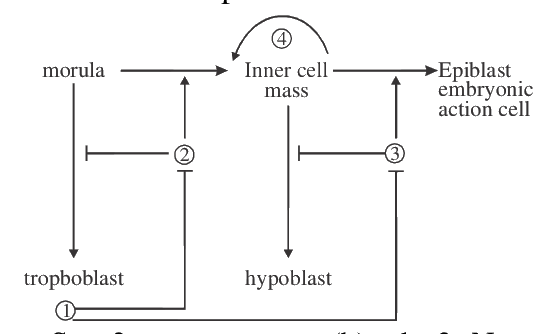
Q53 mcq
Number of rotational symmetry axes for triclinic crystal system is
a.
$4$
b.
$3$
c.
$1$
d.
$0$
Correct Answer & Step-by-Step Solution Locked

Sign in free to reveal the correct answer and AI explanation for this question.
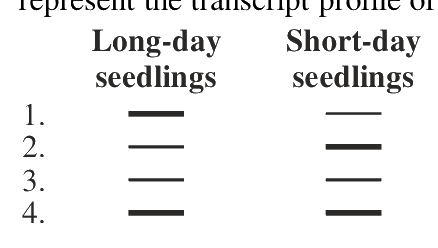
Q54 mcq
Generally, hydrophobic colloids are flocculated efficiently by ions of opposite type and high charge number. This is consistent with the
a.
peptization principle
b.
krafft theory
c.
Hardy-Schulze rule
d.
Langmuir adsorption mechanism
Correct Answer & Step-by-Step Solution Locked

Sign in free to reveal the correct answer and AI explanation for this question.
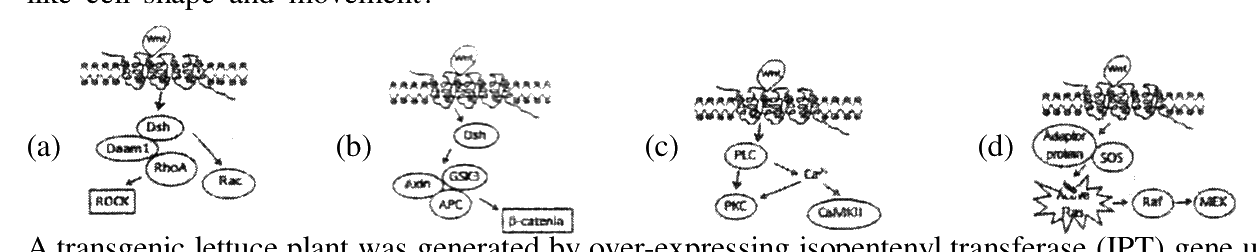
Q55 mcq
Examine the following first order consecutive reactions. The rate constant (in $\text{s}^{-1}$ units) for each step is given above the arrow mark (A) $\text{P} \xrightarrow{10^5} \text{Q} \xrightarrow{10^8} \text{R}$ (B) $\text{P} \xrightarrow{10^5} \text{Q} \xrightarrow{10^3} \text{R}$ (C) $\text{P} \xrightarrow{10^7} \text{Q} \xrightarrow{10^7} \text{R}$ (D) $\text{P} \xrightarrow{10^2} \text{Q} \xrightarrow{10^6} \text{R}$ Steady-state approximation can be applied to
a.
A only
b.
C only
c.
B and C only
d.
A and D only
Correct Answer & Step-by-Step Solution Locked

Sign in free to reveal the correct answer and AI explanation for this question.
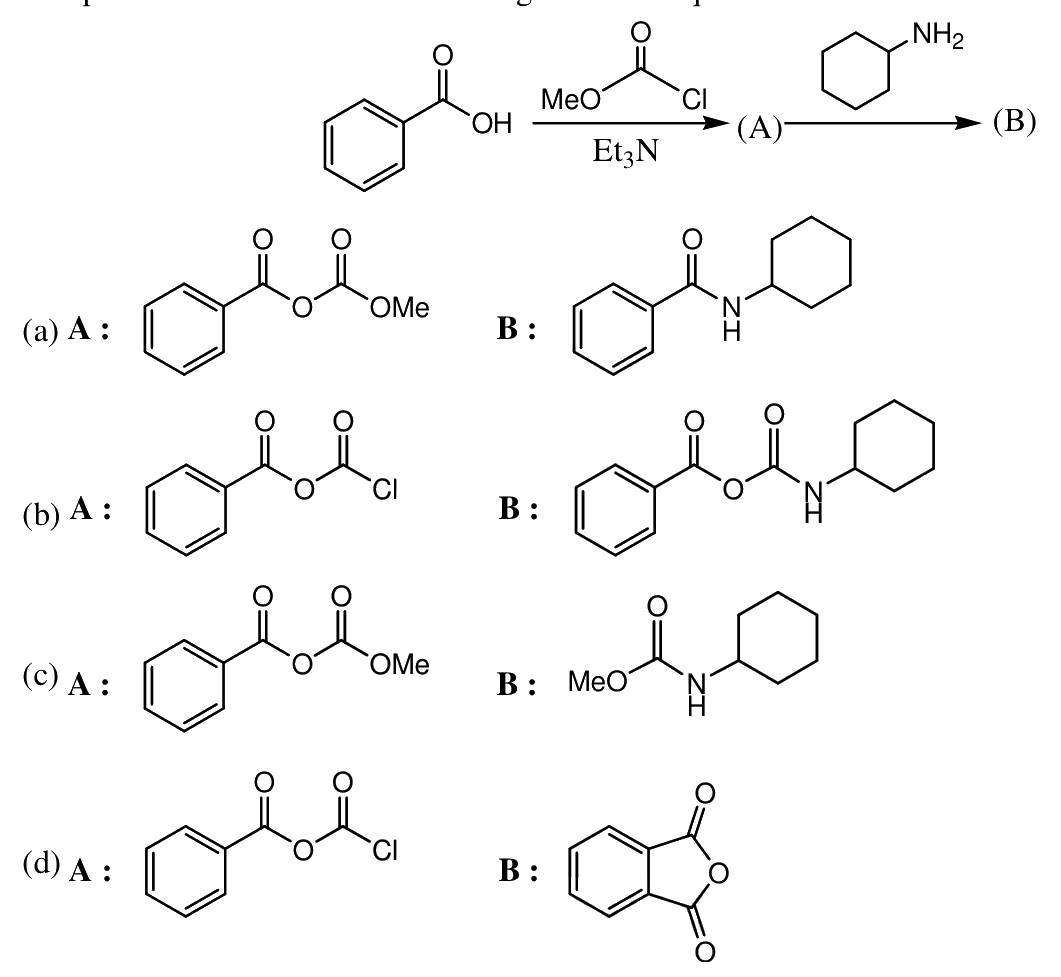
Q56 mcq
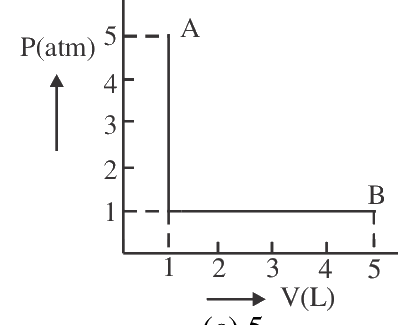
The figure below represents the path followed by a gas during expansion from $\text{A} \rightarrow \text{B}$. The work done is (L atm)
Question 36 image
a.
0
b.
9
c.
5
d.
4
Correct Answer & Step-by-Step Solution Locked

Sign in free to reveal the correct answer and AI explanation for this question.
Q57 mcq
An aqueous solution of an optically pure compound of concentration $100\text{ mg}$ in $1\text{ mL}$ of water and measured in a quartz tube of $5\text{ cm}$ length was found to be $-3^\circ$. The specific rotation is
a.
$-30^\circ$
b.
$-60^\circ$
c.
$-6^\circ$
d.
$+6^\circ$
Correct Answer & Step-by-Step Solution Locked

Sign in free to reveal the correct answer and AI explanation for this question.
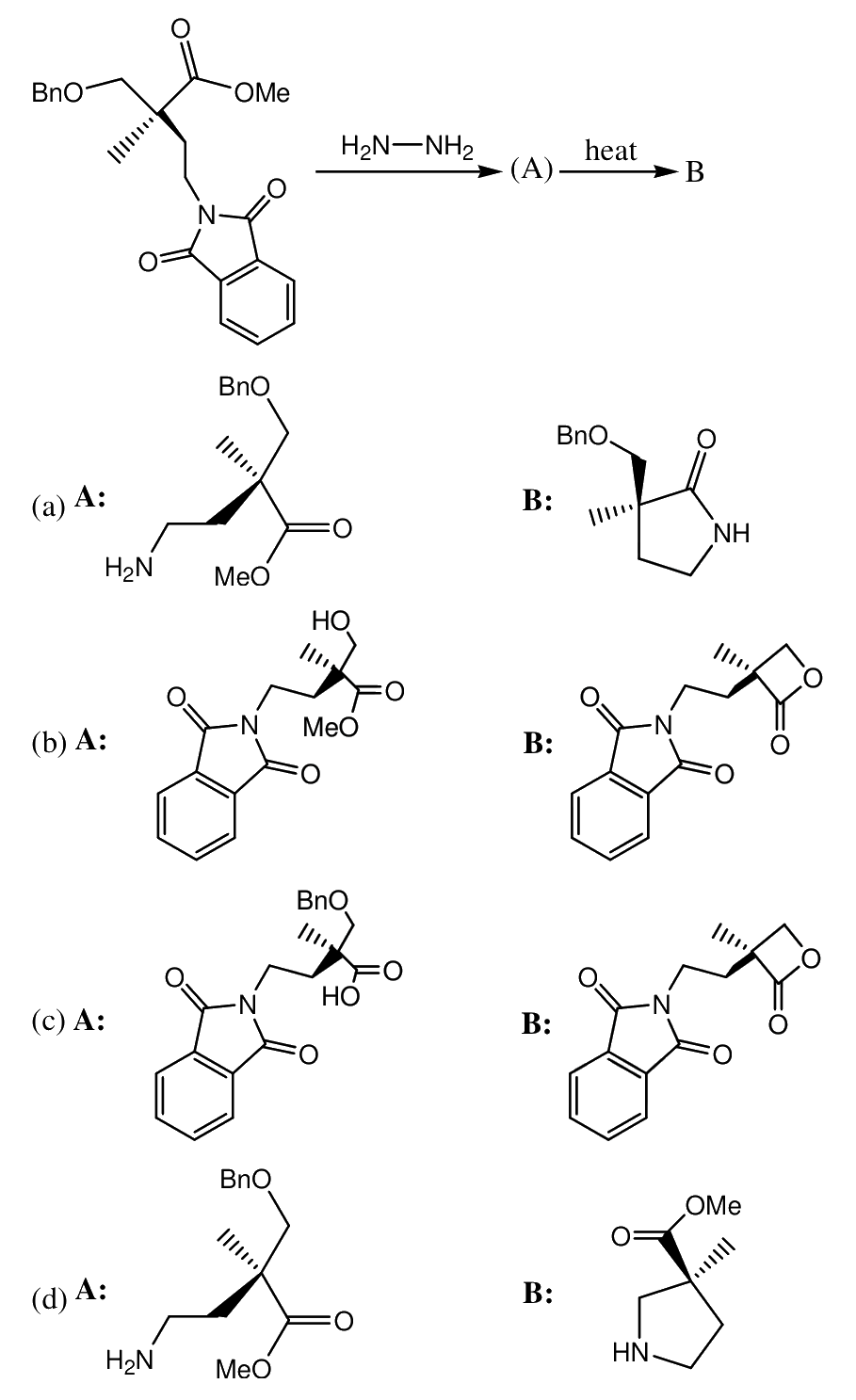
Q58 mcq
Two phases ($\alpha$ and $\beta$) of a species are in equilibrium. The correct relations observed among the variables, $\text{T}$, $\text{p}$ and $\mu$ are
a.
$\text{T}_\alpha = \text{T}_\beta$, $\text{p}_\alpha \neq \text{p}_\beta$, $\mu_\alpha = \mu_\beta$
b.
$\text{T}_\alpha \neq \text{T}_\beta$, $\text{p}_\alpha = \text{p}_\beta$, $\mu_\alpha = \mu_\beta$
c.
$\text{T}_\alpha = \text{T}_\beta$, $\text{p}_\alpha = \text{p}_\beta$, $\mu_\alpha = \mu_\beta$
d.
$\text{T}_\alpha = \text{T}_\beta$, $\text{p}_\alpha = \text{p}_\beta$, $\mu_\alpha \neq \mu_\beta$
Correct Answer & Step-by-Step Solution Locked

Sign in free to reveal the correct answer and AI explanation for this question.
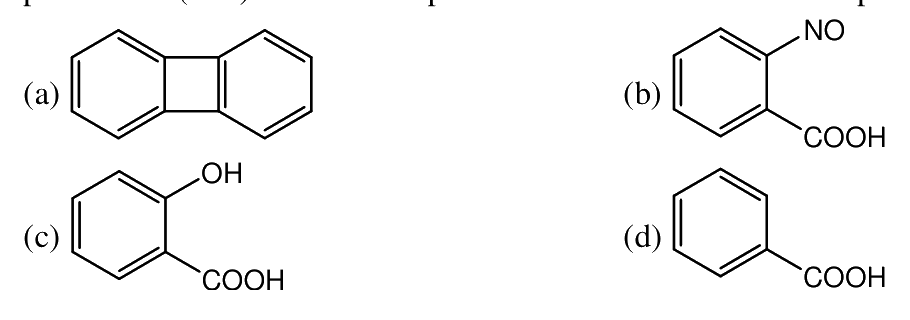
Q59 mcq
The number of configurations in the most probable state, according to Boltzmann formula, is
a.
$e^{\text{S}/\text{k}_\text{B}}$
b.
$e^{-\text{S}/\text{k}_\text{B}}$
c.
$e^{-\text{E}/\text{k}_\text{B}\text{T}}$
d.
$e^{-\Delta\text{G}/\text{k}_\text{B}\text{T}}$
Correct Answer & Step-by-Step Solution Locked

Sign in free to reveal the correct answer and AI explanation for this question.
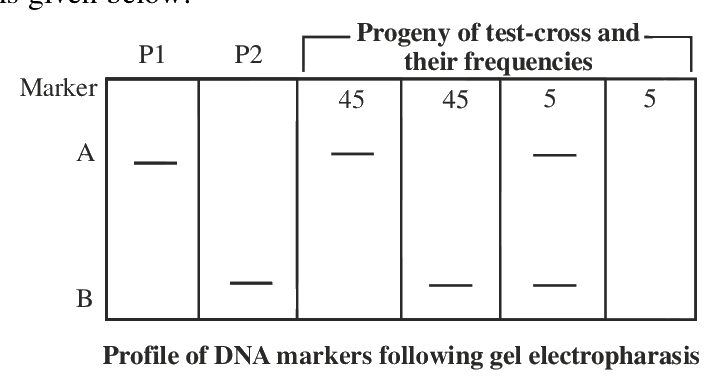
Q60 mcq
The correct match of the $^1\text{H NMR}$ chemical shifts ($\delta$) of the following species/compounds is
Question 40 image
a.
$\text{I} : 5.4; \text{II} : 7.2; \text{III} : 9.2$
b.
$\text{I} : 9.2; \text{II} : 7.2; \text{III} : 5.4$
c.
$\text{I} : 9.2; \text{II} : 5.4; \text{III} : 7.2$
d.
$\text{I} : 7.2; \text{II} : 9.2; \text{III} : 5.4$
Correct Answer & Step-by-Step Solution Locked

Sign in free to reveal the correct answer and AI explanation for this question.
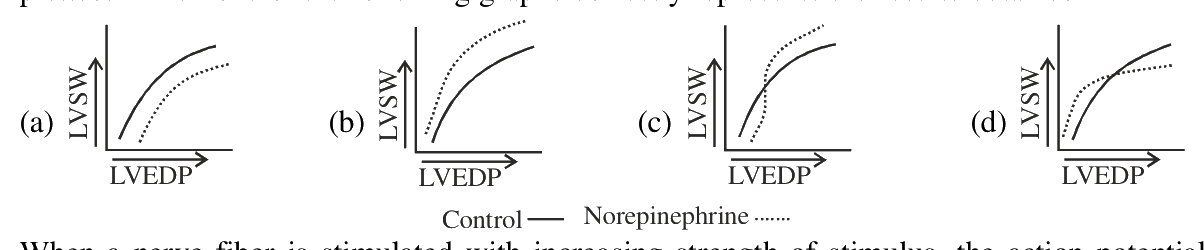
Q61 mcq
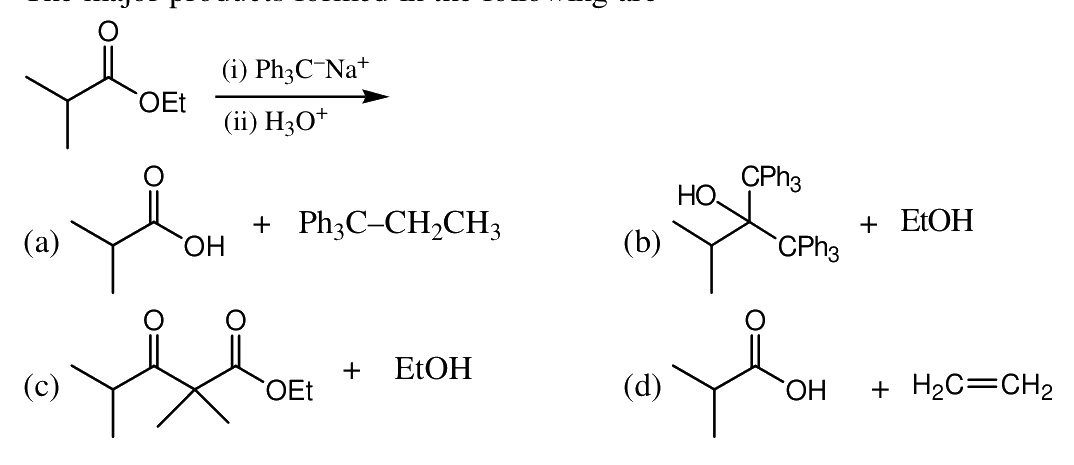
The major products formed in the following are
Question 41 image
a.
An isobutyric acid derivative with a carboxylic group and $\text{Ph}_3\text{C}-\text{CH}_2\text{CH}_3$
b.
A tertiary alcohol with two $\text{CPh}_3$ groups and $\text{EtOH}$
c.
A $\beta$-keto ester derivative and $\text{EtOH}$
d.
Isobutyric acid and $\text{H}_2\text{C}=\text{CH}_2$
Correct Answer & Step-by-Step Solution Locked

Sign in free to reveal the correct answer and AI explanation for this question.
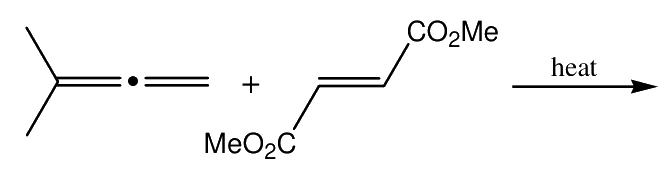
Q62 mcq
In a Diels-Alder reaction, the most reactive diene amongst the following is
a.
(4E)-1, 4-hexadiene
b.
(4Z)-1, 4-hexadiene
c.
(2E, 4E)-2, 4-hexadiene
d.
(2Z, 4Z)-2, 4-hexadiene
Correct Answer & Step-by-Step Solution Locked

Sign in free to reveal the correct answer and AI explanation for this question.
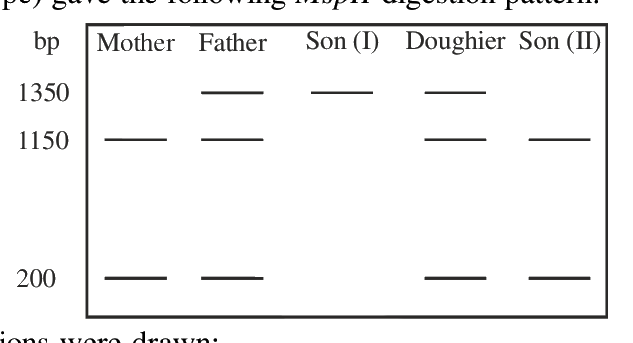
Q63 mcq
Consider the statements about the following structures X and Y (A) X and Y are resonance structures (B) X and Y are tautomers (C) Y is more basic than X (D) X is more basic than Y The correct statement(s) among the above is/are
Question 43 image
a.
A and C
b.
C
c.
B and D
d.
B and C
Correct Answer & Step-by-Step Solution Locked

Sign in free to reveal the correct answer and AI explanation for this question.
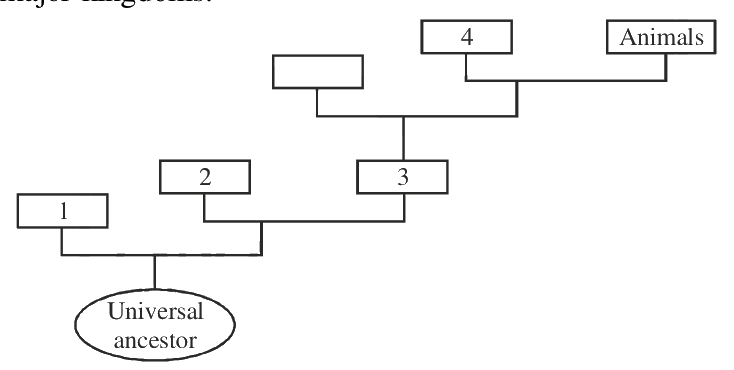
Q64 mcq
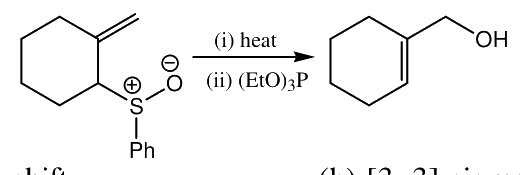
Pericyclic reaction involved in one of the steps of the following reaction sequence is
Question 44 image
a.
$[1, 3]$ sigmatropic shift
b.
$[3, 3]$ sigmatropic shift
c.
$[1, 5]$ sigmatropic shift
d.
$[2, 3]$ sigmatropic shift
Correct Answer & Step-by-Step Solution Locked

Sign in free to reveal the correct answer and AI explanation for this question.
Q65 mcq
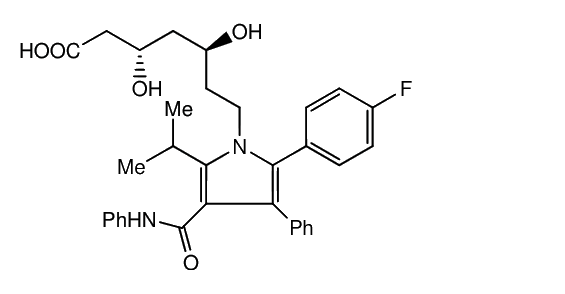
Atorvastatin (structure given below) is a
Question 45 image
a.
cholesterol lowering drug
b.
blood sugar lowering drug
c.
anti-plasmodial drug
d.
anti-HIV drug
Correct Answer & Step-by-Step Solution Locked

Sign in free to reveal the correct answer and AI explanation for this question.
Q66 mcq
The maximum bond order obtained from the molecular orbitals of a transition metal dimer, formed as linear combinations of d-orbitals alone, is
a.
3
b.
4
c.
5
d.
6
Correct Answer & Step-by-Step Solution Locked

Sign in free to reveal the correct answer and AI explanation for this question.
Q67 mcq
The term symbol that is NOT allowed for the $\text{np}^2$ configuration is
a.
$^1\text{D}$
b.
$^3\text{P}$
c.
$^1\text{S}$
d.
$^3\text{D}$
Correct Answer & Step-by-Step Solution Locked

Sign in free to reveal the correct answer and AI explanation for this question.
Q68 mcq
If the ionization energy of $\text{H}$ atom is $\text{x}$, the ionization energy of $\text{Li}^{2+}$, is
a.
$2\text{x}$
b.
$3\text{x}$
c.
$9\text{x}$
d.
$27\text{x}$
Correct Answer & Step-by-Step Solution Locked

Sign in free to reveal the correct answer and AI explanation for this question.
Q69 mcq
If temprature is doubled and the mass of the gaseous molecule is halved, the rms speed of the molecular will change by a factor of
a.
1
b.
2
c.
1/2
d.
1/4
Correct Answer & Step-by-Step Solution Locked

Sign in free to reveal the correct answer and AI explanation for this question.
Q70 mcq
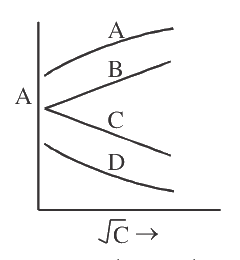
In the graph below, the correct option, according to Kohlrausch law, is
Question 50 image
a.
A is a weak electrolyte and B is a strong electrolyte
b.
A is a strong electrolyte and B is a weak electrolyte
c.
C is a strong electrolyte and D is a weak electrolyte
d.
C is weak electrolyte and D is a strong electrolyte
Correct Answer & Step-by-Step Solution Locked

Sign in free to reveal the correct answer and AI explanation for this question.
Q71 mcq
Reaction of $[\text{Ru}(\text{NH}_3)_5(\text{isonicotinamide})]^{3+}$ with $[\text{Cr}(\text{H}_2\text{O})_6]^{2+}$ occurs by inner sphere mechanism and rate of th reaction is determined by dissociation of the successor complex. It is due to the
a.
Inert ruthenium birdged to inert chromium centre
b.
Inert ruthenium bridged to labile chromium centre
c.
Labile ruthenium bridged to inert chromium centre
d.
Labile ruthenium bridged to labile chromium centre
Correct Answer & Step-by-Step Solution Locked

Sign in free to reveal the correct answer and AI explanation for this question.
Q72 mcq
Consider the second order rate constants for the following outer-sphere electron transfer reactions: $$[\text{Fe}(\text{H}_2\text{O})_6]^{3+} / [\text{Fe}(\text{H}_2\text{O})_6]^{2+} \quad 4.0\text{ M}^{-1}\text{ sec}^{-1}$$ $$[\text{Fe}(\text{phen})_3]^{3+} / [\text{Fe}(\text{phen})_3]^{2+} \quad 3.0 \times 10^7\text{ M}^{-1}$$ ($\text{phen} = 1, 10\text{-phenanthroline}$) The enhanced rate constant for the second reaction is due to the fact that
a.
The 'phen' is a $\pi$-acceptor ligand that allows mixing of electron donor and acceptor orbitals that enhances the rate of electron transfer
b.
The 'phen' is a $\pi$-donor ligand that enhances the rate of electron transfer
c.
The 'phen' forms charge transfer complex with iron and facilitates the eletron transfer
d.
The 'phen' forms kinetically labile complex with iron and facilitates the electron transfer.
Correct Answer & Step-by-Step Solution Locked

Sign in free to reveal the correct answer and AI explanation for this question.
Q73 mcq
The compound $[\text{Re}_2(\text{Me}_2\text{PPh})_4\text{Cl}_4]$ ($\text{M}$) having a configuration of $\sigma^2\pi^4\delta^2\delta^{*2}$ can be oxidized to $\text{M}^+$ and $\text{M}^{2+}$. The formal metal-metal order in $\text{M}$, $\text{M}^+$ and $\text{M}^{2+}$ respectively, are
a.
3.0, 3.5 and 4.0
b.
3.5, 4.0 and 3.0
c.
4.0, 3.5 and 3.0
d.
3.0, 4.0 and 3.5
Correct Answer & Step-by-Step Solution Locked

Sign in free to reveal the correct answer and AI explanation for this question.
Q74 mcq
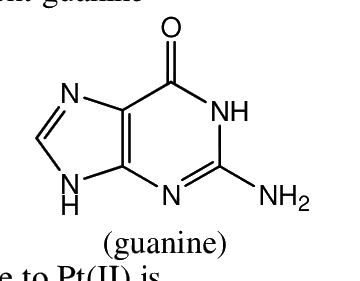
In low chloride ion concentration, the anticancer drug cis-platin hydrolyses to give a diaqua complex and this binds to DNA via adjacent guanine The coordinating atom of guanine to $\text{Pt(II)}$ is
Question 54 image
a.
N1
b.
N3
c.
N7
d.
N9
Correct Answer & Step-by-Step Solution Locked

Sign in free to reveal the correct answer and AI explanation for this question.

Q75 mcq
The $^{19}\text{F}$ NMR spectrum of $\text{ClF}_3$ shows
a.
doublet and triplet for a T-shaped structure
b.
singlet for a trigonal planar structure
c.
singlet for a trigonal pyramidal structure
d.
doublet and singlet for a T-shaped structure
Correct Answer & Step-by-Step Solution Locked

Sign in free to reveal the correct answer and AI explanation for this question.

Q76 mcq
The low temperature ($-98^\circ\text{C}$) $^{19}\text{F}$ NMR spectrum of $\text{SF}_4$ shows doublet of triplets. It is consistent with the point group symmetry.
a.
$\text{C}_{3\text{v}}$
b.
$\text{C}_{4\text{v}}$
c.
$\text{T}_\text{d}$
d.
$\text{C}_{2\text{v}}$
Correct Answer & Step-by-Step Solution Locked

Sign in free to reveal the correct answer and AI explanation for this question.

Q77 mcq
Amongst organolithium (A), Grignard (B) and organoaluminium (C) compounds, those react with $\text{SiCl}_4$ to give compound containing Si-C bond are
a.
A and B
b.
B and C
c.
A and C
d.
A, B and C
Correct Answer & Step-by-Step Solution Locked

Sign in free to reveal the correct answer and AI explanation for this question.

Q78 mcq
In its electronic spectrum, $[\mathrm{V}(\mathrm{H}_2\mathrm{O})_6]^{3+}$ exhibits two absorption bands, one at $17,800\ (\nu_1)$ and the second at $25,700\ (\nu_2)\text{ cm}^{-1}$. The correct assignment of these bands, respectively, is
a.
$\nu_1 = {^3\mathrm{T}_{1\mathrm{g}}}(\mathrm{F}) \rightarrow {^3\mathrm{T}_{2\mathrm{g}}}(\mathrm{F}),\ \nu_2 = {^3\mathrm{T}_{1\mathrm{g}}}(\mathrm{F}) \rightarrow {^3\mathrm{T}_{1\mathrm{g}}}(\mathrm{P})$
b.
$\nu_1 = {^3\mathrm{T}_{1\mathrm{g}}}(\mathrm{F}) \rightarrow {^3\mathrm{T}_{1\mathrm{g}}}(\mathrm{P}),\ \nu_2 = {^3\mathrm{T}_{1\mathrm{g}}}(\mathrm{F}) \rightarrow {^3\mathrm{T}_{2\mathrm{g}}}(\mathrm{P})$
c.
$\nu_1 = {^3\mathrm{A}_{2\mathrm{g}}} \rightarrow {^3\mathrm{T}_{1\mathrm{g}}}(\mathrm{F}),\ \nu_2 = {^3\mathrm{A}_{2\mathrm{g}}} \rightarrow {^3\mathrm{T}_{2\mathrm{g}}}(\mathrm{F})$
d.
$\nu_1 = {^3\mathrm{A}_{2\mathrm{g}}} \rightarrow {^3\mathrm{T}_{2\mathrm{g}}}(\mathrm{F}),\ \nu_2 = {^3\mathrm{A}_{2\mathrm{g}}} \rightarrow {^3\mathrm{T}_{1\mathrm{g}}}(\mathrm{F})$
Correct Answer & Step-by-Step Solution Locked

Sign in free to reveal the correct answer and AI explanation for this question.

Q79 mcq
Reactions of elemental As with hot and conc. $\mathrm{HNO}_3$ and $\mathrm{H}_2\mathrm{SO}_4$, respectively, give
a.
$\mathrm{As}_4\mathrm{O}_6$ and $\mathrm{As}_2(\mathrm{SO}_4)_3$
b.
$\mathrm{As}(\mathrm{NO}_3)_5$ and $\mathrm{As}_2(\mathrm{SO}_4)_3$
c.
$\mathrm{As}_4\mathrm{O}_6$ and $\mathrm{H}_3\mathrm{AsO}_4$
d.
$\mathrm{H}_3\mathrm{AsO}_4$ and $\mathrm{As}_4\mathrm{O}_6$
Correct Answer & Step-by-Step Solution Locked

Sign in free to reveal the correct answer and AI explanation for this question.

Q80 mcq
The total valence electron count and the structure type adopted by the complex $[\mathrm{Fe}_5(\mathrm{CO})_{15}\mathrm{C}]$ respectively, are
a.
74 and nido
b.
60 and closo
c.
84 and arachno
d.
62 and nido
Correct Answer & Step-by-Step Solution Locked

Sign in free to reveal the correct answer and AI explanation for this question.

Q81 mcq
$^1\mathrm{H}\text{ NMR}$ spectrum of $[\eta^5-\mathrm{C}_5\mathrm{H}_5\mathrm{Rh}(\mathrm{C}_2\mathrm{H}_4)_2]$ at $-20^\circ\mathrm{C}$ shows a typical $\mathrm{AA'XX'}$ pattern in the olefinic region. On increasing the temperature to $\sim 70^\circ\mathrm{C}$, the separate lines collapse into a single line which is due to
a.
free rotation of the ethylene ligand about the metal-olefin bond
b.
interamolecular exchange between the ethylene ligands
c.
intermolecular exchange between the ethylene ligands
d.
change in hapticity of the cyclopentadienyl ligand
Correct Answer & Step-by-Step Solution Locked

Sign in free to reveal the correct answer and AI explanation for this question.

Q82 mcq
The nuclides among the following, capable of undergoing fission by thermal neutrons, are (A) $^{233}\mathrm{U}$ (B) $^{235}\mathrm{U}$ (C) $^{239}\mathrm{Pu}$ (D) $^{232}\mathrm{Th}$
a.
A, B and D
b.
A, C and D
c.
B, C and D
d.
A, B and C
Correct Answer & Step-by-Step Solution Locked

Sign in free to reveal the correct answer and AI explanation for this question.

Q83 mcq
The use of dynamic inert atmosphere in thermogravimetric analysis (TGA)
a.
decreases decomposition temperature
b.
decrease weight loss
c.
reducds rate of decomposition
d.
increases weight loss
Correct Answer & Step-by-Step Solution Locked

Sign in free to reveal the correct answer and AI explanation for this question.

Q84 mcq
The correct statements for hollow cathode lamp (HCL) from the following are (A) HCL is suitable for atomic absorption spectroscopy (AAS) (B) lines emitted from HCL are very narrow (C) the hardening of lamp makes it unsuitbale for AAS (D) transition elements used in lamps have short life
a.
A, B and C
b.
B, C and D
c.
C, D and A
d.
D, A and B
Correct Answer & Step-by-Step Solution Locked

Sign in free to reveal the correct answer and AI explanation for this question.

Q85 mcq
Identify the correct statement about $[\mathrm{Ni}(\mathrm{H}_2\mathrm{O})_6]^{2+}$ and $[\mathrm{Cu}(\mathrm{H}_2\mathrm{O})_6]^{2+}$
a.
All Ni-O and Cu-O bond lengths of individual species are equal
b.
Ni-O(equatorial) and Cu-O(equatorial)
c.
All Ni-O bond lengths are equal whereas Cu-O (equatorial) bonds are shorter than Cu-O(axial) bonds
d.
All Cu-O bond lengths are equal whereas Ni-O(equatorial) bonds are shorter than Ni-O(axial) bonds.
Correct Answer & Step-by-Step Solution Locked

Sign in free to reveal the correct answer and AI explanation for this question.

Q86 mcq
Reaction of nitrosyl tetrafluoroborate to Vaska's complex gives complex A with $\angle\mathrm{M}-\mathrm{N}-\mathrm{O} = 124^\circ$. The complex A and its N-O stretching frequency are, respectively
a.
$[\mathrm{IrCl}(\mathrm{CO})(\mathrm{NO})(\mathrm{PPh}_3)_2]\mathrm{BF}_4$, $1620\text{ cm}^{-1}$
b.
$[\mathrm{IrCl}(\mathrm{CO})(\mathrm{NO})_2(\mathrm{PPh}_3)](\mathrm{BF}_4)_2$, $1730\text{ cm}^{-1}$
c.
$[\mathrm{IrCl}(\mathrm{CO})(\mathrm{NO})_2(\mathrm{PPh}_3)](\mathrm{BF}_4)_2$, $1520\text{ cm}^{-1}$
d.
$[\mathrm{IrCl}(\mathrm{CO})(\mathrm{NO})(\mathrm{PPh}_3)_2]$, $1820\text{ cm}^{-1}$
Correct Answer & Step-by-Step Solution Locked

Sign in free to reveal the correct answer and AI explanation for this question.

Q87 mcq
The correct order of decreasing electronegativity of the following atoms is,
a.
$\text{As} > \text{Al} > \text{Ca} > \text{S}$
b.
$\text{S} > \text{As} > \text{Al} > \text{Ca}$
c.
$\text{Al} > \text{Ca} > \text{S} > \text{As}$
d.
$\text{S} > \text{Ca} > \text{As} > \text{Al}$
Correct Answer & Step-by-Step Solution Locked

Sign in free to reveal the correct answer and AI explanation for this question.

Q88 mcq
A $1 : 2$ mixture of $\text{Me}_2\text{NCH}_2\text{CH}_2\text{CH}_2\text{PPh}_2$ and $\text{KSCN}$ with $\text{K}_2[\text{PdCl}_4]$ gives a square planar complex A. Identify the correct pairs of donor atoms trans to each other in complex A from the following combinations.
a.
P, N
b.
N, S
c.
P, S
d.
N, N
Correct Answer & Step-by-Step Solution Locked

Sign in free to reveal the correct answer and AI explanation for this question.

Q89 mcq
For a low energy nuclear reaction, $^{24}\text{Mg}(\text{d}, \alpha)^{22}\text{Na}$, the correct statements from the following are (A) Kinetic energy of d particle is not fully available for exciting $^{24}\text{Mg}$. (B) Total number of protons and neutrons is conserved (C) Q value of nuclear reaction is much higher in magnitude relative to heat of chemical reaction (D) Threshold energy is $\le \text{Q}$ value.
a.
A, B and C
b.
A, B and D
c.
B, C and D
d.
A, C and D
Correct Answer & Step-by-Step Solution Locked

Sign in free to reveal the correct answer and AI explanation for this question.

Q90 mcq
At pH 7, the zinc(II) ion in carbonic anhydrase reacts with $\text{CO}_2$ to give
Question 70 image
a.
See image
b.
See image
c.
See image
d.
See image
Correct Answer & Step-by-Step Solution Locked

Sign in free to reveal the correct answer and AI explanation for this question.

Q91 mcq
Molybdoenzymes can both oxidize as well as reduce the substrates, because
a.
$\text{Mo(VI)}$ is more stable than $\text{Mo(IV)}$
b.
$\text{Mo(IV)}$ can transfer oxygen atom to the substrate and $\text{Mo(VI)}$ can abstract oxygen atom from the substrate
c.
Conversion of $\text{Mo(VI)}$ to $\text{Mo(IV)}$ is not favoured
d.
$\text{Mo(VI)}$ can transfer oxygen atom to the substrate and $\text{Mo(IV)}$ can abstract oxygen atom from the substrate.
Correct Answer & Step-by-Step Solution Locked

Sign in free to reveal the correct answer and AI explanation for this question.

Q92 mcq
A comparison of the valence electron configuration of the elements, Sm and Eu suggests that
a.
Sm is a better one electron reductant than Eu
b.
Sm is a better one electron oxidant than Eu
c.
Facile oxidation state is +2 for both the elements
d.
Both of these display similar redox behaviour.
Correct Answer & Step-by-Step Solution Locked

Sign in free to reveal the correct answer and AI explanation for this question.

Q93 mcq
The cooperative binding of $\text{O}_2$ in hemoglobin is due to
a.
a decrease in size of iron followed by changes in the protein conformation
b.
an increase in size of iron followed by changes in the protein conformation
c.
a decrease in size of iron that is NOT accompanied by the protein conformational changes
d.
an increase in size of iron that is NOT accompanied by the protein conformational changes
Correct Answer & Step-by-Step Solution Locked

Sign in free to reveal the correct answer and AI explanation for this question.

Q94 mcq
Amongst the following which is not isolobal pairs
a.
$\text{Mn(CO)}_5, \text{CH}_3$
b.
$\text{Fe(CO)}_4, \text{O}$
c.
$\text{Co(CO)}_3, \text{R}_2\text{Si}$
d.
$\text{Mn(CO)}_5, \text{RS}$
Correct Answer & Step-by-Step Solution Locked

Sign in free to reveal the correct answer and AI explanation for this question.

Q95 mcq
The correct order of the size of $\text{S}, \text{S}^{2-}, \text{S}^{2+}$ and $\text{S}^{4+}$ species is,
a.
$\text{S} > \text{S}^{2+} > \text{S}^{4+} > \text{S}^{2-}$
b.
$\text{S}^{2+} > \text{S}^{4+} > \text{S}^{2-} > \text{S}$
c.
$\text{S}^{2-} > \text{S} > \text{S}^{2+} > \text{S}^{4+}$
d.
$\text{S}^{4+} > \text{S}^{2-} > \text{S} > \text{S}^{2+}$
Correct Answer & Step-by-Step Solution Locked

Sign in free to reveal the correct answer and AI explanation for this question.

Q96 mcq
The major product formed in the following reaction is
Question 76 image
Correct Answer & Step-by-Step Solution Locked

Sign in free to reveal the correct answer and AI explanation for this question.

Q97 mcq
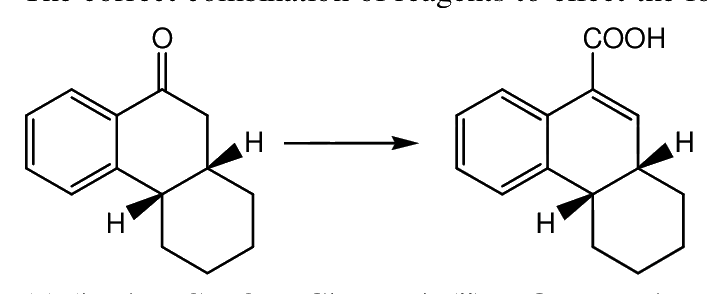
The correct combination of reagents to effect the following conversion is
Question 77 image
a.
(i) $\text{Ph}_3\text{P}^+\text{CH}_2\text{OMeCl}^-$, $\text{BuLi}$, (ii) $\text{H}_3\text{O}^+$, Jones' reagent
b.
(i) $\text{H}_2\text{N-NHTs}$; (ii) $\text{BuLi}$ (2 equiv); (iii) $\text{DMF}$
c.
(i) $\text{H}_2\text{N-NHTs}$; (ii) $\text{BuLi}$ (2 equiv); (iii) $\text{CO}_2$
d.
(i) $\text{ClCH}_2\text{CO}_2\text{Et}$, $\text{LDA}$; (ii) $\text{BF}_3\cdot\text{OEt}_2$; (iii) $\text{DMSO}$, $(\text{COCl})_2$, $\text{Et}_3\text{N}$, $-78^\circ\text{C}$ to rt.
Correct Answer & Step-by-Step Solution Locked

Sign in free to reveal the correct answer and AI explanation for this question.

Q98 mcq
The major product formed in the following reaction is
Question 78 image
Correct Answer & Step-by-Step Solution Locked

Sign in free to reveal the correct answer and AI explanation for this question.

Q99 mcq
Consider the following reaction, The appropriate intermediate involved in this reaction is
Question 79 image
Correct Answer & Step-by-Step Solution Locked

Sign in free to reveal the correct answer and AI explanation for this question.

Q100 mcq
The correct $^{13}\text{C}$ NMR chemical ($\delta$) shift values of carbons labeled a-e in the following ester are
Question 80 image
a.
a : 19; b : 143; c : 167; d : 125; e : 52
b.
a : 52; b : 143; c : 167; d : 125; e : 19
c.
a : 52; b : 167; c : 143; d : 125; e : 19
d.
a : 52; b : 167 ; c : 125; d : 143 ; e : 19
Correct Answer & Step-by-Step Solution Locked

Sign in free to reveal the correct answer and AI explanation for this question.

Q101 mcq
The products A and B in the following reaction sequence are
Question 81 image
a.
A and B shown in option (a)
b.
A and B shown in option (b)
c.
A and B shown in option (c)
d.
A and B shown in option (d)
Correct Answer & Step-by-Step Solution Locked

Sign in free to reveal the correct answer and AI explanation for this question.

Q102 mcq
The biosynthesis of isopentenyl pyrophosphate from acetyl CoA involves: A. Four molecules of acetyl CoA B. Three molecules of ATP C. Two molecules of NADPH D. Two molecules of lipoic acid The correct options among these are
a.
A, B and D
b.
A and B
c.
B and C
d.
A, C and D
Correct Answer & Step-by-Step Solution Locked

Sign in free to reveal the correct answer and AI explanation for this question.

Q103 mcq
Amongst the following, the major products formed in the following photochemical reactions are
Question 83 image
a.
A and C
b.
B and C
c.
A and D
d.
A and B
Correct Answer & Step-by-Step Solution Locked

Sign in free to reveal the correct answer and AI explanation for this question.

Q104 mcq
The products A and B in the following reaction sequence are
Question 84 image
Correct Answer & Step-by-Step Solution Locked

Sign in free to reveal the correct answer and AI explanation for this question.

Q105 mcq
Anthranilic acid, on treament with iso-amyl nitrite furnishes a product which displays a strong peak at 76 (m/e) in its mass spectrum. The strucrture of the product is
Question 85 image
Correct Answer & Step-by-Step Solution Locked

Sign in free to reveal the correct answer and AI explanation for this question.

Q106 mcq
The organoborane $\text{X}$, when reacted with $\text{Et}_2\text{Zn}$ followed by p-iodotoluene in the presence of catalytic amount of $\text{Pd(PPh}_3)_4$ furnishes a tri-substituted alkene. The intermediate and the product of the reaction, respectively, are
Question 86 image
Correct Answer & Step-by-Step Solution Locked

Sign in free to reveal the correct answer and AI explanation for this question.

Q107 mcq
Using Boltzmann distribution, the probability of an oscillator occupying the first three levels ($n = 0$, $1$ and $2$) is found to be $p_0 = 0.633$, $p_1 = 0.233$ and $p_2 = 0.086$. The probability of finding an oscillator in energy levels in $n \ge 3$ is
a.
0.032
b.
0.048
c.
0.952
d.
1.000
Correct Answer & Step-by-Step Solution Locked

Sign in free to reveal the correct answer and AI explanation for this question.

Q108 mcq
The major products A and B in the following reaction sequence are
Question 88 image
Correct Answer & Step-by-Step Solution Locked

Sign in free to reveal the correct answer and AI explanation for this question.

Q109 mcq
The correct combination of reagents required to effect the following conversion is
Question 89 image
a.
(i) $\text{Na}$, xylene, $\text{Me}_3\text{SiCl}$, heat; (ii) $\text{H}_3\text{O}^+$
b.
(i) $\text{Na}$, xylene, heat; (ii) $\text{H}_2\text{O}_2$, $\text{NaOH}$
c.
(i) $\text{NaOEt}$, $\text{EtOH}$; (ii) $\text{Na}$, xylene, heat
d.
(i) $\text{TiCl}_3$, $\text{Zn-Cu}$, $\text{Me}_3\text{SiCl}$, heat; (ii) $\text{H}_3\text{O}^+$
Correct Answer & Step-by-Step Solution Locked

Sign in free to reveal the correct answer and AI explanation for this question.

Q110 mcq
An organic compound gives following spectral data: IR : $2210, 1724\text{ cm}^{-1}$, $^1\text{H NMR} : \delta\ 1.4\text{ (t, } J = 7.1\text{ Hz, 3H)}, 4.4\text{ (q, } J = 7.1\text{ Hz, 2H)}$; $^{13}\text{C NMR} : \delta\ 16, 62, 118, 119, 125, 127, 168$. The compound is
Question 90 image
Correct Answer & Step-by-Step Solution Locked

Sign in free to reveal the correct answer and AI explanation for this question.

Q111 mcq
The major product formed in the following reaction is
Question 91 image
Correct Answer & Step-by-Step Solution Locked

Sign in free to reveal the correct answer and AI explanation for this question.

Q112 mcq
The correct combination of reagents for effecting the following sequence of reactions is
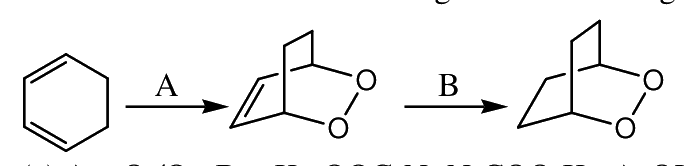
Question 92 image
a.
$\text{A} = \text{O}_3/\text{O}_2$; $\text{B} = \text{K}^+ \, ^-\text{OOC-N=N-COO}^- \text{K}^+, \text{AcOH}$
b.
$\text{A} = \text{O}_2$, Rose Bengal, $h\nu$; $\text{B} = \text{K}^+ \, ^-\text{OOC-N=N-COO}^- \text{K}^+, \text{AcOH}$
c.
$\text{A} = \text{O}_2$, Rose Bengal, $h\nu$; $\text{B} = \text{H}_2, \text{Pd/C}$
d.
$\text{A} = \text{O}_2$, Rose Bengal; $\Delta$; $\text{B} = \text{H}_2, \text{Pd/C}$
Correct Answer & Step-by-Step Solution Locked

Sign in free to reveal the correct answer and AI explanation for this question.

Q113 mcq
The correct combination of reagents required to effect the following conversion is
Question 93 image
a.
$\text{I}_2, \text{HNO}_3$
b.
$\text{s-BuLi}, -78^\circ\text{C}$ followed by $\text{KI}$
c.
$\text{NaOEt}$ followed by $\text{ICH}_2\text{CH}_2\text{I}$
d.
$\text{s-BuLi}, -78^\circ\text{C}$ followed by $\text{ICH}_2\text{CH}_2\text{I}$
Correct Answer & Step-by-Step Solution Locked

Sign in free to reveal the correct answer and AI explanation for this question.

Q114 mcq
Consider a particle confined in a cubic box. The degeneracy of the level, that has an energy twice that of the lowest level, is
a.
3
b.
1
c.
2
d.
4
Correct Answer & Step-by-Step Solution Locked

Sign in free to reveal the correct answer and AI explanation for this question.

Q115 mcq
Only two products are obtained in the following reaction sequence. The structures of the products from the list I-IV are
Question 95 image
a.
I and II
b.
II and IV
c.
I and III
d.
III and IV
Correct Answer & Step-by-Step Solution Locked

Sign in free to reveal the correct answer and AI explanation for this question.

Q116 mcq
The major product A formed in the following reaction is
Question 96 image
Correct Answer & Step-by-Step Solution Locked

Sign in free to reveal the correct answer and AI explanation for this question.

Q117 mcq
The products A and B in the following reaction sequnce are
Question 97 image
Correct Answer & Step-by-Step Solution Locked

Sign in free to reveal the correct answer and AI explanation for this question.

Q118 mcq
The spatial part of the wave function of the atom in its ground state is $\text{1s}(1)\text{ 1s}(2)$. The spin part would be
a.
$\alpha(1)\alpha(2)$
b.
$\beta(1)\beta(2)$
c.
$\frac{1}{\sqrt{2}}[\alpha(1)\beta(2)+\beta(1)\alpha(2)]$
d.
$\frac{1}{\sqrt{2}}[\alpha(1)\beta(2)-\beta(1)\alpha(2)]$
Correct Answer & Step-by-Step Solution Locked

Sign in free to reveal the correct answer and AI explanation for this question.

Q119 mcq
The number of phases, components and degrees of freedom, when $\text{Ar}$ is added to an equilibrium mixture of $\text{NO}$, $\text{O}_2$ and $\text{NO}_2$ in gas phase are, respectively,
a.
1, 3, 5
b.
1, 4, 5
c.
1, 3, 4
d.
1, 4, 4
Correct Answer & Step-by-Step Solution Locked

Sign in free to reveal the correct answer and AI explanation for this question.

Q120 mcq
The major product formed in the following reaction is
Question 100 image
Correct Answer & Step-by-Step Solution Locked

Sign in free to reveal the correct answer and AI explanation for this question.

Q121 mcq
A particle in a one dimensional harmonic oscillator in x-direction is perturbed by a potential $\lambda x$ ($\lambda$ is a number). The first-order correction to the energy of the ground state
a.
is zero
b.
is negative
c.
is positive
d.
may be negative or positive but NOT zero.
Correct Answer & Step-by-Step Solution Locked

Sign in free to reveal the correct answer and AI explanation for this question.

Q122 mcq
The points A and B in the following sequene of reactions are
Question 102 image
a.
A and B as shown in option (a)
b.
A and B as shown in option (b)
c.
A and B as shown in option (c)
d.
A and B as shown in option (d)
Correct Answer & Step-by-Step Solution Locked

Sign in free to reveal the correct answer and AI explanation for this question.

Q123 mcq
The mass spectrum of the product A, formed in the following reaction, exhibits M, M+2, M + 4 peaks in the ratio of about $1 : 2 : 1$. The reagent HX and the product A are
Question 103 image
a.
$\text{HX} = \text{HF}$ and $\text{A} =$ 1-(4-bromophenyl)-1-fluoropropane
b.
$\text{HX} = \text{HCl}$ and $\text{A} =$ 1-(4-bromophenyl)-1-chloropropane
c.
$\text{HX} = \text{HBr}$ and $\text{A} =$ 1-(4-bromophenyl)-1-bromopropane
d.
$\text{HX} = \text{HBr}$ and $\text{A} =$ 1-(4-bromophenyl)-2-bromopropane
Correct Answer & Step-by-Step Solution Locked

Sign in free to reveal the correct answer and AI explanation for this question.

Q124 mcq
Match the following natural products in column A with their structural features in column B \begin{tabular}{ll} \textbf{Column A} & \textbf{Column B} \\ (I) Colchicine & (A) Tetrahydrooxepine \\ (II) Strychnine & (B) Phenanthrene \\ (III) Quinine & (C) Tropolone \\ (IV) Ephedrine & (D) Phenylethylamine \\ & (E) Quinoline \\ & (F) Benzofuran \end{tabular} Identify the correct match from the following
a.
I-C, II-A, III-E, IV-D
b.
I-F, II-A, III-B, IV-E
c.
I-A, II-D, III-F, IV-D
d.
I-C, II-A, III-E, IV-F
Correct Answer & Step-by-Step Solution Locked

Sign in free to reveal the correct answer and AI explanation for this question.

Q125 mcq
A particle in a one-dimensional box (potential zero between to a and infinite outside) has the ground state energy $E_0 = \frac{0.125h^2}{\text{ma}^2}$. The expectation value of the above Hamiltonian with $\psi(x) = x(x-a)$ yields an energy $E_1$. Using a linear combination of two even functions $x(x-a)$ and $x^2(x-a)^2$, we obtain variational mainimum to the ground state energy as $E_2$. Which of the following relations holds for $E_0$, $E_1$ and $E_2$?
a.
$E_0 < E_1 < E_2$
b.
$E_0 < E_2 < E_1$
c.
$E_1 < E_0 < E_2$
d.
$E_2 < E_0 < E_1$
Correct Answer & Step-by-Step Solution Locked

Sign in free to reveal the correct answer and AI explanation for this question.

Q126 mcq
The dissociation constant of a weak acid $\text{HX}$ at a given temperature is $2.5 \times 10^{-5}$. The pH of $0.01\text{ M}$ $\text{NaX}$ at this temperature is
a.
$7.3$
b.
$7.7$
c.
$8.3$
d.
$8.7$
Correct Answer & Step-by-Step Solution Locked

Sign in free to reveal the correct answer and AI explanation for this question.

Q127 mcq
The ground state energy of hydrogen atom is $-13.598\text{ eV}$. The expectation values of kinetic energy, $\langle T \rangle$ and potential energy, $\langle V \rangle$, in units of $\text{eV}$, are
a.
$\langle T \rangle = 13.598, \langle V \rangle = -27.196$
b.
$\langle T \rangle = -27.196, \langle V \rangle = 13.598$
c.
$\langle T \rangle = -6.799, \langle V \rangle = -6.799$
d.
$\langle T \rangle = 6.799, \langle V \rangle = -20.397$
Correct Answer & Step-by-Step Solution Locked

Sign in free to reveal the correct answer and AI explanation for this question.

Q128 mcq
If $\psi = 0.8\,\varphi_A + 0.4\,\varphi_B$ is a normalized molecular orbital of a diaotmic molecule $\text{AB}$, constructed from $\varphi_A$ and $\varphi_B$ which are also normalized, the overlap between $\varphi_A$ and $\varphi_B$ is
a.
$0.11$
b.
$0.31$
c.
$0.51$
d.
$0.71$
Correct Answer & Step-by-Step Solution Locked

Sign in free to reveal the correct answer and AI explanation for this question.

Q129 mcq
At a given temperature consider $$\text{Fe}_2\text{O}_3(\text{s}) + 3\text{CO}(\text{g}) \rightleftharpoons 2\text{Fe}(\text{s}) + 3\text{CO}_2(\text{g}); \text{K}_1 = 0.05$$ $$2\text{CO}_2(\text{g}) \rightleftharpoons 2\text{CO}(\text{g}) + \text{O}_2(\text{g}); \text{K}_2 = 2 \times 10^{-12}$$ The equilibrium constant for the reaction $$2\text{Fe}_2\text{O}_3(\text{s}) \rightleftharpoons 4\text{Fe}(\text{s}) + 3\text{O}_2\text{ is}$$
a.
$1 \times 10^{-13}$
b.
$2 \times 10^{-38}$
c.
$4 \times 10^{-15}$
d.
$2 \times 10^{-24}$
Correct Answer & Step-by-Step Solution Locked

Sign in free to reveal the correct answer and AI explanation for this question.

Q130 mcq
In a bomb calorimeter, the combustion of $0.5\text{ g}$ of compound A (molar mass = $50\text{ g mol}^{-1}$) increased the temperature by $4\text{K}$. If the heat capacity of the calorimeter along with that of the material is $2.5\text{ kJ K}^{-1}$, the molar internal energy of combustion, in $\text{kJ}$, is
a.
$1000$
b.
$-1000$
c.
$20$
d.
$-20$
Correct Answer & Step-by-Step Solution Locked

Sign in free to reveal the correct answer and AI explanation for this question.

Q131 mcq
The translational, rotational and vibrational partition functions for a molecule are $f_{\text{translation}} \simeq 10^{10}\text{ m}^{-1}$, $f_{\text{rotation}} \simeq f_{\text{vibration}} \simeq 1$, $(k_B\text{T} / h) \simeq 10^{13}$ at room temperature, $N_A \simeq 6 \times 10^{23}$ Using the approximate data given above, the frequency factor (A) for a reaction of the type: atom + diatomic molecule $\rightarrow$ non-linear transtion state $\rightarrow$ product, according to the conventional transition state theory is
a.
$2 \times 10^3$
b.
$6 \times 10^7$
c.
$2 \times 10^{12}$
d.
$6 \times 10^{13}$
Correct Answer & Step-by-Step Solution Locked

Sign in free to reveal the correct answer and AI explanation for this question.

Q132 mcq
The interplanar spacing of (110) planes in a cubic unit cell with lattice parameter $\text{a} = 4.242\text{Å}$ is
a.
$5\text{Å}$
b.
$6\text{Å}$
c.
$7.35\text{Å}$
d.
$2.45\text{Å}$
Correct Answer & Step-by-Step Solution Locked

Sign in free to reveal the correct answer and AI explanation for this question.

Q133 mcq
A compound $\text{A}_\text{x}\text{B}_\text{y}$ has a cubic structure with A atoms occupying all corners of the cube as well as all the face centre positions. The B atoms occupy four tetrahedral voids. The values of x and y respectively, are
a.
4, 4
b.
4, 8
c.
8, 4
d.
4, 2
Correct Answer & Step-by-Step Solution Locked

Sign in free to reveal the correct answer and AI explanation for this question.

Q134 mcq
The number of lines in the ESR spectrum of $\text{CD}_3$ is (the spin of D is 1)
a.
1
b.
3
c.
4
d.
7
Correct Answer & Step-by-Step Solution Locked

Sign in free to reveal the correct answer and AI explanation for this question.

Q135 mcq
The $\text{C}=\text{O}$ bond length is $120\text{ pm}$ in $\text{CO}_2$. The moment of inertia of $\text{CO}_2$ would be close to (masses of C and O are $1.9\times 10^{-27}\text{ kg}$ and $2.5\times 10^{-27}\text{ kg}$, respectively)
a.
$1.8\times 10^{-45}\text{ kgm}^2$
b.
$3.6\times 10^{-45}\text{ kgm}^2$
c.
$5.4\times 10^{-45}\text{ kgm}^2$
d.
$7.2\times 10^{-45}\text{ kgm}^2$
Correct Answer & Step-by-Step Solution Locked

Sign in free to reveal the correct answer and AI explanation for this question.

Q136 mcq
The fluorescence lifetime of a molecule in a solution is $5\times 10^{-9}\text{ s}$. The sum of all of the non-radiative rate constants $(\Sigma\text{k}_{\text{nr}})$ for the decay of excited state is $1.2\times 10^8\text{ s}^{-1}$. The fluorescence quantum yield of the molecule is
a.
0.1
b.
0.2
c.
0.4
d.
0.6
Correct Answer & Step-by-Step Solution Locked

Sign in free to reveal the correct answer and AI explanation for this question.

Q137 mcq
Solutions of three electrolytes have the same ionic strength and different dielectric constants as 4, 25 and 81. The corresponding relative magnitude of Debye-Hückel screening, lengths of the three solutions are
a.
4, 25 and 81
b.
2, 5 and 9
c.
1/2, 1/5 and 1/9
d.
1, 1 and 1
Correct Answer & Step-by-Step Solution Locked

Sign in free to reveal the correct answer and AI explanation for this question.

Q138 mcq
Simple Hückel molecular orbital theory
a.
considers electron-electron repulsion explicitly
b.
distinguishes cis-butadiene and trans-butadiene
c.
disinguishes cis-butadiene and cyclobutadiene
d.
has different coulomb integrals for non-equivalent carbons.
Correct Answer & Step-by-Step Solution Locked

Sign in free to reveal the correct answer and AI explanation for this question.

Q139 mcq
For the non-dissociative Langmuir type adsorption of a gas on a solid surface at a particular temperature, the fraction of surface coverage is 0.6 at 30 bar. The Langmuir isotherm constant (in $\text{bar}^{-1}$ units) at this temperature is
a.
0.05
b.
0.20
c.
2.0
d.
5.0
Correct Answer & Step-by-Step Solution Locked

Sign in free to reveal the correct answer and AI explanation for this question.

Q140 mcq
For a set of 10 observed data points, the mean is 8 and the variance is 0.04. The 'standard deviation' and the 'coefficient of variation' of the data are, respectively
a.
0.005, 0.1%
b.
0.02, 0.2%
c.
0.20, 2.5%
d.
0.32, 1.0%
Correct Answer & Step-by-Step Solution Locked

Sign in free to reveal the correct answer and AI explanation for this question.

Q141 mcq
In the Lineweaver-Burk plot of $\text{(initial rate)}^{-1}$ vs. $\text{(initial substrate concentration)}^{-1}$ for an enzyme catalyzed reaction following Michaelis-Menten mechanism, the y-intercept is $5000\text{ M}^{-1}\text{ s}$. If the initial enzyme concentration is $1\times 10^{-9}\text{ M}$, the turnover number is
a.
$2.5\times 10^3$
b.
$1.0\times 10^4$
c.
$2.5\times 10^4$
d.
$2.0\times 10^5$
Correct Answer & Step-by-Step Solution Locked

Sign in free to reveal the correct answer and AI explanation for this question.

Q142 mcq
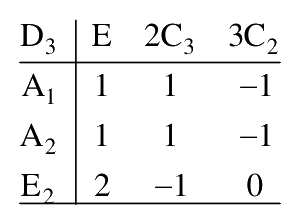
The $\text{E}\otimes\text{E}$ direct product in $\text{D}_3$ point group contains the irreducible representations $$\begin{array}{c|ccc} \text{D}_3 & \text{E} & 2\text{C}_3 & 3\text{C}_2 \\ \hline \text{A}_1 & 1 & 1 & -1 \\ \text{A}_2 & 1 & 1 & -1 \\ \text{E} & 2 & -1 & 0 \end{array}$$
Question 122 image
a.
$\text{A}_1 + \text{A}_2 + \text{E}$
b.
$2\text{A}_1 + \text{E}$
c.
$2\text{A}_2 + \text{E}$
d.
$2\text{A}_1 + 2\text{A}_2$
Correct Answer & Step-by-Step Solution Locked

Sign in free to reveal the correct answer and AI explanation for this question.

Q143 mcq
The result of the product $\text{C}_2(\text{x})\text{C}_2(\text{y})$ is
a.
$\text{E}$
b.
$\sigma_{\text{xy}}$
c.
$\text{C}_2(\text{z})$
d.
$\text{i}$
Correct Answer & Step-by-Step Solution Locked

Sign in free to reveal the correct answer and AI explanation for this question.

Q144 mcq
Given; A. $\text{Fe(OH)}_2(\text{s}) + 2\text{e}^- \rightarrow \text{Fe(s)} + 2\text{OH}^-(\text{aq}); \text{E}^0 = -0.877\text{ V}$ B. $\text{Al}^{3+}(\text{aq}) + 3\text{e}^- \rightarrow \text{Al(s)}; \text{E}^0 = -1.66\text{ V}$ C. $\text{AgBr(aq)} + \text{e}^- \rightarrow \text{Ag(s)} + \text{Br}^-(\text{aq}); \text{E}^0 = 0.071\text{ V}$ The overall reaction for the cells in the direction of spontaneous change would be
a.
Cell with A and B : Fe reduced Cell with A and C : Fe reduced
b.
Cell with A and B : Fe reduced Cell with A and C : Fe oxidized
c.
Cell with A and B : Fe oxidized Cell with A and C : Fe oxidized
d.
Cell with A and B : Fe oxidized Cell with A and C : Fe reduced
Correct Answer & Step-by-Step Solution Locked

Sign in free to reveal the correct answer and AI explanation for this question.

Q145 mcq
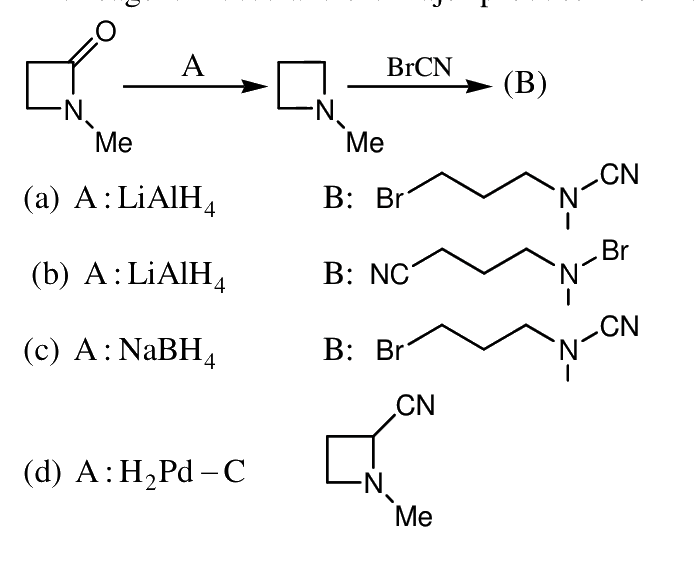
The reagent A used and the major product B formed in the following reaction sequence are
Question 125 image
a.
$\text{A : LiAlH}_4$, $\text{B : } \text{Br}-(\text{CH}_2)_3-\text{N}(\text{Me})-\text{CN}$
b.
$\text{A : LiAlH}_4$, $\text{B : } \text{NC}-(\text{CH}_2)_3-\text{N}(\text{Me})-\text{Br}$
c.
$\text{A : NaBH}_4$, $\text{B : } \text{Br}-(\text{CH}_2)_3-\text{N}(\text{Me})-\text{CN}$
d.
$\text{A : H}_2\text{Pd}-\text{C}$, $\text{B : }$ 1-methylazetidine-2-carbonitrile
Correct Answer & Step-by-Step Solution Locked

Sign in free to reveal the correct answer and AI explanation for this question.