Antimony pentafluoride ($ ext{SbF}_5$) is an extremely strong Lewis acid and fluoride ion acceptor. In anhydrous $ ext{HF}$ (a superacid system, fluoroantimonic acid), the reaction is:
$$\text{SbF}_5 + 2\text{HF} \rightleftharpoons [\text{H}_2\text{F}]^+[\text{SbF}_6]^-$$
Therefore, the product formed is $[\text{SbF}_6]^- [\text{H}_2\text{F}]^+$, matching option D.
Q22mcq
The $\delta$-bond is formed via the overlap of
a.
$\text{d}_{x^2-y^2}$ and $\text{d}_{x^2-y^2}$ orbitals
b.
$\text{d}_{xz}$ and $\text{d}_{xz}$ orbitals
c.
$\text{d}_{xy}$ and $\text{d}_{xy}$ orbitals
Correct Answer
d.
$\text{d}_{yz}$ and $\text{d}_{yz}$ orbitals
Step-by-Step AI Explanation
Verified Method
A $\delta$-bond is formed by the face-to-face (four-lobe) overlap of two $d$-orbitals with their internuclear axis chosen as the $z$-axis. The orbitals that can form $\delta$-bonds along the $z$-axis are $d_{xy}$ and $d_{x^2-y^2}$. In standard coordination chemistry conventions (e.g., in quadruply bonded dimetal complexes such as $[\text{Re}_2\text{Cl}_8]^{2-}$ where ligands occupy the $x$ and $y$ axes), the metal-metal $\delta$-bond is formed by the overlap of two $d_{xy}$ orbitals, while the $d_{x^2-y^2}$ orbitals are involved in metal-ligand $\sigma$-bonding. Therefore, the overlap of $\text{d}_{xy}$ and $\text{d}_{xy}$ orbitals forms the $\delta$-bond (Option C).
Q23mcq
Among $\text{F}^-$, $\text{Na}^+$, $\text{O}^{2-}$ and $\text{Mg}^{2+}$ ions, those having the highest and the lowest ionic radii respectively are
a.
$\text{O}^{2-}$ and $\text{Na}^+$
b.
$\text{F}^-$ and $\text{Mg}^{2+}$
c.
$\text{O}^{2-}$ and $\text{Mg}^{2+}$
Correct Answer
d.
$\text{Mg}^{2-}$ and $\text{O}^{2-}$
Step-by-Step AI Explanation
Verified Method
The ions $\text{O}^{2-}$, $\text{F}^-$, $\text{Na}^+$, and $\text{Mg}^{2+}$ are all isoelectronic species with 10 electrons ($1s^2 2s^2 2p^6$). For isoelectronic ions, the ionic radius decreases as the effective nuclear charge ($Z$) increases:
- $\text{O}^{2-}$: $Z = 8$ (lowest nuclear charge, highest ionic radius)
- $\text{F}^-$: $Z = 9$
- $\text{Na}^+$: $Z = 11$
- $\text{Mg}^{2+}$: $Z = 12$ (highest nuclear charge, lowest ionic radius)
Thus, $\text{O}^{2-}$ has the highest ionic radius and $\text{Mg}^{2+}$ has the lowest ionic radius.
Q24mcq
The extent of $\pi$-electron conjugation in macrocyclic rings of (1) heme, (2) coenzyme $\text{B}_{12}$ and (3) chlorophyll follows the order
a.
$(1) > (3) > (2)$
Correct Answer
b.
$(1) > (2) > (3)$
c.
$(3) > (1) > (2)$
d.
$(2) \approx (1) > (3)$
Step-by-Step AI Explanation
Verified Method
The macrocyclic rings in these systems have differing numbers of conjugated double bonds:
1. **Heme** contains a **porphyrin** ring, which has a fully conjugated $18\pi$-electron aromatic system (with 11 conjugated double bonds in the ring).
2. **Chlorophyll** contains a **chlorin** ring, which is a dihydroporphyrin with one reduced pyrrole ring (reduced conjugation compared to porphyrin, possessing 10 double bonds / reduced conjugation path).
3. **Coenzyme $\text{B}_{12}$** contains a **corrin** ring, which lacks one meso-carbon bridge and has several saturated positions, leading to the least extensive conjugation (only 6 conjugated double bonds).
Therefore, the extent of $\pi$-electron conjugation follows the order: $\text{heme (1)} > \text{chlorophyll (3)} > \text{coenzyme B}_{12} \text{ (2)}$, which is $(1) > (3) > (2)$.
Q25mcq
The correct order of the retention of cations on a sulfonated cation exchange resin column is
For a strongly acidic sulfonated cation exchange resin, the affinity (retention) for univalent metal ions generally increases with decreasing hydrated ionic radius (or increasing polarizability and bare ionic radius):
$$\text{Li}^+ < \text{Na}^+ < \text{K}^+$$
Among alkali metal ions and silver, $\text{Ag}^+$ has a much higher selectivity/retention due to its greater polarizability and covalent interaction with the sulfonate group:
$$\text{Ag}^+ > \text{K}^+ > \text{Na}^+ > \text{Li}^+$$
Thus, option A is correct.
Q26mcq
In a polarographic measurement, (aqueous $\text{KCl}$ solution used as supporting electrolyte) an applied potential more than $+0.4\text{ V}$, results mainly in the formation of
a.
$\text{Hg}^\text{I}$
Correct Answer
b.
$\text{Hg}^\text{II}$
c.
$\text{Cl}_2$
d.
$\text{O}_2$
Step-by-Step AI Explanation
Verified Method
At a dropping mercury electrode (DME) in the presence of chloride ions, anodic oxidation of mercury occurs at potentials more positive than approximately $+0.25$ to $+0.4\text{ V}$ vs SCE. The oxidation produces insoluble calomel (mercury(I) chloride, $\text{Hg}_2\text{Cl}_2$):
$$2\text{Hg} + 2\text{Cl}^- \rightarrow \text{Hg}_2\text{Cl}_2(s) + 2e^-$$
In this species, mercury exists in the $\text{Hg}^\text{I}$ oxidation state ($[\text{Hg}_2]^{2+}$). Therefore, the main product is $\text{Hg}^\text{I}$.
Q27mcq
The correct order of the isomeric shift in Mössbauer spectra ($^{57}\text{Fe}$ source) of iron compounds is
For the $^{57}\text{Fe}$ Mössbauer transition, the nuclear radius in the excited state is smaller than in the ground state ($\Delta R/R < 0$). Consequently, the isomer shift ($\delta$) is inversely proportional to the electron density at the nucleus, $|\psi(0)|^2$. As the oxidation state of iron increases, the number of $3d$ shielding electrons decreases:
- $\text{Fe(II)}$ ($d^6$) has more $d$-electrons, leading to more shielding of the $s$-electrons, lower $s$-electron density at the nucleus, and thus a **higher isomer shift**.
- $\text{Fe(III)}$ ($d^5$) has fewer $d$-electrons than $\text{Fe(II)}$, hence higher $s$-electron density and a **lower isomer shift**.
- $\text{Fe(IV)}$ ($d^4$) has even fewer $d$-electrons, yielding the **lowest isomer shift**.
Therefore, the correct order is $\text{Fe(II)} > \text{Fe(III)} > \text{Fe(IV)}$.
Q28mcq
The hapticities 'x' and 'y' of the arene moieties in the diamagnetic complex $[(\eta^x - \text{C}_6\text{H}_6)\text{Ru}(\eta^y - \text{C}_6\text{H}_6)]$ respectively are
a.
6 and 6
b.
4 and 4
c.
4 and 6
Correct Answer
d.
6 and 2
Step-by-Step AI Explanation
Verified Method
The complex is diamagnetic, which means it satisfies the 18-electron rule. Ruthenium is in group 8, so $\text{Ru}(0)$ has 8 valence electrons. To reach an 18-electron configuration, the two benzene ligands must collectively donate $18 - 8 = 10$ electrons. An $\eta^6$-arene donates 6 electrons, and an $\eta^4$-arene donates 4 electrons ($6 + 4 = 10$). Therefore, the hapticities must be $x = 4$ and $y = 6$ (or vice-versa).
Q29mcq
The rate of the reaction $\text{Ni(CO)}_4 + \text{PPh}_3 \xrightarrow{h\nu} [\text{Ni(CO)}_3(\text{PPh}_3)] + \text{CO}$ depends on
a.
Concentration of both the reactants
b.
Concentration of $\text{Ni(CO)}_4$ only
Correct Answer
c.
Concentration of $\text{PPh}_3$ only
d.
The steric bulk of $\text{PPh}_3$
Step-by-Step AI Explanation
Verified Method
Substitution in metal carbonyls, especially 18-electron species like $\text{Ni(CO)}_4$, occurs via a dissociative ($D$ or $I_d$) mechanism. Photochemical or thermal activation induces the dissociation of a $\text{CO}$ ligand as the rate-determining step:
$$\text{Ni(CO)}_4 \xrightarrow{h\nu, \text{slow}} [\text{Ni(CO)}_3] + \text{CO}$$
$$\text{[Ni(CO)}_3] + \text{PPh}_3 \xrightarrow{\text{fast}} [\text{Ni(CO)}_3(\text{PPh}_3)]$$
Thus, the rate law is first order with respect to $\text{Ni(CO)}_4$ only: $\text{Rate} = k[\text{Ni(CO)}_4]$.
Q30mcq
The product of the reaction of propene, $\text{CO}$ and $\text{H}_2$ in the presence of $\text{CO}_2(\text{CO})_8$ as a catalyst is
a.
Butanoic acid
b.
Butanal
Correct Answer
c.
2-butanone
d.
Methylpropanoate
Step-by-Step AI Explanation
Verified Method
The reaction of an alkene with $\text{CO}$ and $\text{H}_2$ (syngas) in the presence of a cobalt catalyst, $\text{Co}_2(\text{CO})_8$, is hydroformylation (the oxo process). Hydroformylation converts propene ($\text{CH}_3\text{CH}=\text{CH}_2$) into aldehydes containing one additional carbon atom, yielding mainly butanal (along with 2-methylpropanal).
🎉 10 Free Sample Solutions Completed
Unlock All 118 Questions & Solutions
Sign up free in seconds to unlock step-by-step AI answers for the remaining 108 questions.
Identify correct statements for mercury as an environment pollutant.
A. Carbanionic biomethylation converts it to $\mathrm{MeHg}^+$
B. Thiol group of cysteine has strong affinity for mercury
C. Mercury containing industrial catalyst release caused Minamata disaster
The correct answer is
a.
A and B
b.
A and C
c.
B and C
d.
A, B and C
Correct Answer & Step-by-Step Solution Locked
Sign in free to reveal the correct answer and AI explanation for this question.
A compound with molecular formula $\text{C}_4\text{H}_6\text{O}_2$ shows band at $1770\text{ cm}^{-1}$ in IR spectrum and peaks at 178, 68, 28 and 22 ppm in $^{13}\text{C}$ NMR spectrum. The correct structure of the compound is
Correct Answer & Step-by-Step Solution Locked
Sign in free to reveal the correct answer and AI explanation for this question.
The mass of metastable ion produced due to decomposition of $\text{F}_1^+$ in the following mass fragmentation sequence is
$$\text{Diethyl-phthalate}\ (M^{+\cdot}, 222) \rightarrow \text{F}_1^+\ (177) \rightarrow \text{F}_2^+ + \text{CO}$$
a.
141.2
b.
125.4
c.
45.0
d.
210.2
Correct Answer & Step-by-Step Solution Locked
Sign in free to reveal the correct answer and AI explanation for this question.
If the component of the orbital angular momentum along the molecular axis of a heteronuclear diatomic molecule is non-zero, the rotational-vibrational spectrum will show
a.
P and R branches only.
b.
P and Q branches only.
c.
Q and R branches only.
d.
All the P, Q and R branches.
Correct Answer & Step-by-Step Solution Locked
Sign in free to reveal the correct answer and AI explanation for this question.
For a particle of mass $m$ confined in a box of length $L$, assume $\Delta x = L$. Assume further that $\Delta p(\text{min}) = \left< p^2 \right>^{1/2}$. Use the uncertainity principle to obtain an estimate of the energy of the particle. The value will be
a.
$\frac{h^2}{(8mL^2)}$
b.
$\frac{\hbar^2}{(8mL^2)}$
c.
$\frac{h^2}{(32mL^2)}$
d.
$\frac{h^2}{(2mL^2)}$
Correct Answer & Step-by-Step Solution Locked
Sign in free to reveal the correct answer and AI explanation for this question.
For the cell reaction, $\text{Sn}(\text{s}) + \text{Sn}^{4+}(\text{aq}) \rightleftharpoons 2\text{Sn}^{2+}(\text{aq})$, separate electrode reactions could be written with the respective standard electrode potential data at $25^\circ\text{C}$ as
$$\text{Sn}^{4+}(\text{aq}) + 2\text{e}^- \rightarrow \text{Sn}^{2+}(\text{aq}), \quad \text{E}^0 = +0.15\text{ V}$$
$$\text{Sn}^{2+}(\text{aq}) + 2\text{e}^- \rightarrow \text{Sn}(\text{s}), \quad \text{E}^0 = -0.14\text{ V}$$
When $\text{RT}/\text{F}$ is given as $25.7\text{ mV}$, logarithm of the equilibrium constant ($\ell\text{n }\text{K}$) is
a.
$22.6$
b.
$226$
c.
$2.26$
d.
$2.26 \times 10^{-1}$
Correct Answer & Step-by-Step Solution Locked
Sign in free to reveal the correct answer and AI explanation for this question.
Hydrogen is adsorbed on many metal surfaces by dissociation (S represents a surface site):
$$\text{H}_2 + \begin{array}{cc} | & | \\ \text{—S} & \text{S—} \end{array} \rightleftharpoons \begin{array}{cc} \text{H} & \text{H} \\ | & | \\ \text{—S} & \text{S—} \end{array}$$
If the pressure of $\text{H}_2$ (p) is small, the fraction of the surface covered by hydrogen is proportional to
a.
$\text{p}$
b.
$\text{p}^2$
c.
$\text{p}^{1/2}$
d.
$\text{p}^{3/2}$
Correct Answer & Step-by-Step Solution Locked
Sign in free to reveal the correct answer and AI explanation for this question.
The angular momentum operator $L_z = -i\hbar\frac{\partial}{\partial\phi}$ has eigen functions of the form $\exp[iA\phi]$. The condition that a full rotation leaves such an eigen function unchanged is satisfies for all the values of $A$.
A reaction $\text{A} + \text{B} + \text{C} \rightarrow \text{D}$ follows the mechanism
$$\text{A} + \text{B} \rightleftharpoons \text{AB}$$
$$\text{AB} + \text{C} \rightarrow \text{D}$$
in which first step remains essentially in equilibrium. If $\Delta H$ is the enthalpy change for the first reaction and $E_0$ is the activation energy for the second reaction, the activation energy of the overall reaction will be given by
a.
$E_0$
b.
$E_0 - \Delta H$
c.
$E_0 + \Delta H$
d.
$E_0 + 2\Delta H$
Correct Answer & Step-by-Step Solution Locked
Sign in free to reveal the correct answer and AI explanation for this question.
Wavelength ($\lambda$ in nm) of the Lyman series for an one-electron ion is in the range $24 \le \lambda \le 30$. The ionization energy of the ion will be closest to ($1\text{ J} = \frac{10^{19}}{1.6}\text{ eV}$)
a.
$32\text{ eV}$
b.
$42\text{ eV}$
c.
$52\text{ eV}$
d.
$62\text{ eV}$
Correct Answer & Step-by-Step Solution Locked
Sign in free to reveal the correct answer and AI explanation for this question.
A sample experiment revealed that PVC formed in the medium has $\langle\text{M}_\text{n}\rangle = 13$, and $\langle\text{M}_\text{w}\rangle = 16$, where $\langle\text{M}_\text{n}\rangle$ stands for the number average molar mass and $\langle\text{M}_\text{w}\rangle$ for the weight average molar mass. The variance of $\text{M}_\text{n}$ will then be
a.
39
b.
3
c.
1
d.
87
Correct Answer & Step-by-Step Solution Locked
Sign in free to reveal the correct answer and AI explanation for this question.
For an enzyme-substrate reaction, a plot between $\frac{1}{v}$ and $\frac{1}{[S]_0}$ yields a slope of $40\text{s}$. If the enzyme concentration is $2.5\ \mu\text{M}$, then the catalytic efficiency of the enzyme is
a.
$40\text{ L}\text{mol}^{-1}\text{s}^{-1}$
b.
$10^{-4}\text{ L}\text{mol}^{-1}\text{s}^{-1}$
c.
$10^7\text{ L}\text{mol}^{-1}\text{s}^{-1}$
d.
$10^4\text{ L}\text{mol}^{-1}\text{s}^{-1}$
Correct Answer & Step-by-Step Solution Locked
Sign in free to reveal the correct answer and AI explanation for this question.
$10\text{ ml}$ of $0.02\text{ M NaOH}$ is added to $10\text{ ml}$ of $0.02\text{ M}$ acetic acid ($\text{p}K_a = 4.75$). The pH of the solution will be closest to
a.
7.0
b.
8.4
c.
5.6
d.
9.6
Correct Answer & Step-by-Step Solution Locked
Sign in free to reveal the correct answer and AI explanation for this question.
Which of the following will result in deviation from Beer's law:
(A) Change in refractive index of medium,
(B) Dissociation of analyte on dilution,
(C) Polychromatic light
(D) Path length of cuvette
a.
A, B and C
b.
B, C and D
c.
A, C and D
d.
A, B and D
Correct Answer & Step-by-Step Solution Locked
Sign in free to reveal the correct answer and AI explanation for this question.
Match the metalloproteins in column–A with their function in column–B
**Column–A**
I. Oxyhemocyanin
II. Carbonic anhydrase
III. Cytochrome $\text{P}_{450}$
IV. Carboxy-peptidase A
**Column–B**
A. hydrolysis of C-terminal peptide bond
B. methylation
C. Conversion of $\text{CO}_2$ to $\text{H}_2\text{CO}_3$
D. oxdiation of alkene
E. oxygen stroage
F. oxygen transport
The correct answer is
a.
I – F; II – C; III – D; IV – A
b.
I – E; II – C; III – A; IV – F
c.
I – F; II – B; III – C; IV – A
d.
I – E; II – D; III – C; IV – A
Correct Answer & Step-by-Step Solution Locked
Sign in free to reveal the correct answer and AI explanation for this question.
$\text{Na}[(\eta^5\text{- C}_5\text{H}_5)\text{Fe(CO)}_2]$ reacts with $\text{Br}_2$ to give A. Reaction of A with $\text{LiAlH}_4$ results in B. The proton NMR spectrum of B consists of two singlets of relative intensity 5:1. Compounds A and B, respectively, are
a.
$(\eta^5\text{- C}_5\text{H}_5)\text{Fe(CO)}_2\text{ Br}$ and $(\eta^5\text{- C}_5\text{H}_5)\text{Fe(CO)}_2\text{H}$
b.
$(\eta^4\text{- C}_5\text{H}_5)\text{Fe(CO)}_2\text{ Br}_2$ and $(\eta^4\text{- C}_5\text{H}_5)\text{Fe(CO)}_2\text{HBr}$
c.
$(\eta^5\text{- C}_5\text{H}_5)\text{Fe(CO)}_2\text{ Br}$ and $(\eta^4\text{- C}_5\text{H}_5)\text{Fe(CO)}_2(\text{H})_2$
d.
$(\eta^5\text{- C}_5\text{H}_5)\text{Fe(CO)}_2\text{ Br}$ and $(\eta^5\text{- C}_5\text{H}_5)\text{Fe(CO)}_2\text{HBr}$
Correct Answer & Step-by-Step Solution Locked
Sign in free to reveal the correct answer and AI explanation for this question.
$^1\text{H}$ NMR spectrum of free benzene shows a peak at $\sim 7.2\text{ ppm}$. The expected chemical shift (in ppm) of $\text{C}_6\text{H}_6$ ligand in $^1\text{H}$ NMR spectrum of $[(\eta^6-\text{C}_6\text{H}_6)\text{Cr}(\text{CO})_3]$ and the reason for it, if an, is/are
a.
$4.5$ ; disruption of ring current
b.
$9.0$ ; inductive effect
c.
$7.2$
d.
$2.5$ ; combination of inductive effect and disruption of ring current
Correct Answer & Step-by-Step Solution Locked
Sign in free to reveal the correct answer and AI explanation for this question.
An aqueous solution of $[\text{Mn}(\text{H}_2\text{O})_6]^{2+}$ complex is pale pink in colour. The probable reasons for it are
(A) Presence of $^6\text{A}_{1\text{g}}$ ground state
(B) Disallowed transition by spin selection rule
(C) Presence of $^2\text{T}_{2\text{g}}$ ground state
(D) Charge transfer transition
The correct answer is
a.
A and B
b.
A and C
c.
B and C
d.
C and D
Correct Answer & Step-by-Step Solution Locked
Sign in free to reveal the correct answer and AI explanation for this question.
The reaction of phosphorus trichloride with phenyllithium in 1:3 molar ratio yields product 'A', which on further treatment with methyl iodide produces 'B'. The reaction of B with $^n\text{BuLi}$ gives product 'C'. The products A, B and C, respectively, are
The reaction between diphenyldichlorosilane and water in 1:2 molar ratio gives product A which on heating above $100^\circ\text{C}$ yields a cyclic or polymeric product B. The products A and B respectively, are
a.
$\text{Ph}_2\text{Si}(\text{OH})_2$ and $\text{Ph}_2(\text{OH})\text{Si}-\text{O}-\text{Si}(\text{OH})\text{Ph}_2$
b.
Cyclic $(\text{Ph}_2\text{SiO})_2$ and $(\text{Ph}_2\text{SiO})_n (n = 3, 4, \text{ or } \infty)$
c.
$\text{Ph}_2\text{Si}(\text{OH})_2$ and $(\text{Ph}_2\text{SiO})_n (n = 3, 4, \text{ or } \infty)$
d.
$\text{Ph}_2\text{Si}(\text{H})(\text{OH})$ and $\text{Ph}_2\text{Si}(\text{H})-\text{O}-\text{Si}(\text{H})\text{Ph}_2$
Correct Answer & Step-by-Step Solution Locked
Sign in free to reveal the correct answer and AI explanation for this question.
Hindered $\beta-\text{diketonates}$ like $\text{dpmH}$ ($\text{dpmH} = \text{dipivaloylmethane}$) are used for the separation of lanthanides because complexes formed with $\text{dpmH}$ can be separated by
a.
Gel permeantion chromatography
b.
Gas chromatography
c.
Gel filtration chromatography
d.
Ion exchange chromatography
Correct Answer & Step-by-Step Solution Locked
Sign in free to reveal the correct answer and AI explanation for this question.
Base hydrolysis of $[\text{CoCl}(\text{NH}_3)_5]^{2+}$ is an overall second order reaction, whereas that of $[\text{Co}(\text{CN})_6]^{3-}$ is of first order. The rates depend in both cases solely on the concentrations of the cobalt complex. This may be due to
(A) Presence of ionizable proton in $[\text{CoCl}(\text{NH}_3)_5]^{2+}$ but not in $[\text{Co}(\text{CN})_6]^{3-}$
(B) $\text{S}_{\text{N}}^1\text{CB}$ mechanism in the case of $[\text{CoCl}(\text{NH}_3)_5]^{2+}$ only
(C) $\text{S}_{\text{N}}^1\text{CB}$ mechanism in the case of $[\text{Co}(\text{CN})_6]^{3-}$ only
(D) $\text{S}_{\text{N}}^1\text{CB}$ mechanism in both the complexes
Correct explanation(s) is/are
a.
A and B
b.
A and C
c.
B only
d.
A and D
Correct Answer & Step-by-Step Solution Locked
Sign in free to reveal the correct answer and AI explanation for this question.
A borane (X) is reacted with ammonia to give a salt of borohydride (Y). The $^{11}\text{B}$ NMR spectrum of Y consists of a triplet and a quintet. The borane X is
a.
$\text{B}_2\text{H}_6$
b.
$\text{B}_3\text{H}_9$
c.
$\text{B}_4\text{H}_8$
d.
$\text{B}_5\text{H}_9$
Correct Answer & Step-by-Step Solution Locked
Sign in free to reveal the correct answer and AI explanation for this question.
Complexes $\text{HM}(\text{CO})_5$ and $[(\eta^5-\text{C}_5\text{H}_5)\text{M}'(\text{CO})_3]_2$ obey the 18-electron rule. Identify $\text{M}$ and $\text{M}'$ and their $^1\text{H}$ NMR chemical shifts relative to TMS.
Gel permeation chromatography can be used to separate which of the following
(A) Lanthanides
(B) Alkaline earths
(C) Fatty acids
(D) Low molecular weight peptides
The correct answer is
a.
A and B
b.
B and C
c.
C and D
d.
A and D
Correct Answer & Step-by-Step Solution Locked
Sign in free to reveal the correct answer and AI explanation for this question.
The major product formed in the following reaction sequence is
(i) $\text{EtCOCl}$, $\text{Et}_3\text{N}$
(ii) $\text{LDA}$, $\text{THF}$, $-78^\circ\text{C}$, $\text{TMSCl}$
(iii) $\Delta$
(iv) $\text{H}_3\text{O}^+$
(v) $\text{CH}_2\text{N}_2$
Correct Answer & Step-by-Step Solution Locked
Sign in free to reveal the correct answer and AI explanation for this question.
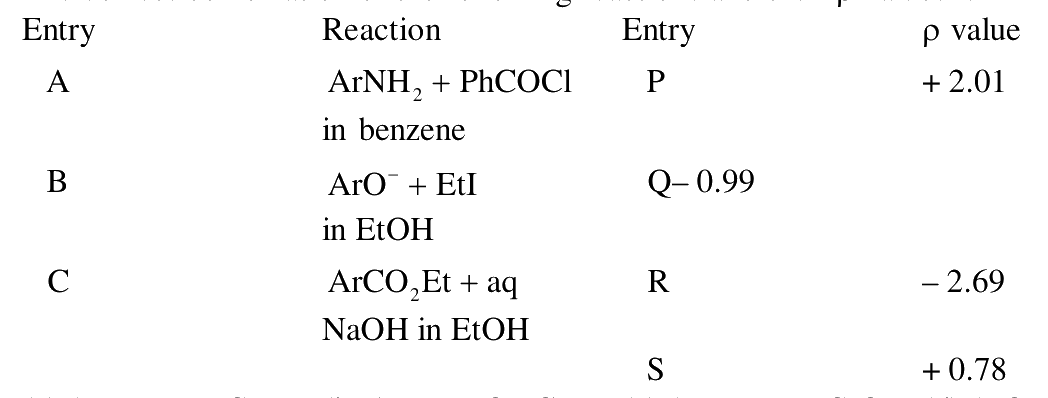
The correct combination of the following reactions and their $\rho$ values is
\begin{tabular}{llcc}
Entry & Reaction & Entry & $\rho$ value \\
A & $\text{ArNH}_2 + \text{PhCOCl}$ in benzene & P & $+2.01$ \\
B & $\text{ArO}^- + \text{EtI}$ in EtOH & Q & $-0.99$ \\
C & $\text{ArCO}_2\text{Et} + \text{aq NaOH in EtOH}$ & R & $-2.69$ \\
& & S & $+0.78$
\end{tabular}
a.
A-P ; B-R ; C-P
b.
A-R ; B-Q ; C-P
c.
A-R ; B-P ; C-Q
d.
A-Q ; B-R ; C-S
Correct Answer & Step-by-Step Solution Locked
Sign in free to reveal the correct answer and AI explanation for this question.
The following reactions gives a product (racemic) which exhibits the following NMR data :
$^1\text{H NMR} : \delta\; 2.67\; (2\text{H}, \text{s}), 5.60\; (2\text{H}, \text{s})$ ppm; $^{13}\text{C NMR} : \delta\; 170.3, 129.0, 105.0, 25.4\text{ ppm}$
The structure of the product (racemic) is
Correct Answer & Step-by-Step Solution Locked
Sign in free to reveal the correct answer and AI explanation for this question.
For a gaseous reaction, $2\text{NO}(\text{g}) + \text{Cl}_2(\text{g}) \rightarrow \text{Non-linear T.S.} \rightarrow 2\text{NOCl}$, the pre-exponential factor in the rate constant is proportional to
a.
$\text{T}^{1/2}$
b.
$\text{T}^{-1/2}$
c.
$\text{T}^{-5/2}$
d.
$\text{T}^{-7/2}$
Correct Answer & Step-by-Step Solution Locked
Sign in free to reveal the correct answer and AI explanation for this question.
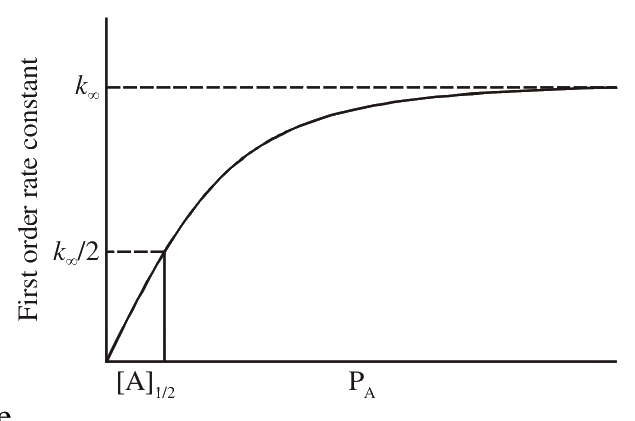
Species A undergoes a unimolecular reaction as follows:
$$\text{A} + \text{A} \xrightleftharpoons[k_{-1}]{k_1} \text{A}^* + \text{A}$$
$$\text{A}^* \xrightarrow{k_2} \text{P}$$
For this reaction, the first order rate constant at high pressure is $k_\infty$. The first order rate constant becomes $\frac{k_\infty}{2}$ when pressure of A is $[\text{A}]_{1/2}$.
The value of $k_1$ will be
a.
$\frac{k_\infty}{[\text{A}]_{1/2}}$
b.
$k_\infty [\text{A}]_{1/2}$
c.
$k_\infty - [\text{A}]_{1/2}$
d.
$\frac{[\text{A}]_{1/2}}{k_\infty}$
Correct Answer & Step-by-Step Solution Locked
Sign in free to reveal the correct answer and AI explanation for this question.
A particle in a 1-dimensional box of length $L$ is perturbed by a delta function potential, $\delta(x - L/2)$, in the middle of the box. The first order energy correction to the ground state will be
$[\text{Hint} : \int_{+\infty}^{-\infty} f(x)\delta(x - a)dx = f(a)]$
a.
$0$
b.
$1$
c.
$L/2$
d.
$2/L$
Correct Answer & Step-by-Step Solution Locked
Sign in free to reveal the correct answer and AI explanation for this question.
The operators $S_\pm$ are defined by $S_\pm = S_x \pm iS_y$, where $S_x$ and $S_y$ are components of the spin angular momentum operator. The commutator $[S_z, S_+]$ is
a.
$\hbar S_+$
b.
$\hbar S_-$
c.
$-\hbar S_+$
d.
$-\hbar S_-$
Correct Answer & Step-by-Step Solution Locked
Sign in free to reveal the correct answer and AI explanation for this question.
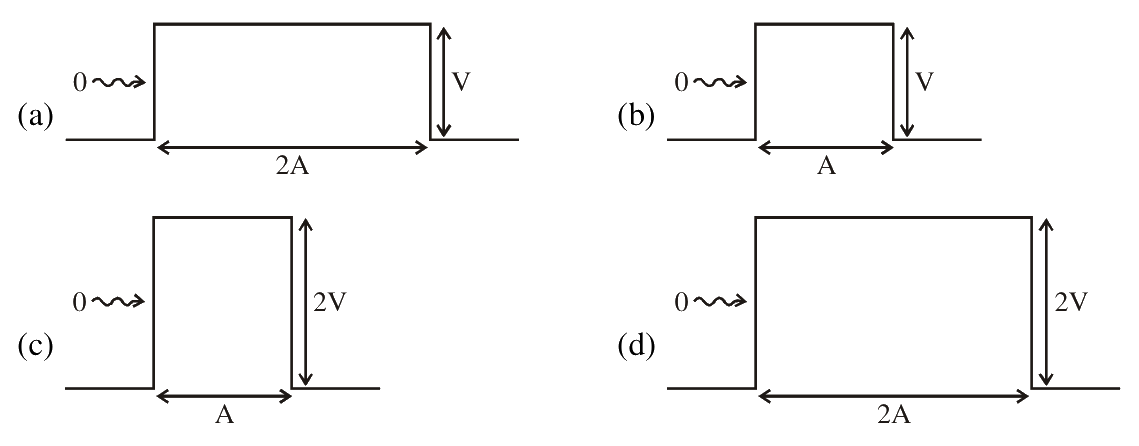
A quantum particle with fixed initial energy $E_0 < V$ is allowed to strike the following four barriers separately. The transmission probability is maximum in
a.
Barrier of width $2A$ and height $V$
b.
Barrier of width $A$ and height $V$
c.
Barrier of width $A$ and height $2V$
d.
Barrier of width $2A$ and height $2V$
Correct Answer & Step-by-Step Solution Locked
Sign in free to reveal the correct answer and AI explanation for this question.
Given the following two relations,
$$x_1 d\mu_1 + x_2 d\mu_2 = 0 \quad \text{(A)}$$
and
$$x_1 d\overline{V}_1 + x_2 d\overline{V}_2 = 0, \quad \text{(B)}$$
for a binary liquid mixture at constant temperature and pressure, the true statement is that,
a.
Both the relations are correct
b.
Relation A is correct, but B is not
c.
Relation B is correct, but A is not
d.
Both the relations are incorrect, except for very dilute solutions.
Correct Answer & Step-by-Step Solution Locked
Sign in free to reveal the correct answer and AI explanation for this question.
If the bond length of a heteronuclear diatomic molecule is greater in the upper vibrational state, the gap between the successive absorption lines of P-branch
a.
Increases non-linearly
b.
Decreases non-linearly
c.
Increases linearly
d.
Decreases linearly
Correct Answer & Step-by-Step Solution Locked
Sign in free to reveal the correct answer and AI explanation for this question.
If $\text{D}_0(\text{A})$ and $\text{I}(\text{A})$ refer respectively to the dissociation energy and ionization potential of $\text{A}$ (where $\text{A}$ is either $\text{H}$, $\text{H}_2$, or $\text{H}_2^+$ species), the correct relation among the following is
The number of microstates that are possible, when two particles are distributed in four states such that the resulting wave functions are antisymmetric with respect to exchange of the particles, is
a.
16
b.
12
c.
8
d.
6
Correct Answer & Step-by-Step Solution Locked
Sign in free to reveal the correct answer and AI explanation for this question.
A Slater determinant corresponding to the ionic part of the ground state valence bond wave function of $\text{H}_2$ molecule is ($1s_a\alpha$, $1s_a\beta$, $1s_b\alpha$, $1s_b\beta$ are atomic spin-orbitals of hydrogen atoms $a$ and $b$ of the hydrogen molecule)
The rate constant for a reaction $A^{1+} + B^{n+} \rightarrow P$ is measured in two different aqueous solutions of ionic strengths $0.01\text{ M}$ and $0.04\text{ M}$. If $\log \frac{k_{0.04}}{k_{0.01}} = 0.3$, the charge $n$ on $\text{B}$ is closest to
a.
1
b.
2
c.
3
d.
6
Correct Answer & Step-by-Step Solution Locked
Sign in free to reveal the correct answer and AI explanation for this question.
According to Hückel theory, the $\pi$ electron charge on the central carbon atom in propenyl cation $(\text{CH}_2\text{CHCH}_2)^+$ is (in units of electronic charge)
a.
$\frac{1}{2}$
b.
$\frac{1}{\sqrt{2}}$
c.
$1$
d.
$2$
Correct Answer & Step-by-Step Solution Locked
Sign in free to reveal the correct answer and AI explanation for this question.