← Joint CSIR UGC NET Exam
CSIR NET · Chemical Sciences

June

2013 · 125 questions · First 10 Solutions Free
Questions 1–10 have full step-by-step solutions visible. Sign in to unlock all 125 →
Q21 mcq
Which of the following pairs has the highest difference in their first ionization energy?
a.
$\text{Xe}, \text{Cs}$
b.
$\text{Kr}, \text{Rb}$
c.
$\text{Ar}, \text{K}$
d.
$\text{Ne}, \text{Na}$ Correct Answer
Step-by-Step AI Explanation
Verified Method
Noble gases have very high first ionization energies, while alkali metals have very low first ionization energies. Across the periods from top to bottom, ionization energy decreases. The difference $\Delta IE = IE_1(\text{noble gas}) - IE_1(\text{alkali metal})$ is highest for the pair with the smallest principal quantum number, which is $\text{Ne}$ ($IE_1 = 2080.7\text{ kJ/mol}$) and $\text{Na}$ ($IE_1 = 495.8\text{ kJ/mol}$), giving $\Delta IE \approx 1585\text{ kJ/mol}$, which is significantly greater than for the other pairs.
Q22 mcq
The ligand in uranocene is:
a.
$\text{C}_8\text{H}_8^{2-}$ Correct Answer
b.
$\text{C}_5\text{H}_5^{2-}$
c.
$\text{C}_6\text{H}_6$
d.
$\text{C}_4\text{H}_4^{2-}$
Step-by-Step AI Explanation
Verified Method
Uranocene is the organouranium compound with the formula $\text{U}(\text{C}_8\text{H}_8)_2$. It is a sandwich complex comprising a uranium atom sandwiched between two cyclooctatetraenide dianions, $\text{C}_8\text{H}_8^{2-}$ (COT$^{2-}$), each donating $10\pi$ electrons.
Q23 mcq
In metal-olefin interaction, the extent of increase in metal $\rightarrow$ olefin $\pi-\text{back}-\text{donation}$ would
a.
lead to a decrease in $\text{C}=\text{C}$ bond length
b.
change the formal oxidation state of the metal
c.
change the hybridisation of the olefin carbon from $\text{sp}^2$ to $\text{sp}^3$. Correct Answer
d.
increase with the presence of electron donating substituent on the olefin.
Step-by-Step AI Explanation
Verified Method
According to the Dewar-Chatt-Duncanson model, metal-to-olefin $\pi$-back-donation populates the $\text{C}=\text{C}$ $\pi^*$ antibonding orbital. In the limit of strong $\pi$-back-donation, the complex is best described as a metallacyclopropane, where the $\text{C}-\text{C}$ bond order decreases toward a single bond and the hybridization of the olefinic carbons shifts from $\text{sp}^2$ toward $\text{sp}^3$.
Q24 mcq
The oxidation state of molybdenum in $\left[(\eta^7-\text{tropylium})\text{Mo}(\text{CO})_3\right]^+$ is :
a.
$+2$
b.
$+1$
c.
$0$ Correct Answer
d.
$-1$
Step-by-Step AI Explanation
Verified Method
In the neutral counting method: $\text{Mo}$ contributes $x$ valence electrons; the $\eta^7$-tropylium cation ($\text{C}_7\text{H}_7^+$) can be treated using the ionic model where tropylium is a cation $(\text{C}_7\text{H}_7^+)$ donating 6 electrons, and $\text{CO}$ ligands are neutral donating 2 electrons each. With a total complex charge of $+1$: $\text{Mo}^{n+} + (\text{C}_7\text{H}_7^+) + 3(\text{CO}) = +1 \implies n + 1 + 0 = +1 \implies n = 0$. Alternatively, treating the tropylium ring as a monoanion $\text{C}_7\text{H}_7^-$ or a neutral radical, both methods yield an oxidation state of 0 for molybdenum.
Q25 mcq
The reaction of $\left[\text{PtCl}_4\right]^{2-}$ with two equivalents of $\text{NH}_3$ produces
a.
$\text{cis}-\left[\text{Pt}(\text{NH}_3)_2\text{Cl}_2\right]$ Correct Answer
b.
$\text{trans}-\left[\text{Pt}(\text{NH}_3)_2\text{Cl}_2\right]$
c.
boths $\text{cis}-\left[\text{Pt}(\text{NH}_3)_2\text{Cl}_2\right]$ and $\text{trans}-\left[\text{Pt}(\text{NH}_3)_2\text{Cl}_2\right]$
d.
$\text{cis}-\left[\text{Pt}(\text{NH}_3)_2\text{Cl}_4\right]^{2-}$
Step-by-Step AI Explanation
Verified Method
Due to the trans effect, chloride ($\text{Cl}^-$) has a stronger trans-directing effect than ammonia ($\text{NH}_3$). In the first substitution step, one $\text{Cl}^-$ is replaced by $\text{NH}_3$ to form $[\text{PtCl}_3(\text{NH}_3)]^-$. In the second step, the incoming $\text{NH}_3$ ligand is directed to substitute a chloride trans to another chloride (since $\text{Cl}^-$ has a higher trans influence/effect than $\text{NH}_3$). This produces $\text{cis}-[\text{Pt}(\text{NH}_3)_2\text{Cl}_2]$ (cisplatin).
Q26 mcq
The electronic transition responsible for the color of the transition metal ions is
a.
$\text{d}_\pi \rightarrow \text{d}_\sigma$
b.
$\text{d}_\pi \rightarrow \text{d}_{\sigma^*}$ Correct Answer
c.
$\text{d}_\pi \rightarrow \text{d}_{\pi^*}$
d.
$\text{d}_\sigma \rightarrow \text{d}_{\pi^*}$
Step-by-Step AI Explanation
Verified Method
In an octahedral transition metal complex, the $d$-orbitals split into $t_{2g}$ and $e_g^*$ sets. The $t_{2g}$ orbitals ($d_{xy}, d_{yz}, d_{xz}$) are essentially non-bonding or weakly $\pi$-bonding ($d_\pi$), while the $e_g^*$ orbitals ($d_{z^2}, d_{x^2-y^2}$) are $\sigma$-antibonding ($d_{\sigma^*}$). Thus, typical $d-d$ transitions responsible for color correspond to $t_{2g} \rightarrow e_g^*$, which is a $d_\pi \rightarrow d_{\sigma^*}$ transition.
Q27 mcq
The number of metal-metal bonds in $\left[\text{W}_2(\text{OPh})_6\right]$ is:
a.
$1$
b.
$2$
c.
$3$ Correct Answer
d.
$4$
Step-by-Step AI Explanation
Verified Method
In $[\text{W}_2(\text{OPh})_6]$, the phenoxide ligands are monodentate monoanionic ligands ($-\text{OPh}$), so the oxidation state of tungsten is $+3$ ($d^3$ configuration, since $\text{W}$ is in Group 6). For two $\text{W}(\text{III})$ centers, there are $3 + 3 = 6$ metal valence electrons available to form metal-metal bonds. These 6 electrons completely fill the bonding molecular orbitals ($\sigma^2\pi^4$), resulting in a metal-metal triple bond (bond order = 3).
Q28 mcq
The Mulliken symbols for the spectroscopic states arising from the free-ion term $\text{F}$ are
a.
$\text{T}_{2\text{g}} + \text{E}_{\text{g}}$
b.
$\text{T}_{1\text{g}} + \text{T}_{2\text{g}} + \text{T}_{1\text{u}}$
c.
$\text{T}_{1\text{g}} + \text{T}_{2\text{g}} + \text{A}_{2\text{g}}$ Correct Answer
d.
$\text{A}_{1\text{g}} + \text{T}_{2\text{g}} + \text{T}_{1\text{g}}$
Step-by-Step AI Explanation
Verified Method
In an octahedral ligand field ($O_h$), a free-ion term with orbital angular momentum $L = 3$ (an $F$ term, which has $2L+1 = 7$-fold orbital degeneracy) splits into three states: $A_{2g}$ (1-fold), $T_{2g}$ (3-fold), and $T_{1g}$ (3-fold). Therefore, the resulting Mulliken symbols are $T_{1g} + T_{2g} + A_{2g}$.
Q29 mcq
Which of the following is used as propellant for whipping creams?
a.
$\text{N}_2\text{O}$ Correct Answer
b.
$\text{NO}$
c.
$\text{N}_2\text{O}_3$
d.
$\text{N}_2\text{O}_5$
Step-by-Step AI Explanation
Verified Method
Nitrous oxide ($\text{N}_2\text{O}$), also known as laughing gas, is widely used as an aerosol propellant in whipped cream dispensers. It is non-toxic, bacteriostatic, and easily dissolves into fats under pressure, foaming upon release.
Q30 mcq
Flame proof fabrices contain
a.
$\text{H}_2\text{NC}(\text{O})\text{NH}_2.\text{Na}_2\text{SO}_4$
b.
$\text{H}_2\text{NC}(\text{S})\text{NH}_2.\text{Na}_2\text{SO}_4$
c.
$\text{H}_2\text{NC}(\text{O})\text{NH}_2.\text{H}_3\text{PO}_4$ Correct Answer
d.
$\text{H}_2\text{NC}(\text{S})\text{NH}_2.\text{H}_3\text{PO}_4$
Step-by-Step AI Explanation
Verified Method
Flame-retardant (or flame-proof) fabrics often contain urea phosphate, $\text{H}_2\text{NC}(\text{O})\text{NH}_2\cdot\text{H}_3\text{PO}_4$. Upon heating, it decomposes to form polyphosphoric acids that promote char formation and release non-combustible gases, thereby inhibiting flame propagation.
🎉 10 Free Sample Solutions Completed

Unlock All 125 Questions & Solutions

Sign up free in seconds to unlock step-by-step AI answers for the remaining 115 questions.

Q31 mcq
Among the compounds A-D, those which hydrolyse easily are
a.
$\text{NCl}_3$
b.
$\text{NF}_3$
c.
$\text{BiCl}_3$
d.
$\text{PCl}_3$.
Correct Answer & Step-by-Step Solution Locked

Sign in free to reveal the correct answer and AI explanation for this question.

Q32 mcq
The coordination geometry of copper (II) in the type I copper protein plastocyanin is:
a.
square planar
b.
tetrahedral
c.
octahedral
d.
distorted tetrahedral
Correct Answer & Step-by-Step Solution Locked

Sign in free to reveal the correct answer and AI explanation for this question.
Q33 mcq
The metal ions present in the active site of nitrogenase enzyme co-factor are
a.
Fe, Mo
b.
Fe, W
c.
Fe, Cu
d.
Fe, Ni
Correct Answer & Step-by-Step Solution Locked

Sign in free to reveal the correct answer and AI explanation for this question.
Q34 mcq
The reaction, $[(\text{CO})_5 \text{Mn}(\text{Me})] + \text{CO} \rightarrow [(\text{CO})_5 \text{Mn}\{\text{C(O)Me}\}]$ is an example for
a.
oxidative addition
b.
electrophilic substitution
c.
nucleophilic substitution
d.
migratory insertion
Correct Answer & Step-by-Step Solution Locked

Sign in free to reveal the correct answer and AI explanation for this question.

Q35 mcq
The number of EPR signals observed for octahedral $\text{Ni(II)}$ complexes is
a.
One
b.
Two
c.
Three
d.
Zero
Correct Answer & Step-by-Step Solution Locked

Sign in free to reveal the correct answer and AI explanation for this question.
Q36 mcq
For neutron activation analysis of an element, the favourable characteristics of both the target and the product are from the following (A) high neutron cross-section area of target (B) long half-life of the product (C) low neutron cross-section area of target (D) low half-life time of the product. The correct characteristics from the above are
a.
A and B
b.
C and D
c.
B and C
d.
A and D
Correct Answer & Step-by-Step Solution Locked

Sign in free to reveal the correct answer and AI explanation for this question.
Q37 mcq
The concentrations of a species $\text{A}$ undergoing the reaction $\text{A} \rightarrow \text{P}$ is $1.0, 0.5, 0.33, 0.25 \text{ mol dm}^{-3}$ at $\text{t} = 0, 1, 2$ and $3\text{ seconds}$, respectively. The order of the reaction is:
a.
two
b.
one
c.
zero
d.
three
Correct Answer & Step-by-Step Solution Locked

Sign in free to reveal the correct answer and AI explanation for this question.
Q38 mcq
The difference in energy levels of $\text{n} = 2$ and $\text{n} = 1$ of a particle -in - a one dimensional box is $6\text{ units}$ of energy. In the same units, what is the difference in energy levels of $\text{n} = 3$ and $\text{n} = 2$ for the above system?
a.
4
b.
5
c.
9
d.
10
Correct Answer & Step-by-Step Solution Locked

Sign in free to reveal the correct answer and AI explanation for this question.
Q39 mcq
The wave function $\psi$ of a certain system is the linear combination $$\psi = \sqrt{\frac{1}{4}}\psi_1 + \sqrt{\frac{3}{4}}\psi_2$$ where $\psi_1$ and $\psi_2$ are energy eigen functions with eigen values (non-degenerate) $\text{E}_1$ and $\text{E}_2$, respectively. What is the probability that the system energy will be observed to be $\text{E}_1$?
a.
$\sqrt{\frac{3}{16}}$
b.
$\frac{3}{4}$
c.
$\frac{1}{4}$
d.
$\sqrt{\frac{1}{4}}$
Correct Answer & Step-by-Step Solution Locked

Sign in free to reveal the correct answer and AI explanation for this question.
Q40 mcq
What is the atomic term symbol for helium atom with electronic configuration $1\text{s}^2$?
a.
${}^2\text{S}_{1/2}$
b.
${}^1\text{P}_0$
c.
${}^1\text{S}_0$
d.
${}^1\text{S}_1$
Correct Answer & Step-by-Step Solution Locked

Sign in free to reveal the correct answer and AI explanation for this question.
Q41 mcq
A molecules contains the following symmetry operations: $\text{E}, 2\text{C}_6, 2\text{C}_3, \text{C}_2, 3\sigma_d, 3\sigma_v$. The number of classes and order of the symmetry point group is:
a.
$3, 12$
b.
$5, 12$
c.
$6, 12$
d.
$6, 6$
Correct Answer & Step-by-Step Solution Locked

Sign in free to reveal the correct answer and AI explanation for this question.
Q42 mcq
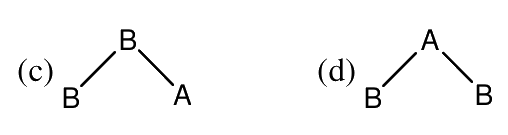
A triatomic molecule of the type $\text{AB}_2$ shows two IR absorption lines and one IR-Raman line. The structure of the molecule is:
Question 22 image
a.
$\text{B}-\text{B}-\text{A}$
b.
$\text{B}-\text{A}-\text{B}$
c.
Bent $\text{B}-\text{B}-\text{A}$
d.
Bent $\text{B}-\text{A}-\text{B}$
Correct Answer & Step-by-Step Solution Locked

Sign in free to reveal the correct answer and AI explanation for this question.

Q43 mcq
In NMR spectroscopy, the product of the nuclear 'g' factor ($\text{g}_\text{N}$), the nuclear magneton ($\beta_\text{N}$) and the magnetic field strength ($\text{B}_0$) gives the
a.
energy of transition from $\alpha$ to $\beta$ state
b.
chemical shift
c.
spin-spin coupling constant
d.
magnetogyric ratio
Correct Answer & Step-by-Step Solution Locked

Sign in free to reveal the correct answer and AI explanation for this question.
Q44 mcq
An aqueous mixed solution of $\mathrm{NaCl}$ and $\mathrm{HCl}$ is exactly neutralized by an aqueous $\mathrm{NaOH}$ solution. The number of components in the final mixture is
a.
1
b.
2
c.
3
d.
4
Correct Answer & Step-by-Step Solution Locked

Sign in free to reveal the correct answer and AI explanation for this question.
Q45 mcq
The lowest pressure at which the liquid phase of a pure substance can exist is known as
a.
critical point pressure
b.
super-incumbent pressure
c.
triple-point pressure
d.
saturation vapour pressure.
Correct Answer & Step-by-Step Solution Locked

Sign in free to reveal the correct answer and AI explanation for this question.
Q46 mcq
A chemical reaction involving $\text{nonlinear molecule} + \text{nonlinear molecule} \rightleftharpoons \text{nonlinear activated complex}$ The number of vibrational degrees of freedom in the activated complex, containing $\mathrm{N}$ atoms, is
a.
$3\mathrm{N}-5$
b.
$3\mathrm{N}-6$
c.
$3\mathrm{N}-7$
d.
$3\mathrm{N}-8$
Correct Answer & Step-by-Step Solution Locked

Sign in free to reveal the correct answer and AI explanation for this question.
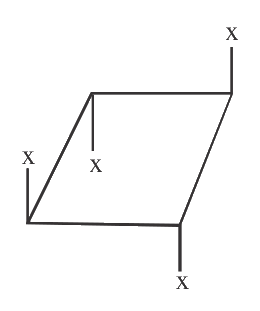
Q47 mcq
Calculate the total number of microstates for 6 identical particles with their occupation numbers $\{1, 2, 3\}$ in three states is:
a.
6
b.
12
c.
60
d.
720
Correct Answer & Step-by-Step Solution Locked

Sign in free to reveal the correct answer and AI explanation for this question.
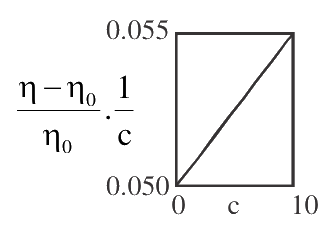
Q48 mcq
If the concentration (c) is increased to 4 times its original value (c), the change in molar conductivity for strong electrolytes is (where b is Kohlrausch constant)
a.
0
b.
$b\sqrt{c}$
c.
$2b\sqrt{c}$
d.
$4b\sqrt{c}$
Correct Answer & Step-by-Step Solution Locked

Sign in free to reveal the correct answer and AI explanation for this question.
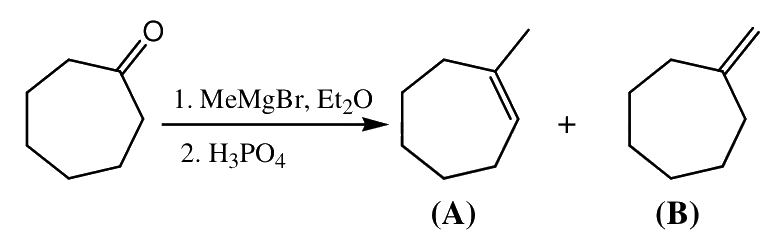
Q49 mcq
In atom recombination reactions
a.
$\mathrm{E_a} = 0, \Delta\mathrm{S}^\# = +\text{ve}, \Delta\mathrm{H}^\# = +\text{ve}$
b.
$\mathrm{E_a} = 0, \Delta\mathrm{S}^\# = -\text{ve}, \Delta\mathrm{H}^\# = -\text{ve}$
c.
$\mathrm{E_a} = +\text{ve}, \Delta\mathrm{S}^\# = -\text{ve}, \Delta\mathrm{H}^\# = -\text{ve}$
d.
$\mathrm{E_a} = +\text{ve}, \Delta\mathrm{S}^\# = +\text{ve}, \Delta\mathrm{H}^\# = +\text{ve}$
Correct Answer & Step-by-Step Solution Locked

Sign in free to reveal the correct answer and AI explanation for this question.
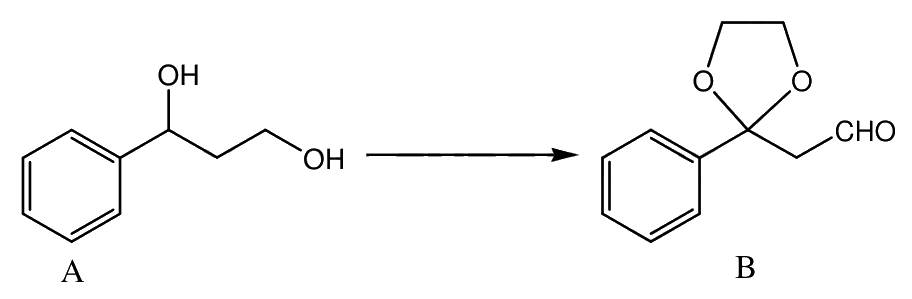
Q50 mcq
In the Lindemann mechanism of unimolecular reactions, the observed order at low concentration is
a.
0.5
b.
1
c.
1.5
d.
2
Correct Answer & Step-by-Step Solution Locked

Sign in free to reveal the correct answer and AI explanation for this question.

Q51 mcq
The aggregation of surfactant molecules is known as
a.
micelles
b.
clusters
c.
gel
d.
colloid
Correct Answer & Step-by-Step Solution Locked

Sign in free to reveal the correct answer and AI explanation for this question.
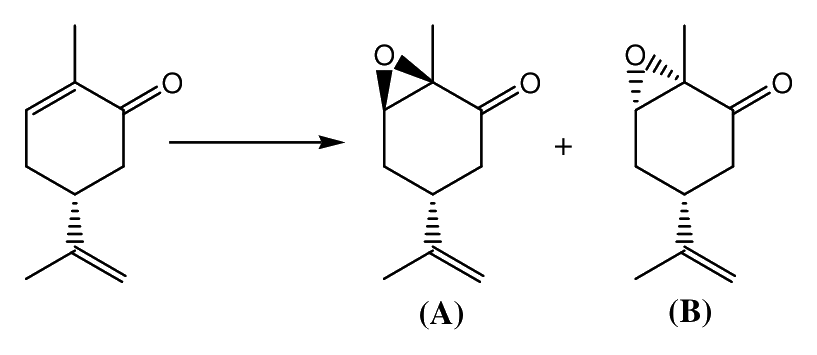
Q52 mcq
The coordinates for the atoms in a body centred cubic unit cell are
a.
$(0, 0, 0)$ and $(1/2, 0, 0)$
b.
$(0, 0, 0)$ and $(1/2, 1/2, 1/2)$
c.
$(0, 0, 0)$ and $(0, 1/2, 0)$
d.
$(0, 0, 0)$ and $(0, 0, 1/2)$
Correct Answer & Step-by-Step Solution Locked

Sign in free to reveal the correct answer and AI explanation for this question.
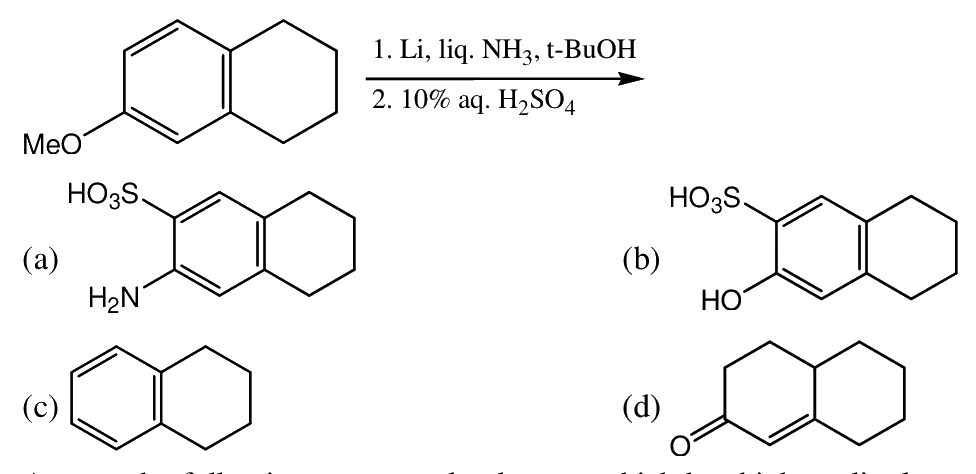
Q53 mcq
The inter planar distance (\AA) for a $(100)$ plane in a cubic structure with the lattice parameter of $4\text{ \AA}$ is:
a.
1
b.
2
c.
4
d.
8
Correct Answer & Step-by-Step Solution Locked

Sign in free to reveal the correct answer and AI explanation for this question.
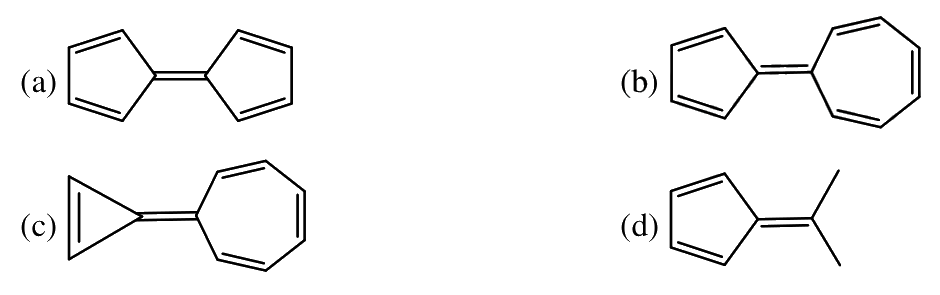
Q54 mcq
The correlation coefficient of two parameters is found to be $-0.99$. It may be concluded that the two parameters are
a.
strongly correlated
b.
almost uncorrelated
c.
connected by a cause-effect relationship
d.
not connected by a cause-effect relationship
Correct Answer & Step-by-Step Solution Locked

Sign in free to reveal the correct answer and AI explanation for this question.
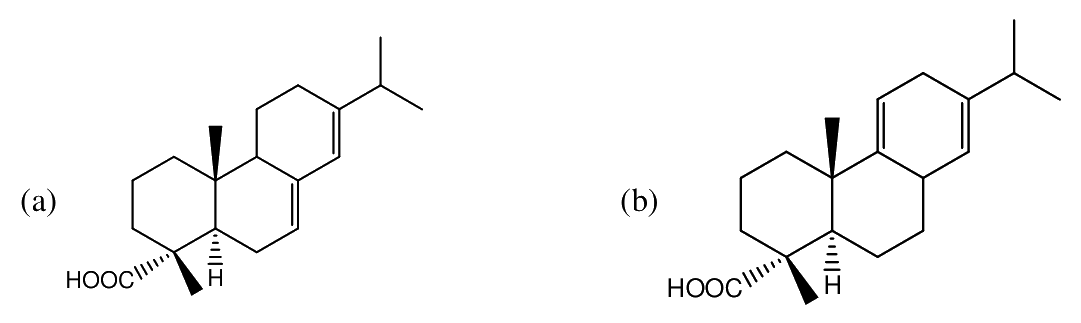
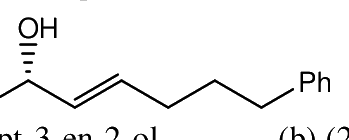
Q55 mcq
The IUPAC name for the compound given below is
Question 35 image
a.
(2R, 3Z)-7-phenylhept-3-en-2-ol
b.
(2S, 3Z)-7-phenylhept-3-en-2-ol
c.
(2R, 3E)-7-phenylhept-3-en-2-ol
d.
(2S, 3E)-7-phenylhept-3-en-2-ol
Correct Answer & Step-by-Step Solution Locked

Sign in free to reveal the correct answer and AI explanation for this question.
Q56 mcq
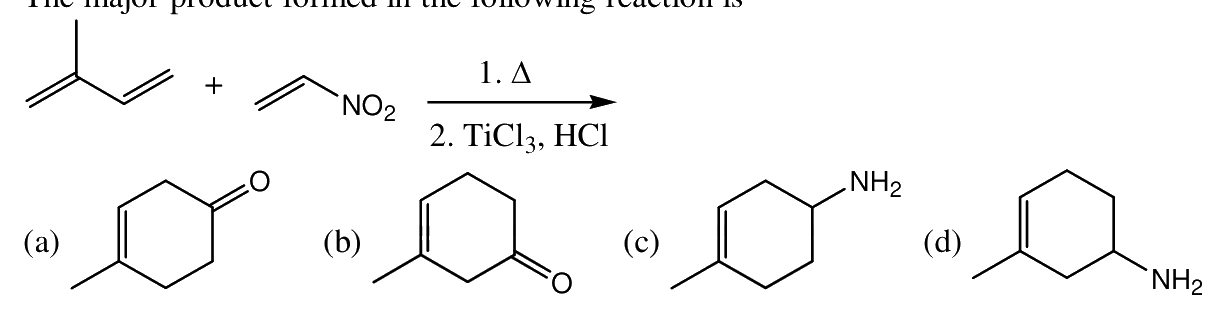
Among the following esters, the one that undergoes acid hydrolysis fastest is
Question 36 image
a.
(a)
b.
(b)
c.
(c)
d.
(d)
Correct Answer & Step-by-Step Solution Locked

Sign in free to reveal the correct answer and AI explanation for this question.
Q57 mcq
Reaction of cyclohexyl benzyl ether with hydrogen in the presence of $10\%\text{ Pd/C}$ yields
a.
cyclohexanol and toluene
b.
cyclohexanol and benzyl alcohol
c.
cyclohexane and benzyl alcohol
d.
cyclohexane and toluene
Correct Answer & Step-by-Step Solution Locked

Sign in free to reveal the correct answer and AI explanation for this question.
Q58 mcq
Among the following dibromocyclohexanes, the one that reacts fastest with sodium iodide to give cyclohexene is
Question 38 image
Correct Answer & Step-by-Step Solution Locked

Sign in free to reveal the correct answer and AI explanation for this question.

Q59 mcq
Match the following drugs with their medicinal activity: (A) 5-fluorouracil (B) amoxicillin (i) anti-bacterial (ii) cholesterol lowering (iii) anticancer (iv) anti-inflammatory
a.
A-i, B-ii
b.
A-iv, B-iii
c.
A-iii, B-iv
d.
A-iii, B-i
Correct Answer & Step-by-Step Solution Locked

Sign in free to reveal the correct answer and AI explanation for this question.

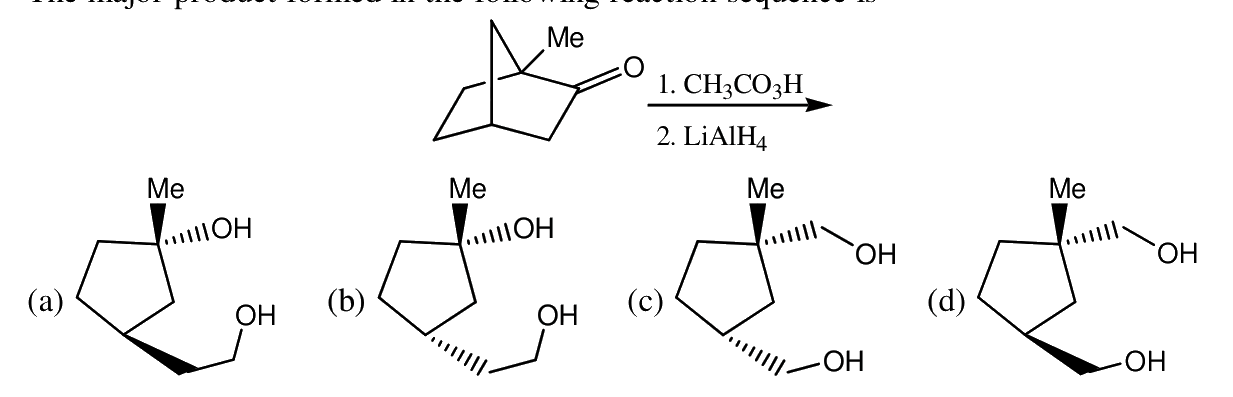
Q60 mcq
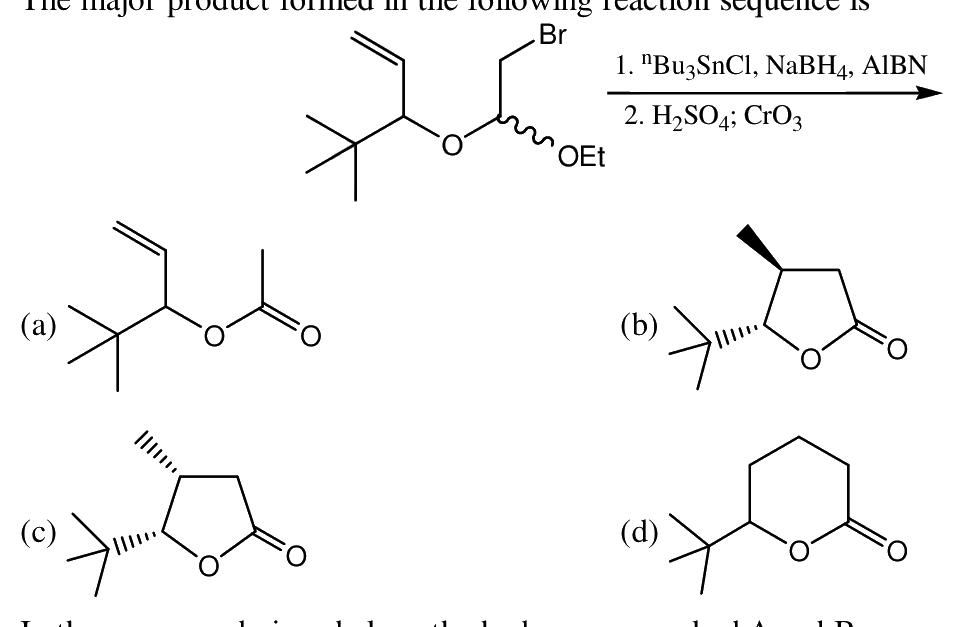
The major product formed in the following reaction sequence is
Question 40 image
Correct Answer & Step-by-Step Solution Locked

Sign in free to reveal the correct answer and AI explanation for this question.
Q61 mcq
The biosynthetic precursor for the steroids is
a.
secologanin
b.
shikimic acid
c.
mevalonic acid
d.
$\alpha$-ketoglutaric acid
Correct Answer & Step-by-Step Solution Locked

Sign in free to reveal the correct answer and AI explanation for this question.
Q62 mcq
The major product formed in the following reaction sequence is
Question 42 image
Correct Answer & Step-by-Step Solution Locked

Sign in free to reveal the correct answer and AI explanation for this question.

Q63 mcq
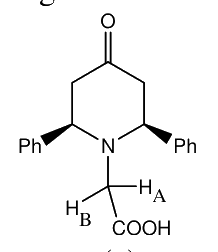
In the compound given below, the hydrogens marked A and B are
Question 43 image
a.
homotopic
b.
isotopic
c.
enantiotopic
d.
diastereotopic
Correct Answer & Step-by-Step Solution Locked

Sign in free to reveal the correct answer and AI explanation for this question.
Q64 mcq
In the IR spectrum, the absorption band due to carbonyl group in phenyl acetate appears at
a.
$1800\text{ cm}^{-1}$
b.
$1760\text{ cm}^{-1}$
c.
$1710\text{ cm}^{-1}$
d.
$1660\text{ cm}^{-1}$
Correct Answer & Step-by-Step Solution Locked

Sign in free to reveal the correct answer and AI explanation for this question.
Q65 mcq
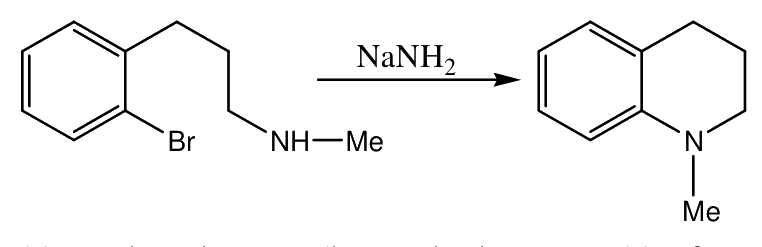
The reactive intermediate involved in the following reaction is:
Question 45 image
a.
a carbocation
b.
a carbanion
c.
a free radical
d.
an aryne
Correct Answer & Step-by-Step Solution Locked

Sign in free to reveal the correct answer and AI explanation for this question.
Q66 mcq
Number of isoprene units present in lupeol is
Question 46 image
a.
two
b.
four
c.
six
d.
eight
Correct Answer & Step-by-Step Solution Locked

Sign in free to reveal the correct answer and AI explanation for this question.
Q67 mcq
The heterocyclic ring present in the amino acid histidine is:
a.
pyridine
b.
tetrahydropyrrole
c.
indole
d.
imidazole
Correct Answer & Step-by-Step Solution Locked

Sign in free to reveal the correct answer and AI explanation for this question.
Q68 mcq
The gauche conformation ($\varphi = 60^\circ$) of n-butane posseses
a.
plane of symmmetry; and is achiral
b.
$\text{C}_2$-axis of symmetry; and is chiral
c.
centre of symmetry; and is achiral
d.
plane of symmetry; and is chiral
Correct Answer & Step-by-Step Solution Locked

Sign in free to reveal the correct answer and AI explanation for this question.
Q69 mcq
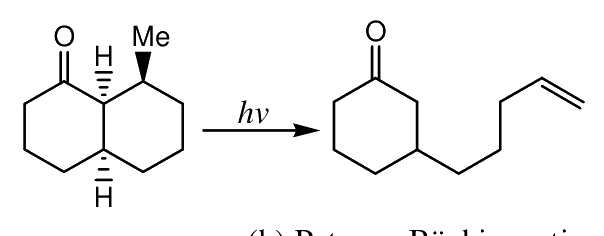
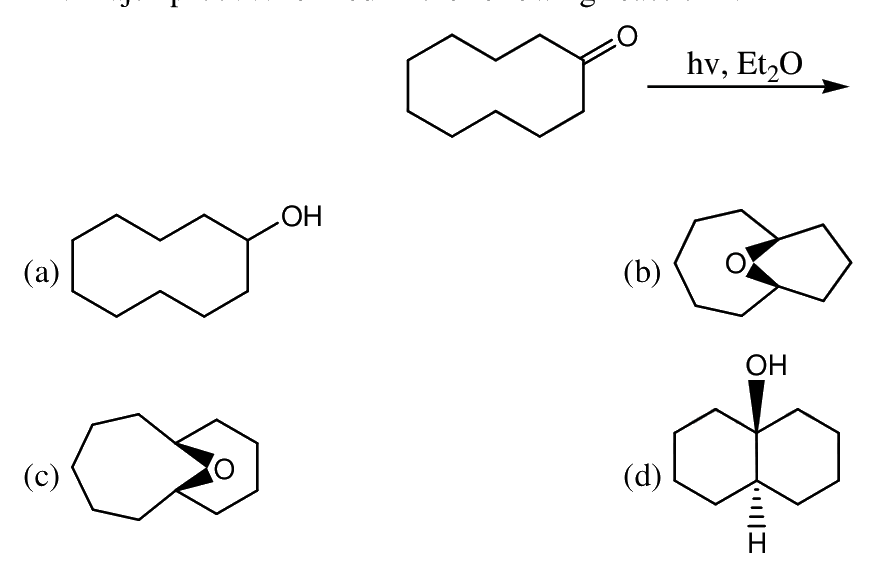
The following photochemical conversion proceeds through
Question 49 image
a.
Barton reaction
b.
Paterno-Büchi reaction
c.
Norrish type I reaction
d.
Norrish type II reaction
Correct Answer & Step-by-Step Solution Locked

Sign in free to reveal the correct answer and AI explanation for this question.
Q70 mcq
Among the following dienes, the one that undergoes a degenerate Cope rearrangement is
Question 50 image
Correct Answer & Step-by-Step Solution Locked

Sign in free to reveal the correct answer and AI explanation for this question.
Q71 mcq
A radioisotope $^{41}\text{Ar}$ initially decays at the rate of $34,500\text{ disintegrations/minute}$, but decay rate falls to $21,500\text{ disintegrations/minute}$ after $75\text{ minutes}$. The $t_{1/2}$ for $^{41}\text{Ar}$ is:
a.
$90\text{ minutes}$
b.
$110\text{ minutes}$
c.
$180\text{ minutes}$
d.
$220\text{ minuts.}$
Correct Answer & Step-by-Step Solution Locked

Sign in free to reveal the correct answer and AI explanation for this question.
Q72 mcq
The orders of reactivity of ligands, $\text{NMe}_3$, $\text{PMe}_3$ and $\text{CO}$ with complexes $\text{MeTiCl}_3$ and $(\text{CO})_5\text{Mo}(\text{thf})$ are
a.
$\text{CO} > \text{PMe}_3 > \text{NMe}_3$ and $\text{CO} > \text{NMe}_3 > \text{PMe}_3$
b.
$\text{PMe}_3 > \text{CO} > \text{NMe}_3$ and $\text{NMe}_3 > \text{CO} > \text{PMe}_3$
c.
$\text{NMe}_3 > \text{PMe}_3 > \text{CO}$ and $\text{CO} > \text{PMe}_3 > \text{NMe}_3$
d.
$\text{NMe}_3 > \text{CO} > \text{PMe}_3$ and $\text{PMe}_3 > \text{NMe}_3 > \text{CO}$
Correct Answer & Step-by-Step Solution Locked

Sign in free to reveal the correct answer and AI explanation for this question.
Q73 mcq
The number of lone-pairs are identical in the pairs
a.
$\text{XeF}_4$, $\text{ClF}_3$
b.
$\text{XeO}_4$, $\text{ICl}_4^-$
c.
$\text{XeO}_2\text{F}_2$, $\text{ICl}_4^-$
d.
$\text{XeO}_4$, $\text{ClF}_3$
Correct Answer & Step-by-Step Solution Locked

Sign in free to reveal the correct answer and AI explanation for this question.

Q74 mcq
Among the following, those can act as Mössbauer nuclei are (A) $^{129}\text{I}$, (B) $^{57}\text{Co}$, (C) $^{57}\text{Fe}$, (D) $^{121}\text{Sb}$
a.
A, B, C and D
b.
B, C and D only
c.
A, B, and D only
d.
A, C and D only.
Correct Answer & Step-by-Step Solution Locked

Sign in free to reveal the correct answer and AI explanation for this question.

Q75 mcq
Which of the pairs will generally result in tetrahedral coordination complexes, when ligands are $\text{Cl}^-$ or $\text{OH}^-$ (A) $\text{Be(II)}, \text{Ba(II)}$ (B) $\text{Ba(II)}, \text{Co(II)}$ (C) $\text{Co(II)}, \text{Zn(II)}$ (D) $\text{Be(II)}, \text{Zn(II)}$
a.
A and B
b.
B and C
c.
C and D
d.
A and D
Correct Answer & Step-by-Step Solution Locked

Sign in free to reveal the correct answer and AI explanation for this question.

Q76 mcq
Silica gel contains $[\text{CoCl}_4]^{2-}$ as an indicator. When activated, silica gel becomes dark blue while upon absorption of moisture, its colour changes to pale pink. This is because,
a.
$\text{Co(II)}$ changes its coordination from tetrahedral to octahedral.
b.
$\text{Co(II)}$ changes its oxidation state to $\text{Co(III)}$
c.
Tetrahedral crystal field splitting is NOT equal to octahedral crystal field splitting.
d.
$\text{Co(II)}$ forms kinetically labile while $\text{Co(III)}$ forms kinetically inert complexes.
Correct Answer & Step-by-Step Solution Locked

Sign in free to reveal the correct answer and AI explanation for this question.

Q77 mcq
For the metalloprotein hemerythrin, the statement that is NOT TRUE is
a.
there are two iron centres per active site.
b.
both iron centres are hexacoordinated in the active state.
c.
one iron is hexacoordinated while the other is pentacoordinated in the active state.
d.
it is found in marine invertebrates.
Correct Answer & Step-by-Step Solution Locked

Sign in free to reveal the correct answer and AI explanation for this question.

Q78 mcq
For a tetragonally distorted $\text{Cr(III)}$ complex, zero-field splitting results in the following number of Kramers doublets:
a.
1
b.
2
c.
3
d.
4
Correct Answer & Step-by-Step Solution Locked

Sign in free to reveal the correct answer and AI explanation for this question.

Q79 mcq
Intense band at $15000\text{ cm}^{-1}$ in the UV-visible spectrum of $[\text{Bu}_4\text{N}]_2\text{Re}_2\text{Cl}_8$ is due to the transition
a.
$\pi-\pi^*$
b.
$\delta-\delta^*$
c.
$\delta-\pi^*$
d.
$\pi-\delta^*$
Correct Answer & Step-by-Step Solution Locked

Sign in free to reveal the correct answer and AI explanation for this question.

Q80 mcq
Electron change in reduction of $\text{Ce}(\text{SO}_4)_2$, $\text{KMnO}_4$, $\text{HNO}_2$ and $\text{I}_2$ with hydrazine in acidic medium, respectively is
a.
1e, 1e, 2e and 4e
b.
1e, 3e, 2e and 4e
c.
2e, 3e, 1e and 4e
d.
2e, 4e, 1e and 3e
Correct Answer & Step-by-Step Solution Locked

Sign in free to reveal the correct answer and AI explanation for this question.

Q81 mcq
The compound that will behave as an acid in $\text{H}_2\text{SO}_4$ is
a.
$\text{CH}_3\text{COOH}$
b.
$\text{HNO}_3$
c.
$\text{HClO}_4$
d.
$\text{H}_2\text{O}$
Correct Answer & Step-by-Step Solution Locked

Sign in free to reveal the correct answer and AI explanation for this question.

Q82 mcq
Among the oxides of nitrogen, $\text{N}_2\text{O}_3$, $\text{N}_2\text{O}_4$ and $\text{N}_2\text{O}_5$, the compound(s) having $\text{N}-\text{N}$ bond is/are
a.
$\text{N}_2\text{O}_4$ and $\text{N}_2\text{O}_5$
b.
$\text{N}_2\text{O}_3$ and $\text{N}_2\text{O}_5$
c.
$\text{N}_2\text{O}_3$ and $\text{N}_2\text{O}_4$
d.
$\text{N}_2\text{O}_5$ only
Correct Answer & Step-by-Step Solution Locked

Sign in free to reveal the correct answer and AI explanation for this question.

Q83 mcq
The treatment of $\text{PhBr}$ with $\text{n-BuLi}$ yields:
a.
$2\text{ n-BuPh} + \text{Br}_2 + \text{Li}_2$
b.
$\text{PhPh} + \text{octane} + 2\text{ LiBr}$
c.
$\text{n-BuPh} + \text{LiBr}$
d.
$\text{PhLi} + \text{n-BuBr}$
Correct Answer & Step-by-Step Solution Locked

Sign in free to reveal the correct answer and AI explanation for this question.

Q84 mcq
Though cyclobutadiene ($\text{C}_4\text{H}_4$) is highly unstable and readily polymerizes in its free state, its transition metal complexes could be isolated because
a.
it engages in long-range interaction with transition metals.
b.
it gains stability due to formation of $\text{C}_4\text{H}_4^{2-}$ on binding to transition metals.
c.
its polymerization ability reduces in presence of transition metal.
d.
it becomes stable in presence of transition metals due to formation of $\text{C}_4\text{H}_4^{2+}$.
Correct Answer & Step-by-Step Solution Locked

Sign in free to reveal the correct answer and AI explanation for this question.

Q85 mcq
Identify the order representing increasing $\pi$-acidity of the following ligands $\text{C}_2\text{F}_4$, $\text{NEt}_3$, $\text{CO}$ and $\text{C}_2\text{H}_4$
a.
$\text{CO} < \text{C}_2\text{F}_4 < \text{C}_2\text{H}_4 < \text{NEt}_3$
b.
$\text{C}_2\text{F}_4 < \text{C}_2\text{H}_4 < \text{NEt}_3 < \text{CO}$
c.
$\text{C}_2\text{H}_4 < \text{NEt}_3 < \text{CO} < \text{C}_2\text{F}_4$
d.
$\text{NEt}_3 < \text{C}_2\text{H}_4 < \text{C}_2\text{F}_4 < \text{CO}$
Correct Answer & Step-by-Step Solution Locked

Sign in free to reveal the correct answer and AI explanation for this question.

Q86 mcq
The species with highest magnetic moment (spin only value) is
a.
$\text{VCl}_6^{4-}$
b.
$(\eta^5-\text{C}_5\text{H}_5)_2\text{Cr}$
c.
$[\text{Co}(\text{NO}_2)_6]^{3-}$
d.
$[\text{Ni}(\text{EDTA})]^{2-}$
Correct Answer & Step-by-Step Solution Locked

Sign in free to reveal the correct answer and AI explanation for this question.

Q87 mcq
The number of metal-metal bonds in $\text{Ir}_4(\text{CO})_{12}$ is
a.
4
b.
6
c.
10
d.
12
Correct Answer & Step-by-Step Solution Locked

Sign in free to reveal the correct answer and AI explanation for this question.

Q88 mcq
Three bands in the electronic spectrum of $[\text{Cr}(\text{NH}_3)_6]^{3+}$ are due to the following transitions (A) $^4\text{A}_{2\text{g}} \rightarrow {}^4\text{T}_{1\text{g}}$ (B) $^4\text{A}_{2\text{g}} \rightarrow {}^4\text{T}_{2\text{g}}$ (C) $^4\text{A}_{2\text{g}} \rightarrow {}^2\text{E}_{\text{g}}$ Identify the correct statement about them
a.
Intensity of (A) is lowest
b.
Intensity of (C) is lowest
c.
Intensitites of (A), (B) and (C) are similar
d.
Intensities of (B) and (C) are similar
Correct Answer & Step-by-Step Solution Locked

Sign in free to reveal the correct answer and AI explanation for this question.

Q89 mcq
Identify the pairs in which the covalent radii of elements are almost similar (A) $\text{Nb}$, $\text{Ta}$ (B) $\text{Mo}$, $\text{W}$ (C) $\text{La}$, $\text{Lu}$ (D) $\text{Sc}$, $\text{Y}$
a.
A and B only
b.
A and C only
c.
B and C only
d.
A, B and C only
Correct Answer & Step-by-Step Solution Locked

Sign in free to reveal the correct answer and AI explanation for this question.

Q90 mcq
Consider following lanthanide (III) ions (A) $\text{Nd}(\text{III})$ (B) $\text{Gd}(\text{III})$ (C) $\text{Dy}(\text{III})$ The magnetic moment closest to the spin only value is(are) for
a.
B only
b.
A and B only
c.
A and C only
d.
B and C only
Correct Answer & Step-by-Step Solution Locked

Sign in free to reveal the correct answer and AI explanation for this question.

Q91 mcq
The $\Delta_{\text{t}}$ of the following complexes (A) $[\text{CoCl}_4]^{2-}$ (B) $[\text{CoBr}_4]^{2-}$ (C) $[\text{Co}(\text{NCS})_4]^{2-}$ follows the order
a.
$\text{C} > \text{A} > \text{B}$
b.
$\text{A} > \text{B} > \text{C}$
c.
$\text{B} > \text{A} > \text{C}$
d.
$\text{C} > \text{B} > \text{A}$
Correct Answer & Step-by-Step Solution Locked

Sign in free to reveal the correct answer and AI explanation for this question.

Q92 mcq
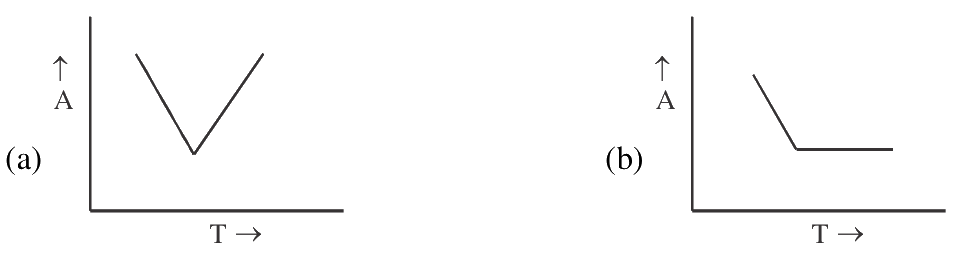
In complexometric titration $$\text{S}(\text{substrate}) + \text{T}(\text{titrant}) \rightarrow \text{P}(\text{product})$$ The end point is estimated spectrophotometrically. If $\text{S}$ and $\text{P}$ have $\varepsilon = 0$, the shape of the titration curve would look like
Question 72 image
Correct Answer & Step-by-Step Solution Locked

Sign in free to reveal the correct answer and AI explanation for this question.

Q93 mcq
Identify the chiral complexes from the following (A) $[\text{Cr(EDTA)}]^{-}$ (B) $[\text{Ru (bipy)}_3]^{3+}$ (C) $[\text{PtCl(diene)}]^{+}$
a.
A only
b.
A and B only
c.
A and C only
d.
B and C only
Correct Answer & Step-by-Step Solution Locked

Sign in free to reveal the correct answer and AI explanation for this question.

Q94 mcq
Distribution ratio of 'A' between $\text{CHCl}_3$ and water is $9.0$. It is extracted with several, $5\text{ mL}$ aliquots of $\text{CHCl}_3$. The number of aliquots needed to extract $99.9\%$ of 'A' from its $5\text{ mL}$ aqueous solution are
a.
2
b.
3
c.
4
d.
5
Correct Answer & Step-by-Step Solution Locked

Sign in free to reveal the correct answer and AI explanation for this question.

Q95 mcq
The correct equilibrium order for the interconversion of different forms of $\text{SiO}_2$ is
a.
$\text{Tridymite} \rightleftharpoons \text{quartz} \rightleftharpoons \text{cristobalite} \rightleftharpoons \text{liquid } \text{SiO}_2$
b.
$\text{quartz} \rightleftharpoons \text{Tridymite} \rightleftharpoons \text{cristobalite} \rightleftharpoons \text{liquid } \text{SiO}_2$
c.
$\text{quartz} \rightleftharpoons \text{cristobalite} \rightleftharpoons \text{tridymite} \rightleftharpoons \text{liquid } \text{SiO}_2$
d.
$\text{Cristobalite} \rightleftharpoons \text{tridymite} \rightleftharpoons \text{quartz} \rightleftharpoons \text{liquid } \text{SiO}_2$
Correct Answer & Step-by-Step Solution Locked

Sign in free to reveal the correct answer and AI explanation for this question.

Q96 mcq
The rate equation for the reaction $2\text{AB} + \text{B}_2 \rightarrow 2\text{ AB}_2$ is given by $$\text{rate} = k[\text{AB}][\text{B}_2]$$ A possible mechanism consistent with this rate law is
a.
$2\text{AB} + \text{B}_2 \xrightarrow{\text{slow}} 2\text{AB}_2$
b.
$\text{AB} + \text{AB} \rightleftharpoons \text{A}_2\text{B}_2\text{ (fast)}$ $\text{A}_2\text{B}_2 + \text{B}_2 \xrightarrow{\text{slow}} 2\text{AB}_2$
c.
$\text{AB} + \text{B}_2 \xrightarrow{\text{slow}} \text{AB}_3$ $\text{AB}_3 + \text{AB} \xrightarrow{\text{fast}} 2\text{AB}_2$
d.
$\text{AB} + \text{B}_2 \rightleftharpoons \text{AB}_3\text{ (fast)}$ $\text{AB}_3 + \text{AB} \xrightarrow{\text{slow}} 2\text{AB}_2$
Correct Answer & Step-by-Step Solution Locked

Sign in free to reveal the correct answer and AI explanation for this question.

Q97 mcq
Observe the following statements (I) In the $\text{H}_2-\text{O}_2$ reaction, explosion occurs when the rate of chain branching exceeds that of chain termination. (II) The order of the reaction, $n\text{A} \rightarrow \text{products}$, is $2.5$. For this reaction, $t_{1/2} \propto [\text{A}]_0^{-3/2}$ (III) Unimolecular gas phase reactions are second order at low pressure but becomes first order at high pressure. Which of the following is correct?
a.
I, II and III are correct
b.
Only II is correct
c.
Only III is correct
d.
I and II are correct.
Correct Answer & Step-by-Step Solution Locked

Sign in free to reveal the correct answer and AI explanation for this question.

Q98 mcq
For the particle-in-a-box problem in $(0,\text{L})$ an approximate wave function is given as $x(\text{L}/2-x)(\text{L}-x)$. The average energy $\bar{\text{E}}$ for such a state will obey
a.
$\frac{\text{h}^2}{8\text{mL}^2} < \bar{\text{E}} < \frac{\text{h}^2}{2\text{mL}^2}$
b.
$\bar{\text{E}} > \frac{\text{h}^2}{2\text{mL}^2}$
c.
$\frac{\text{h}^2}{4\text{mL}^2} < \bar{\text{E}} < \frac{\text{h}^2}{2\text{mL}^2}$
d.
$0 < \bar{\text{E}} < \frac{\text{h}^2}{8\text{mL}^2}$
Correct Answer & Step-by-Step Solution Locked

Sign in free to reveal the correct answer and AI explanation for this question.

Q99 mcq
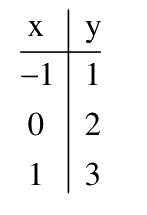
For two variables x and y, the following data set is given: $$\begin{array}{|c|c|} \hline x & y \\ \hline -1 & 1 \\ 0 & 2 \\ 1 & 3 \\ \hline \end{array}$$ The correct statement for the covariance A and correlation coefficient B of x and y is
Question 79 image
a.
$\text{A} = 2/3, \text{B} = 1$
b.
$\text{A} = -2/3, \text{B} = 1$
c.
$\text{A} = -2/3, \text{B} = -1$
d.
$\text{A} = 0, \text{B} = 0$
Correct Answer & Step-by-Step Solution Locked

Sign in free to reveal the correct answer and AI explanation for this question.

Q100 mcq
The hydrogenic orbital with the form of the radial function $$r^2 (\alpha_1 - r)(\alpha_2 - r)\exp[-\beta r], \text{ where } \alpha_1, \alpha_2 \text{ and } \beta$$ are constants, may be identified as a
a.
3d orbital
b.
4f orbital
c.
5d orbital
d.
5f orbital
Correct Answer & Step-by-Step Solution Locked

Sign in free to reveal the correct answer and AI explanation for this question.

Q101 mcq
The operator $\left[x, \left[x, p^2\right]\right]$ is identical with
a.
$[px, [x, p]]$
b.
$[xp, [x, p]]$
c.
$-\left[p, \left[x^2, p\right]\right]$
d.
$\left[x, \left[x^2, p\right]\right]$
Correct Answer & Step-by-Step Solution Locked

Sign in free to reveal the correct answer and AI explanation for this question.

Q102 mcq
For the particle-in-a-box problem in $(0, \text{L})$, the value of $\left\langle x^3 \right\rangle$ in the $n \to \infty$ limit would be
a.
$\frac{\text{L}^3}{6}$
b.
$\frac{\text{L}^3}{3}$
c.
$\frac{\text{L}^3}{4}$
d.
$\frac{\text{L}^4}{4}$
Correct Answer & Step-by-Step Solution Locked

Sign in free to reveal the correct answer and AI explanation for this question.

Q103 mcq
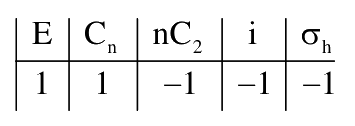
Identify the Mulliken notation for the following irreducible representation $$\begin{array}{|c|c|c|c|c|} \hline \text{E} & \text{C}_n & \text{nC}_2 & \text{i} & \sigma_h \\ \hline 1 & 1 & -1 & -1 & -1 \\ \hline \end{array}$$
Question 83 image
a.
$\text{A}_{1\text{u}}^{'}$
b.
$\text{A}_{2\text{u}}^{''}$
c.
$\text{B}_{2\text{u}}^{'}$
d.
$\text{A}_{2\text{u}}^{'}$
Correct Answer & Step-by-Step Solution Locked

Sign in free to reveal the correct answer and AI explanation for this question.

Q104 mcq
Identify the point group symmetry of the following molecule (all C--C bond lengths are equal)
Question 84 image
a.
$\text{C}_{2\text{v}}$
b.
$\text{S}_4$
c.
$\text{D}_{2\text{d}}$
d.
$\text{D}_{4\text{d}}$
Correct Answer & Step-by-Step Solution Locked

Sign in free to reveal the correct answer and AI explanation for this question.

Q105 mcq
The ground state term symbol for $\text{Nb}$ (atomic number 41) is $^6\text{D}$. The electronic configuration corresponding to this term symbol is
a.
$[\text{Kr}]4\text{d}^3 5\text{s}^2$
b.
$[\text{Kr}]4\text{d}^4 5\text{s}^1$
c.
$[\text{Kr}]4\text{d}^5 5\text{s}^0$
d.
$[\text{Kr}]4\text{d}^3 5\text{s}^1 5\text{p}^1$
Correct Answer & Step-by-Step Solution Locked

Sign in free to reveal the correct answer and AI explanation for this question.

Q106 mcq
In the presence of an external magnetic field (normal Zeeman effect), the transition $^1\text{D}_2 \rightarrow {}^1\text{P}_1$ splits into
a.
9 lines
b.
8 lines
c.
7 lines
d.
6 lines
Correct Answer & Step-by-Step Solution Locked

Sign in free to reveal the correct answer and AI explanation for this question.

Q107 mcq
Identify the Huckel determinant for cyclobutadiene
a.
$\begin{vmatrix} \alpha - \text{E} & \beta & 0 & 0 \\ \beta & \alpha - \text{E} & \beta & 0 \\ 0 & \beta & \alpha - \text{E} & \beta \\ 0 & 0 & \beta & \alpha - \text{E} \end{vmatrix}$
b.
$\begin{vmatrix} \alpha - \text{E} & \beta & 0 & \beta \\ \beta & \alpha - \text{E} & \beta & 0 \\ 0 & \beta & \alpha - \text{E} & \beta \\ \beta & \beta & 0 & \alpha - \text{E} \end{vmatrix}$
c.
$\begin{vmatrix} \alpha - \text{E} & \beta & 0 & \beta \\ \beta & \alpha - \text{E} & \beta & 0 \\ 0 & \beta & \alpha - \text{E} & \beta \\ \beta & 0 & \beta & \alpha - \text{E} \end{vmatrix}$
d.
$\begin{vmatrix} \alpha - \text{E} & \beta & 0 & \beta \\ \beta & \alpha - \text{E} & \beta & 0 \\ 0 & \beta & \alpha - \text{E} & \beta \\ 0 & 0 & \beta & \alpha - \text{E} \end{vmatrix}$
Correct Answer & Step-by-Step Solution Locked

Sign in free to reveal the correct answer and AI explanation for this question.

Q108 mcq
On mixing $120\text{ ml}$ of $0.05\text{ M } \text{CH}_3\text{COOH}$ and $40\text{ ml}$ of $0.05\text{ M}$ of $\text{NaOH}$, the $\text{pH}$ of the solution is ($\text{pK}_\text{a} = -\log \text{K}_\text{a}$)
a.
$\text{pK}_\text{a} + 0.69$
b.
$\text{pK}_\text{a} + 0.301$
c.
$\text{pK}_\text{a}$
d.
$\text{pK}_\text{a} - 0.69$
Correct Answer & Step-by-Step Solution Locked

Sign in free to reveal the correct answer and AI explanation for this question.

Q109 mcq
A system consists of gaseous $\text{H}_2$, $\text{O}_2$, $\text{H}_2\text{O}$ and $\text{CO}_2$ where the amount of $\text{CO}_2$ is specified and the equilibrium constant for the reaction $2\text{H}_2(\text{g}) + \text{O}_2(\text{g}) \rightleftharpoons 2\text{H}_2\text{O}(\text{g})$ is known. The number of degrees of freedom of the system is
a.
2
b.
3
c.
4
d.
5
Correct Answer & Step-by-Step Solution Locked

Sign in free to reveal the correct answer and AI explanation for this question.

Q110 mcq
"Colloids are thermodynamically unstable with reference to bulk but kinetically stable". Identify the correct pair **Statements** (A) thermodynamically unstable (B) kinetically stable **Reasons** (C) interfacial surface tension (D) electrical double layer
a.
$(\text{A}) \leftrightarrow (\text{D})$ and $(\text{B}) \leftrightarrow (\text{C})$
b.
$(\text{A}) \leftrightarrow (\text{C})$ and $(\text{B}) \leftrightarrow (\text{D})$
c.
$(\text{A}) \leftrightarrow (\text{C})$ and $(\text{B}) \leftrightarrow (\text{C})$
d.
$(\text{A}) \leftrightarrow (\text{D})$ and $(\text{B}) \leftrightarrow (\text{D})$
Correct Answer & Step-by-Step Solution Locked

Sign in free to reveal the correct answer and AI explanation for this question.

Q111 mcq
An AX system gave 4 lines at $4.72$, $4.6$, $1.12$ and $1.0\text{ ppm}$ away from the TMS using an nmr spectrometer operating at $100\text{ MHz}$. What are the values of $\text{J}_{\text{AX}}$ (in Hz) and $\delta_{\text{AX}}$ (in ppm), respectively
a.
12 and 3.6
b.
6 and 3.6
c.
12 and 2.86
d.
6 and 2.86
Correct Answer & Step-by-Step Solution Locked

Sign in free to reveal the correct answer and AI explanation for this question.

Q112 mcq
The equilibrium population ratio $(\text{n}_\text{j} / \text{n}_\text{i})$ of a doubly-degenerate energy level $(\text{E}_\text{j})$ lying at energy 2 units higher than a lower non-degenerate energy level $(\text{E}_\text{i})$, assuming $\text{k}_\text{B}\text{T} = 1\text{ unit}$, will be
a.
$2\text{e}^{-2}$
b.
$2\text{e}^2$
c.
$\text{e}^2$
d.
$\text{e}^{-2}$
Correct Answer & Step-by-Step Solution Locked

Sign in free to reveal the correct answer and AI explanation for this question.

Q113 mcq
Which of the following statements is true for a cyclic process?
a.
$\oint \text{dq} = 0$
b.
$\oint \text{dw} = 0$
c.
Heat can be completely convereted into work
d.
Work can be completely converted into heat
Correct Answer & Step-by-Step Solution Locked

Sign in free to reveal the correct answer and AI explanation for this question.

Q114 mcq
Identify, from the following, the correct ionic strengths for (A) $0.01\text{ molal}$ solution of $\text{NaCl}$ and (B) a $0.01\text{ molal}$ solution of $\text{Na}_2\text{SO}_4$.
a.
(A) $0.010\text{ mol kg}^{-1}$ (B) $0.010\text{ mol kg}^{-1}$
b.
(A) $0.010\text{ mol kg}^{-1}$ (B) $0.030\text{ mol kg}^{-1}$
c.
(A) $0.010\text{ mol kg}^{-1}$ (B) $0.025\text{ mol kg}^{-1}$
d.
(A) $0.010\text{ mol kg}^{-1}$ (B) $0.015\text{ mol kg}^{-1}$
Correct Answer & Step-by-Step Solution Locked

Sign in free to reveal the correct answer and AI explanation for this question.

Q115 mcq
A system has $100$ degenerate energy levels and $100$ bosons are kept in it. Find the entropy of the system at equilibrium.
a.
$10^{-2}\text{ k}_\text{B}$
b.
$10^2\text{ k}_\text{B}$
c.
$460.6\text{ k}_\text{B}$
d.
$4.606\text{ k}_\text{B}$
Correct Answer & Step-by-Step Solution Locked

Sign in free to reveal the correct answer and AI explanation for this question.

Q116 mcq
Which is correct Nernst equation for redox reaction $\text{O} + \text{ne} \rightleftharpoons \text{R}$?
a.
$\text{E} = \text{E}^0 - \frac{\text{RT}}{\text{nF}} \ln \frac{[\text{O}]}{[\text{R}]}$
b.
$\frac{[\text{O}]}{[\text{R}]} = \text{e}^{\frac{\text{nF}}{\text{RT}}(\text{E} - \text{E}^0)}$
c.
$\frac{[\text{O}]}{[\text{R}]} = \text{e}^{-\frac{\text{nF}}{\text{RT}}(\text{E} - \text{E}^0)}$
d.
$\frac{[\text{O}]}{[\text{R}]} = \text{e}^{\frac{\text{RT}}{\text{nF}}(\text{E} - \text{E}^0)}$
Correct Answer & Step-by-Step Solution Locked

Sign in free to reveal the correct answer and AI explanation for this question.

Q117 mcq
A plane of spacing '$\text{d}$' shows first order Bragg diffraction at angle $\theta$. A plane of spacing $2\text{d}$
a.
shows Bragg diffraction at $2\theta$
b.
shows Bragg diffraction at $\frac{\theta}{2}$
c.
shows Bragg diffraction at $\sin^{-1}\left(\frac{\sin\theta}{2}\right)$
d.
shows Bragg diffraction at $\sin^{-1}\left(\frac{\sin 2\theta}{2}\right)$
Correct Answer & Step-by-Step Solution Locked

Sign in free to reveal the correct answer and AI explanation for this question.

Q118 mcq
In the formation of $\text{H}_2$ molecules from $2\text{H}$ atoms placed at positions $\text{A}$ and $\text{B}$, and separated by a distance $\text{r}_\text{AB}$, a part of the spatial wave function is $$\Phi_\text{A}(1)\phi_\text{A}(2) + \phi_\text{B}(1)\phi_\text{B}(2)$$
a.
This is a covalent term and is important as $\text{r}_\text{AB} \rightarrow \infty$
b.
This is an ionic term and is important as $\text{r}_\text{AB} \rightarrow \infty$
c.
This is a covalent term and is important as $\text{r}_\text{AB} \rightarrow 0$
d.
This is an ionic term and is important as $\text{r}_\text{AB} \rightarrow 0$
Correct Answer & Step-by-Step Solution Locked

Sign in free to reveal the correct answer and AI explanation for this question.

Q119 mcq
A $0.1\text{ M}$ solution of compound A shows $50\%$ transmittance when a cell of $1\text{ cm}$ width is used at $\lambda_1\text{ nm}$. Another $0.1\text{ M}$ solution of compound B gives the optical density value of $0.1761$ using $1\text{cm}$ cell at $\lambda_1\text{ nm}$. What will be the transmittance of a solution that is simultaneously $0.1\text{ M}$ in A and $0.1\text{ M}$ in B using the same cell and at the same wave length? $[\log 20 = 1.301; \log 30 = 1.4771; \log 50 = 1.699]$
a.
$33.3\%$
b.
$50\%$
c.
$66.7\%$
d.
$70\%$
Correct Answer & Step-by-Step Solution Locked

Sign in free to reveal the correct answer and AI explanation for this question.

Q120 mcq
Using standard equation for intrinsic viscosity $[\eta] = \mathrm{K} \ \overline{\mathrm{M}}_{\mathrm{v}}^{\mathrm{a}}$, for a solution of polymer and any information from the graph identify viscosity average molar mass $(\overline{\mathrm{M}})$ [given that $\mathrm{a} = 0.5$, $\mathrm{K} = 5\times10^{-5}\text{ L g}^{-1}$]
Question 100 image
a.
$10^3\text{ g/mol}$
b.
$10^4\text{ g/mol}$
c.
$10^5\text{ g/mol}$
d.
$10^6\text{ g/mol}$
Correct Answer & Step-by-Step Solution Locked

Sign in free to reveal the correct answer and AI explanation for this question.

Q121 mcq
Among the following, the correct statement for the following reaction is
Question 101 image
a.
A is the major product and it will have five signals in the proton decoupled $^{13}\text{C}$ NMR spectrum
b.
A is the minor product and it will have eight signals in the proton decoupled $^{13}\text{C}$ NMR spectrum
c.
B is the major product and it will have five signals in the proton decoupled $^{13}\text{C}$ NMR spectrum
d.
B is the minor product and it will have five signals in the proton decoupled $^{13}\text{C}$ NMR spectrum
Correct Answer & Step-by-Step Solution Locked

Sign in free to reveal the correct answer and AI explanation for this question.

Q122 mcq
For the following three step conversion of A to B, the appropriate sequence of reactions is
Question 102 image
a.
$\text{MnO}_2$; $(\text{CH}_2\text{OH})_2/\text{p-TSA}$; $\text{PCC}$
b.
$\text{PCC}$; $\text{MnO}_2$; $(\text{CH}_2\text{OH})_2/\text{p-TSA}$;
c.
$\text{PCC}$; $(\text{CH}_2\text{OH})_2/\text{p-TSA}$; Jones' reagent
d.
Jones' reagent; $(\text{CH}_2\text{OH})_2/\text{p-TSA}$; $\text{MnO}_2$.
Correct Answer & Step-by-Step Solution Locked

Sign in free to reveal the correct answer and AI explanation for this question.

Q123 mcq
Which one of the following statements is true for the following transformation?
Question 103 image
a.
A is the major product and it is a Cram product.
b.
A is the major product and it is anti-Cram product.
c.
B is the major product and it is a Cram product.
d.
B is the major product and it is anti-Cram product.
Correct Answer & Step-by-Step Solution Locked

Sign in free to reveal the correct answer and AI explanation for this question.

Q124 mcq
Which one of the following statements is true for the following transformation?
Question 104 image
a.
Suitable reagent is m-CPBA and B is the major product
b.
Suitable reagent in m-CPBA and A is the major product.
c.
Suitable reagent is aq. $\text{H}_2\text{O}_2/\text{NaOH}$ and B is the major product.
d.
Suitable reagent is aq. $\text{H}_2\text{O}_2/\text{NaOH}$ and A is the major product.
Correct Answer & Step-by-Step Solution Locked

Sign in free to reveal the correct answer and AI explanation for this question.

Q125 mcq
The compound formed in the following reaction sequence is
Question 105 image
Correct Answer & Step-by-Step Solution Locked

Sign in free to reveal the correct answer and AI explanation for this question.

Q126 mcq
Among the following compounds, the one which has highest dipole moment is
Question 106 image
Correct Answer & Step-by-Step Solution Locked

Sign in free to reveal the correct answer and AI explanation for this question.

Q127 mcq
In the UV-visible is spectrum, a diterpenoid exhibited a $\lambda_{\max}$ at $275\text{ nm}$. The compound, among the choices given below is
Question 107 image
Correct Answer & Step-by-Step Solution Locked

Sign in free to reveal the correct answer and AI explanation for this question.

Q128 mcq
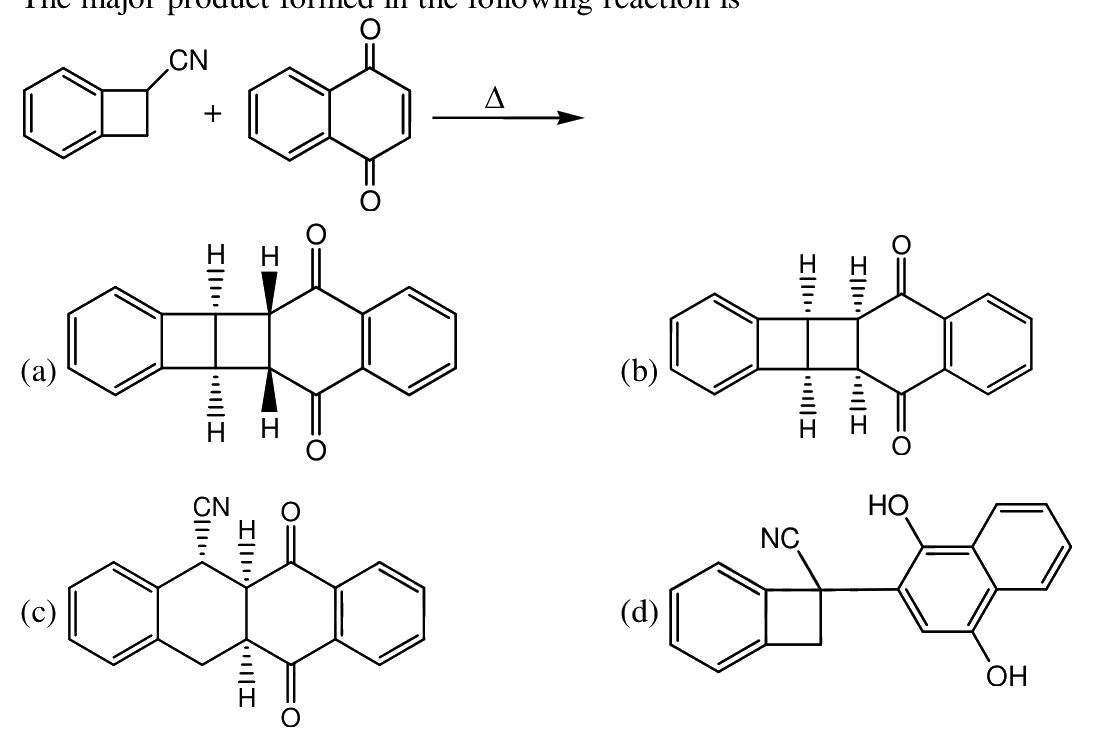
The major product formed in the following reaction is
Question 108 image
Correct Answer & Step-by-Step Solution Locked

Sign in free to reveal the correct answer and AI explanation for this question.

Q129 mcq
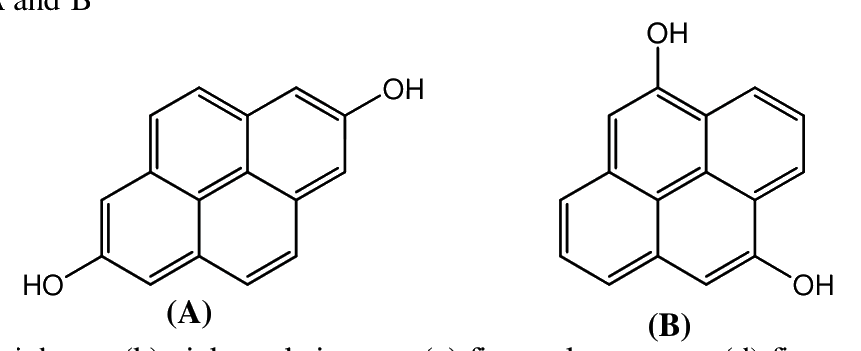
In the broad band decoupled $^{13}\text{C}$ NMR spectrum, the number of signals appearing for the two pyrenediols A and B
Question 109 image
a.
eight and eight
b.
eight and sixteen
c.
five and ten
d.
five and eight
Correct Answer & Step-by-Step Solution Locked

Sign in free to reveal the correct answer and AI explanation for this question.

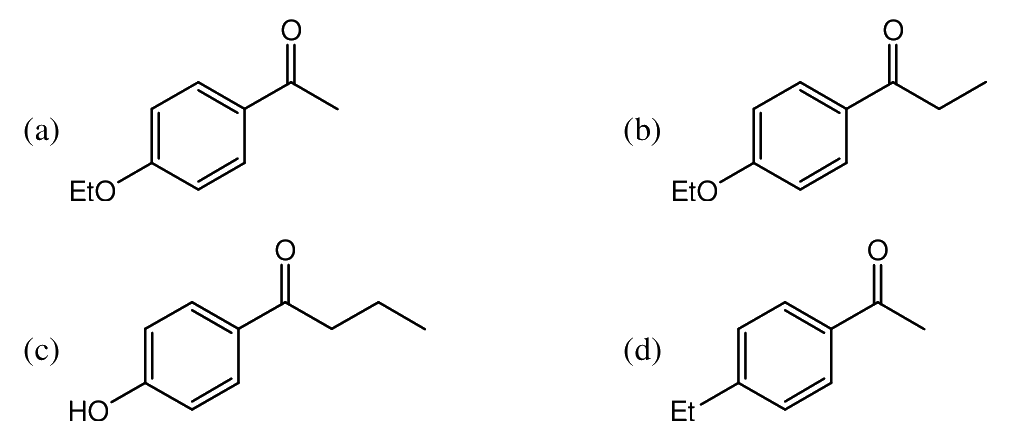
Q130 mcq
An organic compound exhibited the following $^{1}\text{H}$ NMR spectra data: $$\delta\ 7.80\ (2\text{ H}, \text{d}, J = 8\text{ Hz}),\ 6.80\ (2\text{ H}, \text{d}, J = 8\text{ Hz}),\ 4.10\ (2\text{ H}, \text{q}, J = 7.2\text{ Hz}),\ 2.4(3\text{H}, \text{s}),\ 1.25(3\text{ H}, \text{t}, J = 7.2\text{ Hz})$$ The compound, among the choices given below is,
Question 110 image
Correct Answer & Step-by-Step Solution Locked

Sign in free to reveal the correct answer and AI explanation for this question.

Q131 mcq
$\alpha$-Pinene on reaction with dilute alkaline $\text{KMnO}_4$ produces a diol, which on further oxidation with chromium trioxide gives product A, which undergoes a positive haloform test. The compound A is
Question 111 image
Correct Answer & Step-by-Step Solution Locked

Sign in free to reveal the correct answer and AI explanation for this question.

Q132 mcq
The major product formed in the reaction of guanosine with one equivalent of methyl iodide is
Question 112 image
Correct Answer & Step-by-Step Solution Locked

Sign in free to reveal the correct answer and AI explanation for this question.

Q133 mcq
The major product formed in the following reaction is
Question 113 image
Correct Answer & Step-by-Step Solution Locked

Sign in free to reveal the correct answer and AI explanation for this question.

Q134 mcq
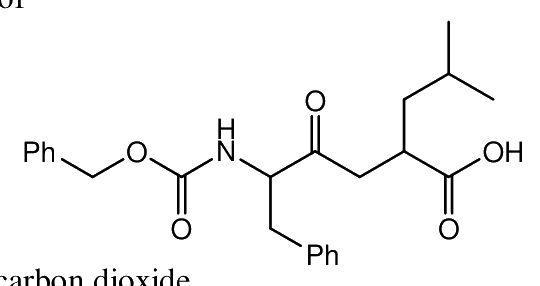
Reaction of the dipeptide, given below, with hydrogen in the presence of $10\%$ palladium over carbon, produces a mixture of
Question 114 image
a.
Gly-Leu + toluene + carbon dioxide
b.
Phe-Leu + toluene + carbon dioxide
c.
Phe-Leu + benzyl alcohol + carbon dioxide
d.
Gly-Leu + benzyl alcohol + carbon dioxide
Correct Answer & Step-by-Step Solution Locked

Sign in free to reveal the correct answer and AI explanation for this question.

Q135 mcq
Among the following, the most suitable reagent for carrying out resolution of racemic 3-methylcyclohexanone is
Question 115 image
Correct Answer & Step-by-Step Solution Locked

Sign in free to reveal the correct answer and AI explanation for this question.

Q136 mcq
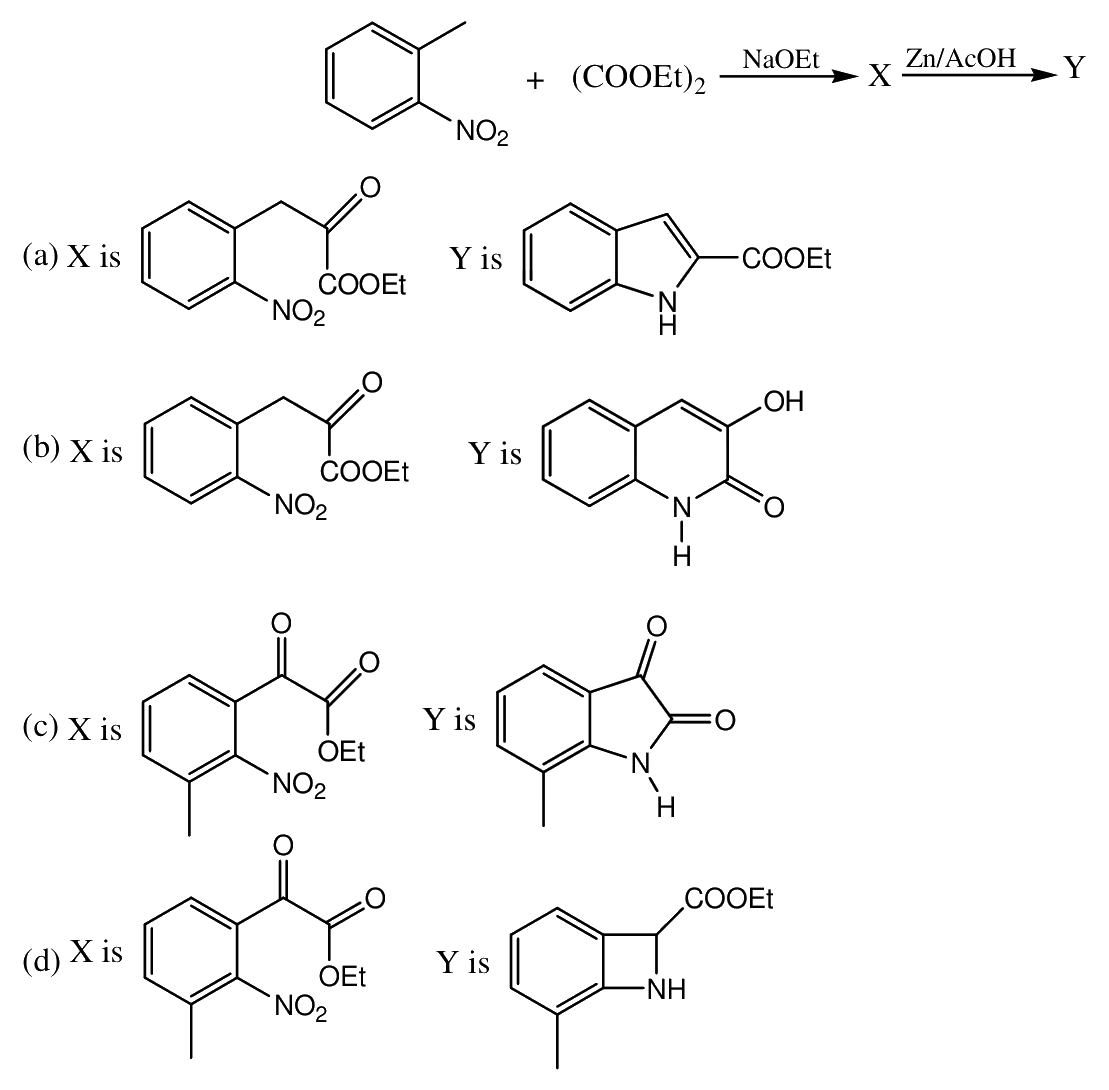
In the following reaction sequence, structures of the major product $\text{X}$ and $\text{Y}$ are
Question 116 image
a.
$\text{X}$ is 2-nitrophenylpyruvate ester derivative, $\text{Y}$ is ethyl $1H$-indole-2-carboxylate
b.
$\text{X}$ is 2-nitrophenylpyruvate ester derivative, $\text{Y}$ is quinoline derivative
c.
$\text{X}$ is phenylpyruvate derivative, $\text{Y}$ is indoline derivative
d.
$\text{X}$ is phenylpyruvate derivative, $\text{Y}$ is indoline ester derivative
Correct Answer & Step-by-Step Solution Locked

Sign in free to reveal the correct answer and AI explanation for this question.

Q137 mcq
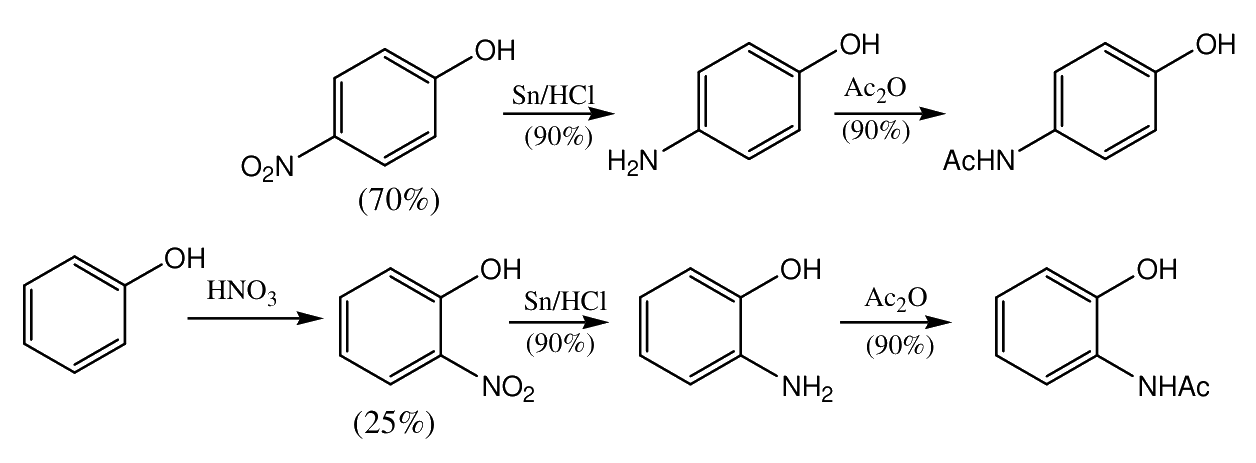
Consider the following reaction sequence The overall yield for the formation of p-hydroxyacetanilide and o-hydroxyacetanilides from phenol, respectively, are approximately
Question 117 image
a.
57 and 20%
b.
57 and 68%
c.
83 and 68%
d.
83 and 20%
Correct Answer & Step-by-Step Solution Locked

Sign in free to reveal the correct answer and AI explanation for this question.

Q138 mcq
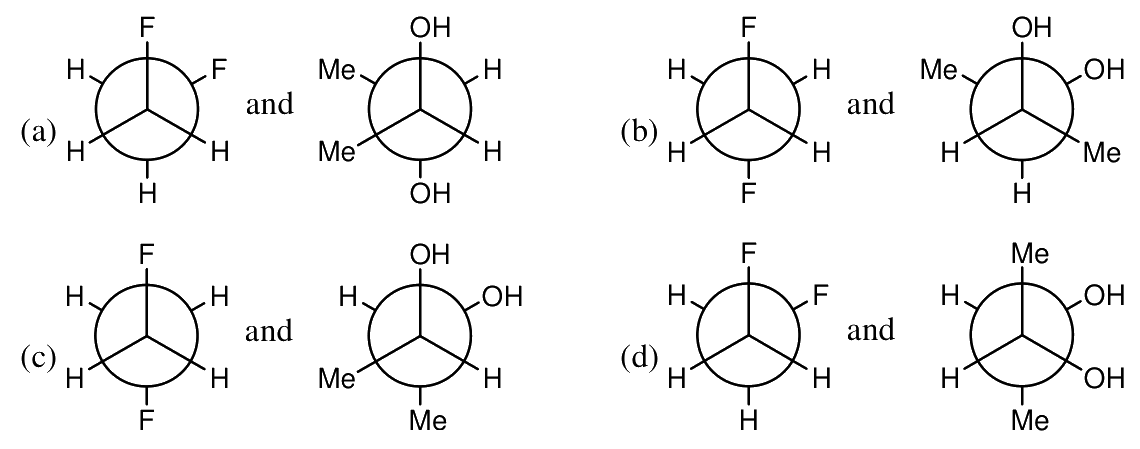
The most stable conformations of 1, 2-difluoroethane and dl-2, 3-butanediol are
Question 118 image
Correct Answer & Step-by-Step Solution Locked

Sign in free to reveal the correct answer and AI explanation for this question.

Q139 mcq
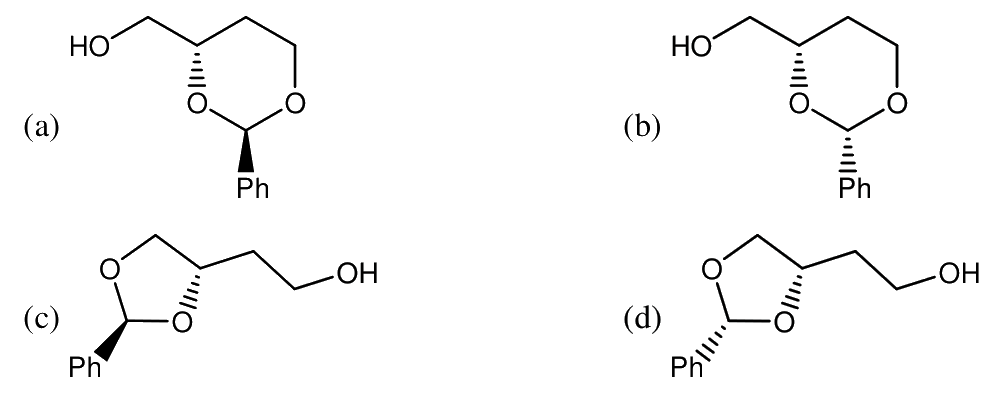
Reaction of (S)-1, 2, 4-butanetriol with benzaldehyde in the presence of catalytic amount of p-TSA furnished the major product A. The structure of A is
Question 119 image
Correct Answer & Step-by-Step Solution Locked

Sign in free to reveal the correct answer and AI explanation for this question.

Q140 mcq
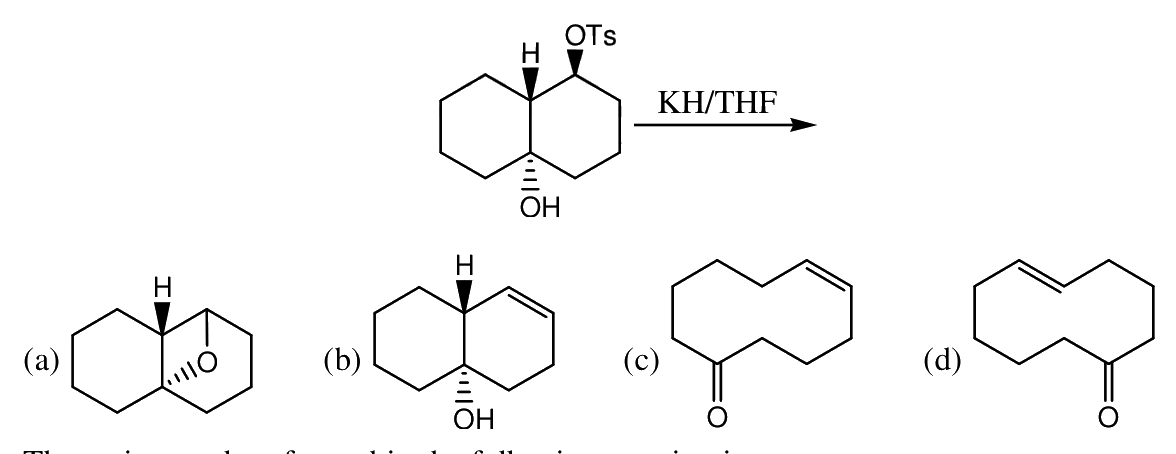
The major product formed in the following reaction is
Question 120 image
Correct Answer & Step-by-Step Solution Locked

Sign in free to reveal the correct answer and AI explanation for this question.

Q141 mcq
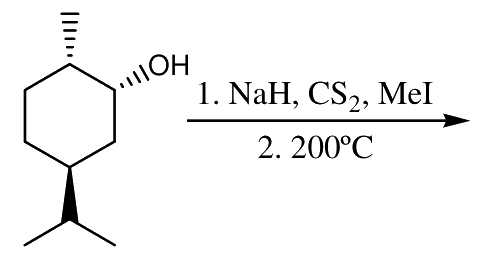
The major product formed in the following reaction is
Question 121 image
Correct Answer & Step-by-Step Solution Locked

Sign in free to reveal the correct answer and AI explanation for this question.

Q142 mcq
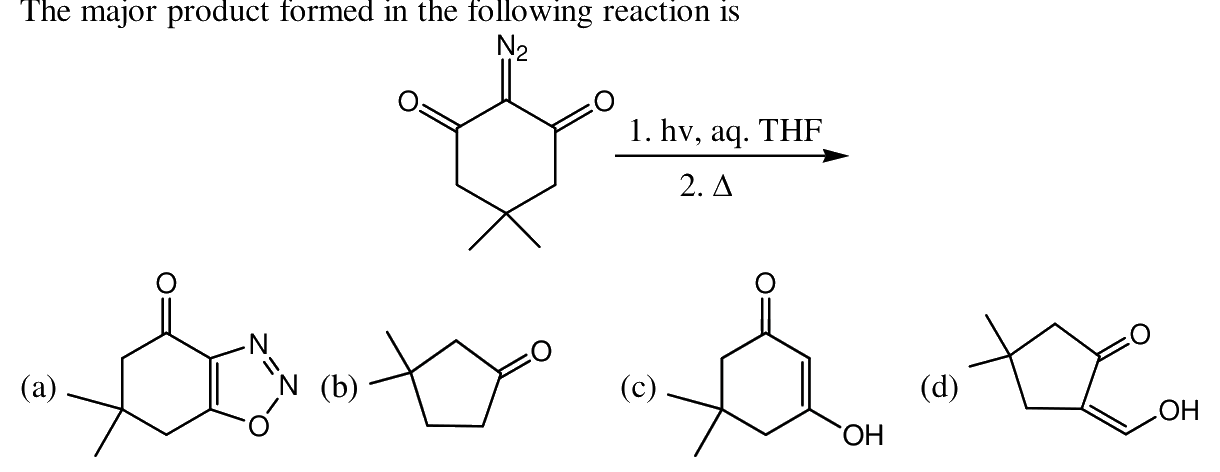
The major product formed in the following reaction is
Question 122 image
Correct Answer & Step-by-Step Solution Locked

Sign in free to reveal the correct answer and AI explanation for this question.

Q143 mcq
The major product formed in the following reaction is
Question 123 image
Correct Answer & Step-by-Step Solution Locked

Sign in free to reveal the correct answer and AI explanation for this question.

Q144 mcq
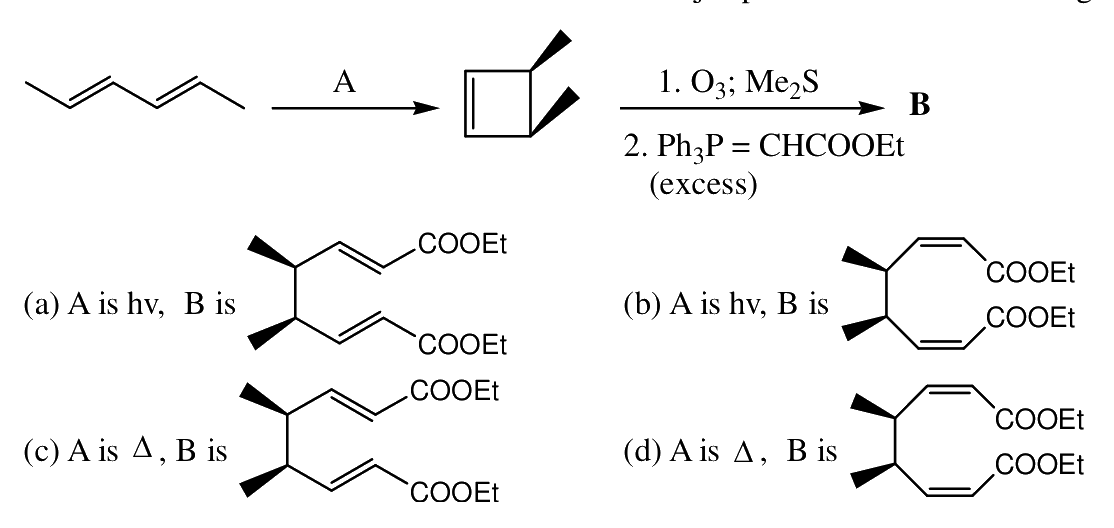
Predict the condition A and the structure of the major product B in the following sequence.
Question 124 image
a.
A is $h\nu$, B is
b.
A is $h\nu$, B is
c.
A is $\Delta$, B is
d.
A is $\Delta$, B is
Correct Answer & Step-by-Step Solution Locked

Sign in free to reveal the correct answer and AI explanation for this question.

Q145 mcq
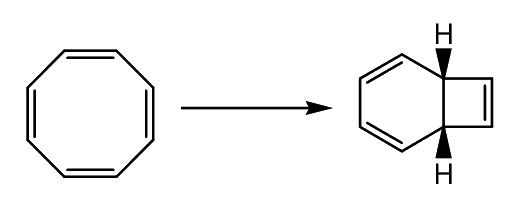
The most appropriate mode of cyclisation in the following transformation is
Question 125 image
a.
con-rotatory in photochemical; and dis-rotatory in thermal conditions.
b.
con-rotatory in thermal; and dis-rotatory in photochemical conditions.
c.
con-rotatory in thermal; and con-rotatory in photochemical conditions.
d.
dis-rotatory in photochemical; and dis-rotatory in thermal conditions.
Correct Answer & Step-by-Step Solution Locked

Sign in free to reveal the correct answer and AI explanation for this question.