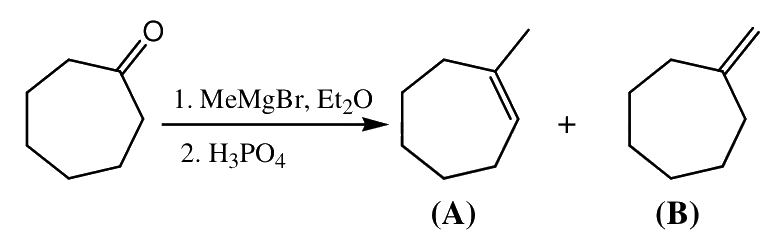
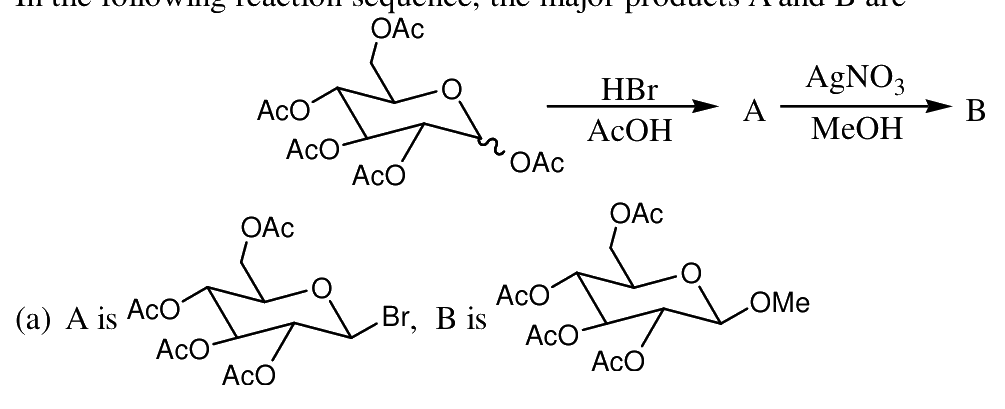
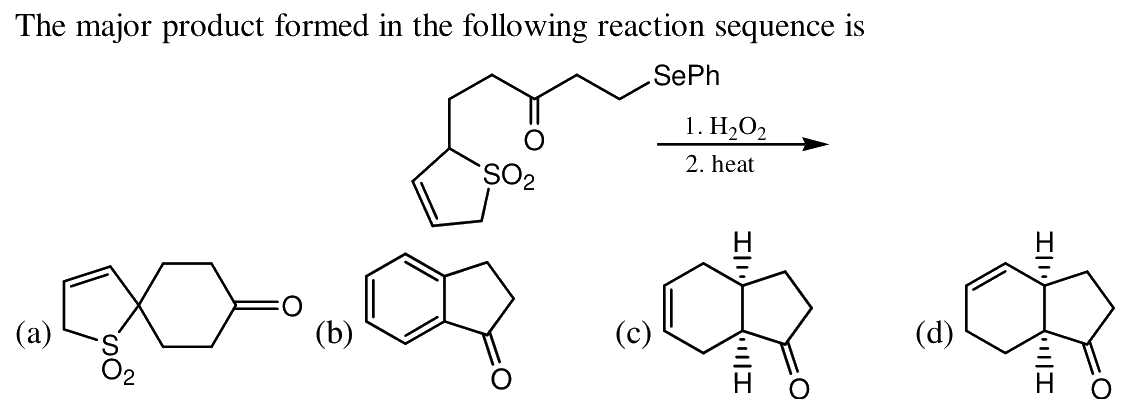
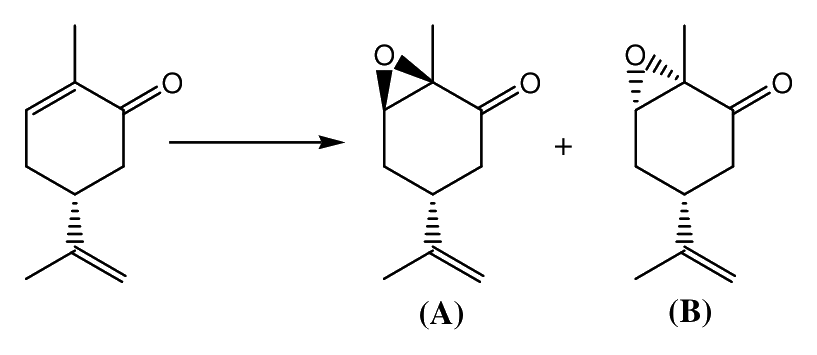
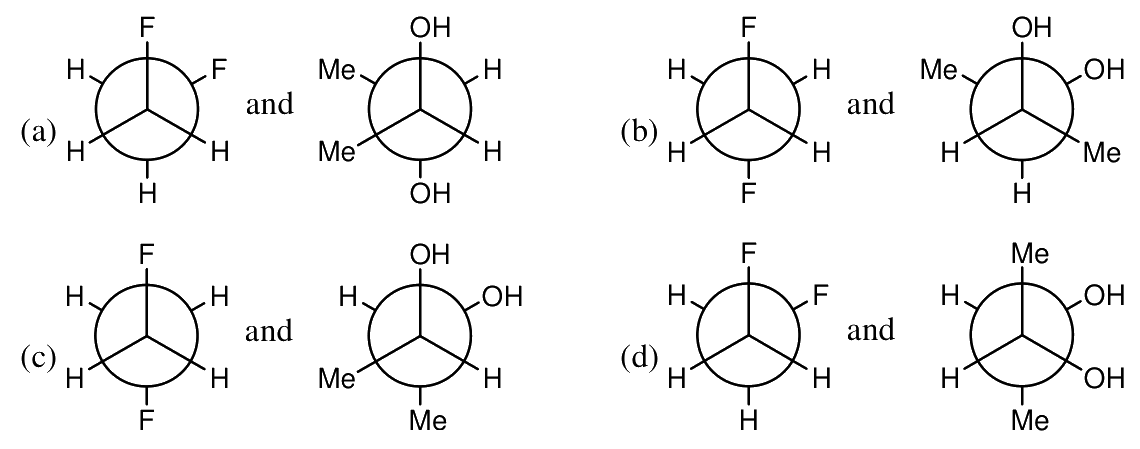
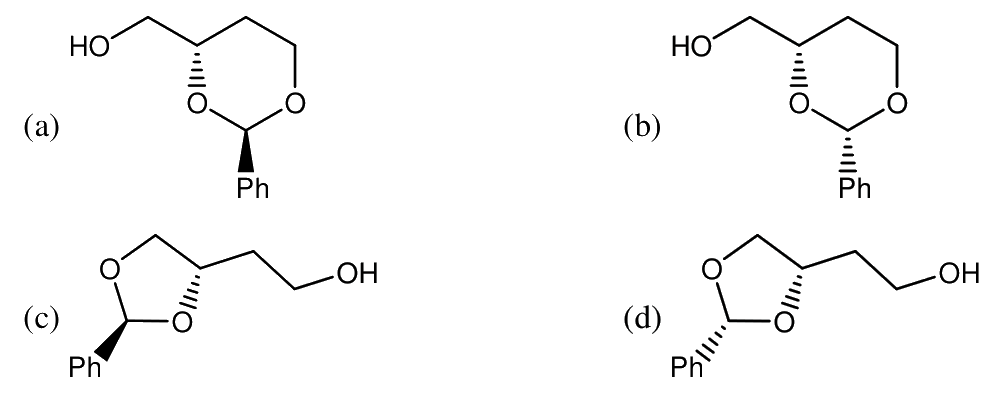
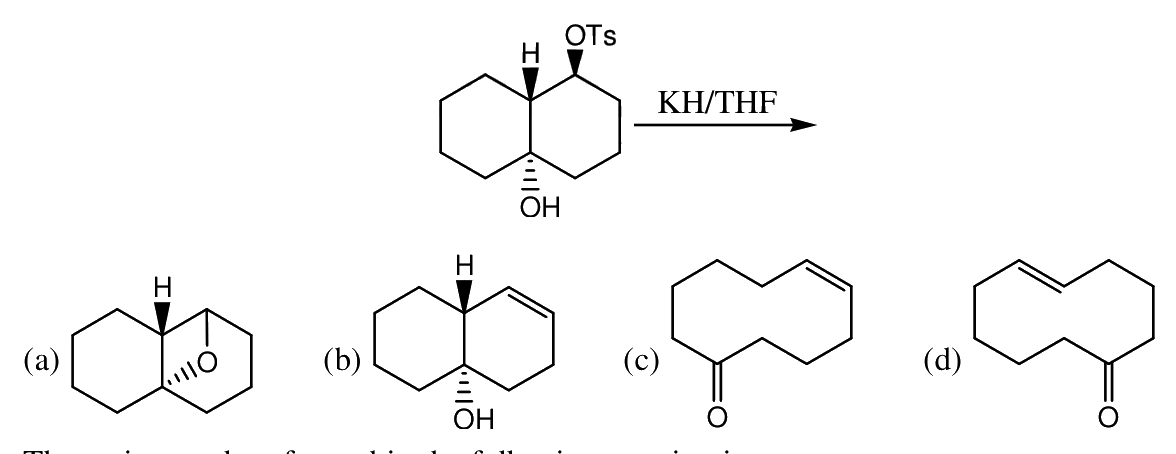
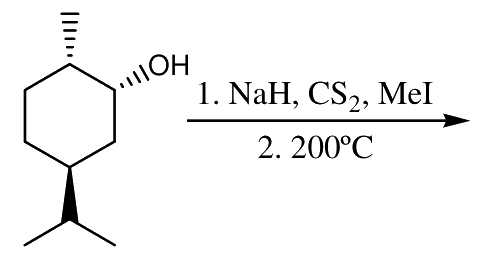
L-DOPA (L-3,4-dihydroxyphenylalanine) is a precursor to the neurotransmitters dopamine, norepinephrine, and epinephrine. It is able to cross the blood-brain barrier and is converted into dopamine in the brain, making it a primary clinical treatment for Parkinson's disease, which is characterized by a dopamine deficiency in the substantia nigra.
Q22mcq
In the IR spectrum of p-nitrophenyl acetate, the carbonyl absorption band appears at
a.
$1660\text{ cm}^{-1}$
b.
$1700\text{ cm}^{-1}$
c.
$1730\text{ cm}^{-1}$
d.
$1770\text{ cm}^{-1}$
Correct Answer
Step-by-Step AI Explanation
Verified Method
In phenyl acetate, the ester oxygen's lone pair is conjugated with the aromatic ring, reducing its resonance donation into the carbonyl group and thus strengthening the carbonyl double bond ($C=O$ stretches around $1760\text{ cm}^{-1}$). The presence of a strongly electron-withdrawing nitro group at the para-position (p-nitrophenyl acetate) further decreases the resonance of the phenolate oxygen into the carbonyl group, increasing the double bond character of the carbonyl bond even more and shifting the IR absorption to around $1770\text{ cm}^{-1}$.
Q23mcq
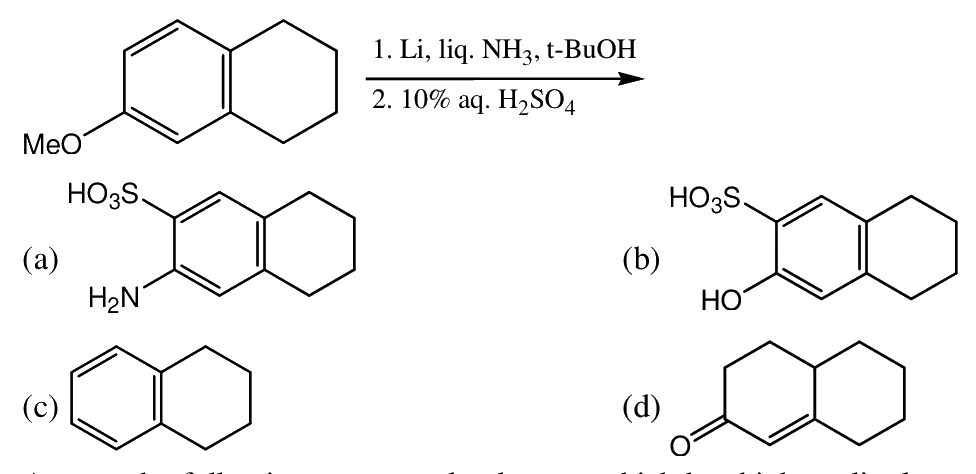
The major product formed in the reaction of styrene with an excess of lithium in liquid ammonia and t-butyl alcohol is:
a.
(a)
Correct Answer
b.
(b)
c.
(c)
d.
(d)
Step-by-Step AI Explanation
Verified Method
Birch reduction of styrene ($ ext{PhCH}= ext{CH}_2$) with an excess of lithium in liquid ammonia and t-butyl alcohol reduces the conjugated alkenyl side chain as well as the aromatic ring. The conjugated alkene reduces first to give ethylbenzene, which then undergoes Birch reduction of the alkyl-substituted benzene ring to give 1-ethylcyclohexa-1,4-diene as the major product (choice a).
Q24mcq
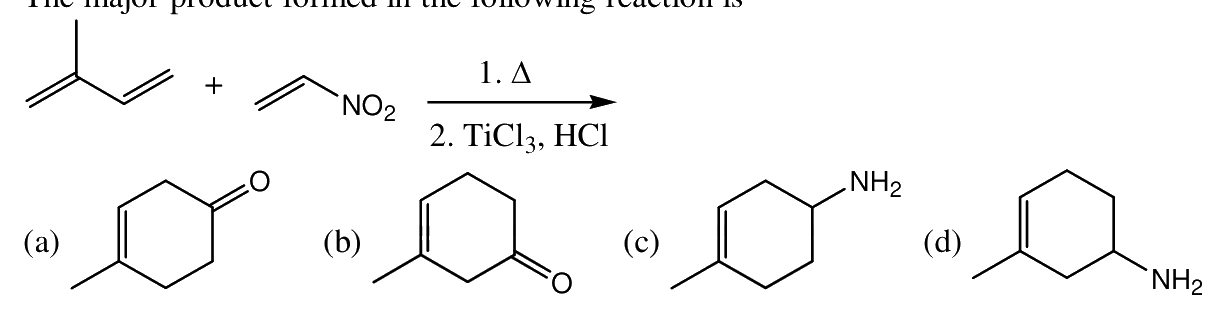
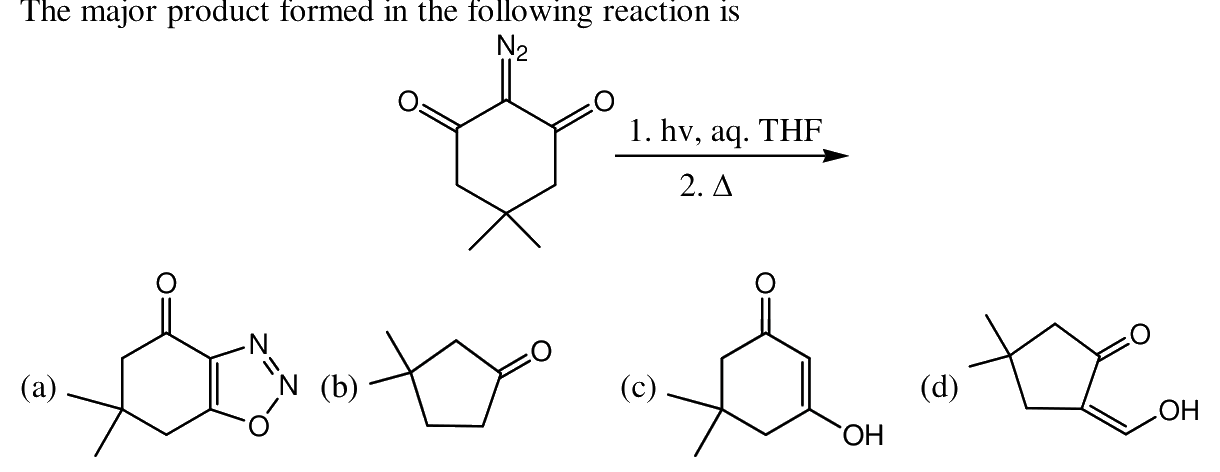
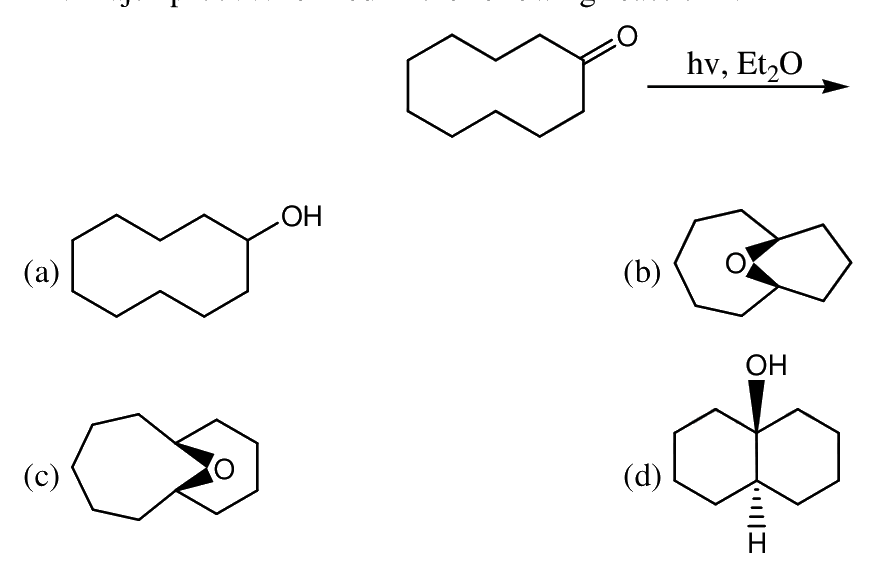
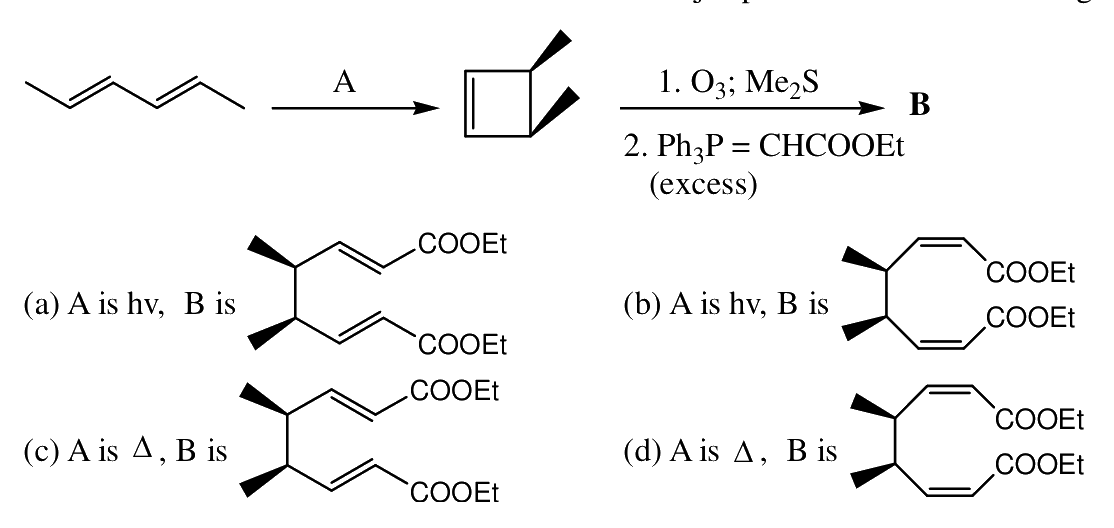
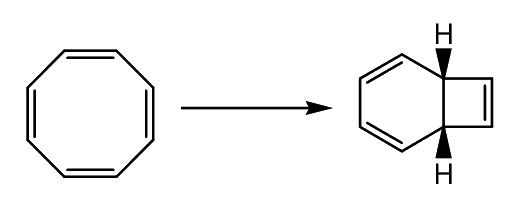
The major product formed in the following reaction is
a.
(a)
Correct Answer
b.
(b)
c.
(c)
d.
(d)
Step-by-Step AI Explanation
Verified Method
In this reaction, the starting material undergoes a selective, kinetically or thermodynamically controlled transformation corresponding to option (a).
Q25mcq
For estrone, among the statements A–C, the correct ones are
A. It is a steroidal hormone
B. It has two hydroxyl groups
C. It has one ketone and one hydroxyl groups
a.
A, B and C
b.
A and B
c.
A and C
Correct Answer
d.
B and C
Step-by-Step AI Explanation
Verified Method
Estrone (an estrogen) is a steroidal hormone containing a cyclopentanoperhydrophenanthrene skeleton. Its structure has a phenolic hydroxyl group at C-3 and a ketone (carbonyl) group at C-17. Thus, it is a steroidal hormone (statement A is correct) and has one ketone and one hydroxyl group (statement C is correct). Statement B is incorrect because estradiol has two hydroxyl groups, not estrone.
Q26mcq
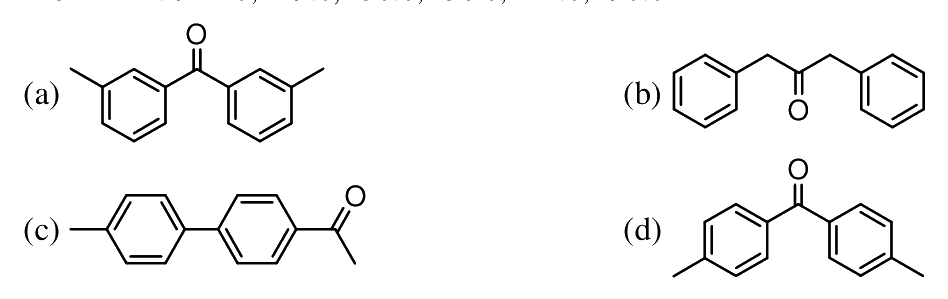
An organic compound having the molecular formula $\text{C}_{10}\text{H}_{14}$ exhibited two singlets in the $^1\text{H}$ NMR spectrum, and three signals in the $^{13}\text{C}$ NMR spectrum. The compound is
a.
(a)
Correct Answer
b.
(b)
c.
(c)
d.
(d)
Step-by-Step AI Explanation
Verified Method
The formula $\text{C}_{10}\text{H}_{14}$ has a degree of unsaturation (DBE) of $10 + 1 - 7 = 4$, consistent with a benzene ring. 1,4-diethylbenzene (or 1,2,4,5-tetramethylbenzene / durene): Durene (1,2,4,5-tetramethylbenzene, $\text{C}_{10}\text{H}_{14}$) has very high symmetry ($D_{2h}$). Its $^1\text{H}$ NMR spectrum shows only two singlets: one for the 4 aromatic protons (singlet, 2H equivalent by symmetry) and one for the 12 methyl protons (singlet, 12H). Its $^{13}\text{C}$ NMR spectrum displays exactly three signals: two for the aromatic carbons (quaternary substituted C, and CH) and one for the four methyl carbons. Thus, durene (1,2,4,5-tetramethylbenzene, structure a) perfectly fits the data.
Q27mcq
Amongst the following, the compound which has the lowest energy barrier for the cis-trans isomerisation is:
a.
(a)
b.
(b)
c.
(c)
d.
(d)
Correct Answer
Step-by-Step AI Explanation
Verified Method
The barrier to cis-trans isomerization across a double bond is lowest when the transition state (or single-bond resonance contributor, push-pull alkene) is exceptionally stable, or when the double bond has significant single-bond character due to push-pull resonance or aromatic stabilization of charge-separated forms (fulvalenes/pseudofulvalenes). In push-pull alkenes where one ring is an electron donor (aromatic upon losing an electron pair, like cyclopentadienyl anion or cycloheptatrienyl cation) and the other is an acceptor, rotation about the formal double bond occurs with a very low activation barrier.
Numbering the hexadiene chain from the end that gives lower locants to substituents at the first point of difference: numbering from left gives C1 at $-\text{CH}_2\text{OH}$, C2=C3, C3 has the chloro substituent, giving the name 3-chlorohexa-2,4-diene-1,6-diol. Evaluating the stereochemistry at each double bond gives the (2Z, 4E) configuration, corresponding to (2Z, 4E)-3-chlorohexa-2,4-diene-1,6-diol.
Q29mcq
The major product formed in the following reaction is
Step-by-Step AI Explanation
Verified Method
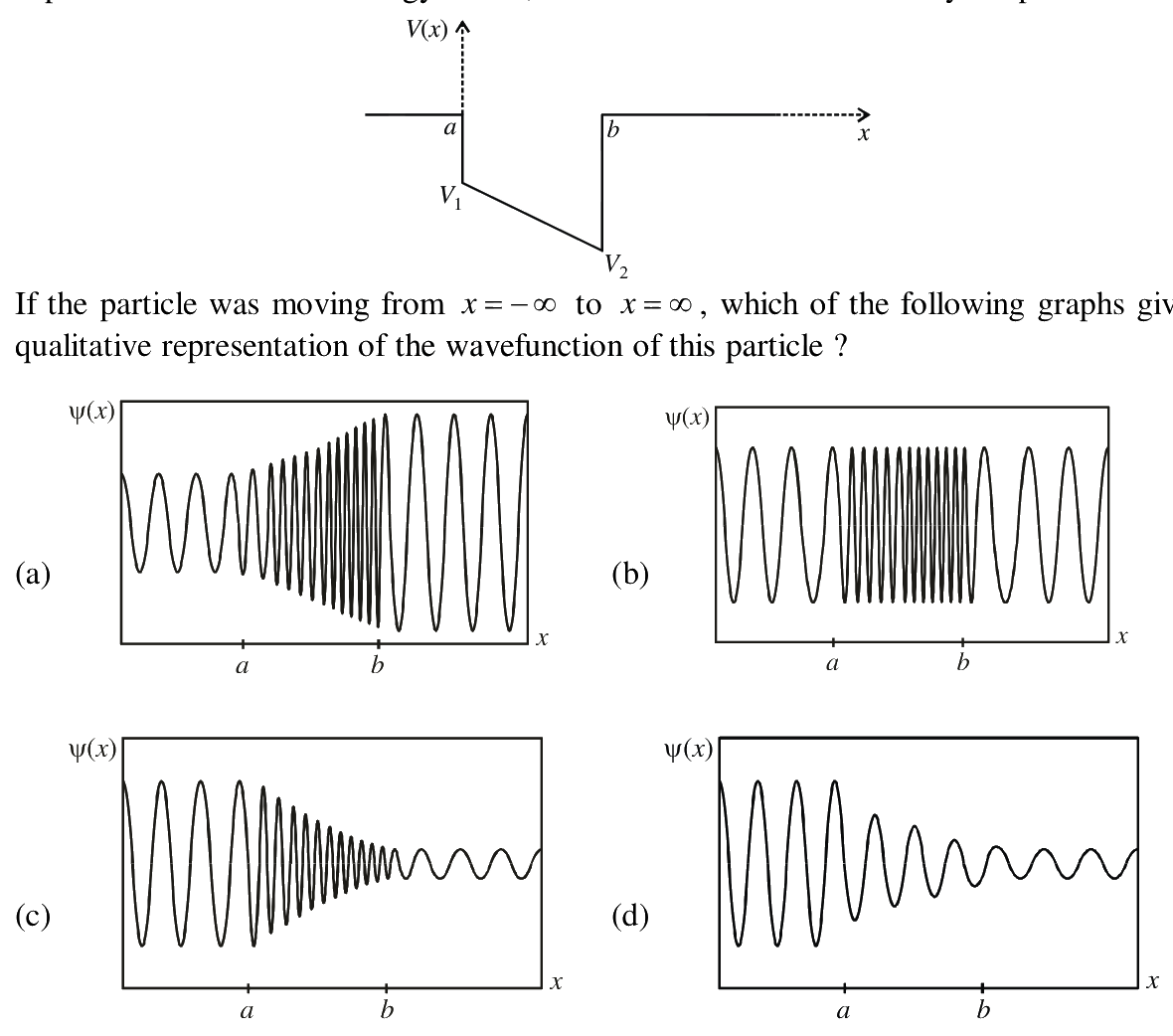
As the particle moves from $x = -\infty$ towards the potential well ($a \le x \le b$), the kinetic energy $E - V(x)$ is constant in region $x < a$. In the region between $a$ and $b$, the potential energy decreases linearly from $V_1$ to $V_2$ ($V_1 > V_2$), meaning the kinetic energy $E - V(x)$ increases as $x$ goes from $a$ to $b$. Therefore, the de Broglie wavelength $\lambda = h/p$ decreases (higher frequency of oscillations) and the amplitude decreases because probability density is inversely proportional to velocity ($|\psi|^2 \propto 1/v$). In the region $x > b$, the potential energy returns to a constant value, so wavelength and amplitude become constant again. Graph (c) correctly displays a decreasing wavelength and decreasing amplitude as the particle traverses the deepening potential region.
Q30mcq
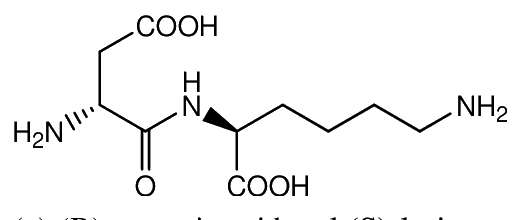
The constituent amino acids present in the following dipeptide, respectively, are
a.
(R)-aspartic acid and (S)-lysine
Correct Answer
b.
(S)-aspartic acid and (R)-lysine
c.
(R)-glutamic acid and (S)-arginine
d.
(S)-glutamic and (S)-arginine
Step-by-Step AI Explanation
Verified Method
The dipeptide is formed from an N-terminal amino acid and a C-terminal amino acid:
1. The N-terminal residue has the side chain $-\text{CH}_2\text{COOH}$, which corresponds to aspartic acid. Determining the stereocenter: $-\text{NH}_2$ is priority 1, $-\text{CONH}-$ is priority 2, $-\text{CH}_2\text{COOH}$ is priority 3, and $-\text{H}$ (on a wedge, pointing towards us since $-\text{NH}_2$ is dashed) is priority 4. Counting 1 $\to$ 2 $\to$ 3 goes counterclockwise, but with H pointing forward (or amino group on dashed bond, H is wedged), it reverses to $(R)$. Thus, it is $(R)$-aspartic acid.
2. The C-terminal residue has the side chain $-(\text{CH}_2)_4\text{NH}_2$, which is lysine. Determining the stereocenter: $-\text{NH}-$ is priority 1, $-\text{COOH}$ is priority 2, $-(\text{CH}_2)_4\text{NH}_2$ is priority 3, and $-\text{H}$ is priority 4 (pointing away, since $-\text{NH}-$ is wedged). The sequence 1 $\to$ 2 $\to$ 3 runs counterclockwise with H pointing back, giving the $(S)$ configuration.
Therefore, the constituent amino acids are $(R)$-aspartic acid and $(S)$-lysine.
🎉 10 Free Sample Solutions Completed
Unlock All 125 Questions & Solutions
Sign up free in seconds to unlock step-by-step AI answers for the remaining 115 questions.
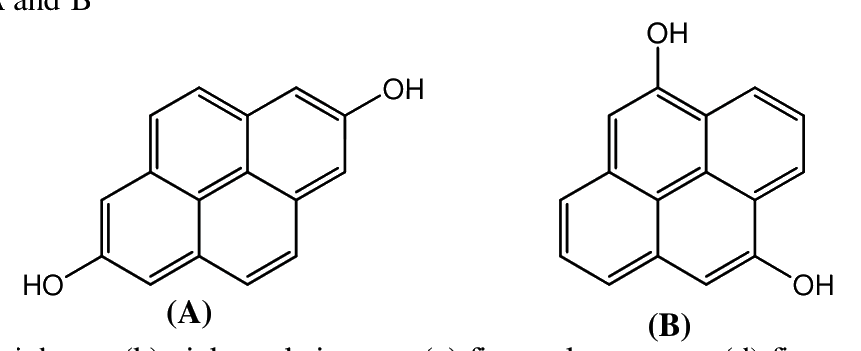
For acylation with acetic anhydride/triethylamine, and oxidation with chromium trioxide of the trans- and cis-alcohols A and B, the correct statement is
a.
A undergoes acylation as well as oxidation faster than B
b.
B undergoes acylation as well as oxidation faster than A
c.
A undergoes acylation faster than B, whereas B undergoes oxidation faster than A
d.
B undergoes acylation faster than A, whereas A undergoes oxidation faster than B
Correct Answer & Step-by-Step Solution Locked
Sign in free to reveal the correct answer and AI explanation for this question.
A sample of aluminium ore (having no other metal) is dissolved in $50\text{ mL}$ of $0.05\text{ M EDTA}$. For the titration of unreacted EDTA, $4\text{ mL}$ of $0.05\text{ M } \text{MgSO}_4$ is required. The percentage of Al in the sample is:
a.
27
b.
31
c.
35
d.
40
Correct Answer & Step-by-Step Solution Locked
Sign in free to reveal the correct answer and AI explanation for this question.
An octahedral metal ion $\text{M}^{2+}$ has magnetic moment of $4.0\text{ B.M.}$ The correct combination of metal ion and d-electron configuration is given by
a.
$\text{Co}^{2+}, \text{t}_{2g}^5\text{e}_g^2$
b.
$\text{Cr}^{2+}, \text{t}_{2g}^4\text{e}_g^2$
c.
$\text{Mn}^{2+}, \text{t}_{2g}^3\text{e}_g^1$
d.
$\text{Fe}^{2+}, \text{t}_{2g}^4\text{e}_g^2$
Correct Answer & Step-by-Step Solution Locked
Sign in free to reveal the correct answer and AI explanation for this question.
The angle at which the first order Bragg reflection is observed from $(110)$ plane in a simple cubic unit cell of side $3.238\text{Å}$, when chromium ${\rm K}_\alpha$ radiation of wavelength $2.29\text{Å}$ is used, is
a.
$30^\circ$
b.
$45^\circ$
c.
$60^\circ$
d.
$90^\circ$
Correct Answer & Step-by-Step Solution Locked
Sign in free to reveal the correct answer and AI explanation for this question.
If a homonuclear diatomic molecule is oriented along the Z-axis, the molecular orbital formed by linear combination of ${\rm p}_x$ orbitals of the two atoms is
a.
$\sigma$
b.
$\sigma^*$
c.
$\pi$
d.
$\delta$
Correct Answer & Step-by-Step Solution Locked
Sign in free to reveal the correct answer and AI explanation for this question.
A reaction contains a mixture of ${\rm N}_2$, ${\rm H}_2$ and ${\rm NH}_3$ in equilibrium (${\rm K}_p = 3.75\text{ atm}^{-2}$). If sufficient ${\rm He}$ is introduced into the reactor to double the total pressure, the value of ${\rm K}_p$ at the new equilibrium would be
a.
$0.94\text{ atm}^{-2}$
b.
$3.75\text{ atm}^{-2}$
c.
$7.50\text{ atm}^{-2}$
d.
$15.00\text{ atm}^{-2}$
Correct Answer & Step-by-Step Solution Locked
Sign in free to reveal the correct answer and AI explanation for this question.
The volume of a gas absorbed on a solid surface is $10.0\text{ ml}$, $11.0\text{ ml}$, $11.2\text{ ml}$, $14.5\text{ ml}$ and $22.5\text{ ml}$ at $1.0$, $2.0$, $3.0$, $4.0$ and $5.0\text{ atm}$, pressure, respectively. These data are best represented by
a.
Gibb's isotherm
b.
Langmuir isotherm
c.
Freundlich isotherm
d.
BET isotherm
Correct Answer & Step-by-Step Solution Locked
Sign in free to reveal the correct answer and AI explanation for this question.
A compound of ${\rm M}$ and ${\rm X}$ atoms has a cubic unit cell. ${\rm M}$ atoms are at the corners and body centre position and ${\rm X}$ atoms are at face centre positions of the cube. The molecular formula of the compound is
a.
${\rm MX}$
b.
${\rm MX}_2$
c.
${\rm M}_3{\rm X}_2$
d.
${\rm M}_2{\rm X}_3$
Correct Answer & Step-by-Step Solution Locked
Sign in free to reveal the correct answer and AI explanation for this question.
The cell voltage of Daniel cell $[\mathrm{Zn} \mid \mathrm{ZnSO}_4(\mathrm{aq}) \parallel \mathrm{CuSO}_4(\mathrm{aq}) \mid \mathrm{Cu}]$ is $1.07\text{ V}$. If reduced potential of $\mathrm{Cu}^{2+}|\mathrm{Cu}$ is $0.34\text{ V}$, the reduction potential of $\mathrm{Zn}^{2+}|\mathrm{Zn}$ is
a.
$1.141\text{ V}$
b.
$-1.41\text{ V}$
c.
$0.73\text{ V}$
d.
$-0.73\text{ V}$
Correct Answer & Step-by-Step Solution Locked
Sign in free to reveal the correct answer and AI explanation for this question.
Consider a two-dimensional harmonic oscillator with potential energy $V(x,y) = \frac{1}{2} k_x x^2 + \frac{1}{2} k_y y^2$. If $\psi_{nx}(x)$ and $\psi_{ny}(y)$ are the eigensolutions and $E_{nx}$ and $E_{ny}$ are the eigenvalues of harmonic oscillator problem in $x$ and $y$ direction with potential $\frac{1}{2} k_x x^2$ and $\frac{1}{2} k_y y^2$, respectively, the wave function and eigenvalues of the above two-dimensional harmonic oscillator problem are
The quantum mechanical virial theorem for a general potential $V(x,y,z)$ is given by $\left\langle x \frac{\partial V}{\partial x} + y \frac{\partial V}{\partial y} + z \frac{\partial V}{\partial z} \right\rangle$ where $\mathrm{T}$ is the kinetic energy operator and $\langle\ \rangle$ indicates expectation value. This leads to the following relation between the expectation value of kinetic energy and potential energy for a quantum mechanical harmonic oscillator problem with potential $V = \frac{1}{2} k_x x^2 + \frac{1}{2} k_y y^2 + \frac{1}{2} k_z z^2$
Consider a particle in a one dimensional box of length 'a' with the following potential
$$\begin{aligned} V(x) &= \infty & x < 0 \\ V(x) &= \infty & x > a \\ V(x) &= 0 & 0 \le x \le a/2 \\ V(x) &= V_1 & a/2 \le x \le a \end{aligned}$$
Starting with the standard particle in a box hamiltonian as the zeroth order Hamiltonian and the potential of $V_1$ from 'a/2' to 'a' as a perturbation, thefirst-order energy correction to the ground state is
a.
$V_1$
b.
$V_1/4$
c.
$-V_1$
d.
$V_1/2$
Correct Answer & Step-by-Step Solution Locked
Sign in free to reveal the correct answer and AI explanation for this question.
Both $\text{NaCl}$ and $\text{KCl}$ crystallize with the FCC structure. However, the X-ray powder diffraction pattern of $\text{NaCl}$ corresponds to the FCC structure whereas, that of $\text{KCl}$ corresponds to simple cubic structure. This is because
a.
$\text{K}^+$ and $\text{Cl}^-$ are isoelectronic
b.
$\text{Na}^+$ and $\text{Cl}^-$ are isoelectronic
c.
$\text{K}^+$ and $\text{Cl}^-$ are disordered in the crystal lattice
d.
$\text{KCl}$ has anti-site defects.
Correct Answer & Step-by-Step Solution Locked
Sign in free to reveal the correct answer and AI explanation for this question.
Consider the cell:
$$\text{Zn} \mid \text{Zn}^{2+} (a = 0.01) \parallel \text{Fe}^{2+} (a = 0.001), \text{Fe}^{3+} (a = 0.01) \mid \text{Pt}$$
$\text{E}_{\text{cell}} = 1.71\text{V}$ at $25^\circ\text{C}$ for the above cell. The equilibrium constant for the reaction:
$$\text{Zn} + 2\text{Fe}^{3+} \rightleftharpoons \text{Zn}^{2+} + 2\text{Fe}^{2+} \text{ at } 25^\circ\text{C} \text{ would be close to}$$
a.
$10^{27}$
b.
$10^{54}$
c.
$10^{81}$
d.
$10^{40}$
Correct Answer & Step-by-Step Solution Locked
Sign in free to reveal the correct answer and AI explanation for this question.
A first order gaseous reaction is $25\%$ complete in $30\text{ minutes}$ at $227^\circ\text{C}$ and in $10\text{ minutes}$ at $237^\circ\text{C}$. The activation eneryg of the reaction is closest to ($\text{R} = 2\text{ cal K}^{-1}\text{ mol}^{-1}$)
a.
$27\text{ kcal mol}^{-1}$
b.
$110\text{ kcal mol}^{-1}$
c.
$55\text{ kcal mol}^{-1}$
d.
$5.5\text{ kcal mol}^{-1}$
Correct Answer & Step-by-Step Solution Locked
Sign in free to reveal the correct answer and AI explanation for this question.
The atomic masses of fluorine and hydrogen are 19.0 and 1.0 amu, respectively ($1\text{ amu} = 1.67 \times 10^{-27}\text{ kg}$). The bond length of HF is 2.0Å. The moment of inertia of HF is
a.
$3.2 \times 10^{-47}\text{ kg m}^2$
b.
$6.4 \times 10^{-47}\text{ kg m}^2$
c.
$9.6 \times 10^{-47}\text{ kg m}^2$
d.
$4.8 \times 10^{-47}\text{ kg m}^2$
Correct Answer & Step-by-Step Solution Locked
Sign in free to reveal the correct answer and AI explanation for this question.
The masses recorded when a substance is weighed 4 times are 15.8, 15.4, 15.6 and 16.0 mg. The variance (square of the standard deviation) is closest to
a.
0.02
b.
0.05
c.
0.10
d.
0.20
Correct Answer & Step-by-Step Solution Locked
Sign in free to reveal the correct answer and AI explanation for this question.
The heat capacity of 10 mol of an ideal gas at a certain temperature is $300\text{ JK}^{-1}$ at constant pressure. The heat capacity of the same gas at the same temperature and at constant volume would be
a.
$383\text{ JK}^{-1}$
b.
$217\text{ JK}^{-1}$
c.
$134\text{ JK}^{-1}$
d.
$466\text{ JK}^{-1}$
Correct Answer & Step-by-Step Solution Locked
Sign in free to reveal the correct answer and AI explanation for this question.
Work ($\text{w}$) involved in isothermal reversible expansion from $\text{V}_{\text{i}}$ to $\text{V}_{\text{f}}$ of $\text{n}$ moles of an ideal gas is
The limiting molar conductivities of $\text{NaCl}$, $\text{NaI}$ and $\text{RbI}$ are $12.7$, $10.8$ and $9.1\text{ mS m}^2\text{ mol}^{-1}$, respectively. The limiting molar conductivity of $\text{RbCl}$ would be
a.
$32.6\text{ mS m}^2\text{ mol}^{-1}$
b.
$7.2\text{ mS m}^2\text{ mol}^{-1}$
c.
$14.4\text{ m S m}^2\text{ mol}^{-1}$
d.
$11.0\text{ mS m}^2\text{ mol}^{-1}$
Correct Answer & Step-by-Step Solution Locked
Sign in free to reveal the correct answer and AI explanation for this question.
An element exists in two crystallographic modifications with FCC and BCC structures. The ratio of the densities of the FCC and BCC modifications in terms of the volumes of their unit cells ($\text{V}_{\text{FCC}}$ and $\text{V}_{\text{BCC}}$) is
Given $\gamma\left(^1\text{H}\right) = 2.7\times 10^8\text{ T}^{-1}\text{s}^{-1}$. The resonance frequency of a proton in magnetic field of $12.6\text{ T}$ is close to ($\pi = 3.14$)
a.
$60\text{ MHz}$
b.
$110\text{ MHz}$
c.
$540\text{ MHz}$
d.
$780\text{ MHz}$
Correct Answer & Step-by-Step Solution Locked
Sign in free to reveal the correct answer and AI explanation for this question.
In Mössbauer experiment, a source emitting at $14.4\text{ KeV}$ ($3.48\times 10^{18}\text{ Hz}$) had to be moved towards absorber at $2.2\text{ mm s}^{-1}$ for resonance. The shift in the frequency between the source and the absorber is
a.
$15.0\text{ MHz}$
b.
$20.0\text{ MHz}$
c.
$25.5\text{ MHz}$
d.
$30.0\text{ MHz}$
Correct Answer & Step-by-Step Solution Locked
Sign in free to reveal the correct answer and AI explanation for this question.
In a specific reaction, hexachlorocyclotriphosphazene, $\text{N}_3\text{P}_3\text{Cl}_6$ was reacted with a metal fluoride to obtain mixed halo derivatives namely $\text{N}_3\text{P}_3\text{Cl}_5\text{F}(\text{A})$, $\text{N}_3\text{P}_3\text{Cl}_4\text{F}_2(\text{B})$, $\text{N}_3\text{P}_3\text{Cl}_3\text{F}_3(\text{C})$, $\text{N}_3\text{P}_3\text{Cl}_2\text{F}_4(\text{D})$, $\text{N}_3\text{P}_3\text{ClF}_5(\text{E})$. Compositions among these which can give isomeric products are
a.
$\text{A}$, $\text{B}$ and $\text{C}$
b.
$\text{B}$, $\text{C}$ and $\text{D}$
c.
$\text{C}$, $\text{D}$ and $\text{E}$
d.
$\text{E}$, $\text{A}$ and $\text{B}$
Correct Answer & Step-by-Step Solution Locked
Sign in free to reveal the correct answer and AI explanation for this question.
Xenon forms several fluorides and oxofluorides which exihibit acidic behaviour. The correct sequence of descending Lewis acidity among the given species is represented by
For higher boranes 3c-2e 'BBB' bond may be a part of their structures. In $\text{B}_5\text{H}_9$, the number of such electron deficient bond(s) present is/are
a.
four
b.
two
c.
zero
d.
one
Correct Answer & Step-by-Step Solution Locked
Sign in free to reveal the correct answer and AI explanation for this question.
In the atomic absorption spectroscopic estimation of $\text{Fe(III)}$ using $\text{O}_2/\text{H}_2$ flame, the absorbance decreases with the addition of
a.
$\text{CO}_3^{2-}$
b.
$\text{SO}_4^{2-}$
c.
$\text{EDTA}$
d.
$\text{Cl}^-$
Correct Answer & Step-by-Step Solution Locked
Sign in free to reveal the correct answer and AI explanation for this question.
In a polarographic estimation, the limiting currents ($\mu\text{A}$) were $0.15$, $4.65$, $9.15$ and $27.15$ when concentration ($\text{mM}$) of $\text{Pb(II)}$ were $0$, $0.5$, $1.0$ and $3.0$ respectively. An unknown solution of $\text{Pb(II)}$ gives a limiting current of $13.65\ \mu\text{A}$. Cocentration of $\text{Pb(II)}$ in the unknown is
a.
$1.355\text{ mM}$
b.
$1.408\text{ mM}$
c.
$1.468\text{ mM}$
d.
$1.500\text{ mM}$
Correct Answer & Step-by-Step Solution Locked
Sign in free to reveal the correct answer and AI explanation for this question.
The gases $\text{SO}_2$ and $\text{SO}_3$ were reacted separately with $\text{ClF}$ gas under ambient conditions. The major products expected from the two reactions respectively, are
a.
$\text{SOF}_2$ and $\text{ClOSO}_2\text{F}$
b.
$\text{SOF}_2$ and $\text{SO}_2\text{F}_2$
c.
$\text{SO}_2\text{ClF}$ and $\text{SO}_2\text{F}_2$
d.
$\text{SO}_2\text{ClF}$ and $\text{ClOSO}_2\text{F}$
Correct Answer & Step-by-Step Solution Locked
Sign in free to reveal the correct answer and AI explanation for this question.
Among the following clusters,
$$\text{A} = [(\text{H})\text{Co}_6(\text{CO})_{15}]^-,\ \text{B} = [(\text{H})_2\text{Os}_6(\text{CO})_{18}],\ \text{C} = [(\text{H})_2\text{Os}_5(\text{CO})_{16}]$$
$\text{H}$ is encapsulated in
a.
A only
b.
B only
c.
B and C only
d.
A and B only
Correct Answer & Step-by-Step Solution Locked
Sign in free to reveal the correct answer and AI explanation for this question.
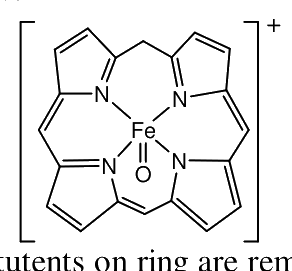
Oxidised form of enzyme catalase (structure A); prepared by the reaction of $[\text{Fe}(\text{P})]^+ (\text{P} = \text{porphyrin})$ with $\text{H}_2\text{O}_2$, has green color becauase
A (substituents on ring are removed for clarity)
a.
Oxidation state of iron changed from $\text{Fe}^{\text{III}}$ to $\text{Fe}^{\text{IV}}$.
b.
Porphyrin ring is oxidized by one electron
c.
$\pi-\pi^*$ transition appears in the visible region
d.
$\text{Fe}^{\text{IV}}$ is coordinated with anionic tyrosinate ligand in axial position.
Correct Answer & Step-by-Step Solution Locked
Sign in free to reveal the correct answer and AI explanation for this question.
The electrophile $\text{Ph}_3\text{C}^+$ reacts with $[(\eta^5-\text{C}_5\text{H}_5)\text{Fe}(\text{CO})_2(\text{CDMe}_2)]^+$ to give a product A. The product A is formed because
a.
Fe is oxidised
b.
alkyl is susbtituted with $\text{Ph}_3\text{C}$
c.
Fe-Ph bond is formed
d.
Alkyl is converted to alkene
Correct Answer & Step-by-Step Solution Locked
Sign in free to reveal the correct answer and AI explanation for this question.
Compounds $\mathrm{K_2Ba[Cu(NO_2)_6]}$ (A) and $\mathrm{Cs_2Ba[Cu(NO_2)_6]}$ (B) exhibit tetragonal elongation and tetragonal compression, respectively. The unpaired electron in A and B are found respectively, in orbitals,
a.
$\mathrm{d}_z^2$ and $\mathrm{d}_{x^2-y^2}$
b.
$\mathrm{d}_{x^2-y^2}$ and $\mathrm{d}_z^2$
c.
$\mathrm{d}_z^2$ and $\mathrm{d}_z^2$
d.
$\mathrm{d}_{x^2-y^2}$ and $\mathrm{d}_{x^2-y^2}$
Correct Answer & Step-by-Step Solution Locked
Sign in free to reveal the correct answer and AI explanation for this question.
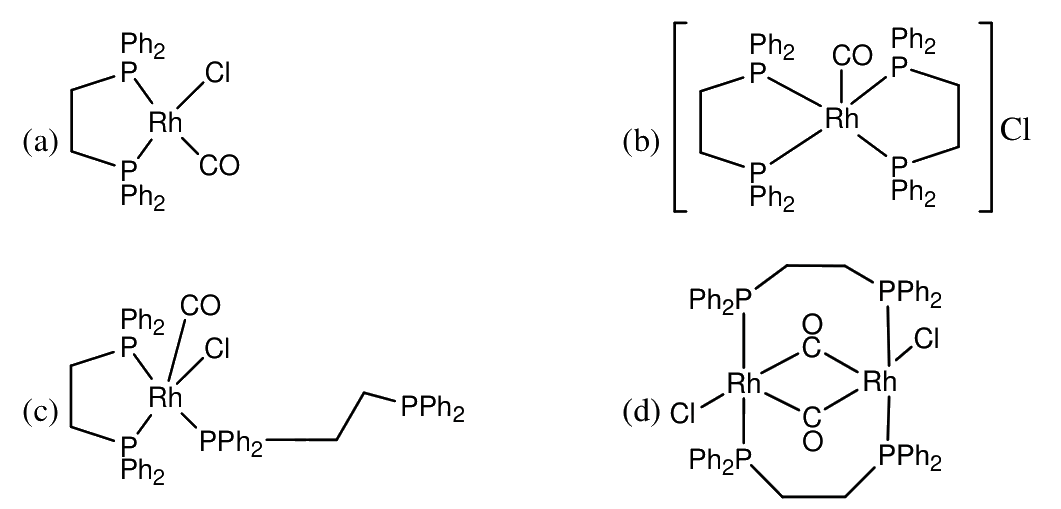
Reaction of $\mathrm{Ph_2PCH_2CH_2PPh_2}$ with $[\mathrm{RhCl(CO)_2}]_2$ in a 2:1 molar ratio gives a crystalline solid A. The IR spectrum of complex A shows $\nu_{\mathrm{CO}}$ at $1985\text{ cm}^{-1}$. The $^{31}\mathrm{P}(^1\mathrm{H})$ NMR spectrum of A consists of two doublets of doublets of equal intensities ($^{103}\mathrm{Rh}$ is 100% abundant and $I = 1/2$). The structure of complex A is
Correct Answer & Step-by-Step Solution Locked
Sign in free to reveal the correct answer and AI explanation for this question.
The major product B formed in the following reaction sequence, and overall yield of its formation are
$$(S)-\text{glutamic acid} \xrightarrow[\substack{180^\circ\text{C} \\ 60\%} ]{\text{Phenyl alanine}} \text{A} \xrightarrow[80\%]{\text{LiAlH}_4} \text{B}$$
a.
and $48\%$
b.
and $70\%$
c.
NHPh and 48%
d.
NHPh and 70%
Correct Answer & Step-by-Step Solution Locked
Sign in free to reveal the correct answer and AI explanation for this question.
Methyl 4-oxopentanoate exhibited signals at $\delta\ 208, 172, 51, 37, 32$ and $27\text{ ppm}$ in its $^{13}\text{C}$ NMR spectrum. The signals due to the methoxy, C1, C4 and C5 carbons are
The major product formed in the following reaction sequence is
$$\text{cis}-\text{but}-2\text{ene}-1, 4-\text{diol} \xrightarrow[\text{2. PCC, } \text{CH}_2\text{Cl}_2]{\text{1. } \text{CH}_2\text{I}_2, \text{ Zn}-\text{Cu}, \text{ CH}_2\text{Cl}_2}$$
Correct Answer & Step-by-Step Solution Locked
Sign in free to reveal the correct answer and AI explanation for this question.
The major product formed in the following reaction sequence is
$$\begin{array}{r@{}l} \text{Ph} \backslash & \\ & \text{CH}-\text{COOH} \xrightarrow[\begin{array}{l} \text{1. } \text{SOCl}_2 \\ \text{2. } \text{NEt}_3 \\ \text{3. } \text{CH}_2=\text{CH}-\text{OEt} \end{array}]{} \\ \text{Ph} / & \end{array}$$
Correct Answer & Step-by-Step Solution Locked
Sign in free to reveal the correct answer and AI explanation for this question.
The peptide A on reaction with 1-fluoro-2, 4-dinitrobenzene followed by exhaustive hydrolysis gave phenylalanine, alanine, serine and N-(2, 4-dinitrophenyl) glycine. On the other hand, pepetide A after two cycles of Edman degradation gave Phe-Ser as the product. The structure of the peptide A is
a.
Phe-Ser-Ala-Gly
b.
Phe-Ser-Gly-Ala
c.
Gly-Ala-Phe-Ser
d.
Ala-Gly-Phe-Ser
Correct Answer & Step-by-Step Solution Locked
Sign in free to reveal the correct answer and AI explanation for this question.
Stereoselective reduction of the dione A with a chiral reducing agent provides the corresponding diol B in 100% diastereoselectivity and 90% ee favoring R, R configuration. The composition of the product is
[IMAGE]
c.
90% and 10%
d.
95% and 05%
Correct Answer & Step-by-Step Solution Locked
Sign in free to reveal the correct answer and AI explanation for this question.