← Joint CSIR UGC NET Exam
CSIR NET · Chemical Sciences

June

2012 · 125 questions · First 10 Solutions Free
Questions 1–10 have full step-by-step solutions visible. Sign in to unlock all 125 →
Q21 mcq
In the reactions (A) and (B), $$n\text{H}_2\text{O} + \text{Cl}^- \longrightarrow [\text{Cl}(\text{H}_2\text{O})_n]^-\quad \dots\text{(A)}$$ $$6\text{H}_2\text{O} + \text{Mg}^{2+} \longrightarrow [\text{Mg}(\text{H}_2\text{O})_6]^{2+}\quad \dots\text{(B)}$$ water behaves as
a.
An acid in both (A) and (B)
b.
An acid in (A) and a base in (B) Correct Answer
c.
A base in (A) an acid in (B)
d.
A base in both (A) and (B)
Step-by-Step AI Explanation
Verified Method
In reaction (A), $\text{H}_2\text{O}$ donates hydrogen-bond interactions (accepts electron density via its electropositive H atoms, acting as a Lewis acid or hydrogen-bond donor toward the Lewis base $\text{Cl}^-$). In reaction (B), $\text{H}_2\text{O}$ donates an electron pair via its oxygen atom to the $\text{Mg}^{2+}$ cation, forming coordination bonds, and thus acts as a Lewis base.
Q22 mcq
The size of the d orbitals in $\text{Si}$, $\text{P}$, $\text{S}$ and $\text{Cl}$ follows the order.
a.
$\text{Cl} > \text{S} > \text{P} > \text{Si}$
b.
$\text{Cl} > \text{P} > \text{S} > \text{Si}$
c.
$\text{P} > \text{S} > \text{Si} > \text{Cl}$
d.
$\text{Si} > \text{P} > \text{S} > \text{Cl}$ Correct Answer
Step-by-Step AI Explanation
Verified Method
Moving from left to right across the third period (from $\text{Si}$ to $\text{Cl}$), the effective nuclear charge ($Z_{\text{eff}}$) increases. As $Z_{\text{eff}}$ increases, the valence orbitals, including the empty $3d$ orbitals, contract in size. Therefore, the size of the $d$ orbitals follows the order: $\text{Si} > \text{P} > \text{S} > \text{Cl}$.
Q23 mcq
The correct structure of basic beryllium nitrate is:
Question 3 image
a.
(a) Correct Answer
b.
(b)
c.
(c)
d.
(d)
Step-by-Step AI Explanation
Verified Method
Basic beryllium nitrate has the formula $\text{Be}_4\text{O}(\text{NO}_3)_6$. It has a central oxygen atom tetrahedrally coordinated to four beryllium atoms, with the nitrate groups bridging the edges of the $\text{Be}_4$ tetrahedron, analogous to basic beryllium acetate, $\text{Be}_4\text{O}(\text{CH}_3\text{COO})_6$.
Q24 mcq
The total number of lone pairs of electrons in $\text{I}_3^-$ is:
a.
Zero
b.
Three
c.
Six
d.
Nine Correct Answer
Step-by-Step AI Explanation
Verified Method
The triiodide ion, $\text{I}_3^-$, consists of a central iodine atom with 3 lone pairs and 2 bonding pairs (linear geometry, $sp^3d$ hybridization). The two terminal iodine atoms each possess 3 lone pairs. Therefore, the total number of lone pairs in $\text{I}_3^-$ is $3 + 3 + 3 = 9$.
Q25 mcq
If Mössbauer spectrum of $\text{Fe}(\text{CO})_5$ is recorded in the presence of a magnetic field, the original spectrum with two lines changes into the one with
a.
Three lines
b.
Four lines
c.
Five lines
d.
Six lines Correct Answer
Step-by-Step AI Explanation
Verified Method
In $^{57}\text{Fe}$ Mössbauer spectroscopy, the excited state has nuclear spin $I = 3/2$ and the ground state has $I = 1/2$. In the absence of an applied magnetic field, a non-cubic environment like in trigonal bipyramidal $\text{Fe}(\text{CO})_5$ shows quadrupole splitting giving a two-line spectrum (doublet). When an external magnetic field is applied, the nuclear Zeeman effect lifts the degeneracy of both the ground state ($m_I = \pm 1/2$, split into 2 levels) and the excited state ($m_I = \pm 1/2, \pm 3/2$, split into 4 levels). According to the selection rule $\Delta m_I = 0, \pm 1$, transitions between these levels result in a 6-line pattern.
Q26 mcq
The spectrophotometric response for the titration of a mixture of $\text{Fe}^{3+}$ and $\text{Cu}^{2+}$ ions against EDTA is given below. The correct statement is:
Question 6 image
a.
Volume $\text{ab} \equiv [\text{Fe}^{3+}]$ and volume $\text{cd} \equiv [\text{Cu}^{2+}]$ Correct Answer
b.
Volume $\text{ab} \equiv [\text{Cu}^{2+}]$ and volume $\text{cd} \equiv [\text{Fe}^{3+}]$
c.
Volume $\text{ab} \equiv [\text{Fe}^{3+}]$ and volume $\text{ab} \equiv \text{excess EDTA}$
d.
Volume $\text{ab} \equiv [\text{Cu}^{2+}]$ and volume $\text{cd} \equiv \text{excess EDTA}$
Step-by-Step AI Explanation
Verified Method
EDTA forms complexes with $\text{Fe}^{3+}$ with a much higher stability constant ($\log K_f \approx 25.1$) than with $\text{Cu}^{2+}$ ($\log K_f \approx 18.8$). Thus, during titration with EDTA, $\text{Fe}^{3+}$ is complexed first, corresponding to the initial region/titrant volume $\text{ab} \equiv [\text{Fe}^{3+}]$, followed by titration of $\text{Cu}^{2+}$, which corresponds to region $\text{cd} \equiv [\text{Cu}^{2+}]$.
Q27 mcq
In 'carbon-dating' application of radioisotopes, $^{14}\text{C}$ emits
a.
$\beta-\text{particle}$ Correct Answer
b.
$\alpha-\text{particle}$
c.
$\gamma-\text{radiation}$
d.
Positron.
Step-by-Step AI Explanation
Verified Method
In radiocarbon dating, $^{14}\text{C}$ decays via spontaneous $\beta^-$ emission to nitrogen-14 according to the nuclear reaction: $^{14}_6\text{C} \longrightarrow {^{14}_7\text{N}} + \text{e}^- + \bar{\nu}_e$.
Q28 mcq
The actual base pairs present in the double helical structure of DNA containing adenine (A), thymine (T), cytosine (C) and guanine (G), are
a.
AG and CT
b.
AC and GT
c.
AG and AC
d.
AT and GC Correct Answer
Step-by-Step AI Explanation
Verified Method
According to the Watson-Crick base-pairing rules in the DNA double helix, adenine (A) pairs specifically with thymine (T) via two hydrogen bonds, and guanine (G) pairs with cytosine (C) via three hydrogen bonds.
Q29 mcq
The oxidation state of iron in met-hemoglobin is
a.
Three Correct Answer
b.
Two
c.
Four
d.
Zero
Step-by-Step AI Explanation
Verified Method
Met-hemoglobin (metHb) is the oxidized form of hemoglobin in which the iron in the heme group is in the $+3$ (ferric) oxidation state instead of the $+2$ (ferrous) state found in normal hemoglobin.
Q30 mcq
The reactions of $\text{Ni}(\text{CO})_4$ with the ligand $(\text{L} = \text{PMe}_3\text{ or }\text{P}(\text{OMe})_3)\text{L}$ yields $\text{Ni}(\text{CO})_3\text{L}$. The reaction is
a.
Associative
b.
Dissociative Correct Answer
c.
Interchange $(\text{I}_\text{a})$
d.
Interchange $(\text{I}_\text{d})$
Step-by-Step AI Explanation
Verified Method
$\text{Ni}(\text{CO})_4$ is an 18-electron saturated tetrahedral complex. Ligand substitution reactions in 18-electron metal carbonyl complexes typically proceed via a dissociative mechanism (loss of a CO ligand to form a 16-electron intermediate, $\text{Ni}(\text{CO})_3$, followed by rapid coordination of the incoming ligand L).
🎉 10 Free Sample Solutions Completed

Unlock All 125 Questions & Solutions

Sign up free in seconds to unlock step-by-step AI answers for the remaining 115 questions.

Q31 mcq
As a ligand $\text{Cl}^-$ is:
a.
Only a $\sigma-\text{donor}$
b.
Only a $\pi-\text{donor}$
c.
Both a $\sigma-\text{donor}$ and a $\pi-\text{donor}$
d.
A $\sigma-\text{donor}$ and a $\sigma-\text{acceptor}$
Correct Answer & Step-by-Step Solution Locked

Sign in free to reveal the correct answer and AI explanation for this question.

Q32 mcq
The correct d-electron configuration showing spin-orbit coupling is
a.
$\text{t}_{2\text{g}}^4\ \text{e}_\text{g}^2$
b.
$\text{t}_{2\text{g}}^6\ \text{e}_\text{g}^0$
c.
$\text{t}_{2\text{g}}^4\ \text{e}_\text{g}^0$
d.
$\text{t}_{2\text{g}}^3\ \text{e}_\text{g}^2$
Correct Answer & Step-by-Step Solution Locked

Sign in free to reveal the correct answer and AI explanation for this question.
Q33 mcq
The correct statement for the aggregating nature of alkyl lithium (RLi) reagent is:
a.
The carbanion nucleophilicity increases with aggregation.
b.
The observed aggregation arises from its electron deficient nature.
c.
Carbanion nucleophilicity does not depend on aggregation.
d.
The extent of aggregation is maximum in polar dative solvents.
Correct Answer & Step-by-Step Solution Locked

Sign in free to reveal the correct answer and AI explanation for this question.
Q34 mcq
For the reaction, $\text{trans-}[\text{IrCl}(\text{CO})(\text{PPh}_3)_2] + \text{Cl}_2 \rightarrow \text{trans-}[\text{IrCl}_3(\text{CO})(\text{PPh}_3)_2]$, the correct observation
a.
$\nu_\text{CO}(\text{product}) > \nu_\text{CO}(\text{reactant})$
b.
$\nu_\text{CO}(\text{product}) < \nu_\text{CO}(\text{reactant})$
c.
$\nu_\text{CO}(\text{product}) = \nu_\text{CO}(\text{reactant})$
d.
$\nu_\text{CO}(\text{product}) = \nu_\text{CO}(\text{free CO})$
Correct Answer & Step-by-Step Solution Locked

Sign in free to reveal the correct answer and AI explanation for this question.
Q35 mcq
The nucleophilic attack on olefins under mild conditions:
a.
Is always facile
b.
Is more facile than electrophilic attack on olefins
c.
Is facile for electron-rich olefins
d.
Requires activation by coordination to metal.
Correct Answer & Step-by-Step Solution Locked

Sign in free to reveal the correct answer and AI explanation for this question.
Q36 mcq
Among the following the strongest oxidizing agent is:
a.
$[\text{WO}_4]^{2-}$
b.
$[\text{CrO}_4]^{2-}$
c.
$[\text{MoO}_4]^{2-}$
d.
$[\text{ReO}_4]^{-2}$
Correct Answer & Step-by-Step Solution Locked

Sign in free to reveal the correct answer and AI explanation for this question.
Q37 mcq
The least basic among the following is:
a.
$\text{Al}(\text{OH})_3$
b.
$\text{La}(\text{OH})_3$
c.
$\text{Ce}(\text{OH})_3$
d.
$\text{Lu}(\text{OH})_3$
Correct Answer & Step-by-Step Solution Locked

Sign in free to reveal the correct answer and AI explanation for this question.
Q38 mcq
For any operator $\text{A}$ and its adjoint $\text{A}^\dagger$, the \textbf{INCORRECT} statement is:
a.
$\text{AA}^\dagger$ is hermitian
b.
$\text{AA}^\dagger + \text{A}^\dagger\text{A}$ is hermitian.
c.
$\text{A} + \text{A}^\dagger$ is hermitian
d.
$\text{A} - \text{A}^\dagger$ is hermitian.
Correct Answer & Step-by-Step Solution Locked

Sign in free to reveal the correct answer and AI explanation for this question.
Q39 mcq
For hydrogen-like atom with a nuclear charge $\text{Z}$, the energy of orbital with principal quantum number '$\text{n}$' follows the relation.
a.
$\text{E}_n \propto \text{n}^2\text{Z}^2$
b.
$\text{E}_n \propto -\frac{\text{Z}^2}{\text{n}}$
c.
$\text{E}_n \propto -\frac{\text{Z}}{\text{n}}$
d.
$\text{E}_n \propto -\frac{\text{Z}^2}{\text{n}^2}$
Correct Answer & Step-by-Step Solution Locked

Sign in free to reveal the correct answer and AI explanation for this question.
Q40 mcq
The average value of the radius $\langle r \rangle$ in the 1s state of the hydrogen atom is ($\text{a}_0$ is Bohr radius)
a.
$\text{a}_0$
b.
$1.5\text{ a}_0$
c.
$0.75\text{ a}_0$
d.
$0.5\text{ a}_0$.
Correct Answer & Step-by-Step Solution Locked

Sign in free to reveal the correct answer and AI explanation for this question.
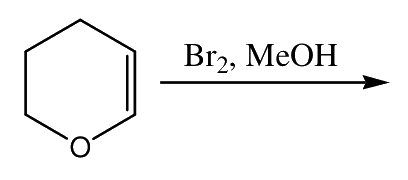
Q41 mcq
Among the following, the \textbf{CORRECT} statement is:
a.
The number of irreducible representations is equal to classes of symmetry operations.
b.
The number of irreducible representations is equal to the order of the symmetry point group.
c.
The irreducible representations contained in any point group are always of one dimension.
d.
A symmetry point group may not contain a totally symmetric irreducible representation.
Correct Answer & Step-by-Step Solution Locked

Sign in free to reveal the correct answer and AI explanation for this question.
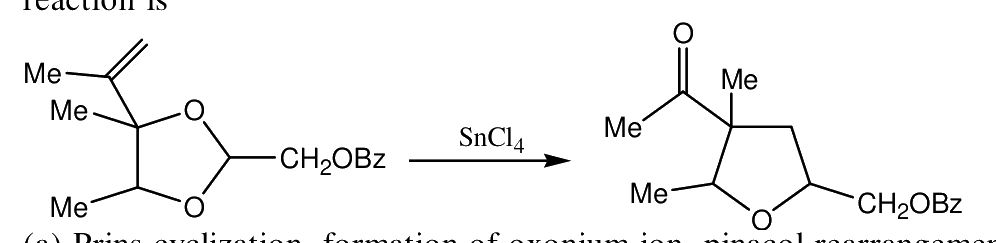
Q42 mcq
For a diatomic molecule AB, the energy for the rotational transition from $\text{J} = 0$ to $\text{J} = 1$ state is $3.9\text{ cm}^{-1}$. The energy for the rotational transition from $\text{J} = 3$ to $\text{J} = 4$ state would be
a.
$3.9\text{ cm}^{-1}$
b.
$7.8\text{ cm}^{-1}$
c.
$11.7\text{ cm}^{-1}$
d.
$15.6\text{ cm}^{-1}$
Correct Answer & Step-by-Step Solution Locked

Sign in free to reveal the correct answer and AI explanation for this question.
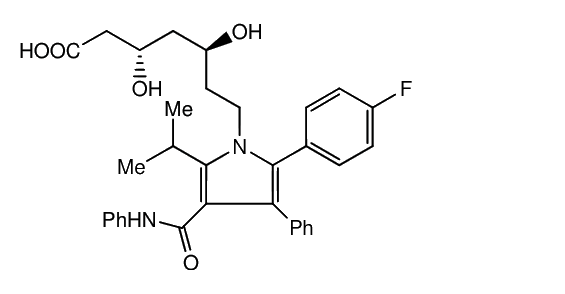
Q43 mcq
For the vibrational Raman spectrum of a homonuclear diatomic molecule, the selection rule under harmonic approximation is
a.
$\Delta v = 0$ only
b.
$\Delta v = \pm 1$ only
c.
$\Delta v = \pm 2$ only
d.
$\Delta v = 0, \pm 1$
Correct Answer & Step-by-Step Solution Locked

Sign in free to reveal the correct answer and AI explanation for this question.
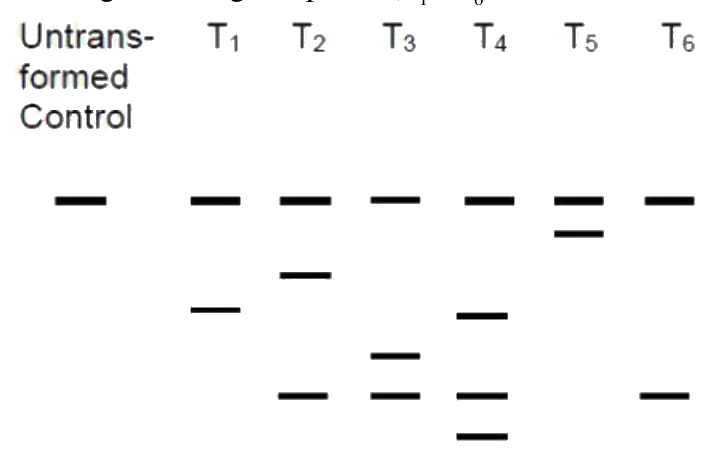
Q44 mcq
With increase in temperature, the Gibbs free energy for the adsorption of a gas on to a solid surface
a.
Becomes more positive from a positive value
b.
Becomes more negative from a positive value
c.
Becomes more positive from a negative value.
d.
Becomes more negative from a negative value
Correct Answer & Step-by-Step Solution Locked

Sign in free to reveal the correct answer and AI explanation for this question.
Q45 mcq
The vapour of a pure substance, when cooled under a pressure less than its triple-point pressure,
a.
Liquefies
b.
Liquifies first and then solidifies
c.
Solidifies directly
d.
Remains unchanged.
Correct Answer & Step-by-Step Solution Locked

Sign in free to reveal the correct answer and AI explanation for this question.
Q46 mcq
The quantities, which are held fixed in a canonical ensemble are
a.
$\text{N}$, $\text{T}$ and $\text{P}$
b.
$\text{V}$, $\text{T}$ and $\text{N}$
c.
$\text{N}$, $\text{V}$ and $\text{E}$
d.
$\mu$, $\text{V}$ and $\text{P}$
Correct Answer & Step-by-Step Solution Locked

Sign in free to reveal the correct answer and AI explanation for this question.
Q47 mcq
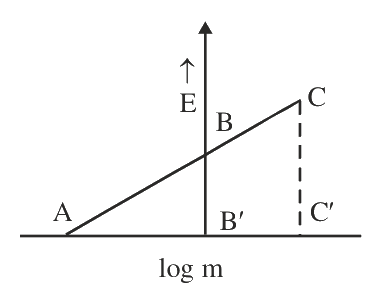
The correct value of $E^\circ$, of a half cell in the following graph of $E$ vs $\log m(\text{molality})$ is:
Question 27 image
a.
$\text{CC}'/\text{AC}'$
b.
$\text{AB}'$
c.
$\text{BB}'$
d.
$\text{CC}'$
Correct Answer & Step-by-Step Solution Locked

Sign in free to reveal the correct answer and AI explanation for this question.
Q48 mcq
One of the assumptions made in the conventional activated complex theory is:
a.
Equilibrium is maintained between reactants and the activated complex
b.
Equilibrium is maintained between the reactants and the products.
c.
Equilibrium is maintained between the products and the activated complex
d.
Equilibrium is maintained between the reactants, the activated complex and the products.
Correct Answer & Step-by-Step Solution Locked

Sign in free to reveal the correct answer and AI explanation for this question.

Q49 mcq
For a reaction, the rate constant $k$ at $27^\circ\text{C}$ was found to be $k = 5.4 \times 10^{11}\ e^{-50}$ The activation energy of the reaction is
a.
$50\text{ J mol}^{-1}$
b.
$415\text{ J mol}^{-1}$
c.
$15,000\text{ J mol}^{-1}$
d.
$125,000\text{ J mol}^{-1}$
Correct Answer & Step-by-Step Solution Locked

Sign in free to reveal the correct answer and AI explanation for this question.
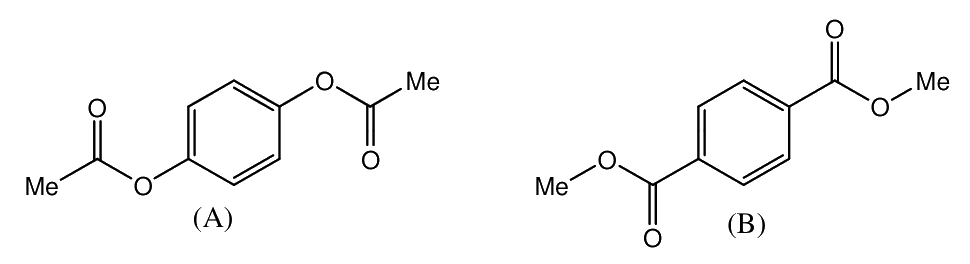
Q50 mcq
During the addition polymerisation, the reaction proceeds via
a.
Step-growth process
b.
Free-radical chain reaction
c.
Cascade process
d.
Addition reaction
Correct Answer & Step-by-Step Solution Locked

Sign in free to reveal the correct answer and AI explanation for this question.
Q51 mcq
How many atoms are there in an element packed in a fcc structure
a.
1
b.
2
c.
4
d.
8
Correct Answer & Step-by-Step Solution Locked

Sign in free to reveal the correct answer and AI explanation for this question.
Q52 mcq
The structure obtained when all the tetrahedral holes are occupied in a fcc structure is of the type
a.
$\text{NaCl}$
b.
$\text{CsCl}$
c.
$\text{CaF}_2$
d.
$\text{ZnS}$
Correct Answer & Step-by-Step Solution Locked

Sign in free to reveal the correct answer and AI explanation for this question.
Q53 mcq
Dispersion of a solid in a liquid, a liquid in a gas and a liquid in a liquid are respectively known as
a.
Aerosol, emulsion, sol
b.
Sol, aerosol, emulsion
c.
Emulsion, sol, aerosol
d.
Aerosol, sol, emulsion
Correct Answer & Step-by-Step Solution Locked

Sign in free to reveal the correct answer and AI explanation for this question.
Q54 mcq
The data obtained from two sets of experiments A and B have the following characteristics \begin{tabular}{lll} \textbf{Experiment} & \textbf{A} & \textbf{B} \\ \textbf{Mean} & 50 units & 100 units \\ \textbf{Standard deviation} & 2 units & 2 units \end{tabular} It may be concluded that
Question 34 image
a.
A is more precise than B
b.
A is less precise than B
c.
A and B are of the same precision
d.
Relative precision of A and B cannot be assessed.
Correct Answer & Step-by-Step Solution Locked

Sign in free to reveal the correct answer and AI explanation for this question.
Q55 mcq
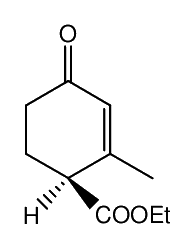
The IUPAC name of the compound given below is:
Question 35 image
a.
ethyl (R)-2-methyl-4-oxocyclohex-2-enecarboxylate
b.
ethyl (S)-2-methyl-4-oxocyclohex-2-enecarboxylate
c.
(R)-4-ethoxycarbonyl-3-methylcyclo-hex-2-enone
d.
(S)-4-ethoxycarbonyl-3-methylcyclo-hex-2-enone
Correct Answer & Step-by-Step Solution Locked

Sign in free to reveal the correct answer and AI explanation for this question.
Q56 mcq
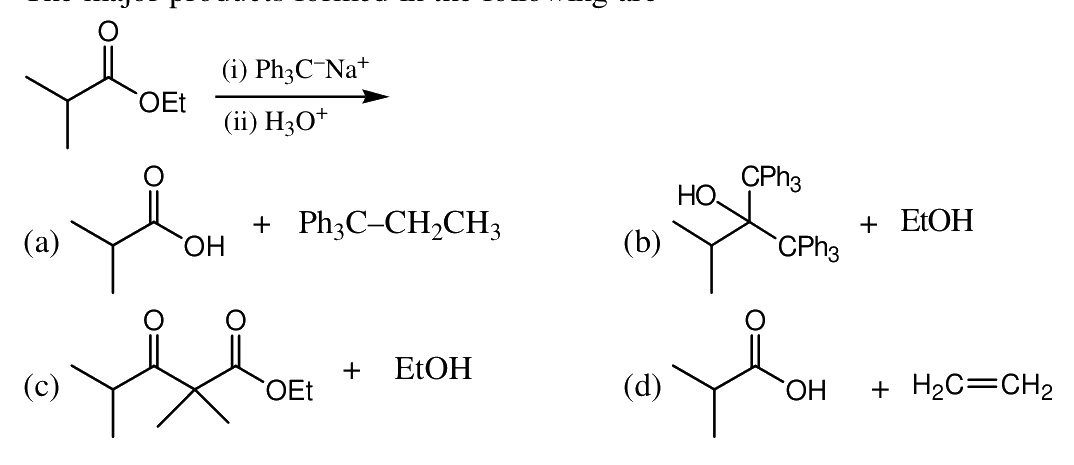
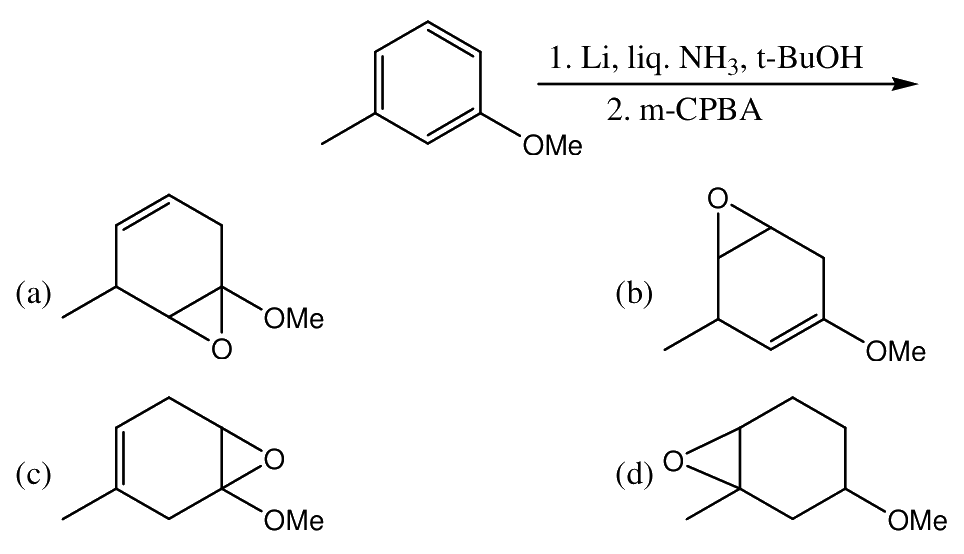
The major product formed in the following reaction is:
Question 36 image
Correct Answer & Step-by-Step Solution Locked

Sign in free to reveal the correct answer and AI explanation for this question.
Q57 mcq
The number of signals that appear in the broadband decoupled $^{13}\text{C}$ NMR spectrum of phenanthrene and anthracene, respectively are
a.
ten and four
b.
ten and ten
c.
seven and four
d.
seven and seven.
Correct Answer & Step-by-Step Solution Locked

Sign in free to reveal the correct answer and AI explanation for this question.
Q58 mcq
The co-enzyme that is involved in the reduction of a double bond in fatty acid bisynthesis is:
a.
NADH
b.
Biotin
c.
Pyridoxal
d.
$\text{FADH}_2$.
Correct Answer & Step-by-Step Solution Locked

Sign in free to reveal the correct answer and AI explanation for this question.
Q59 mcq
Epoxidation of (R)-cyclohex-2-enol with peracetic acid yields a 95:5 mixture of compounds A and B. Compounds A and B are
a.
Enantiomers
b.
Diastereomers
c.
Constitutional isomers
d.
Homomers
Correct Answer & Step-by-Step Solution Locked

Sign in free to reveal the correct answer and AI explanation for this question.
Q60 mcq
The major product formed in the following concerted reaction is
Question 40 image
Correct Answer & Step-by-Step Solution Locked

Sign in free to reveal the correct answer and AI explanation for this question.
Q61 mcq
The structure of meso-tricarboxylic acid that is formed on potassium permanganate oxidation of abietic acid is:
Question 41 image
Correct Answer & Step-by-Step Solution Locked

Sign in free to reveal the correct answer and AI explanation for this question.
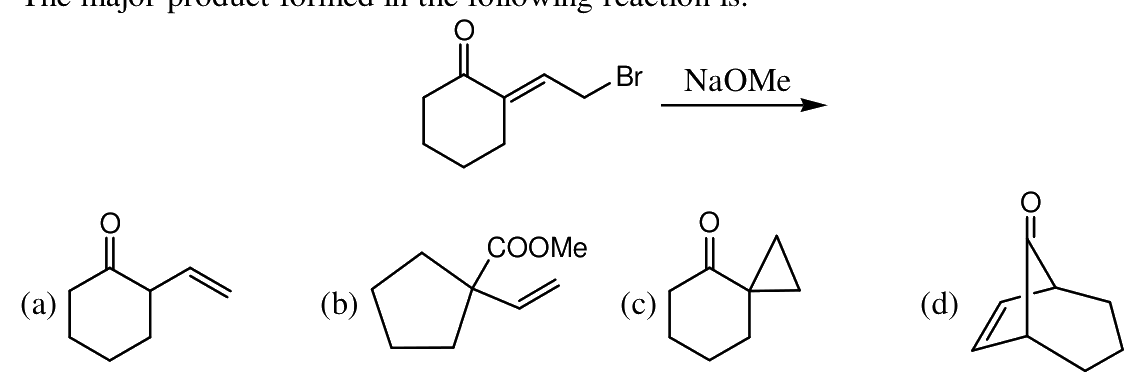
Q62 mcq
The major product formed in the following reaction is:
Question 42 image
Correct Answer & Step-by-Step Solution Locked

Sign in free to reveal the correct answer and AI explanation for this question.

Q63 mcq
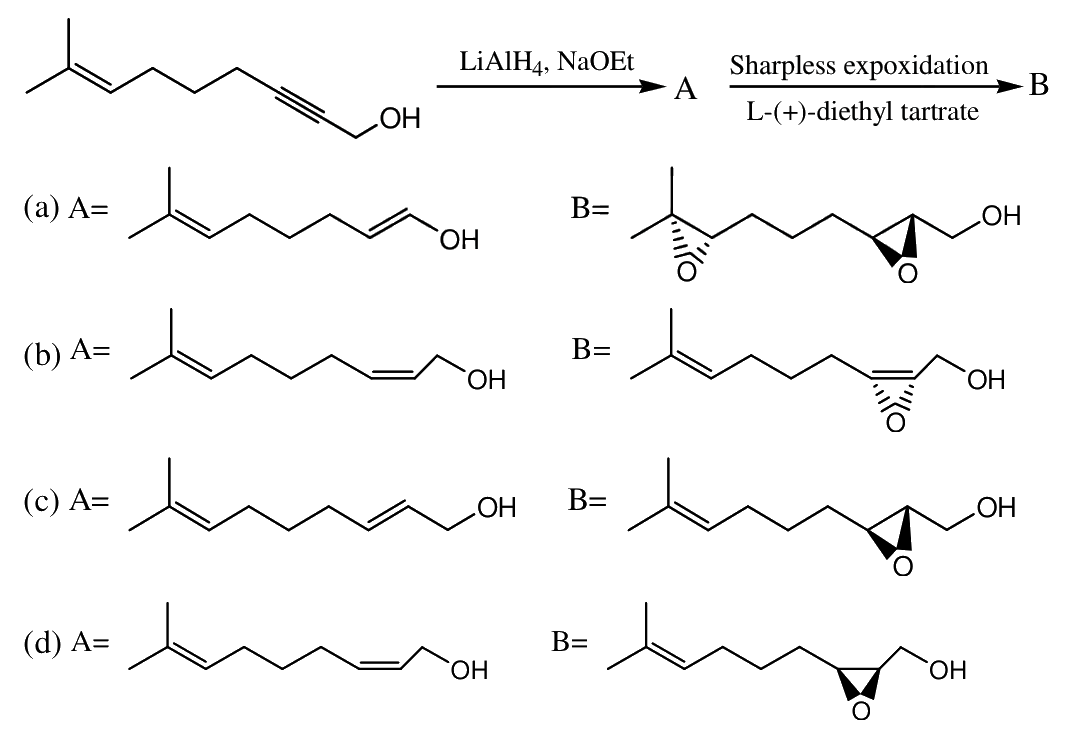
The major product formed in the following reaction is:
Question 43 image
Correct Answer & Step-by-Step Solution Locked

Sign in free to reveal the correct answer and AI explanation for this question.
Q64 mcq
Among the following, the synthetic equivalent for acyl anion is:
a.
Nitroethane and base
b.
$\alpha$ - chloroacrylonitrile
c.
Ethylmagnesium bromide
d.
Acetyl chloride and triethylamine
Correct Answer & Step-by-Step Solution Locked

Sign in free to reveal the correct answer and AI explanation for this question.
Q65 mcq
Among the following, the compound that undergoes deprotection easily on treatment with hydrogen in the presence of $10\%\text{ Pd/C}$ to generate $\text{RNH}_2$ is:
Question 45 image
Correct Answer & Step-by-Step Solution Locked

Sign in free to reveal the correct answer and AI explanation for this question.
Q66 mcq
Among the following, the amino acid which is basic in nature is:
a.
Tyrosine
b.
Asparagine
c.
Leucine
d.
Arginine
Correct Answer & Step-by-Step Solution Locked

Sign in free to reveal the correct answer and AI explanation for this question.
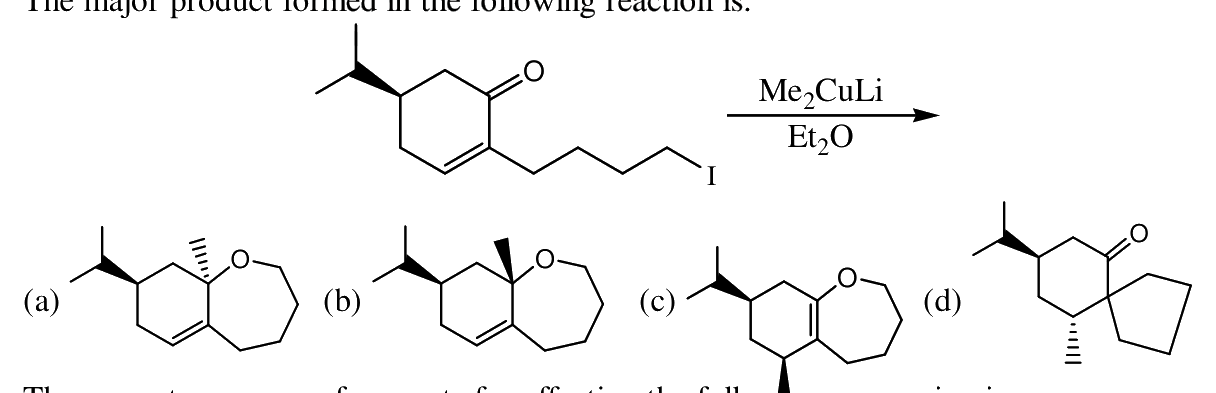
Q67 mcq
"Phosphorescence" is represented as
a.
$\text{T}_1 \longrightarrow \text{S}_0 + \text{h}\nu$
b.
$\text{T}_1 \longrightarrow \text{S}_0 + \Delta$
c.
$\text{S}_1 \longrightarrow \text{S}_0 + \text{h}\nu$
d.
$\text{S}_1 \longrightarrow \text{T}_1 + \Delta$
Correct Answer & Step-by-Step Solution Locked

Sign in free to reveal the correct answer and AI explanation for this question.
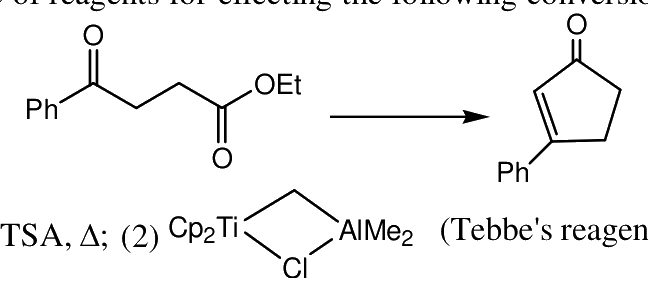
Q68 mcq
Among the following diacids, the one that forms an anhydride fastest on heating with acetic anhydride is:
Question 48 image
Correct Answer & Step-by-Step Solution Locked

Sign in free to reveal the correct answer and AI explanation for this question.
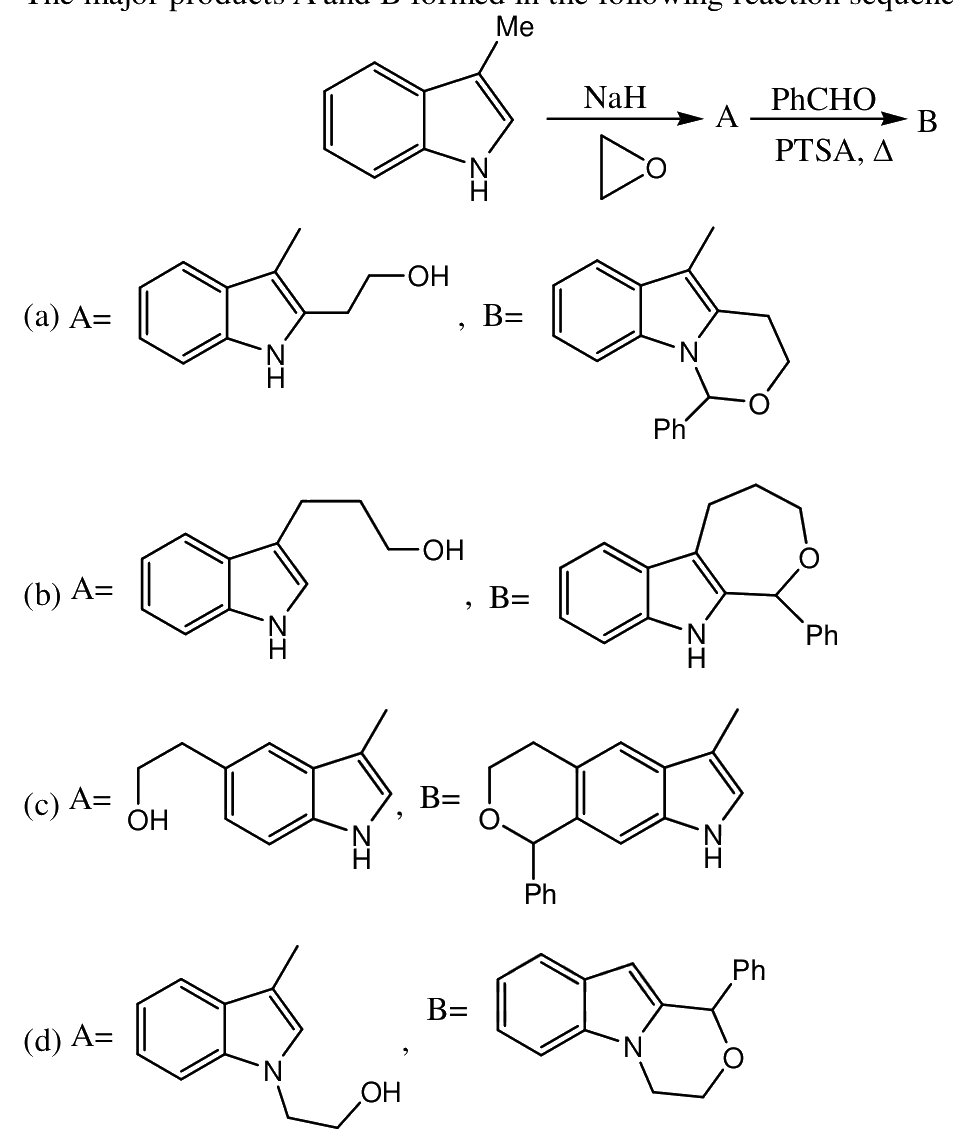
Q69 mcq
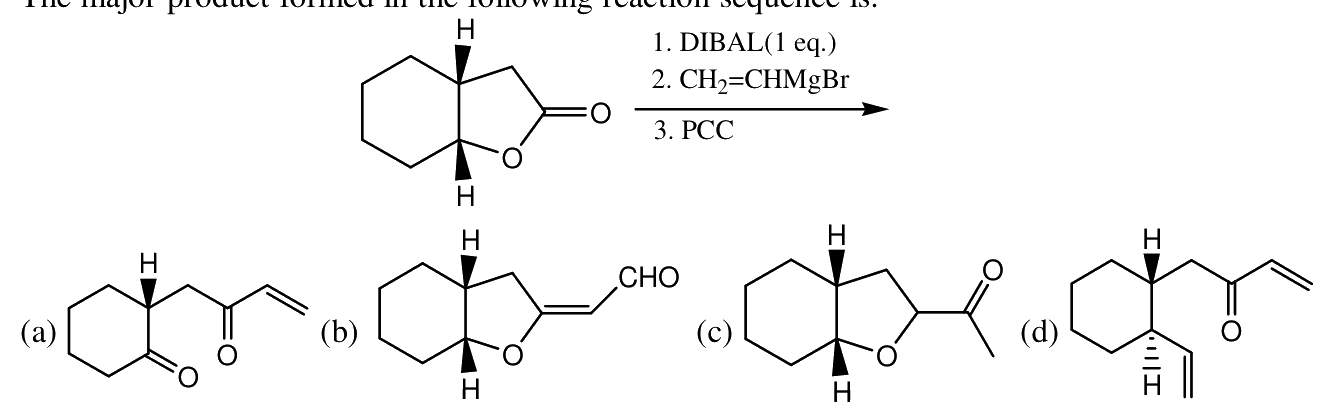
The major product formed in the following reaction sequence is:
Question 49 image
a.
(a)
b.
(b)
c.
(c)
d.
(d)
Correct Answer & Step-by-Step Solution Locked

Sign in free to reveal the correct answer and AI explanation for this question.
Q70 mcq
In the $400\text{ MHz}$ $^1\text{H}$ NMR spectrum, of organic compound exhibited a doublet. The two lines of the doublet are at $\delta\ 2.35$ and $2.38\text{ ppm}$. The coupling constant ($J$) value is
a.
$3\text{ Hz}$
b.
$6\text{ Hz}$
c.
$9\text{ Hz}$
d.
$12\text{ Hz}$
Correct Answer & Step-by-Step Solution Locked

Sign in free to reveal the correct answer and AI explanation for this question.
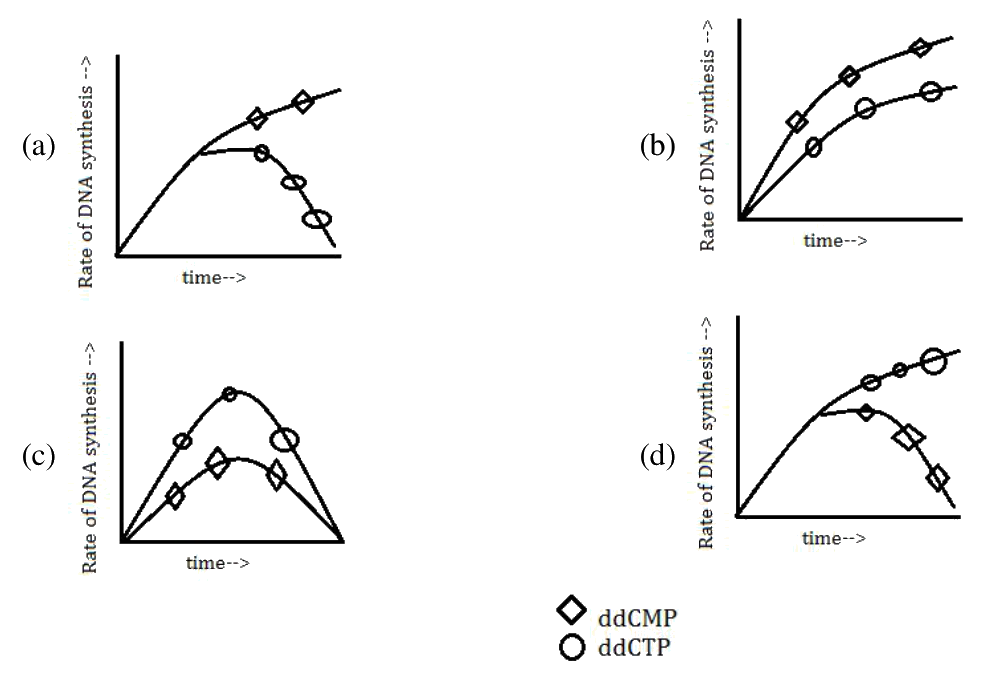
Q71 mcq
The strength of $\text{p}_\pi-\text{d}_\pi$ bonding in $\text{E}-\text{O}$ ($\text{E} = \text{Si, P, S}$ and $\text{Cl}$) follows the order
a.
$\text{Si}-\text{O} > \text{P}-\text{O} > \text{S}-\text{O} > \text{Cl}-\text{O}$
b.
$\text{P}-\text{O} > \text{Si}-\text{O} > \text{S}-\text{O} > \text{Cl}-\text{O}$
c.
$\text{S}-\text{O} > \text{Cl}-\text{O} > \text{P}-\text{O} > \text{Si}-\text{O}$
d.
$\text{Cl}-\text{O} > \text{S}-\text{O} > \text{P}-\text{O} > \text{Si}-\text{O}$
Correct Answer & Step-by-Step Solution Locked

Sign in free to reveal the correct answer and AI explanation for this question.

Q72 mcq
In the following reactions carried out in liquid $\text{NH}_3$, $$\text{Zn}\left(\text{NH}_2\right)_2 + 2\text{ KNH}_2 \longrightarrow \text{K}_2\left[\text{Zn}\left(\text{NH}_2\right)_4\right]$$ $$\text{K}_2\left[\text{Zn}\left(\text{NH}_2\right)_4\right] + 2\text{ NH}_4\text{NO}_3 \longrightarrow \text{Zn}\left(\text{NH}_2\right)_2 + 2\text{ KNO}_3 + 4\text{ NH}_3$$ $\text{KNH}_2$ and $\text{NH}_4\text{NO}_3$ act respectively as
a.
Solvo-acid and solvo-base
b.
Solvo-base and solvo-acid
c.
Conjugate acid and conjugate base
d.
Conjugate base and conjugate acid
Correct Answer & Step-by-Step Solution Locked

Sign in free to reveal the correct answer and AI explanation for this question.

Q73 mcq
The pair of lanthanides with the highest third-ionization energy is:
a.
$\text{Eu, Gd}$
b.
$\text{Eu, Yb}$
c.
$\text{Dy, Yb}$
d.
$\text{Lu, Yb}$
Correct Answer & Step-by-Step Solution Locked

Sign in free to reveal the correct answer and AI explanation for this question.

Q74 mcq
The lanthanide(III) ion having the highest partition coefficient between tri-n-butylphosphate and concentrated $\text{HNO}_3$ is:
a.
$\text{La(III)}$
b.
$\text{Eu(III)}$
c.
$\text{Nd(III)}$
d.
$\text{Lu(III)}$
Correct Answer & Step-by-Step Solution Locked

Sign in free to reveal the correct answer and AI explanation for this question.

Q75 mcq
The quantitative determination of $\text{N}_2\text{H}_4$ with $\text{KIO}_3$ proceeds in a mixture of $\text{H}_2\text{O}/\text{CCl}_4$ as follows $$\text{N}_2\text{H}_4 + \text{KIO}_3 + 2\text{HCl} \longrightarrow \text{N}_2 + \text{KCl} + \text{ICl} + 3\text{H}_2\text{O}$$ The end point for the titrimetric reaction is:
a.
Consumption of $\text{N}_2\text{H}_4$
b.
$\text{ICl}$ formation
c.
Disappearance of the Yellow color due to $\text{Cl}_2$ in $\text{CCl}_4$ layer.
d.
Displacement of the Red color due to $\text{I}_2$ in $\text{CCl}_4$ layer.
Correct Answer & Step-by-Step Solution Locked

Sign in free to reveal the correct answer and AI explanation for this question.

Q76 mcq
Among the halides, $\text{NCl}_3(\text{A})$, $\text{PCl}_3(\text{B})$ and $\text{AsCl}_3(\text{C})$, those which produce two different acids.
a.
A and B
b.
A and C
c.
B and C
d.
A, B and C
Correct Answer & Step-by-Step Solution Locked

Sign in free to reveal the correct answer and AI explanation for this question.

Q77 mcq
The decreasing order of dipole moment of molecules is
a.
$\text{NF}_3 > \text{NH}_3 > \text{H}_2\text{O}$
b.
$\text{NH}_3 > \text{NF}_2 > \text{H}_2\text{O}$
c.
$\text{H}_2\text{O} > \text{NH}_3 > \text{NF}_3$
d.
$\text{H}_2\text{O} > \text{NF}_3 > \text{NH}_3$
Correct Answer & Step-by-Step Solution Locked

Sign in free to reveal the correct answer and AI explanation for this question.

Q78 mcq
The cluster having arachno type structure is:
a.
$[\text{Os}_5(\text{CO})_{16}]$
b.
$[\text{Os}_3(\text{CO})_{12}]$
c.
$[\text{Ir}_4(\text{CO})_{12}]$
d.
$[\text{Rh}_6(\text{CO})_{16}]$
Correct Answer & Step-by-Step Solution Locked

Sign in free to reveal the correct answer and AI explanation for this question.

Q79 mcq
The carbonyl resonance in $^{13}\text{C}$ NMR spectrum of $[(\eta^5-\text{C}_5\text{H}_5)\text{Rh}(\text{CO})]_3$ ($^{103}\text{Rh}$, nuclear spin, $\text{I} = 1/2$, $100\%$) shows a triplet at $-65^\circ\text{ C}$ owing to the presence of
a.
Terminal $\text{CO}$
b.
$\mu_2-\text{CO}$
c.
$\mu_3-\text{CO}$
d.
$\eta^5-\text{C}_5\text{H}_5$
Correct Answer & Step-by-Step Solution Locked

Sign in free to reveal the correct answer and AI explanation for this question.

Q80 mcq
Low oxidation state complexes are often air-sensitive, but are rarely water sensitive because
a.
Air is reducing in nature while water is inert
b.
Both air and water are oxidizing in nature
c.
Both air and water are not $\pi-\text{acceptors}$
d.
Complexes with low oxidation states will easily lose electrons to $\text{O}_2$ but will not bind to a $\pi-\text{donor}$ molecule like $\text{H}_2\text{O}$.
Correct Answer & Step-by-Step Solution Locked

Sign in free to reveal the correct answer and AI explanation for this question.

Q81 mcq
The metal complex that exhibits a triplet as well as doublet in its $^{31}\text{P}$ NMR spectrum is
a.
$\text{mer}-[\text{IrCl}_3(\text{PPh}_3)_3]$
b.
$\text{trans}-[\text{IrCl}(\text{Co})(\text{PPh}_3)_2]$
c.
$\text{fac}-[\text{IrCl}_3(\text{PPh}_3)_3]$
d.
$[\text{Ir}(\text{PPh}_3)_4]^+$
Correct Answer & Step-by-Step Solution Locked

Sign in free to reveal the correct answer and AI explanation for this question.

Q82 mcq
The complex that DOES NOT obey 18- electron rule is:
a.
$[(\eta^5-\text{C}_5\text{H}_5)\text{RuCl}(\text{CO})(\text{PPh}_3)]$
b.
$[\text{W}(\text{CO})_3(\text{SiMe}_3)(\text{Cl})(\text{NCMe})_2]$
c.
$[\text{IrCl}_3(\text{PPh}_3)_2(\text{AsPh}_2)]$
d.
$[\text{Os}(\text{N})\text{Br}_2(\text{PMe}_3)(\text{NMe}_2)]^-$
Correct Answer & Step-by-Step Solution Locked

Sign in free to reveal the correct answer and AI explanation for this question.

Q83 mcq
The number of spin-allowed ligand field transitions for octahedral $\text{Ni(II)}$ complexes with $^3\text{A}_{2\text{g}}$ ground state is:
a.
Two
b.
Three
c.
One
d.
Four
Correct Answer & Step-by-Step Solution Locked

Sign in free to reveal the correct answer and AI explanation for this question.

Q84 mcq
The correct structure of $\text{P}_4\text{S}_3$ is:
Question 64 image
a.
See image (a)
b.
See image (b)
c.
See image (c)
d.
See image (d)
Correct Answer & Step-by-Step Solution Locked

Sign in free to reveal the correct answer and AI explanation for this question.

Q85 mcq
The final product of the reaction $[\text{Mn}(\text{CO})_6]^+ + \text{MeLi} \longrightarrow$ is:
a.
$[\text{Mn}(\text{CO})_6]^+ \text{Me}^-$
b.
$[\text{Mn}(\text{CO})_5\text{Me}]$
c.
$[\text{Mn}(\text{CO})_6]$
d.
$[(\text{MeCO})\text{Mn}(\text{CO})_5]$
Correct Answer & Step-by-Step Solution Locked

Sign in free to reveal the correct answer and AI explanation for this question.

Q86 mcq
The reaction that yields $\text{Li}[\text{AlH}_4]$ is:
a.
$\text{HCl}(\text{excess}) + \text{AlCl}_3 + \text{Li} \rightarrow$
b.
$\text{H}_2 + \text{Al} + \text{Li} \rightarrow$
c.
$\text{LiH}(\text{excess}) + \text{AlCl}_3 \rightarrow$
d.
$\text{LiH}(\text{excess}) + \text{Al} \rightarrow$
Correct Answer & Step-by-Step Solution Locked

Sign in free to reveal the correct answer and AI explanation for this question.

Q87 mcq
The number of microstates for $\text{d}^5$ electron configuration is:
a.
$21 \times 6^3$
b.
$14 \times 6^3$
c.
$7 \times 6^2$
d.
$28 \times 6^3$
Correct Answer & Step-by-Step Solution Locked

Sign in free to reveal the correct answer and AI explanation for this question.

Q88 mcq
The carbon-14 activity of an old wood sample is found to be $14.2\text{ disintegrations min}^{-1}\text{g}^{-1}$. Calculate age of old wood sample, if for a fresh wood sample carbon-14 activity is $15.3\text{ disintegrations min}^{-1}\text{g}^{-1}$ ($\text{t}_{1/2}\text{ carbon-14 is 5730 years}$), is:
a.
$5,000\text{ years}$
b.
$4,000\text{ years}$
c.
$877\text{ years}$
d.
$617\text{ years}$
Correct Answer & Step-by-Step Solution Locked

Sign in free to reveal the correct answer and AI explanation for this question.

Q89 mcq
The reaction $3\left[\text{Rh}_4(\text{CO})_{12}\right] \rightarrow 2\left[\text{Rh}_6(\text{CO})_{16}\right] + 4\text{CO}\ [25^\circ\text{C},\ 500\text{ atm CO}]$ is:
a.
Exothermic as more metal-metal bonds are formed.
b.
Endothermic as stronger metal-carbonyl bonds are cleaved while weaker metal-metal bonds are formed.
c.
Is entropically favorable but enthalpically unfavorable such that $\Delta\text{G} = 0$
d.
Thermodynamically unfavourable ($\Delta\text{G} > 0$).
Correct Answer & Step-by-Step Solution Locked

Sign in free to reveal the correct answer and AI explanation for this question.

Q90 mcq
A column is packed with $0.5\text{ g}$ of a strongly acidic ion exchange resin in $\text{H}^+$ form. A $1.0\text{ M NaCl}$ solution is passed through the column until the eluant coming out becomes neutral. The collected eluant is completely neutralized by $17\text{ ml}$ of $0.5\text{ M NaOH}$. The ion exchange capacity of the resin is:
a.
$1.00\text{ meq/g}$
b.
$1.25\text{ meq/g}$
c.
$1.50\text{ meq/g}$
d.
$1.75\text{ meq/g}$
Correct Answer & Step-by-Step Solution Locked

Sign in free to reveal the correct answer and AI explanation for this question.

Q91 mcq
The molar extinction coefficient of $\text{B}\ (\text{MW} = 180)$ is $4 \times 10^3\text{ lit mol}^{-1}\text{ cm}^{-1}$. One liter solution of $\text{C}$ which contains $0.1358\text{ g}$ pharmaceutical preparation of $\text{B}$, shows an absorbance of $0.411$ in a $1\text{ cm}$ quartz cell. The percentage (w/w) of $\text{B}$ in the pharmaceutical preparation is:
a.
$10.20$
b.
$14.60$
c.
$20.40$
d.
$29.12$
Correct Answer & Step-by-Step Solution Locked

Sign in free to reveal the correct answer and AI explanation for this question.

Q92 mcq
The changes (from A-D given below) which occur when $\text{O}_2$ binds to hemerythrin are (A) One iron atoms is oxidized (B) Both the iron atoms are oxidized (C) $\text{O}_2$ binds to one iron atom and is also hydrogen bonded. (D) $\text{O}_2$ binds to both the iron atoms and is also hydrogen bonded.
a.
B and C
b.
B and D
c.
A and D
d.
A and C
Correct Answer & Step-by-Step Solution Locked

Sign in free to reveal the correct answer and AI explanation for this question.

Q93 mcq
In photosynthetic systems the redox metalloproteins involved in electron transfer are cytochrome (cyt, b), cytochrome bf complex (cyt bf) and plastocyanin (PC). The pathway of electron flow is
a.
$\text{PC} \rightarrow \text{cyt b} \rightarrow \text{cyt bf}$
b.
$\text{cyt bf} \rightarrow \text{cyt b} \rightarrow \text{PC}$
c.
$\text{cyt b} \rightarrow \text{cyt bf} \rightarrow \text{PC}$
d.
$\text{PC} \rightarrow \text{cyt bf} \rightarrow \text{cyt b}$
Correct Answer & Step-by-Step Solution Locked

Sign in free to reveal the correct answer and AI explanation for this question.

Q94 mcq
The total numbers of fine and hyperfine EPR lines expected for octahedral high-spin $\text{Mn(II)}$ complexes are respectively ($\text{I} = 5/2\text{ for Mn}$)
a.
$3\text{ and }30$
b.
$5\text{ and }33$
c.
$5\text{ and }30$
d.
$4\text{ and }24$
Correct Answer & Step-by-Step Solution Locked

Sign in free to reveal the correct answer and AI explanation for this question.

Q95 mcq
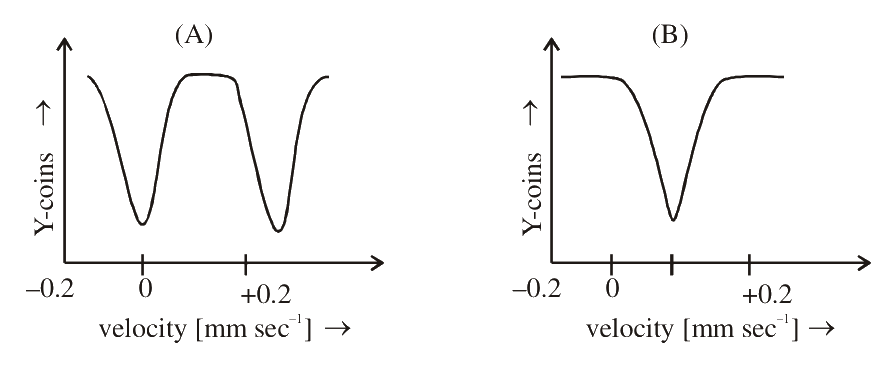
The Mossbauer spectra of two iron complexes are shown below. They may arise from (i) high-spin iron(III), (ii) high-spin iron(II) and (iii) low-spin iron(III) The correct matches of spectra (A) and (B) with the iron complexes are
Question 75 image
a.
A with (i) and B with (ii)
b.
A with (ii) and B with (i)
c.
A with (iii) and B with (ii)
d.
A with (ii) and B with (iii)
Correct Answer & Step-by-Step Solution Locked

Sign in free to reveal the correct answer and AI explanation for this question.

Q96 mcq
The probability of finding the particle in a one dimensional box of length 'L' in the region between $\frac{\text{L}}{4}$ and $\frac{3\text{L}}{4}$ for quantum number $n = 1$ is:
a.
$\frac{1}{2}$
b.
$\frac{1}{2} + \frac{1}{\pi}$
c.
$\frac{1}{2} - \frac{1}{\pi}$
d.
$\frac{2}{3}$
Correct Answer & Step-by-Step Solution Locked

Sign in free to reveal the correct answer and AI explanation for this question.

Q97 mcq
A particle in three dimensional cubic box of length $\text{L}$ has energy of $\frac{14\text{h}^2}{8\text{mL}^2}$. The degeneracy of the state is
a.
2
b.
3
c.
6
d.
9
Correct Answer & Step-by-Step Solution Locked

Sign in free to reveal the correct answer and AI explanation for this question.

Q98 mcq
The following are the three statements about perturbation theory (A) Second order perturbation correction to the ground state energy is ALWAYS negative. (B) Sum of the zeroth order and the first order corrections to the ground state energy is ALWAYS greater than the exact ground state energy. (C) Sum of the zeroth order and first order corrections to the ground state energy is less than the exact state energy. From the following which one is correct?
a.
Only A is true
b.
Both A and B are true
c.
Only C is true
d.
Both B and C are true
Correct Answer & Step-by-Step Solution Locked

Sign in free to reveal the correct answer and AI explanation for this question.

Q99 mcq
Using Hückel molecular orbital approximation, the two roots of secular equation of ethene are
a.
$\alpha + \sqrt{2}\beta$, $\alpha - \sqrt{2}\beta$
b.
$\alpha + \beta$, $\alpha$
c.
$\alpha + \beta$, $\alpha - \beta$
d.
$\alpha + 2\beta$, $\alpha - 2\beta$
Correct Answer & Step-by-Step Solution Locked

Sign in free to reveal the correct answer and AI explanation for this question.

Q100 mcq
For $\text{H}_2$ molecule in the excited state $\sigma_g^1\ \sigma_u^1$, the spin part of the triplet state with $\text{m}_s = 0$ is proportional to
a.
$\alpha(1)\beta(2)$
b.
$[\alpha(1)\beta(2) - \beta(1)\alpha(2)]$
c.
$\alpha(1)\alpha(2)$
d.
$[\alpha(1)\beta(2) + \beta(1)\alpha(2)]$
Correct Answer & Step-by-Step Solution Locked

Sign in free to reveal the correct answer and AI explanation for this question.

Q101 mcq
A square pyramidal, $\text{MX}_4$, molecule belongs to $\text{C}_{4\text{v}}$ point group. The symmetry operations are: $\text{E}$, $2\text{C}_4$, $\text{C}_2$, $2\sigma_\text{v}$ and $2\sigma_\text{d}$. The trace for the reducible representation, when symmetry operations of $\text{C}_{4\text{v}}$ applied to $\text{MX}_4$, is:
a.
5 1 1 1 3
b.
1 1 1 1 1
c.
5 1 1 1 1
d.
4 1 1 1 3
Correct Answer & Step-by-Step Solution Locked

Sign in free to reveal the correct answer and AI explanation for this question.

Q102 mcq
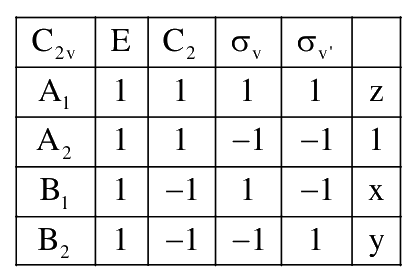
Character table of $\text{C}_{2\text{v}}$ point group is: \begin{tabular}{|c|c|c|c|c|c|} \hline $\text{C}_{2\text{v}}$ & $\text{E}$ & $\text{C}_2$ & $\sigma_\text{v}$ & $\sigma_\text{v}'$ & \\ \hline $\text{A}_1$ & $1$ & $1$ & $1$ & $1$ & $\text{z}$ \\ \hline $\text{A}_2$ & $1$ & $1$ & $-1$ & $-1$ & $1$ \\ \hline $\text{B}_1$ & $1$ & $-1$ & $1$ & $-1$ & $\text{x}$ \\ \hline $\text{B}_2$ & $1$ & $-1$ & $-1$ & $1$ & $\text{y}$ \\ \hline \end{tabular} If the initial and final states belong to $\text{A}_1$ and $\text{B}_1$ irreducible representation respectively, the allowed electronic transition from $\text{A}_1$ to $\text{B}_1$ is:
Question 82 image
a.
z-polarized
b.
y-polarized
c.
x-polarized
d.
x, z-polarized
Correct Answer & Step-by-Step Solution Locked

Sign in free to reveal the correct answer and AI explanation for this question.

Q103 mcq
Using cuvettes of $0.5\text{ cm}$ path length, a $10^{-4}\text{ M}$ solution of a chromophore shows $50\%$ transmittance at certain wave length. The molar extinction coefficient of the chromophore at this wave length is ($\log 2 = 0.301$)
a.
$1500\text{ M}^{-1}\text{ cm}^{-1}$
b.
$3010\text{ M}^{-1}\text{ cm}^{-1}$
c.
$5000\text{ M}^{-1}\text{ cm}^{-1}$
d.
$6020\text{ M}^{-1}\text{ cm}^{-1}$
Correct Answer & Step-by-Step Solution Locked

Sign in free to reveal the correct answer and AI explanation for this question.

Q104 mcq
The set of allowed electronic transitions among the following is: (A) $^4\Sigma \rightarrow {^2\Pi}$ (B) $^3\Sigma \rightarrow {^3\Pi}$ (C) $^1\Delta \rightarrow {^1\Delta}$ (D) $^2\Pi \rightarrow {^2\Pi}$ (E) $^3\Sigma \rightarrow {^3\Delta}$
a.
A, B, E
b.
A, C, E
c.
B, C, D
d.
C, D, E
Correct Answer & Step-by-Step Solution Locked

Sign in free to reveal the correct answer and AI explanation for this question.

Q105 mcq
The following data were obtained from the vibrational fine structure in the vibronic spectrum of a diatomic molecule: $$\omega_e = 512\text{ cm}^{-1},\; \omega_e x_e = 8\text{ cm}^{-1}$$ where $\omega_e$ is the energy associated with the natural frequency of vibration and $x_e$ is the anharmonicity constant. The dissociation energy ($ ext{D}_e$) of the molecule is:
a.
$4096\text{ cm}^{-1}$
b.
$6144\text{ cm}^{-1}$
c.
$8192\text{ cm}^{-1}$
d.
$16384\text{ cm}^{-1}$
Correct Answer & Step-by-Step Solution Locked

Sign in free to reveal the correct answer and AI explanation for this question.

Q106 mcq
An ideal gas was subjected to a reversible, adiabatic, expansion and then its initial volume was restored by a reversible, isothermal compression. If ‘q’ denotes the heat added to the system and ‘w’ the work done by the system, then
a.
$w < 0,\; q < 0$
b.
$w > 0,\; q < 0$
c.
$w < 0,\; q > 0$
d.
$w > 0,\; q > 0$
Correct Answer & Step-by-Step Solution Locked

Sign in free to reveal the correct answer and AI explanation for this question.

Q107 mcq
The gas phase reaction $2\text{NO}_2\,(\text{g}) \rightarrow \text{N}_2\text{O}_4\,(\text{g})$ is an exothermic process. In an equilibrium mixture of $\text{NO}_2$ and $\text{N}_2\text{O}_4$, the decomposition of $\text{N}_2\text{O}_4$ can be induced by
a.
Lowering the temperature
b.
Increasing the pressure
c.
Introducing an inert gas at constant volume
d.
Introducing an inert gas at constant pressure.
Correct Answer & Step-by-Step Solution Locked

Sign in free to reveal the correct answer and AI explanation for this question.

Q108 mcq
Indicate which one of the following relations is NOT correct.
a.
$-\left(\frac{\partial T}{\partial V}\right)_S = \left(\frac{\partial P}{\partial S}\right)_V$
b.
$-\left(\frac{\partial T}{\partial P}\right)_S = \left(\frac{\partial V}{\partial S}\right)_P$
c.
$-\left(\frac{\partial S}{\partial V}\right)_T = \left(\frac{\partial P}{\partial T}\right)_V$
d.
$-\left(\frac{\partial S}{\partial P}\right)_T = \left(\frac{\partial V}{\partial T}\right)_P$
Correct Answer & Step-by-Step Solution Locked

Sign in free to reveal the correct answer and AI explanation for this question.

Q109 mcq
The energy levels of the harmonic oscillator (neglecting zero point energy) are $\varepsilon_v = \text{nhv}$ for $\text{n} = 0, 1, 2, \dots \infty$. Assuming $\text{h}v = \text{k}_\text{B}\text{T}$, the partition function is:
a.
$\text{e}$
b.
$\frac{1}{\text{e}}$
c.
$1 - \frac{1}{\text{e}}$
d.
$\frac{1}{1 - \frac{1}{\text{e}}}$
Correct Answer & Step-by-Step Solution Locked

Sign in free to reveal the correct answer and AI explanation for this question.

Q110 mcq
The correct entropy for 6 identical particles with their occupation number $\{0, 1, 2, 3\}$ in four states is
a.
$\text{k}_\text{B} \ell\text{n} 6$
b.
$\text{k}_\text{B} \ell\text{n} 12$
c.
$\text{k}_\text{B} \ell\text{n} 60$
d.
$\text{k}_\text{B} \ell\text{n} 720$
Correct Answer & Step-by-Step Solution Locked

Sign in free to reveal the correct answer and AI explanation for this question.

Q111 mcq
The correct Nernst equation for the concentration cell: $\text{Pt} \mid \text{H}_2(\text{p}) \mid \text{HCl}(\text{a}_\pm)_1 \mid \text{AgCl}(\text{s}) \mid \text{Ag} \quad \text{Ag} \mid \text{AgCl}(\text{s}) \mid \text{HCl}(\text{a}_\pm)_1 \text{H}_2(\text{p}) \mid \text{Pt}$ without liquid junction would be
a.
$\text{E} = \frac{2\text{RT}}{\text{F}} \ell\text{n} \frac{(\text{a}_\pm)_1}{(\text{a}_\pm)_2}$
b.
$\text{E} = \frac{\text{RT}}{\text{F}} \ell\text{n} \frac{(\text{a}_\pm)_2}{(\text{a}_\pm)_1}$
c.
$\text{E} = \frac{2\text{RT}}{\text{F}} \ell\text{n} \frac{(\text{a}_\pm)_2}{(\text{a}_\pm)_1}$
d.
$\text{E} = \frac{\text{RT}}{2\text{F}} \ell\text{n} \frac{(\text{a}_\pm)_2}{(\text{a}_\pm)_1}$
Correct Answer & Step-by-Step Solution Locked

Sign in free to reveal the correct answer and AI explanation for this question.

Q112 mcq
Main assumption(s) involved in the derivation of Debye-Hückel equation is(are) the validity of
a.
Only Poission equation
b.
Poission equation and Boltzmann distribution
c.
Poission equation, Boltzmann distribution and $|\pm\text{Ze}\phi| \gg \text{k}_\text{B}\text{T}$
d.
Poission equation Boltzmann distribution and $|\pm\text{Ze}\phi| \ll \text{k}_\text{B}\text{T}$
Correct Answer & Step-by-Step Solution Locked

Sign in free to reveal the correct answer and AI explanation for this question.

Q113 mcq
In the base ($\text{OH}^-$) hydrolysis of a transition metal complex $[\text{ML}_6]^{\text{Z}+}$, the slope between $\log(\text{k}/\text{k}_0)$ and $\sqrt{\text{I}}$ is found to be $-2.1$. The charge on the complex is:
a.
$+1$
b.
$+2$
c.
$+3$
d.
$+4$
Correct Answer & Step-by-Step Solution Locked

Sign in free to reveal the correct answer and AI explanation for this question.

Q114 mcq
The rate law for one of the mechanism of the pyrolysis of $\text{CH}_3\text{CHO}$ at $520^\circ\text{C}$ and $0.2\text{ bar}$ is $$\text{Rate} = -\left[\text{k}_2 \left(\frac{\text{k}_1}{2\text{k}_4}\right)^{1/2}\right][\text{CH}_3\text{CHO}]^{3/2}$$ The overall activation energy $\text{E}$, in terms of the rate law is:
a.
$\text{E}_\text{a}(2) + \text{E}_\text{a}(1) + 2\text{E}_\text{a}(4)$
b.
$\text{E}_\text{a}(2) + \frac{1}{2}\text{E}_\text{a}(1) - \text{E}_\text{a}(4)$
c.
$\text{E}_\text{a}(2) + \frac{1}{2}\text{E}_\text{a}(1) - \frac{1}{2}\text{E}_\text{a}(4)$
d.
$\text{E}_\text{a}(2) - \frac{1}{2}\text{E}_\text{a}(1) + \frac{1}{2}\text{E}_\text{a}(4)$
Correct Answer & Step-by-Step Solution Locked

Sign in free to reveal the correct answer and AI explanation for this question.

Q115 mcq
In the Michaelis-Menten mechanism for enzyme kinetics, the expression obtained is: $$\frac{\text{v}}{[\text{E}]_0[\text{S}]} = 1.4 \times 10^{12} - \frac{10^4 \text{v}}{[\text{E}]_0}$$ The values of $\text{k}_3$ ($\text{k}_{\text{exp}}$, $\text{mol }\text{L}^{-1}\text{s}^{-1}$) and $\text{K}$ (Michaelis constant, $\text{mol }\text{L}^{-1}$), respectively are
a.
$1.4 \times 10^{12}, 10^4$
b.
$1.4 \times 10^8, 10^4$
c.
$1.4 \times 10^8, 10^{-4}$
d.
$1.4 \times 10^{12}, 10^{-4}$
Correct Answer & Step-by-Step Solution Locked

Sign in free to reveal the correct answer and AI explanation for this question.

Q116 mcq
The most used acid catalyst in oil industry and the relevant process are respectively
a.
Aluminophosphate and reforming
b.
Aluminosilicate and cracking
c.
Aluminosilicate and reforming
d.
Aluminophosphate and cracking.
Correct Answer & Step-by-Step Solution Locked

Sign in free to reveal the correct answer and AI explanation for this question.

Q117 mcq
The wavelength and the spectral region for a single electron transfer across the band gap in a semi-conductor $\left(\mathrm{E}_x = 1.98 \times 10^{-19}\right)$ are $\left[\mathrm{h} = 6.626 \times 10^{-34}\ \mathrm{Js}, \mathrm{c} = 3 \times 10^8\ \mathrm{ms}^{-1}\right]$
a.
$1000\text{ nm}$, UV
b.
$1000\text{ nm}$, IR
c.
$500\text{ nm}$, visible
d.
$500\text{ nm}$, FAR IR
Correct Answer & Step-by-Step Solution Locked

Sign in free to reveal the correct answer and AI explanation for this question.

Q118 mcq
The lattice parameter of an element stabilized in a fcc structure is $4.04\text{ \AA}$. The atomic radius of the element is:
a.
$2.86\text{\AA}$
b.
$1.43\text{\AA}$
c.
$4.29\text{\AA}$
d.
$5.72\text{\AA}$
Correct Answer & Step-by-Step Solution Locked

Sign in free to reveal the correct answer and AI explanation for this question.

Q119 mcq
The number-average molar mass $(\overline{\mathrm{M}}_\mathrm{n})$ and weight-average molar mass $(\overline{\mathrm{M}}_\mathrm{w})$ of a polymer are obtained respectively by
a.
Osmometry and light scattering measurements
b.
Osmometry and viscosity measurements
c.
Light scattering and sedimentation measurements
d.
Viscosity and light scattering measurements
Correct Answer & Step-by-Step Solution Locked

Sign in free to reveal the correct answer and AI explanation for this question.

Q120 mcq
Two data sets involving the same variables $\mathrm{X}$ and $\mathrm{Y}$ are given below $$\begin{array}{lcccccc} \mathbf{X} & 4.1 & 4.2 & 4.3 & 4.4 & 4.5 & 4.6 \\ \mathbf{Y}(\text{set A}) & 10.2 & 10.6 & 10.9 & 11.5 & 11.8 & 12.2 \\ \mathbf{Y}(\text{set B}) & 10.2 & 10.6 & 11.1 & 11.3 & 11.8 & 12.2 \end{array}$$ If the slopes and intercepts of the regression lines for the two sets are denoted by $(\mathrm{m_A}, \mathrm{m_B})$ and $(\mathrm{C_A}, \mathrm{C_B})$, respectively, then
Question 100 image
a.
$\mathrm{m_A} > \mathrm{m_B},\ \mathrm{C_A} > \mathrm{C_B}$
b.
$\mathrm{m_A} < \mathrm{m_B},\ \mathrm{C_A} > \mathrm{C_B}$
c.
$\mathrm{m_A} > \mathrm{m_B},\ \mathrm{C_A} < \mathrm{C_B}$
d.
$\mathrm{m_A} < \mathrm{m_B},\ \mathrm{C_A} < \mathrm{C_B}$
Correct Answer & Step-by-Step Solution Locked

Sign in free to reveal the correct answer and AI explanation for this question.

Q121 mcq
Compounds $\mathrm{A}$ and $\mathrm{B}$ exhibit two singlets, each in their $^1\mathrm{H}\text{ NMR}$ spectra. The expected chemical shifts are at $\delta$
Question 101 image
a.
$6.9$ and $2.1$ for $\mathrm{A}$; $7.7$ and $3.9$ for $\mathrm{B}$
b.
$7.7$ and $3.9$ for $\mathrm{A}$; $6.9$ and $2.1$ for $\mathrm{B}$
c.
$6.9$ and $3.9$ for $\mathrm{A}$; $7.7$ and $2.1$ for $\mathrm{B}$
d.
$7.7$ and $2.1$ for $\mathrm{A}$; $6.9$ and $3.9$ for $\mathrm{B}$
Correct Answer & Step-by-Step Solution Locked

Sign in free to reveal the correct answer and AI explanation for this question.

Q122 mcq
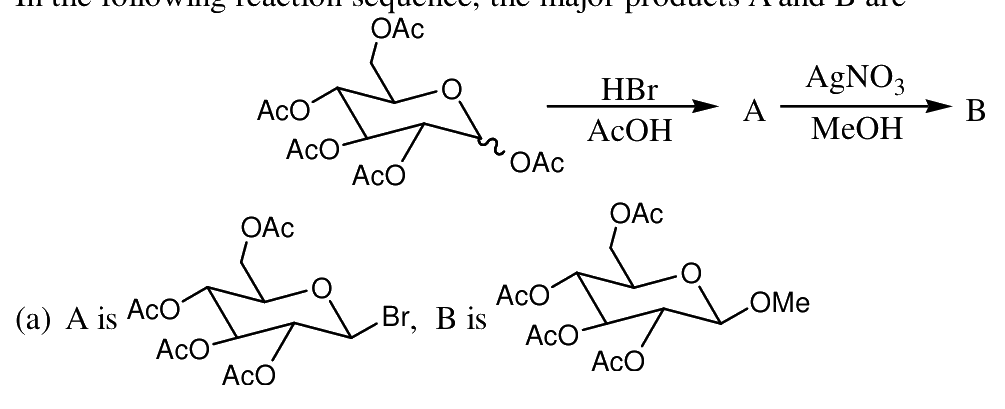
In the following reaction sequence, the major products $\mathrm{A}$ and $\mathrm{B}$ are
Question 102 image
Correct Answer & Step-by-Step Solution Locked

Sign in free to reveal the correct answer and AI explanation for this question.

Q123 mcq
The structure of the tricyclic compound formed in the following two step sequence is
Question 103 image
Correct Answer & Step-by-Step Solution Locked

Sign in free to reveal the correct answer and AI explanation for this question.

Q124 mcq
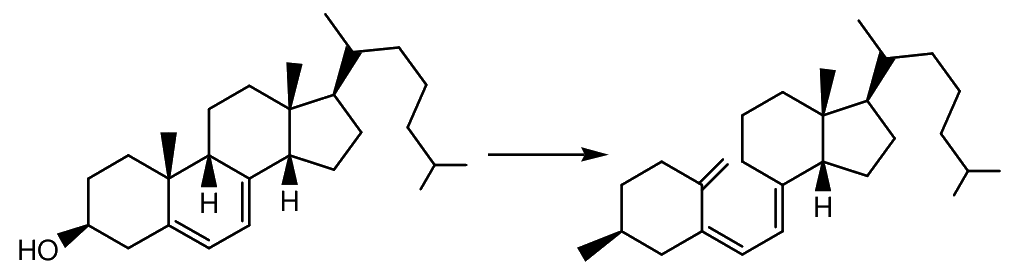
The two step conversion of 7-dehydrocholesterol to vitamin $\text{D}_3$ proceeds through
Question 104 image
a.
Photochemical electrocyclic disrotatory ring opening; and thermal antarafacial [1, 7]-H shift.
b.
Photochemical electrocyclic conrotatory ring opening; and thermal antarafacial [1, 7]-H shift.
c.
Thermal electrocyclic conrotatory ring opening; and photochemical suprafacial [1, 7]-H shift.
d.
Thermal electrocyclic disrotatory ring opening; and thermal suprafacial [1, 7]-H shift.
Correct Answer & Step-by-Step Solution Locked

Sign in free to reveal the correct answer and AI explanation for this question.

Q125 mcq
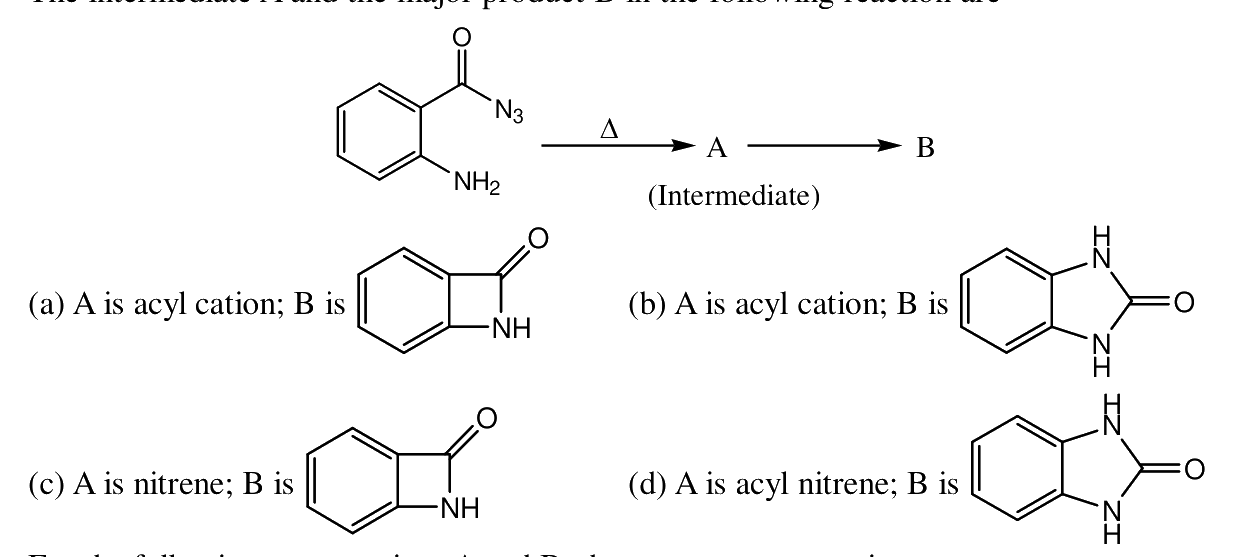
The intermediate A and the major product B in the following reaction are
Question 105 image
a.
A is acyl cation; B is indolin-2-one derivative
b.
A is acyl cation; B is quinazoline/benzimidazolone derivative
c.
A is nitrene; B is indolin-2-one derivative
d.
A is acyl nitrene; B is benzimidazolone derivative
Correct Answer & Step-by-Step Solution Locked

Sign in free to reveal the correct answer and AI explanation for this question.

Q126 mcq
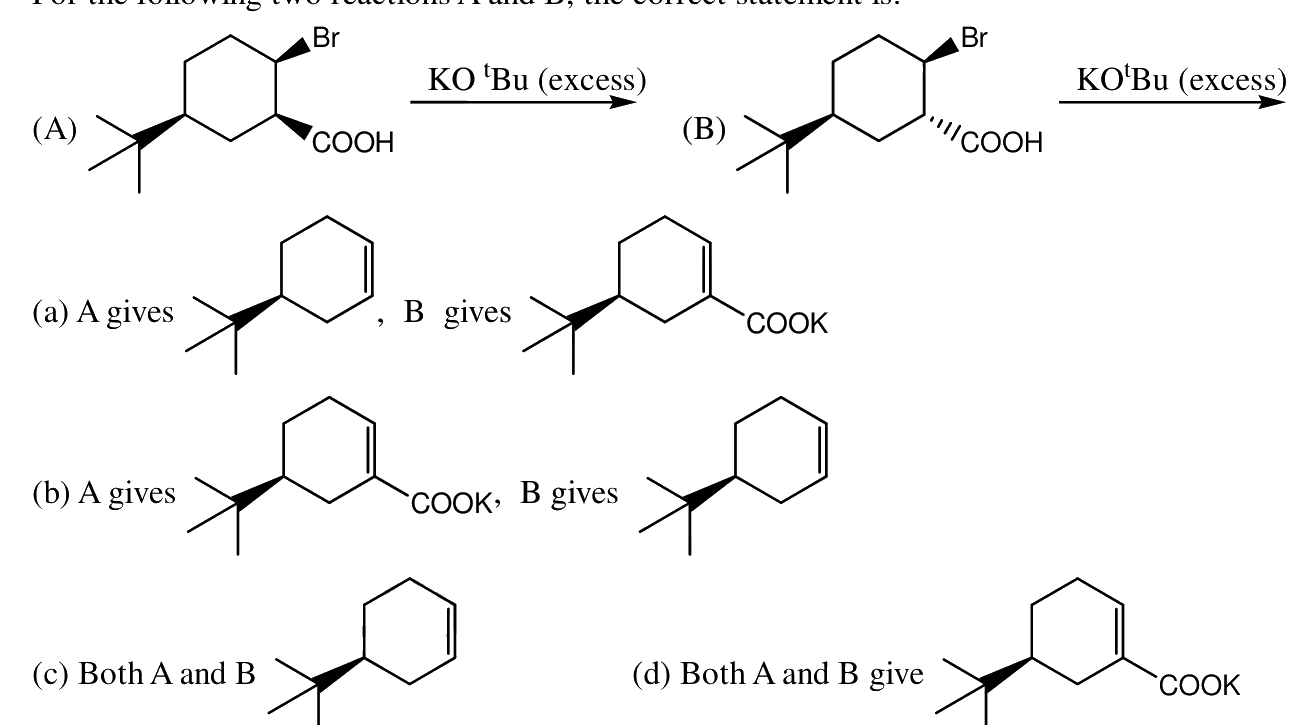
For the following two reactions A and B, the correct statement is:
Question 106 image
a.
A gives alkene; B gives conjugated carboxylate
b.
A gives conjugated carboxylate; B gives alkene
c.
Both A and B give alkene
d.
Both A and B give conjugated carboxylate
Correct Answer & Step-by-Step Solution Locked

Sign in free to reveal the correct answer and AI explanation for this question.

Q127 mcq
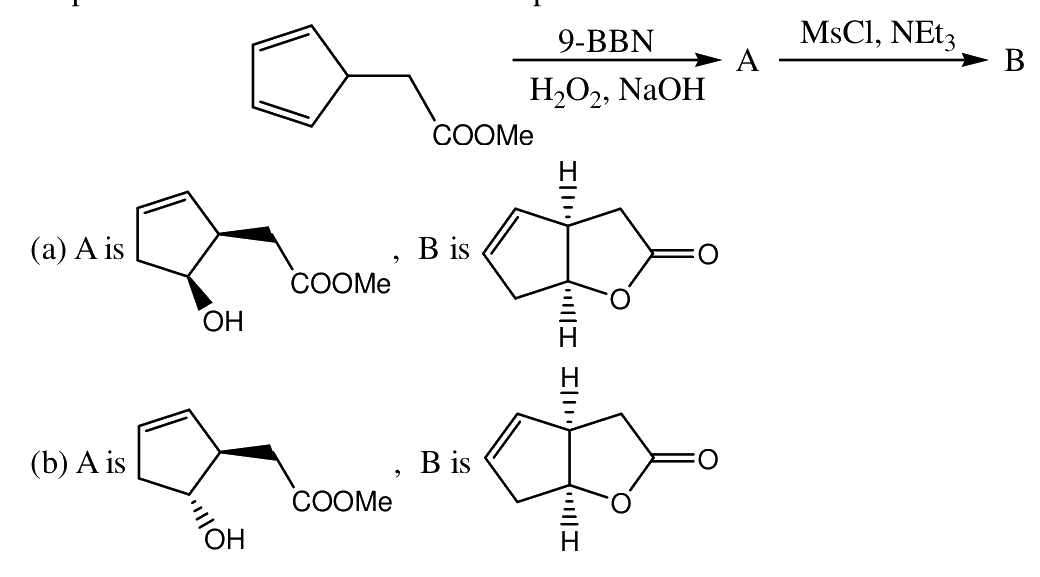
The major compound B formed in the reaction sequence given below exhibited a carbonyl absorption band at $1770\text{ cm}^{-1}$ in the IR spectrum. The structure A and B are
Question 107 image
a.
A is hydroxy ester; B is cis-fused bicyclic lactone
b.
A is hydroxy ester with different stereochemistry; B is unsaturated bicyclic lactone
c.
A is (1R, 4S)-4-(hydroxymethyl)cyclopent-2-en-1-ol derivative, B is bicyclic lactone as shown
d.
A is (1S, 4S)-4-(hydroxymethyl)cyclopent-2-en-1-ol derivative, B is bicyclic lactone as shown
Correct Answer & Step-by-Step Solution Locked

Sign in free to reveal the correct answer and AI explanation for this question.

Q128 mcq
Consider the following reaction sequence starting with monoterpene $\alpha$-pinene. Identify the correct statement $$\underset{\alpha\text{-pinene}}{\text{A}} \xrightarrow{\text{alk } \text{KMnO}_4} \underset{\text{pinonic acid}}{\text{B}} \xrightarrow{\text{NaOH/Br}_2} \underset{\text{pinic acid}}{\text{C}}$$
a.
A has a disubstituted double bond; B and C are dicarboxylic acids.
b.
A has a trisubstituted double bond; B is a methyl ketone; and C is a dicarboxylic acid.
c.
A has a disubstituted double bond; B is a methyl ketone; and C is a dicarboxylic acid.
d.
A has an exocyclic double bond; B and C are monocarboxylic acids.
Correct Answer & Step-by-Step Solution Locked

Sign in free to reveal the correct answer and AI explanation for this question.

Q129 mcq
The major product formed when (3R, 4S)-3, 4-dimethylhexa-1, 5-diene is heated at $240^\circ\text{C}$ is:
a.
(2Z, 6Z)-octa-2, 6-diene
b.
(2E, 6E)-octa-2, 6-diene
c.
(2E, 6Z)-octa-2, 6-diene
d.
(3Z, 5E)-octa-3, 5-diene
Correct Answer & Step-by-Step Solution Locked

Sign in free to reveal the correct answer and AI explanation for this question.

Q130 mcq
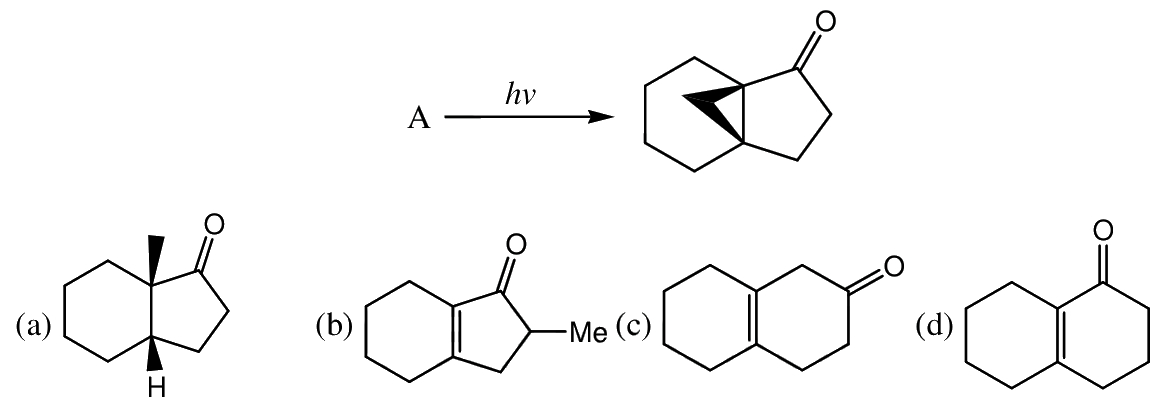
Structure of the starting material A in the following photochemical Norrish reaction, is
Question 110 image
a.
(a)
b.
(b)
c.
(c)
d.
(d)
Correct Answer & Step-by-Step Solution Locked

Sign in free to reveal the correct answer and AI explanation for this question.

Q131 mcq
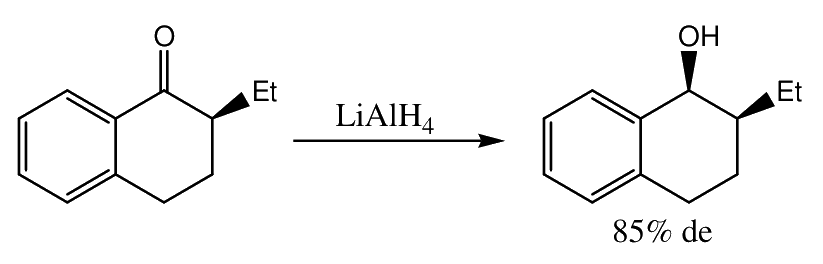
Considering the following reaction, among A-C, the correct statements are (A) The carbonyl group has enantiotopic faces; (B) The hydride attack is re-facial; (C) It is a diastereoselective reduction.
Question 111 image
a.
(A) and (B) only
b.
(A) and (C) only
c.
(B) and (C) only
d.
(A), (B) and (C)
Correct Answer & Step-by-Step Solution Locked

Sign in free to reveal the correct answer and AI explanation for this question.

Q132 mcq
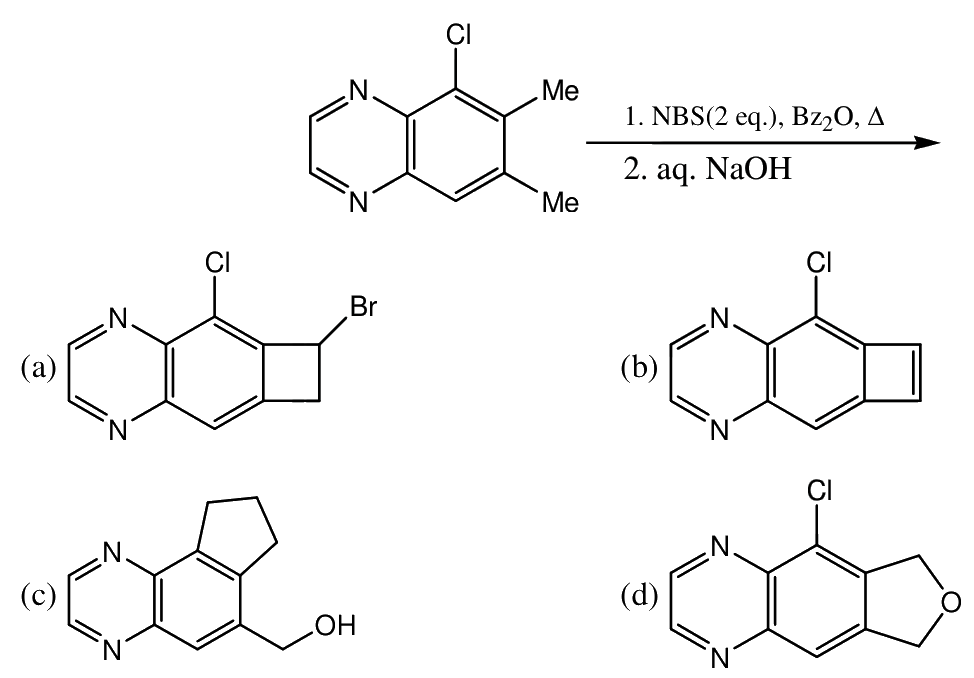
The major product formed in the following reaction sequence is
Question 112 image
Correct Answer & Step-by-Step Solution Locked

Sign in free to reveal the correct answer and AI explanation for this question.

Q133 mcq
The major product formed in the following reaction sequence is:
Question 113 image
Correct Answer & Step-by-Step Solution Locked

Sign in free to reveal the correct answer and AI explanation for this question.

Q134 mcq
Match the following \begin{tabular}{ll} \textbf{Compound} & \textbf{$^{13}\text{C}$ NMR chemical shift ($\delta$ ppm)} \\ (A) Acetic acid & (i) 95 \\ (B) Acetonitrile & (ii) 115 \\ (C) Acetone & (iii) 175 \\ (D) Carbon tetrachloride & (iv) 205 \end{tabular}
a.
(A)-(iii), (B)-(ii), (C)-(iv), (D)-(i)
b.
(A)-(iii), (B)-(iv), (C)-(i), (D)-(ii)
c.
(A)-(i), (B)-(ii), (C)-(iv), (D)-(ii)
d.
(A)-(iii), (B)-(i), (C)-(iii), (D)-(iv)
Correct Answer & Step-by-Step Solution Locked

Sign in free to reveal the correct answer and AI explanation for this question.

Q135 mcq
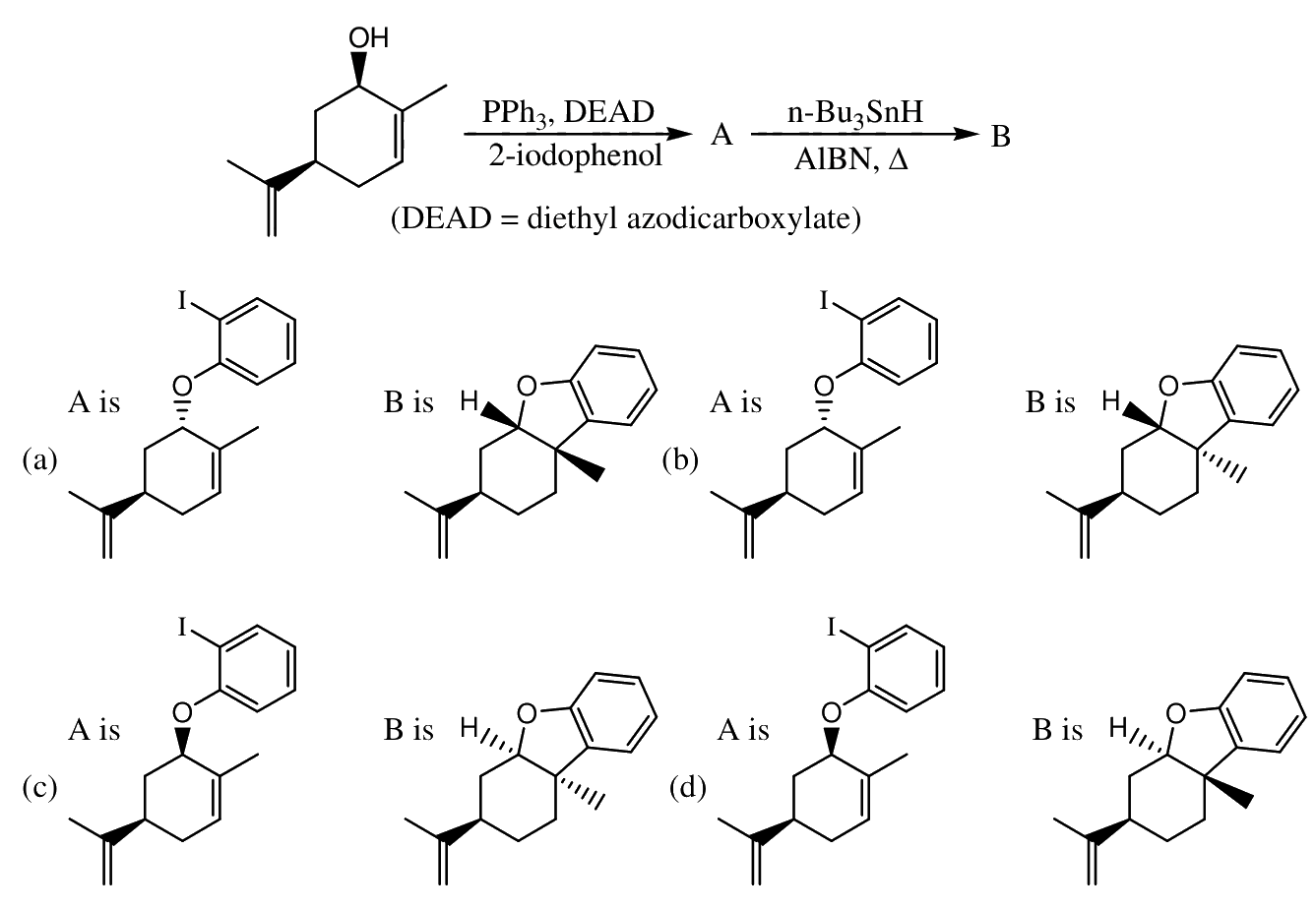
The major products A and B in the following reaction sequence are ($\text{DEAD} = \text{diethyl azodicarboxylate}$)
Question 115 image
Correct Answer & Step-by-Step Solution Locked

Sign in free to reveal the correct answer and AI explanation for this question.

Q136 mcq
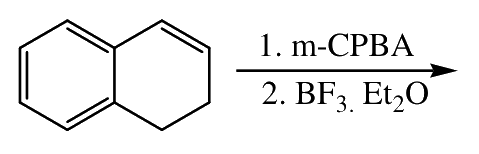
The major product formed in the following reaction is:
Question 116 image
Correct Answer & Step-by-Step Solution Locked

Sign in free to reveal the correct answer and AI explanation for this question.

Q137 mcq
The reagents A and B in the following reactions are
Question 117 image
a.
$\text{A} = \text{CH}_2\text{I}_2, \text{Zn}-\text{Cu}; \quad \text{B} = \text{Me}_3\text{S}^+\text{I}^-, \text{NaH}$
b.
$\text{A} = \text{CH}_2\text{I}_2, \text{Zn}-\text{Cu}; \quad \text{B} = \text{Me}_3\text{S}^+(\text{O})\text{I}^-, \text{NaH}$
c.
$\text{A} = \text{Me}_3\text{S}^+\text{I}^-, \text{NaH}; \quad \text{B} = \text{Me}_3\text{S}^+(\text{O})\text{I}^-, \text{NaH}$
d.
$\text{A} = \text{Me}_3\text{S}^+(\text{O})\text{I}^-, \text{NaH}; \quad \text{B} = \text{CH}_2\text{I}_2, \text{Zn}-\text{Cu}$
Correct Answer & Step-by-Step Solution Locked

Sign in free to reveal the correct answer and AI explanation for this question.

Q138 mcq
The major products A and B formed in the following reaction sequence are
Question 118 image
Correct Answer & Step-by-Step Solution Locked

Sign in free to reveal the correct answer and AI explanation for this question.

Q139 mcq
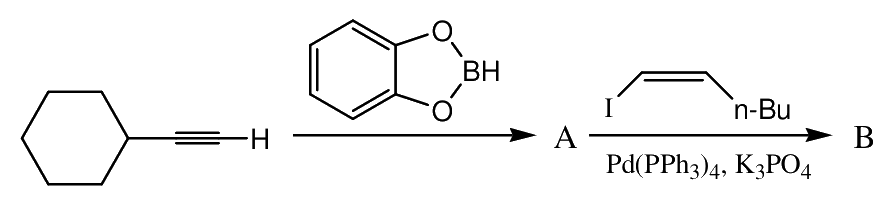
The major products A and B formed in the following reaction sequence are
Question 119 image
a.
A is catecholatoborane derivative $((E)$-alkenylborane), B is $(E,E)$-diene
b.
A is catecholatoborane derivative $((E)$-alkenylborane), B is $(E,Z)$-diene
c.
A is catecholatoborane derivative $((Z)$-alkenylborane), B is $(Z,Z)$-diene
d.
A is catecholatoborane derivative $((Z)$-alkenylborane), B is $(Z,E)$-diene
Correct Answer & Step-by-Step Solution Locked

Sign in free to reveal the correct answer and AI explanation for this question.

Q140 mcq
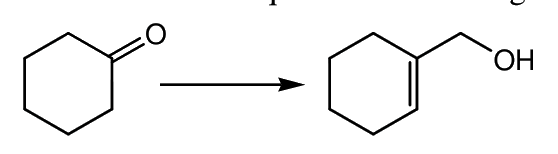
The correct reagent combination/reaction sequence for effecting the following conversion is:
Question 120 image
a.
(1) $\text{Me}_3\text{SiCH}_2\text{OMe}$, $\text{BuLi}$; (2) $\text{H}_3\text{O}^+$; (3) $\text{NaBH}_4$, $\text{MeOH}$
b.
(1) $\text{Ph}_3\text{P}^+\text{CH}_2\text{MeCl}^-$, $\text{BuLi}$; (2) $\text{H}_3\text{O}^+$; (3) $\text{NaBH}_4$, $\text{MeOH}$
c.
(1) $\text{NH}_2\text{NHTs}$; (2) $\text{NaOEt}$; (3) $\text{ClCOOEt}$
d.
(1) $\text{NH}_2\text{NHTs}$; (2) $2\text{ eq. }\text{BuLi}$; (3) $\text{HCHO}$
Correct Answer & Step-by-Step Solution Locked

Sign in free to reveal the correct answer and AI explanation for this question.

Q141 mcq
The major product formed in the following reaction is:
Question 121 image
Correct Answer & Step-by-Step Solution Locked

Sign in free to reveal the correct answer and AI explanation for this question.

Q142 mcq
The correct sequence of reagents for effecting the following conversion is:
Question 122 image
a.
(1) $(\text{CH}_2\text{OH})_2$, $\text{PTSA}$, $\Delta$; (2) Tebbe's reagent; (3) $\text{H}_3\text{O}^+$; (4) $\text{KOH}$
b.
(1) $(\text{CH}_2\text{OH})_2$, PTSA, $\Delta$; (2) $\text{Ph}_3\text{P}-\text{CH}_2$; (3) $\text{H}_3\text{O}^+$; (4) KOH
c.
(1) $\text{Cp}_2\text{Ti}(\mu\text{-Cl})(\mu\text{-CH}_2)\text{AlMe}_2$ (Tebbe's reagent); (2) $\text{H}_3\text{O}^+$; (3) KOH
d.
$\text{Ph}_3\text{P}=\text{CH}_2$; (2) $\text{H}_3\text{O}^+$; (3) KOH
Correct Answer & Step-by-Step Solution Locked

Sign in free to reveal the correct answer and AI explanation for this question.

Q143 mcq
The major products A and B formed in the following reaction sequence are
Question 123 image
a.
A and B as shown in option (a)
b.
A and B as shown in option (b)
c.
A and B as shown in option (c)
d.
A and B as shown in option (d)
Correct Answer & Step-by-Step Solution Locked

Sign in free to reveal the correct answer and AI explanation for this question.

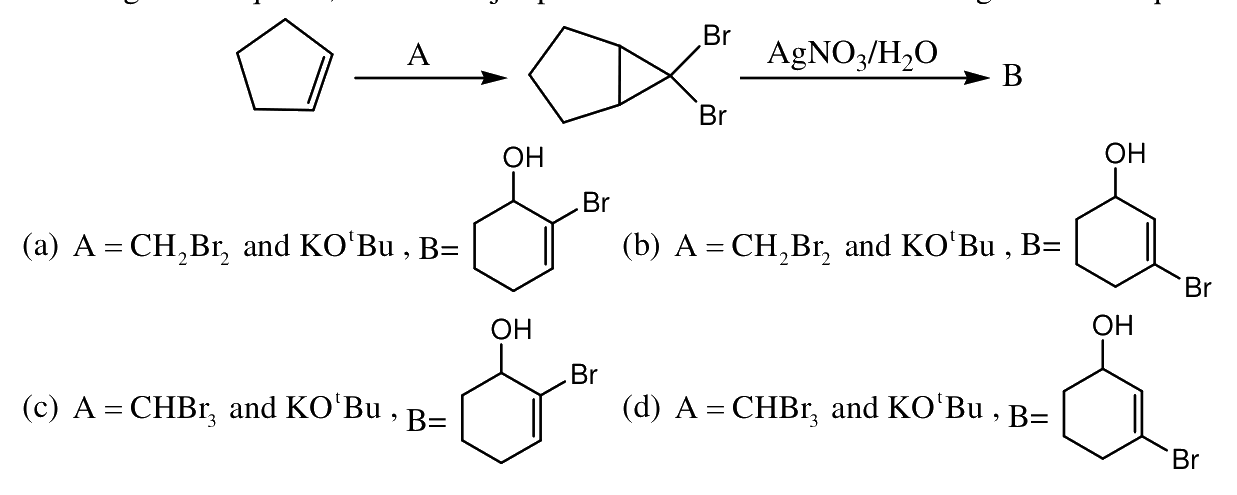
Q144 mcq
The reagent A required, and the major product B formed in the following reaction sequence are
Question 124 image
a.
$\text{A} = \text{CH}_2\text{Br}_2 \text{ and } \text{KO}^t\text{Bu}$, $\text{B} = $ 2-bromocyclohex-2-en-1-ol
b.
$\text{A} = \text{CH}_2\text{Br}_2 \text{ and } \text{KO}^t\text{Bu}$, $\text{B} = $ 3-bromocyclohex-2-en-1-ol
c.
$\text{A} = \text{CHBr}_3 \text{ and } \text{KO}^t\text{Bu}$, $\text{B} = $ 2-bromocyclohex-2-en-1-ol
d.
$\text{A} = \text{CHBr}_3 \text{ and } \text{KO}^t\text{Bu}$, $\text{B} = $ 3-bromocyclohex-2-en-1-ol
Correct Answer & Step-by-Step Solution Locked

Sign in free to reveal the correct answer and AI explanation for this question.

Q145 mcq
Among the choices, the correct statements for A formed in the following reaction.
Question 125 image
a.
A is a single enantiomer
b.
A is a racemic mixture
c.
A is a mixture of two diastereomers
d.
A is a mixture of two epimers.
Correct Answer & Step-by-Step Solution Locked

Sign in free to reveal the correct answer and AI explanation for this question.