For an odd nucleon in 'g' nuclear orbital and parallel to I, spin and parity are
a.
$9/2$ and $(+)$
Correct Answer
b.
$7/2$ and $(+)$
c.
$9/2$ and $(-)$
d.
$7/2$ and $(-)$
Step-by-Step AI Explanation
Verified Method
For a 'g' nuclear orbital, the orbital angular momentum quantum number is $l = 4$.
Since the nucleon spin is parallel to the orbital angular momentum ($l$), the total nuclear spin is:
$$j = l + s = 4 + \frac{1}{2} = \frac{9}{2}$$
The parity is determined by $(-1)^l$:
$$\text{Parity} = (-1)^4 = +1 \text{ (positive or } + \text{)}$$
Therefore, the spin and parity are $9/2$ and $(+)$, which corresponds to option A.
Q22mcq
For the deposition of $\text{Pb}$ by electroplating, the best suited compound among the following is
a.
$\text{PbCl}_2$
b.
$\text{PbSO}_4$
c.
$\text{Pb(Et)}_4$
d.
$\text{Pb(BF}_4)_2$
Correct Answer
Step-by-Step AI Explanation
Verified Method
Lead fluoborate, $\text{Pb(BF}_4)_2$, is highly soluble in water and provides high throwing power and fine-grained, smooth deposits without excessive passivation of the anode. $\text{PbSO}_4$ and $\text{PbCl}_2$ are poorly soluble in aqueous media, and tetraethyllead $\text{Pb(Et)}_4$ is an organometallic, highly toxic, non-electrolyte compound. Hence, $\text{Pb(BF}_4)_2$ is the electrolyte of choice for lead electroplating.
Q23mcq
Appropriate reasons for the deviation form the Beer's law among the following are
(A) Monochromaticity of light
(B) Association of analyte
(C) Very high concentration of analyte
(D) Dissociation of analyte.
a.
A, B and D
b.
B, C and D
Correct Answer
c.
A, C and D
d.
A, B and C
Step-by-Step AI Explanation
Verified Method
Beer's law strictly holds for dilute solutions using monochromatic radiation with non-interacting analyte species.
- Monochromaticity of light is an ideal condition under which Beer's law is obeyed (polychromatic light causes deviations).
- Association (B) and dissociation (D) change the chemical equilibrium and the nature/concentration of absorbing species, causing chemical deviations.
- Very high concentration (C) causes interactions between absorbing species (solute-solute interactions, changes in refractive index), leading to deviations.
Therefore, the reasons for deviation from Beer's law are (B), (C), and (D).
Q24mcq
Which one of the following shows the highest solubility in hot concentrated aqueous $\text{NaOH}$?
a.
$\text{La(OH)}_3$
b.
$\text{Nd(OH)}_3$
c.
$\text{Sm(OH)}_3$
d.
$\text{Lu(OH)}_3$
Correct Answer
Step-by-Step AI Explanation
Verified Method
Across the lanthanide series from $\text{La}^{3+}$ to $\text{Lu}^{3+}$, the ionic radius decreases due to lanthanide contraction. Consequently, the charge density of the $\text{Ln}^{3+}$ ion increases, making the heavier lanthanide hydroxides more covalent and increasingly amphoteric. While the lighter lanthanide hydroxides like $\text{La(OH)}_3$ are purely basic and insoluble in concentrated $\text{NaOH}$, $\text{Lu(OH)}_3$ exhibits amphoteric character and dissolves in hot concentrated aqueous $\text{NaOH}$ to form complex anions like $[\text{Lu(OH)}_6]^{3-}$ or $[\text{Lu(OH)}_4]^-$. Thus, $\text{Lu(OH)}_3$ has the highest solubility in hot concentrated $\text{NaOH}$.
Q25mcq
In the vibrational spectrum of $\text{CO}_2$, the number of fundamental vibrational modes common in both infrared and Raman are
a.
Three
b.
Two
c.
One
d.
Zero
Correct Answer
Step-by-Step AI Explanation
Verified Method
Carbon dioxide ($\text{CO}_2$) is a centrosymmetric linear molecule belonging to the $D_{\infty h}$ point group. According to the mutual exclusion rule, any vibrational mode in a molecule possessing a center of inversion ($i$) cannot be both infrared (IR) and Raman active simultaneously. The symmetric stretch ($\Sigma_g^+$) is Raman active only, while the asymmetric stretch ($\Sigma_u^+$) and the degenerate bending mode ($\Pi_u$) are IR active only. Therefore, the number of fundamental vibrational modes common to both IR and Raman is zero.
Q26mcq
The light pink color of $[\text{Co}(\text{H}_2\text{O})_6]^{2+}$ and the deep blue color of $[\text{CoCl}_4]^{2-}$ are due to
a.
MLCT transition in the first and d-d transition in the second
b.
LMCT transition in both
c.
d-d transitions in both
Correct Answer
d.
d-d transition in the first and MLCT transition in the second.
Step-by-Step AI Explanation
Verified Method
Both $[\text{Co}(\text{H}_2\text{O})_6]^{2+}$ (an octahedral $\text{Co(II)}$ complex) and $[\text{CoCl}_4]^{2-}$ (a tetrahedral $\text{Co(II)}$ complex) have a $d^7$ electronic configuration, and their colors arise from $d\text{-}d$ electronic transitions. In $[\text{Co}(\text{H}_2\text{O})_6]^{2+}$, the complex is centrosymmetric, so $d\text{-}d$ transitions are Laporte-forbidden, resulting in a pale/light pink color. In $[\text{CoCl}_4]^{2-}$, the tetrahedral geometry lacks a center of inversion, allowing $p\text{-}d$ mixing, which relaxes the Laporte selection rule and gives much higher molar absorptivity, leading to an intense deep blue color.
Q27mcq
In $[\text{Mo}_2(\text{S}_2)_6]^{2-}$ cluster the number of bridging $\text{S}_2^{2-}$ and coordination number of Mo respectively, are
a.
$2$ and $8$
Correct Answer
b.
$2$ and $6$
c.
$1$ and $8$
d.
$1$ and $6$
Step-by-Step AI Explanation
Verified Method
The complex $[\text{Mo}_2(\text{S}_2)_6]^{2-}$ can be formulated as $[(\eta^2\text{-S}_2)_2\text{Mo}(\mu\text{-S}_2)_2\text{Mo}(\eta^2\text{-S}_2)_2]^{2-}$.
In this structure, there are two bridging disulfide ligands ($\mu\text{-S}_2^{2-}$) and four terminal bidentate disulfide ligands ($\eta^2\text{-S}_2^{2-}$), two on each molybdenum center.
Each bridging disulfide ligand contributes 2 sulfur atoms coordinated to each Mo (since each $\mu\text{-S}_2^{2-}$ bridges in a $\mu\text{-}\eta^2:\eta^2$ or $\mu\text{-}\eta^1:\eta^1$ manner, specifically each Mo is bonded to 4 sulfur atoms from the two bridging $\text{S}_2$ and 4 sulfur atoms from the two chelating $\eta^2\text{-S}_2$), plus a $\text{Mo-Mo}$ bond, giving each Mo atom a coordination number of 8 with respect to sulfur ligands. Thus, the number of bridging $\text{S}_2^{2-}$ ligands is 2 and the coordination number of Mo is 8.
Q28mcq
$^1\text{H}$ NMR spectrum of $\text{HD}$ would show
a.
a singlet
b.
a doublet
c.
a triplet with intensity ratio $1:2:1$
d.
a triplet with intensity ratio $1:1:1$
Correct Answer
Step-by-Step AI Explanation
Verified Method
In $\text{HD}$, the proton ($^1\text{H}$) couples to the deuterium nucleus ($^2\text{H}$ or $\text{D}$). The spin of deuterium is $I = 1$. The multiplicity of the $^1\text{H}$ NMR signal is given by $2nI + 1$, where $n = 1$:
$$\text{Multiplicity} = 2(1)(1) + 1 = 3 \text{ (a triplet)}$$
Because the coupling is to a single nucleus of spin $I=1$, the magnetic quantum numbers are $m_I = -1, 0, +1$, all having equal statistical weight. Consequently, the triplet peaks have equal intensities with a ratio of $1:1:1$.
Q29mcq
The number of possible isomers of $[\text{Ru}(\text{PPh}_3)_2(\text{acac})_2]$ ($\text{acac} = \text{acetylacetonate}$) is:
a.
2
b.
3
Correct Answer
c.
4
d.
5
Step-by-Step AI Explanation
Verified Method
The complex $[\text{Ru}(\text{PPh}_3)_2(\text{acac})_2]$ is of the type $[\text{M}(\text{AA})_2\text{B}_2]$, where $\text{acac}$ is a symmetric bidentate ligand and $\text{PPh}_3$ is a monodentate ligand. This type of octahedral complex exhibits geometric isomerism: the *trans*-isomer (which is achiral) and the *cis*-isomer (which is chiral and exists as a pair of enantiomers, $\Delta$ and $\Lambda$). Thus, there are a total of 3 stereoisomers (one *trans* and two *cis* enantiomers).
Q30mcq
The total number of $\text{Cu}-\text{O}$ bonds present in the crystalline copper(II) acetate monohydrate is:
a.
10
Correct Answer
b.
6
c.
8
d.
4
Step-by-Step AI Explanation
Verified Method
Crystalline copper(II) acetate monohydrate is a dinuclear paddlewheel complex, $[\text{Cu}_2(\mu-\text{O}_2\text{CCH}_3)_4(\text{H}_2\text{O})_2]$. Each copper atom is coordinated to four oxygen atoms from bridging acetate groups and one oxygen atom from an axial water molecule. Thus, each copper forms 5 $\text{Cu}-\text{O}$ bonds, giving a total of $2 \times 5 = 10$ $\text{Cu}-\text{O}$ bonds in the dimer unit.
🎉 10 Free Sample Solutions Completed
Unlock All 125 Questions & Solutions
Sign up free in seconds to unlock step-by-step AI answers for the remaining 115 questions.
The number of lines exhibited by a high resolution EPR spectrum of the species, $[\text{Cu}(\text{ethylenediamine})_2]^{2+}$ is [Nuclear spin (I) of $\text{Cu} = 3/2$ and that of $\text{N} = 1$]
a.
12
b.
15
c.
20
d.
36
Correct Answer & Step-by-Step Solution Locked
Sign in free to reveal the correct answer and AI explanation for this question.
Degradation of penicillin G gives penicillamine that can utilize nitrogen, oxygen or sulfur atoms as donors to bind with lead(II), mercury (II) or copper(II). The structure of penicillamine is
a.
(a)
b.
(b)
c.
(c)
d.
(d)
Correct Answer & Step-by-Step Solution Locked
Sign in free to reveal the correct answer and AI explanation for this question.
The relative population in two states with energies $\text{E}_1$ and $\text{E}_2$ satisfying Boltzmann distribution is given by $\text{n}_1/\text{n}_2 = (3/2)\exp[-(\text{E}_1 - \text{E}_2)/\text{k}_{\text{B}}\text{T}]$. The relative degeneracy $\text{g}_2/\text{g}_1$ is:
a.
$2$
b.
$2/3$
c.
$3/2$
d.
$3$
Correct Answer & Step-by-Step Solution Locked
Sign in free to reveal the correct answer and AI explanation for this question.
The absorption spectrum of $\text{O}_2$ shows a vibrational structure that becomes continuum at $56875\text{ cm}^{-1}$. At the continuum, it dissociates into one ground state atom $(\text{O}_{\text{g}})$ and one excited state atom $(\text{O}_{\text{e}})$. The energy difference between $\text{O}_{\text{e}}$ and $\text{O}_{\text{g}}$ is $15125\text{ cm}^{-1}$. The dissociation energy (in $\text{cm}^{-1}$) of ground state of $\text{O}_2$ is:
a.
$\frac{56875}{15125}$
b.
$\frac{15125}{56875}$
c.
$72000$
d.
$41750$
Correct Answer & Step-by-Step Solution Locked
Sign in free to reveal the correct answer and AI explanation for this question.
The correct representation of the variation of molar conductivity ($y$-axis) with surfactant concentration ($x$-axis) is [CMC = critical micelle concentration].
Correct Answer & Step-by-Step Solution Locked
Sign in free to reveal the correct answer and AI explanation for this question.
If the $\text{pK}_\text{a}$ value for p-methoxybenzoic acid is $4.46$ and that of benzoic acid is $4.19$, the $\sigma_{\text{para}}$ for methoxy group is:
a.
$8.65$
b.
$4.32$
c.
$0.27$
d.
$-0.27$
Correct Answer & Step-by-Step Solution Locked
Sign in free to reveal the correct answer and AI explanation for this question.
In the $^{1}\text{H}$ NMR spectrum recorded at $293\text{ K}$, an organic compound ($\text{C}_3\text{H}_7\text{NO}$), exhibited signals at $\delta$ $7.8\ (1\text{H, s})$, $2.8\ (3\text{H, s})$ and $2.6\ (3\text{H, s})$. The compound is
Consider the following statements for [18]-annulene
(A) It is aromatic
(B) The inner protons resonate at $\delta\ 9.28$ in its $^{1}\text{H}$ NMR spectrum
(C) There are six protons in the shielded zone.
a.
A, B, C
b.
A and B only
c.
B and C only
d.
A and C only
Correct Answer & Step-by-Step Solution Locked
Sign in free to reveal the correct answer and AI explanation for this question.
Complexes of general formula, $\text{fac-}[\text{Mo(CO)}_3(\text{phosphite})_3]$ have the $\text{C—O}$ stretching bands as given below.
Phosphines: $\text{PF}_3(\text{A});\ \text{PCl}_3(\text{B});\ \text{P(Cl)Ph}_2(\text{C});\ \text{PMe}_3(\text{D})$
$\nu(\text{CO}),\text{ cm}^{-1}$: $2090(\text{i});\ 2040(\text{ii});\ 1977(\text{iii});\ 1945(\text{iv})$
The correct combiriation of the phsphine and the streching frequency is,
On subjecting $9.5\text{ ml}$ solution of $\text{Pb}^{2+}$ of $\text{X M}$ to polarographic measurements, $\text{I}_d$ was found to be $1\ \mu\text{A}$. When $0.5\text{ mL}$ of $0.04\text{ M Pb}^{2+}$ was added before the measurement, the Id was found to be $1.25\ \mu\text{A}$.
a.
0.0035
b.
0.0400
c.
0.0067
d.
0.0080
Correct Answer & Step-by-Step Solution Locked
Sign in free to reveal the correct answer and AI explanation for this question.
Match each item from the List-I (compound in solvent) with that from the List-II (its behaviour) and select the correct combination using the codes given below.
List-I
A. $\text{CH}_3\text{COOH}$ in pyridine
B. $\text{CH}_3\text{COOH}$ in $\text{H}_2\text{SO}_4$
C. $\text{HClO}_4$ in $\text{H}_2\text{SO}_4$
D. $\text{SbF}_5$ in $\text{HF}$
List-II
(i) strong acid.
(ii) weak acid
(iii) strong base
(iv) weak base
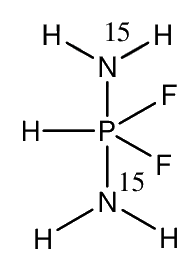
For the molecule below,
consider the following statements about its room temperature spectral data.
(A) $^{1}\text{H NMR}$ has singlets at $5.48$ and $3.18\text{ ppm}$
(B) $^{1}\text{H NMR}$ has multiplet at $5.48$ and singlet at $3.18\text{ ppm}$
(C) IR has $\text{CO}$ stretching bands at $1950$ and $1860\text{ cm}^{-1}$
(D) IR has only one $\text{CO}$ stretching band at $1900\text{ cm}^{-1}$.
The correct pair of statement is,
a.
A and C
b.
B and C
c.
A and D
d.
B and D
Correct Answer & Step-by-Step Solution Locked
Sign in free to reveal the correct answer and AI explanation for this question.
In the cluster $\left[\text{Co}_3(\text{CH})(\text{CO})_9\right]$ obeying $18\text{e}$ rule, the number of metal-metal bonds and the bridgind ligands respectively, are
a.
$3$ and $1\text{ CH}$
b.
$0$ and $3\text{ CO}$
c.
$3$ and $1\text{ CO}$
d.
$6$ and $1\text{ CH}$
Correct Answer & Step-by-Step Solution Locked
Sign in free to reveal the correct answer and AI explanation for this question.
Consider the ions $\text{Eu(III)}$, $\text{Gd(III)}$, $\text{Sm(II)}$ and $\text{Lu(III)}$. The observed and calculated magnetic moment values are closest for the pair
a.
$\text{Gd(III)}$, $\text{Lu(III)}$
b.
$\text{Eu(III)}$, $\text{Lu(III)}$
c.
$\text{Sm(III)}$, $\text{Gd(III)}$
d.
$\text{Sm(III)}$, $\text{Eu(III)}$
Correct Answer & Step-by-Step Solution Locked
Sign in free to reveal the correct answer and AI explanation for this question.
In metalloenzymes, the metal centres are covalently linked through the side chains of the amino acid residues. The correct set of amino acids which are involved in the primary coordinates spheres of metalloenzymes is
a.
Ala, Leu, His
b.
Glu, His, Cys
c.
Leu, Glu, Cys
d.
Ala, His, Glu
Correct Answer & Step-by-Step Solution Locked
Sign in free to reveal the correct answer and AI explanation for this question.
Consider the catalyst in column-I and reactin in column-II
**Column-I**
A. $[\text{(R)-BINAP}]\text{Ru}^{2-}$
B. $\left[\text{Rh}(\text{CO})_2\text{I}_2\right]^-$
C. $\text{Pd}(\text{PPh}_3)_4$
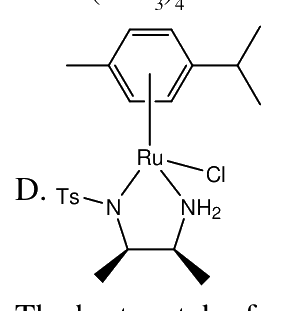
D. [See Image]
**Column-II**
(i) hydroformylation
(ii) asymmetric hydrogenation.
(iii) asymmetric hydrogen transfer
(iv) heck coupling.
The best match of a catalyst of column-I with the reaction nuclear column-II is
a.
(A–ii), (B–i), (C–iv), (D–iii)
b.
(A–i), (B–ii), (C–iii), (D–iv)
c.
(A–iii), (B–i), (C–iv), (D–ii)
d.
(A–iv), (B–iii), (C–ii), (D–i)
Correct Answer & Step-by-Step Solution Locked
Sign in free to reveal the correct answer and AI explanation for this question.
A solution of $2.0\text{ g}$ of brass was analysed for $\text{Cu}$ electrogravimetrically using $\text{Pt}$-gauze as electrode. The weight of $\text{Pt}$-gauze changed from $14.5\text{ g}$ to $16.0\text{ g}$. The percentage weight of $\text{Cu}$ in brass is
a.
50
b.
55
c.
60
d.
75
Correct Answer & Step-by-Step Solution Locked
Sign in free to reveal the correct answer and AI explanation for this question.
The platinum complex of $\text{NH}_3$ and $\text{Cl}^-$ ligands is an anti-tumour agent. The correct isomeric formula of the complex and its precursor are
a.
cis-$\text{Pt(NH}_3)_2\text{Cl}_2$ and $\text{PtCl}_4^{2-}$
b.
trans-$\text{Pt(NH}_3)_2\text{Cl}_2$ and $\text{PtCl}_4^{2-}$
c.
cis-$\text{Pt(NH}_3)_2\text{Cl}_2$ and $\text{Pt(NH}_3)_4^{2+}$
d.
trans-$\text{Pt(NH}_3)_2\text{Cl}_2$ and $\text{Pt(NH}_3)_4^{2-}$
Correct Answer & Step-by-Step Solution Locked
Sign in free to reveal the correct answer and AI explanation for this question.
Successive addition of $\text{NaCl}$, $\text{H}_3\text{PO}_4$, $\text{KSCN}$ and $\text{NaF}$ to a solutin of $\text{Fe(NO}_3)_3\cdot 9\text{H}_2\text{O}$ gives yellow, colourless, red and again colorless solutions due to the respective formation of:
The rate of exchange of $\text{OH}_2$ present in the coordination sphere by $^{18}\text{OH}_2$ of, (i) $[\text{Cu}(\text{OH}_2)_6]^{2+}$, (ii) $[\text{Mn}(\text{OH}_2)_6]^{2+}$, (iii) $[\text{Fe}(\text{OH}_2)_6]^{2+}$, (iv) $[\text{Ni}(\text{OH}_2)_6]^{2+}$, follows an order
a.
(i) > (ii) > (iii) > (iv)
b.
(i) > (iv) > (iii) > (ii)
c.
(ii) > (iii) > (iv) > (i)
d.
(iii) > (i) > (iv) > (ii)
Correct Answer & Step-by-Step Solution Locked
Sign in free to reveal the correct answer and AI explanation for this question.
Based on the behaviour of the metalloenzymes, consider the following statements
(A) In the enzymes, the zinc activates $\text{O}_2$ to form peroxide species.
(B) In the enzymes, the zinc activates $\text{H}_2\text{O}$ and provides a zinc boud hydroxide.
(C) In the oxidases, the iron activates $\text{O}_2$ to break the bonding between the two oxygens
(D) Zinc ion acts as a nucleophile and attacks at the peptide carbonyl
The set of correct statements is,
a.
A and B
b.
B and C
c.
C and D
d.
A and D
Correct Answer & Step-by-Step Solution Locked
Sign in free to reveal the correct answer and AI explanation for this question.
$\text{Fe}^{2+}$-porphyrins fail to exhibit reversible oxygen transport and cannot differentiate $\text{CO}$ from $\text{O}_2$. However, the hemoglobin is free from both these pit falls. Among the following
(A) $\text{Fe}^{2+}$-porphyrins undergo $\mu$-oxodimer formation and the same is prevented in case of the hemoglobin.
(B) $\text{Fe}-\text{CO}$ bond strength is much low in case of hemoglobin when compared to the $\text{Fe}^{2+}$-porphyrins.
(C) While $\text{Fe}-\text{CO}$ is linear, $\text{Fe}-\text{O}_2$ is bent and is recognized by hemoglobin
(D) The interlinked four monomeric units in the hemoglobin are responsible to overcome the pitfalls.
The correct set of statements is
a.
A and B
b.
A and C
c.
C and D
d.
B and D
Correct Answer & Step-by-Step Solution Locked
Sign in free to reveal the correct answer and AI explanation for this question.
A metal crystallizes in fcc structure with a unit cell side of $500\text{ pm}$. If the density of the crystal is $1.33\text{ g/cc}$, the molar mass of the metal is close to
a.
23
b.
24
c.
25
d.
26
Correct Answer & Step-by-Step Solution Locked
Sign in free to reveal the correct answer and AI explanation for this question.
The activation energy for the bimolecular reaction $\text{A} + \text{BC} \rightarrow \text{AB} + \text{C}$ is $\text{E}_0$ in the gas phase. If the reaction is carried out in a confined volume of $\lambda^3$, the activation energy is expected to
a.
remain unchanged
b.
increase with decreasing $\lambda$.
c.
decrease with decreasing $\lambda$.
d.
oscillate with decreasing $\lambda$.
Correct Answer & Step-by-Step Solution Locked
Sign in free to reveal the correct answer and AI explanation for this question.
In a many-electron atom, the total orbital angular momentum ($\text{L}$) and spin ($\text{S}$) are good quantum numbers instead of the individual orbital ($l_1$, $l_2$) and spin ($s_1$, $s_2$) angular momenta in the presence of
a.
inter-electron repulsion
b.
spin-orbit interaction
c.
hyperfine coupling
d.
external magnetic field.
Correct Answer & Step-by-Step Solution Locked
Sign in free to reveal the correct answer and AI explanation for this question.
One of the excited states of $\mathrm{Ti}$ has the electric configuration $[\mathrm{Ar}]\, 4\mathrm{s}^2 3\mathrm{d}^1 4\mathrm{p}^1$. The number of microstates with zero total spin $(\mathrm{S})$ for this configuration is
a.
9
b.
15
c.
27
d.
60
Correct Answer & Step-by-Step Solution Locked
Sign in free to reveal the correct answer and AI explanation for this question.
For the reaction $\mathrm{A}_2 \rightleftharpoons 2\mathrm{A}$ in a closed container, the relation between the degree of dissociation $(\alpha)$ and the equilibrium constant $\mathrm{K}_p$ at a fixed temperature is given by
The fugacity of a gas depends on pressure and the compressibility factor $\mathrm{Z}(= p\bar{\mathrm{V}}/\mathrm{RT})$ through the relation ($\bar{\mathrm{V}}$ is the molar volume)
For most gases at temperature $\mathrm{T}$ and up to moderate pressure, this equation shows that
a.
$f < p$, if $\mathrm{T} \to 0$
b.
$f < p$, if $\mathrm{T} \to \infty$
c.
$f > p$, if $\mathrm{T} \to 0$
d.
$f = p$, if $\mathrm{T} \to 0$
Correct Answer & Step-by-Step Solution Locked
Sign in free to reveal the correct answer and AI explanation for this question.
The internal pressure $(\partial \mathrm{U}/\partial \mathrm{V})_\mathrm{T}$ of a real gas is related to the compressibility factor $\mathrm{Z} = p\bar{\mathrm{V}}/\mathrm{RT}$ by [$\bar{\mathrm{V}}$ is the molar volume]
Suppose, the ground stationary state of a harmonic oscillator with force constant 'k' is given by
$$\psi_0 = \exp [-Ax^2]$$
Then, A should depend on k as
a.
$\mathrm{A} \propto k^{-1/2}$
b.
$\mathrm{A} \propto k$
c.
$\mathrm{A} \propto k^{1/2}$
d.
$\mathrm{A} \propto k^{1/3}$
Correct Answer & Step-by-Step Solution Locked
Sign in free to reveal the correct answer and AI explanation for this question.
Combining two real wave functions $\phi_1$ and $\phi_2$, the following functions are constructed: $\mathrm{A} = \phi_1 + \phi_2$, $\mathrm{B} = \phi_1 + \mathrm{i}\phi_2$, $\mathrm{C} = \phi_1 - \mathrm{i}\phi_2$, $\mathrm{D} = \mathrm{i}(\phi_1 + \phi_2)$. The correct statement will then be
a.
A and B represent the same state
b.
A and C represent the same state.
c.
A and D represents the same state
d.
B and D represent the same state.
Correct Answer & Step-by-Step Solution Locked
Sign in free to reveal the correct answer and AI explanation for this question.
Crystal A diffracts from (1 1 1) and (2 0 0) planes but not from (1 1 0) plane, while the crystal B diffracts from (1 1 0) and (2 0 0) planes but not from the (1 1 1) plane. From the above, we may conclude that
a.
A has fcc lattice while B has bcc lattice
b.
A has bcc lattice while B has fcc lattice
c.
A and B both have fcc lattice
d.
A and B both have bcc lattice.
Correct Answer & Step-by-Step Solution Locked
Sign in free to reveal the correct answer and AI explanation for this question.
The decomposition of $\text{NH}_3$ on $\text{Mo}$ surface follows Langmuir-Hinshelwood mechanism. The decomposition was carried out at low pressures. The initial pressure of $\text{NH}_3$ was $10^{-2}\text{ torr}$. The pressure of $\text{NH}_3$ was reduced to $10^{-4}\text{ torr}$ in 10 minutes. The rate constant of decomposition of $\text{NH}_3$ is:
a.
$9.9 \times 10^{-4}\text{ torr min}^{-1}$
b.
$0.4606\text{ min}^{-1}$
c.
$9.9 \times 10^{-3}\text{ torr min}^{-1}$
d.
$0.693\text{ min}^{-1}$
Correct Answer & Step-by-Step Solution Locked
Sign in free to reveal the correct answer and AI explanation for this question.
A bacterial colony grows most commonly by cell division. The change in the population due to cell division in an actively growing colony is $\text{dN} = \lambda_{\text{g}}\text{N dt}$. The population of bacterial colony at time 't' is $\left[\text{N}_0 = \text{N}(t=0)\right]$
The Arrhenius parameters for the thermal decomposition of $\text{NOCl}$, $2\text{NOCl}(\text{g}) \rightarrow 2\text{NO}(\text{g}) + \text{Cl}_2(\text{g})$, are $\text{A} = 10^{13}\text{M}^{-1}\text{s}^{-1}$, $\text{E}_{\text{a}} = 105\text{ kJ mol}^{-1}$ and $\text{RT} = 2.5\text{ kJ mol}^{-1}$. The enthalpy (in $\text{kJ mol}^{-1}$) of the activated complex will be
a.
110
b.
105
c.
102.5
d.
100
Correct Answer & Step-by-Step Solution Locked
Sign in free to reveal the correct answer and AI explanation for this question.
The vibrational frequency and anharmonicity constant of an alkali halide are $300\text{ cm}^{-1}$ and $0.0025$ respectively. The positions (in $\text{cm}^{-1}$) of its fundamental mode and first overtone are respectively.
a.
300, 600
b.
298.5, 595.5
c.
301.5, 604.5
d.
290, 580
Correct Answer & Step-by-Step Solution Locked
Sign in free to reveal the correct answer and AI explanation for this question.
The adsorption of a gas is described by the Langmuir isotherm with the equilibrium constant $\text{K} = 0.9\text{ kPa}^{-1}$ at $25^\circ\text{C}$. The pressure (in $\text{kPa}$) at which the fractional surface coverage is $0.95$, is
a.
$1/11.1$
b.
$21.1$
c.
$11.1$
d.
$42.2$
Correct Answer & Step-by-Step Solution Locked
Sign in free to reveal the correct answer and AI explanation for this question.
The energy of a harmonic oscillator in its ground state is $\frac{1}{2}\hbar\omega$. According to the virial theorem, the average kinetic (T) and potential (V) energies of the above are
The energy of a hydrogen atom in a state is $-\frac{\text{hcR}_\text{H}}{25} (\text{R}_\text{H} = \text{Rydberg constant})$. The degeneracy of the state will be
a.
5
b.
10
c.
25
d.
50
Correct Answer & Step-by-Step Solution Locked
Sign in free to reveal the correct answer and AI explanation for this question.
The trial wave function of a system is expanded as $\psi_t = c_1\varphi_1 + c_2\varphi_2$. The matrix elements of the Hamiltonian are $\langle\varphi_1|\text{H}|\varphi_1\rangle = 0$; $\langle\varphi_1|\text{H}|\varphi_2\rangle = 2.0 = \langle\varphi_2|\text{H}|\varphi_1\rangle$ and $\langle\varphi_2|\text{H}|\varphi_2\rangle = 3.0$. The approximate ground-state energy of the system from the linear variational principle is
a.
$-1.0$
b.
$-2.0$
c.
$+4.0$
d.
$+5.0$
Correct Answer & Step-by-Step Solution Locked
Sign in free to reveal the correct answer and AI explanation for this question.
One molecular orbital of a polar molecule $\text{AB}$ has the form $c_\text{A}\psi_\text{A} + c_\text{B}\psi_\text{B}$, where $\psi_\text{A}$ and $\psi_\text{B}$ are normalized atomic orbitals centred on $\text{A}$ and $\text{B}$, respectively. The electron in this orbital is found on atom $\text{B}$ with a probability of $90\%$. Neglecting the overalp between $\psi_\text{A}$ and $\psi_\text{B}$, a possible set of $c_\text{A}$ and $c_\text{B}$ is:
a.
$c_\text{A} = 0.95, c_\text{B} = 0.32$
b.
$c_\text{A} = 0.10, c_\text{B} = 0.90$
c.
$c_\text{A} = -0.95, c_\text{B} = 0.32$
d.
$c_\text{A} = 0.32, c_\text{B} = 0.95$
Correct Answer & Step-by-Step Solution Locked
Sign in free to reveal the correct answer and AI explanation for this question.
4-Hydroxybenzoic acid exhibited signals at $\delta$ 171, 162, 133, 122 and 116 ppm in its broadband decoupoled $^{13}\text{C}$ NMR spectrum. The correct assignment of the signals is
The $[\alpha]_\text{D}$ of a $90\%$ optically pure 2-arylpropanoic acid solution is $+135^\circ$. On treatment with a base at RT for one hour, $[\alpha]_\text{D}$ changed to $+120^\circ$. The optical purity is reduced to $40\%$ after 3 hours. If so, the optical purity of the solution after 1 hour, and its $[\alpha]_\text{D}$ after 3 hours, respectively, would be
a.
$80\%$ and $60^\circ$
b.
$70\%$ and $40^\circ$
c.
$80\%$ and $90^\circ$
d.
$70\%$ and $60^\circ$
Correct Answer & Step-by-Step Solution Locked
Sign in free to reveal the correct answer and AI explanation for this question.
Match the following biochemical transformations with coenzymes involved: (i) $\alpha$-ketoglutarate to glutamic acid, (ii) uridine to thymidine, (iii) pyruvic acid to acetyl coenzyme A; (A) tetrahydrofolate, (B) NADH, (C) thiamine pyrophosphate, (D) pyridoxamine
a.
(i)-(D), (ii)-(A), (iii)-(C)
b.
(i)-(A), (ii)-(B), (iii)-(D)
c.
(i)-(B), (ii)-(A), (iii)-(C)
d.
(i)-(D), (ii)-(B), (iii)-(C)
Correct Answer & Step-by-Step Solution Locked
Sign in free to reveal the correct answer and AI explanation for this question.
$12.0\text{ g}$ of acetophenone on reaction with $76.2\text{ g}$ of iodine in the presence of aq. $\text{NaOH}$ gave solid A in $75\%$ yield. Approximate amount of A obtained in the reaction and its structure are
a.
$80\text{ g}, \text{CI}_4$
b.
$40\text{ g}, \text{CI}_4$
c.
$60\text{ g}, \text{CHI}_3$
d.
$30\text{ g}, \text{CHI}_3$
Correct Answer & Step-by-Step Solution Locked
Sign in free to reveal the correct answer and AI explanation for this question.