← Joint CSIR UGC NET Exam
CSIR NET · Chemical Sciences

June

2011 · 125 questions · First 10 Solutions Free
Questions 1–10 have full step-by-step solutions visible. Sign in to unlock all 125 →
Q21 mcq
According to crystal field theory, $\text{Ni}^{2+}$ can have two unpaired electrons in
a.
Octahedral geometry only
b.
Square-planar geometry only
c.
Tetrahedral geometry only
d.
Both octahedral and tetrahedral geometry. Correct Answer
Step-by-Step AI Explanation
Verified Method
$ ext{Ni}^{2+}$ has a $d^8$ electronic configuration. - In an octahedral field, the splitting gives $t_{2g}^6 e_g^2$, which has $2$ unpaired electrons regardless of ligand field strength. - In a tetrahedral field, the splitting gives $e^4 t_2^4$, which also has $2$ unpaired electrons according to Hund's rule. - In a square-planar geometry, low-spin configuration is favored, resulting in all $8$ electrons being paired (diamagnetic, $0$ unpaired electrons). Therefore, $ ext{Ni}^{2+}$ has two unpaired electrons in both octahedral and tetrahedral geometries.
Q22 mcq
$[\text{Ni}(\text{CN})_4]^{2-}$ and $[\text{NiCl}_4]^{2-}$ complex ions are
a.
Both diamagnetic
b.
Both paramagnetic
c.
Diamagnetic and paramagnetic respectively Correct Answer
d.
Antiferromagnetic and diamagnetic respectively
Step-by-Step AI Explanation
Verified Method
In $[ ext{Ni}( ext{CN})_4]^{2-}$, $ ext{Ni}^{2+}$ is a $d^8$ ion with $ ext{CN}^-$ as a strong-field ligand, resulting in a square-planar, low-spin complex ($dsp^2$) with no unpaired electrons ($n = 0$), making it diamagnetic. In $[ ext{NiCl}_4]^{2-}$, $ ext{Cl}^-$ is a weak-field ligand, giving a tetrahedral complex ($sp^3$) with configuration $e^4 t_2^4$, which has two unpaired electrons ($n = 2$), making it paramagnetic. Thus, the complexes are diamagnetic and paramagnetic, respectively.
Q23 mcq
Which of the following spectroscopic techniques will be useful to distinguish between M-SCN and M-NCS binding modes?
a.
NMR
b.
IR Correct Answer
c.
EPR
d.
Mass
Step-by-Step AI Explanation
Verified Method
Infrared (IR) spectroscopy is the classic and most effective technique for distinguishing between linkage isomers involving thiocyanate ($-\text{SCN}^-$) and isothiocyanate ($-\text{NCS}^-$) ligands: - The $\text{C-N}$ stretching frequency, $\nu(\text{CN})$, occurs at higher wavenumbers for S-bonded complexes (typically above $2100\text{ cm}^{-1}$, often sharp) compared to N-bonded complexes (typically below $2100\text{ cm}^{-1}$, usually broad and intense). - More definitively, the $\nu(\text{CS})$ stretching frequency appears around $780 - 860\text{ cm}^{-1}$ for M-NCS and down around $690 - 720\text{ cm}^{-1}$ for M-SCN. - The $\delta(\text{NCS})$ bending modes also show characteristic differences (around $470 - 490\text{ cm}^{-1}$ for N-bonded vs. $410 - 440\text{ cm}^{-1}$ for S-bonded). Therefore, IR spectroscopy (Option B) is the technique used to distinguish between these binding modes.
Q24 mcq
Which of the following compound show a charge-transfer band?
a.
Lanthanum nitrate
b.
Ceric ammonium nitrate Correct Answer
c.
Manganese (II) acetate
d.
Copper (II) sulphate pentahydrate
Step-by-Step AI Explanation
Verified Method
Ceric ammonium nitrate contains $\text{Ce}^{4+}$, which has a noble-gas $4f^0$ configuration. Because it has no $d$ or $f$ electrons, it cannot undergo $d-d$ or $f-f$ transitions. Its intense orange-yellow color arises from a Ligand-to-Metal Charge Transfer (LMCT) transition from the nitrate ligands to the empty $\text{Ce}^{4+}$ orbitals.
Q25 mcq
Among $\text{SF}_4, \text{BF}_4^-, \text{XeF}_4$ and $\text{ICl}_4^-$ the number of species having two lone pair of electrons on the central atom according to VSEPR theory is:
a.
2 Correct Answer
b.
3
c.
4
d.
0
Step-by-Step AI Explanation
Verified Method
Using VSEPR theory to find the number of lone pairs ($lp$) on the central atom: - $\text{SF}_4$: Sulfur has 6 valence electrons; forms 4 single bonds $\implies lp = (6 - 4)/2 = 1$ lone pair. - $\text{BF}_4^-$: Boron has 3 valence electrons $+ 1$ negative charge $= 4$; forms 4 single bonds $\implies lp = (4 - 4)/2 = 0$ lone pairs. - $\text{XeF}_4$: Xenon has 8 valence electrons; forms 4 single bonds $\implies lp = (8 - 4)/2 = 2$ lone pairs. - $\text{ICl}_4^-$: Iodine has 7 valence electrons $+ 1$ negative charge $= 8$; forms 4 single bonds $\implies lp = (8 - 4)/2 = 2$ lone pairs. Thus, only $\text{XeF}_4$ and $\text{ICl}_4^-$ have 2 lone pairs of electrons, making a total of 2 species.
Q26 mcq
The FALSE statement for a polarographic measurement procedure is:
a.
$\text{O}_2$ is removed
b.
Dropping mercury electrode is working electrode.
c.
$\text{I}_d$ is proportionaal to concentation of electroactive species.
d.
Residual current is made zero by adding supporting electrolyte. Correct Answer
Step-by-Step AI Explanation
Verified Method
Statement D is false. The addition of an excess of supporting electrolyte eliminates the migration current (by carrying nearly all the charge through the solution), not the residual current. The residual current consists of the faradaic current from trace impurities and the charging (capacitive) current of the mercury drop, which cannot be eliminated merely by adding supporting electrolyte.
Q27 mcq
The ligand system present in vitamin $\text{B}_{12}$ is:
a.
Porphyrin
b.
Corrin Correct Answer
c.
Phthalocyanine
d.
Crown ether
Step-by-Step AI Explanation
Verified Method
Vitamin $\text{B}_{12}$ (cobalamin) contains a cobalt ion coordinated to a corrin ring, a macrocyclic ligand structurally related to porphyrin but lacking one of the methine bridges, making it more flexible and directly linking two pyrrole rings.
Q28 mcq
Which one of the following exhibits rotational spectra?
a.
$\text{H}_2$
b.
$\text{N}_2$
c.
$\text{CO}$ Correct Answer
d.
$\text{CO}_2$
Step-by-Step AI Explanation
Verified Method
For a molecule to exhibit a pure rotational spectrum in the microwave region, it must possess a permanent electric dipole moment (gross selection rule: $\mu \neq 0$). - $\text{H}_2$ and $\text{N}_2$ are homonuclear diatomic molecules and have $\mu = 0$. - $\text{CO}_2$ is a linear, centrosymmetric molecule and has $\mu = 0$. - $\text{CO}$ is a heteronuclear diatomic molecule with a permanent dipole moment ($\mu \neq 0$), so it exhibits a pure rotational spectrum.
Q29 mcq
In Ziegler-Natta catalysis the commonly used catalyst system is:
a.
$\text{TiCl}_4, \text{Al}(\text{C}_2\text{H}_5)_3$ Correct Answer
b.
$(\eta^5-\text{Cp})_2\text{TiCl}_2, \text{Al}(\text{OEt})_3$
c.
$\text{VO}(\text{acac})_2, \text{Al}_2(\text{CH}_3)_6$
d.
$\text{TiCl}_4, \text{BF}_3$
Step-by-Step AI Explanation
Verified Method
The traditional heterogeneous Ziegler-Natta catalyst system consists of a transition metal halide, most commonly titanium tetrachloride ($\text{TiCl}_4$) or titanium trichloride ($\text{TiCl}_3$), combined with an organoaluminum co-catalyst such as triethylaluminum, $\text{Al}(\text{C}_2\text{H}_5)_3$.
Q30 mcq
Oxidation occurs very easily in case of
a.
$(\eta^5-\text{C}_5\text{H}_5)_2\text{Fe}$
b.
$(\eta^5-\text{C}_5\text{H}_5)_2\text{Co}$ Correct Answer
c.
$(\eta^5-\text{C}_5\text{H}_5)_2\text{Ru}$
d.
$(\eta^5-\text{C}_5\text{H}_5)_2\text{Co}^+$
Step-by-Step AI Explanation
Verified Method
Cobaltocene, $(\eta^5-\text{C}_5\text{H}_5)_2\text{Co}$, is a 19-electron complex with an electron in an antibonding $e_{1g}^*$ orbital. It readily undergoes one-electron oxidation to form the very stable, 18-electron cobaltocenium cation, $[(\eta^5-\text{C}_5\text{H}_5)_2\text{Co}]^+$. In contrast, ferrocene and ruthenocene are already stable 18-electron complexes.
🎉 10 Free Sample Solutions Completed

Unlock All 125 Questions & Solutions

Sign up free in seconds to unlock step-by-step AI answers for the remaining 115 questions.

Q31 mcq
Complex in which organic ligand is having only $\sigma-\text{bond}$ with metal is:
a.
$\text{W}(\text{CH}_3)_6$
b.
$(\eta^5-\text{C}_5\text{H}_5)_2\text{Fe}$
c.
$\text{K}[\text{PtCl}_3(\text{C}_2\text{H}_4)]$
d.
$(\eta^6-\text{C}_6\text{H}_6)_2\text{Ru}$
Correct Answer & Step-by-Step Solution Locked

Sign in free to reveal the correct answer and AI explanation for this question.

Q32 mcq
In the molecules $\text{H}_2\text{O}$, $\text{NH}_3$ and $\text{CH}_4$.
a.
The bond angles are same
b.
The bond distances are same.
c.
The hybridizations are same
d.
The shapes are same.
Correct Answer & Step-by-Step Solution Locked

Sign in free to reveal the correct answer and AI explanation for this question.
Q33 mcq
The correct order of stability of difluorides is:
a.
$\text{GeF}_2 > \text{SiF}_2 > \text{CF}_2$
b.
$\text{CF}_2 > \text{SiF}_2 > \text{GeF}_2$
c.
$\text{SiF}_2 > \text{GeF}_2 > \text{CF}_2$
d.
$\text{CF}_2 > \text{GeF}_2 > \text{SiF}_2$
Correct Answer & Step-by-Step Solution Locked

Sign in free to reveal the correct answer and AI explanation for this question.
Q34 mcq
The number of possible isomers for $[\text{Ru}(\text{bpy})_2\text{Cl}_2]$ is (bpy = 2,2'-bipyridine)
a.
2
b.
3
c.
4
d.
5
Correct Answer & Step-by-Step Solution Locked

Sign in free to reveal the correct answer and AI explanation for this question.
Q35 mcq
The species $^{19}\text{Ne}$ and $^{14}\text{C}$ emit a positron and $\beta-$particle respectively. The resulting species formed are respectively
a.
$^{19}\text{Na}$ and $^{14}\text{B}$
b.
$^{19}\text{F}$ and $^{14}\text{N}$
c.
$^{19}\text{Na}$ and $^{14}\text{N}$
d.
$^{19}\text{F}$ and $^{14}\text{B}$
Correct Answer & Step-by-Step Solution Locked

Sign in free to reveal the correct answer and AI explanation for this question.
Q36 mcq
Cis and trans complexes of the type $[\text{PtA}_2\text{X}_2]$ are distinguished by
a.
Chromyl chloride test
b.
Carbylamine test
c.
Kurnakov test
d.
Ring test
Correct Answer & Step-by-Step Solution Locked

Sign in free to reveal the correct answer and AI explanation for this question.
Q37 mcq
The term symbol of a molecule with electronic configuration $$(1\sigma_g)^2(1\sigma_u)^2(2\sigma_g)^2(2\sigma_u)^2(1\pi_u)^1(1\pi_u)^1 \text{ is:}$$
a.
$^1\Sigma_g^+$
b.
$^3\Sigma_g^-$
c.
$^1\Sigma_g^-$
d.
$^3\Sigma_g^+$
Correct Answer & Step-by-Step Solution Locked

Sign in free to reveal the correct answer and AI explanation for this question.
Q38 mcq
A process is carried out at constant volume and at constant entropy. It will be spontaneous if:
a.
$\Delta G < 0$
b.
$\Delta H < 0$
c.
$\Delta U < 0$
d.
$\Delta A < 0$
Correct Answer & Step-by-Step Solution Locked

Sign in free to reveal the correct answer and AI explanation for this question.
Q39 mcq
The half life of a zero order reaction $(\text{A} \rightarrow \text{P})$ is given by (k = rate constant):
a.
$\text{t}_{1/2} = \frac{[\text{A}]_0}{2\text{k}}$
b.
$\text{t}_{1/2} = \frac{2.303}{\text{k}}$
c.
$\text{t}_{1/2} = \frac{[\text{A}]_0}{\text{k}}$
d.
$\text{t}_{1/2} = \frac{1}{\text{k}[\text{A}]_0}$
Correct Answer & Step-by-Step Solution Locked

Sign in free to reveal the correct answer and AI explanation for this question.
Q40 mcq
For an aqueous solution at $25^\circ\text{C}$, the Debye-Huckel limiting law is given by
a.
$\log \gamma_{\pm} = 0.509 |\text{Z}_+\text{Z}_-|\sqrt{\mu}$
b.
$\log \gamma_{\pm} = 0.509 |\text{Z}_+\text{Z}_-|\mu$
c.
$\log \gamma_{\pm} = -0.509 |\text{Z}_+\text{Z}_-|\sqrt{\mu}$
d.
$\log \gamma_{\pm} = -0.509 |\text{Z}_+\text{Z}_-|\mu^2$
Correct Answer & Step-by-Step Solution Locked

Sign in free to reveal the correct answer and AI explanation for this question.

Q41 mcq
The microwave spectrum of a molecule yields three rotational constants. The molecule is
a.
Prolate symmetric top
b.
Spherical top
c.
Asymmetric top
d.
Oblate symmetric top
Correct Answer & Step-by-Step Solution Locked

Sign in free to reveal the correct answer and AI explanation for this question.
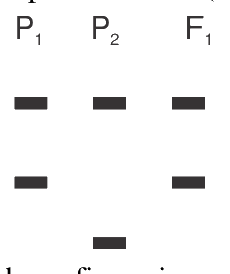
Q42 mcq
The Q band in the vibrational spectrum of acetylene is observed in the
a.
C–C stretching mode
b.
C-H symmetric stretching mode
c.
Bending mode
d.
C-H antisymmetric stretching mode.
Correct Answer & Step-by-Step Solution Locked

Sign in free to reveal the correct answer and AI explanation for this question.
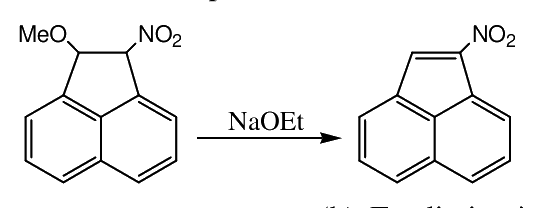
Q43 mcq
The Stark splitting for a given field is larger for a molecule AX as compared to BX. Which one of the following is true? ($\mu$ is the dipole moment)
a.
$\mu_{\text{AX}} = \mu_{\text{BX}}$
b.
$\mu_{\text{AX}} > \mu_{\text{BX}}$
c.
$\mu_{\text{AX}} < \mu_{\text{BX}}$
d.
$\mu_{\text{BX}} = 2\mu_{\text{AX}}$
Correct Answer & Step-by-Step Solution Locked

Sign in free to reveal the correct answer and AI explanation for this question.
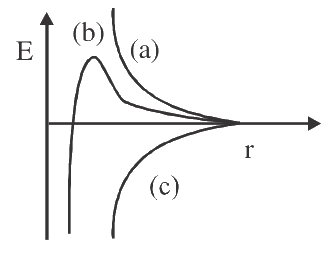
Q44 mcq
The adsoprtion of a gas on a solid surface exhibits the following isotherm. Which one of the following statements is true?
Question 24 image
a.
Heat of adsoprtion is independent of coverage
b.
Adsorption is multilayer
c.
Heat of adsorption varies monotonically with coverage
d.
Heat of adsorption varies exponentially with coverage.
Correct Answer & Step-by-Step Solution Locked

Sign in free to reveal the correct answer and AI explanation for this question.
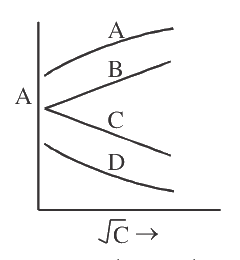
Q45 mcq
In a chemical reaction, $\mathrm{A(s)} + \mathrm{B(g)} \rightleftharpoons \mathrm{C(g)}$, the total pressure at equilibrium is $6\text{ atm}$. The value of equilibrium constant is:
a.
$1/2$
b.
$9$
c.
$1$
d.
$36$
Correct Answer & Step-by-Step Solution Locked

Sign in free to reveal the correct answer and AI explanation for this question.
Q46 mcq
A molecule, AX, has a vibrational energy of $1000\text{ cm}^{-1}$ and rotational energy of $10\text{ cm}^{-1}$. Another molecule, BX, has a vibrational energy of $400\text{ cm}^{-1}$ and rotational energy of $40\text{ cm}^{-1}$. Which one of the following statements about the coupling of vibrational and rotational motion is true?
a.
The coupling is stronger in BX.
b.
The coupling is stronger in AX.
c.
Magnitude of coupling is same in both AX and BX.
d.
There is no coupling in both AX and BX
Correct Answer & Step-by-Step Solution Locked

Sign in free to reveal the correct answer and AI explanation for this question.
Q47 mcq
At room temperature, which molecule has the maximum rotational entropy?
a.
$\mathrm{H}_2$
b.
$\mathrm{O}_2$
c.
$\mathrm{D}_2$
d.
$\mathrm{N}_2$.
Correct Answer & Step-by-Step Solution Locked

Sign in free to reveal the correct answer and AI explanation for this question.
Q48 mcq
The normalized hydrogen atom 1s wavefunction is given by $\Psi_{1\text{s}} = \frac{1}{\sqrt{\pi}}\left(\frac{\zeta}{a_0}\right)^{3/2} e^{-\zeta r/a_0}$ where $\zeta = 1$ and energy is $-0.5\text{ au}$. If we use a normalized wavefunction of the above form with $\zeta \neq 1$, the average value of energy of the ground state of hydrogen atom is:
a.
Greater than $-0.5\text{ au}$
b.
Equal to $-0.5\text{ au}$
c.
Less than $-0.5\text{ au}$
d.
Equal to $\zeta\text{ times} -0.5\text{ au}$.
Correct Answer & Step-by-Step Solution Locked

Sign in free to reveal the correct answer and AI explanation for this question.
Q49 mcq
A constant of motion is defined by the equation:
a.
$[\mathrm{H}, \mathrm{A}] = 0$
b.
$<[\mathrm{H}, \mathrm{A}]> = 0$
c.
$\mathrm{A} = \mathrm{f}(\mathrm{H})$
d.
$\mathrm{A}^\dagger = \mathrm{A}$
Correct Answer & Step-by-Step Solution Locked

Sign in free to reveal the correct answer and AI explanation for this question.
Q50 mcq
The hermitian conjugate of operator $\mathrm{d}/\mathrm{dx}$, called $(\mathrm{d}/\mathrm{dx})^\dagger$, is actually equal to
a.
$-\mathrm{d}/\mathrm{dx}$
b.
$\mathrm{d}/\mathrm{dx}$
c.
$\mathrm{i}(\mathrm{d}/\mathrm{dx})$
d.
$-\mathrm{i}(\mathrm{d}/\mathrm{dx})$
Correct Answer & Step-by-Step Solution Locked

Sign in free to reveal the correct answer and AI explanation for this question.
Q51 mcq
An ideal gas expands by following an equation $\mathrm{PV}^{\mathrm{a}} = \text{constant}$. In which case does one expect heating?
a.
$3 > a > 2$
b.
$2 > a > 1$
c.
$0 < a < 1$
d.
$-1 < a < 0$
Correct Answer & Step-by-Step Solution Locked

Sign in free to reveal the correct answer and AI explanation for this question.
Q52 mcq
If $y^2 = 4x$ and $0.1\%$ error is incurred for $x$, the percentage error involed in $y$ will be
a.
$0.4$
b.
$0.025$
c.
$0.1$
d.
$0.05$
Correct Answer & Step-by-Step Solution Locked

Sign in free to reveal the correct answer and AI explanation for this question.
Q53 mcq
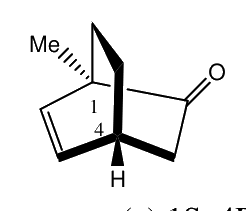
The configuration at the two stereocentres in the compound given below are
Question 33 image
a.
1R, 4R
b.
1R, 4S
c.
1S, 4R
d.
1S, 4S
Correct Answer & Step-by-Step Solution Locked

Sign in free to reveal the correct answer and AI explanation for this question.
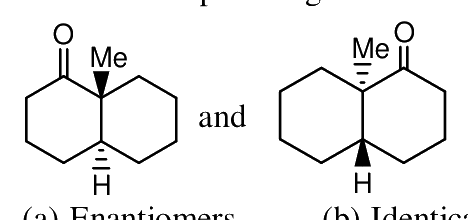
Q54 mcq
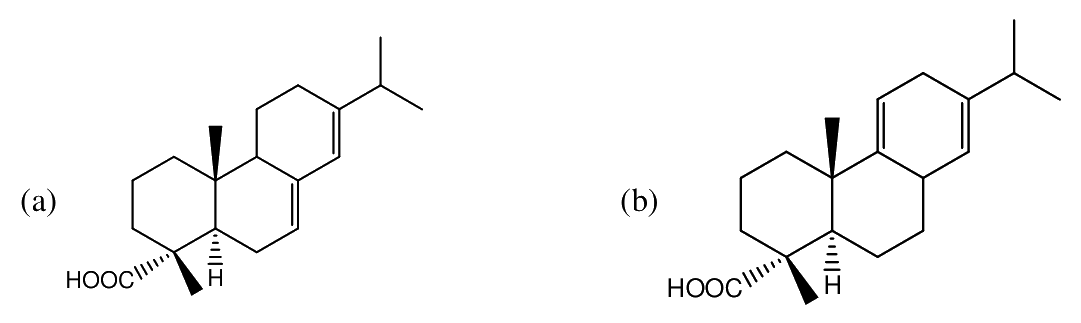
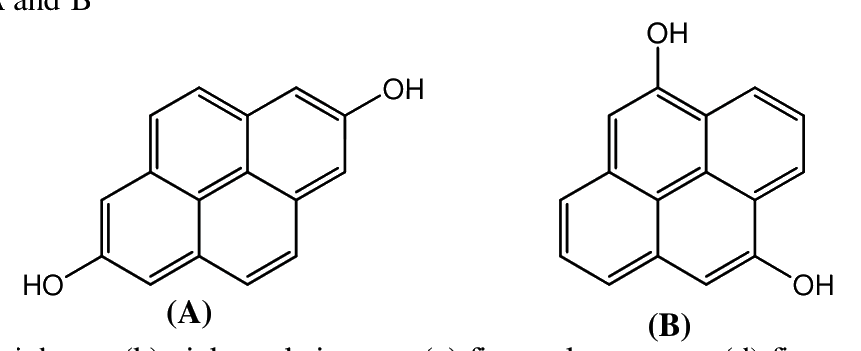
The two compounds given below are
Question 34 image
a.
Enantiomers
b.
Identical
c.
Diastereomers
d.
Regioisomers.
Correct Answer & Step-by-Step Solution Locked

Sign in free to reveal the correct answer and AI explanation for this question.
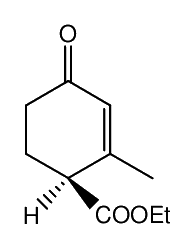
Q55 mcq
A suitable catalyst for bringing out the transformation given below is:
Question 35 image
a.
$\text{BF}_3.\text{Et}_2\text{O}$
b.
$\text{NaOEt}$
c.
Tungsten lamp
d.
Dibenzoyl peroxide
Correct Answer & Step-by-Step Solution Locked

Sign in free to reveal the correct answer and AI explanation for this question.
Q56 mcq
Thermolysis of allyl phenyl ether generates
a.
o-allylphenol only
b.
o- and p-allylphenols
c.
o-, m- and p-allylphenols
d.
m-allylphenol only
Correct Answer & Step-by-Step Solution Locked

Sign in free to reveal the correct answer and AI explanation for this question.
Q57 mcq
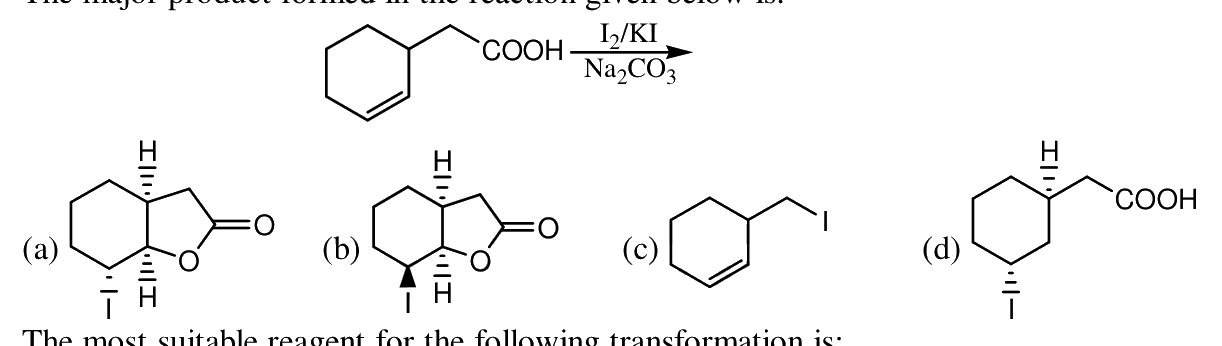
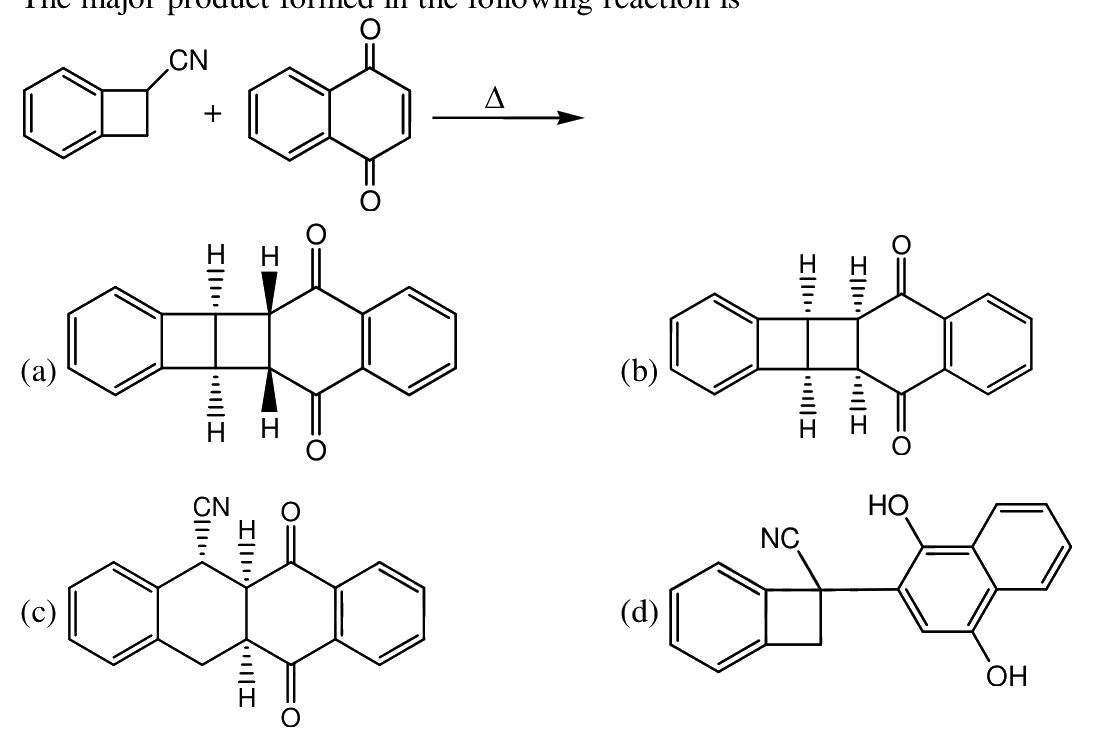
The major product formed in the reaction given below is:
Question 37 image
Correct Answer & Step-by-Step Solution Locked

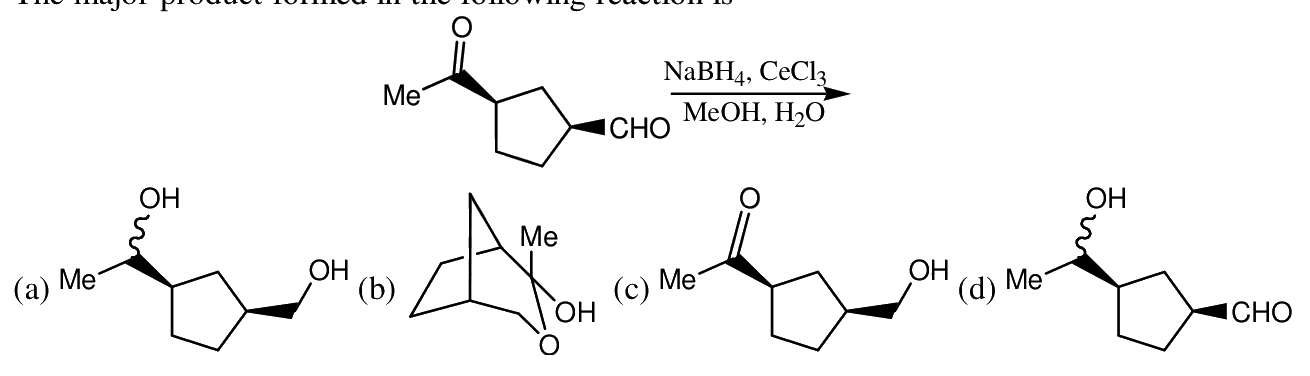
Sign in free to reveal the correct answer and AI explanation for this question.
Q58 mcq
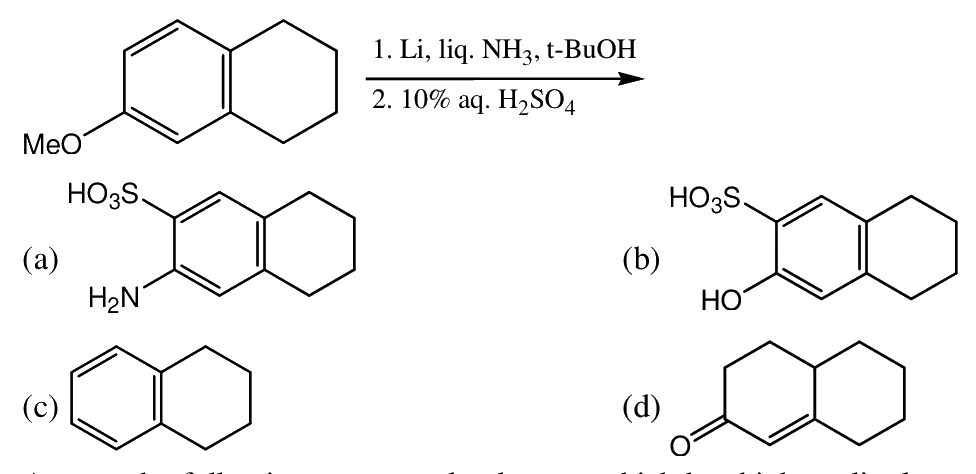
The most suitable reagent for the following transformation is:
Question 38 image
a.
$\text{LiAlH}_4$
b.
$\text{NH}_2\text{NH}_2/\text{KOH}$
c.
$\text{NaBH}_4/\text{CeCl}_3$
d.
$\text{Li/liq. NH}_3$
Correct Answer & Step-by-Step Solution Locked

Sign in free to reveal the correct answer and AI explanation for this question.
Q59 mcq
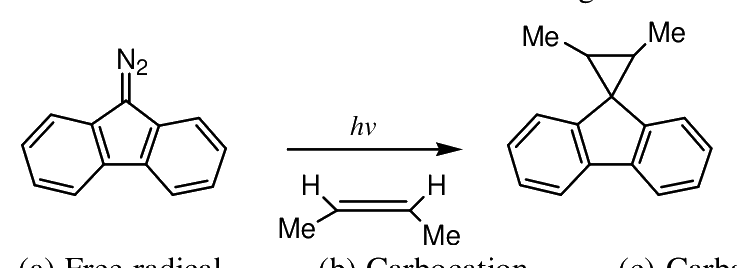
The intermediate involved in the reaction given below is:
Question 39 image
a.
Free radical
b.
Carbocation
c.
Carbanion
d.
Carbene
Correct Answer & Step-by-Step Solution Locked

Sign in free to reveal the correct answer and AI explanation for this question.
Q60 mcq
In the most stable conformation of trans-1-t-butyl-3-methylcyclohexane, the substituents at C–1 and C–3, respectively, are
a.
Axial and equatorial
b.
Equatorial and equatorial
c.
Equatorial and axial
d.
Axial and axial.
Correct Answer & Step-by-Step Solution Locked

Sign in free to reveal the correct answer and AI explanation for this question.
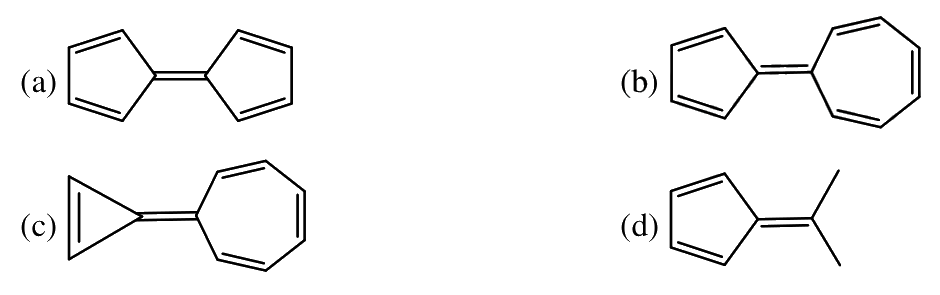
Q61 mcq
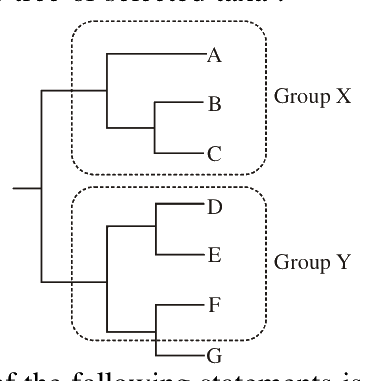
Among the carbocations given below Which of the following statements is true?
Question 41 image
a.
A is homoaromatic, B is antiaromatic and C is aromatic.
b.
A is aromatic, B is antiaromatic and C is homoaromatic.
c.
A is antiaromatic, B is aromatic and C is harmoaromatic.
d.
A is homoaromatic, B is aromatic and C is antiaromatic.
Correct Answer & Step-by-Step Solution Locked

Sign in free to reveal the correct answer and AI explanation for this question.
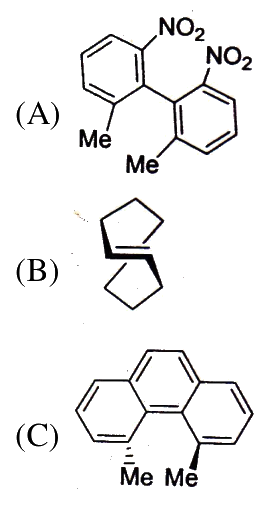
Q62 mcq
The order of carbonyl stretching frequency in the IR spectra of ketone, amide and anhydride is:
a.
Anhydride > amide > ketone
b.
Ketone > amide > anhydride
c.
Amide > anhydride > ketone
d.
Anhydride > ketone > amide
Correct Answer & Step-by-Step Solution Locked

Sign in free to reveal the correct answer and AI explanation for this question.
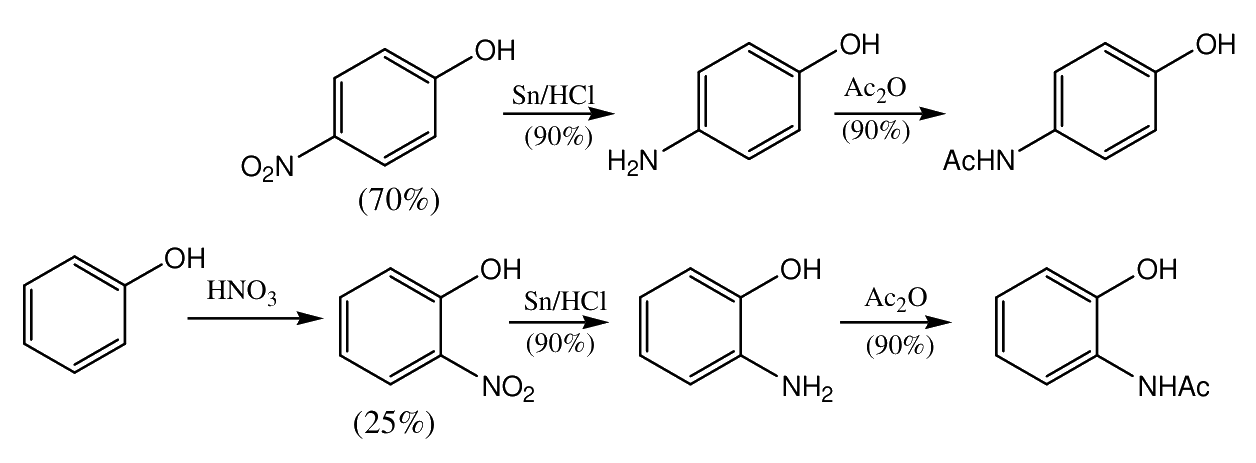
Q63 mcq
In the mass spectrum of the compound given below, during the $\alpha-\text{cleavage}$, the order of preferential loss of groups is:
Question 43 image
a.
$\text{Me} > \text{C}_3\text{H}_7 > \text{Et}$
b.
$\text{C}_3\text{H}_7 > \text{Et} > \text{Me}$
c.
$\text{Et} > \text{Me} > \text{C}_3\text{H}_7$
d.
$\text{Et} > \text{C}_3\text{H}_7 > \text{Me}$
Correct Answer & Step-by-Step Solution Locked

Sign in free to reveal the correct answer and AI explanation for this question.

Q64 mcq
The reaction given below is an example of
Question 44 image
a.
1, 3-sigmatropic hydrogen shift
b.
1, 3-sigmatropic methyl shift
c.
1, 5-sigmatropic hydrogen shift
d.
1, 5-sigmatropic methyl shift.
Correct Answer & Step-by-Step Solution Locked

Sign in free to reveal the correct answer and AI explanation for this question.
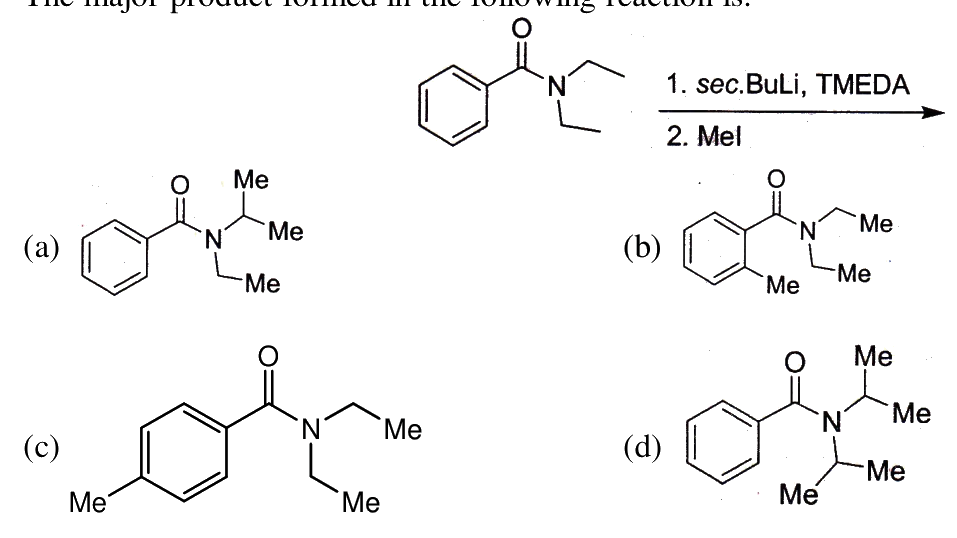
Q65 mcq
The concerted photochemical reaction between two olefins leading to a cyclobutane ring is:
a.
$_{\pi}2_s + {_{\pi}2_a}$ cycloaddition
b.
$_{\pi}2_s + {_{\pi}2_s}$ cycloaddition
c.
$_{\sigma}2_s + {_{\sigma}2_s}$ cycloaddition
d.
$_{\pi}2_s + {_{\sigma}2_a}$ cycloaddition
Correct Answer & Step-by-Step Solution Locked

Sign in free to reveal the correct answer and AI explanation for this question.
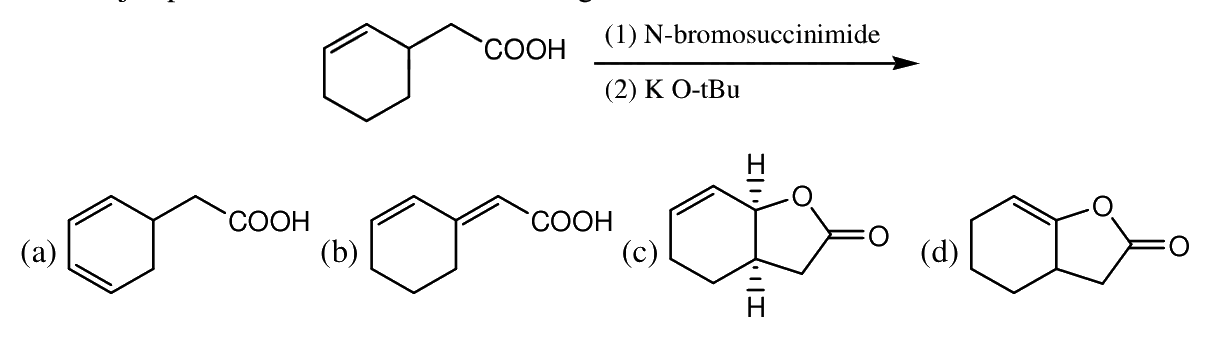
Q66 mcq
Addition of $\text{BH}_3$ to a carbon-carbon double bond is:
a.
anti-Markovinikov syn addition
b.
anti-Markovnikov anti addition
c.
Markovnikov syn addition
d.
Markovnikov anti addition.
Correct Answer & Step-by-Step Solution Locked

Sign in free to reveal the correct answer and AI explanation for this question.
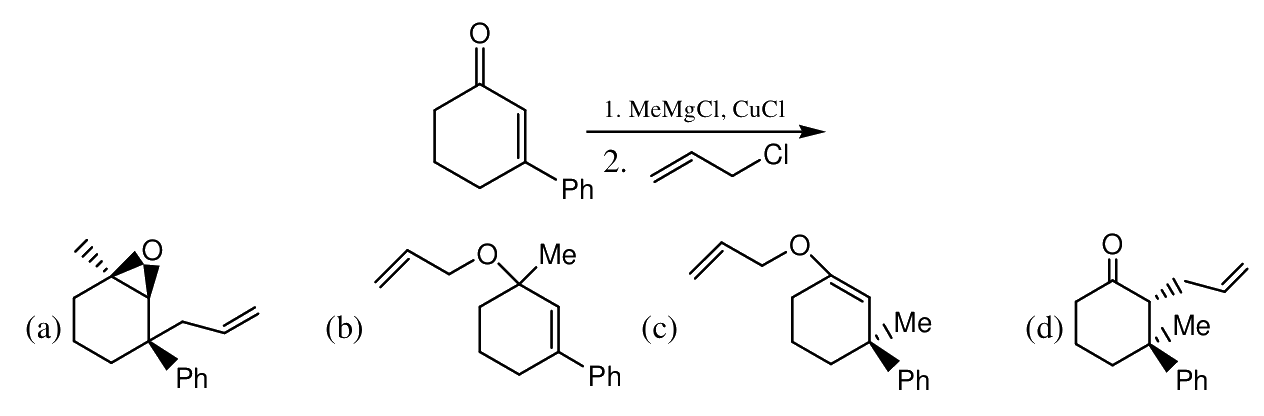
Q67 mcq
The absorption at $\lambda_{\max}\ 279\text{ nm } (\varepsilon = 15)$ in the UV spectrum of acetone is due to
a.
$\pi - \pi^*$ transition
b.
$\text{n} - \pi^*$ transition
c.
$\sigma - \sigma^*$ transition
d.
$\pi - \sigma^*$ transition
Correct Answer & Step-by-Step Solution Locked

Sign in free to reveal the correct answer and AI explanation for this question.
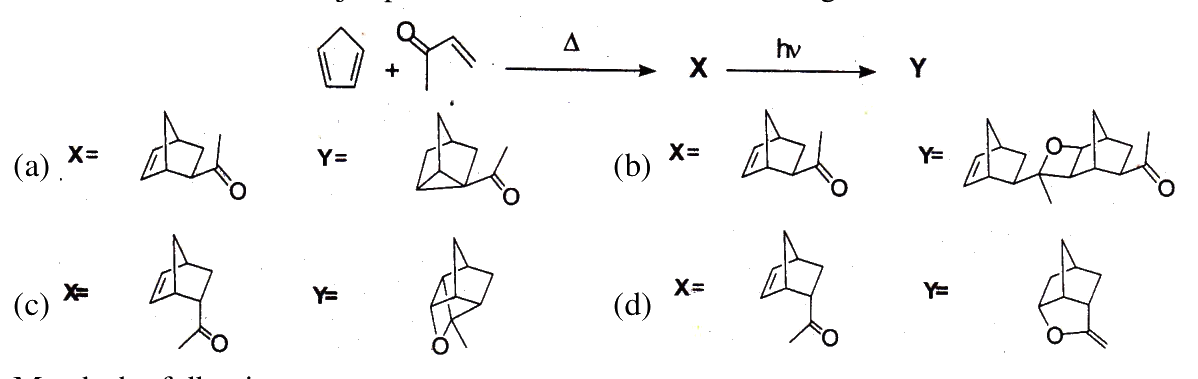
Q68 mcq
The reaction given below is an example of
Question 48 image
a.
$\text{E}_2$-elimination
b.
$\text{E}_1$-elimination
c.
syn-elimination
d.
$\text{E}_1\text{CB}$-elimination
Correct Answer & Step-by-Step Solution Locked

Sign in free to reveal the correct answer and AI explanation for this question.
Q69 mcq
The suitable reagent for the following conversion is:
Question 49 image
a.
$\text{m-CPBA}$
b.
$\text{H}_2\text{O}_2/\text{AcOH}$
c.
$^t\text{BuOH}/\text{HCl}$
d.
$\text{H}_2\text{O}_2/\text{NaOH}$
Correct Answer & Step-by-Step Solution Locked

Sign in free to reveal the correct answer and AI explanation for this question.

Q70 mcq
The relative rates of solvolysis of iodides A-C are
Question 50 image
a.
$\text{C} > \text{A} > \text{B}$
b.
$\text{C} > \text{B} > \text{A}$
c.
$\text{B} > \text{C} > \text{A}$
d.
$\text{B} > \text{A} > \text{C}$
Correct Answer & Step-by-Step Solution Locked

Sign in free to reveal the correct answer and AI explanation for this question.

Q71 mcq
Alkali metal superoxides are obtained by the reaction of
a.
Oxygen with alkali metals in liquid ammonia.
b.
Water with alkali metals in liquid ammonia
c.
$\text{H}_2\text{O}_2$ with alkali metals.
d.
$\text{H}_2\text{O}_2$ with alkali metals in liquid ammonia.
Correct Answer & Step-by-Step Solution Locked

Sign in free to reveal the correct answer and AI explanation for this question.

Q72 mcq
$\text{H}_2\text{O}_2$ reduces (A) $[\text{Fe}(\text{CN})_6]^{3-}$ (B) $\text{KIO}_4$ (C) $\text{Ce}(\text{SO}_4)_2$ (D) $\text{SO}_3^{2-}$
a.
A and B only
b.
B and C only
c.
C and D only
d.
B and D only
Correct Answer & Step-by-Step Solution Locked

Sign in free to reveal the correct answer and AI explanation for this question.

Q73 mcq
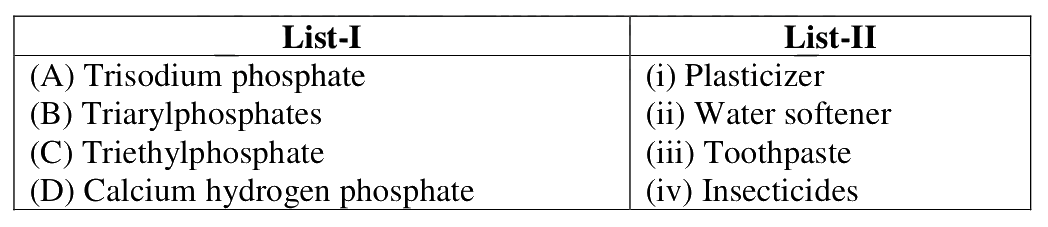
Match List-I (compounds) with List-II (application) and select the correct answer using the codes given below the lists. \begin{tabular}{|l|l|} \hline \textbf{List-I} & \textbf{List-II} \\ \hline (A) Trisodium phosphate & (i) Plasticizer \\ (B) Triarylphosphates & (ii) Water softener \\ (C) Triethylphosphate & (iii) Toothpaste \\ (D) Calcium hydrogen phosphate & (iv) Insecticides \\ \hline \end{tabular}
Question 53 image
a.
(A)-ii (B)-i (C)-iv (D)-iii
b.
(A)-i (B)-ii (C)-iv (D)-iii
c.
(A)-ii (B)-iii (C)-iv (D)-i
d.
(A)-iii (B)-i (C)-ii (D)-iv
Correct Answer & Step-by-Step Solution Locked

Sign in free to reveal the correct answer and AI explanation for this question.

Q74 mcq
Among the following statements, identify the correct ones for complexes of lanthanide(III) ion. (A) Metal-ligand bond is significantly ionic. (B) Complexes rarely show isomerism. (C) The coordination number is not more than 8. (D) The magnetic moments are not accounted even approximately by spin only value for majority of lanthanides.
a.
A, B and D only
b.
A, B and C only
c.
B and C only
d.
A and D only.
Correct Answer & Step-by-Step Solution Locked

Sign in free to reveal the correct answer and AI explanation for this question.

Q75 mcq
According to VSEPR theory, the molecule/ion having ideal tetrahedral shape is:
a.
$\text{SF}_4$
b.
$\text{SO}_4^{2-}$
c.
$\text{S}_2\text{Cl}_2$
d.
$\text{SO}_2\text{Cl}_2$
Correct Answer & Step-by-Step Solution Locked

Sign in free to reveal the correct answer and AI explanation for this question.

Q76 mcq
The complex $\left[\text{Mn}(\text{H}_2\text{O})_6\right]^{2+}$ has very light pink colour. The best reason for it is
a.
The complex does not have a charge transfer transition.
b.
d-d transitions here are orbital forbidden but spin allowed.
c.
d-d transitions here are orbital allowed but spin forbidden.
d.
d-d transitions here are both orbital forbidden and spin forbidden.
Correct Answer & Step-by-Step Solution Locked

Sign in free to reveal the correct answer and AI explanation for this question.

Q77 mcq
The highest occupied MO in $\text{N}_2$ and $\text{O}_2^+$ respectively are (take x-axis as internuclear axis)
a.
$\sigma 2\text{p}_x, \pi^* 2\text{p}_y$
b.
$\pi 2\text{p}_y, \pi 2\text{p}_z$
c.
$\sigma^* 2\text{p}_x, \sigma 2\text{p}_x$
d.
$\pi^* 2\text{p}_y, \pi^* 2\text{p}_z$
Correct Answer & Step-by-Step Solution Locked

Sign in free to reveal the correct answer and AI explanation for this question.

Q78 mcq
The correct order of LMCT energies is:
a.
$\text{MnO}_4^- < \text{CrO}_4^{2-} < \text{VO}_4^{3-}$
b.
$\text{MnO}_4^- > \text{CrO}_4^{2-} > \text{VO}_4^{3-}$
c.
$\text{MnO}_4^- > \text{CrO}_4^{2-} < \text{VO}_4^{3-}$
d.
$\text{MnO}_4^- < \text{CrO}_4^{2-} > \text{VO}_4^{3-}$
Correct Answer & Step-by-Step Solution Locked

Sign in free to reveal the correct answer and AI explanation for this question.

Q79 mcq
Carboxypeptidase contains:
a.
$\text{Zn(II)}$ and hydrolyses $\text{CO}_2$.
b.
$\text{Zn(II)}$ and hydrolyses peptide bonds.
c.
$\text{Mg(II)}$ and hydrolyses $\text{CO}_2$.
d.
$\text{Mg(II)}$ and hydrolyses peptide bonds.
Correct Answer & Step-by-Step Solution Locked

Sign in free to reveal the correct answer and AI explanation for this question.

Q80 mcq
In the EPR spectrum of tetragonal $\text{Cu(II)}$ complex, when $g_\parallel > g_\perp > g_e$ the unpaired electron resides in the orbital.
a.
$\text{d}_{xy}$
b.
$\text{d}_{x^2-y^2}$
c.
$\text{d}_{z^2}$
d.
$\text{d}_{xz}$
Correct Answer & Step-by-Step Solution Locked

Sign in free to reveal the correct answer and AI explanation for this question.

Q81 mcq
The oxidative addition and reductive elimination steps are favoured by
a.
Electron rich metal centres.
b.
Electron deficient metal centers
c.
Electron deficient and electron rich metal centers respectively.
d.
Electron rich and electron deficient metal centers respectively.
Correct Answer & Step-by-Step Solution Locked

Sign in free to reveal the correct answer and AI explanation for this question.

Q82 mcq
Identify the order according to increasing stability of the following organometallic compounds, $\text{TiMe}_4$, $\text{Ti}(\text{CH}_2\text{Ph})_4$, $\text{Ti}(\text{i-Pr})_4$ and $\text{TiEt}_4$. $(\text{Me} = \text{methyl}, \text{Ph} = \text{phenyl}, \text{i-Pr} = \text{isopropyl}, \text{Et} = \text{ethyl})$
a.
$\text{Ti}(\text{CH}_2\text{Ph})_4 < \text{Ti}(\text{i-Pr})_4 < \text{TiEt}_4 < \text{TiMe}_4$
b.
$\text{TiEt}_4 < \text{TiMe}_4 < \text{Ti}(\text{i-Pr})_4 < \text{Ti}(\text{CH}_2\text{Ph})_4$
c.
$\text{Ti}(\text{i-Pr})_4 < \text{TiEt}_4 < \text{TiMe}_4 < \text{Ti}(\text{CH}_2\text{Ph})_4$
d.
$\text{TiMe}_4 < \text{TiEt}_4 < \text{Ti}(\text{i-Pr})_4 < \text{Ti}(\text{CH}_2\text{Ph})_4$
Correct Answer & Step-by-Step Solution Locked

Sign in free to reveal the correct answer and AI explanation for this question.

Q83 mcq
Among the metals, Mn, Fe, Co and Ni, the ones those would react in its native form directly with CO giving metal carbonyl compounds are:
a.
Co and Mn
b.
Mn and Fe
c.
Fe and Ni
d.
Ni and Co
Correct Answer & Step-by-Step Solution Locked

Sign in free to reveal the correct answer and AI explanation for this question.

Q84 mcq
The molecule with highest number of lone-pairs and has a linear shape based on VSEPR theory is:
a.
$\text{CO}_2$
b.
$\text{I}_3^-$
c.
$\text{NO}_2^-$
d.
$\text{NO}_2^+$
Correct Answer & Step-by-Step Solution Locked

Sign in free to reveal the correct answer and AI explanation for this question.

Q85 mcq
Given, $$\text{Ag}^+ + \text{e} \rightarrow \text{Ag}, \quad \text{E}_0 = 0.50\text{ V}$$ $$\text{Cu}^{2+} + 2\text{e} \rightarrow \text{Cu}, \quad \text{E}_0 = 0.34\text{ V}$$ A $100\text{ ml}$ solution is $1080\text{ mg}$ with respect to $\text{Ag}^+$ and $635\text{ mg}$ with respect to $\text{Cu}^{2+}$. If $0.1\text{mg } \text{Ag}^+$ left in the solution is considered to be the complete deposition of $\text{Ag}^+$, the cathode potential, so that no copper is deposited during the process, is:
a.
$0.16\text{ V}$
b.
$0.84\text{ V}$
c.
$0.31\text{ V}$
d.
$-0.16\text{ V}$
Correct Answer & Step-by-Step Solution Locked

Sign in free to reveal the correct answer and AI explanation for this question.

Q86 mcq
In the $\mathrm{H_2Ru_6(CO)_{18}}$ cluster, containing 8-coordinated Ru centers, the hydrogen atoms are
a.
Both terminal
b.
One terminal and the other bridging
c.
Both bridging between two Ru centers
d.
Both bridging between three Ru centers.
Correct Answer & Step-by-Step Solution Locked

Sign in free to reveal the correct answer and AI explanation for this question.

Q87 mcq
In the hydroformylation reaction, the intermediate $\mathrm{CH_3CH_2CH_2Co(CO)_4}$:
a.
Forms are acyl intermediate $\mathrm{CH_3CH_2CH_2COCo(CO)_3}$
b.
Forms an adduct with an olefin reactant.
c.
Reacts with $\mathrm{H_2}$.
d.
Eliminates propane.
Correct Answer & Step-by-Step Solution Locked

Sign in free to reveal the correct answer and AI explanation for this question.

Q88 mcq
Statement I: The sizes of Zr and Hf are similar Statement II: Size of Hf is affected by lanthanide contraction.
a.
Statement I and II are correct and II is correct explanation of I.
b.
Statement I and II are correct but II is not a correct explanation of I.
c.
Statement I is correct and II is incorrect
d.
Statements I and II both are incorrect.
Correct Answer & Step-by-Step Solution Locked

Sign in free to reveal the correct answer and AI explanation for this question.

Q89 mcq
Consider the compounds, (A) $\mathrm{SnF_4}$, (B) $\mathrm{SnCl_4}$ and (C) $\mathrm{R_3SnCl}$. The nuclaer quadrupole splitting are observed for.
a.
(A), (B) and (C)
b.
(A) and (B) only
c.
(B) an d (C) only
d.
(A) and (C) only
Correct Answer & Step-by-Step Solution Locked

Sign in free to reveal the correct answer and AI explanation for this question.

Q90 mcq
Consider two redox pairs (1) $\mathrm{Cr(II)/Ru(III)}$ (2) $\mathrm{Cr(II)/Co(III)}$ The rate of acceleration in going from a outer-sphere to a inner-sphere mechanism is lower for (1) relative to (2). Its correct explanation is:
a.
HOMO/LUMO are $\sigma^*$ and $\sigma^*$ respectively.
b.
HOMO/LUMO are $\sigma^*$ and $\pi^*$ respectively.
c.
HOMO/LUMO are $\pi^*$ and $\sigma^*$ respectively.
d.
HOMO/LUMO are $\pi^*$ and $\pi^*$ respectively.
Correct Answer & Step-by-Step Solution Locked

Sign in free to reveal the correct answer and AI explanation for this question.

Q91 mcq
The correct value of isomer shift (in Mossbauer spectra) and its explanation for $\mathrm{Fe(II)-TPP}$ and $\mathrm{Fe(III)-TPP}$ respectively from the following are: (TPP = tetraphenylporphyrinate) (A) $0.52\text{ mms}^{-1}$ (B) $0.45\text{ mms}^{-1}$ (C) Increase in s electron density (D) Decrease in s electron density.
a.
(A) and (D); (B) and (C)
b.
(A) and (C); (B) and (C)
c.
(B) and (D); (A) and (D)
d.
(B) and (D); (A) and (C)
Correct Answer & Step-by-Step Solution Locked

Sign in free to reveal the correct answer and AI explanation for this question.

Q92 mcq
In IR spectrum of $[\mathrm{Co(CN)_5H}]^{3-}$ the $\mathrm{Co-H}$ stretch is observed at $1840\text{ cm}^{-1}$. The $(\mathrm{Co-D})$ stretch in $[\mathrm{Co(CN)_5D}]^{3-}$ will appear at nearly
a.
$1300\text{ cm}^{-1}$
b.
$1400\text{ cm}^{-1}$
c.
$1500\text{ cm}^{-1}$
d.
$1600\text{ cm}^{-1}$.
Correct Answer & Step-by-Step Solution Locked

Sign in free to reveal the correct answer and AI explanation for this question.

Q93 mcq
For the complexes (A) $[\mathrm{Ni(H_2O)_6}]^{2+}$ (B) $[\mathrm{Mn(H_2O)_6}]^{2+}$ (C) $[\mathrm{Cr(H_2O)_6}]^{3+}$ (D) $[\mathrm{Ti(H_2O)_6}]^{3+}$, the ideal octahedral geometry will not be observed in
a.
(A) and (D)
b.
(C) and (D)
c.
(B) only
d.
(D) only
Correct Answer & Step-by-Step Solution Locked

Sign in free to reveal the correct answer and AI explanation for this question.

Q94 mcq
Among the following, the number of anhydrides of acids are $\mathrm{CO}$, $\mathrm{NO}$, $\mathrm{N_2O}$, $\mathrm{B_2O_3}$, $\mathrm{N_2O_5}$, $\mathrm{SO_3}$ and $\mathrm{P_4O_{10}}$.
a.
3
b.
4
c.
5
d.
6
Correct Answer & Step-by-Step Solution Locked

Sign in free to reveal the correct answer and AI explanation for this question.

Q95 mcq
For a given nuclear fission reaction of $^{235}\text{U}$ $$^{235}_{92}\text{U} + {^1_0}\text{n} \longrightarrow {^{142}_{56}}\text{Ba} + {^{91}_{36}}\text{Kr} + 3{^1_0}\text{n}$$ the amount of energy (in $\text{kJ/mol}$) released during this process is (given $^{235}\text{U} = 235.0439\text{ amu}$, $^{142}\text{Ba} = 141.9164\text{ amu}$, $^{91}\text{Kr} = 90.9234\text{ amu}$, $\text{neutron} = 1.00866\text{ amu}$)
a.
$3.12 \times 10^{12}$
b.
$2.8 \times 10^{11}$
c.
$1.0 \times 10^9$
d.
$1.68 \times 10^{10}$
Correct Answer & Step-by-Step Solution Locked

Sign in free to reveal the correct answer and AI explanation for this question.

Q96 mcq
The decomposition of gaseous acetaldehyde at $\text{T(K)}$ follows second order kinetics. The half-life of this reaction is $400\text{ s}$ when the initial pressure is $250\text{ Torr}$. What will be the rate constant (in $\text{Torr}^{-1}\text{ s}^{-1}$) and half-life (in $\text{s}$) respectively, if the initial pressure of the acetaldehyde is $200\text{ Torr}$ at the same temperature?
a.
$10^5$ and $500$
b.
$10^{-5}$ and $400$
c.
$10^{-4}$ and $400$
d.
$10^{-5}$ and $500$
Correct Answer & Step-by-Step Solution Locked

Sign in free to reveal the correct answer and AI explanation for this question.

Q97 mcq
For an enzyme catalyzed reaction, a Lineweaver-Burk plot gave the following data: $\text{slope} = 40\text{ s}$ $\text{intercept} = 4\text{ (mmol dm}^{-3}\text{ s}^{-1})^{-1}$. If the initial concentration of enzyme is $2.5 \times 10^{-9}\text{ mol dm}^{-3}$, what is the catalytic efficiency (in $\text{dm}^3\text{ mol}^{-1}\text{ s}^{-1}$) of the reaction?
a.
$10^5$
b.
$10^6$
c.
$10^7$
d.
$10^4$
Correct Answer & Step-by-Step Solution Locked

Sign in free to reveal the correct answer and AI explanation for this question.

Q98 mcq
A hydrogenic orbital with radial function of the form $r^\alpha \exp[-\beta r]$ and $\phi-\text{part}$ as $\exp[-3i\ \phi]$ corresponds to
a.
$n > 4, \ \ell > 3, \ m = 3$
b.
$n = 4, \ \ell = 3, \ m = -3$
c.
$n = 4, \ \ell > 3, \ m = 3$
d.
$n > 4, \ \ell = 3, \ m = -3$
Correct Answer & Step-by-Step Solution Locked

Sign in free to reveal the correct answer and AI explanation for this question.

Q99 mcq
For an assembly of molecules (molar mass = $\text{M}$) at temperature $\text{T}$, the standard deviation of Maxweller's speed is approximately
a.
$0.7\sqrt{\dfrac{\text{RT}}{\text{M}}}$
b.
$1.4\sqrt{\dfrac{\text{RT}}{\text{M}}}$
c.
$0.7\sqrt{\dfrac{\text{M}}{\text{RT}}}$
d.
$1.4\sqrt{\dfrac{\text{M}}{\text{RT}}}$
Correct Answer & Step-by-Step Solution Locked

Sign in free to reveal the correct answer and AI explanation for this question.

Q100 mcq
The unperturbed energy levels of a system are $\epsilon_0 = 0$, $\epsilon_1 = 2$ and $\epsilon_2 = 4$. The second order correction to energy for the ground state in pressure of the perturbation $\text{V}$ for which $\text{V}_{10} = 2$, $\text{V}_{20} = 4$ and $\text{V}_{12} = 6$ has been found to be
a.
$-6$
b.
$0$
c.
$+6$
d.
$-8$
Correct Answer & Step-by-Step Solution Locked

Sign in free to reveal the correct answer and AI explanation for this question.

Q101 mcq
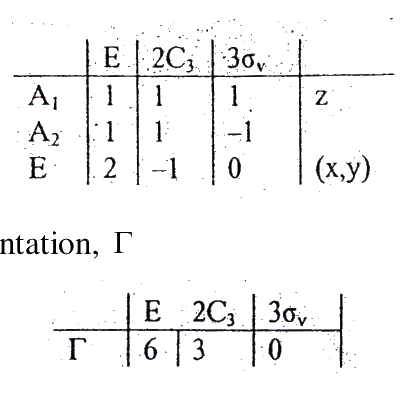
Given the character table of the point group $\text{C}_{3\text{v}}$: \begin{tabular}{|c|c|c|c|l|} \hline & $\text{E}$ & $2\text{C}_3$ & $3\sigma_\text{v}$ & \\ \hline $\text{A}_1$ & $1$ & $1$ & $1$ & $z$ \\ $\text{A}_2$ & $1$ & $1$ & $-1$ & \\ $\text{E}$ & $2$ & $-1$ & $0$ & $(x, y)$ \\ \hline \end{tabular} Consider the reducible representation, $\Gamma$ \begin{tabular}{|c|c|c|c|} \hline & $\text{E}$ & $2\text{C}_3$ & $3\sigma_\text{v}$ \\ \hline $\Gamma$ & $6$ & $3$ & $0$ \\ \hline \end{tabular} Its irreducible components are
Question 81 image
a.
$\text{E} + 2\text{A}_1 + 2\text{A}_2$
b.
$2\text{E} + \text{A}_1 + \text{A}_2$
c.
$3\text{A}_1 + 3\text{A}_2$
d.
$\text{E}^2 + 2\text{A}_1$
Correct Answer & Step-by-Step Solution Locked

Sign in free to reveal the correct answer and AI explanation for this question.

Q102 mcq
Refer to the character table of the point group $\text{C}_{3\text{v}}$ given above. Find which of the following transition is forbidden
a.
$\text{a}_1 \longleftrightarrow \text{a}_1$
b.
$\text{a}_1 \longleftrightarrow \text{e}$
c.
$\text{a}_2 \longleftrightarrow \text{e}$
d.
$\text{a}_1 \longleftrightarrow \text{a}_2$
Correct Answer & Step-by-Step Solution Locked

Sign in free to reveal the correct answer and AI explanation for this question.

Q103 mcq
The electronic configuration for gadalonium (Gd) is $[\text{Xe}]4\text{f}^75\text{d}^16\text{s}^2$, where as that of $\text{Gd}^{2+}$ is:
a.
$[\text{Xe}]4\text{f}^55\text{d}6\text{s}^2$
b.
$[\text{Xe}]4\text{f}^66\text{s}^2$
c.
$[\text{Xe}]\text{f}^65\text{d}^16\text{s}^1$
d.
$[\text{Xe}]4\text{f}^75\text{d}^1$
Correct Answer & Step-by-Step Solution Locked

Sign in free to reveal the correct answer and AI explanation for this question.

Q104 mcq
The possible J values for $^3\text{D}$ term symbol are
a.
2
b.
3
c.
4
d.
5
Correct Answer & Step-by-Step Solution Locked

Sign in free to reveal the correct answer and AI explanation for this question.

Q105 mcq
The energy levels for cyclobutadiene are $\alpha + 2\beta$, $\alpha$, $\alpha$ and $\alpha - 2\beta$. The delocalization energy in this molecule is:
a.
0
b.
$-4\beta$
c.
$-8\beta$
d.
$4\alpha$
Correct Answer & Step-by-Step Solution Locked

Sign in free to reveal the correct answer and AI explanation for this question.

Q106 mcq
The variation of equilibrium constant (K) of a certain reaction with temperature (T) is $$\ln k = 3.0 + \frac{2.0 \times 10^4}{\text{T}}$$ given $\text{R} = 8.3\text{ Jk}^{-1}\text{mol}^{-1}$, the values of $\Delta\text{H}^0$ and $\Delta\text{S}^0$ are.
a.
$166\text{ kJ mol}^{-1}$ and $24.9\text{ Jk}^{-1}\text{ mol}^{-1}$.
b.
$166\text{ kJ mol}^{-1}$ and $-24.9\text{ Jk}^{-1}\text{ mol}^{-1}$
c.
$-166\text{ kJ mol}^{-1}$ and $24.9\text{ Jk}^{-1}\text{ mol}^{-1}$
d.
$-166\text{ kJ mol}^{-1}$ and $24.9\text{ Jk}^{-1}\text{ mol}^{-1}$
Correct Answer & Step-by-Step Solution Locked

Sign in free to reveal the correct answer and AI explanation for this question.

Q107 mcq
The chemical potential of component 1 in a solution of binary mixture is $\mu_1 = \mu_1^0 + \text{RT}\ln \text{p}_1$, when $\text{p}_1$ is the partial pressure of component 1 vapour phase. The standard state $\mu_1^0$ is:
a.
Independent of temperature and pressure
b.
Depends on temperature and pressure both
c.
Depends on temperature only
d.
Depends on pressure only
Correct Answer & Step-by-Step Solution Locked

Sign in free to reveal the correct answer and AI explanation for this question.

Q108 mcq
Debey-Hückel screening length ($\kappa^{-1}$) is a measure of size of diffuse ion cloud around an ion, provided $\sqrt{\frac{2\text{e}^2\text{N}_{\text{A}}}{\epsilon_0\text{ k}_{\text{B}}\text{T}}} \approx 30\left(\text{nm}\sqrt{\text{mol}\text{kg}^{-1}}\right)^{-1}$ at 298K, which of the following values of $\kappa^{-1}$ is true for a 0.03 molal solution for $\text{Na}_2\text{SO}_4$ in water ($\epsilon_{\text{r}} \approx 100$)?
a.
$\frac{10}{9}\text{ nm}$
b.
$\frac{9}{10}\text{ nm}$
c.
$\frac{10\sqrt{2}}{9}\text{ nm}$
d.
$\frac{9}{10\sqrt{2}}\text{ nm}$
Correct Answer & Step-by-Step Solution Locked

Sign in free to reveal the correct answer and AI explanation for this question.

Q109 mcq
If the ratio of composition of oxidized and reduced species in electrochemical cell, is given as $\frac{[\text{O}]}{[\text{R}]} = \text{e}^2$, the correct potential difference will be
a.
$\text{E} - \text{E}^{0'} = +\frac{2\text{RT}}{\text{nF}}$
b.
$\text{E} - \text{E}^{0'} = -\frac{2\text{RT}}{\text{nF}}$
c.
$\text{E} - \text{E}^{0'} = \frac{\text{RT}}{\text{nF}}$
d.
$\text{E} - \text{E}^{0'} = -\frac{\text{RT}}{\text{nF}}$
Correct Answer & Step-by-Step Solution Locked

Sign in free to reveal the correct answer and AI explanation for this question.

Q110 mcq
If the equilibrium constants for the reactions 1 and 2 (1) $\text{CO}(\text{g}) + \text{H}_2\text{O}(\text{g}) \rightleftharpoons \text{CO}_2(\text{g}) + \text{H}_2(\text{g})$ (2) $\text{CH}_4(\text{g}) + \text{H}_2\text{O}(\text{g}) \rightleftharpoons \text{CO}(\text{g}) + 3\text{H}_2(\text{g})$ are $\text{k}_1$ and $\text{k}_2$, the equilibrium constant for the reaction $$\text{CH}_4(\text{g}) + 2\text{H}_2\text{O}(\text{g}) \rightleftharpoons \text{CO}_2(\text{g}) + 4\text{H}_2(\text{g})$$ is:
a.
$\text{k}_1 + \text{k}_2$
b.
$\text{k}_1 - \text{k}_2$
c.
$\text{k}_1\text{k}_2$
d.
$\text{k}_1 / \text{k}_2$
Correct Answer & Step-by-Step Solution Locked

Sign in free to reveal the correct answer and AI explanation for this question.

Q111 mcq
The virial expansion for a real gas can be written in either of the following forms: $$\frac{\text{P}\overline{\text{V}}}{\text{RT}} = 1 + \text{B}_{\text{p}}\text{P} + \text{C}_{\text{p}}\text{P}^2 + .....$$ $$= 1 + \text{B}_{\text{v}}\text{V} + \text{C}_{\text{v}}\text{V}^2 + .....$$ If $\text{B}_{\text{v}} = \alpha\text{B}_{\text{p}}$, the value of $\alpha$ would be
a.
$\text{PV/RT}$
b.
$\text{RT/PV}$
c.
$\text{PV}$
d.
$\text{RT}$
Correct Answer & Step-by-Step Solution Locked

Sign in free to reveal the correct answer and AI explanation for this question.

Q112 mcq
A certain system of noninteracting particles has the single-particle patition has the single-particle partition function $\text{f} = \text{A}\frac{\text{T}^\text{m}}{\text{V}}$ where $\text{A}$ is some constant. The average energy per particle will be
a.
$\text{m}\kappa\text{T}$
b.
$\text{A}\kappa\text{T}$
c.
$\kappa\text{T} / \text{m}$
d.
$\kappa\text{T} / \text{A}$
Correct Answer & Step-by-Step Solution Locked

Sign in free to reveal the correct answer and AI explanation for this question.

Q113 mcq
Observe the following aqueous solutions of same compound. All the measurements are made at same wavelength and same temperature. \textbf{Solution A:} The transmittance of $0.1\text{ mol dm}^{-3}$ using $1\text{ cm}$ cell is $0.5$. \textbf{Solution B:} The optical density $0.5\text{ mol dm}^{-3}$ is measured using $1\text{ mm}$ cell. \textbf{Solution C:} The transmittance of this solution is $0.1$. The optical density of these solutions follow the order. ($\log 20 = 1.3010$; $\log 30 = 1.4771$, $\log 50 = 1.6990$
a.
$\text{A} > \text{B} > \text{C}$
b.
$\text{B} > \text{C} > \text{A}$
c.
$\text{B} > \text{A} > \text{C}$
d.
$\text{C} > \text{A} > \text{B}$
Correct Answer & Step-by-Step Solution Locked

Sign in free to reveal the correct answer and AI explanation for this question.

Q114 mcq
The rotational constant of $^{14}\text{N}_2$ is $2\text{ cm}^{-1}$. The wave number of incident radiation in a Raman spectrometer is $20487\text{ cm}^{-1}$. What is the wave number of first scattered Stokes line (in $\text{cm}^{-1}$) of $^{14}\text{N}_2$?
a.
$20479$
b.
$20475$
c.
$20499$
d.
$20495$
Correct Answer & Step-by-Step Solution Locked

Sign in free to reveal the correct answer and AI explanation for this question.

Q115 mcq
For a certain particle encountering a barrier, the tunneling probability is approximately $\text{e}^{-10}$. If the mass is halved and width of the barrier (rectangular) doubled, approximate value of the tunneling probability will be
a.
$\text{e}^{-10/\sqrt{2}}$
b.
$\text{e}^{-10\sqrt{2}}$
c.
$\text{e}^{-20\sqrt{2}}$
d.
$\text{e}^{-10}$
Correct Answer & Step-by-Step Solution Locked

Sign in free to reveal the correct answer and AI explanation for this question.

Q116 mcq
An operator $\text{A}$ is defined as $\text{A} = -\frac{\text{d}}{\text{dx}} + \text{x}$. Which one of the following statements is true?
a.
$\text{A}$ is a Hermitian operator.
b.
$\text{A}^\dagger$ is an antihermitian operator.
c.
Both $\text{AA}^\dagger$ and $\text{A}^\dagger\text{A}$ are Hermitian.
d.
$\text{AA}^\dagger$ is Hermitian, but $\text{A}^\dagger\text{A}$ is antihermitian.
Correct Answer & Step-by-Step Solution Locked

Sign in free to reveal the correct answer and AI explanation for this question.

Q117 mcq
Isothermal which has fractional coverage, linearly, dependent on pressure at low pressures but almost indepenent at high pressure is called
a.
BET isotherm
b.
Langmuir isotherm
c.
Freundlich isotherm
d.
Temkin isotherm
Correct Answer & Step-by-Step Solution Locked

Sign in free to reveal the correct answer and AI explanation for this question.

Q118 mcq
A one-dimensional crystal of lattice dimension 'a' is metallic. If the structure is distorted in such a way that the lattice dimension is enhanced to '2a'.
a.
The electronic structure remains unchagned.
b.
The width of conduction band decreases and a band gap is generated.
c.
The width of conduction band increases
d.
The width of the conduction band remains unchanged.
Correct Answer & Step-by-Step Solution Locked

Sign in free to reveal the correct answer and AI explanation for this question.

Q119 mcq
For a $\text{H}_2$ molecule, the ground state wavefunction is $\psi(1,2) = \phi(1,2)\sigma(1,2)$ where $\phi$ refers to the space part and $\sigma$ to the spin part. Given that $\phi(1,2) = \phi(2,1)$, the form of $\sigma(1,2)$ would be
a.
$\alpha(1)\beta(2)$
b.
$\alpha(2)\beta(1)$
c.
$\alpha(1)\beta(2) - \alpha(2)\beta(1)$
d.
$\alpha(1)\beta(2) + \alpha(2)\beta(1)$
Correct Answer & Step-by-Step Solution Locked

Sign in free to reveal the correct answer and AI explanation for this question.

Q120 mcq
There are several types of mean molar masses for polymer and they are dependent on experimental methods like: (1) Osmometry (2) Light scattering (3) Sedimentation. Correct relation between mean molar masses and experimental method is:
a.
$\bar{\text{M}}_{\text{n}} \Leftrightarrow (3), \bar{\text{M}}_{\text{w}} \Leftrightarrow (2), \bar{\text{M}}_{\text{z}} \Leftrightarrow (1)$
b.
$\bar{\text{M}}_{\text{n}} \Leftrightarrow (2), \bar{\text{M}}_{\text{w}} \Leftrightarrow (3), \bar{\text{M}}_{\text{z}} \Leftrightarrow (1)$
c.
$\bar{\text{M}}_{\text{n}} \Leftrightarrow (1), \bar{\text{M}}_{\text{w}} \Leftrightarrow (2), \bar{\text{M}}_{\text{z}} \Leftrightarrow (3)$
d.
$\bar{\text{M}}_{\text{n}} \Leftrightarrow (1), \bar{\text{M}}_{\text{w}} \Leftrightarrow (3), \bar{\text{M}}_{\text{z}} \Leftrightarrow (2)$
Correct Answer & Step-by-Step Solution Locked

Sign in free to reveal the correct answer and AI explanation for this question.

Q121 mcq
An organic compound ($\text{C}_7\text{H}_{12}\text{O}_2$) exhibited the following data in the $^1\text{H}$ NMR spectrum. $\delta$ 7.10 (1 H, d t, $J = 16$ and 7.2 Hz), 5.90 (1H, d t, $J = 16$ and 2 Hz), 4.1 (2H, q, $J = 7.2\text{ Hz}$), 2.10 (2H, m), 1.25 (3H, t, $J = 7.2\text{ Hz}$), 0.90 (3H, t, $J = 7.2\text{ Hz}$) ppm. The compound, among the choices given below, is:
Question 101 image
a.
(See image)
b.
(See image)
c.
(See image)
d.
(See image)
Correct Answer & Step-by-Step Solution Locked

Sign in free to reveal the correct answer and AI explanation for this question.

Q122 mcq
In the broad band decoupled $^{13}\text{C}$ NMR spectrum, the number of signals appearing for the bicyclooctane A–C, respectively, are
Question 102 image
a.
Five, four and eight
b.
Three, two and five
c.
Five, four and five
d.
Three, two and eight
Correct Answer & Step-by-Step Solution Locked

Sign in free to reveal the correct answer and AI explanation for this question.

Q123 mcq
In the mass spectrum of dichlorobenzene the ratio of the peaks at m/z 146, 148 and 150, is:
a.
1:1:1
b.
3:3:1
c.
1:2:1
d.
9:6:1
Correct Answer & Step-by-Step Solution Locked

Sign in free to reveal the correct answer and AI explanation for this question.

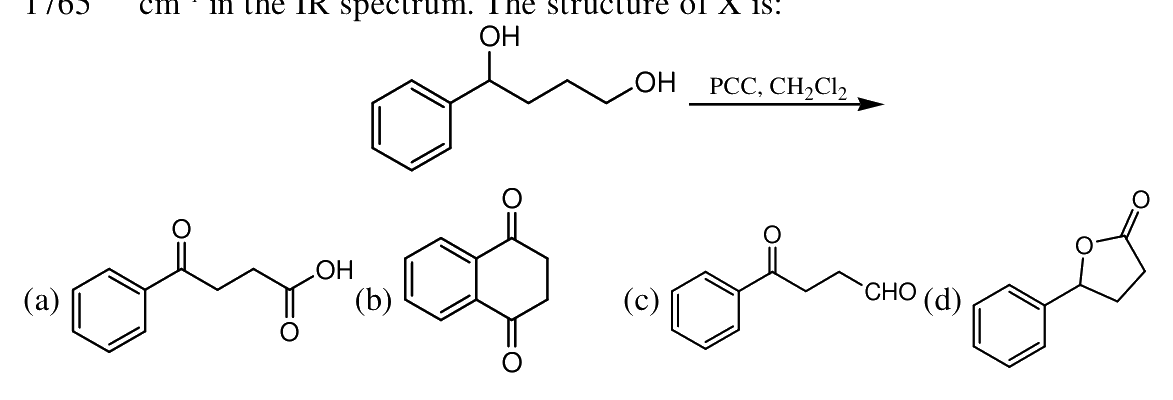
Q124 mcq
The major compound X formed in the following reaction exhibited a strong absorption at $\nu_{\max} 1765\text{ cm}^{-1}$ in the IR spectrum. The structure of X is:
Question 104 image
a.
(See image)
b.
(See image)
c.
(See image)
d.
(See image)
Correct Answer & Step-by-Step Solution Locked

Sign in free to reveal the correct answer and AI explanation for this question.

Q125 mcq
The correct order of acidity of the following compound A–C is:
Question 105 image
a.
$\text{B} > \text{C} > \text{A}$
b.
$\text{C} > \text{B} > \text{A}$
c.
$\text{A} > \text{C} > \text{B}$
d.
$\text{A} > \text{B} > \text{C}$
Correct Answer & Step-by-Step Solution Locked

Sign in free to reveal the correct answer and AI explanation for this question.

Q126 mcq
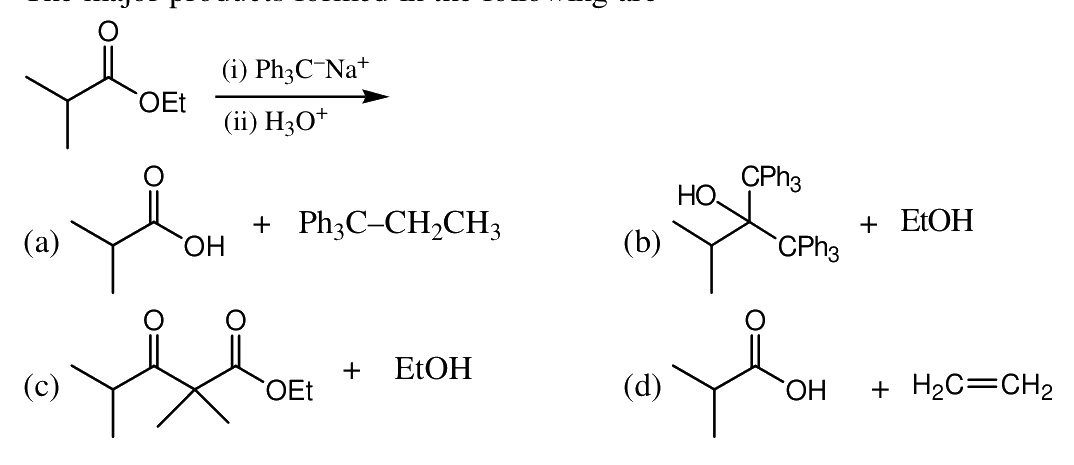
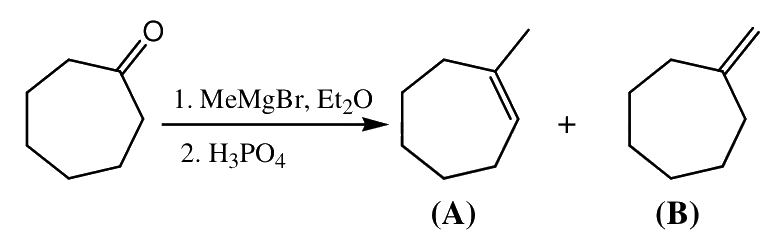
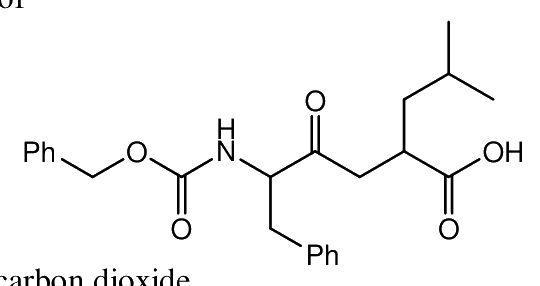
The major product formed in the reaction sequence is:
Question 106 image
Correct Answer & Step-by-Step Solution Locked

Sign in free to reveal the correct answer and AI explanation for this question.

Q127 mcq
For the following allylic oxidation reaction, the appropriate statement, among the choices given below, is:
Question 107 image
a.
Suitable reagent is $\text{KMnO}_4$ and the major product is A.
b.
Suitable reagent is $\text{KMnO}_4$ and the major product is B.
c.
Suitable reagent is $\text{SeO}_2$ and the major product is A.
d.
Suitable reagent is $\text{SeO}_2$ and the major product is B.
Correct Answer & Step-by-Step Solution Locked

Sign in free to reveal the correct answer and AI explanation for this question.

Q128 mcq
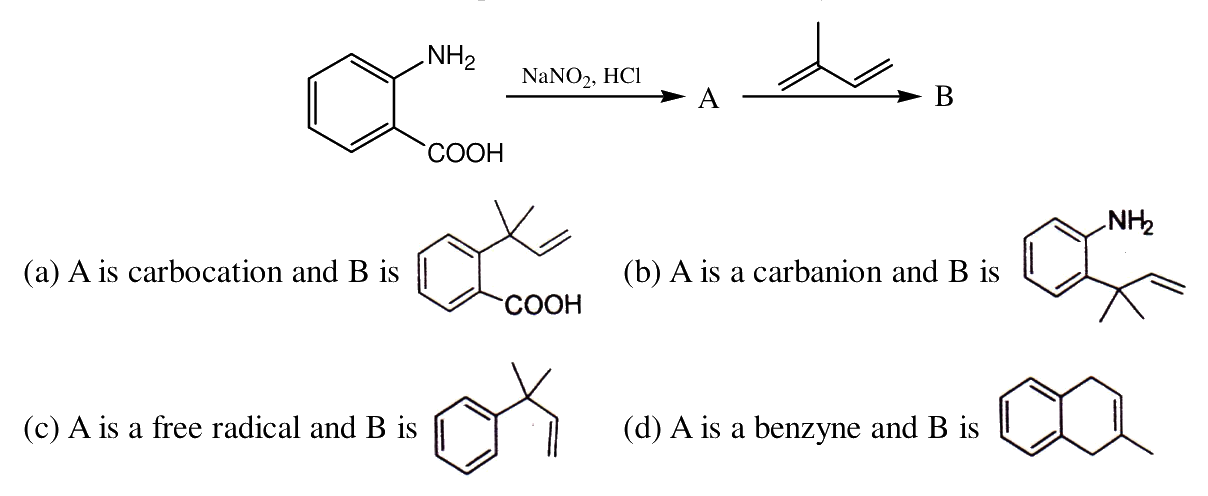
The intermediate A and the major product B in the following conversion are
Question 108 image
a.
A is carbocation and B is
b.
A is a carbanion and B is
c.
A is a free radical and B is
d.
A is a benzyne and B is
Correct Answer & Step-by-Step Solution Locked

Sign in free to reveal the correct answer and AI explanation for this question.

Q129 mcq
The major product formed in the following reaction is:
Question 109 image
Correct Answer & Step-by-Step Solution Locked

Sign in free to reveal the correct answer and AI explanation for this question.

Q130 mcq
The major product formed in the following reaction is:
Question 110 image
Correct Answer & Step-by-Step Solution Locked

Sign in free to reveal the correct answer and AI explanation for this question.

Q131 mcq
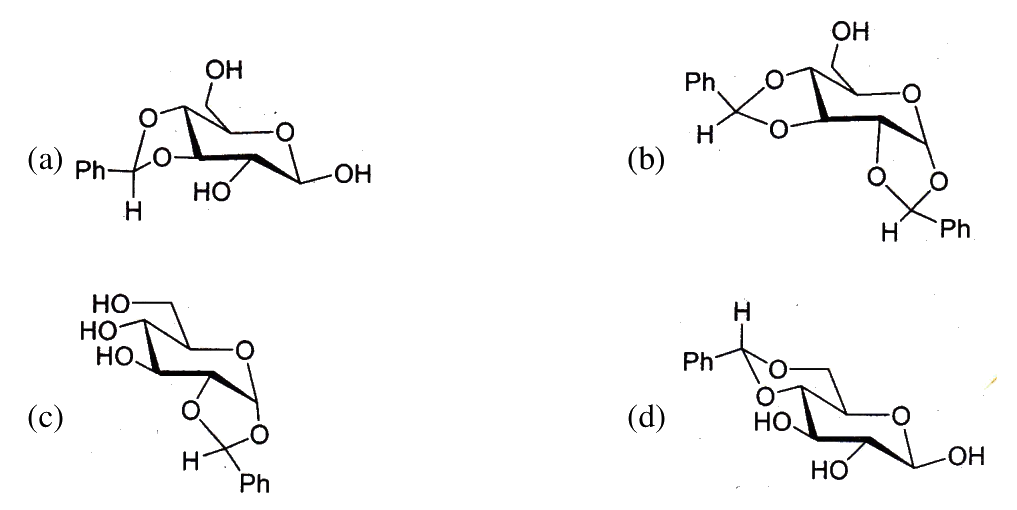
The major product formed in the reaction of glucose with benzaldehyde and p-TSA is:
Question 111 image
Correct Answer & Step-by-Step Solution Locked

Sign in free to reveal the correct answer and AI explanation for this question.

Q132 mcq
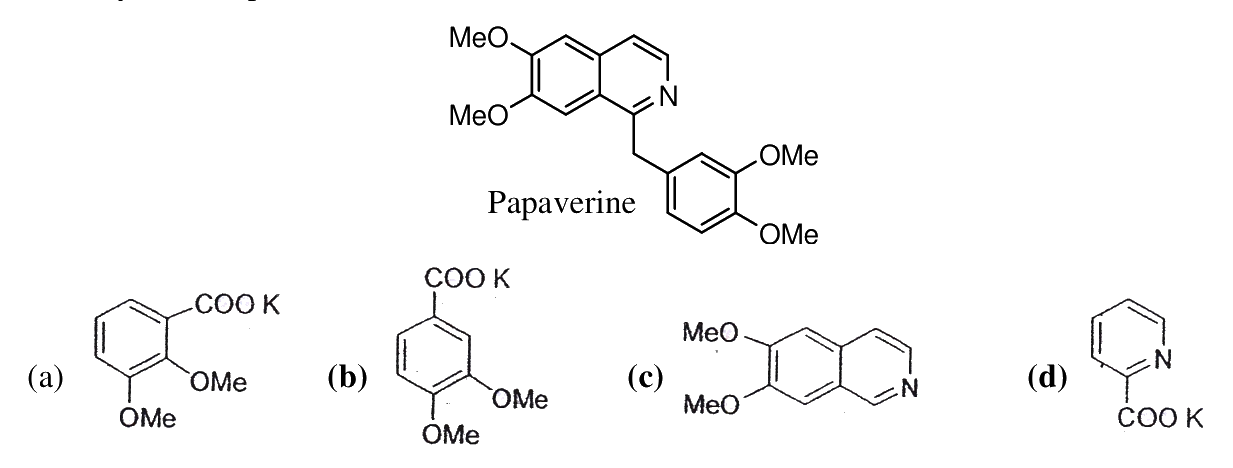
Papaverine on oxidation with potassium permanganate gives a ketone, which on fusion with potassium hydroxide gives
Question 112 image
Correct Answer & Step-by-Step Solution Locked

Sign in free to reveal the correct answer and AI explanation for this question.

Q133 mcq
The major product formed on nitration ($\text{HNO}_3/\text{H}_2\text{SO}_4$) of uridine followed by reduction with tin and $\text{HCl}$ is:
Question 113 image
Correct Answer & Step-by-Step Solution Locked

Sign in free to reveal the correct answer and AI explanation for this question.

Q134 mcq
In the following reaction sequence, the correct structures for the major products X and Y are
Question 114 image
Correct Answer & Step-by-Step Solution Locked

Sign in free to reveal the correct answer and AI explanation for this question.

Q135 mcq
The major product formed in the following reaction is:
Question 115 image
Correct Answer & Step-by-Step Solution Locked

Sign in free to reveal the correct answer and AI explanation for this question.

Q136 mcq
Match the following: **Column I** (A) (B) (C) **Column II** (i) Chiral centre (ii) Chiral axis (iii) Chiral plane (iv) Helical chirality
Question 116 image
a.
(A)-iii, (B)-ii, (C)-iv
b.
(A)-iv, (B)-iii, (C)-ii
c.
(A)-ii, (B)-iv, (C)-iii
d.
(A)-ii, (B)-iii, (C)-iv
Correct Answer & Step-by-Step Solution Locked

Sign in free to reveal the correct answer and AI explanation for this question.

Q137 mcq
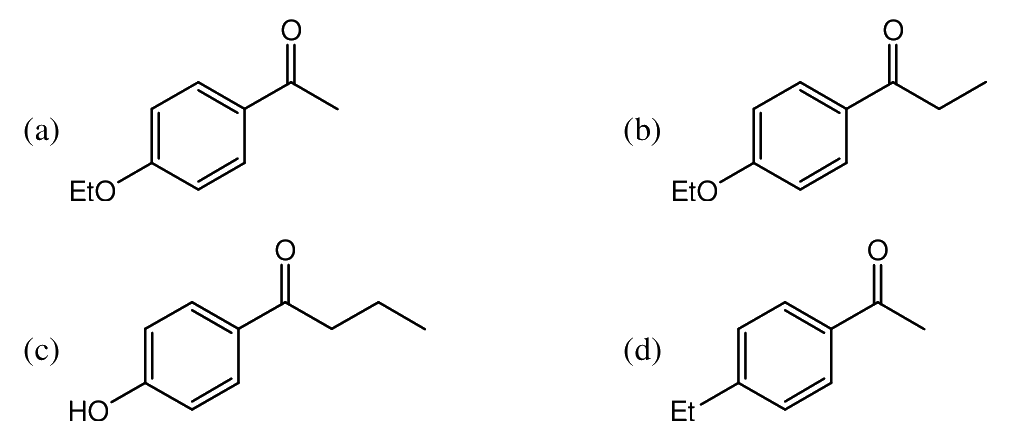
The gauche interaction values for Me/Me, Me/Br and Br/Br are 3.3, 0.8 and 3.0 kJ/mol, respectively. Among the following, the most stable conformation of 2, 3-dibromobutane is:
Question 117 image
Correct Answer & Step-by-Step Solution Locked

Sign in free to reveal the correct answer and AI explanation for this question.

Q138 mcq
The major product formed in the reaction of (S)-1, 2, 4-butanetriol with 3-pentanone in the presence of a catalytic amount of p-TSA is:
Question 118 image
Correct Answer & Step-by-Step Solution Locked

Sign in free to reveal the correct answer and AI explanation for this question.

Q139 mcq
The major product formed in the following reaction is:
Question 119 image
Correct Answer & Step-by-Step Solution Locked

Sign in free to reveal the correct answer and AI explanation for this question.

Q140 mcq
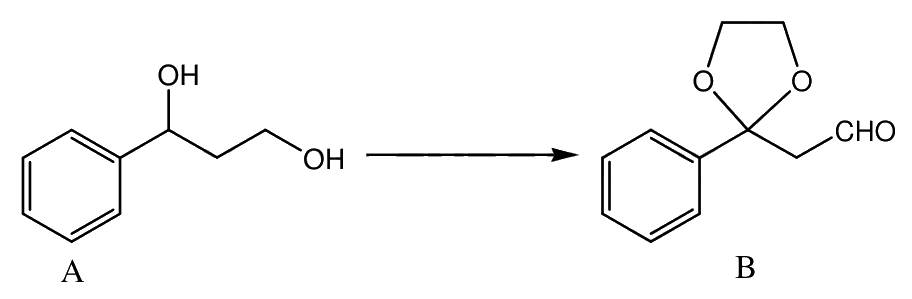
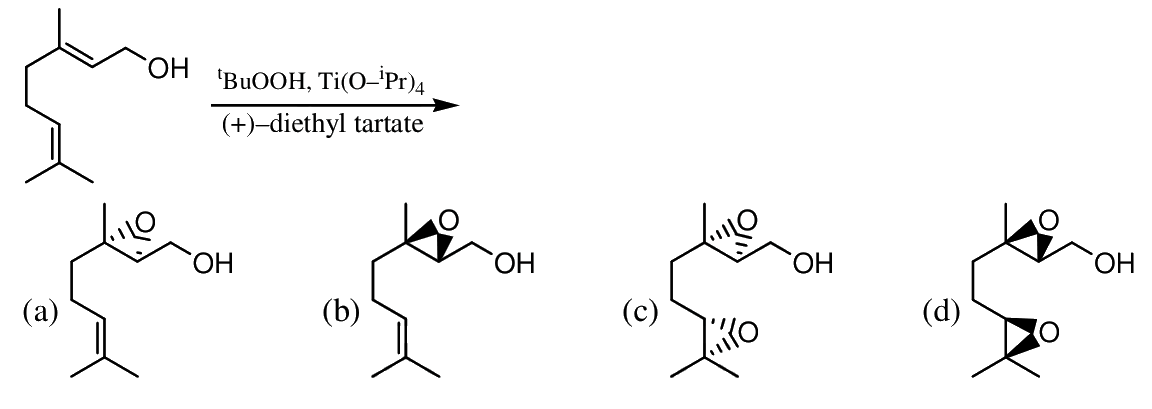
The major product formed in the following transformation is:
Question 120 image
Correct Answer & Step-by-Step Solution Locked

Sign in free to reveal the correct answer and AI explanation for this question.

Q141 mcq
The major product formed in the following transformation is:
Question 121 image
Correct Answer & Step-by-Step Solution Locked

Sign in free to reveal the correct answer and AI explanation for this question.

Q142 mcq
The structures of the major products X and Y in the following transformation are
Question 122 image
Correct Answer & Step-by-Step Solution Locked

Sign in free to reveal the correct answer and AI explanation for this question.

Q143 mcq
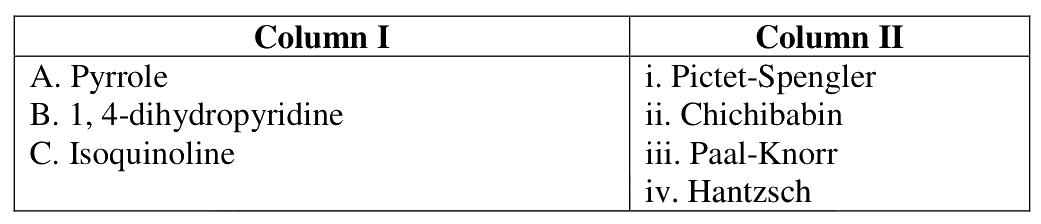
Match the following: \begin{tabular}{|l|l|} \hline \textbf{Column I} & \textbf{Column II} \\ \hline A. Pyrrole & i. Pictet-Spengler \\ B. 1, 4-dihydropyridine & ii. Chichibabin \\ C. Isoquinoline & iii. Paal-Knorr \\ & iv. Hantzsch \\ \hline \end{tabular}
Question 123 image
a.
(A)-i (B)-ii (C)-iii
b.
(A)-ii (B)-iii (C)-iv
c.
(A)-iv (B)-i (C)-ii
d.
(A)-iii (B)-iv (C)-i
Correct Answer & Step-by-Step Solution Locked

Sign in free to reveal the correct answer and AI explanation for this question.

Q144 mcq
Consider the following reaction: In an experiment, 1.99 g of bromide A on reaction with ethanolic potassium hydroxide gave 1.062 g of a mixture of the olefins B and C. If the ratio of olefins B:C formed is 2:1, the yields for their formation, respectively, are
Question 124 image
a.
60 and 30%
b.
50 and 25%
c.
66 and 33%
d.
54 and 27%
Correct Answer & Step-by-Step Solution Locked

Sign in free to reveal the correct answer and AI explanation for this question.

Q145 mcq
An organic compound A ($\text{C}_8\text{H}_{16}\text{O}_2$) on treatment with an excess of methylmagnesium chloride generated two alcohols B and C, whereas reaction of A with lithium aluminium hydride generated only a single alcohol C. Compound B on treatment with an acid yielded an olefin ($\text{C}_6\text{H}_{12}$), which exhibited only a singlet at $\delta\, 1.6\text{ ppm}$ in the $^1\text{H}\text{ NMR}$ spectrum. The compound A is:
Question 125 image
Correct Answer & Step-by-Step Solution Locked

Sign in free to reveal the correct answer and AI explanation for this question.